


Effects of fall and spring prescribed burning in sagebrush steppe in central Oregon
Ulev, Elena; Fryer, Janet L.; Tirmenstein, D., comps. 2008. [revised 2018]. Research Project Summary: Effects of fall and spring prescribed burning in sagebrush steppe in central Oregon. In: Fire Effects Information System, [Online]. U.S. Department of Agriculture, Forest Service, Rocky Mountain Research Station, Fire Sciences Laboratory (Producer). Available: https://research.fs.usda.gov/feis/fire-studies/sapsis-and-kauffman-2018

Sources
Unless otherwise indicated, the information in this Research Project Summary comes from the following papers:
- Sapsis, David B. 1990. Ecological effects of spring and fall prescribed burning on basin big sagebrush/Idaho fescue--bluebunch wheatgrass communities. Corvallis, OR: Oregon State University. 105 p. Thesis. [2].
- Sapsis, David B.; Kauffman, J. Boone. 1991. Fuel consumption and fire behavior associated with prescribed fires in sagebrush ecosystems. Northwest Science. 65(4): 173-179. [3].
Species Included in this Summary
Common names are used throughout this summary. For a complete list of the common and scientific names of species mentioned in this summary see table A1.
Revisions
On 30 March 2018, information from the Fire Case Study in the western juniper Species Review in FEIS was added to this Research Project Summary.
The study was conducted on the Sheep Rock Unit of the John Day Fossil Beds National Monument in central Oregon [2,3]. The site is approximately 5 miles (10 km) west of Dayville, Oregon [2].
Site Description
- Aspect: north
- Slope: 20%-60%
- Elevation: 2,297-2,625 feet (700-860 m)
- Soils: very stony, clay-loams on moderately deep, well-drained slopes
- Annual precipitation: 10-14 inches (250-360 mm); mean of 11 inches (290 mm) at a weather station about 1 mile (2 km) from the study site [2,3]

Sheep Rock Unit of the John Day Fossil Beds National Monument.
Plant Community
The prefire plant community was a steppe community dominated by basin big sagebrush in the overstory and bluebunch wheatgrass-Idaho fescue in the understory. Dominant forbs included common yarrow and basalt milkvetch. Western juniper grew as scattered individuals, many of which were seedlings.
Study sites are classified in the plant community shown in the LANDFIRE Biophysical Settings section and probably historically experienced the fire regime described there.

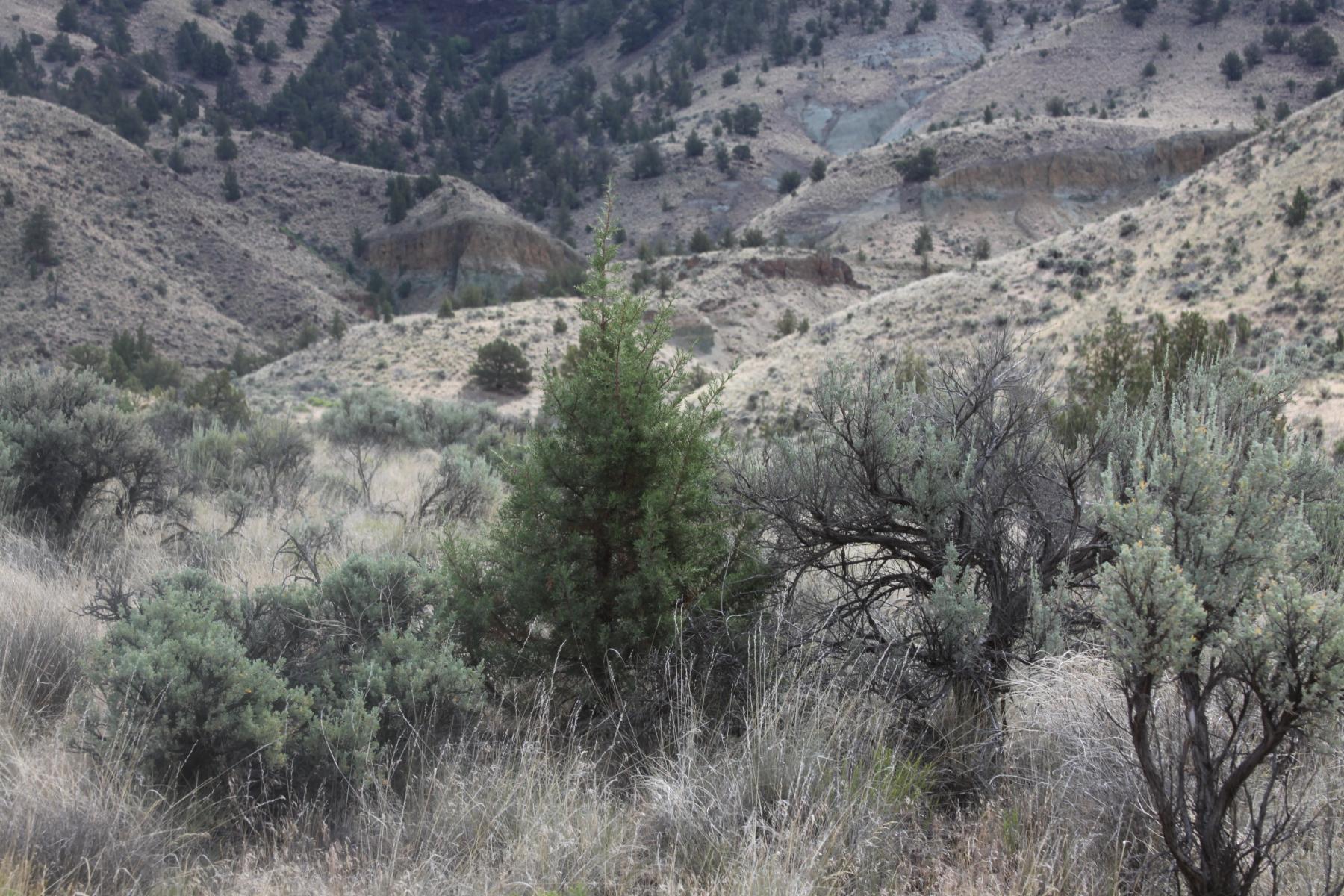
A western juniper seedling that established beneath a basin big sagebrush canopy in the Sheep Rock Unit, John Day Fossil Beds National Monument.
Fuels
Fuels were partitioned into the following categories [1,2]:
- 1-hour timelag: live and dead forbs and grasses, and woody debris from 0 to 0.25 inch (0-0.63 cm) DBH
- 10-hour timelag: woody debris 0.25 to 1.00 inch (0.63-2.54 cm) DBH
- 100-hour timelag: woody debris >1 inch (2.54 cm) DBH
The prefire biomass of herbaceous fuels in both burn units exceeded minimum threshold values needed for fire spread. Total prefire aboveground biomass was significantly higher in fall- than in spring-burned plots, and moisture content of soil and vegetation was generally higher in spring- than fall-burned plots [2,3] (table 2).
| Fuel variable | Fire treatment | |
|---|---|---|
| Fall | Spring | |
| Prefire aboveground biomass (Mg/ha) | ||
| Standing live basin big sagebrush | 4.11 | 1.67a |
| Canopy cover of basin big sagebrush (%) | 15 | 7.5 |
| Standing dead basin big sagebrush | 1.96 | 1.26a |
| Grass/forbs | 3.01 | 2.67a |
| 1-hour timelag | 1.80 | 0.86a |
| 10-hour timelag | 2.22 | 1.03a |
| 100-hour timelag | 2.72 | 1.35a |
| Total aboveground biomass | 10.59 | 6.23 |
| Moisture content (%) | ||
| Soil surface | 2.90 | 3.21 |
| Dead grass/forbs | 8.88 | 7.36 |
| Live grass | not sampled due to lack of vegetation | 142.60 |
| Sagebrush foliage | 97.19 | 186.02a |
| 10-hour timelag | 4.59 | 4.99 |
| a Within rows, significant difference between treatments (P < 0.05). | ||
Plant Phenology
Phenology of the vegetation before the fall and spring fires was not provided, but vegetation was likely actively growing before the spring fire and beginning to senesce at the time of the fall fire.
Fire Season/Intensity Classification
- Fall (9/25/1987), moderate to high intensity
- Spring (5/24/1988), low intensity
Fire Description
The research objective was to examine the effects of fall and spring burning in a basin big sagebrush/Idaho fescue-bluebunch wheatgrass plant community, including fuel consumption and plant species' responses to fire treatments, and to reduce western juniper density [2,3].
Prefire data for the fall fire were collected in July and August 1987, and fall burning was conducted on 25 September 1987. Postfire data for the fall fire were collected in May and June 1988 (postfire year 1) and June and July 1989 (postfire year 2). For the spring prescribed fire, prefire data were collected in April and May 1988, and spring burning was conducted on 24 May 1988. Postfire data for the spring fire were collected in June and July 1989 (postfire year 1); data were not collected for the spring fire in postfire year 2. Each burn unit was 30 × 50 m in area [2,3].
Both burns were ignited with drip torches using a strip-head firing pattern. Overall, pretreatment fuel loads ranged from 22.3 to 53.5 tons/acre (5-12 Mg/ha). Fuel loads averaged 46.8 tons/acre (10.5 Mg/ha) in fall treatment units and 27.8 tons/acre (6.2 Mg/ha) in spring treatment units. Large amounts of herbaceous fuels (>13.4 tons/acre (3.0 Mg/ha)) were present on both burn units [2] (table 3).
| Variable | Fall | Spring |
|---|---|---|
| Time of burn | 9:35-13:45 | 12:35-15:26 |
| Temperature, oF (oC) | 59-64 (15-18) | 73-77 (23-25) |
| Relative humidity, % | 41-48 | 21-24 |
| Windspeed, miles/h (km/h) | 0-9.3 (0-15) | 0-10.5 (0-17) |
| Soil moisture content, % | 2.90 | 3.21 |
| Dead herbaceous moisture content, % | 8.88 | 7.36a |
| 10-hr timelag moisture content, % | 4.59 | 4.99 |
| Sagebrush foliage moisture content, % | 97.19 | 186.02a |
| Live grass moisture content, % | not applicable | 142.60 |
| a Within rows, significant difference between treatments (P < 0.05). | ||
Fire Behavior
Fine fuel moisture was higher in the fall than in the spring fire, resulting in a more intense fire and greater biomass consumption. Flame lengths of the fall fire averaged over 13 feet (4 m) compared to <6.5 feet (2 m) for the spring fire. Because fireline intensity varies exponentially with flame length, this resulted in a more than seven-fold difference in fireline intensity. Rate of spread of the flame front was six times faster in the fall fire, even though temperatures were lower and relative humidity higher in the fall than in the spring fire. Total biomass consumption was significantly greater in fall fire (93%) than in the spring fire (84%); the fall fire consumed about twice as much fuel [2] (table 4).
| Variable | Fall | Spring |
|---|---|---|
| Flame length, feet (m) | 13.58 (4.14) | 5.71 (1.74)a |
| Fireline intensity, kW/m | 6441 | 883a |
| Reaction intensity (heat release rate, kW/m2) | 2.17 | 1.12 |
| Flame depth, feet (m) | 33.96 (10.35) | 8.40 (2.56)a |
| Rate of spread, feet/s (m/s) | 5.15 (1.57) | 0.75 (0.23)a |
| Heat/area in flaming front, kJ/m2 | 3,253 | 3,935 |
| Total energy (flaming & smoldering, kJ/m2) | 18,119 | 9,267 |
| Residence time, s | 6.92 | 11.66a |
| Fuel consumption, tons/acre (Mg/ha) | 43.72 (9.80) | 23.33 (5.23)a |
| a Within rows, significant difference between treatments (P < 0.05). | ||
Fuel Consumption and Residual Fuel Loads
Fuel consumption was significantly greater on fall- than on spring-burned plots for 10-hour and 100-hour fuels as a result of higher fuel loads and lower fuel moisture. Total postfire biomass of residual fuels was not significantly different between treatments [2,3] (table 5).
| Fuel component | Treatment | |||
|---|---|---|---|---|
| Fall | Spring | |||
| Fuel consumption (Mg/ha and % consumption) | ||||
| Fine fuels | 3.64 | 95% | 2.76 | 92% |
| 1-hour timelag | 1.65 | 92% | 0.66 | 77% |
| 10-hour timelag | 1.90 | 86% | 0.54 | 52%a |
| 100-hour timelag | 2.63 | 97% | 1.27 | 94%a |
| Total biomass | 9.8 | 93% | 5.23 | 84%a |
| Residual fuel loads (Mg/ha) | ||||
| Fine fuels | 0.23 | 0.23 | ||
| 1-hour timelag | 0.15 | 0.20 | ||
| 10-hour timelag | 0.32 | 0.49 | ||
| 100-hour timelag | 0.09 | 0.08 | ||
| Total biomass | 0.79 | 1.00 | ||
| aWithin rows, significant difference between treatments (P < 0.05). | ||||
Fire Effects on Plant Community
Response of Dominant Bunchgrasses
Both bluebunch wheatgrass and Idaho fescue showed good survivorship and recovery from the fires. Postfire survivorship, abundance, growth, and production of seed-bearing culms were generally higher for bluebunch wheatgrass than for Idaho fescue [2], probably due to bluebunch wheatgrass's larger stature.
Survivorship
Bluebunch wheatgrass showed higher survivorship than Idaho fescue after the fall prescribed fire. Survival of both species was greater after spring than fall fires, likely due to their higher moisture contents in spring. Most individuals killed by fall fires were located near basin big sagebrush plants [2] (table 6).
| Species | Treatment | ||
|---|---|---|---|
| Mortality after fall Rx fire | Mortality after spring Rx fire | Control | |
| Bluebunch wheatgrass | 5.2a | 4.4b | 0b |
| Idaho fescue | 20.1a | 3.5b | 0.7b |
| aWithin rows, significant difference between treatments (P < 0.10). | |||
Density
Mean density of bluebunch wheatgrass was relatively constant across treatments. Density of Idaho fescue was greater on fall-burned plots compared to control plots throughout the study period [2] (table 7).
| Year | Treatment | ||
|---|---|---|---|
| Fall | Spring | Control | |
| Bluebunch wheatgrass | |||
| Prefire | 2.2 | 3.3 | 1.8 |
| Postfire year 1 | 2.2 | 3.8 | 1.8 |
| Postfire year 2 | 1.9 | ND* | 2.0 |
| Idaho fescue | |||
| Prefire | 18.8a | 3.2 | 1.7 |
| Postfire year 1 | 17.3a | 2.2 | 1.5 |
| Postfire year 2 | 17.3a | ND | 1.2 |
| *ND indicates no data were collected. a Within rows, significant difference between fire treatment and control (P<0.1). | |||
Basal cover of bluebunch wheatgrass increased after the fire on fall-burned plots, but did not increase on spring-burned plots or control plots. Basal cover of Idaho fescue was relatively stable across time on burned and control plots [2] (table 8).
| Sample timing | Treatment | ||
|---|---|---|---|
| Fall | Spring | Control | |
| Bluebunch wheatgrass | |||
| Prefire | 198.5a | 161.2 | 189.3 |
| Postfire year 1 | 214.7ab1 | 148.9 | 153.6 |
| Postfire year 2 | 271.2b1 | ND* | 171.8 |
| Idaho fescue | |||
| Prefire | 60.9 | 40.5 | 66.1 |
| Postfire year 1 | 46.9 | 45.6 | 56.8 |
| Postfire year 2 | 54.8 | ND | 48.6 |
| *ND indicates no data were collected. Within rows, different superscripted letters denote a significant difference between years within treatments; a superscripted number denotes a significant difference between treatment and control within a year (P<0.1). | |||
Mean basal area of bluebunch wheatgrass increased by 36% from prefire levels to postfire year 2 after fire prescribed fire; the decrease observed after spring prescribed fire was not significant. Idaho fescue showed decreases after fall and spring fires, but none were significant [2] (table 9).
| Sample timing | Treatment | ||
|---|---|---|---|
| Fall | Spring | Control | |
| Bluebunch wheatgrass | |||
| Prefire | 198.5a | ND* | 189.3 |
| Postfire year 1 | 214.7ab1 | 161.2 | 153.6 |
| Postfire year 2 | 271.2b1 | 148.9 | 171.8 |
| Idaho fescue | |||
| Prefire | 60.9 | ND | 66.1 |
| Postfire year 1 | 46.9 | 40.5 | 56.8 |
| Postfire year 2 | 54.8 | 45.6 | 48.6 |
| *ND indicates no data were collected. Within columns, different superscripted letters denote a significant difference between years within treatments. A superscripted number denotes a significant difference between treatment and control within years (P < 0.1). | |||
Growth and Reproduction
Fire effects were variable for height and flowering culm production for both bluebunch wheatgrass and Idaho fescue. Mean maximum height of bluebunch wheatgrass and Idaho fescue on fall burns significantly decreased from prefire levels in postfire year 1 but significantly increased between postfire year 1 and postfire year 2. By postfire year 2, mean number of flowering culms had significantly increased on fall-burned compared to prefire and control plots for bluebunch wheatgrass but had decreased for Idaho fescue. Spring burning decreased maximum height of bluebunch wheatgrass compared to prefire and control plots, but spring burning did not significantly change the number of bluebunch wheatgrass's flowering culms compared to prefire numbers. For Idaho fescue, spring burning significantly increased the mean number of flowering culms and maximum plant height compared to the number of culms and maximum plant height on prefire and control plots [2] (table 10).
| Sample timing | Treatment | |||||
|---|---|---|---|---|---|---|
| Fall | Spring | Control | ||||
| height | number | height | number | height | number | |
| Bluebunch wheatgrass | ||||||
| Prefire | 67.1a | 33.6a | 64.8a | 17.1 | 70.0a | 4.6a |
| Postfire year 1 | 59.5b | 11.6b1 | 59.6b1 | 16.7 | 63.8b | 28.1b |
| Postfire year 2 | 83.1c1 | 58.7c1 | ND* | ND | 73.4a | 22.6c |
| Idaho fescue | ||||||
| Prefire | 42.7a | 17.7a | 19.4a | 0.0a | 39.6a | 22.4a |
| Postfire year 1 | 14.7b1 | 0.0b | 26.2b1 | 2.3b1 | 18.3b | 0.0b |
| Postfire year 2 | 36.8a | 11.1c1 | ND | ND | 39.0a | 6.9c |
| *ND indicates no data were collected. Within columns, different superscripted letters denote a significant difference between years within treatments. A superscripted number denotes a significant difference between treatment and control within years (P < 0.1). | ||||||
Response of Annual Grasses, Forbs, and Woody Species
Plant species diversity increased in the sagebrush steppe community on both fall-and spring-burned plots compared to prefire levels. The prescribed fires generally increased annual forb abundance and decreased abundance of annual grasses and woody species. Fall fires in particular stimulated growth of bluebunch wheatgrass, but they temporarily reduced the size and abundance of Idaho fescue plants [2].
Density
Prescribed burning generally reduced the density of annual grasses compared to prefire densities. The exception was small sixweeks grass, which increased the year after fall fire but returned to prefire density in postfire year 2. Both fall and spring burning caused high mortality of basin big sagebrush, broom snakeweed, and western juniper, the only tree on study plots. Fire had no significant effect on green rabbitbrush density [2] (table 11).
| Species | Treatment | |||||||
|---|---|---|---|---|---|---|---|---|
| Fall | Spring | Control | ||||||
| 1987 (prefire) | 1988 (postfire yr 1) | 1989 (postfire yr 2) | 1988 (prefire) | 1989 (postfire yr 1) | 1978 | 1988 | 1989 | |
| Annual grasses | ||||||||
| rattlesnake brome | 23 | 0 | 2 | 3.0 | 0 | 13 | 0 | 0 |
| soft brome | 82a | 10b | 0b | 37a | 0b | 160a | 0b | 0b |
| cheatgrass | 446a | 43b | 169b | 552 | 85b | 524 | 662 | 476 |
| small sixweeks grass | 1.9 | 11 | 1.9 | 0 | 0 | 0 | 0 | 0 |
| Shrubs | ||||||||
| basin big sagebrush | 3,033a | 0b | 0b | 987 | 133 | 1,334 | 1,334 | 1,334 |
| shadscale | 133 | 0 | 0 | 0 | 0 | 667 | 667 | 667 |
| green rabbitbrush | 33 | 33 | 33 | 240 | 240 | 44 | 44 | 44 |
| broom snakeweed | 500 | 0 | 0 | 400 | 112 | 889 | 1,121 | 946 |
| Tree | ||||||||
| western juniper | 456 | 0 | 0 | 369 | 0 | 733 | 733 | 1,040 |
| Within treatments, different superscripted letters denote a significant difference between years (P < 0.10). | ||||||||
Frequency
Out of a total of 59 plant species, relatively few showed changes in frequency compared to prefire levels. In 12- × 24-inch (30 × 60 cm) quadrats sampled for species presence/absence, only 10, 9, and 4 species showed significant changes in frequency after fall fire, spring fire, and control treatments, respectively. Both fall and spring burning caused a short-term reduction in cheatgrass, but cheatgrass returned to prefire levels by the second postfire year on the fall burn. Sagebrush Mariposa lily frequency increased greatly following fall burning. Western yarrow and basin big sagebrush increased greatly after spring burning; increases in basin big sagebrush were due mostly to germinants [2] (table 12).
| Fire timing | Species | Year | ||
|---|---|---|---|---|
| 1987 | 1988 | 1989 | ||
| Fall | Annual grasses | |||
| rattlesnake brome | 22a | 2b | 4b | |
| cheatgrass | 87a | 54b | 84a | |
| Annual forbs | ||||
| spring draba | 0a | 0a | 59b | |
| Canadian horseweed | 0a | 2a | 15b | |
| chaparral willowherb | 4a | 3a | 14b | |
| jagged chickweed | 45a | 11b | 55c | |
| threadleaf phacelia | 0a | 1a | 27b | |
| tall tumblemustard | 1a | 1a | 27b | |
| Perennial forbs | ||||
| sagebrush Mariposa lily | 2a | 3a | 20b | |
| yellow salsify | 9a | 12a | 3b | |
| Spring | Annual grasses | |||
| soft brome | *ND | 27a | 3b | |
| cheatgrass | ND | 89a | 73b | |
| Annual forbs | ||||
| jagged chickweed | ND | 33a | 72b | |
| prickly lettuce | ND | 9a | 24b | |
| Perennial forbs | ||||
| western yarrow | ND | 46a | 67b | |
| smallflower woodland-star | ND | 24a | 0b | |
| bigseed biscuitroot | ND | 15a | 1b | |
| sagebrush false dandelion | ND | 20a | 4b | |
| Shrub | ||||
| basin big sagebrush | ND | 13a | 50b | |
| Control | Annual grass | |||
| rattlesnake brome | 10a | 0b | 0b | |
| Perennial forbs | ||||
| western yarrow | 2a | 17b | 39b | |
| nineleaf biscuitroot | 0a | 17b | 1a | |
| Shrub | ||||
| basin big sagebrush | 2a | 9a | 33b | |
| *ND indicates no data were collected. Within rows, different superscripted letters denote a significant difference between years (P < 0.10). | ||||
Changes in pre- and postfire frequency are listed in table 13 [2].
| Common name | Scientific name | Response to treatment | ||
|---|---|---|---|---|
| Fall firea | Spring fireb | Controlc | ||
| Annual grasses | ||||
| rattlesnake brome | Bromus brizeformis | - - | 0 | - - |
| soft brome | Bromus hordaceus (Bromus mollis)* | 0 0 | - | 0 0 |
| cheatgrass | Bromus tectorum | - 0 | - | 0 0 |
| small sixweeks grass | Vulpia microstachys (Festuca microstachys)* | 0 0 | 0 | 0 0 |
| Perennial grasses | ||||
| squirreltail | Elymus elymoides (Sitanion hystrix)* | 0 0 | — | — |
| Idaho fescue | Festuca idahoensis | 0 0 | 0 | 0 0 |
| needle and thread | Hesperostipa comata (Stipa comata)* | 0 0 | — | — |
| prairie Junegrass | Koeleria macrantha (Koeleria cristata)* | 0 0 | — | 0 0 |
| bulbous bluegrass | Poa bulbosa | — | 0 | — |
| Kentucky bluegrass | Poa pratensis | 0 0 | 0 | 0 0 |
| Sandberg bluegrass | Poa secunda (Poa sandbergii)* | 0 0 | 0 | 0 0 |
| bluebunch wheatgrass | Pseudoroegneria spicata (Agropyron spicatum)* | 0 0 | 0 | 0 0 |
| Annual forbs | ||||
| pale madwort | Alyssum alysoides | 0 0 | 0 | 0 0 |
| bristly fiddleneck | Amsinckia tessellata | — | 0 | — |
| rough eyelashweed | Blepharipappus scaber | — | 0 | — |
| sticky chickweed | Cerastium glomeratum (C. viscosum)* | 0 0 | 0 | 0 0 |
| thyme-leaf sandmat | Chamaesyce serpyllifolia (Euphorbia serpyllifolia)* | 0 0 | 0 | — |
| lambsquarters | Chenopodium album | 0 0 | — | — |
| miner's-lettuce | Claytonia perfoliata (Montia perfoliata)* | 0 0 | — | — |
| Canadian horseweed | Conyza canadensis | 0 + | 0 | — |
| maiden blue-eyed Mary | Collinsia parviflora | 0 | — | |
| pinnate tansymustard | Descurainia pinnata | 0 0 | — | — |
| spring draba | Draba verna | 0 + | 0 | 0 0 |
| chaparral willowherb | Epilobium minutum | 0 + | 0 | 0 0 |
| redstem stork's bill | Erodium cicutarium | — | — | — |
| stickywilly | Galium aparine | 0 0 | 0 | — |
| common sunflower | Helianthus annuus | 0 0 | 0 | — |
| jagged chickweed | Holosteum umbellatum | + + | + | 0 0 |
| branched lagophylla | Lagophylla ramosissima | 0 0 | — | 0 0 |
| clasping pepperweed | Lepidium perfoliatum | 0 0 | 0 | 0 0 |
| threadleaf phacelia | Phacelia linearis | 0 + | 0 | 0 0 |
| longhorn plectritis | Plectritis macrocera | 0 0 | 0 | 0 0 |
| tall tumblemustard | Sisymbium altissimum | 0 + | 0 | 0 0 |
| common dandelion | Taraxacum officinale | — | — | — |
| Perennial forbs | ||||
| common yarrow | Achillea millefolium | 0 0 | + | + + |
| low pussytoes | Antennaria dimorpha | 0 0 | 0 | 0 0 |
| basalt milkvetch | Astragalus filipes | 0 0 | 0 | 0 0 |
| woollypod milkvetch | Astragalus purshii | — | 0 | — |
| sagebrush mariposa lily | Calochortus macrocarpus | 0 + | 0 | — |
| heart-podded hoary cress | Cardaria draba | 0 0 | 0 | — |
| bull thistle | Cirsium vulgare | — | 0 | — |
| largeflower hawksbeard | Crepis occidentalis | — | 0 | 0 0 |
| threadleaf fleabane | Erigeron filifolius | 0 0 | — | 0 0 |
| desert yellow fleabane | Erigeron linearis | 0 0 | 0 | — |
| shaggy fleabane | Erigeron pumilus | 0 0 | 0 | — |
| Blue Mountain buckwheat | Eriogonum strictum | 0 0 | 0 | — |
| prickly lettuce | Lactuca serriola | 0 0 | + | 0 0 |
| smallflower woodland-star | Lithophragma parviflorum | — | - | — |
| bigseed biscuitroot | Lomatium macrocarpum | 0 0 | - | 0 0 |
| nineleaf biscuitroot | Lomatium triternatum | 0 0 | 0 | + 0 |
| sagebrush false dandelion | Nothocalais troximoides (Microseris troximoides)* | 0 0 | - | 0 0 |
| silverleaf phacelia | Phacelia hastata | — | 0 | — |
| woolly groundsel | Packera cana (Senecio canus)* | 0 0 | 0 | 0 0 |
| spearleaf stonecrop | Sedum lanceolatum | 0 0 | 0 | 0 0 |
| Munro's globemallow | Sphaeralcea munroana | 0 0 | — | — |
| common mullein | Verbascum thapsus | — | 0 | — |
| Shrubs | ||||
| basin big sagebrush | Artemisia tridentata subsp. tridentata | 0 0 | + | 0 + |
| shadscale saltbush | Atriplex confertifolia | 0 0 | — | 0 0 |
| green rabbitbrush | Chrysothamnus viscidiflorus | 0 0 | — | — |
| broom snakeweed | Gutierrezia sarothrae | 0 0 | 0 | 0 0 |
| Tree | ||||
| western juniper | Juniperus occidentalis | 0 0 | — | 0 0 |
| *For species that have undergone scientific name changes, scientific names in parentheses are those used in the research papers. a1st value is for postfire year 1 (1988) relative to prefire (1987); 2nd value is for postfire year 2 (1989). bRelative to prefire (1988). c1st value is for 1988 relative to 1987; 2nd value is for 1989 relative to 1987. | ||||
Response of western juniper: Both treatments killed all western juniper (100% reduction in density) and increased relative abundance of native herbaceous species. Western juniper density on control plots increased 40% over the study period due to seedling establishment. Western juniper seedling establishment was likely promoted by higher-than-average precipitation in 1989 [2] (table 14).
| Treatment | Density (stems/ha) | ||
|---|---|---|---|
| Year | 1987 | 1988 | 1989 |
| Fall | 456 | 0 | 0 |
| Spring | not applicable | 369 | 0 |
| Control | 733 | 733 | 1,040 |
Fire Effects on the Seed Bank
In greenhouse trials using soil and duff collected from burned and unburned plots, both fall and spring fires caused significant reductions in viable soil-stored seed populations. Plots were located in a flat area dominated by cheatgrass. Fall fire significantly reduced the number of viable cheatgrass, spring draba, and jagged chickweed seeds. Spring fire reduced the number of viable cheatgrass and redstem stork's bill seeds [2] (table 15).
| Species and season of burning | Treatment | |
|---|---|---|
| Burned | Unburned | |
| Fall | ||
| Cheatgrass | 19* | 184 |
| Spring draba | 8.2* | 95 |
| Redstem stork's bill | 0.6 | 3.8 |
| Jagged chickweed | 5.4* | 151 |
| Common dandelion | 0.2 | 1.4 |
| Spring | ||
| Cheatgrass | 4.0* | 161 |
| Spring draba | 12.8 | 67 |
| Redstem stork's bill | 4.2* | 2.0 |
| Jagged chickweed | 0 | 2.0 |
| *Significant difference between burned and unburned treatments (P < 0.05). | ||
Fire behavior and fuel consumption in basin big sagebrush plant communities differed greatly between fall and spring burning. Differences in active flaming were likely related to fuel moisture, and differences in fuel consumption and total energy released were likely related to fuel availability. Both fall and spring burning shifted plant community composition toward dominance by forbs, bluebunch wheatgrass, and Idaho fescue. Abundance all woody species except green rabbitbrush was reduced by the fires. High postfire frequency of basin big sagebrush germinants on spring-burned plots suggests that basin big sagebrush may reestablish from seed relatively quickly from the spring fire [2].
Both spring and fall fires changed stand structure and succession to dominance by native perennial grasses and forbs. However, since this 1987-1989 research project was conducted, cover of nonnative, invasive grasses—including cheatgrass, medusahead, and ventenata—has increased in John Day Fossil Beds National Monument [1], increasing continuity of fine fuels and chances of shifting the fire regime to a grass/fire cycle [4]. In order to preserve remaining big sagebrush communities, fire management at the Monument as of 2018 was focused on protecting sagebrush communities from fire. Prescribed fire is not used in big sagebrush communities in the Monument due to likely postfire increases in cover of nonnative annual grasses [1].
| Biophysical Setting | Mean Fire Interval (years) | Fire Severity Percent (%) | ||||||
|---|---|---|---|---|---|---|---|---|
| Code | Fire Regime Group | Low | Mixed | Replacement | All | Low | Mixed | Replacement |
| Series 11250 - Inter-Mountain Basins Big Sagebrush Steppe | ||||||||
| 11250_1_7_8_9_10_19 | IV-A | 59 | 59 | 0 | 0 | 100 | ||
| Summary | ||||||||
| Minimum | 59 | 59 | 0 | 0 | 100 | |||
| Maximum | 59 | 59 | 0 | 0 | 100 | |||
| Mean | 59 | 59 | 0 | 0 | 100 | |||
| Median | 59 | 59 | 0 | 0 | 100 | |||
| Percentage of fires in 3 fire severity classes, derived from LANDFIRE succession modeling. Replacement-severity fires cause >75% kill or top-kill of the upper canopy layer; mixed-severity fires cause 26%-75%; low-severity fires cause <26%. | ||||||||
| LANDFIRE. 2020. Biophysical settings models and descriptions, [Online]. Washington, DC: U.S. Department of Agriculture, Forest Service; U.S. Department of the Interior; U.S. Geological Survey; Arlington, VA: The Nature Conservancy, (Producers). Available: https://www.landfirereview.org/search.php [96496] | ||||||||
Table A1
| Common name | Scientific name |
|---|---|
| Annual grasses | |
| rattlesnake brome | Bromus briziformis |
| soft brome | Bromus hordeaceus (Bromus mollis*, annual or biennial) |
| cheatgrass | Bromus tectorum |
| small sixweeks grass | Vulpia microstachys (Festuca microstachys)* |
| medusahead | Taeniatherum caput-medusae |
| ventenata | Ventenata dubia |
| Perennial bunchgrasses | |
| bluebunch wheatgrass | Pseudoroegneria spicata (Agropyron spicatum)* |
| squirreltail | Elymus elymoides (Sitanion hystrix)* |
| Idaho fescue | Festuca idahoensis |
| needle and thread | Hesperostipa comata (Stipa comata)* |
| prairie Junegrass | Koeleria macrantha (Koeleria cristata)* |
| bulbous bluegrass | Poa bulbosa |
| Kentucky bluegrass | Poa pratensis |
| Sandberg bluegrass | Poa secunda (Poa sandbergii)* |
| Annual forbs | |
| pale madwort | Alyssum alysoides |
| bristly fiddleneck | Amsinckia tessellata |
| rough eyelashweed | Blepharipappus scaber |
| sticky chickweed | Cerastium glomeratum (Cerastium viscosum)* |
| thyme-leaf sandmat | Chamaesyce serpyllifolia (Euphorbia serpyllifolia)* |
| lambsquarters | Chenopodium album |
| miner's-lettuce | Claytonia perfoliata (Montia perfoliata)* |
| maiden blue-eyed Mary | Collinsia parviflora |
| Canadian horseweed | Conyza canadensis (annual or biennial) |
| pinnate tansymustard | Descurainia pinnata |
| spring draba | Draba verna |
| chaparral willowherb | Epilobium minutum |
| redstem stork's bill | Erodium cicutarium |
| stickywilly | Galium aparine |
| common sunflower | Helianthus annuus |
| jagged chickweed | Holosteum umbellatum |
| branched lagophylla | Lagophylla ramosissima |
| clasping pepperweed | Lepidium perfoliatum (annual or biennial) |
| threadleaf phacelia | Phacelia linearis |
| longhorn plectritis | Plectritis macrocera |
| tall tumblemustard | Sisymbrium altissimum (annual or biennial) |
| yellow salsify | Tragopogon dubius (annual or biennial) |
| Perennial forbs | |
| common yarrow | Achillea millefolium |
| low pussytoes | Antennaria dimorpha |
| basalt milkvetch | Astragalus filipes |
| woollypod milkvetch | Astragalus purshii |
| sagebrush Mariposa lily | Calochortus macrocarpus |
| Canadian horseweed | Conyza canadensis (biennial or perennial) |
| prickly lettuce | Lactuca serriola (biennial or perennial) |
| smallflower woodland-star | Lithophragma parviflorum |
| bigseed biscuitroot | Lomatium macrocarpum |
| nineleaf biscuitroot | Lomatium triternatum |
| sagebrush false dandelion | Nothocalais troximoides |
| common dandelion | Taraxacum officinale |
| Shrubs | |
| basin big sagebrush | Artemisia tridentata subsp. tridentata |
| shadscale | Atriplex confertifolia |
| green rabbitbrush | Chrysothamnus viscidiflorus |
| broom snakeweed | Gutierrezia sarothrae |
| Tree | |
| western juniper | Juniperus occidentalis |
| *For species that have undergone chnages in their scientific name, the scientific names in parentheses are those used in the research papers. | |
1. Rodhouse, Thomas. 2018. [Personal communication to Janet Fryer]. 9 July. Regarding fire management and control of western juniper at John Day Fossil Beds National Monument. Kimberly, OR: U.S. Department of the Interior, National Park Service. Unpublished information on file with: U.S. Department of Agriculture, Forest Service, Rocky Mountain Research Station, Fire Sciences Laboratory, Missoula, MT; FEIS files. [9276]
2. Sapsis, David B. 1990. Ecological effects of spring and fall prescribed burning on basin big sagebrush/Idaho fescue--bluebunch wheatgrass communities. Corvallis, OR: Oregon State University. 105 p. Thesis. [16579]
3. Sapsis, David B.; Kauffman, J. Boone. 1991. Fuel consumption and fire behavior associated with prescribed fires in sagebrush ecosystems. Northwest Science. 65(4): 173-179. [16594]
4. Zouhar, Kris. 2003. Bromus tectorum. In: Fire Effects Information System, [Online]. U.S. Department of Agriculture, Forest Service, Rocky Mountain Research Station, Fire Sciences Laboratory (Producer). Available: https://research.fs.usda.gov/feis/species-reviews/brotec [92768]