


Vegetation changes following prescription fires in quaking aspen stands of Colorado's Front Range
Gucker, Corey L, comp. 2005. Research Project Summary: Vegetation changes following prescription fires in quaking aspen stands of Colorado's Front Range. In: Fire Effects Information System, [Online]. U.S. Department of Agriculture, Forest Service, Rocky Mountain Research Station, Fire Sciences Laboratory (Producer). Available: https://research.fs.usda.gov/feis/fire-studies/smith-et-al-2005
| Abbreviation | Common Name | Scientific Name | Classification | Status |
|---|---|---|---|---|
| Plants | ||||
| ACHLET | Letterman's needlegrass | Achnatherum lettermanii | Life Form: Plants/Graminoid Kingdom: Plantae Class: Monocot Order: Cyperales Family: Poaceae Genus: Achnatherum | Fed. Protected: No Nativity: Native Invasiveness: Noninvasive |
| ACHMIL | common yarrow | Achillea millefolium | Life Form: Plants/Forb Kingdom: Plantae Class: Dicot Order: Asterales Family: Asteraceae Genus: Achillea | Fed. Protected: No Nativity: Native Invasiveness: Noninvasive |
| CAMROT | bluebell bellflower | Campanula rotundifolia | Life Form: Plants Kingdom: Plantae Class: Dicot Order: Campanulales Family: Campanulaceae Genus: Campanula | Fed. Protected: No Nativity: Native Invasiveness: Noninvasive |
| FRAVIR | Virginia strawberry | Fragaria virginiana | Life Form: Plants/Forb Kingdom: Plantae Class: Dicot Order: Rosales Family: Rosaceae Genus: Fragaria | Fed. Protected: No Nativity: Native Invasiveness: Noninvasive |
| GALBOR | northern bedstraw | Galium boreale | Life Form: Plants/Forb Kingdom: Plantae Class: Dicot Order: Rubiales Family: Rubiaceae Genus: Galium | Fed. Protected: No Nativity: Native Invasiveness: Noninvasive |
| POAPRA | Kentucky bluegrass | Poa pratensis | Life Form: Plants/Graminoid Kingdom: Plantae Class: Monocot Order: Cyperales Family: Poaceae Genus: Poa | Fed. Protected: No Nativity: Nonnative Invasiveness: Invasive |
| PSEMON | false spring parsley | Pseudocymopteris montanus | Life Form: Plants/Forb Kingdom: Plantae Class: Dicot Order: Apiales Family: Apiaceae Genus: Pseudocymopterus | Fed. Protected: No Nativity: Native Invasiveness: Noninvasive |
| TAROFF | common dandelion | Taraxacum officinale | Life Form: Plants/Forb Kingdom: Plantae Class: Dicot Order: Asterales Family: Asteraceae Genus: Taraxacum | Fed. Protected: No Nativity: Nonnative Invasiveness: Invasive |
| THEDIV | spreadfruit goldenbanner | Thermopsis divaricarpa | Life Form: Plants/Forb Kingdom: Plantae Class: Dicot Order: Fabales Family: Fabaceae Genus: Thermopsis | Fed. Protected: No Nativity: Native Invasiveness: Noninvasive |
Sources
Unless otherwise indicated, the information in this Research Project Summary comes from the following papers:
- Smith, Jane K.; Laven, Richard D.; Omi, Philip N. 1985. Vegetation changes in aspen stands resulting from prescribed burning in recreation areas of the Front Range of Colorado. Final Report. Contract Nos. RM-80-112-GR and RM-81-162-GR (EC-367): Eisenhower Consortium for Western Environmental Forestry Research. 53 p. On file with: U.S. Department of Agriculture, Forest Service, Intermountain Research Station, Fire Sciences Laboratory, Missoula, MT.
- Smith, Jane Kapler; Laven, Richard D.; Omi, Philip N. 1993. Microplot sampling of fire behavior on Populus tremuloides stands in north-central Colorado. International Journal of Wildland Fire. 3(2): 85-94.
Prescription fires burned in a portion of the Roosevelt National Forest located approximately 15 km south of Red Feather Lakes, Colorado.
Site Description
Study sites occurred on south-southwest and west-northwest facing slopes of 14%. Elevation averaged 2,700 m in the area. Soils were well-drained sandy loams with granite rock underlying at depths of 25 cm. This region receives an average 380 mm of precipitation a year, and the annual temperature averages 7.8 °C [5].
This study occurs in the following vegetation classifications:
- FRES26 Lodgepole pine [2]
- SAF 217 Aspen [1]
- SAF 218 Lodgepole pine
- SRM 411 Aspen woodland [3]
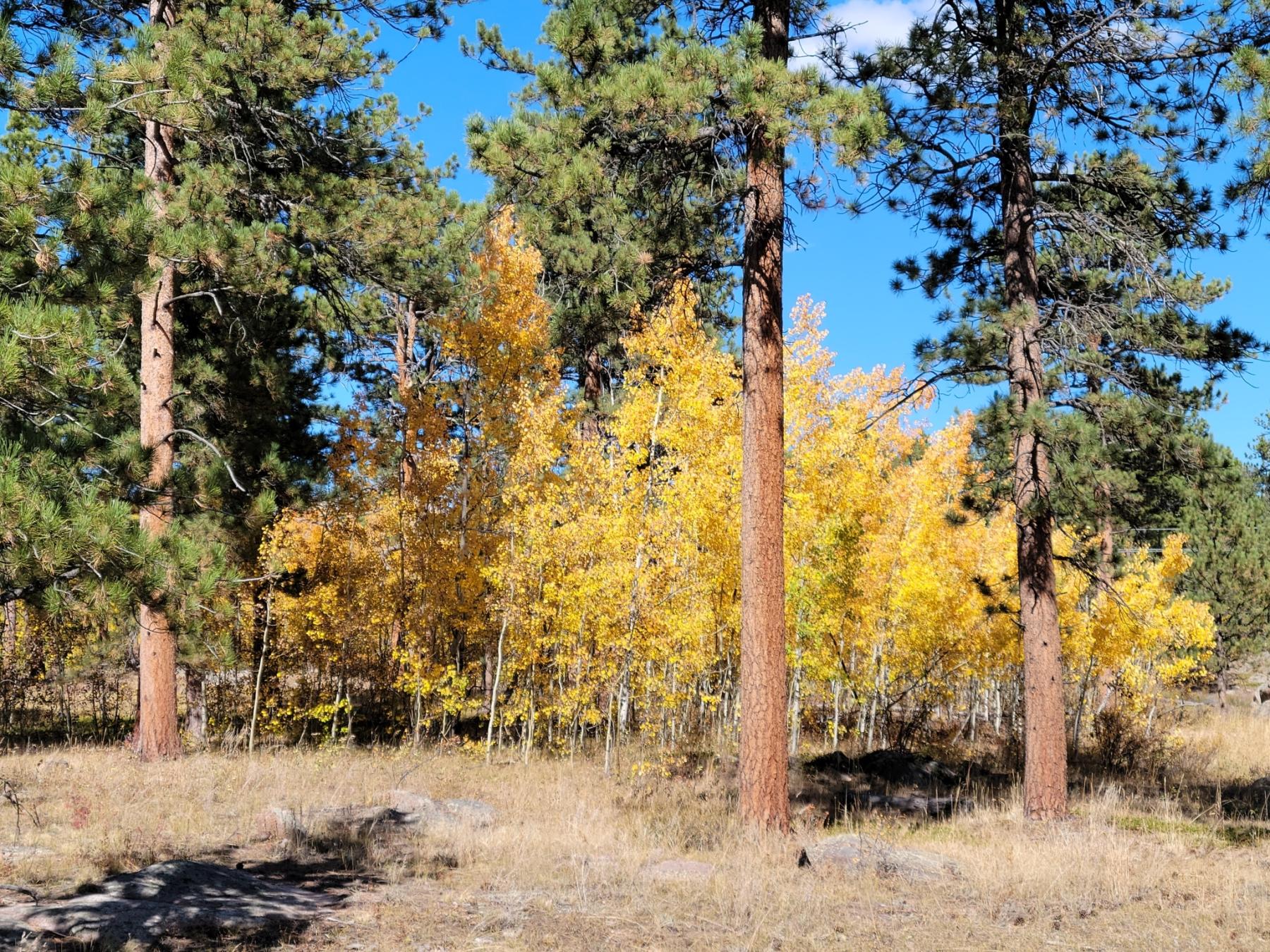
The canopy vegetation of the study site was dominated by uneven-aged quaking aspen (Populus tremuloides), but some Rocky Mountain lodgepole pine (Pinus contorta var. latifolia), limber pine (P. flexilis), and interior ponderosa pine (P. ponderosa var. scopulorum) were scattered throughout. Common juniper (Juniperus communis) clumps dominated the understory of portions of the site, while the rest of the understory was predominantly herbaceous. Dominant forbs included common yarrow (Achillea millefolium), northern bedstraw (Galium boreale), and spreadfruit goldenbanner (Thermopsis divaricarpa). Kentucky bluegrass (Poa pratensis) was the most common grass.
Plant Phenology
Quaking aspen trees had dropped their leaves, and herbaceous vegetation was dry at the time of burning.
Fire Season/Severity Classification
Fall/low severity
Two prescription fires burned in the fall of 1981; one burned on October 19 and the other on November 4.
Fire Description
The design of this study allowed the researchers to compare fire and fuel sampling procedures, characterize fire behavior, and investigate the early postfire vegetation recovery. Measurements of fuels and fire behavior were made on both microplots and macroplots to compare the efficiency of each sampling procedure [5]. Fire behavior characteristics were then studied in relation to short-term aspen regeneration and understory vegetation recovery on burned sites [4]. This summary concentrates on prefire conditions, fire behavior, and vegetation recovery. For more information regarding sampling method efficiency see Smith and others [5].
Below are the weather conditions at the time of burning. Weather characteristics were measured within 5 m of the edge of burned sites. Weather conditions were very similar during the 2 fires. Reported are the median values for nine observations made for site 1 and seven observations for site 2.
| Site | Date burned | Time of ignition (MST) | Dry-bulb temperature (° C) | Relative humidity (%) | Wind speed (km/hr) | Fuel stick analogs (% dry weight) |
|---|---|---|---|---|---|---|
| 1 | Oct. 19 | 14:35 | 12 | 26 | 4 (gusts) | 10.5 |
| 2 | Nov. 4 | 12:00 | 13 | 24 | 6 (steady) | 10.6 |
Site 1 was burned using 5- to 10-m strip fires, because initial fire spread was poor. Site 2 was burned using headfire ignition. Site 2 had significantly (p<0.05) greater fuel depth, less duff, and more fine fuels than site 1. Areas with a common juniper understory had greater fuel depth and total fuel loading than did areas with an herbaceous understory. Site 1 had significantly higher fuel moisture than site 2, and plots with a common juniper-dominated understory had higher fuel moisture than herbaceous-dominated plots.
Fuel composition also differed with understory dominance. On herbaceous plots, fine fuels were made up of approximately 1/2 litter and 1/2 dried herbaceous material. On common juniper plots, litter was 17%, dried herbaceous material was 6%, and shrub crown and branches were 77% of the fine fuels. The table below summarizes the fuel loadings and fuel moistures before burning. Data are means and 1 standard deviation.
| Site | Understory | Number of plots | Fuel depth (cm)* | Fuel load (kg/m²) | Fuel moisture (%) | ||||
|---|---|---|---|---|---|---|---|---|---|
| Duff* | Fine* | Down wood | Total | Duff* | Fine* | ||||
| 1 | herbaceous | 47 | 21±7 | 1.4±0.6 | 0.3±0.2 | 0.7±1.1 | 2.3±1.3 | 75±37 | 33±28 |
| juniper | 13 | 32±7 | 3.5±1.1 | 1±0.5 | 1.1±1.5 | 5.6±1.9 | 102±57 | 58±26 | |
| 2 | herbaceous | 24 | 29±7 | 0.9±0.3 | 0.4±0.1 | 1.3±2.5 | 2.6±2.5 | 30±23 | 23±8 |
| juniper | 6 | 46±10 | 3±1.3 | 1.5±0.5 | 1.9±2.8 | 6.4±3.9 | 60±53 | 25±5 | |
| *Fuel conditions were significantly (p<0.05) different between the 2 sites and between understory types. | |||||||||
A greater percentage of site 2 burned than site 1. The discontinuous burning of site 1 restricted analysis to only those plots that burned. Just 38 of the 60 plots in site 1 were analyzed. Areas with a common juniper understory burned almost completely regardless of site, while plots with an herbaceous understory burned much more completely on site 2 than site 1. Rate of fire spread was highly variable between plots but did not differ significantly between site or understory type. Flame length was significantly greater (p=0.0006) on common juniper plots than herbaceous plots. Fuel consumption and heat released were greater on site 2 and greater for plots with a common juniper understory [5].
Thermocouples within the burned plots indicated that temperatures changed very little below the soil surface, and lethal plant tissue temperatures, if any, were rare [4]. The following table provides the fire behavior characteristics. The sample size for observed spread rate, flame length, and flame depth was lower than the sample size for area burned. For fuel consumption and heat released, sample size was the same as that provided for area burned [5].
| Site | Understory | Area burned (%)* | Rate of spread (m/min) | Flame length (cm) | Flame depth (cm) | Fuel consumption (kg/m²)* | Total heat release (kcal/m²)* |
|---|---|---|---|---|---|---|---|
| 1 | herbaceous | 32 (n=26) | 0.9±0.8 | 13 | 8 | 0.6±0.5 | 2,345±1,953 |
| juniper | 89 (n=12) | 2.8±1.7 | 86 | 45 | 2±1 | 8,300±4,326 | |
| 2 | herbaceous | 97 (n=24) | 1.6±1.1 | 25 | 18 | 1.2±0.7 | 5,037±2,640 |
| juniper | 100 (n=6) | 0.4 | 62 | 44 | 3.3±0.8 | 14,021±3,420 | |
| *Fuel conditions were significantly (p<0.05) different between the 2 sites and between understory types. | |||||||
One year following the fires irradiance and soil moisture were greater on burned plots than unburned plots. These variables were also greater on burned sites with a common juniper understory versus those with an herbaceous understory. Soil temperatures, however, were not substantially different on burned and unburned plots.
Determining the controlling factor of vegetation recovery is difficult given the confounding understory and fire behavior differences in this study. The postfire vegetation may be a result of fire behavior, inherent vegetation type differences, or a combination of these.
Following the fires, total understory vegetation density increased on both herbaceous and common juniper sites. However, increases were much greater on sites with an herbaceous understory. The researchers indicated that increased density on the common juniper sites was not significantly more than that of control plots (not shown). Species richness was relatively unchanged following fire on both sites, and fire slightly increased the frequency of rare and/or small-sized species.
| Herbaceous characteristic | Herbaceous | Common juniper | ||
|---|---|---|---|---|
| prefire (1980) | postfire (1982) | prefire (1980) | postfire (1982) | |
| Total density (number/0.1 m) | 47.7 | 107.4 | 5.5 | 10.3 |
| Species richness | 7.1 | 8.4 | 2.4 | 4.3 |
| Frequency of species with <5% cover | 3.4 | 5.9 | 1.6 | 3 |
| Frequency of species with more than 5% and less than 25% cover | 3.5 | 2 | 0.6 | 1.2 |
| Frequency of species with more than 25% and less than 50% cover | 0.2 | 0.3 | 0.1 | 0.1 |
| Frequency of species with more than 50% and less than 75% cover | 0 | 0.2 | 0 | 0 |
Fires increased the density of new quaking aspen saplings. On burned sites, the density of quaking aspen saplings increased by 6,000% in the first postfire year, while saplings greater than 1 year old decreased by 87%. Changes in quaking aspen density occurred on control plots (not shown) as well, but these changes were not significant, while changes on burned plots were. More saplings occurred on plots with a common juniper-dominated understory. Below are the densities (saplings/ha) of quaking aspen saplings before and after fire on herbaceous and common juniper sites.
| Sapling age class (year) | Herbaceous | Common juniper | Total | |||
|---|---|---|---|---|---|---|
| prefire (1980) | postfire (1982) | prefire (1980) | postfire (1982) | prefire (1980) | postfire (1982) | |
| 1 | 229 | 5,886 | 0 | 8,819 | 229 | 14,705 |
| >1 | 2971 | 457 | 648 | 19 | 3,619 | 476 |
For a more complete review of quaking aspen and common juniper responses to these fires, see the Fire Case Studies Prescribed fire behavior and quaking aspen recovery in Colorado's Front Range and Common juniper effect on a Colorado aspen burn, respectively.
The majority of the dominant herbs increased or remained unchanged following fire regardless of understory type. However, increases were often greater on herbaceous understory plots. In some cases, coverage increased while density decreased or vice versa, indicating that some species increased or decreased in size while, respectively, decreasing or increasing in number. A single species, golden corydalis (Corydalis aurea), appeared only following fire.
Common yarrow, sedge (Carex spp.), northern bedstraw, and spreadfruit goldbanner showed increased density on burned herbaceous plots. Kentucky bluegrass density tripled its prefire density on burned herbaceous plots. Bluebell bellflower (Campanula rotundifolia), Virginia strawberry (Fragaria virginiana), and northern bedstraw densities increased significantly (p<0.05) on burned common juniper sites. Letterman's needlegrass (Achnatherum lettermanii) decreased following fires on both herbaceous and common juniper plots. Researchers noted that regardless of understory type, burned area vegetation was larger and thicker on burned plots compared to unburned areas. Pre- and postfire density and cover were [4]:
| Common name | Scientific name | Herbaceous | Common juniper | |||
|---|---|---|---|---|---|---|
| prefire (1980) | postfire (1982) | prefire (1980) | postfire (1982) | |||
| Forbs | ||||||
| Common yarrow | Achillea millefolium | density¹ | 2.5 | 4.9 | 0.2 | 0.2 |
| cover² | 0.9 | 1.1 | 0.1 | 0.3 | ||
| Bluebell bellflower | Campanula rotundifolia | density | 0.4 | 1 | 0 | 0.5 |
| cover | 0.3 | 0.3 | 0 | 0.2 | ||
| Virginia strawberry | Fragaria virginiana | density | 1 | 1.1 | 0 | 0.7 |
| cover | 0.5 | 0.3 | 0 | 0.2 | ||
| Northern bedstraw | Galium boreale | density | 1.2 | 3.1 | 1.4 | 2.7 |
| cover | 0.7 | 0.5 | 0.5 | 0.9 | ||
| Alpine false springparsley | Pseudocymopterus montanus | density | 0.5 | 0.6 | 0.3 | 0.1 |
| cover | 0.4 | 0.4 | 0.1 | 0.1 | ||
| Common dandelion | Taraxacum officinale | density | 0.7 | 1.7 | 0 | 0.3 |
| cover | 0.5 | 0.5 | 0 | 0.2 | ||
| Spreadfruit goldenbanner | Thermopsis divaricarpa | density | 1.6 | 2.5 | 0.4 | 0.8 |
| cover | 1.3 | 1.4 | 0.4 | 0.7 | ||
| Graminoids | ||||||
| Letterman's needlegrass | Achnatherum lettermanii | density | 3.9 | 1.4 | 0.1 | 0 |
| cover | 0.3 | 0.2 | 0.1 | 0 | ||
| Sedges | Carex spp. | density | 8.6 | 14.4 | 0.9 | 0.5 |
| cover | 1.1 | 1 | 0.2 | 0.5 | ||
| Kentucky bluegrass | Poa pratensis | density | 19.7 | 61.7 | 0.5 | 0.4 |
| cover | 0.9 | 1.6 | 0.1 | 0.1 | ||
¹Density is the number of individuals/0.1 m² ²Coverage is a percentage | ||||||
Researchers were successful in quantifying prefire conditions and monitoring fire behavior at the time of burning. They also captured the early postfire response of the understory vegetation within quaking aspen stands that burned in behaviorally different fires. The fire within plots with a common juniper-dominated understory burned more severely than in areas with an herbaceous understory. The recovery of the understory in common juniper plots was not as rapid as that of the herbaceous plots. The substantial increase in Kentucky bluegrass on herbaceous plots and quaking aspen saplings on common juniper plots will likely affect wildlife and livestock forage selection within this area.
| Biophysical Setting | Mean Fire Interval (years) | Fire Severity Percent (%) | ||||||
|---|---|---|---|---|---|---|---|---|
| Code | Fire Regime Group | Low | Mixed | Replacement | All | Low | Mixed | Replacement |
| Series 10110 - Rocky Mountain Aspen Forest and Woodland | ||||||||
| 10110_28 | IV-B | 844 | 1732 | 145 | 116 | 14 | 7 | 79 |
| Series 10500 - Rocky Mountain Lodgepole Pine Forest | ||||||||
| 10500_16_23_28 | IV-B | 640 | 152 | 123 | 19 | 0 | 81 | |
| Summary | ||||||||
| Minimum | 640 | 1732 | 145 | 116 | 14 | 0 | 79 | |
| Maximum | 844 | 1732 | 152 | 123 | 19 | 7 | 81 | |
| Mean | 742 | 1732 | 149 | 120 | 17 | 4 | 80 | |
| Median | 742 | 1732 | 149 | 120 | 17 | 4 | 80 | |
| Percentage of fires in 3 fire severity classes, derived from LANDFIRE succession modeling. Replacement-severity fires cause >75% kill or top-kill of the upper canopy layer; mixed-severity fires cause 26%-75%; low-severity fires cause <26%. | ||||||||
| LANDFIRE. 2020. Biophysical settings models and descriptions, [Online]. Washington, DC: U.S. Department of Agriculture, Forest Service; U.S. Department of the Interior; U.S. Geological Survey; Arlington, VA: The Nature Conservancy, (Producers). Available: https://www.landfirereview.org/search.php [96496] | ||||||||
1. Eyre, F. H., ed. 1980. Forest cover types of the United States and Canada. Washington, DC: Society of American Foresters. 148 p. [905]
2. Garrison, George A.; Bjugstad, Ardell J.; Duncan, Don A.; Lewis, Mont E.; Smith, Dixie R. 1977. Vegetation and environmental features of forest and range ecosystems. Agric. Handb. 475. Washington, DC: U.S. Department of Agriculture, Forest Service. 68 p. [998]
3. Shiflet, Thomas N., ed. 1994. Rangeland cover types of the United States. Denver, CO: Society for Range Management. 152 p. [23362]
4. Smith, Jane K.; Laven, Richard D.; Omi, Philip N. 1985. Vegetation changes in aspen stands resulting from prescribed burning in recreation areas of the Front Range of Colorado. Final Report. Contract Nos. RM-80-112-GR and RM-81-162-GR (EC-367): Eisenhower Consortium for Western Environmental Forestry Research. 53 p. On file with: U.S. Department of Agriculture, Forest Service, Intermountain Research Station, Fire Sciences Laboratory, Missoula, MT. [23491]
5. Smith, Jane Kapler; Laven, Richard D.; Omi, Philip N. 1993. Microplot sampling of fire behavior on Populus tremuloides stands in north-central Colorado. International Journal of Wildland Fire. 3(2): 85-94. [21376]