


Asimina triloba, pawpaw
Sullivan, Janet. 1993. Asimina triloba, pawpaw. In: Fire Effects Information System, [Online]. U.S. Department of Agriculture, Forest Service, Rocky Mountain Research Station, Fire Sciences Laboratory (Producer). Available: https://research.fs.usda.gov/feis/species-reviews/asitri
| Abbreviation | Common Name | Scientific Name | Classification | Status |
|---|---|---|---|---|
| Plants | ||||
| ASITRI | pawpaw | Asimina triloba | Life Form: Plants/Shrub, Plants/Tree Order: Magnoliales Family: Annonaceae Genus: Asimina | Fed. Protected: No Nativity: Native Invasiveness: Noninvasive |

Taxonomy
The currently accepted scientific name for pawpaw is Asimina triloba (L.) Dunal [15,21,31]. There are no accepted subspecies, varieties or forms.
Pawpaw forms hybrids with dwarf pawpaw (A. parviflora) [21].
Synonyms
- None
Other Common Names
custard apple, dog banana, Indian banana, false-banana, pawpaw-apple, fetid-shrub

Two pawpaw saplings in the understory of a mature forest, Chautauqua County, New York. (CC BY-NC 4.0)
General Distribution
Pawpaw is widely distributed throughout the eastern United States. Its range extends from western New York west across southwestern Ontario to Michigan, Illinois, and Iowa; south to eastern Nebraska, eastern Oklahoma, and eastern Texas; east to the Appalachian Mountains and the Florida panhandle [15,21,28,31].
States and Provinces
- United States: AL AR FL GA IL IN IA KS KY LA MD MI MS MO NE NY NC OH OK PA SC TN TX VA WV
- Canada: ON
Site Characteristics
Pawpaw is found in deciduous forests, on slopes of ravines, along streams, and floodplains. Soils on which it occurs are usually deep, rich, damp, sandy, or clayey [15,28,36].
Plant Communities
Common tree associates include blackgum (Nyssa sylvatica), Ohio buckeye (Aesculus glabra), honey locust (Gleditsia triacanthus), and coffee tree (Gymnocladus dioica) [3,9].
Botanical Description

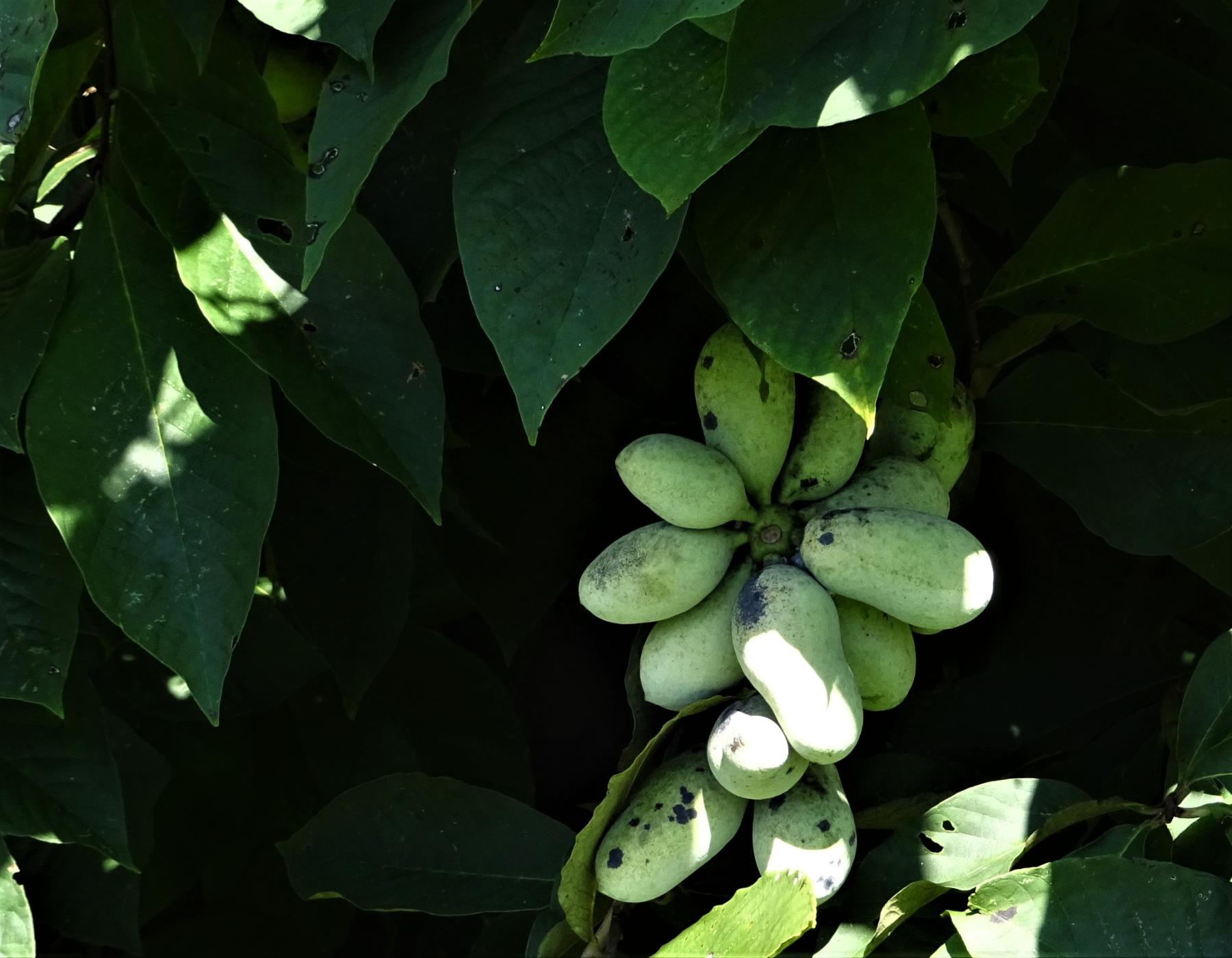
Pawpaw fruits, Westmoreland County, Virginia. (CC BY-NC 4.0)
Pawpaw is a native, deciduous, large shrub or small tree. It exhibits clonal growth, forming thickets or small colonies [15,27]. It grows from 20 to 40 feet (6-12 m) tall [2,16,31]. There is usually a single trunk [28]. The bark is thin with shallow, irregular fissures [28]. Young twigs are hairy [12]. Pawpaw leaves can be up to 1 foot (30 cm) long, and are odorous when bruised [17]. The fruit is a large berry [15,31].
Raunkiaer Life Form (Raunkiaer 1934)
- Phanerophyte
Seasonal Development
Pawpaw flowers emerge with the leaves, from February to May, depending on latitude [8,28]. Fruits ripen from July to September [17].
Regeneration Processes
Vegetative reproduction by root suckering is the most important method of pawpaw regeneration [22]. Rogstad and others [25] reported a relatively high level of genetic variation among populations, but moderate or no variation within populations. This was attributed to the formation of clonal thickets and/or inbreeding in small populations [25].
Pawpaw reproduces sexually, however, the rate of fruit set is very low (0.45 percent) compared to the number of flowers produced [33]. It is pollinated by flies or nitidulid beetles [22,32,33]. It self-pollinates, but outcrossing is more common [20]. Germination of pawpaw seeds is slow, probably due to embryo dormancy [2].
Successional Status
Facultative Seral Species
Pawpaw is tolerant of shade, but appears to die out in old-growth forests. In southwestern Pennsylvania, moderate numbers of pawpaw seedlings and saplings were found in mature second-growth forests, but none were found in undisturbed, old-growth forests [7].
From a compilation of historical records and current data on its distribution, Campbell [3] concluded that pawpaw is suited to regimes of moderate disturbance. Pawpaw is a good competitor when undisturbed for a period of time, but does not spread into either early- or late-successional forest types [3].
Immediate Fire Effects
No entry.
Postfire Regeneration Strategy (Stickney 1989)
- Tree with adventitious-bud root crown/soboliferous species root sucker
- Secondary colonizer - off-site seed
Fire Adaptations
Pawpaw is probably able to survive top-kill by fire due to its ability to produce root sprouts.
Plant Response to Fire
Pawpaw cover is probably reduced by fire. In a study to determine the effects of repeated prescribed fires on vegetation in the prairie-woodland transition zone, fires were conducted for 3 consecutive years. The vegetation was monitored for almost 20 years after the last fire was conducted. Pawpaw stems increased in number only in the absence of fire, and only after 13 years had passed since the last fire [1].
Fire Regimes
For fire regime information, search FEIS for this species by entering the species name on the Advanced Search page and selecting “Fire Regime” as the publication type.
Fire Management Considerations
No entry.
Federal Status
No special status.
Other Status
Pawpaw is considered rare and endangered in New York [4].
Importance to Wildlife and Livestock
Pawpaw fruits are consumed by many birds and mammals, including raccoons, gray foxes, opossums, squirrels, and black bears [6,8,16,31]. White-tailed deer browse pawpaw; beavers consume the bark [17].
Palatability and Nutritional Value
No entry.
Cover Value
No entry.
Value for Rehabilitation or Restoration of Disturbed Sites
No entry.
Other Uses
Pawpaw fruit can be consumed by humans, although handling the fruit may cause allergic reactions in sensitive individuals [28]. The fruits can be eaten raw, cooked in puddings or breads, or used to make ice cream [9]. It is planted for fruit production and as an ornamental [2].
An anticancer drug has been purified from pawpaw, and is being tested [34].
The seeds contain an alkaloid, asiminine, which is reported to have emetic properties. The bark also contains an alkaloid, analobine, and was once used as a medicine [31].
Pawpaw wood is light, soft, coarse-grained, and weak [28,31]. It is not of economic importance.
Other Management Considerations
Pawpaw is not valued for silviculture. Sites that have been clearcut may need to be treated to suppress pawpaw, since it may outcompete valued timber species [13]. Pawpaw creates heavy shade that reduces seedling recruitment of white oak (Quercus alba) and shagbark hickory (Carya ovata) [24,26]. In southwestern Illinois, an increase in pawpaw cover was attributed to defoliation of overstory trees by the linden looper. The pawpaw canopy suppressed seedling establishment of less tolerant species. An increase in shade-tolerant species such as sugar maple (Acer saccharum) is now occurring [24,26].
In Ohio, pawpaw did not occur on study plots until the fourth growing season following clearcutting [35].
Pawpaw leaves are not preferred by the gypsy moth [14].
Table A1— Forest and range ecosystems, Bureau of Land Management (BLM) physiographic regions, Kuchler plant associations, Society for American Foresters (SAF) forest cover types, and Society for Rangeland Management (SRM) rangeland cover types in which this species occurs.
Forest and Range Ecosystems (Garrison et al. 1977)
- FRES13 Loblolly - shortleaf pine
- FRES14 Oak - pine
- FRES15 Oak - hickory
- FRES16 Oak - gum - cypress
- FRES17 Elm - ash - cottonwood
- FRES18 Maple - beech - birch
BLM Physiographic Regions (Bernard and Brown 1977)
- No entry.
Kuchler Plant Associations (Kuchler 1964)
- K089 Black Belt
- K098 Northern floodplain forest
- K100 Oak - hickory forest
- K101 Elm - ash forest
- K102 Beech - maple forest
- K103 Mixed mesophytic forest
- K104 Appalachian oak forest
- K111 Oak - hickory - pine forest
- K112 Southern mixed forest
- K113 Southern floodplain forest
SAF Cover Types (Eyre 1980)
- 25 Sugar maple - beech - yellow birch
- 26 Sugar maple - basswood
- 27 Sugar maple
- 28 Black cherry - maple
- 39 Black ash - American elm - red maple
- 42 Bur oak
- 52 White oak - black oak - northern red oak
- 53 White oak
- 55 Northern red oak
- 57 Yellow-poplar
- 58 Yellow-poplar - eastern hemlock
- 59 Yellow-poplar - white oak - northern red oak
- 60 Beech - sugar maple
- 61 River birch - sycamore
- 62 Silver maple - American elm
- 64 Sassafras - persimmon
- 65 Pin oak - sweetgum
- 76 Shortleaf pine - oak
- 78 Virginia pine - oak
- 82 Loblolly pine - hardwood
- 87 Sweetgum - yellow-poplar
- 91 Swamp chestnut oak - cherrybark oak
- 92 Sweetgum - willow oak
- 93 Sugarberry - American elm - green ash
- 94 Sycamore - sweetgum - American elm
- 108 Red maple
SRM Rangeland Cover Types (Shiflet 1994)
- No entry
1. Anderson, Roger C.; Schwegman, John E. 1991. Twenty years of vegetational change on a southern Illinois barren. Natural Areas Journal. 11(2): 100-107. [16256]
2. Bonner, F. T.; Halls, L. K. 1974. Asimina Adans. pawpaw. In: Schopmeyer, C. S., technical coordinator. Seeds of woody plants in the United States. Agric. Handb. 450. Washington, DC: U.S. Department of Agriculture, Forest Service: 238-239. [3751]
3. Campbell, Julian J. N. 1989. Historical evidence of forest composition in the bluegrass region of Kentucky. In: Rink, George; Budelsky, Carl A., eds. Proceedings, 7th central hardwood conference; 1989 March 5-8; Carbondale, IL. Gen. Tech. Rep. NC-132. St. Paul, MN: U.S. Department of Agriculture, Forest Service, North Central Forest Experiment Station: 231-246. [9385]
4. Zika, Peter F., ed. 1990. New York rare plant status list. Latham, NY: New York Natural Heritage Program. 30 p. [18613]
5. Clewell, Andre F. 1985. Guide to the vascular plants of the Florida Panhandle. Tallahassee, FL: Florida State University Press. 605 p. [13124]
6. Daniel, Francis Leonard. 1978. The fall and winter food habits of the black bear (Ursus americanus) in the Great Dismal Swamp of Virginia. Norfolk, VA: Old Dominion University. 30 p. Thesis. [21918]
7. Downs, Julie A.; Abrams, Marc D. 1991. Composition and structure of an old-growth versus a second-growth white oak forest in southwestern Pennsylvania. In: McCormick, Larry H.; Gottschalk, Kurt W., eds. Proceedings, 8th central hardwood forest conference; 1991 March 4-6; University Park, PA. Gen. Tech. Rep. NE-148. Radnor, PA: U.S. Department of Agriculture, Forest Service, Northeastern Forest Experiment Station: 207-223. [15313]
8. Duncan, Wilbur H.; Duncan, Marion B. 1988. Trees of the southeastern United States. Athens, GA: The University of Georgia Press. 322 p. [12764]
9. Elias, Thomas S.; Dykeman, Peter A. 1982. Field guide to North American edible wild plants. [Place of publication unknown]: Outdoor Life Books. 286 p. [21103]
10. Eyre, F. H., ed. 1980. Forest cover types of the United States and Canada. Washington, DC: Society of American Foresters. 148 p. [905]
11. Garrison, George A.; Bjugstad, Ardell J.; Duncan, Don A.; [and others]. 1977. Vegetation and environmental features of forest and range ecosystems. Agric. Handb. 475. Washington, DC: U.S. Department of Agriculture, Forest Service. 68 p. [998]
12. Gleason, Henry A.; Cronquist, Arthur. 1991. Manual of vascular plants of northeastern United States and adjacent Canada. 2nd ed. New York: New York Botanical Garden. 910 p. [20329]
13. Golden, Michael S.; Loewenstein, Edward F. 1991. Regeneration of tree species 7 years after clearcutting in a river bottom in central Alabama. In: Coleman, Sandra S.; Neary, Daniel G., compilers. Proceedings, 6th biennial southern silvicultural research conference: Volume I; 1990 October 30 - November 1; Memphis, TN. Gen. Tech. Rep. SE-70. Asheville, NC: U.S. Department of Agriculture, Forest Service, Southeastern Forest Experiment Station: 76-83. [17464]
14. Gottschalk, Kurt W. 1988. Gypsy moth and regenerating Appalachian hardwood stands. In: Smith, H. Clay; Perkey, Arlyn W.; Kidd, William E., Jr., eds. Guidelines for regenerating Appalachian hardwood stands: Workshop proceedings; 1988 May 24-26; Morgantown, WV. SAF Publ. 88-03. Morgantown, WV: West Virginia University Books: 241-254. [13950]
15. Great Plains Flora Association. 1986. Flora of the Great Plains. Lawrence, KS: University Press of Kansas. 1392 p. [1603]
16. Hosie, R. C. 1969. Native trees of Canada. 7th ed. Ottawa, ON: Canadian Forestry Service, Department of Fisheries and Forestry. 380 p. [3375]
17. Hunter, Carl G. 1989. Trees, shrubs, and vines of Arkansas. Little Rock, AR: The Ozark Society Foundation. 207 p. [21266]
18. Kuchler, A. W. 1964. Manual to accompany the map of potential vegetation of the conterminous United States. Special Publication No. 36. New York: American Geographical Society. 77 p. [1384]
19. Kudish, Michael. 1992. Adirondack upland flora: an ecological perspective. Saranac, NY: The Chauncy Press. 320 p. [19376]
20. Li, Peng; MacKay, John; Bousquet, Jean. 1992. Genetic diversity in Canadian hardwoods: implications for conservation. Forestry Chronicle. 68(6): 709-719. [20985]
21. Little, Elbert L., Jr. 1979. Checklist of United States trees (native and naturalized). Agric. Handb. 541. Washington, DC: U.S. Department of Agriculture, Forest Service. 375 p. [2952]
22. Norman, Eliane M.; Rice, Kathleen; Cochran, Steven. 1992. Reproductive biology of Asimina parviflora (Annonaceae). Bulletin of the Torrey Botanical Club. 119(1): 1-5. [18207]
23. Raunkiaer, C. 1934. The life forms of plants and statistical plant geography. Oxford: Clarendon Press. 632 p. [2843]
24. Robertson, Philip A.; Weaver, George T.; Cavanaugh, James A. 1978. Vegetation and tree species patterns near the northern terminus of the southern floodplain forest. Ecological Monographs. 48(3): 249-267. [10381]
25. Rogstad, Steven H.; Wolff, Kirsten; Schaal, Barbara A. 1991. Geographical variation in Asimina triloba Dunal (Annonaceae) revealed by the M13 "DNA fingerprinting" probe. American Journal of Botany. 78(10): 1391-1396. [21852]
26. Shotola, Steven J.; Weaver, G. T.; Robertson, P. A.; Ashby, W. C. 1992. Sugar maple invasion of an old-growth oak-hickory forest in southwestern Illinois. American Midland Naturalist. 127(1): 125-138. [17581]
27. Simpson, Benny J. 1988. A field guide to Texas trees. Austin, TX: Texas Monthly Press. 372 p. [11708]
28. Stephens, H. A. 1973. Woody plants of the North Central Plains. Lawrence, KS: The University Press of Kansas. 530 p. [3804]
29. Stickney, Peter F. 1989. Seral origin of species originating in northern Rocky Mountain forests. Unpublished draft on file at: U.S. Department of Agriculture, Forest Service, Intermountain Research Station, Fire Sciences Laboratory, Missoula, MT; RWU 4403 files. 7 p. [20090]
30. U.S. Department of Agriculture, Soil Conservation Service. 1982. National list of scientific plant names. Vol. 1. List of plant names. SCS-TP-159. Washington, DC. 416 p. [11573]
31. Vines, Robert A. 1960. Trees, shrubs, and woody vines of the Southwest. Austin, TX: University of Texas Press. 1104 p. [7707]
32. Voss, Edward G. 1985. Michigan flora. Part II. Dicots (Saururaceae--Cornaceae). Bull. 59. Bloomfield Hills, MI: Cranbrook Institute of Science; Ann Arbor, MI: University of Michigan Herbarium. 724 p. [11472]
33. Willson, Mary F.; Schemske, Douglas W. 1980. Pollinator limitation, fruit production, and floral display in pawpaw (Asimina triloba). Bulletin of the Torrey Botanical Club. 107(3): 401-408. [21850]
34. Anon. 1992. Paw paw tree joins the cancer fight. Arbor Day. Sept/Oct: 6. [19184]
35. Artigas, Francisco J.; Boerner, Ralph E. J. 1989. Advance regeneration and seed banking of woody plants in Ohio pine plantations: implications for landscape change. Landscape Ecology. 2(3): 139-150. [13633]
36. Soper, James H.; Heimburger, Margaret L. 1982. Shrubs of Ontario. Life Sciences Misc. Publ. Toronto, ON: Royal Ontario Museum. 495 p. [12907]