


Euonymus alatus, burningbush
Fryer, Janet L. 2009. Euonymus alatus, burningbush. In: Fire Effects Information System, [Online]. U.S. Department of Agriculture, Forest Service, Rocky Mountain Research Station, Fire Sciences Laboratory (Producer). Available: https://research.fs.usda.gov/feis/species-reviews/euoala
| Abbreviation | Common Name | Scientific Name | Classification | Status |
|---|---|---|---|---|
| Plants | ||||
| EUOALA | burningbush | Euonymus alatus | Life Form: Plants/Shrub Kingdom: Plantae Class: Dicot Order: Celastrales Family: Celastraceae Genus: Euonymus | Fed. Protected: No Nativity: Nonnative Invasiveness: Invasive |


Taxonomy

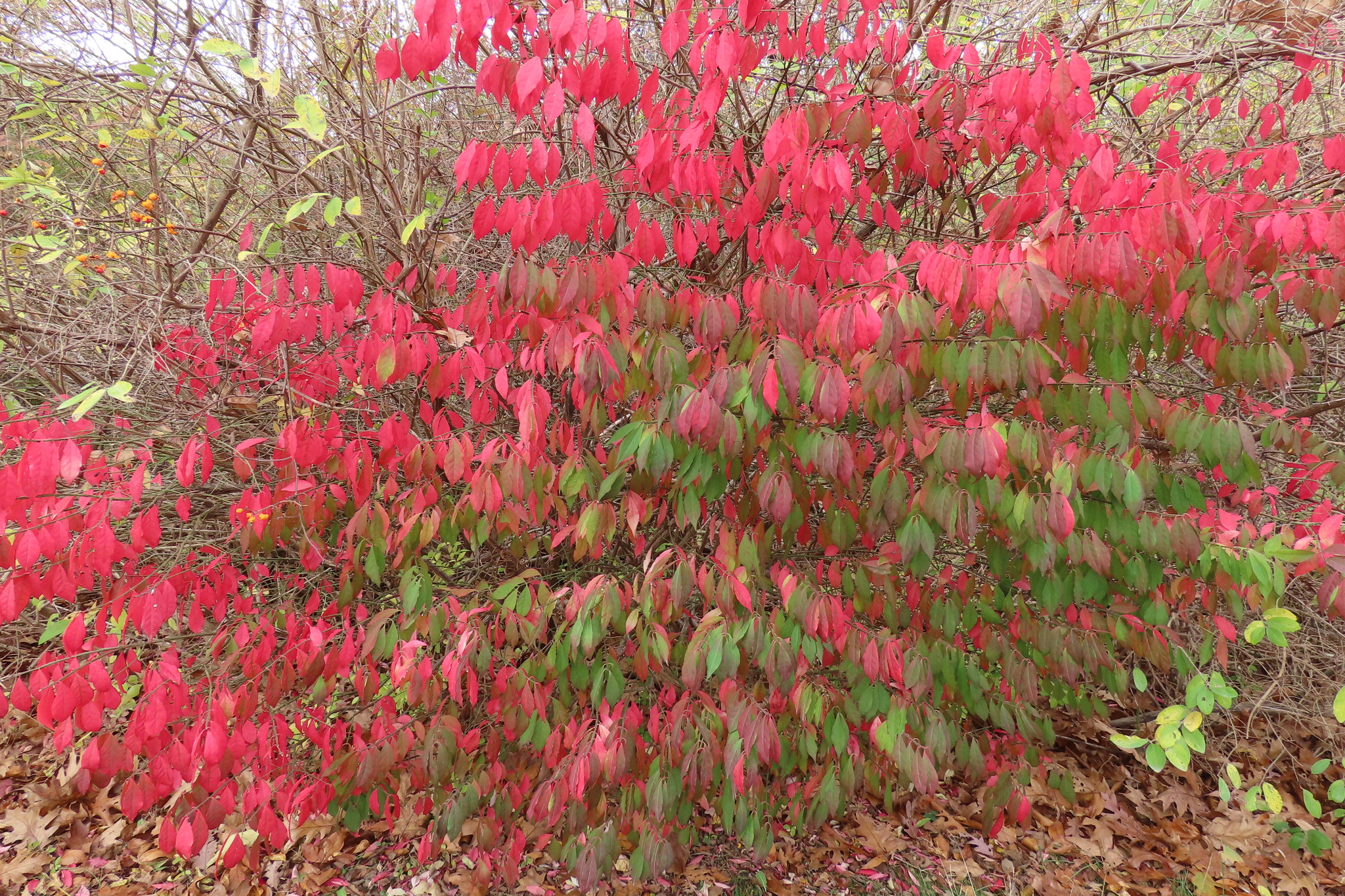
Burningbush growing in Essex County, Massachusetts (CC BY-NC 4.0).
The scientific name of burningbush is Euonymus alatus (Thunb.) Sieb. (Celastraceae) [4,15,16,19,27,42]. Worldwide, 5 poorly differentiated varieties are recognized by various systematists based on leaf color and relative hairiness (review by [4]). These varieties occur in North America [46,51]:
- Euonymus alatus (Thunb.) Sieb. var. alatus
- Euonymus alatus (Thunb.) Sieb. var. apterus Regel
Synonyms
- Euonymus alata (Thub.) Sieb. [34,49]
Other Common Names
winged burning bush, winged spindletree, winged euonymous, winged wahoo
General Distribution
North America
Burningbush is nonnative in North America, where it occurs from Ontario south to Missouri, Kentucky, and South Carolina and east to New Hampshire [27]. Booth and Wright [5] noted its presence in west-central Montana in 1962, but it was not listed in a 1991 flora of the same area [28]. Plants Database provides a distributional map of burningbush and varieties in North America.
Other Continents
Burningbush's native distribution extends from central China to northeastern Asia [5,19,33,42,49]. Besides central and eastern China, burningbush occurs in Korea, the Sakhalin islands of eastern Russia, and Japan [15]. It was introduced in Europe and North America as an ornamental [10,15].
Invasion History in the United States
Burningbush was first introduced in the United States in the 1860s [10]. It has escaped cultivation or become invasive mostly in the northeastern United States.
Northeast
Burningbush was well established in some parts of the Northeast by the late 20th century. It had established near Palestine in Wirt County, West Virginia, by 1977 [42]. In a 1985 Michigan flora, burningbush was noted as rarely escaping cultivation but spreading "occasionally" into woodlands, thickets, and uncultivated urban and rural areas [49]. In 1991, Gleason and Cronquist [19] described it as widely cultivated but only "locally escaped from cultivation" in the Northeast. By the turn of the 21st century, burningbush was locally invasive in many northeastern states. A 2002 fact sheet describes burningbush as most invasive in Connecticut, Virginia, Pennsylvania, and Illinois [33]. A 2006 review describes 21 states as "invaded" [9].
Midwest
As of 2009, burningbush was noted as invasive in the Midwest only in Illinois, where it was first reported as "naturalized" in Coles County in 1973 [11]. By 1984, burningbush was reported from 13 Illinois counties [12]. In 1989, burningbush was the dominant woody species invading the Waterworks Ravine Hill Prairie, where woody species were historically rare. Most other invading woody species were native. Mean density (and frequency) of burningbush was 7,809 stem/ha (66%) [2].
Site Characteristics
Burningbush appears adaptable to a variety of site conditions. As of 2009, few details were available regarding site conditions preferred by this species. Burningbush tolerates a variety of soil textures [33,36] and pH levels [33], and grows in dry to moist soils [10]. A fact sheet described burningbush as drought tolerant but intolerant of wet soils [13]. In oak-hickory-sugar maple forests in Illinois, burningbush dominated forest understories most often within small ravines. It also dominated shady valley floors and shady microsites on north-facing hillslopes [11]. Research is needed on site conditions that may increase vulnerability of native plant communities to burningbush invasion.
In its native China, burningbush occurs in forests, woodlands, and scrublands from sea level to 8,900 feet (2,700 m) elevation [15]. Elevational ranges for burningbush in North America were not available of as 2009.
Burningbush may tolerate elevated levels of soil methane. In New York, it was planted on landfill sites, where methane concentration was 0.9%; and on control sites, where methane was not detected in the soil. Burningbush persisted in landfill soils, although its growth was significantly greater in control soils (P<0.05) [18].
Plant Communities
In the Northeast, burningbush is invasive in pastures, glacial drift hill prairies, woodlands, and mature second-growth forests [20,22,33]. It may be common in late-successional oak-hickory (Quercus-Carya spp.), maple-beech (Acer-Fagus spp.), and other mixed-hardwood forests [22,33,51]. It is noted in mixed-oak forests and swamp chestnut oak-swamp white oak-Shumard's oak (Q. michauxii-Q bicolor-Q. shumardii) swamps of Great Falls National Park, Virginia [23] and in oak-hickory-sugar maple (Acer saccharum) forests of Illinois. It also occurs in little bluestem-Indian grass (Schizachyrium scoparium-Sorghastrum nutans) prairie in Illinois [2]. In southern Connecticut, burningbush occurred in a mixed-hardwood forest with high densities of white-tailed deer. Due to browsing, woody understory vegetation was sparse except for sugar maple seedlings, burningbush, and other nonnative shrubs [51]. See Palatability and/or nutritional value for more information on this study.
Distribution of nonnative species is often difficult to accurately describe due to a lack of details survey information, gaps in understanding of nonnative species' ecological characteristics, and because nonnative species may still be expanding their North American range. Therefore, burningbush may occur in plant communities other than those discussed here and listed in the Fire Regime Table.
As of 2009, little English-language literature was available on burningbush's native habitats. In China, burningbush grows in forests, woodlands, and scrublands [15].
Botanical Description
This description provides characteristics that may be relevant to fire ecology and is not meant for identification. Keys for identification are available (for example, [19,34,42,49]).
Burningbush is a rounded shrub that grows to 8.2 feet (2.5 m) tall [5,19]. The branches typically have prominent, corky wings [5,19,34,42,49], although stem wings are reduced to ridges or absent on some plants [4,16,33,38]. Burningbush is deciduous [5,19,49], with opposite leaves [34]. The inflorescence is a long-peduncled cyme with perfect flowers [34]. The fruit is a dehiscent capsule [19] containing up to 4 seeds [33] that are enclosed in an aril [19]. A fact sheet describes burningbush's root system as deep and fibrous [38].

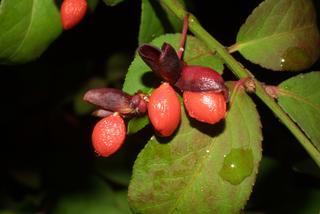
Split burningbush capsules, showing orange arils within.

Burningbush stem wings.
Stand Structure
Based on limited studies, burningbush may form shrublands or dense forest understories; it is uncertain whether this pattern is typical on burningbush-invaded sites. Burningbush has formed dense thickets in Pennsylvania [33]. In New York, burningbush was most common in the tall shrub layer of a yellow-poplar-red oak-American beech (Liriodendron tulipifera-Quercus rubra-Fagus grandifolia) forest [22]:
| Forest layer | Tall shrub layer (2-3.5 m) | Medium shrub layer (1-2 m) | Herb layer (0-1 m) | All layers |
| Cover (%) | 1.86 | 0.6 | 0.53 | 0.53 |
Raunkiaer Life Form
- Phanerophyte [37]

Fall color; burningbush seedlings in foreground.
Seasonal Development
In general, burningbush flowers from May to June in the Northeast [19]. Late April to late June flowering is noted in Pennsylvania [33,38], while burningbush flowers in June and July in Illinois [34]. Fruit capsules ripen in September and October in the Northeast [33]. The capsules dehisce and seeds disperse in September and October in Pennsylvania [38]. Leaves turn a "brilliant" purplish red to scarlet before dropping in autumn [33]. Fall color is most intense in plants growing in sun [38].
Regeneration Processes
Burningbush regenerates from seed and vegetatively [33]. Little is known of burningbush's regeneration requirements in wildland ecosystems. Research is needed on all aspects of burningbush regeneration.
Pollination and Breeding System
No information is available on this topic.
Seed Production
A fact sheet described burningbush seed production as "prodigious" [33].
Seed Dispersal
Seeds are dispersed by frugivorous birds [20,33].
Seed Banking
No information is available on this topic.
Germination
Passage through a bird's digestive system may increase germination rates [33], although this has not been confirmed experimentally. Commercial burningbush seeds are stratified to increase germination rates in the nursery and in the field [48].

Burningbush establishing in oak litter.
Seedling Establishment and Plant Growth
As of 2009, no published information was available on requirements for burningbush establishment and growth. The photo on the right illustrates burningbush establishing in oak litter; the photo in Seasonal Development shows burningbush seedlings establishing beneath parent plants. Seedlings are shade tolerant (see Successional Status), but it is uncertain whether growth rates differ between open than with closed canopies. Fact sheets variously describe burningbush as a fast- [38] or slow-growing [13] species.
Vegetative Regeneration
According to expert opinion [33] and fact sheets [13,38], burningbush sprouts from the root crown after top-kill from herbicides, so it is likely that it also sprouts following other top-killing events. Burningbush tolerates severe pruning [13].
Successional Status
Burningbush tolerates full sun [10] to nearly full shade [10,11,33] and has invaded closed-canopy, "relatively undisturbed" forest communities in Illinois [12]. Little research had been conducted on successional patterns in plant communities with burningbush as of 2009, and research is needed on burningbush's successional role in eastern mixed-hardwood and other plant communities where it is invasive. In the Northeast, burningbush may reach greatest coverage in late-successional hardwood forests. According to a fact sheet, burningbush has overgrown native shrub species and become dominant in the understories of closed-canopy, mixed-hardwood forests in Pennsylvania [38].
Immediate Fire Effects
There was no information on the direct effects of fire on burningbush as of 2009. According to expert opinion [33] and a fact sheet [38], herbicides may only top-kill burningbush, so it is likely that fire may also only top-kill burningbush.
Postfire Regeneration Strategy
- Tall shrub, adventitious buds and/or a sprouting root crown
- Small shrub, adventitious buds and/or a sprouting root crown
- Initial off-site colonizer (off site, initial community)
- Secondary colonizer (on- or off-site seed sources) [41]
Fire Adaptations and Plant Response to Fire
Documentation of burningbush's adaptations and response to fire were lacking as of 2009. Since burningbush sprouts from the root crown after top-kill from herbicides [33,38], it is likely that it also sprouts from the root crown after top-kill by fire. Because birds disperse burningbush seed [20,33], postfire seedling establishment from off-site seed sources may occur. Research is needed on all aspects of burningbush's fire ecology.
Fuels
According to a fact sheet, burningbush can successionally replace native shrubs and form a dense forest understory on some sites in the Northeast [38], so burningbush may increase fuel loads in plant communities it has invaded. However, data are lacking on how burningbush may alter horizontal and/or vertical fuel continuity and fuel loads from historical conditions.
Fire Regimes
Burningbush grows in plant communities that historically experienced both long and short fire-return intervals. The northeastern beech-maple communities that burningbush has invaded [33,51] historically experienced stand-replacement fires at long fire-return intervals, with an estimated range of 230 to 4,970 years in New Hampshire [14]. Oak-hickory communities historically had mostly short fire-return intervals. Some burningbush-invaded oak-hickory communities in Pennsylvania historically experienced low-severity surface fires at 4- to 7-year intervals. Short fire-return intervals kept stand structure open, usually maintaining the communities as woodlands [29]. Several authors have noted cooccurrence of sugar maple and burningbush in oak-hickory forests [2,11]. On many sites, presence of sugar maple in oak-hickory communities may indicate that these burningbush-invaded forests now have longer fire-return intervals than were typical in the past ([39], review by Pallardy and others [35]). Research on how burningbush affects fire regimes of plant communities it has invaded was lacking as of 2009.
See the Fire Regime Table (table A1) for further information on fire regimes of vegetation communities in which burningbush may occur. For additional fire regime information, search FEIS for this species by entering the species name on the Advanced Search page and selecting “Fire Regime” as the publication type.
Fire Management Considerations
Without information on how burningbush responds to fire or how it may affect fuel loads and fire regimes in plant communities it has invaded, it is impossible to make recommendations for its fire management. Studies on the sprouting ability of burningbush after fire; longevity of soil-stored seed; effects (if any) of fire and passage through animal digestive tracts on seed germination; and possible changes in fuels due to burningbush invasion are critically needed to understand the fire ecology burningbush. Postfire monitoring of burningbush can help managers access whether control measures are needed on burned sites.
Federal Status
None
Other Status
Information on state-level noxious weed status of plants in the United States is available at Plants Database.
Importance to Wildlife and Livestock
There was little information on wildlife or livestock use of burningbush as of 2009. Rabbits browse burningbush [3], and birds eat burningbush arils [20,38].
Palatability and Nutritional Value
A southern Connecticut study suggests burningbush is not palatable to white-tailed deer. Although burningbush was plentiful in the understory of a mixed-hardwood forest, white-tailed deer selected other browse species over burningbush. In a related greenhouse study, seedlings of 17 browse species emerged from white-tailed deer fecal samples collected in the forest. None of the samples contained burningbush seedlings [51].
Cover Value
No information is available on this topic.
Other Uses
Burningbush is widely cultivated for its brilliant autumn foliage and distinctive branches [49].

Burningbush infestation.
Impacts
According to a Pennsylvania fact sheet, burningbush may become invasive when planted near pastures, woodlands, and mature second-growth forests, but does not usually escape urban plantings. It is most invasive in moist forest habitats [38]. Burningbush is often used in highway plantings [10], which may contribute to its seed spread.
Limited evidence suggests that in eastern mixed-hardwood forests, heavy white-tailed deer browsing of native shrubs may favor growth of burningbush and other nonnative shrubs [8] (see Palatability and Nutritional Value).
Control
Little published information on controlling burningbush was available as of 2009, and further research is needed on this topic. See The Nature Conservancy's Weed Control Methods Handbook for general information on controlling nonnative invasive species.
In all cases where invasive species are targeted for control, no matter what method is employed, the potential for other invasive species to fill their void must be considered [7]. Control of biotic invasions is most effective when it employs a long-term, ecosystem-wide strategy rather than a tactical approach focused on battling individual invaders [32].
Fire
There was no published information on prescribed fire use for controlling burningbush as of 2009.
Prevention
Burningbush's escape from cultivation could be slowed or prevented if fertile burningbush plants were no longer commercially available and/or if native species were substituted in landscaping projects. However, frugivorous birds may disperse fertile burningbush seed into uninvaded areas (see Seed Dispersal). Studies to develop sterile burningbush cultivars were in progress in 2008 [8,17]. Lists of alternative native species that provide bright red or purple fall color are available in these sources: [33,38].
Preventing invasive plants from establishing in weed-free burned areas is the most effective and least costly management method. This can be accomplished through early detection and eradication, careful monitoring, and by limiting invasive plant seed dispersal into burned areas by:
- incorporating cost of weed prevention and management into fire rehabilitation plans
- acquiring restoration funding
- including weed prevention education during fire training
- minimizing soil disturbance and vegetation removal during fire suppression and rehabilitation activities
- minimize the use of retardants containing nitrogen and phosphorus
- avoiding areas dominated by high priority invasive plants when locating firelines, monitoring camps, staging areas, and helibases
- cleaning equipment and vehicles prior to entering burned areas
- regulating or preventing human and livestock entry into burned areas until desirable site vegetation has recovered sufficiently to resist invasion by undesirable vegetation
- monitoring burned areas and areas of significant management activity
- detecting weeds early and eradicating before vegetative spread and/or seed dispersal
- eradicating small patches and containing or controlling large infestations within or adjacent to the burned area
For more detailed information on these topics see the following publications: [1,6,21,45].
It is commonly argued that the most cost-efficient and effective method of managing invasive species is to prevent their establishment and spread by maintaining "healthy" natural communities [32,40] (for example, avoid road building in wildlands [44]) and by conducting monitoring several times each year [26]. Managing to maintain the integrity of native plant communities and identifying causal factors enhancing ecosystem invasibility are likely to be more effective than an emphasis on controlling the invader [25].
Weed prevention and control can be incorporated into all types of management plans, including logging and site preparation, management of grazing allotments, recreation management, research projects, road building and maintenance, and fire management [45]. See the "Guide to noxious weed prevention practices" [45] for specific guidelines on preventing the spread of weed seeds and propagules under various management conditions.
Cultural
No information is available on this topic.
Physical and/or Mechanical
Mechanical treatments are generally preferred over other methods for controlling small infestations of invasive species [43]. Burningbush seedlings up to 2 feet (0.6 m) tall can be hand-pulled, especially in moist soils. Larger plants require cutting and are likely to sprout unless the stumps are removed or painted with herbicide [33,38].
Biological
As of 2009, biological agents for burningbush control were not available [38]. A review identifies 13 potential biological control agents from China that may help control burningbush in North America [9]. Biological control of invasive species has a long history, and many factors must be considered before using biological controls. Refer to the Weed Control Methods Handbook [43] and these sources: [47,52] for background information and important considerations for developing and implementing biological control programs.
Chemical
Glyphosate may be effective on extensive stands, especially when applied in early summer [33,38].
Integrated Management
As of 2009, published studies on using multiple control methods on burningbush were lacking. According to a fact sheet, glyphosate application to cut stumps can help prevent cut stumps from sprouting [38].
Table A1: Fire Regime Table
| Vegetation Community (Potential Natural Vegetation Group) | Fire severity* | Percent of fires | Mean fire interval (years) | Minimum fire interval (years) | Maximum fire interval (years) |
|---|---|---|---|---|---|
| Northern Plains | |||||
| Northern tallgrass prairie | Replacement | 90% | 6.5 | 1 | 25 |
| Mixed | 9% | 63 | — | — | |
| Surface or low | 2% | 303 | — | — | |
| Oak savanna | Replacement | 7% | 44 | — | — |
| Mixed | 17% | 18 | — | — | |
| Surface or low | 76% | 4 | — | — | |
| Oak woodland | Replacement | 2% | 450 | — | — |
| Surface or low | 98% | 7.5 | — | — | |
| Northern Great Plains wooded draws and ravines | Replacement | 38% | 45 | 30 | 100 |
| Mixed | 18% | 94 | — | — | |
| Surface or low | 43% | 40 | 10 | — | |
| Great Lakes | |||||
| Mosaic of bluestem prairie and oak-hickory | Replacement | 79% | 5 | 1 | 8 |
| Mixed | 2% | 260 | — | — | |
| Surface or low | 20% | 2 | — | 33 | |
| Northern oak savanna | Replacement | 4% | 110 | 50 | 500 |
| Mixed | 9% | 50 | 15 | 150 | |
| Surface or low | 87% | 5 | 1 | 20 | |
| Northern hardwood maple-beech-eastern hemlock | Replacement | 60% | >1,000 | — | — |
| Mixed | 40% | >1,000 | — | — | |
| Maple-basswood | Replacement | 33% | ≥1,000 | — | — |
| Surface or low | 67% | 500 | — | — | |
| Maple-basswood mesic hardwood forest (Great Lakes) | Replacement | 100% | >1,000 | ≥1,000 | >1,000 |
| Maple-basswood-oak-aspen | Replacement | 4% | 769 | — | — |
| Mixed | 7% | 476 | — | — | |
| Surface or low | 89% | 35 | — | — | |
| Northern hardwood-eastern hemlock forest (Great Lakes) | Replacement | 99% | >1,000 | — | — |
| Oak-hickory | Replacement | 13% | 66 | 1 | — |
| Mixed | 11% | 77 | 5 | — | |
| Surface or low | 76% | 11 | 2 | 25 | |
| Pine-oak | Replacement | 19% | 357 | — | — |
| Surface or low | 81% | 85 | — | — | |
| Northeast | |||||
| Eastern woodland mosaic | Replacement | 2% | 200 | 100 | 300 |
| Mixed | 9% | 40 | 20 | 60 | |
| Surface or low | 89% | 4 | 1 | 7 | |
| Northern hardwoods (Northeast) | Replacement | 39% | ≥1,000 | — | — |
| Mixed | 61% | 650 | — | — | |
| Eastern white pine-northern hardwoods | Replacement | 72% | 475 | — | — |
| Surface or low | 28% | >1,000 | — | — | |
| Northern hardwoods-eastern hemlock | Replacement | 50% | ≥1,000 | — | — |
| Surface or low | 50% | ≥1,000 | — | — | |
| Appalachian oak forest (dry-mesic) | Replacement | 2% | 625 | 500 | ≥1,000 |
| Mixed | 6% | 250 | 200 | 500 | |
| Surface or low | 92% | 15 | 7 | 26 | |
| Beech-maple | Replacement | 100% | >1,000 | — | — |
| *Fire Severities: Replacement: Any fire that causes greater than 75% top removal of a vegetation-fuel type, resulting in general replacement of existing vegetation; may or may not cause a lethal effect on the plants. Mixed: Any fire burning more than 5% of an area that does not qualify as a replacement, surface, or low-severity fire; includes mosaic and other fires that are intermediate in effects. Surface or low: Any fire that causes less than 25% upper layer replacement and/or removal in a vegetation-fuel class but burns 5% or more of the area [18,22]. | |||||
1. Asher, Jerry; Dewey, Steven; Olivarez, Jim; Johnson, Curt. 1998. Minimizing weed spread following wildland fires. Proceedings, Western Society of Weed Science. 51: 49. [40409]
2. Behnke, Gerlinde; Ebinger, John E. 1989. Woody invasion of glacial drift hill prairies in east-central Illinois, USA. Transactions of the Illinois State Academy of Science. 82(1-2): 1-4. [71688]
3. Bing, A. 1981. Preemergence weed control in ground covers. Proceedings, Northeastern Weed Science Society. 35: 259-260. [71690]
4. Blakelock, R. A. 1951. A synopsis of the genus Euonymus L. Kew Bulletin. 6(2): 210-290. [71719]
5. Booth, W. E.; Wright, J. C. 1962. [Revised]. Flora of Montana: Part II--Dicotyledons. Bozeman, MT: Montana State College, Department of Botany and Bacteriology. 280 p. [47286]
6. Brooks, Matthew L. 2008. Effects of fire suppression and postfire management activities on plant invasions. In: Zouhar, Kristin; Smith, Jane Kapler; Sutherland, Steve; Brooks, Matthew L., eds. Wildland fire in ecosystems: Fire and nonnative invasive plants. Gen. Tech. Rep. RMRS-GTR-42-vol. 6. Ogden, UT: U.S. Department of Agriculture, Forest Service, Rocky Mountain Research Station: 269-280. [70909]
7. Brooks, Matthew L.; Pyke, David A. 2001. Invasive plants and fire in the deserts of North America. In: Galley, Krista E. M.; Wilson, Tyrone P., eds. Proceedings of the invasive species workshop: The role of fire in the control and spread of invasive species; Fire conference 2000: 1st national congress on fire ecology, prevention, and management; 2000 November 27 - December 1; San Diego, CA. Misc. Publ. No. 11. Tallahassee, FL: Tall Timbers Research Station: 1-14. [40491]
8. Chen, Yongqin; Lu, Litang; Duan, Hui; Deng, Wei; McAvoy, R., Smith, W.; Thammina, C.; von Bodman, S.; Li, Yi; Ye, Dong; Zhao, Degang. 2008. Biotech approach to neutralize the invasiveness of burningbush (Euonymus alatus), a progress report on development of its genetic transformation system and functional analysis of sterile genes. Acta Horticulturae. 769: 21-29. [72792]
9. Ding, Jianqing; Reardon, Richard; Wu, Yun; Hao, Zheng; Fu, Weidong. 2006. Biological control of invasive plants through collaboration between China and the United States of America: a perspective. Biological Invasions. 8(7): 1439-1450. [71691]
10. Ebinger, John E. 1996. Euonymus alatus-- winged euonymus, burning bush. In: Randall, John M.; Marinelli, Janet, eds. Invasive plants: Weeds of the global garden. Handbook #149. Brooklyn, NY: Brooklyn Botanic Garden: 55. [72801]
11. Ebinger, John E.; Phillippe, Loy R. 1973. New plant records for Illinois. Illinois State Academy of Science. 66(3-4): 115. [72522]
12. Ebinger, John; Newman, James; Nyboer, Randy. 1984. Naturalized winged wahoo in Illinois. Natural Areas Journal. 4(2): 26-29. [71687]
13. Evans, Erv. [2002]. Euonymus alatus, [Online]. In: Plant fact sheets. In: Consumer horticulture. Raleigh, NC: North Carolina State University, College of Agriculture and Life Sciences, Horticultural Science; North Carolina Cooperative Extension (Producer). Available: http://www.ces.ncsu.edu/depts/hort/consumer/factsheets/shrubs/euonymus_alatus.html [2009, January 27]. [72818]
14. Fahey, Timothy J.; Reiners, William A. 1981. Fire in the forests of Maine and New Hampshire. Bulletin of the Torrey Botanical Club. 108: 362-373. [9707]
15. Flora of China Project. 2008. Flora of China, [Online]. In: eFloras.org/ Beijing: Science Press; St. Louis, MO: Missouri Botanical Garden Press (Producers). Available: http://www.efloras.org/flora_page.aspx?flora_id=2 [2009, January 14]. [72954]
16. Flora of Japan Database Project. 2008. Flora of Japan, [Online]. Japanese Society for Plant Systematist (Producer). Available: http://foj.c.u-tokyo.ac.jp/gbif/ [2009, January 27]. [72815]
17. Gagliardi, James A.; Brand, Mark H. 2007. Connecticut nursery and landscape industry preferences for solutions to the sale and use of invasive plants. Horticultural Technology. 17(1): 39-45. [71692]
18. Gilman, Edward F.; Leone, Ida A.; Flower, Franklin B. 1981. The adaptability of 19 woody species in vegetating a former sanitary landfill. Forest Science. 27(1): 13-18. [71693]
19. Gleason, Henry A.; Cronquist, Arthur. 1991. Manual of vascular plants of northeastern United States and adjacent Canada. 2nd ed. New York: New York Botanical Garden. 910 p. [20329]
20. Global Invasive Species Database. 2005. Euonymus alata (shrub), [Online]. Invasive Species Specialist Group (ISSG); Species Survival Commission, International Union for Conservation of Nature (Producers). Available: http://www.issg.org/database/species/ecology.asp?si=574&fr=1&sts= [2009, January 27]. [72816]
21. Goodwin, Kim; Sheley, Roger; Clark, Janet. 2002. Integrated noxious weed management after wildfires. EB-160. Bozeman, MT: Montana State University, Extension Service. 46 p. Available online: http://www.montana.edu/wwwpb/pubs/eb160.html [2003, October 1]. [45303]
22. Greller, Andrew M.; Calhoon, Robert E.; Mansky, James M. 1978. Grace Forest, a mixed mesophytic stand on Long Island, New York. Botanical Gazette. 139(4): 482-489. [71752]
23. Grimshaw, Susan; Bradley, Ted R. 1973. The vascular flora of Great Falls National Park, Fairfax County, Virginia. Castanea. 38(3): 229-261. [71699]
24. Hann, Wendel; Havlina, Doug; Shlisky, Ayn; [and others]. 2008. Interagency fire regime condition class guidebook. Version 1.3, [Online]. In: Interagency fire regime condition class website. U.S. Department of Agriculture, Forest Service; U.S. Department of the Interior; The Nature Conservancy; Systems for Environmental Management (Producer). 119 p. Available: http://frames.nbii.gov/frcc/documents/FRCC_Guidebook_2008.07.10.pdf [2008, September 03]. [70966]
25. Hobbs, Richard J.; Humphries, Stella E. 1995. An integrated approach to the ecology and management of plant invasions. Conservation Biology. 9(4): 761-770. [44463]
26. Johnson, Douglas E. 1999. Surveying, mapping, and monitoring noxious weeds on rangelands. In: Sheley, Roger L.; Petroff, Janet K., eds. Biology and management of noxious rangeland weeds. Corvallis, OR: Oregon State University Press: 19-36. [35707]
27. Kartesz, John T. 1999. A synonymized checklist and atlas with biological attributes for the vascular flora of the United States, Canada, and Greenland. 1st ed. In: Kartesz, John T.; Meacham, Christopher A. Synthesis of the North American flora (Windows Version 1.0), [CD-ROM]. Chapel Hill, NC: North Carolina Botanical Garden (Producer). In cooperation with: The Nature Conservancy; U.S. Department of Agriculture, Natural Resources Conservation Service; U.S. Department of the Interior, Fish and Wildlife Service. [36715]
28. Lackschewitz, Klaus. 1991. Vascular plants of west-central Montana--identification guidebook. Gen. Tech. Rep. INT-227. Ogden, UT: U.S. Department of Agriculture, Forest Service, Intermountain Research Station. 648 p. [13798]
29. LANDFIRE Rapid Assessment. 2005. Potential Natural Vegetation Group (PNVG) R7EPWM--eastern woodland mosaic, [Online]. In: Rapid assessment reference condition models. Washington, DC: U.S. Department of Agriculture, Forest Service, Rocky Mountain Research Station, Fire Sciences Laboratory; U.S. Geological Survey; The Nature Conservancy (Producers). Available: https://www.fs.usda.gov/database/feis/pdfs/PNVGs/Northeast/R7EPWM.pdf [2009, January 22]. [72789]
30. LANDFIRE Rapid Assessment. 2005. Reference condition modeling manual (Version 2.1), [Online]. In: LANDFIRE. Cooperative Agreement 04-CA-11132543-189. Boulder, CO: The Nature Conservancy; U.S. Department of Agriculture, Forest Service; U.S. Department of the Interior (Producers). 72 p. Available: https://www.landfire.gov /downloadfile.php?file=RA_Modeling_Manual_v2_1.pdf [2007, May 24]. [66741]
31. LANDFIRE Rapid Assessment. 2007. Rapid assessment reference condition models, [Online]. In: LANDFIRE. U.S. Department of Agriculture, Forest Service, Rocky Mountain Research Station, Fire Sciences Lab; U.S. Geological Survey; The Nature Conservancy (Producers). Available: https://www.landfire.gov /models_EW.php [2008, April 18] [66533]
32. Mack, Richard N.; Simberloff, Daniel; Lonsdale, W. Mark; Evans, Harry; Clout, Michael; Bazzaz, Fakhri A. 2000. Biotic invasions: causes, epidemiology, global consequences, and control. Ecological Applications. 10(3): 689-710. [48324]
33. Martin, Tunyalee. 2006. Weed alert!: Euonymus alatus, [Online]. In: Red alerts! In: TNC global invasive species team. Davis, CA: The Nature Conservancy (Producer). Available: http://tncinvasives.ucdavis.edu/alert/alrteuon.html [2009, January 27]. [71689]
34. Mohlenbrock, Robert H. 1986. [Revised edition]. Guide to the vascular flora of Illinois. Carbondale, IL: Southern Illinois University Press. 507 p. [17383]
35. Pallardy, S. G.; Nigh, T. A.; Garrett, H. E. 1988. Changes in forest composition in central Missouri: 1968-1982. The American Midland Naturalist. 120(2): 380-390. [9043]
36. Ramsey, Gwynn W.; Leys, Charles H.; Wright, Robert A. S.; Coleman, Douglas A.; Neas, Aubrey O.; Stevens, Charles E. 1993. Vascular flora of the James River Gorge watersheds in the central Blue Ridge Mountains of Virginia. Castanea. 58(4): 260-300. [71706]
37. Raunkiaer, C. 1934. The life forms of plants and statistical plant geography. Oxford: Clarendon Press. 632 p. [2843]
38. Rhoads, Ann F.; Block, Timothy A. 2002. Invasive species fact sheet: Winged euonymus--(burning-bush, winged wahoo, winged spindle-tree, Japanese spindle-tree), [Online]. In: Delaware River Invasive Plant Partnership. In: The Pennsylvania Flora Project. Philadelphia, PA: The Pennsylvania Flora Project, Botany Department, Morris Arboretum of the University of Pennsylvania (Producer). Available: http://www.paflora.org/Euonymus%20alatus.pdf [2009, January 27]. [72819]
39. Schlesinger, Richard C. 1989. Dynamics of the sugar maple component of a white oak-yellow poplar community. In: Rink, George; Budelsky, Carl A., eds. Proceedings, 7th central hardwood conference; 1989 March 5-8; Carbondale, IL. Gen. Tech. Rep. NC-132. St. Paul, MN: U.S. Department of Agriculture, Forest Service, North Central Forest Experiment Station: 262-266. [9388]
40. Sheley, Roger; Manoukian, Mark; Marks, Gerald. 1999. Preventing noxious weed invasion. In: Sheley, Roger L.; Petroff, Janet K., eds. Biology and management of noxious rangeland weeds. Corvallis, OR: Oregon State University Press: 69-72. [35711]
41. Stickney, Peter F. 1989. Seral origin of species comprising secondary plant succession in Northern Rocky Mountain forests. FEIS workshop: Postfire regeneration. Unpublished draft on file at: U.S. Department of Agriculture, Forest Service, Intermountain Research Station, Fire Sciences Laboratory, Missoula, MT. 10 p. [20090]
42. Strausbaugh, P. D.; Core, Earl L. 1977. Flora of West Virginia. 2nd ed. Morgantown, WV: Seneca Books, Inc. 1079 p. [23213]
43. Tu, Mandy; Hurd, Callie; Randall, John M., eds. 2001. Weed control methods handbook: tools and techniques for use in natural areas. Davis, CA: The Nature Conservancy. 194 p. [37787]
44. Tyser, Robin W.; Worley, Christopher A. 1992. Alien flora in grasslands adjacent to road and trail corridors in Glacier National Park, Montana (U.S.A.). Conservation Biology. 6(2): 253-262. [19435]
45. U.S. Department of Agriculture, Forest Service. 2001. Guide to noxious weed prevention practices. Washington, DC: U.S. Department of Agriculture, Forest Service. 25 p. Available online: https://www.fs.usda.gov /rangelands/ftp/invasives/documents/GuidetoNoxWeedPrevPractices_07052001.pdf [2005, October 25]. [37889]
46. U.S. Department of Agriculture, Natural Resources Conservation Service. 2009. PLANTS Database, [Online]. Available: https://plants.usda.gov /. [34262]
47. Van Driesche, Roy; Lyon, Suzanne; Blossey, Bernd; Hoddle, Mark; Reardon, Richard, tech. coords. 2002. Biological control of invasive plants in the eastern United States. USDA Forest Service Publication FHTET-2002-04. [Washington, DC]: U.S. Department of Agriculture, Forest Service. 413 p. Available online: http://www.invasive.org/eastern/biocontrol/index.html [2005, August 12]. [54194]
48. VanDusen Seed Collectors. [2008]. Euonymus alatus--burning bush, winged Euonymus, winged spindle tree, [Online]. In: Shrubs. In: VanDusen Seed Collectors. [Vancouver, BC: VanDusen Botanical Garden]. PlantExplorers.com (Producer). Available: http://www.plantexplorers.com/vandusen/product_info.php/products_id/193 [2009, January 27]. [72817]
49. Voss, Edward G. 1985. Michigan flora. Part II. Dicots (Saururaceae--Cornaceae). Bull. 59. Bloomfield Hills, MI: Cranbrook Institute of Science; Ann Arbor, MI: University of Michigan Herbarium. 724 p. [11472]
50. Wherry, E. T.; Fogg, J. M.; Wahl, H. A. 1979. Atlas of the Flora of Pennsylvania. Philadelphia, PA: University of Pennsylvania, Morris Arboretum. 390 p. [72475]
51. Williams, Scott C.; Ward, Jeffrey S.; Ramakrishnan, Uma. 2008. Endozoochory by white-tailed deer (Odocoileus virginianus) across a suburban/woodland interface. Forest Ecology and Management. 255(3-4): 940-947. [70535]
52. Wilson, Linda M.; McCaffrey, Joseph P. 1999. Biological control of noxious rangeland weeds. In: Sheley, Roger L.; Petroff, Janet K., eds. Biology and management of noxious rangeland weeds. Corvallis, OR: Oregon State University Press: 97-115. [35715]