


Hordeum jubatum, foxtail barley
Tesky, Julie L. 1992. Hordeum jubatum, foxtail barley. In: Fire Effects Information System, [Online]. U.S. Department of Agriculture, Forest Service, Rocky Mountain Research Station, Fire Sciences Laboratory (Producer). Available: https://research.fs.usda.gov/feis/species-reviews/horjub
| Abbreviation | Common Name | Scientific Name | Classification | Status |
|---|---|---|---|---|
| Plants | ||||
| HORJUB | foxtail barley | Hordeum jubatum | Life Form: Plants/Graminoid Kingdom: Plantae Class: Monocot Order: Cyperales Family: Poaceae Genus: Hordeum | Fed. Protected: No Nativity: Native Invasiveness: Noninvasive |

Taxonomy
The currently accepted scientific name for foxtail barley is Hordeum jubatum L. [4,17,19]. Hordeum jubatum L. hybridizes with H. brachyantherum in interior and coastal British Columbia, where the two species share the same habitat [4]. Recognized subspecies and varieties of H. jubatum are as follows [4,17,19]:
- H. j. ssp. jubatum
- H. j. ssp. intermedium Bowden
- H. j. ssp. breviarestatum Bowden
- H. j. var. boreale Scribn. & Smith (Boivin)
- H. j. var. caespitasum (Sribn.) Hitchc.
Synonyms
- Critesion jubatum L. Nevski [3]
Other Common Names
foxtail, squirreltail barley, squirreltail grass, foxtail grass, wild barley, skunktail
Notes
The Research Project Summary titled "Vegetation response to restoration treatments in ponderosa pine-Douglas-fir forests of western Montana" provides information on prescribed fire and postfire response of plant community species, including foxtail barley, that was not available when this species review was written. To find this summary, search FEIS for this species by entering the species name on the Advanced Search page and selecting “Fire Study” as the publication type.
General Distribution
Foxtail barley is indigenous to the western United States [35]. It has become naturalized in the East and now occurs throughout the United States with the exception of the South Atlantic and Gulf Coast states [2,17]. It occurs throughout most of Canada and some areas of Mexico [35,45].
States and Provinces
- United States: AL AK AZ AR CA CO CT DE ID IL IN IA KS KY ME MD MA MI MN MS MO MT NE NV NH NJ NM NY ND OH OK OR PA RI SD TN TX UT VT WA WV WI WY
- Canada: AB BC LB MB NB NF NT NS ON PQ SK YT
- Mexico
Site Characteristics
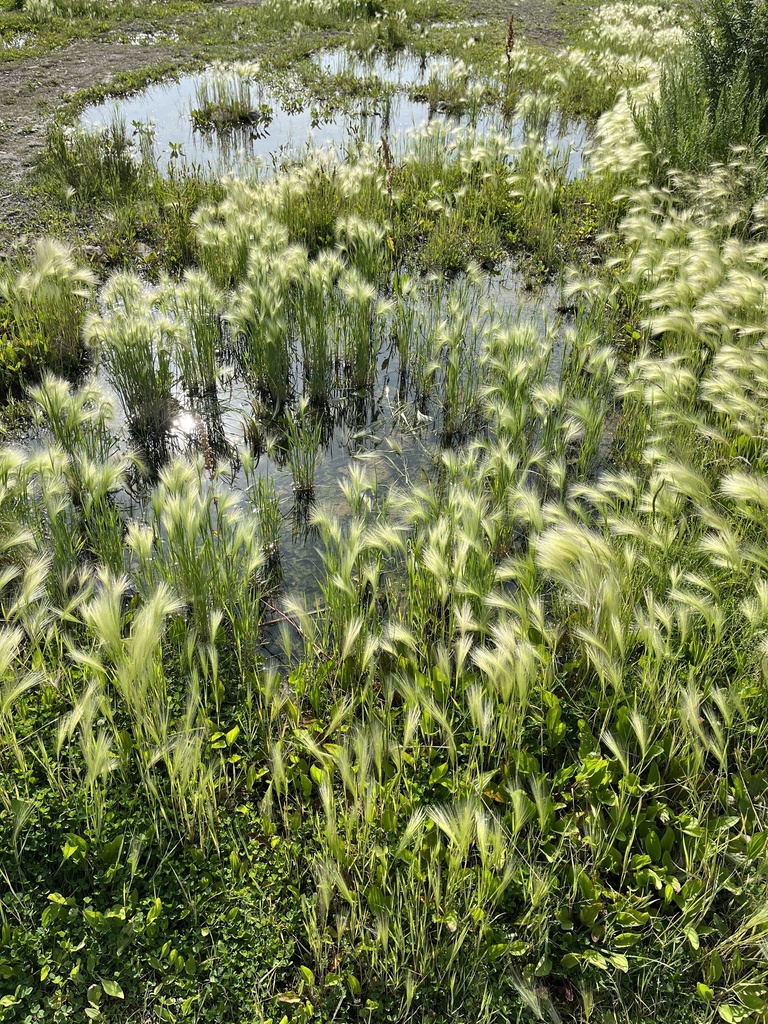
Foxtail barley grows chiefly on grassland types on the plains and lower foothills but also extends upward to subalpine elevations in the spruce belt. It is very common throughout the West, especially along roadsides and other waste places, and in grain and hay fields [17,23,31,35]. It reaches its greatest abundance on the edges of sloughs and salt marshes, grassy slopes, and flatlands in the western prairies [4]. It is also abundant in overgrazed sagebrush margins and irrigated meadows [14]. In sagebrush, pinyon-juniper, salt-desert shrub, and plains grasslands communities, it generally occurs in areas where extra water has accumulated, such as sloughs and around stock-water developments [38].

Foxtail barley growing where extra water has accumulated.
Soils and Salt Tolerance: Foxtail barley grows well on a variety of soil textures ranging from sandy loam to clay, with clay content varying from 17 percent to 56 percent [34,45]. It requires fairly moist conditions and cannot sustain itself during long dry periods [8,34]. Foxtail barley commonly occurs on soils with moderate salinity but can also grow and reproduce under nonsaline conditions [34,45]. Foxtail barley has a broad tolerance to variations in pH. It occurs in areas with a pH from 6.4 to 9.5, with a median value of 8.1 in the surface soils [34].
Elevational Range: The elevational range of foxtail barley in several western states is as follows [8]:
| State | Elevation (ft) | Elevation (m) |
|---|---|---|
| Utah | 2,500–8,800 | 762–2,682 |
| Colorado | 3,400–10,400 | 1,036–3,170 |
| Wyoming | 3,500–9,400 | 1,067–2,865 |
| Montana | 2,100–3,900 | 640–1,189 |
Plant Communities
Foxtail barley is a common riparian dominance type at low to mid-elevations throughout Montana. It occurs in disturbed areas, meadows, basins, and drawdown areas, where soils are saline or alkaline [15].
Foxtail barley may occur in relatively pure stands in moderately saline communities or as a codominant with inland saltgrass (Distichlis stricta var. stricta) and spearleaf saltweed (Atriplex patula var. hastata) [34]. Foxtail barley is also commonly associated with coastal saltgrass (Distichlis spicata), nutka alkaligrass (Puccinellia nutkaensis), Pursh seepweed (Suaeda depressa), heath aster (Aster ericoides), field sowthistle (Sonchus arvensis), curly dock (Rumex crispus), bluegrass (Poa spp.), and wheatgrass (Agropyron spp.) [6,13,15,34].

Foxtail barley dominates a flatland near Logan, Utah.
Botanical Description
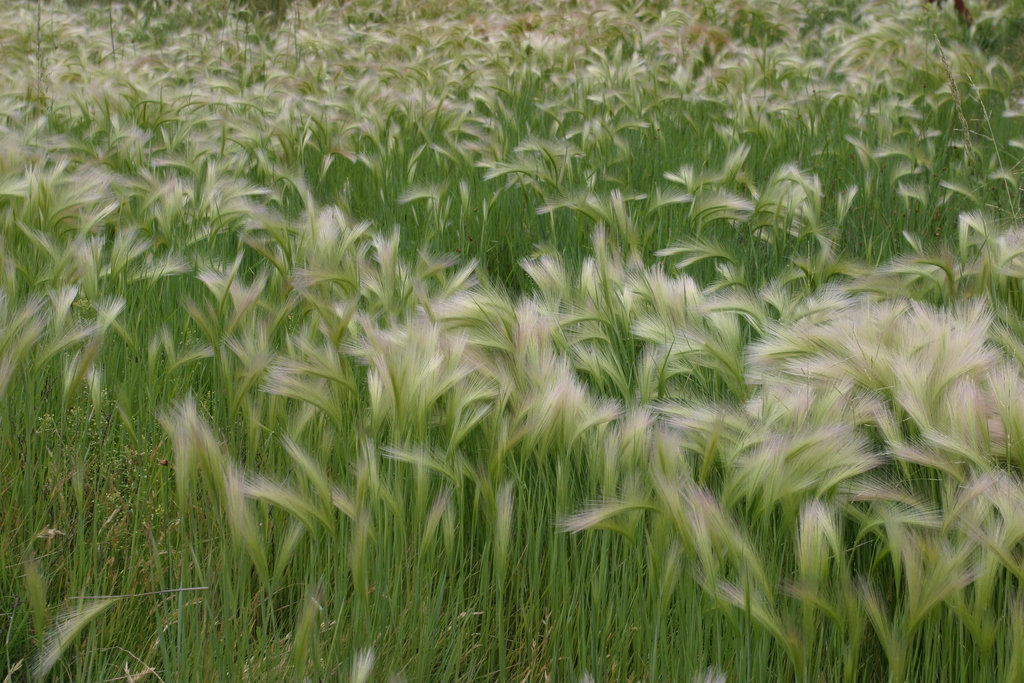
Foxtail barley is a short-lived, native, perennial, cool-season grass [1,14,26,32]. It has erect, slender stems, 1 to 2 feet (0.3-0.6 m) tall, growing in thick bunches or tufts [23,26,38]. The roots are fibrous [35].

Foxtail barley.
Raunkiaer Life Form (Raunkiaer 1934)
- Chamaephyte
- Hemicryptophyte
Seasonal Development
Foxtail barley starts growth in April or May. Flowering and seed set generally occur from May until late July [2,33,34].
Regeneration Processes
Sexual Reproduction
Foxtail barley is a prolific seeder. Ripe seedheads break up and are dispersed by wind or transported in the hair of grazing animals [35].
Seed Germination: Foxtail barley produces two germination cohorts: one in the spring and one in the fall. These two cohorts are important in maintaining populations of foxtail barley [2]. On a saline marsh at Rittman, Ohio, foxtail barley seed production per inflorescence was greater with an increase in soil salinity [1]. Seed germination is inhibited by warm summer temperatures, but seeds readily germinate when exposed to cooler fall temperatures. After cold stratification the temperature range favorable for germination broadens. Freezing temperatures result in high seed mortality [1]. Seeds are capable of germinating in 1.0 percent total salts or less. Germination decrease when salinity increases past 1.0 percent [34]. Germination is independent of light conditions [1].
Seedlings: Foxtail barley seedlings can survive for several months at salinities unfavorable for growth and reproduction. In a marsh at Rittman, Ohio, highest survival of fall and spring seedlings occurred in the most saline lower marsh [2].
Vegetative Reproduction
Foxtail barley reproduces vegetatively by tillering [33].
Successional Status
Facultative Seral Species
Foxtail barley is a pioneer or invader in disturbed areas and in areas with high salinity [10,15,20,43]. It is among the first grasses to establish after disturbance and may become dominant in early seral grassland communities. It also occurs but is not dominant in some late seral to climax grassland communities [29]. It rapidly invades areas exposed by a receding water table. If the water table becomes stabilized at a high level, foxtail barley will ultimately be replaced by saltgrass (Distichlis spp.) or common spikesedge (Eleocharis palustris) in saline areas [10,20,43].
Immediate Fire Effects
Moderate fires with probably top-kill foxtail barley, and hot fires may kill the underground root system.
Postfire Regeneration Strategy (Stickney 1989)
- Initial-offsite colonizer (off-site, initial community)
Fire Adaptations
Foxtail barley will rapidly establish on disturbed sites through off-site seed sources [15,35].
Plant Response to Fire
Foxtail barley generally recovers after fire through off-site seeds [27]. Foxtail barley is most sensitive to spring fire that coincides with its active growing period [41,42]. After a North Dakota prairie fire in the spring of 1966, foxtail barley culm production was greatly reduced [12]. However, the opposite was found to be true following a 1972 spring fire on a northwestern Minnesota prairie. Here flowering activity was stimulated [27]. Following a burn along the Missouri River Breaks of central Montana, foxtail barley was one of the first grass species to become established [44].
Fire Regimes
For fire regime information, search FEIS for this species by entering the species name or acronym on the home page and selecting “Fire Regime” as the publication type.
Fire Management Considerations
As a general rule, cool-season grasses such as foxtail barley can be reduced with late spring burns [41].
Federal Status
None
Other Status
No entry.
Importance to Wildlife and Livestock
Many waterfowl species eat the seeds and occasionally the leaves of foxtail barley [20]. Before flowering, foxtail barley is palatable to livestock and big game. Up to the time when seedheads develop, it is fair to good forage for cattle and horses and fair for domestic sheep [35].
Foxtail barley seedheads, when dry, are very harmful to all kinds of grazing animals, particularly deer, elk, and pronghorn [35]. The sharp-pointed joints of the spike, each with several long and slender awns, stick in the nose and mouth of grazing animals, often penetrating the flesh [24,35]. Infection caused by awns stuck in tissue can cause necrotic sores and necrotic stomatitis, which in turn finally attacks the bones and causes an abnormal enlargement as well as lumpy jaw and pus-forming abscesses. These infections may result in death of the animal [35].
Palatability and Nutritional Value
The palatability of foxtail barley to livestock and wildlife species in several western states is rated as follows [8]:
| Species | Colorado | Montana | North Dakota | Utah | Wyoming |
|---|---|---|---|---|---|
| Cattle | Fair | Poor | Fair | Fair | Poor |
| Domestic sheep | Fair | Fair | Fair | Poor | Fair |
| Horses | Fair | — | — | Fair | Fair |
| Pronghorn | — | Poor | Poor | Fair | Poor |
| Elk | — | Poor | — | Good | Poor |
| Mule deer | — | Poor | Poor | Fair | Poor |
| White-tailed deer | — | Poor | Poor | — | Poor |
| Small mammals | — | — | — | Fair | Fair |
| Small nongame birds | — | Fair | — | Fair | — |
| Upland game birds | — | Poor | — | Fair | Fair |
| Waterfowl | Good | Fair | — | Fair | Fair |
Cover Value
The degree to which foxtail barley provides environmental protection during one or more seasons for wildlife species is rated as follows [8]:
| Species | Colorado | Montana | North Dakota | Utah | Wyoming |
|---|---|---|---|---|---|
| Pronghorn | — | — | Poor | Poor | Poor |
| Elk | — | Poor | — | Poor | Poor |
| Mule deer | — | Poor | Poor | Poor | Poor |
| White-tailed deer | Poor | Fair | — | Poor | — |
| Small mammals | — | Poor | — | Fair | Good |
| Small nongame birds | — | Poor | — | Fair | Good |
| Upland game birds | Poor | Poor | — | Fair | Fair |
| Waterfowl | — | Good | Good | Fair | Fair |
Value for Rehabilitation or Restoration of Disturbed Sites
Foxtail barley has potential for revegetation of saline mine spoils where forage value is of secondary importance. Its extensive root system and aggressive habit make it a good species for erosion control. Foxtail barley seeds are not commercially available [45].
Other Uses
Foxtail barley, cut before the awns have expanded, is sometimes used as an ornamental in dry bouquets [24].
Other Management Considerations
Because of the damage foxtail barley can cause to livestock and other animals, it is often considered a pasture weed [21,24,35]. Hay containing foxtail barley is nearly valueless [24]. Additionally, seedheads of this species can downgrade the value of wool or pelts, causing further economic loss to ranchers [24]. Once established, foxtail barley is hard to eradicate. It increases under excessive grazing pressure. Dense stands are usually associated with some type of disturbance, such as overgrazing, close mowing, or repeated burning [14,29,45].
Seeding disturbed meadows and pastures with desirable, fast-growing forage grasses is effective in reducing the amount of foxtail barley that invades the site. Additionally, conservative grazing can facilitate the establishment of native, palatable grasses and reduce foxtail barley [15,35].
Control with herbicides: Forty-eight pounds of dalapon (2,2-dichloropropionic acid) per acre (7.2 kg/ha) in water at 50 gallons per acre (76 liters/ha) has been shown to give complete kill of foxtail barley. Lower rates of 16 and 32 pounds of dalapon per acre (2.4 kg/ha-4.8 kg/ha) allows some survival. A combination of 30 pounds (4.5 kg/ha) of dalapon and 4 pounds (0.6 kg/ha) of amino triazole per acre will also effectively control foxtail barley [36]. The herbicide mefluidide is most effective in controlling foxtail barley when applied near initiation of flowering [39]. In a meadow brome (Bromus spp.) stand, the herbicide kerb at the rate of 0.5 pounds per acre ( 0.7 kg/ha) gave excellent control of foxtail barley without apparent reduction of the meadow brome [18].
Table A1— Forest and range ecosystems, Bureau of Land Management (BLM) physiographic regions, Kuchler plant associations, Society for American Foresters (SAF) forest cover types, and Society for Rangeland Management (SRM) rangeland cover types in which this species occurs.
Forest and Range Ecosystems (Garrison et al. 1977)
- FRES10 White - red - jack pine
- FRES11 Spruce - fir
- FRES20 Douglas-fir
- FRES21 Ponderosa pine
- FRES23 Fir - spruce
- FRES24 Hemlock - Sitka spruce
- FRES29 Sagebrush
- FRES30 Desert shrub
- FRES34 Chaparral - mountain shrub
- FRES35 Pinyon - juniper
- FRES36 Mountain grasslands
- FRES37 Mountain meadows
- FRES38 Plains grasslands
- FRES39 Prairie
- FRES40 Desert grasslands
- FRES41 Wet grasslands
- FRES42 Annual grasslands
- FRES44 Alpine
BLM Physiographic Regions (Bernard and Brown 1977)
- 1 Northern Pacific Border
- 2 Cascade Mountains
- 3 Southern Pacific Border
- 4 Sierra Mountains
- 5 Columbia Plateau
- 6 Upper Basin and Range
- 7 Lower Basin and Range
- 8 Northern Rocky Mountains
- 9 Middle Rocky Mountains
- 10 Wyoming Basin
- 11 Southern Rocky Mountains
- 12 Colorado Plateau
- 13 Rocky Mountain Piedmont
- 14 Great Plains
- 15 Black Hills Uplift
- 16 Upper Missouri Basin and Broken Lands
Kuchler Plant Associations (Kuchler 1964)
- K001 Spruce - cedar - hemlock forest
- K010 Ponderosa shrub forest
- K011 Western ponderosa forest
- K012 Douglas-fir forest
- K015 Western spruce - fir forest
- K016 Eastern ponderosa forest
- K017 Black Hills pine forest
- K018 Pine - Douglas-fir forest
- K019 Arizona pine forest
- K021 Southwestern spruce - fir forest
- K023 Juniper - pinyon woodland
- K024 Juniper steppe woodland
- K027 Mesquite bosque
- K033 Chaparral
- K034 Montane chaparral
- K037 Mountain-mahogany - oak scrub
- K038 Great Basin sagebrush
- K039 Blackbrush
- K040 Saltbush - greasewood
- K041 Creosotebush
- K048 California steppe
- K049 Tule marshes
- K050 Fescue - wheatgrass
- K051 Wheatgrass - bluegrass
- K053 Grama - galleta steppe
- K055 Sagebrush steppe
- K056 Wheatgrass - needlegrass shrubsteppe
- K057 Galleta - three-awn shrubsteppe
- K060 Mesquite savanna
- K063 Foothills prairie
- K064 Grama - needlegrass - wheatgrass
- K065 Grama - buffalograss
- K066 Wheatgrass - needlegrass
- K067 Wheatgrass - bluestem - needlegrass
- K068 Wheatgrass - grama - buffalograss
- K069 Bluestem - grama prairie
- K070 Sandsage - bluestem prairie
- K074 Bluestem prairie
- K081 Oak savanna
- K093 Great Lakes spruce - fir forest
- K094 Conifer bog
- K095 Great Lakes pine forest
- K098 Northern floodplain forest
- K101 Elm - ash forest
SAF Cover Types (Eyre 1980)
- 1 Jack pine
- 5 Balsam fir
- 12 Black spruce
- 13 Black spruce - tamarack
- 22 White pine - hemlock
- 23 Eastern hemlock
- 38 Tamarack
- 32 Red spruce
- 33 Red spruce - balsam fir
- 34 Red spruce - Fraser fir
- 31 Red spruce - sugar maple - beech
- 35 Paper birch - red spruce - balsam fir
- 206 Engelmann spruce - subalpine fir
- 210 Interior Douglas-fir
- 224 Western hemlock
- 225 Western hemlock - Sitka spruce
- 229 Pacific Douglas-fir
- 230 Douglas-fir - western hemlock
- 237 Interior ponderosa pine
- 239 Pinyon - juniper
- 244 Pacific ponderosa pine - Douglas-fir
- 245 Pacific ponderosa pine
SRM Rangeland Cover Types (Shiflet 1994)
- No entry
1. Badger, Kemuel S.; Ungar, Irwin A. 1989. The effects of salinity and temperature on the germination of the inland halophyte Hordeum jubatum. Canadian Journal of Botany. 67(5): 1420-1425. [14650]
2. Badger, Kemuel S.; Ungar, Irwin A. 1991. Life history and population dynamics of Hordeum jubatum along a soil salinity gradient. Canadian Journal of Botany. 69: 384-393. [14539]
3. Barkworth, Mary E.; Dewey, Douglas R. 1985. Genomically based genera in the perennial Triticeae of North America: identification and membership. American Journal of Botany. 72(5): 767-776. [393]
4. Baum, Bernard R.; Bailey, L. Grant. 1990. Key and synopsis of North American Hordeum species. Canadian Journal of Botany. 68: 2433-2442. [16150]
5. Bernard, Stephen R.; Brown, Kenneth F. 1977. Distribution of mammals, reptiles, and amphibians by BLM physiographic regions and A.W. Kuchler's associations for the eleven western states. Tech. Note 301. Denver, CO: U.S. Department of the Interior, Bureau of Land Management. 169 p. [434]
6. Clambey, Gary K.; Landers, Roger Q. 1978. A survey of wetland vegetation in north-central Iowa. In: Glenn-Lewin, David C.; Landers, Roger Q., Jr., eds. Proceedings, 5th Midwest prairie conference; 1976 August 22-24; Ames, IA. Ames, IA: Iowa State University: 32-35. [3304]
7. Conn, Jeffery S. 1990. Seed viability and dormancy of 17 weed species after burial for 4.7 years in Alaska. Weed Science. 38: 134-138. [11815]
8. Dittberner, Phillip L.; Olson, Michael R. 1983. The plant information network (PIN) data base: Colorado, Montana, North Dakota, Utah, and Wyoming. FWS/OBS-83/86. Washington, DC: U.S. Department of the Interior, Fish and Wildlife Service. 786 p. [806]
9. Eyre, F. H., ed. 1980. Forest cover types of the United States and Canada. Washington, DC: Society of American Foresters. 148 p. [905]
10. Frolik, A. L.; Shepherd, W. O. 1940. Vegetative composition and grazing capacity of a typical area of Nebraska sandhills rangeland. University of Nebraska Agricultural Experimental Station Research Bulletin. Number 117. 39 p. [5417]
11. Garrison, George A.; Bjugstad, Ardell J.; Duncan, Don A.; [and others]. 1977. Vegetation and environmental features of forest and range ecosystems. Agric. Handb. 475. Washington, DC: U.S. Department of Agriculture, Forest Service. 68 p. [998]
12. Hadley, Elmer B. 1970. Net productivity and burning response of native eastern North Dakota prairie communities. American Midland Naturalist. 84(1): 121-135. [5434]
13. Hadley, E. B.; Buccos, R. P. 1967. Plant community composition and net primary production within a native eastern North Dakota prairie. American Midland Naturalist. 77: 116-127. [11422]
14. Hallsten, Gregory P.; Skinner, Quentin D.; Beetle, Alan A. 1987. Grasses of Wyoming. 3rd ed. Research Journal 202. Laramie, WY: University of Wyoming, Agricultural Experiment Station. 432 p. [2906]
15. Hansen, Paul L.; Chadde, Steve W.; Pfister, Robert D. 1988. Riparian dominance types of Montana. Misc. Publ. No. 49. Missoula, MT: University of Montana, School of Forestry, Montana Forest and Conservation Experiment Station. 411 p. [5660]
16. Hitchcock, C. Leo; Cronquist, Arthur. 1961. Vascular plants of the Pacific Northwest. Part 3: Saxifragaceae to Ericaceae. Seattle, WA: University of Washington Press. 614 p. [1167]
17. Hitchcock, C. Leo; Cronquist, Arthur. 1973. Flora of the Pacific Northwest. Seattle, WA: University of Washington Press. 730 p. [1168]
18. Humberg, N. E.; Alley, H. P.; Vore, R. E. 1981. Rangeland and meadowland: Section II. University of Wyoming Agricultural Experiment Station Research Journal. 63: 29-51. [4907]
19. Kartesz, John T.; Kartesz, Rosemarie. 1980. A synonymized checklist of the vascular flora of the United States, Canada, and Greenland. Volume II: The biota of North America. Chapel Hill, NC: The University of North Carolina Press; in confederation with Anne H. Lindsey and C. Richie Bell, North Carolina Botanical Garden. 500 p. [6954]
20. Keith, Lloyd B. 1961. A study of waterfowl ecology on small impoundments in southeastern Alberta. Wildlife Monographs. 6: 1-88. [4501]
21. Kingsbury, John M. 1964. Poisonous plants of the United States and Canada. Englewood Cliffs, NJ: Prentice-Hall, Inc. 626 p. [122]
22. Kuchler, A. W. 1964. Manual to accompany the map of potential vegetation of the conterminous United States. Special Publication No. 36. New York: American Geographical Society. 77 p. [1384]
23. Lackschewitz, Klaus. 1991. Vascular plants of west-central Montana--identification guidebook. Gen. Tech. Rep. INT-227. Ogden, UT: U.S. Department of Agriculture, Forest Service, Intermountain Research Station. 648 p. [13798]
24. Lamson-Scribner, F. 1900. Economic grasses. Bulletin No. 14. Washington, DC: U.S. Department of Agriculture, Division of Agrostology. 85 p. [4282]
25. Lyon, L. Jack; Stickney, Peter F. 1976. Early vegetal succession following large northern Rocky Mountain wildfires. In: Proceedings, Tall Timbers fire ecology conference and Intermountain Fire Research Council fire and land management symposium; 1974 October 8-10; Missoula, MT. No. 14. Tallahassee, FL: Tall Timbers Research Station: 355-373. [1496]
26. Morris, H. E.; Booth, W. E.; Payne, G. F.; Stitt, R. E. 1950. Important grasses on Montana ranges. Bull. No. 470. Bozeman, MT: Montana Agricultural Experiment Station. 52 p. [5520]
27. Pemble, R. H.; Van Amburg, G. L.; Mattson, Lyle. 1981. Intraspecific variation in flowering activity following a spring burn on a northwestern Minnesota prairie. In: Stuckey, Ronald L.; Reese, Karen J., eds. The prairie peninsula--in the "shadow" of Transeau: Proceedings, 6th North American prairie conference; 1978 August 12-17; Columbus, OH. Ohio Biological Survey: Biological Notes No. 15. Columbus, OH: Ohio State University, College of Biological Sciences: 235-240. [3435]
28. Ferguson, Dennis E.; Boyd, Raymond J. 1988. Bracken fern inhibition of conifer regeneration in northern Idaho. Ogden, UT: U.S. Department of Agriculture, Forest Service, Intermountain Research Station. 11 p. [2834]
29. Ross, Robert L.; Hunter, Harold E. 1976. Climax vegetation of Montana based on soils and climate. Bozeman, MT: U.S. Department of Agriculture, Soil Conservation Service. 64 p. [2028]
30. Russell, W. B. 1985. Vascular flora of abandoned coal-mined land, Rocky Mountain Foothills, Alberta. Canadian Field-Naturalist. 99(4): 503-516. [10461]
31. Sampson, Arthur W.; Chase, Agnes; Hedrick, Donald W. 1951. California grasslands and range forage grasses. Bull. 724. Berkeley, CA: University of California College of Agriculture, California Agricultural Experiment Station. 125 p. [2052]
32. Stubbendieck, J.; Nichols, James T.; Roberts, Kelly K. 1985. Nebraska range and pasture grasses (including grass-like plants). E.C. 85-170. Lincoln, NE: University of Nebraska, Department of Agriculture, Cooperative Extension Service. 75 p. [2269]
33. Stubbendieck, J.; Hatch, Stephan L.; Hirsch, Kathie J. 1986. North American range plants. 3rd ed. Lincoln, NE: University of Nebraska Press. 465 p. [2270]
34. Ungar, Irwin A. 1974. Inland halophytes of the United States. In: Reinold, Robert J.; Queen, William H., eds. Ecology of halophytes. New York: Academic Press, Inc: 235-305. [11429]
35. U.S. Department of Agriculture, Forest Service. 1937. Range plant handbook. Washington, DC. 532 p. [2387]
36. U.S. Department of Agriculture, U.S. Department of the Interior; Range Seeding Equipment Committee. 1959. Handbook: Chemical control of range weeds. Washington, DC: [Publisher unknown]. 93 p. [12129]
37. U.S. Department of Agriculture, Soil Conservation Service. 1982. National list of scientific plant names. Vol. 1. List of plant names. SCS-TP-159. Washington, DC. 416 p. [11573]
38. Vallentine, John F. 1961. Important Utah range grasses. Extension Circular 281. Logan, UT: Utah State University. 48 p. [2937]
39. White, Larry M. 1989. Growth regulators' effect on crested wheatgrass forage yield and quality. Journal of Range Management. 42(1): 46-50. [4170]
40. Whitman, W. C., Wali, M. K. 1975. Grasslands of North Dakota. In: Wali, Mohan K., ed. Prairie: a multiple view. Grand Forks, ND: University of North Dakota Press: 53-74. [4430]
41. Wright, Henry A.; Bailey, Arthur W. 1982. Fire ecology: United States and southern Canada. New York: John Wiley & Sons. 501 p. [2620]
42. Young, Richard P. 1986. Fire ecology and management in plant communities of Malheur National Wildlife Refuge. Portland, OR: Oregon State University. 169 p. Thesis. [3745]
43. Millar, J. B. 1973. Vegetation changes in shallow marsh wetlands under improving moisture regimes. Canadian Journal of Botany. 51: 1443-1457. [14589]
44. Eichhorn, Larry C.; Watts, C. Robert. 1984. Plant succession on burns in the river breaks of central Montana. Proceedings, Montana Academy of Science. 43: 21-34. [15478]
45. Hardy BBT Limited. 1989. Manual of plant species suitability for reclamation in Alberta. 2d ed. Report No. RRTAC 89-4. Edmonton, AB: Alberta Land Conservation and Reclamation Council. 436 p. [15460]
46. Stickney, Peter F. 1989. Seral origin of species originating in northern Rocky Mountain forests. Unpublished draft on file at: U.S. Department of Agriculture, Forest Service, Intermountain Research Station, Fire Sciences Laboratory, Missoula, MT; RWU 4403 files. 7 p. [20090]