


Mitchella repens, partridgeberry
Coladonato, Milo. 1993. Mitchella repens, partridgeberry. In: Fire Effects Information System, [Online]. U.S. Department of Agriculture, Forest Service, Rocky Mountain Research Station, Fire Sciences Laboratory (Producer). Available: https://research.fs.usda.gov/feis/species-reviews/mitrep
| Abbreviation | Common Name | Scientific Name | Classification | Status |
|---|---|---|---|---|
| Plants | ||||
| MITREP | partridgeberry | Mitchella repens | Life Form: Plants/Shrub Kingdom: Plantae Class: Dicot Order: Rubiales Family: Rubiaceae Genus: Mitchella | Fed. Protected: No Nativity: Native Invasiveness: Noninvasive |

Taxonomy
The currently accepted scientific name for partridgeberry is Mitchella repens L. [5,10]. There are no recognized subspecies, varieties, or forms.
Synonyms
No entry.
Other Common Names
two-eyed, berry running-fox
General Distribution
Partridgeberry is widely distributed throughout the eastern United States. It ranges from Newfoundland south to central Florida and from southern Ontario and Minnesota south to eastern Texas [4,5,22,24,31].
States and Provinces
- United States: AL AR CT DE FL GA IL IN IA KS KY ME MD MA MI MN MS MO NH NJ NY NC OH OK PA SC TN TX VT VA WV WI
- Canada: NB NF NS ON PQ
Site Characteristics
Partridgeberry grows on a variety of sites but generally prefers mildly acidic, well-drained mesic soils [1,17] It grows on leached banks, shaded sandstone ledges, and mossy hammocks and bogs [4,10,11].
In addition to those identified under Distribution and Occurrence, common associates of partridgeberry include red mulberry (Morus rubra), strawberry-bush (Euonymus americanus), Carolina silverberry (Halesia carolina), southern black-haw (Viburnum prunifolium), devil's walkingstick (Aralia spinosa), Virginia creeper (Parthenocissus quinquefolia), Canada mayflower (Maianthemum canadense), yaupon (Ilex vomitoria), huckleberry (Gaylussacia spp.), blueberry (Vaccinium spp.), hickory (Carya spp.), grape (Vitis spp.), wintergreen (Gaultheria procumbens), and fetterbush (Lyonia ferruginea) [3,4,16,26]. A complete list of trees associated with partridgeberry would include a majority of trees growing in the eastern United States.
Plant Communities
Partridgeberry is part of the climax undergrowth vegetation in several forest communities in the eastern United States. It is not an indicator or dominant species in any habitat types [12,16,21,26].
Botanical Description

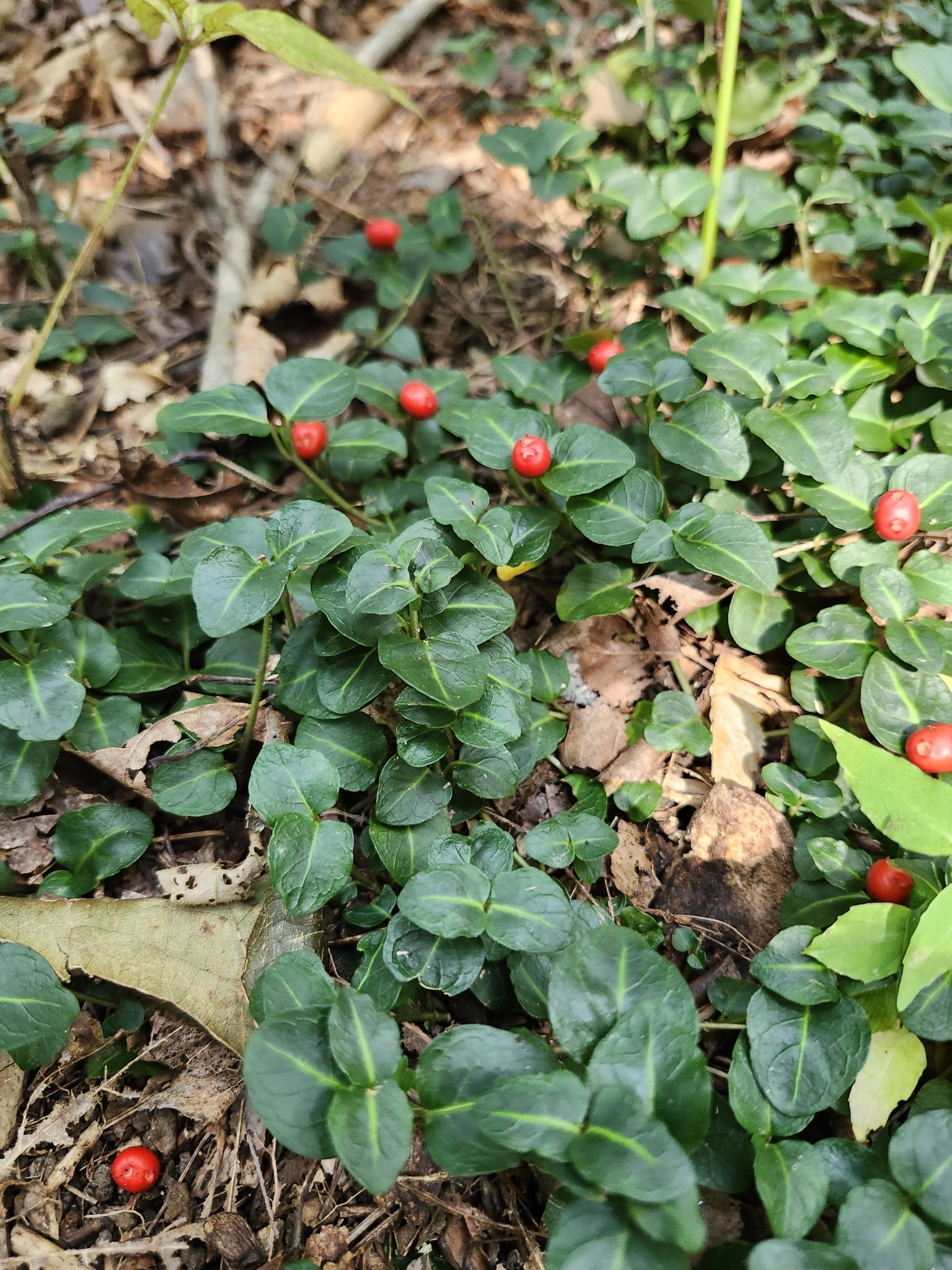
Partridgeberry.
Partridgeberry is a creeping, rhizomatous, evergreen, woody vine up to 1.5 feet (50 cm) tall. It roots at the nodes and often forms loose mats. The flowers are borne in axillary, single stalks at the tip of the branchlets. The fruit is a drupe containing eight seeds [11,19,22,24].
Raunkiaer Life Form (Raunkiaer 1934)
- Hemicryptophyte
Seasonal Development
Partridgeberry flowers between April and June, and often again in autumn. The fruit ripens between July and October, and often persists throughout the year [3,10,28].
Regeneration Processes
Although partridgeberry is a seed producer, information regarding its propagation by seed is scant. The primary mode of reproduction is vegetative [3].
Successional Status
Facultative Seral Species
Partridgeberry is a shade tolerant, mid- to late-seral species. It is a component of climax forests in the eastern United States [3,16,26].
Immediate Fire Effects
Most fires probably top-kill partridgeberry, and severe fires may kill the plant.
Postfire Regeneration Strategy (Stickney 1989)
- Rhizomatous low woody plant, rhizome in organic mantle
Fire Adaptations
Partridgeberry is not well adapted to fire. The rhizomes are usually in the litter layer and not well protected from fire [6,18]. However, protected and underground rhizomes probably sprout following fire. Partridgeberry probably colonizes burned area by animal-dispersed seed or by trailing vines, but these regeneration strategies have not been documented in the literature.
Plant Response to Fire
Partridgeberry's response to fire is not well documented. Reports in the literature suggest that it is a fire decreaser, although postfire density, frequency, or growth rates for partridgeberry were not given [9,23,29,30].
The Research Project Summary Effects of surface fires in a mixed red and eastern white pine stand in Michigan provides information on prescribed fire and postfire response of plant community species, including partridgeberry, that was not available when this species review was written.
Fire Regimes
For fire regime information, search FEIS for this species by entering the species name on the Advanced Search page and selecting “Fire Regime” as the publication type.
Fire Management Considerations
No entry.
Federal Status
None
Other Status
None
Importance to Wildlife and Livestock
The fruit of partridgeberry is eaten by ruffed grouse, northern bobwhite, sharp-tailed grouse, and prairie chicken. The fruit is also frequently eaten by raccoons and red fox [5,28]. Keegan [13] reported that partridgeberry made up 2.9 to 3.4 percent (dry weight) of the summer and fall diets of white-tailed deer.
Palatability and Nutritional Value
No entry.
Cover Value
No entry.
Value for Rehabilitation or Restoration of Disturbed Sites
No entry.
Other Uses
Partridgeberry has been planted as an ornamental in several parts of its range [2]. In Newfoundland, the berry is made into jam and sold commercially [15].
Other Management Considerations
No entry.
Table A1— Forest and range ecosystems, Bureau of Land Management (BLM) physiographic regions, Kuchler plant associations, Society for American Foresters (SAF) forest cover types, and Society for Rangeland Management (SRM) rangeland cover types in which this species occurs.
Forest and Range Ecosystems (Garrison et al. 1977)
- FRES10 White - red - jack pine
- FRES11 Spruce – fir
- FRES12 Longleaf - slash pine
- FRES13 Loblolly - shortleaf pine
- FRES14 Oak – pine
- FRES15 Oak – hickory
- FRES16 Oak - gum – cypress
- FRES17 Elm - ash – cottonwood
- FRES18 Maple - beech – birch
- FRES19 Aspen - birch
BLM Physiographic Regions (Bernard and Brown 1977)
No entry.
Kuchler Plant Associations (Kuchler 1964)
- K095 Great Lakes pine forest
- K096 Northeastern spruce - fir forest
- K097 Southeastern spruce - fir forest
- K100 Oak - hickory forest
- K101 Elm - ash forest
- K102 Beech - maple forest
- K104 Appalachian oak forest
- K106 Northern hardwoods
- K111 Oak - hickory - pine forest
- K112 Southern mixed forest
- K113 Southern floodplain forest
SAF Cover Types (Eyre 1980)
- 14 Northern pin oak
- 17 Pin cherry
- 19 Gray birch - red maple
- 20 White pine - northern red oak - red maple
- 21 Eastern white pine
- 22 White pine – hemlock
- 23 Eastern hemlock
- 25 Sugar maple - beech - yellow birch
- 28 Black cherry – maple
- 31 Red spruce - sugar maple – beech
- 43 Bear oak
- 44 Chestnut oak
- 51 White pine - chestnut oak
- 52 White oak - black oak - northern red oak
- 53 White oak
- 55 Northern red oak
- 59 Yellow-poplar - white oak - northern red oak
- 60 Beech - sugar maple
- 62 Silver maple - American elm
- 64 Sassafras – persimmon
- 80 Loblolly pine - shortleaf pine
- 82 Loblolly pine – hardwood
- 83 Longleaf pine - slash pine
- 93 Sugarberry - American elm - green ash
- 97 Atlantic white-cedar
- 108 Red maple
- 110 Black oak
SRM Rangeland Cover Types (Shiflet 1994)
No entry.
1. Archambault, Louis; Barnes, Burton V.; Witter, John A. 1989. Ecological species groups of oak ecosystems of southeastern Michigan. Forest Science. 35(4): 1058-1074. [9768]
2. Bare, Janet E. 1979. Wildflowers and weeds of Kansas. Lawrence, KS: The Regents Press of Kansas. 509 p. [3801]
3. Bierzychudek, Paulette. 1982. Life histories and demography of shade-tolerant temperate forest herbs: a review. New Phytologist. 90: 757-776. [19197]
4. Braun, E. Lucy. 1961. The woody plants of Ohio. Columbus, OH: Ohio State University Press. 362 p. [12914]
5. Brinkman, K. A.; Erdmann, G. G. 1974. Mitchella repens L. partridgeberry. In: Schopmeyer, C. S., ed. Seeds of woody plants in the United States. Agric. Handb. 450. Washington, DC: U.S. Department of Agriculture, Forest Service: 543. [7709]
6. Chapman, Rachel Ross; Crow, Garrett E. 1981. Application of Raunkiaer's life form system to plant species survival after fire. Torrey Botanical Club. 108(4): 472-478. [7432]
7. Eyre, F. H., ed. 1980. Forest cover types of the United States and Canada. Washington, DC: Society of American Foresters. 148 p. [905]
8. Garrison, George A.; Bjugstad, Ardell J.; Duncan, Don A.; [and others]. 1977. Vegetation and environmental features of forest and range ecosystems. Agric. Handb. 475. Washington, DC: U.S. Department of Agriculture, Forest Service. 68 p. [998]
9. Gilliam, Frank S. 1991. The significance of fire in an oligotrophic forest ecosystem. In: Nodvin, Stephen C.; Waldrop, Thomas A., eds. Fire and the environment: ecological and cultural perspectives: Proceedings of an international symposium; 1990 March 20-24; Knoxville, TN. Gen. Tech. Rep. SE-69. Asheville, NC: U.S. Department of Agriculture, Forest Service, Southeastern Forest Experiment Station: 113-122. [16641]
10. Godfrey, Robert K. 1988. Trees, shrubs, and woody vines of northern Florida and adjacent Georgia and Alabama. Athens, GA: The University of Georgia Press. 734 p. [10239]
11. Godfrey, Robert K.; Wooten, Jean W. 1981. Aquatic and wetland plants of southeastern United States: Dicotyledons. Athens, GA: The University of Georgia Press. 933 p. [16907]
12. Hough, A. F. 1936. A climax forest community on East Tionesta Creek in northwestern Pennsylvania. Ecology. 17(1): 9-28. [3460]
13. Keegan, Thomas W.; Johnson, Mark K.; Nelson, Billy D. 1989. American jointvetch improves summer range for white-tailed deer. Journal of Range Management. 42(2): 128-134. [9840]
14. Kuchler, A. W. 1964. Manual to accompany the map of potential vegetation of the conterminous United States. Special Publication No. 36. New York: American Geographical Society. 77 p. [1384]
15. Kudish, Michael. 1992. Adirondack upland flora: an ecological perspective. Saranac, NY: The Chauncy Press. 320 p. [19376]
16. Kurz, Herman. 1944. Secondary forest succession in the Tallahassee Red Hills. Proceedings, Florida Academy of Science. 7(1): 59-100. [10799]
17. Lemieux, G. J. 1963. Soil-vegetation relationships in northern hardwoods of Quebec. In: Forest-soil relationships in North America. Corvallis, OR: Oregon State University Press: 163-176. [8874]
18. McKinley, Carol E.; Day, Frank P., Jr. 1979. Herb. prod. in cut-burned, uncut-burned & contl areas of a Chamaecyparis thyoides (L.) BSP (Cupressaceae) stand in the Great Dismal Swamp. Bulletin of the Torrey Botanical Club. 106(1): 20-28. [14089]
19. Radford, Albert E.; Ahles, Harry E.; Bell, C. Ritchie. 1968. Manual of the vascular flora of the Carolinas. Chapel Hill, NC: The University of North Carolina Press. 1183 p. [7606]
20. Raunkiaer, C. 1934. The life forms of plants and statistical plant geography. Oxford: Clarendon Press. 632 p. [2843]
21. Roberts, Mark R.; Christensen, Norman L. 1988. Vegetation variation among mesic successional forest stands in northern lower Michigan. Canadian Journal of Botany. 66(6): 1080-1090. [14479]
22. Roland, A. E.; Smith, E. C. 1969. The flora of Nova Scotia. Halifax, NS: Nova Scotia Museum. 746 p. [13158]
23. Sidhu, S. S. 1973. Early effects of burning and logging in pine-mixed woods. I. Frequency and biomass of minor vegetation. Inf. Rep. PS-X-46. Chalk River, ON: Canadian Forestry Service, Petawawa Forest Experiment Station. 47 p. [7901]
24. Soper, James H.; Heimburger, Margaret L. 1982. Shrubs of Ontario. Life Sciences Misc. Publ. Toronto, ON: Royal Ontario Museum. 495 p. [12907]
25. Stickney, Peter F. 1989. Seral origin of species originating in northern Rocky Mountain forests. Unpublished draft on file at: U.S. Department of Agriculture, Forest Service, Intermountain Research Station, Fire Sciences Laboratory, Missoula, MT; RWU 4403 files. 7 p. [20090]
26. Stransky, John J.; Huntley, Jimmy C.; Risner, Wanda J. 1986. Net community production dynamics in the herb-shrub stratum of a loblolly pine-hardwood forest: effects of clearcutting and site prepar. Gen. Tech. Rep. SO-61. New Orleans, LA: U.S. Department of Agriculture, Forest Service, Southern Forest Experiment Station. 11 p. [9835]
27. U.S. Department of Agriculture, Soil Conservation Service. 1982. National list of scientific plant names. Vol. 1. List of plant names. SCS-TP-159. Washington, DC. 416 p. [11573]
28. Van Dersal, William R. 1938. Native woody plants of the United States, their erosion-control and wildlife values. Washington, DC: U.S. Department of Agriculture. 362 p. [4240]
29. Waldrop, Thomas A.; White, David L.; Jones, Steven M. 1992. Fire regimes for pine-grassland communities in the southeastern United States. Forest Ecology and Management. 47: 195-210. [17763]
30. White, David L.; Waldrop, Thomas A.; Jones, Stephen M. 1991. Forty years of prescribed burning on the Santee fire plots: effects on understory vegetation. In: Nodvin, Stephen C.; Waldrop, Thomas A., eds. Fire and the environment: ecological and cultural perspectives: Proceedings of an international symposium; 1990 March 20-24; Knoxville, TN. Gen. Tech. Rep. SE-69. Asheville, NC: U.S. Department of Agriculture, Forest Service, Southeastern Forest Experiment Station: 51-59. [16633]
31. Wunderlin, Richard P. 1982. Guide to the vascular plants of central Florida. Tampa, FL: University Presses of Florida, University of South Florida. 472 p. [13125]