


Thalictrum dioicum, early meadow-rue
Pavek, Diane S. 1992. Thalictrum dioicum, early meadow-rue. In: Fire Effects Information System, [Online]. U.S. Department of Agriculture, Forest Service, Rocky Mountain Research Station, Fire Sciences Laboratory (Producer). Available: https://research.fs.usda.gov/feis/species-reviews/thadio
| Abbreviation | Common Name | Scientific Name | Classification | Status |
|---|---|---|---|---|
| Plants | ||||
| THADIO | early meadow-rue | Thalictrum dioicum | Life Form: Plants/Forb Kingdom: Plantae Class: Dicot Order: Ranunculales Family: Ranunculaceae Genus: Thalictrum | Fed. Protected: No Nativity: Native Invasiveness: Noninvasive |


Taxonomy
The scientific name for early meadow-rue is Thalictrum dioicum L. It has three recognized varieties in Canada:
- Thalictrum dioicum var. adiantinum Greene,
- Thalictrum dioicum var. huronense Greene
- Thalictrum dioicum var. langfordii Greene [19].
In Canada and Minnesota, this species has been confused with Thalictrum venulosum Trel., which is a separate and valid species [12].
Synonyms
- No entry
Other Common Names
quicksilver-weed, dioecious meadowrue
General Distribution
Early meadow-rue's range extends from south-central Canada south to Georgia and Alabama. It is distributed eastward from the Mississippi River to the Atlantic Coast [9,17,20,21].

Distribution of early meadow-rue.
States and Provinces
- United States: AL CT GA IL IA KS KY MA ME MI MN MO ND NH RI SC SD TN VT WI WV
- Canada: LB MB ON PQ SK
Site Characteristics
Early meadow-rue commonly occurs on alluvial soils that range from well-drained sandy loams to poorly drained clays [1,16]; however, it usually is found on well-drained soils [1]. It grows in moist open woods and is found on north-facing slopes, ledges, rocky areas, ravines, and near limestone outcrops [21].
Plant Communities
Early meadow-rue is listed as a dominant in the following classification:
Field guide to forest habitat types of northern Wisconsin [10].
Botanical Description
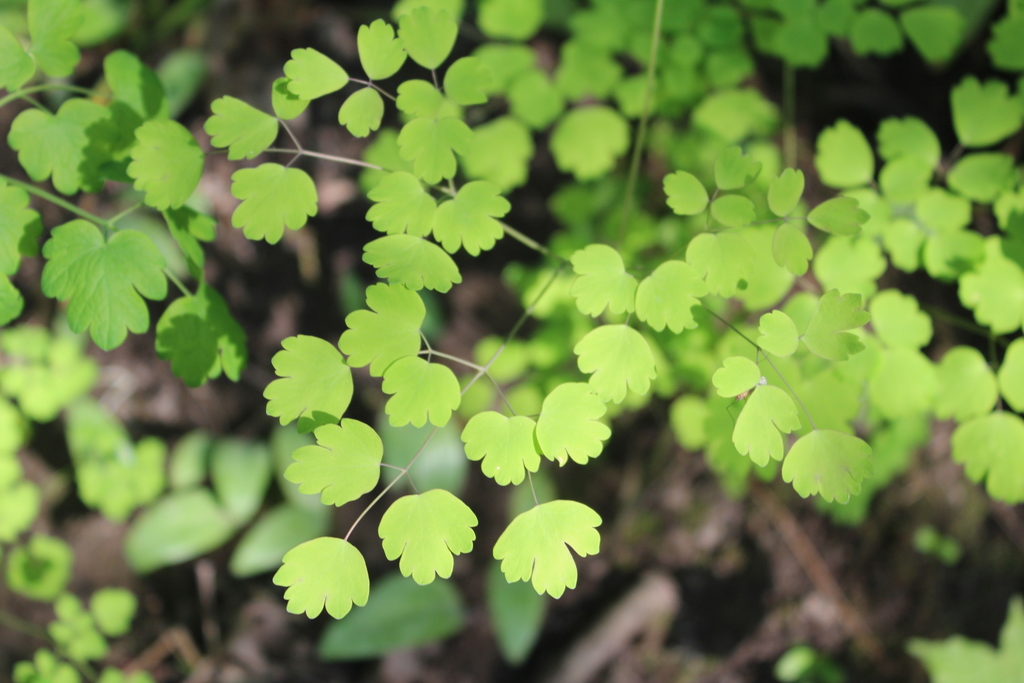
Early meadow-rue is a dioecious perennial. Its hollow stems rise 8 to 28 inches (20-70 cm) from a caudex or rootstock [9]. The caudex has dried persistent bracts from the growth of previous years. The alternate, compound leaves have long stalks. Flowers have no petals and are in loose, open panicles. Both male and female flowers have four purple to greenish white sepals that drop off before fruits are formed [9].
Raunkiaer Life Form (Raunkiaer 1934)
- Hemicryptophyte
Seasonal Development
With its leaves about half grown, early meadow-rue blooms early in spring (April or May) throughout its range [9,17,20,21]. It flowers with or before the expansion of leaves on deciduous trees. Fruit begins to mature approximately 1 month later (June) [9,17,20,21]. Leaves are maintained throughout summer. In fall, leaves become senescent, and there are no living shoots during winter [9,17,20,21].
Regeneration Processes
Early meadow-rue has a shallowly rooted caudex. Foliage dies back to this rootstock each winter and resprouts in spring. Brundrett and others [3] note that it grows typically in colonies. However, Melampy [14] asserts that only male plants produce stolons; therefore, colonies are unisexual. While vegetative reproduction favors the spread of male plants, Melampy [14] notes that they may be more susceptible to environmental stresses than female plants. Male plants also reproduce sexually, having long pendulous stamens that facilitate wind pollination [9]. Fruits are achenes with no special dispersal mechanisms. Most likely, the dry fruits drop near the parent plants unless they are consumed. There is no information on the effects of animal digestive tracts on seed survival.

Male flowers of early meadow-rue.
Successional Status
A shade-tolerant plant, early meadow-rue occurs as a minor component (up to 25% cover, [4]) in subclimax communities of bur oak (Quercus macrocarpa) and aspen (Populus tremuloides).
Immediate Fire Effects
Fire effects have not been studied in this plant. It is probably top-killed by fire. Any aboveground stolons also would be killed. Spring burning would have the greatest impact on this species, since it would kill the seeds that mature in June.
Postfire Regeneration Strategy (Stickney 1989)
- Caudex, growing points in soil
Fire Adaptations
Early meadow-rue is a component of deciduous forests that abut prairies. Prairie fire suppression has increased the range of this plant [4]. With a shallowly rooted caudex, the degree of resistance to fire depends on protection obtained from soil cover. As with other stolon-producing species, early meadow-rue is most likely to survive cool fires that do not consume duff [7]. However, seedlings probably will not survive. This plant would not survive severe fires. Fire risk is greatest during the summer when severe thunderstorms commonly occur throughout its range.
Plant Response to Fire
The abundance of early meadow-rue would be severely reduced immediately postfire. Since this species reproduces both vegetatively and sexually, long-term postfire recovery should be fairly successful. Off-site regeneration is possible but anticipated to be slow, since seed is not wind dispersed. Fire severity and rooting depth of the caudex controls its recovery.
Fire Regimes
For fire regime information, search FEIS for this species by entering the species name or acronym on the home page and selecting “Fire Regime” as the publication type.
Fire Management Considerations
No entry.
Federal Status
None
Other Status
No entry.
Importance to Wildlife and Livestock
Nongame birds and small mammals may consume the seeds of early meadow-rue.
Palatability and Nutritional Value
No food value is listed for early meadow-rue. However, another similar meadow-rue (Thalictrum fendleri) has about 11 percent digestible protein [15].
Cover Value
No entry.
Value for Rehabilitation or Restoration of Disturbed Sites
The male plants reproduce asexually by stolons, which could help stabilize shaded moist disturbed habitats [14].
Other Uses
The gray-green fernlike foliage is decorative. It persists in dry summer and autumn and provides good ground cover for shaded wildflower gardens [21].
Other Management Considerations
No entry.
Table A1— Forest and range ecosystems, Bureau of Land Management (BLM) physiographic regions, Kuchler plant associations, Society for American Foresters (SAF) forest cover types, and Society for Rangeland Management (SRM) rangeland cover types in which this species occurs.
Forest and Range Ecosystems (Garrison et al. 1977)
- FRES10 White - red - jack pine
- FRES13 Loblolly - shortleaf pine
- FRES14 Oak - pine
- FRES15 Oak - hickory
- FRES18 Maple - beech - birch
- FRES19 Aspen - birch
BLM Physiographic Regions (Bernard and Brown 1977)
- 14 Great Plains
- 16 Upper Missouri Basin and Broken Lands
Kuchler Plant Associations (Kuchler 1964)
- K081 Oak savanna
- K082 Mosaic of bluestem prairie and oak - hickory forest
- K084 Cross Timbers
- K089 Black Belt
- K095 Great Lakes pine forest
- K099 Maple - basswood forest
- K100 Oak - hickory forest
- K102 Beech - maple forest
- K103 Mixed mesophytic forest
- K104 Appalachian oak forest
- K106 Northern hardwoods
- K107 Northern hardwoods - fir forest
- K108 Northern hardwoods - spruce forest
- K111 Oak - hickory - pine forest
- K112 Southern mixed forest
- K114 Pocosin
SAF Cover Types (Eyre 1980)
- 1 Jack pine
- 14 Northern pin oak
- 15 Red pine
- 16 Aspen
- 18 Paper birch
- 19 Gray birch - red maple
- 20 White pine - northern red oak - maple
- 25 Sugar maple - beech - yellow birch
- 26 Sugar maple - basswood
- 27 Sugar maple
- 28 Black cherry - maple
- 40 Post oak - blackjack oak
- 42 Bur oak
- 43 Bear oak
- 44 Chestnut oak
- 45 Pitch pine
- 46 Eastern redcedar
- 50 Black locust
- 51 White pine - chestnut oak
- 52 White oak - black oak - northern red oak
- 53 White oak
- 55 Northern red oak
- 57 Yellow-poplar
- 58 Yellow-poplar - eastern hemlock
- 59 Yellow-poplar - white oak - northern red oak
- 60 Beech - sugar maple
- 64 Sassafras - persimmon
- 67 Mohrs ("shin") oak
- 69 Sand pine
- 71 Longleaf pine - scrub oak
- 72 Southern scrub oak
- 73 Southern redcedar
- 74 Cabbage palmetto
- 75 Shortleaf pine
- 76 Shortleaf pine - oak
- 78 Virginia pine - oak
- 79 Virginia pine
- 80 Loblolly pine - shortleaf pine
- 81 Loblolly pine
- 82 Loblolly pine - hardwood
- 85 Slash pine - hardwood
- 87 Sweetgum - yellow-poplar
- 108 Red maple
- 109 Hawthorn
- 110 Black oak
SRM Rangeland Cover Types (Shiflet 1994)
- No entry
1. Alban, David H.; Perala, Donald A.; Schlaegel, Bryce E. 1978. Biomass and nutrient distribution in aspen, pine, and spruce stands on the same soil type in Minnesota. Canadian Journal of Forest Research. 8: 290-299. [16911]
2. Bernard, Stephen R.; Brown, Kenneth F. 1977. Distribution of mammals, reptiles, and amphibians by BLM physiographic regions and A.W. Kuchler's associations for the eleven western states. Tech. Note 301. Denver, CO: U.S. Department of the Interior, Bureau of Land Management. 169 p. [434]
3. Dawson, Todd E.; Ehleringer, James R. 1993. Gender-specific physiology, carbon isotope discrimination, and habitat distribution in boxelder, Acer negundo. Ecology. 74(3): 798-815. [17565]
4. Daubenmire, Rexford F. 1936. The "big woods" of Minnesota: its structure, and relation to climate, fire, and soils. Ecological Monographs. 6(2): 233-268. [2697]
5. Dittberner, Phillip L.; Olson, Michael R. 1983. The plant information network (PIN) data base: Colorado, Montana, North Dakota, Utah, and Wyoming. FWS/OBS-83/86. Washington, DC: U.S. Department of the Interior, Fish and Wildlife Service. 786 p. [806]
6. Eyre, F. H., ed. 1980. Forest cover types of the United States and Canada. Washington, DC: Society of American Foresters. 148 p. [905]
7. Fischer, William C.; Bradley, Anne F. 1987. Fire ecology of western Montana forest habitat types. Gen. Tech. Rep. INT-223. Ogden, UT: U.S. Department of Agriculture, Forest Service, Intermountain Research Station. 95 p. [633]
8. Garrison, George A.; Bjugstad, Ardell J.; Duncan, Don A.; [and others]. 1977. Vegetation and environmental features of forest and range ecosystems. Agric. Handb. 475. Washington, DC: U.S. Department of Agriculture, Forest Service. 68 p. [998]
9. Great Plains Flora Association. 1986. Flora of the Great Plains. Lawrence, KS: University Press of Kansas. 1392 p. [1603]
10. Kotar, John; Kovach, Joseph A.; Locey, Craig T. 1988. Field guide to forest habitat types of northern Wisconsin. Madison, WI: University of Wisconsin, Department of Forestry; Wisconsin Department of Natural Resources. 217 p. [11510]
11. Kuchler, A. W. 1964. Manual to accompany the map of potential vegetation of the conterminous United States. Special Publication No. 36. New York: American Geographical Society. 77 p. [1384]
12. Lakela, O. 1965. A flora of northeastern Minnesota. Minneapolis, MN: University of Minnesota Press. 541 p. [18142]
13. Lyon, L. Jack; Stickney, Peter F. 1976. Early vegetal succession following large northern Rocky Mountain wildfires. In: Proceedings, Tall Timbers fire ecology conference and Intermountain Fire Research Council fire and land management symposium; 1974 October 8-10; Missoula, MT. No. 14. Tallahassee, FL: Tall Timbers Research Station: 355-373. [1496]
14. Melampy, Michael N. 1981. Sex-linked niche differentiation in two species of Thalictrum. American Midland Naturalist. 106(2): 325-334. [18190]
15. National Academy of Sciences. 1971. Atlas of nutritional data on United States and Canadian feeds. Washington, DC: National Academy of Sciences. 772 p. [1731]
16. Potter, Loren D.; Moir, D. Ross. 1961. Phytosociological study of burned deciduous woods, Turtle Mountains North Dakota. Ecology. 42(3): 468-480. [10191]
17. Radford, Albert E.; Ahles, Harry E.; Bell, C. Ritchie. 1968. Manual of the vascular flora of the Carolinas. Chapel Hill, NC: The University of North Carolina Press. 1183 p. [7606]
18. Raunkiaer, C. 1934. The life forms of plants and statistical plant geography. Oxford: Clarendon Press. 632 p. [2843]
19. Scoggan, H. J. 1978. The flora of Canada. Ottawa, Canada: National Museums of Canada. (4 volumes). [18143]
20. Seymour, Frank Conkling. 1982. The flora of New England. 2d ed. Phytologia Memoirs 5. Plainfield, NJ: Harold N. Moldenke and Alma L. Moldenke. 611 p. [7604]
21. Steyermark, J. A. 1963. Flora of Missouri. Ames, IA: Iowa State University Press. 1725 p. [18144]
22. Stickney, Peter F. 1989. Seral origin of species originating in northern Rocky Mountain forests. Unpublished draft on file at: U.S. Department of Agriculture, Forest Service, Intermountain Research Station, Fire Sciences Laboratory, Missoula, MT; RWU 4403 files. 7 p. [20090]
23. USDA Natural Resources Conservation Service. 2018. PLANTS Database, [Online]. U.S. Department of Agriculture, Natural Resources Conservation Service (Producer). Available: https://plants.usda.gov/. [34262] FEIS Home Page