


Acer pensylvanicum, striped maple
Coladonato, Milo. 1993. Acer pensylvanicum, striped maple. In: Fire Effects Information System, [Online]. U.S. Department of Agriculture, Forest Service, Rocky Mountain Research Station, Fire Sciences Laboratory (Producer). Available: https://research.fs.usda.gov/feis/species-reviews/acepen
| Abbreviation | Common Name | Scientific Name | Classification | Status |
|---|---|---|---|---|
| Plants | ||||
| ACEPEN | striped maple | Acer pensylvanicum | Life Form: Plants/Shrub, Plants/Tree Kingdom: Plantae Class: Dicot Order: Sapindales Family: Aceraceae Genus: Acer | Fed. Protected: No Nativity: Native Invasiveness: Noninvasive |

Taxonomy
The currently accepted scientific name for striped maple is Acer pensylvanicum L. [14].
Synonyms
- None
Other Common Names
moosewood, goosefoot maple, whistlewood
General Distribution
Striped maple is widely distributed over the northeastern quarter of the United States and adjacent southeastern Canada. Its natural range extends from Nova Scotia and the Gaspe Peninsula of Quebec west to southern Ontario, Michigan, and eastern Minnesota; south to northeastern Ohio, Pennsylvania, and New Jersey, and in the Appalachian Mountains to northern Georgia [6,14].
States and Provinces
- United States: CT GA KY ME MD MA MI MN NH NJ NY NC OH PA RI SC TN VT VA WV
- Canada: NB NS ON PE PQ

Striped maple, Pendleton County, West Virginia. (CC BY-NC 4.0)
Site Characteristics
Striped maple is found on moist, acid soils in deep valleys and on cool, moist, shaded, north-facing slopes. In middle elevations and on mesic sites in the Green Mountains of Vermont, it is found from 1,830 to 2,830 feet (550-830 m) in elevation. It reaches best development below 2,430 feet (730 m) in elevation [6,9].
Plant Communities
Striped maple is a common but minor understory forest component. It appears as an understory species in boreal mixed woodland, and in spruce-fir and hardwood types in northern forest regions.
The most common understory associates of striped maple include hobblebush (Viburnum alnifolium), Canada yew (Taxus canadensis), mountain maple (Acer spicatum), oxalis (Oxalis spp.), eastern hophornbeam (Ostrya virginiana), American hornbeam (Carpinus caroliniana), serviceberry (Amelanchier spp.), hawthorn (Crataegus spp.), and pawpaw (Asimina triloba) [6,17,25].
Botanical Description

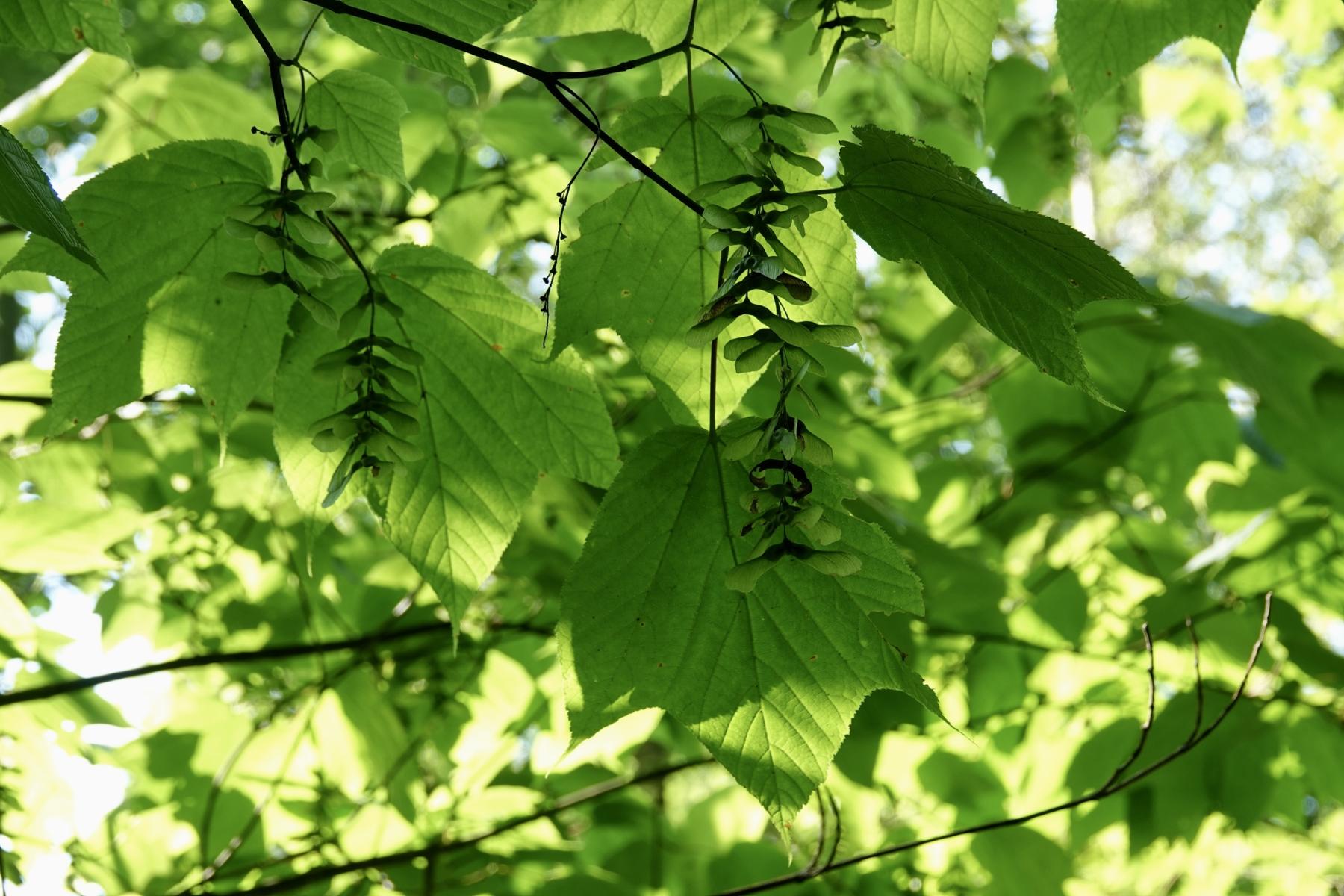
Striped maple with samaras, Windsor County, Vermont. (CC BY-NC 4.0)
Striped maple is a native, deciduous, tall shrub or small tree. It reaches a maximum height of about 45 feet (13 m), but is usually smaller [11,16]. It has a short, forked trunk divided into a few ascending, arching branches, forming a broad but uneven, flat-topped to rounded crown. The branchlets are straight and slender [6,11]. Striped maple is primarily dioecious; monoecy is rare. The sex ratio is male-biased. Hibbs [9] reported that 80 percent of a Massachusetts population was male. The fruit of striped maple is a two-winged samara. The root system is shallow and wide-spreading [6,11].
Raunkiaer Life Form (Raunkiaer 1934)
- Phanerophyte
Seasonal Development
Striped maple flowers from May to June. The fruits ripen in September and October and are dispersed in October and November [18].
Regeneration Processes
Sexual reproduction: Striped maple reproduces mostly by seed. Seed production varies from tree to tree; some trees produce as few as 10 seeds, whereas others produce several thousand. Seed production begins at about 10 years of age, and large seed crops are produced every year. The seeds are wind dispersed [6,18].
A small proportion of striped maples undergo gender change. The gender of such trees may differ from year to year [9,19]. In one year, in a sample of trees taken in western Massachusetts, 27 of 243 trees changed sex. Most changes were from male to female [6].
Vegetative reproduction: Vegetative reproduction does not seem to play an important part in the reproduction of striped maple. Although it reproduces by layering and basal sprouting, sampling of striped maple populations showed that only 3 percent of the trees originated from layering, and 8 percent by sprouting [6]. In general, vegetative propagation seems to be a mechanism by which it survives suppression rather than increases in number [6].
Successional Status
Facultative Seral Species
Striped maple is tolerant of deep shade but develops best under moderate light [3,16]. Rapid shoot growth can occur under low light intensity, but the growth is etiolated. Under direct sunlight, striped maple is succeeded by mountain maple. It grows well in small forest openings and under thinned overstories that result in moderate understory lighting. Because its maximum height growth is about 50 feet (15 m), it never becomes a major component in the upper canopy of northern hardwood forests. It may, however, occupy forest openings for more than 100 years [6,21,22].
Immediate Fire Effects
Striped maple establishes from seed and/or sprouts after fire [103]. Crown fire that burns only the upper canopy of a deciduous forest presumably has little effect on striped maple, because striped maple never reaches the upper canopy. Crown fire can create partial openings in a stand, ideal for striped maple recruitment [2,4,15].
Postfire Regeneration Strategy (Stickney 1989)
- Tall shrub, adventitious-bud root crown
- Crown residual colonizer (on-site, initial community)
- Secondary colonizer - off-site seed
Fire Adaptations
Striped maple is moderately resistant to low-severity fires. In a study of tree survival after low-severity surface fires in Great Smoky Mountains National Park, striped maple showed a positive correlation of bark thickness to tree diameter growth. Equations relating bark thickness, tree diameter, tree diameter growth rate, and fire survival were given [8].
Plant Response to Fire
Striped maple probably sprouts from the root crown after fire [6]. Information regarding postfire establishment of striped maple is sparse.
On the George Washington National Forest, West Virginia, a spring prescribed fire increased total striped maple density in a mixed-hardwood forest. Average striped maple seedling densities before fire and in postfire year 5 were were 3,921 and 2,158 seedlings/acre, respectively; striped maple sprout densities were 342 sprouts/acre before and 1,658 sprouts/acre 5 years after the fire. See the Research Paper of Wendel and Smith's [26] study for details on the fire prescription and fire effects on striped maple and 6 other tree species.
The Research Project Summary "Early postfire effects of a prescribed fire in the southern Appalachians of North Carolina" provides information on prescribed fire and postfire response of plant community species, including striped maple, that was not available when this species review was originally written.
Fire Regimes
For fire regime information, search FEIS for this species by entering the species name on the Advanced Search page and selecting “Fire Regime” as the publication type.
Fire Management Considerations
No entry.
Federal Status
No special status.
Other Status
No entry.
Importance to Wildlife and Livestock
Striped maple is an important wildlife food. It is one of the preferred species for rabbits, and is frequently eaten by porcupines. The leaves and shoots are browsed by moose, white-tailed deer, and beavers [11,12]. Ruffed grouse consume the vegetative buds [6]. The nectar is an important food source for honeybees [1].
Palatability and Nutritional Value
No entry.
Cover Value
No entry.
Value for Rehabilitation or Restoration of Disturbed Sites
No entry.
Other Uses
Striped maple is occasionally planted as an ornamental [11].
The wood of striped maple wood is porous and fine grained, and has occasionally been used by cabinet makers for inlay material [6].
Other Management Considerations
When striped maple regeneration is abundant before cutting, it frequently becomes the dominant species after cutting, excluding more desirable species [10]. In northwest Pennsylvania, when more than 30 percent of regeneration plots had more than eight striped maple seedlings before clearcutting, this species became dominant after cutting. If the number of striped maple stems exceeds this percentage, it is essential to reduce their numbers before cutting to encourage regeneration of desirable hardwood species. Striped maple can be controlled with glyphosate applied during the growing season [6,10].
Table A1— Forest and range ecosystems, Bureau of Land Management (BLM) physiographic regions, Kuchler plant associations, Society for American Foresters (SAF) forest cover types, and Society for Rangeland Management (SRM) rangeland cover types in which this species occurs.
Forest and Range Ecosystems (Garrison et al. 1977)
- FRES10 White - red - jack pine
- FRES11 Spruce - fir
- FRES15 Oak - hickory
- FRES18 Maple - beech - birch
- FRES19 Aspen - birch
BLM Physiographic Regions (Bernard and Brown 1977)
- No entry.
Kuchler Plant Associations (Kuchler 1964)
- K093 Great Lakes spruce - fir forest
- K095 Great Lakes pine forest
- K096 Northeastern spruce - fir forest
- K102 Beech - maple forest
- K103 Mixed mesophytic forest
- K104 Appalachian oak forest
- K106 Northern hardwoods
- K107 Northern hardwoods - fir forest
- K108 Northern hardwoods - spruce forest
SAF Cover Types (Eyre 1980)
- 5 Balsam fir
- 16 Aspen
- 17 Pin cherry
- 18 Paper birch
- 20 White pine - northern red oak - red maple
- 21 Eastern white pine
- 22 White pine - hemlock
- 23 Eastern hemlock
- 24 Hemlock - yellow birch
- 25 Sugar maple - beech - yellow birch
- 26 Sugar maple - basswood
- 27 Sugar maple
- 28 Black cherry - maple
- 30 Red spruce - yellow birch
- 31 Red spruce - sugar maple - beech
- 32 Red spruce
- 35 Paper birch - red spruce - balsam fir
- 44 Chestnut oak
- 51 White pine - chestnut oak
- 60 Beech - sugar maple
- 107 White spruce
SRM Rangeland Cover Types (Shiflet 1994)
- No entry.
1. Batra, S. W. T. 1985. Red maple (Acer rubrum L.), an important early spring food resource for honey bees and other insects. Journal of the Kansas Entomological Society. 58(1): 169-172. [12666]
2. Bergeron, Yves; Brisson, Jacques. 1990. Fire regime in red pine stands at the northern limit of the species range. Ecology. 71(4): 1352-1364. [11819]
3. Clebsch, Edward E. C.; Busing, Richard T. 1989. Secondary succession, gap dynamics, and community structure in a southern Appalachian cove forest. Ecology. 70(3): 728-735. [6972]
4. Engstrom, F. Brett; Mann, Daniel H. 1991. Fire ecology of red pine (Pinus resinosa) in northern Vermont, U.S.A. Canadian Journal of Forest Research. 21: 882-889. [14997]
5. Eyre, F. H., ed. 1980. Forest cover types of the United States and Canada. Washington, DC: Society of American Foresters. 148 p. [905]
6. Gabriel, William J.; Walters, Russell S. 1990. Striped maple. In: Burns, Russell M.; Honkala Barbara H, eds. Silvics of North America. Agricultural Handbook 654. Washington D. C.: U.S. Department of Agriculture, Forest Service: 53-59. [21505]
7. Garrison, George A.; Bjugstad, Ardell J.; Duncan, Don A.; [and others]. 1977. Vegetation and environmental features of forest and range ecosystems. Agric. Handb. 475. Washington, DC: U.S. Department of Agriculture, Forest Service. 68 p. [998]
8. Harmon, Mark E. 1984. Survival of trees after low-intensity surface fires in Great Smoky Mountains National Park. Ecology. 65(3): 796-802. [10997]
9. Hibbs, David E. 1978. The life history and strategy of striped maple (Acer pensylvanicum L.). Amherst, MA: University of Massachusetts. 96 p. Ph.D. dissertation. [10211]
10. Horsley, Stephen B. 1988. How vegetation can influence regeneration. In: Smith, H. Clay; Perkey, Arlyn W.; Kidd, William E., Jr, eds. Guidelines for regenerating Appalachian hardwood stands: Workshop proceedings; 1988 May 24-26; Morgantown, WV. Society of American Foresters Publ. 88-03. Morgantown, WV: West Virginia University Books: 38-54. [13544]
11. Hosie, R. C. 1969. Native trees of Canada. 7th ed. Ottawa, ON: Canadian Forestry Service, Department of Fisheries and Forestry. 380 p. [3375]
12. Krefting, Laurtis W. 1974. The ecology of the Isle Royale Moose with special reference to the habitat. Tech. Bull. 297, Forestry Series 15. Minneapolis, MN: University of Minnesota, Agricultural Experiment Station. 75 p. [8678]
13. Kuchler, A. W. 1964. Manual to accompany the map of potential vegetation of the conterminous United States. Special Publication No. 36. New York: American Geographical Society. 77 p. [1384]
14. Little, Elbert L., Jr. 1979. Checklist of United States trees (native and naturalized). Agric. Handb. 541. Washington, DC: U.S. Department of Agriculture, Forest Service. 375 p. [2952]
15. Loope, Walter L. 1991. Interrelationships of fire history, land use history, and landscape pattern within Pictured Rocks National Seashore, Michigan. Canadian Field-Naturalist. 105(1): 18-28. [5950]
16. Marquis, Robert J.; Passoa, Steven. 1989. Seasonal diversity and abundance of the herbivore fauna of striped maple Acer pensylvanicum L. (Aceraceae) in western Virginia. American Midland Naturalist. 122: 313-320. [9274]
17. Nichols, George E. 1913. The vegetation of Connecticut. II. Virgin forests. Torreya. 13(9): 199-215. [14069]
18. Olson, David F., Jr.; Gabriel, W. J. 1974. Acer L. maple. In: Schopmeyer, C. S., technical coordinator. Seeds of woody plants in the United States. Agric. Handb. 450. Washington, DC: U.S. Department of Agriculture, Forest Service: 187-194. [7462]
19. Primack, Richard B.; McCall, Claire. 1986. Gender variation in a red maple population (Acer rubrum: Aceraceae): a seven-year study of a "polygamodioecious" species. American Journal of Botany. 73(9): 1239-1248. [12609]
20. Raunkiaer, C. 1934. The life forms of plants and statistical plant geography. Oxford: Clarendon Press. 632 p. [2843]
21. Roberts, Mark R. 1992. Stand development and overstory-understory interactions in an aspen- northern hardwoods stand. Forest Ecology and Management. 54: 157-174. [19949]
22. Sakai, Ann K.; Roberts, Mark R.; Jolls, Claudia L. 1985. Successional changes in a mature aspen forest in northern lower Michigan: 1974-1981. American Midland Naturalist. 113(2): 271-282. [4450]
23. Stickney, Peter F. 1989. Seral origin of species originating in northern Rocky Mountain forests. Unpublished draft on file at: U.S. Department of Agriculture, Forest Service, Intermountain Research Station, Fire Sciences Laboratory, Missoula, MT; RWU 4403 files. 7 p. [20090]
24. U.S. Department of Agriculture, Soil Conservation Service. 1982. National list of scientific plant names. Vol. 1. List of plant names. SCS-TP-159. Washington, DC. 416 p. [11573]
25. Wendel, G. W. 1990. Prunus pensylvanica L. f. pin cherry. In: Burns, Russell M.; Honkala, Barbara H., technical coordinators. Silvics of North America. Volume 2. Hardwoods. Agric. Handb. 654. Washington, DC: U.S. Department of Agriculture, Forest Service: 587-593. [13971]
26. Wendel, G. W.; Smith, H. Clay. 1986. Effects of a prescribed fire in a central Appalachian oak-hickory stand. NE-RP-594. Broomall, PA: U.S. Department of Agriculture, Forest Service, Northeastern Forest Experiment Station. 8 p. [73936]