


Amelanchier arborea, common serviceberry
Snyder, S. A. 1992. Amelanchier arborea, common serviceberry. In: Fire Effects Information System, [Online]. U.S. Department of Agriculture, Forest Service, Rocky Mountain Research Station, Fire Sciences Laboratory (Producer). Available: https://research.fs.usda.gov/feis/species-reviews/amearb
| Abbreviation | Common Name | Scientific Name | Classification | Status |
|---|---|---|---|---|
| Plants | ||||
| AMEARB | common serviceberry | Amelanchier arborea | Life Form: Plants/Shrub, Plants/Tree Kingdom: Plantae Class: Dicot Order: Rosales Family: Rosaceae Genus: Amelanchier | Fed. Protected: No Nativity: Native Invasiveness: Noninvasive |


Taxonomy
The scientific name for common serviceberry is Amelanchier arborea (Michx.) Fern.( Rosaceae) [4]. There are 3 varieties [22]:
- Amelanchier arborea var. alabamensis, Alabama serviceberry
- Amelanchier arborea var. arborea, common serviceberry
- Amelanchier arborea var. austromontana, downy serviceberry
Common serviceberry hybridizes with the following species [4]:
- low serviceberry (Amelanchier humilis Wieg.)
- Canada serviceberry (Amelanchier canadensis (L.) Medic.)
- oblongfruit serviceberry (Amelanchier bartramiana (Tausch) Roemer)
Hybridization is common and usually produces fertile offspring. Authors differ in their treatment of the hybrids [20].
Synonyms
- None
Other Common Names
downy serviceberry, Juneberry, shadbush, shadblow, sugarplum
General Distribution

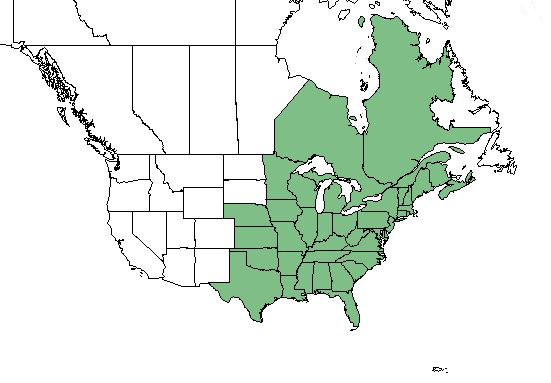
Distribution of common serviceberry.
Common serviceberry occurs from the southern tip of Newfoundland south to the northern tip of the Florida Panhandle and west to southern Ontario and Quebec, eastern Kansas, the eastern edge of Nebraska, and southern Mississippi and Alabama. North of Virginia, it is found along the coast, but from Virginia south it occurs inland [14].
States and Provinces
- United States: AL AR CT DE FL GA IL IN IA KS KY LA ME MD MA MI MN MS MO NE NH NJ NY NC OH OK PA RI SC TN VT VA WV WI
- Canada: NB NF NS ON PE PQ
Site Characteristics
Common serviceberry grows on a variety of sites from swampy lowlands to dry woods and sandy bluffs. It also grows on rocky ridges, forest edges, and open woodlands and fields [20,23]. In the mixed hardwoods of Appalachia, common serviceberry may compete better with other species in stands on low quality sites [21].
Common serviceberry grows in red spruce (Picea rubens)-Fraser fir (Abies fraseri) forests of the mountainous Southeast. Here it grows in association with yellow birch (Betula alleghaniensis), mountain ash (Sorbus americana), elderberry (Sambucus pubens), and hobblebush (Viburnum alnifolium) at elevations between 4,950 and 6,600 feet (1,500-2,000 m). Soils in these types are moderately drained Inceptisols with a thick organic horizon and a low pH [2].
In the Midwest common serviceberry grows with boxelder (Acer negundo), sugar maple (A. saccharum), white oak (Quercus alba), black ash (Fraxinus nigra), American beech (Fagus grandifolia), shagbark hickory (Carya ovata), and American hornbeam (Carpinus caroliniana). Soils here are well-drained silty clay loam and poorly drained silt loams [13]. Some understory associates include lowbush blueberry (Vaccinium angustifolium), penstemon (Penstemon canescens), raspberry (Rubus spp.), greenbrier (Smilax spp.), and witch-hazel (Hamamelis virginiana) [7,8].
Plant Communities
No entry.
Botanical Description

Common serviceberry bark.
Common serviceberry is a tall, deciduous shrub or small tree, growing up to 30 feet (9 m) or more [20]. Its trunk is about 16 inches (40 cm) in diameter [4]. The maximum recorded height and diameter for common serviceberry is 70 feet (21 m) high and 2 feet (0.6 m) d.b.h. [14]. Its branches are purplish when young but turn grey at maturity. Leaves are alternate and simple with serrate margins. They are almost twice as long as broad. Flowers are white, and the berrylike pomme fruit is dark red to purple [20]. There are 4 to 10 seeds per fruit [1].
Raunkiaer Life Form (Raunkiaer 1934)
- Phanerophyte
- Hemicryptophyte
Seasonal Development
In the northern part of its range, common serviceberry flowers at the same time its leaves emerge in April and May. Fruits are produced in June and July [20]. In southern parts of its range, common serviceberry flowers in March and produces fruit from June through August [1,4].

Common serviceberry flowers.
Regeneration Processes
Common serviceberry regenerates mainly by seed, but it also sprouts from the root crown [14]. Seeds are dispersed by birds and mammals; bird ingestion of seeds is an important scarification process [17]. Seeds should be collected soon after ripening before animals eat them. Seeds can be washed from the fruits by mashing them with water. There is an average of 80,000 cleaned seeds per pound (176,000 kg). Seeds should be dry stored at 41 degrees Fahrenheit (5 deg C) in sealed containers. Seeds can be sown in either fall or spring after 2 to 6 months of cold stratification, but they will not usually germinate until after the second spring [1].
Successional Status
Common serviceberry is a late successional to climax species in mixed-hardwood forests of the central United States [13].
Immediate Fire Effects
Fire top-kills common serviceberry [19].
August burning of slash piles in the forest of lower Michigan killed most of the common serviceberry on the site [19]. Stumps and roots sprouted the following year, but much of common serviceberry found on the site was established from seed dispersed by birds and mammals. Studies in Pennsylvania showed contradictory results in the closely related species, Amelanchier canadensis [9]. A. canadensis was not present on burned sites until more than 15 years following fire but was prolific on unburned sites.
Postfire Regeneration Strategy (Stickney 1989)
- survivor species; on-site surviving root crown
- off-site colonizer; seed carried by animals or water; postfire yr 1 & 2
Fire Adaptations
Common serviceberry can sprout from root crowns and stumps following fire [19]. Some reestablishment from seed dispersed from off-site may also occur.
Plant Response to Fire
Common serviceberry will recolonize sites following fire [18,19].
Following wildfire in a spruce-fir forest of Appalachia, common serviceberry was present in stands after 30 years, but was less than 1 percent of the total basal area. Specific effects of the fire on common serviceberry were not studied [18]. For fire information on a related species, see Amelanchier alnifolia.
The following Research Project Summaries provide information on prescribed fire use and postfire response of plant community species, including common serviceberry, that was not available when this species review was originally written:
- Early postfire effects of a prescribed fire in the southern Appalachians of North Carolina
- Early postfire response of southern Appalachian Table Mountain-pitch pine stands to prescribed fires in North Carolina and Virginia
Fire Regimes
For fire regime information, search FEIS for this species by entering the species name or acronym on the home page and selecting “Fire Regime” as the publication type.
Fire Management Considerations
No entry.
Federal Status
None
Other Status
No entry.
Importance to Wildlife and Livestock
At least 40 bird species and several dozen mammal species eat the fruit of the Amelanchier genus. Mammals that use common serviceberry include squirrels, chipmunks, mice, voles, foxes, black bears, and elk [12,17].
Palatability and Nutritional Value
No entry.
Cover Value
No entry.
Value for Rehabilitation or Restoration of Disturbed Sites
No entry.
Other Uses
In areas where common serviceberry grows big enough, it is used for pulpwood [21].
Other Management Considerations
Common serviceberry is the preferred food of the gypsy moth (Lymantria dispar) during its larval stages [6]. Common serviceberry has been known to increase in number and density after defoliation from gypsy moths [8].
Table A1— Forest and range ecosystems, Bureau of Land Management (BLM) physiographic regions, Kuchler plant associations, Society for American Foresters (SAF) forest cover types, and Society for Rangeland Management (SRM) rangeland cover types in which this species occurs.
Forest and Range Ecosystems (Garrison et al. 1977)
- FRES10 White - red - jack pine
- FRES11 Spruce - fir
- FRES13 Loblolly - shortleaf pine
- FRES14 Oak - pine
- FRES15 Oak - hickory
- FRES17 Elm - ash - cottonwood
- FRES18 Maple - beech - birch
- FRES19 Aspen - birch
BLM Physiographic Regions (Bernard and Brown 1977)
- No entry.
Kuchler Plant Associations (Kuchler 1964)
- K097 Southeastern spruce - fir forest
- K098 Northern floodplain forest
- K099 Maple - basswood forest
- K100 Oak - hickory
- K101 Elm - ash forest
- K102 Beech - maple forest
- K103 Mixed mesophytic forest
- K104 Appalachian oak forest
- K106 Northern hardwoods
- K109 Transition between K104 and K106
- K110 Northeastern oak - pine forest
- K111 Oak - hickory - pine
- K112 Southern mixed forest
SAF Cover Types (Eyre 1980)
- 1 Jack pine
- 16 Aspen
- 25 Sugar maple - beech - yellow birch
- 26 Sugar maple - basswood
- 27 Sugar maple
- 28 Black cherry - maple
- 30 Red spruce - yellow birch
- 31 Red spruce - sugar maple - beech
- 34 Red spruce - Fraser fir
- 39 Black ash - American elm - red maple
- 42 Bur oak
- 52 White oak - black oak - northern red oak
- 53 White oak
- 55 Northern red oak
- 57 Yellow-poplar
- 59 Yellow-poplar - white oak - northern red oak
- 60 Beech - sugar maple
- 61 River birch - sycamore
- 62 Silver maple - American elm
- 64 Sassafras - persimmon
- 65 pin oak - sweet gum
- 75 Shortleaf pine
- 76 Shortleaf pine - oak
- 97 Atlantic white-cedar
- 108 Red maple
- 109 Hawthorn
- 110 Black oak
SRM Rangeland Cover Types (Shiflet 1994)
- No entry.
1. Brinkman, K. A. 1974. Amelanchier Med. serviceberry. In: Schopmeyer, C. S., technical coordinator. Seeds of woody plants in the United States. Agric. Handb. 450. Washington, DC: U.S. Department of Agriculture, Forest Service: 212-215. [7516]
2. Busing, Richard T.; Clebsch, Edward E. C.; Eagar, Christopher C.; Pauley, Eric F. 1988. Two decades of change in a Great Smoky Mountains spruce-fir forest. Bulletin of the Torrey Botanical Club. 115(1): 25-31. [4491]
3. Eyre, F. H., ed. 1980. Forest cover types of the United States and Canada. Washington, DC: Society of American Foresters. 148 p. [905]
4. Fernald, Merritt Lyndon. 1950. Gray's manual of botany. [Corrections supplied by R. C. Rollins]. Portland, OR: Dioscorides Press. 1632 p. (Dudley, Theodore R., gen. ed.; Biosystematics, Floristic & Phylogeny Series; vol. 2). [14935]
5. Garrison, George A.; Bjugstad, Ardell J.; Duncan, Don A.; [and others]. 1977. Vegetation and environmental features of forest and range ecosystems. Agric. Handb. 475. Washington, DC: U.S. Department of Agriculture, Forest Service. 68 p. [998]
6. Gottschalk, Kurt W. 1988. Gypsy moth and regenerating Appalachian hardwood stands. In: Smith, H. Clay; Perkey, Arlyn W.; Kidd, William E., Jr., eds. Guidelines for regenerating Appalachian hardwood stands: Workshop proceedings; 1988 May 24-26; Morgantown, WV. SAF Publ. 88-03. Morgantown, WV: West Virginia University Books: 241-254. [13950]
7. Hall, Christine N.; Kuss, Fred R. 1989. Vegetation alteration along trails in Shenandoah National Park, Virginia. Biological Conservation. 48: 211-227. [9306]
8. Hix, David M.; Fosbroke, David E.; Hicks, Ray R., Jr.; Gottschalk, Kurt W. 1991. Development of regeneration following gypsy moth defoliation of Appalachian Plateau and Ridge & Valley hardwood stands. In: McCormick, Larry H.; Gottschalk, Kurt W., eds. Proceedings, 8th central hardwood forest conference; 1991 March 4-6; University Park, PA. Gen. Tech. Rep. NE-148. Radnor, PA: U.S. Department of Agriculture, Forest Service, Northeastern Forest Experiment Station: 347-359. [15323]
9. Jordan, Marilyn J. 1975. Effects of zinc smelter emissions and fire on a chestnut-oak woodland. Ecology. 56: 78-91. [3461]
10. Kuchler, A. W. 1964. Manual to accompany the map of potential vegetation of the conterminous United States. Special Publication No. 36. New York: American Geographical Society. 77 p. [1384]
11. Lyon, L. Jack; Stickney, Peter F. 1976. Early vegetal succession following large northern Rocky Mountain wildfires. In: Proceedings, Tall Timbers fire ecology conference and Intermountain Fire Research Council fire and land management symposium; 1974 October 8-10; Missoula, MT. No. 14. Tallahassee, FL: Tall Timbers Research Station: 355-373. [1496]
12. Masters, Ronald E. 1991. Effects of fire and timber harvest on vegetation and cervid use on oak-pine sites in Oklahoma Ouachita Mountains. In: Nodvin, Stephen C.; Waldrop, Thomas A., eds. Fire and the environment: ecological and cultural perspectives: Proceedings of an international symposium; 1990 March 20-24; Knoxville, TN. Gen. Tech. Rep. SE-69. Asheville, NC: U.S. Department of Agriculture, Forest Service, Southeastern Forest Experiment Station: 168-176. [16648]
13. Parker, G. R.; Leopold, D. J.; Eichenberger, J. K. 1985. Tree dynamics in an old-growth, deciduous forest. Forest Ecology and Management. 11(1&2): 31-57. [13314]
14. Preston, Richard J., Jr. 1948. North American trees. Ames, IA: The Iowa State College Press. 371 p. [1913]
15. Raunkiaer, C. 1934. The life forms of plants and statistical plant geography. Oxford: Clarendon Press. 632 p. [2843]
16. Robinson, W. Ann. 1982. Experimental taxonomy in the genus Amelanchier. II: Do the taxa in the genus Amelanchier form an agamic complex?. Rhodora. 84: 85-99. [17998]
17. Robinson, W. Ann. 1986. Effect of fruit ingestion on Amelanchier seed germination. Bulletin of the Torrey Botanical Club. 113(2): 131-134. [4552]
18. Saunders, Paul R.; Smathers, Garrett A.; Ramseur, George S. 1983. Secondary succession of a spruce-fir burn in the Plott Balsam Mountains, North Carolina. Castanea. 48(1): 41-47. [8658]
19. Scheiner, Samuel M.; Sharik, Terry L.; Roberts, Mark R.; Vande Kopple, Robert. 1988. Tree density and modes of tree recruitment in a Michigan pine-hardwood forest after clear-cutting and burning. Canadian Field-Naturalist. 102(4): 634-638. [8718]
20. Soper, James H.; Heimburger, Margaret L. 1982. Shrubs of Ontario. Life Sciences Misc. Publ. Toronto, ON: Royal Ontario Museum. 495 p. [12907]
21. Trimble, G. R., Jr. 1972. Reproduction 7 years after seed-tree harvest cutting in Appalachian hardwoods. Res. Pap. NE-223. Upper Darby, PA: U.S. Department of Agriculture, Forest Service, Northeastern Forest Experiment Station. 19 p. [10924]
22. USDA Natural Resources Conservation Service. 2018. PLANTS Database, [Online]. U.S. Department of Agriculture, Natural Resources Conservation Service (Producer). Available: https://plants.usda.gov/. [342622] 23. Voss, Edward G. 1985. Michigan flora. Part II. Dicots (Saururaceae--Cornaceae). Bull. 59. Bloomfield Hills, MI: Cranbrook Institute of Science; Ann Arbor, MI: University of Michigan Herbarium. 724 p. [11472]
24. Wendel, G. W.; Kochenderfer, J. N. 1982. Glyphosate controls hardwoods in West Virginia. Res. Pap. NE-497. Upper Darby, PA: U.S. Department of Agriculture, Forest Service, Northeastern Forest Experiment Station. 7 p. [9869]