


Antennaria microphylla, littleleaf pussytoes
Matthews, Robin F. 1993. Antennaria microphylla, littleleaf pussytoes. In: Fire Effects Information System, [Online]. U.S. Department of Agriculture, Forest Service, Rocky Mountain Research Station, Fire Sciences Laboratory (Producer). Available: https://research.fs.usda.gov/feis/species-reviews/antmic
| Abbreviation | Common Name | Scientific Name | Classification | Status |
|---|---|---|---|---|
| Plants | ||||
| ANTMIC | littleleaf pussytoes | Antennaria microphylla | Life Form: Plants/Forb Kingdom: Plantae Class: Dicot Order: Asterales Family: Asteraceae Genus: Antennaria | Fed. Protected: No Nativity: Native Invasiveness: Noninvasive |
Taxonomy
The currently accepted scientific name for littleleaf pussytoes is Antennaria microphylla Rydb. [13,14,16,28]. Antennaria is a taxonomically complex genus due to a high degree of apomixis, polyploidy, and hybridization. Antennaria microphylla is a highly variable species and many segregates have been named, although none appear to warrant taxonomic recognition [12]. Littleleaf pussytoes is often confused with A. rosea Greene because of frequent hybridization. These two species have been treated as the same entity by some authorities, but it has recently been determined that they are taxonomically distinct [30]. Littleleaf pussytoes also frequently hybridizes with umbrinella pussytoes (A. umbrinella) [16,30] and alpine pussytoes (A. alpina) [16].
Synonyms
- Antennaria rosea Rydb. [12,13,16,28]
- Antennaria arida Nels. [13,14]
- Antennaria nitida Greene [30]
- Antennaria bracteosa Rydb. [30]
- Antennaria solstitialis Lunell [30]
Other Common Names
dwarf everlasting, pink pussytoes, rosy pussytoes, small pussytoes
General Distribution
Littleleaf pussytoes is distributed from Alaska east to Ontario and south to California, New Mexico, Colorado, and Nebraska [1,12,13,16,28].
States and Provinces
- United States: AK AZ CA CO ID MN MT NE NV NM ND OR SD UT WA WY
- Canada: AB BC MB ON SK YT
Site Characteristics
Littleleaf pussytoes is found in dry, open habitats including plains, hills, open woods, and dry meadows [9,12,13]. It is found at elevations of 6,000 to 11,400 feet (1,830-3,450 m) in Utah and 5,000 to 11,000 feet (1,500-3,300 m) in Colorado [13,28]. In west-central Montana, littleleaf pussytoes is found from the valley floor to alpine zones [16].
Plant Communities
Some species associated with littleleaf pussytoes in sagebrush or grassland habitats include Idaho fescue (Festuca idahoensis), rough fescue (Festuca scabrella), needle-and-thread grass (Stipa comata), bluebunch wheatgrass (Pseudoroegneria spicata), western wheatgrass (Pascopyrum smithii), blue grama (Bouteloua gracilis), Sandberg bluegrass (Poa secunda), prairie junegrass (Koeleria cristata), cheatgrass (Bromus tectorum), threadleaf sedge (Carex filifolia), lupine (Lupinus spp.), western yarrow (Achillea millefolium), buckwheat (Eriogonum spp.), phlox (Phlox spp.), and fleabane (Erigeron spp.) [3,8,25,26].
Botanical Description
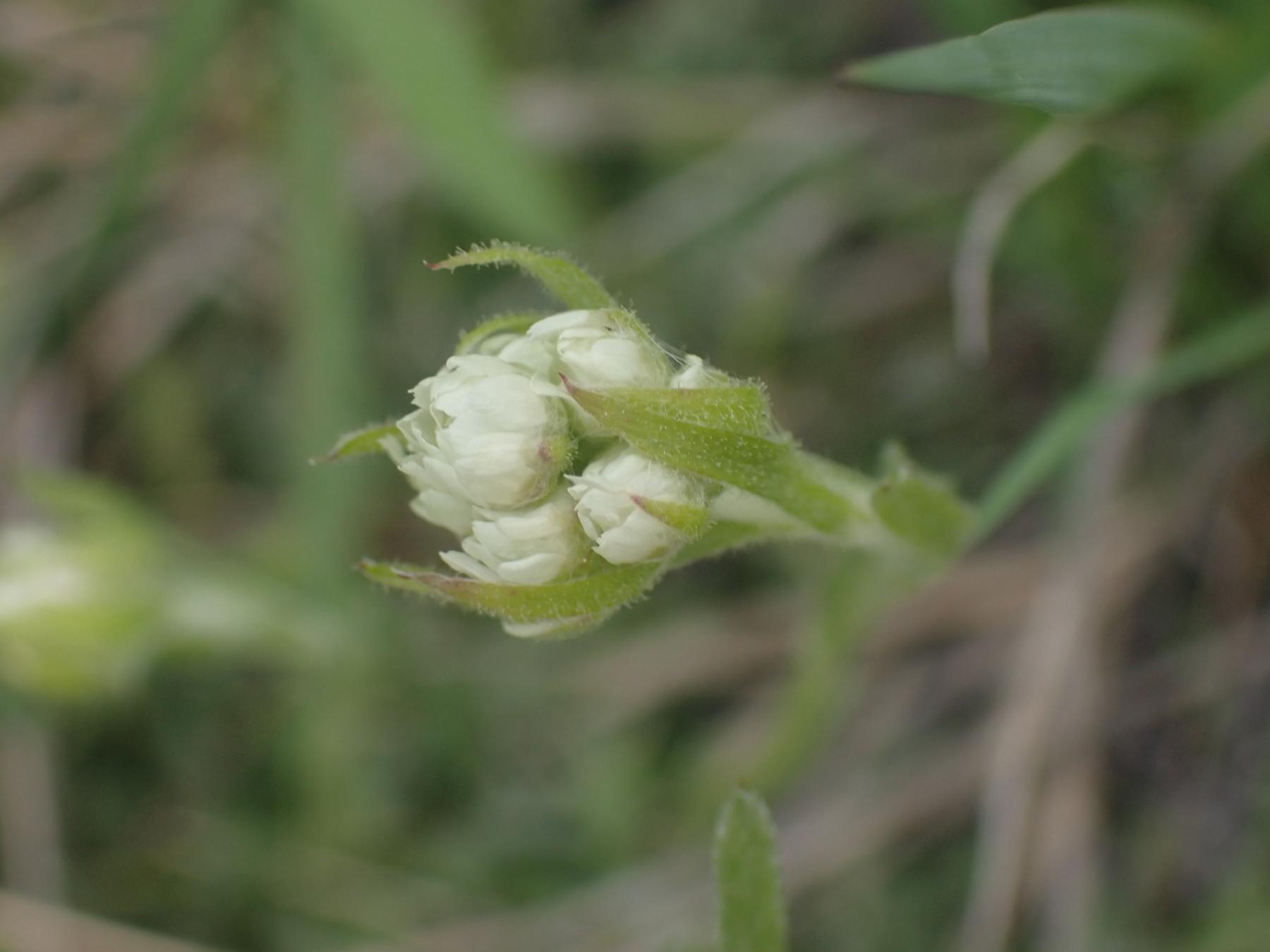
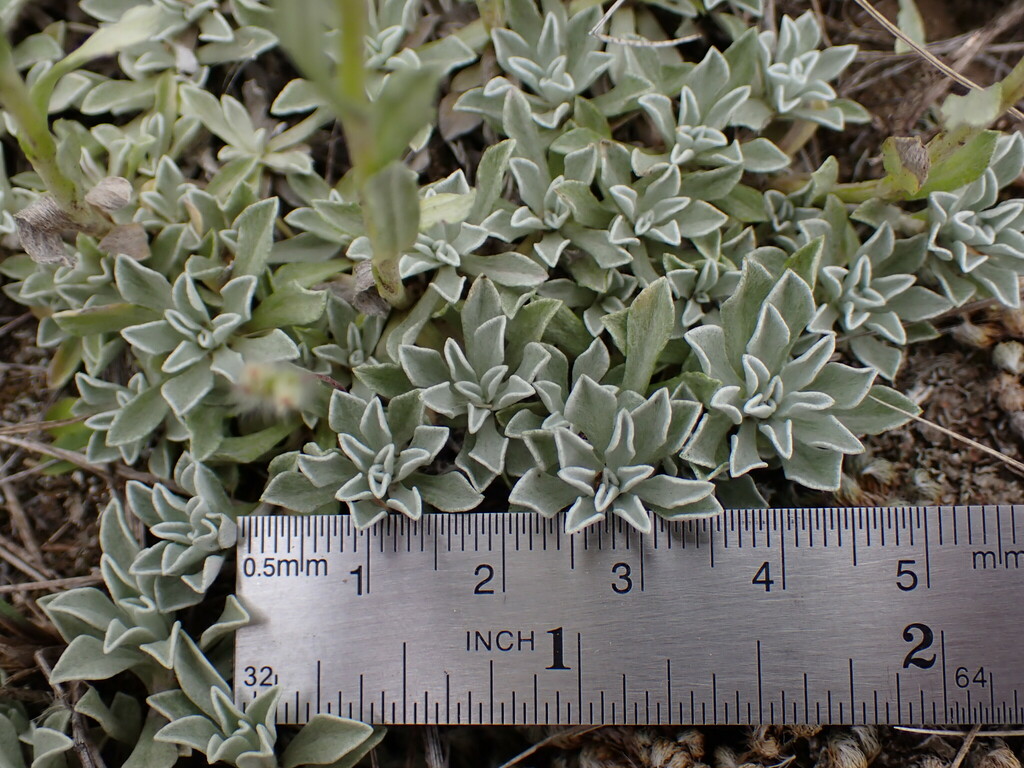
Littleleaf pussytoes is a stoloniferous, mat-forming, perennial forb. Stems are generally 1.6 to 12 inches (4-30 cm) tall. Leaves are spoon-shaped or narrowly oblong and simple, alternate, and mostly basal. Cauline leaves are reduced upwards. The inflorescence is a congested to open cyme with 2 to 13 heads. The fruit is an achene 0.03 to 0.05 inch (0.08-0.12 cm) long [12,16,28]. Stolons are usually 0.4 to 2 inches (1-5 cm) long [1].

Littleleaf pussytoes leaves.
Raunkiaer Life Form (Raunkiaer 1934)
- Hemicryptophyte
Seasonal Development
Littleleaf pussytoes flowers from the end of May to July [5,12].
Regeneration Processes
Littleleaf pussytoes reproduces from seed or spreads vegetatively through stolons. Seeds are light and wind dispersed. They are generally not stored in soil seedbanks [22]. Littleleaf pussytoes is dioecious [1,16].

A flowering littleleaf pussytoes stem.
Successional Status
Facultative Seral Species
Littleleaf pussytoes is found in disturbed areas as well as stable climax communities. It was present on thin mud and tephra in the first 2 years following the volcanic eruption of Mount St. Helens in Washington [29]. It invades heavily grazed sagebrush-grassland communities in Nevada [25]. In central Idaho littleleaf pussytoes is a major early seral species in subalpine fir (Abies lasiocarpa)/beargrass (Xerophyllum tenax) habitat types [21] and a prominent mid-seral species in Douglas-fir/pinegrass habitat types, where it persists beneath a partial canopy [22]. It also occurs in seral and climax trembling aspen communities in Utah [18].
Immediate Fire Effects
Littleleaf pussytoes is probably killed by moderate or severe fires. However, no marked littleleaf pussytoes plants were killed by low-severity spring or fall prescribed fires in mountain big sagebrush (Artemisia tridentata spp. vaseyana)/rough fescue (Festuca scabrella), mountain big sagebrush/Kentucky bluegrass (Poa pratense), or Douglas-fir/mountain big sagebrush vegetation types in the Helena National Forest, Montana [20].
Postfire Regeneration Strategy (Stickney 1989)
- Initial-offsite colonizer (off-site, initial community)
- Secondary colonizer - off-site seed
Fire Adaptations
Littleleaf pussytoes colonizes bare mineral soil from light, wind-dispersed seed [21,22].
Plant Response to Fire
The response of littleleaf pussytoes to fire probably depends on site characteristics and fire severity. It is a major early seral species following fires in subalpine fir/beargrass habitat types in central Idaho [21]. Littleleaf pussytoes was first observed in postfire year 3 following the severe Sundance Forest Fire in northern Idaho [23]. In Douglas-fir stands in the Deerlodge National Forest, Montana, littleleaf pussytoes decreased 22.5 percent in the first 2 postfire years after spring fires [7]. In sagebrush habitats in Idaho littleleaf pussytoes decreased the first years following September prescribed fires, but then increased and regained much of its original cover. Production was greater on lightly burned or moderately burned sites than on either unburned or severely burned sites 15 years after the fires [3].
Fire Regimes
For fire regime information, search FEIS for this species by entering the species name or acronym on the home page and selecting “Fire Regime” as the publication type.
Fire Management Considerations
No entry.
Federal Status
None
Other Status
No entry.
Importance to Wildlife and Livestock
Littleleaf pussytoes is eaten by Columbia ground squirrels [17] but is generally of low forage value [3].
Palatability and Nutritional Value
No entry.
Cover Value
No entry.
Value for Rehabilitation or Restoration of Disturbed Sites
No entry.
Other Uses
No entry.
Other Management Considerations
Littleleaf pussytoes does not survive mechanical scarification but can colonize bare scarified soil. Herbaceous layers dominated by littleleaf pussytoes in Douglas-fir (Pseudotsuga menziesii)/pinegrass (Calamagrostis rubescens) habitat types in central Idaho occur on scarified, cool, dry sites where the herbaceous layer is depauperate. Littleleaf pussytoes in this habitat type has the following responses to different silvicultural practices: a minor increase in vegetative growth after clearcutting with no subsequent site preparation; a major decrease in canopy cover after shelterwood cuts followed by mechanical scarification; a major decrease in canopy cover and a minor increase in seedling establishment after clearcutting followed by mechanical scarification; and a minor decrease in canopy cover after wildfire and after clearcutting followed by broadcast burning [22].
Littleleaf pussytoes is often present in trembling aspen (Populus tremuloides) stands heavily grazed by cattle and deer in Wyoming [6]. Under light to moderate grazing in central Idaho, it dominates the herbaceous layer of Douglas-fir/ pinegrass habitat types [22]. Pussytoes (Antennaria spp.) generally increase in response to grazing [26].
The herbicide 2,4-D caused light damage (1-33% kill) to littleleaf pussytoes when it was sprayed on nearby sagebrush (Artemisia spp.) [4].
Table A1— Forest and range ecosystems, Bureau of Land Management (BLM) physiographic regions, Kuchler plant associations, Society for American Foresters (SAF) forest cover types, and Society for Rangeland Management (SRM) rangeland cover types in which this species occurs.
Forest and Range Ecosystems (Garrison et al. 1977)
- FRES19 Aspen - birch
- FRES20 Douglas-fir
- FRES21 Ponderosa pine
- FRES23 Fir - spruce
- FRES26 Lodgepole pine
- FRES28 Western hardwoods
- FRES29 Sagebrush
- FRES35 Pinyon - juniper
- FRES36 Mountain grasslands
- FRES37 Mountain meadows
- FRES38 Plains grasslands
- FRES44 Alpine
BLM Physiographic Regions (Bernard and Brown 1977)
- 1 Northern Pacific Border
- 2 Cascade Mountains
- 3 Southern Pacific Border
- 4 Sierra Mountains
- 5 Columbia Plateau
- 6 Upper Basin and Range
- 7 Lower Basin and Range
- 8 Northern Rocky Mountains
- 9 Middle Rocky Mountains
- 10 Wyoming Basin
- 11 Southern Rocky Mountains
- 12 Colorado Plateau
- 14 Great Plains
- 15 Black Hills Uplift
- 16 Upper Missouri Basin and Broken Lands
Kuchler Plant Associations (Kuchler 1964)
- K008 Lodgepole pine - subalpine forest
- K011 Western ponderosa forest
- K012 Douglas-fir forest
- K015 Western spruce - fir forest
- K016 Eastern ponderosa forest
- K017 Black Hills pine forest
- K018 Pine - Douglas-fir forest
- K019 Arizona pine forest
- K020 Spruce - fir - Douglas-fir forest
- K021 Southwestern spruce - fir forest
- K022 Great Basin pine forest
- K023 Juniper - pinyon woodland
- K024 Juniper steppe woodland
- K038 Great Basin sagebrush
- K050 Fescue - wheatgrass
- K051 Wheatgrass - bluegrass
- K052 Alpine meadows and barren
- K055 Sagebrush steppe
- K056 Wheatgrass - needlegrass shrubsteppe
- K063 Foothills prairie
- K064 Grama - needlegrass - wheatgrass
- K065 Grama - buffalograss
- K066 Wheatgrass - needlegrass
- K067 Wheatgrass - bluestem - needlegrass
- K068 Wheatgrass - grama - buffalograss
SAF Cover Types (Eyre 1980)
- 16 Aspen
- 206 Engelmann spruce - subalpine fir
- 210 Interior Douglas-fir
- 213 Grand fir
- 217 Aspen
- 218 Lodgepole pine
- 220 Rocky Mountain juniper
- 237 Interior ponderosa pine
- 238 Western juniper
SRM Rangeland Cover Types (Shiflet 1994)
- No entry
1. Bayer, Randall J. 1993. A taxonomic revision of the genus Antennaria (Asteraceae: Inuleae: Gnaphaliinae) of Alaska & Yukon Territory, northwestern North America. Arctic and Alpine Research. 25(2): 150-159. [21664]
2. Bernard, Stephen R.; Brown, Kenneth F. 1977. Distribution of mammals, reptiles, and amphibians by BLM physiographic regions and A.W. Kuchler's associations for the eleven western states. Tech. Note 301. Denver, CO: U.S. Department of the Interior, Bureau of Land Management. 169 p. [434]
3. Blaisdell, James P. 1953. Ecological effects of planned burning of sagebrush-grass range on the upper Snake River Plains. Tech. Bull. 1975. Washington, DC: U.S. Department of Agriculture. 39 p. [462]
4. Blaisdell, James P.; Mueggler, Walter F. 1956. Effect of 2,4-D on forbs and shrubs associated with big sagebrush. Journal of Range Management. 9: 38-40. [465]
5. Budd, A. C.; Campbell, J. B. 1959. Flowering sequence of a local flora. Journal of Range Management. 12: 127-132. [552]
6. Burke, Ingrid C.; Reiners, William A.; Olson, Richard K. 1989. Topographic control of vegetation in a mountain big sagebrush steppe. Vegetatio. 84(2): 77-86. [11178]
7. Bushey, Charles L. 1985. Summary of results from the Galena Gulch 1982 spring burns (Units 1b). Missoula, MT: Systems for Environmental Management. 9 p. [567]
8. Coupland, Robert T. 1961. A reconsideration of grassland classification in the northern Great Plains of North America. Journal of Ecology. 49: 135-167. [12588]
9. Dorn, Robert D. 1988. Vascular plants of Wyoming. Cheyenne, WY: Mountain West Publishing. 340 p. [6129]
10. Eyre, F. H., ed. 1980. Forest cover types of the United States and Canada. Washington, DC: Society of American Foresters. 148 p. [905]
11. Garrison, George A.; Bjugstad, Ardell J.; Duncan, Don A.; [and others]. 1977. Vegetation and environmental features of forest and range ecosystems. Agric. Handb. 475. Washington, DC: U.S. Department of Agriculture, Forest Service. 68 p. [998]
12. Great Plains Flora Association. 1986. Flora of the Great Plains. Lawrence, KS: University Press of Kansas. 1392 p. [1603]
13. Harrington, H. D. 1964. Manual of the plants of Colorado. 2d ed. Chicago: The Swallow Press Inc. 666 p. [6851]
14. Hitchcock, C. Leo; Cronquist, Arthur. 1973. Flora of the Pacific Northwest. Seattle, WA: University of Washington Press. 730 p. [1168]
15. Kuchler, A. W. 1964. Manual to accompany the map of potential vegetation of the conterminous United States. Special Publication No. 36. New York: American Geographical Society. 77 p. [1384]
16. Lackschewitz, Klaus. 1991. Vascular plants of west-central Montana--identification guidebook. Gen. Tech. Rep. INT-227. Ogden, UT: U.S. Department of Agriculture, Forest Service, Intermountain Research Station. 648 p. [13798]
17. Lambeth, Ron; Hironaka M. 1982. Columbia ground squirrel in sublapine forest openings in central Idaho. Journal of Range Management. 35(4): 493-497. [8269]
18. Mueggler, Walter F.; Campbell, Robert B., Jr. 1986. Aspen community types of Utah. Res. Pap. INT-362. Ogden, UT: U.S. Department of Agriculture, Forest Service, Intermountain Research Station. 69 p. [1714]
19. Raunkiaer, C. 1934. The life forms of plants and statistical plant geography. Oxford: Clarendon Press. 632 p. [2843]
20. Schwecke, Deitrich A.; Hann, Wendell. 1989. Fire behavior and vegetation response to spring and fall burning on the Helena National Forest. In: Baumgartner, David M.; Breuer, David W.; Zamora, Benjamin A.; [and others], compilers. Prescribed fire in the Intermountain region: Symposium proceedings; 1986 March 3-5; Spokane, WA. Pullman, WA: Washington State University, Cooperative Extension: 135-142. [11260]
21. Simpson, Michael L. 1990. The subalpine fir/beargrass habitat type: Succession and management. Moscow, ID: University of Idaho. 134 p. Thesis. [13464]
22. Steele, Robert; Geier-Hayes, Kathleen. 1993. The Douglas-fir/pinegrass habitat type in central Idaho: succession and management. Gen. Tech. Rep. INT-298. Ogden, UT: U.S. Department of Agriculture, Forest Service, Intermountain Research Station. 83 p. [21512]
23. Stickney, Peter F. 1986. First decade plant succession following the Sundance Forest Fire, northern Idaho. Gen. Tech. Rep. INT-197. Ogden, UT: U.S. Department of Agriculture, Forest Service, Intermountain Research Station. 26 p. [2255]
24. Stickney, Peter F. 1989. Seral origin of species originating in northern Rocky Mountain forests. Unpublished draft on file at: U.S. Department of Agriculture, Forest Service, Intermountain Research Station, Fire Sciences Laboratory, Missoula, MT; RWU 4403 files. 7 p. [20090]
25. Tueller, P. T.; Platou, K. A. 1991. A plant succession gradient in a big sagebrush/grass ecosystem. Vegetatio. 94(1): 57-68. [16576]
26. Tweit, Susan J.; Houston, Kent E. 1980. Grassland and shrubland habitat types of the Shoshone National Forest. Cody, WY: U.S. Department of Agriculture, Forest Service, Shoshone National Forest. 143 p. [2377]
27. U.S. Department of Agriculture, Soil Conservation Service. 1982. National list of scientific plant names. Vol. 1. List of plant names. SCS-TP-159. Washington, DC. 416 p. [11573]
28. Welsh, Stanley L.; Atwood, N. Duane; Goodrich, Sherel; Higgins, Larry C., eds. 1987. A Utah flora. Great Basin Naturalist Memoir No. 9. Provo, UT: Brigham Young University. 894 p. [2944]
29. del Moral, Roger. 1983. Initial recovery of subalpine vegetation on Mount St. Helens, Washington. American Midland Naturalist. 109(1): 72-80. [5987]
30. Chmielewski, J. G.; Chinnappa, C. C.; Semple, J. C. 1990. The genus Antennaria (Asteraceae: Inuleae) in western North America: morphometric analysis of Antennaria alborosea, A. corymbosa, A. marginata, A. microphylla, A. parvifolia, A. rosea, and A. umbrinella. Plant Systematics and Evolution. 169: 151-175. [22102]