


Antrostomus vociferus, eastern whip-poor-will
Innes, Robin J. 2023. Antrostomus vociferus, eastern whip-poor-will. In: Fire Effects Information System, Online. U.S. Department of Agriculture, Forest Service, Rocky Mountain Research Station, Missoula Fire Sciences Laboratory (Producer). Available: https://research.fs.usda.gov/feis/species-reviews/anvo
| Abbreviation | Common Name | Scientific Name | Classification | Status |
|---|---|---|---|---|
| Animals | ||||
| ANVO | eastern whip-poor-will | Antrostomus vociferus | Life Form: Animals/Bird Kingdom: Animalia Class: Bird Order: Caprimulgiformes Family: Caprimulgidae Genus: Antrostomus | Fed. Protected: No Nativity: Native Invasiveness: Noninvasive |
This review synthesizes the information that was available in the scientific literature as of 2023 on the biology, ecology, and effects of fire on eastern whip-poor-wills.
Eastern whip-poor-wills are migratory birds whose populations have declined throughout much of their range. They breed in the eastern United States and winter in the southern United States, Mexico, and Central America. Eastern whip-poor-wills prefer large tracts of continuous forest interspersed with open areas and are associated with edge habitat.
Eastern whip-poor-wills are aerial insectivores that forage only during twilight and moonlit nights. Foraging sites include forests with sparse to moderate canopy cover and openings with nearby perches.
Eastern whip-poor-wills nest on the ground typically on litter and usually lay two eggs/clutch and have either one or two clutches/year. Nesting occurs as early as mid-April and as late as July and the semiprecocial chicks hatch after 19 to 22 days. They typically nest in dry or dry-mesic pine, hardwood, or mixed pine-hardwood forests but will nest in a variety of habitats, typically with sparse to moderate understory cover.
Few studies were available on the eastern whip-poor-will’s response to fire. Eastern whip-poor-wills use burned areas on their breeding range, and possibly on their wintering range. On their breeding range, eastern whip-poor-wills may occupy burns soon after fire and up to at least 25 years after fire. However, recent burns may be avoided until understory cover becomes available. Periodic fire may help create and maintain some habitats preferred by eastern whip-poor-wills, such as pitch pine barrens in the Northeast and oak-hickory, pine-oak, and mixed-oak woodlands in the Midwest. Because breeding eastern whip-poor-wills use a combination of open areas and forests in proximity and avoid areas of dense, uninterrupted forests, fire or other treatments that create interspersion of open areas in large, densely forested areas are likely improve eastern whip-poor-will habitat. However, in areas with few large, forested areas, such as in agricultural landscapes in the Midwest, fires that reduce forested area are likely to reduce available habitat. Fire management considerations for eastern whip-poor-wills consist mostly of (1) maintaining openings and creating new openings where they are lacking in densely forested landscapes and (2) protecting suitable large forest patches adjacent to openings.



Taxonomy
In 2010, the American Ornithologists Union changed the generic name of the whip-poor-will (Caprimulgus vociferus) to Antrostomus and divided it into two species—eastern whip-poor-will (Antrostomus vociferus) and Mexican whip-poor-will (Antrostomus arizonae) [25]. This division is supported by genetic evidence [6,114]; in addition, the two species differ in voice, morphology, plumage patterns, and egg pigmentation [6,26,89]. Because their ranges overlap, especially during migration and in winter, it is not always possible to determine which of the two species are being referred to in studies published prior to 2010. Studies where the identification of the species is in doubt were omitted from this review.
Common names are used throughout this Species Review. See tables in the appendix for scientific names of animals and plants mentioned and links to other FEIS Species Reviews.
Synonyms
- Caprimulgus vociferus [89]
Other Common Names
northern whip-poor-will, ,whippoorwill, whip-poorwill, poorwill
General Distribution
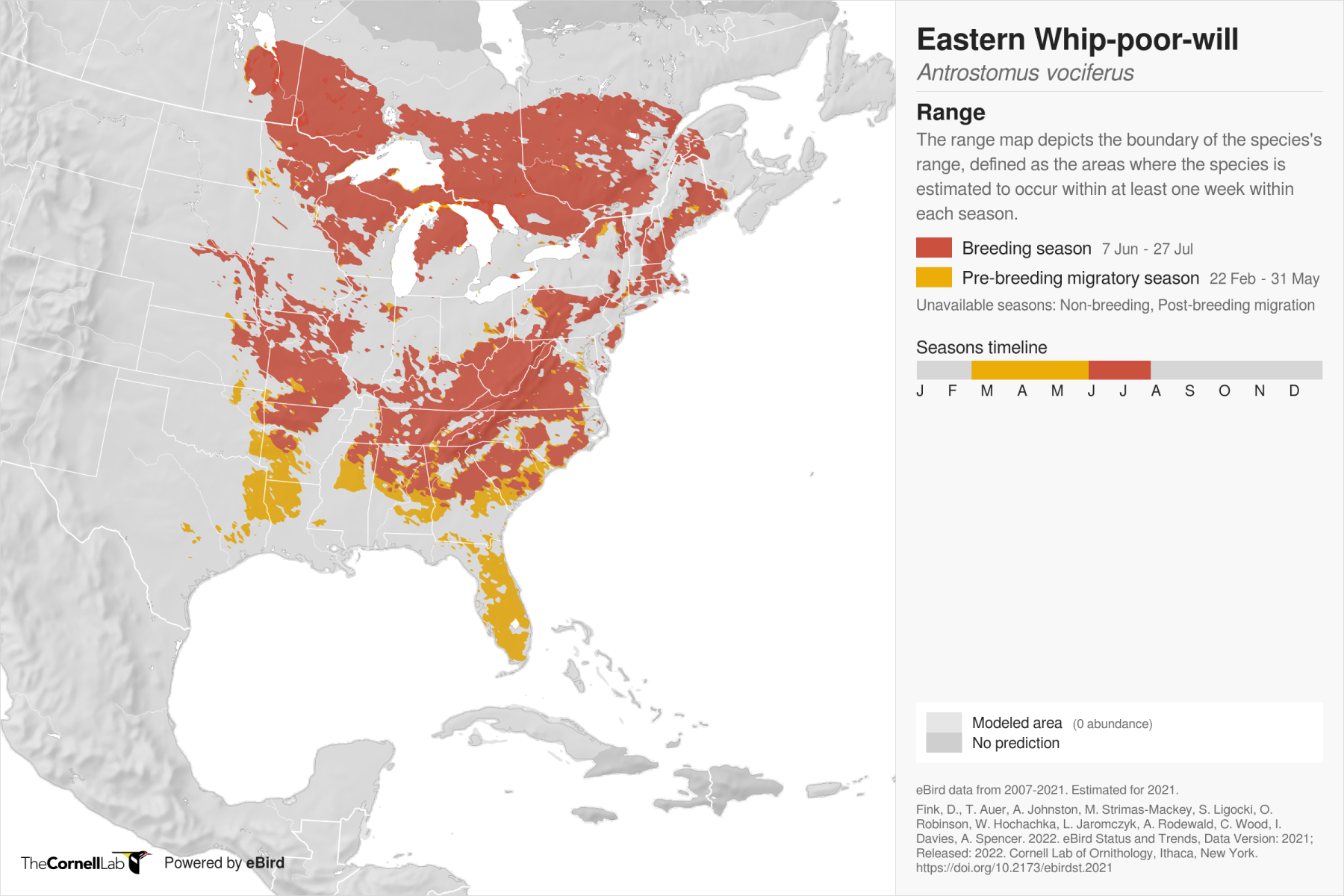
The eastern whip-poor-will is native to North America and Central America (fig. 2). It is a migratory species, with no known resident populations, and individuals spend more than half the year on migration and wintering grounds [26]. While its populations are declining in some areas (see Population Trends), and some areas lack populations that had them historically, the extent of the eastern whip-poor-will’s current range and that of its historical range appear similar [87].

Figure 2—Distribution of the eastern whip-poor-will in North America and Central America. In Canada, it also occurs on Price Edward Island [21]
States and Provinces
- United States: AL, AR, CA, CT, DC, DE, FL, GA, IA, IL, IN, KS, KY, LA, MA, MD, ME, MI, MN, MO, MS, NC, ND, NE, NH, NJ, NY, OH, OK, PA, RI, SC, SD, TN, TX, VA, VT, WI, WV [89]
- Canada: MB, NB, ON, QC, SK [90], NS [21,26], and PE [21]
- Mexico: Chis, Hgp, NL, Oax, Pue, SLP, Tab, Tamps, Ver [26,138]
Breeding Range
The eastern whip-poor-will’s breeding range extends from Nova Scotia and Prince Edward Island west to Saskatchewan and south to Oklahoma and South Carolina [21,26,90]. During the breeding season, eastern whip-poor-will vagrants have been observed in many parts of western North America, including Alaska, British Columbia, California, Arizona, New Mexico, and Colorado [6,26,139]. Eastern whip-poor-wills show fidelity to breeding sites [37].
Wintering Range
The eastern whip-poor-will’s wintering range extends from South Carolina west to Texas and south to eastern Mexico and Central America [26,37,69,70,115]. During winter, eastern whip-poor-will vagrants have been observed in southern California, Cuba, and Panama [6]. Birds from geographically dispersed breeding populations have high spatiotemporal overlap on winter ranges [69,115]. Eastern whip-poor-wills show fidelity to wintering sites [37].
Migration
Migration Routes
Migration occurs throughout the southern United States, Mexico, and Central America [26,37,69,70,115]. Migration occurs primarily at night [70]. Most tracked birds migrated to Mexico or Central America; few have remained in the United States [35,37,69,70,115], so little is known about the movements of birds wintering in the United States. Individuals typically migrate overland [26,37,69,70,115]; however, some individuals may cross over the Gulf of Mexico [37], and vagrants have been observed during migration in Bermuda, Cuba, and Jamaica [26]. Key migration routes and stopover locations during migration occur in the Ozark Plateau, the Ouachita Mountains, the prairie-forest ecoregion of eastern Texas, and the Gulf Coastal Plain [37,69,70,115].
Migration Duration and Distance
Migration distance and duration vary by location of individual birds [37,69] and limited data suggests by season [115] and sex [37]. Migration distance and duration may be long, with birds traveling >100 km/day. For example, birds breeding in southeastern Ontario migrated an average of 3,434 km over 28 days (123 km/day) during fall migration, while those breeding in Manitoba and northwestern Ontario migrated an average of 4,110 km over 41 days (100 km/day) [69]. Birds breeding in the Midwest migrated an average of 3,337 km (range: 1,600-5,000 km) in 21 days (159 km/day) during fall migration [115]. During fall migration, two tracked females breeding in Ontario departed later, spent more time migrating, and arrived later on wintering grounds than 23 males [37].
Birds often stopover for multiple days during migration[37,69,70,115]; limited data suggests that the number and duration of stops may be fewer and shorter in spring than fall [37]. Tracked birds breeding in the Midwest [115] and Canada [37,70] had up to four stopovers during spring or fall migration and each lasted up to 15 days. For breeding birds in Canada, stopovers appeared to be less numerous and of shorter duration in spring than fall [37].
Migration Timing
Eastern whip-poor-wills arrive on breeding sites from early March to mid-May, with most arriving in April. They leave breeding sites from August to early December, with peak migration occurring from mid-September to mid-October [55,69,115]. Arrival and departure dates vary regionally (table 1). It is difficult to distinguish between departing summer residents and arriving winter residents in southern states such as Alabama, Georgia, and South Carolina [26]. In the northern part of its breeding range, timing of arrival in spring coincides with the availability of large flying insects [161] and timing of departure in fall coincides with hard frosts that reduce insect availability [142]. Birds arrive on wintering sites from as early as mid-September [16] to as late as early December [35] and remain on wintering sites until at least late February [37] to late May [138] (table 2).
| Region | Earliest arrival date | Latest departure date |
|---|---|---|
| Northeast US | 27 March [127] | 1 December [112] |
| Midwest US | Mid-March [86] | 14 October (Thompson et al. 2011 cited in [26]) |
| Southeast US | 8 March (Post and Gauthreaux 1989 cited in [26]) | 6 November [142] |
| Canada | 18 April [38] | 1 November (Tufts 1986 cited in [26]) |
| Region | Earliest arrival date | Latest departure date |
|---|---|---|
| Southeast US | 13 September [16] | April [45] |
| Central and South America | 1 October [35] | 25 May [138] |
Plant Communities and Site Characteristics
The eastern whip-poor-will is an upland, terrestrial bird [7,15] that uses many plant communities at low to mid-elevations throughout its breeding and wintering ranges [21,58,81,95,118]. On both ranges, it uses a combination of forests and openings in proximity (e.g., [9,58,61,158,159]). The species uses hardwood, conifer, and mixed forests [82,160].
Breeding Range
Forests and Woodlands
Forests and woodlands used by eastern whip-poor-wills are typically dry or dry-mesic pine, hardwood, and mixed pine-hardwood forests (e.g., [9,26,28,52,96,118,140,145]). In the Northeast, pitch pine-bear oak communities are particularly important for eastern whip-poor-wills [1,48,58,59,61,79]. In the Northeast, Midwest, and Canada, eastern whip-poor-wills commonly occur in eastern white pine-eastern hemlock [52], red pine [5,140], and jack pine [26,65,82,125] forests. In the Southeast, eastern whip-poor-wills use shortleaf pine [76,157], loblolly pine [158], and longleaf pine [73] forests. In the Midwest [144] and Canada [125], birch and aspen forests may be important habitat. They do not use high-elevation conifer forests such as spruce or spruce-fir forests [52,118]. While eastern whip-poor-wills occur in both upland and bottomland mixed hardwood forests (e.g., [5,145,147]), upland mixed hardwood forests are sometimes considered better habitat for eastern whip-poor-wills (e.g., [145]).
Eastern whip-poor-wills are common in oak and pine-oak communities throughout their range. These include dry oak savannahs and woodlands [48,82,135,145], dry-mesic oak forests [145], oak-hickory woodlands and forests [12,135], pine-oak woodlands and forests [76,87,93,135,145,157], and mixed hardwood forests [3,102,145,147]. In Kansas, eastern whip-poor-wills were most abundant in oak-hickory forests, cross timbers-oak forest, and upland riparian forests [26]. Eastern whip-poor-wills may use pine plantations (e.g., [9,87,102,156,158,159]), although often with less frequency than other available plant communities [9,82].
Open Communities
Open plant communities used by eastern whip-poor-wills include early successional forests, savannahs, barrens, glades, alvars, rocky or sandy outcrops, shrublands, wetlands, prairies, pastures, old fields, and agricultural fields (e.g., [1,13,21,39,95,100,121,135,140,158]). Early successional plant communities used by eastern whip-poor-wills result from disturbances including burning, clearcutting, and hurricanes [5,43,58,61,122,135,140,159]. In Manitoba, Nebraska, and Kansas, eastern whip-poor-wills occur in upland and gallery forests close to tallgrass prairie [10,64].
Wetlands
Wetlands are important plant communities for foraging in many areas (e.g., [13,21,39,42,43,50,61,100,118,149]), while they are avoided in others [50,61,101,117]. For example, in northwestern Ontario, eastern whip-poor-wills were detected at sites with a relatively high proportion of open wetland within a 5-km radius, and wetlands appeared to be important foraging areas [43]. In contrast, in southeastern Ontario, eastern whip-poor-wills tended to avoid wetlands [50], and in northwestern Ontario eastern whip-poor-wills were more likely to select home ranges without wetlands [101]. However, many studies describing wetland use by eastern whip-poor-wills lump wetlands into a single category without differentiating them by wetland type (e.g., [39,42,43,50,101,117,149]), and use, structure, and available insect prey are likely to differ among wetland types [101]. For example, eastern whip-poor-wills are likely to forage only on the edges of wetlands that lack interior shrubs or trees to use as perches [21,61,101].
Specific wetland plant communities used by eastern whip-poor-wills include shrub and herbaceous wetlands [7,74], beaver ponds [107], northern white-cedar-tamarack-black ash bogs [126], and sphagnum-leatherleaf-tamarack bogs [14].
Migration
Plant communities used during migration are likely similar to those used on the breeding range [26]. A key stopover corridor used by eastern whip-poor-wills in the Ozark Plateau, Ouachita Mountains, and prairie/forest ecoregion of eastern Texas is predominantly forested, and eastern whip-poor-wills appear to be selecting forests in these areas during migration [117]. Eastern whip-poor-wills may occur in coastal scrub during migration through Mexico (Howell and Webb 1995 cited in [26]).
Wintering Range
Southeast
In the Southeast, wintering eastern whip-poor-wills are primarily found in mixed pine (usually loblolly and shortleaf pine)-hardwood (usually oak) forests, oak woodlands, pine flatwoods, or hardwood hammocks [26,53,99,119,142]. In central Florida, overwintering territories at Archbold Biological Station were mostly in slash pine-turkey oak (36% of 25 territories), sand pine scrub (24%), and scrubby flatwood (24%) habitats [26].
Mexico and Central America
In the dry forest, humid forest, and Sierra Madre Oriental ecoregions of Mexico and Central America, wintering eastern whip-poor-wills use hardwood and conifer forests [35,115,116,117], including pine-oak forests and edges [150], mimosa thickets [94], and scrublands [56] at low and mid-elevations up to about 1,500 m [111,116,117] or 2,100 m [2]. However, information is limited on specific plant communities used, although in Nicaragua, eastern whip-poor-wills can be found “in virtually all terrestrial habitats” [23].
Biological Characteristics
This review includes information covering many aspects of eastern whip-poor-will life history but focuses on those most relevant to fire. Much of the information on the general biology of the eastern whip-poor-will comes from a literature review in Birds of the World by Cink et al. (2020) [26] and the Recovery Strategy for the Eastern Whip-poor-will in Canada by Environment and Climate Change Canada [21]. Many aspects of its ecology are poorly understood in part because of its cryptic coloration and crepuscular and nocturnal behavior [26].

Figure 3—A female eastern whip-poor-will in Mineral County, West Virginia.
Species Description
The eastern whip-poor-will is an aerial insectivore that forages only during twilight and moonlit nocturnal periods. It is a migratory, ground-nesting bird with cryptic plumage—mottled with dark gray, brown, and black—that blends in easily with the deciduous leaf litter on which it nests and the tree branches on which it roosts during daylight hours (fig. 3). The plumage of males and females is similar except that males have conspicuous white corners on the tail and the female has a drab buff-colored tail [26]. Adults are 22 to 26 cm long and weigh 43.0 to 67.5 g [26,37]. Females are larger and heavier than males. The head and eyes of eastern whip-poor-wills are large, and its bill is small with an enormous gape that can consume large-bodied flying insects, their primary prey [26].
Social Structure
Eastern whip-poor-wills are generally solitary except during the breeding season when monogamous pairs form [26]. Loose flocks may form during migration [26,142].
Life Span and Mortality
Life Span
Little information is available on the life span of eastern whip-poor-wills. A banded female of unknown age was recaptured on the same territory in Kansas 13 years later, and a banded male was recaptured 15 years later [26].
Sources of Mortality
Predators
Little information is available on predators of eastern whip-poor-wills. Most known losses of eastern whip-poor-wills to predators are of eggs and chicks <2 weeks old [26,88] (see Reproductive Success). Tracks left in soft soil around 15 predated eastern whip-poor-will nests in Kansas indicated that striped skunks (33%), northern raccoons (27%), coyotes (20%), red foxes (13%), and snakes (7%) preyed on eggs and young [26]. In eastern Ontario, eggs or chicks were lost to fishers, northern raccoons, gray ratsnakes, white-tailed deer, a porcupine, and possibly ants [38]. Other predators mentioned in published literature include peregrine falcons [19,41], Cooper’s hawks [137], blue jays, great crested flycatchers [26], domestic dogs and cats [4,26], and snakes [120]. Other potential predators include weasels and eastern chipmunks [50]. The eastern whip-poor-will relies chiefly on camouflage as protection from predation [142].
Weather/Exposure
Exposure to extreme weather may kill some eastern whip-poor-wills but little information is available. One study reported that eastern whip-poor-wills were killed while migrating over Lake Michigan during severe weather that included high rain, high winds, and hail [34].
Collisions
Eastern whip-poor-will are sometimes killed by vehicles and trains [26,109] and collisions with wind turbines [54], and probably high-rise buildings [115].
Development and Reproduction

Figure 4—Eastern whip-poor-will eggs laid on oak litter in Fremont, Missouri.
Females lay their two-egg clutch directly on leaf litter on the forest floor (fig. 4). Both males and females share in incubation and brooding duties as well as in provisioning of young. Chicks are semiprecocial [26].
Breeding
Eastern whip-poor-wills are monogamous. At the start of the breeding season, males sing to establish a territory that is used throughout the breeding season [26]. Females do not sing [87]. Pairs appear to form within 2 weeks of arriving on their breeding grounds. The age at first reproduction is unknown [26].
Nesting
Females usually lay two eggs/clutch and have either one or two clutches/year [1,26,38,86,96,142] (see Reproductive Success). Uncommonly, females lay one egg; limited data suggests that this is more likely to occur during the second nesting attempt within a breeding season [26,38]. No studies reported laying more than two eggs/clutch. One study reported that eastern whip-poor-wills may lay a third clutch in a single breeding season [38]. Nesting occurs from as early as mid-April [128] to as late as late July [38,142] throughout the breeding range (table 3).
| Region | Earliest nesting date | Latest nesting date |
|---|---|---|
| Northeast US | 24 April (Robbins and Bystrak 1977 cited in [106]) | Mid-July [103] |
| Midwest US | Late April [86] | 26 July [142] |
| Southeast US | 9 April [128] | 10 June [128] |
| Canada | 19 May [38] | 19 July [38] |
Hatching
Both sexes incubate eggs; females do most of the incubating [26,103,120]. Chicks hatch after 19 to 22 days [1,26,103,142]. Females may lay a second clutch about 10 to 14 days after the first clutch hatches [26,103].
Brooding
Both sexes care for their young [26]. When the young molt into their black-speckled, highly camouflaged plumage at about 7 to 9 days old, the female often leaves them in the care of the male and initiates a second clutch within the territory; the female then lays a second clutch 3 to 5 days later [26,103]. In Ontario, earliest foraging attempts were noted when the chicks were 18 to 19 days old [88]. Young stay with one or both parents until at least 30 days old. Mills (1986) reported that 30-day-old chicks accepted food from parents even though they could feed themselves [88].
Fledging
First flight can be as early as 14 or 15 days after hatching [47,88], but flight ability at this time is still rudimentary [120]. In Kansas, mean age of first flight was 20 days old [26]. In Ontario, first flights occurred between 14 and 21 days old [88].
Movement and Dispersal
Chicks are semiprecocial and can move from the nest within days of hatching [26]. Chicks are found increasingly farther from nests as they age [120]. At 4 days, chicks are found near nests but actively wander [47,103] and by 7 days they are found away from the immediate vicinity of the nest [66,103,142] in dense cover[26]. At fledging, they increase mobility and decrease association with adults [38,120]. They remain with adults until at least 30 days old [88] and limited evidence suggests that adult and young may remain together until fall migration and possibly depart from breeding territories as a group [26]. Little is known about movements of eastern whip-poor-wills after fledging because most studies do not monitor chicks after they have fledged (e.g., [38,120]).
Reproductive Success
Little information is available on the reproductive success of eastern whip-poor-wills. What information is available suggests that reproductive success is variable but may be high [1,26,38,120]. Over a 3-year period in eastern Ontario, an average of 67% (range: 40%-91%) of chicks from 24 nests survived to fledging age, with an average of 0.6 to 1.1 chicks/nest surviving to fledging age each year. Models indicated that daily chick survival was lowest when chicks hatched in the middle of the breeding season and was higher for both very early and very late nests. Preferred prey (moth) abundance had a positive effect on daily chick survival rates. Between 33% and 67% of nesting pairs made more than one nesting attempt per year, and between 20% and 57% of pairs that fledged a first brood attempted a second brood [38]. Over 2 years in Illinois, an average of 67% of chicks from 27 nests survived to fledging. Models indicated that daily chick survival probability declined with increasing chick age, probably due to increased predation risk on chicks as they become more mobile but not yet able to fly [120]. In a pitch pine-bear oak barren in western Massachusetts, 67% of 21 nests had at least one egg survive to hatching over 6 years [1]. In Kansas, about 12 of 20 (60%) eastern whip-poor-will pairs reared two broods/season. Of 100 total nesting attempts, 140 chicks (70%) fledged successfully [26].
Activity and Habitat
Eastern whip-poor-wills remain inactive at roosting and nesting sites during the day and forage at night. They may use the same or different plant communities for these activities, often roosting and nesting in similar forest habitat and foraging in more open (nonforested) habitat [21] (table 4). For more information, see Foraging Sites, Nesting Sites, and Roosting Sites.
| Activity | Habitat attributes |
|---|---|
| Both nesting and foraging | Forests with sparse to moderate canopy cover or open habitats AND Sparse to moderate shrub and herbaceous cover AND Well-drained soils |
| Nesting only (must be adjacent to suitable foraging habitats) | Forests with a dense canopy cover AND Sparse to moderate shrub and herbaceous cover AND Well-drained soils |
| Foraging only (must be adjacent to suitable nesting habitats) | Forests with sparse canopy cover or open habitats AND Dense shrub cover AND Poorly drained soils OR Agricultural land with scattered shrubs or trees (e.g., hedgerows) that can be used as perches |
Diet and Foraging
Eastern whip-poor-wills are aerial insectivores that forage on flying insects primarily by flying from arboreal perches located up to 5 m from the ground—sometimes from shrubs or on the ground—capturing insects on the wing, and returning to the perch (i.e., sallying) [26,91,121,142]. They may occasionally glean insects off bark or search for insects under leaves or in rotten logs [26,142], and they may also occasionally fly slowly and silently along the tree line, catching insects in their especially wide mouths [35]. They usually forage at dawn and dusk, but on moonlit nights they may forage throughout the night [26].
Diet
Eastern whip-poor-wills are generalist insectivores [15,142] that eat a variety of night-flying insects, including moths, beetles, flying ants, flies (e.g., mosquitoes and caddisflies), grasshoppers, and crickets [26,142]. Their enormous gape (36-37 mm) enables them to swallow insects with a wingspan of up to 50 or 60 mm [26,121]. Both parents feed regurgitated insects to young [26,103] until they are at least 30 days old [88] (see Brooding). Studies on the dietary preferences of eastern whip-poor-wills are from the breeding range; diet has not been studied on the wintering range.
Moths, particularly medium-sized moths (10-60 mm), and beetles, particularly scarab beetles, appear to be favorite foods [26,48,121,142]. Moths may be especially important for young because they are soft-bodied [26]. Volume of insect species in the stomachs of 55 individuals collected from throughout the eastern whip-poor-will’s breeding range was as follows: moths (57.1%); scarab beetles (31.7%); click beetles (3.1%); katydids (1.8%); stoneflies (1.8%); ground beetles (0.9%); carrion beetles (0.8%); tiger moths (0.7%); ants, bees, and wasps (0.4%); fireflies (0.2%); longhorn beetles (0.2%); geometer moths (0.2%); owlet moths (0.2%); snout beetles (0.1%); minute brown scavenger beetles (0.1%); and unknown species (0.7%) [26]. On Cape Cod, 98% of prey items of eastern whip-poor-wills in pitch pine communities consisted of moths (61%) and scarab beetles (37%), which were both consumed in a proportion greater than their availability [48]. In Illinois, 92% of fecal samples contained moths, of which 84% consisted of medium-sized moths from three families: owlet moths, erebid moths, and geometer moths. Other insects included flies (35%), cockroaches (11%), and beetles (8%) [121]. According to Rand (2014), scarab beetles and most of the moths preferred by eastern whip-poor-wills are terrestrial, rather than wetland, species [101].
Quality of prey available to eastern whip-poor-wills appears to have decreased in the past 100 years [36] (see Threats: Declining Insect Prey).
Foraging Activity
Eastern whip-poor-wills usually forage at dawn and dusk, but they may forage throughout the night on moonlit nights [26,28,88,120]. Eastern whip-poor-wills are visual predators that must see insects to capture them [38,88,160], so light at twilight and on moonlit nights is required [88]. Eastern whip-poor-wills occasionally forage near anthropogenic light sources at night [49]; however, too much artificial light may hinder their foraging ability [113] (see Threats: Light Pollution). Eastern whip-poor-wills do not forage in cold, rainy weather [26]; they are most active on warm, clear nights, which may be related to increased ambient light conditions and an increased prevalence of flying insects [120].
Eastern whip-poor-wills concentrate foraging activities in areas with high moth and beetle abundance, such as forest edges [39,121]. In Ontario, regional-scale eastern whip-poor-will presence was positively related to moth abundance, and local-scale eastern whip-poor-will abundance was best predicted by beetle abundance and land cover variables (open-canopy habitats and edge length) [39]. In Illinois, eastern whip-poor-will abundance was positively associated with the number of large moths—the primary prey at the site—and forest edges, but only when edges were associated with high moth abundance [121].
Foraging Sites
Many plant communities may be used by foraging eastern whip-poor-wills if they have available insect prey, perches, and are close to forests with suitable structure for nesting and roosting; plant species composition appears less important than structure for foraging eastern whip-poor-wills [1,21,82]. According to the Recovery Strategy for the Eastern Whip-poor-will (Antrostomus vociferus) in Canada (2018), suitable foraging sites include both forests with sparse to moderate canopy cover and openings [21] (table 4). These plant communities likely have characteristics that facilitate successful foraging by allowing eastern whip-poor-wills to maneuver and detect flying insect prey, either by providing a clear line-of-sight or by backlighting them against the sky (e.g., [1,38,48,82,88,158]). Dense forests are not suitable for foraging [21]. Cink (2020) stated that foraging activities usually take place within 500 m of the nest, often near forest edges [26], so proximity of foraging sites to nesting sites is important during the breeding season [21] (see Opening Size, Shape, and Configuration). Use of forest interiors may increase during brightly illuminated lunar phases [159].
Breeding Activities
Nesting Sites
Eastern whip-poor-wills are ground-nesting birds that do not construct nests, but rather lay eggs directly on leaf litter, or occasionally, on bare ground or decayed wood [1,26,66,86,87,96,142] (fig. 4). Eggs are placed on well-drained, sandy or loamy soils [21,121,142]. Eastern whip-poor-wills typically nest in forested habitat, under hardwood tree canopies [1,112,142], but other habitats (e.g., shrubby thickets, small woodlots in agricultural areas, rock or sand barrens or glades with scattered trees, burns, pine plantations, and tree-covered sand dunes [21,47,66,96,103,128,142,158] may be used for nesting as long as suitable structure is present. According to the Recovery Strategy for the Eastern Whip-poor-will (Antrostomus vociferus) in Canada (2018) [21], suitable nesting habitat includes forests or openings with sparse to moderate shrub and herbaceous cover (e.g., [1,21,48,142,160]) (table 4). Forests with moderate canopy cover—where trees are spaced far enough apart to cast an uneven shade—are typically used (e.g., [21,48,58,142]), although the edges of dense forests may be used for nesting if the understory structure is suitable and they are near to more open foraging habitats [1,21,48].
While relatively open understories may be preferred in many areas (e.g., [26,48,122]), nesting sites are also found in patches with dense understory vegetation [1]. Eggs are typically placed such that they are in the open or are partially shaded by short-statured plants, but not tucked away near the stems [1,87,142]. Eggs are often placed on the northern or northeastern side of plants to provide shade from hot afternoon sun [26] and near to a fallen branch or log [66,96,128,142]. Deciduous leaf litter and uneven, dappled shade provides “excellent” camouflage for brooding adults and nestlings [1] and a sparse to moderate understory may provide an easy escape route from potential predators [48].
Individuals appear to show a high degree of fidelity to nesting sites [26,103], and sites may be reused year after year. For example, in a Kansas population, 25 of 50 nesting sites were used again the next year; 12 sites were used for 3 consecutive years, and 4 sites were used for 4 consecutive years [26]. Different nesting sites are used for second broods but these are usually within 80 m of the first site [26].
Brood-rearing Sites
Most chicks move to denser cover than provided around nesting sites after they are 7 days old and in care of the male [26]. More information is needed on this topic.
Roosting Sites
Eastern whip-poor-wills typically roost during the day either on branches up to 5 m off the ground or on the ground [1,26,61]. They use the same roosting sites repeatedly, unless disturbed [26,48]. During the breeding season, roosts are typically near nest sites [1,47,142] often in the same plant communities as nesting sites, such as in forests [1,61,123,159], shrublands, and thickets [1,47,61,142] but often with greater canopy cover than foraging sites [123]. They have been observed roosting in openings [61], although this appears relatively uncommon. Eastern whip-poor-wills appear to select roosting sites that maximize concealment from potential diurnal predators [50] and possibly to enhance thermoregulation [1].
Area Requirements
Breeding Range
Eastern whip-poor-wills are typically territorial during the breeding season. Males sing from a variety of perches along a regular route to establish territories that include nesting, roosting, and foraging sites [26,47,142]. While they typically do not share territories with other eastern whip-poor-wills, they may share foraging habitats within their home ranges [60,82]. In northwestern Ontario, eastern whip-poor-will home ranges overlapped with four or fewer other individuals, including both males and females. Overlap ranged from <1% to 100% [101].
Little information is available on territory or home range sizes of eastern whip-poor-wills. Three studies reported territory sizes ranging from about 2.8 to 11.1 ha [26,46,59] and three studies reported home range sizes from 0.8 to 499.5 ha [61,101,159] (table 5). Only one study examined differences between males and females, and it found that they had similar home range sizes [101]. Large home ranges in some studies (e.g., [101,159]) may reflect the wandering behavior of birds that did not find mates during the breeding season [60,61].
| Location; plant community | Territory (based on calling bird locations) | Core range (where radiotracked birds spent 50% of their time) | Home range (where radiotracked birds spent 75% of their time) |
|---|---|---|---|
| Kansas, Fitch Natural History Reservation; woodlands and woodland edges | 2.8-11.1 ha (n = 3 birds) [46] | — | — |
| Kansas, unknown location; unknown plant community | Most birds (52%) averaged 5.1 ha (n = 26 birds) [26] | — | — |
| New Hampshire, Mast Yard State Forest; pine-oak forest | Mean maximum (possibly includes locations attributed to birds in adjacent territories): 6.55-6.79 ha Mean minimum: 3.75-4.94 ha (n = 17 birds) [59] | — | — |
| New Hampshire, Mast Yard State Forest and surrounding areas; pine-oak forest | Mean maximum: 6.7-13.0 ha Mean minimum: 0.8-2.7 ha (n = 43 birds) [61] | — | — |
| North Carolina, eastern; loblolly pine forest | — | 1.7-154.4 ha | 5.1- 282.8 ha (n = 27 birds) [159] |
| Ontario, Rainy River district; forests dominated by quaking aspen, balsam poplar, speckled alder, red pine, jack pine, white spruce, and black spruce | — | 3.73-132.43 ha (mean: 31.0 ha) | 19.6-499.5 ha (mean: 136.2 ha) (n = 13 birds) [101] |
Little information is available on factors that influence home range size. In Mast Yard State Forest and surrounding areas, home ranges of eastern whip-poor-wills ranged from about 1 to 13 ha and appeared slightly larger where forests occurred without substantial openings [61]. Rand (2014) hypothesized that the large mean home range size reported in the Rainy River district of northwestern Ontario (136.2 ha) was due to “generally lower quality habitat” at the northern limit of the eastern whip-poor-will’s breeding range [101]. However, in loblolly pine forest in eastern North Carolina, neither landscape configuration (homogeneous versus heterogeneous landscapes), year of study, or amount of moonlight had a significant influence on home range size (range: 5.1-282.8 ha) of tracked eastern whip-poor-wills over 2 years, likely because of a high amount of variation among individuals [159].
Individuals appear to show a high degree of fidelity to territories. Eight of 14 males in a Kansas population returned to their former territories the following year, and 5 of 10 females returned not only to same territory but also to within 5 m of their former nesting site. A banded female of unknown age was recaptured on the same territory in Kansas 13 years later, and a banded male was recaptured 15 years later [26].
Wintering Range
Little information is available on the sizes of eastern whip-poor-will territories and home ranges on the wintering range, but limited information suggests that territories and home ranges are smaller on wintering ranges (generally <11 ha; table 6) than on breeding ranges. Wintering territories of 12 eastern whip-poor-wills wintering in South Carolina, Mexico, and Central America averaged 3.2 ha. However, the one bird wintering in South Carolina had a wintering territory of 28.9 ha; the territories of the other 11 birds averaged only 0.88 ha [35]. Home ranges of 11 eastern whip-poor-wills wintering in Texas, Mexico, and Central America were relatively small (0.5-10.9 ha), and 3 birds had two distinct ranges, moving from 1.5 to 115 km between them [138]. Home ranges of male eastern whip-poor-wills wintering in Mexico and Central America were also small (0.3-9.1 ha), and models suggested that home range size decreased as ruggedness increased and increased when agriculture was present in the home range, possibly because of reduced prey quantity or quality near agricultural areas [116,117].
| Location | Territory (based on calling bird locations) | Home range (where radiotracked birds spent 95-100% of their time) |
|---|---|---|
| Florida | Mean: 1.8 ha (n = not provided) [26] | — |
| South Carolina, Mexico, and Central America | — | Mean: 3.2 ha (n = 12 males) [35] |
| Texas, Mexico, and Central America | — | Mean: 5.2 ha (0.5-10.9 ha) (n = 10 males, 1 female) [138] |
| Mexico and Central America | — | Mean: 1.9 ha (0.3-9.1 ha) (n = 25 males) [116] |
Habitat Structure, Age, Size, Shape, and Configuration
Foraging, nesting, and roosting sites can either occur in the same habitats or they can occur in distinctly different habitat types (see Forest Structure and Size). If the latter, foraging sites often occur along forest edges or in the interiors of open or semi-open habitats (e.g., burns, wetlands, grasslands, and clearcuts) (see Foraging Sites), while nesting and roosting sites often occur in forests (see Nesting Sites and Roosting Sites) such that birds can forage, nest, and roost in proximity (see Opening Size, Shape, and Configuration). Because eastern whip-poor-wills require a mosaic of habitats, the spatial configuration of forest habitats near open habitats is often reported as an important predictor of the species’ presence. However, it is unclear what the optimal size of habitat patches or proportion of forest or openings is (Proportion of Forest to Openings).
Breeding Range
Forest Structure and Size
Eastern whip-poor-wills prefer large tracts of continuous forest (e.g., [29,39,135,149]) interspersed with open areas [21], and are thus positively associated with edge habitat (e.g., [21,39,58,59,61,97,118,121,158,159]). For example, in Ontario from the 1980s to the 2000s, the probability of detecting eastern whip-poor-wills in 2,300-ha breeding bird atlas blocks increased from 30% to 87% as forest cover increased from 4% to 96% and nearly doubled as forest edge increased from 13 to 800 km [39]. Large, continuous areas of forests and woodlands are particularly important within agricultural landscapes, such as in the western portion of the eastern whip-poor-will’s range where forests and woodlands are sparse [13,21,149]. Eastern whip-poor-wills are least abundant in areas of human development [58,121] and are absent from urban areas [39,82,149].
Large areas of dense, closed-canopy forests are generally unsuitable for eastern whip-poor-wills [26,39,52,82,140], and eastern whip-poor-wills tend to occur in areas where forest openings, such as those created by thinning [122,135] and clearcutting [158], are relatively common on the landscape (e.g., [5,9,58,59,61,122,158]). For example, in Mast Yard State Forest and surrounding areas, eastern whip-poor-wills avoided closed-canopy mature pine forests and preferred thinned pine forests, young regenerating clearcut forests, and shrub wetland edges [61].
In pitch pine barrens in the Northeast, eastern whip-poor-wills appear to reach their highest densities in communities with a moderate tree and understory shrub cover [1,26,61]; areas with very sparse or very dense canopy cover appear to be avoided [61]. For example, during 2 years in pitch pine-bear oak barrens in western Massachusetts, eastern whip-poor-wills were absent from areas lacking trees, most abundant in areas with tree canopy cover of less than 40%, and uncommon in areas with >80% canopy cover [1]. On Cape Cod, estimates of the number of birds per survey point ranged from 0.3 to 4.2, with the largest estimates at points in open to partially open pitch pine-bear oak communities, and fewest in closed-canopy black oak-scarlet oak-pitch pine communities (P. Cavanaugh, personal communication cited in [26]).
Because of the eastern whip-poor-wills positive association with large forest tracts, the species is sometimes classified as a “forest interior” species (e.g., [85,133,160]). However, factors that influence ease of prey capture at a site (e.g., stand structure, prey abundance, and moonlight availability) or availability of suitable nesting sites (e.g., well-drained soil and suitable understory cover) appear more important in eastern whip-poor-will habitat selection than whether the site is in the forest interior or at the forest edge [1,121,160]. For more information, see Foraging Sites and Nesting Sites.
The optimal amount of forest cover and size of forest stands required by eastern whip-poor-wills is unknown, and most information is anecdotal and from eastern whip-poor-wills in agricultural landscapes where small, isolated woodlands are considered poor habitat [106]. In semi-open agricultural areas of eastern Ontario, eastern whip-poor-will occupancy rates in forest patches ranging from 0.4 to 24.7 ha suggested that landscapes with few large forest patches are more important than landscapes with many small forest patches. The researchers hypothesized that predation risk may be higher in small forest patches in areas with high amounts of agriculture [149].
Time Since Disturbance
Eastern whip-poor-wills are often most common in early successional forests [1,27,43,61,110], but they can occur in forests of all successional stages, from early successional, regenerating (0-5 years old) stands to late successional (80-125 years old) stands [32,84,143]. It is often characterized as a “disturbance-dependent species” because it uses early-successional habitats and forests with canopy openings (e.g., [67,122,135]). For example, Spiller et al. (2021) and Thompson et al. (2022) concluded that the eastern whip-poor-will is disturbance-dependent because of its preference for intermediate levels of forest density (basal area) in northern hardwood forests in New York [122] and because of its preference for heterogeneity in canopy cover in oak-hickory, pine-oak, and mixed-oak woodlands in Missouri [135].
While eastern whip-poor-wills are common in early successional forests, they typically do not use clearcuts the first few years after clearcutting, before vegetation has regenerated. Use often peaks in early succession (beginning 3-5 years after disturbance), then declines as forest canopies close (e.g., [1,17,27,42,43,59,61,62,110,134]), although abundance of eastern whip-poor-wills in late-successional forests can be high [104]. According to DeGraaf and Yamasaki (2003), early successional habitat created by clearcuts become less suitable over time for early successional bird species such as eastern whip-poor-wills, and after 10 to 15 years, clearcut forests generally transition to less optimal habitat [33]. For example, in mixed-oak stands in southwestern Virginia, eastern whip-poor-wills occurred in 7-year-old clearcuts but were absent in younger (1 and 3 years old) and older (12 years old) clearcuts, and pole (about 30 years old) and mature (110-180 years old) forest stands [27]. In northern Wisconsin, mean relative abundance of eastern whip-poor-wills in quaking aspen stands was 0.2 bird/500 m transect 4 to 7 years after clearcutting, and 0 birds/500 m transect 11 to 36 years after clearcutting [110]. However, in Upton, New York, 11 to 32 territorial males/km2 were observed in late-successional (probably 50-70 years since cutting) second-growth oak-pitch pine forests [104].
Eastern whip-poor-wills generally prefer forests with a heterogeneous, uneven-aged structure and frequent canopy gaps over forests with a homogeneous, even-aged structure and a closed canopy [61,84,132,135], and prefer forests with an open to moderately dense understory over forests with a dense understory [17,21,26,48,82,84,142,160], although forests with dense understories are also used [103,135] (see Nesting Sites). In the Midwest and Northeast, eastern whip-poor-wills use late-successional and old-growth forests with multi-aged forest structure and canopy gaps [32,143]. In the Southeast, eastern whip-poor-wills are considered a “characteristic species” of late-successional mixed oak-pine stands with frequent canopy gaps. These stands are characterized by an uneven-aged tree distribution, sparse herbaceous understory, and “considerable” horizontal and vertical structure [84].
Opening Size, Shape, and Configuration
Eastern whip-poor-wills use openings of various sizes within forests [84], and it is unclear if there is an optimal opening size. On one hand, some openings may be too small to use. For example, in Mast Yard, New Hampshire, small clearcuts (<1 ha) appeared less likely to be used by eastern whip-poor-wills than larger clearcuts [61], and in Thunder Bay, Ontario, eastern whip-poor-wills were not found in openings <9.0 ha. However, there was no relationship between clearcut patch size and eastern whip-poor-will occupancy on the landscape with clearcut patches ranging from 1.8 to 254.8 ha [43]. On the other hand, because eastern whip-poor-wills need forest habitat, large clearcuts may reduce occupancy if there is not enough forest cover on the landscape [43]. Hunt (2013) noted that interiors of clearcuts larger than about 5 to 6 ha may not be used by eastern whip-poor-wills [61], because they tend to focus their activity in clearcut stands to within 100 m of the forest-clearcut edges [158].
Because eastern whip-poor-wills require a mosaic of habitats, the spatial configuration of forest habitats near to open habitats is often reported as an important predictor of the species’ presence (e.g., [159]). However, it is unclear what the optimal configuration of openings to forest is. Cink (2020) stated that eastern whip-poor-wills usually forage within 500 m of their nest, often near forest edges [26], so openings within 500 m of suitable, uninterrupted forest stands may be beneficial to eastern whip-poor-wills. However, in poor habitats, eastern whip-poor-wills may tolerate longer foraging distances. In poor habitat in northwestern Ontario the maximum foraging distance was 1,250 m [21,101].
Complex patch shapes may benefit eastern whip-poor-wills. In southeastern Massachusetts, eastern whip-poor-will abundance was strongly positively associated with complex patch shapes and “high contrast” edges [51]. Other studies noted the use of edge habitats that are hard or abrupt (e.g., [61]).
Proportion of Forest to Openings
Few data are available on the relative proportion of forest to openings required by eastern whip-poor-wills on the landscape, and what data are available are inconsistent. Tirpak et al. (2009) developed a habitat suitability model for eastern whip-poor-will in the Central Hardwoods and West Gulf Coastal Plain/Ouachitas Bird Conservation regions that assumed that a landscape with 70% forest and 30% open habitat was optimal and that landscapes with a greater proportion of forest were more suitable than those with less forest cover as long as some openings were present [136]. In North Carolina, mean home range size was about 40 ha in landscapes with about 50% open habitat in the forest matrix and about 50 ha in landscapes with little open habitat in the forest matrix, suggesting that home ranges may be larger if the proportion of forest to open areas is larger, although the difference in home range size was not significant [159]. At the northern edge of the species’ distribution in northwestern Ontario, home ranges were comprised of an average of 58% forest and 41% openings (scrub, field, rock, and wetland); however, home range sizes were larger than in other studies, which may be a result of poorer quality habitat in this region [101]. In eastern Algonquin Provincial Park, Ontario, a mean of 12 ha of clearcuts per 100 ha of mature pine-dominated forest was associated with eastern whip-poor-will occupancy. The clearcuts were of various sizes (interquartile range: 3–42 ha) and ages (interquartile range: 5–24 years since harvest) [140].
Wintering Range
On their wintering range, eastern whip-poor-wills are highly dependent on contiguous forest cover at all spatial scales (territory, home range, local, and landscape). Edge habitats do not appear to be important [35,116,117,138]. In home ranges of all 25 tracked eastern whip-poor-wills wintering in Mexico and Central America, forest comprised the greatest cover (82%), followed by agriculture (9%), scrub (6%), and cleared areas (2%). Developed areas and open water were not present in home ranges. Nine individuals had only forest in their home ranges, and edge density was not an important predictor of home range size, suggesting that these individuals were not strongly affiliated with habitat edges. Thus, fragmentation of forest by agriculture or other disturbances may reduce habitat for eastern whip-poor-wills on their wintering range [116,117]. The home ranges of all of 11 eastern whip-poor-wills wintering in Texas, Mexico, and Central America contained closed-canopy forest land cover (42%–100%), and no other land cover type (scrub/shrub, open, or developed) represented >50% of any home range. Although sample sizes were small, total edge habitat within the home range was negatively related to home range size [138]. Territories of 12 male eastern whip-poor-wills wintering in South Carolina, Mexico, and Central America contained a mixture of young forest, mature forest, and agricultural land. Birds selected territories with dense forests and generally avoided agricultural areas. Some birds had one territory and others had two territories. One-territory birds had 67% more forest cover on their primary wintering territory on average than two-territory birds. Two-territory birds likely relocated due to poor habitat quality due to agricultural expansion [35].
Fire-caused Mortality
No information is available in the published literature on fire-caused mortality of eastern whip-poor-wills. Once eastern whip-poor-wills can fly, direct fire-caused mortality is unlikely. However, because eastern whip-poor-wills nest directly on the ground, eggs and nestlings are vulnerable to even low-intensity surface fire.
Fire Effects on Habitats and Occupancy
Eastern whip-poor-wills use burned areas on their breeding range [1,59,61,65,79], and possibly on their wintering range [99]. No information was available on use of burns during migration. On their breeding range, eastern whip-poor-wills may occur in burns immediately or soon after fire [65,125] and up to at least 25 years after fire [142]. However, recent burns may be avoided by nesting eastern whip-poor-wills until understory cover becomes available [1,3,59,61,79] (see Fire Effects on Nesting and Roosting). Periodic fire may help create and maintain some habitats preferred by eastern whip-poor-wills, such as pitch pine barrens in the Northeast [151] and oak-hickory, pine-oak, and mixed-oak woodlands in the Midwest [135]. Because breeding eastern whip-poor-wills use a combination of open areas and forests in proximity (e.g., [9,58,61,158,159]) and avoid areas of dense, uninterrupted forests (e.g., [26,52]) (see Activity and Habitat), burned or treated areas that result in interspersion of open areas in large, densely forested areas are likely to increase use of densely forested areas by eastern whip-poor-wills [135]. However, in areas with few large, forested areas, such as in agricultural landscapes in the Midwest [13], fires that reduce available forested area are likely detrimental to eastern whip-poor-wills.
Breeding Range
Northeast
Information on fire effects on eastern whip-poor-will habitats in the Northeast comes from studies in pitch pine barrens [1,59,61,79] and one study in jack pine barrens [65]; information from other plant communities is lacking.
Fire in pitch pine barrens is generally thought to benefit eastern whip-poor-wills by removing hardwood canopy trees, reducing canopy cover, and initiating vigorous sprouting of shrubs, and thus promoting the stability of pitch pine-bear oak stands used by eastern whip-poor-wills [151]. However, several researchers noted a lack of eastern whip-poor-wills in recent (0-3 year old) burns [1,59,61,79] possibly because recent burns may not provide suitable cover for eastern whip-poor-wills, especially during nesting [59] (see Nesting Sites). In addition, pitch pine barrens with widely scattered trees and few or low shrubs, resembling savannah, are rarely used [61]. In western Massachusetts, abundance of calling eastern whip-poor-wills was greater in treated open-canopy bear oak barrens (<22% canopy cover) and treated open-canopy pitch pine barrens (<40%) than in untreated closed-canopy pitch pine forest (>80%) or untreated closed-canopy hardwood forest (>90%) for 2 years, and more abundant in treated bear oak barrens than in treated pitch pine barrens. Treatments included burning, thinning, and/or mowing. Eastern whip-poor-wills may have preferred the treated bear oak and pitch pine barrens because treatments were relatively older and they had greater understory cover and more complex vegetation structure [1]. For more information on the effects of integrated management on eastern whip-poor-wills, see Integrated Management with Fire.
In a jack pine/blueberry barren in Altona Flat Rock State Forest, New York, several eastern whip-poor-wills were heard singing the year after a 225-ha July 2019 wildfire [65]. No other information was provided.
Midwest
One study in Hoosier National Forest, Indiana, suggested that recently burned mixed hardwood forests appear less suitable for eastern whip-poor-wills and other ground-nesting birds than unburned forests due to the removal of understory vegetation providing nesting cover. Eastern whip-poor-wills were present in an unburned control mixed hardwood forest but absent from burned mixed hardwood forest in 1996, 3 years after an initial prescribed fire and 1 year after a second. However, in 1997, they were absent from both burned and unburned forest. The objective of the prescribed fires was to reduce the density of understory shade-tolerant shrubs and tree saplings and to stimulate growth of herbaceous vegetation and oak regeneration [3].
In oak-hickory, pine-oak, and mixed-oak woodlands in the Ozark Highlands, eastern whip-poor-wills appeared to benefit from treatments that resulted in interspersion of forests with understories burned within the last 10 years and unburned forests within a 1-km radius of survey points. Eastern whip-poor-will abundance increased from 1.3 to 2.7 birds/survey point as the percent area burned increased from 0% to 100%. While eastern whip-poor-will abundance peaked at 100% of area burned, there was still heterogeneity within burned areas because fire severity was mixed [135].
Southeast
See Integrated Management with Fire for information on the combined effects of thinning and prescribed fire on eastern whip-poor-wills in the Southeast.
Canada
Great Lakes-St. Lawrence Forest Region
Studies in the Great Lakes-St. Lawrence region in Ontario indicate that eastern whip-poor-wills use burns soon after fire [125] and at least 25 years after fire [142]. In a second-growth mixed conifer-hardwood forest near Gogama, at least one eastern whip-poor-will was recorded in a 380-ha burn 2 days after a high-severity fire. Seven were recorded in the burn and two in nearby unburned areas 17 to 35 days after the fire. Because total invertebrate abundance was greater in burned than unburned areas [125], suggests that eastern whip-poor-wills may have been foraging in burns so soon after fire because of greater prey availability in burns at this time. At Frank's Bay, eastern whip-poor wills were common in a stand with dense, 4.6- to 6-m tall poplars that was burned about 25 years prior [142].
Boreal Forest Region
Eastern whip-poor-will occupancy in boreal forest in northwestern Ontario was similar among sites in a 17-year-old burned stand, recent clearcuts (with regrowth less than an average height of 3 m), and open wetlands, although eastern whip-poor-will occupancy tended to be higher in burned sites. The probability of occupancy was 0.47 in burned sites compared with 0.36 in clearcuts and 0.40 along wetland edges [43].
Wintering Range
Very little is known about eastern whip-poor-will use of burned areas on their wintering range. In Chignahuapan, Puebla, Mexico, eastern whip-poor-wills and/or Mexican whip-poor-wills were not captured in oak woodlands that had been burned at low severity or at high severity the previous year but were captured in burns >5 years old [99].
Fire Effects on Nesting and Roosting
Eastern whip-poor-wills nest on the ground, typically in forests with moderate canopy cover. This includes early successional habitat, such as burned stands and regenerating clearcuts, and forest edges (e.g., [1,21,42,43,48]) (see Nesting Sites). They roost nearby, often in the same plant communities as nesting sites [1,47,61,123,142,159]} (see Roosting Sites). Information about fire effects on nesting and roosting sites comes from studies in pitch pine barrens in the Northeast [1], oak savannas and forests in the Midwest [12], longleaf pine and mixed pine-hardwood forests in the Southeast [73], and boreal forest in Canada [42,43].
Time Since Fire
Eastern whip-poor-wills may nest in areas that burned more than 2 years prior, sometimes preferring burned areas over closed-canopy forests. Burns less than 2-years-old may not provide enough understory cover for nesting or roosting, and suitable leaf litter required for nesting may not be present in burned areas until a few years after fire [1,59,73]. In western Massachusetts from 2006 to 2013, 24 eastern whip-poor-will nests were found in treated pitch pine barrens (n = 17 nests) and treated bear oak barrens (n = 7 nests) and none were found in untreated closed-canopy pitch pine or hardwood forests. Treatments included thinning, burning, and/or mowing 2 to 7 years prior. Nests were found in both dense and sparse understory vegetation. No nests were found in vegetation patches that were less than 2 years since treatment. Many of the sites used for nesting were also used for roosting. Roosting locations were primarily in treated pitch pine barrens (n = 45 roosts) and treated bear oak barrens (n = 11 roosts) that had some residual canopy cover and were in early succession, and a few roosts were found at the edges of closed-canopy forests (n = 3). Roosts occurred in treatments ranging from 1 to 9 years old. All roosting locations were on the ground under the shaded cover of understory shrubs or overstory trees [1]. In the Sandhill region of North Carolina, eastern whip-poor-wills were scarce in both periodically burned longleaf pine stands and “suppressed” mixed pine-hardwood stands but two nests were found on burned stands and none in suppressed stands. Burned stands were relatively open and grassy and had experienced one or more prescribed growing-season fires and regular dormant season fires (i.e., at 5-year intervals) since the 1970s. Suppressed stands had relatively closed canopies, large saplings, and small trees and had not experienced any prescribed growing season fires and few dormant season fires (i.e., skipped one or more 5-year rotations) during this time [73]. In the boreal forest region of northwestern Ontario, eastern whip-poor-wills nested within and on the edges of <20-year-old burns [42,43].
Fire Effects on Nesting Success
Little information is available on how nesting success compares between burned and unburned areas. In west-central Illinois, nest success was similar between restored oak-hickory savanna (0.949, n = 4 nests) and closed-canopy mixed-oak forest (0.966, n = 11 nests). Restored savanna had periodic mechanical removal of mesophytic tree species (especially maples) and prescribed fire on a 3- to 5-year rotation. Canopy cover ranged from 40% to 70%, the mid-canopy was sparse, and there were few shrubs. The mixed-oak forest had 90% to 95% canopy cover, a dense midstory, and a shrub layer [12].
Fire Effects on Prey Abundance
Only one study examined the effects of fire specifically on the insect prey of eastern whip-poor-wills. This study found that arthropods (e.g., moths and beetles) eaten by eastern whip-poor-wills in pitch pine-bear oak barrens at Bolton Flats Wildlife Management Area, Massachusetts, were more abundant in unburned areas than burned areas less than 1 year prior, although statistical tests were not conducted. Both burned and unburned areas were also mowed [154].
Reviews indicate that insect populations may increase, decrease, or remain unchanged following fire; and the response of the overall insect community to fire are complex. In the short-term, fire may reduce insect abundance through direct mortality and reduction in plants required for food, shelter, and oviposition sites, or increase it by attracting pyrophilous insects to freshly burned areas. Over the longer-term, insect abundance may increase because of regrowth of plants that attract recolonizing insects. The effect of burning on insect diversity and abundance varies considerably depending on insect taxa (e.g., its mobility and feeding guild) and life history stage; fire frequency, severity, size, and timing; plant community; other disturbances (e.g., livestock grazing, mowing, and past land uses); and other factors (e.g., [8,22,72,92,98,105,131,155]). A literature review of fire effects on arthropods in the Great Plains found that insects in the orders Coleoptera and Orthoptera tended to respond positively to fire in the short term, while insects in the orders Lepidoptera and certain suborders of Hemiptera tended to respond negatively, but the researchers acknowledged that each order or suborder can respond in a variety of ways and that individual species within them are also likely to respond variably. In addition, insects in orders such as Lepidoptera that may initially respond negatively to fire may respond positively to fire over time, but long-term studies are needed. Insects in the orders Hemiptera, Diptera, and Hymenoptera, overall, showed variable responses to fire with no clear positive, negative, or neutral pattern [72]. Although many studies have examined effects of burning on insects, these studies often combine guilds such as ground-dwelling and flying insects (e.g., Coleoptera) or diurnal and nocturnal insects (e.g., Lepidoptera) into one category, and thus, include taxa that are not readily available to eastern whip-poor-wills or other nocturnal insectivores, like bats [98]. For more information on how fire affects nocturnal flying insects, see the literature reviews in table A3.
Fire Regimes
Eastern whip-poor-wills occur in a variety of plant communities in the eastern United States (see Plant Communities and Site Characteristics) that historically had varied fuel structures and fire regimes. For example, historical fire frequency estimates based on LANDFIRE succession modeling range from 8 years in pitch pine barren ecosystems to 381 to 386 years in Great Lakes alvar ecosystems to 1,428 years in Appalachian shale barren ecosystems [75]. For additional fire regime information, search FEIS for this species by entering the species name or acronym on the home page and selecting “Fire Regime” as the publication type.
Fire Management Considerations
Fire management considerations for eastern whip-poor-wills consist mostly of (1) maintaining openings and creating new openings where they are lacking in densely forested landscapes and (2) protecting suitable large forest patches adjacent to openings to ensure that both forests and openings are maintained in proximity [50,58,61]. Prescribed fires can be a useful tool for maintaining and creating openings for eastern whip-poor-wills. They are often combined with other management techniques such as cutting overstory trees and mowing understory vegetation that enhances habitat heterogeneity and benefits eastern whip-poor-wills (e.g., [48]) (see Integrated Management with Fire).
Prescribed fires may maintain and/or create suitable openings for eastern whip-poor-wills in dense, forested stands, including oak-pine, aspen-birch, jack pine [144], and pitch pine [151] stands. For example, prescribed fires can be used to create and maintain a mosaic of pitch pine stands and bear oak openings in pitch pine communities and prevent succession to homogenous, closed-canopy pitch pine or hardwood-dominated stands. These fires remove hardwood canopy trees, stimulate coppice growth of trees, and initiate vigorous sprouting of shrubs that increase the amount of vertical and horizontal vegetative cover after several growing seasons [48,151] (see FEIS Species Review about pitch pine). Preliminary data from southeastern Massachusetts suggest that eastern whip-poor-wills prefer roost locations close to bear oak openings [58]. Garlapow (2007) recommended an intermediate burn frequency and intensity that “keeps the majority of the tree canopy intact, and only top-kills shrubs” to maintain suitable habitat for eastern whip-poor-wills in pitch pine barrens [48].
Declines in availability of early successional habitats considered detrimental to eastern whip-poor-wills are sometimes attributed to fire suppression (e.g., [87,140]) (see Threats: Loss and Alteration of Habitat), and fire exclusion is likely to be detrimental to eastern whip-poor-wills if it results in large areas of dense, mature forest habitat [144].
In general, patchy fires of mixed severity are more likely to create habitats suitable to wildlife than large, uniform fires because the former fires provide the greatest variety in vertical structure and cover (successional stages) and distances from forest to edge habitat. Conversely, fires that are very large and/or homogeneous likely have a negative effect on wildlife in general [152], and eastern whip-poor-will in particular, because eastern whip-poor-wills require forested areas and openings in proximity. Fires that create very large openings or remove too much forested area may be detrimental to eastern whip-poor-wills [136,140] (see Opening Size, Shape, and Configuration and Proportion of Forest to Openings). A heterogeneous burn pattern that creates complex shapes is likely to be more suitable for eastern whip-poor-will than a homogeneous burn pattern by increasing structural heterogeneity [51,61,135].
Little information is available about how fire timing affects eastern whip-poor-wills. Because eastern whip-poor-wills nest directly on the ground, eggs and nestlings are vulnerable to even low-intensity surface fire, and Hunt (2013) suggested that forest treatments should not occur during the peak breeding season (April to July, depending on location; see Development and Reproduction: Nesting) [61]. However, eastern whip-poor-wills often nest more than once in a breeding season [26,38] (see Reproductive Success), so birds may renest after disturbances that occur early in the breeding season, such as after prescribed fires.
Little information is available about how fire frequency affects eastern whip-poor-wills, but because eastern whip-poor-wills often avoid recently burned or otherwise disturbed areas (see Time Since Disturbance and Time Since Fire), very frequent fire (less than a 3- to 5-year interval) is likely to be detrimental to eastern whip-poor-wills [76,77].
Integrated Management with Fire
Prescribed burns are the preferred method of maintaining or restoring pitch pine barren habitat, in part because pitch pine germination is facilitated by fire. In most New Hampshire pitch pine barrens, fire is combined with other treatments (usually mowing and/or tree harvest) that opens the understory prior to burning. This combination serves the dual purpose of removing competing plant species and reducing fuel loads and wildfire risk. However, prescribed burns in pitch pine stands are more beneficial to eastern whip-poor-wills if shrubs and other understory plants are not removed prior to burning (e.g., by mowing) [61]. For example, at the Ossipee Pine Barrens, shrub mowing combined with tree removal resulted in sites with widely scattered trees and few shrubs. After burning, the sites resembled savannah and were rarely occupied by eastern whip-poor-wills. However, after a few years, as regenerating shrubs became larger, eastern whip-poor-wills began to use the sites, but even then, use was concentrated at the edges of the treated areas. Burning without mowing or selective tree and/or shrub removal created habitat patches that appeared more attractive to eastern whip-poor-wills immediately and soon after burning [61].
While research is lacking, researchers suggest silvicultural treatments to maintain or enhance eastern whip-poor-will habitat in specific regions. In upland oak stands in the Southern Piedmont, silvicultural treatments such as the “shelterwood-burn method” that are aimed at favoring oak dominance while creating uneven-aged stands are likely to benefit eastern whip-poor-wills by providing complex vertical structure more than clearcutting, which creates even-aged stands [76,77]; however, no data are available on the use of such treated stand by eastern whip-poor-wills. Thompson et al. (2022) surmised that in pine-oak woodlands of the Ozark Highlands, thinning to reduce basal area to 9 or 10 m2/ha and periodic burning to prevent the redevelopment of the understory and midstory should create conditions that support abundant eastern whip-poor-wills [135].
One long-term study suggested that integrated treatments intended to restore shortleaf pine-bluestem habitats for endangered red-cockaded woodpeckers may be detrimental to eastern whip-poor-wills and other ground-nesting birds in the Southeast by removing the litter layer and reducing vegetation structure [85,157]. In second-growth shortleaf pine-oak stands in Ouachita National Forest, Arkansas, eastern whip-poor-wills were more abundant in untreated control plots (mean: 0.8 birds/40 ha averaged over 4 years from 1992 to 2000) than in plots treated to restore shortleaf pine-bluestem habitat (mean: 0 birds/40 ha). Treatments were conducted from 1990 to 1993 and included: (1) thinning midstory and codominant trees only and (2) thinning combined with a first, second, or third early growing season prescribed fire [85,157].
Prey Management
No information is available on the effects of prescribed fire—alone or in combination with other forest management techniques —specifically on eastern whip-poor-will prey. A literature review of fire effects on arthropods in the Great Plains concluded that fire should be variable in space and time to maximize heterogeneity on the landscape and suggested that providing a mosaic of burned areas and unburned areas (refugia) would promote the highest number of arthropod species [72]. A literature review on fire effects on insects also suggested the importance of retaining spatiotemporal variation among sites of the same ecosystem type by altering the frequency of fire and other disturbances to create and maintain diverse habitat niches and therefore insect species diversity [131]. Combining prescribed burning with silvicultural techniques such as clearcutting or thinning may increase the abundance and diversity of moths and other prey important to eastern whip-poor-wills if they result in abundant and diverse woody and herbaceous vegetation in various stages of succession on the landscape [98,129,130,158]. More information is needed on this topic.
The eastern whip-poor-will is a bird of conservation concern in many areas of the United States and Canada because populations appear to be declining due primarily to loss and alteration of habitat and declining abundance of insect prey.
US Federal Legal Status
None [146]
Other Status
Other US Conservation Status
As of 2021, the eastern whip-poor-will is a bird of conservation concern in the following Bird Conservation Regions in the continental United States according to the US Fish and Wildlife Service [148]:
- Prairie Potholes
- Boreal Hardwood Transition
- Lower Great Lakes/St. Lawrence Plain
- Atlantic Northern Forest
- Eastern Tallgrass Prairie
- Prairie Hardwood Transition
- Central Hardwoods
- West Gulf Coastal Plain/Ouachitas
- Mississippi Alluvial Valley
- Southeastern Coastal Plain
- Appalachian Mountains
- Piedmont
- New England/Mid-Atlantic Coast
Spiller (2019) reported that eastern whip-poor-wills are designated as a species of concern in 11 states, and in 30 of the 32 states in which they breed, they are designated as a “species of greatest conservation need” [123].
Canadian Legal Status
The eastern whip-poor-will was designated as threatened in Canada in April 2009 due to concern about long-term population declines. In December 2022, it was designated a species of concern following reanalysis of trend data that suggested that population declines may not have been quite as severe as thought at the time of the previous assessment. More recent data suggest that abundance may now be stable or increasing [20].
NatureServe Status
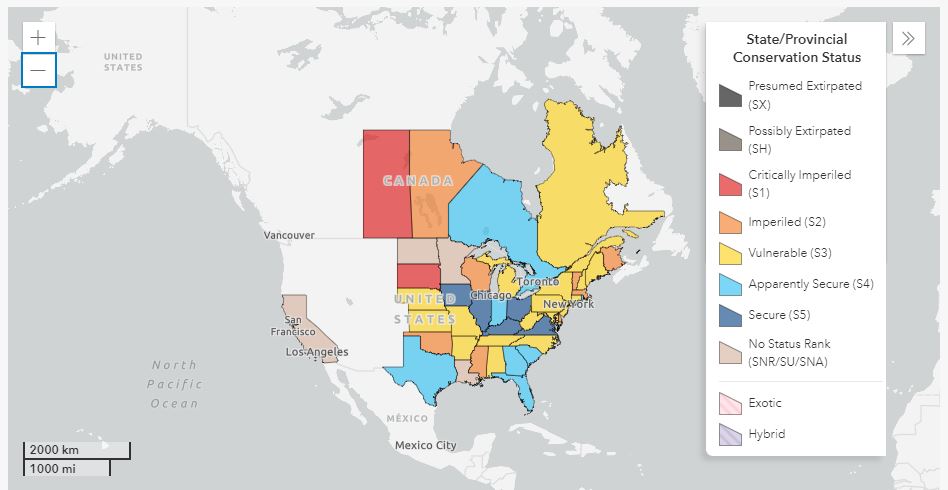
NatureServe (2023) lists the status of eastern whip-poor-will as secure (G5) because it is still relatively common overall, although rare in certain parts of its range. As of 2023, the eastern whip-poor-will is considered critically imperiled in Saskatchewan and South Dakota and imperiled in Manitoba, Wisconsin, Oklahoma, Alabama, Vermont, and Massachusetts (fig. 5). Information on state- and province-level protection status of animals in the United States and Canada is available at NatureServe, although recent changes in status may not be included [89].

Figure 5—State and provincial conservation status in 2023.
IUCN Red List of Threatened Species
Near Threatened [63]
Population Trends
Eastern whip-poor-will populations [36,91,124]—and aerial insectivorous bird populations in general [91,124]—appear to be declining. Based on data from 1966 to 2015 North American Breeding Bird Surveys, eastern whip-poor-will populations declined in many parts of their breeding range, especially in the Southeast, while populations in a few areas increased. The average annual decline was –2.76%, with large annual declines in the following regions: Boreal Hardwood Transition (–2.67%); Central Hardwoods (–3.02%); Eastern Tallgrass Prairie (–3.78%); Appalachian Mountains (–3.45%); Piedmont (–3.51%); and New England/Mid-Atlantic Coast (–4.37%) (Sauer et al. 2017 cited in [26]).
Threats
Primary threats to eastern whip-poor-will populations include loss and alteration of habitat and declining insect prey quality and abundance [26]. Other factors include increasing urbanization and associated light pollution [26,87] and climate change [21].
Loss and Alteration of Habitat
Probable causes of eastern whip-poor-will population declines in many areas include (1) loss of forests due to changes in land uses such as increased agriculture and urbanization; (2) forest succession that results in more closed-canopy, dense forests and loss of forest openings; and (3) livestock grazing [21,26,89].
Breeding Range
Land Use Changes
Land use changes that contribute to loss of forests, such as agricultural expansion and intensification, urban expansion and development, and energy development and mineral extraction can reduce habitat available to breeding eastern whip-poor-wills [21,26,59,87]. Eastern whip-poor-will populations are particularly vulnerable to loss of forests in regions where these habitats are already small, such as in North Dakota [26].
Loss of Early Successional Forests
Declines in eastern whip-poor-will populations in many areas have been attributed to declines in early successional habitats and forest maturation [21,26,61,87,89,140]. For example, in Canada, declines in useable open habitat (e.g., forest clearcuts and old fields) within 1,140 m of Breeding Bird Survey points from 1967 to 2013 explained approximately 40% to 57% of the variation in eastern whip-poor-will occurrence. Loss of useable open habitat was primarily caused by succession of previously open habitats to forests, and gains of useable open habitat were primarily caused by forest clearcutting and farmland abandonment [100]. In the eastern United States, declines in early successional stages are most evident in the Southeast (-3.19%/year), followed by the Northeast (-2.38%/year) and Midwest (-1.69%/year) [67]. The causes of declines in early successional forests vary regionally and include reforestation of abandoned farmlands, fire exclusion, fewer disturbance-creating floods, land development, a transition to selective harvesting (in contrast to clearcutting), and fewer beavers [33,140,141].
Livestock Grazing
Livestock grazing may reduce eastern whip-poor-will populations because nests are vulnerable to trampling [89] and available nesting habitat is reduced [26]. Cink et al. (2020) noted the disappearance of nesting eastern whip-poor-wills from grazed woodlands in eastern Kansas [26], and in Iowa, eastern whip-poor-wills did not return to nest in woodlands that had been heavily grazed by domestic sheep (Nauman 1925 cited in [26]). The effect of livestock grazing on eastern whip-poor-wills likely depends on grazing intensity and the amount of residual vegetation. In contrast, livestock grazing may benefit eastern whip-poor-wills in some areas by reducing dense, nonnative invasive woody shrubs (e.g., honeysuckle and common buckthorn in oak woodland understories in Wisconsin), which may be too dense for nesting eastern whip-poor-wills [102].
Migration
Birds migrating to and from the Midwest experience different environmental factors along their migration route than birds migrating to and from the Northeast. For example, birds migrating to the Midwest traverse areas with broad-scale, intensive agricultural landscapes with limited forest cover, while birds migrating to and from the Northeast traverse areas with relatively high levels of urban development and artificial light pollution [69].
Little information is available about habitats used during migration and more information is needed to identify and conserve migratory bottlenecks or hotspots [69]. What information is available suggests that forests from the Ozark Plateau in southern Missouri to the prairie-forest ecoregion of eastern Texas are especially important for eastern whip-poor-wills migrating to and from the Midwest (see Distribution: Migration). Threats to forests in the region include climate change, agricultural and urban expansion, and pests such as the red oak borer [115].
Wintering Range
Eastern whip-poor-wills are concentrated in a relatively small area of forested habitat on winter ranges and deforestation and agricultural expansion and intensification (i.e., increased use of agricultural pesticides) are major concerns [21,115]. Changes on the wintering grounds are probably responsible for a disproportionate amount of observed eastern whip-poor-will population declines [115]. Minimizing additional forest loss and promoting agricultural systems that incorporate forest expansion would benefit eastern whip-poor-wills on their winter range [116,117].
Declining Insect Prey
One cause of eastern whip-poor-will population decline appears to be declining insect prey quality [36], abundance [21], and availability [21,153]. The main possible causes include: (1) loss of insect producing habitats due to agricultural intensification such as pesticide use, and (2) lack of synchrony between eastern whip-poor-will hatching and peak insect abundance due to climate change [21,153]. In many parts of the Northeast, pesticides used to treat infestations of the introduced spongy moth may be reducing Lepidopteran prey available to eastern whip-poor-wills [89,144].
Light Pollution
Eastern whip-poor-wills use dark, rural areas during migratory stopovers while avoiding brightly lit urban areas; therefore, urbanization and associated light pollution likely harm eastern whip-poor-wills [71].
Nonfire Habitat Management
Eastern whip-poor-wills and other early successional bird species may benefit from forest management practices that create or maintain early successional forests [1,21,33,61,122,135,140,144,158]. However, little is known about how these practices affect key aspects of eastern whip-poor-will biology and ecology, including abundance and reproductive success [26]. Silvicultural treatments (e.g., thinning and clearcutting) may have short-term negative effects on nesting eastern whip-poor-wills by disrupting breeding activities, disturbing nest sites, and/or damaging eggs [21], but no data are available on these topics.
Silvicultural Practices
Eastern whip-poor-will’s use of clearcuts is variable (e.g., [43,61,134,158]). Factors that influence their use include clearcut structure, age, and size (see Opening Size, Shape, and Configuration). Clearcuts are generally not suitable to eastern whip-poor-wills within the first 5 years after harvest because they lack preferred vegetation structure, unless understory saplings and shrubs are left. However, if a clearcut is adjacent to forests with suitable structure, the edge of a young clearcut may be used by foraging eastern whip-poor-wills. As the clearcut regenerates and vegetation structural diversity increases (5-8 years postharvest), it is more likely to be used by eastern whip-poor-wills [61]. In many cases, clearcuts may rapidly mature into unsuitable, even-aged young forest with a dense understory. For example, DeGraaf and Yamasaki (2003) stated that clearcuts become less suitable for early successional species after 10 to 15 years [33] (see Time Since Disturbance). Suitability of clearcut patches may be prolonged beyond this time if the patch is burned within a year of harvest (e.g., in pine-oak forest in New Hampshire) [61]. Eastern whip-poor-wills may not use clearcuts that are too small or large. According to Hunt (2013), very small clearcuts (<1 ha) may not be used; this includes group-selection cuts, which tend to be small (<1 ha). On the other hand, clearcuts larger than about 5 to 6 ha could have unused interiors [61] (see Opening Size, Shape, and Configuration). However, eastern whip-poor-wills do forage along narrow, linear openings in managed stands, such as along logging and skid roads [61].
Eastern whip-poor-wills are often abundant in thinned forests as they provide suitable nesting habitats [61]. For example, at Fort Drum, New York, eastern whip-poor-will occupancy was highest in northern hardwood forests with intermediate levels of basal area (8.4–18.7 m2/ha), with peak occupancy at 13.8 m2/ha, a value that corresponds with residual basal area levels resulting from shelterwood harvest [122]. Thompson et al. (2022) suggested that management to restore and sustain pine-oak woodlands that reduces overstory tree density by thinning, and understory and midstory density by prescribed fire, should create conditions to support dense eastern whip-poor-will populations in the Ozark Highlands [135]. For more information, see Integrated Management with Fire.
Management Under a Changing Climate
Changes in eastern whip-poor-will distribution over time and timing of migration have been attributed to a warming climate [11,163], although studies are inconsistent. In New York, eastern whip-poor-wills showed both a southward latitudinal shift and a downward elevational shift in distribution between 1980-1985 and 2000-2005 [163]. In Wisconsin, eastern whip-poor-will first arrival dates from 1936 to 1998 became earlier, possibly due to climate warming [11]. However, in Cayuga Lake Basin, New York, first arrival dates did not change significantly from 1903-1950 to 1951-1993, and in Worcester County, Massachusetts, they did not change from 1932 to 1993 [18]. A later study in Worcester, Massachusetts that extended the study period to 2013, found that while some bird species temporally shifted their first arrival date in response to warming springtime temperatures, eastern whip-poor-wills did not [31]. In Maine, mean arrival date from 1899-1911 (10 May) was significantly earlier than the mean arrival date from 1994-2017 (19 May), contrary to predictions of an earlier first arrival date during the later period due to climate warming [162]. Changes in first arrival dates and timing of insect availability resulting from climate changes could result in a lack of synchronization between reproductive timing (e.g., hatching) and peak insect prey abundance, potentially harming eastern whip-poor will populations [21,153].
The effects of climate warming on eastern whip-poor-will is uncertain. Because the eastern whip-poor-will is considered highly sensitive to temperature and moisture changes throughout its annual cycle, Culp et al. (2017) ranked it as “highly vulnerable” to predicted climate changes in the Upper Midwest Great Lakes region [30]. However, in Acadia National Park, Maine, Fisichelli et al. (2014) categorized eastern whip-poor-will as a potential “persister” because its projected habitat suitability showed no change under two potential future climate change scenarios (“least change” and “major change”) for three future periods (2040, 2070, and 2100) [44].
Weather extremes are expected to occur more frequently with predicted future climate changes [57]. An increase in the number of severe weather events (e.g., cold snaps, hurricanes, and windstorms), can impact eastern whip-poor-will habitats on breeding grounds, migration routes, and wintering grounds [21]. Eastern whip-poor-wills do not forage during cold, wet weather [26] (see Foraging Activity) and exposure to extreme weather may kill some eastern whip-poor-wills [34] (see Source of Mortality: Weather/Exposure). Habitat loss and degradation due to increasingly frequent and severe hurricanes along migration routes are a concern for this species according to the Committee on the Status of Endangered Wildlife in Canada [20]. However, Slover and Katzner (2016) suggested that, in West Virginia, increasing severity of storms that kill overstory trees and create forest gaps, may increase suitability of forests for eastern whip-poor-wills [118].
| Class | Common name | Scientific name |
|---|---|---|
| Insect | ants | family Formicidae |
| Insect | ants, bees, sawflies, and wasps | order Hymenoptera |
| Insect | beetles | order Coleoptera |
| Insect | caddisflies | order Trichoptera |
| Insect | carrion beetles | family Silphidae |
| Insect | cicadas, aphids, planthoppers, leafhoppers, assassin bugs, bed bugs, and shield bugs | order Hemiptera |
| Insect | click beetles | family Elateridae |
| Insect | cockroaches | order Blattodea |
| Insect | crickets, grasshoppers, and locusts | order Orthoptera |
| Insect | erebid moths | family Erebidae |
| Insect | fireflies | family Lampyridae |
| Insect | flies | order Diptera |
| Insect | flying ants | suborder Apocrita, order Hymenoptera |
| Insect | geometer moths | family Geometridae |
| Insect | ground beetles | family Carabidae |
| Insect | katydids | family Tettigoniidae |
| Insect | longhorn beetles | family Cerambycidae |
| Insect | minute brown scavenger beetles | family Latridiidae |
| Insect | mosquitoes | family Culicidae |
| Insect | moths and butterflies | order Lepidoptera |
| Insect | owlet moths | family Noctuidae |
| Insect | red oak borer | Enaphalodes rufulus |
| Insect | scarab beetles | family Scarabaeidae |
| Insect | snout beetles | family Curculionidae |
| Insect | *spongy moth | Lymantria dispar |
| Insect | stoneflies | order Plecoptera |
| Insect | tiger moths | subfamily Arctiidae, family Erebidae |
| Bird | blue jay | Cyanocitta cristata |
| Bird | Cooper’s hawk | Accipiter cooperii |
| Bird | eastern whip-poor-will | Antrostomus vociferus |
| Bird | great crested flycatcher | Myiarchus crinitus |
| Bird | Mexican whip-poor-will | Antrostomus arizonae |
| Bird | nightjars | Caprimulus spp. and Antrostomus spp. |
| Bird | peregrine falcon | Falco peregrinus |
| Bird | red-cockaded woodpecker | Dryobates borealis |
| Mammal | coyote | Canis latrans |
| Mammal | domestic dog | Canis lupus familiaris |
| Mammal | domestic cat | Felis catus |
| Mammal | domestic sheep | Ovis aries |
| Mammal | eastern chipmunk | Tamias striatus |
| Mammal | fisher | Pekania pennanti |
| Mammal | northern raccoon | Procyon lotor |
| Mammal | porcupine | Erethizon dorsatum |
| Mammal | red fox | Vulpes vulpes |
| Mammal | striped skunk | Mephitis mephitis |
| Mammal | white-tailed deer | Odocoileus virginianus |
| Mammal | weasels | Mustela spp. |
| Reptile | gray ratsnake | Pantherophis spiloides |
| Reptile | snakes | suborder Serpentes, order Squamata |
| Life form | Common name | Scientific name |
|---|---|---|
| Bryophyte | sphagnum | Sphagnum spp. |
| Graminoid | bluestem | Andropogon spp. |
| Shrub | bear oak (a.k.a., scrub oak) | Quercus ilicifolia |
| Shrub | blueberry | Vaccinium spp. |
| Shrub | *common buckthorn | Rhamnus cathartica |
| Shrub | *honeysuckle | Lonicera spp. |
| Shrub | leatherleaf | Chamaedaphne calyculata |
| Tree | aspen | Populus spp. |
| Tree | birch | Betula spp. |
| Tree | black ash | Fraxinus nigra |
| Tree | black oak | Quercus nigra |
| Tree | eastern hemlock | Tsuga canadensis |
| Tree | eastern white pine | Pinus strobus |
| Tree | fir | Abies spp. |
| Tree | hickory | Carya spp. |
| Tree | jack pine | Pinus banksiana |
| Tree | loblolly pine | Pinus taeda |
| Tree | longleaf pine | Pinus palustris |
| Tree | maple | Acer spp. |
| Tree | northern white-cedar | Thuja occidentalis |
| Tree | oak | Quercus spp. |
| Tree | pine | Pinus spp. |
| Tree | pitch pine | Pinus rigida |
| Tree | poplars | Populus spp. |
| Tree | quaking aspen | Populus tremuloides |
| Tree | red pine | Pinus resinosa |
| Tree | sand pine | Pinus clausa |
| Tree | scarlet oak | Quercus coccinea |
| Tree | shortleaf pine | Pinus echinata |
| Tree | slash pine | Pinus elliottii |
| Tree | spruce | Picea spp. |
| Tree | tamarack | Larix laricina |
| Tree | turkey oak | Quercus laevis |
| Title | Reference |
|---|---|
| A global synthesis of fire effects on pollinators | [22] |
| A literature review of insect responses to fire, compared to other conservation managements of open habitat | [131] |
| A review of fire effects on bats and bat habitat in the eastern oak region | [98] |
| Arthropods and fire: Previous research shaping future conservation | [72] |
| Bats and fire: A global review | [80] |
| Do fire and insects interact in eastern forests? | [108] |
| Ecological effects of prescribed fire season: A literature review and synthesis for managers | [68], chapters therein |
| Fire effects on wildlife foods | [83] |
| First-order fire effects on animals: Review and recommendations | [40] |
| Increasing prevalence of severe fires change the structure of arthropod communities: Evidence from a meta-analysis | [8] |
| Insects, fire, and conservation | [92] |
| Response of grassland arthropods to burning: a review | [155] |
| Responses of prairie insects and other arthropods to prescription burns | [105] |
1. Akresh, Michael E.; King, David I. 2016. Eastern whip-poor-will breeding ecology in relation to habitat management in a pitch pine-scrub oak barren. Wildlife Society Bulletin. 40(1): 97-105. [97678]
2. Andrle, Robert F. 1966. North American migrants in the Sierra de Tuxtla of southern Veracruz, Mexico. The Condor. 68(2): 177-184. [98098]
3. Aquilani, Steven M.; Morrell, Thomas E.; LeBlanc, David C. 2003. Breeding bird communities in burned and unburned sites in a mature Indiana oak forest. Proceedings of the Indiana Academy of Science. 112(2): 186-191. [60825]
4. Arsenault, A. A. 2009. Disturbance impact thresholds: Recommended land use guidelines for protection of vertebrate species of concern in Saskatchewan. Technical Report 2009-06. Regina, SK: Saskatchewan Ministry of Environment, Lands Branch - Fish and Wildlife Branch. 94 p.[97939]
5. Barton, Barbara J. 2007. Whip-poor-will and common nighthawk surveys in support of the Michigan Breeding Bird Atlas II - 2007 final report. Report to the Michigan Department of Natural Resources, Wildlife Division. Report Number MNFI 2007-17. Lansing, MI: Michigan Natural Features Inventory. 31 p. [97925]
6. Baumann, Matthew J.; Pederson, Nicholas D.; Oldenettel, Jerry; Graus, Matthew S.; McNew, Sabrina M.; Witt, Christopher C. 2011. Molecular and morphological evidence confirm the first record of eastern whip-poor-will (Caprimulgus vociferus) for New Mexico. New Mexico Ornithological Society Bulletin. 39(1): 1-10. [97908]
7. Benson, Catherine E. 2013. Ecological value of wetland restoration. Potsdam, New York: Clarkson University: 93 p. Dissertation. [97913]
8. Bieber, Blyssalyn V.; Vyas, Dhaval K.; Koltz, Amanda M.; Burkle, Laura A.; Bey, Kiaryce S.; Guzinski, Claire; Murphy, Shannon M.; Vidal, Mayra C. 2022. Increasing prevalence of severe fires change the structure of arthropod communities: Evidence from a meta-analysis. Functional Ecology. 37(8): 2096-2109. [97839]
9. Bjorklund, Richard G.; Bjorklund, Eric R. 1983. Abundance of whip-poor-wills, Caprimulgus vociferous, in the Sand Ridge State Forest. Transactions of the Illinois State Academy of Science. 76(1-2): 271-276. [97899]
10. Borkowsky, Christie L. 2017. Manitoba tall grass prairie preserve: Providing habitat for protected and provincially rare species. The Prairie Naturalist. 16: 126-127. [98058]
11. Bradley, Nina L.; Leopold, A. Carl; Ross, John; Huffaker, Wellington. 1999. Phenological changes reflect climate change in Wisconsin. Proceedings of the National Academy of Science. 96(17): 9701-9704. [97963]
12. Brawn, Jeffrey D. 2006. Effects of restoring oak savannas on bird communities and populations. Conservation Biology. 20(2): 460-469. [61997]
13. Brenner, Stephen J.; Jorgensen, Joel G. 2020. Range limits and habitat associations of eastern whip-poor will (Antrostomus vociferous) and chuck-wills-widow (Antrostomus carolinensis) across eastern Nebraska. Lincoln, NE: Nebraska Game and Parks Commission, Nongame Bird Program. 9 p. [97928]
14. Brewer, Richard. 1967. Bird populations of bogs. The Wilson Bulletin. 79(4): 371-396. [98061]
15. Brooks, Robert P.; Croonquist, Mary Jo. 1990. Wetland, habitat, and trophic response guilds for wildlife species in Pennsylvania. Journal of the Pennsylvania Academy of Science. 64(2): 93-102. [97914]
16. Burleigh, Thomas D. 1944. The bird life of the Gulf Coast region of Mississippi. Occasional Papers of the Museum of Natural Science, Louisiana State University. 20(1): 329-489. [98077]
17. Bushman, Ellen S.; Therres, Glenn D. 1988. Habitat management guidelines for forest interior breeding birds of coastal Maryland. Wildlife Technical Publications 88-1. Annapolis, MD: Maryland Department of Natural Resources, Forest, Park & Wildlife Service. 50 p. [98048]
18. Butler, Christopher J. 2003. The disproportionate effect of global warming on the arrival dates of short-distance migratory birds in North America. Ibis. 145(3): 484-495. [97964]
19. Cade, Tom J.; Martell, Mark; Redig, Patrick; Septon, Greg; Tordoff, Harrison. 1996. Peregrine falcons in urban North America. In: Bird, David M.; Varland, Daniel E.; Negro, Juan Jose, eds. Raptors in human landscapes: Adaptations to built and cultivated environments. San Diego, CA: Academic Press: 3-13. [71307]
20. Committee on the Status of Endangered Wildlife in Canada. 2022. COSEWIC Wildlife Species Assessments (detailed version), December 2022. Gatineau, QC: Committee on the Status of Endangered Wildlife in Canada. 8 p. Available online: https://www.cosewic.ca/images/cosewic/pdf/2022-wildlife-species-assessments-detailed-december-en.pdf. [2023, May 12]. [97972]
21. Environment and Climate Change Canada. 2018. Recovery strategy for the eastern whip-poor-will (Antrostomus vociferus) in Canada. Species at Risk Act Recovery Strategy Series. Ottawa, Canada: Government of Canada, Environment and Climate Change Canada. vi + 107 p. [97860]
22. Carbone, Lucas M.; Tavella, Julia; Pausas, Juli G.; Aguilar, Ramiro. 2019. A global synthesis of fire effects on pollinators. Global Ecology and Biogeography. 28(10): 1487-1498. [97848]
23. Chavarria-Duriaux, Liliana. 2018. Nightjars and allies: Caprimulgidae. In: Chavarria-Duriaux, Liliana. Birds of Nicaragua: A field guide. Ithaca, NY: Cornell University Press. 64-69 p. [98099]
24. Chesser, R. T.; Billerman, S. M.; Burns, K. J.; Cicero, C.; Dunn, J. L.; Hernandez-Banos, B. E.; Jimenez, R. A.; Kratter, A. W.; Mason, N. A.; Rasmussen, P. C.; Remsen, J. V., Jr.; Winker, K. 2022. Checklist of North and middle American birds, [Online]. Chicago, IL: American Ornithological Society (Producer). Available: http://checklist.americanornithology.org/taxa. [97323]
25. Chesser, R. Terry; Banks, Richard C.; Barker, F. Keith; Cicero, Carla; Dunn, Jon L.; Kratter, Andrew W.; Lovette, Irby J.; Rasmussen, Pamela C.; Remsen, J. V., Jr.; Rising, James D.; Stotz, Douglas F.; Winker, Kevin. 2012. Fifty-third supplement to the American Ornithologists' Union check-list of North American birds. The Auk. 129(3): 573-588. [97906]
26. Cink, C. L.; Pyle, P.; Patten, M. A. 2020. Eastern whip-poor-will (Antrostomus vociferus), version 1.0, [Online]. In: Rodewald, P. G., ed. Birds of the World. Ithaca, NY: Cornell Lab of Ornithology, (Producer). Available: https://doi.org/10.2173/bow.whip-p1.01. [2023, January 11]. [97580]
27. Conner, Richard N.; Adkisson, Curtis S. 1975. Effects of clearcutting on the diversity of breeding birds. Journal of Forestry. 73(12): 781-785. [25043]
28. Cooper, Robert J. 1981. Relative abundance of Georgia Caprimulgids based on call-counts. Wilson Bulletin. 93(3): 363-371. [97919]
29. Cooper, Robert J. 1982. Range expansion of the whip-poor-will in Georgia. The Oriole. 47(1&2): 1-9. [98066]
30. Culp, Leah A.; Cohen, Emily B.; Sarpignato, Amy L.; Thogmartin, Wayne E.; Marra, Peter P. 2017. Full annual cycle climate change vulnerability assessment for migratory birds. Ecosphere. 8(3): e01565. [97965]
31. Cunningham, Caitlin M.; Luscier, Jason D.; Mackey, Erica A.; Palmer, Corey A.; Bolster, Daniel R.; Valentine, Anna L.; McCrimmon, Donald A., Jr. 2020. Changes in the migration phenology of Massachusetts birds 1940-2013 in relation to temperatures along the Atlantic flyway. Northeastern Naturalist. 27(3): 448-468. [97970]
32. DeGraaf, Richard M. 1985. Breeding bird assemblages in New England northern hardwoods. In: Conference proceedings: The impact of timber management practices on nongame birds in Vermont; 1982 August 7; Johnson, VT. Johnson, VT: Johnson State College: 5-22. [98079]
33. DeGraaf, Richard M.; Yamasaki, Mariko. 2003. Options for managing early-successional forest and shrubland bird habitats in the northeastern United States. Forest Ecology and Management. 185(1-2): 179-191. [48395]
34. Diehl, Robert H.; Bates, John M.; Willard, David E.; Gnoske, Thomas P. 2014. Bird mortality during nocturnal migration over Lake Michigan: A case study. The Wilson Journal of Ornithology. 126(1): 19-29. [97940]
35. Driscoll, Joshua; Ross, Allison. 2019. Wintering ground habitat selection by the eastern whip-poor-will. Undergraduate research project. Worchester, MA: Worcester Polytechnic Institute. 43 p. [97859]
36. English, Philina A.; Green, David J.; Nocera, Joseph J. 2018. Stable isotopes from museum specimens may provide evidence of long-term change in the trophic ecology of a migratory aerial insectivore. Frontiers in Ecology and Evolution. 6(14): 1-13. [97833]
37. English, Philina A.; Mills, Alexander M.; Cadman, Michael D.; Heagy, Audrey E.; Rand, Greg J.; Green, David J.; Nocera, Joseph J. 2017. Tracking the migration of a nocturnal aerial insectivore in the Americas. BMC Zoology. 2(5): 1-11. [97830]
38. English, Philina A.; Nocera, Joseph J.; Green, David J. 2018. Nightjars may adjust breeding phenology to compensate for mismatches between moths and moonlight. Ecology and Evolution. 8(11): 5515-5529. [97818]
39. English, Philina A.; Nocera, Joseph J.; Pond, Bruce A.; Green, David J. 2017. Habitat and food supply across multiple spatial scales influence the distribution and abundance of a nocturnal aerial insectivore. Landscape Ecology. 32(2): 343-359. [97862]
40. Engstrom, R. Todd. 2010. First-order fire effects on animals: Review and recommendations. Fire Ecology. 6(1): 115-130. [82000]
41. Errington, Paul L. 1933. Food habits of southern Wisconsin raptors. Part II. Hawks. The Condor. 35(1): 19-29. [61995]
42. Farrell, Claire E.; Fahrig, Lenore; Mitchell, Greg; Wilson, Scott. 2019. Local habitat association does not inform landscape management of threatened birds. Landscape Ecology. 34(6): 1313-1327. [97680]
43. Farrell, Claire E.; Wilson, Scott; Mitchell, Greg. 2017. Assessing the relative use of clearcuts, burned stands, and wetlands as breeding habitat for two declining aerial insectivores in the boreal forest. Forest Ecology and Management. 386: 62-70. [97679]
44. Fisichelli, Nicholas A.; Monahan, William B.; Peters, Matthew P.; Matthews, Stephen N. 2014. Climate change and birds of the Acadia National Park region: Projected changes in habitat suitability for 130 breeding bird species. Natural Resource Report NPS/ACAD/NRR-2014/840. Fort Collins, CO: U.S. Department of the Interior, National Park Service. 59 p. [97968]
45. Fisk, Erma J. 1979. Fall and winter birds near Homestead, Florida. Bird-Banding. 50(3): 22-243. [98100]
46. Fitch, Henry S. 1958. Home ranges, territories, and seasonal movements of vertebrates of the Natural History Reservation. University of Kansas Publication: Museum of Natural History. 11(3): 63-326. [98065]
47. Fowle, C. David; Fowle, Ann M. 1954. Observations at a whip-poor will's nest. The Canadian Field-Naturalist. 68(1): 38-39. [97943]
48. Garlapow, Ross M. 2007. Whip-poor-will prey availability and foraging habitat: Implications for management in pitch pine/scrub oak barrens habitats. Amherst, MA: University of Massachusetts Amherst. 47 p. Thesis. [97834]
49. Gehring, Joelle. 2009. Sensitive wildlife species surveys and observations for the White Pine Wind Resource Area - 2009 field season. MFNI Report Number 2009-29. Lansing, MI: Michigan State University. 14 p. [97948]
50. Grahame, Elora R. M.; Martin, K. D.; Gow, E. A.; Norris, D. R. 2021. Diurnal and nocturnal habitat preference of Eastern whip-poor-wills (Antrostomus vociferus) in the northern portion of their breeding range. Avian Conservation & Ecology. 16(2): 14. [97863]
51. Grand, Joanna; Cushman, Samuel A. 2003. A multi-scale analysis of species-environment relationships: Breeding birds in a pitch pine--scrub oak (Pinus rigida--Quercus ilicifolia) community. Biological Conservation. 112(3): 307-317. [61265]
52. Hall, George A. 1983. West Virginia birds: Distribution and ecology. Carnegie Museum of Natural History Species; Publication No. 7. Pittsburgh, PA: Carnegie Museum of Natural History. 180 p. [97920]
53. Hamel, Paul B. 1992. Land manager's guide to the birds of the South. Chapel Hill, NC: The Nature Conservancy. 437 p. [97933]
54. Herrera-Alsina, Leonel; Villegas-Patraca, Rafael; Eguiarte, Luis E.; Arita, Hector T. 2013. Bird communities and wind farms: A phylogenetic and morphological approach. Biodiversity Conservation. 22: 2821-2836. [98063]
55. Honkomp, Nora. 2021. Exploring shifts in migration phenology and breeding distribution of declining North American avian aerial insectivores. Kent, OH: Kent State University: 67 p. [97912]
56. Howell, Steve N. G.; Dyer, Dale. 2023. Eastern whip-poor-will. In: Howell, Steve N. G.; Dyer, Dale. Birds of Belize. Princeton, NJ: Princeton University Press. 128-129. [98101]
57. Huber, Daniel. G; Gulledge, Jay. 2011. Extreme weather and climate change: Understanding the link and managing the risk. Arlington, VA: Center for Climate and Energy Solutions, Science and Impacts Program. 13 p. [97967]
58. Hunt, Pamela D. 2006. An analysis of whip-poor-will habitat use in the Piscataquog River watershed: 2003-2005 with notes on statewide comparisons. A report submitted to the Piscataquog Watershed Association and Russell Piscataquog River Watershed Foundation. Concord, NH: New Hampshire Audubon. 14 p. [97892]
59. Hunt, Pamela D. 2010. Whip-poor-will territory mapping at two New Hampshire sites. A report to the Nuttall Ornithological Club and Norcross Wildlife Foundation. Concord, NH: New Hampshire Audubon. 16 p.[97921]
60. Hunt, Pamela D. 2016. Extra-territorial movements by eastern whip-poor-wills. North American Bird Bander. 41(3): 97-102. [97949]
61. Hunt, Pamela. D. 2013. Habitat use by the eastern whip-poor-will (Antrostomus vociferus) in New Hampshire, with recommendations for management. Report to the NH Fish and Game Department, Nongame and Endangered Species Program. Concord, NH: New Hampshire Audubon. 38 p. [97885]
62. Hunter, William C.; Buehler, David A.; Canterbury, Ronald A.; Confer, John L.; Hamel, Paul B. 2001. Conservation of disturbance-dependent birds in eastern North America. Wildlife Society Bulletin. 29(2): 440-455. [73446]
63. IUCN. 2021. The IUCN red list of threatened species, [Online]. Version 2022-2. International Union for Conservation of Nature & Natural Resources (Producer). Available: http://www.iucnredlist.org. [2023, September 28]. [48717]
64. Johnsgard, Paul A. 2007. A guide to the tallgrass prairies of eastern Nebraska and adjacent states. 5th ed ed. Lincoln, NE: University of Nebraska-Lincoln. 169 p. [98057]
65. Johnson, Kaylee; Garneau, Danielle. 2020. Non-invasive monitoring of nest boxes, [poster]. Plattsburgh, NY: SUNY, Center for Earth and Environmental Science. [97922]
66. Kent, Fred W.; Vane, Robert F. 1958. A nesting of the whip-poor-will in Iowa County. Iowa Bird Life. 28(4): 71-79. [98059]
67. King, David I.; Schlossberg, Scott. 2014. Synthesis of the conservation value of the early-successional stage in forests of eastern North America. Forest Ecology and Management. 324: 186-195. [97951]
68. Knapp, Eric E.; Estes, Becky L.; Skinner, Carl N. 2009. Ecological effects of prescribed fire season: A literature review and synthesis for managers. Gen. Tech. Rep. PSW-GTR-224. Albany, CA: U.S. Department of Agriculture, Forest Service, Pacific Southwest Research Station. 80 p. [79558]
69. Korpach, Alicia M.; Davy, Christina M.; Mills, Alex; Fraser, Kevin C. 2022. Migratory connectivity and timing for an at-risk Canadian landbird, eastern whip-poor-will (Antrostomus vociferus), from two geographically distant breeding areas. Canadian Journal of Zoology. 100(10): 660-668. [97831]
70. Korpach, Alicia M.; Mills, Alex; Heidenreich, Claire; Davy, Christina M.; Fraser, Kevin C. 2019. Blinded by the light? Circadian partitioning of migratory flights in a nightjar species. Journal of Ornithology. 160(3): 835-840. [97888]
71. Korpach, Alicia M.; Garroway, Colin J.; Mills, Alex M.; von Zuben, Valerie; Davy, Christina M.; Fraser, Kevin C. 2022. Urbanization and artificial light at night reduce the functional connectivity of migratory aerial habitat. Ecography. 2022(8): e05581. [97958]
72. Kral, Katherine C.; Limb, Ryan F.; Harmon, Jason P.; Hovick, Torre J. 2017. Arthropods and fire: Previous research shaping future conservation. Rangeland Ecology & Management. 70(5): 589-598. [95135]
73. Krieger, Sharlene Marie. 1997. Abundance, habitat associations, and nest success of passerines within a fire maintained longleaf pine (Pinus palustris) ecosystem. Raleigh, NC: North Carolina State University. 78 p. Thesis. [62074]
74. Lacki, Michael J.; Hummer, Joseph W.; Webster, Harold J. 1991. Avian diversity patterns at a constructed wetland: Use of ecological theory in the evaluation of a mine land reclamation technique. International Journal of Surface Mining and Reclamation. 5(3): 101-105. [97931]
75. LANDFIRE. 2020. Biophysical settings models and descriptions, [Online]. Washington, DC: U.S. Department of Agriculture, Forest Service; U.S. Department of the Interior; U.S. Geological Survey; Arlington, VA: The Nature Conservancy, (Producers). Available: http://www.landfirereview.org/search.php. [2022, February 2]. [96496]
76. Lanham, J. Drew; Keyser, Patrick D.; Brose, Patrick H.; Van Lear, David H. 2002. Management options for songbirds using the oak shelterwood-burn technique in upland forests of the southeastern United States. In: Ford, W. Mark; Russell, Kevin R.; Moorman, Christopher E., eds. The role of fire in nongame wildlife management and community restoration: Traditional uses and new directions: Proceedings of a special workshop; 2000 December 15; Nashville, TN. Gen. Tech. Rep. NE-288. Newtown Square, PA: U.S. Department of Agriculture, Forest Service, Northeastern Research Station: 65-72. [41559]
77. Lanham, J. Drew; Keyser, Patrick D.; Brose, Patrick H.; Van Lear, David H. 2002. Oak regeneration using the shelterwood-burn technique: Management options and implications for songbird conservation in the southeastern United States. Forest Ecology and Management. 155(1-3): 143-152. [45949]
78. Lepage, Denise. 2023. Eastern whip-poor-will: Antrostomus vociferus (Wilson, A 1812). In: Avibase: The world bird database, [Database]. Birds Canada (Producer). Available: https://avibase.bsc-eoc.org. [2023 March 14]. [97798]
79. Lloyd-Evans, Trevor L. 1974. The ornithology and vegetation of a burnt-over pitch pine forest in Plymouth County, Massachusetts. Research Report No. 7. Manomet, MA: Manomet Bird Observatory. 15 p. [+ appendices]. [65603]
80. Loeb, Susan C.; Blakey, Rachel V. 2021. Bats and fire: A global review. Fire Ecology. 17: 1-18. [97856]
81. Loetscher, Frederick W., Jr. 1955. North American migrants in the state of Veracruz, Mexico: A summary. The Auk. 72(1): 14-54. [97915]
82. Lohre, Michael J. 2003. Habitat associations of the whip-poor-will (Caprimulgus vociferus) in central Wisconsin: Implications for conservation. Oshkish, WI: The University of Wisconsin Oshkosh. 72 p. Thesis. [97809]
83. Lyon, L. Jack; Hooper, Robert G.; Telfer, Edmund S.; Schreiner, David Scott. 2000. Fire effects on wildlife foods. In: Smith, Jane Kapler, ed. Wildland fire in ecosystems: Effects of fire on fauna. Gen. Tech. Rep. RMRS-GTR-42-vol. 1. Ogden, UT: U.S. Department of Agriculture, Forest Service, Rocky Mountain Research Station: 51-58. [44448]
84. Masters, Ronald E. 2007. The importance of shortleaf pine for wildlife and diversity in mixed oak-pine forests and in pine-grassland woodlands. In: Kabrick, John M.; Dey, Daniel C.; Gwaze, David, eds. Shortleaf pine restoration and ecology in the Ozarks: Proceedings of a symposium; 2006 November 7-9; Springfield, MO. Gen. Tech. Rep. NRS-P-15. Newtown Square, PA: U.S. Department of Agriculture, Forest Service, Northern Research Station: 35-46. [80664]
85. Masters, Ronald E.; Wilson, Christopher W.; Cram, Douglas S.; Bukenhofer, George A.; Lochmiller, Robert L. 2002. Influence of ecosystem restoration for red-cockaded woodpeckers on breeding bird and small mammal communities. In: Ford, W. Mark; Russell, Kevin R.; Moorman, Christopher E., eds. The role of fire in nongame wildlife management and community restoration: Traditional uses and new directions: Proceedings of a special workshop; 2000 December 15; Nashville, TN. Gen. Tech. Rep. NE-288. Newtown Square, PA: U.S. Department of Agriculture, Forest Service, Northeastern Research Station: 73-90. [41563]
86. Mengel, Robert M. 1965. The birds of Kentucky. Ornithological Monographs No. 3. Lawrence, KS: The American Ornithologists' Union. 581 p. [24548]
87. Mills, A. M. 1987. Whip-poor-will Engoulevent bois-pourri Caprimulgus vociferus. In: Cadman, M.D.; Eagles, P. F. J.; Helleiner, F. M., eds. Atlas of the breeding birds of Ontario. Waterloo, Ontario: University of Waterloo Press: 224-225. [97909]
88. Mills, Alexander M. 1986. The influence of moonlight on the behavior or goatsuckers (Caprimulgidae). The Auk. 103(2): 370-378. [97935]
89. NatureServe. 2023. Antrostomus vociferus, eastern whip-poor-will. In: NatureServe Explorer, [Online]. Arlington, VA: NatureServe, (Producer). Available: https://explorer.natureserve.org/Taxon/ELEMENT_GLOBAL.2.871696/Antrostomus_vociferus [2023 March 14]. [97799]
90. NatureServe. 2023. NatureServe Explorer, [Online]. Arlington, VA: NatureServe (Producer). Available: https://explorer.natureserve.org/. [94379]
91. Nebel, Silke; Mills, Alex; McCracken, Jon D.; Taylor, Philip D. 2010. Declines of aerial insectivores in North America follow a geographic gradient. Avian Conservation and Ecology. 5(2): 1. [97959]
92. New, Tim R. 2014. Insects, fire, and conservation. Chasm, Switzerland: Springer International Publishing. 208 p. [97950]
93. Nordman, Carl; Faber-Langendoen, Don; Baggs, Joanne. 2021. Rapid ecological integrity assessment metrics to restore wildlife habitat and biodiversity for shortleaf pine-oak ecosystems. Forests. 12(12): 1739. [97926]
94. Orians, Gordon H.; Paulson, Dennis R. 1969. Notes on Costa Rican birds. The Condor. 71(4): 426-431. [98342]
95. Palumbo, Matthew D.; Murtaugh, Jenny; Novak, Paul. 2021. Multi-season site occupancy of eastern whip-poor-wills (Antrostomus vociferus) in New York. The Wilson Journal of Ornithology. 133(4): 568-578. [97867]
96. Peck, George K.; James, Ross D. 1987. Breeding birds of Ontario: Nidiology and distribution. Miscellaneous Publications. Toronto, ON: Royal Ontario Museum, Publications in Life Sciences. 387 p. [23214]
97. Perkins, Carroll J.; Hurst, George A. 1989. Avifauna of the pine-hardwood forest in east central Mississippi. In: Waldrop, Thomas A., ed. Proceedings of pine-hardwood mixtures: A symposium on management and ecology of the type; 1989 April 18-19; Atlanta, GA. Gen. Tech. Rep. SE-58. Asheville, NC: U.S. Department of Agriculture, Forest Service, Southeastern Forest Experiment Station: 149-155. [10272]
98. Perry, Roger W. 2012. A review of fire effects on bats and bat habitat in the eastern oak region. In: Dey, Daniel C.; Stambaugh, Michael C.; Clark, Stacy L.; Schweitzer, Callie J., eds. Proceedings of the 4th fire in eastern oak forests conference; 2011 May 17-19; Springfield, MO. Gen. Tech. Rep. NRS-P-102. Newtown Square, PA: U.S. Department of Agriculture, Forest Service, Northern Research Station: 170-191. [87698]
99. Ponce Calderon, Laura Patricia; Aguilar Valdez, Beatriz Cecila; Rodriguez Trejo, Dante Arturo; Lopez Perez, Elvia; Santillan Perez, Javier. 2012. The influence of fire upon bird richness and diversity in a temperate forest of Puebla state. Revista Mexicana de Ciencias Forestales. 3(1): 65-76. [97955]
100. Purves, Elisabeth Frances. 2015. The role of breeding habitat loss in the decline of eastern whip-poor-will (Antrostomus vociferus) populations in Canada. Kingston, Ontario: Queen's University. 85 p. Thesis. [97868]
101. Rand, Gregory J. 2014. Home range use, habitat selection, and stress physiology of Eastern whip-poor-wills (Antrostomus vociferus) at the northern edge of their range. Peterborough, Ontario: Trent University. 55 p. Thesis. [97869]
102. Rasmussen, Paul. 2006. Common nighthawk. In: Cutright, Noel J.; Harriman, Bettie R.; Howe, Robert W., eds. Atlas of the breeding birds of Wisconsin. Waukesha, WI: The Wisconsin Society for Ornithology. 238-241. [98056]
103. Raynor, Gilbert S. 1941. The nesting habits of whip-poor-will. Bird-banding. 12(3): 98-104. [97942]
104. Raynor, Gilbert S.; Ruscica, John J.; Clinton, James H.; Larsen, David L. 1977. The 1977 breeding bird censuses and vegetation surveys in two successional stages of oak-pine forest. BNL 50775; UC-11. Upton, NY: Brookhaven National Laboratory Associated Universities, Inc. 24 p.[98069]
105. Reed, Catherine C. 1997. Responses of prairie insects and other arthropods to prescription burns. Natural Areas Journal. 17(4): 380-385. [27912]
106. Reese, Jan G. 1996. Whip-poor-will. In: Robbins, Chandler S.; Blom, Eirik A. T., eds. Atlas of the breeding birds of Maryland and the District of Columbia. Pittsburgh, PA: University of Pittsburgh Press. 194-195. [98072]
107. Reese, Kerry P.; Hair, Jay D. 1976. Avian species diversity in relation to beaver pond habitats in the piedmont region of South Carolina. In: Proceedings of the 30th Annual Conference of the Southeastern Association of Fish and Wildlife Agencies; 24-27 October 1976; Jackson, MS. Knoxville, TN: Southeastern Association of Fish and Wildlife Agencies: 437-447. [97932]
108. Rieske-Kinney, Lynne K. 2006. Do fire and insects interact in eastern forests? In: Dickinson, Matthew B., ed. Fire in eastern oak forests: Delivering science to land managers: Proceedings of a conference; 2005 November 15-17; Columbus, OH. Gen. Tech. Rep. NRS-P-1. Newtown Square, PA: U.S. Department of Agriculture, Forest Service, Northern Research Station: 152-157. [66407]
109. Rohling, Kevin. 2013. A spatial analysis of small road-killed vertebrates in Madison County, IL: Implications for conservation on a suburban fringe. Edwardsville, IL: Southern Illinois University: 99 p. Thesis. [98062]
110. Roth, Amber M. 2012. Retention of canopy trees as biological legacies for balancing woody biomass reproduction and biodiversity in managed aspen forests of the Great Lakes region. Houghton, MI: Michigan Technological University: 172 p. Dissertation. [98049]
111. Ruelas Inzunza, Ernesto; Hoffman, Stephen W.; Goodrich, Laurie J. 2005. Stopover ecology of neotropical migrants in central Veracruz, Mexico. In: Ralph, C. John; Rich, Terrell D., eds. Bird conservation implementation and integration in the Americas: Proceedings of the 3rd international Partners in Flight conference--Vol. 2; 2002 March 20-24; Asilomar, CA. Gen. Tech. Rep. PSW-GTR-191. Albany, CA: U.S. Department of Agriculture, Forest Service, Pacific Southwest Research Station: 657-672. [63459]
112. Sibley, David. 1997. Whip-poor-will. In: Sibley, David. The birds of Cape May. 2nd. ed. rev. by Elia, Vince; Sibley, David, ed. Cape May, NJ: Cape May Bird Observatory, New Jersey Audubon Society. 88-91. [98064]
113. Sierro, A.; Erhardt, A. 2019. Light pollution hampers recolonization of revitalized European nightjar habitats in the Valais (Swiss Alps). Journal of Ornithology. 160(3): 749-761. [97945]
114. Sigurdsson, Snorri; Cracraft, Joel. 2014. Deciphering the diversity and history of New World nightjars (Aves: Caprimulgidae) using molecular phylogenetics. Zoological Journal of the Linnean Society. 170(3): 506-545. [97907]
115. Skinner, A. A.; Ward, M. P.; Souza-Cole, Ian; Wright, James R.; Thompson, Frank R., III; Benson, Thomas J.; Matthews, Stephen N.; Tonra, Christopher M. 2022. High spatiotemporal overlap in the non-breeding season despite geographically dispersed breeding locations in the eastern whip-poor-will (Antrostomus vociferus). Diversity and Distributions. 28(4): 712-726. [97819]
116. Skinner, Aaron A.; Matthews, Stephen N.; Ward, Michael P.; Souza-Cole, Ian; Wright, James R.; Thompson, Frank R., III; Benson, Thomas J.; Tonra, Christopher M. 2023. Eastern whip-poor-wills have larger nonbreeding home ranges in areas with more agriculture and forest fragmentation. Ornithological Applications. 125(1): 1-15. [97900]
117. Skinner, Aaron. 2021. Using GPS-tracking to fill knowledge gaps in the full annual cycle of an elusive aerial insectivore in steep decline. Columbus, OH: The Ohio State University. 136 p. Thesis. [97873]
118. Slover, Christina L.; Katzner, Todd E. 2016. Eastern whip-poor-wills (Antrostomus vociferus) are positively associated with low elevation forest in the central Appalachians. The Wilson Journal of Ornithology. 128(4): 846-856. [97861]
119. Small, Parks E.; Emanuel, Brian W. 1996. Summer singing of a whip-poor-will (Caprimulgus vociferus) in Florida. Florida Field Naturalist. 24(2): 46-47. [97934]
120. Souza-Cole, Ian Francis. 2021. Understanding the diel activity patterns and determinants of abundance of the eastern whip-poor-will. Urbana, IL: University of Illinois Urbana-Champaign. 76 p. Thesis. [97836]
121. Souza-Cole, Ian; Ward, Michael P.; Mau, Rebecca L.; Foster, Jeffrey T.; Benson, Thomas J. 2022. Eastern whip-poor-will abundance declines with urban land cover and increases with moth abundance in the American Midwest. Ornithological Applications. 124(4): 1-13. [97835]
122. Spiller, Kimberly J.; King, David I. 2021. Breeding habitat associations of eastern whip-poor-wills in managed forests. The Journal of Wildlife Management. 85(5): 1009-1016. [97865]
123. Spiller, Kimberly J.; Dettmers, Randy. 2019. Eastern whip-poor-will habitat associations in Fort Drum, New York. Amherst, MA: University of Massachusetts Amherst: 64 p. [97946]
124. Spiller, Kimberly J.; Dettmers, Randy. 2019. Evidence for multiple drivers of aerial insectivore declines in North America. Ornithological Applications. 121(2): 1-13. [97947]
125. Spires, S.; Bendell, J. F. 1983. Early postfire effects on some invertebrates, small mammals and birds in north-central Ontario. In: Wein, Ross W.; Riewe, Roderick R.; Methven, Ian R., eds. Resources and dynamics of the boreal zone: Proceedings of a conference; 1982 August; Thunder Bay, ON. Ottawa: Association of Canadian Universities for Northern Studies: 308-318. [64438]
126. Stewart, Robert E.; Aldrich, John W. 1952. Ecological studies of breeding bird populations in northern Maine. Ecology. 33(2): 226-238. [98060]
127. Stewart, Robert E.; Cope, James B.; Robbins, C. S.; Brainerd, John W. 1952. Seasonal distribution of bird populations at the Patuxent Research Refuge. The American Midland Naturalist. 47(2): 257-363. [98076]
128. Summerour, Bill. 2001. Two whip-poor-will (Caprimulgus vociferus) breeding records from Calhoun County, Alabama. Alabama Birdlife. 47(1): 5-11. [97944]
129. Summerville, Keith S. 2011. Managing the forest for more than the trees: Effects of experimental timber harvest on forest Lepidoptera. Ecological Applications. 21(3): 806-816. [98054]
130. Summerville, Keith S.; Crist, Thomas O. 2002. Effects of timber harvest on forest Lepidoptera: Community, guild, and species responses. Ecological Applications. 12(3): 820-835. [98053]
131. Swengel, Ann B. 2001. A literature review of insect responses to fire, compared to other conservation managements of open habitat. Biodiversity and Conservation. 10(7): 1141-1169. [43751]
132. Thatcher, Benjamin Stephen. 2007. Evaluation of forest management to improve breeding habitat for songbirds in oak-hickory forests at Tennessee National Wildlife Refuge. Knoxville, TN: University of Tennessee. 256 p. Dissertation. [84098]
133. Therres, Glenn D. 1993. Integrating management of forest interior migratory birds with game in the northeast. In: Finch, Deborah M.; Stangel, Peter W., eds. Status and management of neotropical migratory birds; 1992 September 21-25; Estes Park, CO. Gen. Tech. Rep. RM-229. Fort Collins, CO: U.S. Department of Agriculture, Forest Service, Rocky Mountain Forest and Range Experiment Station: 402-407. [98067]
134. Thompson, Frank R., III; Fritzell, Erik K. 1990. Bird densities and diversity in clearcut and mature oak-hickory forest. Res. Pap. NC-293. St. Paul, MN: U.S. Department of Agriculture, Forest Service, North Central Forest Range Experimental Station. 7 p. [27423]
135. Thompson, Frank R., III; Roach, Melissa C.; Bonnot, Thomas W. 2022. Woodland restoration and forest structure affect nightjar abundance in the Ozark Highlands. The Journal of Wildlife Management. 86(2): e22170. [97810]
136. Tirpak, John M.; Jones-Farrand, D. Todd; Thompson, Frank R., III; Twedt, Daniel J.; Uihlein, William B., III. 2009. Multiscale habitat suitability index models for priority landbirds in the Central Hardwoods and West Gulf Coastal Plain/Ouachitas Bird Conservation Regions. Gen. Tech. Rep. NRS-49. Newtown Square, PA: U.S. Department of Agriculture, Forest Service, Northern Research Station. 195 p. [98073]
137. Toland, Brian. 1985. Food habitats and hunting success of Cooper's hawks in Missouri. Journal of Field Ornithology. 56(4): 419-422. [97937]
138. Tonra, Christopher M.; Wright, James R.; Matthews, Stephen N. 2019. Remote estimation of overwintering home ranges in an elusive, migratory nocturnal bird. Ecology and Evolution. 9(22): 12586-12599. [97870]
139. Toochin, Rick; Cecile, Don. 2018. The first record of eastern whip-poor-will (Antrostomus vociferus) in British Columbia, [Online]. In: Klinkenberg, Brian; ed. 2021. E-Fauna BC: Electronic atlas of the fauna of British Columbia. Vancouver, WA: Lab for Advanced Spatial Analysis, Department of Geography, University of British Columbia, (Producer). Available: https://ibis.geog.ubc.ca/biodiversity/efauna/documents/EAWP-article-RT-DC.pdf. [16 Aug, 2023]. [97910]
140. Tozer, Douglas C.; Hoare, Jennifer C.; Inglis, Jeremy E.; Yaraskavitch, Joe; Kitching, Hugo; Dobbyn, Sandy. 2014. Clearcut with seed trees in red pine forests associated with increased occupancy by eastern Whip-poor-wills. Forest Ecology and Management. 330: 1-7. [97871]
141. Trani, Margaret K.; Brooks, Robert T.; Schmidt, Thomas L.; Rudis, Victor A.; Gabbard, Christine M. 2001. Patterns and trends of early successional forests in the eastern United States. Wildlife Society Bulletin. 29(2): 413-424. [40774]
142. Tyler, W. M. 1940. Eastern whip-poor-will. In: Life histories of North American cuckoos, goatsuckers, hummingbirds and their allies. Bent, A. C., ed. U.S. Natl. Mus. Bull. No. 176. p 163-183. [97889]
143. USDA, Forest Service, Eastern Region. 2004. Final environmental impact statement: Forest plan revision: Chippewa National Forest and Superior National Forest. Vol. 2; Appendices. Milwaukee, WI: U.S. Forest Service, Chippewa National Forest. 370 p p. [98068]
144. USDA, Forest Service, Eastern Region. 2005. Affected environment and environmental consequences. In: Draft environmental impact statement: To accompany the 2005 proposed land and resource management plan. Cadillac, MI: U.S. Department of Agriculture, Huron-Manistee National Forests: ES-12. [98230]
145. USDA, Forest Service. 2005. Appendix D - Biological Resources. In: Appendices to the draft environmental impact statement for the proposed revised land and resource management plan: Ouachita National Forest Arkansas and Oklahoma. Hot Springs, AR: U.S. Department of Agriculture, Ouachita National Forest. D1-D324 [appendix]. [97918]
146. USDI, Fish and Wildlife Service. 2022. ECOS: Environmental conservation online system, [Online]. Available: https://ecos.fws.gov/ecp0/reports/ad-hoc-species-report-input. [97326]
147. USDI, Fish and Wildlife Service. 2006. Crab Orchard National Wildlife Refuge draft environmental impact statement and comprehensive conservation plan. Draft DES #: 05-48. Marion, IL: U.S. Fish and Wildlife Service, Crab Orchard National Wildlife Refuge. 426 p p.[97927]
148. USDI, Fish and Wildlife Service. 2021. Birds of Conservation Concern 2021. 86 FR 32056. Falls Church, VA: USDI, Fish and Wildlife Service, Migratory Birds. 48 p.[97829]
149. Vala, Michelle A.; Mitchell, Greg W.; Hannah, Kevin C.; Put, Julia E.; Wilson, Scott. 2020. The effects of landscape composition and configuration on eastern whip-poor-will (Caprimulgus vociferous) and common nighthawk (Chordeiles minor) occupancy in an agroecosystem. Avian Conservation & Ecology. 15(1): 24. [97872]
150. Vallely, Andrew C.; Dyer, Dale. 2018. Birds of Central America: Belize, Guatemala, Honduras, El Salvador, Nicaragua, Costa Rica, and Panama. Princeton, NJ: Princeton University Press. 584 p. [98267]
151. Vickery, Peter D.; Zuckerberg, Benjamin; Jones, Andrea L.; Shriver, W. Gregory; Weik, Andrew P. 2005. Influence of fire and other anthropogenic practices on grassland and shrubland birds in New England. In: Saab, Victoria A.; Powell, Hugh D. W., eds. Fire and avian ecology in North America. Studies in Avian Biology No. 30. Ephrata, PA: Cooper Ornithological Society: 139-146. [62306]
152. Vogl, Richard J. 1967. Controlled burning for wildlife in Wisconsin. In: Proceedings, 6th annual Tall Timbers fire ecology conference; 1967 March 6-7; Tallahassee, FL. No. 6. Tallahassee, FL: Tall Timbers Research Station: 47-96. [18726]
153. Wagner, David L. 2020. Insect declines in the Anthropocene. Annual Review of Entomology. 65: 457-480. [97960]
154. Walkes, Elizabeth. 2018. Arthropod abundance in Bolton Flats Wildlife Management Area. Worcester, MA: Worcester Polytechnic Institute: 43 p. Undergraduate Project. [98052]
155. Warren, S. D.; Scifres, C. J.; Teel, P. D. 1987. Response of grassland arthropods to burning: A review. Agriculture, Ecosystems and Environment. 19(2): 105-130. [4350]
156. Webster, J. Dan. 1980. Forty-third breeding bird census: Pine plantation. American Birds. 34(1): 62. [98055]
157. Wilson, Christoper W.; Masters, Ronald E.; Bukenhofer, George A. 1995. Breeding bird response to pine-grassland community restoration for red-cockaded woodpeckers. The Journal of Wildlife Management. 59(1): 56-67. [29218]
158. Wilson, Michael D.; Watts, Bryan D. 2008. Landscape configuration effects on distribution and abundance of whip-poor-wills. The Wilson Journal of Ornithology. 120(4): 778-783. [97857]
159. Wilson, Michael Daniel. 2003. Distribution, abundance, and home range of the whip-poor-will (Caprimulgus vociferus) in a managed forest landscape. Williamsburg, VA: College of William & Mary. 86 p. Thesis. [97858]
160. Wilson, Steven G. 1985. Summer distribution of whip-poor-wills in Minnesota. The Loon. 57: 6-8. [97916]
161. Wilson, W. Herbert, Jr. 2009. Variability of arrival dates of Maine migratory breeding birds: Implications for detecting climate change. Northeastern Naturalist. 16(3): 443-454. [98096]
162. Wilson, W. Herbert, Jr. 2017. The dynamics of arrivals of Maine migratory breeding birds: Results from a 24-year study. Biology. 6(4): 38. [97971]
163. Zuckerberg, Benjamin; Woods, Anne M.; Porter, William F. 2009. Poleward shifts in breeding bird distributions in New York state. Global Change Biology. 15(8): 1866-1863. [97969]