


Arctostaphylos patula, greenleaf manzanita
Hauser, A. Scott. 2007. Arctostaphylos patula, greenleaf manzanita. In: Fire Effects Information System, [Online]. U.S. Department of Agriculture, Forest Service, Rocky Mountain Research Station, Fire Sciences Laboratory (Producer). Available: https://research.fs.usda.gov/feis/species-reviews/arcpat
| Abbreviation | Common Name | Scientific Name | Classification | Status |
|---|---|---|---|---|
| Plants | ||||
| ARCPAT | greenleaf manzanita | Arctostaphylos patula | Life Form: Plants/Shrub Kingdom: Plantae Class: Dicot Order: Ericales Family: Ericaceae Genus: Arctostaphylos | Fed. Protected: No Nativity: Native Invasiveness: Noninvasive |



Taxonomy

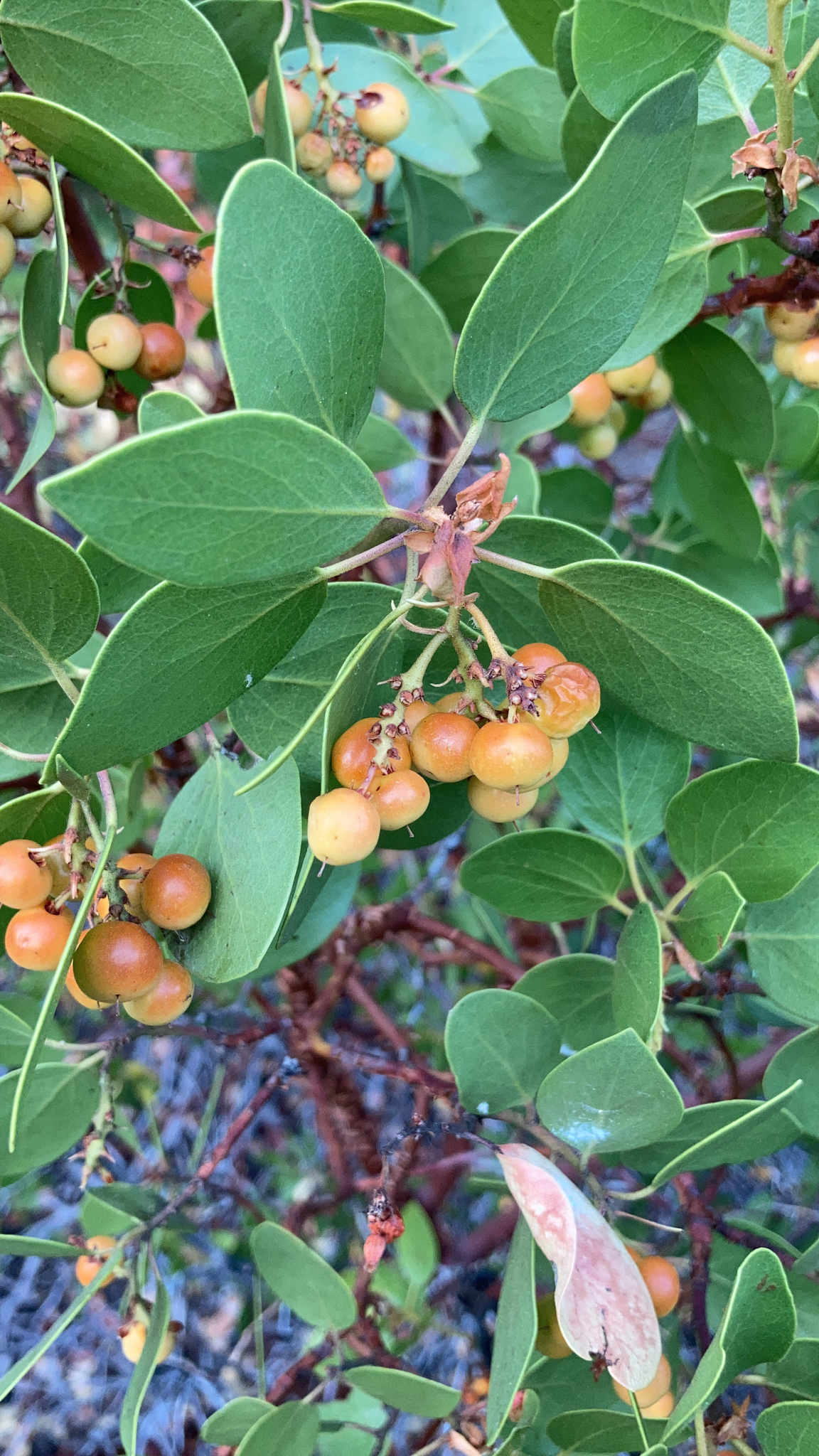
Greenleaf manzanita.
The scientific name of greenleaf manzanita is Arctostaphylos patula Greene (Ericaceae) [55,89,90,91,94,105,106,113,226,227]. Greenleaf manzanita likely hybridizes with whiteleaf manzanita (A. viscida) [14,162] and Mariposa manzanita (A. v. ssp. mariposa) [57] in the Sierra Nevada of California.
Synonyms
- Arctostaphylos acutifolia Eastw. [105]
- Arctostaphylos parryana Lemmon var. pinetorum (Rollins) Wies. & Schreib.[105]
- Arctostaphylos patula Greene ssp. platyphylla (Gray) P.V. Wells [105,159,223,227]
- Arctostaphylos patula Greene var. coalescens W. Knight [105]
Other Common Names
green leaf manzanita, snowbrush manzanita
General Distribution
Greenleaf manzanita is the most common manzanita in the Great Basin and much of the Sierra Nevada [157,205]. It occurs from Washington south to California and Baja California, east to New Mexico, and north to Montana [55,89,90,91,94,105,106,113,226,227]. Plants Database provides a distributional map of greenleaf manzanita.
States and Provinces
- United States: AZ CA CO MT NV NM OR UT WA
- Mexico: B.C.N.
Site Characteristics
Greenleaf manzanita is most commonly associated with dry sites in arid chaparral belts [117,161,181,189], on old and new burn sites [123,125,229], in open coniferous forests (particularly ponderosa pine), and in woodlands [90,94,106].
Climate
Greenleaf manzanita is well adapted to hot, dry climates and can withstand wide temperature extremes [149]. In the Sierra Nevada, where greenleaf manzanita is prevalent, the climate is characterized by hot, dry summers and mild, moist winters. Most of the precipitation occurs as snow from November to May [165,181,188].
Greenleaf manzanita is well adapted to high foliar temperatures and low soil moisture availability [42].
Elevation
| Location | Elevation |
|---|---|
| Arizona | 7,000 to 8,500 feet [113] |
| California | 2,000 to 11,000 feet [90,160,183] |
| Colorado | 7,000 to 9,000 feet [88,119] |
| Nevada | 2,000 to 9,000 feet [106,192] |
| Utah | 4,500 to 9,300 feet [167,226] |
| Sierra Nevada montane chaparral | 5,000 to 7,000 feet [188] |
Slope and Aspect
Greenleaf manzanita is most common on southern and southwestern aspects where full sunlight is available [59,95].
Soil
Greenleaf manzanita typically occurs on soils that are well drained [96,119,149], shallow to moderately deep, and sandy loam to silty loam in texture [59,95,192]. Parent materials may include sandstone, limestone, pumice, and granite [25,53,95,138,214,230].
Detailed soil data for the Teakettle Experimental Forest in the Sierra Nevada [165] and a Pacific ponderosa pine/antelope bitterbrush-greenleaf manzanita community located in the Cascade Range of south-central Oregon [56] are available. Detailed descriptions of soil chemical and mineral composition in a midseral Jeffrey pine/greenleaf manzanita forest are also available [177].
Plant Communities
Greenleaf manzanita is described as a dominant species in the following locations and vegetation classifications:
California
- Black oak (Quercus velutina)/greenleaf manzanita in the hardwood rangelands [3]
- Whitethorn ceanothus (Ceanothus cordulatus)-greenleaf manzanita-bush chinquapin (Chrysolepis sempervirens) in the San Bernardino Mountains [154]
- Jeffrey pine (Pinus jeffreyi)/greenleaf manzanita-snowbrush ceanothus (Ceanothus velutinus), found throughout the Sierra Nevada at mid- to upper elevations (5,920-9,520 feet (1,800-2,900 m)) [170]
- Canyon live oak (Q. chrysolepis)/whiteleaf manzanita-greenleaf manzanita in Castle Crags State Park, Shasta County
- Wedgeleaf ceanothus-California coffeeberry (C. cuneatus-Rhamnus californica)-greenleaf manzanita in Castle Crags State Park [196]
- Pacific ponderosa pine (Pinus ponderosa var. ponderosa)/greenleaf manzanita in Lava Beds National Monument
- Pacific ponderosa pine/antelope bitterbrush (Purshia tridentata)-greenleaf manzanita near the extreme southern border of Lava Beds National Monument
- Pacific ponderosa pine/antelope bitterbrush-greenleaf manzanita/western needlegrass (Achnatherum occidentale ssp. occidentale) at the highest elevations of Lava Beds National Monument [58]
Nevada
- Quaking aspen-white fir (Populus tremuloides-Abies concolor)/greenleaf manzanita community type in the Snake Range of the Humboldt National Forest from 8,300 to 9,500 feet (2,500-2,900 m) [2,158,163]
- Singleleaf pinyon/pale serviceberry (Pinus monophylla-Amelanchier pallida)/ greenleaf manzanita in the eastern part of Mathews Canyon Watershed [25]
- Greenleaf manzanita/snowbrush ceanothus-prostrate ceanothus (C. prostratus) shrublands [163]
- Singleleaf pinyon/Saskatoon serviceberry (A. alnifolia)/greenleaf manzanita woodlands [163]
Oregon
- Pacific ponderosa pine/antelope bitterbrush-greenleaf manzanita community in the Cascade Range of south-central Oregon [56]
- Tanoak (Lithocarpus densiflorus)/manzanita (greenleaf, whiteleaf, and hairy manzanita (Arctostaphylos columbiana)/beargrass (Xerophyllum tenax) east of the Coast Ranges crest in the southwestern portion of the state from approximately 3,000 to 3,700 feet (900-1,100 m) [9]
- Pacific ponderosa pine/greenleaf manzanita/Idaho fescue (Festuca idahoensis) on the Silver Lake mule deer range from 4,900 to 6,500 feet (1,500-2,000 m) [53] and in other south-central portions of the state [65]
- Pacific ponderosa pine/antelope bitterbrush-greenleaf manzanita on pumice soils in the south-central portion of the state [65]
- Pacific ponderosa pine/antelope bitterbrush-greenleaf manzanita/yellow sedge (Carex pensylvanica) on pumice soils on the east slopes of the Cascade Range [65,214]
- Greenleaf manzanita/snowbrush ceanothus in the eastern Siskiyou Mountains [65]
- Pacific ponderosa pine/antelope bitterbrush-greenleaf manzanita/Idaho fescue in the Fremont and Deschutes National Forests from 3,100 to 6,000 feet (940-2,000 m) [95,214]
- White fir-Pacific ponderosa pine/greenleaf manzanita-pinemat manzanita-Oregon-grape (A. nevadensis-Berberis repens) in the Fremont-Winema National Forest from 5,000 to 6,500 feet (1,500-2,000 m) [95]
- Sierra lodgepole pine (Pinus contorta var. murrayana)/snowbrush ceanothus-greenleaf manzanita-pinemat manzanita in the Deschutes and Fremont-Winema National Forests from 4,800 to 6,000 feet (1,500-2,000 m)
- Sierra lodgepole pine/pinemat manzanita-greenleaf manzanita in the Deschutes and Fremont-Winema National Forests from 5,800 to 7,000 feet (1,800-2,000 m)
- Pacific ponderosa pine/antelope bitterbrush-greenleaf manzanita/Columbia needlegrass (Achnatherum nelsonii) in the Deschutes and Fremont-Winema National Forests from 3,000 to 5,900 feet (900-1,800 m)
- Pacific ponderosa pine-white fir-sugar pine (Pinus lambertiana)/snowbrush ceanothus-greenleaf manzanita in the Deschutes and Fremont-Winema National Forests from 4,100 to 5,900 feet (1,200-1,800 m)
- Pacific ponderosa pine-Sierra lodgepole pine-white fir/greenleaf manzanita-snowbrush ceanothus/yellow sedge-glaucous beardtongue (Penstemon euglaucus) in the Deschutes National Forest from 4,300 to 5,600 feet (1,300-1,700 m)
- California red fir (Abies magnifica)-white fir-western white pine (Pinus monticola)/pinemat manzanita-greenleaf manzanita in the Deschutes and Fremont-Winema National Forests from 5,450 to 7,000 feet (1,660-2,000 m) [214]
Utah
- Rocky Mountain Douglas-fir (Pseudotsuga menziesii var. glauca)/greenleaf manzanita in the central and southern mountains from 7,200 to 8,700 feet (2,200-2,700 m) [2,230]
- White fir/greenleaf manzanita in the southern mountains from 8,100 to 8,500 feet (2,500-2,600 m) [2,230]
- Interior ponderosa pine (Pinus ponderosa var. scopulorum)/Idaho fescue (greenleaf manzanita phase) in the south-central Uinta Mountains; this habitat type is associated with warm, dry sites [138]
- Interior ponderosa pine/greenleaf manzanita in Garfield County and east to the LaSal and Abajo mountains [230]
Regions
- Interior ponderosa pine/greenleaf manzanita in the Rocky Mountain and Intermountain West regions of southern Utah and western Colorado [2]
- Interior ponderosa pine/Idaho fescue greenleaf manzanita phase in the Rocky Mountain and Intermountain West regions of eastern Washington, Idaho, northern Utah, central and southeastern Montana, and north-central Wyoming from 2,500 to 6,000 feet (760-2,000 m), and south-central Colorado from 8,800 to 9,300 feet (2,700-2,800 m) [2]
Botanical Description
This description provides characteristics that may be relevant to fire ecology, and is not meant for identification. Keys for identification are available (e.g., [90,91,92,94,105,106,113,160,226,227]).
Aboveground Description

Greenleaf manzanita flowers (CC BY-NC 4.0).
Greenleaf manzanita is an erect shrub with stout branches [94,106] that grows from 3 to 7 feet (1-2 m) tall [47,70,90,92,94,106,160]. Individual plants may have an ultimate spread of 10 feet (3 m) [197]. Spreading or drooping leaves (never vertical) [89,92,160] are 0.8 to 2 inches (2-6 cm) long, 0.6 to 2 inches (1.5-4 cm) broad [90,92,94,160,226], and produced on twisted, crooked, or gnarled stems [226]. The flowers, about 6 mm long [92], are borne on condensed, many-flowered panicles at the ends of some of the branches [94,167]. The fruit is a drupe, roughly 7-10 mm broad [90,92,160]. Each drupe contains approximately 5 stony, 1-seeded nutlets [70,120].
Belowground Description
Unlike greenleaf manzanita populations elsewhere, greenleaf manzanita in the Sierra Nevada and southwestern Oregon has a lignotuber [1,89,94]. The lignotuber is described as a heavy, turnip- or globular-shaped organ that may form tabular platforms [92,99,102]. Greenleaf manzanita roots grow deep into the ground [119,197]. In the southern Sierra Nevada, greenleaf manzanita roots extend to a depth of no greater than 7 feet (2 m). Roots in the latter 5.74 feet (1.74 m) grew down through weathered, porous granitic bedrock [96]. The roots of greenleaf manzanita are commonly infected by ectomycorrhizae or arbutoid mycorrhizae in the Sierra Nevada [131].
Physiology
Greenleaf manzanita is a drought-tolerant shrub [83]. Based on data collected from Alpine County near Reno, Nevada, DeLucia and Schlesinger [54] describe greenleaf manzanita as having high drought tolerance and nitrogen-use efficiency, but low water-use efficiency. Greenleaf manzanita is adapted to high levels of water stress. Greenleaf manzanita plants in the Sierra Nevada maintained a xylem potential of >-0.7 MPa throughout the growing season even during periods of drought [130].
Raunkiaer Life Form
- Phanerophyte [174]
Seasonal Development
The flowering period of greenleaf manzanita in several states and regions is presented below.
| Location | Flowering period |
|---|---|
| Arizona | May to June [113] |
| California | April to June [160] |
| Nevada | April to June [106,192] |
| southern California | May to June [159] |
| Utah | April to June [197] |
| Great Basin | May to June [157] |
| Pacific Northwest | May to June [92] |
| Baja California | March to June [227] |
Flowering of greenleaf manzanita may be triggered by summer moisture stress [20]. The number of flowers produced is partially dependent upon the amount of the previous year's precipitation. Flower buds form 1 year prior to maturity. They are dormant the following summer, fall, and winter, and bloom the next spring [157].
Fruits ripen in late summer to early fall [205]. Generally, this species fruits over its entire range between July and October [20,217]. In Nevada, fruiting occurs from May to September [217]. The fruits may occasionally persist on the shrub year-round [209]. Most chaparral species experience the greatest amount of growth in May and June. Growth ceases in mid-July due to high air temperatures and low soil moisture [99].
The seasonal development of greenleaf manzanita was as follows in a Pacific ponderosa pine forest [51]:
| Date | Developmental stage |
|---|---|
| 6 May | Few blossoms beginning to develop |
| 27 May | Blossoming near completion |
| 5 July | Blossoming complete and new fruits formed |
| 22 September | No visible sign of growth |
Regeneration Processes
Greenleaf manzanita regenerates from seeds [59,62,94,99,120,149,167,188], layering [24,90,94,98,106,113,140,141], and in the Sierra Nevada and southwestern Oregon, sprouting from the lignotuber [59,62,80,89,93,94,98,99,149,188].

Greenleaf manzanita fruits (CC BY-NC 4.0).
Pollination and Breeding System
Greenleaf manzanita is insect pollinated [139].
The mating system of greenleaf manzanita is primarily outcrossing [139].
Seed Production
Greenleaf manzanita produces large seed crops nearly every year [149]. In a mixed-conifer community of the Sierra Nevada, greenleaf manzanita populations produced a mean of 10,000 seeds/acre [188]. In general, greenleaf manzanita plants do not begin to flower and fruit until the age of 8 to 10 [175]. Where greenleaf manzanita populations sprout from a lignotuber, seed production is less than in nonsprouting populations [98,120].
Seed Dispersal
Greenleaf manzanita seeds are dispersed by birds [139,175] and mammals including rodents, American black bears, and coyotes [112,117,139,175]. Seeds are dispersed from late summer [116] until the following spring [139,175]. The vast majority of Arctostaphylos spp. seeds are dispersed beneath the parent's canopy [117].
Seed Banking
Greenleaf manzanita utilizes a seed bank [143,171,202]. The hard seeds of greenleaf manzanita can remain dormant in the soil for hundreds of years until stimulated to germinate [50,108].
Germination
Greenleaf manzanita seeds require scarification (by heat or disturbance such as logging activities) [67,99,109] followed by a period of cold stratification [18,109] for germination to occur. Seeds generally germinate on burned sites in the spring [117]. Seedling densities as high as 25,233/ha have been reported following fire in the northern Sierra Nevada [110].
Fire-induced Germination
Seeds can be stimulated to germinate by heat and/or chamise (Adenostoma fasciculatum) charate, followed by stratification [116,117]. Keeley [116] investigated the effects light, darkness, temperature, and charate had on greenleaf manzanita seed germination. Germination trials were conducted on filter paper and in soil. Greenleaf manzanita seeds germinated significantly (P<0.001) better in the filter paper treatment, and the following results are from the seeds germinated on filter paper. Temperature treatments were an unheated control, 158 °F (70 °C) for 1 hour; 212 °F (100 °C) for 5 minutes; and 248 °F (120 °C) for 5 minutes. One set of seeds received a 0.50-g application of chamise charate prior to temperature treatments. Following charate and temperature treatments, the seeds were stratified for 1 month at 41 °F (5 °C) and then incubated in the light or dark treatment for 3 weeks at 73 °F (23 °C). Light had a significant (P<0.001) negative effect on greenleaf manzanita germination. Further, in the light treatment, seeds subjected to 248 °F for 5 minutes germinated significantly (P<0.05) better than either seeds exposed to 158 °F for 1 hour or the no-heat control seeds. In the dark treatment, seeds exposed to charate and either no heat or 212 °F for 5 minutes germinated significantly (P<0.05) better than seeds not exposed to charate and either no-heat or 212 °F treatments. Further, in the dark/charate treatments, greenleaf manzanita seed germination significantly (P<0.05) decreased in the 248 °F treatment [116].
| Treatment | Light | Dark | ||||||
|---|---|---|---|---|---|---|---|---|
| Control | 158°F (1 hour) | 212 °F (5 min) | 248 °F (5 min) | Control | 158°F (1 hour) | 212 °F (5 min) | 248 °F (5 min) | |
| Control | 1 | 3 | 4 | 6 | 6 | 12 | 10 | 7 |
| Charate | 1 | 3 | 1 | 4 | 17 | 19 | 18 | 10 |
Seedling Establishment and Growth
Greenleaf manzanita seedlings rarely occur on unburned or undisturbed sites [24]. James [99] states that "fire prepares a soil environment conducive to greenleaf manzanita seedling growth by increasing both the ash layer and soil pH, and destroying allelopathic soil chemicals". Seedling establishment generally occurs the first postfire year [117]. In a montane chaparral site in northern California, greenleaf manzanita seedlings establishing after fire reached a height of 3 feet (1 m) within 3 years [24].
In the first few years of development, greenleaf manzanita seedlings generally grow multiple stems. In May 1992, greenleaf manzanita seedlings ranging from 2 to 4 inches (5-10 cm) tall were planted at an elevation of 3,600 feet (1,100 m) on an unburned site in the Shasta-Trinity National Forest, California. Greenleaf manzanita seedlings were single stemmed at the time of planting and remained so throughout the first growing season. New sprouts appeared by the second growing season. At the end of the second growing season, 76% of seedlings had multiple stems, and that proportion remained constant throughout the 4-year study. At the end of the 1995 growing season, 89% of the seedlings had survived, yet none had produced flowers [149].
| Growth characteristics | 1992 | 1993 | 1994 | 1995 |
|---|---|---|---|---|
| Height (cm) | 12.4 | 31.1 | 47.1 | 63.2 |
| Crown width (cm) | 10.9 | 27.8 | 47.7 | 68.6 |
Vegetative Reproduction and Regeneration
Greenleaf manzanita regenerates vegetatively by layering [24,90,94,98,106,113,140,141] and sprouting from the lignotuber [59,62,76,80,93,94,98,99,149,188,224,225].
Greenleaf manzanitas with lignotubers sprout following total or partial top-kill. In an early May clipping study in the Siskiyou Mountains in southwestern Oregon, greenleaf manzanita was either cut to ground level or had 50% of the plant removed. While plants cut to ground level did not show immediate growth, plants with growth only partially removed sprouted by 1 July. By posttreatment year 1, greenleaf manzanita density was substantially greater after clipping than before treatment on both sites [93].
| Treatment | Sample timing | Stems/ha | Basal area (m²/ha) |
|---|---|---|---|
| Total removal | Pretreatment | 40,895 | 4.01 |
| Immediately after treatment | 0 | 0 | |
| 1 year after treatment | 308,504 | 1.4 | |
| Partial removal | Pretreatment | 73,389 | 7.54 |
| Immediately after treatment | 56,092 | 4.65 | |
| 1 year after treatment | 208,098 | 4.72 |
Successional Status
Greenleaf manzanita is shade intolerant [4,96,149], prefers disturbed sites [96], and typically is an early to midseral species [12,87,149,150,175,177]. Its ability to colonize quickly after disturbance and interfere with conifer seedling growth allows it to dominate for many decades after disturbance. Without further disturbance, conifers eventually overtop greenleaf manzanita. Greenleaf manzanita may still inhibit conifer growth after being overtopped until canopy closure shades it out [42,43,46,198]. In the absence of further disturbance, it may take from 30 to 100 years for conifers to gain dominance over shrubs [23,24,59,116,130,172,186,188,192].
Effect on conifers: Greenleaf manzanita inhibits the growth of Pacific ponderosa pine (Pinus ponderosa var. ponderosa) [10,34,129,142,186,202,219] and coast Douglas-fir (Pseudotsuga menziesii var. menziesii) [101,204] seedlings. Greenleaf manzanita's ability to severely deplete available soil moisture is the greatest contributing factor in greenleaf manzanita inhibition of Pacific ponderosa pine seedling growth [172,173]. The ability to extract water from moisture-depleted soil is likely attributable to a better-developed root system than that of conifer seedlings.
In plots with 0% greenleaf manzanita cover and 100% Pacific ponderosa pine seedling cover, Pacific ponderosa pine seedling production 2.5 years after establishment averaged 5 kg/300 m². In plots with 25% greenleaf manzanita and 75% Pacific ponderosa pine cover, seedling production was reduced to 2 kg/300 m², a 60% decrease. Anderson and Helms [4] found that greenleaf manzanita seedling mean root:shoot ratio and mean root:total root length were 30% and 35%, respectively: greater than ponderosa pine seedling ratios. Tinnin and Kirkpatrick [204] found that Douglas-fir seedling root growth was significantly (P<0.05 and P<0.001) less when growing in greenleaf manzanita leaf litter than in the absence of greenleaf manzanita leaf litter. In a review by Tappeiner and others [202], greenleaf manzanita was described as reducing pine (Pinus spp.) volume by 9% to 37%, reducing conifer height, crown volume, and biomass, and causing ponderosa pine moisture stress that decreased productivity.
In a review by Aune [10], increased shrub cover (greenleaf manzanita, snowbrush ceanothus, and Klamath plum (Prunus subcordata)) is shown to decrease Pacific ponderosa pine survival and growth rates.
| Pacific ponderosa pine characteristics | Shrub cover (%) | |||
|---|---|---|---|---|
| 0 | 21 | 35 | 44 | |
| Survival (%) | 98 | 98 | 98 | 80 |
| Height (feet) | 16.5 | 12 | 9.3 | 5.8 |
| Diameter (inches) | 5.1 | 3.9 | 2.9 | 1.3 |
Greenleaf manzanita fields may cause substantial mortality of white fir and sugar pine seedlings. On the Teakettle Experimental Forest east of Fresno, California, fields of greenleaf manzanita were burned in October 1999, either lightly (no added fuel, some foliage burned) or with a "hot" fire (fuels added before burn, near complete foliage burned off and some stems charred). Burn and unburned control plots were planted with either white fir or sugar pine seedlings in October 2000. At the end of the second growing season (October 2002), total white fir survival rate across both treatments was 0.6%, which was significantly lower (P=0.02) than total survival of sugar pine (3.8%). Only early on (spring 2001) was there a significant difference (P=0.01) between treatments and survival rates. In spring 2001 white fir and sugar pine survival was lower on "hot" burn sites for both species than the light-fuel treatments [77].
Fire
Within its range, greenleaf manzanita is very prevalent as a pioneer species following fire [50,66,123,125,181,229]. Following crown fires in white fir and yellow pine forests of the Sierra Nevada, burn sites are "rapidly" occupied by montane chaparral shrub species including greenleaf manzanita [44,97,199].
In the pinyon-juniper (Pinus monophylla, P. edulis-Juniperus occidentalis) woodlands of the San Bernardino Mountains at elevations greater than 7,000 feet (2,000 m), greenleaf manzanita had 10.7% cover and a density of 1,416/ha on 70-year-old burn sites. Following fires in the pinyon-juniper woodlands, which were mostly severe canopy fires, shrub cover and density increased for 30 to 50 years. Based on observation from other sites and aerial photography, chronosequence sampling, and replication of the 1929 to 1935 California Vegetation Type Map, the researchers concluded that mature shrubs acted as nurse plants for singleleaf pinyon, which established beneath shrubs at approximately 25 to 40 years after fire. Around postfire year 50, shrubs began to decline, and by postfire years 100 to 150, a mature woodland returned [220].
Logging
Greenleaf manzanita thrives following logging in mixed-conifer forests [61,72,228]. Forty years following logging of mixed-conifer forests on the Blacks Mountain in northeastern California, greenleaf manzanita cover was significantly greater (P<0.05) on 30-year-old cut sites than uncut sites [215,216].
Immediate Fire Effects
Greenleaf manzanita is generally top-killed by fire where it forms a lignotuber [11,84,94,118,157,166]. In the absence of a lignotuber, fire may kill greenleaf manzanita [94,135].
Postfire Regeneration Strategy
- Tall shrub, adventitious buds and/or a sprouting root crown
- Initial off-site colonizer (off site, initial community)
- Secondary colonizer (on-site or off-site seed sources) [194]
Fire Adaptations
Greenleaf manzanita establishes after fire by seed [11,31,84,112,135,137,161,179,198,199] and sprouting from the lignotuber [15,24,31,89,97,137,157,198]. The dormancy of greenleaf manzanita seeds stored in soil and duff is broken by fire scarification [11,31,84,135,137,161,179,198,199]. Greenleaf manzanita seeds have a hard seed coat that requires fire (or other) scarification. Postfire lignotuber sprouting only occurs in some populations in California and southern Oregon, especially from parts of the Sierra Nevada, southernmost Cascade Range, and North Coast Ranges [94,99]. James [99] notes that greenleaf manzanita lignotubers may increase in size following fire in chaparral ecosystems. The physical and chemical characteristics of greenleaf manzanita produce a highly flammable shrub [30,49,114]. Kauffman [112] postulates that since greenleaf manzanita reproduction is partially dependent upon fire, heightened shrub flammability may be a fire adaptation.
Plant Response to Fire

Greenleaf manzanita seedlings in postfire year 1. Sequoia-Kings National Park, California.
Greenleaf manzanita establishes after fire by seed [11,31,84,112,135,137,161,179,198,199] and sometimes, sprouting from the lignotuber [15,24,31,89,97,137,157,198]. The dormancy of greenleaf manzanita seeds stored in soil and duff is partially broken by fire treatment [11,31,84,135,137,161,179,198,199]. Following scarification, greenleaf manzanita seeds require a period of cold stratification [18,109,112]. Greenleaf manzanita seedlings typically appear in large numbers during the spring of postfire year 1 [74,109,111,112,123,124,125].
Greenleaf manzanita with lignotubers sprout after fire unless the entire periphery of the lignotuber is deeply charred, which rarely happens [15,181]. Shrubs produce new sprouts from dormant buds on the lignotuber in as little as 10 days to 3 weeks [31,93,99,157]. Greenleaf manzanita plants with a lignotuber can withstand repeated burnings [31,52]. However, Martin [134] found that repeated burning of greenleaf manzanita plants with a lignotuber can cause plant mortality.
General Fire Studies
The following 2 studies do not discuss whether postfire growth is from seedlings or sprouting. In both studies, burning increased greenleaf manzanita.
Prescribed burning increased greenleaf manzanita density on the Deschutes National Forest. During the spring of 1979, moderate- and high-severity prescription burns were conducted in a Pacific ponderosa pine/antelope bitterbrush-greenleaf manzanita/western needlegrass community. Prior to burning, 300 to 400 greenleaf manzanita shrubs/ha occurred on both treatment sites. In postfire year 15 (1984), greenleaf manzanita averaged 2,590 shrubs/ha on moderate-severity burns and 3,550 shrubs/ha on high-severity burn sites [180].
On Donner Pass, California, an August 1960 wildfire burned 40,000 acres (16,000 ha) in a conifer forest consisting primarily of mixed pine and fir species. In 1963 and 1975 line transects were run throughout the burned areas. In 1963 greenleaf manzanita was 0% on line transects. Greenleaf manzanita cover on transects increased to 3.8% in 1975 [26].
Postfire Seedlings
In the following studies, an increase in greenleaf manzanita seedlings occurred following fire. Higher-severity fires caused greater seedling establishment than lower-severity fires [109,111,112,222].
Before and after a September 1927 fire on a chamise-dominated site in Mendocino County, California, greenleaf manzanita seedlings/milacre were counted. Prior to the fire, there were no greenleaf manzanita seedlings present. Seedling establishment was greatest during the first postfire year. A survey of the area during postfire year 7 (1934) found that a large proportion of greenleaf manzanita seedlings which were present in postfire year 5 had survived and developed into robust plants [181].
| Prefire | 1st postfire year | 2nd postfire year | 3rd postfire year | 4th postfire year | 5th postfire year |
|---|---|---|---|---|---|
| 0 | 7.2 | 4 | 2.6 | 2.6 | 2.6 |
Sixty to 70-year-old white fir stands with an understory of snowbrush ceanothus and greenleaf manzanita and/or pinemat manzanita (species not differentiated in study) were burned before and after tree harvest in the Lassen National Forest, California [222]. Prior to spring or fall burning and white fir harvest in 1983, manzanita seedlings ranged from 0 to 1,700 seedlings/acre. During the summer of 1984, manzanita seedling density ranged from 11,000 to 16,000/acre on sites burned in spring 1983 before harvest. Manzanita seedling densities on sites burned after harvest in the spring and fall of 1983 ranged from 13,000 to 16,000/acre and 10,000 to 11,000/acre for spring and fall burns, respectively. The density of manzanita seedlings after postharvest burning was considerably higher for spring burns than for fall burns. This seasonal difference was attributed to consistently higher percent burned area in spring than in fall; fall fuels were wet due to rains [222].
Fall and spring prescribed burns of varying severities conducted in 1983 at 2 sites on the west slope of the Sierra Nevada and Cascade Range produced significant greenleaf manzanita seedling increases (P<0.10) during either postfire year 1 or 2 [109,111,112]. The first site, Blodgett Forest Research Station, sits at an elevation of 4,300 feet (1,300 m) and was dominated by white fir, ponderosa pine, incense-cedar, and Douglas-fir, with a scattered and diverse shrub understory consisting of whitethorn ceanothus, greenleaf manzanita, California black oak, deer brush (Ceanothus integerrimus), giant chinquapin (Chrysolepis chrysophylla), tanoak (Lithocarpus densiflora), Sierra mountain misery (Chamaebatia foliolosa), and pine rose (Rosa pinetorium). The second site, Quincy Ranger District, sits at an elevation of 4,432 feet (1,351 m) and was dominated by Jeffrey pine, coast Douglas-fir, and incense-cedar. The most common understory shrubs included California black oak, deer brush, thimbleberry (Rubus parviflorus), and pale serviceberry (Amelanchier pallida). Greenleaf manzanita was a minor species at Quincy; therefore, greenleaf manzanita seedlings were far fewer after Quincy fires than fires at Blodgett [109,111,112].
Four burn treatments were conducted at each site. Researchers included an early spring-moderate consumption burn; a late spring-high consumption burn; an early fall-high consumption burn; and a late fall-moderate consumption burn. The early spring-moderate consumption burn was conducted as soon as fuels could carry fire. The late spring-high consumption burn was conducted as late in the season as safely possible (prior to the active fire suppression season). The early fall-high consumption burn was conducted as early in the fall as possible and before major precipitation. Finally, the late fall-moderate consumption burn was conducted 1 to 2 days after significant precipitation. Seedling densities of greenleaf manzanita, particularly at the Blodgett site, were much higher on high-consumption burns than moderate-consumption burns. Comparing high-consumption burns, spring burns produced more greenleaf manzanita seedlings than fall burns at Blodgett, while the opposite was true at Quincy. On spring sites, excluding the early spring-moderate consumption burn at the Blodgett site, greenleaf manzanita seedlings were not produced in postfire year 1 because the stratification period was incomplete until the winter of 1985. At one Blodgett site (late fall-moderate consumption) and two Quincy sites (early fall-high consumption and late fall-moderate consumption), greenleaf manzanita seedlings increased in postfire year 1 but decreased during postfire year 2. This was attributed to shading: greenleaf manzanita seedlings occurred under a dense canopy [109,111,112].
Most greenleaf manzanita seeds present in the seed bank had been cached by rodents many years prior to the fires, likely before conifer establishment. After postfire seedling establishment, the rodents dug into these caches in search of seeds. This caused substantial mortality of fragile greenleaf manzanita seedlings [112].
The table below describes density of greenleaf manzanita seedlings prior to the prescribed burns (1983), at the end of the 1984 and 1985 growing seasons (postfire years 1 and 2), and on the unburned control sites [109,111,112].
| Treatment | Date of fire | 1983 (prefire) | 1984 | 1985 |
|---|---|---|---|---|
| Early fall-high consumption | 28 September 1984 | 0 (0) | — | 11,833 (2,625) |
| Late fall-moderate consumption | 8 October 1983 | 2,042 (1,116) | 4,875 (1,508) | 958 (305) |
| Late spring-high consumption | 26 June 1984 | 367 (200) | 0 (0) | 25,233 (5,832) |
| Early spring-moderate consumption | 17 May 1984 | 233 (202) | 34 (33) | 4,600 (2,059) |
| Control | NA | 467 (210) | 134 (65) | 134 (65) |
| Treatment | Date of fire | 1983 (prefire) | 1984 | 1985 |
|---|---|---|---|---|
| Early fall-high consumption | 15 September 1983 | 0 (0) | 3,567 (769) | 861.1 (285) |
| Late fall-moderate consumption | 12 October 1983 | 0 (0) | 1,167 (356) | 167 (87) |
| Late spring-high consumption | 24 May 1984 | 0 (0) | 0 (0) | 833 (540) |
| Early spring-moderate consumption | 7 May 1984 | 0 (0) | 0 (0) | 367 (155) |
| Control | NA | 0 (0) | 0 (0) | 0 (0) |
For a complete review of this study, see the FEIS Research Project Summary by Kauffman [109,111,112].
Repeated Burning
On Lookout Mountain in central Oregon, a Pacific ponderosa pine/greenleaf manzanita community was burned twice over a 4-year period, causing nearly complete mortality of mature greenleaf manzanita and complete mortality of greenleaf manzanita seedlings. Prescribed burning took place at 2 sites, designated as the upper and lower plots [134].
| Date/conditions | Upper plot, 1st burn | Lower plot, 1st burn | Upper plot, 2nd burn | Upper plot, 2nd burn |
|---|---|---|---|---|
| Burn date | 9/27/1976 | 10/1/1976 | 10/2/1979 | 6/9/1980 |
| Temperature (°F) | 56-71 | 70-74 | 56-67 | 50-52 |
| Relative humidity (%) | 37-61 | 30-38 | 38-54 | 42-43 |
| Wind (mph) | 0-8 | 0-5 | 0-5 | 7-Feb |
| Fuel moisture content/new litter (%) | 15-Dec | 11-Oct | 20-Jul | 8-May |
| Fuel moisture content/old litter (%) | Oct-36 | 15-Nov | 21-Nov | 14-Jun |
| Fuel moisture content/duff (%) | 26-65 | 26-75 | 14-21 | 52-54 |
Following the fires, Martin [134] measured the percent of greenleaf manzanita that was unburned, burned and sprouting after fire, or killed. Greenleaf manzanita seedling mortality was measured after second fire. Unfortunately, the researcher did not provide the date of postfire vegetation measurements. "Poor" postfire sprouting of greenleaf manzanita occurred on both sites. The researcher expected this, since greenleaf manzanita is a poor sprouter in the area and the overstory was a closed Pacific ponderosa pine canopy. Results of the 2 fires are presented below [134]:
| Fire effects | Upper plot | Lower plot |
|---|---|---|
| 1st fire | ||
| Unburned | 0 | 0 |
| Burned/sprouted | 0 | 3.7 |
| Dead | 100 | 96.3 |
| 2nd fire | ||
| Unburned | 10.4 | 0 |
| Burned/sprouted | 2.9 | 0 |
| Dead | 97.1 | 0 |
| Shrub seedlings dead | 100 | 100 |
For further information on prescribed fire use and postfire responses of multiple plant species in this plant community, see Martin's [134] original Research Paper.
In a montane chaparral site in northern California, a prescribed fire caused the germination of thousands of greenleaf manzanita seedlings. Three years later the site was reburned, and only 1 greenleaf manzanita seedling emerged after fire. A third and fourth fire completely eliminated greenleaf manzanita [24]. Presumably, the initial fire exhausted the greenleaf manzanita seed bank, leaving few or no seeds to germinate following subsequent fires. Since it can take 8 to 10 years for greenleaf manzanita plants to flower and fruit [175], there was no replenishing of the seed bank between the first and second fires.
Fire Regimes
Greenleaf manzanita is found in plant communities/ecosystems with varying fire regimes. Greenleaf manzanita may occur where fire-return intervals are as short as 1 year or as long as several hundred years. A more detailed description of greenleaf manzanita fire-return intervals follows.
Oak/chaparral woodland: The oak/chaparral woodland of Yosemite National Park, California, had a presettlement fire-return interval of 20 to 30 years. Presently, many areas have not burned for 60 to 100 years due to fire exclusion [30].
Lodgepole pine forests: Greenleaf manzanita occurs in lodgepole pine forests on the east side of the Cascade Range, the Blue Mountains, and the Okanogan Highlands of Washington north into British Columbia and south to Colorado and California. Inland Pacific Northwest lodgepole pine communities had an historic mean fire-return interval of 112 years. Lodgepole pine forests in areas susceptible to summer drought in the Inland Pacific Northwest historically had low- to medium-severity surface fires occurring at intervals of 25 to 50 years [38].
Mixed-conifer forests: Greenleaf manzanita is prevalent in open mixed-conifer forests, particularly in the Sierra Nevada. The minimum and maximum historic fire-return intervals for mixed-conifer forests of the Sierra Nevada ranged from approximately 3 to 8 years and 10 to 20 years, respectively [44,107,126,155,165]. Prior to fire exclusion in the Sierra Nevada, fires were generally low -severity surface fires, and fire-return intervals were frequent [126].
Elsewhere, the fire-return interval ranges from 15 to 29 years in mixed-conifer/chaparral sites in the San Bernardino Mountains [155], from 10 to 80 years in mixed conifer-hardwood forests of southwestern Oregon [38], and 4 to 7 years in mixed-conifer forests in Bryce Canyon National Park, Utah [32].
Using aerial photography and ground sampling, the approximate mean fire-return interval from 1925 to 1991 for the Sierra San Pedro Mártir, Baja California, was estimated at 52 years. The Sierra San Pedro Mártir is the last remaining mixed-conifer forest along the Pacific coast still subject to uncontrolled, periodic surface fires. It is estimated that the infrequent fires are severe surface fires. Heavy fuels result from the gradual buildup of shrub cover (predominately greenleaf manzanita, pointleaf manzanita (Arctostaphylos pungens), and pinkbracted manzanita (A. pringlei ssp. drupacea)), conifer recruitment, and litter accumulation [153].
Montane chaparral: Fire-return intervals for montane chaparral sites in the Sierra Nevada are variable [189]. Nagel and Taylor [161] studied the fire ecology of 6 montane chaparral sites codominated by greenleaf manzanita and huckleberry oak (Quercus vaccinifolia) in Lake Tahoe Basin in the northern Sierra Nevada. Prior to fire exclusion in the late 1800s and early 1900s, the mean fire-return interval was 28 years, with a range of 16 to 40 years. Other research estimates that the fire-return interval ranged from 30 to 60 years [38]. When fuel moistures drop below 100%, fire is likely to remove a large portion of the shrubs in this type. When moisture drops below 100%, explosive fire conditions with rapid rates of spread and flame heights greater than 10 feet (3 m) are expected [97]. High-severity fires are typical, with most shrubs being top-killed [38].
Pinyon-juniper woodlands: In the San Bernardino Mountains, greenleaf manzanita occurs in high-elevation (7,000 feet (2,000 m)) pinyon-juniper woodlands. Using fire scar data, Wangler and Minnich [220] estimate the fire-return interval was approximately 480 years. When fire occurs, it is generally high-severity crown fire [220].
Pacific ponderosa pine forests: Fire scar data from the years 1700 to 1875 on dry ridges in the southern Sierra Nevada showed that the minimum and maximum fire-return intervals were 2 and 12 years, respectively. The mean fire-return interval for that period was 5.5 years [126]. Fire historically occurred approximately every 13 years in ponderosa pine woodlands of Lava Bed National Monument, California [137]. Greenleaf manzanita occurs throughout ponderosa pine forests on the eastern side of the Oregon Cascade Range. Using fire scar analysis, Bork [29] found that the mean historic fire-return intervals at 3 sites, Cabin Lake, Pringle Butte, and Lookout Mountain, were 24, 11, and 15 years, respectively. In a Pacific ponderosa pine/incense-cedar (Calocedrus decurrens)/greenleaf manzanita community, the fire-return interval ranged from 9 to 42 years [150].
Red fir forests: For the period 1740 to 1985, the mean fire-return interval at Swain Mountain Experimental Forest in northeastern California was 12.9 years, with a range of 1 to 57 years. Larger fires (>10 acres (5 ha)) occurred every 26.2 years, with a range of 11 to 47 years. Average fire-free intervals were shorter during the settlement period (1851-1934, x = 7.9 years) than during the presettlement (1740-1850, x = 21.4 years) and fire-exclusion (1935-1985, x = 17.3 years) periods. Fires in red fir forests are generally of low and moderate severity [203].
The following table provides fire-return intervals for plant communities and ecosystems where greenleaf manzanita is important. For additional fire regime information, search FEIS for this species by entering the species name on the Advanced Search page and selecting “Fire Regime” as the publication type.
| Community or Ecosystem | Dominant Species | Fire Return Interval Range (years) |
|---|---|---|
| California chaparral | Adenostoma and/or Arctostaphylos spp. | <35 to <100 |
| California montane chaparral | Ceanothus and/or Arctostaphylos spp. | 50-100 [168] |
| Sugarberry-America elm-green ash | Celtis laevigata-Ulmus americana-Fraxinus pennsylvanica | <35 to 200 [218] |
| Paloverde-cactus shrub | Cercidium spp./Opuntia spp. | <35 to <100 [168] |
| Curlleaf mountain-mahogany* | Cercocarpus ledifolius | 13-1,000 [8,184] |
| Western juniper | Juniperus occidentalis | 20-70 |
| Rocky Mountain juniper | Juniperus scopulorum | <35 |
| Pinyon-juniper | Pinus-Juniperus spp. | <35 [168] |
| Rocky Mountain lodgepole pine* | Pinus contorta var. latifolia | 25-340 [16,17,201] |
| Sierra lodgepole pine* | Pinus contorta var. murrayana | 35-200 [5] |
| Colorado pinyon | Pinus edulis | 10-400+ [64,71,115,168] |
| Jeffrey pine | Pinus jeffreyi | 5-30 |
| Pacific ponderosa pine* | Pinus ponderosa var. ponderosa | 1-47 [5] |
| Interior ponderosa pine* | Pinus ponderosa var. scopulorum | 2-30 [5,13,132] |
| Arizona pine | Pinus ponderosa var. arizonica | 2-15 [13,48,185] |
| Quaking aspen (west of the Great Plains) | Populus tremuloides | 7-120 [5,81,151] |
| Rocky Mountain Douglas-fir* | Pseudotsuga menziesii var. glauca | 25-100 [5,6,7] |
| Coastal Douglas-fir* | Pseudotsuga menziesii var. menziesii | 40-240 [5,156,178] |
| Pacific coast mixed evergreen | Pseudotsuga menziesii var. menziesii-Lithocarpus densiflorus-Arbutus menziesii | <35-130 [5,39] |
| California oakwoods | Quercus spp. | <35 [5] |
| Oak-juniper woodland (Southwest) | Quercus-Juniperus spp. | <35 to <200 [168] |
| Coast live oak | Quercus agrifolia | 2-75 [78] |
| Canyon live oak | Quercus chrysolepis | <35 to 200 |
| Oregon white oak | Quercus garryana | <35 [5] |
| California black oak | Quercus kelloggii | 5-30 [168] |
| Redwood | Sequoia sempervirens | 5-200 [5,63,195] |
| *fire return interval varies widely; trends in variation are noted in the species review | ||
Fire Management Considerations
Avian Community Changes
In the 15-year period following a 39,000-acre (15,800 ha) August fire in a pine-fir (Pinus-Abies spp.) forest in the northern Sierra Nevada, the population of greenleaf manzanita increased, and with it, bird species characteristic of shrub stands. At postfire year 15, yellow warbler, green-tailed towhee, and fox sparrow populations "increased dramatically" from postfire year 8 [27].
Fire Behavior
The fire behavior of 16 prescribed burned plots in montane chaparral communities codominated by greenleaf manzanita, huckleberry oak, and whitethorn ceanothus was measured in Yosemite National Park. These fires were separated in space and time. At the time of burning few shrubs exceeded 6 feet (2 m) in height [210].
| Spread/minute (feet) | Flame length (feet) | ||||
|---|---|---|---|---|---|
| Mean | Min | Max | Mean | Min | Max |
| 11.7 | 0.0 | 35.3 | 12.5 | 1.0 | 25.0 |
Live Fuel Moisture
In the Sierra Nevada and Cascade Range of California, greenleaf manzanita live fuel moisture during the 1984 fire season ranged from a high of approximately 150% on 29 May to a low of approximately 100% on 15 October [176]. On the Shasta-Trinity National Forest, greenleaf manzanita mature leaf moisture content varied widely throughout the year. Samples taken in November 1966 showed an average moisture content of 120%, which dropped to 86% by 25 June 1967. From the end of June to 10 July 1967, average moisture content increased rapidly to 125% and remained at or above 100% until April 1968. The moisture content of new leaves was substantially higher than mature leaves. On 13 July, when the moisture content of mature leaves was 123%, new greenleaf manzanita leaves had a moisture content of 259% [35].
Fuel Characteristics
On the eastern slopes of Mt Shasta at elevations ranging from 4,000 to 6,000 feet (1,200-1,800 m), greenleaf manzanita physical characteristics relevant to fire were studied over a 4-year period [49].
| Characteristic | Foliage | Woody fuel (inches diameter) | |||
|---|---|---|---|---|---|
| < 0.25 | 0.26-0.50 | 0.51-1.0 | > 1.0 | ||
| Living fuel density (lb/ft²) | 54.7 | 38.9 | 41.3 | 44.5 | 46.4 |
| Solvent extractives in living fuel (%) | 16.9 | 6.2 | 4.2 | 3.6 | 3.4 |
| Solvent extractives in dead fuel (%) | 0 | 2.6 | 1.2 | 1.4 | 1.9 |
| Surface-to-volume ratio (ft²/ft³) | 1,623 | 343 | 137 | 66 | 32 |
| Heating value of living fuel (Btu/lb) | 9,076 | 8,246 | 8,212 | 8,306 | 8,320 |
| Heating value of dead fuel (Btu/lb) | no data | 8,280 | 8,367 | 8,201 | 8,429 |
Data on the average greenleaf manzanita biomass by fuel size class and crown cover across many areas of Oregon, Washington, and northern California east of the Cascade Range are available [136].
Soil
Data on the average bulk density and nutrient concentrations of soil on burned shrub sites dominated by snowbrush ceanothus and containing greenleaf manzanita are available in Johnson and others [103].
Surface and subsurface (3 to 4.3 inches (7-11 cm)) soil temperatures were measured during prescribed fires of high and low severity in greenleaf manzanita stands in the Sierra National Forest, California, at an elevation of 7,000 feet (2,000 m). High-severity fires were created by adding fine and woody fuels to the burn sites. Low-severity sites were burned with existing fuel loads. On the high-severity sites, temperatures reached over 600 °F (300 °C) at the soil surface and 400 °F (200 °C) in the subsurface zone. On the low-severity sites, temperatures reached 300 °F (150 °C) at the surface and 200 °F (100 °C) in the subsurface zone [166].
Fire economics: Literature is available on the costs associated with and the economic feasibility of burning greenleaf manzanita and other northern California chaparral species [182].
Federal Status
None
Other Status
Information on state-level protected status of plants in the United States is available at Plants Database.
Importance to Wildlife and Livestock
Greenleaf manzanita foliage has little value as browse for livestock and wildlife [82,94,183]. Its value as browse is primarily limited to winter forage or when little else is available [19,52,82,183]. Rocky Mountain mule deer tend to favor greenleaf manzanita more than other browsing ungulates [128,133,192]. Following fire or other disturbances, most livestock and deer lightly browse greenleaf manzanita sprouts and seedlings [82,94,97,183].
The fruits and seeds of greenleaf manzanita are important to a variety of birds and mammals [86,122,146,149]. The fruits are a food source for American black bears in northern California and southern Oregon during late summer and early fall [69,94,95,97,169]. Grouse, wild turkeys, songbirds, and deer mice also consume the fruits [85,94,97,100].
Palatability and Nutritional Value
The palatability of greenleaf manzanita is described as "poor to worthless" for domestic goats and "worthless" for cattle and horses [104,183]. It is palatable to domestic sheep [79,144] (see Other Management Considerations).
The crude protein of greenleaf manzanita taken from California ranges from a low of 5.2% in February to a high of 7.8% in August and September [22]. In Truckee River Canyon on the California-Nevada border, crude protein of greenleaf manzanita ranged from a low of 6.0% in January to 7.8% in August and September [183]. The ash content of greenleaf manzanita foliage taken from Mt Shasta at elevations of 4,000 to 6,000 feet (1,200-1,800 m) averaged 3.9% [49].
Cover Value
While there is little in the literature on the cover value of greenleaf manzanita, it is likely valuable to numerous animal species due to the dense thickets it produces. It is described as an important cover species for small mammals, birds, insects, and arthropods [33,94,208].
Value for Rehabilitation or Restoration of Disturbed Sites
Greenleaf manzanita is a valuable species for revegetating severely disturbed sites [36,37] and rated as a superior shrub for erosion control [190,191,192].
A greenleaf manzanita cultivar ('Altura') is available [206].
Other Uses
Greenleaf manzanita is used as an ornamental [19,193,200].
Greenleaf manzanita had many uses for Native Americans. The fruits were eaten whole, made into cider and jelly, and brewed into tea to treat poison-oak (Toxicodendron diversilobum) exposure [94,200]. The leaves were used as an emetic, for treating insect bites, and to relieve bronchitis, dropsy, and other diseases [94,200]. Dried leaves were also used in herbal smoking mixtures [59,200].
Other Management Considerations
Browsing: Domestic sheep browsing reduces greenleaf manzanita biomass. Over a 7-year period, 1,000 to 1,500 domestic sheep grazed a 2,000+ acre (800 ha) site containing large amounts of greenleaf manzanita and snowbrush ceanothus from approximately 1 May until late August to late September. The site, on the Plumas National Forest, California, sits at an elevation of 6,600 feet (2,000 m) and had been burned by wildfire 2 to 3 years prior to stocking. After 7 years, volume of greenleaf manzanita on grazed sites was 1,302 ft³/acre compared to 5,232 ft³/acre on ungrazed sites [144].
Herbicides: Research papers are available on the effects of greenleaf manzanita herbicide treatments on conifer species [40,41,45,75,121,140,143,147,148,221].
Host species: Greenleaf manzanita is a host to the manzanita leaf-gall aphid, which produces galls on the leaves and flower buds [152]. On the Deschutes National Forest, greenleaf manzanita is host to at least 12 fungal species, 3 of which are "important" plant pathogens [50].
Mechanical control: While the work is arduous, greenleaf manzanita can be successfully controlled by grubbing. In a young northern California Pacific ponderosa pine plantation, greenleaf manzanita was significantly reduced (P<0.05) over a 10-year period on grubbed sites [62]. Other mechanical control studies are available [145].
Table A1— Forest and range ecosystems, Bureau of Land Management (BLM) physiographic regions, Kuchler plant associations, Society for American Foresters (SAF) forest cover types, and Society for Rangeland Management (SRM) rangeland cover types in which this species occurs.
Forest and Range Ecosystems
- FRES20 Douglas-fir
- FRES21 Ponderosa pine
- FRES23 Fir-spruce
- FRES26 Lodgepole pine
- FRES27 Redwood
- FRES28 Western hardwoods
- FRES34 Chaparral-mountain shrub
- FRES35 Pinyon-juniper [68]
BLM Physiographic Regions
- 1 Northern Pacific Border
- 2 Cascade Mountains
- 3 Southern Pacific Border
- 4 Sierra Mountains
- 5 Columbia Plateau
- 6 Upper Basin and Range
- 7 Lower Basin and Range
- 8 Northern Rocky Mountains
- 9 Middle Rocky Mountains
- 10 Wyoming Basin
- 11 Southern Rocky Mountains
- 12 Colorado Plateau
- 13 Rocky Mountain Piedmont [21]
Kuchler Plant Associations
- K005 Mixed conifer forest
- K006 Redwood forest
- K007 Red fir forest
- K008 Lodgepole pine-subalpine forest
- K010 Ponderosa shrub forest
- K011 Western ponderosa forest
- K012 Douglas-fir forest
- K015 Western spruce-fir forest
- K018 Pine-Douglas-fir forest
- K019 Arizona pine forest
- K020 Spruce-fir-Douglas-fir forest
- K022 Great Basin pine forest
- K023 Juniper-pinyon woodland
- K024 Juniper steppe woodland
- K026 Oregon oakwoods
- K029 California mixed evergreen forest
- K030 California oakwoods
- K031 Oak-juniper woodland
- K032 Transition between K031 and K037
- K033 Chaparral
- K034 Montane chaparral
- K037 Mountain-mahogany-oak scrub [127]
SAF Cover Types
- 207 Red fir
- 210 Interior Douglas-fir
- 211 White fir
- 217 Aspen
- 218 Lodgepole pine
- 220 Rocky Mountain juniper
- 229 Pacific Douglas-fir
- 232 Redwood
- 233 Oregon white oak
- 234 Douglas-fir-tanoak-Pacific madrone
- 237 Interior ponderosa pine
- 238 Western juniper
- 239 Pinyon-juniper
- 241 Western live oak
- 243 Sierra Nevada mixed conifer
- 244 Pacific ponderosa pine-Douglas-fir
- 245 Pacific ponderosa pine
- 246 California black oak
- 247 Jeffrey pine
- 248 Knobcone pine
- 249 Canyon live oak
- 255 California coast live oak [60]
SRM Rangeland Cover Types
- 109 Ponderosa pine shrubland
- 202 Coast live oak woodland
- 204 North coastal shrub
- 206 Chamise chaparral
- 207 Scrub oak mixed chaparral
- 208 Ceanothus mixed chaparral
- 209 Montane shrubland
- 210 Bitterbrush
- 409 Tall forb
- 411 Aspen woodland
- 412 Juniper-pinyon woodland
- 415 Curlleaf mountain-mahogany
- 420 Snowbrush
- 503 Arizona chaparral
- 504 Juniper-pinyon pine woodland
- 509 Transition between oak-juniper woodland and mahogany-oak association [187]
1. Adams, J. E. 1940. A systematic study of the genus Arctostaphylos Adans. Journal of the Elisha Mitchell Scientific Society. 56(1): 1-61. [20515]
2. Alexander, Robert R. 1988. Forest vegetation on National Forests in the Rocky Mountain and Intermountain Regions: habitat and community types. Gen. Tech. Rep. RM-162. Fort Collins, CO: U.S. Department of Agriculture, Forest Service, Rocky Mountain Forest and Range Experiment Station. 47 p. [5903]
3. Allen, Barbara H.; Holzman, Barbara A.; Evett, Rand R. 1991. A classification system for California's hardwood rangelands. Hilgardia. 59(2): 1-45. [17371]
4. Anderson, Paul D.; Helms, John A. 1994. Tissue water relations of Pinus ponderosa and Arctostaphylos patula exposed to various levels of soil moisture depletion. Canadian Journal of Forest Research. 24: 1495-1502. [23871]
5. Arno, Stephen F. 2000. Fire in western forest ecosystems. In: Brown, James K.; Smith, Jane Kapler, eds. Wildland fire in ecosystems: Effects of fire on flora. Gen. Tech. Rep. RMRS-GTR-42-vol. 2. Ogden, UT: U.S. Department of Agriculture, Forest Service, Rocky Mountain Research Station: 97-120. [36984]
6. Arno, Stephen F.; Gruell, George E. 1983. Fire history at the forest-grassland ecotone in southwestern Montana. Journal of Range Management. 36(3): 332-336. [342]
7. Arno, Stephen F.; Scott, Joe H.; Hartwell, Michael G. 1995. Age-class structure of old growth ponderosa pine/Douglas-fir stands and its relationship to fire history. Res. Pap. INT-RP-481. Ogden, UT: U.S. Department of Agriculture, Forest Service, Intermountain Research Station. 25 p. [25928]
8. Arno, Stephen F.; Wilson, Andrew E. 1986. Dating past fires in curlleaf mountain-mahogany communities. Journal of Range Management. 39(3): 241-243. [350]
9. Atzet, Thomas; White, Diane E.; McCrimmon, Lisa A.; Martinez, Patricia A.; Fong, Paula Reid; Randall, Vince D., tech. coords. 1996. Field guide to the forested plant associations of southwestern Oregon. Technical Paper R6-NR-ECOL-TP-17-96. Portland, OR: U.S. Department of Agriculture, Forest Service, Pacific Northwest Region. Available online: https://www.fs.usda.gov /r6/siskiyou/guide.htm [2004, October 7]. [49881]
10. Aune, Philip S. 1991. Seed-tree method. In: Genetics/silviculture workshop proceedings; 1990 August 27-31; Wenatchee, WA. Washington, DC: U.S. Department of Agriculture, Forest Service, Timber Management Staff: 224-234. [16026]
11. Bacon, Warren R.; Dell, John. 1985. National forest landscape management: Volume 2, Chapter 6--Fire. Agriculture Handbook No 608. Washington, DC: U.S. Department of Agriculture, Forest Service. 89 p. [38793]
12. Bailey, Warren Hutchinson. 1963. Revegetation in the 1914-1915 devastated area of Lassen Volcanic National Park. Corvallis, OR: Oregon State University. 195 p. Dissertation. [29203]
13. Baisan, Christopher H.; Swetnam, Thomas W. 1990. Fire history on a desert mountain range: Rincon Mountain Wilderness, Arizona, U.S.A. Canadian Journal of Forest Research. 20: 1559-1569. [14986]
14. Ball, Charles T.; Keeley, Jon; Mooney, Harold; [and others]. 1983. Relationship between form, function, and distribution of two Arctostaphylos species (Ericaceae) and their putative hybrids. Oecologia Plantarum. 4: 153-164. [12179]
15. Barbour, Michael G.; Burk, Jack H.; Pitts, Wanna D. 1980. Fire. In: Barbour, Michael G.; Burk, Jack H.; Pitts, Wanna D. Terrestrial plant ecology. Menlo Park, CA: The Benjamin/Cummings Publishing Company, Inc: 365-583. [45716]
16. Barrett, Stephen W. 1993. Fire regimes on the Clearwater and Nez Perce National Forests north-central Idaho. Final Report: Order No. 43-0276-3-0112. Ogden, UT: U.S. Department of Agriculture, Forest Service, Intermountain Research Station, Fire Sciences Laboratory. Unpublished report on file with: U.S. Department of Agriculture, Forest Service, Rocky Mountain Research Station, Fire Sciences Laboratory, Missoula, MT. 21 p. [41883]
17. Barrett, Stephen W.; Arno, Stephen F.; Key, Carl H. 1991. Fire regimes of western larch - lodgepole pine forests in Glacier National Park, Montana. Canadian Journal of Forest Research. 21: 1711-1720. [17290]
18. Baskin, Carol C.; Baskin, Jerry M. 2001. Seeds: ecology, biogeography, and evolution of dormancy and germination. San Diego, CA: Academic Press. 666 p. [60775]
19. Belcher, Earl. 1985. Handbook on seeds of browse -- shrubs and forbs. Technical Publication R8-TP8. Atlanta, GA: U.S. Department of Agriculture, Forest Service, Southern Region. 246 p. In cooperation with: Association of Official Seed Analysts. [43463]
20. Berg, Arthur R. 1974. Arctostaphylos Adans. manzanita. In: Schopmeyer, C. S., technical coordinator. Seeds of woody plants in the United States. Agric. Handb. 450. Washington, DC: U.S. Department of Agriculture, Forest Service: 228-231. [7428]
21. Bernard, Stephen R.; Brown, Kenneth F. 1977. Distribution of mammals, reptiles, and amphibians by BLM physiographic regions and A.W. Kuchler's associations for the eleven western states. Tech. Note 301. Denver, CO: U.S. Department of the Interior, Bureau of Land Management. 169 p. [434]
22. Bissell, Harold D.; Strong, Helen. 1955. The crude protein variations in the browse diet of California deer. California Fish and Game. 41(2): 145-155. [10524]
23. Biswell, H. H.; Buchanan, H.; Gibbens, R. P. 1966. Ecology of the vegetation of a second-growth sequoia forest. Ecology. 47(4): 630-634. [55065]
24. Biswell, Harold H. 1974. Effects of fire on chaparral. In: Kozlowski, T. T.; Ahlgren, C. E., eds. Fire and ecosystems. New York: Academic Press: 321-364. [14542]
25. Blackburn, Wilbert H.; Tueller, Paul T.; Eckert, Richard E., Jr. 1969. Vegetation and soils of the Pine and Mathews Canyon watersheds. Reno, NV: University of Nevada, Agricultural Experiment Station. 109 p. In cooperation with: U.S. Department of the Interior, Bureau of Land Management. [7437]
26. Bock, Carl E.; Bock, Jane H. 1977. Patterns of post-fire succession on the Donner Ridge burn, Sierra Nevada. In: Mooney, Harold A.; Conrad, C. Eugene, tech. coords. Proceedings of the symposium of environmental consequences of fire and fuel management in Mediterranean ecosystems; 1977 August 1-5; Palo Alto, CA. Gen. Tech. Rep. WO-3. Washington, DC: U.S. Department of Agriculture, Forest Service: 464-469. [4896]
27. Bock, Carl E.; Raphael, Martin; Bock, Jane H. 1978. Changing avian community structure during early post-fire succession in the Sierra Nevada. Wilson Bulletin. 90(1): 119-123. [16029]
28. Bock, Jane H.; Raphael, Martin; Bock, Carl E. 1978. A comparison of planting and natural succession after a forest fire in the northern Sierra Nevada. Journal of Applied Ecology. 15: 597-602. [480]
29. Bork, Joyce L. 1985. Fire history in three vegetation types on the eastern side of the Oregon Cascades. Corvallis, OR: Oregon State University. 94 p. Dissertation. [42571]
30. Botti, Stephen. 1979. Natural, conditional, and prescribed fire management plan. Washington, DC: U.S. Department of the Interior, National Park Service, Yosemite National Park. 51 p. [20901]
31. Bradley, Anne F.; Noste, Nonan V.; Fischer, William C. 1992. Fire ecology of forests and woodlands in Utah. Gen. Tech. Rep. INT-287. Ogden, UT: U.S. Department of Agriculture, Forest Service, Intermountain Research Station. 128 p. [18211]
32. Buchanan, Hayle; Tolman, Joseph Mark. 1983. The pre-historic fire regime of the forests of Bryce Canyon National Park, Utah. In: Fire history of the forests of Bryce Canyon National Park, UT. Final Report to the National Park Service: Contract No. PX 1330-3-0161. 40 p. Unpublished manuscript on file with: U.S. Department of Agriculture, Forest Service, Rocky Mountain Research Station, Fire Sciences Laboratory, Missoula, MT. [15602]
33. Burns, Kevin J.; Hackett, Shannon J. 1993. Nest and nest-site characteristics of a western population of fox sparrow (Passerella iliaca). The Southwestern Naturalist. 38(3): 277-279. [66105]
34. Busse, M. D.; Cochran, P. H.; Barrett, J. W. 1996. Changes in ponderosa pine site productivity following removal of understory vegetation. Soil Science Society of America Journal. 60: 1614-1621. [28434]
35. Carpenter, Stanley B.; Bentley, Jay R.; Graham, Charles A. 1970. Moisture contents of brushland fuels desiccated for burning. Res. Note PSW-202. Berkeley, CA: U.S. Department of Agriculture, Forest Service, Pacific Southwest Forest and Range Experiment Station. 7 p. [13588]
36. Chan, Franklin J. 1993. Response of revegetation on a severely disturbed decomposed granitic site. In: Sommarstrom, Sari, ed. Proceedings of the conference on decomposed granitic soils: problems and solutions; 1992 October 21-23. Redding, CA; University of California, Davis, University Extension: 140-151. [27532]
37. Chan, Franklin J.; Wong, Raymond M. 1989. Reestablishment of native riparian species at an altered high elevation site. In: Abell, Dana L., technical coordinator. Proceedings of the California riparian systems conference: Protection, management, and restoration for the 1990's; 1988 September 22-24; Davis, CA. Gen. Tech. Rep. PSW-110. Berkeley, CA: U.S. Department of Agriculture, Forest Service, Pacific Southwest Forest and Range Experiment Station: 428-435. [13771]
38. Chappell, Christopher B.; Crawford, Rex C.; Barrett, Charley; Kagan, Jimmy; Johnson, David H.; O'Mealy, Mikell; Green, Greg A.; Ferguson, Howard L.; Edge, W. Daniel; Greda, Eva L.; O'Neil, Thomas A. 2001. Wildlife habitats: descriptions, status, trends, and system dynamics. In: Johnson, David H.; O'Neil, Thomas A., managing directors. Wildlife-habitat relationships in Oregon and Washington. Corvallis, OR: Oregon State University Press: 22-114. [63870]
39. Chappell, Christopher B.; Giglio, David F. 1999. Pacific madrone forests of the Puget Trough, Washington. In: Adams, A. B.; Hamilton, Clement W., eds. The decline of the Pacific madrone (Arbutus menziesii Pursh): Current theory and research directions: Proceedings of the symposium; 1995 April 28; Seattle, WA. Seattle, WA: Save Magnolia's Madrones, Center for Urban Horticulture, Ecosystems Database Development and Research: 2-11. [40472]
40. Cole, E. C.; Newton, M. 1990. Broadcast spraying of snowbrush ceanothus and greenleaf manzanita. In: Progress report--Western Society of Weed Science; Notes from a meeting held 1990 March 13-15; Reno, NV. [Place of publication unknown]: Western Society of Weed Science: 122-125. [35509]
41. Cole, Elizabeth C.; Newton, Michael; White, Diane E. 1987. Evaluation of herbicides for early season conifer release. Proceedings, Western Society of Weed Science. 40: 119-128. [38437]
42. Conard, S. G.; Radosevich, S. R. 1981. Photosynthesis, xylem pressure potential, and leaf conductance of three montane chaparral species in California. Forest Science. 27(4): 627-639. [8761]
43. Conard, S. G.; Radosevich, S. R. 1982. Growth responses of white fir to decreased shading and root competition by montane chaparral shrubs. Forest Science. 28(2): 309-320. [35046]
44. Conard, S. G.; Radosevich, S. R. 1982. Post-fire succession in white fir (Abies concolor) vegetation of the northern Sierra Nevada. Madrono. 29(1): 42-56. [4931]
45. Conard, Susan G.; Emmingham, W. H. 1984. Herbicides for forest brush control in southwestern Oregon. Corvallis, OR: Oregon State University, College of Forestry. 7 p. [10817]
46. Conard, Susan G.; Sparks, Steven R. 1993. Abies concolor growth responses to vegetation changes following shrub removal, northern Sierra Nevada, California. Res. Pap. PSW-RP-218. Albany, CA: U.S. Department of Agriculture, Forest Service, Pacific Southwest Research Station. 9 p. [22327]
47. Cooke, Wm. Bridge. 1940. Flora of Mount Shasta. The American Midland Naturalist. 23(3): 497-572. [64906]
48. Cooper, Charles F. 1961. Pattern in ponderosa pine forests. Ecology. 42(3): 493-499. [5780]
49. Countryman, Clive M. 1982. Physical characteristics of some northern California brush fuels. Gen. Tech. Rep. PSW-61. Berkeley, CA: U.S. Department of Agriculture, Forest Service, Pacific Southwest Forest and Range Experiment Station. 8 p. [4177]
50. Crawford, Ralph H.; Carpenter, Steven E.; Mayfield, John; Martin, Robert E. 1987. Fungi from foliage of Arctostaphylos patula, Castanopsis chrysophylla, and Ceanothus velutinus. Res. Note PNW-RN-462. Portland, OR: U.S. Department of Agriculture, Forest Service, Pacific Northwest Research Station. 6 p. [286]
51. Dahms, Walter B. 1961. Chemical control of brush in ponderosa pine forests of central Oregon. Res. Pap. 39. Portland, OR: U.S. Department of Agriculture, Forest Service, Pacific Northwest Forest and Range Experiment Station. 17 p. [66103]
52. Dayton, William A. 1931. Important western browse plants. Misc. Publ. 101. Washington, DC: U.S. Department of Agriculture. 214 p. [768]
53. Dealy, J. Edward. 1971. Habitat characteristics of the Silver Lake mule deer range. Res. Pap. PNW-125. Portland, OR: U.S. Department of Agriculture, Forest Service, Pacific Northwest Forest and Range Experiment Station. 99 p. [782]
54. DeLucia, Evan H.; Schlesinger, William H. 1991. Resource-use efficiency and drought tolerance in adjacent Great Basin and Sierran plants. Ecology. 72(1): 51-58. [15486]
55. Dorn, Robert D. 1984. Vascular plants of Montana. Cheyenne, WY: Mountain West Publishing. 276 p. [819]
56. Dyrness, C. T.; Youngberg, C. T. 1966. Soil-vegetation relationships within the ponderosa pine type in the central Oregon pumice region. Ecology. 47(1): 122-138. [63276]
57. Ellstrand, Norman C.; Lee, Janet M.; Keeley, Jon E.; Keeley, Sterling C. 1987. Ecological isolation and introgression: biochemical confirmation of introgression in an Arctostaphylos (Ericaceae) population. Acta Oecologica, Oecologica Plantarum. 8(4): 299-308. [7907]
58. Erhard, Dean H. 1979. Plant communities and habitat types in the Lava Beds National Monument, California. Corvallis, OR: Oregon State University. 173 p. Thesis. [869]
59. Everett, Yvonne. 1997. A guide to selected non-timber forest products of the Hayfork Adaptive Management Area, Shasta-Trinity and Six Rivers National Forests, California. Gen. Tech. Rep. PSW-GTR-162. Albany, CA: U.S. Department of Agriculture, Forest Service, Pacific Southwest Research Station. 64 p. [28986]
60. Eyre, F. H., ed. 1980. Forest cover types of the United States and Canada. Washington, DC: Society of American Foresters. 148 p. [905]
61. Fernau, R. F.; Benayas, J. M. Rey; Barbour, M. G. 1998. Early secondary succession following clearcuts in red fir forests of the Sierra Nevada, California. Madrono. 45(2): 131-136. [30094]
62. Fiddler, Gary O.; McDonald, Philip M. 1999. Treatment duration and time since disturbance affect vegetation development in a young ponderosa pine plantation. Res. Note PSW-RN-424. Albany, CA: U.S. Department of Agriculture, Forest Service, Pacific Southwest Research Station. 8 p. [37341]
63. Finney, Mark A.; Martin, Robert E. 1989. Fire history in a Sequoia sempervirens forest at Salt Point State Park, California. Canadian Journal of Forest Research. 19: 1451-1457. [9845]
64. Floyd, M. Lisa; Romme, William H.; Hanna, David D. 2000. Fire history and vegetation pattern in Mesa Verde National Park, Colorado, USA. Ecological Applications. 10(6): 1666-1680. [37590]
65. Franklin, Jerry F.; Dyrness, C. T. 1973. Natural vegetation of Oregon and Washington. Gen. Tech. Rep. PNW-8. Portland, OR: U.S. Department of Agriculture, Forest Service, Pacific Northwest Forest and Range Experiment Station. 417 p. [961]
66. Fried, Jeremy S.; Bolsinger, Charles L.; Beardsley, Debby. 2004. Chaparral in southern and central coastal California in the mid-1990s: area, ownership, condition, and change. Resource Bulletin PNW-RB-240. Portland, OR: U.S. Department of Agriculture, Forest Service, Pacific Northwest Research Station. 86 p. [50376]
67. Fulbright, Timothy E. 1987. Natural and artificial scarification of seeds with hard coats. In: Frasier, Gary W.; Evans, Raymond A., eds. Seed and seedbed ecology of rangeland plants: proceedings of symposium; 1987 April 21-23; Tucson, AZ. Washington, DC: U.S. Department of Agriculture, Agricultural Research Service: 40-47. [3706]
68. Garrison, George A.; Bjugstad, Ardell J.; Duncan, Don A.; Lewis, Mont E.; Smith, Dixie R. 1977. Vegetation and environmental features of forest and range ecosystems. Agric. Handb. 475. Washington, DC: U.S. Department of Agriculture, Forest Service. 68 p. [998]
69. Goldsmith, Audrey; Walraven, Michael E.; Graber, David; White, Marshall. 1981. Ecology of the black bear in Sequoia National Park. Tech. Rep. No. 1. Davis, CA: University of California at Davis, Institute of Ecology, Cooperative National Park Resources Studies Unit. 64 p. [18240]
70. Goodrich, Sherel; Neese, Elizabeth. 1986. Uinta Basin flora. Ogden, UT: U.S. Department of Agriculture, Forest Service, Intermountain Region, Ashley National Forest; Vernal, UT: U.S. Department of the Interior, Bureau of Land Management, Vernal District. 320 p. [23307]
71. Gottfried, Gerald J.; Swetnam, Thomas W.; Allen, Craig D.; Betancourt, Julio L.; Chung-MacCoubrey, Alice L. 1995. Pinyon-juniper woodlands. In: Finch, Deborah M.; Tainter, Joseph A., eds. Ecology, diversity, and sustainability of the Middle Rio Grande Basin. Gen. Tech. Rep. RM-GTR-268. Fort Collins, CO: U.S. Department of Agriculture, Forest Service, Rocky Mountain Forest and Range Experiment Station: 95-132. [26188]
72. Graham, Joseph N.; Murray, Edward W.; Minore, Don. 1982. Environment, vegetation, and regeneration after timber harvest in the Hungry-Pickett area of southwest Oregon. Res. Note PNW-400. Portland, OR: U.S. Department of Agriculture, Forest Service, Pacific Northwest Forest and Range Experiment Station. 17 p. [8424]
73. Gratkowski, H. J.; Philbrick, J. R. 1965. Repeated aerial spraying and burning to control sclerophyllous brush. Journal of Forestry. 63(12): 919-923. [8797]
74. Gratkowski, H. 1961. Brush seedlings after controlled burning of brushlands in southwestern Oregon. Journal of Forestry. 59(12): 885-888. [3392]
75. Gratkowski, H. 1975. Silvicultural use of herbicides in Pacific Northwest forests. Gen. Tech. Rep. PNW-37. Portland, OR: U.S. Department of Agriculture, Forest Service, Pacific Northwest Forest and Range Experiment Station. 44 p. [10998]
76. Gratkowski, H. 1978. Herbicides for shrub and weed control in western Oregon. Gen. Tech. Rep. PNW-77. Portland, OR: U.S. Department of Agriculture, Forest Service, Pacific Northwest Forest and Range Experiment Station. 48 p. [6539]
77. Gray, Andrew N.; Zald, Harold S. J.; Kern, Ruth A.; North, Malcolm. 2005. Stand conditions associated with tree regeneration in Sierran mixed-conifer forests. Forest Science. 51(3): 198-210. [55853]
78. Greenlee, Jason M.; Langenheim, Jean H. 1990. Historic fire regimes and their relation to vegetation patterns in the Monterey Bay area of California. The American Midland Naturalist. 124(2): 239-253. [15144]
79. Greiman, Harley L. 1988. Sheep grazing in conifer plantations. Rangelands. 10(3): 99-101. [5411]
80. Griffin, James R. 1967. Soil moisture and vegetation patterns in northern California forests. Res. Pap. PSW-46. Berkeley, CA: U.S. Department of Agriculture, Forest Service, Pacific Southwest Forest and Range Experiment Station. 22 p. [52006]
81. Gruell, G. E.; Loope, L. L. 1974. Relationships among aspen, fire, and ungulate browsing in Jackson Hole, Wyoming. Fort Collins, CO: U.S. Department of Agriculture, Forest Service, Rocky Mountain Forest and Range Experiment Station. 33 p. In cooperation with: U.S. Department of the Interior, National Park Service, Rocky Mountain Region. [3862]
82. Gullion, Gordon W. 1964. Contributions toward a flora of Nevada. No. 49: Wildlife uses of Nevada plants. CR-24-64. Beltsville, MD: U.S. Department of Agriculture, Agricultural Research Service, National Arboretum Crops Research Division. 170 p. [6729]
83. Gutknecht, Kurt W. 1989. Xeriscaping: an alternative to thirsty landscapes. Utah Science. 50(4): 142-146. [10166]
84. Habeck, James R. 1984. Effects of fire on the flora of the northern Rocky Mountains. Unpublished handout included as part of the 1984 Managing Fire Effects Course, Northern Training Center, Interagency Training Group, Missoula MT. On file with: U.S. Department of Agriculture, Forest Service, Rocky Mountain Research Station, Fire Sciences Laboratory, Missoula, MT. 21 p. [41835]
85. Hagar, Donald C. 1960. The interrelationships of logging, birds, and timber regeneration in the Douglas-fir region of northwestern California. Ecology. 41(1): 116-125. [34500]
86. Hall, Frederick C. 1989. Plant community classification: from concept to application. In: Ferguson, Dennis E.; Morgan, Penelope; Johnson, Frederic D., compilers. Proceedings--land classifications based on vegetation: applications for resource management; 1987 November 17-19; Moscow, ID. Gen. Tech. Rep. INT-257. Ogden, UT: U.S. Department of Agriculture, Forest Service, Intermountain Research Station: 41-48. [6960]
87. Harper, Kimball T.; Sanderson, Stewart C.; McArthur, E. Durant. 2003. Pinyon-juniper woodlands in Zion National Park. Western North American Naturalist. 63(2): 189-202. [44853]
88. Harrington, H. D. 1964. Manual of the plants of Colorado. 2nd ed. Chicago, IL: The Swallow Press, Inc. 666 p. [6851]
89. Hayes, Doris W.; Garrison, George A. 1960. Key to important woody plants of eastern Oregon and Washington. Agric. Handb. 148. Washington, DC: U.S. Department of Agriculture, Forest Service. 227 p. [1109]
90. Hickman, James C., ed. 1993. The Jepson manual: Higher plants of California. Berkeley, CA: University of California Press. 1400 p. [21992]
91. Hitchcock, C. Leo; Cronquist, Arthur. 1973. Flora of the Pacific Northwest. Seattle, WA: University of Washington Press. 730 p. [1168]
92. Hitchcock, C. Leo; Cronquist, Arthur; Ownbey, Marion. 1959. Vascular plants of the Pacific Northwest. Part 4: Ericaceae through Campanulaceae. Seattle, WA: University of Washington Press. 510 p. [1170]
93. Hobbs, Stephen D.; Wearstler, Kenneth A., Jr. 1985. Effects of cutting sclerophyll brush on sprout development and Douglas- fir growth. Forestry Ecology and Management. 13: 69-81. [9690]
94. Holmgren, Noel H.; Holmgren, Patricia K.; Cronquist, Arthur. 2005. Intermountain flora: Vascular plants of the Intermountain West, U.S.A. Vol. 2, Part B: Subclass Dilleniidae. New York: The New York Botanical Garden. 488 p. [63251]
95. Hopkins, William E. 1979. Plant associations of the Fremont National Forest. R6-ECOL-79-004. Portland, OR: U.S. Department of Agriculture, Forest Service, Pacific Northwest Region. 106 p. [7340]
96. Hubbert, K. R.; Beyers, J. L.; Graham, R. C. 2001. Roles of weathered bedrock and soil in seasonal water relations of Pinus jeffreyi and Arctostaphylos patula. Canadian Journal of Forestry Research. 31: 1947-1957. [43216]
97. Husari, Susan. 1980. Fire ecology of the vegetative habitat types in the Lassen Fire Management Planning Area. In: Swanson, John R.; Johnson, Robert C.; Merrifield, Dave; Dennestan, Alan, compilers. Lassen Fire Management Planning Area: Lassen Volcanic National Park-Caribou Wilderness Unit. Mineral, CA: U.S. Department of the Interior, National Park Service, Lassen Volcanic National Park; Susanville, CA: U.S. Department of Agriculture, Forest Service, Lassen National Forest: Appendix 3: 1-23. [21408]
98. James, Susanne Marie. 1983. Lignotubers and vegetative regeneration of Arctostaphylos in the California chaparral--anatomy , morphology and ecological significance. Riverside, CA: University of California. 133 p. Dissertation. [12197]
99. James, Susanne. 1984. Lignotubers and burls--their structure, function and ecological significance in Mediterranean ecosystems. Botanical Review. 50(3): 225-266. [5590]
100. Jameson, E. W., Jr. 1952. Food of deer mice, Peromyscus maniculatus and P. boylei, in the northern Sierra Nevada, California. Journal of Mammalogy. 33(1): 50-60. [21605]
101. Jaramillo, Annabelle E. 1988. Growth of Douglas-fir in southwestern Oregon after removal of competing vegetation. Res. Note PNW-470. Portland, OR: U.S. Department of Agriculture, Forest Service, Pacific Northwest Forest and Range Experiment Station. 10 p. [6224]
102. Jepson, Willis L. 1916. Regeneration in Manzanita. Madrono. 1: 3-11. [12206]
103. Johnson, D. W.; Murphy, J. F.; Susfalk, R. B.; Caldwell, T. G.; Miller, W. W.; Walker, R. F.; Powers, R. F. 2005. The effects of wildfire, salvage logging, and post-fire N-fixation on the nutrient budgets of a Sierran forest. Forest Ecology and Management. 220(1-3): 155-165. [56109]
104. Julander, Odell. 1937. Utilization of browse by wildlife. In: Transactions of the 2nd North American Wildlife Conference. Washington, DC: American Wildlife Institute: 276-287. [25031]
105. Kartesz, John T. 1999. A synonymized checklist and atlas with biological attributes for the vascular flora of the United States, Canada, and Greenland. 1st ed. In: Kartesz, John T.; Meacham, Christopher A. Synthesis of the North American flora (Windows Version 1.0), [CD-ROM]. Chapel Hill, NC: North Carolina Botanical Garden (Producer). In cooperation with: The Nature Conservancy; U.S. Department of Agriculture, Natural Resources Conservation Service; U.S. Department of the Interior, Fish and Wildlife Service. [36715]
106. Kartesz, John Thomas. 1988. A flora of Nevada. Reno, NV: University of Nevada. 1729 p. [In 2 volumes]. Dissertation. [42426]
107. Kauffman, J. B.; Martin, R. E. 1990. Sprouting shrub response to different seasons and fuel consumption levels of prescribed fire in Sierra Nevada mixed conifer ecosystems. Forest Science. 36(3): 748-764. [13063]
108. Kauffman, J. B.; Sapsis, D. B. 1989. The natural role of fire in Oregon's high desert. In: Oregon's high desert: the last 100 years. Special Report 841. Corvallis, OR: Oregon State University, Agricultural Experiment Station: 15-19. In cooperation with: U.S. Department of Agriculture, Agricultural Research Service. [15514]
109. Kauffman, J. Boone; Martin, R. E. 1985. A preliminary investigation on the feasibility of preharvest prescribed burning for shrub control. In: Proceedings, 6th annual forestry vegetation management conference; 1984 November 1-2; Redding, CA. Redding, CA: Forest Vegetation Management Conference: 89-114. [7526]
110. Kauffman, J. Boone; Martin, R. E. 1991. Factors influencing the scarification and germination of three montane Sierra Nevada shrubs. Northwest Science. 65(4): 180-187. [16344]
111. Kauffman, J. Boone; Martin, Robert E. 1985. Shrub and hardwood response to prescribed burning with varying season, weather, and fuel moisture. In: Donoghue, Linda R.; Martin, Robert E., eds. Weather--the drive train connecting the solar engine to forest ecosystems: Proceedings, 8th conference on fire and forest meteorology; 1985 April 29-May 2; Detroit, MI. Bethesda, MD: Society of American Foresters: 279-286. [9796]
112. Kauffman, John Boone. 1986. The ecological response of the shrub component to prescribed burning in mixed conifer ecosystems. Berkeley, CA: University of California, Berkeley. 235 p. Dissertation. [19559]
113. Kearney, Thomas H.; Peebles, Robert H.; Howell, John Thomas; McClintock, Elizabeth. 1960. Arizona flora. 2nd ed. Berkeley, CA: University of California Press. 1085 p. [6563]
114. Keeley, Jon E. 1977. Seed production, seed populations in soil, and seedling production after fire for 2 congeneric pairs of sprouting and nonsprouting chaparral shrubs. Ecology. 58: 820-829. [6220]
115. Keeley, Jon E. 1981. Reproductive cycles and fire regimes. In: Mooney, H. A.; Bonnicksen, T. M.; Christensen, N. L.; Lotan, J. E.; Reiners, W. A., tech. coords. Fire regimes and ecosystem properties: Proceedings of the conference; 1978 December 11-15; Honolulu, HI. Gen. Tech. Rep. WO-26. Washington, DC: U.S. Department of Agriculture, Forest Service: 231-277. [4395]
116. Keeley, Jon E. 1987. Role of fire in seed germination of woody taxa in California chaparral. Ecology. 68(2): 434-443. [5403]
117. Keeley, Jon E. 1991. Seed germination and life history syndromes in the California chaparral. The Botanical Review. 57(2): 81-116. [36973]
118. Keeley, Jon E. 2006. South Coast bioregion. In: Sugihara, Neil G.; van Wagtendonk, Jan W.; Shaffer, Kevin E.; Fites-Kaufman, Joann; Thode, Andrea E., eds. Fire in California's ecosystems. Berkeley, CA: University of California Press: 350-390. [65557]
119. Kelly, George W. 1970. A guide to the woody plants of Colorado. Boulder, CO: Pruett Publishing Co. 180 p. [6379]
120. Kelly, Victoria R.; Parker, V. Thomas. 1991. Percentage seed set, sprouting habit and ploidy level in Arctostaphylos (Ericaceae). Madrono. 38(4): 227-232. [16884]
121. Kelpsas, Bruce R.; White, Diane E. 1986. Conifer tolerance and shrub response to triclopyr, 2,4-D and clopyralid. Proceedings, Western Society of Weed Science. 39: 124-125. [38438]
122. Keyes, Christopher R. 2000. Natural regeneration of ponderosa pine: Pest management strategies for seed predators. The Forestry Chronicle. 76(4): 623-626. [35894]
123. Kilgore, Bruce M. 1971. The role of fire in managing red fir forests. In: Transactions, 36th North American wildlife and natural resources conference; 1971 March 7-10; Portland, OR. Washington, DC: Wildlife Management Institute: 405-416. [6474]
124. Kilgore, Bruce M. 1973. Impact of prescribed burning on a Sequoia-mixed conifer forest. In: Proceedings, annual Tall Timbers fire ecology conference; 1972 June 8-10; Lubbock, TX. No. 12. Tallahassee, FL: Tall Timbers Research Station: 345-375. [6270]
125. Kilgore, Bruce M.; Biswell, H. H. 1971. Seedling germination following fire in a giant Sequoia forest. California Agriculture. 25(2): 8-10. [6355]
126. Kilgore, Bruce M.; Taylor, Dan. 1979. Fire history of a sequoia-mixed conifer forest. Ecology. 60(1): 129-142. [7641]
127. Kuchler, A. W. 1964. Manual to accompany the map of potential vegetation of the conterminous United States. Special Publication No. 36. New York: American Geographical Society. 77 p. [1384]
128. Kufeld, Roland C.; Wallmo, O. C.; Feddema, Charles. 1973. Foods of the Rocky Mountain mule deer. Res. Pap. RM-111. Fort Collins, CO: U.S. Department of Agriculture, Forest Service, Rocky Mountain Forest and Range Experiment Station. 31 p. [1387]
129. Lanini, W. T.; Radosevich, S. R. 1986. Response of three conifer species to site preparation and shrub control. Forest Science. 32(1): 61-77. [4711]
130. Lanini, W. Thomas; Radosevich, Steven R. 1982. Herbicide effectiveness in response to season of application and shrub physiology. Weed Science. 30: 467-475. [3389]
131. Largent, David L.; Sugihara, Neil; Wishner, Carl. 1980. Occurrence of mycorrhizae on ericaceous and pyrolaceous plants in northern California. Canadian Journal of Botany. 58: 2274-2279. [35868]
132. Laven, R. D.; Omi, P. N.; Wyant, J. G.; Pinkerton, A. S. 1980. Interpretation of fire scar data from a ponderosa pine ecosystem in the central Rocky Mountains, Colorado. In: Stokes, Marvin A.; Dieterich, John H., tech. coords. Proceedings of the fire history workshop; 1980 October 20-24; Tucson, AZ. Gen. Tech. Rep. RM-81. Fort Collins, CO: U.S. Department of Agriculture, Forest Service, Rocky Mountain Forest and Range Experiment Station: 46-49. [7183]
133. Leach, Howard R. 1956. Food habits of the Great Basin deer herds of California. California Fish and Game. 38: 243-308. [3502]
134. Martin, Robert E. 1982. Shrub control by burning before timber harvest. In: Baumgartner, David M., compiler. Site preparation and fuels management on steep terrain: Proceedings of a symposium; 1982 February 15-17; Spokane, WA. Pullman, WA: Washington State University, Cooperative Extension: 35-40. [18528]
135. Martin, Robert E.; Dell, John D. 1978. Planning for prescribed burning in the Inland Northwest. Gen. Tech. Rep. PNW-76. Portland, OR: U.S. Department of Agriculture, Forest Service, Pacific Northwest Forest and Range Experiment Station. 67 p. [18621]
136. Martin, Robert E.; Frewing, David W.; McClanahan, James L. 1981. Average biomass of four northwest shrubs by fuel size class and crown cover. Research Note PNW-374. Portland, OR: U.S. Department of Agriculture, Forest Service, Pacific Northwest Forest and Range Experiment Station. 6 p. [1536]
137. Martin, Robert E.; Johnson, Arlen H. 1979. Fire management of Lava Beds National Monument. In: Linn, Robert M., ed. Proceedings, 1st conference on scientific research in the National Parks: Volume II; 1976 November 9-12; New Orleans, LA. NPS Transactions and Proceedings Series No. 5. Washington, DC: U.S. Department of the Interior, National Park Service: 1209-1217. [1537]
138. Mauk, Ronald L.; Henderson, Jan A. 1984. Coniferous forest habitat types of northern Utah. Gen. Tech. Rep. INT-170. Ogden, UT: U.S. Department of Agriculture, Forest Service, Intermountain Forest and Range Experiment Station. 89 p. [1553]
139. McArthur, E. Durant. 1989. Breeding systems in shrubs. In: McKell, Cyrus M., ed. The biology and utilization of shrubs. San Diego, CA: Academic Press, Inc.: 341-361. [8039]
140. McDonald, Philip M.; Abbott, Celest S.; Fiddler, Gary O. 1994. Response of young ponderosa pines, shrubs, and ferns to three release treatments. Western Journal of Applied Forestry. 9(1): 24-28. [22809]
141. McDonald, Philip M.; Abbott, Celeste S. 1997. Vegetation trends in a 31-year-old ponderosa pine plantation: effect of different shrub densities. Res. Paper PSW-RP-231. Albany, CA: U.S. Department of Agriculture, Forest Service, Pacific Southwest Research Station. 35 p. [38454]
142. McDonald, Philip M.; Fiddler, Gary O. 1989. Competing vegetation in ponderosa pine plantations: ecology and control. Gen. Tech. Rep. PSW-113. Berkeley, CA: U.S. Department of Agriculture, Forest Service, Pacific Southwest Forest and Range Experiment Station. 26 p. [15923]
143. McDonald, Philip M.; Fiddler, Gary O. 1990. Ponderosa pine seedlings and competing vegetation: ecology, growth, and cost. Res. Pap. PSW-199. Berkeley, CA: U.S. Department of Agriculture, Forest Service, Pacific Southwest Research Station. 10 p. [15769]
144. McDonald, Philip M.; Fiddler, Gary O. 1991. Grazing with sheep: effect on pine seedlings, shrubs, forbs, and grasses. In: Garrett, H. E., ed. Proceedings, 2nd conference on agroforestry in North America; 1991 August 18-21; Springfield, MO. Columbia, MO: University of Missouri, The School of Natural Resources: 221-231. [21262]
145. McDonald, Philip M.; Fiddler, Gary O. 1993. Feasibility of alternatives to herbicides in young conifer plantations in California. Canadian Journal of Forest Research. 23: 2015-2022. [41929]
146. McDonald, Philip M.; Fiddler, Gary O. 1995. Development of a mixed shrub - ponderosa pine community in a natural and treated condition. Res. Pap. PSW-RP-224. Berkeley, CA: U.S. Department of Agriculture, Forest Service, Pacific Southwest Research Station. 18 p. [34998]
147. McDonald, Philip M.; Fiddler, Gary O. 1996. Development of a mixed shrub-tanoak-Douglas-fir community in a treated and untreated condition. Res. Pap. PSW-RP-225. Albany, CA: U.S. Department of Agriculture, Forest Service, Pacific Southwest Research Station. 16 p. [27731]
148. McDonald, Philip M.; Fiddler, Gary O. 1997. Treatment duration and time since disturbance affect vegetation development in a young California red fir plantation. Res. Pap. PSW-RP-233. Albany, CA: U.S. Department of Agriculture, Forest Service, Pacific Southwest Research Station. 14 p. [28933]
149. McDonald, Philip M.; Laurie, William D.; Hill, Richard. 1998. Early growth characteristics of planted deerbrush and greenleaf manzanita seedlings in California. Res. Note PSW-RN-442. Albany, CA: U.S. Department of Agriculture, Forest Service, Pacific Southwest Research Station. 6 p. [31114]
150. McNeil, Robert Curlan. 1975. Vegetation and fire history of a ponderosa pine - white fir forest in Crater Lake National Park. Corvallis, OR: Oregon State University. 171 p. Thesis. [5737]
151. Meinecke, E. P. 1929. Quaking aspen: A study in applied forest pathology. Tech. Bull. No. 155. Washington, DC: U.S. Department of Agriculture. 34 p. [26669]
152. Miller, D. G., III. 1998. Life history, ecology and communal gall occupation in the manzanita leaf-gall aphid, Tamalia coweni (Cockerell) (Homoptera: Aphididae). Journal of Natural History. 32(3): 351-366. [65751]
153. Minnich, R. A.; Barbour, M. G.; Burk, J. H.; Sosa-Ramirez, J. 2000. California mixed-conifer forests under unmanaged fire regimes in the Sierra San Pedro Martir, Baja California, Mexico. Journal of Biogeography. 27(1): 105-129. [38479]
154. Minnich, Richard A. 1976. Vegetation of the San Bernardino Mountains. In: Latting, June, ed. Symposium proceedings: plant communities of southern California; 1974 May 4; Fullerton, CA. Special Publication No. 2. Berkeley, CA: California Native Plant Society: 99-124. [4232]
155. Minnich, Richard A. 1999. Vegetation, fire regimes, and forest dynamics. In: Miller, P. R.; McBride, J. R., eds. Oxidant air pollution impacts in the montane forests of southern California: a case study of the San Bernardino Mountains. Ecological Studies: Analysis and Synthesis, Vol. 134. New York: Springer-Verlag: 44-80. [30370]
156. Morrison, Peter H.; Swanson, Frederick J. 1990. Fire history and pattern in a Cascade Range landscape. Gen. Tech. Rep. PNW-GTR-254. Portland, OR: U.S. Department of Agriculture, Forest Service, Pacific Northwest Research Station. 77 p. [13074]
157. Mozingo, Hugh N. 1987. Shrubs of the Great Basin: A natural history. Reno, NV: University of Nevada Press. 342 p. [1702]
158. Mueggler, Walter F. 1988. Aspen community types of the Intermountain Region. Gen. Tech. Rep. INT-250. Ogden, UT: U.S. Department of Agriculture, Forest Service, Intermountain Research Station. 135 p. [5902]
159. Munz, Philip A. 1974. A flora of southern California. Berkeley, CA: University of California Press. 1086 p. [4924]
160. Munz, Philip A.; Keck, David D. 1973. A California flora and supplement. Berkeley, CA: University of California Press. 1905 p. [6155]
161. Nagel, Thomas A.; Taylor, Alan H. 2005. Fire and persistence of montane chaparral in mixed conifer forest landscapes in the northern Sierra Nevada, Lake Tahoe Basin, California, USA. Journal of the Torrey Botanical Society. 132(3): 442-457. [61027]
162. Nason, John D.; Ellstrand, Norman C.; Arnold, Michael L. 1992. Patterns of hybridization and introgression in populations of oaks, manzanitas, and irises. American Journal of Botany. 79(1): 101-111. [17591]
163. Nevada Natural Heritage Program. 2003. National vegetation classification for Nevada [NVC], [Online]. Carson City, NV: Nevada Department of Conservation and Natural Resources (Producer). Available: http://heritage.nv.gov/ecology/nv_nvc.htm [2005, November 3]. [55021]
164. Nissley, S. D.; Zasoski, R. J.; Martin, R. E. 1980. Nutrient changes after prescribed surface burning of Oregon ponderosa pine stands. In: Martin, Robert E.; Edmonds, Donald A.; Harrington, James B.; Fuquay, Donald M.; Stocks, Brian J.; Barr, Sumner, eds. Proceedings, 6th conference of fire and forest meteorology; 1980 April 22-24; Seattle, WA. Washington, DC: Society of American Foresters: 214-219. [10207]
165. North, Malcolm; Oakley, Brian; Chen, Jiquan; Erickson, Heather; Gray, Andrew; Izzo, Antonio; Johnson, Dale; Ma, Siyan; Marra, Jim; Meyer, Marc; Purcell, Kathryn; Rambo, Tom; Rizzo, Dave; Roath, Brent; Schowalter, Tim. 2002. Vegetation and ecological characteristics of mixed-conifer and red fir forests at the Teakettle Experimental Forest. Gen. Tech. Rep. PSW-GTR-186. Albany, CA: U.S. Department of Agriculture, Forest Service, Pacific Southwest Research Station. 52 p. [47226]
166. Oakley, Brian B.; North, Malcolm P.; Franklin, Jerry F. 2003. The effects of fire on soil nitrogen associated with patches of the actinorhizal shrub Ceanothus cordulatus. Plant and Soil. 254: 35-46. [60513]
167. Parker, Karl G. 1975. Some important Utah range plants. Extension Service Bulletin EC-383. Logan, UT: Utah State University. 174 p. [9878]
168. Paysen, Timothy E.; Ansley, R. James; Brown, James K.; Gottfried, Gerald J.; Haase, Sally M.; Harrington, Michael G.; Narog, Marcia G.; Sackett, Stephen S.; Wilson, Ruth C. 2000. Fire in western shrubland, woodland, and grassland ecosystems. In: Brown, James K.; Smith, Jane Kapler, eds. Wildland fire in ecosystems: Effects of fire on flora. Gen. Tech. Rep. RMRS-GTR-42-vol. 2. Ogden, UT: U.S. Department of Agriculture, Forest Service, Rocky Mountain Research Station: 121-159. [36978]
169. Piekielek, William; Burton, Timothy S. 1975. A black bear population study in northern California. California Fish and Game. 61(1): 4-25. [51872]
170. Potter, Donald A. 1998. Forested communities of the upper montane in the central and southern Sierra Nevada. Gen. Tech. Rep. PSW-GTR-169. Albany, CA: U.S. Department of Agriculture, Forest Service, Pacific Southwest Research Station. 319 p. [44951]
171. Quick, Clarence R. 1956. Viable seeds from the duff and soil of sugar pine forests. Forest Science. 2: 36-42. [1921]
172. Radosevich, S. R. 1984. Interference between greenleaf manzanita (Arctostaphylos patula) and ponderosa pine (Pinus ponderosa). In: Duryea, Mary L.; Brown, Gregory N., eds. Seedling physiology and reforestation success: Proceedings of the physiology working group technical session; 1983 October 16-20; Portland, OR. In: Forestry Sciences. 14(14): 259-270. [65747]
173. Radosevich, Steven R. 1985. Ecological principles of plant competition. In: Proceedings, Southern Weed Science Society 38th annual meeting; 1985 January 14-16; Houston, TX. Champaign, IL: Southern Weed Science Society: 293-304. [65759]
174. Raunkiaer, C. 1934. The life forms of plants and statistical plant geography. Oxford: Clarendon Press. 632 p. [2843]
175. Rejmanek, Marcel; Leps, Jan. 1996. Negative associations can reveal interspecific competition and reversal of competitive hierarchies during succession. Oikos. 76(1): 161-168. [41136]
176. Rice, C. L.; Martin, R. E. 1985. Live fuel moistures of California north coast scrub species. In: Donoghue, Linda R.; Martin, Robert E., eds. Weather--the drive train connecting the solar engine to forest ecosystems. Proceedings of the 8th conference on fire and forest meteorology; 1985 April 29-May 2; Detroit, MI. Bethesda, MD: Society of American Foresters: 263-269. [66098]
177. Riegel, G. M.; Svejcar, T. J.; Busse, M. D. 2002. Does the presence of Wyethia mollis affect growth of Pinus jeffreyi seedlings. Western North American Naturalist. 62(2): 141-150. [47183]
178. Ripple, William J. 1994. Historic spatial patterns of old forests in western Oregon. Journal of Forestry. 92(11): 45-49. [33881]
179. Ross, Darrell W.; Walstad, John D. 1986. Vegetative competition, site-preparation, and pine performance: a literature review with reference to southcentral Oregon. Research Bulletin 58. Corvallis, OR: Forest Research Lab, College of Forestry, Oregon State University. 21 p. [2853]
180. Ruha, T. L. A.; Landsberg, J. D.; Martin, R. E. 1996. Influence of fire on understory shrub vegetation in ponderosa pine stands. In: Barrow, Jerry R.; McArthur, E. Durant; Sosebee, Ronald E.; Tausch, Robin J., compilers. Proceedings: shrubland ecosystem dynamics in a changing environment; 1995 May 23-25; Las Cruces, NM. Gen. Tech. Rep. INT-GTR-338. Ogden, UT: U.S. Department of Agriculture, Forest Service, Intermountain Research Station: 108-113. [27036]
181. Sampson, Arthur W. 1944. Plant succession on burned chaparral lands in northern California. Bull. 65. Berkeley, CA: University of California, College of Agriculture, Agricultural Experiment Station. 144 p. [2050]
182. Sampson, Arthur W.; Burcham, L. T. 1954. Costs and returns of controlled brush burning for range improvement in northern California. Range Improvement Studies No. 1. Sacramento, CA: California Department of Natural Resources, Division of Forestry. 41 p. [41820]
183. Sampson, Arthur W.; Jespersen, Beryl S. 1963. California range brushlands and browse plants. Berkeley, CA: University of California, Division of Agricultural Sciences; California Agricultural Experiment Station, Extension Service. 162 p. [3240]
184. Schultz, Brad W. 1987. Ecology of curlleaf mountain mahogany (Cercocarpus ledifolius) in western and central Nevada: population structure and dynamics. Reno, NV: University of Nevada. 111 p. Thesis. [7064]
185. Seklecki, Mariette T.; Grissino-Mayer, Henri D.; Swetnam, Thomas W. 1996. Fire history and the possible role of Apache-set fires in the Chiricahua Mountains of southeastern Arizona. In: Ffolliott, Peter F.; DeBano, Leonard F.; Baker, Malchus B., Jr.; Gottfried, Gerald J.; Solis-Garza, Gilberto; Edminster, Carleton B.; Neary, Daniel G.; Allen, Larry S.; Hamre, R. H., tech. coords. Effects of fire on Madrean Province ecosystems: a symposium proceedings; 1996 March 11-15; Tucson, AZ. Gen. Tech. Rep. RM-GTR-289. Fort Collins, CO: U.S. Department of Agriculture, Forest Service, Rocky Mountain Forest and Range Experiment Station: 238-246. [28082]
186. Shainsky, L. J.; Radosevich, S. R. 1986. Growth and water relations of Pinus ponderosa seedlings in competitive regimes with Arctostaphylos patula seedlings. Journal of Applied Ecology. 23: 957-966. [11992]
187. Shiflet, Thomas N., ed. 1994. Rangeland cover types of the United States. Denver, CO: Society for Range Management. 152 p. [23362]
188. Skau, C. M.; Meeuwig, R. O.; Townsend, T. W. 1970. Ecology of eastside Sierra chaparral: A literature review. R71. Reno, NV: University of Nevada, Max C. Fleischmann College of Agriculture, Agricultural Experiment Station. 14 p. [3798]
189. Skinner, Carl N.; Chang, Chi-ru. 1996. Fire regimes, past and present. In: Status of the Sierra Nevada. Sierra Nevada Ecosystem Project: Final report to Congress. Volume II: Assessments and scientific basis for management options. Wildland Resources Center Report No. 37. Davis, CA: University of California, Centers for Water and Wildland Resources: 1041-1069. [28975]
190. Slayback, Robert D. 1987. Vegetative solutions to erosion control in the Tahoe Basin (California). Restoration & Management Notes. 5(2): 102-103. [3780]
191. Slayback, Robert D.; Clary, Raymond F., Jr. 1988. Vegetative solutions to erosion control in the Tahoe Basin. In: Rieger, John P.; Williams, Bradford K., eds. Proceedings of the second native plant revegetation symposium; 1987 April 15-18; San Diego, CA. Madison, WI: University of Wisconsin Arboretum, Society for Ecological Restoration & Management: 66-69. [4097]
192. Stark, N. 1966. Review of highway planting information appropriate to Nevada. Bull. No. B-7. Reno, NV: University of Nevada, College of Agriculture, Desert Research Institute. 209 p. In cooperation with: Nevada State Highway Department. [47]
193. Stark, N. 1972. Low-maintenance landscaping. In: McKell, Cyrus M.; Blaisdell, James P.; Goodin, Joe R., tech. eds. Wildland shrubs--their biology and utilization: An international symposium: Proceedings; 1971 July; Logan, UT. Gen. Tech. Rep. INT-1. Ogden, UT: U.S. Department of Agriculture, Forest Service, Intermountain Forest and Range Experiment Station: 77-81. [22752]
194. Stickney, Peter F. 1989. Seral origin of species comprising secondary plant succession in Northern Rocky Mountain forests. FEIS workshop: Postfire regeneration. Unpublished draft on file at: U.S. Department of Agriculture, Forest Service, Intermountain Research Station, Fire Sciences Laboratory, Missoula, MT. 10 p. [20090]
195. Stuart, John D. 1987. Fire history of an old-growth forest of Sequoia sempervirens (Taxodiaceae) forest in Humboldt Redwoods State Park, California. Madrono. 34(2): 128-141. [7277]
196. Stuart, John D.; Worley, Tom; Buell, Ann C. 1996. Plant associations of Castle Crags State Park, Shasta County, California. Madrono. 43(2): 273-291. [64661]
197. Sutton, Richard F.; Johnson, Craig W. 1974. Landscape plants from Utah's mountains. EC-368. Logan, UT: Utah State University, Cooperative Extension Service. 135 p. [49]
198. Sweeney, J. R. 1969. The effects of wildfire on plant distribution in the Southwest. In: Wagle, R. F., ed. Proceedings of the symposium on fire ecology and the control and use of fire in wild land management; 1969 April 19; Tucson, AZ. In: Journal of the Arizona Academy of Science. Tucson, AZ: Arizona Academy of Science: 23-29. [4730]
199. Sweeney, James R. 1968. Ecology of some "fire type" vegetation in northern California. In: Proceedings, California Tall Timbers Fire Ecology Conference; 1967 November 9-10; Hoberg, CA. Number 7. Tallahassee, FL: Tall Timbers Research Station: 111-125. [6573]
200. Sweet, Muriel. 1962. Common edible and useful plants of the West. Healdsburg, CA: Naturegraph Company. 64 p. [54095]
201. Tande, Gerald F. 1979. Fire history and vegetation pattern of coniferous forests in Jasper National Park, Alberta. Canadian Journal of Botany. 57: 1912-1931. [18676]
202. Tappeiner, John C., II; McDonald, Philip M.; Newton, Michael; Harrington, Timothy B. 1992. Ecology of hardwoods, shrubs, and herbaceous vegetation: effects on conifer regeneration. In: Hobbs, Stephen D.; Tesch, Steven D.; Owston, Peyton W.; [and others], eds. Reforestation practices in southwestern Oregon and northern California. Corvallis, OR: Oregon State University, Forest Research Laboratory: 136-164. [22157]
203. Taylor, Alan H. 1993. Fire history and structure of red fir (Abies magnifica) forests, Swain Mountain Experimental Forest, Cascade Range, northeastern California. Canadian Journal of Forest Research. 23(8): 1672-1678. [22282]
204. Tinnin, Robert O.; Kirkpatrick, Lee Ann. 1985. The allelopathic influence of broadleaf trees and shrubs on seedlings of Douglas-fir. Forest Science. 31(4): 945-952. [9692]
205. U.S. Department of Agriculture, Forest Service. 1937. Range plant handbook. Washington, DC. 532 p. [2387]
206. U.S. Department of Agriculture, Natural Resources Conservation Service, Tucson Plant Materials Center. 2001. Commercial sources of conservation plant materials, [Online]. Available: http://plant-materials.nrcs.usda.gov/pubs/azpmsarseedlist0501.pdf [2003, August 25]. [44989]
207. U.S. Department of Agriculture, Natural Resources Conservation Service. 2007. PLANTS Database, [Online]. Available: https://plants.usda.gov /. [34262]
208. Valenti, Michael A.; Ferrell, George T.; Berryman, Alan A. 1997. Insects and related arthropods associated with greenleaf manzanita in montane chaparral communities of northeastern California. Gen. Tech. Rep. PSW-GTR-167. Albany, CA: U.S. Department of Agriculture, Forest Service, Pacific Southwest Research Station. 26 p. [28981]
209. Van Dersal, William R. 1938. Native woody plants of the United States, their erosion-control and wildlife values. Misc. Publ. No. 303. Washington, DC: U.S. Department of Agriculture. 362 p. [4240]
210. van Wagtendonk, Jan W.; Botti, Stephen J. 1984. Modeling behavior of prescribed fires in Yosemite National Park. Journal of Forestry. 82(8): 479-484. [50511]
211. van Wagtendonk, Jan W.; Fites-Kaufman, Jo Ann. 2006. Sierra Nevada bioregion. In: Sugihara, Neil G.; van Wagtendonk, Jan W.; Shaffer, Kevin E.; Fites-Kaufman, Joann; Thode, Andrea E., eds. Fire in California's ecosystems. Berkeley, CA: University of California Press: 264-294. [65544]
212. Vankat, John L. 1977. Fire and man in Sequoia National Park. Annals of the Association of American Geographers. 67(1): 17-27. [18667]
213. Vankat, John L.; Major, Jack. 1978. Vegetation changes in Sequoia National Park, California. Journal of Biogeography. 5: 377-402. [17353]
214. Volland, Leonard A. 1985. Plant associations of the central Oregon pumice zone. R6-ECOL-104-1985. Portland, OR: U.S. Department of Agriculture, Forest Service, Pacific Northwest Region. 138 p. [7341]
215. Vora, Robin S. 1988. Species frequency in relation to timber harvest methods and elevation in the pine type of northeast California. Madrono. 35(2): 150-158. [3541]
216. Vora, Robin S. 1993. Effects of timber harvest treatments on understory plants and herbivores in northeastern California after 40 years. Madrono. 40(1): 31-37. [20709]
217. Vories, Kimery C. 1981. Growing Colorado plants from seed: a state of the art. Volume I: Shrubs. Gen. Tech. Rep. INT-103. Ogden, UT: U.S. Department of Agriculture, Forest Service, Intermountain Forest and Range Experiment Station. 80 p. [3426]
218. Wade, Dale D.; Brock, Brent L.; Brose, Patrick H.; Grace, James B.; Hoch, Greg A.; Patterson, William A., III. 2000. Fire in eastern ecosystems. In: Brown, James K.; Smith, Jane Kapler, eds. Wildland fire in ecosystems: Effects of fire on flora. Gen. Tech. Rep. RMRS-GTR-42-vol. 2. Ogden, UT: U.S. Department of Agriculture, Forest Service, Rocky Mountain Research Station: 53-96. [36983]
219. Wagner, Robert G.; Petersen, Terry D.; Ross, Darrell W.; Radosevich, Steven R. 1989. Competition thresholds for the survival and growth of ponderosa pine seedlings associated with woody and herbaceous vegetation. New Forests. 3(2): 151-170. [15552]
220. Wangler, Michael J.; Minnich, Richard A. 1996. Fire and succession in pinyon-juniper woodlands of the San Bernardino Mountains, California. Madrono. 43(4): 493-514. [27891]
221. Washington State Cooperative Extension Service. 1982. Herbicides in forestry. Pullman, WA: Washington State University, College of Agriculture, Cooperative Extension Service. 13 p. [7873]
222. Weatherspoon, C. Phillip. 1985. Preharvest burning for shrub control in a white fir stand: preliminary observations. In: Proceedings, 6th annual forest vegetation management conference; 1984 November 1-2; Redding, CA. Redding, CA: Forest Vegetation Management Conference: 71-88. [11568]
223. Weber, William A. 1987. Colorado flora: western slope. Boulder, CO: Colorado Associated University Press. 530 p. [7706]
224. Wells, Philip V. 1968. New taxa, combinations, and chromosome numbers in Arctostaphylos (Ericaceae). Madrono. 19: 193-210. [12171]
225. Wells, Philip V. 1987. The leafy-bracted, crown-sprouting manzanitas, an ancestral group in Arctostaphylos. Four Seasons. 7(4): 4-27. [8799]
226. Welsh, Stanley L.; Atwood, N. Duane; Goodrich, Sherel; Higgins, Larry C., eds. 1987. A Utah flora. The Great Basin Naturalist Memoir No. 9. Provo, UT: Brigham Young University. 894 p. [2944]
227. Wiggins, Ira L. 1980. Flora of Baja California. Stanford, CA: Stanford University Press. 1025 p. [21993]
228. Yerkes, Vern P. 1960. Occurrence of shrubs and herbaceous vegetation after clear cutting old-growth Douglas-fir. Res. Pap. PNW-34. Portland, OR: U.S. Department of Agriculture, Forest Service, Pacific Northwest Forest and Range Experiment Station. 12 p. [8937]
229. Young, James A.; Evans, Raymond A.; Kay, Burgess L.; Budy, Jerry D. 1986. California black oak woodlands in the Great Basin. Transactions of the Western Section of the Wildlife Society. 22: 117-120. [65869]
230. Youngblood, Andrew P.; Mauk, Ronald L. 1985. Coniferous forest habitat types of central and southern Utah. Gen. Tech. Rep. INT-187. Ogden, UT: U.S. Department of Agriculture, Forest Service, Intermountain Research Station. 89 p. [2684]