


Arctostaphylos uva-ursi, kinnikinnick
Crane, M. F. 1991. Arctostaphylos uva-ursi, kinnikinnick. In: Fire Effects Information System, [Online]. U.S. Department of Agriculture, Forest Service, Rocky Mountain Research Station, Fire Sciences Laboratory (Producer). Available: https://research.fs.usda.gov/feis/species-reviews/arcuva
| Abbreviation | Common Name | Scientific Name | Classification | Status |
|---|---|---|---|---|
| Plants | ||||
| ARCUVA | kinnikinnick | Arctostaphylos uva-ursi | Life Form: Plants/Shrub Kingdom: Plantae Class: Dicot Order: Ericales Family: Ericaceae Genus: Arctostaphylos | Fed. Protected: No Nativity: Native Invasiveness: Noninvasive |


Taxonomy
The currently accepted scientific name of kinnikinnick is Arctostaphylos uva-ursi (L.) Spreng [59,67]. The following forms are recognized [117,149]:
- A. u. forma adenotricha (Fern. & Macbr.) Wells
- A. u. forma coactilis (Fern. & Macbr.) Wells
- A. u. forma longipilosa (Packer & Denford) Wells
- A. u. forma stipitata (Packer & Denford) Wells
- A. u. forma uva-ursi
Kinnikinnick hybridizes with hairy manzanita (A. columbiana) to produce A. Xmedia Greene [59,73]. It occasionally hybridizes with greenleaf manzanita (A. patula) [150].
Synonyms
- No entry
Other Common Names
bearberry
General Distribution
Kinnikinnick is a widespread, circumpolar species [111]. In North America, it grows from the northern half of California north to Alaska and across Canada and the northern United States to New England and Newfoundland. Its range extends south in the Rocky Mountains to New Mexico. In eastern North America, it extends south along the Atlantic Coast to New Jersey and in the Appalachian Mountains to Virginia. Rare, disjunct populations occur in Georgia [59,117,152].

Kinnikinnick growing in Ontario, Canada.
Most infrataxa occur in the Rocky Mountains and are widespread. Distribution of the forms is as follows:
- Forma adenotricha is common in the Rocky Mountains but absent in the Appalachian Mountain region and both Coasts. A closely related taxa is found in the Sierra Nevada [117,149].
- Forma coactilis may not be present in Alaska; it is most abundant on both Coasts. It is found farther south along the Pacific Coast and in the Appalachian Mountains than the other forms [117,149]. It is the primary form in Ohio and New England [15,125].
- Forma longipilosa is absent from the Appalachian Mountains and very rare on both Coasts [117,149]. Forma stipitata grows only in the Rocky Mountains and far West [117,149].
- Forma uva-ursi extends the farthest north in the Arctic and is circumboreal through Eurasia [117,149].
States and Provinces
- United States: AK CA CO CT GA ID IL ME MA MI MN MT NV NH NJ NM ND OH OR PA SD UT VT VA WA WI WY
- Canada: AB BC LB MB NB NF NT NS ON PE PQ SK YT
Site Characteristics
Kinnikinnick is most often a dominant understory species in open pine forests under jack pine (Pinus banksiana), lodgepole pine (P. contorta), limber pine (P. flexilis), ponderosa pine (P. ponderosa) or pitch pine (P. rigida) [47,96,113,138,148]. It is also found in the understories of Douglas-fir (Pseudotsuga menziesii), subalpine fir (Abies lasiocarpa), white spruce (Picea glauca), black spruce (P. mariana), paper birch (Betula papyrifera), aspen, and some eastern deciduous forests [6,30,96,134]. In the Pacific Northwest and Rocky Mountains, it grows on steep, sunny, dry slopes [41,131]. In the southern boreal forests of Saskatchewan and Manitoba, kinnikinnick is characteristic of dry and very dry forests [113]. It is common in heathland communities but grows in a variety of boreal forest sites, including eroded banks and peat bogs. It also grows in sand-dune areas of subboreal regions [111]. Kinnikinnick is fairly abundant in the alpine zone of the Northwest and northern Rocky Mountains and may be dominant on stable, well drained, south-facing sites [10,27,31,32,33]. It grows under Oregon white oak (Quercus garryana) in Washington woodlands [42]. Kinnikinnick is conspicuous in the Badlands of eastern Alberta [96]. In the foothills of the northern Great Plains, it grows in the rough fescue (Festuca scabrella) prairie [21,80]. In the Alaskan taiga, kinnikinnick occupies warmer sites [140].
In Michigan and Wisconsin, kinnikinnick is found on dry sand plains, and in Wisconsin it grows in bracken fern (Pteridium aquilinum)-grasslands [18,25]. In Ohio it grows on the beaches and dunes along Lake Erie [15]. In Ontario, it frequently grows on the shores of lakes and rivers and in semiopen coniferous woods [127]. In New England it grows in dry sandy open woods [125]. Kinnikinnick is one of the most abundant low understory species in the fire-prone, pygmy pine forests of the New Jersey Pine Barrens [91].
Site Variation by Form
Collections of North American kinnikinnick plants exhibit form differences between sites. In the Rocky Mountains these ecological differences between forms are less pronounced [116,117]. Forma coactilis grows best on the driest sites and is generally more common on acidic and drier substrates. It is the only form found along the Coasts (pH of most sites <6.6) and on the relatively moist substrates of the Appalachian Mountains (pH of most sites 3.7-5.5). Forma coactilis grows most frequently in full sunlight and is relatively uncommon on shaded sites [116,117]. Forma adenotricha is most common on basic substrates and seldom occurs on very acidic soils. It seems to grow better on relatively moist sites. In the Great Lakes area, it is the most shade-tolerant form [116,117]. Forma stipitata is more frequent on relatively basic sites; forma longpilosa grows well on acidic soils. Both grow well on sites with intermediate moisture status. Forma stipitata is most common on open sites in the Rocky Mountains; forma longipilosa grows in intermediate light conditions [116,117].
Soils
Kinnikinnick grows on a wide range of soil textures, although it is commonly found on well-drained soils that have relatively low amounts of clay and silt [8,76,142,147,148]. It frequently occurs on sandy soils, shallow soils, soils on rock outcrops, and rapidly drained coarse-skeletal soils [70,127]. Along both Coasts and in conifer forests, kinnikinnick occurs on dry, acidic substrates [117]. In the Appalachian Mountains, it usually grows on moist, acidic soils. The sandy to rocky soils on which kinnikinnick grows in the Great Lakes region are neutral to basic [117]. In Colorado, Montana, North Dakota, Utah, and Wyoming, kinnikinnick growth is fair to good on acidic soils; poor to fair on organic soils and poor on saline, sodic and sodic-saline soils. Optimum soil depth in this area is 10 to 20 inches (25.4-50.8 cm) [30].
In the subalpine zone of western Montana, kinnikinnick grows on soils derived from granite and quartzite parent materials but not on soils developed on limestone [48]. However, it grows on soils formed from calcareous parent materials in the alpine zone [10]. It is found on basaltic lava flows, mudflow deposits, serpentine outcrops, and coarse glacial outwash in the Pacific Northwest [42].
Kinnikinnick is common on dry, nutrient-poor soils [8,76,148]. Information relating kinnikinnick growth habits to specific soil nutrient levels is available for British Columbia [147]. Results of one study indicate that leaves are retained longer on plants growing on a sandy, nutrient-poor substrate than on plants growing on a site with better nutrient availability [111].
Elevation
Elevational ranges in some western regions are [20,30,142,150]:
| State | Minimum | Maximum | ||
|---|---|---|---|---|
| Feet | Meters | Feet | Meters | |
| Alberta | 500 | 150 | 2,000 | 610 |
| Colorado | 6,000 | 1,829 | 11,700 | 3,566 |
| Montana | 2,900 | 884 | 7,700 | 2,347 |
| New Mexico | 5,000 | 1,524 | 10,000 | 3,048 |
| Utah | 7,021 | 2,140 | 11,516 | 3,510 |
| Wyoming | 4,000 | 1,219 | 9,700 | 2,957 |
Plant Communities
In British Columbia kinnikinnick indicates sites that are moisture deficient because of rapid drainage [70]. Published classification schemes listing kinnikinnick as an indicator species or a dominant part of vegetation include:
- The Alaska vegetation classification [141]
- A classification of spruce-fir and mixed conifer habitat types of Arizona and New Mexico [94]
- Forest habitat types in the Apache, Gila, and part of the Cibola National Forests, Arizona and New Mexico [40]
- A preliminary classification of the natural vegetation of Colorado [7]
- Forest habitat types of Montana [107]
- Forest and woodland habitat types (plant associations) of northern New Mexico and northern Arizona [77]
- Climax forest series of northern New Mexico and southern Colorado [28]
- A classification of forest habitat types of northern New Mexico and southern Colorado [29]
- Riparian zone associations: Deschutes, Ochoco, Fremont, and Winema National Forests [72]
- Plant association and management guide: Willamette National Forest [57]
- Plant associations of south Chiloquin and Klamath Ranger Districts--Winema National Forest [64]
- Plant associations of the central Oregon Pumice Zone [145]
- Coniferous forest habitat types of northern Utah [90]
- Forested plant associations of the Okanogan National Forest [151]
- The forest communities of Mount Rainier National Park [43]
- Forest types of the North Cascades National Park Service Complex [3]
- Alpine and high subalpine plant communities of the North Cascades Range, Washington and British Columbia [33]
- Forest vegetation of eastern Washington and northern Idaho [26]
- Field guide to forest habitat types of northern Wisconsin [71]
- Forest vegetation of the Bighorn Mountains, Wyoming: a habitat type classification [61]
- Forest vegetation of the Medicine Bow National Forest in southeastern Wyoming [5]
- The Pinus contorta forests of Banff and Jasper National Parks: a study in comparative synecology and syntaxonomy [76]
- Field guide to forest ecosystems of west-central Alberta [20]
Botanical Description
Kinnikinnick is a prostrate, evergreen shrub that produces extensive trailing stems [92]. The bark is thin and exfoliates in largish flakes [142]. The leathery, dark green leaves are about 0.5 to 1 inch (1.27-2.54 cm) long. The flowers are borne in terminal racemes [59] and are followed by bright red berrylike drupes, 0.25 to 0.4 inch (6-10 mm) broad. Each drupe contains five (sometimes four) single-seeded nutlets [50,59].

Kinnikinnick flowers (CC BY-NC 4.0).
In western Montana, kinnikinnick roots were found to extend to a depth of 36 inches (91 cm) on one site and 72 inches (183 cm) on a drier site with the same soil type [100]. In two jack pine stands in central Alberta, kinnikinnick roots extended from 43.3 to 53.1 inches deep (110-135 cm) [135].
The forms (sometimes classed as varieties) of kinnikinnick are primarily distinguished by the types of pubescence. These have been described in detail [15,117,142].
Raunkiaer Life Form (Raunkiaer 1934)
- Chamaephyte
Seasonal Development
Fruit dispersal in eastern deciduous forests occurs between August and March [134]. In California, flowering primarily occurs between March and May, fruit ripening between June and August, and seed dispersal from August to March [11]. In Ontario, bloom is in May and June, and fruit is ripe by August or September [127]. In the northern Great Plains, flowering is in June, and fruit develops by September [132]. In New England, flowering is from May 1 to June 10 [125]. Virginia and disjunct Georgia populations bloom in May and June [152]. In the Black Hills of South Dakota, growth begins in May and ends in September, but over half the season's total growth occurs during June [123]. Phenological observations of kinnikinnick made over an 8-year period east of the Continental Divide in Montana and in Yellowstone National Park are summarized below [121]:
| Phenological event | Earliest date | Average date | Latest date |
|---|---|---|---|
| Leaf buds burst | May 27 | June 6 | June 22 |
| Leaves full grown | July 21 | August 2 | August 15 |
| Flowers start | May 15 | May 30 | June 20 |
| Flowers end | May 31 | June 11 | June 30 |
| Fruits ripe | May 25 | August 23 | September 25 |
| Seed fall starts (2 observations) | October 16 | October 16 | October 16 |
Regeneration Processes
Vegetative
Regeneration is primarily asexual [129]. After the second year, the stems (stolons) produce adventitious, feeding roots at the nodes which seldom grow deeper than the duff layer [92]. If a stem is severed from the original plant, roots develop which penetrate into mineral soil [92]. When plants are growing in sandy soil or loose duff, the creeping stems often grow under the surface [14,111,129]. After 7 or 8 years, small nodules may appear at intervals along buried stems. These nodules resemble nitrogen-fixing root nodules but examination has shown these nodules to be composed of latent buds that have no ability to fix nitrogen [38,136]. In eastern North America and Scotland, plants subjected to physical damage or fire appear to have more of these structures [136]. On 10-year-old or older stems, there may be as many as 100 buds surrounding the lignotuber [111]. Kinnikinnick's clonal pattern is generally compact. Recruitment of new seedlings into established clones has been reported [36]. A growth model based on a detailed study of the morphology and growth of kinnikinnick is available [111,112].
Seed
The berrylike drupes persist on the plants through winter and are dispersed by animals and gravity [114,134]. Seeds have hard seedcoats and dormant embryos, and may be stored in the soil [11,81]. Soil-stored seed has been found near the surface [87]. Study results indicate that removing the surface litter increases seedling establishment, although the total number of germinants in this study was very small [87]. In a natural environment, seedling growth is slow for the first 3 years, then increases. During the first year, root growth exceeds shoot growth [111]. Kinnikinnick plants which originated naturally as seedlings appear to be rare [111].

Kinnikinnick with drupes and flowers growing in British Columbia, Canada (CC BY-NC 4.0).
Successional Status
Kinnikinnick is a seral, shade-intolerant species often found in seral, open pine forests [47,69,96,113,114,148]. It grows best in high light situations and becomes very rare when shade becomes intense [8,41,123]. In the open, kinnikinnick forms a compact and intricate mat; under a canopy, long, thin trailing stems creep along the forest floor. Shoots are more upright under partial shade than in the open [111]. Pubescence of cuttings from the same plant may vary with light intensity and substrate [117]. Results of a Rocky Mountain study of postdisturbance vegetation cover indicate that the primary variables governing early seral kinnikinnick cover are overtopping cover of other shrubs and site variables such as elevation [78].
Kinnikinnick pioneers on dry rock outcrops in the Pacific Northwest [42]. It is an integral part of succession on dry, stable, sand dunes in the Great Lakes and along both the Atlantic and Pacific coasts [34,42]. On Lake Michigan sand dunes, it invades bunchgrass communities and thrives under slow burial by drifting sand that covers part of the plant [103]. On drier sites in Yukon Territory and the Alaskan taiga, kinnikinnick is part of secondary succession in communities with aspen and willows (Salix spp.) [56,140]. Kinnikinnick enters seral communities on glacial outwash in the pioneer stage, reaches its highest cover early in the meadow stage, and continues declining in the early shrub stage [139]. Kinnikinnick succeeds lichens in northern Manitoba when the lichens are damaged by caribou use [93].
Immediate Fire Effects
Fire effects vary with the season, severity and intensity of the fire, site and surface soil characteristics, and the age, location, and vigor of the plants. When kinnikinnick is rooted in mineral soil, it can survive moderate fire [114]. However, when kinnikinnick is rooted in organic soil horizons, a fire that removes those horizons will kill kinnikinnick [6,14,39]. If the duff and soil are moist and not completely consumed by fire, some kinnikinnick root crowns may survive [23]. Rooted stolons under rocks, moist logs, or in other protected microsites may also survive [22]. Kinnikinnick plants are sufficiently resistant to ignition to inhibit fire spread in light, flashy fuels [46,68].
In a controlled experiment, five kinnikinnick plants were burned at different temperatures. Heat treatments lasted about 2 minutes apiece. Kinnikinnick response was strongest at the middle temperature of 1112 degrees F (600 degrees C). The number of postfire sprouts after 3 months, and the amount of cover, height of the sprouts, and oven-dry biomass after 17 months were recorded [86]:
| Postfire resprout characteristics | Temperature in degrees F (°C) | |||||
|---|---|---|---|---|---|---|
| 752 (400) | 1,112 (600) | 1,472 (800) | ||||
| Mean | S.E. | Mean | S.E. | Mean | S.E. | |
| Sprout numbers | 44 | 20 | 48 | 13 | 26 | 7 |
| Percent cover | 42 | 15 | 78 | 19 | 45 | 19 |
| Height (in) | 2.4 | 3.5 | 2.4 | 0.4 | 1.6 | 0.4 |
| Height (cm) | 6 | 9 | 6 | 1 | 4 | 1 |
| Biomass (oz) | 1.1 | 0.4 | 1.9 | 0.5 | 0.9 | 0.4 |
| Biomass (g) | 30 | 11 | 54 | 15 | 26 | 10 |
Postfire Regeneration Strategy (Stickney 1989)
- Prostrate woody plant, stem growing on organic mantle
- Small shrub, adventitious-bud root crown
- Ground residual colonizer (on-site, initial community)
- Initial-offsite colonizer (off-site, initial community)
- Secondary colonizer - off-site seed
Fire Adaptations
Kinnikinnick is a sprouting species that is best suited to short fire cycles with low fuel buildup and low fire intensities [65,76,114,122]. It possesses latent buds on the horizontal stems and dormant buds on the stembase or root crown that allow sprouting of surviving plants or rooted stems [22,23,39,85]. In northern Saskatchewan, it is a strong sprouter from golfball-sized lignotubers located in mineral soil [114]. The crown of kinnikinnick plants may lie just below the top of mineral soil, but as duff increases it migrates into the duff layer and becomes susceptible to fire [14,92,114]. Kinnikinnick's main roots extend into mineral soil, but it has been considered to be incapable of regeneration from the roots if the crown is killed [81,92]. Since it can be propagated from root cuttings [63], it might be capable of regeneration from the roots under some circumstances. Kinnikinnick may be a seedbanking species with fire resistant seed [81,114].
Plant Response to Fire
Kinnikinnick sprouts from the root crown and establishes from seedbank-stored seed after fire [85,114,115,129]. Kinnikinnick seeds have been reported to survive fire in the upper soil and be stimulated to germinate by heat from the fire [114]. Rowe [114] suggests that kinnikinnick may be a shade-intolerant species that stores seed in the soil.
After fire in heathland, kinnikinnick sprouts vigorously and expands rapidly [85]. Kinnikinnick reinvades burned sites from adjacent, unburned vegetation and/or from seed [6,23,39,81,148].
In boreal forest, kinnikinnick has regenerated from surviving basal sprouts following fire [115,129]. Full recovery in many areas has been slow [17,32,120].
Kinnikinnick's response is variable and dependent upon survival of shallow regenerative organs and seed sources. Several studies seem to indicate a slow postfire response with a definite increase in early succession. Immediate postfire results of a study in Scotland heath were variable. In one set of plots, seedling establishment during the first 3 years after a March fire was good [87]. A second set of plots monitored following the same fire had good vegetative recovery but no seedlings [88]. Results of a northwestern Montana study showed the following average percent cover of kinnikinnick 3 years after fire on plots burned at different intensities [130]:
| Burn status | Unburned | Light burn | Medium burn | Hot burn |
|---|---|---|---|---|
| Cover (%) | 3.27 | 1.80 | 0.89 | None |
Following spring burning in a Montana shrubfield created 35 years previously by wildfire, kinnikinnick volume decreased the first two seasons, but kinnikinnick appeared to be recovering well [101]. Kinnikinnick had an average of 0.6 percent frequency in samples from sites where slash pile fires occurred 2 to 15 years previously and was considered to be a retreater on hotly burned sites [144]. Following fire in Colorado lodgepole pine forest stands, kinnikinnick was one of the major shrub dominants during the first century of succession [17]. However, data from this study do not show any kinnikinnick in the first few years after fire [17]. Ten or 11 years after fire on the Tillamook Burn in Oregon, kinnikinnick had 11 percent frequency on burned areas and was not present in or near plots in adjacent unburned forest [98]. Following fire in British Columbia, kinnikinnick cover is weakly correlated with environmental factors. Evidently, kinnikinnick is able to grow on a variety of sites under postfire conditions [41]. Twenty-nine years after an alpine wildfire in British Columbia, kinnikinnick cover and frequency were slightly higher in burned areas of both krummholz and heath than in unburned areas [32].
During the first 3 years after prescribed fire on jack pine clearcuts in Michigan, kinnikinnick cover and frequency were very low when compared to similar clearcuts that were not burned or undisturbed forest [1]. Another Michigan study found the highest postfire frequency of kinnikinnick occurred 31 years after fire [120]. Results of a paired plot study in the northern Wisconsin pine barrens indicated that kinnikinnick frequency decreases after a single fire or repeated fires [143].
The following Research Project Summaries provide information on prescribed fire use and postfire response of plant community species including kinnikinnick:
- Vegetation change in grasslands and heathlands following multiple spring, summer, and fall prescription fires in Massachusetts
- Vegetation response to restoration treatments in ponderosa pine-Douglas-fir forests of western Montana
Fire Regimes
For fire regime information, search FEIS for this species by entering the species name on the Advanced Search page and selecting “Fire Regime” as the publication type.
Fire Management Considerations
Equations have been developed for estimating the fuel loading of kinnikinnick from cover and plant height values in the northern and central Rocky Mountains [4,16].
Federal Status
None
Other Status
No entry.
Importance to Wildlife and Livestock
Kinnikinnick browse is of moderate importance to bighorn sheep, mountain goat, black-tailed deer, and white-tailed deer [9,142]. Kinnikinnick is important to moderately important browse for Rocky Mountain mule deer [9,24,75]. Elk browse it on winter ranges in Alberta [148]. During early spring in Montana, moose browse kinnikinnick in snowfree areas near trees on south and west aspects [133].
Since kinnikinnick's low-quality fruit spoils slowly, it lasts through winter and is available when other fruits are gone [134]. The fruits of kinnikinnick are eaten by songbirds, gamebirds, including five species of grouse and wild turkey, deer, elk, and small mammals [49,89,134,148]. Black bear and grizzly bear eat kinnikinnick fruits in the autumn, but fruits are especially important to bears in the early spring [55,83,84,148]. In Montana, grouse may be attracted to very recent burns by fire-exposed kinnikinnick fruit [68].

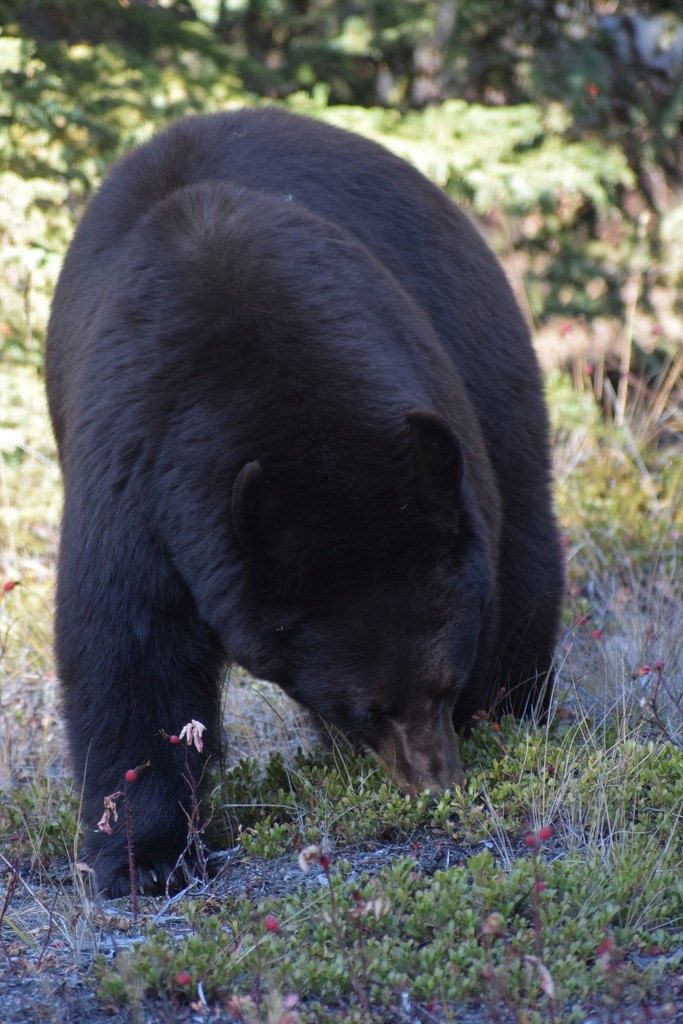
A black bear eating kinnikinnick berries in September in the Yukon Territory, Canada (CC BY-NC 4.0).
Hummingbirds take nectar from the flowers of kinnikinnick and have been observed to alight momentarily to probe low flowers [108].
Palatability and Nutritional Value
Kinnikinnick is unpalatable to domestic livestock but relished by wildlife [49]. It is palatable to white-tailed deer in the Black Hills of South Dakota from fall to late spring [58]. Kinnikinnick fruits are relished and highly important to black bear in the Yukon [84]. The fruit is of moderate importance to grizzly bear in Montana [83]. The degree of use shown by livestock and wildlife species for kinnikinnick is rated as follows [30]:
| Animal | Colorado | Montana | Utah | Wyoming | North Dakota |
|---|---|---|---|---|---|
| Cattle | Poor | Poor | Poor | Poor | Poor |
| Sheep | Poor | Poor | Poor | Poor | Poor |
| Horses | Poor | Poor | Poor | Poor | Poor |
| Pronghorn | — | — | Poor | Poor | Poor |
| Elk | Fair | Poor | Poor | Poor | — |
| Mule deer | Fair | Fair | Poor | Fair | Fair |
| White-tailed deer | — | Fair | — | Fair | Fair |
| Small mammals | Good | Fair | Good | Good | — |
| Small nongame birds | Good | Fair | Fair | Fair | — |
| Upland game birds | Good | Fair | Good | Good | — |
| Waterfowl | — | — | Poor | Poor | — |
The energy and protein values of kinnikinnick browse are low [30]. Results of a nutrient study in stands of sapling and pole-sized ponderosa pine in the Black Hills of South Dakota showed no trends in the nutrients sampled relative to stocking (shade) levels that ranged from 0 (0 m2/ha basal area) to unthinned (40 m2/ha basal area) [124]. Production decreases when crown cover exceeds 40 percent [105]. Average percentages of the six nutrients studied for kinnikinnick forage are given below [124]:
| Attribute | Pole stands | Sapling stands | ||
|---|---|---|---|---|
| Mean | Standard error | Mean | Standard error | |
| Crude protein | 5.5 | 0.1 | 5.7 | 0.1 |
| Acid detergent fiber | 25.8 | 0.6 | 26.8 | 0.1 |
| Acid detergent lignin | 12.6 | 0.3 | 13.3 | 0.2 |
| Ash | 3.15 | 0.55 | 3.08 | 0.09 |
| Calcium | 0.63 | 0.01 | 0.60 | 0.01 |
| Phosphorus | 0.14 | 0.01 | 0.14 | 0.01 |
A similar nutrient study done previously in the Black Hills gave the percent composition by season [45]:
| Attribute | October 1 | January 1 | April 1 | July 1 |
|---|---|---|---|---|
| Carotene (micrograms/gram) | 18.67 | 10.86 | 31.97 | 38.10 |
| Moisture (%) | 47.54 | 49.11 | 36.65 | 60.81 |
| Ash (%) | 1.93 | 2.01 | 2.27 | 1.66 |
| Crude fat (%) | 5.97 | 4.88 | 8.28 | 4.72 |
| Crude fiber (%) | 9.00 | 8.29 | 9.18 | 6.22 |
| Crude protein (%) | 2.70 | 2.55 | 2.98 | 3.30 |
| N-free extract (%) | 32.86 | 33.16 | 40.63 | 23.39 |
| Phosphorus (%) | 0.064 | .067 | 0.09 | 0.08 |
| Calcium (%) | 0.39 | 0.60 | 0.52 | 0.22 |
| Iron (ppm) | 270.75 | 309.28 | 236.51 | 173.70 |
| Manganese (ppm) | 12.38 | 13.36 | 20.91 | 16.29 |
Cover Value
Kinnikinnick has little or no cover value for most game animals but may have fair cover value for upland game birds in Colorado and Utah. It offers fair to good cover for small mammals and small nongame birds [30].
Value for Rehabilitation of Disturbed Sites
Kinnikinnick is very useful in erosion control plantings and attractive along highway embankments [11,73,118,148]. It is recommended for revegetation projects on well-drained soils in Alaska and moist to dry sites in most of Alberta. It is well suited to coarse-textured soils that are low in nutrients. Kinnikinnick can be aggressive on open sites and may invade disturbed sites vegetatively [148]. Its potential is better as a long-term revegetative species than as a short-term revegatative species because its growth rate is moderate [30,148]. Growth is good on gentle to steep sites [30].
Stem cuttings taken in the fall are described as the best method of establishment [11,63,148]. Kinnikinnick roots normally form endomycorrhizae, and cuttings can be inoculated with endomycorrhizal fungi prior to rooting [99]. Propagation by root cuttings has been done successfully [63]. Good seed crops occur at 1- to 5-year intervals. Seedling establishment is difficult and time consuming [11,30,46,146,148]. Details on seed cleaning, stratification, scarification, and germination as well as culture are well known and described [11,46,142,146,148]. Seed is available commercially [148].
Other Uses
Smoking the leaves as a tobacco substitute is the most widely mentioned human use of kinnikinnick. However, medical uses of kinnikinnick leaves were recognized by early Romans, Native Americans, and settlers [54,95,142]. Kinnikinnick leaves are used medicinally in Poland and many other countries [46]. The most important medical use of the leaves is for treating urinary tract disease. They can also be used to make a highly astringent wash and as a vasoconstrictor for the endometrium of the uterus [46,54,79,95]. Some Native American tribes powdered the leaves and applied them to sores [54]. For medical use the leaves are best collected in the fall [46].
The berrylike drupes have dry, insipid, and tasteless flesh when raw but are useful emergency food [53,54,142]. Native Americans fry or dry them and to use in pemmican [54]. The fruit is also used in jelly, jam, and sauces [53]. In Scandinavia, kinnikinnick is used commercially to tan leather [79].
Kinnikinnick is an attractive and excellent garden ground cover on sunny, sandy banks, along roadways, rock walls, rockeries, parking strips, and other sunny places in urban areas [73,128]. It withstands low summer moisture; some forms will withstand salt spray, grow very slowly, or grow under semishady conditions [73,128]. Branches with fruit are used for fall and Christmas decorations [53]. Kinnikinnick plants are available in nurseries [11,119]. Propagation by layering or rooted cuttings is easy and well described [46,73,128].
Other Management Considerations
Kinnikinnick increases following moderate disturbances [151]. In western Montana, it increased strongly after clearcutting with no further treatment but showed little change after clearcutting with broadcast burning or mechanical scarification [6]. It is easily killed by scraping or fire but is able to regenerate from surviving parts or seed [6]. In north-central Washington it is often the only species growing on abandoned stock driveways [151]. Kinnikinnick is moderately resistant to trampling and has low short-term and long-term resilience [19]. In northern Idaho, its cover was sharply reduced in grazed stands, and it was considered to be less resistant to trampling due to its small size and shallow rhizomes (buried stems) [153]. In the Wind River Range of Wyoming, kinnikinnick increases in response to heavy livestock grazing and trampling and becomes characteristic of disturbed aspen (Populus tremuloides) stands [110].
Kinnikinnick is a host to yellow witch's broom, which also affects three species of spruce (Picea spp.) in Alberta [148]. Kinnikinnick's sensitivity to herbicides varies from susceptible to intermediate resistance, depending on both the type of treatment and the life stage treated [9,13]. Resprouts following disturbance are easily killed by herbicides, while old-growth is more difficult to kill [13]. Detailed treatment information is available [13,104].
Kinnikinnick is relatively insensitive to the effects of sulfur dioxide gas [60]. Concentrations of heavy metals due to air pollution have been determined for fruit, stems, and leaves [126].
Table A1— Forest and range ecosystems, Bureau of Land Management (BLM) physiographic regions, Kuchler plant associations, Society for American Foresters (SAF) forest cover types, and Society for Rangeland Management (SRM) rangeland cover types in which this species occurs.
Forest and Range Ecosystems (Garrison et al. 1977)
- FRES10 White - red - jack pine
- FRES11 Spruce - fir
- FRES13 Loblolly - shortleaf pine
- FRES19 Aspen - birch
- FRES20 Douglas-fir
- FRES21 Ponderosa pine
- FRES22 Western white pine
- FRES23 Fir - spruce
- FRES25 Larch
- FRES26 Lodgepole pine
- FRES28 Western hardwoods
- FRES29 Sagebrush
- FRES34 Chaparral - mountain shrub
- FRES36 Mountain grasslands
- FRES38 Plains grasslands
- FRES44 Alpine
BLM Physiographic Regions (Bernard and Brown 1977)
- 1 Northern Pacific Border
- 2 Cascade Mountains
- 4 Sierra Mountains
- 5 Columbia Plateau
- 6 Upper Basin and Range
- 8 Northern Rocky Mountains
- 9 Middle Rocky Mountains
- 10 Wyoming Basin
- 11 Southern Rocky Mountains
- 12 Colorado Plateau
- 13 Rocky Mountain Piedmont
- 15 Black Hills Uplift
- 16 Upper Missouri Basin and Broken Lands
Kuchler Plant Associations (Kuchler 1964)
- K005 Mixed conifer forest
- K011 Western ponderosa forest
- K012 Douglas-fir forest
- K013 Cedar - hemlock - pine forest
- K014 Grand fir - Douglas-fir forest
- K015 Western spruce - fir forest
- K016 Eastern ponderosa forest
- K017 Black Hills pine forest
- K018 Pine - Douglas-fir forest
- K019 Arizona pine forest
- K020 Spruce - fir - Douglas-fir forest
- K021 Southwestern spruce - fir forest
- K022 Great Basin pine forest
- K026 Oregon oakwoods
- K037 Mountain mahogany - oak scrub
- K050 Fescue - wheatgrass
- K052 Alpine meadows and barren
- K056 Wheatgrass - needlegrass shrubsteppe
- K063 Foothills prairie
- K064 Grama - needlegrass - wheatgrass
- K066 Wheatgrass - needlegrass
- K067 Wheatgrass - bluestem - needlegrass
- K081 Oak savanna
- K093 Great Lakes spruce - fir forest
- K095 Great Lakes pine forest
- K110 Northeastern oak - pine forest
SAF Cover Types (Eyre 1980)
- 1 Jack pine
- 12 Black spruce
- 15 Red pine
- 18 Paper birch
- 45 Pitch pine
- 107 White spruce
- 202 White spruce - paper birch
- 206 Engelmann spruce - subalpine fir
- 208 Whitebark pine
- 210 Interior Douglas-fir
- 211 White fir
- 212 Western larch
- 213 Grand fir
- 215 Western white pine
- 216 Blue spruce
- 217 Aspen
- 218 Lodgepole pine
- 219 Limber pine
- 229 Pacific Douglas-fir
- 237 Interior ponderosa pine
- 251 White spruce - aspen
SRM Rangeland Cover Types (Shiflet 1994)
- No entry
1. Abrams, Marc D.; Dickmann, Donald I. 1984. Floristic composition before and after prescribed fire on a jack pine clear-cut site in northern lower Michigan. Canadian Journal of Forest Research. 14: 746-749. [7236]
2. Acsai, Jan; Largent, David L. 1983. Mycorrhizae of Arbutus menziesii Pursh. and Arctostaphylos manzanita Parry in northern California. Mycotaxon. 16(2): 519-536. [12209]
3. Agee, James K.; Kertis, Jane. 1987. Forest types of the North Cascades National Park Service Complex. Canadian Journal of Botany. 65: 1520-1530. [6327]
4. Alexander, Martin E. 1978. Estimating fuel weights of two common shrubs in Colorado lodgepole pine stands. Res. Note RM-354. Fort Collins, CO: U.S. Department of Agriculture, Forest Service, Rocky Mountain Forest and Range Experiment Station. 4 p. [302]
5. Alexander, Robert R.; Hoffman, George R.; Wirsing, John M. 1986. Forest vegetation of the Medicine Bow National Forest in southeastern Wyoming: a habitat type classification. Res. Pap. RM-271. Fort Collins, CO: U.S. Department of Agriculture, Forest Service, Rocky Mountain Forest and Range Experiment Station. 39 p. [307]
6. Arno, Stephen F.; Simmerman, Dennis G.; Keane, Robert E. 1985. Forest succession on four habitat types in western Montana. Gen. Tech. Rep. INT-177. Ogden, UT: U.S. Department of Agriculture, Forest Service, Intermountain Forest and Range Experiment Station. 74 p. [349]
7. Baker, William L. 1984. A preliminary classification of the natural vegetation of Colorado. Great Basin Naturalist. 44(4): 647-676. [380]
8. Bakuzis, E. V.; Hansen, H. L. 1962. Ecographs of shrubs and other undergrowth species of Minnesota forest communities. Minnesota Forestry Notes. 117: 1-2. [10316]
9. Balfour, Patty M. 1989. Effects of forest herbicides on some important wildlife forage species. Victoria, BC: British Columbia Ministry of Forests, Research Branch. 58 p. [12148]
10. Bamberg, Samuel A.; Major, Jack. 1968. Ecology of the vegetation and soils associated with calcareous parent materials in three alpine regions of Montana. Ecological Monographs. 38(2): 127-167. [12554]
11. Berg, Arthur R. 1974. Arctostaphylos Adans. manzanita. In: Schopmeyer, C. S., technical coordinator. Seeds of woody plants in the United States. Agric. Handb. 450. Washington, DC: U.S. Department of Agriculture, Forest Service: 228-231. [7428]
12. Bernard, Stephen R.; Brown, Kenneth F. 1977. Distribution of mammals, reptiles, and amphibians by BLM physiographic regions and A.W. Kuchler's associations for the eleven western states. Tech. Note 301. Denver, CO: U.S. Department of the Interior, Bureau of Land Management. 169 p. [434]
13. Bovey, Rodney W. 1977. Response of selected woody plants in the United States to herbicides. Agric. Handb. 493. Washington, DC: U.S. Department of Agriculture, Agricultural Research Service. 101 p. [8899]
14. Bradley, Anne Foster. 1984. Rhizome morphology, soil distribution, and the potential fire survival of eight woody understory species in western Montana. Missoula, MT: University of Montana. 183 p. Thesis. [502]
15. Braun, E. Lucy. 1961. The woody plants of Ohio. Columbus, OH: Ohio State University Press. 362 p. [12914]
16. Brown, James K.; Marsden, Michael A. 1976. Estimating fuel weights of grasses, forbs, and small woody plants. Res. Note INT-210. Ogden, UT: U.S. Department of Agriculture, Forest Service, Intermountain Forest & Range Experiment Station. 11 p. [5030]
17. Clagg, Harry B. 1975. Fire ecology in high-elevation forests in Colorado. Fort Collins, CO: Colorado State University. 137 p. Thesis. [113]
18. Coffman, Michael S.; Alyanak, Edward; Resovsky, Richard. 1980. Field guide habitat classification system: For Upper Peninsula of Michigan and northeast Wisconsin. [Place of publication unknown]: Cooperative Research on Forest Soils. 112 p. [8997]
19. Cole, David N. 1988. Disturbance and recovery of trampled montane grassland and forests in Montana. Res. Pap. INT-389. Ogden, UT: U.S. Department of Agriculture, Forest Service, Intermountain Research Station. 37 p. [3622]
20. Corns, I. G. W.; Annas, R. M. 1986. Field guide to forest ecosystems of west-central Alberta. Edmonton, AB: Canadian Forestry Service, Northern Forestry Centre. 251 p. [8998]
21. Coupland, Robert T. 1961. A reconsideration of grassland classification in the northern Great Plains of North America. Journal of Ecology. 49: 135-167. [12588]
22. Crane, Marilyn F. 1982. Fire ecology of Rocky Mountain Region forest habitat types. Final Report Contract No. 43-83X9-1-884. Missoula, MT: U.S. Department of Agriculture, Forest Service, Region 1. 272 p. On file with: U.S. Department of Agriculture, Forest Service, Intermountain Research Station, Fire Sciences Laboratory, Missoula, MT. [5292]
23. Crane, M. F.; Fischer, William C. 1986. Fire ecology of the forest habitat types of central Idaho. Gen. Tech. Rep. INT-218. Ogden, UT: U.S. Department of Agriculture, Forest Service, Intermountain Research Station. 85 p. [5297]
24. Currie, P. O.; Reichert, D. W.; Malechek, J. C.; Wallmo, O. C. 1977. Forage selection comparisons for mule deer and cattle under managed ponderosa pine. Journal of Range Management. 30(5): 352-356. [4697]
25. Curtis, John T. 1959. The vegetation of Wisconsin. Madison, WI: The University of Wisconsin Press. 657 p. [7116]
26. Daubenmire, Rexford F.; Daubenmire, Jean B. 1968. Forest vegetation of eastern Washington and northern Idaho. Technical Bulletin 60. Pullman, WA: Washington State University, Agricultural Experiment Station. 104 p. [749]
27. del Moral, Roger; Wood, David M. 1988. The high elevation flora of Mount St. Helens, Washington. Madrono. 35(4): 309-319. [6412]
28. DeVelice, Robert L.; Ludwig, John A. 1983. Climax forest series of northern New Mexico and southern Colorado. In: Moir, W. H.; Hendzel, Leonard, tech. coords. Proceedings of the workshop on Southwestern habitat types; 1983 April 6-8; Albuquerque, NM. Albuquerque, NM: U.S. Department of Agriculture, Forest Service, Southwestern Region: 45-53. [779]
29. DeVelice, Robert L.; Ludwig, John A.; Moir, William H.; Ronco, Frank, Jr. 1986. A classification of forest habitat types of northern New Mexico and southern Colorado. Gen. Tech. Rep. RM-131. Fort Collins, CO: U.S. Department of Agriculture, Forest Service, Rocky Mountain Forest and Range Experiment Station. 59 p. [781]
30. Dittberner, Phillip L.; Olson, Michael R. 1983. The plant information network (PIN) data base: Colorado, Montana, North Dakota, Utah, and Wyoming. FWS/OBS-83/86. Washington, DC: U.S. Department of the Interior, Fish and Wildlife Service. 786 p. [806]
31. Douglas, George Wayne. 1970. A vegetation study in the subalpine zone of the western North Cascades, Washington. Seattle, WA: University of Washington. 293 p. Thesis. [8560]
32. Douglas, George W.; Ballard, T. M. 1971. Effects of fire on alpine plant communities in the North Cascades, Washington. Ecology. 52(6): 1058-1064. [6738]
33. Douglas, George W.; Bliss, L. C. 1977. Alpine and high subalpine plant communities of the North Cascades Range, Washington and British Columbia. Ecological Monographs. 47: 113-150. [9487]
34. Duncan, Wilbur H.; Duncan, Marion B. 1987. The Smithsonian guide to seaside plants of the Gulf and Atlantic Coasts from Louisiana to Massachusetts, exclusive of lower peninsular Florida. Washington, DC: Smithsonian Institution Press. 409 p. [12906]
35. Eastwood, Alice. 1934. A revision of Arctostaphylos with key and descriptions. Leaflets of Western Botany. 1(11): 105-127. [12207]
36. Eriksson, O. 1989. Seedling dynamics and life histories in clonal plants. Oikos. 55: 231-238. [10322]
37. Eyre, F. H., ed. 1980. Forest cover types of the United States and Canada. Washington, DC: Society of American Foresters. 148 p. [905]
38. Farnsworth, Raymond B. 1975. Nitrogen fixation in shrubs. In: Stutz, Howard C., ed. Wildland shrubs: Proceedings--symposium and workshop; 1975 November 5-7; Provo, UT. Provo, UT: Brigham Young University: 32-71. [909]
39. Fischer, William C.; Bradley, Anne F. 1987. Fire ecology of western Montana forest habitat types. Gen. Tech. Rep. INT-223. Ogden, UT: U.S. Department of Agriculture, Forest Service, Intermountain Research Station. 95 p. [633]
40. Fitzhugh, E. Lee; Moir, William H.; Ludwig, John A.; Ronco, Frank, Jr. 1987. Forest habitat types in the Apache, Gila, and part of the Cibola National Forests, Arizona and New Mexico. Gen. Tech. Rep. RM-145. Fort Collins, CO: U.S. Department of Agriculture, Forest Service, Rocky Mountain Forest and Range Experiment Station. 116 p. [4206]
41. Forsythe, Warren Louis. 1975. Site influence on the post-fire composition of a Rocky Mountain forest. Missoula, MT: University of Montana. 173 p. Dissertation. [6723]
42. Franklin, Jerry F.; Dyrness, C. T. 1973. Natural vegetation of Oregon and Washington. Gen. Tech. Rep. PNW-8. Portland, OR: U.S. Department of Agriculture, Forest Service, Pacific Northwest Forest and Range Experiment Station. 417 p. [961]
43. Franklin, Jerry F.; Moir, William H.; Hemstrom, Miles A.; [and others]. 1988. The forest communities of Mount Rainier National Park. Scientific Monograph Series No 19. Washington, DC: U.S. Department of the Interior, National Park Service. 194 p. [12393]
44. Garrison, George A.; Bjugstad, Ardell J.; Duncan, Don A.; [and others]. 1977. Vegetation and environmental features of forest and range ecosystems. Agric. Handb. 475. Washington, DC: U.S. Department of Agriculture, Forest Service. 68 p. [998]
45. Gastler, George F.; Moxon, Alvin L.; McKean, William T. 1951. Composition of some plants eaten by deer in the Black Hills of South Dakota. Journal of Wildlife Management. 15(4): 352-357. [3996]
46. Gawlowska, Jadwiga. 1969. Seminatural cultivation of economically important plant species growing in the wild state. Biological Conservation. 1: 151-155. [13013]
47. Givnish, Thomas J. 1981. Serotiny, geography, and fire in the pine barrens of New Jersey. Evolution. 35(1): 101-123. [8634]
48. Goldin, A.; Nimlos, T. J. 1977. Vegetation patterns on limestone and acid parent materials in the Garnet Mountains of western Montana. Northwest Science. 51(3): 149-160. [10675]
49. Gullion, Gordon W. 1964. Wildlife uses of Nevada plants. Contributions toward a flora of Nevada No. 49. Beltsville, MD: U. S. Department of Agriculture, Agricultural Research Service, National Arboretum Crops Research Division. 170 p. [6729]
50. Great Plains Flora Association. 1986. Flora of the Great Plains. Lawrence, KS: University Press of Kansas. 1392 p. [1603]
51. Hall, Frederick C. 1984. Ecoclass coding system for the Pacific Northwest plant associations. R6 Ecol 173-1984. Portland, OR: U.S. Department of Agriculture, Forest Service, Pacific Northwest Region. 83 p. [7650]
52. Harrington, H. D. 1964. Manual of the plants of Colorado. 2d ed. Chicago: The Swallow Press Inc. 666 p. [6851]
53. Harrington, H. D. 1976. Edible native plants of the Rocky Mountains. Albuquerque, NM: University of New Mexico Press. 392 p. [12903]
54. Hart, J. 1976. Montana--native plants and early peoples. Helena, MT: Montana Historical Society. 75 p. [9979]
55. Hatler, David F. 1972. Food habits of black bears in interior Alaska. Canadian Field-Naturalist. 86(1): 17-31. [10389]
56. Hawkes, Brad C. 1982. Fire history and ecology of forest ecosystems in Kluane National Park. In: Wein, Ross W.; Riewe, Roderick R.; Methven, Ian R., eds. Resources and dynamics of the Boreal Zone; [Date of conference unknown]; Thunder Bay, ON. [Place of publication unknown]. Association of Canadian Universities for Northern Studies: 266-280. [7444]
57. Hemstrom, Miles A.; Logan, Sheila E.; Pavlat, Warren. 1987. Plant association and management guide: Willamette National Forest. R6-Ecol 257-B-86. Portland, OR: U.S. Department of Agriculture, Forest Service, Pacific Northwest Region. 312 p. [13402]
58. Hill, Ralph R. 1946. Palatability ratings of Black Hills plants for white-tailed deer. Journal of Wildlife Management. 10(1): 47-54. [3270]
59. Hitchcock, C. Leo; Cronquist, Arthur; Ownbey, Marion. 1959. Vascular plants of the Pacific Northwest. Part 4: Ericaceae through Campanulaceae. Seattle, WA: University of Washington Press. 510 p. [1170]
60. Hocking, Drake. 1975. Effects on the forest of sulphur dioxide from a sulphur fire near Edson, Alberta. Information Report NOR-X-139. Edmonton, AB: Environment Canada, Canadian Forestry Service, Northern Forest Research Center. 8 p. [7610]
61. Hoffman, George R.; Alexander, Robert R. 1976. Forest vegetation of the Bighorn Mountains, Wyoming: a habitat type classification. Res. Pap. RM-170. Fort Collins, CO: U.S. Department of Agriculture, Forest Service, Rocky Mountain Forest and Range Experiment Station. 38 p. [1180]
62. Hoffman, George R.; Alexander, Robert R. 1987. Forest vegetation of the Black Hills National Forest of South Dakota and Wyoming: a habitat type classification. Res. Pap. RM-276. Fort Collins, CO: U.S. Department of Agriculture, Forest Service, Rocky Mountain Forest and Range Experiment Station. 48 p. [1181]
63. Holloway, Patricia; Zasada, John. 1979. Vegetative propagation of 11 common Alaska woody plants. Res. Note PNW-334. Portland, OR: U.S. Department of Agriculture, Forest Service, Pacific Northwest Forest and Range Experiment Station. 12 p. [1183]
64. Hopkins, William E. 1979. Plant associations of south Chiloquin and Klamath Ranger Districts-- Winema National Forest. R6-Ecol-79-005. Portland, OR: U.S. Department of Agriculture, Forest Service, Pacific Northwest Region. 96 p. [7339]
65. Johnson, E. A. 1975. Buried seed populations in the subarctic forest east of Great Slave Lake, Northwest Territories. Canadian Journal of Botany. 53: 2933-2941. [6466]
66. Johnston, Barry C. 1987. Plant associations of Region Two: Potential plant communities of Wyoming, South Dakota, Nebraska, Colorado, and Kansas. 4th ed. R2-ECOL-87-2. Lakewood, CO: U.S. Department of Agriculture, Forest Service, Rocky Mountain Region. 429 p. [3519]
67. Kartesz, John T.; Kartesz, Rosemarie. 1980. A synonymized checklist of the vascular flora of the United States, Canada, and Greenland. Volume II: The biota of North America. Chapel Hill, NC: The University of North Carolina Press; in confederation with Anne H. Lindsey and C. Richie Bell, North Carolina Botanical Garden. 500 p. [6954]
68. Keown, L. D. 1977. Interim report: Black Tail Hills Prescribed Fire Project: implementation and results. Great Falls, MT: U.S. Department of Agriculture, Forest Service, Lewis and Clark National Forest. 9 p. [12233]
69. Kittredge, J., Jr. 1934. Evidence of the rate of forest succession on Star Island, Minnesota. Ecology. 15(1): 24-35. [10102]
70. Klinka, K.; Krajina, V. J.; Ceska, A.; Scagel, A. M. 1989. Indicator plants of coastal British Columbia. Vancouver, BC: University of British Columbia Press. 288 p. [10703]
71. Kotar, John; Kovach, Joseph A.; Locey, Craig T. 1988. Field guide to forest habitat types of northern Wisconsin. Madison, WI: University of Wisconsin, Department of Forestry; Wisconsin Department of Natural Resources. 217 p. [11510]
72. Kovalchik, Bernard L. 1987. Riparian zone associations: Deschutes, Ochoco, Fremont, and Winema National Forests. R6 ECOL TP-279-87. Portland, OR: U.S. Department of Agriculture, Forest Service, Pacific Northwest Region. 171 p. [9632]
73. Kruckeberg, A. R. 1982. Gardening with native plants of the Pacific Northwest. Seattle: University of Washington Press. 252 p. [9980]
74. Kuchler, A. W. 1964. Manual to accompany the map of potential vegetation of the conterminous United States. Special Publication No. 36. New York: American Geographical Society. 77 p. [1384]
75. Kufeld, Roland C.; Wallmo, O. C.; Feddema, Charles. 1973. Foods of the Rocky Mountain mule deer. Res. Pap. RM-111. Fort Collins, CO: U.S. Department of Agriculture, Forest Service, Rocky Mountain Forest and Range Experiment Station. 31 p. [1387]
76. La Roi, George H.; Hnatiuk, Roger J. 1980. The Pinus contorta forests of Banff and Jasper National Parks: a study in comparative synecology and syntaxonomy. Ecological Monographs. 50(1): 1-29. [8347]
77. Larson, Milo; Moir, W. H. 1987. Forest and woodland habitat types (plant associations) of northern New Mexico and northern Arizona. 2d ed. Albuquerque, NM: U.S. Department of Agriculture, Forest Service, Southwestern Region. 90 p. [8947]
78. Laursen, Steven B. 1984. Predicting shrub community composition and structure following management disturbance in forest ecosystems of the Intermountain West. Moscow, ID: University of Idaho. 261 p. Dissertation. [6717]
79. Lewin, Renate. 1989. Vanishing resources; Protecting medicinal plants of the forest. Forest World. 5(2): 15-20. [11058]
80. Looman, J. 1969. The fescue grasslands of western Canada. Vegetatio. 19: 128-145. [1471]
81. Lutz, H. J. 1956. Ecological effects of forest fires in the interior of Alaska. Tech. Bull. No. 1133. Washington, DC: U.S. Department of Agriculture, Forest Service. 121 p. [7653]
82. Lyon, L. Jack; Stickney, Peter F. 1976. Early vegetal succession following large northern Rocky Mountain wildfires. In: Proceedings, Tall Timbers fire ecology conference and Intermountain Fire Research Council fire and land management symposium; 1974 October 8-10; Missoula, MT. No. 14. Tallahassee, FL: Tall Timbers Research Station: 355-373. [1496]
83. Mace, Richard D. 1986. Analysis of grizzly bear habitat in the Bob Marshall Wilderness, Montana. In: Contreras, Glen P.; Evans, Keith E, compilers. Proceedings--grizzly bear habitat symposium; 1985 April 30 - May 2; Missoula, MT. Gen. Tech. Rep. INT-207. Ogden, UT: U.S. Department of Agriculture, Forest Service, Intermountain Research Station: 136-149. [10814]
84. MacHutchon, A. Grant. 1989. Spring and summer food habits of black bears in the Pelly River Valley, Yukon. Northwest Science. 63(3): 116-118. [12249]
85. Mallik, A. U.; Gimingham, C. H. 1983. Regeneration of heathland plants following burning. Vegetatio. 53: 45-58. [6337]
86. Mallik, A. U.; Gimingham, C. H. 1985. Ecological effects of heather burning. II. Effects on seed germination and vegetative regeneration. Journal of Ecology. 73: 633-644. [6338]
87. McClaran, Mitchel P.; Bartolome, James W. 1989. Fire-related recruitment in stagnant Quercus douglasii populations. Canadian Journal of Forest Research. 19: 580-585. [7416]
88. Mallik, A. U.; Hobbs, R. J.; Rahman, A. A. 1988. Seed-bed substrates and revegetation of Calluna heathlands following burning. Journal of Environmental Management. 27: 379-397. [6594]
89. Martin, Alexander C.; Zim, Herbert S.; Nelson, Arnold L. 1951. American wildlife and plants. New York: McGraw-Hill Book Company, Inc. 500 p. [4021]
90. Mauk, Ronald L.; Henderson, Jan A. 1984. Coniferous forest habitat types of northern Utah. Gen. Tech. Rep. INT-170. Ogden, UT: U.S. Department of Agriculture, Forest Service, Intermountain Forest and Range Experiment Station. 89 p. [1553]
91. McCormick, Jack; Buell, Murray F. 1968. The Plains: pigmy forests of the New Jersey Pine Barrens, a review and annotated bibliography. New Jersey Academy of Sciences Bulletin. 13: 20-34. [11611]
92. McLean, Alastair. 1968. Fire resistance of forest species as influenced by root systems. Journal of Range Management. 22: 120-122. [1621]
93. Miller, Donald R. 1976. Taiga winter range relationships and diet. Canadian Wildlife Service Rep. Series No. 36. Ottawa, ON: Environment Canada, Wildlife Service. 42 p. (Biology of the Kaminuriak population of barren-ground caribou; pt 3). [13007]
94. Moir, William H.; Ludwig, John A. 1979. A classification of spruce-fir and mixed conifer habitat types of Arizona and New Mexico. Res. Pap. RM-207. Fort Collins, CO: U.S. Department of Agriculture, Forest Service, Rocky Mountain Forest and Range Experiment Station. 47 p. [1677]
95. Moore, Michael. 1979. Medicinal plants of the Mountain West. Santa Fe, NM: Museum of New Mexico Press. 200 p. [12905]
96. Moss, E. H. 1955. The vegetation of Alberta. Botanical Review. 21(9): 493-567. [6878]
97. Munz, Philip A. 1973. A California flora and supplement. Berkeley, CA: University of California Press. 1905 p. [6155]
98. Neiland, Bonita J. 1958. Forest and adjacent burn in the Tillamook Burn area of northwestern Oregon. Ecology. 39(4): 660-671. [8879]
99. Nelson, S. D. 1987. Rooting and subsequent growth of woody ornamental softwood cuttings treated with endomycorrhizal inoculum. Journal of the American Society of Horticultural Science. 112(2): 263-266. [8377]
100. Nimlos, Thomas J.; Van Meter, Wayne P.; Daniels, Lewis A. 1968. Rooting patterns of forest understory species as determined by radioiodine absorption. Ecology. 49(6): 1145-1151. [4120]
101. Noste, Nonan V. 1982. Vegetation response to spring and fall burning for wildlife habitat improvement. In: Baumgartner, David M., compiler & editor. Site preparation and fuels management on steep terrain: Proceedings of a symposium; 1982 February 15-17; Spokane, WA. Pullman, WA: Washington State University, Cooperative Extension: 125-132. [1784]
102. Noste, Nonan V.; Bushey, Charles L. 1987. Fire response of shrubs of dry forest habitat types in Montana and Idaho. Gen. Tech. Rep. INT-239. Ogden, UT: U.S. Department of Agriculture, Forest Service, Intermountain Research Station. 22 p. [255]
103. Olson, Jerry S. 1958. Rates of succession and soil changes on southern Lake Michigan sand dunes. Botanical Gazette. 119(3): 125-170. [10557]
104. Parker, Robert, compiler. 1982. Reaction of various plants to 2,4-D, MCPA, 2,4,5-T, silvex and 2,4-DB. Pullman, WA: Washington State University, College of Agriculture, Cooperative Extension. 61 p. In cooperation with: U.S. Department of Agriculture. [1817]
105. Pase, Charles P. 1958. Herbage production and composition under immature ponderosa pine stands in the Black Hills. Journal of Range Management. 11: 238-243. [1823]
106. Peck, Morton E. 1941. A manual of the higher plants of Oregon. Portland, OR: Binfords & Mort. 800 p. [12444]
107. Pfister, Robert D.; Kovalchik, Bernard L.; Arno, Stephen F.; Presby, Richard C. 1977. Forest habitat types of Montana. Gen. Tech. Rep. INT-34. Ogden, UT: U.S. Department of Agriculture, Forest Service, Intermountain Forest and Range Experiment Station. 174 p. [1878]
108. Pojar, Jim. 1975. Hummingbird flowers of British Columbia. Syesis. 8: 25-28. [6537]
109. Raunkiaer, C. 1934. The life forms of plants and statistical plant geography. Oxford: Clarendon Press. 632 p. [2843]
110. Reed, Robert M. 1971. Aspen forests of the Wind River Mountains, Wyoming. American Midland Naturalist. 86(2): 327-343. [1951]
111. Remphrey, W. R.; Steeves, T. A.; Neal, B. R. 1983. The morphology and growth of Arctostaphylos uva-ursi (bearberry): an architectural analysis. Canadian Journal of Botany. 61: 2430-2450. [2963]
112. Remphrey, W. R.; Neal, B. R.; Steeves, T. A. 1983. The morphology and growth of Arctostaphylos uva-ursi (bearberry): an architectural model simulating colonizing growth. Canadian Journal of Botany. 61( 451): 2451-2457. [2964]
113. Rowe, J. S. 1956. Uses of undergrowth plant species in forestry. Ecology. 37(3): 461-473. [8862]
114. Rowe, J. S. 1983. Concepts of fire effects on plant individuals and species. In: Wein, Ross W.; MacLean, David A., eds. SCOPE 18: The role of fire in northern circumpolar ecosystems. Chichester; New York: John Wiley & Sons: 135-154. [2038]
115. Rowe, J. S.; Scotter, G. W. 1973. Fire in the boreal forest. Quaternary Research. 3: 444-464. [72]
116. Rosatti, Thomas J. 1982. Trichome variation and the ecology of Arctostaphylos in Michigan. Michigan Botanist. 21: 171-180. [13059]
117. Rosatti, Thomas J. 1987. Field and garden studies of Arctostaphylos uva-ursi (Ericaceae) in North America. Systematic Botany. 12(1): 61-77. [2025]
118. Rudolf, Paul O. 1950. Forest plantations in the Lake States. Tech. Bull. 1010. Washington, DC: U.S. Department of Agriculture. 171 p. [13463]
119. Sampson, Arthur W.; Jespersen, Beryl S. 1963. California range brushlands and browse plants. Berkeley, CA: University of California, Division of Agricultural Sciences, California Agricultural Experiment Station, Extension Service. 162 p. [3240]
120. Scheiner, Samuel M.; Teeri, James A. 1981. A 53-year record of forest succession following fire in northern lower Michigan. Michigan Botanist. 20(1): 3-14. [5022]
121. Schmidt, Wyman C.; Lotan, James E. 1980. Phenology of common forest flora of the northern Rockies--1928 to 1937. Res. Pap. INT-259. Ogden, UT: U.S. Department of Agriculture, Forest Service, Intermountain Forest and Range Experiment Station. 20 p. [2082]
122. Scotter, George W. 1972. Chemical composition of forage plants from the Reindeer Preserve, Northwest Territories. Arctic. 25(1): 21-27. [16563]
123. Severson, Kieth E.; Garrett, E. Chester. 1974. Growth characteristics of bearberry in the Black Hills. Res. Note. RM-254. Fort Collins, CO: U.S. Department of Agriculture, Forest Service, Rocky Mountain Forest and Range Experiment Station. 3 p. [5408]
124. Severson, Kieth E.; Uresk, Daniel W. 1988. Influence of ponderosa pine overstory on forage quality in the Black Hills, South Dakota. Great Basin Naturalist. 48(1): 78-82. [2807]
125. Seymour, Frank Conkling. 1982. The flora of New England. 2d ed. Phytologia Memoirs 5. Plainfield, NJ: Harold N. Moldenke and Alma L. Moldenke. 611 p. [7604]
126. Shaw, George. 1981. Concentrations of twenty-eight elements in fruiting shrubs downwind of the smelter at Flin Flon, Manitoba. Environmental Pollution (Series A). 25(3): 197-209. [10794]
127. Soper, James H.; Heimburger, Margaret L. 1982. Shrubs of Ontario. Life Sciences Misc. Publ. Toronto, ON: Royal Ontario Museum. 495 p. [12907]
128. Sperka, Marie. 1973. Growing wildflowers: A gardener's guide. New York: Harper & Row. 277 p. [10578]
129. Stallard, Harvey. 1929. Secondary succession in the climax forest formations of northern Minnesota. Ecology. 10(4): 476-547. [3808]
130. Stark, N.; Steele, R. 1977. Nutrient content of forest shrubs following burning. American Journal of Botany. 64(10): 1218-1224. [2224]
131. Stelfox, John G. 1976. Range ecology of Rocky Mountain bighorn sheep in Canadian national parks. Report Series Number 39. Ottawa, ON: Canadian Wildlife Service. 50 p. [13851]
132. Stephens, H. A. 1973. Woody plants of the North Central Plains. Lawrence, KS: The University Press of Kansas. 530 p. [3804]
133. Stevens, David R. 1970. Winter ecology of moose in the Gallatin Mountains, Montana. Journal of Wildlife Management. 34(1): 37-46. [7932]
134. Stiles, Edmund W. 1980. Patterns of fruit presentation and seed dispersal in bird-disseminated woody plants in the Eastern deciduous forest. American Naturalist. 116(5): 670-688. [6508]
135. Strong, W. L.; LaRoi, G. H. 1986. A strategy for concurrently monitoring the plant water potentials of spatially separate forest ecosystems. Canadian Journal of Forest Research. 16(2): 346-351. [10805]
136. Tiffney, W. N., Jr.; Benson, D. R.; Eveleigh, D. E. 1978. Does Arctostaphylos uva-ursi (bearberry) have nitrogen-fixing root nodules?. American Journal of Botany. 65(6): 625-628. [13495]
137. U.S. Department of Agriculture, Soil Conservation Service. 1994. Plants of the U.S.--alphabetical listing. Washington, DC: U.S. Department of Agriculture, Soil Conservation Service. 954 p. [23104]
138. Uresk, Daniel W.; Severson, Kieth E. 1989. Understory-overstory relationships in ponderosa pine forests, Black Hills, South Dakota. Journal of Range Management. 42(3): 203-208. [6705]
139. Viereck, Leslie A. 1966. Plant succession and soil development on gravel outwash of the Muldrow Glacier, Alaska. Ecological Monographs. 36(3): 181-199. [12484]
140. Viereck, Leslie A. 1975. Forest ecology of the Alaska taiga. In: Proceedings of the circumpolar conference on northern ecology; 1975 September 15-18; Ottawa, ON. Washington, DC: U.S. Department of Agriculture, Forest Service: 1-22. [7315]
141. Viereck, L. A.; Dyrness, C. T.; Batten, A. R.; Wenzlick, K. J. 1992. The Alaska vegetation classification. Gen. Tech. Rep. PNW-GTR-286. Portland, OR: U.S. Department of Agriculture, Forest Service, Pacific Northwest Research Station. 278 p. [2431]
142. Vines, Robert A. 1960. Trees, shrubs, and woody vines of the Southwest. Austin, TX: University of Texas Press. 1104 p. [7707]
143. Vogl, Richard J. 1971. Fire and the northern Wisconsin pine barrens. In: Proceedings, annual Tall Timbers Fire ecology conference; 1970 August 20-21; New Brunsick, Canada. No. 10. Tallahassee, FL: Tall Timbers Research Station: 175-209. [2432]
144. Vogl, Richard J.; Ryder, Calvin. 1969. Effects of slash burning on conifer reproduction in Montana's Mission Range. Northwest Science. 43(3): 135-147. [8546]
145. Volland, Leonard A. 1985. Plant associations of the central Oregon Pumice Zone. Rt-ECOL-104-1985. Portland, OR: U.S. Department of Agriculture, Forest Service, Pacific Northwest Region. 138 p. [7341]
146. Vories, Kimery C. 1981. Growing Colorado plants from seed: a state of the art. Volume I. Shrubs. Gen. Tech. Rep. INT-103. Ogden, UT: U.S. Department of Agriculture, Forest Service, Intermountain Forest and Range Experiment Station. 80 p. [3426]
147. Wali, M. K.; Krajina, V. J. 1973. Vegetation-environment relationships of some sub-boreal spruce zone ecosystems in British Columbia. Vegetatio. 26: 237-381. [9856]
148. Watson, L. E.; Parker, R. W.; Polster, D. F. 1980. Manual of plant species suitablity for reclamation in Alberta. Vol. 2. Forbs, shrubs and trees. Edmonton, AB: Land Conservation and Reclamation Council. 537 p. [8855]
149. Wells, Philip V. 1988. New combinations in Arctostaphylos (Ericaceae): Annotated list of changes in status. Madrono. 35(4): 330-341. [6448]
150. Welsh, Stanley L.; Atwood, N. Duane; Goodrich, Sherel; Higgins, Larry C., eds. 1987. A Utah flora. Great Basin Naturalist Memoir No. 9. Provo, UT: Brigham Young University. 894 p. [2944]
151. Williams, Clinton K.; Lillybridge, Terry R. 1983. Forested plant associations of the Okanogan National Forest. R6-Ecol-132b. Portland, OR: U.S. Department of Agriculture, Forest Service, Pacific Northwest Region. 116 p. [2566]
152. Wofford, B. Eugene. 1989. Guide to the vascular plants of the Blue Ridge. Athens, GA: The University of Georgia Press. 384 p. [12908]
153. Zimmerman, G. T.; Neuenschwander, L. F. 1984. Livestock grazing influences on community structure, fire intensity, and fire frequency within the Douglas-fir/ninebark habitat type. Journal of Range Management. 37(2): 104-110. [10103]
154. Stickney, Peter F. 1989. Seral origin of species originating in northern Rocky Mountain forests. Unpublished draft on file at: U.S. Department of Agriculture, Forest Service, Intermountain Research Station, Fire Sciences Laboratory, Missoula, MT; RWU 4403 files. 7 p. [20090]