


Athene cunicularia, burrowing owl
Howard, Janet L. 1996. Athene cunicularia, burrowing owl. In: Fire Effects Information System, [Online]. U.S. Department of Agriculture, Forest Service, Rocky Mountain Research Station, Fire Sciences Laboratory (Producer). https://research.fs.usda.gov/feis/species-reviews/atcu
| Abbreviation | Common Name | Scientific Name | Classification | Status |
|---|---|---|---|---|
| Animals | ||||
| ATCU | burrowing owl | Athene cunicularia | Life Form: Animals/Bird Kingdom: Animalia Class: Bird Order: Strigiformes Family: Strigidae Genus: Athene | Fed. Protected: No Nativity: Native Invasiveness: Noninvasive |


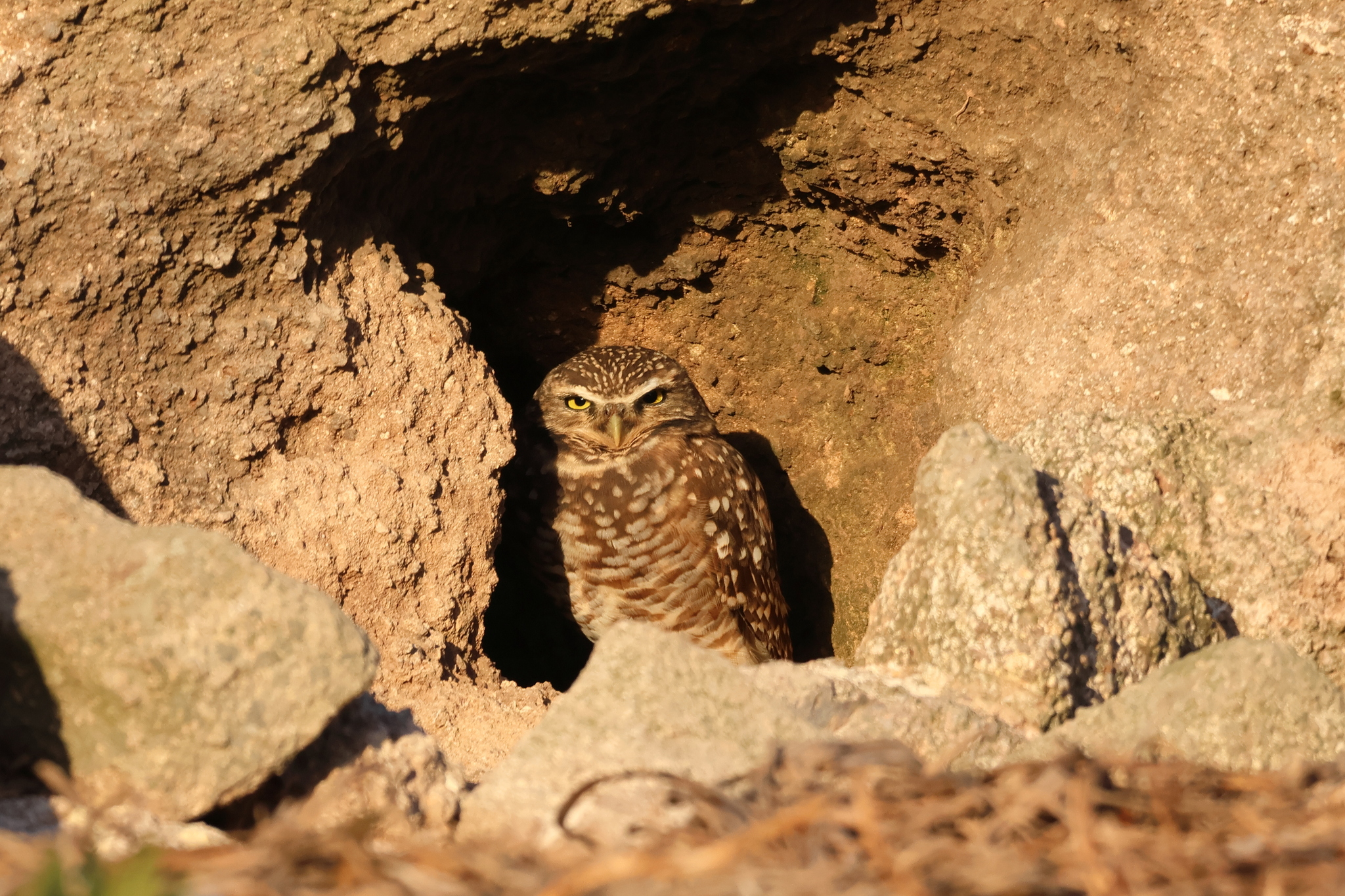
Taxonomy
The scientific name of burrowing owl is Athene cunicularia (Molina). Subspecies of burrowing owl occurring in the United States and Canada are [2,58]:
- Athene cunicularia hypugaea: burrowing owl, western burrowing owl, Colorado burrowing owl
- Athene cunicularia floridana: Florida burrowing owl
Synonyms
- Speotyto cunicularia (Molina) [2,58]
Other Common Names
None
General Distribution
Burrowing owl is a pan-American species. In North America, it is distributed from British Columbia and Manitoba south through the western half of the United States, Louisiana, Florida, the Caribbean islands, and Mexico. Distribution continues through Central America to western South America, from Columbia south to Tierra del Fuego in Argentina [2,35,61].
Distribution of North American subspecies:Athene cunicularia subsp. hypugaea is distributed from southern interior British Columbia east to south-central Manitoba and south to west-central Mexico. Populations in British Columbia are reintroduced; prior to the 1986 reintroduction, burrowing owl had not been sighted in British Columbia since 1979. The range of S. c. ssp. hypugaea once extended to Minnesota and Iowa, but burrowing owl is probably extirpated from those states [28].
Athene cunicularia subsp. floridana occurs in Florida and the Bahama islands. In Florida, the subspecies was formerly restricted to central and southern portions of the state, but has expanded its range northward nearly to Georgia [28].
States and Provinces
- United States: AZ CA CO FL ID KS LA MT NE NV NM ND OK OR SD TX UT WA WY
- Canada: AB BC MB SK
- Mexico
Plant Communities
Burrowing owl occurs in grasslands, shrub-grasslands, and savannas [63].
Biological Characteristics
Migration: Burrowing owls are migratory, but little is known of their migration routes and wintering areas. The majority of burrowing owls that breed in Canada and the northern United States are thought to migrate south during September and October and north during March and April. Burrowing owls migrating to Saskatchewan arrive in early May [28]. Banding studies suggest that Canadian burrowing owls migrate further south than burrowing owls in the United States [33]. Christmas birds counts show California as the most important American state for wintering burrowing owls, followed by New Mexico, Florida, Arizona, and Texas, respectively [36]. Florida, the Southwest, and southern California have year-round burrowing owl residents as well as winter migrants [28].
Development and Reproduction

Juvenile burrowing owls standing at the entrance of a burrow, Rocky Mountain Arsenal National Wildlife Refuge, Adams County, Colorado. (CC BY-NC 4.0)
Burrowing owls begin nesting in spring in burrows that they line with cow, horse, or bison (Bison bison) dung [63]. In eastern Colorado, burrowing owls lay eggs in May [16]. The female does all incubation and brooding [28]. Clutch size is large, from 6 to 11 eggs [31], with an average of 6.5 eggs [51]. Eggs are laid at intervals of 24 to 72 hours. Incubation period is 27 to 30 days and begins when the first egg is laid, resulting in a multi-aged brood [16]. Owlets are born partially covered with down and with eyes closed. Eyes open at 5 days of age [28]. Owlets move among nest burrows when 10 days old [31]. They fly well by 6 weeks of age, and fledge when about 44 days old [43].
At Davis, California, a DNA fingerprinting study of burrowing owl showed that 37 percent of adult owls were raising owlets other than their biological offspring. Owlet movement and polygamy accounted for some of the discrepancy; intraspecific brood parasitism may also be a factor [38].
Predators
Rattlesnakes and prairie dogs raid burrows for burrowing owl eggs and nestlings [4,63]. Hawks (Accipiter and Buteo spp.), falcons (Falco spp.), great horned owl (Bubo virginianus), coyote (Canis latrans), domestic dog (C. domesticus), badger (Taxidea taxus), skunks (Spilogale, Mephitis, and Conepatus spp.), weasels (Mustela spp.), and bobcat (Lynx rufus) prey on both adult and nestling burrowing owls [28].
Habitat
Diet

Burrowing owl with grasshopper (Acrididae) prey, Clark County, Nevada. (CC BY-NC 4.0)
Burrowing owls hunt in both day and night. They hunt on the wing, from prairie dog mounds or other high spots on the ground, and from fenceposts or other elevated perches. Prey is either run down on foot or caught by hovering and swooping [63]. Arthropods, mainly insects, form the majority of the burrowing owl diet. An overall assessment of the burrowing diet in western North America, calculated from 3,564 prey items, included 90.0 percent invertebrates (mostly insects), 6.9 percent mammals (mostly rodents), 2.0 percent herptiles, and 0.3 percent birds [59]. Young prairie dogs (Cynomys spp.), ground squirrels, pocket gophers, voles (Microtus spp.), mice (Heteromyidae, Muridae, and Zapodidiae), young cottontails (Sylvilagus spp.), and young jackrabbits (Lepus spp.) are common mammalian prey. Grasshoppers (Acrididae), Jerusalem crickets (Gryllacrididae), and beetles (Coleoptera) are the most common arthropod prey, although other arthropod taxa are taken as available [22,24,45,63]. Herptiles are a large component of the Florida burrowing owl's diet [28].
Seasonal variation: In Oklahoma, vertebrates comprised 85 percent of the burrowing owl winter diet, while arthropods comprised almost 100 percent of the summer diet [9]. A study of the spring and summer diets of burrowing owl on the shortgrass prairie of Colorado showed that most rodents were taken in April. Most Jerusalem crickets were taken June, most grasshoppers in July, and most dung beetles (Scarabaeinae) in August. Ground beetles (Carabidae) were taken in quantity throughout spring and summer [47].
Preferred Habitat
Burrowing owls occupy grasslands, shrub steppes, and savannas. They also occur in other open areas such as agricultural lands, old fields, extensive forest clearings, airports, golf courses, and spacious residential zones [1,3,23,50,63,76].
Home range: In central Saskatchewan, home range size for six radio-tagged males varied from 0.06 to 1.92 square miles (0.14-4.81 sq km), with an average of 0.96 square mile (2.41 sq km). Diurnal activities were restricted to within 825 feet (250 m) of the burrow [30].
Cover Requirements

An adult burrowing owl at the entrance of a burrow on Southeast Farallon Island. Farallon National Wildlife Refuge, San Francisco County, California. (CC BY-NC 4.0)
Burrowing owls typically live in colonies, using burrows excavated by other animal species for cover [63]. Burrows are used for breeding, nesting, and brooding [28]. When selecting a burrow, the owls prefer burrows with low, open cover that provide good horizontal visibility [23]. Burrowing owls are commonly found in plant communities in early stages of succession because cover is low [45]. Long-abandoned burrows are usually not used because the burrow entrance has become overgrown. Burrows adjacent to burrows occupied by other burrowing owls are preferred, although burrowing owl pairs have nested alone if other burrowing owls were not in the area [28]. Burrowing owls often evict other animal species from desirable burrows [63].
In the Plains States, burrowing owls use black-tailed prairie dog (Cynomys ludovicianus) burrows most often [45,56,63], although burrows of ground squirrels (Spermophilus spp.) are also frequently used [17]. Deserted black-tailed prairie dog towns become unsuitable as burrowing owl habitat within 1 to 3 years [9,10]. White-tailed prairie dog (C. leucurus) burrows are used infrequently because plant cover surrounding white-tailed prairie dog burrows is usually too high for burrowing owl requirements [48]. In California and Idaho, burrowing owls primarily use ground squirrel burrows [23]. Florida burrowing owls occupy raccoon (Procyon lotor), snake (Serpentes), and gopher tortoise (Gopherus polyphemus) burrows [63]. Other burrows commonly occupied by burrowing owl throughout North America include those of badger, pocket gophers (Geomyidae), fox (Vulpes and Urocyon spp.), and rattlesnakes (Crotalus spp.) [22,26,63]. Length and depth of the burrow depends upon the requirements of the species that dug it [28]. In friable soil, burrowing owls dig their own burrows when suitable ones are not available [23,63]. In Forida, where burrowing rodents are scarce, Florida burrowing owls dig their own burrows in sandy soils. The burrows are about 6.5 to 9 feet long (2-3 m) and less than feet 3.3 feet (1 m) deep when burrowing owls excavate them [49].
Burrowing owls use ground cavities other than burrows for cover. On the Snake River Plain of Idaho, they sometimes use cavities in basalt outcrops [40,53]. Burrowing owls also use human-constructed cavities such as culverts. Pipe can be laid down for artificial nests [11]. In California, hatching success rate of burrowing owl eggs laid in artificial nests was 55 percent [43].
Fire-caused Mortality
Fire-related mortality of burrowing owl has not been documented in the literature. Burrowing mammals that stay in their burrows during fire are usually unharmed; burrowing owls in their burrows during fire probably are probably unharmed as well. Some burrowing mammals have asphyxiated in their burrows during fire; this may also happen to burrowing owls in their burrows during fire [14]. When caught outside their burrows during fire, adult burrowing owls probably escape fire easily; some young that cannot yet fly may be injured or killed.
Fire Effects on Habitat
Fire affects burrowing owl in two ways: by altering vegetation and by altering their prey base [3].
Fire effects on vegetation: Wright and Bailey [66] identified three major fire-dependent plant associations (grassland, semidesert grass-shrub, and sagebrush-grass) in which burrowing owl occur. Frequent fire can maintain or improve burrowing owl habitats by reducing plant height and cover around burrows and by controlling woody plant invasion. For example, 3 months following a May prescribed fire on the Nebraska sandhills prairie, where burrowing owl occur, vegetative cover on burned sites averaged 16 percent less than on adjacent unburned sites [7]. One year after a May 1965 wildfire on Nebraska sandhills prairie, vegetative growth was 53 to 91 percent greater on unburned than on burned sites [65].
Fire in grasslands has been shown to reduce encroachment of woody shrubs and trees [66]. Mixed-grass prairie of South Dakota, for example, has become invaded by ponderosa pine (Pinus ponderosa) in the absence of fire; it is estimated that in the Black Hills, 50 percent of presettlement prairie has converted to ponderosa pine woodland [20].
Fire effects on prey: Periodic fire in grasslands probably increases prey diversity for raptors including burrowing owl, and may increase overall prey density [3]. Rodent populations in grasslands usually show an initial drop after fire; loss of cover makes rodents more vulnerable to predators such as burrowing owl [12]. After a 1- to 3-year reduction in prey, rodent numbers usually match or exceed prefire levels [66]. Deer mouse (Peromyscus maniculatus) numbers have returned to prefire levels in the first postfire growing season [12]. Ground squirrels, an important burrowing owl prey, also increase in number after fire [5,21].
Since arthropods form the majority of the burrowing owl's diet, fire effects on burrowing owl's arthropod prey are an important management consideration. Because beetles, grasshoppers, and crickets form the majority of the burrowing owl's arthropod diet, they are discussed here.
Beetles are a diverse order, and the effects of fire on beetles are variable. Generally, however, beetle populations in grassland habitats recover quickly from fire. After a March wildfire on an Illinois prairie, beetle numbers initially dropped 15 percent, but nearly equaled beetle numbers on an adjacent unburned prairie within a month. Rove beetle (Aleocharinae) numbers on burned sites, however, stayed below those on adjacent unburned prairie throughout the month of the study [52]. On Minnesota tallgrass prairie, Tester and Marshall [60] recorded an increase in beetles following fire. On the Konza Prairie Research Natural Area of Kansas, scarab beetle (Scarabaeideae) grub numbers were significantly (p<0.05) greater on annually burned prairie than on unburned prairie [55]. (Data for other beetle families were not collected.)
Most grasshopper species increase after spring fire due to increased nutritional quality of new grasses [39,52,60]. On native tallgrass prairie in Kansas, grasshopper numbers were highest after early spring prescribed burning, followed by mid-spring burning; numbers were lowest on late-spring burned sites [39]. In a review of fire effects on insects, Warren and others [64] reported that grasshoppers and crickets (Orthoptera) generally increase after fire in any season; however, "hot" grass fires that occur before Orthoptera have developed wings may reduce their numbers. Jerusalem crickets are a key element in the diet of burrowing owl in many areas. Unlike most Orthoptera, they are wingless even as adults. They habitually burrow or hide under rocks, where they are probably protected from fire. After rangeland fire in northern Utah, Jerusalem crickets occurred exclusively on burned areas [25].
Florida burrowing owl: Periodic fire is important in keeping the sandy soils open for burrowing. It also maintains the early successional stages that burrowing owl and most of their herptile and mammal prey require [42].
Fire Regimes
For fire regime information, search FEIS for this species by entering the species name on the Advanced Search page and selecting “Fire Regime” as the publication type.
Fire Management Considerations
No entry.
Federal Status
None
Other Status
State Status: Burrowing owl is listed as endangered in Minnesota and Iowa and as a species of special concern in California, Oregon, Washington, Idaho, Montana, Wyoming, North Dakota, South Dakota, Utah, Oklahoma, and Florida [34,46].
Canadian Status: Burrowing owl is listed as threatened in Alberta, British Columbia, Manitoba, and Saskatchewan [69].
Other: Burrowing owl is classified as a species of special concern on the Audubon Society's Blue List [68].
Other Management Information
Factors in population decline: Intensive agriculture or development results in loss of burrows, loss of foraging habitat, and creation of suboptimal nesting habitat. It also increases vulnerability to predation [26] and may reduce the chances of unpaired owls to find mates [28]. Loss of habitat has been cited as factor of decline in the Bay Area and Central Valley of California [13,23] and elsewhere. Breeding Bird Survey data show that in the Great Plains, burrowing owl populations declined an average of 0.71 percent per year from 1966 to 1987 [54].
Programs to destroy prairie dogs and other burrowing rodents have greatly reduced burrowing owl populations by reducing the amount of prey and burrows available [4,23,28,63]. Poisons used to destroy rodents probably have a direct effect on burrowing owls: at least one rodenticide (carbamate) has been shown to lower burrowing owl reproduction and survival when sprayed over nest burrows [37]. The effects of consuming poisoned prey on burrowing owl are not well known [28]. However, weight of breeding burrowing owl in pastures where strychnine-coated grain was used to control ground squirrels was significantly lower than on control pastures, suggesting either a sublethal effect or less available food [36].
Reintroduction: Burrowing owls were reintroduced in British Columbia in 1986. As of 1993, 91 fledglings had been produced. No returns of burrowing owl reintroduced in Manitoba or Minnesota have been recorded [28].
Florida burrowing owl: Human activities have had a beneficial effect on Florida burrowing owl. Mowing, cattle grazing [44], and wetland drainage have increased the subspecies' range. Residential and industrial areas currently support the largest populations [49].
Grazing effects: Moderate grazing can benefit burrowing owl by keeping vegetation around burrows short [23]. In Florida, cattle often break through the sandy soils and damage burrows, but overall, cattle grazing has benefitted the Florida burrowing owl [28]. Overstocking can harm burrowing owl, however. Burrowing owl have become extirpated from some islands of Tierra del Fuego by domestic sheep trampling their burrows [32].
Table A1— Forest and range ecosystems, Bureau of Land Management (BLM) physiographic regions, Kuchler plant associations, Society for American Foresters (SAF) forest cover types, and Society for Rangeland Management (SRM) rangeland cover types in which this species occurs.
Forest and Range Ecosystems (Garrison et al. 1977)
- FRES28 Western hardwoods
- FRES29 Sagebrush
- FRES30 Desert shrub
- FRES32 Texas savanna
- FRES33 Southwestern shrubsteppe
- FRES34 Chaparral-mountain shrub
- FRES35 Pinyon-juniper
- FRES36 Mountain grasslands
- FRES37 Mountain meadows
- FRES38 Plains grasslands
- FRES39 Prairie
- FRES40 Desert grasslands
- FRES41 Wet grasslands
- FRES42 Annual grasslands
BLM Physiographic Regions (Bernard and Brown 1977)
- 1 Northern Pacific Border
- 2 Cascade Mountains
- 3 Southern Pacific Border
- 4 Sierra Mountains
- 5 Columbia Plateau
- 6 Upper Basin and Range
- 7 Lower Basin and Range
- 8 Northern Rocky Mountains
- 9 Middle Rocky Mountains
- 10 Wyoming Basin
- 11 Southern Rocky Mountains
- 12 Colorado Plateau
- 13 Rocky Mountain Piedmont
- 14 Great Plains
- 15 Black Hills Uplift
- 16 Upper Missouri Basin and Broken Lands
Kuchler Plant Associations (Kuchler 1964)
- K024 Juniper steppe woodland
- K027 Mesquite bosque
- K030 California oakwoods
- K035 Coastal sagebrush
- K039 Blackbrush
- K041 Creosotebush
- K042 Creosotebush-bursage
- K043 Paloverde-cactus shrub
- K044 Creosotebush-tarbush
- K047 Fescue-oatgrass
- K048 California steppe
- K049 Tule marshes
- K050 Fescue-wheatgrass
- K051 Wheatgrass-bluegrass
- K053 Grama-galleta steppe
- K054 Grama-tobosa prairie
- K055 Sagebrush steppe
- K056 Wheatgrass-needlegrass shrubsteppe
- K057 Galleta-three-awn shrubsteppe
- K058 Grama-tobosa shrubsteppe
- K063 Foothills prairie
- K064 Grama-needlegrass-wheatgrass
- K065 Grama-buffalograss
- K066 Wheatgrass-needlegrass
- K067 Wheatgrass-bluestem-needlegrass
- K068 Wheatgrass-grama-buffalograss
- K069 Bluestem-grama prairie
- K070 Sandsage-bluestem prairie
- K074 Bluestem prairie
- K075 Nebraska Sandhills prairie
- K076 Blackland prairie
- K077 Bluestem-sacahuista prairie
- K079 Palmetto prairie
- K085 Mesquite-buffalograss
- K088 Fayette prairie
SAF Cover Types (Eyre 1980)
- 68 Mesquite
- 242 Mesquite
- 250 Blue oak-foothills pine
- 255 California coast live oak
SRM Rangeland Cover Types (Shiflet 1994)
- 101 Bluebunch wheatgrass
- 102 Idaho fescue
- 103 Green fescue
- 104 Antelope bitterbrush-bluebunch wheatgrass
- 105 Antelope bitterbrush-Idaho fescue
- 106 Bluegrass scabland
- 107 Western juniper/big sagebrush/bluebunch wheatgrass
- 201 Blue oak woodland
- 202 Coast live oak woodland
- 204 North coastal shrub
- 205 Coastal sage shrub
- 212 Blackbush
- 214 Coastal prairie
- 215 Valley grassland
- 216 Montane meadows
- 217 Wetlands
- 301 Bluebunch wheatgrass-blue grama
- 302 Bluebunch wheatgrass-Sandberg bluegrass
- 303 Bluebunch wheatgrass-western wheatgrass
- 304 Idaho fescue-bluebunch wheatgrass
- 305 Idaho fescue-Richardson needlegrass
- 306 Idaho fescue-slender wheatgrass
- 307 Idaho fescue-threadleaf sedge
- 308 Idaho fescue-tufted hairgrass
- 309 Idaho fescue-western wheatgrass
- 310 Needle-and-thread-blue grama
- 311 Rough fescue-bluebunch wheatgrass
- 312 Rough fescue-Idaho fescue
- 313 Tufted hairgrass-sedge
- 314 Big sagebrush-bluebunch wheatgrass
- 315 Big sagebrush-Idaho fescue
- 316 Big sagebrush-rough fescue
- 317 Bitterbrush-bluebunch wheatgrass
- 318 Bitterbrush-Idaho fescue
- 319 Bitterbrush-rough fescue
- 320 Black sagebrush-bluebunch wheatgrass
- 321 Black sagebrush-Idaho fescue
- 322 Curlleaf mountain-mahogany-bluebunch wheatgrass
- 323 Shrubby cinquefoil-rough fescue
- 324 Threetip sagebrush-Idaho fescue
- 401 Basin big sagebrush
- 402 Mountain big sagebrush
- 403 Wyoming big sagebrush
- 502 Grama-galleta
- 505 Grama-tobosa shrub
- 506 Creosotebush-bursage
- 507 Palo verde-cactus
- 508 Creosotebush-tarbush
- 601 Bluestem prairie
- 602 Bluestem-prairie sandreed
- 603 Prairie sandreed-needlegrass
- 604 Bluestem-grama prairie
- 605 Sandsage prairie
- 606 Wheatgrass-bluestem-needlegrass
- 607 Wheatgrass-needlegrass
- 608 Wheatgrass-grama-needlegrass
- 609 Wheatgrass-grama
- 610 Wheatgrass
- 611 Blue grama-buffalograss
- 612 Sagebrush-grass
- 613 Fescue grassland
- 614 Crested wheatgrass
- 615 Wheatgrass-saltgrass-grama
- 701 Alkali sacaton-tobosagrass
- 702 Black grama-alkali sacaton
- 703 Black grama-sideoats grama
- 704 Blue grama-western wheatgrass
- 705 Blue grama-galleta
- 706 Blue grama-sideoats grama
- 707 Blue grama-sideoats grama-black grama
- 708 Bluestem-dropseed
- 709 Bluestem-grama
- 710 Bluestem prairie
- 711 Bluestem-sacahuista prairie
- 712 Galleta-alkali sacaton
- 713 Grama-muhly-threeawn
- 714 Grama-bluestem
- 715 Grama-buffalograss
- 716 Grama-feathergrass
- 717 Little bluestem-Indiangrass-Texas wintergrass
- 718 Mesquite-grama
- 719 Mesquite-liveoak-seacoast bluestem
- 720 Sand bluestem-little bluestem (dunes)
- 721 Sand bluestem-little bluestem (plains)
- 722 Sand sagebrush-mixed prairie
- 723 Sea oats
- 724 Sideoats grama-New Mexico feathergrass-winterfat
- 725 Vine mesquite-alkali sacaton
- 726 Cordgrass
- 727 Mesquite-buffalograss
1. Amadon, Dean; Bull, John. 1988. Hawks and owls of the world: a distributional and taxonomic list. Western Foundation of Vertebrate Zoology. 3(4): 295-357. [25642]
2. American Ornithologists' Union. 1991. Thirty-eighth supplement to the American Ornithologists; Union check-list of North American birds. Auk. 108: 750-754. [26109]
3. Andersen, David E. 1991. Management of North American grasslands for raptors. In: Pendleton, Beth Giron; Krahe, Diane L., eds. Proceedings of the Midwest raptor management symposium and workshop; [Date of conference unknown]; Chicago, IL. Scientific and Technical Series No. 15. Washington, DC: National Wildlife Federation: 203-209. [22969]
4. Baumgartner, Frederick M.; Baumgartner, A. Marguerite. 1992. Oklahoma bird life. Norman, OK: University of Oklahoma Press. 443 p. [25637]
5. Beck, Alan M.; Vogl, Richard J. 1972. The effects of spring burning on rodent populations in a brush prairie savanna. Journal of Mammalogy. 53(2): 336-346. [196]
6. Bernard, Stephen R.; Brown, Kenneth F. 1977. Distribution of mammals, reptiles, and amphibians by BLM physiographic regions and A.W. Kuchler's associations for the eleven western states. Tech. Note 301. Denver, CO: U.S. Department of the Interior, Bureau of Land Management. 169 p. [434]
7. Bragg, Thomas B. 1978. Effects of burning, cattle grazing, and topography on vegetation of the choppy sands range site in the Nebraska Sandhills Prairie. In: Hyder, Donald N., ed. Proceedings, 1st international rangeland congress; 1978 August 14-18; Denver, CO. Denver, CO: Society for Range Management: 248-253. [4468]
8. Buech, Richard R.; Siderits, Karl; Radtke, Robert E.; Sheldon, Howard L.; Elsing, Donald. 1977. Small mammal populations after a wildfire in northeast Minnesota. Res. Note. NC-151. St. Paul, MN: U.S. Department of Agriculture, Forest Service, North Central Forest Experiment Station. 8 p. [8667]
9. Butts, Kenneth Olin. 1973. History and habitat requirements of burrowing owls in western Oklahoma. Stillwater, OK: Oklahoma State University. 188 p. Thesis. [27333]
10. Butts, K. O.; Lewis, J. C. 1982. The importance of prairie dog towns to burrowing owls in Oklahoma. Proceedings, Oklahoma Academy of Sciences. 62: 46-52. [26110]
11. Collins, Charles T.; Landry, Ross E. 1977. Artificial nest burrows for burrowing owls. North American Bird Bander. 2: 151-154. [26111]
12. Cook, Sherburne F., Jr. 1959. The effects of fire on a population of small rodents. Ecology. 40(1): 102-108. [230]
13. Desante, D. F.; Ruhlen, E.; Amin, S.; Burton, K. M. 1993. Results of the 1991 census of burrowing owls in central California: an alarmingly small and declining population. Journal of Raptor Research. 27(1): 59. [Abstract]. [25632]
14. Erwin, William J.; Stasiak, Richard H. 1979. Vertebrate mortality during the burning of a reestablished prairie in Nebraska. The American Midland Naturalist. 101(1): 247-249. [3818]
15. Eyre, F. H., ed. 1980. Forest cover types of the United States and Canada. Washington, DC: Society of American Foresters. 148 p. [905]
16. Franz, Robert; Franz, Lorri. 1992. Species profile: burrowing owl (Athene cunicularia). Wildbird. 6(8): 58-61. [25636]
17. Frisina, Michael R.; Mariani, Jina M. 1995. Wildlife and livestock as elements of grassland ecosystems. Rangelands. 17(1): 23-25. [25696]
18. Garrison, George A.; Bjugstad, Ardell J.; Duncan, Don A.; [and others]. 1977. Vegetation and environmental features of forest and range ecosystems. Agric. Handb. 475. Washington, DC: U.S. Department of Agriculture, Forest Service. 68 p. [998]
19. Gartner, F. Robert; Thompson, Wesley W. 1973. Fire in the Black Hills forest-grass ecotone. In: Proceedings, annual Tall Timbers fire ecology conference; 1972 June 8-9; Lubbock, TX. No. 12. Tallahassee, FL: Tall Timbers Research Station: 37-68. [1002]
20. Gartner, F. Robert; White, E. M. 1986. Fire in the Northern Great Plains and its use in management. In: Komarek, Edwin V.; Coleman, Sandra S.; Lewis, Clifford E.; Tanner, George W., compilers. Prescribed fire and smoke management: Symposium proceedings: 39th annual meeting of the Society for Range Management; 1986 February 13; Kissimmee, FL. Denver, CO: Society for Range Management: 13-21. [3094]
21. Gashwiler, Jay S. 1970. Plant and mammal changes on a clearcut in west-central Oregon. Ecology. 51(6): 1018-1026. [8523]
22. Gleason, Richard S.; Johnson, Donald R. 1985. Factors influencing nesting success of burrowing owls in southeastern Idaho. The Great Basin Naturalist. 45(1): 81-84. [22260]
23. Gould, Gordon I., Jr. 1985. A case for owls. In: Proceedings, 7th annual wildlife conference; 1983 February 4-6; San Francisco, CA. San Francisco, CA: San Francisco Zoological Society: 14-21. [22601]
24. Green, Gregory A.; Fitzner, Richard E.; Anthony, Robert G.; Rogers, Lee E. 1993. Comparative diets of burrowing owls in Oregon and Washington. Northwest Science. 67(2): 88-93. [22071]
25. Hansen, J. D.; Sutton, J. E. 1985. Insect activity on a burned site after a range fire. In: Proceedings, 38th annual meeting of the Society for Range Management; 1985 February 11-15; Salt Lake City, UT. Denver, CO: Society for Range Management. Abstract. [26508]
26. Haug, Elizabeth A. 1985. Observations on the breeding ecology of burrowing owls in Saskatchewan. Saskatoon, SK: University of Saskatchewan. 89 p. Thesis. [26174]
27. Haug, Elizabeth A.; Didiuk, Andrew B. 1991. Updated status report on the burrowing owl (Athene cunicularia hypugaea) in Canada. Ottawa, ON: Committee on the Status of Endangered Wildlife. 29 p. [26234]
28. Haug, Elizabeth A.; Millsap, Brian A.; Martell, Mark S. 1993. Burrowing owl (Speotyto cunicularia). In: Poole, A.; Gill, F., eds. The birds of North America. No. 61. Philadelphia, PA: The Academy of Natural Sciences; Washington, DC: The American Ornithologists' Union. 20 p. [27325]
29. Haug, Elizabeth A.; Oliphant, Lynn W. 1987. Proceedings of the workshop on endangered species in the prairie provinces; 1986; Edmonton, AB. Provincial Museum Occasional Paper No. 9. Edmonton, AB: Curatorial Section, Provincial Museum of Alberta: 269-271. On file with: U.S. Department of Agriculture, Forest Service, Intermountain Research Station, Fire Sciences Laboratory, Missoula, MT. [27326]
30. Haug, Elizabeth A.; Oliphant, Lynn W. 1990. Movements, activity patterns, and habitat use of burrowing owls in Saskatchewan. Journal of Wildlife Management. 54(1): 27-35. [21841]
31. Henny, Charles J.; Blus, Lawrence J. 1981. Artificial burrows provide new insight into burrowing owl nesting biology. Raptor Research. 15(3): 82-85. [26112]
32. Humphrey, Philip S.; Bridge, David; Reynolds, Percival W.; Peterson, Rodger Tory. 1970. Preliminary Smithsonian manual: birds of Isla Grande (Tierra del Fuego). Lawrence, KS: University of Kansas, Museum of Natural History. 411 p. [26094]
33. James, Paul C. 1992. Where do Canadian burrowing owls spend the winter? Blue Jay. 50(2): 93-95. [25634]
34. James, P. C. 1993. The status of the burrowing owl in North America. Journal of Raptor Research. 27(1): 89. [Abstract]. [25631]
35. James, Paul C.; Ethier, Thomas J. [n.d.]. Trends in the winter distribution and abundance of burrowing owls in North America. American Birds. 43(4): 1224-1225. [21842]
36. James Paul C.; Ethier, Thomas J.; Toutloff, Mauray K. 1996. Parameters of a declining burrowing owl population in Saskatchewan. [In press]. Journal of Raptor Research. [27953]
37. James, Paul C.; Fox, Glen A. 1987. Effects of some insecticides on productivity of burrowing owls. Blue Jay. 45(2): 65-71. [27324]
38. Johnson, B. S. 1993. Reproductive success, relatedness, and mating patterns in a colonial bird, the burrowing owl. Journal of Raptor Research. 27(1): 61. [Abstract]. [25630]
39. Knutson, Herbert; Campbell, John B. 1976. Relationships of grasshoppers (Acrididae) to burning, grazing, and range sites of native tallgrass prairie in Kansas. In: Tall Timbers conference on ecological animal control by habitat management: Proceedings; 1974 February 28 - March 1; Gainesville, FL. Number 6. Tallahassee, FL: Tall Timbers Research Station: 107-120. [17851]
40. Kochert, Michael N. 1986. Raptors. In: Cooperrider, Allan Y.; Boyd, Raymond J.; Stuart, Hanson R., eds. Inventory and monitoring of wildlife habitat. Denver, CO: U.S. Department of the Interior, Bureau of Land Management, Denver Service Center: 313-349. [13527]
41. Kuchler, A. W. 1964. United States [Potential natural vegetation of the conterminous United States]. Special Publication No. 36. New York: American Geographical Society. 1:3,168,000; colored. [3455]
42. Landers, J. Larry. 1987. Prescribed burning for managing wildlife in southeastern pine forests. In: Dickson, James G.; Maughan, O. Eugene, eds. Managing southern forests for wildlife and fish: a proceedings; [Date of conference unknown]; [Location of conference unknown]. Gen. Tech. Rep. SO-65. New Orleans, LA: U.S. Department of Agriculture, Forest Service, Southern Forest Experiment Station: 19-27. [11562]
43. Landry, Ross E. 1979. Growth and development of the burrowing owl, Athene cunicularia. Long Beach, CA: California State University. 66 p. Thesis. [26117]
44. Ligon, J. David. 1963. Breeding range expansion of the burrowing owl in Florida. Auk. 80: 367-368. [26113]
45. MacCracken, James G.; Uresk, Daniel W.; Hansen, Richard M. 1985. Vegetation and soils of burrowing owl nest sites in Conata Basin, South Dakota. The Condor. 87: 152-154. [21831]
46. Martell, Mark Stephen. 1990. Reintroduction of burrowing owls into Minnesota: a feasibility study. Minneapolis: University of Minnesota. 95 p. Thesis. [26096]
47. Marti, Carl D. 1974. Feeding ecology of four sympatric owls. The Condor. 76: 45-61. [26114]
48. Martin, Stephen J. 1983. Burrowing owl occurrence on white-tailed prairie dog colonies. Journal of Field Ornithology. 54(4): 422-423. [26115]
49. Millsap, B.A.; Bear, C. 1993. Mate and territory fidelity and natal dispersal in an urban population of Florida burrowing owls. Journal of Raptor Research. 27(1): 62. [Abstract]. [27712]
50. Mealey, B. K. 1993. Reproductive ecology of the burrowing owl, Athene cunicularia floridana, in Dade and Broward Counties, Florida. Journal of Raptor Research. 27(1): 61-62. [Abstract]. [25646]
51. Murray, Gale A. 1976. Geographic variation in the clutch sizes of seven owl species. Auk. 93: 602-613. [26116]
52. Rice, Lucile A. 1932. The effect of fire on the prairie animal communities. Ecology. 13(4): 392-401. [263]
53. Rich, Terrell. 1986. Habitat and nest-site selection by burrowing owls in the sagebrush steppe of Idaho. Journal of Wildlife Management. 50(4): 548-555. [1969]
54. Sauer, John R.; Droege, Sam; Bystrak, Danny. 1991. Breeding bird survey and bird banding data: applications to raptor research and management. In: Pendleton, Beth Giron; Krahe, Diane L., eds. Proceedings of the Midwest raptor management symposium and workshop; [Date of conference unknown]; Chicago, IL. Scientific and Technical Series No. 15. Washington, DC: National Wildlife Federation: 125-133. [23788]
55. Seastedt, T. R.; Hayes, D. C.; Petersen, N. J. 1986. Effects of vegetation, burning and mowing on soil macroarthropods of tallgrass prairie. In: Clambey, Gary K.; Pemble, Richard H., eds. The prairie: past, present and future: Proceedings of the 9th North American prairie conference; 1984 July 29 - August 1; Moorhead, MN. Fargo, ND: Tri-College University Center for Environmental Studies: 99-102. [3537]
56. Sharps, Jon C.; Uresk, Daniel W. 1990. Ecological review of black-tailed prairie dogs and associated species in western South Dakota. The Great Basin Naturalist. 50(4): 339-345. [25639]
57. Shiflet, Thomas N., ed. 1994. Rangeland cover types of the United States. Denver, CO: Society for Range Management. 152 p. [23362]
58. Sibley, Charles G.; Monroe, Burt L., Jr. 1990. Distribution and taxonomy of the birds of the world. New Haven, CT: Yale University Press. 1111 p. [22814]
59. Snyder, Noel F. R.; Wiley, James W. 1976. Sexual size dimorphism in hawks and owls of North America. Ornithological Monographs No. 20. Lawrence, KS: Allen Press, Inc. 96 p. [26095]
60. Tester, John R.; Marshall, William H. 1961. A study of certain plant and animal interrelations on a native prairie in northwestern Minnesota. Occasional Papers: No. 8. Minneapolis, MN: The University of Minnesota, Minnesota Museum of Natural History. 51 p. [25709]
61. National Geographic Society. 1987. Field guide to the birds of North America. 2nd ed. Washington, DC: The National Geographic Society. 464 p. [24327]
62. U.S. Department of the Interior, National Biological Survey. [n.d.]. NP Flora [Data base]. Davis, CA: U.S. Department of the Interior, National Biological Survey. [23119]
63. Voous, K. H. 1988. Owls of the northern hemisphere. London: William Collins Sons and Company, LTD. 320 p. [25638]
64. Warren, S. D.; Scifres, C. J.; Teel, P. D. 1987. Response of grassland arthropods to burning: a review. Agriculture, Ecosystems and Environment. 19: 105-130. [4350]
65. Wolfe, Carl W. 1973. Effects of fire on a sandhills grassland environment. In: Proceedings, annual Tall Timbers fire ecology conference; 1972 June 8-9; Lubbock, TX. Number 12. Tallahassee, FL: Tall Timbers Research Station: 241-255. [8469]
66. Wright, Henry A.; Bailey, Arthur W. 1982. Fire ecology: United States and southern Canada. New York: John Wiley & Sons. 501 p. [2620]
67. Young, Leonard S. 1989. Effects of agriculture on raptors in the western United States: an overview. In: Proceedings of the western raptor symposium and workshop; 1987 October 26-28; Boise, ID. NWF Scientific and Technical Series No. 12. Washington, DC: National Wildlife Federation: 209-218. [22649]
68. Tate, James, Jr. 1986. The Blue List for 1986. American Birds. 40(2): 227-235. [24324]
69. Committee on the Status of Endangered Wildlife in Canada. 1992. Canadian species at risk. Ottawa, ON. 10 p. [26183]
70. American Ornithologists' Union. 2004. The A.O.U. check-list of North American birds, 7th edition, [Online]. American Ornithologists' Union (Producer). Available: http://www.aou.org/checklist/index.php3 [2005, January 10]. [50863]