


Canis latrans, coyote
Tesky, Julie L. 1995. Canis latrans, coyote. In: Fire Effects Information System, [Online]. U.S. Department of Agriculture, Forest Service, Rocky Mountain Research Station, Fire Sciences Laboratory (Producer). Available: https://research.fs.usda.gov/feis/species-reviews/cala
| Abbreviation | Common Name | Scientific Name | Classification | Status |
|---|---|---|---|---|
| Animals | ||||
| CALA | coyote | Canis latrans | Life Form: Animals/Mammal Kingdom: Animalia Class: Mammal Order: Carnivora Family: Canidae Genus: Canis | Fed. Protected: No Nativity: Native Invasiveness: Noninvasive |


Taxonomy
The currently accepted scientific name for the coyote is Canis latrans Say. It is in the family Canidae. Nineteen subspecies are currently recognized, however; only 16 subspecies occur in Mexico, the United States, and Canada [4,30]:
- Canis latrans cagottis (Hamilton-Smith) (Mexican coyote)
- Canis latrans clepticus Elliot (San Pedro Martir coyote)
- Canis latrans frustror Woodhouse (southeastern coyote)
- Canis latrans impavidus Allen (Durango coyote)
- Canis latrans incolatus Hall (northern coyote)
- Canis latrans jamesi Townsend (Tiburon Island coyote)
- Canis latrans latrans (plains coyote)
- Canis latrans lestes Merriam (mountain coyote)
- Canis latrans mearnsi Merriam (Mearns coyote)
- Canis latrans microdon Merriam (Lower Rio Grande coyote)
- Canis latrans ochropus Eschscholtz (California valley coyote)
- Canis latrans peninsulae Merriam (peninsula coyote)
- Canis latrans texesis Bailey (Texas plains coyote)
- Canis latrans thamnos Jackson (northeastern coyote)
- Canis latrans umpquesis Jackson (northwest coast coyote)
- Canis latrans vigilis Merriam (Colima coyote)
Fertile hybrids have been produced by matings of coyotes with feral dogs (C. familiaris), red wolves (C. rufus), gray wolves (C. lupus), and red foxes (Vulpes vulpes) [4,12]. Coyote-dog hybrids exhibit decreased fecundity [12].
Synonyms
- No entry
Other Common Names
brush wolf, prairie wolf, American jackal
General Distribution
Coyotes are found from Costa Rica to northern Alaska, and from coast to coast in the United States and Canada. The highest densities occur in the Great Plains states and in south-central United States. Coyotes are absent from the barrens and Arctic islands of northern Canada, including much of northern Quebec, northern Newfoundland, and Labrador. Coyotes are uncommon where gray wolf populations are high in northeastern Minnesota, northern Alaska, the Northwest Territories, Manitoba, and Ontario. The distribution of coyotes in eastern North America has expanded during this century. In some states such as Florida and Georgia, coyotes have been introduced [4,12,43]. Today, all eastern states and provinces have at least a small population of coyotes [64]. Distribution of the subspecies is listed below [61,66]:
- Mexican coyote - Occurs in Oaxaca, San Luis Potosi, Pueblo, and Veracrus, Mexico. Its range may extend into southern Nuevo Leon and southern Tamaulipas, Mexico.
- San Pedro Martir coyote - Occurs in northern Baja California and southwestern California (mostly San Diego County).
- southeastern coyote - Occurs in southeastern and extreme eastern Kansas, Oklahoma, Texas, Missouri, and Arkansas.
- Durango coyote - Occurs along the Pacific coast drainage of western Mexico between about 22 degrees and 26 degrees north latitude, extreme southern Sonora, extreme southwestern Chihuahua, western Durango, western Zacatecas, and Sinaloa.
- northern coyote - In Canada, northern coyotes occur in Yukon Territory, the Northwest Territories, northern British Columbia, and northern Alberta. In the United States, northern coyotes occur in most of Alaska except the southeastern coastal section.
- Tiburon Island coyote - Occurs on Tiburon Island off Baja California.
- plains coyote - In Canada, plains coyotes occur in southeastern Alberta, southern Saskatchewan, and the extreme southwestern corner of Manitoba. In the United States, they occur in Montana, Wyoming, and Colorado east of the Rocky Mountains, and the northeastern corner of New Mexico; North Dakota except the northeastern quarter; northwestern Oklahoma, and the northern Panhandle region of Texas.
- mountain coyote - In Canada, mountain coyotes occur in southern British Columbia and southeastern Alberta. In the United States, they occur in Oregon and Washington east of the Cascade Range, northern California, Idaho, western Montana, Wyoming, and Colorado (except the southeast corner), northern and central Nevada, and northern and central Utah.
- Mearns coyote - Occurs in southwestern Colorado, extreme southern Utah and Nevada, southeastern California, northeastern Baja California, Arizona, west of the Rio Grande in New Mexico, and Sonora and Chihuahua in Mexico.
- Lower Rio Grande coyote - Occurs in extreme southern Texas and northern Tamaulipas, Mexico.
- California valley coyote - Occurs in California west of the Sierra Nevada, except in the northern part.
- peninsula coyote - Occurs on the Baja California peninsula.
- Texas plains coyote - Occurs in Texas, except for the northern panhandle region, the eastern part, and the extreme southern tip. Texas plains coyotes also occur in eastern New Mexico except for the northeastern corner, and part of northeastern Mexico.
- northeastern coyote - In Canada, northeastern coyotes occur in north-central Saskatchewan, Manitoba (except the extreme southwestern corner), southern Ontario, and extreme southern Quebec. In the United States, northeastern coyotes occur along the eastern edge of North Dakota and in Minnesota, Iowa, Missouri (north of the Missouri River), Michigan, Wisconsin, Illinois (except the extreme southern portion), and northern Indiana.
- northwest coast coyote - Occurs west of the Cascade Range in Oregon and Washington.
- Colima coyote - Occurs along the southwestern Pacific slope of Jalisco, Michoacan, and Guerrero, Mexico.
States and Provinces
- United States: AL AK AZ AR CA CO CT DE FL GA ID IL IN IA KS KY LA ME MD MA MI MN MS MO MT NE NV NH NJ NM NY NC ND OH OK OR PA RI SC SD TN TX UT VT VA WA WV WI WY
- Canada: AB BC MB NB NF NT NS ON PE PQ SK YT
- Mexico
Plant Communities
Coyotes evolved in a plains environment and were historically most numerous in western grasslands where large ungulate populations were high. Coyotes flourished in the shortgrass-steppe, semiarid sagebrush (Artemisia spp.)-grasslands, and deserts, and they ranged from deserts and plains to alpine areas of adjacent mountains [58].
Today, range expansions indicate that coyotes can be successful in any plant community from the tropics of Guatemala to the tundra of northern Alaska [58]. Although they occur in most plant communities throughout their range, coyotes do show some preferences. In the Intermountain region, coyotes are closely associated with sagebrush communities. Coyotes in eastern Nevada preferred black sagebrush (Artemisia nova) flats to other habitats. These flats were areas of highest black-tailed jackrabbit (Lepus californicus) densities [44]. In the Sierra Nevada, California, coyotes inhabit almost every plant community and successional stage. However, they prefer grass-forb and shrub-conifer seedling-conifer sapling communities [63].
Biological Characteristics

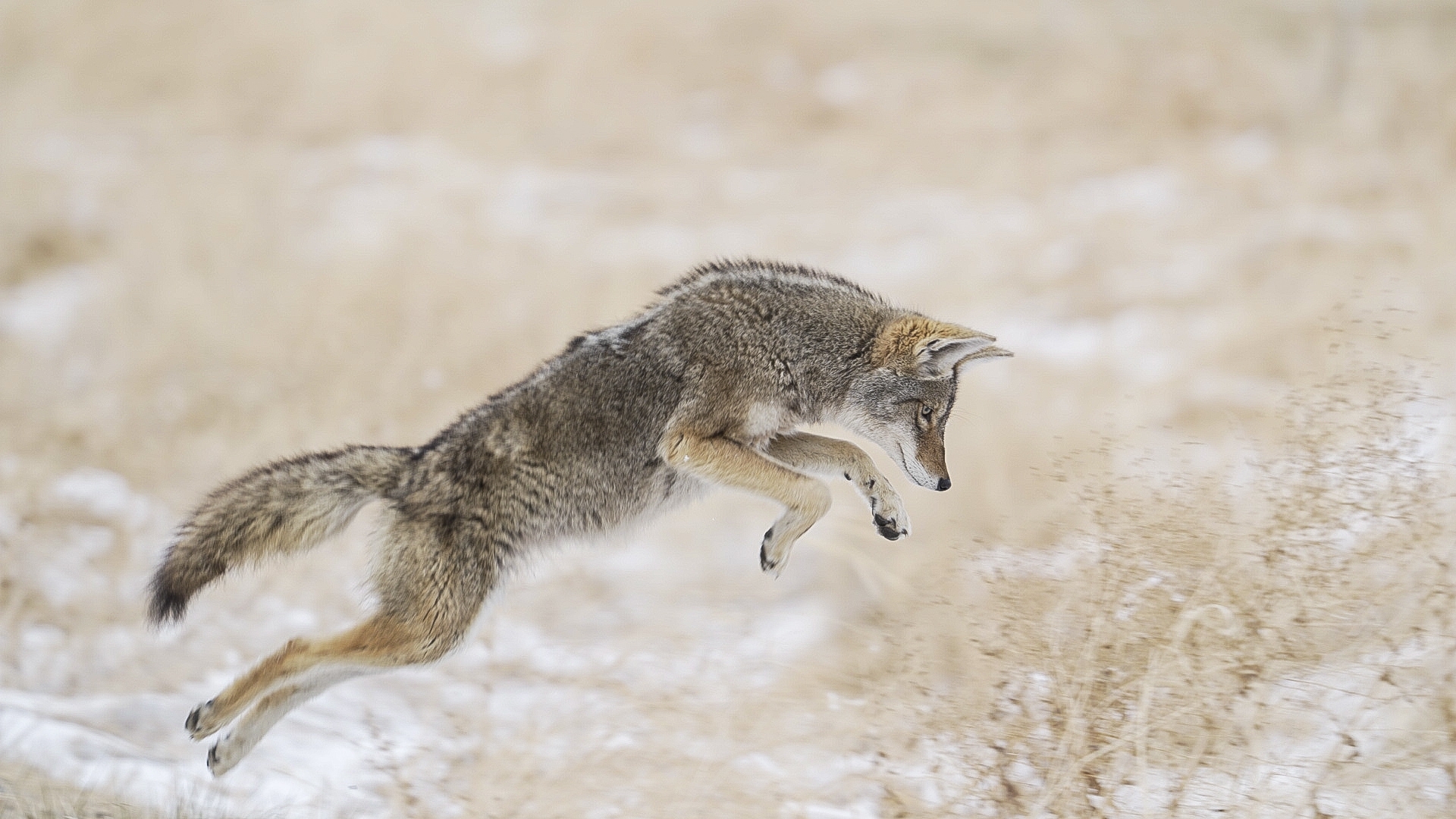
A coyote pouncing for prey, Malheur Nation Wildlife Refuge, Harney County, Oregon. (CC BY-NC-ND 4.0)
Social organization: There is a considerable amount of variability in coyote social organizations. In many areas, most coyotes are solitary outside of the breeding season. In other areas, such as Jackson Hole, Wyoming, and Jasper, Alberta, groups of coyotes are frequently observed. Coyote social organization is influenced by prey size. In populations where the major prey items throughout the year are small rodents, coyotes tend to be solitary. In populations where large animals are available (e.g., elk [Cervus elaphus], and deer [Odocoileus spp.]), large groups of coyotes form [12].
Activity and movements: Coyotes are active day and night, with peaks in activity at sunrise or sunset. Generally, activity and movements such as foraging are greatest at night. Andelt [1] found that daytime activity increased during the breeding season. In Arkansas, Gipson and Sealander [26] found that young were more active than adults during the day.
Life span: Coyotes in captivity may live as long as 18 years, but in wild populations few coyotes live more than 6 to 8 years. The maximum known age for a wild coyote is 14.5 years [4].
Development and Reproduction
Breeding season: Courtship may begin as early as 2 to 3 months before coyotes attempt to mate. The female is monoestrous, having one period of heat per year usually between January and March [4,62]. Estrus lasts 2 to 5 days. Some coyotes mate with the same individual from year to year, but not necessarily for life [4]. In the Sierra Nevada, coyotes mate from February to May, with peak breeding time in April and May [63]. Yearling females usually breed later in the season than older females [12].
Age at first breeding: Both males and females are capable of breeding as yearlings [4]. However, many coyotes do not breed until their second year [63]. Generally, about 60 to 90 percent of adult females and 0 to 70 percent of female yearlings produce litters [12]. In years when food is abundant, more females (especially yearlings) breed. In years when rodent populations are high, as many as 75 percent of yearling females may breed [4].

Coyote pups playing with a glove, Teton County, Wyoming. (CC BY-NC 4.0)
Gestation and litter size: Gestation lasts approximately 63 days. The average litter size is 6, but may range from 3 to 15 [12,63]. Litter size can be affected by population density and food availability. Knowlton [36] reported average litter sizes of 4.3 at high coyote densities and 6.9 at low coyote densities. In years of high rodent density, mean litter size is generally higher than in years of low rodent densities [12].
Development of young: Coyote young are born with their eyes closed. They are cared for by the mother and sometimes siblings from a previous year. The father and other males often provide food for the mother and the young. Pups emerge from the den in 2 or 3 weeks. They begin to eat solid food at about 3 weeks of age and are weaned at about 5 to 7 weeks of age [4].
Dispersal of juveniles: Juvenile coyotes usually disperse alone or sometimes in groups at 6 to 9 months of age during October to February. However, some juveniles do not disperse until their second year. Juvenile coyotes may disperse up to 100 miles (160 km) from their den [4]. In Minnesota, Berg and Chesness [7] reported mean dispersal distances of 30 miles (48 km) that occurred at a mean rate of 7 miles (11 km) per week [12]. Juvenile dispersal distances averaged 17 to 19 miles (28-31 km) in Alberta [48], 4 miles (7 km) in Arkansas [26], and 3 to 4 miles (5-6 km) in California [32].
Predators
Mountain lions (Felis concolor) sometimes kill and eat coyotes [4]. Other predators of coyotes include humans, gray wolves, black bears (Ursus americanus), and grizzly bears (Ursus arctos). Golden eagles (Aquila chrysaetos) attack young coyotes [2].
Habitat
Diet

A coyote scavenging a white-tailed deer carcass in winter, Chittenden County, Vermont. (CC BY 4.0)
Coyotes are opportunistic feeders and eat a variety of food [4,12,64]. About 90 percent of their diet consists of animal matter; however, they also eat vegetable matter. Some common prey items include deer, elk, sheep (Ovis spp.), rabbits and hares (Leporidae), various rodents (Rodentia), ground-nesting birds, amphibians, lizards, snails, fish, crustaceans, and insects. During winter, much of the diet is made up of rabbits, hares, and the carrion of large ungulates. Small mammals, especially voles and mice (Muridae), are important food items during spring, summer, and fall [4,64]. Various berries are also eaten [4].
An extensive study of coyote food habits conducted in 17 western states showed that major diet items were lagomorphs (33%), carrion (25%), rodents (18%), and domestic livestock (13.5%) [56]. Coyote diets in sagebrush habitat of northeastern Utah and south-central Idaho consisted of about 75 percent black-tailed jackrabbits year-round [13]. In northeastern California, meadow voles (Microtus pennsylvanicus) occurred in about half of all coyote scats analyzed. Other important diet items were mule deer (Odocoileus hemionus) and cattle, probably eaten as carrion [33]. Mule deer were also important in coyote diets in two areas of southern Utah. In central Wyoming, mule deer, pronghorn (Antilocapra americana), white-tailed jackrabbits (Lepus townsendii), and desert cottontails (Sylvilagus audubonii) were present in 63 percent of coyote scats [58]. On Arizona cattle ranges, where the habitat was primarily open grasslands, oak (Quercus spp.), juniper, and ponderosa pine (Pinus ponderosa), coyote diets contained high percentages of plant material. Juniper berries were particularly important, followed by prickly pear (Opuntia spp.) fruit [47].
Preferred Habitat
Coyotes occupy a broad range of habitats [4,12,64]. Almost any habitat that supports prey populations also supports coyotes; however, some preferences have been noted (see Plant Communities) [64].
Dens: Coyotes den in a wide variety of places, including brush-covered slopes, steep banks, rock ledges, thickets, and hollow logs. Dens previously used by other animals (e.g., American badgers [Taxidea taxus]) are frequently used [12]. Dens are usually about 1 foot (0.3 m) in diameter and from 5 to 25 feet (1.5-7.5 m) long [4]. They usually have more than one entrance and many interconnecting tunnels. The same den may be used from year to year. Den sharing occurs only rarely [4,12]. Movement of pups from one den to another is very common. The reason is unknown, but disturbance and possibly infestation by parasites may be factors. Most moves are over relatively short distances; however, moves over 2.5 miles (4 km) are not uncommon [12].
Home range and territory: A single home range may be inhabited by a family of two or more generations, a mated pair, or a single adult. Home ranges vary from an average of 2 square miles (5 sq km) in Texas [1] to averages of 21 to 55 square miles (54-142 sq km) in Washington [57]. Males tend to have larger home ranges than females. In Minnesota, male home ranges averaged 16 square miles (42 sq km), whereas those of females averaged 4 square miles (10 sq km). The home ranges of males overlapped considerably, but those of females did not [4]. In Arkansas, Gipson and Sealander [26] reported that male coyote home ranges were 8 to 16 square miles (21-42 sq km) and female home ranges were 3 to 4 square miles (8-10 sq km).
In southeastern Colorado, the home range size of coyotes varied with habitat, which was correlated with prey abundance. Coyotes in canyon woodlands and in hills dominated by pinyon-juniper (Pinus-Juniperus spp.) woodlands interspersed with grassland and shrubland had the smallest home ranges. Coyotes in pinyon-juniper-prairie had intermediate-size home ranges, and coyotes in shortgrass prairie had the largest home ranges. As the amount of pinyon-juniper increased, home range size decreased, possibly because these areas had high small mammal populations and provided cover for resting sites and dens. The shortgrass prairie had the lowest relative abundance of small mammals in the study area [25].
Group size and social behavior may also influence home range size. Coyotes living in packs and defending ungulate carrion during winter may have smaller home ranges than coyotes living in pairs or alone [12,64]. Typically, only pack members defend territories; pairs of coyotes and solitary individuals do not [4,12].
Cover Requirements
Coyotes commonly hunt in open to semiopen areas [12,18,51]. In California coyotes used ecotones, fuelbreaks, roads, trails, and open chaparral more than dense unbroken cover. In southern California where chaparral is adjacent to unbroken areas, coyotes forage at night along edges and return during the day to chaparral cover. The steep slopes and heavy cover of most chaparral communities impede coyote movements [51]. In Georgia, the proportion of open area in coyote home ranges was significantly (P<0.04) greater than that generally available in the area, and the proportion of forest was significantly (P<0.04) less [59].
Coyotes use cover for daytime resting and den sites. In Georgia, areas with "sufficient" cover were used more for daytime rest sites, and early successional and open areas were used more for nocturnal foraging. In summer, some coyotes used corn fields for cover during the day [59]. Urban coyotes in Seattle, Washington, foraged in residential areas, but only in areas that were immediately adjacent to forest cover. Forested areas provided the majority of cover, including denning sites [51].
Fire-caused Mortality
Coyotes are very mobile and can probably escape most fires. There are no reports of direct coyote mortality due to fire [49].
Fire Effects on Habitat
Fire may improve the foraging habitat and prey base of coyotes. In New England, coyotes are commonly found in forest openings created by fire or logging [18]. Fires that reduce vegetation height and create open areas probably increase hunting efficiency by coyotes. Surface fires often open substrates for quieter stalking and easier capture of prey than can occur in closed forests [38]. Wirtz [68] noted increases in consumption of birds and deer by coyotes after a chaparral fire in the San Dimas Experimental Forest, California. Increased consumption was presumably the result of increased vulnerability of prey with reduced cover, but no change was noted in small mammal consumption.
Periodic fire helps to maintain habitat for many prey species of coyote. Fires that create a mosaic of burned and unburned areas are probably the most beneficial to many coyote prey species. Several studies indicate that many small mammal populations increase rapidly subsequent to burning in response to increased food availability. Fire often improves hare and rabbit forage quality and quantity for two or more growing seasons [38]. Hill [67] concluded that burning at intervals longer than 2 years would be less beneficial to rabbits and hares, but any fire is believed better than fire exclusion. Along the coast of northern California, black-tailed jackrabbits occurred at highest density in open brush, moderate density on recent burn areas, and lowest density in mature chaparral stands [68]. Wagle [65] reported that fire suppression in grasslands is detrimental to populations of small bird and mammal herbivores due to organic matter accumulation and reduced plant vigor.
The 1988 fires in Yellowstone National Park have probably benefited coyotes. Fire in combination with drought likely increased available carrion the fall and winter following the fire. Additionally, the fires stimulated grass production, which should lead to an increase in small mammal populations [45]. In California, coyotes are abundant in young chaparral (less than 20 years old) and are rare or absent in chaparral that has not been burned for 20 years or more [51]. Quinn [51] observed more coyote sign during the second and third years after a chamise (Adenostoma spp.) chaparral wildfire in Riverside County than had been observed prior to burning. Coyote numbers increased during the second and third years following a chaparral fire in the Sierra Nevada foothills [39].
Fire Regimes
For fire regime information, search FEIS for this species by entering the species name on the Advanced Search page and selecting “Fire Regime” as the publication type.
Fire Management Considerations
Prescribed burning that favors small mammals by creating ecotones and different age classes of vegetation would increase the prey base for coyotes and make hunting easier by opening up the habitat [51].
Federal Status
None
Other Status
Information on state- and province-level protection status of animals in the United States and Canada is available at NatureServe, although recent changes in status may not be included.
Other Management Information
Coyotes are the principal predator of domestic sheep in the West [44]. Predation on sheep often occurs in the summer [64]. In 16 studies reviewed by Sterner and Shumake [60], coyotes were responsible for 82 percent of all sheep losses due to predators. However, only a few flocks typically showed sizeable losses [12]. Coyote predation is a minor cause of most livestock losses. Most of the livestock consumed, except sheep, is carrion [64].
Methods of coyote control have been described in the literature [1,4,12,64]. The impact of predator control on coyote population densities, behavior, and ecology are not well known. Coyote populations are able to maintain themselves under considerable human-induced mortality. Their means of survival include behavioral adaptations and biological compensatory mechanisms such as increased rates of reproduction, survival, and immigration. In most areas, coyote numbers likely are controlled by competition for food and by social stress, diseases, and parasites [1]. There is little evidence to support the notion that coyote predation is a primary limiting factor on populations of large ungulates [12].
Coyote population control efforts may affect the social organization and activity patterns of coyotes. In areas where population control is not practiced, most coyotes exist in relatively "large" groups, whereas coyotes in areas where populations are controlled generally exist in "smaller" groups. Coyotes have been reported as more active during the day in uncontrolled [26,70] than in population-controlled areas [71]. Roy and Dorrance [72] reported that coyotes avoided open areas near roads during daylight hours in areas where they were hunted.
Coyotes often aid in the dispersal of seeds. Seeds of oneseed juniper (Juniperus monosperma) and Indian manzanita (Arctostaphylos mewukka) have been found in coyote scats [24,31].
Coyotes are inflicted with a wide variety of parasites and diseases which are described by Gier and others [28].
Table A1— Forest and range ecosystems, Bureau of Land Management (BLM) physiographic regions, Kuchler plant associations, Society for American Foresters (SAF) forest cover types, and Society for Rangeland Management (SRM) rangeland cover types in which this species occurs.
Forest and Range Ecosystems (Garrison et al. 1977)
- FRES10 White-red-jack pine
- FRES11 Spruce-fir
- FRES12 Longleaf-slash pine
- FRES13 Loblolly-shortleaf pine
- FRES14 Oak-pine
- FRES15 Oak-hickory
- FRES16 Oak-gum-cypress
- FRES17 Elm-ash-cottonwood
- FRES18 Maple-beech-birch
- FRES19 Aspen-birch
- FRES20 Douglas-fir
- FRES21 Ponderosa pine
- FRES22 Western white pine
- FRES23 Fir-spruce
- FRES24 Hemlock-Sitka spruce
- FRES25 Larch
- FRES26 Lodgepole pine
- FRES27 Redwood
- FRES28 Western hardwoods
- FRES29 Sagebrush
- FRES30 Desert shrub
- FRES31 Shinnery
- FRES32 Texas savanna
- FRES33 Southwestern shrubsteppe
- FRES34 Chaparral-mountain shrub
- FRES35 Pinyon-juniper
- FRES36 Mountain grasslands
- FRES37 Mountain meadows
- FRES38 Plains grasslands
- FRES39 Prairie
- FRES40 Desert grasslands
- FRES41 Wet grasslands
- FRES42 Annual grasslands
- FRES44 Alpine
BLM Physiographic Regions (Bernard and Brown 1977)
- 1 Northern Pacific Border
- 2 Cascade Mountains
- 3 Southern Pacific Border
- 4 Sierra Mountains
- 5 Columbia Plateau
- 6 Upper Basin and Range
- 7 Lower Basin and Range
- 8 Northern Rocky Mountains
- 9 Middle Rocky Mountains
- 10 Wyoming Basin
- 11 Southern Rocky Mountains
- 12 Colorado Plateau
- 13 Rocky Mountain Piedmont
- 14 Great Plains
- 15 Black Hills Uplift
- 16 Upper Missouri Basin and Broken Lands
Kuchler Plant Associations (Kuchler 1964)
- Widely distributed, occurs in most types within its range.
SAF Cover Types (Eyre 1980)
- Widely distributed, occurs in most types within its range.
SRM Rangeland Cover Types (Shiflet 1994)
- Widely distributed, occurs in most types within its range.
1. Andelt, William F. 1985. Behavioral ecology of coyotes in South Texas. Wildlife Monograph 94. Washington, DC: Wildlife Society. 45 p. [25123]
2. Banfield, A. W. F. 1974. The mammals of Canada. Toronto, ON: University of Toronto Press. 438 p. [21084]
3. Barrett, Reginald H. 1983. Food habits of coyotes, Canis latrans, in eastern Tehama County, California. California Fish and Game. 69(3): 184-186. [13786]
4. Bekoff, Marc. 1977. Canis latrans. Mammalian Species. 79: 1-9. [24979]
5. Bell, M. M.; Studinski, G. H. 1972. Habitat manipulation and its relationship to avian and small rodent populations on the Decanso District of the Cleveland National Forest. Unpublished paper on file at: U.S. Department of Agriculture, Forest Service, Intermountain Research Station, Fire Sciences Laboratory, Missoula, MT. 21 p. [17047]
6. Bendell, J. F. 1974. Effects of fire on birds and mammals. In: Kozlowski, T. T.; Ahlgren, C. E., eds. Fire and ecosystems. New York: Academic Press: 73-138. [16447]
7. Berg, W. E.; Chesness, R. A. 1978. Ecology of coyotes in northern Minnesota. In: Bekoff, M., ed. Coyotes: biology, behavior and management. New York: Academic Press: 229-247. [24974]
8. Bernard, Stephen R.; Brown, Kenneth F. 1977. Distribution of mammals, reptiles, and amphibians by BLM physiographic regions and A.W. Kuchler's associations for the eleven western states. Tech. Note 301. Denver, CO: U.S. Department of the Interior, Bureau of Land Management. 169 p. [434]
9. Bradley, Lisa C.; Fagre, Daniel B. 1988. Coyote and bobcat responses to integrated ranch management practices in south Texas. Journal of Range Management. 41(4): 322-327. [5240]
10. Brown, David E. 1982. Alpine and subalpine grasslands. In: Brown, David E., ed. Biotic communities of the American Southwest--United States and Mexico. Desert Plants. 4(1-4): 109-111. [8894]
11. Bullock, Stephen H. 1980. Dispersal of a desert palm by opportunistic frugivores. Principes. 24(1): 29-32. [19703]
12. Chapman, Joseph A.; Feldhamer, George A., eds. 1982. Wild mammals of North America. Baltimore, MD: The Johns Hopkins University Press. 1147 p. [21085]
13. Clark, Frank W. 1972. Influence of jackrabbit density on coyote population change. Journal of Wildlife Management. 36(2): 343-356. [25122]
14. Clary, Warren P. 1987. Overview of ponderosa pine bunchgrass ecology and wildlife habitat enhancement with emphasis on southwestern United States. In: Fisser, Herbert G., ed. Wyoming shrublands: Proceedings, 16th Wyoming shrub ecology workshop; 1987 May 26-27; Sundance, WY. Laramie, WY: University of Wyoming, Department of Range Management, Wyoming Shrub Ecology Workshop: 11-21. [13913]
15. Cornett, James W. 1985. Germination of Washingtonia filifera seeds eaten by coyotes. Principes. 20(1): 19. [19220]
16. Crabtree, Robert L. 1991. Effects of 1988 fires on ecology of coyotes in Yellowstone National Park: baseline preceding possible wolf recovery. In: Plumb, Glenn E., ed. University of Wyoming National Park Service Research Center: 15th annual report 1991. Laramie, WY: University of Wyoming: 219-226. [14325]
17. Davis, Russell; Sidner, Ronnie. 1992. Mammals of woodland and forest habitats in the Rincon Mountains of Saguaro National Monument, Arizona. Technical Report NPS/WRUA/NRTR-92/06. Tucson, AZ: The University of Arizona, School of Renewable Natural Resources, Cooperative National Park Resources Study Unit. 62 p. [20966]
18. DeGraaf, Richard M.; Yamasaki, Mariko. 1986. New England wildlife: habitat, natural history, and distribution. Gen. Tech. Rep. NE-108. Broomall, PA: U.S. Department of Agriculture, Forest Service, Northeastern Forest Experiment Station. 491 p. [21386]
19. Denyes, H. Arliss. 1956. Natural terrestrial communities of Brewster County, Texas, with special reference to the distribution of the mammals. The American Midland Naturalist. 55(2): 289-320. [10862]
20. Edwards, R. Y. 1954. Fire and the decline of a mountain caribou herd. Journal of Wildlife Management. 18(4): 521-526. [8394]
21. Eyre, F. H., ed. 1980. Forest cover types of the United States and Canada. Washington, DC: Society of American Foresters. 148 p. [905]
22. Fulbright, Timothy E.; Diamond, David D.; Rappole, John; Norwine, Jim. 1990. The coastal Sand Plain of southern Texas. Rangelands. 12(6): 337-340. [14110]
23. Garrison, George A.; Bjugstad, Ardell J.; Duncan, Don A.; [and others]. 1977. Vegetation and environmental features of forest and range ecosystems. Agric. Handb. 475. Washington, DC: U.S. Department of Agriculture, Forest Service. 68 p. [998]
24. Germano, David Joseph. 1978. Response of selected wildlife to mesquite removal in desert grassland. Tucson, AZ: University of Arizona. 60 p. M.S. thesis. [10532]
25. Gese, Eric M.; Rongstad, Orrin J.; Mytton, William R. 1988. Home range and habitat use of coyotes in southeastern Colorado. Journal of Wildlife Management. 52(4): 640-646. [6136]
26. Gipson, Philip S.; Sealander, John A. 1972. Home range and activity of the coyote (Canis latrans frustror) in Arkansas. Proceedings, Annual Conference Southeastern Association of Game and Fish Commissioners. 26: 82-95. [25125]
27. Gier, H. T. 1975. Ecology and social behavior of the coyote. In: Fox, M. W., ed. The wild canids: their systematics, behavioral ecology, and evolution. New York: Van Nostrand Reinhold Company: 247-262. [24976]
28. Gier, H. T.; Kruckengerg, S. M.; Marler, R. J. 1978. Parasites and diseases of coyotes. In: Bekoff, M. W., ed. Coyotes: biology , behavior and management. New York: Academic Press: 37-71. [24977]
29. Green, Gregory A.; Anthony, Robert G. 1989. Nesting success and habitat relationships of burrowing owls in the Columbia Basin, Oregon. The Condor. 91: 347-354. [21840]
30. Hall, E. Raymond. 1981. The mammals of North America. 2nd ed. Vol. 2. New York: John Wiley and Sons. 1271 p. [14765]
31. Kauffman, J. Boone; Martin, R. E. 1991. Factors influencing the scarification and germination of three montane Sierra Nevada shrubs. Northwest Science. 65(4): 180-187. [16344]
32. Hawthorne, Vernon M. 1971. Coyote movements in Sagehen Creek Basin, northeastern California. California Fish and Game. 57(3): 154-161. [25126]
33. Hawthorne, Vernon M. 1972. Coyote food habits in Sagehen Creek Basin, northeastern California. California Fish and Game. 58(1): 4-12. [25124]
34. Howard, Volney W., Jr. 1988. Importance of pinyon-juniper woodlands to wildlife. In: Fisher, James T.; Mexal, John G.; Pieper, Rex D., tech. coords. Pinyon-juniper woodlands of New Mexico: a biological and economic appraisal. Special Report 73. Las Cruces, NM: New Mexico State University, College of Agriculture and Home Economics, Agricultural Experiment Station: 45-47. [5775]
35. Johnsen, Thomas N., Jr. 1962. One-seeded juniper invasion of northern Arizona grasslands. Ecological Monographs. 32(3): 187-207. [1267]
36. Knowlton, Frederick F. 1972. Preliminary interpretations of coyote population mechanics with some management implications. Journal of Wildlife Management. 36(2): 369-382. [25118]
37. Krefting, Laurits W. 1951. What is the future of the Isle Royale moose herd? Transactions, 16th North American Wildlife Conference. 16: 461-470. [17043]
38. Landers, J. Larry. 1987. Prescribed burning for managing wildlife in southeastern pine forests. In: Dickson, James G.; Maughan, O. Eugene, eds. Managing southern forests for wildlife and fish: a proceedings; [Date of conference unknown]; [Location of conference unknown]. Gen. Tech. Rep. SO-65. New Orleans, LA: U.S. Department of Agriculture, Forest Service, Southern Forest Experiment Station: 19-27. [11562]
39. Lawrence, George E. 1966. Ecology of vertebrate animals in relation to chaparral fire in the Sierra Nevada foothills. Ecology. 47(2): 278-291. [147]
40. MacCracken, James G.; Hansen, Richard M. 1987. Coyote feeding strategies in southeastern Idaho: optimal foraging by an opportunistic predator? Journal of Wildlife Management. 51(2): 278-285. [19923]
41. MacCracken, James G.; Uresk, Daniel W. 1984. Coyote foods in the Black Hills, South Dakota. Journal of Wildlife Management. 48(4): 1420-1423. [4518]
42. MacPhee, Douglas T. 1991. Prescribed burning and managed grazing restores tobosa grassland, antelope populations. Restoration & Management Notes. 9(1): 35-36. [16571]
43. Martell, Arthur M.; Dickinson, Dawn M.; Casselman, Lisa M. 1984. Wildlife of the Mackenzie Delta region. Occasional Publ. No. 15. Edmonton, AB: The University of Alberta, Boreal Institute for Northern Studies. 214 p. [15014]
44. McAdoo, J. Kent; Klebenow, Donald A. 1979. Native faunal relationships in sagebrush ecosystems. In: The sagebrush ecosystem: a symposium: Proceedings; 1978 April; Logan, UT. Logan, UT: Utah State University, College of Natural Resources: 50-61. [1562]
45. Mills, Susan M., editor. 1989. The Greater Yellowstone postfire assessment. [Denver, CO]: U.S. Department of Agriculture, Forest Service, Northern Region. [Pages unknown]. In cooperation with: U.S. Department of the Interior, National Park Service, Grand Teton and Yellowstone National Parks. [24521]
46. Minta, Steven C.; Minta, Kathryn A.; Lott, Dale F. 1992. Hunting associations between badgers (Taxidea taxus) and coyotes (Canis latrans). Journal of Mammalogy. 73(4): 814-820. [20972]
47. Murie, Adolph. 1951. Coyote food habits on a southwestern cattle range. Journal of Mammalogy. 32(3): 291-295. [25116]
48. Nellis, Carl H.; Keith, Lloyd B. 1976. Population dynamics of coyotes in central Alberta, 1964-68. Journal of Wildlife Management. 40(3): 389-399. [25121]
49. Nichols, R.; Menke, J. 1984. Effects of chaparral shrubland fire on terrestrial wildlife. In: DeVries, Johannes J., ed. Shrublands in California: literature review and research needed for management. Contribution No. 191. Davis, CA: University of California, Water Resources Center: 74-97. [5706]
50. Ortega, J. C. 1987. Coyote food habits in southeastern Arizona. The Southwestern Naturalist. 32(1): 152-155. [9885]
51. Quinn, Ronald D. 1990. Habitat preferences and distribution of mammals in California chaparral. Res. Pap. PSW-202. Berkeley, CA: U.S. Department of Agriculture, Forest Service, Pacific Southwest Research Station. 11 p. [15761]
52. Ramirez, Bernardo Villa. 1974. Major game mammals and their habitats in the Chihuahuan Desert region. In: Wauer, Roland H.; Riskind, David H., eds. Transactions of the symposium on the biological resources of the Chihuahuan Desert region, United States and Mexico; 1974 October 17-18; Alpine, TX. Transactions and Proceedings Series No. 3. Washington, DC: U.S. Department of the Interior, National Park Service: 155-161. [16059]
53. Reichel, James D. 1991. Relationships among coyote food habits, prey populations, and habitat use. Northwest Science. 65(3): 133-137. [17112]
54. Schwartz, John E., II; Mitchell, Glen E. 1945. The Roosevelt elk on the Olympic Peninsula, Washington. Journal of Wildlife Management. 9(4): 295-319. [8878]
55. Shiflet, Thomas N., ed. 1994. Rangeland cover types of the United States. Denver, CO: Society for Range Management. 152 p. [23362]
56. Sperry, Charles C. 1941. Food habits of the coyote. Wildlife Research Bulletin 4. Washington, DC: U.S. Department of the Interior, Fish and Wildlife Service. 70 p. [25128]
57. Springer, Joseph Tucker. 1982. Movement patterns of coyotes in south central Washington. Journal of Wildlife Management. 46(1): 191-200. [25117]
58. Spowart, Richard A.; Samson, Fred B. 1986. Carnivores. In: Cooperrider, Allan Y.; Boyd, Raymond J.; Stuart, Hanson R., eds. Inventory and monitoring of wildlife habitat. Denver, CO: U.S. Department of the Interior, Bureau of Land Management, Service Center: 475-496. [13526]
59. Holzman, Stephen; Conroy, Michael J.; Pickering, John. 1992. Home range, movements, and habitat use of coyotes in southcentral Georgia. Journal of Wildlife Management. 56(1): 139-146. [24978]
60. Stenner, R. T.; Shumake, S. A. 1978. Coyote damage-control research: a review and analysis. In: Beckoff, M., ed. Coyotes: biology, behavior and management. New York: Academic Press: 297-325. [24975]
61. Terres, J. K., ed. 1964. The world of the coyote. Philadelphia; New York: J. B. Lippincott Company. 150 p. [25129]
62. Van Gelden, Richard George. 1982. Mammals of the National Parks. Baltimore, MD: Johns Hopkins University Press. 310 p. [20893]
63. Verner, Jared; Boss, Allan S., tech. coords. 1980. California wildlife and their habitats: western Sierra Nevada. Gen. Tech. Rep. PSW-37. Berkeley, CA: U.S. Department of Agriculture, Forest Service, Pacific Southwest Forest and Range Experiment Station. 439 p. [10237]
64. Voigt, Dennis R.; Berg, William E. 1987. Coyote. In: Novak, M.; Baker, J. A.; Obbard, M. E.; Malloch, B., ed. Wild furbearer management and conservation in North America. [Place of publication unknown]: [Publisher unknown]. 344-357. [24980]
65. Wagle, R. F. 1981. Fire: its effects on plant succession and wildlife in the Southwest. Tucson, AZ: University of Arizona. 82 p. [4031]
66. Young, Stanley P.; Jackson, Hartley H. T. 1951. The clever coyote. Harrisburg, PA: The Stockpole Company. 405 p. [24973]
67. Hill, Edward P. 1981. Prescribed fire and rabbits in southern forests. In: Wood, Gene W., ed. Prescribed fire and wildlife in southern forests: Proceedings of a symposium; 1981 April 6-8; Myrtle Beach, SC. Georgetown, SC: Clemson University, Belle W. Baruch Forest Science Institute: 103-108. [14816]
68. Wirtz, William O., II. 1977. Vertebrate post-fire succession. In: Mooney, Harold A.; Conrad, C. Eugene, technical coordinators. Symposium on the environmental consequences of fire and fuel management in Mediterranean ecosystems: Proceedings; 1977 August 1-5; Palo Alto, CA. Gen. Tech. Rep. WO-3. Washington, DC: U.S. Department of Agriculture, Forest Service: 46-57. [4801]
69. Andelt, William F. 1985. Behavioral ecology of coyotes in South Texas. Wildlife Monograph 94. Washington, DC: Wildlife Society. 45 p. [25123]
70. Andelt, William F.; Gipson, Philip S. 1979. Domestic turkey losses to radio-tagged coyotes. Journal of Wildlife Management. 43(3): 673-679. [25120]
71. Roy, Laurence D.; Dorrance, Michael J. 1985. Coyote movements, habitat use, and vulnerability in central Alberta. Journal of Wildlife Management. 49(2): 307-313. [25119]