


Calamagrostis canadensis, bluejoint
Tesky, Julie L. 1992. Calamagrostis canadensis, bluejoint. In: Fire Effects Information System, [Online]. U.S. Department of Agriculture, Forest Service, Rocky Mountain Research Station, Fire Sciences Laboratory (Producer). Available: https://research.fs.usda.gov/feis/species-reviews/calcan
| Abbreviation | Common Name | Scientific Name | Classification | Status |
|---|---|---|---|---|
| Plants | ||||
| CALCAN | bluejoint | Calamagrostis canadensis | Life Form: Plants/Graminoid Kingdom: Plantae Class: Monocot Order: Cyperales Family: Poaceae Genus: Calamagrostis | Fed. Protected: No Nativity: Native Invasiveness: Noninvasive |
Taxonomy
The scientific name of bluejoint is Calamagrostis canadensis (Michx.) Beauv. (Poaceae). Recognized varieties are as follows [1,12,21,23,39]:
- Calamagrostis canadensis var. canadensis (Michx.) Beauv., bluejoint
- Calamagrostis canadensis var. langsdorfii (Link) Inman, bluejoint
- Calamagrostis canadensis var. macouniana (Vasey) Stebbins, Macoun's reedgrass
Synonyms
For Calamagrostis canadensis var. canadensis (Michx.) Beauv.:
- Calamagrostis canadensis var. imberbis (Stebbins) C.Hitchc.
- Calamagrostis canadensis var. pallida (Vasey & Scriber) Stebbins
- Calamagrostis canadensis var. robusta Vasey
- Calamagrostis canadensis var. typica Stebbins [1,12,21,23,39]
For Calamagrostis canadensis var. langsdorffi (Link) Inman:
- Calamagrostis canadensis (Michx.) P. Beauv. subsp. langsdorffii (Link) Hultén
- Calamagrostis canadensis var. lactea (W.J. Beal.) C.Hitchc.
- Calamagrostis canadensis var. scabra (J.Presl.) A.Hitchc. [1,12,21,23,39]
For Calamagrostis canadensis var. macouniana (Vasey) Stebbins:
- Calamagrostis canadensis var. imberbis (Stebbins) C.Hitchc.
- Calamagrostis canadensis var. pallida (Vasey & Scriber) Stebbins
Other Common Names
bluejoint reedgrass, meadow pinegrass, Canadian reedgrass, marsh pinegrass, marsh reedgrass, Macoun's reedgrass
General Distribution
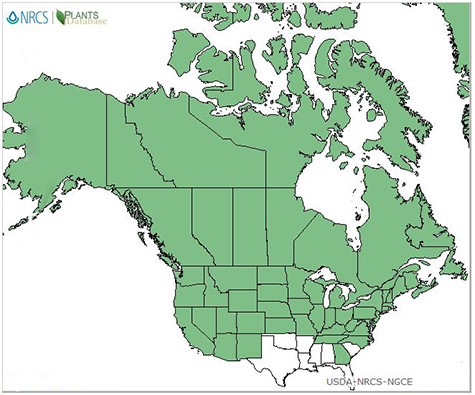
Bluejoint is the most common and widespread Calamagrostis species in North America [38]. It occurs throughout the boreal and temperate regions. Bluejoint is common in the subarctic from Alaska to Quebec and extends south to all but the southeastern United States [16,17,38].

Distribution of bluejoint.
States and Provinces
- United States: AK AZ CA CO CT DE HI ID IL IN IA KS KY ME MD MA MI MN MO MT NE NV NH NJ NM NY NC ND OH OR PA RI SD TN UT VA VT WA WV WI WY
- Canada: AB BC LB MB NB NF NT NS ON PE PQ SK YT
Site Characteristics
Bluejoint occurs in a wide range of habitats from lowland wet sites, semi-shaded woodlands, to windswept alpine ridges [16,18]. It extends from sea level in the north and northwest to elevations of over 12,000 feet (3,658 m) near the southern limit of its range in New Mexico [18,38]. It prefers moist sites but can survive in a wide range of moisture regimes [16]. This grass, however, cannot germinate under drought conditions, although it is very drought resistant once established [16].

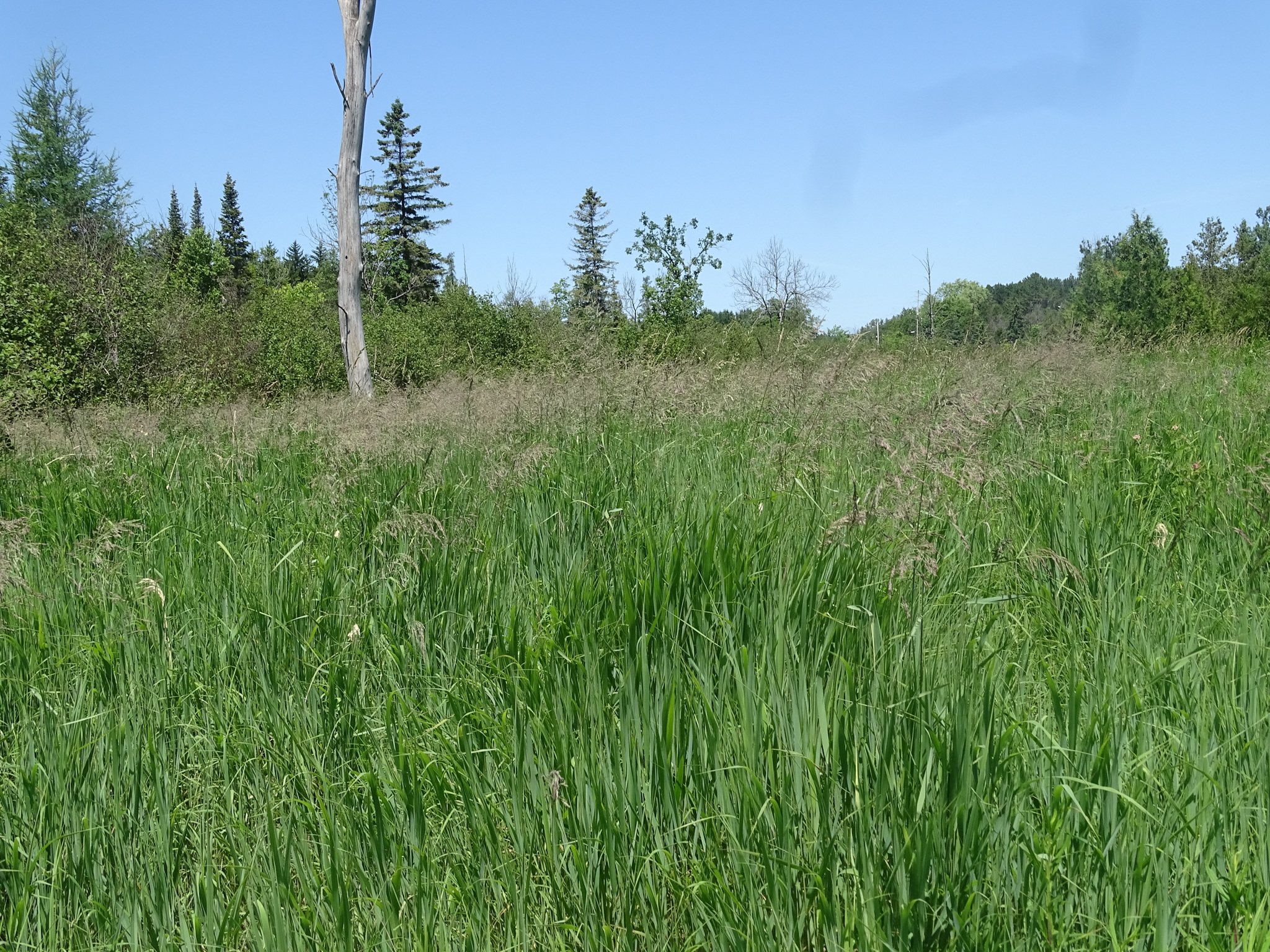
A field of bluejoint.
Soils: Bluejoint occupies sites with imperfectly to moderately well-drained soils. It is found on both peat and mineral soils, but most often on peat, and is adapted to a wide range of soil textures. This grass is tolerant of extremely acidic soils, with pH values as low as 3.5, and is moderately tolerant of saline soils [8,16,19].
Plant Communities
Bluejoint occurs as an understory dominant or codominant in many early seral to climax riparian and cool, moist forest communities. Published classifications listing bluejoint as a dominant or codominant in habitat types (hts), dominance types (dts), community types (cts), riparian site types (rst), and plant associations (pas) are listed below:
| Area | Classification | Authority |
|---|---|---|
| Alaska | General veg. pas | Viereck & Dyress 1980 |
| Alaska, interior | Postfire forest cts | Foote 1983 |
| Alaska, northwest | Forest veg. cts | Hanson 1953 |
| Colorado | Forest hts | Arno & Presby 1977 |
| Colorado | Hts | Powell 1988 |
| Colorado, west | Riparian veg. cts | Baker 1989a |
| Colorado, northwest | General veg. pas | Baker & Kennedy 1985 |
| Colorado, Arapaho & Roosevelt National Forests | Forest hts | Hess & Alexander 1986 |
| Colorado, Gunnison & Uncompahgre National Forests | Forest hts | Komarkova & others 1988 |
| Idaho, central | Riparian cts, hts | Tuhy & Jensen 1982 |
| Idaho, north | Forest cts, hts | Cooper & others 1991 |
| Idaho, east and western Wyoming | Forest hts | Steele & others 1983 |
| Idaho, east and western Wyoming | Riparian cts | Youngblood & others 1985 |
| Montana | Riparian dts | Hansen & others 1988 |
| Montana | Forest hts | Pfister & others 1977 |
| Montana, central, east | Riparian veg. rst., cts, hts | Hansen & others 1989 |
| Montana, northwest | Riparian cts | Boggs & others 1990 |
| Montana, southwest | Riparian veg. rst, cts, hts | Hansen & others 1989 |
| Montana, west central | Wetland cts | Pierce & Johnson 1986 |
| Utah, Uinta Mountains | Forest hts | Henderson & other 1977 |
| Utah, north | Forest hts | Mauk & Henderson 1984 |
| Utah, southeast Idaho | Riparian cts | Padgett & others 1989 |
| Wyoming | Riparian veg. rst | Olson & Gerhart 1982 |
| Wyoming, central Yellowstone | Riparian hts | Mattson 1984 |
| Quebec, Saint Lawrence Valley | General veg. pas | Darsereau 1957 |
| Yukon | Veg. types | Stanek & others 1981 |
Bluejoint is commonly associated with the following species: Kentucky bluegrass (Poa pratensis), fireweed (Epilobium angustifolium), beaked sedge (Carex rostrata), tufted hairgrass (Deschampsia caespitosa), Geyer willow (Salix geyeriana), booth willow (Salix boothii), wolf's willow (Salix wolfii), subalpine fir (Abies lasiocarpa), lodgepole pine (Pinus contorta), and Engelmann spruce (Picea engelmannii) [13,14,15,30,31,40,41].
Botanical Description
Bluejoint is a sod-forming, native, perennial, cool-season grass [5,12,16,36]. Its blades are numerous and generally obtain a height of 2 to 4 feet (60-120 cm) [12,16]. In Alaska, this grass has been known to reach heights of up to 6.5 feet (200 cm) within 6 weeks [16]. This grass is long-lived. Well-developed fields may persist for as long as 100 years [16]. Creeping underground rhizomes are extensive and fibrous roots are shallow [16,32,36,38].
Raunkiaer Life Form (Raunkiaer 1934)
- Hemicryptophyte
- Geophyte
Seasonal Development
In general, bluejoint leaf and culm production occurs from early May to mid-June followed by significant vegetative growth of shoot biomass [5,19]. By mid-June flowering heads begin to emerge and by late June to early July flowering begins [5,19]. Flowering peaks from late June to mid-July. Aboveground senescence begins mid to late August [5,19].
Regeneration Processes
Sexual Reproduction: Bluejoint flowers are wind pollinated. Prolific flowering, however, occurs only in wetlands and recently disturbed sites [28]. The winged seeds are very lightweight and easily wind-borne [16,28]. Seed yields are low, but seed can remain viable in the soil for up to 5 years [6,16]. Seeds collected near Inuvik, Northwest Territories, had a germination rate of 90 percent at 68 degrees Fahrenheit (20 deg C). Seedling vigor was rated as moderate [3,16].

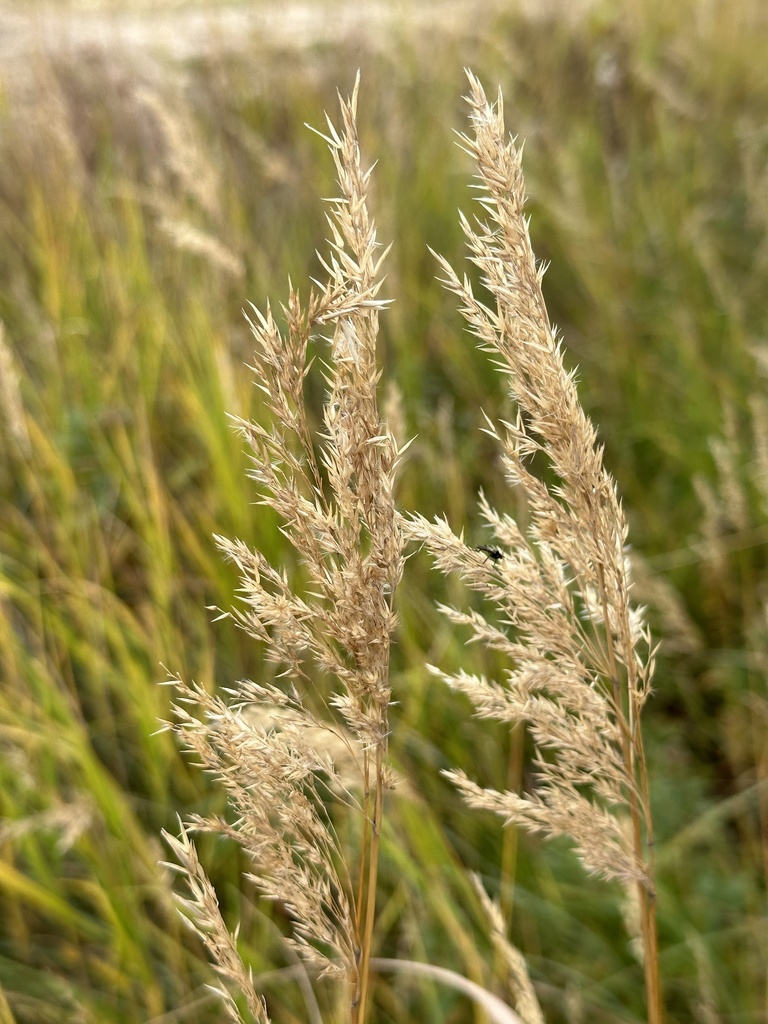
Reproductive stalks of bluejoint.
Vegetative Reproduction: Bluejoint can also reproduce vegetatively by rhizomes [6,16,28,33,38]. This grass is capable of producing an extensive network of rhizomes during a single growing season. Small sections (two or more internodes) of several rhizomes can produce shoots and establish new clones [28,33].
Successional Status
Bluejoint is a common constituent in a number of seral and climax communities. A combination of sexual and vegetative reproduction allows this grass to persist throughout the successional continuum [4]. It is an aggressive ground residual colonizer and initial off-site colonizer in early seral communities. Once established, a very dense stand of bluejoint may persist almost indefinitely, severely limiting the invasion of woody species [5]. In some mid-seral to climax wetland forest communities and forest communities having high water tables, bluejoint occurs as a dominant or codominant understory species [13,14,15,31,40].
Immediate Fire Effects
Fire will kill aboveground vegetation of bluejoint [35,37]. Severe fires will also kill belowground rhizomes [35,37].
Under droughty conditions dead shoots of bluejoint exhibit low moisture content [20,37]. In small experimental fires in Inuvik, Northwest Territories, dead litter sustained combustion, but the fire merely burned around the live material [37].
Postfire Regeneration Strategy (Stickney 1989)
- Rhizomatous herb, rhizome in soil
- Initial-offsite colonizer (off-site, initial community)
Fire Adaptations
Bluejoint sprouts from on-site surviving rhizomes following fire [7,28,35,37]. It can also establish on burned sites by wind-dispersed seeds [7].
Plant Response to Fire
Following low-severity fires, bluejoint will typically sprout from on-site surviving rhizomes. Buried or wind-dispersed seeds may be the primary source of plant establishment on severely burned sites [28,37].
Light surface burning tends to increase the abundance of bluejoint [9,35,40]. Following a low-severity burn in a trembling aspen (Populus tremuloides) woodland in southern Ontario, this species' frequency was twice as high on burned areas. The abundance of bluejoint 4 months after the fires in 1973 was four times greater than in the control areas and two times greater than in areas burned in 1972 [35].
Hamilton's Research Papers (Hamilton 2006a, Hamilton 2006b) and the following Research Project Summaries provide information on prescribed fire and postfire responses of many plant species, including bluejoint:
- The effects of experimental fires in an Alaskan black spruce/feather moss community
- Forest floor and plant responses to experimental fires in an Alaskan black spruce/ feather moss community
- Revegetation in a subalpine fir forest after logging and fire in central British Columbia
- Understory recovery after burning and reburning quaking aspen stands in central Alberta
Fire Regimes
For fire regime information, search FEIS for this species by entering the species name or acronym on the home page and selecting “Fire Regime” as the publication type.
Fire Management Considerations
When grazing pressure is light, litter accumulates rapidly [37]. Low-intensity fires can be used to remove this litter and improve forage quality [22]. Because of wet conditions in the spring and summer, successful burning of these communities is limited to the drier fall period [4].
Federal Status
None
Other Status
No entry.
Importance to Wildlife and Livestock
Bluejoint furnishes a large amount of forage for many big game species and livestock [16,18,38]. Occasionally it occupies considerable areas to the exclusion of other native grasses [26]. Under such conditions it yields a large amount of quality hay for livestock [26]. This grass is important forage for livestock in Alaska and is an important component in the diet of bison herds in the Slave River lowland, Northwest Territories, Canada [20]. It is grazed lightly by deer but makes up a major part of the diet of elk in the winter [25,42].
Palatability and Nutritional Value
Bluejoint is most palatable when young and succulent. Since it often grows in wet habitats, use by livestock is often limited until late in the season when the grass is tough [18,38].
The relish and degree of use shown by wildlife species for bluejoint in several western states has been rated as follows [8]:
| Animal | Montana | North Dakota | Utah | Wyoming |
|---|---|---|---|---|
| Pronghorn | — | Poor | Poor | — |
| Elk | Fair | — | Fair | — |
| Mule deer | Poor | Poor | Fair | — |
| White-tailed deer | Poor | Poor | — | — |
| Small mammals | — | — | Fair | Fair |
| Small nongame birds | — | — | Fair | Fair |
| Upland game birds | — | — | Poor | Poor |
| Waterfowl | — | Fair | Poor | Fair |
Bluejoint has been rated as fair in energy value and poor in protein value [8,15]. In July of 1974, nutrient and mineral composition of this grass on Alaska's Kenai Peninsula were as follows [29]:
| Species | In vitro dry-matter digestibility (%) |
|---|---|
| Moose | 48.1 |
| Dairy cow | 55.9 |
| Fiber source | Fiber (%) |
|---|---|
| Cell walls | 69.8 |
| Acid detergent fiber | 37.8 |
| Lignin | 3.7 |
| Nutrient | Content (%) |
|---|---|
| Protein | 9.8 |
| Nutrient | Content (ppm) |
|---|---|
| Ca | 617.0 |
| K | 9,799.0 |
| Mg | 1,481.0 |
| Na | 74.0 |
| Cu | 22.3 |
| Fe | 58.0 |
| Mn | 30.9 |
| Zn | 21.6 |
Cover Value
The degree to which bluejoint provides environmental protection during one or more seasons for wildlife species has been rated as follows [8]:
| Species | Montana | North Dakota | Utah | Wyoming |
|---|---|---|---|---|
| Pronghorn | — | — | Poor | Poor |
| Elk | — | — | Poor | — |
| Mule deer | — | Fair | Poor | — |
| White-tailed deer | — | Good | — | — |
| Small mammals | Poor | — | Fair | Fair |
| Small nongame birds | Poor | — | Fair | Good |
| Upland game birds | Poor | — | Fair | Fair |
| Waterfowl | Good | Fair | Fair | Fair |
Value for Rehabilitation or Restoration of Disturbed Sites
The rhizomatous nature of bluejoint helps provide streambank stability. This is particularly important on higher gradient streams where scouring by seasonal flooding is possible [4]. This grass is a vigorous invader of oil spill sites in the Northwest Territories, Canada, and recovers rapidly after spills [16]. Bluejoint was evaluated for revegetation in tundra and northern boreal forest sites. It established slowly, but by the end of the growing season, cover and biomass production equaled or exceeded those of commercial varieties. Seeds of bluejoint has been collected for revegetation trials in Alberta [16].
Other Uses
No entry.
Other Management Considerations
Grazing: Bluejoint is sensitive to overgrazing. Yields decreased by 15 to 20 percent when bluejoint was cut two to four times during the growing the season, by 35 to 45 percent when cut five to six times, and about 70 percent when cut seven times, when compared to plots cut once at the end of the growing season [16]. Grazing should be restricted when soils are moist, especially along streams where bank sloughing can occur [13]. Livestock use should be timed according to both the drying of soil surface and the maturation of the seedheads. Livestock should be removed when 40 percent or less utilization of herbaceous forage is obtained [13].
Insect and Disease: Some bluejoint strains are susceptible to white top. This condition is caused by insect or fungal damage of the lower culms. Bluejoint, in general, is not susceptible to snow mold [16].
Site Competitor: Bluejoint is a serious competitor of regeneration of conifer seedlings on disturbed moist sites. Bluejoint often produces a thick, "mulch" of litter which insulates the soil surface, causing the soil temperature to decrease. Cold soils could partially explain the poor growth of conifer seedlings that often occurs after planting in bluejoint-dominated sites [19].
Control: Bluejoint can be controlled with glyphosate applied after flowering and about the same time as aboveground senescence begins [5].
Table A1— Forest and range ecosystems, Bureau of Land Management (BLM) physiographic regions, Kuchler plant associations, Society for American Foresters (SAF) forest cover types, and Society for Rangeland Management (SRM) rangeland cover types in which this species occurs.
Forest and Range Ecosystems (Garrison et al. 1977)
- FRES11 Spruce - fir
- FRES19 Aspen - birch
- FRES20 Douglas-fir
- FRES21 Ponderosa pine
- FRES22 Western white pine
- FRES23 Fir - spruce
- FRES25 Larch
- FRES26 Lodgepole pine
- FRES28 Western hardwoods
- FRES34 Chaparral - mountain shrub
- FRES35 Pinyon - juniper
- FRES36 Mountain grasslands
- FRES37 Mountain meadows
- FRES38 Plains grasslands
- FRES39 Prairie
- FRES41 Wet grasslands
- FRES44 Alpine
BLM Physiographic Regions (Bernard and Brown 1977)
- 1 Northern Pacific Border
- 2 Cascade Mountains
- 3 Southern Pacific Border
- 4 Sierra Mountains
- 5 Columbia Plateau
- 6 Upper Basin and Range
- 7 Lower Basin and Range
- 8 Northern Rocky Mountains
- 9 Middle Rocky Mountains
- 10 Wyoming Basin
- 11 Southern Rocky Mountains
- 12 Colorado Plateau
- 13 Rocky Mountain Piedmont
- 14 Great Plains
- 15 Black Hills Uplift
- 16 Upper Missouri Basin and Broken Lands
Kuchler Plant Associations (Kuchler 1964)
- K005 Mixed conifer forest
- K007 Red fir forest
- K008 Lodgepole pine - subalpine forest
- K010 Ponderosa shrub - forest
- K011 Western ponderosa pine
- K012 Douglas-fir forest
- K014 Grand fir - Douglas-fir forest
- K015 Western spruce - fir forest
- K016 Eastern ponderosa forest
- K017 Black Hills pine forest
- K018 Pine - Douglas-fir forest
- K021 Southwestern spruce - fir forest
- K023 Juniper - pinyon woodland
- K030 California oakwoods
- K033 Chaparral
- K034 Montane chaparral
- K037 Mountain mahogany - oak scrub
- K038 Great Basin sagebrush
- K049 Tules marshes
- K052 Alpine meadows and barren
- K055 Sagebrush steppe
- K056 Wheatgrass - needlegrass shrubsteppe
- K063 Foothills prairie
- K064 Grama - needlegrass - wheatgrass
- K065 Grama - buffalograss
- K066 Wheatgrass - needlegrass
- K067 Wheatgrass - bluestem - needlestem
- K068 Wheatgrass - grama - buffalograss
- K069 Bluestem - grama prairie
- K074 Bluestem prairie
- K081 Oak savanna
- K093 Great Lakes spruce - fir forest
- K094 Conifer bog
- K096 Northeastern spruce - fir forest
- K098 Northern floodplain forest
- K104 Appalachian oak forest
- K111 Oak - hickory - pine forest
SAF Cover Types (Eyre 1980)
- 12 Black spruce
- 13 Black spruce - tamarack
- 16 Aspen
- 18 Paper birch
- 21 Eastern white pine
- 22 White pine - hemlock
- 37 Paper birch - red spruce - balsam fir
- 38 Tamarack
- 68 Mesquite
- 107 White spruce
- 201 White spruce
- 202 White spruce - paper birch
- 204 Black spruce
- 206 Engelmann spruce - subalpine fir
- 208 Whitebark pine
- 212 Western Larch
- 215 Western white pine
- 217 Aspen
- 218 Lodgepole pine
- 243 Sierra Nevada mixed conifer
- 246 California black oak
- 250 Blue oak - gray pine
- 251 White spruce - aspen
- 252 Paper birch
- 253 Black spruce - white spruce
- 254 Black spruce - paper birch
- 255 California coast live oak
- 256 California mixed subalpine
SRM Rangeland Cover Types (Shiflet 1994)
- No entry
1. Anderson, J. P. 1959. Flora of Alaska and adjacent parts of Canada. Ames, IA: Iowa State University Press. 543 p. [9928]
2. Bernard, Stephen R.; Brown, Kenneth F. 1977. Distribution of mammals, reptiles, and amphibians by BLM physiographic regions and A.W. Kuchler's associations for the eleven western states. Tech. Note 301. Denver, CO: U.S. Department of the Interior, Bureau of Land Management. 169 p. [434]
3. Bliss, L. C.; Grulke, N. E. 1988. Revegetation in the High Arctic: its role in reclamation of surface disturbance. In: Kershaw, Peter, ed. Northern environmental disturbances. Occas. Publ. No. 24. Edmonton, AB: University of Alberta, Boreal Institute for Northern Studies: 43-55. [14419]
4. Boggs, Keith; Hansen, Paul; Pfister, Robert; Joy, John. 1990. Classification and management of riparian and wetland sites in northwestern Montana. Missoula, MT: University of Montana, School of Forestry, Montana Forest and Conservation Experiment Station, Montana Riparian Association. 217 p. Draft Version 1. [8447]
5. Conn, Jeffery S.; Deck, Richard E. 1991. Bluejoint reedgrass (Calamagrostis canadensis) control with glyphosate and additives. Weed Technology. 5: 521-524. [17408]
6. Conn, Jeffery S.; Farris, Martha L. 1987. Seed viability and dormancy of 17 weed species after 21 months in Alaska. Weed Science. 35: 524-529; 1987. [5]
7. Crane, M. F.; Fischer, William C. 1986. Fire ecology of the forest habitat types of central Idaho. Gen. Tech. Rep. INT-218. Ogden, UT: U.S. Department of Agriculture, Forest Service, Intermountain Research Station. 85 p. [5297]
8. Dittberner, Phillip L.; Olson, Michael R. 1983. The plant information network (PIN) data base: Colorado, Montana, North Dakota, Utah, and Wyoming. FWS/OBS-83/86. Washington, DC: U.S. Department of the Interior, Fish and Wildlife Service. 786 p. [806]
9. Dyrness, C. T.; Norum, Rodney A. 1983. The effects of experimental fires on black spruce forest floors in interior Alaska. Canadian Journal of Forest Research. 13: 879-893. [7299]
10. Eyre, F. H., ed. 1980. Forest cover types of the United States and Canada. Washington, DC: Society of American Foresters. 148 p. [905]
11. Garrison, George A.; Bjugstad, Ardell J.; Duncan, Don A.; [and others]. 1977. Vegetation and environmental features of forest and range ecosystems. Agric. Handb. 475. Washington, DC: U.S. Department of Agriculture, Forest Service. 68 p. [998]
12. Hallsten, Gregory P.; Skinner, Quentin D.; Beetle, Alan A. 1987. Grasses of Wyoming. 3rd ed. Research Journal 202. Laramie, WY: University of Wyoming, Agricultural Experiment Station. 432 p. [2906]
13. Hansen, Paul; Boggs, Keith; Pfister, Robert; Joy, John. 1990. Classification and management of riparian and wetland sites in central and eastern Montana. Missoula, MT: University of Montana, School of Forestry, Montana Forest and Conservation Experiment Station, Montana Riparian Association. 279 p. [12477]
14. Hansen, Paul; Chadde, Steve; Pfister, Robert; [and others]. 1988. Riparian site types, habitat types, and community types of southwestern Montana. Missoula, MT: University of Montana, School of Forestry, Montana Riparian Association. 140 p. [5883]
15. Hansen, Paul; Pfister, Robert; Boggs, Keith; [and others]. 1989. Classification and management of riparian sites in central and eastern Montana. Missoula, MT: University of Montana, School of Forestry, Montana Riparian Association. 368 p. Draft Version 1. [8934]
16. Hardy BBT Limited. 1989. Manual of plant species suitability for reclamation in Alberta. 2d ed. Report No. RRTAC 89-4. Edmonton, AB: Alberta Land Conservation and Reclamation Council. 436 p. [15460]
17. Harrington, H. D. 1964. Manual of the plants of Colorado. 2d ed. Chicago: The Swallow Press Inc. 666 p. [6851]
18. Herzman, Carl W.; Everson, A. C.; Mickey, Myron H.; [and others]. 1959. Handbook of Colorado native grasses. Bull. 450-A. Fort Collins, CO: Colorado State University, Extension Service. 31 p. [10994]
19. Hogg, Edward H.; Lieffers, Victor J. 1991. The impact of Calamagrostis canadensis on soil thermal regimes after logging in northern Alberta. Canadian Journal of Forest Research. 21: 387-394. [14344]
20. Hogg, E. H.; Lieffers, Victor J. 1991. The relationship between seasonal changes in rhizome carbohydrate reserves and recovery following disturbance in Calamagrostis canadensis. Canadian Journal of Botany. 69: 641-646. [14343]
21. Hulten, Eric. 1968. Flora of Alaska and neighboring territories. Stanford, CA: Stanford University Press. 1008 p. [13403]
22. Kantrud, Harold A.; Millar, John B.; van der Valk, A. G. 1989. Vegetation of wetlands of the prairie pothole region. In: van der Valk, Arnold, ed. Northern prairie wetlands. Ames, IA: Iowa State University Press: 132-187. [15217]
23. Kartesz, John T.; Kartesz, Rosemarie. 1980. A synonymized checklist of the vascular flora of the United States, Canada, and Greenland. Volume II: The biota of North America. Chapel Hill, NC: The University of North Carolina Press; in confederation with Anne H. Lindsey and C. Richie Bell, North Carolina Botanical Garden. 500 p. [6954]
24. Kuchler, A. W. 1964. Manual to accompany the map of potential vegetation of the conterminous United States. Special Publication No. 36. New York: American Geographical Society. 77 p. [1384]
25. Kufeld, Roland C. 1973. Foods eaten by the Rocky Mountain elk. Journal of Range Management. 26(2): 106-113. [1385]
26. Lamson-Scribner, F. 1900. Economic grasses. Bulletin No. 14. Washington, DC: U.S. Department of Agriculture, Division of Agrostology. 85 p. [4282]
27. Lyon, L. Jack; Stickney, Peter F. 1976. Early vegetal succession following large northern Rocky Mountain wildfires. In: Proceedings, Tall Timbers fire ecology conference and Intermountain Fire Research Council fire and land management symposium; 1974 October 8-10; Missoula, MT. No. 14. Tallahassee, FL: Tall Timbers Research Station: 355-373. [1496]
28. MacDonald, S. Ellen; Lieffers, Victor J. 1991. Population variation, outcrossing, and colonization of disturbed areas by Calamagrostis canadensis: evidence from allozyme analysis. American Journal of Botany. 78(8): 1123-1129. [15475]
29. Oldemeyer, J. L.; Franzmann, A. W.; Brundage, A. L.; [and others]. 1977. Browse quality and the Kenai moose population. Journal of Wildlife Management. 41(3): 533-542. [12805]
30. Padgett, Wayne G.; Youngblood, Andrew P.; Winward, Alma H. 1989. Riparian community type classification of Utah and southeastern Idaho. R4-Ecol-89-01. Ogden, UT: U.S. Department of Agriculture, Forest Service, Intermountain Region. 191 p. [11360]
31. Pfister, Robert D.; Kovalchik, Bernard L.; Arno, Stephen F.; Presby, Richard C. 1977. Forest habitat types of Montana. Gen. Tech. Rep. INT-34. Ogden, UT: U.S. Department of Agriculture, Forest Service, Intermountain Forest and Range Experiment Station. 174 p. [1878]
32. Powell, David C. 1988. Aspen community types of the Pike and San Isabel National Forests in south-central Colorado. R2-ECOL-88-01. Denver, CO: U.S. Department of Agriculture, Forest Service, Rocky Mountain Region. 254 p. [15285]
33. Powelson, R. A.; Lieffers, V. J. 1991. Growth of dormant buds on severed rhizomes of Calamagrostis canadensis. Canadian Journal of Plant Science. 71: 1093-1099. [17592]
34. Raunkiaer, C. 1934. The life forms of plants and statistical plant geography. Oxford: Clarendon Press. 632 p. [2843]
35. Smith, D. W.; James, T. D. W. 1978. Changes in the shrub and herb layers of vegetation after prescribed burning in Populus tremuloides woodland in southern Ontario. Canadian Journal of Botany. 56: 1792-1797. [16400]
36. Stubbendieck, J.; Nichols, James T.; Roberts, Kelly K. 1985. Nebraska range and pasture grasses (including grass-like plants). E.C. 85-170. Lincoln, NE: University of Nebraska, Department of Agriculture, Cooperative Extension Service. 75 p. [2269]
37. Sylvester, T. W.; Wein, Ross W. 1981. Fuel characteristics of arctic plant species and simulated plant community flammability by Rothermel's model. Canadian Journal of Botany. 59: 898-907. [17685]
38. U.S. Department of Agriculture, Forest Service. 1937. Range plant handbook. Washington, DC. 532 p. [2387]
39. U.S. Department of Agriculture, Natural Resources Conservation Service. 2018. PLANTS Database, [Online]. U.S. Department of Agriculture, Natural Resources Conservation Service (Producer). Available: https://plants.usda.gov/. [34262]
40. Viereck, L. A.; Dyrness, C. T.; Batten, A. R.; Wenzlick, K. J. 1992. The Alaska vegetation classification. Gen. Tech. Rep. PNW-GTR-286. Portland, OR: U.S. Department of Agriculture, Forest Service, Pacific Northwest Research Station. 278 p. [2431]
41. Youngblood, Andrew P.; Padgett, Wayne G.; Winward, Alma H. 1985. Riparian community type classification of eastern Idaho - western Wyoming. R4-Ecol-85-01. Ogden, UT: U.S. Department of Agriculture, Forest Service, Intermountain Region. 78 p. [2686]
42. Gullion, Gordon W. 1964. Wildlife uses of Nevada plants. Contributions toward a flora of Nevada No. 49. Beltsville, MD: U. S. Department of Agriculture, Agricultural Research Service, National Arboretum Crops Research Division. 170 p. [6729]
43. Stickney, Peter F. 1989. Seral origin of species originating in northern Rocky Mountain forests. Unpublished draft on file at: U.S. Department of Agriculture, Forest Service, Intermountain Research Station, Fire Sciences Laboratory, Missoula, MT; RWU 4403 files. 7 p. [20090]