


Casuarina spp.: Casuarina cunninghamiana, C. equisetifolia, C. glauca, sheoaks: river sheoak, beach sheoak, gray sheoak
Snyder, S. A. 1992. Casuarina spp., sheoaks. In: Fire Effects Information System, [Online]. U.S. Department of Agriculture, Forest Service, Rocky Mountain Research Station, Fire Sciences Laboratory (Producer). Available: https://research.fs.usda.gov/feis/species-reviews/casspp
| Abbreviation | Common Name | Scientific Name | Classification | Status |
|---|---|---|---|---|
| Plants | ||||
| CASCUN | river sheoak | Casuarina cunninghamiana | Life Form: Plants/Tree Family: Casuarinaceae Genus: Casuarina | Fed. Protected: No Nativity: Nonnative Invasiveness: Invasive |
| CASEQU | beach sheoak | Casuarina equisetifolia | Life Form: Plants/Tree Family: Casuarinaceae Genus: Casuarina | Fed. Protected: No Nativity: Nonnative Invasiveness: Invasive |
| CASGLA | gray sheoak | Casuarina glauca | Life Form: Plants/Tree Family: Casuarinaceae Genus: Casuarina | Fed. Protected: No Nativity: Nonnative Invasiveness: Invasive |
| CASSPP | sheoak | Casuarina spp. | Life Form: Plants/Tree Kingdom: Plantae Class: Dicot Order: Casuarinales Family: Casuarinaceae Genus: Casuarina | Fed. Protected: No Nativity: Nonnative Invasiveness: Invasive |


Taxonomy
The scientific name of the sheoak genus is Casuarina (Casuarinaceae) [12,19]. Three species of sheoak are common in the United States. All will be treated in this report because of their similar status as invader species and across-the-board efforts to eradicate the genus from the continent. "Sheoak" refers to the genus. The species covered in this review are:
- Casuarina cunninghamiana Miq., river sheoak
- Casuarina equisetifolia L., beach sheoak
- Casuarina glauca Seiber, gray sheoak [6,19]
These species hybridize with each other [14].
Synonyms
- For Casuarina cunninghamiana: Casuarina litorea L.
Other Common Names
- For Casuarina cunninghamiana: river-oak, sheoak, she-oak.
- For Casuarina equisetifolia: Australian-pine, horestail casuarina.
- For Casuarina glauca: ironwood, longleaf casuarina, whistling pine.
General Distribution
Sheoaks were introduced to the United States near the turn of the 20th century [14]. They are widely distributed in southern Florida and are also found in California, Arizona, and Hawaii [12,17].

Distributions of river, beach, and gray sheoak.
States and Provinces
- United States: AZ CA FL HI
- Mexico
Site Characteristics
Because of its nitrogen-fixing capability, sheoak can colonize nutrient-poor soils [12]. It can grow in sloughs, sawgrass (Cladium jamaicensis) glades, wet prairies, saltmarshes, pinelands, along rocky coasts, on sandbars, dunes, and islands, and in water-logged clay or brackish tidal areas [3,10,14,17,18]. C. equisetifolia is found only in south Florida because of its cold intolerance. It is resistant to salt spray but not to prolonged flooding. C. cunninghaminana grows along freshwater streambanks and is not salt tolerant [3]. It is more resistant to cold temperatures than C. equisetifolia [12]. C. glauca grows on steep slopes as well as in intermittently flooded or poorly drained sites. It is salt tolerant [3].
Some associates of sheoak include eucalyptus (Eucalyptus spp.), melaleuca (Melaleuca quinquenervia), lovegrass (Eragrostis spp.), muhly grasses (Huhlenbergia spp.), beard grasses (Andropogon spp.), plume grass (Erianthus giganteus), saltbush (Baccharis halimifolia), wax myrtle (Myrica cerifera), willow (Salix spp.), sweetbay (Magnolia virginiana), redbay (Persia borbonia), and coco plum (Chrysobalanus icaco) [18]. Native associates in the Northern Mariana Islands include Neisosperma, Barringtonia, Terminalia, Heritiera, Cynometia, and Cordia [5,6].
Plant Communities
River sheoak is listed as a community dominant or component in the following publications:
- Vegetation survey of Rota, Tinian, and Saipan, Commonwealth of the Northern Mariana Islands [5]
- Vegetation survey of the Republic of Palau [2]
Botanical Description
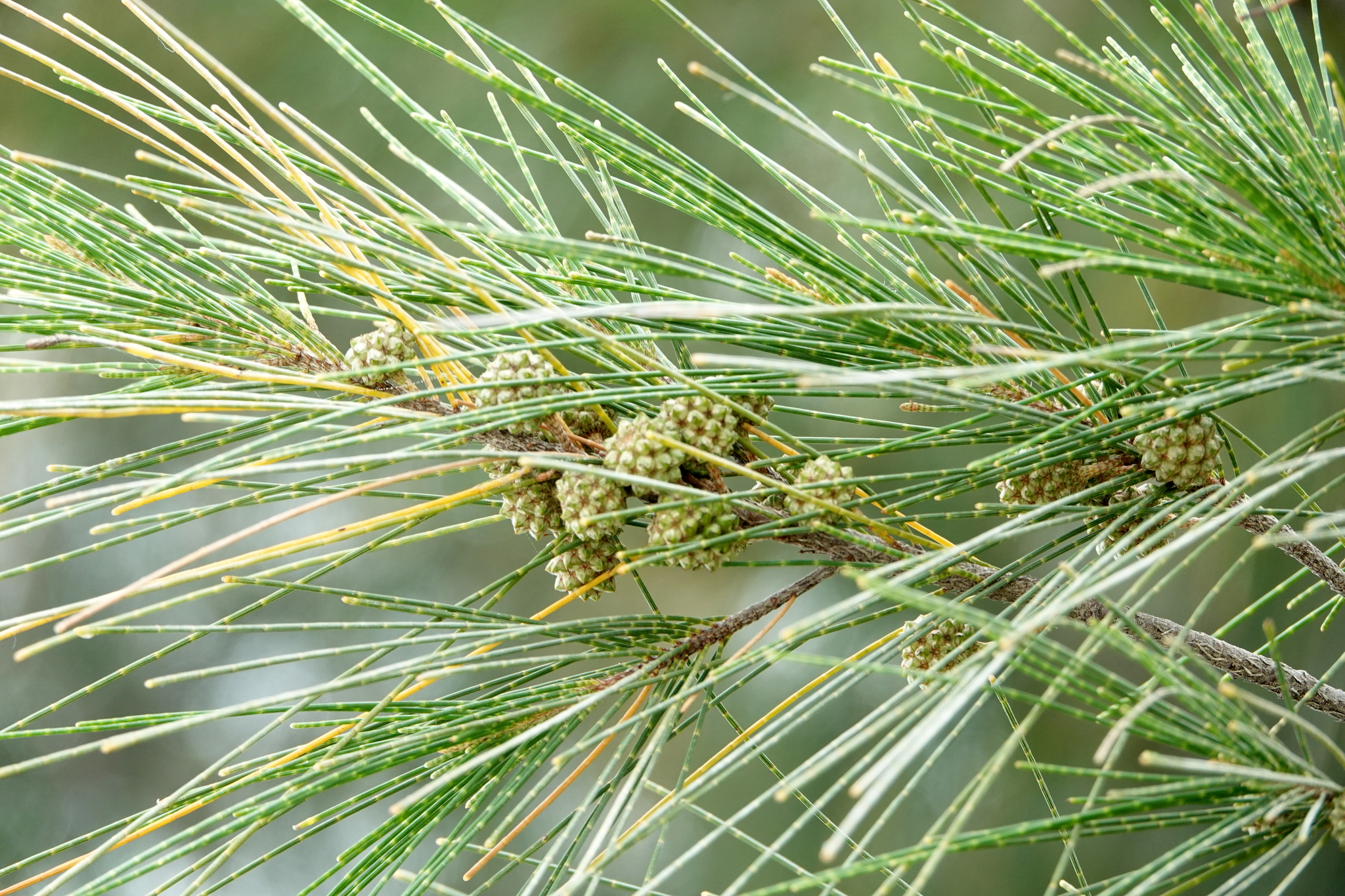
Sheoaks are medium to tall evergreen trees. They have stout trunks with rough bark and erect or semispreading main branches and drooping twigs [12]. Leaves are jointed and scalelike. The fruits are round and warty with winged seeds. Trees can be dioecious or monoecious; male flowers are borne at the tips of twigs, while female flowers form on nonshedding branches [3,14]. Sheoak fixes nitrogen with the aid of Frankia spp. fungi.
Characteristics of individual species are as follows:
C. cunninghamiana (river sheoak) - 80 feet (25 m) in height, 2 feet (6 m) d.b.h., dioecious, nonsprouter.

River sheoak with fruit, Florida.
C. equisetifolia (beach sheoak) - 50 to 100 feet (15-30 m) in height, 1.0 to 1.5 feet (3-5 m) d.b.h., monoecious, nonsprouter.

Beach sheoak male and female flowers.
C. glauca (gray sheoak) - 40 to 50 feet (10-15 m) in height, 1.5 feet (5 m) d.b.h., dioecious, aggressive sprouter, in Florida, usually does not produce fruit [12].

Gray sheoak fruits.
Raunkiaer Life Form (Raunkiaer 1934)
- Phanerophyte
Seasonal Development
Sheoak can flower and fruit year-round in warm climates [3]. Its peak flowering time is between April and June, and its peak fruiting time is between September and December. The minimum seed-bearing age is 4 to 5 years, and it produces a good seed crop annually. C. equisetifolia usually flowers and fruits two times a year: between February and April, and September and October. It produces fruit in June and December. The fastest growth occurs in the first 7 years with maximum growth reached in 20 years. The maximum lifespan of Australian pine is 40 to 50 years [3].
Regeneration Processes
Sheoaks regenerate by seed as well as vegetatively through sprouting [3,12,14]. They are fast growing (5 to 10 feet [1.5-3 m] per year) [14]. Seeds average 300,000 per pound. No pregermination treatment is necessary. Seeds can remain fertile for a few months to a year and will germinate in moist and porous soil, sometimes within 4 to 8 days of dispersal [14].
Successional Status
Sheoak is listed as a dominant species in some South Pacific island's vegetation types [2,5,6]. It is a warm weather species, not native to North America. It can be a primary or secondary colonizer in disturbed areas of Florida [3,10].
Immediate Fire Effects
Sheoaks greater than 3 inches (8 cm) in diameter are killed by fire [3].
A May wildfire killed 60 to 70 percent of sheoak in Florida [10]. A smoldering controlled burn in Florida killed 90 percent of the sheoaks on the study plot [14]. A second attempt in the same area killed all the sheoaks; trunk diameters were between 5 and 8 inches (13-20 cm). Another tree, with a d.b.h. of 2 feet (0.66 m), was killed after charcoal was left to smolder at its base [14].
Postfire Regeneration Strategy (Stickney 1989)
- survivor species; on-site surviving root crown or caudex
- off-site colonizer; seed carried by wind; postfire years 1 and 2
- off-site colonizer; seed carried by animals or water; postfire year 1 and 2
- secondary colonizer; off-site seed carried to site after year 2
Fire Adaptations
Sheoak less than 3 inches (8 cm) in diameter can sucker following fire [3].
Plant Response to Fire
Trees less than 3 inches (8 cm) in diameter may sprout following fire. Trees larger than this usually die [3,14].
Fire Regimes
For fire regime information, search FEIS for this species by entering the species name or acronym on the home page and selecting “Fire Regime” as the publication type.
Fire Management Considerations
Periodic fires coupled with the use of herbicides may be an effective method of controlling sheoak. However, too frequent, intense fires that kill overstory native pines may actually encourage Casuarina species to establish [18]. Morton [14] warns that burning Australian pine in peat soils may be hazardous. Elfer [3] suggests that fire may be an effective control method for trees greater than 3 inches (8 cm) in diameter and in dense stands. Burning could be potentially harmful if the soil pH is changed such that native species cannot establish [3].
Federal Status
None
Other Status
All 3 species of sheoak are list as noxious weeds (prohibited aquatic plants, Class 1) in Florida [16].
Importance to Wildlife and Livestock
Sheoak poses a serious threat to some wildlife species. Nest sites of three endangered species, the American crocodile (Crocodylus acutus), the loggerhead turtle (Caretta caretta ssp. caretta), and the gopher tortoise (Gopherus polyphemus), are all threatened by beach sheoak invasion [9,10]. Also, this invader creates sterile foraging and breeding environments for small mammals [3,14]. It does, however, provide food for migrating goldfinches which feed on sheoak seeds [3].
Palatability and Nutritional Value
Tannins in the leaves of sheoak are carcinogenic and could be fatal to foraging cattle, which sometimes eat the leaves [3].
Cover Value
No entry.
Value for Rehabilitation or Restoration of Disturbed Sites
Sheoak was once used in the United States for reclaiming eroded areas, but many land managers condemn its use because it threatens indigenous plants and animals [12]. Some African and Asian countries use it to combat desertification [17].
Other Uses
Sheoak has various medicinal uses and is also used for dyes, as an ornamental, and in windbreaks [12]. C. cunninghamiana (the most cold-hardy) can be planted in citrus groves to protect fruit trees from cold [14].
Sheoak wood has many uses, including fuelwood, poles, posts, beams, oxcart tongues, shingles, paneling, fence rails, furniture, marine pilings, tool handles, and cabinets [3,12]. The wood, however, is subject to cracking and splitting [14].
Other Management Considerations
Sheoak is extremely fast growing, crowding out many native plants and creating sterile environments for both plants and animals [10]. It forms dense roots, which deplete soil moisture and break water and sewer lines. It is also susceptible to windthrow during hurricanes [3]. Cutting often induces sprouting, so it is not an effective control method. Chemicals, such as 2,4,5-T, 2,4-D, or Garlon 3A, can be used to eradicate sheoak [10,14].
Table A1— Forest and range ecosystems, Bureau of Land Management (BLM) physiographic regions, Kuchler plant associations, Society for American Foresters (SAF) forest cover types, and Society for Rangeland Management (SRM) rangeland cover types in which this species occurs.
Forest and Range Ecosystems (Garrison et al. 1977)
- FRES12 Longleaf - slash pine
- FRES13 Loblolly - shortleaf pine
- FRES16 Oak - gum - cypress
- FRES41 Wet grasslands
BLM Physiographic Regions (Bernard and Brown 1977)
- 3 Southern Pacific Border
- 7 Lower Basin and Range
Kuchler Plant Associations (Kuchler 1964)
- K080 Marl - Everglades
- K091 Cypress savanna
- K092 Everglades
SAF Cover Types (Eyre 1980)
- 70 Longleaf pine
- 75 Shortleaf pine
- 80 Loblolly pine - shortleaf pine
- 81 Loblolly pine
- 83 Longleaf pine - slash pine
- 84 Slash pine
- 111 South Florida slash pine
SRM Rangeland Cover Types (Shiflet 1994)
- No entry.
1. Bernard, Stephen R.; Brown, Kenneth F. 1977. Distribution of mammals, reptiles, and amphibians by BLM physiographic regions and A.W. Kuchler's associations for the eleven western states. Tech. Note 301. Denver, CO: U.S. Department of the Interior, Bureau of Land Management. 169 p. [434]
2. Cole, Tomas G.; Whitesell, Craig D.; Falanruw, Marjore C.; MacLean, Colin D.; [and others]. 1987. Vegetation survey of the Republic of Palau. Res. Bull. PSW-22. Berkeley, CA: U.S. Department of Agriculture, Forest Service, Pacific Southwest Forest and Range Experiment Station. 13 p. [16147]
3. Elfers, Susan C. 1988. Casuarina equisetifolia. Unpublished report prepared for The Nature Conservancy on Australian pine. Winter Park, FL: The Nature Conservancy. 14 p. On file at: U.S. Department of Agriculture, Forest Service, Intermountain Research Station, Fire Sciences Laboratory, Missoula, MT. [17376]
4. Eyre, F. H., ed. 1980. Forest cover types of the United States and Canada. Washington, DC: Society of American Foresters. 148 p. [905]
5. Falanruw, Marjorie C.; Cole, Thomas G.; Ambacher, Alan H. 1989. Vegetation survey of Rota, Tinian, and Saipan, Commonwealth of the Northern Mariana Islands. Resource Bulletin PSW-27. Berkeley, CA: U.S. Department of Agriculture, Forest Service, Pacific Southwest Research Station. 11 p. [15707]
6. Falanruw, Marjorie C.; Maka, Jean E.; Cole, Thomas G.; Whitesell, Craig D. 1990. Common and scientific names of trees and shrubs of Mariana, Caroline, and Marshall Islands. Resource Bulletin PSW-26. Berkeley, CA: U.S. Department of Agriculture, Forest Service, Pacific Southwest Research Station. 91 p. [15706]
7. Flores, Eugenia M. 1980. Shoot vascular system and phyllotaxis of Casuarina (Casuarinaceae). American Journal of Botany. 67(2): 131-140. [17373]
8. Garrison, George A.; Bjugstad, Ardell J.; Duncan, Don A.; [and others]. 1977. Vegetation and environmental features of forest and range ecosystems. Agric. Handb. 475. Washington, DC: U.S. Department of Agriculture, Forest Service. 68 p. [998]
9. Klukas, Richard W. 1973. Control burn activities in Everglades National Park. In: Proceedings, annual Tall Timbers fire ecology conference; 1972 June 8-9; Lubbock, TX. Number 12. Tallahassee, FL: Tall Timbers Research Station: 397-425. [8476]
10. Klukas, Richard W. 1969. The Australian pine problem in Everglades National Park. Part 1. The problem and some solutions. Internal Report. South Florida Research Center, Everglades National Park. 16 p.On file with: U.S. Department of Agriculture, Forest Service, Intermountain Research Station, Fire Sciences Laboratory, Missoula, MT. [17375]
11. Kuchler, A. W. 1964. Manual to accompany the map of potential vegetation of the conterminous United States. Special Publication No. 36. New York: American Geographical Society. 77 p. [1384]
12. Little, Elbert L., Jr.; Skomen, Roger G. 1989. Common forest trees of Hawaii (native and introduced). Agric. Handb. 679. Washington, DC: U.S Department of Agriculture, Forest Service. 321 p. [9433]
13. Lyon, L. Jack; Stickney, Peter F. 1976. Early vegetal succession following large northern Rocky Mountain wildfires. In: Proceedings, Tall Timbers fire ecology conference and Intermountain Fire Research Council fire and land management symposium; 1974 October 8-10; Missoula, MT. No. 14. Tallahassee, FL: Tall Timbers Research Station: 355-373. [1496]
14. Morton, Julia F. 1980. The Australian pine or beefwood (Casuarina equisetifolia L.), an invasive "weed" tree in Florida. In: Proceedings, Florida State Horticultural Society. 93: 87-95. [17343]
15. Raunkiaer, C. 1934. The life forms of plants and statistical plant geography. Oxford: Clarendon Press. 632 p. [2843]
16. USDA Natural Resources Conservation Service. 2018. PLANTS Database, [Online]. U.S. Department of Agriculture, Natural Resources Conservation Service (Producer). Available: https://plants.usda.gov/ [34262]
17. Vietmeyer, Noel. 1986. Casuarina: weed or windfall? American Forests. Feb: 22-26; 63. [17345]
18. Wade, Dale; Ewel, John; Hofstetter, Ronald. 1980. Fire in South Florida ecosystems. Gen. Tech. Rep. SE-17. Asheville, NC: U.S. Department of Agriculture, Forest Service, Southeastern Forest Experiment Station. 125 p. [10362]
19. Wunderlin, Richard P. 1998. Guide to the vascular plants of Florida. Gainesville, FL: University Press of Florida. 806 p. [28655]