


Centaurea diffusa, diffuse knapweed
Innes, Robin J.; Zouhar, Kris. 2020. Centaurea diffusa, diffuse knapweed. In: Fire Effects Information System, [Online]. U.S. Department of Agriculture, Forest Service, Rocky Mountain Research Station, Missoula Fire Sciences Laboratory (Producer). Available: https://research.fs.usda.gov/feis/species-reviews/cendif
| Abbreviation | Common Name | Scientific Name | Classification | Status |
|---|---|---|---|---|
| Plants | ||||
| CENDIF | diffuse knapweed | Centaurea diffusa | Life Form: Plants/Forb Kingdom: Plantae Class: Dicot Order: Asterales Family: Asteraceae Genus: Centaurea | Fed. Protected: No Nativity: Nonnative Invasiveness: Invasive |
This review summarizes information that was available in the scientific literature as of 2020 on the biology, ecology, and effects of fire on diffuse knapweed in North America.
Diffuse knapweed is not native in North America and is invasive in shortgrass and mixedgrass prairie, steppe, shrub-steppe, and dry, open forests and woodlands in the western United States and southern British Columbia. It is especially invasive after disturbance, so limiting disturbance is key to preventing diffuse knapweed invasion.
Diffuse knapweed reproduces by seed and can sprout from the root crown after top-kill. It is typically biennial but sometimes behaves as an annual or as a short-lived perennial. Seedlings usually emerge in spring or fall and develop into rosettes with a taproot. Rosettes bolt when a critical size or stage of development is reached and after exposure to cold temperatures. Plants that complete their juvenile growth by fall and overwinter as rosettes usually bolt in early May. Plants may remain as rosettes through the second year and bolt during a third year. Flowering occurs late spring to early fall as permitted by adequate moisture and mild temperatures. Diffuse knapweed plants can produce hundreds or thousands of seeds. After seeds mature, the plant dies.
Seeds remain in seedheads after they mature and may be retained for long periods. Seeds are dispersed by gravity and wind, either beneath the parent plant as plants sway and release seeds, or over longer distances when plants break off and spread seeds as they tumble. Seeds are also spread by animals, water, people, and vehicles. Seeds remain viable in the soil seed bank for an unknown period, but at least a year, and it is assumed that survival would be similar to other knapweeds, 2 to 5 years, with a few seeds surviving longer.
Diffuse knapweed seeds germinate best near the surface of moist, disturbed soils. High spring precipitation promotes diffuse knapweed seedling establishment. Seedling mortality is highest during summer drought. Once diffuse knapweed seedlings establish as rosettes, they become drought resistant. Once established, diffuse knapweed can form monotypic stands on some sites.
Information on diffuse knapweed’s fire adaptations and response to fire is lacking in the literature. Diffuse knapweed has a deep taproot and may sprout following top-kill from fire if the root crown survives and sufficient moisture is available. Diffuse knapweed root crowns and seeds in the soil would probably survive a single, low-severity fire. High-severity fire is more likely to kill both plants and seeds; however, published observations are lacking. Fire creates a seedbed suitable for diffuse knapweed germination and establishment, so it may establish after fire from on- or off-site seed sources. Severe fire may favor diffuse knapweed establishment and spread by decreasing shade and interference from established plants, increasing bare ground, and changing water and nutrient availability and soil microbial communities. It is commonly suggested that fire may be used to remove plant debris and improve herbicide efficacy to control diffuse knapweed, but no experimental evidence was published to support this. Some researchers speculated that fire may be used to control diffuse knapweed but only where associated grasses increase after fire.
In addition to fire, other control methods, such as physical and mechanical control, livestock grazing, biological control, and chemical control may be used in an integrated management program to control diffuse knapweed. No matter what method is used to kill diffuse knapweed plants, establishment or maintenance of desirable plants is needed for long-term control.



Taxonomy
The scientific name for diffuse knapweed is Centaurea diffusa Lam. (Asteraceae) [7, 28, 42, 47, 58, 59, 173, 181].

Figure 1—Diffuse knapweed plant in Kamloops, British Columbia.
A fertile hybrid between diffuse knapweed and spotted knapweed (C. stoebe subsp. stoebe), Centaurea × psammogena G. Gáyer [106], has been reported in North America in at least seven states [106] including Washington, Oregon, Idaho, Montana, Wyoming, Colorado [12], and Michigan [177]. The hybrid is often misidentified [10, 42]. It was most likely introduced to North America along with diffuse knapweed around 1900 [12], given its occurrence in diffuse knapweed sites but not in spotted knapweed sites in North America [10, 12].
The Flora of North America reports that diffuse knapweed “readily hybridizes” with spotted knapweed (C. s. subsp. micranthos) [42]. However, hybridization only occurs between diploid diffuse knapweed and diploid spotted knapweed (C. s. subsp. stoebe) and not between other cytotype pairings. North American populations of spotted knapweed are tetraploid (C. s. subsp. micranthos). Diploid spotted knapweed does not occur in North America, but its range overlaps with that of diploid diffuse knapweed in some locations in Europe [12].
Common names are used throughout this review. For scientific names see table A1.
Synonyms
- None
Other Common Names
tumble knapweed, white knapweed, spreading knapweed
General Distribution
Diffuse knapweed is native to grassland and shrub-steppe of the eastern Mediterranean region [99, 172] and was introduced into North and South America [61, 107, 140]. It occurs sparsely throughout western Europe where it is considered a “naturalized alien” [172]. It is thought to have been introduced to North America multiple times [61, 90], possibly as a contaminant in alfalfa seed from Asia Minor-Turkmenistan or in hybrid alfalfa seed from Germany [87]. The earliest record of diffuse knapweed in North America is from an alfalfa field in Washington in 1907 [127].

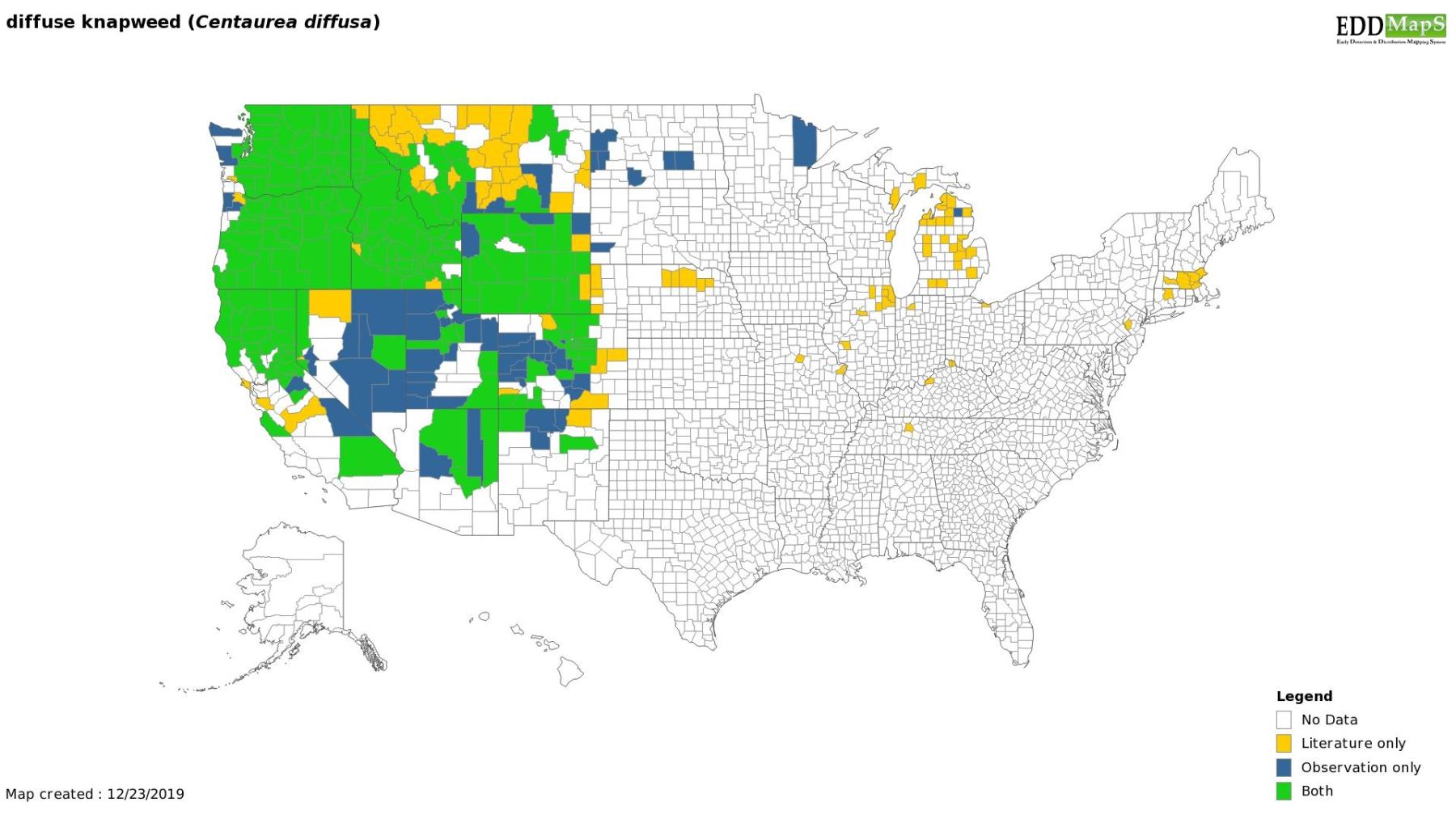
Figure 2—County-level distribution of diffuse knapweed in the United States.
In Canada, it occurs from Yukon south through British Columbia and east to Quebec. In the United States, its primary range is in the West, from Washington, Idaho, and Montana south to New Mexico and Arizona [39, 173] (fig. 2). Maddox [88] notes that diffuse knapweed is more common on the western side of the Great Basin, and spotted knapweed is more common on the eastern side. Diffuse knapweed has also been reported in many Midwestern States and in New Jersey, Connecticut, and Massachusetts, on the east coast [39, 173]. Based on surveys of land managers, Duncan (2001) reported that diffuse knapweed occurred on about 3.5 million acres (1.4 million ha) across 16 western states and provinces in 2000 [35], and Duncan and Jachetta (2005) reported that it occurred on about 1.8 million acres (750,000 ha) in 17 western states and about 5,000 acres (2,000 ha) in eastern states in 2003 [33, 34]. While these studies cover slightly different areas, they suggest that the acreage occupied by diffuse knapweed decreased substantially over those 3 years. While diffuse knapweed populations fluctuate from year to year (see Botanical Description), the reason for this difference in acreage occupied was not addressed by the authors. According to Piper and Story [116] the “worst infested states” in 2004 were Washington, Oregon, Idaho, and Montana. In the Great Plains, diffuse knapweed is “sporadic and not long persisting” [47].
Site Characteristics
Diffuse knapweed is invasive in arid and semiarid rangeland and dry, open forests in western North America [32, 38], especially after disturbance [22, 126], when it can rapidly establish dense, often monotypic, stands. In British Columbia, density of diffuse knapweed was correlated with degree of soil disturbance (P < 0.05), but not with any soil chemical properties [180]. Disturbances may be as small as rodent activity or a single hailstorm [77, 78] and may not be recent [77, 126]. Diffuse knapweed commonly invades disturbed sites such as transportation corridors, water ways, gravel pits, and industrial areas [129]. It is also capable of invading well managed rangeland [9, 78, 144].
Diffuse knapweed tolerates a range of precipitation and temperature conditions. It occurs in places with mean annual precipitation ranging from 6 to 35 inches (150–900 mm) [9, 128, 179] (table 1). However, it seems to be most invasive on semiarid sites, and less so on drier or wetter sites [9, 101, 126]. The amount of winter precipitation may be important to diffuse knapweed seedling establishment on some sites [66] (see Germination). Diffuse knapweed does not tolerate flooded or waterlogged conditions, and it is not common in wet sites such as irrigated areas [101], gullies, depressions, and poorly drained soils [9, 126].
| Location | Mean annual precipitation |
|---|---|
| Arizona | 15 inches (380 mm) in Coconino County [23]; 22 inches (563 mm) near Hart Prairie, Coconino National Forest [187] |
| Colorado | 14–20 inches (363–514 mm) [24, 84, 94, 135, 136, 138, 142, 165] |
| Washington | 6–35 inches (150–900 mm) [73, 74, 76, 77, 93, 126, 141, 167] |
| Wyoming | 15 inches (380 mm) near Cheyenne [13, 14, 85, 124] |
| British Columbia | 8–25 inches (200–647 mm) [9, 26, 29, 69, 156, 179, 180, 182] |
Diffuse knapweed grows from sea level in eastern Washington (Talbot 1987 cited in [126]) up to 9,200 feet (2,800 m) in Colorado [142] (table 2). In eastern Washington, diffuse knapweed occurred on all aspects and slopes, from flat to more than 60% [126, 128, 167].
Diffuse knapweed commonly occurs on well-drained soils such as sandy or gravelly loams or loamy fine sands, with proportion of coarse fragments ranging from 0% to over 80% [127, 128]. It is less frequent on shallow soils (<15 inches (38 cm) deep) and very coarse-textured soils such as sand or loamy coarse sand, although it may establish and spread on these sites when disturbance removes other vegetation [128]. It grows best on fertile, well-watered Mollisols in open and uncultivated sites with dry summers [51, 144].
| Location | Elevation |
|---|---|
| Arizona | up to 7,000 feet (2,130 m) [191]; 8,400 feet (2,560 m) on the Coconino National Forest [187] |
| Arizona, New Mexico, Colorado, and Utah | 5,250–7,710 feet (1,600–2,350 m) [58] |
| California | <7,500 feet (2,300 m) [7] |
| Colorado | 5,100–9,200 feet (1,540–2,800 m) [24, 94, 135, 138, 142] |
| Washington | Up to 5,000 feet (1,500 m) [72, 76, 93, 126, 141, 167] |
| Wyoming | 6,300 feet (1,930 m) near Cheyenne [13, 14] |
| British Columbia | 500–3,000 feet (150–1,115 m) [29, 45, 69, 95, 102, 131, 156, 158, 179, 182] |
Plant Communities
Diffuse knapweed seems to be most invasive in shortgrass and mixedgrass prairies, steppe, shrub-steppe, and dry, open ponderosa pine and Douglas-fir communities in the western United States [51, 86, 101, 126, 128, 185]. It is also invasive on upland sites in pinyon and juniper woodlands [23, 126, 166].
United States
In Washington, diffuse knapweed is most common east of the Cascade Range on the northwest slopes of the Columbia River Basin, where it occurs in grassland, shrub-steppe (e.g., big sagebrush/bunchgrass), and dry forest communities [126, 128], and associates include bluebunch wheatgrass, Sandberg bluegrass, Russian-thistle, and cheatgrass [141]. It is most invasive in antelope bitterbrush/bluebunch wheatgrass communities, with or without needle and thread [126, 167]. Lillybridge et al. (1995) described invasion by diffuse knapweed a “serious problem” in Oregon white oak, ponderosa pine, and dry Douglas-fir communities on the Wenatchee National Forest [86]. It can dominate the understory of ponderosa pine/shrub communities such as ponderosa pine/antelope bitterbrush habitat types. It may be common in Douglas-fir/common snowberry and Douglas-fir/mallow ninebark habitat types that were cleared and either support second-growth forest or pasture. Most dryland pastures dominated by diffuse knapweed were previously dominated by Kentucky bluegrass [126].
In western Montana, diffuse knapweed is invasive in bluebunch wheatgrass rangelands, other grasslands, woodlands, and open forests [78, 96].
In Utah, the antelope bitterbrush/bunchgrass shrub-steppe is highly susceptible to invasion by diffuse knapweed [126].
In Colorado, diffuse knapweed invades shortgrass steppe in the Front Range foothills and eastern plains. Adjacent pinyon-juniper-oak and higher elevation montane zones are also susceptible [126].
In Arizona, diffuse knapweed, musk thistle, and tall tumblemustard “seemed to have the highest potential for displacing native vegetation” in the lower San Francisco Volcanic Field in Coconino County, where twoneedle pinyon-oneseed juniper woodland dominates. In 2008 it was infrequent in disturbed areas and along roadsides [23].
Canada
Interior grasslands and dry forest edges of southern British Columbia and shortgrass prairies of Alberta and Saskatchewan are considered vulnerable to diffuse knapweed invasion [51, 101]. Diffuse knapweed occurs in areas dominated by bluebunch wheatgrass, Idaho fescue, bluegrass, needle and thread, Dore’s needlegrass, sand dropseed, and slender wheatgrass [9, 60, 101]. These native bunchgrasses may be displaced by annual grasses, sagebrush, diffuse knapweed, and spotted knapweed [118]. Diffuse knapweed also occurs in antelope bitterbrush, mallow ninebark, ponderosa pine, and Douglas-fir communities. It has established in dry subzones of the montane spruce and interior western redcedar-western hemlock biogeoclimatic zones in the southern interior of British Columbia, where dominant species include Douglas-fir, lodgepole pine, Engelmann spruce, subalpine fir, and understory components such as pinegrass, fireweed, and blueberry [117].
Botanical Description
The following description provides characteristics of diffuse knapweed that may be relevant to fire ecology and is not meant to be used for identification. Keys for identifying diffuse knapweed are available in these publications: [7, 28, 42, 47, 58, 59, 181, 185].

Figure 3—Diffuse knapweed rosette near the Columbia River, Douglas County, Washington.
Diffuse knapweed is a nonnative, annual, biennial, or short-lived perennial forb [7, 38, 42, 47, 58, 144, 179, 181, 185]. During the juvenile stage, diffuse knapweed is a rosette with deeply divided basal leaves (fig. 3) on short stalks that emerge from a central root crown. It has a deep and fibrous taproot [47, 58, 126] that can grow >2.3 feet (0.7 m) deep in the first 40 days [81] (see Seedling Establishment and Plant Growth). At maturity, diffuse knapweed produces one to several upright stems [42, 58]. Stems range from about 1 to 3 feet (0.3–1 m) tall [7, 42, 47, 58, 126, 181], with numerous, spreading branches [7, 42, 58] that give plants a ball-shaped appearance and tumbleweed mobility when broken off [58, 126] (fig 5). Stem leaves on diffuse knapweed are stalkless, getting smaller and less divided higher up the stem [47, 58, 126]. White, lavender, or purple flowerheads are solitary or borne in clusters of two or three at the ends of branches [47, 126]. Diffuse knapweed flowerheads are 3 to 6 mm in diameter and 8 to 13 mm long, excluding spines and flowers (fig. 1) [7, 42, 47, 58, 126, 181]. Bracts are edged with a fringe of spines, with a longer erect spine at the tip that is typically 1 to 3 mm long [7, 42, 47, 59] but may be as long as 8 mm [47]. Seeds are achenes [47] or cypselae [7, 42, 58] that are 2 to 3 mm long [7, 42, 47, 58] with or without a plume or pappus that varies from scale-like up to 1 mm long [7, 28, 42, 47, 58, 59, 126].

Figure 4—Dense diffuse knapweed population in Tygh Valley, Oregon.
Diffuse knapweed may occur as solitary plants or in small patches, especially where establishment was recent, but it can also form large, dense monotypic stands [179] (fig. 4). Diffuse knapweed cover may vary from year to year. For example, across 25 previously tilled and abandoned agricultural fields (old fields) in a shrub-steppe ecosystem in the Methow Valley, Washington, diffuse knapweed cover was ≈13% during one year and ≈1% the following 2 years [72]. Precipitation may account for some of the variability from year-to-year (see Seedling Establishment and Plant Growth). The invasiveness of diffuse knapweed has been attributed to it depleting soil moisture [155], to allelopathy [19-22, 41], and to other competitive or interference mechanisms [19, 20]. However, the contribution of allelopathy to invasion success is debated [62, 64, 105, 108, 120, 168]. See Impacts for more information.
Raunkiaer Life Form
- Hemicryptophyte [121]
Seasonal Development
Diffuse knapweed plants are typically biennial; however, lifespan and phenology of individual plants is variable and depends on climatic and site conditions such as soil moisture availability, temperature, and plant density. Diffuse knapweed seeds can germinate any time there is sufficient moisture [9, 179, 185]; however, seedlings usually emerge in spring (April–June) or late summer/early fall (August–September) [9, 101, 118, 179] and develop into rosettes. Diffuse knapweed overwinters either as a rosette or a seed [179]. According to Powell (1990), who studied diffuse knapweed populations in the ponderosa pine-bunchgrass zone in British Columbia, about 95% of seedling recruitment occurs in late April, when the ground is moist and temperatures are moderate, and the rest occurs in late September [118]. Most root development occurs during the rosette stage [179]. Rosettes bolt in response to a period of cold temperature (vernalization) after a critical size or stage of development is reached [118, 169]. Diffuse knapweed plants that overwinter as rosettes usually bolt the following growing season. Plants that overwinter as seed may develop into and remain as rosettes through the second year and bolt during the third year. Flowering occurs from late spring to early fall (table 3), as permitted by adequate moisture and mild temperatures [126]. After seeds mature, the plant dies. Seeds are not dispersed upon maturity, and most diffuse knapweed seedheads remain closed in the fall. When seedheads dry, a small opening is formed through which seeds disperse individually over a prolonged period, as dead plants sway or break off at ground level and tumble in the wind [179]. In Washington, seeds are typically fully dispersed by mid-June [133] but may be dispersed over a longer period [179].
Diffuse knapweed plants sometimes behave as short-lived perennials or annuals. For example, under conditions of severe crowding in a near monoculture in British Columbia, some diffuse knapweed plants were at least 5 years old when they flowered [118]. At another site in British Columbia, most diffuse knapweed plants remained in the rosette stage for at least 2 years before bolting, regardless of rosette density. Only 5% of the diffuse knapweed rosettes present in June bolted by September, and there was no difference in the number of bolted plants among sites sown at three densities (368, 944, and 1,504 seeds/m2) [131]. Plants can also continue to grow after producing seeds to flower again the following year, but this is appears to be rare [126]. Conversely, plants that germinate in early spring may flower the first year (<1% observed) [133].
| Location | Flowering dates |
|---|---|
| California | May–October [7] |
| Four Corners region of Arizona, New Mexico, Colorado, and Utah | June–August [58] |
| Great Plains | July–September [47] |
| Intermountain West | July–September [28] |
| British Columbia | July–August [179] |
Regeneration Processes
Diffuse knapweed reproduces exclusively by seed and is typically biennial. The plants begin as low rosettes and may remain in this form for 1 to several years, until they reach a critical size (e.g., root crown diameter of about 4–6 mm) [118], or stage of development (e.g., a minimum leaf number). At this point they respond to vernalization by bolting, flowering, setting seed, and dying. Thus, they may behave as annuals, biennials, or short-lived perennials [169].
Pollination and Breeding System
Fertilization in diffuse knapweed requires cross-pollination. This can limit the reproductive success of isolated individuals, but it also promotes genetic diversity and may thereby contribute to invasiveness. Watson and Renney [179] reported that diffuse knapweed is self-compatible, but the results of Harrod and Taylor [56] refute this assertion. Diffuse knapweed is primarily insect pollinated [56, 180]. Honeybees, bumble bees, and digger bees are frequent diffuse knapweed flower visitors [56].
Seed Production and Predation
Annual seed production in diffuse knapweed is typically adequate to maintain populations, but it varies with moisture availability [133] and level of seed predation by larvae of insects released for biological control (e.g., [100, 185]). The number of viable seeds per seedhead and number of seedheads per stem is greater in years with above-average precipitation on semiarid sites in eastern Washington and northern Idaho [133]. A review stated that diffuse knapweed plants “can produce anywhere from 5 to 900 seeds, some of which can remain dormant for many years” [185]. Considerable variation in seed production (ranging from 4,200 to 146,300 seeds/m2) was observed between sites and years in northeastern Washington. Nonetheless, seed production was estimated to be 1,000 times what was needed to maintain observed population levels [133] (table 4).
Diffuse knapweed may produce fewer seeds when diffuse knapweed plant density is high. In southern British Columbia, the number of seeds produced per plant was negatively correlated with flowering plant density at four unburned sites during 2 years (r = -0.60) [100]. However, on experimental sites in southern British Columbia, the mean number of bolted plants was not affected by sowing density even though rosette density was highest (13 rosettes/625 cm2) on plots with the highest sowing density (1,504 seeds/m2) [131].
Biocontrol insect larvae that consume immature seeds and other tissues in diffuse knapweed seedheads can greatly reduce seed production [185] (see Biological Control). However, reduced seed production may not result in reduced diffuse knapweed abundance. Modeled diffuse knapweed populations that included reduced seed production from gall fly larvae resulted in higher diffuse knapweed plant densities than modeled populations lacking gall flies because increased seedling survival compensated for reduced seed production [100].
| State or provincea: site type(s) | Seedheads /plant | Seeds/ seedhead | Seeds/plant | Seeds/m² | Citation |
|---|---|---|---|---|---|
| CO: mixedgrass prairie | 27 | 0.89 | 24* | 350 | [84] |
| 78 | 1.26 | 98* | 420 | ||
| CO: pasture | not reported | not reported | 206 (3–1,064) | not reported | [6] |
| WA (eastern) and ID (northern): old field, pasture, rangeland, and forest sites | 89 | 13 | 1,157 | 26,400 | [133] |
| BC: ponderosa pine-bunchgrass zone and interior Douglas-fir zone | not reported | not reported | burned: ≈800 unburned: ≈50–350 | not reported | [100] |
| BC: semiarid rangeland | 74 | 12 | 925 | not reported | [179] |
| BC: irrigated sites | 1,404 | 13 | 18,248 | not reported | |
a List of state and province abbreviations b Data in this cell calculated from previous two cells. | |||||
Seed Dispersal

Figure 5—Tumbling diffuse knapweed trapped in pasture fence.
Dispersal of diffuse knapweed seeds is mainly by gravity and wind, but seeds can also be dispersed by animals, human activities, and water [6, 126, 179, 180]. The seedheads do not open when seeds are mature, so seeds are not dispersed all at once [185]. Instead, mature seeds remain in seedheads and disperse individually over time through a small opening at the top of the seedhead after it has dried, resulting in a prolonged seed rain [145]. Dispersal in the vicinity of the parent plant occurs when horizontally placed seedheads release seeds as plants sway in the wind. Dispersal over longer distances occurs when plants break off at ground level and disperse seeds as they tumble in the wind [6, 179] (fig. 5).
Near Superior, Colorado, diffuse knapweed plants sampled at the beginning of the dispersal season in September had an estimated mean of 206 seeds/plant (3–1,064 seeds/plant). Twenty-eight weeks after senescence, plants that had not tumbled had an estimated mean of 25 seeds/plant (0-213 seeds/plant). During 2 years of study, 34 diffuse knapweed plants tumbled estimated distances ranging from 36 to 3,409 feet (11-1,039 m). Number of seeds remaining in these plants after tumbling ranged from 0 to 2,104 seeds/plant. Wind tunnel trials suggested that number of seeds deposited while tumbling was not related to plant size, and the authors suggest that plants with more seeds might disperse seeds over longer distances than plants with fewer seeds [6]. Different establishment patterns observed in different topographic locations suggested variation in wind patterns or seed dispersal by cattle on rangeland in British Columbia [101].
Seed-bearing plants that "hitchhike" on vehicles can disperse seeds potentially long distances along roadsides (fig. 6). Seeds may also be transported in mud adhering to vehicles or shoes [180]. In British Columbia, logging trucks, off-road vehicles, and trail bikes have greatly contributed to the spread of both diffuse knapweed and spotted knapweed [163]. Plants carried in rivers and irrigation systems can disperse seeds along the banks of waterways [126].

Figure 6—Diffuse knapweed plant caught on undercarriage of a truck.
Seed Viability and Seed Banking
Diffuse knapweed seed production and viability vary with environmental conditions—particularly moisture availability—during the growing season (e.g., [133]), but most seeds (>80%) are viable at maturity (e.g., [25, 77, 85, 94, 110, 133]) and remain viable for an unknown period of time under field conditions. Seeds remain viable over winter when retained in seedheads (e.g., [133, 179, 180]) and when buried in soil (e.g., [187]), although viability of seeds in the soil seed bank may be reduced (e.g., [26]). However, information on diffuse knapweed seed longevity in soil seed banks is lacking.
While evidence suggests diffuse knapweed seeds persist in the soil in the short-term, it is unclear how long viability is retained. In diffuse knapweed populations in lightly grazed grasslands in the interior Douglas-fir zone of British Columbia, the presence of rosettes and flowering plants in May—1 year after herbicide treatment that reduced diffuse knapweed density—suggested establishment from the soil seed bank. Density of diffuse knapweed seeds counted in soil samples was about 1,000 times that of flowering diffuse knapweed plants; however, viability tests were not performed [101]. Only two studies were available that tested germination of diffuse knapweed seeds collected from soil samples [26, 142], and these do not provide insights into seed longevity. One review suggested that diffuse knapweed seeds remain viable for “many years” [185], and another that diffuse knapweed seed longevity would be similar to that of other Centaurea species—2 to 5 years, with a few seeds surviving longer [32]. Duncan et al. (2017) reported that diffuse knapweed seed longevity is >8 years, but the source of this information is not given [38].
Most diffuse knapweed seeds harvested from seedheads and stored under laboratory conditions (for varied time periods and under varied conditions) appear to be viable, and germination rates >80% are consistently reported by researchers conducting viability tests on filled seeds harvested in British Columbia [179], Washington [77, 110, 133], Idaho [133], Nevada [25], Wyoming [85], and Colorado [25, 94]. Watson [180] reports 93% to 95% germination rates for 20-month-old seeds stored at room temperature.
Little information is available regarding longevity of seeds under field conditions, and none beyond 1 year. Viability is retained, and germination rate may increase, for seeds that overwinter in seedheads [133, 179, 180]. For example, germination rates were 40% for seeds removed from seedheads at maturity, 68% for seeds stored under dry conditions for 25 days, and 88% for seeds that had overwintered in seedheads under field conditions [179, 180]. Schirman (1981) also reports >80% viability in seeds retained in seedheads until April in the Inland Northwest [133].
Only two studies were available that characterized soil seed banks in areas where diffuse knapweed occurred [26, 142]. The total soil seed bank in the top 4 inches (10 cm) of soil under antelope bitterbrush shrub-steppe communities in southern British Columbia averaged about 12,650 seeds/m2 across 10 sites with different grazing histories, and diffuse knapweed was among the five species contributing the largest number of seeds to the total. It comprised about 6% of the total seed bank, with a mean density of 815 seeds/m2. Although viability tests on a subsample of these seeds indicated only 4.5% viability, this would be sufficient to maintain or increase diffuse knapweed aboveground density. Seeds of diffuse knapweed were found under a variety of environmental conditions at these sites. Diffuse knapweed seed density was negatively correlated with litter cover (r = −0.66; P = 0.05). While the highest densities of diffuse knapweed seeds in seed banks were found on two of three heavily grazed sites, there was no significant positive correlation between diffuse knapweed plant density and seed bank seed density at any of six sites, and a significant negative correlation was observed on one site (P < 0.05). The highest density of diffuse knapweed seeds (2,006 seeds/m2) occurred on a site with diffuse knapweed plant density of only 8 plants/m2, and the second highest density of diffuse knapweed seeds (1,879 seeds/m2) occurred on a site with 20.3 plants/m2. Diffuse knapweed seeds were also found on sites where plants were absent from samples [26], suggesting long-distance seed dispersal, possibly facilitated by grazing animals.
The other study of soil seed banks that includes diffuse knapweed was conducted in and adjacent to burn scars resulting from slash pile burning in Colorado ponderosa pine-Douglas-fir and lodgepole pine forests. Although diffuse knapweed is listed as one of six “noxious species … observed growing in scars during the duration of the study…”, it was not detected in soil seed bank samples (burned or unburned) in postfire year 2. Aboveground biomass was not measured at the time seed banks were sampled; however, diffuse knapweed was not recorded in any aboveground biomass samples (burned or unburned) in postfire year 3. It occurred with low mean biomass in burn scars (0.35 g/m2) and unburned control plots (0.44 g/m2) in postfire year 4, 2 years after soil seed banks were sampled [142], suggesting that these plants may have established from seeds dispersed onto the burns from off site.
Germination
In British Columbia, most diffuse knapweed seeds germinate in late summer/early fall (August/September) or in spring (May/June) [9, 101, 118, 179], but given sufficient moisture, seeds can germinate throughout the growing season [9, 179, 185]. Neither nitrogen nor phosphorus availability affected diffuse knapweed germination rates in grasslands of eastern Colorado [84].
The amount of winter precipitation may be important to diffuse knapweed seedling establishment on some sites because its seeds require moist soil conditions for at least 4 days to germinate [66]. For example, in a Wyoming mixedgrass prairie dominated by western wheatgrass, needle and thread, and blue grama, diffuse knapweed seedling establishment and biomass were higher in plots with high soil water content due to experimentally-added snow than in control plots [13]. Water stress may delay germination and reduce seedling root growth. Saline conditions may also reduce seedling root growth [66].
Only one study was available with information on diffuse knapweed germination rates after fire (table 5). This study found that germination of diffuse knapweed seeds buried in high-severity burned plots was higher than that in unburned plots. The authors attributed higher germination rates in severely burned sites to higher soil water content in severely burned than unburned sites, and generally lower soil temperatures on unburned sites [187]. See Plant Response to Fire for more information about this study.
Diffuse knapweed seeds germinate under a wide range of environmental conditions in the laboratory [25, 154, 179] (table 5). Diffuse knapweed seeds required >55% soil moisture to initiate germination, with optimum germination at 70% in a greenhouse with temperatures alternating between about 59 and 70 °F (15−21 °C) [154]. Seeds collected from British Columbia germinated better in red light than in dark [104], while seeds collected from an unknown location germinated equally well under simulated canopy cover (simulated using slits in cardboard covers) ranging from 0% to 100% [154]. Seeds germinated best on the soil surface, and germination rate decreased as seeding depth increased, with little to no germination below 1 inch (2.5 cm) [154, 179].
| Study location/plant community | Purpose and methods of study | Main findings related to diffuse knapweed germination | Reference |
|---|---|---|---|
| AZ: ponderosa pine communities near Flagstaff | Compared diffuse knapweed seed germination in 1) undisturbed plots, 2) plots raked to bare soil, 3) moderate-severity burned plots (≤30% crown scorch), and 4) high-severity burned plots (80%–100% crown scorch or total crown consumption) by burying seeds in packets in October (after burning) and collecting a sample of packets monthly, from April to November on wildfire sites, and May to August in pile burn scars |
| [187] |
| Greenhouse: seed source not reported | Examined the effects of canopy cover, seed burial, and soil moisture on germination of diffuse knapweed and spotted knapweed |
| [154] |
| Growth Chamber: seeds collected from throughout the interior of BC | Examined germination and dormancy in diffuse knapweed and spotted knapweed at 7 sites |
| [104] |
| Germination rate was highest (77.8%) at 70% soil moisture content and lowest (6.7%) at 60% soil moisture. No germination was observed at 55% soil moisture. | Literature review and summary of biological information on diffuse knapweed and spotted knapweed that includes a study on the effects of light, temperature, and depth of sowing on germination and seedling establishment |
| [179] |
| Laboratory: seeds collected from ruderal populations and urban areas in the sagebrush zone of NV, and an unspecified location in CO | Developed temperature profiles under laboratory conditions for diffuse knapweed seeds from 6 sites |
| [25] |
Seedling Establishment and Plant Growth
Much has been published that examines the effects of environment, vegetation, and site conditions on diffuse knapweed seedling establishment; however, none of these studies examined postfire seedling establishment, and only one study was available that examined diffuse knapweed plant growth after fire [187].
Diffuse knapweed seedlings can emerge whenever adequate moisture is available [9, 179, 185] (see Seasonal Development and Germination). Because seeds are not all dispersed at the same time (see Seed Dispersal), and because some seeds may be dormant when dispersed (e.g., [104, 179]), seedling establishment can occur over an extended period, giving diffuse knapweed the potential to occupy more available microsites [145].
Adequate moisture after emergence is essential and often the most limiting factor for diffuse knapweed seedling survival and recruitment [9, 118]. Seedlings are the most vulnerable stage in diffuse knapweed’s life cycle, and most mortality occurs between the seedling and rosette stages [94, 101], typically due to desiccation when conditions are dry after emergence [179]. Seedling survival is initially high in spring when moisture availability is high, and most mortality typically occurs in summer [101, 118, 133, 179]. For example, near Spokane, Washington, diffuse knapweed seedlings that emerged in April had high survival rates (30%–51% across 3 years), and most of those (70%–88%) flowered the following year. Diffuse knapweed seedlings that emerged in June and July had low survival rates (<13%), and none flowered the following year [133].
Surviving seedlings develop into drought-resistant rosettes with deep taproots [9, 101, 179]. Among rosettes, mortality is highest for small rosettes and rosettes with close neighbors [118]. Maximal root growth occurs during the rosette stage [179], and root growth may be rapid [65, 81]. For example, total root length of diffuse knapweed grown in growth chambers for 40 days averaged 404 and 365 inches (1,027 and 926 cm), root depth averaged 30 and 22 inches (77 and 56 cm), and total biomass averaged 314 and 201 mg in soils with water potentials of −0.01 and −0.03 MPa, respectively [81].
High spring precipitation appears to favor diffuse knapweed seedling establishment [146]. For example, diffuse knapweed seedling establishment in undisturbed plots across nine steppe, shrub-steppe, and ponderosa pine sites in Washington, Oregon, and Idaho was positively correlated with April to June precipitation during 2 years (r2 = 0.34 and 0.55). Establishment in 2005, an abnormally wet year, was twice that in 2004, a mild to moderate drought year [110]. In a native grassland in Colorado, greater emergence of diffuse knapweed from buried seeds sown in fall than from those sown in spring was likely due to precipitation in fall that increased moisture availability during emergence [94]. In southern British Columbia, lack of sufficient moisture appeared to limit diffuse knapweed establishment on a site where annual precipitation averaged 8 inches (200 mm), whereas diffuse knapweed established and spread on a similar site where annual precipitation averaged 13 inches (330 mm) [9].
Diffuse knapweed outcompetes associated grasses for water over a relatively narrow range of moisture conditions, and outside this range it is likely less invasive and easier to control [9]. For example, leaf area data and root:shoot ratios suggest that diffuse knapweed grows faster than bluebunch wheatgrass in cool, moist conditions but not in warm, dry conditions. In dry conditions, diffuse knapweed allocates more energy to root growth than to leaf area [65].
In addition to soil moisture availability, other factors that affect establishment and survival of seedlings include seed availability (i.e., propagule pressure) [131, 146], depth of seed burial [94, 179], extent of soil surface disturbance (especially of litter [94] and biological soil crusts [110]), abundance and condition of existing vegetation [94, 136, 146], seedling density (i.e., intraspecific competition) [118], timing of emergence [133, 145], and soil characteristics, such as nutrient availability after fire [187].
Persistence of diffuse knapweed stands in dry regions where it is most prevalent depends in part on sufficient seed availability [9]. However, diffuse knapweed seedling density was not related to the number of seeds produced across five sites in southern British Columbia [100]. Studies on the effects of seed sowing rate on diffuse knapweed seedling establishment generally show greater establishment at higher sowing rates. In a second-growth Douglas-fir/pinegrass community in British Columbia, mean number of diffuse knapweed rosettes was not different between sowing densities of 368 and 944 seeds/m2 (3 and 6 rosettes/plot, respectively), but was significantly greater at a sowing density of 1,504 seeds/m2 (13 rosettes/plot) [131]. Similarly, in a bluebunch wheatgrass-needle and thread habitat type dominated by nonnative crested wheatgrass in southeastern Washington, sowing density of 6,000 diffuse knapweed seeds/m2 resulted in more seedlings (18.2 versus 11.3) and more total diffuse knapweed plants (29.2 versus 22.8) than a sowing density of 3,000 seeds/m2. However, sowing rate did not affect diffuse knapweed seedling density at a similar site where native perennial grasses dominated [146]. Annual seed production in diffuse knapweed is typically adequate to maintain populations, especially in relatively wet years [133] (see Seed Production and Predation). In addition, a single plant can produce thousands of seeds, so even if establishment rates are low, diffuse knapweed is likely to persist and spread if any plants produce seeds.
Although still vulnerable to diffuse knapweed establishment and spread, undisturbed grasslands are more resistant to invasion than those where soil, vegetation, or both are disturbed (e.g., [94, 110, 136, 146]). Diffuse knapweed establishment was consistently greater where surface soil was disturbed [9] or biological soil crusts were removed [110] than in undisturbed areas. For example, in a semiarid grassland in British Columbia, about 2 to 4 times more diffuse knapweed seedlings and rosettes occurred in plots where soil had been physically disturbed to a depth of 0.8 to 1.2 inches (2–3 cm) with a rake than in undisturbed plots (P < 0.01) [9]. Diffuse knapweed seedling establishment across nine sites in Washington, Oregon, and Idaho tended to be greater in plots where either biological soil crusts were removed or both soil crusts and plants were removed than in undisturbed plots [110].
Soil disturbance may improve diffuse knapweed germination and seedling establishment by improving soil-to-seed contact and burying seeds (e.g., up to about 0.4 inch (1.0 cm) deep [94, 179]); however, seedlings may not emerge from seeds buried more than about 1.2 inches (3 cm) (table 5). Disturbances such as burrowing animals and trampling by large ungulates (wild or domestic) might increase seedling establishment by burying seeds and also by weakening established native plants [94].
Disturbances that reduce abundance of desirable plants and competition for available resources (i.e., by increasing the size of openings) tend to increase site invasibility by increasing available establishment sites and growing space for diffuse knapweed (e.g., [84, 136, 146]); however, disturbance effects may vary with associated species (e.g., [9, 146]). For example, in bluebunch wheatgrass habitat types in southeastern Washington, diffuse knapweed established best on plots dominated by either bluebunch wheatgrass or crested wheatgrass when associated grasses were severely defoliated (≥80% defoliation on bluebunch wheatgrass plots and 100% defoliation on crested wheatgrass plots) [146]. In a Colorado semiarid grassland, diffuse knapweed establishment and growth were greater in plots where grasses were removed (with herbicide) than in intact vegetation. Establishment rates averaged 0.68% and 0.02%, and biomass averaged 47.2 g/m2 and 0.86 g/m2 in grass removal and intact vegetation plots, respectively [136]. In another Colorado grassland, diffuse knapweed establishment from seeds sown in fall was greater where grasses were removed with herbicide than in intact vegetation; however, grass removal did not affect diffuse knapweed establishment from seeds sown in spring. Small and large openings provided sites for diffuse knapweed emergence and establishment, and more seedlings emerged from buried seeds in large openings than in areas without openings [94].
Diffuse knapweed seedling growth may be reduced in compacted soils. In antelope bitterbrush–big sagebrush steppe in Methow Valley, Washington, 4-week old diffuse knapweed seedlings were taller (4.0 cm) in plots with low soil compaction (similar to recently tilled soil) than in plots with higher soil compaction (3.0 cm) (similar to previously tilled old fields and off-road vehicle tracks). However, diffuse knapweed cover was similar (56%–68%) among compaction levels surveyed across the landscape [77].
As populations persist and invasion progresses, diffuse knapweed seedlings establish in the spaces opened when parent plants die, resulting in a pattern where clumps of seedlings are interspersed between clumps of established plants [118]. Crowding can lead to high rates of mortality in seedling clumps [100, 118]. For example, in a near monoculture of diffuse knapweed in the ponderosa pine/sagebrush zone of southern British Columbia infested with Sphenoptera jugoslavica, mortality rates of diffuse knapweed seedlings and rosettes were higher in dense populations than in sparse populations, and the proportion of plants that flowered and produced seeds each year increased with available growing space. In the most crowded treatment (nearest neighbor at 0.2 inch (0.5 cm)), 40% of seedlings died, compared to seedling mortality of <7% in less crowded treatments (nearest neighbor at 0.4–6.3 inches (1–16 cm)). In crowded treatments, mortality rates were highest among the smallest rosettes and declined with rosette size. Most rosettes (≈78%–97%) in the three least-crowded treatments (nearest neighbor: 1.6–6.3 inches (4–16 cm)) flowered in the second year, while most (≈90%–100%) rosettes in the three most-crowded treatments (nearest neighbor: 0.2–0.8 inch (0.5–2 cm)) did not flower. Fewer than 5% of plants with root crown diameter <4 mm flowered, but >90% of plants with 5-mm and 6-mm root crown diameters flowered [118]. At five other southern British Columbia sites, survival of rosettes and flowering plants over summer averaged 95%, and survival of rosettes was not related to rosette density [100].
Diffuse knapweed may grow larger on severely burned than unburned sites. See Plant Response to Fire for more information.
Vegetative Regeneration
Diffuse knapweed can sprout from the root crown after top-kill, but does not develop lateral shoots [57, 126, 179]. Few studies document sprouting, and sprouting after top-kill may not be consistent. Thirty-eight percent of diffuse knapweed rosettes cut just below the root crown sprouted, compared to 4% of rosettes cut 2 to 4 inches (5–10 cm) below the root crown [126] (see Physical and Mechanical Control). In a semiarid grassland in Colorado, all aboveground biomass of diffuse knapweed was harvested in late May, and some plants sprouted by late July. The authors speculated that sprouting occurred in response to “unusually wet weather during that year” [136]. Other methods of asexual regeneration are not known to occur in diffuse knapweed [179].
Successional Status
Shade Tolerance
Diffuse knapweed plants do not grow well in dense shade [126].
Succession
Diffuse knapweed is an early successional species [72, 111, 145] that establishes best on disturbed soil (e.g., [9, 94, 110]) where existing vegetation is damaged or killed (e.g., [84, 136, 146]). For example, diffuse knapweed cover was positively correlated with bare ground cover in mixedgrass prairie in eastern Colorado (r = 0.55, P = 0.053) and negatively correlated with cover of other plants (r = −0.83, P = 0.02) [84]. It can also establish in undisturbed and late-successional grasslands (e.g., [94]), and it can persist by replacing itself as long as conditions allow for sufficient seed production and seedling establishment [101, 118, 136].
The combination of increased nutrient availability and reduced interference from established vegetation following disturbance can favor rapid establishment and growth of diffuse knapweed in early-successional communities [84, 136, 187] (see Seedling Establishment and Plant Growth). Established plants can then become seed sources that allow it to persist in place—dominating the plant community and forming monotypic stands on some sites [145]—and to possibly spread into adjacent, undisturbed vegetation [101, 136].
Diffuse knapweed became less abundant with time-since-abandonment in a 52-year chronosequence of 25 previously tilled old fields in a shrub-steppe ecosystem in the Methow Valley, Washington. Across the chronosequence, nonnative plants dominated previously tilled old fields, and native plants dominated old fields that had never been tilled. Following this pattern, diffuse knapweed cover was higher overall in tilled (5%) than never-tilled (0.1%) old fields, and it “did not show strong potential to invade native-dominated communities” in the study area. In previously tilled old fields, diffuse knapweed cover was highest in early years after agricultural abandonment and declined over time (P < 0.05); other nonnative plants dominated previously tilled old fields with longer time-since-abandonment. In never-tilled old fields, no response to time-since-abandonment was evident for diffuse knapweed [72].
Immediate Fire Effects
Although experimental evidence is lacking, a single, low-severity fire will probably not kill diffuse knapweed root crowns or seeds in the soil. High-severity fire is more likely to kill both plants and seeds; however, published observations are lacking.
Postfire Regeneration Strategy
- Herbaceous root crown, growing points in soil
- Ground residual colonizer (on-site, initial community)
- Initial off-site colonizer (off-site, initial community)
- Secondary colonizer (on-site or off-site seed sources) [160]
Fire Adaptations
Research on diffuse knapweed adaptations to fire is lacking. Literature reviews state that diffuse knapweed may sprout following top-kill from fire [57, 126], assuming the root crown survives and sufficient moisture is available. Diffuse knapweed also produces large quantities of seed that may survive fire, but no information was available on postfire seed banks. Diffuse knapweed seeds may disperse long distances by tumbleweed action, and fire creates a seedbed suitable for diffuse knapweed germination and establishment (see Regeneration Processes), so it may establish after fire from surviving seed in the soil seed bank or seed from off-site sources. It is likely to respond positively to reduced interference from established plants and reduced abundance of mycorrhizae (which facilitate native plant growth) after severe fire [187]. Wolfson et al. (2005) concluded that “if a diffuse knapweed seed source exists near ponderosa pine forests burned by severe wildfire or pile burns, colonization may occur easily and rapidly after fire” [187].
Plant Response to Fire
As of this writing (2020), reports in the literature regarding diffuse knapweed response to fire are very limited and based almost exclusively on anecdotal information. An extensive search for literature yielded only three studies that included data or observations on diffuse knapweed’s response to fire [29, 100, 187].
Inferences based on life history information and site preferences suggest that diffuse knapweed establishment and spread may be enhanced after fire due to favorable postfire growing conditions including decreased shade [126], increased bare ground [84], reduced inter- and intraspecific interference from established plants [84, 100, 136, 146], increased water and nutrient availability, and changes in soil microbial communities [187]. See Regeneration Processes and Successional Status for more information on these topics.
Observations in the ponderosa pine-bunchgrass zone of southern British Columbia suggest that seed production may be greater in diffuse knapweed plants established on burned sites, possibly due to reduced density of flowering plants. On a burned site, mean density of flowering diffuse knapweed plants was ~1 plant/0.25 m2 and mean seed production was 800 seeds/plant, 1 year after fire. On five unburned sites, mean density of flowering diffuse knapweed plants ranged from about 2 to 8 plants/0.25 m2, and mean seed production was less than ≈350 seeds/plant during 2 years. Flowering plant density and number of seeds produced per plant were negatively correlated during 2 years across four of the unburned sites (n = 8; r = −0.60). When data from a single year at the burned site were included, the relationship was stronger (n = 9; r = −0.71) [100].
Research in Arizona ponderosa pine communities suggests that diffuse knapweed may establish and grow better on severely burned sites than on unburned sites. Severely burn sites were either the result of high-severity wildfire (heavily burned forest floor dominated by ash and bare soil and 80%–100% crown scorch or consumption) or slash pile burning. Mean germination rates of diffuse knapweed seeds in packets buried in severely burned sites (76% in wildfire and 67% in slash pile sites) were greater than in packets buried in adjacent unburned sites (59% and 38%). Germination rates of seeds buried in moderate-severity wildfire sites (some forest floor consumption and <30% crown scorch) were similar to those buried in unburned sites. The authors attributed higher germination rates in severely burned sites to greater moisture availability and warmer soil temperatures than in unburned sites. Mean diffuse knapweed biomass/pot was also higher in soil taken from sites burned by severe wildfire (2.6 g) than in soil from unburned sites (0.6 g), although biomass/pot was similar in soil taken from pile burn scars (3.3 g) and soil from unburned sites (2.5 g). Mean diffuse knapweed biomass/pot was 189% greater than that of other species in soil from wildfire sites, 58% less than that of other species in soil from unburned sites, and similar to that of other species in soil from pile burn scars. The authors speculated that differences in mean biomass/pot may have been due to differences in available nutrients, which tend to increase after fire in the short term or to reduced mycorrhizae in burned than unburned soil. Because the only plants that produced seed in the first year occurred in severely burned soils, the authors concluded that “rapid seed production of diffuse knapweed in burned forests could decrease the time needed for establishment of new populations” [187].
Although these data from Arizona ponderosa pine communities suggest the potential for rapid postfire establishment and spread [187], a study on plant community response to pile burning and postfire rehabilitation treatments in dry ponderosa pine communities near Kamloops, British Columbia, found that diffuse knapweed did not establish in burned sites during the first postfire year, despite its occurrence in surrounding unburned areas. These burned sites were dominated by seeded species and nonnative annual bromes [29].
Viability of diffuse knapweed seeds in seedheads or soil seed banks may be reduced by exposure to high temperatures during fire [125], but data and observations are lacking. In a greenhouse study, germination rates of spotted knapweed seeds were reduced in seeds exposed to 392 °F (200 °C) for 120 seconds or more and for seeds exposed to 752 °F (400 °C) for 30 seconds or more [1]; it is reasonable to expect similar results for diffuse knapweed.
Diffuse knapweed plants may sprout following top-kill from fire, and new plants may establish from seeds in the soil seed bank or dispersed from unburned plants or off-site sources. A review by Roche and Roche (1999) suggests that diffuse knapweed "resprouts following fire, even if burned by intense wildfire at bolting to flowering stage" [126]. However, no observations of postfire sprouting or seedling establishment were described in the available literature. A review by Harrod et al. (1996) cites unpublished data (location not given) suggesting the opposite: that fire might reduce the ability of diffuse knapweed to produce seeds in the current year because many bolting stems appeared to revert back to a rosette stage after fire. The authors further suggest that this might allow grasses (which appeared to be stimulated by fire) to gain a competitive advantage [57]. See Fire Management Considerations for more information.
Fuels

Figure 7—Prescribed fire to control diffuse knapweed, south of Shoshone, Idaho.
No information specifically describing diffuse knapweed fuel characteristics was found in the available literature as of 2020.
It is unclear how diffuse knapweed might change fuel characteristics in invaded communities. However, diffuse knapweed can dominate sites—often to the exclusion of other herbaceous species [55]. Observations indicate that spotted knapweed, which has similar plant morphology, does not carry fire as readily as grasses in invaded communities [92, 188]. Similarly, Harrod and Reichard (2001) stated that “it is conceivable, although not studied, that diffuse knapweed could reduce fire frequency and intensity by the lack of continuous fuel development” [55].
Fire Regimes
Diffuse knapweed is most invasive in shortgrass and mixedgrass prairie, steppe, shrub-steppe, and dry, open forests and woodlands in the western United States and southern British Columbia (see Plant Communities). Diffuse knapweed did not occur in these communities when presettlement fire regimes were functioning, but has established since fire exclusion began. It is unclear how fire regimes of these communities might affect or be affected by diffuse knapweed populations. However, fire regime characteristics, such as fire frequency, size, and severity, may be altered if diffuse knapweed populations alter fuel characteristics in invaded communities.
FEIS publications with information on fire regimes in ecosystems where diffuse knapweed is invasive in one or more Biophysical Settings include the following:
Prairie
- Mixedgrass prairie
- Shortgrass prairie
Steppe and shrub-steppe
- Columbia Plateau grasslands and steppe
- Mixed dwarf sagebrush
- Mountain big sagebrush
- Wyoming big sagebrush and basin big sagebrush
Pinyon-juniper
- California pinyon-juniper communities
- Columbia and northern Great basin juniper
- Northern Rocky Mountain juniper
- Southwestern juniper
- Southwestern pinyon-juniper communities
Ponderosa pine, Douglas-fir, and mixed conifer
- Arizona ponderosa pine
- Blue Mountains conifer
- California montane mixed conifer
- Colorado ponderosa pine
- East Cascades ponderosa pine and montane mixed conifer
- Great Basin mixed conifer
- New Mexico ponderosa pine
- Northern Rocky Mountain montane mixed conifer
- Northern Rocky Mountain ponderosa pine
- Rocky Mountain subalpine mixed conifer
- Southern Rocky Mountain mixed conifer
- Utah and Nevada ponderosa pine
- Wyoming ponderosa pine
- Rocky Mountain Douglas-fir
Oak
- Oregon white oak
For detailed fire regime information, search FEIS for this species by entering the species name on the Advanced Search page and selecting “Fire Regime” as the publication type.
Fire Management Considerations
Fire as a Control Agent
With only limited information available on the effects of fire on diffuse knapweed, it is not surprising to find mixed opinions on the potential effectiveness of fire to control it. Reduced abundance of diffuse knapweed after a single fire is likely to be only temporary [38, 126], because it may sprout and flower after top-kill, seeds may survive in the soil seed bank or in unburned seedheads, and seeds may be dispersed to burned sites from off-site sources [125]. It is commonly suggested that fire may be used to remove plant debris and improve herbicide efficacy [36, 38, 126]. For example, Duncan et al. (2017) proposed burning prior to herbicide application as a means to increase herbicide effectiveness by “stimulating and exposing new knapweed growth prior to herbicide application” [38]. However, there is no published experimental evidence to support this.
A review by Carpenter and Murray (2000) suggests that burning may be an effective means of controlling diffuse knapweed in areas where native plants respond to fire with increased abundance [22]. Harrod et al. (1996) suggested that burning diffuse knapweed might allow associated grasses “to gain a competitive advantage” if grass growth is stimulated by fire [57]. Watson and Renney (1974) cite Popova (1960) as reporting that fire provides effective control of diffuse knapweed in Crimea in areas with “strong growth of the associated grass species” [179].
Preventing Postfire Establishment and Spread
Diffuse knapweed is one of several introduced species mentioned as "taking over large tracts of logged, burned, or otherwise disturbed lands in British Columbia" [171], and it has the potential to establish and spread after fire on some sites. Fire can provide an ideal seedbed by reducing shade and interference from established plants, exposing mineral soil, and increasing nutrient availability (see Plant Response to Fire). If diffuse knapweed was present on or near a site before fire, there is potential for its establishment and spread after fire. As a precaution, it is a good idea to survey surrounding areas for diffuse knapweed skeletons that may contain seeds that could be dispersed onto burns.
General recommendations for preventing postfire establishment and spread of invasive plants, including diffuse knapweed, include the following:
- Incorporate costs of weed prevention and management into fire rehabilitation plans.
- Acquire restoration funding.
- Include weed prevention education in fire training.
- Minimize soil disturbance and vegetation removal during fire suppression and rehabilitation activities.
- Minimize the use of retardants that may alter soil nutrient availability, such as those containing nitrogen and phosphorus.
- Avoid areas dominated by high-priority invasive plants when locating firelines, camps, staging areas, and helibases.
- Clean equipment and vehicles prior to entering burned areas.
- Regulate or prevent human and livestock entry into burned areas until desirable vegetation has recovered sufficiently to resist invasion by undesirable vegetation.
- Monitor burned areas and areas disturbed by management activity.
- Detect weeds early and eradicate them before vegetative spread and/or seed dispersal.
- Eradicate small populations and contain or control large populations within or adjacent to burned areas.
- Reestablish vegetation on bare ground as soon as possible.
- Avoid use of fertilizers in postfire rehabilitation and restoration.
- Use only certified weed-free seed mixes when revegetation is necessary.
For more detailed information on these topics, see the following publications: [15, 46, 174].
Federal Status
None
Other Status
See the PLANTS Database for information on state-level legal status of diffuse knapweed.
Importance to Wildlife and Livestock
Diffuse knapweed replaces traditional wildlife and livestock forage on range and pasturelands [30, 95, 101], and reports of its use by grazing animals vary. Diffuse knapweed may be grazed by deer and domestic sheep [144], and by elk and cattle, at least through the bolting stage [126]. Watson and Renney (1974) report that while it is not poisonous, the presence of diffuse knapweed in hay or on rangeland can decrease feeding value to wildlife and livestock. They also note that in situations of overgrazing or drought, when fewer forage species are available, diffuse knapweed flower shoots are sometimes grazed, but rosettes are not [179] because their low growth form makes them difficult to eat [144]. Mature knapweed plants are coarse and fibrous and the spines on the bracts can be very irritating [144] or may even cause injury to the mouths and digestive tracts of grazing animals [180].
Miller [95] observed California and Rocky Mountain bighorn sheep, white-tailed deer, mule deer, and elk consuming diffuse knapweed and spotted knapweed in the Gilpin Range and in the Robson/Syringa Park area of British Columbia. Knapweeds are important forage for these animals in the winter and early spring. In the Gilpin Range, knapweed rosettes comprised 80% of the diet of California bighorn sheep as the snow receded in January and February, and knapweed seedheads were the most common component of their diet when snow depth exceeded 8 inches (20 cm). When snow did not restrict availability, knapweed rosettes and bluegrass comprised 90% of the diet of mule deer and white-tailed deer during February and early March. In the Robson/Syringa Park area, Rocky Mountain bighorn sheep ate knapweed seedheads and basal rosettes throughout the year, while local deer and elk populations foraged on knapweed rosettes in late fall/early winter, and again when snow cover receded and spring green-up commenced. The impact of knapweed consumption on the welfare of these animals, and the effects of heavy utilization of rosettes need further examination [95]. Harris (1988) notes that deer in British Columbia began eating knapweed seedheads as winter browse after the establishment of Urophora affinis and Urophora quadrifasciata, two introduced biocontrol insects, and that almost all the nutrition in these seedheads comes from their larvae [49].
Diffuse knapweed is a source of pollen and nectar for honey bees during mid- to late summer when other sources are in short supply, and it is sometimes eaten by grasshoppers during outbreaks [40, 126]. At high densities, grasshoppers may consume large amounts of knapweed and reduce seed production [40]. Birds and rodents, including chipmunks, eat diffuse knapweed seeds [127, 180]. Chipmunks probably cache some seeds for later use [127].
Palatability and Nutritional Value
Fielding et al. (1996) observed that diffuse knapweed had low palatability to two generalist herbivore grasshoppers and suggested that this may confer a competitive advantage to diffuse knapweed over other rangeland plants. They suggested that diffuse knapweed palatability may be related to varying concentrations of the compound cnicin in different plant parts during different times of year [40].
Nutritional value of diffuse knapweed varies with the developmental stage of the plant and the season. Crude protein levels of diffuse knapweed were 18% in the rosette stage, 11% in the bolt stage, 8% during bud and flowering stages, and 7% at seed-ripe stage [126]. In the Gilpin Range, British Columbia, nutritional value of diffuse knapweed was comparable to associated grasses in the area (table 6).
| Date | Seedheads | Rosettes |
|---|---|---|
| Crude protein (%) | ||
| 30 Jan | 7.5 | 16.9 |
| 20 Mar | 6.98 | 20.4 |
| 15 Dec | 8.3 | 17.3 |
| Digestible crude protein (%) | ||
| 20 Mar | 1.26 | 9.27 |
| Acid-detergent fiber (%) | ||
| 30 Jan | 50.8 | 31.8 |
| 15 Dec | 23.8 | 23.8 |
| Dry matter (%) | ||
| 30 Jan | 71.8 | 24.2 |
| 15 Dec | 78.9 | 16.9 |
Other Uses
Diffuse knapweed provides nectar and pollen for honey bees [179, 180]. In laboratory tests, some extracts from diffuse knapweed inhibited larval growth of variegated cutworms [132], while other extracts inhibited the growth of various plants [153], suggesting a potential to develop pesticides and herbicides from these extracts. Diffuse knapweed releases the chemical 8-Hydroxyquinoline from its roots, which has been demonstrated to be an antimicrobial (Vivanco et al. 2004 cited in [186]).
Impacts
Many environmental and economic losses have been attributed to diffuse knapweed invasions. Examples include replacing wildlife and livestock forage on rangeland and pasture [30, 51, 95, 101, 146, 179], depleting soil and water resources [30, 126, 146], displacing native species on wildlands [189], reducing biodiversity [30, 146], reducing land value [30, 126], and disflavoring milk [88]. For example, on Montana rangelands in 2018, diffuse knapweed and spotted knapweed were reported by livestock producers as causing the third largest decrease in livestock production after leafy spurge and Canada thistle [89].
The presence of knapweeds may be a symptom of range degradation; however, diffuse knapweed can also invade good condition range in the absence of grazing [78, 101, 145]. Diffuse knapweed invasion can be slow and insidious or rapid and conspicuous [78]. Diffuse knapweed possesses several traits that give it an advantage over perennial grasses such as continuous seed rain, extended periods of seedling establishment, rapid growth rates, and high seed production, which allow it to occupy more microsites and maximize site dominance [145]. Even on good condition range, bluebunch wheatgrass may offer little resistance to knapweed invasion. Diffuse knapweed and spotted knapweed growing at moderate densities among bunchgrasses in British Columbia were “more vigorous” than when growing alone [2]. Table 7 provides a list of publications that studied factors contributing to invasiveness of diffuse knapweed.
Diffuse knapweed may have fewer impacts in forest and woodland. For example, neither diffuse knapweed nor spotted knapweed inhibited the growth or survival of conifer seedlings (lodgepole pine and Douglas-fir) in a study conducted in British Columbia [117]. Density of diffuse knapweed did not affect seed weight in antelope bitterbrush at sites in British Columbia and northern Washington [70].
| Study location | Title | Reference |
|---|---|---|
| CO: Boulder County | Biotic constraints on the invasion of diffuse knapweed (Centaurea diffusa) in North American grasslands | [136] |
| CO: Boulder County | Nutrient availability does not explain invasion and dominance of a mixed grass prairie by the exotic forb Centaurea diffusa Lam. | [84] |
| CO: Boulder County | Competitive impacts and responses of an invasive weed: Dependencies on nitrogen and phosphorus availability | [165] |
| CO: Boulder County | Effects of soil nitrogen reduction on nonnative plants in restored grasslands | [123] |
| WA: Methow Valley | Exotic plant communities shift water-use timing in a shrub-steppe ecosystem | [76] |
| WA: Methow Valley | Finding endemic soil-based controls for weed growth | [75] |
| WA: Methow Valley | Reduced soil compaction enhances establishment of non-native plant species | [77] |
| WA: near Rock Creek | Assessing resource competition through species removals: Leaf water potential comparisons between Centaurea and native grasses | [109] |
| WY: High Plains Grassland Research Station near Cheyenne | Carbon addition interacts with water availability to reduce invasive forb establishment in a semi-arid grassland | [14] |
| Greenhouse: seeds collected from Boulder County, CO | Herbivory and novel weapons: No evidence for enhanced competitive ability or allelopathy induction of Centaurea diffusa by biological controls | [105] |
| Greenhouse: seeds collected from Larimer County and soils collected from Kittitas County, WA | The role of the native soil community in the invasion ecology of spotted (Centaurea maculosa auct. non Lam.) and diffuse (Centaurea diffusa Lam.) knapweed | [93] |
| Growth chamber: seeds collected from 14 locations in North America, Europe, and eastern Asia | Adaptive plasticity and niche expansion in an invasive thistle | [172] |
| Growth chamber: seeds collected near LaGrande, OR | Diffuse knapweed and bluebunch wheatgrass seedling growth under stress | [65] |
Diffuse knapweed contains varying concentrations of phytotoxic secondary compounds, particularly 8-Hydroxyquinoline and sesquiterpene lactones such as cnicin (e.g., [62, 97, 120, 132, 140, 153, 168, 176]) (table 8), and it is thought that diffuse knapweed suppresses other vegetation by allelopathy [21, 22, 41] in its nonnative range where these compounds are novel [19, 20, 176]. However, the importance of allelopathy has been challenged (e.g., [64, 105, 108, 120, 168]). One author suggests that factors contributing to invasiveness of diffuse knapweed in North America are “probably complex and not due to any one factor” [120]. Allelopathy may be one part of a more complex interference strategy that takes advantage of novel plant-plant and plant-soil interactions in invaded sites [19, 20].
| Collection location | Title | Reference |
|---|---|---|
| CO: roots collected from Boulder County | Phytotoxic compounds from roots of Centaurea diffusa Lam. | [120] |
| CO: seeds collected from Boulder County | Dual purpose secondary compounds: Phytotoxin of Centaurea diffusa also facilitates nutrient uptake | [168] |
| CO: seeds collected from Boulder County | Herbivory and novel weapons: No evidence for enhanced competitive ability or allelopathy induction of Centaurea diffusa by biological controls | [105] |
| CO, MT, OR, WA and Outside the US: seeds collected from Colorado and plants collected from Washington, Oregon, Montana, and the country of Georgia | Biogeographical variation in community response to root allelochemistry: Novel weapons and exotic invasion | [176] |
| MT and Outside the US: seeds collected from Montana and in the country of Georgia | Invasive plants versus their new and old neighbors: A mechanism for exotic invasion | [19] |
| Outside the US: extracts from plants in Argentina | Allelopathic activity of Centaurea diffusa and Centaurea tweediei. Effect of cnicin and onopordopicrin on seed germination, phytopathogenic bacteria and soil | [140] |
| Unknown location: root extracts | Interaction of 8-Hydroxyquinoline with soil environment mediates its ecological function | [62] |
Prevention
Preventing diffuse knapweed invasion is the most economically and ecologically effective management strategy [144]. Minimizing soil disturbance and maintaining desirable vegetation, limiting diffuse knapweed seed dispersal, and establishing a program for monitoring and early detection can help prevent its establishment, persistence, and spread. If disturbance cannot be avoided, establishing desirable species on disturbed areas as soon as possible may reduce diffuse knapweed establishment and spread [38] (see Revegetation).
Maintaining Desirable Vegetation
Proper grazing management is essential to the maintenance of a competitive, desirable plant community that can slow diffuse knapweed establishment and spread (e.g., [26, 38, 69, 82]). Grazing systems that alter the season of use, rotate or combine livestock types and pastures, and allow grazed plants to recover before being regrazed can reduce potential for weed invasion [38]. In eastern Washington, defoliation of associated grasses was not necessary for diffuse knapweed establishment and did not affect diffuse knapweed cover, but severe levels of defoliation were associated with increased density and greater productivity (biomass) of diffuse knapweed. Thirteen months after defoliation treatments on sites dominated by bluebunch wheatgrass and needle and thread, diffuse knapweed density was greater on plots with 80% to 100% grass defoliation than on plots with 0% to 20% defoliation, and diffuse knapweed biomass was greater on plots with 100% grass defoliation than on those with 0% to 60% defoliation. On sites dominated by crested wheatgrass, diffuse knapweed density was greater on plots where grasses were 100% defoliated than on those with 0% to 60% defoliation, and diffuse knapweed biomass was greater on plots with 100% grass defoliation than on those with 0% to 80% defoliation. Moderate levels of defoliation did not appear to increase diffuse knapweed density or biomass. However, the effects of other disturbances associated with grazing, such as trampling and mineral soil exposure, were not examined [146]. For more information, see Livestock Grazing.
Limiting Spread
Diffuse knapweed seed dispersal can be limited by restricting vehicle, human, and livestock travel from diffuse knapweed populations to areas without diffuse knapweed, especially after seeds have matured and plants have died. Washing the undercarriage of vehicles leaving areas with weeds is recommended [38] (fig. 5). Controlling established plants in transportation corridors (highways, roads, and trails) can help limit diffuse knapweed spread [125]. Public awareness of the identity and characteristics of diffuse knapweed, support of local weed management programs, and restrictions for using only certified weed-free seed and hay for livestock entering the backcountry can also help prevent seed dispersal [38, 178, 191].
Detecting new populations when they are small improves chances for eradication and preventing persistence and spread on new sites. This may be achieved with regular monitoring of susceptible areas, such as areas near established populations and along roads [38].
Control
For diffuse knapweed, a typically biennial forb that reproduces exclusively by seed (see Botanical and Ecological Characteristics), preventing new seed production (e.g., killing the plant or removing the aboveground portion prior to seed set) can reduce the spread of existing populations. Areas must then be monitored two to three times a year, for several years, and any new plants killed [22, 190]. Activities that increase bare ground and remove other vegetation without replacement with desirable species are not recommended [38] because diffuse knapweed cover is likely to increase in areas with bare ground and reduced cover of other plants [84] (see Seedling Establishment and Succession). Establishing and maintaining desirable vegetation is important for lasting control of diffuse knapweed (see Revegetation). Preventing dispersal, by cooperating with managers of adjacent land and land along shared transportation and water corridors and by being aware of potential seed dispersal vectors, can help prevent reestablishment [4, 5].
The following sections include information about general control methods available for nonnative invasive plants, including fire, physical and mechanical control, livestock grazing, biological control, and chemical control. Combining methods is likely more effective than any method alone (see Integrated Management). Table 10 provides information from studies on diffuse knapweed’s response to control treatments other than fire that were published from 1999 to 2020.
Fire
For information on the use of prescribed fire to control this species, see Fire Management Considerations.
Physical and Mechanical Control
Removal of, or damage to, diffuse knapweed plants by physical or mechanical methods may offer some degree of control depending on the timing and frequency of treatment, the condition of desired vegetation, and the degree of soil disturbance imposed by the treatment itself.
Digging or Hand Pulling: Digging and hand pulling are practical methods for removing diffuse knapweed when sufficient labor is available and plants are scattered or in areas where other control methods are not feasible. It is important to remove the entire root crown with as little soil disturbance as possible [189]. Diffuse knapweed rosettes cut just below the root crown are more likely to sprout than rosettes cut 2 to 4 inches (5–10 cm) below the root crown [126] (see Vegetative Regeneration). On dry soils, removing the entire root crown may be too difficult for pulling to be effective. Repeated pulling is necessary during the growing season and over many years [31, 190].
Diffuse knapweed was successfully controlled on a site in Oregon by pulling plants 3 times a year over 5 consecutive years: in spring when soils are moist, in summer to remove bolting plants before they flower, and again in late summer just before seed dispersal. Plants must be removed from the site and disposed of in a manner that prevents seed dispersal [31, 190]. After 5 years of this regimen to control small populations of diffuse knapweed scattered among native plants, average density of diffuse knapweed plants was reduced 98%. About 10 person-hours were then required each season to monitor and remove the few dozen plants that established from the seed bank. For larger populations, a combination of herbicides and pulling can be effective. In Oregon and Colorado, diffuse knapweed was sprayed with picloram in the spring, followed later in the season by pulling surviving plants, with good results [141, 190]. In some cases, however, pulling may not be effective. On a Colorado rangeland, for example, hand pulling twice a year failed to control diffuse knapweed, probably because the root tended to break off near the soil surface. Additionally, plants on nearby experimental plots were allowed to seed, and just a few diffuse knapweed plants can repopulate a large area [139].
Cutting or Mowing: Mowing typically does not kill diffuse knapweed plants. For example, in Washington, 22% of plants mowed to a 2-inch (5 cm) height each month of the growing season (April through October) were still growing 4 years later [126]. However, mowing can reduce seed production, especially when bolted plants are mowed at the late bud to early bloom stage [31, 57, 63]. A long-term program in which only bolted plants are cut for several consecutive years can reduce the number and cover of diffuse knapweed plants; however, in some cases it can severely damage or disturb desirable vegetation and make the area more susceptible to knapweed invasion [22, 139, 179, 191]. Repeated mowing may be needed to reduce seed production. Seedheads that are produced late in the season are likely to escape attack by biocontrol insects [63, 134]. Mowing after seed set is not effective and will disperse seeds. Mowing is sometimes recommended to remove dead growth to improve herbicide contact with seedlings and rosettes [31].
Disking or Tilling: Diffuse knapweed is intolerant of cultivation and is generally not considered a problem on cultivated land [51, 155, 163, 179, 180]. Cultivation in combination with reseeding competitive perennial grasses may minimize reinvasion by knapweeds [38, 79] (see Revegetation). However, this is not practical or advisable management for wildlands [31]. While shallow tilling that severs the tap root below the root crown may reduce diffuse knapweed populations, it would also create a favorable seedbed for diffuse knapweed establishment and damage native plants [63].
The Salmon River Restoration Council (SRRC) provides an example of nonchemical spotted and diffuse knapweed control in the Salmon River watershed in northern California, using physical and mechanical control techniques including hand pulling and digging, propane torching, mulching with black plastic (solarization), and mowing [68]. See their website, for detailed information on this program.
Livestock Grazing
Although diffuse knapweed is not typically considered palatable to livestock, and grazing is not an effective eradication method, domestic sheep, cattle, and domestic goats will graze diffuse knapweed under certain conditions, especially in early spring [31] when it is green and succulent [63, 126, 144] (see Importance to Wildlife and Livestock). Piper et al. (1996) suggest that livestock grazing of diffuse knapweed in early spring can reduce seed production [115]. One study in Boulder County, Colorado, found that cattle readily grazed diffuse knapweed in spring (in the early to mid-bolt growth stages), and that grazing for 2 consecutive years reduced diffuse knapweed seed production. However, decreased seed production did not result in reduced diffuse knapweed density the following spring [8].
However, livestock grazing can create conditions that favor diffuse knapweed invasion (e.g., soil disturbance and damage to desired plants) [22, 31], and may not be compatible with biological control insects (e.g., [63, 134]). For example, in antelope bitterbrush shrub-steppe communities in southern British Columbia, mean canopy cover of diffuse knapweed in shrub interspaces was higher on sites lightly and heavily grazed by cattle and horses than on ungrazed sites [69]. Domestic sheep and domestic goat grazing are not compatible with seedhead-feeding biocontrol insects because these livestock eat the seedheads that the insects need for larval development [63]. If grazing is conducted after the period of Larinus minutus egg laying and plants sprout and flower late in the growing season, grazing may reduce the effectiveness of this biocontrol insect [134].
Biological Control
Literature reviews about biological control of diffuse knapweed from 2008 and 2012 describe 17 organisms that have been introduced and tested for diffuse knapweed control: 13 insects, 1 nematode, 2 fungi, and 1 mite. The fungi and mite had not been released in the field [63, 185]. Three types of insects are used in biocontrol of knapweeds: flies, moths, and beetles [185]. Table 9 lists the 13 insects released for knapweed biocontrol. For identification keys, insect descriptions, and life-cycle characteristics see Coombs et al. (2004) [27], Harris (2011) [54], and Winston et al. (2012) [185].
Larvae of insects used to control diffuse knapweed damage plants by feeding inside either seedheads or roots. With the exception of two of the seedhead weevils, Larinus minutus and Larinus obtusus, adult insects have little impact on plants. Adult Larinus spp. can substantially defoliate knapweed stems and weaken plants. Seedhead-feeding larvae include those of four flies, one moth, and three weevils. Each prefers certain seedhead characteristics and stages of development, such that larvae of more than one species can occupy a seedhead at one time [185]. These larvae reduce seed production (e.g., [3, 52, 171]) by damaging and eating seeds and receptacle tissue. Root-feeding larvae include those of three moths, one weevil, and another beetle; larvae of all five can be present in the root at the same time [185]. These larvae damage plants (e.g., [118, 162]) by feeding on the root’s vascular tissue or cortex [185].
Biocontrols are unlikely to eliminate diffuse knapweed populations [185]. However, several studies attributed declines in diffuse knapweed abundance to the introduction of one or more biological control agents (e.g., [118, 150, 162]). For example, in southern British Columbia, mortality of diffuse knapweed rosettes during summer appeared to be due to a combination of feeding by the introduced biocontrol beetle Sphenoptera jugoslavica and summer drought [118] (see Seedling Establishment and Plant Growth). Biocontrol insects may be especially useful in integrated control programs by weakening plants and/or reducing seed output enough to make populations more susceptible to other control methods [22, 119, 122].
Not all biocontrol insects released for knapweed control have established (table 9). Site characteristics may be an important consideration in the successful establishment of biocontrol agents [164]. For example, seedhead flies may be most effective under site conditions that are marginal to diffuse knapweed survival [9]. Diffuse knapweed plants colonized by mycorrhizal fungi had an increased attack rate and survival of Sphenoptera jugoslavica compared with uncolonized diffuse knapweed plants [50]. Other considerations for biological control include complex, indirect effects that biocontrol agents can have on native communities, such as the relationship between spotted knapweed gall flies and deer mice [112-114]. For more detail, see the FEIS Species Review about spotted knapweed.
Biological control of invasive species has a long history, and there are many important considerations to be made before the implementation of a biological control program. More information on biological control for diffuse knapweed is available from [53, 98, 130, 171, 183] and the Weed Control Methods Handbook [170].
| Scientific name | Common name |
|---|---|
| Seedhead-feeding insects | |
| Bangansternus fausti | broad-nosed knapweed seedhead weevil |
| Chaetorellia acrolophi | knapweed peacock fly |
| Larinus minutus | lesser knapweed flower weevil |
| Larinus obtusus | blunt knapweed flower weevil |
| Metzneria paucipunctella | spotted knapweed seedhead moth |
| Terellia virens | green clearwing fly or verdant seed fly |
| Urophora affinis | banded knapweed gall-fly |
| Urophora quadrifasciata | UV knapweed seedhead fly |
| Root-boring insects | |
| Agapeta zoegana | sulfur knapweed root moth |
| Cyphocleonus achates | knapweed root weevil |
| Pelochrista medullana* | gray-winged knapweed root moth |
| Pterolonche inspersa* | brown-winged knapweed root moth |
| Sphenoptera jugoslavica | bronze knapweed root borer |
| *According to Winston et al. [185], these insects were not established in the United States as of 2012 and no studies published from 1999 to 2020 indicated that these insects have established (see table 10). | |
Chemical Control
Herbicides may be effective in gaining initial control of a new invasion or a severe invasion of diffuse knapweed, but are rarely a complete or long-term solution to weed management [17]. Control with herbicides is temporary, as it does not change conditions that allow invasion to occur in the first place [190]. Herbicides are more effective on large populations of diffuse knapweed when incorporated into long-term management plans that include replacement of weeds with desirable species, careful land use management, and prevention of new invasions [17, 38]. See the Weed Control Methods Handbook [170] for considerations on the use of herbicides in natural areas and detailed information on specific chemicals.
Many herbicides have been tested for controlling diffuse knapweed, and their application, efficacy, and length of control depend on a number of factors including the soil residual activity of the herbicide, site characteristics (e.g., soils), weather, and the present and desired plant community [63, 127]. See DiTomaso et al. (2013) for information on the use and efficacy of specific chemicals on diffuse knapweed [31] as well as the publications in table 10.
Revegetation
No matter what method is used to kill diffuse knapweed plants (see Control), establishment or maintenance of desirable plants is needed for long-term control [38, 126]. Seeding competitive, site-adapted species may be necessary in areas without residual populations of desirable plants [122]. Revegetation with seeded desirable species has been shown to inhibit reinvasion of knapweeds [38], especially with the help of effective biological control agents and carefully prescribed grazing practices [126]. It is important to reduce knapweed abundance prior to establishing desirable species. Follow up treatments may be necessary to control knapweed while desirable plants are establishing [155, 161].
No single species will suppress diffuse knapweed on all sites at all times. Species effectiveness depends on site conditions including soil type, soil moisture, slope, and aspect [37]. Species that remove water from the rooting zone of diffuse knapweed during seedling establishment are most effective [22, 155]. Several studies found decreased abundance of diffuse knapweed where nonnative wheatgrasses (e.g., [9, 60, 79, 80]) and other nonnative grasses were planted (e.g., [9, 48, 80, 126]), but some did not (e.g., [91, 190]). Establishment of native species may be low (e.g., [67, 74, 190]), so seeding or planting native species may not result in reduced diffuse knapweed abundance. For example, survival was low for Idaho fescue seedlings planted in Oregon, and knapweed abundance did not decrease [190]. Establishment of native species in diffuse knapweed communities may be increased with soil amendments. In old fields dominated by nonnative plants in the Methow Valley, Washington, seeding alone did not restore native plant dominance, but adding activated carbon to seeded plots restored native plant dominance [74]. In Yakima County, Washington, seeding, sucrose addition (to increase the carbon:nitrogen ratio), and soil microbial amendments in diffuse knapweed and spotted knapweed communities appeared to create a soil environment more favorable for establishment and maintenance of native plant species than that in untreated controls [67].
Success in restoring desirable vegetation in diffuse knapweed-invaded communities is likely to vary with site characteristics (soils, topography, and climate), fire characteristics (timing and intensity), weather, site preparation method (burning, mechanical methods, or herbicide application), revegetation method (native versus nonnative materials and seeding and planting techniques), posttreatment livestock grazing (timing and intensity), and other factors. For example, the same management methods can have different effects on diffuse knapweed suppression under different climatic regimes. Seeding crested wheatgrass and Russian wildrye provided very good long-term suppression of diffuse knapweed in a region of British Columbia that receives 8 inches (200 mm) mean annual precipitation, but poor suppression on a site with 13 inches (330 mm) mean annual precipitation [9].
Integrated Management
The use of multiple control methods is important when implementing any weed management system [122], because multiple approaches can create a cumulative stress on target plants, and reduce their reproduction and spread. A combination of methods also provides some redundancy, in case one type of control treatment is ineffective [22]. With combinations of treatments, timing is critical and must be customized to the plant community, present and desired, and to site conditions [36].
Integrated management includes a long-term commitment to replace weed-dominated plant communities with more desirable plant communities. Methods selected for control of diffuse knapweed on a specific site are determined by land use objectives, environmental factors, economics, extent, and effectiveness of the control techniques on diffuse knapweed [122]. Sheley et al. (1996) suggest using a generalized objective such as developing an ecologically healthy plant community that is weed resistant and meets other land-use objectives such as livestock forage, wildlife habitat, or recreation [147]. A weed-resistant plant community is comprised of diverse species that occupy most of the niches [37]. Once the desired plant community has been determined, an integrated weed management strategy can be developed to direct succession toward that plant community by identifying key mechanisms and processes directing plant community dynamics (site availability, species availability, and species performance) and predicting plant community response to control measures [143].
Some examples of combined approaches are presented within the preceding sections.
| Study location | Title | Control methods investigated | Reference |
|---|---|---|---|
| Steppe, shrub-steppe, and ponderosa pine woodland | |||
| MT: ponderosa pine communities | Impact of biological control agents on Centaurea diffusa (diffuse knapweed) in central Montana | Biocontrol (Agapeta zoegana, Bangansternus fausti, Cyphocleonus achates, Larinus minutus, Larinus obtusus, Pterolonche inspersa, Sphenoptera jugoslavica, Terellia virens, Urophora affinis, and Urophora quadrifasciata) | [151] |
| MT and OR: “heavy infestations” of diffuse knapweed | Field cage assessment of interference among insects attacking seed heads of spotted and diffuse knapweed | Biocontrol (Bangasternus fausti, Larinus minutus, and Urophora affinis) | [149] |
| WA: old fields dominated by diffuse knapweed and cheatgrass in former shrub-steppe | Changing soils to manage plant communities: Activated carbon as a restoration tool in ex-arable fields | Herbicide application (glyphosate), clipping, seeding native and nonnative seed mixes, and activated carbon application | [74] |
| WA: diffuse knapweed community | Comparative fungal responses in managed plant communities with by spotted (Centaurea maculosa Lam.) and diffuse (C. diffusa Lam.) knapweed | Seeding native and nonnative seed mixes, carbon application (sucrose), and whole soil inoculum application | [67] |
| WA: sagebrush steppe and Rocky Mountain Douglas-fir-mallow ninebark association with diffuse knapweed and spotted knapweed, respectively | Effects of control measures on diffuse knapweed, plant diversity, and transitory soil seed-banks in eastern Washington | Mowing, herbicide application (picloram), and hand pulling, and seeding native and nonnative grasses | [141] |
| BC: grasslands in the bunchgrass biogeoclimatic zone | Influences of two life-history stages of the weevil, Larinus minutus, on its host plant Centaurea diffusa | Biocontrol (Larinus minutus) | [158] |
| BC: grasslands in the bunchgrass biogeoclimatic zone | Resource concentration by insects and implications for plant populations | Biocontrol (Larinus minutus and Urophora affinis) | [157] |
| BC: grasslands in the bunchgrass and dry phases of the ponderosa pine biogeoclimatic zones | The decline of diffuse knapweed in British Columbia | Biocontrol (Agapeta zoegana, Cyphocleonus achates, Larinus minutus, and Urophora affinis) | [103] |
| BC: grasslands in the bunchgrass and dry phases of the ponderosa pine and interior Douglas-fir biogeoclimatic zones | Impact of biological control on two knapweed species in British Columbia | Biocontrol (various, not specified) | [45] |
| BC: grasslands in the bunchgrass and dry phases of the ponderosa pine and interior Douglas-fir biogeoclimatic zones | Successful biological control of diffuse knapweed, Centaurea diffusa, in British Columbia, Canada | Biocontrol (Agapeta zoegana, Cyphocleonus achates, Larinus minutus, Sphenoptera jugoslavica, and Urophora spp.) | [102] |
| BC: grasslands in the bunchgrass biogeoclimatic zones | Testing biological control agent compatibility: Cyphocleonus achates and Larinus minutus on diffuse knapweed | Biocontrol (Cyphocleonus achates and Larinus minutus) | [159] |
| BC: ponderosa pine-bunchgrass biogeoclimatic zone and the interior Douglas-fir biogeoclimatic zone | Why reduced seed production is not necessarily translated into successful biological weed control | Biocontrol (Sphenoptera jugoslavica, Urophora affinis, and Urophora quadrifasciata) | [100] |
| BC: semi-desert shrub-steppe dominated by big sagebrush and threetip sagebrush | Plant community changes after the reduction of an invasive rangeland weed, diffuse knapweed, Centaurea diffusa | Biocontrol (Larinus minutus) | [156] |
| Mixedgrass and shortgrass prairie | |||
| CO: nonnative annual grassland on a perennial grassland site with diffuse knapweed | Combined effects of herbicides and Sphenoptera jugoslavica on diffuse knapweed (Centaurea diffusa) population dynamics | Herbicide application (clopyralid or picloram) and biocontrol (Sphenoptera jugoslavica) | [184] |
| CO: “degraded” shortgrass prairie (history of heavy grazing); diffuse knapweed comprised 30% of the plant cover | Effect of biocontrol insects on diffuse knapweed (Centaurea diffusa) in a Colorado grassland | Mowing and biocontrol (Cyphocleonus achates, Larinus minutus, Metzneria paucipunctella, Sphenoptera jugoslavica, Urophora affinis, and Urophora quadrifasciata) | [134] |
| CO: mixedgrass prairie dominated by cheatgrass and Japanese brome | Effects of soil nitrogen reduction on nonnative plants in restored grasslands | Carbon application (sucrose and sawdust) | [123] |
| CO: mixedgrass prairie with diffuse knapweed | Plant community response to the decline of diffuse knapweed in a Colorado grassland | Biocontrol (Cyphocleonus achates and Larinus minutus) | [16] |
| CO: mixedgrass prairie “heavily invaded by” diffuse knapweed | Biological control insect use of fertilized and unfertilized diffuse knapweed in a Colorado grassland | Biocontrol (Cyphocleonus achates, Larinus minutus, Sphenoptera jugoslavica, Urophora affinis, and U. quadrifasciata) and fertilizer application (nitrogen and/or phosphorus) | [83] |
| CO: mixedgrass prairie “heavily invaded by” diffuse knapweed | Competitive impacts and responses of an invasive weed: Dependencies on nitrogen and phosphorus availability | Carbon application (sucrose) and/or gypsum application | [165] |
| CO: mixedgrass prairie “heavily invaded by” diffuse knapweed | Nutrient availability does not explain invasion and dominance of a mixed grass prairie by the exotic forb Centaurea diffusa Lam. | Fertilizer application (nitrogen and/or phosphorus) | [84] |
| CO: semiarid grasslands with diffuse knapweed | Understanding invasions: The rise and fall of diffuse knapweed (Centaurea diffusa) in North America | Biocontrol (Cyphocleonus achates, Larinus minutus, Sphenoptera jugoslavica, Urophora affinis, and Urophora quadrifasciata) | [137] |
| CO: shortgrass prairie with diffuse knapweed, cheatgrass, Japanese brome, and Dalmatian toadflax | Chapter 3: Extending the duration of biennial and perennial weed seedling control with indaziflam tank-mixes | Herbicide application (aminocyclopyrachlor, chlorsulfuron, indaziflam, and/or picloram) | [24] |
| CO: various, including upland meadows, mixedgrass prairie, and roadside sites | Interactions and effects of multiple biological control insects on diffuse and spotted knapweed in the Front Range of Colorado | Biocontrol (Cyphocleonus achates, Larinus species, Sphenoptera jugoslavica, and Urophora spp.) | [135] |
| WY: mixedgrass prairie dominated by western wheatgrass, needleleaf sedge, and needle and thread | Increased seed consumption by biological control weevil tempers positive CO2 effect on invasive plant (Centaurea diffusa) fitness | Digging and raking; biocontrol (Larinus minutus); increased ambient temperature; carbon monoxide enrichment; seeding native and nonnative seed mixes | [124] |
| WY: native grasslands dominated by western wheatgrass, needle-and-thread, and blue grama | Carbon addition interacts with water availability to reduce invasive forb establishment in a semi-arid grassland | Water application, carbon application (dextrose), and fertilizer application (nitrogen) | [14] |
| Eastern cottonwood floodplain | |||
| AB: pasture with diffuse knapweed, wavyleaf thistle, crested wheatgrass, sweetclover, curlycup gumweed, and veiny dock in a floodplain with eastern cottonwood nearby | Impact of Cyphocleonus achates on diffuse knapweed and its interaction with Larinus minutus. | Biocontrol (Cyphocleonus achates and Larinus minutus) | [175] |
| Multiple locations | |||
| CO, OR, WA, and WY as well as outside the US in Romania and Ukraine: various plant communities with diffuse knapweed and a greenhouse | How do biological control and hybridization affect enemy escape? | Biocontrol (Larinus minutus) | [11] |
| Greenhouse and laboratory | |||
| Greenhouse: diffuse knapweed seeds collected from Boulder County, CO | Herbivory and novel weapons: no evidence for enhanced competitive ability or allelopathy induction of Centaurea diffusa by biological controls | Biocontrol (Cyphocleonus achates and Larinus minutus) | [105] |
| Greenhouse: diffuse knapweed seeds collected from Boulder and Larimer counties, CO | Preemergence control of nine invasive weeds with aminocyclopyrachlor, aminopyralid, and indaziflam | Herbicide application (aminocyclopyrachlor, aminopyralid, and/or indaziflam) | [138] |
| Laboratory: diffuse knapweed plants from Russia, Hungary, and Slovak Republic | Identification, pathogenicity and comparative virulence of Fusarium spp. associated with insect-damaged, diseased Centaurea spp. in Europe | Biocontrol (Agapeta spp., Cyphocleonus spp., and Fusarium spp.) | [18] |
Management Under a Changing Climate
Ongoing and predicted increases of atmospheric carbon dioxide and temperature may facilitate diffuse knapweed invasion in mixedgrass prairie in North America by increasing diffuse knapweed seed production, biomass, and density, especially where changes include increased precipitation [13, 85, 124]. Phenological mismatches between host plants and their biocontrols may result from climate changes; however, in the case of diffuse knapweed and Larinus minutus, a better phenological match may make the biological control agent more effective as carbon dioxide levels and temperatures rise [124]. Climate change effects on diffuse knapweed are complex and little studied. See Table 11 for a list of publications providing information on climate change effects on diffuse knapweed.
| Study location | Title | Reference |
|---|---|---|
| WY: High Plains Grasslands Research Station near Cheyenne | Increased seed consumption by biological control weevil tempers positive effect on invasive plant (Centaurea diffusa) fitness | [124] |
| WY: High Plains Grasslands Research Station near Cheyenne | Increased snow facilitates plant invasion in mixedgrass prairie | [13] |
| WY: High Plains Grasslands Research Station near Cheyenne | Seed traits and germination of native grasses and invasive forbs are largely insensitive to parental temperature and CO2 concentration | [85] |
| BC: interior | Seedling growth and leaf surface morphological responses of three rangeland weeds to ultraviolet-B radiation | [43] |
Table A1— Common and scientific names of plants mentioned in this Species Review. For further information on fire ecology of these taxa, search for FEIS Species Reviews. Nonnative species are indicated with an asterisk.
| Common name | Scientific name |
|---|---|
| Forbs | |
| alfalfa* | Medicago sativa |
| Canada thistle* | Cirsium arvense |
| diffuse knapweed* | Centaurea diffusa |
| curlycup gumweed | Grindelia squarrosa |
| Dalmatian toadflax* | Linaria dalmatica |
| fireweed | Chamerion angustifolium |
| knapweed* | Centaurea spp. |
| leafy spurge* | Euphorbia esula |
| musk thistle* | Carduus nutans |
| Russian-thistle* | Salsola kali |
| spotted knapweed* | Centaurea stoebe subsp. micranthos |
| sweetclover | Melilotus spp. |
| tall tumblemustard* | Sisymbrium altissimum |
| veiny dock | Rumex venosus |
| wavyleaf thistle | Cirsium undulatum |
| Graminoids | |
| bluebunch wheatgrass | Pseudoroegneria spicata |
| blue grama | Bouteloua gracilis |
| bluegrass | Poa spp. |
| cheatgrass* | Bromus tectorum |
| crested wheatgrass* | Agropyron cristatum |
| Dore’s needlegrass | Achnatherum nelsonii subsp. dorei |
| Idaho fescue | Festuca idahoensis |
| Japanese brome* | Bromus japonicus |
| Kentucky bluegrass* | Poa pratensis |
| needle and thread | Hesperostipa comata |
| needleleaf sedge | Carex duriuscula |
| pinegrass | Calamagrostis rubescens |
| Russian wildrye* | Psathyrostachys juncea |
| sand dropseed | Sporobolus cryptandrus |
| Sandberg bluegrass | Poa secunda |
| western wheatgrass | Pascopyrum smithii |
| Shrubs | |
| antelope bitterbrush | Purshia tridentata |
| big sagebrush | Artemisia tridentata |
| basin big sagebrush | Artemisia tridentata subsp. tridentata |
| mountain big sagebrush | Artemisia tridentata subsp. vaseyana |
| Wyoming big sagebrush | Artemisia tridentata subsp wyomingensis |
| blueberry | Vaccinium spp. |
| common snowberry | Symphoricarpos albus |
| mallow ninebark | Physocarpus malvaceus |
| sagebrush | Artemisia spp. |
| threetip sagebrush | Artemisia tripartita |
| tall threetip sagebrush | Artemisia tripartita subsp. tripartita |
| Trees | |
| Douglas-fir | Pseudotsuga menziesii |
| coast Douglas-fir | Pseudotsuga menziesii var. menziesii |
| Rocky Mountain Douglas-fir | Pseudotsuga menziesii var. glauca |
| eastern cottonwood | Populus deltoides |
| Engelmann spruce | Picea engelmannii |
| juniper | Juniperus spp. |
| lodgepole pine | Pinus contorta |
| Rocky Mountain lodgepole pine | Pinus contorta var. latifolia |
| Sierra lodgepole pine | Pinus contorta var. murrayana |
| oak | Quercus spp. |
| oneseed juniper | Juniperus monosperma |
| Oregon white oak | Quercus garryana |
| pinyon | Pinus spp. |
| ponderosa pine | Pinus ponderosa |
| Columbian ponderosa pine | Pinus ponderosa var. ponderosa |
| Pacific ponderosa pine | Pinus ponderosa var. benthamiana |
| Rocky Mountain ponderosa pine | Pinus ponderosa var. scopulorum |
| southwestern ponderosa pine | Pinus ponderosa var. brachyptera |
| Washoe pine | Pinus ponderosa var. washoensis |
| spruce | Picea spp. |
| subalpine fir | Abies lasiocarpa |
| twoneedle pinyon | Pinus edulis |
| western hemlock | Tsuga heterophylla |
| western redcedar | Thuja plicata |
Table A2— Forest and range ecosystems, Bureau of Land Management (BLM) physiographic regions, Kuchler plant associations, Society for American Foresters (SAF) forest cover types, and Society for Rangeland Management (SRM) rangeland cover types in which this species occurs.
| Code | Cover Type |
|---|---|
| Ecosystems [44] | |
| FRES20 | Douglas-fir |
| FRES21 | Ponderosa pine |
| FRES22 | Western white pine |
| FRES23 | Fir–spruce |
| FRES26 | Lodgepole pine |
| FRES29 | Sagebrush |
| FRES35 | Pinyon-juniper |
| FRES36 | Mountain grasslands |
| FRES38 | Plains grasslands |
| FRES40 | Desert grasslands |
| Kuchler Plant Associations [71] | |
| K005 | Mixed conifer forest |
| K010 | Ponderosa shrub forest |
| K011 | Western ponderosa forest |
| K012 | Douglas-fir forest |
| K013 | Cedar-hemlock-pine forest |
| K014 | Grand fir–Douglas-fir forest |
| K015 | Western spruce-fir forest |
| K018 | Pine-Douglas-fir forest |
| K019 | Arizona pine forest |
| K023 | Juniper-pinyon woodland |
| K024 | Juniper steppe woodland |
| K050 | Fescue-wheatgrass |
| K051 | Wheatgrass-bluegrass |
| K053 | Grama-galleta steppe |
| K055 | Sagebrush steppe |
| K056 | Wheatgrass-needlegrass shrubsteppe |
| K063 | Foothills prairie |
| K064 | Grama-needlegrass-wheatgrass |
| K066 | Wheatgrass-needlegrass |
| SAF Forest Cover Types [152] | |
| 206 | Engelmann spruce-subalpine fir |
| 210 | Interior Douglas-fir |
| 215 | Western white pine |
| 218 | Lodgepole pine |
| 220 | Rocky Mountain juniper |
| 224 | Western hemlock |
| 235 | Cottonwood-willow |
| 237 | Interior ponderosa pine |
| 238 | Western juniper |
| 239 | Pinyon-juniper |
| 243 | Sierra Nevada mixed conifer |
| 244 | Pacific ponderosa pine-Douglas-fir |
| 245 | Pacific ponderosa pine |
| 247 | Jeffrey pine |
| SRM Rangeland Cover Types [148] | |
| 101 | Bluebunch wheatgrass |
| 102 | Idaho fescue |
| 104 | Antelope bitterbrush-bluebunch wheatgrass |
| 105 | Antelope bitterbrush-Idaho fescue |
| 107 | Western juniper/big sagebrush/bluebunch wheatgrass |
| 109 | Ponderosa pine shrubland |
| 110 | Ponderosa pine-grassland |
| 301 | Bluebunch wheatgrass-blue grama |
| 302 | Bluebunch wheatgrass-Sandberg bluegrass |
| 303 | Bluebunch wheatgrass-western wheatgrass |
| 304 | Idaho fescue-bluebunch wheatgrass |
| 305 | Idaho fescue-Richardson needlegrass |
| 306 | Idaho fescue-slender wheatgrass |
| 309 | Idaho fescue-western wheatgrass |
| 314 | Big sagebrush-bluebunch wheatgrass |
| 315 | Big sagebrush-Idaho fescue |
| 317 | Bitterbrush-bluebunch wheatgrass |
| 318 | Bitterbrush-Idaho fescue |
| 320 | Black sagebrush-bluebunch wheatgrass |
| 321 | Black sagebrush-Idaho fescue |
| 401 | Basin big sagebrush |
| 402 | Mountain big sagebrush |
| 403 | Wyoming big sagebrush |
| 404 | Threetip sagebrush |
| 405 | Black sagebrush |
| 406 | Low sagebrush |
| 407 | Stiff sagebrush |
| 408 | Other sagebrush types |
| 409 | Tall forb |
| 412 | Juniper-pinyon woodland |
| 420 | Snowbrush |
| 421 | Chokecherry-serviceberry-rose |
| 612 | Sagebrush-grass |
| 613 | Fescue grassland |
| 614 | Crested wheatgrass |
1. Abella, Scott R.; MacDonald, Neil W. 2000. Intense burns may reduce spotted knapweed germination. Ecological Restoration. 18(2): 203-204. [38262].
2. Agriculture Canada. 1979. Research station: Kamloops, British Columbia. In: Research branch report: 1976-1978. Kamloops, BC: Agriculture Canada, Research Station: 325-323. [4890].
3. Agriculture Canada. 1979. Research station: Regina, Saskatchewan. In: Research branch report 1976-1978. Regina, SK: Agriculture Canada, Research Station: 327-333. [5512].
4. Ali, Shafeek. 1989. Knapweed eradication program in Alberta. In: Fay, Peter K.; Lacey, John R., eds. Proceedings: Knapweed symposium; 1989 April 4-5; Bozeman, MT. Bozeman, MT: Montana State University: 105-106. [37803].
5. Ali, Shafeek. 2001. Knapweed eradication program of Alberta. In: Smith, Lincoln, ed. Proceedings, 1st international knapweed symposium of the 21st century; 2001 March 15-16; Coeur d'Alene, ID. Albany, CA: U.S. Department of Agriculture, Agricultural Research Service: 8-10. [37825].
6. Baker, Dirk V.; Withrow, John R.; Brown, Cynthia S.; Beck, K. George. 2010. Tumbling: Use of diffuse knapweed (Centaurea diffusa) to examine an understudied dispersal mechanism. Invasive Plant Science and Management. 3: 301-309. [93929].
7. Baldwin, Bruce G.; Goldman, Douglas H.; Keil, David J.; Patterson, Robert; Rosatti, Thomas J.; Wilken, Dieter H., eds. 2012. The Jepson manual. Vascular plants of California, second edition. Berkeley, CA: University of California Press. 1568 p. [86254].
8. Beck, K. George; Sebastian, James R.; Rittenhouse, Larry R. 1998. The influence of cattle grazing on diffuse knapweed populations in Colorado. Abstract. In: Proceedings, Western Society of Weed Science: 1988 Research Progress Report; 1988 March 8-10; Fresno, CA. [Newark, CA]: Western Society of Weed Science: 1-29. [38339].
9. Berube, Denis E.; Myers, Judith H. 1982. Suppression of knapweed invasion by crested wheatgrass in the dry interior of British Columbia. Journal of Range Management. 35(4): 459-461. [24376].
10. Blair, A. C.; Hufbauer, R. A. 2010. Hybridization and invasion: One of North America’s most devastating invasive plants shows evidence for a history of interspecific hybridization. Evolutionary Applications. 3(1): 40-51. [93888].
11. Blair, A. C.; Schaffner, U.; Hafliger, P.; Meyer, S. K.; Hufbauer, R. A. 2008. How do biological control and hybridization affect enemy escape? Biological Control. 46(3): 358-370. [93790].
12. Blair, Amy C.; Hufbauer, Ruth A. 2009. Geographic patterns of interspecific hybridization between spotted knapweed (Centaurea stoebe) and diffuse knapweed (C. diffusa). Invasive Plant Science and Management. 1(3): 55-69. [81104].
13. Blumenthal, D.; Chimner, R. A.; Welker, J. M.; Morgan, J. A. 2008. Increased snow facilitates plant invasion in mixedgrass prairie. New Phytologist. 179(2): 440-448. [83627].
14. Blumenthal, Dana Michael. 2009. Carbon addition interacts with water availability to reduce invasive forb establishment in a semi-arid grassland. Biological Invasions. 11(6): 1281-1290. [93791].
15. Brooks, Matthew L. 2008. Effects of fire suppression and postfire management activities on plant invasions. In: Zouhar, Kristin; Smith, Jane Kapler; Sutherland, Steve; Brooks, Matthew L., eds. Wildland fire in ecosystems: Fire and nonnative invasive plants. Gen. Tech. Rep. RMRS-GTR-42. Vol. 6. Ogden, UT: U.S. Department of Agriculture, Forest Service, Rocky Mountain Research Station: 269-280. [70909].
16. Bush, R. T.; Seastedt, T. R.; Buckner, D. 2007. Plant community response to the decline of diffuse knapweed in a Colorado grassland. Ecological Restoration. 25(3): 169-174. [93792].
17. Bussan, Alvin J.; Dyer, William E. 1999. Herbicides and rangeland. In: Sheley, Roger L.; Petroff, Janet K., eds. Biology and management of noxious rangeland weeds. Corvallis, OR: Oregon State University Press: 116-132. [35716].
18. Caesar, A. J.; Campobasso, G.; Terragitti, G. 2002. Identification, pathogenicity and comparative virulence of Fusarium spp. associated with insect-damaged, diseased Centaurea spp. in Europe. BioControl. 47(2): 217-229. [93737].
19. Callaway, Ragan M.; Aschehoug, Erik T. 2000. Invasive plants versus their new and old neighbors: A mechanism for exotic invasion. Science. 290(5491): 521-523. [38340].
20. Callaway, Ragan M.; Aschehoug, Erik T. 2001. Mechanisms for the success of invaders: Diffuse knapweed interacts differently with new neighbors than with old ones. In: Smith, Lincoln, ed. Proceedings, 1st international knapweed symposium of the 21st century; 2001 March 15-16; Coeur d'Alene, ID. Albany, CA: U.S. Department of Agriculture, Agricultural Research Service: 69. Abstract. [37844].
21. Callaway, Ragan M.; Vivanco, Jorge M. 2007. Invasion of plants into native communities using the underground information superhighway. Allelopathy Journal. 19(1): 143. [93955].
22. Carpenter, Alan T.; Murray, Thomas A. 2000. Element stewardship abstract: Centaurea diffusa Lamarck. In: Weeds on the web, wildland invasive species program. Arlington, VA: The Nature Conservancy. 18 p. [38342].
23. Christie, Kyle. 2008. Vascular flora of the lower San Francisco volcanic field, Coconino County, Arizona. Madrono. 55(1): 1-14. [80019].
24. Clark, Shannon Lee. 2019. Extending the duration of biennial and perennial weed seedling control with indaziflam tank-mixes. In: A new paradigm in rangeland restoration: Using a pre-emergent herbicide to assist in native plant establishment and release. Fort Collins, CO: Colorado State University. Dissertation: 61-86. [93853].
25. Clements, Charlie D.; Harmon, Daniel; Young, James A. 2010. Diffuse knapweed (Centaurea diffusa) seed germination. Weed Science. 58(4): 369-373. [93932].
26. Clements, David R.; Krannitz, Pam G.; Gillespie, Shauna M. 2007. Seed bank responses to grazing history by invasive and native plant species in a semi-desert shrub-steppe environment. Northwest Science. 81(1): 37-49. [67241].
27. Coombs, Eric M.; Clark, Janet K.; Piper, Gary L.; Cofrancesco, Alfred F., Jr., eds. 2004. Biological control of invasive plants in the United States. Corvallis, OR: Oregon State University Press. 467 p. [52973].
28. Cronquist, Arthur; Holmgren, Arthur H.; Holmgren, Noel H.; Reveal, James L.; Holmgren, Patricia K. 1994. Intermountain flora: Vascular plants of the Intermountain West, U.S.A. Vol. 5: Asterales. New York: The New York Botanical Garden. 496 p. [28653].
29. DeSandoli, Lisa Ann. 2013. Restoration of plant communities to red-burned soils. Vancouver, BC: University of British Columbia. 67 p. Thesis. [88561].
30. DiTomaso, Joseph M. 2000. Invasive weeds in rangelands: Species, impacts, and management. Weed Science. 48(2): 255-265. [37419].
31. DiTomaso, Joseph M.; Kyser, Guy B.; Oneto, Scott R.; Wilson, Rob G.; Orloff, Steve B.; Anderson, Lars W.; Wright, Steven D.; Roncoroni, John A.; Miller, Timothy L.; Prather, Timothy S.; Ransom, Corey; Beck, K. George; Duncan, Celestine; Wilson, Katherine A.; Mann, J. Jeremiah. 2013. Diffuse knapweed. In: Weed control in natural areas in the western United States. Davis, CA: University of California, Weed Research and Information Center: 93-96. [93821].
32. DiTomaso, Joseph M.; Kyser, Guy B.; Oneto, Scott R.; Wilson, Rob G.; Orloff, Steve B.; Anderson, Lars W.; Wright, Steven D.; Roncoroni, John A.; Miller, Timothy L.; Prather, Timothy S.; Ransom, Corey; Beck, K. George; Duncan, Celestine; Wilson, Katherine A.; Mann, J. Jeremiah. 2013. Weed control in natural areas in the western United States. Davis, CA: University of California, Davis, Weed Research and Information Center. 544 p. [91004].
33. Duncan, Celestine A. 2005. Diffuse knapweed--Centaurea diffusa Lam. In: Duncan, Celestine L.; Clark, Janet K., eds. Invasive plants of range and wildlands and their environmental, economic, and societal impacts. WSSA Special Publication. Lawrence, KS: Weed Science Society of America: 26-35. [60229]
34. Duncan, Celestine A.; Jachetta, John J. 2005. Introduction. In: Duncan, Celestine L.; Clark, Janet K., eds. Invasive plants of range and wildlands and their environmental, economic, and societal impacts. WSSA Special Publication. Lawrence, KS: Weed Science Society of America: 1-7. [60226].
35. Duncan, Celestine Lacey. 2001. Knapweed management: Another decade of change. In: Smith, Lincoln, ed. Proceedings, 1st international knapweed symposium of the 21st century; 2001 March 15-16; Coeur d'Alene, ID. Albany, CA: U.S. Department of Agriculture, Agricultural Research Service: 1-7. [37824].
36. Duncan, Celestine; Brown, Melissa; Carrithers, Vanelle F.; Sebastian, Jim; Beck, K. George. 2001. Integrated management of spotted and diffuse knapweed. In: Smith, Lincoln, ed. Proceedings, 1st international knapweed symposium of the 21st century; 2001 March 15-16; Coeur d'Alene, ID. Albany, CA: U.S. Department of Agriculture, Agricultural Research Service: 80-81. Abstract. [37856].
37. Duncan, Celestine; Story, Jim; Sheley, Roger. 2001. Montana knapweeds: Identification, biology, and management. Circular 311 [Revised from 1998]. Bozeman, MT: Montana State University, Extension Service. 17 p. [38344].
38. Duncan, Celestine; Story, Jim; Sheley, Roger. 2017. Biology, ecology and management of Montana knapweeds. Revised by Parkinson, Hilary; Mangold, Jane. Extension Bulletin EB0204. Bozeman, MT: Montana State University. 19 p. [93948].
39. EDDMapS. 2020. Early detection & distribution mapping system. Athens, GA: The University of Georgia, Center for Invasive Species and Ecosystem Health. Available online: http://www.eddmaps.org. [93957].
40. Fielding, Dennis J.; Brusven, M. A.; Kish, L. P. 1996. Consumption of diffuse knapweed by two species of polyphagous grasshoppers (Orthoptera: Acrididae) in southern Idaho. The Great Basin Naturalist. 56(1): 22-27. [26603].
41. Fletcher, R. A.; Renney, A. J. 1963. A growth inhibitor found in Centaurea spp. Canadian Journal of Plant Science. 43(4): 475-481. [23851].
42. Flora of North America Editorial Committee, eds. 2019. Flora of North America north of Mexico, [Online]. Flora of North America Association (Producer). Available: http://www.efloras.org/flora_page.aspx?flora_id=1. [36990].
43. Furness, Nancy H.; Upadhyaya, Mahesh K.; Ormrod, Douglas P. 1999. Seedling growth and leaf surface morphological responses of three rangeland weeds to ultraviolet-B radiation. Weed Science. 47(4): 427-434. [93933].
44. Garrison, George A.; Bjugstad, Ardell J.; Duncan, Don A.; Lewis, Mont E.; Smith, Dixie R. 1977. Vegetation and environmental features of forest and range ecosystems. Agric. Handb. 475. Washington, DC: U.S. Department of Agriculture, Forest Service. 68 p. [998].
45. Gayton, Don; Miller, Val. 2013. Impact of biological control on two knapweed species in British Columbia. Journal of Ecosystems and Management. 13(3): 1-14. [93800].
46. Goodwin, Kim; Sheley, Roger; Clark, Janet. 2002. Integrated noxious weed management after wildfires, [Online]. EB-160. Bozeman, MT: Montana State University, Extension Service (Producer). 46 p. Available: https://digitalcommons.usu.edu/cgi/viewcontent.cgi?article=1586&context=govdocs [2021, January 28]. [45303].
47. Great Plains Flora Association. 1986. Flora of the Great Plains. Lawrence, KS: University Press of Kansas. 1392 p. [1603].
48. Harris, Grant A.; Dobrowolski, James P. 1986. Population dynamics of seeded species on northeast Washington semiarid sites, 1948-1983. Journal of Range Management. 39(1): 46-51. [1095].
49. Harris, P. 1988. Environmental impact of weed-control insects. BioScience. 38(8): 542-548. [5326].
50. Harris, P.; Clapperton, M. J. 1997. An exploratory study on the influence of vesicular-arbuscular mycorrhizal fungi on the success of weed biological control with insects. Biocontrol Science and Technology. 7(2): 193-201. [38345].
51. Harris, P.; Cranston, R. 1979. An economic evaluation of control methods for diffuse and spotted knapweed in western Canada. Canadian Journal of Plant Science. 59(2): 375-382. [16].
52. Harris, P.; Shorthouse, J. D. 1996. Effectiveness of gall inducers in weed biological control. The Canadian Entomologist. 128(6): 1021-1055. [37288].
53. Harris, Peter. 1990. The Canadian biocontrol of weeds program. In: Roche, Ben F.; Roche, Cindy Talbott, eds. Range weeds revisited: Proceedings of a symposium: A 1989 Pacific Northwest range management short course; 1989 January 24-26; Spokane, WA. Pullman, WA: Washington State University, Department of Natural Resource Sciences, Cooperative Extension: 61-68. [14838].
54. Harris, Peter. 2011. A knapweed biological control perspective. Biocontrol Science and Technology. 21(5): 573-586. [93795].
55. Harrod, Richy J.; Reichard, Sarah. 2001. Fire and invasive species within the temperate and boreal coniferous forests of western North America. In: Galley, Krista E. M.; Wilson, Tyrone P., eds. Proceedings of the invasive species workshop: The role of fire in the control and spread of invasive species; Fire conference 2000: The first national congress on fire ecology, prevention, and management; 2000 November 27 - December 1; San Diego, CA. Misc. Publ. No. 11. Tallahassee, FL: Tall Timbers Research Station: 95-101. [40680].
56. Harrod, Richy J.; Taylor, Ronald J. 1995. Reproduction and pollination biology of Centaurea and Acroptilon species, with emphasis on C. diffusa. Northwest Science. 69(2): 97-105. [28487].
57. Harrod, Richy J.; Taylor, Ronald J.; Gaines, William L.; Lillybridge, Terry; Everett, Richard. 1996. Noxious weeds in the Blue Mountains. In: Jaindl, R. G.; Quigley, T. M., eds. Search for a solution: Sustaining the land, people, and economy of the Blue Mountains. Washington, DC: American Forests: 107-117. [27087].
58. Heil, Kenneth D.; O'Kane, Steve L. Jr.; Reeves, Linda Mary; Clifford, Arnold. 2013. Flora of the Four Corners Region. Vascular plants of the San Juan River Drainage: Arizona, Colorado, New Mexico, and Utah. St. Louis, MO: Missouri Botanical Garden Press. 1098 p. [94189].
59. Hitchcock, C. Leo; Cronquist, Arthur. 2018. Flora of the Pacific Northwest. 2nd ed. Seattle, WA: University of Washington Press. 882 p. [94186].
60. Hubbard, William A. 1975. Increased range forage production by reseeding and the chemical control of knapweed. Journal of Range Management. 28(5): 406-407. [21].
61. Hufbauer, Ruth A.; Sforza, Rene. 2008. Multiple introductions of two invasive Centaurea taxa inferred from cpDNA haplotypes. Diversity and Distributions. 14(2): 252-261. [93934].
62. Inderjit; Bajpai, Devika; Rajeswari, M. S. 2010. Interaction of 8-hydroxyquinoline with soil environment mediates its ecological function. PLoS ONE. 5(9): e12852. [93953].
63. Jacobs, Jim. 2008. Ecology and management of diffuse knapweed (Centaurea diffusa Lam.). Invasive Species Tech. Note MT-20. Bozeman, MT: U.S. Department of Agriculture, Natural Resources Conservation Service, Montana State Office. 12 p. [93857].
64. Kelsey, Rick G.; Bedunah, Donald J. 1989. Ecological significance of allelopathy for Centaurea species in the northwestern United States. In: Fay, Peter K.; Lacey, John R., eds. Proceedings: knapweed symposium; 1989 April 4-5; Bozeman, MT. Bozeman, MT: Montana State University: 10-32. [37791].
65. Kiemnec, G.; Larson, L. L.; Grammon, A. 2003. Diffuse knapweed and bluebunch wheatgrass seedling growth under stress. Journal of Range Management. 56(1): 65-67. [43608].
66. Kiemnec, Gary; Larson, Larry. 1991. Germination and root growth of two noxious weeds as affected by water and salt stresses. Weed Technology. 5(3): 612-615. [38403].
67. Klein, Donald A.; Paschke, Mark W.; Heskett, Tamara L. 2006. Comparative fungal responses in managed plant communities infested by spotted (Centaurea maculosa Lam.) and diffuse (C. diffusa Lam.) knapweed. Applied Soil Ecology. 32(1): 89-97. [93752].
68. Knight, Marla; Brucker, Peter; Leavens, Cathy. 2001. Salmon River non-chemical spotted knapweed control. In: Smith, Lincoln, ed. Proceedings, 1st international knapweed symposium of the 21st century; 2001 March 15-16; Coeur d'Alene, ID. Albany, CA: U.S. Department of Agriculture, Agricultural Research Service: 84-85. Abstract. [37860].
69. Krannitz, P. G. 2008. Response of antelope bitterbrush shrubsteppe to variation in livestock grazing. Western North American Naturalist. 68(2): 138-152. [93796].
70. Krannitz, Pam G. 1997. Seed weight variability of antelope bitterbrush (Purshia tridentata: Rosaceae). The American Midland Naturalist. 138(2): 306-321. [23387].
71. Kuchler, A. W. 1964. Manual to accompany the map of potential vegetation of the conterminous United States. Special Publication No. 36. New York: American Geographical Society. 166 p. [1384].
72. Kulmatiski, Andrew. 2006. Exotic plants establish persistent communities. Plant Ecology. 187(2): 261-275. [67765].
73. Kulmatiski, Andrew; Beard, Karen H. 2006. Activated carbon as a restoration tool: Potential for control of invasive plants in abandoned agricultural fields. Restoration Ecology. 14(2): 251-257. [63263].
74. Kulmatiski, Andrew; Beard, Karen H.; Stark, John M. 2004. Finding endemic soil-based controls for weed growth. Weed Technology. 18: 1353-1358. [93797].
75. Kulmatiski, Andrew; Beard, Karen H.; Stark, John M. 2004. Finding endemic soil-based controls for weed growth. Weed Technology. 18: 1353-1358. [93947].
76. Kulmatiski, Andrew; Beard, Karen H.; Stark, John M. 2006. Exotic plant communities shift water-use timing in a shrub-steppe ecosystem. Plant Soil. 288(1-2): 271-284. [93936].
77. Kyle, G. Page; Beard, Karen H.; Kulmatiski, Andrew. 2007. Reduced soil compaction enhances establishment of non-native plant species. Plant Ecology. 193(2): 223-232. [71494].
78. Lacey, John; Husby, Peter; Handl, Gene. 1990. Observations on spotted and diffuse knapweed invasion into ungrazed bunchgrass communities in western Montana. Rangelands. 12(1): 30-32. [11390].
79. Larson, L. L.; McInnis, M. L. 1989. Impact of grass seedings on establishment and density of diffuse knapweed and yellow starthistle. Northwest Science. 63(4): 162-166. [9278].
80. Larson, Larry L. 1990. Research efforts in Oregon. In: Roche, Ben F.; Roche, Cindy Talbott, eds. Range weeds revisited: Proceedings of a symposium: A 1989 Pacific Northwest range management short course; 1989 January 24-26; Spokane, WA. Pullman, WA: Washington State University, Department of Natural Resource Sciences, Cooperative Extension: 33-34. [14831].
81. Larson, Larry; Kiemnec, Gary. 2003. Seedling growth and interference of diffuse knapweed (Centaurea diffusa) and bluebunch wheatgrass (Pseudoroegneria spicata). Weed Technology. 17(1): 79-83. [94157].
82. Leininger, Wayne C. 1988. Non-chemical alternatives for managing selected plant species in the western United States. XCM-118. Fort Collins, CO: Colorado State University, Cooperative Extension. In cooperation with: U.S. Department of the Interior, Fish and Wildlife Service. 47 p. [13038].
83. LeJeune, K. D.; Suding, K. N.; Sturgis, S.; Scott, A.; Seastedt, T. R. 2005. Biological control insect use of fertilized and unfertilized diffuse knapweed in a Colorado grassland. Environmental Entomology. 34(1): 225-234. [93798].
84. LeJeune, Katherine D.; Suding, Katharine N.; Seastedt, Timothy R. 2006. Nutrient availability does not explain invasion and dominance of a mixed grass prairie by the exotic forb Centaurea diffusa Lam. Applied Soil Ecology. 32(1): 98-110. [93799].
85. Li, Jin; Ren, Lei; Bai, Yuguang; Lecain, Daniel; Blumenthal, Dana; Morgan, Jack. 2018. Seed traits and germination of native grasses and invasive forbs are largely insensitive to parental temperature and CO2 concentration. Seed Science Research. 28(4): 303-311. [93931].
86. Lillybridge, Terry R.; Kovalchik, Bernard L.; Williams, Clinton K.; Smith, Bradley G. 1995. Field guide for forested plant associations of the Wenatchee National Forest. Gen. Tech. Rep. PNW-GTR-359. Portland, OR: U.S. Department of Agriculture, Forest Service, Pacific Northwest Research Station. 335 p. In cooperation with: U.S. Department of Agriculture, Forest Service, Pacific Northwest Region, Wenatchee National Forest. [29851].
87. Maddox, D. M. 1979. The knapweeds: Their economics and biological control in the western states, U.S.A. Rangelands. 1(4): 139-141. [137].
88. Maddox, Donald M. 1977. The economic importance of diffuse and spotted knapweed in the western United States. In: Knapweed symposium: Proceedings; 1977 October 6-13; Kamloops, BC. Victoria, BC: British Columbia Ministry of Agriculture: 271-275. [2863].
89. Mangold, Jane M.; Fuller, Kate B.; Davis, Stacy, C.; Rinella, Matthew J. 2018. The economic cost of noxious weeds on Montana grazing lands. Invasive Plant Science and Management. 11(2): 96-100. [93928].
90. Marrs, Robin A.; Sforza, Rene; Hufbauer, Ruth A. 2008. When invasion increases population genetic structure: A study with Centaurea diffusa. Biological Invasions. 10(4): 561-572. [73299].
91. Maxwell, James F.; Drinkwater, Robert; Clark, David; Hall, John W. 1992. Effect of grazing, spraying, and seeding on knapweed in British Columbia. Journal of Range Management. 45(2): 180-182. [24377].
92. McGowan-Stinski, Jack. 2001. [Email to Kristin Zouhar]. October 11. Regarding spotted knapweed and fire. Lansing, MI: The Nature Conservancy, Michigan Chapter. On file at: U.S. Department of Agriculture, Forest Service, Rocky Mountain Research Station, Missoula Fire Sciences Lab; FEIS files. [38258].
93. Meiman, Paul J.; Redente, Edward F.; Paschke, Mark W. 2006. The role of the native soil community in the invasion ecology of spotted (Centaurea maculosa auct. non Lam.) and diffuse (Centaurea diffusa Lam.) knapweed. Applied Soil Ecology. 32(1): 77-88. [93938].
94. Meiman, Paul J.; Redente, Edward F.; Paschke, Mark W. 2009. Diffuse knapweed (Centaurea diffusa Lam.) seedling emergence and establishment in a Colorado grassland. Plant Ecology. 201(2): 631-638. [80588].
95. Miller, Valerie A. 1990. Knapweed as forage for big game in the Kootenays. In: Roche, Ben F.; Roche, Cindy Talbott, eds. Range weeds revisited: Proceedings of a symposium: A 1989 Pacific Northwest range management short course; 1989 January 24-26; Spokane, WA. Pullman, WA: Washington State University, Department of Natural Resource Sciences, Cooperative Extension: 35-37. [14832].
96. Montana Natural Heritage Program. 2020. Diffuse knapweed - Centaurea diffusa. [Online]. Montana field guide. Helena, MT: Montana Natural Heritage Program. Available: http://fieldguide.mt.gov/speciesDetail.aspx?elcode=PDAST1Y060 [2020, April 8]. [94235].
97. Muir, Alister D.; Majak, Walter. 1983. Allelopathic potential of diffuse knapweed (Centaurea diffusa) extracts. Canadian Journal of Plant Science. 63(4): 989-996. [34].
98. Muller-Scharer, Heinz; Schroeder, Dieter. 1993. The biological control of Centaurea spp. in North America: Do insects solve the problem? Pesticide Science. 37(4): 343-353. [24494].
99. Muller, Heinz; Schroeder, Dieter. 1989. The biological control of diffuse and spotted knapweed in North America--what did we learn? In: Fay, Peter K.; Lacey, John R., eds. Proceedings of the knapweed symposium; 1989 April 4-5; Bozeman, MT. Bozeman, MT: Montana State University: 151-169. [37811].
100. Myers, J. H.; Risley, Christopher. 2000. Why reduced seed production is not necessarily translated into successful biological weed control. In: Spencer, N. R., ed. Proceedings of the X international symposium on biological control of weeds; 4-14 July 1999; Montana State University, Bozeman, MT. [Publisher name unknown] 569-581. [93871].
101. Myers, Judith H.; Berube, Denis E. 1983. Diffuse knapweed invasion into rangeland in the dry interior of British Columbia. Canadian Journal of Plant Science. 63(4): 981-987. [24378].
102. Myers, Judith H.; Jackson, Caroline; Quinn, Hillary; White, Shannon R.; Cory, Jenny S. 2009. Successful biological control of diffuse knapweed, Centaurea diffusa, in British Columbia, Canada. Biological Control. 50(1): 66-72. [93802].
103. Newman, R. F.; Turner, S.; Wallace, B. M.; Cesselli, S. 2011. The decline of diffuse knapweed in British Columbia. Tech. Rep. 065. Victoria, BC: Ministry of Forest and Range, Forestry Science Program. 16 p. [93804].
104. Nolan, Daryl G.; Upadhyaya, Mahesh K. 1988. Primary seed dormancy in diffuse and spotted knapweed. Canadian Journal of Plant Science. 68(3): 775-783. [5593].
105. Norton, Andrew P.; Blair, Amy C.; Hardin, Janet G.; Nissen, Scott J.; Brunk, Galen R. 2008. Herbivory and novel weapons: No evidence for enhanced competitive ability or allelopathy induction of Centaurea diffusa by biological controls. Biological Invasions. 10(1): 79-88. [93805].
106. Ochsmann, Jorg. 2001. An overlooked knapweed hybrid in North America: Centaurea X psammogena Gayer (diffuse knapweed X spotted knapweed). In: Smith, Lincoln, ed. Proceedings, 1st international knapweed symposium of the 21st century; 2001 March 15-16; Coeur d'Alene, ID. Albany, CA: U.S. Department of Agriculture, Agricultural Research Service: 76. Abstract. [37850].
107. Ochsmann, Jorg. 2001. Centaurea diffusa Lam. [Home page of Jorg Schsmann], [Online]. Available: http://www.ipk-gatersleben.de/ [2001, September 28]. [38808].
108. Olson, Bret E. 1999. Impacts of noxious weeds on ecologic and economic systems. In: Sheley, Roger L.; Petroff, Janet K., eds. Biology and management of noxious rangeland weeds. Corvallis, OR: Oregon State University Press: 4-18. [35706].
109. Pankey, Joel Robert. 2009. Chapter 3: Assessing resource competition through species removals: Leaf water potential comparisons between Centaurea and native grasses. In: Centaurea in the Columbia Basin ecoregion: Disturbance, invasion, and competition. Pullman, WA: Washington State University. Dissertation: 72-116. [93946].
110. Pankey, Joel Robert. 2009. Testing the biotic resistance hypothesis: Effects of community disturbance on establishment rates of Centaurea. In: Centaurea in the Columbia Basin ecoregion: Disturbance, invasion, and competition. Pullman, WA: Washington State University. Dissertation: 15-71. [93944].
111. Parks, Catherine G.; Radosevich, Steven R.; Endress, Bryan A.; Naylor, Bridgett J.; Anzinger, Dawn; Rew, Lisa J.; Maxwell, Bruce D.; Dwire, Kathleen A. 2005. Natural and land-use history of the Northwest mountain ecoregions (USA) in relation to patterns of plant invasions. Perspectives in Plant Ecology, Evolution and Systematics. 7(3): 137-158. [70353].
112. Pearson, Dean E.; Callaway, Ragan M. 2006. Biological control agents elevate hantavirus by subsidizing deer mouse populations. Ecology Letters. 9(4): 443-450. [93889].
113. Pearson, Dean E.; Callaway, Ragan M. 2008. Weed-biocontrol insects reduce native plant recruitment through second-order apparent competition. Ecological Applications. 18(6): 1489-1500. [74019].
114. Pearson, Dean E.; McKelvey, Kevin S.; Ruggiero, Leonard F. 2000. Non-target effects of an introduced biological control agent on deer mouse ecology. Oecologia. 122(1): 121-128. [37451].
115. Piper, G. I.; Rosenthal, S. S.; Story, J. M.; Rees, N. E. 1996. Diffuse knapweed: Centaurea diffusa. In: Rees, Norman E.; Quimby, Paul C., Jr.; Piper, Gary L.; [and others], eds. Biological control of weeds in the West. Bozeman, MT: Western Society of Weed Science. In cooperation with: U.S. Department of Agriculture, Agricultural Research Service; Montana Department of Agriculture; Montana State University: Section II. [38275].
116. Piper, G. L.; Story, J. M. 2004. Diffuse knapweed. In: Coombs, Eric M.; Clark, Janet K.; Piper, Gary L.; Cofrancesco, Alfred F., Jr., eds. Biological control of invasive plants in the United States. Corvallis, OR: Oregon State University Press: 198-200. [52993].
117. Powell, G. W.; Wikeem, B. M.; Sturko, A.; Boateng, J. 1997. Knapweed growth and effect on conifers in a montane forest. Canadian Journal of Forest Research. 27(9): 1427-1433. [28561].
118. Powell, Robert D. 1990. The role of spatial pattern in the population biology of Centaurea diffusa. Journal of Ecology. 78(2): 374-388. [13279].
119. Powell, Robert D.; Risley, Chris; Myers, Judith H. 1989. Plant size, seed production, and attack by biological control agents of knapweed in an area of reduced plant density following picloram spraying. In: Fay, Peter K.; Lacey, John R., eds. Proceedings: Knapweed symposium; 1989 April 4-5; Bozeman, MT. Bozeman, MT: Montana State University: 58-66. [37796].
120. Quintana, Naira; El Kassis, Elie G.; Stermitz, Frank R.; Vivanco, Jorge M. 2009. Phytotoxic compounds from roots of Centaurea diffusa Lam. Plant Signaling and Behavior. 4(1): 9-14. [93949].
121. Raunkiaer, C. 1934. The life forms of plants and statistical plant geography. Oxford, England: Clarendon Press. 632 p. [2843].
122. Rees, Norman E.; Quimby, Paul C., Jr.; Piper, Gary L.; Coombs, E. M.; Turner, C. E.; Spencer, N. R.; Knutson, L. V., eds. 1996. Biological control of weeds in the West. Bozeman, MT: Western Society of Weed Science. 334 p. In cooperation with: U.S. Department of Agriculture, Agricultural Research Service; Montana Department of Agriculture; Montana State University. [37788].
123. Reever Morghan, K. J.; Seastedt, T. R. 1999. Effects of soil nitrogen reduction on nonnative plants in restored grasslands. Restoration Ecology. 7(1): 51-55. [93801].
124. Reeves, Justin L.; Blumenthal, Dana M.; Kray, Julie A.; Demer, Justin D. 2015. Increased seed consumption by biological control weevil tempers positive CO2 effect on invasive plant (Centaurea diffusa) fitness. Biological Control. 84: 36-43. [93808].
125. Renney, J. A.; Hughes, E. C. 1969. Control of knapweed, Centaurea species, in British Columbia with Tordon herbicide. Down to Earth. 24: 6-8. [37783].
126. Roche, Ben F., Jr.; Roche, Cindy Talbott. 1999. Diffuse knapweed. In: Sheley, Roger L.; Petroff, Janet K., eds. Biology and management of noxious rangeland weeds. Corvallis, OR: Oregon State University Press: 217-230. [35725].
127. Roche, Ben F., Jr.; Talbott, Cindy Jo. 1986. The collection history of Centaureas found in Washington state. Research Bulletin XB 0978. Pullman, WA: Washington State University, College of Agriculture and Home Economics, Agriculture Research Center. 36 p. [2016].
128. Roche, Cindy Talbott. 1990. Knapweed: Major populations in Washington. In: Roche, Ben F.; Roche, Cindy Talbott, eds. Range weeds revisited: Proceedings of a symposium: A 1989 Pacific Northwest range management short course; 1989 January 24-26; Spokane, WA. Pullman, WA: Washington State University, Department of Natural Resource Sciences, Cooperative Extension: 23-28. [14829].
129. Roche, Cindy Talbott; Roche, Ben F. Jr. 1988. Distribution and amount of four knapweed (Centaurea L.) species found in eastern Washington. Northwest Science. 62(5): 242-253. [6439].
130. Rosenthal, Sara S.; Campobasso, Gaetano; Fornasari, Luca; Sobhian, Rouhollah; Turner, C. E. 1991. Biological control of Centaurea spp. In: James, Lynn F.; Evans, John O.; Ralphs, Michael H.; Child, R. Dennis, eds. Noxious range weeds. Westview special studies in agricultural science and policy. Boulder, CO: Westview Press: 292-302. [23556].
131. Roze, L. D.; Frazer, B. D.; McLean, A. 1984. Establishment of diffuse and spotted knapweed from seed on disturbed ground in British Columbia, Canada. Journal of Range Management. 37(6): 501-502. [93930].
132. Salloum, G. S.; Isman, M. B. 1989. Crude extracts of Asteraceous weeds: Growth inhibitors for variegated cutworm. Journal of Chemical Ecology. 15(4): 1379-1390. [38346].
133. Schirman, Roland. 1981. Seed production and spring seedling establishment of diffuse and spotted knapweed. Journal of Range Management. 34(1): 45-47. [62].
134. Seastedt, T. R.; Gregory, Nathan; Buckner, David. 2003. Effect of biocontrol insects on diffuse knapweed (Centaurea diffusa) in a Colorado grassland. Weed Science. 51(2): 237-245. [93809].
135. Seastedt, T. R.; Knochel, D. G.; Garmoe, M.; Shosky, S. A. 2007. Interactions and effects of multiple biological control insects on diffuse and spotted knapweed in the Front Range of Colorado. Biological Control. 42(3): 345-354. [93735].
136. Seastedt, T. R.; Suding, K. N. 2007. Biotic constraints on the invasion of diffuse knapweed (Centaurea diffusa) in North American grasslands. Oecologia. 151(4): 626-636. [66540].
137. Seastedt, Timothy R.; Suding, Katharine N.; LeJeune, Katherine D. 2005. Understanding invasions: The rise and fall of diffuse knapweed (Centaurea diffusa) in North America. In: Inderjit, ed. Invasive plants: Ecological and agricultural aspects. Basel, Switzerland: Birkhauser Verlag: 129-139. [93856].
138. Sebastian, Derek J.; Nissen, Scott J.; Sebastian, James R.; Meiman, Paul J.; Beck, K. George. 2017. Preemergence control of nine invasive weeds with aminocyclopyrachlor, aminopyralid, and indaziflam. Invasive Plant Science and Management. 10(1): 99-109. [93810].
139. Sebastian, James R.; Beck, K. G.; Halstvedt, Mary. 1999. The influence of various control methods on diffuse knapweed on Colorado rangeland. Proceedings, Western Society of Weed Science. 52: 41-43. [38348].
140. Sesto Cabral, M. E.; Fortuna, A. M.; De Riscala,E. C.; Catalan, C. A. N.; Sigstad, E. E. 2008. Allelopathic activity of Centaurea diffusa and Centaurea tweediei: Effects of cnicin and onopordopicrin on seed germination, phytopathogenic bacteria and soil. Allelopathy Journal. 21(1): 183-190. [93951].
141. Shanafelt, Bonita Joy. 2000. Effects of control measures on diffuse knapweed, plant diversity, and transitory soil seed-banks in eastern Washington. Pullman, WA: Washington State University. 89 p. Thesis. [38405].
142. Shanklin, Amber. 2014. Experimental restoration treatments for burn pile fire scars in conifer forests of the Front Range, Colorado. Fort Collins, CA: Colorado State University. 56 p. Thesis. [88540].
143. Sheley, Roger L. 2001. Ecological principles for managing knapweed. In: Smith, Lincoln, ed. Proceedings, 1st international knapweed symposium of the 21st century; 2001 March 15-16; Coeur d'Alene, ID. Albany, CA: U.S. Department of Agriculture, Agricultural Research Service: 62. Abstract. [37834].
144. Sheley, Roger L.; Jacobs, James S.; Carpinelli, Michael F. 1998. Distribution, biology, and management of diffuse knapweed (Centaurea diffusa) and spotted knapweed (Centaurea maculosa). Weed Technology. 12(2): 353-362. [37449].
145. Sheley, Roger L.; Larson, Larry L. 1996. Emergence date effects on resource partitioning between diffuse knapweed seedlings. Journal of Range Management. 49(3): 241-244. [26609].
146. Sheley, Roger L.; Olson, Bret E.; Larson, Larry L. 1997. Effect of weed seed rate and grass defoliation level on diffuse knapweed. Journal of Range Management. 50(1): 39-43. [27401].
147. Sheley, Roger L.; Svejcar, Tony J.; Maxwell, Bruce D.; Jacobs, James S. 1996. Successional rangeland weed management. Rangelands. 18(4): 155-159. [27134].
148. Shiflet, Thomas N., ed. 1994. Rangeland cover types of the United States. Denver, CO: Society for Range Management. 152 p. [23362].
149. Smith, L.; Mayer, M. 2005. Field cage assessment of interference among insects attacking seed heads of spotted and diffuse knapweed. Biocontrol Science and Technology. 15(5): 427-442. [93764].
150. Smith, Lincoln. 2001. Considerations for resuming foreign exploration for natural enemies of spotted and diffuse knapweed. In: Smith, Lincoln, ed. Proceedings, 1st international knapweed symposium of the 21st century; 2001 March 15-16; Coeur d'Alene, ID. Albany, CA: U.S. Department of Agriculture, Agricultural Research Service: 18-26. [37827].
151. Smith, Lincoln. 2004. Impact of biological control agents on Centaurea diffusa (diffuse knapweed) in central Montana. In: Cullen, J. M.; Briese, J. T.; Kriticos, D. J.; Lonsdale, W. M.; Morin, L.; Scott. J. K., eds. Proceedings of the XI International Symposium on Biological Control of Weeds; 27 April–2 May 2003; Canberra, Australia. Canberra, Australia: CIRSO Entomology: 590-594. [93806].
152. Society of American Foresters. 1954. Forest cover types of North America (exclusive of Mexico). Washington, D.C.: Society of American Foresters. 67 p. [2196].
153. Solymosi, P. 1994. Crude plant extracts as weed biocontrol agents. Acta Phytopathologica et Entomologica Hungarica. 29(3-4): 361-370. [38350].
154. Spears, B. M.; Rose, S. T.; Belles, W. S. 1980. Effect of canopy cover, seeding depth, and soil moisture on emergence of Centaurea maculosa and C. diffusa. Weed Research. 20(2): 87-90. [70].
155. Stannard, Mark. 1993. Overview of the basic biology, distribution and vegetative suppression of four knapweed species in Washington. Plant Materials Center Tech. Notes #25. Pullman, WA: U.S. Department of Agriculture, Natural Resources Conservation Service, Pullman Plant Materials Center. 8 p. [38351].
156. Stephens, Andrea E. A.; Krannitz, Pam G.; Myers, Judith H. 2009. Plant community changes after the reduction of an invasive rangeland weed, diffuse knapweed, Centaurea diffusa. Biological Control. 51(1): 140-146. [93811].
157. Stephens, Andrea E. A.; Myers, Judith H. 2012. Resource concentration by insects and implications for plant populations. Journal of Ecology. 100(4): 923-931. [93813].
158. Stephens, Andrea E. A.; Myers, Judith H. 2013. Influences of two life-history stages of the weevil, Larinus minutus, on its host plant Centaurea diffusa. Environmental Entomology. 38(1): 40-48. [93814].
159. Stephens, Andrea E. A.; Myers, Judith H. 2014. Testing biological control agent compatibility: Cyphocleonus achates and Larinus minutus on diffuse knapweed. Biological Control. 70: 48-53. [93815].
160. Stickney, Peter F. 1989. Seral origin of species comprising secondary plant succession in northern Rocky Mountain forests. FEIS workshop: Postfire regeneration. Unpublished draft on file at: U.S. Department of Agriculture, Forest Service, Rocky Mountain Research Station, Fire Sciences Laboratory, Missoula, MT. 10 p. [20090].
161. Story, James M. 1989. The status of biological control of spotted and diffuse knapweed. In: Fay, Peter K.; Lacey, John R., eds. Proceedings: Knapweed symposium; 1989 April 4-5; Bozeman, MT. Bozeman, MT: Montana State University: 37-42. [37793].
162. Story, Jim M.; Piper, Gary L. 2001. Status of biological control efforts against spotted and diffuse knapweed. In: Smith, Lincoln, ed. Proceedings, 1st international knapweed symposium of the 21st century; 2001 March 15-16; Coeur d'Alene, ID. Albany, CA: U.S. Department of Agriculture, Agricultural Research Service: 11-17. [37826].
163. Strang, R. M.; Lindsay, K. M.; Price, R. S. 1979. Knapweeds: British Columbia's undesirable aliens. Rangelands. 1(4): 141-143. [48].
164. Sturdevant, Nacy J.; Kegley, Sandy J. 2001. Spotted and diffuse knapweed--biological control and taxonomy. In: Smith, Lincoln, ed. Proceedings, 1st international knapweed symposium of the 21st century; 2001 March 15-16; Coeur d'Alene, ID. Albany, CA: U.S. Department of Agriculture, Agricultural Research Service: 71. Abstract. [38267].
165. Suding, Katharine N.; LeJeune, Katherine D.; Seastedt, Timothy R. 2004. Competitive impacts and responses of an invasive weed: Dependencies on nitrogen and phosphorus availability. Oecologia. 141(3): 526-535. [93816].
166. Svejcar, Tony. 1999. Implications of weedy species in management and restoration of pinyon and juniper woodlands. In: Monsen, Stephen B.; Stevens, Richard, comps. Proceedings: Ecology and management of pinyon-juniper communities within the Interior West: Sustaining and restoring a diverse ecosystem; 1997 September 15-18; Provo, UT. Proceedings RMRS-P-9. Ogden, UT: U.S. Department of Agriculture, Forest Service, Rocky Mountain Research Station: 394-396. [30585].
167. Talbott, C. J. 1987. Distribution and ecologic amplitude of selected Centaurea species in eastern Washington. Pullman, WA: Washington State University. [Number of pages unknown] Thesis. [38546].
168. Tharayil, Nishanth; Bhowmik, Prasanta; Alper, Peter; Walker, Elsbeth; Amarasiriwardena, Dulasiri; Xing, Baoshan. 2008. Dual purpose secondary compounds: Phototoxin of Centaurea diffusa also facilitates nutrient uptake. New Phytologist. 181(3): 424-434. [83622].
169. Thompson, D. J.; Stout, D. G. 1991. Duration of the juvenile period in diffuse knapweed (Centaurea diffusa). Canadian Journal of Botany. 69(2): 368-371. [14107].
170. Tu, Mandy; Hurd, Callie; Randall, John M., eds. 2001. Weed control methods handbook: Tools and techniques for use in natural areas. Davis, CA: The Nature Conservancy. 194 p. [37787].
171. Turner, C. E.; Story, J. M.; Rosenthal, S. S.; Rees, N. E. 1996. The knapweeds. In: Rees, Norman E.; Quimby, Paul C., Jr.; Piper, Gary L.; Coombs, Eric M.; Turner, Charles E.; Spencer, Neal R.; Knutson, Lloyd V., eds. Biological control of weeds in the West. Bozeman, MT: Western Society of Weed Science. In cooperation with: U.S. Department of Agriculture, Agricultural Research Service; Montana State University, Department of Agriculture: Section II. [38274].
172. Turner, Kathryn G.; Freville, Helene; Rieseberg, Loren H. 2015. Adaptive plasticity and niche expansion in an invasive thistle. Ecology and Evolution. 5(15): 3183-3197. [93935].
173. USDA, NRCS. 2019. The PLANTS Database, [Online]. U.S. Department of Agriculture, Natural Resources Conservation Service, National Plant Data Team, Greensboro, NC (Producer). Available: https://plants.usda.gov/. [34262].
174. USDA. 2001. Guide to noxious weed prevention practices, [Online]. Washington, DC: U.S. Department of Agriculture, Forest Service (Producer). 25 p. Available online: https://www.fs.fed.us/invasivespecies/documents/FS_WeedBMP_2001.pdf [2017, January 10] [2009, November 19]. [37889].
175. Van Hezewijk, Brian H.; Bourchier, Robert S. 2012. Impact of Cyphocleonus achates on diffuse knapweed and its interaction with Larinus minutus. Biological Control. 62(2): 113-119. [93817].
176. Vivanco, Jorge M.; Bais, Harsh P.; Stermitz, Frank R.; Thelen, Giles C.; Callaway, Ragan M. 2004. Biogeographical variation in community response to root allelochemistry: Novel weapons and exotic invasion. Ecology Letters. 7(4): 285-292. [93950].
177. Voss, Edward G. 1996. Michigan flora. Part III: Dicots (Pyrolaceae--Compositae). Bulletin 61. Bloomfield Hills, MI: Cranbrook Institute of Science; Ann Arbor, MI: University of Michigan Herbarium. 622 p. [30401].
178. Wallander, Roseann T.; Olson, Bret E.; Lacey, John R. 1995. Spotted knapweed seed viability after passing through sheep and mule deer. Journal of Range Management. 48(2): 145-149. [37447].
179. Watson, A. K.; Renney, A. J. 1974. The biology of Canadian weeds. 6. Centaurea diffusa and C. maculosa. Canadian Journal of Plant Science. 54(4): 687-701. [54].
180. Watson, Kemball Watson. 1972. The biology and control of Centaurea diffusa Lam. and Centaurea maculosa Lam. Vancouver, BC: University of British Columbia. 101 p. Thesis. [38404].
181. Welsh, Stanley L.; Atwood, N. Duane; Goodrich, Sherel; Higgins, Larry C., eds. 2015. A Utah flora. 5th ed. Provo, UT: Brigham Young University. 987 p. [94185].
182. Wikeem, Brian M.; Powell, George W. 1999. Biology of Cyphocleonus achates (Coleoptera: Curculionidea), propagated for the biological control of knapweeds (Asteraceae). Canadian Entomologist. 131(2): 243-250. [37786].
183. Wilson, Linda M.; McCaffrey, Joseph P. 1999. Biological control of noxious rangeland weeds. In: Sheley, Roger L.; Petroff, Janet K., eds. Biology and management of noxious rangeland weeds. Corvallis, OR: Oregon State University Press: 97-115. [35715].
184. Wilson, Rob; Beck, K. George. 2004. Combined effects of herbicides and Sphenoptera jugoslavica on diffuse knapweed (Centaurea diffusa) population dynamics. Weed Science. 52(3): 418-423. [48636].
185. Winston, Rachel; Schwarzlander, Mark; Randall, Carol Bell; Reardon, Richard. 2012. Biology and biological control of knapweeds. FHTET-2011-05. U.S. Department of Agriculture, Forest Service, Forest Health Technology Enterprise Team. 149 p. [94068].
186. Wolfe, Benjamin E.; Klironomos, John N. 2005. Breaking new ground: Soil communities and exotic plant invasion. Bioscience. 55(6): 477-487. [53515].
187. Wolfson, B. A. S.; Kolb, T. E.; Sieg, C. H.; Clancy, K. M. 2005. Effects of post-fire conditions on germination and seedling success of diffuse knapweed in northern Arizona. Forest Ecology and Management. 216(1-3): 342-358. [60263].
188. Xanthopoulos, Gavriil. 1988. Guidelines for burning spotted knapweed infestations for fire hazard reduction in western Montana. In: Fischer, William C.; Arno, Stephen F., comps. Protecting people and homes from wildfire in the Interior West: Proceedings of the symposium and workshop; 1987 October 6-8; Missoula, MT. Gen. Tech. Rep. INT-251. Ogden, UT: U.S. Department of Agriculture, Forest Service, Intermountain Research Station: 195-198. [5301].
189. Youtie, Berta. 2001. Restoring natural areas with successful diffuse knapweed control. In: Smith, Lincoln, ed. Proceedings, 1st international knapweed symposium of the 21st century; 2001 March 15-16; Coeur d'Alene, ID. Albany, CA: U.S. Department of Agriculture, Agricultural Research Service: 70. Abstract. [37845].
190. Youtie, Berta; Soll, Jonathan. 1990. Diffuse knapweed control on the Tom McCall Preserve and Mayer State Park. Grant proposal prepared for the Mazama Research Committee, Portland OR. Unpublished paper on file at: U.S. Department of Agriculture, Forest Service, Rocky Mountain Research Station, Fire Sciences Laboratory, Missoula, MT. 18 p. [38353].
191. Zimmerman, Julie A. C. 1997. Ecology and distribution of Centaurea diffusa Lam., Asteraceae. In: Southwest exotic plant mapping program, [Online]. Northern Arizona State University, U.S. Biological Survey (Producer). Available: https://www.sciencebase.gov/catalog/item/5977074ce4b0ec1a48889f44 [2021, February 10]. [38338].