


Cephalanthus occidentalis, common buttonbush
Snyder, S. A. 1991. Cephalanthus occidentalis, common buttonbush. In: Fire Effects Information System, [Online]. U.S. Department of Agriculture, Forest Service, Rocky Mountain Research Station, Fire Sciences Laboratory (Producer). Available: https://research.fs.usda.gov/feis/species-reviews/cepocc
| Abbreviation | Common Name | Scientific Name | Classification | Status |
|---|---|---|---|---|
| Plants | ||||
| CEPOCC | common buttonbush | Cephalanthus occidentalis | Life Form: Plants/Shrub, Plants/Tree Kingdom: Plantae Class: Dicot Order: Rubiales Family: Rubiaceae Genus: Cephalanthus | Fed. Protected: No Nativity: Native Invasiveness: Noninvasive |

Taxonomy
The scientific name of common buttonbush is Cephalanthus occidentalis L. (Rubiaceae) [8].
Synonyms
- Cephalanthus occidentalis var. pubescens (Raf.)
- Cephalanthus occidentalis var. californicus (Benth.)
- Cephalanthus occidentalis var. angustifolius (Dippel) [8,21,28]
Other Common Names
buttonball, buttonbush, button willow, riverbush
General Distribution

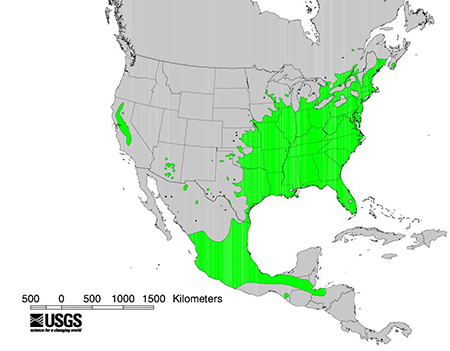
Distribution of common buttonbush.
Common buttonbush's distribution extends from southern Nova Scotia, New Brunswick, Quebec, and Ontario south through southern Florida and west through the eastern half of the Great Plains States [8,16]. Scattered populations exist in New Mexico, Arizona, and the Central Valley of California [28].
States and Provinces
- United States: AL AZ AR CA CT DE FL GA IL IN IA KS KY LA ME MA MI MN MS MO NE NH NJ NM NC OH OK PA RI SC TN TX VT VA WV WI
- Canada: NB NS ON PQ
- Mexico
Site Characteristics
Common buttonbush grows along swamps, marshes, bogs, ditches, and other riparian areas that are inundated for at least part of the year [8,24]. It grows in alluvial plains that experience intermittent flooding, but can be damaged by spring flooding [12,20,23]. Faber-Langendoen and Maycock [7] reported that common buttonbush was very tolerant of flooding and that its abundance increased with increasing water depth. These authors also reported an increase in common buttonbush with an increase in light level. Elevational and geographical distribution of common buttonbush may be limited by mean July temperatures of 68 degrees Fahrenheit (20 deg C) [13]. Elevations have been reported at 635 feet (193 m) in Illinois [1] and between 60 and 160 feet (22-50 m) in Quebec [27]. Common buttonbush was found growing in sandy, loamy sandy, or alluvial soil with a sandy or silty surface in Quebec [27].
Common associates of common buttonbush include American beech (Fagus grandifolia), red maple (Acer rubrum), sugar maple (A. saccharum), ash (Fraxinus spp.), black oak (Quercus velutina), pin oak (Q. palustris), tupelo and gum (Nyssa spp.), baldcypress (Taxodium distichum), southern bayberry (Myrica cerifera), redbay (Persea palustris), holly (Ilex spp.), dogberry (Ribes cynosbati), grape (Vitis spp.), viburnum (Viburnum spp.), poison-ivy (Toxicodendron radicans), indiangrass (Sorgastrom nutans), big bluestem (Andropogon gerardii), switchgrass (Panicum virgatum), and sedge (Carex spp.) [5,7,11].
Plant Communities
Common buttonbush is a wetland shrub common to most swamps and floodplains of eastern and southern North America [8,28]. It is listed as a component of the following community types:
| Area | Classification | Authority |
|---|---|---|
| California: Sacramento Valley | riparian cts | Conard & others 1977 |
| United States | wetland cts | Cowardin & others 1979 |
Botanical Description

Common buttonbush.
Common buttonbush is a deciduous, warm-season, tall shrub or small tree that can reach up to 18 feet (6 m) in height [28]. Its base is often swollen. Branches are usually green when young but turn brown at maturity. Common buttonbush has opposite, lanceolate-oblong leaves about 7 inches (18 cm) long and 3 inches (7.5 cm) wide [24]. Tiny, white flowers occur in dense, spherical clusters at the ends of the branches. Fruits are a round cluster of brown, cone-shaped nutlets [28].
Raunkiaer Life Form (Raunkiaer 1934)
- Phanerophyte
Seasonal Development
Common buttonbush flowers between June and September and produces fruit between September and October [8,24,28].
Regeneration Processes
Common buttonbush regenerates by seed. Seed is best collected when the nutlets have turned reddish-brown, and averages about 134,000 per pound (60,702/kg) [31]. Pretreatment of seeds is unnecessary [3]. Seeds have a low germination rate [28]. Common buttonbush can also be propagated by planting cuttings in moist, sandy soil.
Successional Status
Common buttonbush is a pioneer species in frequently flooded baldcypress/water tupelo (Nyssa aquatica) swamps, establishing on rotting logs and stumps [35]. In the Sacremento Valley, common buttonbush/dogwood (Corunus spp.) communities are succeeded by white alder (Alnus rhombifolia)/willow (Salix spp.)/Oregon ash (Fraxinus latifolia) and eventually cottonwood (Populus spp.) forests [36]. Common buttonbush also colonizes lowland marsh communities dominated by hardstem bulrush (Scirpus acutus).
Immediate Fire Effects
Fire likely top-kills common buttonbush.
Postfire Regeneration Strategy (Stickney 1989)
- off-site colonizer; seed carried by animals or water; postfire yr 1 & 2
Fire Adaptations
Because the base of common buttonbush shrubs are partially submerged during most of the year, fire may not be a threat.
Plant Response to Fire
Common buttonbush sprouts following fire [9,11].
Common buttonbush can become the dominant shrub in grassy, wetland areas of the South excluded from fire [14]. However, when these areas are burned common buttonbush has been observed sprouting within a few months following fire [9,11,29]. Frequent fires in hardwood swamps of the South often promote willow sprouting and, occasionally, common buttonbush sprouting [30].
Following 2 years of drought, a severe fire in an area of the Okefenokee Swamp that supported common buttonbush killed most of the trees and consumed a 1-inch (2.45 cm) layer of peat. Common buttonbush was first observed on study plots 7 years later [34].
Fire Regimes
For fire regime information, search FEIS for this species by entering the species name or acronym on the home page and selecting “Fire Regime” as the publication type.
Fire Management Considerations
In Southern marshlands, where grasses are thick and impenetrable, fire can reduce grass densities and release nutrients, which enhances establishment of shrubs such as common buttonbush [29].
Federal Status
None
Other Status
No entry.
Importance to Wildlife and Livestock
Many species of waterfowl and shorebirds eat common buttonbush seeds [18,28]. White-tailed deer use of common buttonbush browse varies from light in Pennsylvania [32] to heavy in Nova Scotia [23]. Bees use common buttonbush to produce honey [31].
Palatability and Nutritional Value
No entry.
Cover Value
Common buttonbush is important to wood ducks for brood rearing and hiding [19].
Value for Rehabilitation or Restoration of Disturbed Sites
No entry.
Other Uses
The bark of common buttonbush was traditionally used for making laxatives, and for curing skin, bronchial, and venereal diseases [28]. Caution must be used, however, because the bark contains cephalathin, a poison that can induce vomiting, paralysis, and convulsions.
Other Management Considerations
Much of common buttonbush's natural habitat in California is being destroyed by agriculture and water development projects; common buttonbush is not a good colonizer of manmade waterways [13]. Common buttonbush is moderately susceptible to herbicides; if shrubs become too thick, they can be reduced by cutting in the fall during low water [4,18].
Table A1— Forest and range ecosystems, Bureau of Land Management (BLM) physiographic regions, Kuchler plant associations, Society for American Foresters (SAF) forest cover types, and Society for Rangeland Management (SRM) rangeland cover types in which this species occurs.
Forest and Range Ecosystems (Garrison et al. 1977)
- FRES15 Oak - hickory
- FRES16 Oak - gum - cypress
- FRES17 Elm - ash - cottonwood
- FRES18 Maple - beech - birch
- FRES32 Texas savanna
- FRES41 Wet grasslands
- FRES42 Annual grasslands
BLM Physiographic Regions (Bernard and Brown 1977)
- 3 Southern Pacific Border
- 7 Lower Basin and Range
- 12 Colorado Plateau
- 13 Rocky Mountain Piedmont
- 14 Great Plains
Kuchler Plant Associations (Kuchler 1964)
- K030 California oakwoods
- K049 Tule marshes
- K080 Marl - Everglades
- K091 Cypress savanna
- K092 Everglades
- K098 Northern floodplain forest
- K099 Maple - basswood forest
- K100 Oak - hickory forest
- K101 Elm - ash forest
- K102 Beech - maple forest
- K103 Mixed mesophytic forest
- K104 Appalachian oak forest
- K105 Mangrove
- K106 Northern hardwoods
- K110 Northeastern oak - pine forest
- K112 Southern mixed forest
- K113 Southern floodplain forest
- K114 Pocosin
SAF Cover Types (Eyre 1980)
- 14 Northern pin oak
- 16 Aspen
- 19 Grey birch - red maple
- 26 Sugar maple - basswood
- 27 Sugar maple
- 28 Black cherry - maple
- 39 Black ash - American elm - red maple
- 43 Bear oak
- 63 Cottonwood
- 64 Sassafras - persimmon
- 65 Pin oak - sweet gum
- 74 Cabbage palmetto
- 87 Sweet gum - yellow-poplar
- 88 Willow oak - water oak - diamondleaf oak
- 89 Live oak
- 91 Swamp chestnut oak - cherrybark oak
- 92 Sweetgum - willow oak
- 93 Sugarberry - American elm - green ash
- 94 Sycamore - sweetgum - American elm
- 95 Black willow
- 96 Overcup oak - water hickory
- 100 Pondcypress
- 101 Baldcypress
- 102 Baldcypress - tupelo
- 103 Water tupelo - swamp tupelo
- 104 Sweetbay - swamp tupelo - redbay
- 105 Tropical hardwoods
- 106 Mangrove
- 108 Red maple
- 235 Cottonwood - willow
SRM Rangeland Cover Types (Shiflet 1994)
- No entry.
1. Bell, David T. 1974. Tree stratum composition and distribution in the streamside forest. American Midland Naturalist. 92(1): 35-46. [10410]
2. Bernard, Stephen R.; Brown, Kenneth F. 1977. Distribution of mammals, reptiles, and amphibians by BLM physiographic regions and A.W. Kuchler's associations for the eleven western states. Tech. Note 301. Denver, CO: U.S. Department of the Interior, Bureau of Land Management. 169 p. [434]
3. Bonner, F. T. 1974. Cephalanthus occidentalis L. common buttonbush. In: Schopmeyer, C. S., technical coordinator. Seeds of woody plants in the United States. Agric. Handb. 450. Washington, DC: U.S. Department of Agriculture, Forest Service: 301-302. [7580]
4. Bovey, Rodney W. 1977. Response of selected woody plants in the United States to herbicides. Agric. Handb. 493. Washington, DC: U.S. Department of Agriculture, Agricultural Research Service. 101 p. [8899]
5. Cink, Calvin L.; Lowther, Peter E. 1989. Breeding bird populations of a floodplain tallgrass prairie in Kansas. In: Bragg, Thomas B.; Stubbendieck, James, eds. Prairie pioneers: ecology, history and culture: Proceedings, 11th North American prairie conference; 1988 August 7-11; Lincoln, NE. Lincoln, NE: University of Nebraska: 259-262. [14059]
6. Eyre, F. H., ed. 1980. Forest cover types of the United States and Canada. Washington, DC: Society of American Foresters. 148 p. [905]
7. Faber-Langendoen, Don; Maycock, Paul F. 1989. Community patterns and environmental gradients of buttonbush, Cephalanthus occidentalis, ponds in lowland forests of southern Ontario. Canadian Field-Naturalist. 103(4): 479-485. [13458]
8. Fernald, Merritt Lyndon. 1950. Gray's manual of botany. [Corrections supplied by R. C. Rollins]. Portland, OR: Dioscorides Press. 1632 p. (Dudley, Theodore R., gen. ed.; Biosystematics, Floristic & Phylogeny Series; vol. 2). [14935]
9. Forthman, Carol Ann. 1973. The effects of prescribed burning on sawgrass. Coral Gables, FL: University of Miami. 83 p. Thesis. [14571]
10. Garrison, George A.; Bjugstad, Ardell J.; Duncan, Don A.; [and others]. 1977. Vegetation and environmental features of forest and range ecosystems. Agric. Handb. 475. Washington, DC: U.S. Department of Agriculture, Forest Service. 68 p. [998]
11. Gunderson, Lance H. 1984. Regeneration of cypress in logged and burned strands at Corkscrew Swamp Sanctuary, Florida. In: Ewel, Katherine Carter; Odum, Howard T., eds. Cypress swamps. Gainesville, FL: University of Florida Press: 349-357. [14857]
12. Holland, Marjorie M.; Burk, C. John. 1990. The marsh vegetation of three Connecticut River oxbows: a ten-year comparison. Rhodora. 92(871): 166-204. [14521]
13. Holstein, Glen. 1984. California riparian forests: deciduous islands in an evergreen sea. In: Warner, Richard E.; Hendrix, Kathleen M., eds. California riparian systems: Ecology, conservation, and productive management: Proceedings of a conference; 1981 September 17-19; Davis, CA. Berkeley, CA: University of California Press: 2-22. [5830]
14. Huffman, Jean M.; Blanchard, S. W. 1991. Changes in woody vegetation in Florida dry prairie and wetlands during a period of fire exclusion, and after dry-growing-season fire. In: Nodvin, Stephen C.; Waldrop, Thomas A., eds. Fire and the environment: ecological and cultural perspectives: Proceedings of an international symposium; 1990 March 20-24; Knoxville, TN. Gen. Tech. Rep. SE-69. Asheville, NC: U.S. Department of Agriculture, Forest Service, Southeastern Forest Experiment Station: 75-83. [16636]
15. Kuchler, A. W. 1964. Manual to accompany the map of potential vegetation of the conterminous United States. Special Publication No. 36. New York: American Geographical Society. 77 p. [1384]
16. Little, Elbert L., Jr. 1976. Atlas of United States trees. Volume 3. Minor western hardwoods. Misc. Publ. 1314. Washington, DC: U.S. Department of Agriculture, Forest Service. 13 p. 290 maps. [10430]
17. Lyon, L. Jack; Stickney, Peter F. 1976. Early vegetal succession following large northern Rocky Mountain wildfires. In: Proceedings, Tall Timbers fire ecology conference and Intermountain Fire Research Council fire and land management symposium; 1974 October 8-10; Missoula, MT. No. 14. Tallahassee, FL: Tall Timbers Research Station: 355-373. [1496]
18. Martin, Alex C.; Erickson, Ray C.; Steenis, John H. 1957. Improving duck marshes by weed control. Circular 19 (Revised). Washington, DC: U.S. Department of the Interior, Bureau of Sport Fisheries and Wildlife. 60 p. [16324]
19. Parr, Delbert E.; Scott, M. Douglas; Kennedy, David D. 1979. Autumn movements and habitat use by wood ducks in southern Illinois. Journal of Wildlife Management. 43(1): 102-108. [13765]
20. Penfound, William T. 1952. Southern swamps and marshes. The Botanical Review. 18: 413-446. [11477]
21. Powell, A. Michael. 1988. Trees & shrubs of Trans-Pecos Texas including Big Bend and Guadalupe Mountains National Parks. Big Bend National Park, TX: Big Bend Natural History Association. 536 p. [6130]
22. Raunkiaer, C. 1934. The life forms of plants and statistical plant geography. Oxford: Clarendon Press. 632 p. [2843]
23. Roland, A. E. 1991. Coastal-plain plants in inland Nova Scotia. Rhodora. 93(875): 291-298. [16490]
24. Soper, James H.; Heimburger, Margaret L. 1982. Shrubs of Ontario. Life Sciences Misc. Publ. Toronto, ON: Royal Ontario Museum. 495 p. [12907]
25. U.S. Department of Agriculture, Forest Service. 1937. Range plant handbook. Washington, DC. 532 p. [2387]
26. U.S. Department of Agriculture, Soil Conservation Service. 1982. National list of scientific plant names. Vol. 1. List of plant names. SCS-TP-159. Washington, DC. 416 p. [11573]
27. Vincent, Gilles; Bergeron, Yves; Meilleur, Alain. 1986. Plant community pattern analysis: a cartographic approach applied in the Lac des Deux-Montagnes area (Quebec). Canadian Journal of Botany. 64: 326-335. [16948]
28. Vines, Robert A. 1960. Trees, shrubs, and woody vines of the Southwest. Austin, TX: University of Texas Press. 1104 p. [7707]
29. Vogl, Richard J. 1973. Effects of fire on the plants and animals of a Florida wetland. American Midland Naturalist. 89: 334-347. [14580]
30. Wade, Dale; Ewel, John; Hofstetter, Ronald. 1980. Fire in South Florida ecosystems. Gen. Tech. Rep. SE-17. Asheville, NC: U.S. Department of Agriculture, Forest Service, Southeastern Forest Experiment Station. 125 p. [10362]
31. Young, James A.; Young, Cheryl G. 1986. Collecting, processing and germinating seeds of wildland plants. Portland, OR: Timber Press. 236 p. [12232]
32. Bramble, W. C.; Goddard, M. K. 1943. Seasonal browsing of woody plants by white-tailed deer in the bear oak forest type. Journal of Forestry. 41(7): 471-475. [3298]
33. Cowardin, Lewis M.; Carter, Virginia; Golet, Francis C.; LaRoe, Edward T. 1979. Classification of wetlands and deepwater habitats of the United States. FWS/OBS-79/31. Washington, DC: U.S. Department of the Interior, Fish and Wildlife Service. 103 p. [3482]
34. Cypert, Eugene. 1973. Plant succession on burned areas in Okefenokee Swamp following the fires of 1954 and 1955. In: Proceedings, annual Tall Timbers fire ecology conference; 1972 June 8-9; Lubbock, TX. Number 12. Tallahassee, FL: Tall Timbers Research Station: 199-217. [8467]
35. Conner, William H.; Gosselink, James G.; Parrondo, Roland T. 1981. Comparison of the vegetation of three Louisiana swamp sites with different flooding regimes. American Journal of Botany. 68(3): 320-331. [16947]
36. Eleuterius, Lionel N. 1975. The life history of the salt marsh rush, Juncus roemerianus. Bulletin of the Torrey Botanical Club. 102(3): 135-140. [16946]
37. Thompson, Robert S.; Anderson, Katherine H.; Bartlein, Patrick J. 1999. Digital representations of tree species range maps from "Atlas of United States trees" by Elbert L. Little, Jr. (and other publications). In: Atlas of relations between climatic parameters and distributions of important trees and shrubs in North America. Denver, CO: U.S. Geological Survey, Information Services (Producer). On file at: U.S. Department of Agriculture, Forest Service, Rocky Mountain Research Station, Fire Sciences Laboratory, Missoula, MT; FEIS files. [92575]