


Chamaebatia foliolosa, mountain misery
Howard, Janet L. 1992. Chamaebatia foliolosa, mountain misery. In: Fire Effects Information System, [Online]. U.S. Department of Agriculture, Forest Service, Rocky Mountain Research Station, Fire Sciences Laboratory (Producer). Available: https://research.fs.usda.gov/feis/species-reviews/chafol
| Abbreviation | Common Name | Scientific Name | Classification | Status |
|---|---|---|---|---|
| Plants | ||||
| CHAFOL | mountain misery | Chamaebatia foliolosa | Life Form: Plants/Shrub Kingdom: Plantae Class: Dicot Order: Rosales Family: Rosaceae Genus: Chamaebatia | Fed. Protected: No Nativity: Native Invasiveness: Noninvasive |


Taxonomy
The currently accepted name of mountain misery is Chamaebatia foliolosa Benth., in the Rosaceae, or rose, family. There are no recognized subspecies, varieties, or forms. Chamaebatia australis (southern mountain misery), once described as C. foliolosa var. australis, is now considered a distinct species [24,33].
Synonyms
- No entry
Other Common Names
bear-clover, bearmat, kit-kee-dizze, ket-ket-dizze, tarweed, Sierra mountain misery
General Distribution
Mountain misery is distributed along western slopes of the Cascade Range and the Sierra Nevada from Shasta County south to Kern County, California [24,29].
States
- United States: CA
Site Characteristics
Mountain misery grows in a Mediterranean climate, characterized by mild, wet winters and hot, dry summers. At one representative site in the central Sierra Nevada, annual precipitation averages 68 inches (173 cm), with about 98 percent falling between October and May. The top 12 inches (30.5 cm) of soil is dry from June to September.
The most common soil series supporting mountain misery has a loamy texture in surface horizons, grading to a clayey loam with depth. Soil pH is acid to moderately acid [21].
Plants occur at elevations between 2,000 and 7,000 feet (610-2,134 m) [20].
Associated overstory species not listed under Distribution and Occurrence include sugar pine (Pinus lambertiana), incense-cedar (Calocedrus decurrens), Pacific dogwood (Cornus nuttallii), and sequoia (Sequoiadendron giganteum). Understory associates include bush chinquapin (Chrysolepsis sempervirens), mountain whitethorn (Ceanothus cordulatus), deerbrush (C. integerrimus), wedgeleaf ceanothus, Mariposa manzanita (Arctostaphylos manzanita), greenleaf manzanita (A. patula), whiteleaf manzanita (A. viscida), and gooseberry (Ribes spp.) [1,34].
Plant Communities
Mountain misery clones form a low-growing layer in open ponderosa pine (Pinus ponderosa) and mixed coniferous forests [29]. Stands occur in patches, providing from 20 to 90 percent cover [30]. In the Challenge Experimental Forest of the Plumas National Forest, density in the mixed coniferous forest is as high as 17,068 stems per acre (42,175 stems/ha) [15].
In California black oak (Quercus kelloggii) forests, mountain misery frequently codominates the understory with whiteleaf manzanita and greenleaf manzanita [25].
Publications listing mountain misery as a dominant understory species are as follows:
- Profiles of California vegetation [7]
- Montane and subalpine vegetation of the Sierra Nevada and Cascade Ranges [28].

Mountain misery sprouts flowering 15 months after the 2013 Rim Fire on the Stanislaus National Forest.
Botanical Description
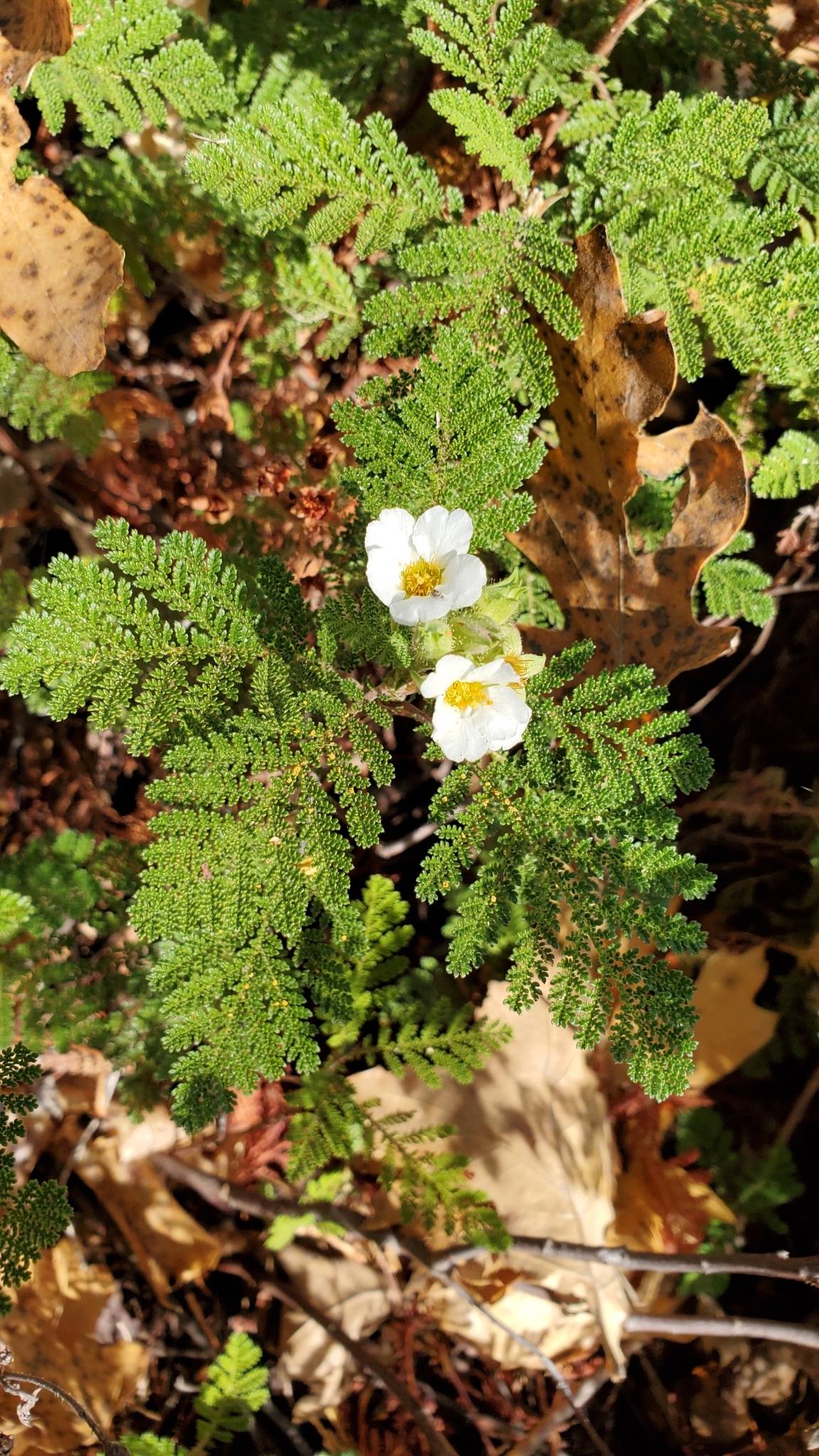
Mountain misery is a low, erect, native evergreen shrub from 0.5 to 2 feet (0.2-0.6 m) in height [29]. The multibranched stems arise at intervals of a few inches from a complicated and sometimes matlike system of roots and rhizomes [32]. Individual rhizomes have been measured at over 82 feet (25 m) in length (Munn, in [31]) and extend from 4 to 16 inches (10-40 cm) beneath the soil surface. Roots are found as deep as 4.9 feet (1.5 m) belowground [30]. Masses of multilobed nitrogen-fixing nodules have been found on roots of plants near Pollock Pines. Examination of roots in areas where soils have thick surface horizons (Ao), however, revealed no root nodulation in that horizon. Roots in lower horizons were not examined [35]. The fernlike, viscid, aromatic leaves are pinnately dissected into tiny crowded segments. Each segment is tipped with a resin gland. Flowers are glutinous. The fruit is an achene about 0.5 inch (5 mm) long, containing a single seed [20,21,24,29].
Raunkiaer Life Form (Raunkiaer 1934)
- Phanerophyte
- Chamaephyte
- Geophyte
Seasonal Development
New leaf initiation begins in spring, with flowers opening from May through July [12,20,24]. Growth usually stops in midsummer, probably limited by inadequate soil moisture [12]. Seed is disseminated in fall [32]. Leaves are retained for 12 to 19 months before abscission [27].
Regeneration Processes
The primary method of reproduction is vegetative. Mountain misery produces clones from its rhizomes, roots, and root crown [15,21]. Sexual reproduction is less frequent. Methods of seed dissemination were not reported in the literature. Seeds require from 1 to 3 months of cold stratification (35 to 41 degrees Fahrenheit [1.7-5.0 deg C]) prior to germination [20].
Successional Status
Mountain misery is moderately shade tolerant, growing under open tree stands but not under closed canopies [1,14]. When fire or other disturbance occurs at regular intervals, it attains subcanopy dominance within 3 to 4 years and remains dominant until the next disturbance [6,13]. Mountain misery is a climax understory species in ponderosa pine forests, which are fire-climax in California [2]. Without fire or other disturbance, it will decline as the overhead canopy closes [1,14].
Immediate Fire Effects
Fire top-kills mountain misery [15].
Postfire Regeneration Strategy (Stickney 1989)
- Small shrub, adventitious-bud root crown
- Rhizomatous shrub, rhizome in soil
- Geophyte, growing points deep in soil
Fire Adaptations
The resinous, finely divided leaves of mountain misery are highly flammable, especially when draped with fallen pine needles and other forest debris. Mountain misery will carry surface fire, and the species is an important element of fuel loads in California's mixed coniferous and ponderosa pine forests. Expert opinions on natural fire frequencies in these forests vary. Fire scar studies show average frequencies of 8 years [4]. Some authorities, however, feel this method gives results that are too conservative. Biswell [4] estimated a natural fire occurrence of about every 4 years in mixed coniferous forests. Biswell [4] thought ponderosa pine forests of California burned approximately every 2 to 3 years. Prior to fire suppression, fires in mixed coniferous and ponderosa pine forests were almost always surface fires, carried in large part by highly concentrated fine fuels composed of mountain misery and coniferous needles, cones, and twigs caught in its foliage and tangled woody stems [4,32].

Mountain misery sprouts flowering 15 months after the 2013 Rim Fire on the Stanislaus National Forest.
Mountain misery survives fire by sprouting from the root crown, roots, and rhizomes following top-kill [15]. It reestablishes on burns almost exclusively from sprouting [16].
Plant Response to Fire
Recovery from fire is rapid. Three years following top-kill by a wildfire of unreported severity on the Tahoe National Forest, mountain misery sprouts were 1.6 to 16 inches (24-40 cm) tall, and occupied 1,612 square feet per acre (370 sq m/ha) [18].
The following Research Project Summaries provide information on prescribed fire and postfire responses of many plant community species including mountain misery:
- Plant response to prescribed burning with varying season, weather, and fuel moisture in mixed-conifer forests of California
- Fire effects and a refined fire prescription after low-intensity spring fires in low-elevation mixed-conifer forests of Yosemite National Park, California
Fire Regimes
For additional fire regime information, search FEIS for this species by entering the species name on the Advanced Search page and selecting “Fire Regime” as the publication type.
Fire Management Considerations
- Mountain misery will carry prescribed ground fire when present in the understory [11]. It is difficult and time-consuming to construct fire breaks within its growth, however, because the numerous, tangled woody stems, rhizomes, and shallow roots must be removed in order to expose mineral soil [32].
- If managers wish to decrease mountain misery cover through the use of prescribed fire, late spring/high consumption prescriptions appear to be most effective. Early spring/moderate consumption fires reduce densities the least [15]. Prescribed burning, however, is only a temporary method of controlling this vigorous sprouter.
- Mountain misery regrowth affords good soil protection in burn areas [32].
Federal Status
None
Other Status
None
Importance to Wildlife and Livestock
Mountain misery is usually considered unpalatable browse of low nutritional quality [8,32]. The resinous oils of the foliage have a penetrating odor throughout the growing season that repels most animals. In winter, when rains have washed the glutinous leaves, wildlife utilize the plant in varying degrees. Black-tailed deer consume more of the foliage than other wildlife. Deer eat it while migrating, and in some localities it comprises a great portion of their winter diet. On the Jawbone Ridge winter deer range of Tuolumne County, where mountain misery has a frequency occurrence of 75 percent, stomach analysis shows that mountain misery provides 37 percent by volume of the deer's winter feed. This degree of ingestion is more striking when compared to the volume percentage consumed of better known browse species. Wedgeleaf ceanothus (Ceanothus cuneatus) makes up only 12 percent by volume of winter diets of deer on Jawbone Ridge.
Livestock find mountain misery unpalatable even after winter rains [29].
Palatability and Nutritional Value
The value of mountain misery as browse is good to fair for black-tailed deer, fair to poor for domestic goats, poor to useless for sheep, and useless for cattle and horses [29].
Nutritive value is reported to lessen in winter months [29], but quantitative nutritional studies of mountain misery were not found in the literature.
Cover Value
Mountain misery provides cover for small birds and mammals.

A mountain quail nest hidden in mountain misery.

A mountain quail nest hidden in mountain misery.
Value for Rehabilitation or Restoration of Disturbed Sites
Mountain misery has high value for watershed protection because it checks runoff, prevents erosion, and maintains the moisture absorption capacity of soils [32].
Other Uses
No entry.
Other Management Considerations
Timber: Mountain misery greatly reduces survival and growth of conifer seedlings [20,22,23,32]. The deep roots are strong competitors for limited water resources. Tappeiner and Radosevich [30] examined its effect on ponderosa pine seedlings on a good site at the Blodgett Research Station of El Dorado County. Treatments were: (1) untreated mountain misery, (2) mountain misery sprayed with a mixture of 2,4-D and 2,4,5-T prior to tree planting, and (3) mountain misery eliminated by a combination of herbicides, clipping, and grubbing to stop root and rhizome invasion. After 3 years, ponderosa pine seedling survival was only 13 percent on untreated plots. Spraying prior to planting resulted in 71 percent survival, and complete control resulted in 97 percent survival of trees. After 19 years, tree heights averaged 5.2 feet (1.6 m) with no treatment, 6.2 feet (1.9 m) with the herbicide mixture, and 18.7 feet (5.7 m) with the combination of treatments. When this loss is extended to 50 years, net wood production would have been reduced an estimated 75 percent as a result of mountain misery competition.
Control: Mountain misery is sensitive to intermediate in response to foliar spraying of phenoxy herbicides and is susceptible to such applications of dicamba and triclopyr [5,18]. Aerosol application of triclopyr temporarily reduced mountain misery canopy volume by 94 to 96 percent on the Tahoe National Forest [18]. Mountain misery may sprout vigorously following herbicide treatment, and one application probably will not provide adequate control. Plants may actually be rejuvenated by a single treatment. Thorough site preparation, which controls mountain misery before planting and permits good establishment of conifer seedlings, followed by spraying of mountain misery sprouts is recommended. Growth of conifer seedlings and competing mountain misery should be evaluated for at least 10 years after planting [30]. Best results are obtained when herbicides are applied in spring or early summer during the period of new leaf initiation [18]. Mountain misery can also be controlled by grubbing.
Plywood, used as an unusual mulch for Douglas-fir (Pseudotsuga menziesii) seedlings on a plantation in the central Sierra Nevada, killed mountain misery beneath it and increased soil moisture available to seedlings in midsummer [22].
Control of mountain misery is problematic for forest managers. Although it greatly inhibits growth of young conifers, it is of considerable value as a slope stabilizer of watersheds and because it is a host species for nitrogen-fixing bacteria [32,35]. Additionally, Sampson and Jesperson [29] thought that heavy black-tailed deer use on some winter ranges should be taken into consideration when managing this species.
| Biophysical Setting | Mean Fire Interval (years) | Fire Severity Percent (%) | ||||||
|---|---|---|---|---|---|---|---|---|
| Code | Fire Regime Group | Low | Mixed | Replacement | All | Low | Mixed | Replacement |
| Series 10270 - Mediterranean California Dry-Mesic Mixed Conifer Forest and Woodland | ||||||||
| 10270_2_3_7 | I-B | 12 | 32 | 337 | 8 | 71 | 26 | 3 |
| 10270_4_5_6 | I-B | 17 | 35 | 150 | 11 | 62 | 31 | 7 |
| Series 10280 - Mediterranean California Mesic Mixed Conifer Forest and Woodland | ||||||||
| 10280_2_3 | I-B | 25 | 47 | 237 | 15 | 61 | 33 | 6 |
| 10280_4_6_7_12 | I-C | 33 | 46 | 148 | 17 | 51 | 37 | 12 |
| Series 10300 - Mediterranean California Lower Montane Black Oak-Conifer Forest and Woodland | ||||||||
| 10300_2_3_4_5_6_7 | I-B | 15 | 38 | 176 | 10 | 67 | 27 | 6 |
| Series 10310 - California Montane Jeffrey Pine(-Ponderosa Pine) Woodland | ||||||||
| 10310_2_3_4_5_6_12 | I-B | 11 | 84 | 165 | 9 | 83 | 11 | 6 |
| 10310_7 | I-C | 26 | 118 | 200 | 19 | 74 | 16 | 10 |
| Series 11700 - Klamath-Siskiyou Xeromorphic Serpentine Savanna and Chaparral | ||||||||
| 11700_2_3_7 | I-B | 14 | 201 | 13 | 93 | 0 | 7 | |
| Series 10080 - North Pacific Oak Woodland | ||||||||
| 10080_1_2_3_7 | I-B | 14 | 37 | 293 | 10 | 71 | 26 | 3 |
| Series 10290 - Mediterranean California Mixed Oak Woodland | ||||||||
| 10290_2_3_4_5_6_7_12 | I-B | 11 | 33 | 285 | 8 | 72 | 25 | 3 |
| Series 10320 - Mediterranean California Red Fir Forest | ||||||||
| 10320_2_3_7 | I-C | 58 | 58 | 189 | 25 | 43 | 43 | 14 |
| Series 10440 - Northern California Mesic Subalpine Woodland | ||||||||
| 10440_3_6_7 | V-A | 929 | 504 | 327 | 0 | 35 | 65 | |
| Series 11130 - California Coastal Live Oak Woodland and Savanna | ||||||||
| 11130_3 | I-B | 27 | 31 | 174 | 13 | 50 | 42 | 8 |
| 11130_4 | I-B | 27 | 31 | 175 | 13 | 50 | 42 | 8 |
| Series 11140 - California Lower Montane Blue Oak-Foothill Pine Woodland and Savanna | ||||||||
| 11140_3_6_7 | I-B | 10 | 572 | 128 | 9 | 91 | 2 | 7 |
| 11140_4_5 | I-B | 14 | 150 | 127 | 12 | 83 | 8 | 9 |
| Series 11120 - California Central Valley Mixed Oak Savanna | ||||||||
| 11120_4_5 | I-B | 14 | 96 | 181 | 11 | 82 | 12 | 6 |
| Series 11180 - Southern California Oak Woodland and Savanna | ||||||||
| 11180_4 | I-C | 30 | 43 | 173 | 16 | 54 | 37 | 9 |
| Series 10321 - Mediterranean California Red Fir Forest - Cascades | ||||||||
| 10321_6 | I-C | 58 | 176 | 149 | 34 | 58 | 19 | 23 |
| Series 10322 - Mediterranean California Red Fir Forest - Southern Sierra | ||||||||
| 10322_6 | III-A | 78 | 317 | 294 | 52 | 66 | 16 | 18 |
| Series 10510 - Southern Rocky Mountain Dry-Mesic Montane Mixed Conifer Forest and Woodland | ||||||||
| 10510_6 | I-B | 14 | 76 | 91 | 11 | 74 | 14 | 12 |
| Series 11720 - Sierran-Intermontane Desert Western White Pine-White Fir Woodland | ||||||||
| 11720_7 | I-C | 45 | 65 | 202 | 24 | 52 | 36 | 12 |
| Series 10540 - Southern Rocky Mountain Ponderosa Pine Woodland | ||||||||
| 10540_13_14 | I-B | 28 | 39 | 254 | 15 | 55 | 39 | 6 |
| Series 11170 - Southern Rocky Mountain Ponderosa Pine Savanna | ||||||||
| 11170_13_15_28 | I-B | 11 | 368 | 11 | 97 | 0 | 3 | |
| Summary | ||||||||
| Minimum | 10 | 31 | 91 | 8 | 0 | 0 | 3 | |
| Maximum | 78 | 929 | 504 | 327 | 97 | 43 | 65 | |
| Mean | 26 | 139 | 217 | 29 | 65 | 24 | 11 | |
| Median | 17 | 53 | 185 | 13 | 67 | 26 | 8 | |
| Percentage of fires in 3 fire severity classes, derived from LANDFIRE succession modeling. Replacement-severity fires cause >75% kill or top-kill of the upper canopy layer; mixed-severity fires cause 26%-75%; low-severity fires cause <26%. | ||||||||
| LANDFIRE. 2020. Biophysical settings models and descriptions, [Online]. Washington, DC: U.S. Department of Agriculture, Forest Service; U.S. Department of the Interior; U.S. Geological Survey; Arlington, VA: The Nature Conservancy, (Producers). Available: https://www.landfirereview.org/search.php [96496] | ||||||||
Table A1— Forest and range ecosystems, Bureau of Land Management (BLM) physiographic regions, Kuchler plant associations, Society for American Foresters (SAF) forest cover types, and Society for Rangeland Management (SRM) rangeland cover types in which this species occurs.
Forest and Range Ecosystems (Garrison et al. 1977)
- FRES21 Ponderosa pine
- FRES23 Fir – spruce
- FRES28 Western hardwoods
BLM Physiographic Regions (Bernard and Brown 1977)
- 4 Sierra Mountains
Kuchler Plant Associations (Kuchler 1964)
- K005 Mixed conifer forest
- K007 Red fir forest
- K010 Ponderosa shrub forest
- K011 Western ponderosa forest
- K030 California oakwoods
SAF Cover Types (Eyre 1980)
- 207 Red fir
- 211 White fir
- 243 Sierra Nevada mixed conifer
- 244 Pacific ponderosa pine - Douglas-fir
- 245 Pacific ponderosa pine
- 246 California black oak
- 247 Jeffrey pine
- 249 Canyon live oak
- 250 Blue oak - foothills pine
SRM Rangeland Cover Types (Shiflet 1994)
- No entry
1. Adams, Lowell; Dunaway, David J. 1960. The effect of timber overstory on deer habitat in mixed conifer type. Res. Note No. 158. Berkeley, CA: U.S. Department of Agriculture, Forest Service, Pacific Southwest Forest and Range Experiment Station. 2 p. [16894]
2. Bancroft, Larry. 1979. Fire management plan: Sequoia and Kings Canyon National Parks. San Francisco, CA: U.S. Department of the Interior, National Park Service, Western Region. 190 p. [11887]
3. Bernard, Stephen R.; Brown, Kenneth F. 1977. Distribution of mammals, reptiles, and amphibians by BLM physiographic regions and A.W. Kuchler's associations for the eleven western states. Tech. Note 301. Denver, CO: U.S. Department of the Interior, Bureau of Land Management. 169 p. [434]
4. Biswell, Harold H. 1973. Fire ecology in ponderosa pine-grassland. In: Komarek, Edwin V., Sr., technical coordinator. Proceedings, annual Tall Timbers fire ecology conference; 1972 June 8-9; Lubbock, TX. Number 12. Tallahassee, FL: Tall Timbers Research Station: 69-96. [8462]
5. Bovey, Rodney W. 1977. Response of selected woody plants in the United States to herbicides. Agric. Handb. 493. Washington, DC: U.S. Department of Agriculture, Agricultural Research Service. 101 p. [8899]
6. Burcham, L. T. 1957. California range land: An historico-ecological study of the range resource of California. Sacramento, CA: State of California, Department of Natural Resources, Division of Forestry. 247 p. [186]
7. Critchfield, William B. 1971. Profiles of California vegetation. Res. Pap. PSW-76. Berkeley, CA: U.S. Department of Agriculture, Forest Service, Pacific Southwest Forest and Range Experiment Station. 54 p. [712]
8. Dayton, William A. 1931. Important western browse plants. Misc. Publ. 101. Washington, DC: U.S. Department of Agriculture. 214 p. [768]
9. Eyre, F. H., ed. 1980. Forest cover types of the United States and Canada. Washington, DC: Society of American Foresters. 148 p. [905]
10. Garrison, George A.; Bjugstad, Ardell J.; Duncan, Don A.; [and others]. 1977. Vegetation and environmental features of forest and range ecosystems. Agric. Handb. 475. Washington, DC: U.S. Department of Agriculture, Forest Service. 68 p. [998]
11. Green, Lisle R. 1982. Prescribed burning in the California Mediterranean ecosystem. In: Conrad, C. Eugene; Oechel, Walter C., technical coordinators. Proceedings of the symposium on dynamics and management of Mediterranean-type ecosystems; 1981 June 22-26; San Diego, CA. Gen. Tech. Rep. PSW-58. Berkeley, CA: U.S. Department of Agriculture, Forest Service, Pacific Southwest Forest and Range Experiment Station: 464-471. [6052]
12. Holland, Robert F. 1986. Preliminary descriptions of the terrestrial natural communities of California. Sacramento, CA: California Department of Fish and Game. 156 p. [12756]
13. Horn, E. E. 1938. Some wildlife-forest relationships. Transactions, 3rd North American Wildlife Conference. 3: 376-380. [15135]
14. Horton, Jerome S. 1949. Trees and shrubs for erosion control of southern California mountains. Berkeley, CA: U.S. Department of Agriculture, Forest Service, California [Pacific Southwest] Forest and Range Experiment Station; California Department of Natural Resources, Division of Forestry. 72 p. [10689]
15. Kauffman, J. Boone; Martin, R. E. 1985. A preliminary investigation on the feasibility of preharvest prescribed burning for shrub control. In: Proceedings, 6th annual forestry vegetation management conference; [Date of conference unknown]; Redding, CA. [Place of publication unknown]. [Publisher unknown]. 89-114. [7526]
16. Kauffman, J. B.; Martin, R. E. 1990. Sprouting shrub response to different seasons and fuel consumption levels of prescribed fire in Sierra Nevada mixed conifer ecosystems. Forest Science. 36(3): 748-764. [13063]
17. Kuchler, A. W. 1964. Manual to accompany the map of potential vegetation of the conterminous United States. Special Publication No. 36. New York: American Geographical Society. 77 p. [1384]
18. Lanini, W. Thomas; Radosevich, Steven R. 1982. Herbicide effectiveness in response to season of application and shrub physiology. Weed Science. 30: 467-475. [3389]
19. Lyon, L. Jack; Stickney, Peter F. 1976. Early vegetal succession following large northern Rocky Mountain wildfires. In: Proceedings, Tall Timbers fire ecology conference and Intermountain Fire Research Council fire and land management symposium; 1974 October 8-10; Missoula, MT. No. 14. Tallahassee, FL: Tall Timbers Research Station: 355-373. [1496]
20. Magill, Arthur W. 1974. Chamaebatia foliolosa Benth. bearmat. In: Schopmeyer, C. S., technical coordinator. Seeds of woody plants in the United States. Agric. Handb. 450. Washington, DC: U.S. Department of Agriculture, Forest Service: 315. [7585]
21. McDonald, Philip M.; Fiddler, Gary O. 1989. Competing vegetation in ponderosa pine plantations: ecology and control. Gen. Tech. Rep. PSW-113. Berkeley, CA: U.S. Department of Agriculture, Forest Service, Pacific Southwest Forest and Range Experiment Station. 26 p. [15923]
22. McDonald, Philip M.; Helgerson, Ole T. 1990. Mulches aid in regenerating California and Oregon forests: past, present, and future. Gen. Tech. Rep. PSW-123. Berkeley, CA: U.S. Department of Agriculture, Forest Service, Pacific Southwest Research Station. 19 p. [15105]
23. Miller, Daniel L. 1988. The influence of competing vegetation in ponderosa pine forests. In: Baumgartner, David M.; Lotan, James E., compilers. Ponderosa pine: The species and its management: Symposium proceedings; 1987 September 29 - October 1; Spokane, WA. Pullman, WA: Washington State University, Cooperative Extension: 115-120. [9407]
24. Munz, Philip A. 1973. A California flora and supplement. Berkeley, CA: University of California Press. 1905 p. [6155]
25. Parsons, David J. 1981. The historical role of fire in the foothill communities of Sequoia National Park. Madrono. 28(3): 111-120. [13586]
26. Raunkiaer, C. 1934. The life forms of plants and statistical plant geography. Oxford: Clarendon Press. 632 p. [2843]
27. Rundel, Philip W. 1986. Structure and function in California chaparral. Fremontia. 14(3): 3-10. [18650]
28. Rundel, Philip W.; Parsons, David J.; Gordon, Donald T. 1977. Montane and subalpine vegetation of the Sierra Nevada and Cascade Ranges. In: Barbour, Michael G.; Major, Jack, eds. Terrestrial vegetation of California. New York: John Wiley & Sons: 559-599. [4235]
29. Sampson, Arthur W.; Jespersen, Beryl S. 1963. California range brushlands and browse plants. Berkeley, CA: University of California, Division of Agricultural Sciences, California Agricultural Experiment Station, Extension Service. 162 p. [3240]
30. Tappeiner, John C., II; Radosevich, Steven R. 1982. Effect of bearmat (Chamaebatia foliolosa) on soil moisture and ponderosa pine (Pinus ponderosa ) growth. Weed Science. 30: 98-101. [19201]
31. Tappeiner, John; Zasada, John; Ryan, Peter. 1988. Structure of salmonberry clones and understories in western coastal Oregon forests: the basis for stable shrub communities. Unpublished paper on file at: College of Forestry, Oregon State University, U.S. Department of Agriculture Forest Service, Pacific Northwest Research Station, Corvallis, OR: 27 p. [7061]
32. U.S. Department of Agriculture, Forest Service. 1937. Range plant handbook. Washington, DC. 532 p. [2387]
33. U.S. Department of Agriculture, Soil Conservation Service. 1982. National list of scientific plant names. Vol. 1. List of plant names. SCS-TP-159. Washington, DC. 416 p. [11573]
34. Aleksiuk, Michael. 1970. The seasonal food regime of arctic beavers. Ecology. 51(2): 264-270. [18436]
35. Heisey, Rod M.; Delwiche, C. C.; Virginia, Ross A.; [and others]. 1980. A new nitrogen-fixing non-legume: Chamaebatia foliolosa (Rosaceae). American Journal of Botany. 67(3): 429-431. [19803]