


Cladium mariscus subsp. jamaicense, Jamaica swamp sawgrass
Uchytil, Ronald J. 1992. Cladium mariscus subsp. jamaicense, Jamaica swamp sawgrass.In: Fire Effects Information System, [Online]. U.S. Department of Agriculture, Forest Service, Rocky Mountain Research Station, Fire Sciences Laboratory (Producer). Available: https://research.fs.usda.gov/feis/species-reviews/clamarj
| Abbreviation | Common Name | Scientific Name | Classification | Status |
|---|---|---|---|---|
| Plants | ||||
| CLAMARJ | Jamaica swamp sawgrass | Cladium mariscus subsp. jamaicense | Life Form: Plants/Graminoid Kingdom: Plantae Class: Monocot Order: Cyperales Family: Cyperaceae Genus: Cladium | Fed. Protected: No Nativity: Native Invasiveness: Noninvasive |


Taxonomy
The scientific name of Jamaica swamp sawgrass is Cladium mariscus (L.) Pohl subsp. jamaicense (Crantz) Kuk. [26]. There are no recognized infrataxa.
Synonyms
- Cladium jamaicense Crantz. [10,21]
- Mariscus jamaicensis (Crantz) Britt.
Other Common Names
Jamaica sawgrass, sawgrass
General Distribution
Jamaica swamp sawgrass is most extensive in southern Florida, but it occurs in all the southeastern Coast States and Gulf States. Its range extends from coastal Virginia to Florida and west to southeastern Texas. It is also native to Puerto Rico and the West Indies. An outlying population grows in Guadalupe Mountains National Park, Texas [10,29]. Jamaica swamp sawgrass is also native to Hawaii [31].

Distribution of Jamaica swamp sawgrass in the coterminous United States.

Distribution of Jamaica swamp sawgrass in Hawaii.

Distribution of Jamaica swamp sawgrass in Puerto Rico.
States and Provinces
- United States: AL FL GA HI LA MS NC SC TX VA
Site Characteristics
Jamaica swamp sawgrass primarily grows in shallow, freshwater marshes, although it occasionally grows in and may even dominate some brackish water areas [27,29]. It grows best on seasonally flooded sites in which the period of inundation is 6 to 9 months, or longer [14,15,27]. Optimum water depth is about 1 foot (0.28 m) [1]. Jamaica swamp sawgrass grows best on deep organic soils. In fact, the vast Jamaica swamp sawgrass marshes of the Everglades grow on peat and muck deposits up to 13 feet (4 m) deep [24]. Jamaica swamp sawgrass also grows on marl soil and even in small solution holes in rocky areas, but with decreased vigor [8]. Jamaica swamp sawgrass has extremely low nutrient requirements. It dominates the Everglade's organic peats which are deficient in minor elements and have low quantities of available phosphorus and potash [14,24].
Plant Communities
Kushlan [14] speculated that Jamaica swamp sawgrass-dominated communities once covered nearly 2 million acres (800,000 ha) of the Everglades. Although Jamaica swamp sawgrass stands have declined due to reduced water flows and increased salinity, they still dominate approximately 65 to 70 percent of the remaining Everglades. Jamaica swamp sawgrass marshes have been classified into two general categories: (1) dense stands occurring in shallow water underlain by deep organic soils and (2) sparse stands occurring in deep water on shallow peat or marl [14]. Dense stands appear monospecific but often include other tall emergents. Sparse stands often include considerable amounts of spikerush (Eleocharis spp.), arrowhead (Sagittaria latifolia, S. lancifolia), and maidencane (Panicum hemitomon).
Published classifications describing Jamaica swamp sawgrass community types (cts) include:
| Area | Classification | Authority |
|---|---|---|
| Florida, Everglades | General veg. cts | Loveless 1959 |
| Louisiana, southeast | Marshland veg. cts | Penfound & Hathaway 1938 |
Loveless [15] found that the Jamaica swamp sawgrass-arrowhead-maidencane community type was the most extensive in the Everglades and covered vast areas of marsh. Common associates in Jamaica swamp sawgrass-dominated freshwater marshes in southeastern Louisiana include cattail (Typha angustifolia, T. latifilia) and giant bulrush (Scirpus californicus) [29].

Jamaica swamp sawgrass dominates the Kawainui Marsh, Oahu, HI.
Botanical Description
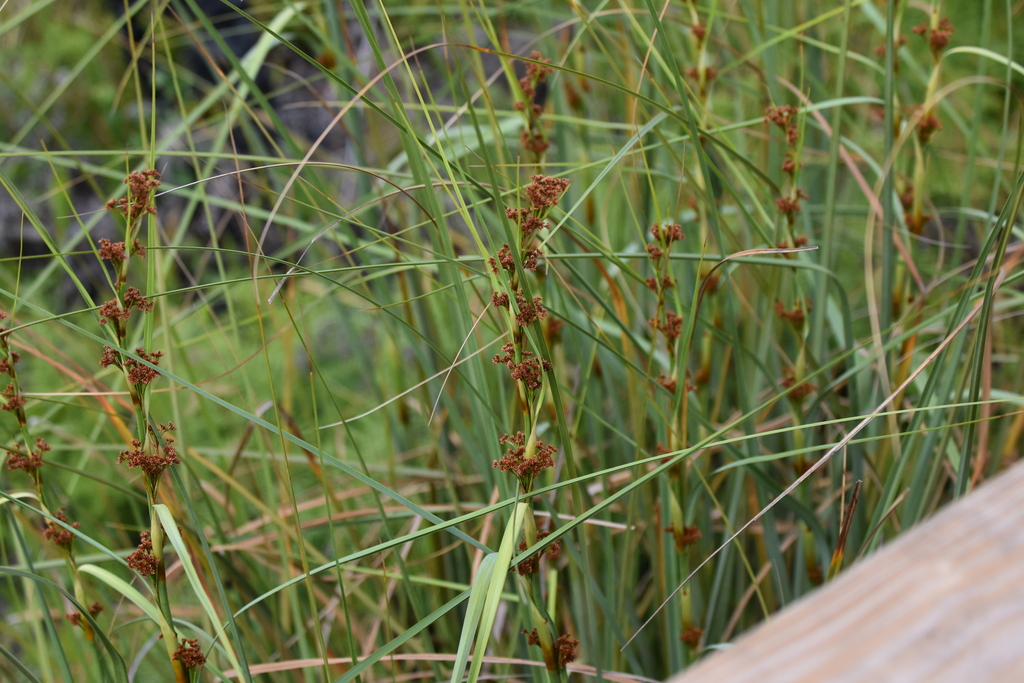
Jamaica swamp sawgrass is a coarse, rhizomatous, perennial sedge. The flat 0.5-inch-wide (1.2 cm) leaves have saw-toothed margins, and are seldom less than 3 feet (1 m) long, and typically 6 to 10 feet (2-3 m) long [8]. Jamaica swamp sawgrass often grows in dense, nearly monospecific stands which result from an extensive network of rhizomes. Apical meristems arise from the top of the rhizomes. In the Everglades, Yates [28] found that rhizomes were generally within the top 4 inches (10 cm) in marl soil, and within the top 6 to 8 inches (15-20 cm) of peat soil. On permanently flooded sites Jamaica swamp sawgrass forms tussocks and the roots and rhizomes grow above the sediment surface [28].

Jamaica swamp sawgrass.
Raunkiaer Life Form (Raunkiaer 1934)
- Cryptophyte
Seasonal Development
In Florida, Jamaica swamp sawgrass vegetative growth is not winter dormant. In fact, it is one of the most cold-tolerant of Florida's marsh species [24]. Leaf growth continues year-round but does slow somewhat during the dry season [11]. Flowering stalks are first visible in March or April. They grow rapidly and are in full flower by June or July. Seeds mature by August, and thereafter begin dropping [1,28]. After flowering, the culm and its associated leaves and rhizome die. Death and decay are rapid [1].
Regeneration Processes
Jamaica swamp sawgrass's predominant mode of reproduction is vegetative through an extensive rhizome system [1].
Sexual reproduction via seedling establishment is generally insignificant [1,24]. Although seeds are produced each year in most stands, seedling establishment and survival are rare. Seed production varies greatly from year to year, and from one location to another. Occasionally large numbers of seeds are produced, but viability is usually low. Germination of southern Florida seed averaged about 20 percent [1]. In southern Florida, seedfall begins in early August, which coincides with the wet season. The floating seeds are primarily water-dispersed. Some seeds are also dispersed by waterfowl after passing through the digestive tract unharmed [28]. Naturally germinating seedlings have been observed in the fall following summer seed dispersal. They are usually found in open areas with wet but unflooded soils. Seedling survival is poor because the seedlings are intolerant of fluctuating water levels and are killed by either dry-down or flooding [1].
Successional Status
Jamaica swamp sawgrass stands are relatively stable on sites shallowly flooded for most of the year. However, when flooding depth or hydroperiod is altered, Jamaica swamp sawgrass is replaced by other communities. When water levels increase, Jamaica swamp sawgrass is often replaced by cattails, pickerelweed (Pontederia lanceolata), fire flag (Thalia geniculata), maidencane, spikerush, white water lily (Nymphaea odorata), neverwet (Orontium aquaticum), and yellow lotus (Nelumbo lutea) [1,14]. When water levels are reduced or hydroperiods shortened, drier site species replace Jamaica swamp sawgrass. These include wax myrtle (Myrica cerifera), saltbush (Baccharis spp.), buttonwood (Concarpus erecta), red mangrove (Rhizophora mangle), plume grass (Erianthus giganteus), muhly grass (Muhlenbergia spp.), marsh fleabane (Pluchea spp.), fennels (Eupatorium spp.), hemp vine (Mikania spp.), pigweed (Acnida cuspidata), bluestems (Andropogon spp.), and giant bristlegrass (Setaria magna) [5,15,27].
In areas of the Everglades receiving nutrient rich inflows such as along canal system inflow gates, Jamaica swamp sawgrass stands are being invaded by Dominican cattail (T. domingensis) [6].
Primarily a freshwater species, Jamaica swamp sawgrass has been replaced by saltmarsh species in the southern Everglades as brackish water moves farther inland due to reduced freshwater inflows and the slowly rising sea level [27].
Immediate Fire Effects
In general, fires carry well in both drained and flooded Jamaica swamp sawgrass stands, consuming most of the aboveground or abovewater biomass. On flooded sites, plants are burned down to a uniform height, usually several inches above the water surface [8,27].
The effects of fire on Jamaica swamp sawgrass mortality vary with water depth and soil moisture. On flooded sites, and on sites with exposed but saturated soils, no underground regenerative structures are harmed. As soils begin to dry, however, some meristems are killed by the heat of fire. When soils become dry because of drought or marshland drainage by man, fires can burn deep into peat layers, consuming all of the rhizomes and roots, thus killing entire stands [8,27].
Jamaica swamp sawgrass typically sprouts and grows rapidly after fire, but is killed if water levels rise rapidly, keeping the new growth completely submerged [14].
In the Everglades, peat-destroying fires have been recorded in the 1920's, 1937, 1945, 1946, 1947, 1951, 1952, 1962, and 1965 [12]. In some areas, the peat burned to bedrock or marl soil [5]. These fires destroyed "tremendous expanses" of Jamaica swamp sawgrass communities, which were replaced by maidencane or shallow-water aquatic communities. The increased frequency of these severe fires, which would normally only occur under extended drought conditions, is a result of man's alterations of the Everglade's hydrology (lowering of the water table).
Postfire Regeneration Strategy (Stickney 1989)
- Rhizomatous herb, rhizome in soil
Fire Adaptations
For much of the year, Jamaica swamp sawgrass rhizomes are buried in soil under water where they cannot be harmed by the heat of a fire. Even when marsh soils are exposed during low water level periods, the meristems are insulated by surrounding, tightly overlapping leaves. Furthermore, these attached leaves often act as wicks when soils are moist, keeping the base of the culm moist [14,27]. When aboveground foliage is consumed by fire, Jamaica swamp sawgrass quickly initiates new top-growth (often within a day) from these surviving rhizomes.
Yates [28] observed Jamaica swamp sawgrass seeds germinating on recently burned sites. However, seedling establishment is an insignificant mode of postfire recovery for Jamaica swamp sawgrass.
Plant Response to Fire
Leaf Growth: If rhizomes and meristems are undamaged, regrowth is rapid following fires occurring at any time of the year. Plants may sprout the day after burning, and within 2 weeks, leaves are commonly 8 to 16 inches (20-40 cm) tall [8]. Within 6 months plants have typically grown 3 to 6 feet (1-2 m) tall, and within 1 to 2 years approach preburn heights [8,12,23,25,28].
Cover and Weight: Most of the cover in unburned Jamaica swamp sawgrass stands is from accumulated litter [8]. Thus, even 1 year after burning, cover remains low because the cover is entirely from live leaves. In the Everglades, Jamaica swamp sawgrass regained about 50 percent of its preburn cover and 70 percent of its standing crop (aboveground dry weight) within 1 year of burning [8]. If fire damages the meristems, regrowth is much slower. A wildfire burned Jamaica swamp sawgrass stands in the Everglades in May 1971, an extreme drought year. Eighteen months after burning, the standing crop of burned stands was only 38 percent of that of unburned stands [24].
Density: In the Everglades, Jamaica swamp sawgrass density was neither increased nor decreased following burning when standing water was present [8].
Flowering: Fire does not seem to stimulate flowering in Jamaica swamp sawgrass. Flower stalks are usually produced the second year following burning [5] but have been observed in April following January and February prescribed burns [12].
Growth rates following burning vary with soil moisture and season of burning. The most rapid growth occurs following winter or spring burning on sites that are flooded or have saturated soils. Tilmant [25] observed Jamaica swamp sawgrass growing up to 2.5 feet (0.75 m) 2 weeks after an early March burn that took place when water was at the ground surface level.
In the Everglades, plants regained 73 to 98 percent of their preburn height within 7 to 12 months after burning [8]:
| Date burned | 31 Oct 1971 | 9 Dec 1971 | 8 or 16 March 1972 |
|---|---|---|---|
| Average preburn height (in.) | 107 | 133 | 93 |
| Average postburn height in Oct 1972 (in) | 90 | 97 | 92 |
| Preburn height regain by Oct 1972 (%) | 85 | 73 | 98 |
The sites burned in March 1972 had burned 1 year earlier, and thus preburn leaf height was lower than normal. Nevertheless, the rate of growth following this spring burn was greater than the fall burn growth rates.
Fire Regimes
Jamaica swamp sawgrass evolved under a regime of frequent fire and requires fire to maintain dominance. Without fire, litter builds up and surpasses live biomass in just 3 to 5 years [27]. After many years without burning, plant vigor declines. Estimates of natural fire frequencies range from 3 to 25 years [27]. Kushlan [14] felt that Jamaica swamp sawgrass marsh is best adapted to burning about once every 10 years; however, Jamaica swamp sawgrass responds well to prescribed burning intervals of 3 to 5 years [27] and has also shown no detrimental effects from burning 2 successive years [8]. For additional fire regime information, search FEIS for this species by entering the species name or acronym on the home page and selecting “Fire Regime” as the publication type.
Fire Management Considerations
Jamaica swamp sawgrass leaves have a high surface area-to-volume ratio, and, after a few years without burning, stands accumulate much of this dead fuel which promotes fire spread. In general, dense stands are easy to ignite and burn hot. They will burn within hours after a rain and when water levels are a foot (0.28 m) or deeper [27]. The highest temperatures during Jamaica swamp sawgrass fires occur at about 1.6 feet (0.5 m) above the water surface where most litter accumulates. During Jamaica swamp sawgrass fires in the Everglades, maximum temperatures at this height ranged from 576 to 750 degrees Fahrenheit (302-399 C) [8].
Fires will generally not carry in sparse Jamaica swamp sawgrass stands when water is present or soils are saturated. In dense Jamaica swamp sawgrass stands in the Everglades, when water was present, fire spread in a fingering or mosaic pattern and stopped when it reached sparse Jamaica swamp sawgrass, open glade, or dense hardwood stands [8]. Containment is not a problem when burning Jamaica swamp sawgrass because most prescribed burning takes place when water is present, and thus fire usually stops when it reaches an area of sparse fuel more than a few feet (1 m) wide [27].
In Jamaica swamp sawgrass stands burns are prescribed mainly to reduce wildfire hazard. To accomplish this, burning has to remove much of the accumulated litter. Prescribed burning can be done safely anytime the soil is wet but is usually done when several inches of water is present to allow the use of airboats [27]. Burning when water is present also ensures Jamaica swamp sawgrass survival because the water layer protects the rhizomes. Conversely, prescribed burns can be used to kill Jamaica swamp sawgrass if burning takes place when the marsh floor is completely dry. Whenever possible, headfires or spot fires should be used when burning Jamaica swamp sawgrass [27]. Pushed by the wind, these fires will cross areas of sparse fuels backfires are unable to. Also, because headfires are fast-moving, they are less likely to dry-out and ignite any elevated areas of organic soil.
Fire plays an important role in the competitive relationship between Jamaica swamp sawgrass and maidencane. In many marshes Jamaica swamp sawgrass competitively excludes maidencane. However, maidencane quickly invades when Jamaica swamp sawgrass stands are destroyed by severe, peat-consuming fires. Jamaica swamp sawgrass reestablishment is slow because maidencane inhibits Jamaica swamp sawgrass seedling establishment. Jamaica swamp sawgrass may eventually reclaim these areas, but only slowly, through rhizome expansion [16].
Federal Status
None
Other Status
No entry.
Importance to Wildlife and Livestock
Jamaica swamp sawgrass leaves are practically worthless as forage and are generally avoided by livestock, wild ungulates, and small mammals [9,24]. The starchy underground organs are consumed occasionally by muskrat [25], and frequently by nutria [20].
The seeds are eaten by ducks and shorebirds but generally in small to moderate quantities [4,19,28]. After a few years without burning, Jamaica swamp sawgrass stands become very dense and accumulate much standing dead material. This dense cover prevents waterfowl from foraging for the seeds. Burning opens the stands, making foraging for seeds much easier [23,27].
Palatability and Nutritional Value
Jamaica swamp sawgrass's palatability to livestock is low [9,24].
Cover Value
Jamaica swamp sawgrass provides good hiding cover for ducks, muskrat, racoon, mink, and otter [17]. In Louisiana, dense Jamaica swamp sawgrass stands support high densities of mink because they provide excellent cover, elevation above the water, and prey [2]. In the Everglades, round-tailed muskrats use Jamaica swamp sawgrass stands for nesting only when the stands are bordered by other communities which contain preferred foods [25].
Value for Rehabilitation or Restoration of Disturbed Sites
No entry.
Other Uses
No entry.
Other Management Considerations
Jamaica swamp sawgrass is susceptible to changes in salinity and hydroperiod [see Successional Status].
Table A1— Forest and range ecosystems, Bureau of Land Management (BLM) physiographic regions, Kuchler plant associations, Society for American Foresters (SAF) forest cover types, and Society for Rangeland Management (SRM) rangeland cover types in which this species occurs.
Forest and Range Ecosystems (Garrison et al. 1977)
- FRES16 Oak - gum - cypress
- FRES41 Wet grasslands
BLM Physiographic Regions (Bernard and Brown 1977)
- 13 Rocky Mountain Piedmont
Kuchler Plant Associations (Kuchler 1964)
- K073 Northern cordgrass prairie
- K078 Southern cordgrass prairie
- K080 Marl - everglades
- K091 Cypress savanna
- K092 Everglades
SAF Cover Types (Eyre 1980)
- 101 Baldcypress
- 106 Mangrove
SRM Rangeland Cover Types (Shiflet 1994)
- No entry
1. Alexander, Taylor R. 1971. Jamaica swamp sawgrass biology related to the future of the Everglades ecosystem. Soil and Crop Science Society of Florida Proceedings. 31: 72-74. [17527]
2. Allen, Arthur W. 1986. Habitat suitability index models: mink. Biol. Rep. 82 (10.127). Washington, DC: U.S. Department of the Interior, Fish and Wildlife Service. 23 p. [11713]
3. Bernard, Stephen R.; Brown, Kenneth F. 1977. Distribution of mammals, reptiles, and amphibians by BLM physiographic regions and A.W. Kuchler's associations for the eleven western states. Tech. Note 301. Denver, CO: U.S. Department of the Interior, Bureau of Land Management. 169 p. [434]
4. Chamberlain, J. L. 1959. Gulf Coast marsh vegetation as food of wintering waterfowl. Journal of Wildlife Management. 23(1): 97-102. [14535]
5. Craighead, Frank C., Sr. 1971. The trees of south Florida. Vol. 1. The natural environments and their succession. Coral Gables, FL: University of Miami Press. 212 p. [17802]
6. Davis, Steven M. 1991. Growth, decomposition, and nutrient retention of Cladium jamaicense Crantz and Typha domingensis Pers. in the Florida Everglades. Aquatic Botany. 40(3): 203-224. [15767]
7. Eyre, F. H., ed. 1980. Forest cover types of the United States and Canada. Washington, DC: Society of American Foresters. 148 p. [905]
8. Forthman, Carol Ann. 1973. The effects of prescribed burning on sawgrass. Coral Gables, FL: University of Miami. 83 p. Thesis. [14571]
9. Garrison, George A.; Bjugstad, Ardell J.; Duncan, Don A.; [and others]. 1977. Vegetation and environmental features of forest and range ecosystems. Agric. Handb. 475. Washington, DC: U.S. Department of Agriculture, Forest Service. 68 p. [998]
10. Godfrey, Robert K.; Wooten, Jean W. 1979. Aquatic and wetland plants of southeastern United States: Monocotyledons. Athens, GA: The University of Georgia Press. 712 p. [16906]
11. Hofstetter, Ronald H.; Parsons, Frances. 1979. The ecology of sawgrass in the Everglades of southern Florida. In: Linn, Robert M., ed. Proceedings, 1st conference on scientific research in the National Parks; 1976 November 9-12; New Orleans, LA. Vol. 1. Transactions and Proceedings Series No. 5. Washington, DC: U.S. Department of the Interior, National Park Service: 165-170. [11527]
12. Klukas, Richard W. 1973. Control burn activities in Everglades National Park. In: Proceedings, annual Tall Timbers fire ecology conference; 1972 June 8-9; Lubbock, TX. Number 12. Tallahassee, FL: Tall Timbers Research Station: 397-425. [8476]
13. Kuchler, A. W. 1964. Manual to accompany the map of potential vegetation of the conterminous United States. Special Publication No. 36. New York: American Geographical Society. 77 p. [1384]
14. Kushlan, James A. 1990. Freshwater marshes. In: Myers, Ronald L.; Ewel, John J., eds. Ecosystems of Florida. Orlando, FL: University of Central Florida Press: 324-363. [17393]
15. Loveless, Charles M. 1959. A study of the vegetation in the Florida Everglades. Ecology. 40(1): 1-9. [11478]
16. Lowe, Edgar F. 1986. The relationship between hydrology and vegetational patterns within the floodplain marsh of a subtropical, Florida lake. Florida Scientist. 49: 213-233. [17526]
17. Lynch, John J. 1941. The place of burning in management of the Gulf Coast wildlife refuges. Journal of Wildlife Management. 5(4): 454-457. [14640]
18. Lyon, L. Jack; Stickney, Peter F. 1976. Early vegetal succession following large northern Rocky Mountain wildfires. In: Proceedings, Tall Timbers fire ecology conference and Intermountain Fire Research Council fire and land management symposium; 1974 October 8-10; Missoula, MT. No. 14. Tallahassee, FL: Tall Timbers Research Station: 355-373. [1496]
19. Martin, Alexander C.; Zim, Herbert S.; Nelson, Arnold L. 1951. American wildlife and plants. New York: McGraw-Hill Book Company, Inc. 500 p. [4021]
20. Milne, Robert C.; Quay, Thomas L. 1967. The foods and feeding habits of the nutria on Hatteras Island, North Carolina. Proceedings, Annual Conference of Southeastern Association of Game and Fish Commissions. 20: 112-123. [15302]
21. Radford, Albert E.; Ahles, Harry E.; Bell, C. Ritchie. 1968. Manual of the vascular flora of the Carolinas. Chapel Hill, NC: The University of North Carolina Press. 1183 p. [7606]
22. Raunkiaer, C. 1934. The life forms of plants and statistical plant geography. Oxford: Clarendon Press. 632 p. [2843]
23. Singleton, J. R. 1951. Production and utilization of waterfowl food plants on the east Texas Gulf Coast. Journal of Wildlife Management. 15(1): 46-56. [14536]
24. Steward, Kerry K.; Ornes, W. Harold. 1975. The autecology of sawgrass in the Florida Everglades. Ecology. 56: 162-171. [11474]
25. Tilmant, James Thomas. 1975. Habitat utilization by round-tailed muskrats (Neofiber alleni) in Everglades National Park. Arcata, CA: Humboldt State University. 91 p. Thesis. [17793]
26. U.S. Department of Agriculture, Natural Resources Conservation Service. 2018. PLANTS Database, [Online]. U.S. Department of Agriculture, Natural Resources Conservation Service (Producer). Available: https://plants.usda.gov/. [11573]
27. Wade, Dale; Ewel, John; Hofstetter, Ronald. 1980. Fire in South Florida ecosystems. Gen. Tech. Rep. SE-17. Asheville, NC: U.S. Department of Agriculture, Forest Service, Southeastern Forest Experiment Station. 125 p. [10362]
28. Yates, Susan A. 1974. An autecological study of sawgrass, Cladium jamaicense, in southern Florida. Coral Gables, FL: University of Miami. 117 p. Thesis. [17794]
29. Penfound, W. T.; Hathaway, Edward S. 1938. Plant communities in the marshlands of southeastern Louisiana. Ecological Monographs. 8(1): 3-56. [15089]
30. Stickney, Peter F. 1989. Seral origin of species originating in northern Rocky Mountain forests. Unpublished draft on file at: U.S. Department of Agriculture, Forest Service, Intermountain Research Station, Fire Sciences Laboratory, Missoula, MT; RWU 4403 files. 7 p. [20090]
31. St. John, Harold. 1973. List and summary of the flowering plants in the Hawaiian islands. Hong Kong: Cathay Press Limited. 519 p. [25354]