


Danthonia spicata, poverty oatgrass
Covington, Daniel. 2000. Danthonia spicata, poverty oatgrass. In: Fire Effects Information System, [Online]. U.S. Department of Agriculture, Forest Service, Rocky Mountain Research Station, Fire Sciences Laboratory (Producer). Available: https://research.fs.usda.gov/feis/species-reviews/danspi
| Abbreviation | Common Name | Scientific Name | Classification | Status |
|---|---|---|---|---|
| Plants | ||||
| DANSPI | poverty oatgrass | Danthonia spicata | Life Form: Plants/Graminoid Kingdom: Plantae Class: Monocot Order: Cyperales Family: Poaceae Genus: Danthonia | Fed. Protected: No Nativity: Native Invasiveness: Noninvasive |

Taxonomy
The currently accepted scientific name of poverty oatgrass is Danthonia spicata (L.) Beauv. ex. Roem. & Schult. (Poaceae) [20,21,25,27,57].

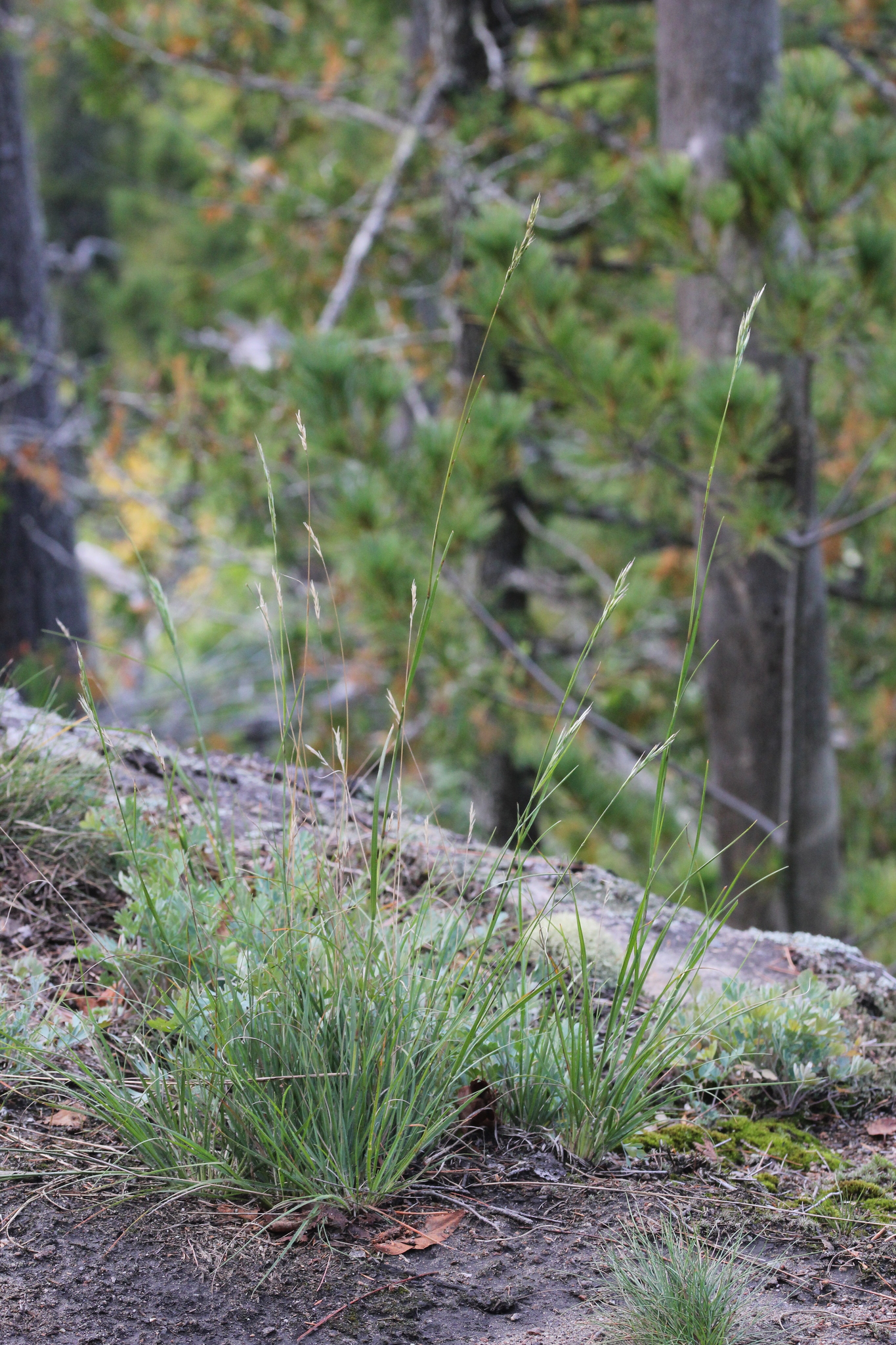
Poverty oatgrass growing in Ontario, Canada (CC BY 4.0).
Synonyms
- No entry
Other Common Names
poverty danthonia, poverty grass
General Distribution
Poverty oatgrass inhabits much of the United States. It is distributed from British Columbia east to Newfoundland and south to Florida, New Mexico, and Mexico [11,20,21,25,57]. The Natural Resources Conservation Service PLANTS database provides a map of poverty oatgrass' distribution in the United States.
States and Provinces
- United States: AK AL AR CO CT DE FL GA ID IL IN IA KS KY LA ME MD MA MI MN MS MO MT NH NJ NM NY NC ND OH OK OR PA RI SC SD TN TX VT VA WA WV WI WY
- Canada: AB BC MB NB NF ON PQ SK
- Mexico
Site Characteristics
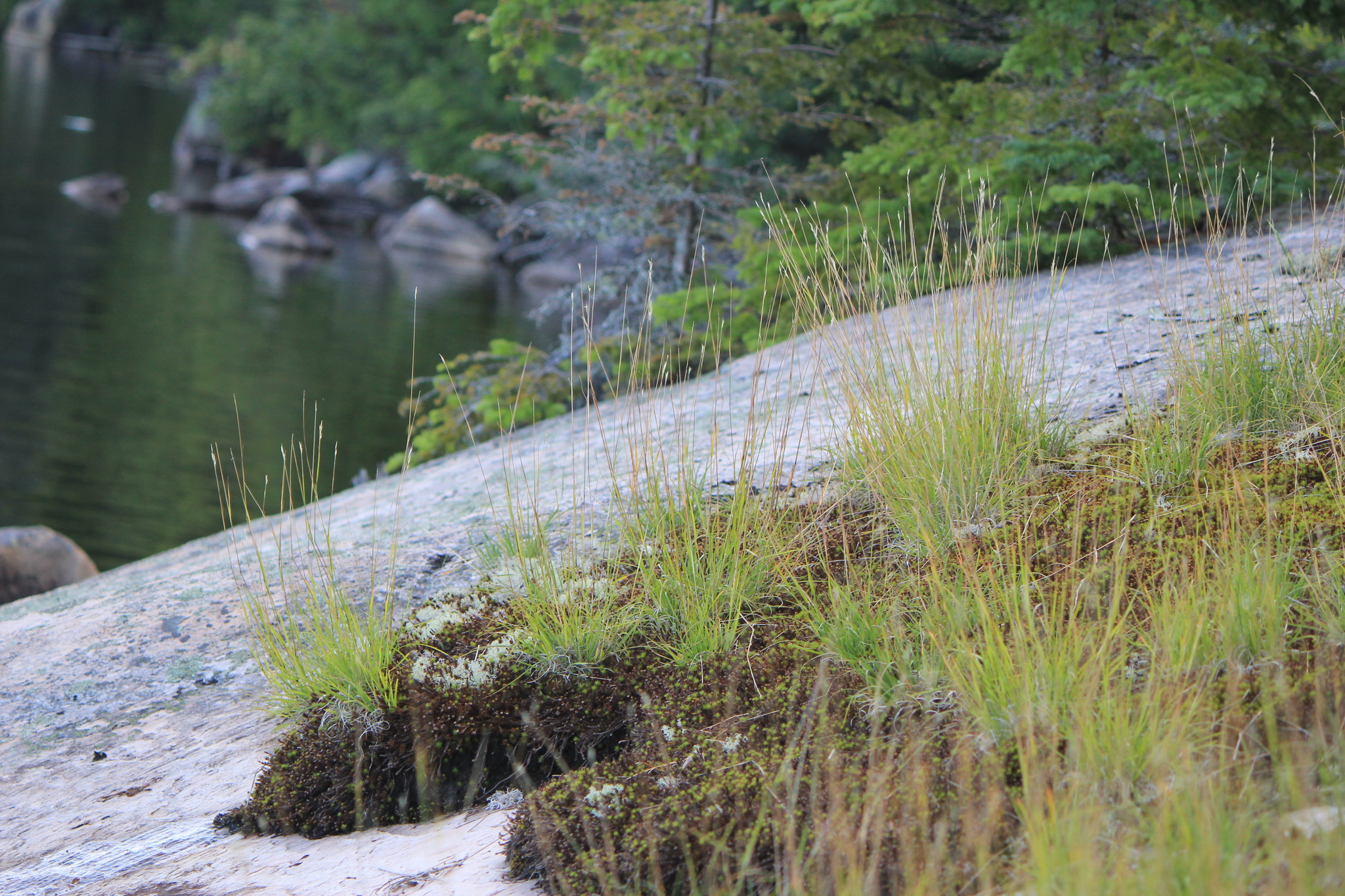
Poverty oatgrass most commonly inhabits low fertility, sandy or rocky, well-drained soils of old fields, pastures, roadsides, and woodland margins characterized by low soil moisture [11,14,15,22,28]. Poverty oatgrass also inhabits clearcuts, burns, and trampled ground of flat and mountainous areas throughout much of the eastern United States [10]. Poverty oatgrass tends to inhabit shallow A horizons overlying substrates such as limestone, marble rock, sandstone, granite, siltstone, clay, and chert [7,23,26,36].

Poverty oatgrass growing in a shallow soil layer over bedrock (CC BY 4.0).
Plant Communities
Poverty oatgrass is a component in many grass, shrub, and forest habitats. Despite its abundance, poverty oatgrass is not cited as a habitat type indicator species because it is a secondary successor on burned and anthropogenically disturbed sites. Common eastern and prairie associates of poverty oatgrass include lowbush blueberry (Vaccinium angustifolium), goldenrod (Solidago spp.), bracken fern (Pteridium aquilinum), little bluestem (Schizachyrium scoparium), junegrasses (Koelaria spp.), threeawans (Aristida spp.), panicgrasses (Panicum spp.), wheatgrasses (Triticeae), fescues (Festuca spp.), needlegrasses (Achnatherum spp.), and bluegrasses (Poa spp.) [15,33,36,42,46,50,58].
Botanical Description

Poverty oatgrass growing in Quebec, Canada.
Poverty oatgrass is a cool-season, native, perennial bunchgrass. Roots are fibrous without rhizomes or stolons, and most of the foliage occurs as a crowed basal clump of leaves. Curved or twisted leaves are 4 to 6 inches (10-15 cm) long and persist with age. The inflorescence is a constricted panicle containing 2 to 13 spikelets. Both male and female flower parts appear on each individual. Florets that cross-fertilize (chasmogamous) are located on the aerial panicle and contain more pollen grains than the unopened, self-fertilized florets (cleistogamous) that are located inside 1 or more of the leaf sheaths throughout their development. Floret lemmas have twisted awns with long, stiff hairs, both of which aid in dispersal [11,22].
Research in a pine-hardwood forest in Michigan found that poverty oatgrass has a population half-life of 2.2 years [42].
Raunkiaer Life Form
- Chamaephyte [37]
Seasonal Development
In the southern and eastern United States, poverty oatgrass begins active growth in early spring. Flowers develop and bloom from late spring to early June. Seed maturation and shattering closely follow pollination. Poverty oatgrass is commonly dormant during the hot summer months. A period of vegetative growth may occur when temperatures decrease in early fall. In Canada, seasonal development occurs a few weeks later as a result of temperature and photoperiod restrictions [11,28].
Regeneration Processes
Poverty oatgrass reproduces by seed and by tillering [11]. Its production of cleistogamous flowers and chasmogamous flowers makes this species highly self-compatible and often dominant in favorable growing conditions. Chasmogamous florets are more abundant than self-fertile florets. Cleistogamous florets occur most frequently in plants growing on disturbed, grazed, wooded, and mountainous areas [9]. The presence of both flower types in varying proportions yields 2 different reproductive strategies. However, seed production through self-pollination in closed florets is most common [35].
While conducting a study on poverty oatgrass reproduction, Clay [9] observed that healthy plants set seed in all 200 of observed florets of both flower types. Pronounced twisted and pubescent awns aid in seed dispersal. Maximum germination of seeds was investigated by Toole [51]. Seeds taken from the Shenandoah National Forest in Virginia germinated best when temperatures were alternated between room temperature and 95 degrees Fahrenheit (35 °C). A 71% sulfuric acid treatment weakened the seed coat, facilitating germination. Prechilling the seeds at 37 degrees Fahrenheit (3 °C) before room temperature germination with a potassium nitrate treatment was also effective.
Seeds of poverty oatgrass are highly dormant but germinate readily on exposed mineral soil. Even if the aboveground population no longer exists, seeds may remain in soil for decades before a disturbance such as fire initiates another population [43].
Successional Status
Poverty oatgrass is a secondary successor of burned and/or cut sites, old fields, and old pastureland [14,15,19,38,47]. It is a common pioneer on northeastern coastal sandplains and old domestic sheep pastures [14]. Its ability to colonize after disturbance is attributed to long periods of seed dormancy [31]. Optimally growing in high light, conditions are most favorable for poverty oatgrass during early years of succession [42]. As competition for light and other resources increases, poverty oatgrass populations decrease [3]. Individuals appearing in mid-late successional stages of natural reforestation allocate most resources to reproductive efforts in order to continue the population [43].
Some barren and alvar ecosystems are kept in early succession by repeated fires [7,46]. Smith and Sparling [46] found poverty oatgrass was a persistent member of jack pine (Pinus banksiana) barrens maintained by frequent fire. A prairie and savanna restoration study conducted in central Wisconsin showed marked increases in poverty oatgrass populations with increased prescribed burning [4]. However, it should be noted that some grasslands dominated by poverty oatgrass might be drought-dependent, not fire-dependent [7].
Immediate Fire Effects
Fire usually top-kills poverty oatgrass [32,34,42].
While studying the population dynamics of poverty oatgrass during secondary succession of a pine-hardwood forest in northern lower Michigan, Scheiner [42] found that fire's predominant effect was mortality. Seventy-five percent of individuals had died in an experimental plot burned the previous summer.
Postfire Regeneration Strategy
- Ground residual colonizer (on-site, initial community)
- Tussock graminoid [48]
Fire Adaptations
Poverty oatgrass has adapted to fire by tillering and establishing from seed after top-kill [32,34,42].
Plant Response to Fire
Most barrens, forested, prairie, and flatwood ecosystems show a marked increase in poverty oatgrass populations the growing season following fire [32,34,41,42,49,55,56]. Open-grown poverty oatgrass plants may produce 4.5 times more vegetative culms and 1.5 times more flowering culms than those growing in more successionally advanced communities. During the 1st few growing seasons following fire, poverty oatgrass allocates its resources to vegetative growth over reproductive effort. As the canopy of more advanced successional stages reduces light reaching the herbaceous layer, this trend reverses. In general, environmental changes imposed by successional trends contribute to a drastic population reduction 20 to 30 years following fire [42].
Despite the overwhelming evidence supporting fire's contribution to poverty oatgrass establishment and success, some grassland ecosystems show a decrease in poverty oatgrass following frequent disturbance [33,50]. While observing floristic trends of annually burned, post-agricultural little bluestem fields, Nierling and Dreyer [33] noticed a drastic decrease in poverty oatgrass. Similarly, prescribed burns in goldenrod-poverty oatgrass communities resulted in a 26% decrease of poverty oatgrass frequency, while unburned fields supported contiguous poverty oatgrass plants. In this particular community type, fire temporarily promoted forb dominance followed by a slow emergence of poverty oatgrass [50].
Fire Regimes
Fire regimes for plant communities and ecosystems in which poverty oatgrass occurs are summarized below. For additional fire regime information, search FEIS for this species by entering the species name on the Advanced Search page and selecting “Fire Regime” as the publication type.
| Community or Ecosystem | Dominant Species | Fire Return Interval Range in Years |
|---|---|---|
| maple-beech-birch | Acer-Fagus-Betula | >1000 |
| sugar maple | A. saccharum | >1000 |
| sugar maple-basswood | A. s.-Tilia americana | > 000 [5] |
| bluestem prairie | Andropogon gerardii var. gerardii-Schizachyrium scoparium | <10 [5,29] |
| Nebraska sandhills prairie | A. g. var. paucipilus-Schizachyrium scoparium | <10 |
| plains grasslands | Bouteloua spp. | <35 |
| blue grama-buffalo grass | B. gracilis-Buchloe dactyloides | <35 |
| sugarberry-America elm-green ash | Celtis laevigata-Ulmus americana-Fraxinus pennsylvanica | <35 to 200 |
| beech-sugar maple | Fagus spp.-Acer saccharum | >1000 |
| juniper-oak savanna | Juniperus ashei-Quercus virginiana | <35 |
| yellow-poplar | Liriodendron tulipifera | <35 |
| wheatgrass plains grasslands | Pascopyrum smithii | <35 |
| Great Lakes spruce-fir | Picea-Abies spp. | 35 to >200 |
| northeastern spruce-fir | Picea-Abies spp. | 35-200 |
| southeastern spruce-fir | Picea-Abies spp. | 35 to >200 [5] |
| Rocky Mountain lodgepole pine* | Pinus contorta var. latifolia | 25-300+ [1,39] |
| shortleaf pine | P. echinata | 2-15 |
| shortleaf pine-oak | P. e.-Quercus spp. | <10 |
| longleaf pine-scrub oak | P. palustris-Quercus spp. | 6-10 [5] |
| red pine (Great Lakes region) | P. resinosa | 10-200 (10)** [5,17] |
| red-white-jack pine* | P. r.-P. strobus-P. banksiana | 10-300 [5] |
| pitch pine | P. rigida | 6-25 [6,24] |
| eastern white pine | P. strobus | 35-200 |
| eastern white pine-eastern hemlock | P. s.-Tsuga canadensis | 35-200 |
| eastern white pine-northern red oak-red maple | P. s.-Quercus rubra-Acer rubrum | 35-200 |
| loblolly-shortleaf pine | P. taeda-P.echinata | 10 to <35 |
| Virginia pine-oak | P.virginiana-Quercus spp. | 10 to <35 |
| aspen-birch | Populus tremuloides-Betula papyrifera | 35-200 [5] |
| mountain grasslands | Pseudoroegneria spicata | 3-40 (10)** [1] |
| oak-hickory | Quercus-Carya spp. | <35 |
| northeastern oak-pine | Quercus-Pinus spp. | 10 to <35 |
| southeastern oak-pine | Quercus-Pinus spp. | <10 |
| white oak-black oak-northern red oak | Q. alba-Q. velutina-Q. rubra | <35 |
| chestnut oak | Q. prinus | 3-8 |
| northern red oak | Q. rubra | 10 to <35 |
| post oak-blackjack oak | Q. stellata-Q. marilandica | <10 |
| black oak | Q. velutina | <35 |
| little bluestem-grama prairie | Schizachyrium scoparium-Bouteloua spp. | <35 |
| eastern hemlock-yellow birch | Tsuga canadensis-Betula alleghaniensis | >200 |
| elm-ash-cottonwood | Ulmus-Fraxinus-Populus spp. | <35 to 200 [5] |
*Fire-return interval varies widely; trends in variation are noted in the Species review. **(Mean). | ||
Fire Management Considerations
Poverty oatgrass is usually associated with frequent burning. Its population maintenance in open woodland and woodland-grassland margins is certainly dependent upon fire [34,49,55]. Conversely, successional advancement in the absence of fire may result in very small populations of poverty oatgrass.
No published sources provide fuel management, fire behavior, or fire use planning information concerning poverty oatgrass.
Federal Status
None
Other Status
No entry.
Importance to Wildlife and Livestock
Importance of poverty oatgrass to wildlife and livestock is limited to early season utilization. However, palatability and preference vary according to local growing conditions and relative abundance of other forage [40].
Palatability and Nutritional Value
Most sources cite poverty oatgrass as rather unpalatable to livestock throughout the growing season [8,13,22,40]. However, Skovlin and others [45] found that poverty oatgrass was second only to bluebunch wheatgrass (Pseudoroegneria spicata) for utilization by cattle over an 8-year period at 3 different stocking levels. This study, conducted in the ponderosa pine (Pinus ponderosa)/bunchgrass range of the Pacific Northwest, showed heaviest use of poverty oatgrass during season-long and deferred grazing rotations. If utilized by domestic and wild ungulates, poverty oatgrass' young green blades are preferred in early spring and summer for optimal palatability. Poverty oatgrass is much less palatable by midsummer [15]. The palatability of poverty oatgrass for wildlife in Wyoming has been rated as follows [13]:
| Animal | Palatability |
|---|---|
| pronghorn | poor |
| elk | good |
| mule deer | poor |
| white-tailed deer | poor |
| small nongame birds | poor |
| upland game birds | poor |
| waterfowl | poor |
Compared to graminoid associates, nutritional value of poverty oatgrass is low. Ungulate use is generally restricted to early season when protein value is optimal [15].
Cover Value
Given the low-growing stature of poverty oatgrass, cover value for large mammals is negligible. However, Dittberner and Olson [13] found that poverty oatgrass provides fair cover value for small mammals, small nongame birds, and upland game birds in Wyoming.
Value for Rehabilitation of Disturbed Sites
Poverty oatgrass inhabits sites of varying nutrient and moisture content. However, special interest is given to its ability to establish and succeed on sites of particularly poor nutrient and moisture regimes, such as roadsides [22]. It protects soil from erosion and excessive nutrient leaching, and is frost-heave resistant. Poverty oatgrass also has the ability to inhabit acidic soils (pH 4.5-4.7) [54]. Most sources cite poverty oatgrass as a common secondary successor and valuable erosion controller of fire-disturbed areas and clearcuts in the eastern United States [10].
Other Uses
No entry.
Other Management Considerations
Poverty oatgrass serves as an excellent indicator of low-fertility agricultural and pasture lands. Its presence and increase in the absence of fire may imply declining soil conditions and overuse [11,22,52]. Active grazing usually favors an increase in the abundance of poverty oatgrass. This is attributed to the almost basal location of cleistogamous flowers, which are generally out of reach and not removed by cattle grazing [9].
The herbicide hexazinone has proven effective in reducing competition imposed by poverty oatgrass and bluegrasses in lowbush blueberry fields in Michigan [58].
Table A1— Forest and range ecosystems, Bureau of Land Management (BLM) physiographic regions, Kuchler plant associations, Society for American Foresters (SAF) forest cover types, and Society for Rangeland Management (SRM) rangeland cover types in which this species occurs.
Forest and Range Ecosystems
- FRES10 White-red-jack pine
- FRES11 Spruce-fir
- FRES12 Longleaf-slash pine
- FRES13 Loblolly-shortleaf pine
- FRES14 Oak-pine
- FRES15 Oak-hickory
- FRES17 Elm-ash-cottonwood
- FRES18 Maple-beech-birch
- FRES19 Aspen-birch
- FRES21 Ponderosa pine
- FRES23 Fir-spruce
- FRES26 Lodgepole pine
- FRES36 Mountain grasslands
- FRES38 Plains grasslands
- FRES39 Prairie [18]
BLM Physiographic Regions
- 2 Cascade Mountains
- 5 Columbia Plateau
- 8 Northern Rocky Mountains
- 9 Middle Rocky Mountains
- 10 Wyoming Basin
- 11 Southern Rocky Mountains
- 12 Colorado Plateau
- 13 Rocky Mountain Piedmont
- 14 Great Plains
- 15 Black Hills Uplift [2]
Kuchler Plant Associations
- K010 Ponderosa shrub forest
- K011 Western ponderosa forest
- K016 Eastern ponderosa forest
- K017 Black Hills pine forest
- K047 Fescue-oatgrass
- K050 Fescue-wheatgrass
- K051 Wheatgrass-bluegrass
- K063 Foothills prairie
- K064 Grama-needlegrass-wheatgrass
- K065 Grama-buffalo grass
- K066 Wheatgrass-needlegrass
- K067 Wheatgrass-bluestem-needlegrass
- K068 Wheatgrass-grama-buffalo grass
- K069 Bluestem-grama prairie
- K093 Great Lakes spruce-fir forest
- K095 Great Lakes pine forest
- K096 Northeastern spruce-fir forest
- K098 Northern floodplain forest
- K099 Maple-basswood forest
- K100 Oak-hickory
- K101 Elm-ash forest
- K102 Beech-maple forest
- K103 Mixed mesophytic forest
- K104 Appalachian oak forest
- K106 Northern hardwoods
- K107 Northern hardwoods-fir forest
- K108 Northern hardwoods-spruce forest
- K109 Transition between K104 and K106
- K110 Northeastern oak-pine forest
- K111 Oak-hickory-pine
- K112 Southern mixed forest [30]
SAF Cover Types
- 1 Jack pine
- 5 Balsam fir
- 15 Red pine
- 16 Aspen
- 17 Pin cherry
- 20 White pine-northern red oak-red maple
- 21 Eastern white pine
- 22 White pine-hemlock
- 39 Black ash-American elm-red maple
- 40 Post oak-blackjack oak
- 42 Bur oak
- 45 Pitch pine
- 52 White oak-black oak-northern red oak
- 55 Northern red oak
- 70 Longleaf pine
- 71 Longleaf pine-scrub oak
- 76 Shortleaf pine-oak
- 82 Loblolly pine-hardwood
- 201 White spruce
- 203 Balsam poplar
- 218 Lodgepole pine [16]
SRM Rangeland Cover Types
- 101 Bluebunch wheatgrass
- 102 Idaho fescue
- 103 Green fescue
- 109 Ponderosa pine shrubland
- 110 Ponderosa pine-grassland
- 215 Valley grassland
- 216 Montane meadows
- 218 Lodgepole pine
- 237 Interior ponderosa pine
- 251 White spruce-aspen
- 253 Black spruce-white spruce
- 254 Black spruce-paper birch
- 301 Bluebunch wheatgrass-blue grama
- 302 Bluebunch wheatgrass-Sandberg bluegrass
- 303 Bluebunch wheatgrass-western wheatgrass
- 310 Needle-and-thread-blue grama
- 411 Aspen woodland
- 502 Grama-galleta
- 601 Bluestem prairie
- 604 Bluestem-grama prairie
- 606 Wheatgrass-bluestem-needlegrass
- 607 Wheatgrass-needlegrass
- 611 Blue grama-buffalo grass
- 613 Fescue grassland
- 704 Blue grama-western wheatgrass
- 705 Blue grama-galleta
- 709 Bluestem-grama
- 710 Bluestem prairie
- 714 Grama-bluestem
- 717 Little bluestem-Indiangrass-Texas wintergrass
- 802 Missouri prairie
- 809 Mixed hardwood and pine
- 920 White spruce-paper birch [44]
1. Arno, Stephen F. 1980. Forest fire history in the northern Rockies. Journal of Forestry. 78(8): 460-465. [11990]
2. Bernard, Stephen R.; Brown, Kenneth F. 1977. Distribution of mammals, reptiles, and amphibians by BLM physiographic regions and A.W. Kuchler's associations for the eleven western states. Tech. Note 301. Denver, CO: U.S. Department of the Interior, Bureau of Land Management. 169 p. [434]
3. Bever, James C. 1994. Feedback between plants and their soil communities in an old field community. Ecology. 75(7): 1965-1977. [24157]
4. Blewett, Thomas. 1978. Prairie and savanna restoration in the Necedah National Wildlife Refuge. In: Glenn-Lewin, David C.; Landers, Roger Q., Jr., eds. Proceedings, 5th Midwest prairie conference; 1976 August 22-24; Ames, IA. Ames, IA: Iowa State University: 154-157. [3370]
5. Brown, James K.; Smith, Jane Kapler, eds. 2000. Wildland fire in ecosystems: effects of fire on flora. Gen. Tech. Rep. RMRS-GTR-42-vol. 2. Ogden, UT: U.S. Department of Agriculture, Forest Service, Rocky Mountain Research Station. 257 p. [33874]
6. Buchholz, Kenneth: Good, Ralph E. 1982. Density, age structure, biomass and net annual aboveground productivity of dwarfed Pinus rigida Moll. from the New Jersey Pine Barren Plains. Bulletin of the Torrey Botanical Club. 109(1): 24-34. [8639]
7. Catling, Paul M.; Brownell, Vivian R. 1998. Importance of fire in alvar ecosystems--evidence from the Burnt Lands, eastern Ontario. The Canadian Field Naturalist. 112(4): 661-667. [30338]
8. Clary, Warren P. 1988. Silvicultural systems for forage production in ponderosa pine forests. In: Baumgartner, David M.; Lotan, James E., compilers. Ponderosa pine: The species and its management: Symposium proceedings; 1987 September 29 - October 1; Spokane, WA. Pullman, WA: Washington State University, Cooperative Extension: 185-191. [9417]
9. Clay, Keith. 1983. The differential establishment of seedlings from chasmogamous and cleistogamous flowers in natural populations of the grass Danthonia spicata (L.) Beauv. Ecologia. 57(1/2): 183-188. [30471]
10. Core, Earl L. 1929. Plant ecology of Spruce Mountain, West Virginia. Ecology. 10(1): 1-13. [9218]
11. Darbyshire, S. J.; Cayquette, J. 1989. The biology of Canadian weeds. 92. Danthonia spicata (L.) Beauv. in Roem. & Sultz. Canadian Journal of Plant Science. 69(4): 1217-1233. [30417]
12. Dibble, Alison C.; Campbell, Christopher S.; Tyler, Harry R., Jr.; Vickery, Barbara St. J. 1989. Maine's official list of endangered and threatened plants. Rhodora. 91(867): 244-269. [4258]
13. Dittberner, Phillip L.; Olson, Michael R. 1983. The plant information network (PIN) data base: Colorado, Montana, North Dakota, Utah, and Wyoming. FWS/OBS-83/86. Washington, DC: U.S. Department of the Interior, Fish and Wildlife Service. 786 p. [806]
14. Dunwiddie, Peter W. 1997. Long-term effects of sheep grazing on coastal sandplain vegetation. Natural Areas Journal. 17(3): 261-264. [27443]
15. Dustman, R. B.; Shriver, L. C. 1929. The chemical composition of Andropogon virginicus and Danthonia spicata at successive growth stages. Journal of the American Society of Agronomy. 21(5): 561-567. [30419]
16. Eyre, F. H., ed. 1980. Forest cover types of the United States and Canada. Washington, DC: Society of American Foresters. 148 p. [905]
17. Frissell, Sidney S., Jr. 1968. A fire chronology for Itasca State Park, Minnesota. Minnesota Forestry Research Notes No. 196. St. Paul, MN: University of Minnesota. 2 p. [34527]
18. Garrison, George A.; Bjugstad, Ardell J.; Duncan, Don A.; [and others]. 1977. Vegetation and environmental features of forest and range ecosystems. Agric. Handb. 475. Washington, DC: U.S. Department of Agriculture, Forest Service. 68 p. [998]
19. Gates, Frank C. 1930. Aspen association in northern lower Michigan. Botanical Gazette. 40(3): 233-259. [16933]
20. Gleason, Henry A.; Cronquist, Arthur. 1991. Manual of vascular plants of northeastern United States and adjacent Canada. 2nd ed. New York: New York Botanical Garden. 910 p. [20329]
21. Great Plains Flora Association. 1986. Flora of the Great Plains. Lawrence, KS: University Press of Kansas. 1392 p. [1603]
22. Grelen, Harold E.; Hughes, Ralph H. 1984. Common herbaceous plants of southern forest range. Res. Pap. SO-210. New Orleans, LA: U.S. Department of Agriculture, Forest Service, Southern Forest and Range Experiment Station. 147 p. [2946]
23. Heikens, Alice Long; West, K. Andrew; Robertson, Philip A. 1994. Short-term response of chert and shale barrens vegetation to fire in southwestern Illinois. Castanea. 59(3): 274-285. [27228]
24. Hendrickson, William H. 1972. Perspective on fire and ecosystems in the United States. In: Proceedings, fire in the environment: a symposium; 1972 May 1-5; Denver, CO. Fort Collins, CO: U.S. Department of Agriculture, Forest Service, Rocky Mountain Forest and Range Experiment Station: 29-33. [17276]
25. Hitchcock, C. Leo; Cronquist, Arthur. 1973. Flora of the Pacific Northwest. Seattle, WA: University of Washington Press. 730 p. [1168]
26. Homoya, Michael A. 1994. Indiana barrens: classification and description. Castanea. 59(3): 204-213. [26826]
27. Kartesz, John T. 1994. A synonymized checklist of the vascular flora of the United States, Canada, and Greenland. Volume I--checklist. 2nd ed. Portland, OR: Timber Press. 622 p. [23877]
28. Kelley, Steven E. 1985. The effects of neighbors as environments: characterization of the competitive performance of Danthonia spicata genotypes. In: Jacquard, P. [and others], eds. Genetic differentiation and dispersal in plants. NATO ASI Series. Vol. G5. Berlin: Springer-Verlag: 204-221. [30465]
29. Kucera, Clair L. 1981. Grasslands and fire. In: Mooney, H. A.; Bonnicksen, T. M.; Christensen, N. L.; [and others], technical coordinators. Fire regimes and ecosystem properties: Proceedings of the conference; 1978 December 11-15; Honolulu, HI. Gen. Tech. Rep. WO-26. Washington, DC: U.S. Department of Agriculture, Forest Service: 90-111. [4389]
30. Kuchler, A. W. 1964. United States [Potential natural vegetation of the conterminous United States]. Special Publication No. 36. New York: American Geographical Society. 1:3,168,000; colored. [3455]
31. Livingston, R. B.; Allessio, Mary L. 1968. Buried viable seed in successional field and forest stands, Harvard Forest, Massachusetts. Bulletin of the Torrey Botanical Club. 95(1): 58-69. [3377]
32. Martin, J. Lynton. 1956. An ecological survey of burned-over forest land in southwestern Nova Scotia. Forestry Chronicle. 32: 313-336. [8932]
33. Niering, William A.; Dreyer, Glenn D. 1989. Effects of prescribed burning on Andropogon scoparius in postagricultural grasslands in Connecticut. The American Midland Naturalist. 122: 88-102. [8768]
34. Paulsell, Lee K. 1957. Effects of burning on Ozark hardwood timberlands. Res. Bull. 640. Columbia, MO: University of Missouri, College of Agriculture, Agricultural Experiment Station. 24 p. [11885]
35. Philipson, Melva N. 1986. A re-assessment of the form of reproduction in Danthonia spicata (L.) Beauv. The New Phytologist. 103(1): 231-243. [30418]
36. Quarterman, Elsie; Burbanck, Madeline P.; Shure, Donald J. 1993. Rock outcrop communities: limestone, sandstone, and granite. In: Martin, William H.; Boyce, Stephen G.; Echternacht, Arthur C., eds. Biodiversity of the southeastern United States: Upland terrestrial communities. New York: John Wiley & Sons, Inc: 35-86. [21936]
37. Raunkiaer, C. 1934. The life forms of plants and statistical plant geography. Oxford: Clarendon Press. 632 p. [2843]
38. Roberts, M. R.; Gilliam, F. S. 1995. Disturbance effects on herbaceous layer vegetation and soil nutrients in Populus forests of northern lower Michigan. Journal of Vegetation Science. 6(6): 903-912. [27755]
39. Romme, William H. 1982. Fire and landscape diversity in subalpine forests of Yellowstone National Park. Ecological Monographs. 52(2): 199-221. [9696]
40. Rummell, Robert S. 1951. Some effects of livestock grazing on ponderosa pine forest and range in central Washington. Ecology. 32(4): 594-607. [16338]
41. Scheiner, S. M. 1987. Size and fecundity hierarchies in an herbaceous perennial. Oecologia. 74(1): 128-132. [30470]
42. Scheiner, Samuel M. 1988. Population dynamics of an herbaceous perennial Danthonia spicata during secondary forest succession. The American Midland Naturalist. 119(2): 268-281. [4140]
43. Scheiner, Samuel M. 1989. Variable selection along a successional gradient. Evolution. 43(3): 548-562. [30421]
44. Shiflet, Thomas N., ed. 1994. Rangeland cover types of the United States. Denver, CO: Society for Range Management. 152 p. [23362]
45. Skovlin, Jon M.; Harris, Robert W.; Strickler, Gerald S.; Garrison, George A.. 1976. Effects of cattle grazing methods on ponderosa pine-bunchgrass range in the Pacific Northwest. Tech. Bull. No. 1531. Washington, D. C.: U.S. Department of Agriculture, Forest Service. 40 p. [10923]
46. Smith, David W.; Sparling, John H. 1966. The temperatures of surface fires in jack pine barrens. Canadian Journal of Botany. 44(10): 1285-1292. [9011]
47. Stallard, Harvey. 1929. Secondary succession in the climax forest formations of northern Minnesota. Ecology. 10(4): 476-547. [3808]
48. Stickney, Peter F. 1989. Seral origin of species originating in northern Rocky Mountain forests. Unpublished draft on file at: U.S. Department of Agriculture, Forest Service, Intermountain Research Station, Fire Sciences Laboratory, Missoula, MT; RWU 4403 files. 10 p. [20090]
49. Stritch, Lawrence R. 1990. Landscape-scale restoration of barrens-woodland within the oak-hickory forest mosaic. Restoration & Management Notes. 8(2): 73-77. [13750]
50. Swan, Frederick R., Jr. 1970. Post-fire response of four plant communities in south-central New York state. Ecology. 51(6): 1074-1082. [3446]
51. Toole, Vivian Kearns. 1939. Germination of the seed of poverty grass. Journal of the American Society of Agronomy. 31(11): 954-965. [30425]
52. U.S. Department of Agriculture, Forest Service. 1937. Range plant handbook. Washington, DC. 532 p. [2387]
53. U.S. Department of Agriculture, Soil Conservation Service. 1994. Plants of the U.S.--alphabetical listing. Washington, DC: U.S. Department of Agriculture, Soil Conservation Service. 954 p. [23104]
54. Van Kley, James E.; Parker, George R. 1993. An ecological classification system for the central hardwoods region: the Hoosier National Forest. In: Gillespie, Andrew R.; Parker, George R.; Pope, Phillip E., eds. Proceedings, 9th central hardwood forest conference; 1993 March 8-10; West Lafayette, IN. Gen. Tech. Rep. NC-161. St. Paul, MN: U.S. Department of Agriculture, Forest Service, North Central Forest Experiment Station: 308-326. [27015]
55. Vankat, John L.; Snyder, Gary W. 1991. Floristics of a chronosequence corresponding to old field - deciduous forest succession in southwestern Ohio. I. Undisturbed vegetation. Bulletin of the Torrey Botanical Club. 118(4): 365-376. [18759]
56. Whittle, C.A.; Duchesne, L. C.; Needham, T. 1997. The impact of broadcast burning and fire severity on species composition and abundance of surface vegetation in a jack pine (Pinus banksiana) clear-cut. Forest Ecology and Management. 94(1/3): 141-148. [28642]
57. Wunderlin, Richard P. 1998. Guide to the vascular plants of Florida. Gainesville, FL: University Press of Florida. 806 p. [28655]
58. Yarborough, David E.; Bhowmik, Prasanta C. 1986. Effect of hexazinone on weeds and on lowbush blueberries in Maine. In: Proceedings of the 40th Annual Meeting of the Northeastern Weed Science Society; [Date of conference unknown]; [Location of conference unknown]. [Place of publication unknown]. [Publisher unknown]. 165-166. [9902]