


Danthonia unispicata, onespike danthonia
Matthews, Robin F. 2000. Danthonia unispicata, onespike danthonia. In: Fire Effects Information System, [Online]. U.S. Department of Agriculture, Forest Service, Rocky Mountain Research Station, Fire Sciences Laboratory (Producer). Available: https://research.fs.usda.gov/feis/species-reviews/danuni
| Abbreviation | Common Name | Scientific Name | Classification | Status |
|---|---|---|---|---|
| Plants | ||||
| DANUNI | onespike danthonia | Danthonia unispicata | Life Form: Plants/Graminoid Kingdom: Plantae Class: Monocot Order: Cyperales Family: Poaceae Genus: Danthonia | Fed. Protected: No Nativity: Native Invasiveness: Noninvasive |


Taxonomy
The scientific name of onespike danthonia is Danthonia unispicata (Thurb.) Munro ex Macoun (Poaceae) [5,14,24,44].

Onespike danthonia growing in Modoc County, California (CC BY-NC-SA 4.0).
Synonyms
- No entry
Other Common Names
onespike oatgrass, oneside oatgrass, poverty oatgrass
General Distribution
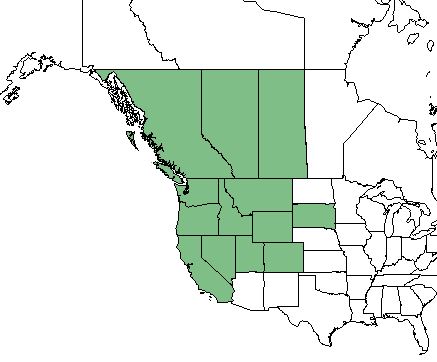
Onespike danthonia occurs from British Columbia south to California and east to Alberta, Montana, Wyoming, South Dakota, Utah, and Colorado [5,9,17,44].

Distribution of onespike danthonia.
States and Provinces
- United States: CA CO ID MT NV OR SD UT WA WY
- Canada: AB BC
Site Characteristics
Onespike danthonia occurs on dry to moist sites from prairies and foothills to open parks and ridges at higher elevations [5,16,18,26,44]. Sites are often rocky with shallow, poorly drained soils [7,14,16,26,33]. Stands of onespike danthonia are limited to intermediate elevations in the Sierra Nevada and in northeastern California, where they occur in high desert or lava areas [31]. Onespike danthonia grows at elevations of 2,970 to 10,560 feet (900-3200 m) in California [16], and 7,000 to 10,000 feet (2130-3050 m) in Utah [44].
Onespike danthonia frequently codominates plant communities with Sandberg bluegrass on bluegrass scablands characterized by thin, rocky soils. These scablands are typically located on intermountain plateaus and ridges derived from Columbia River basaltic flows east of the Cascade Mountains and west of the Rocky Mountains in the Pacific Northwest [32]. Similar scablands are described on central Oregon pumice-derived substrates [32,40].
Plant Communities
Onespike danthonia is present in numerous grassland, sagebrush (Artemisia spp.), mountain brush, quaking aspen (Populus tremuloides)-Douglas-fir (Pseudotsuga menziesii), ponderosa pine (Pinus ponderosa), and lodgepole pine (P. contorta) habitat types and plant communities [27,37,40,44].

Yellowing onespike danthonia growing with taller, greener timothy (CC BY 4.0).
Plants commonly growing in association with onespike danthonia include the following: big sagebrush (A. tridentata), stiff sagebrush (A. rigida), low sagebrush (A. arbuscula), shrubby cinquefoil (Dasiphora floribunda), antelope bitterbrush (Purshia tridentata), common snowberry (Symphoricarpos albus), sticky geranium (Geranium viscosissimum), arrowleaf balsamroot (Balsamorhiza sagittata), western yarrow (Achillea millefolium), lupine (Lupinus spp.), pussytoes (Antennaria spp.), biscuitroot (Lomatium spp.), rough fescue (Festuca altaica), Idaho fescue (F. idahoensis), bluebunch wheatgrass (Pseudoroegneria spicata), needle-and-thread grass (Hesperostipa comata), prairie Junegrass (Koeleria macrantha), bottlebrush squirreltail (Elymus elymoides), and Sandberg bluegrass (Poa secunda) [6,22,30,36,45].
Classifications describing plant communities in which onespike danthonia is a dominant or codominant species are as follows:
- Habitat characteristics of the Silver Lake mule deer range [7]
- Natural vegetation of Oregon and Washington [11]
- Plant associations of the Fremont National Forest [19]
- Plant associations of the Wallowa-Snake Province: Wallowa-Whitman National Forest [22]
Botanical Description
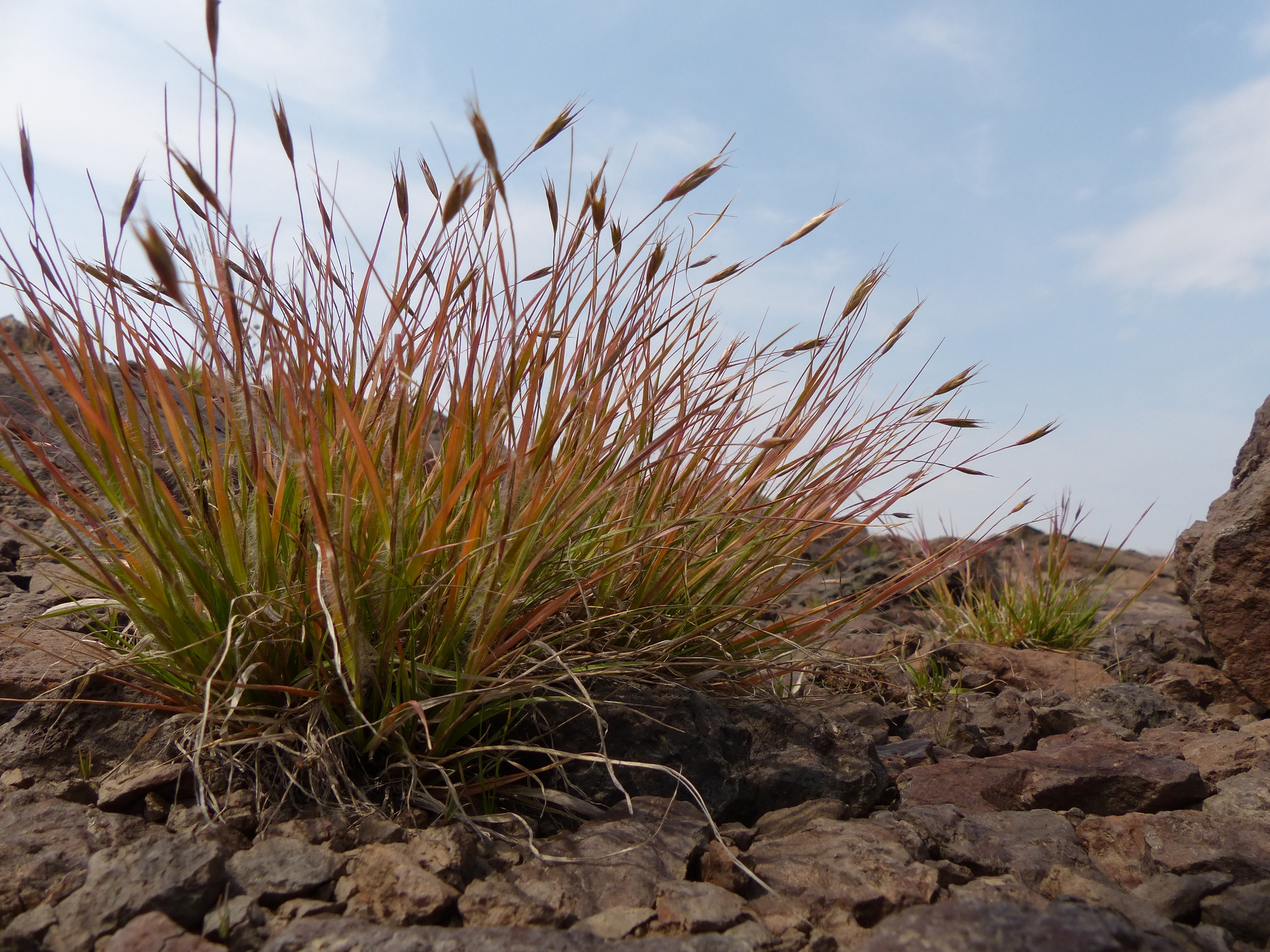
Onespike danthonia is a native, densely tufted perennial bunchgrass [5,17,44]. The centers of the spreading tufts ultimately die out and old sheaths persist at the base of the plants [5]. Culms typically grow 4 to 12 inches (10-30 cm) in height [5,16,26,44]. The inflorescence is a panicle mostly reduced to a single spikelet, but 2 or 3 spikelets may occasionally be present [5,17,18,26]. The root system of onespike danthonia is shallow and fibrous [20,31,33].

Onespike danthonia growing in Harney County, Oregon (CC BY-NC 4.0).

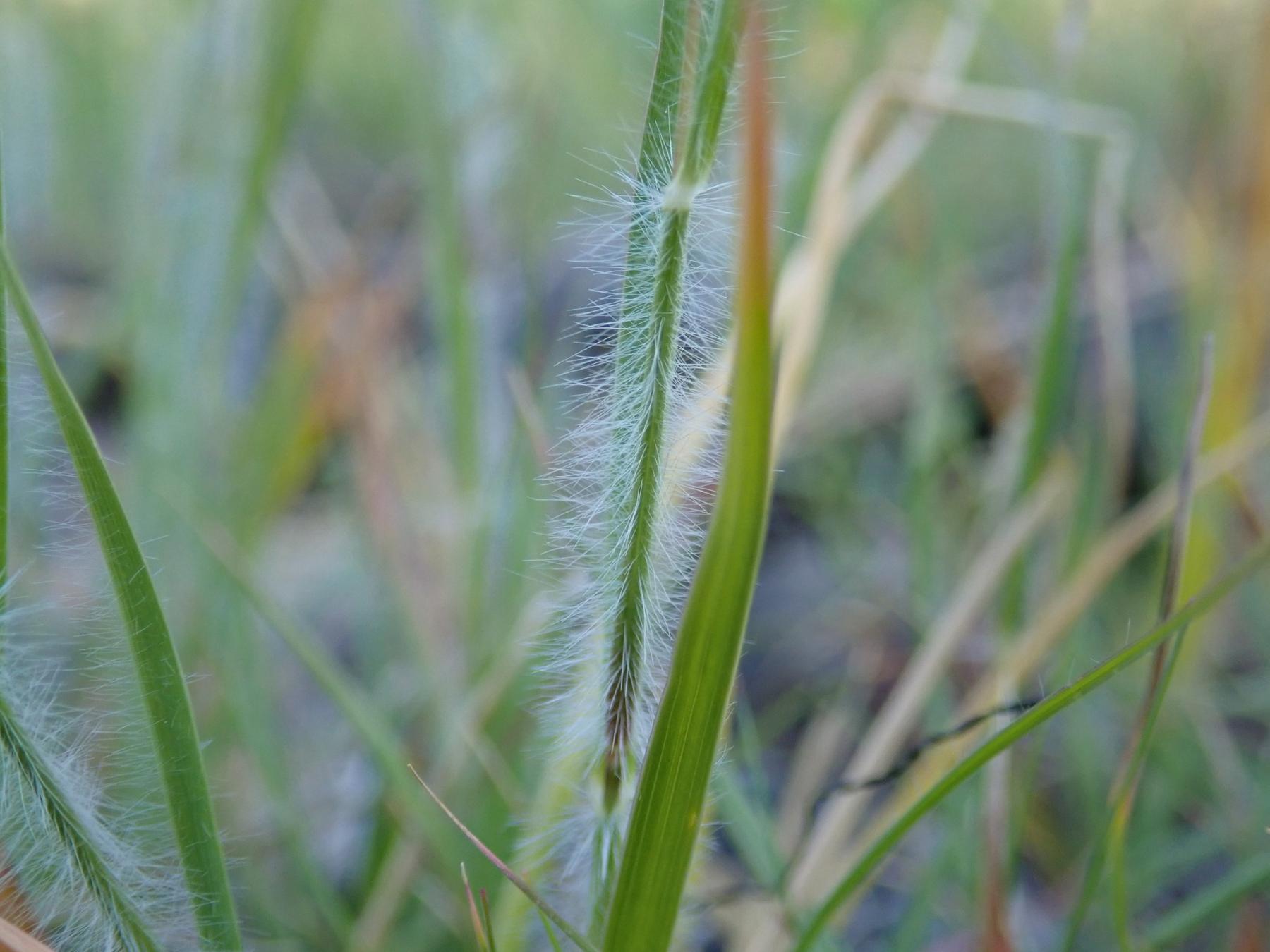
Stem and node of onespike danthonia.
Raunkiaer Life Form (Raunkiaer 1934)
- Hemicryptophyte
Seasonal Development
Onespike danthonia generally flowers from June to August [5,8].
Regeneration Processes
Little information on the regenerative processes of onespike danthonia is available in the literature.
Danthonia species reproduce by seed and tillering from the base [8,15,35,39,41]. Spikelets located in the axils of the lower leaves of onespike danthonia are self-fertilizing [31,44].
Successional Status
Onespike danthonia is referred to as a climax species on thin soil scablands of the Intermountain Pacific Northwest, where shallow soil depths and bedrock limit the establishment of deeper-rooted plants. In the same region, onespike danthonia is an invader on deep-soil sites dominated by fescues (Festuca spp.) where moisture retention has been diminished by overgrazing [21]. Onespike danthonia has also been found on disturbed sites such as trail edges in ponderosa pine forests of eastern Washington and northern Idaho [6].
Johnson and Simon [22] report that onespike danthonia is a principal indicator species of scabland communities of the Wallowa-Whitman National Forest. It is present in mid- to late-seral stages on moist microsites in bluebunch wheatgrass-Sandberg bluegrass plant associations, as well as early to late seres of stiff sagebrush/Sandberg bluegrass associations. Within this study area, onespike danthonia often colonizes areas downslope from water sources, where soil moisture is retained for longer periods in the summer. It has been observed to decline with disturbance that increases bare ground. The authors distinguish Sandberg bluegrass-onespike danthonia plant associations in this region, but are speculative as to whether these sites are climax or a result of severe site degradation of Idaho fescue-prairie Junegrass communities.
Immediate Fire Effects
Onespike danthonia is probably top-killed by fire.
Postfire Regeneration Strategy (Stickney 1989)
- Caudex, growing points in soil
Fire Adaptations
Little information is available in the literature that addresses onespike danthonia adaptations to fire.
Historically, Sandberg bluegrass-onespike danthonia plant associations in the Columbia River Basin had such low biomass that they typically did not carry fire, and have probably rarely burned [1].
Johnson and Simon [22] state that onespike danthonia is 'probably' resistant to fire based on its high moisture content throughout summer, and may in fact respond favorably to burning. However, burning of frost-heaved onespike danthonia may cause damage due to exposure of the root crown to heat. They also state that fire does not spread well in Sandberg bluegrass-onespike danthonia plant associations of the Wallowa-Whitman National Forest due to insufficient fuel availability and high rock cover.
In the Pacific Northwest, other Danthonia species have been described as moderately resistant to fire [41].
Plant Response to Fire
In the Gallatin National Forest of southwestern Montana, onespike danthonia was a dominant species on a big sagebrush-grassland site prior to a spring prescribed fire. It increased in basal cover in the following summer [3,28].
Within a Sandberg bluegrass-onespike danthonia plant association on the Wallowa Whitman National Forest, onespike danthonia declined in coverage in postfire year 1 on 'very lightly burned' ridgetop sites. It was not determined by the author whether this loss in cover was directly related to fire or if the decline should be attributed to soil moisture loss or grazing by elk [23].
Onespike danthonia was present in postfire years 1 and 2 on ponderosa pine plots following the 1988 Red Bench Fire in Glacier National Park, Montana [42,43].
On ponderosa pine and Douglas-fir communities in the Blue Mountains of northeastern Oregon, onespike danthonia cover and frequency in postfire year 4 were higher on prescribed burned sites than on thinned, thinned-and-burned, or unburned control sites. Onespike danthonia was determined to be an indicator species for burned sites (P≤0.05). For further information on the effects of thinning and burning treatments on onespike danthonia and 48 other species, see the Research Project Summary of Youngblood and others' [46] study.
The Research Project Summary Vegetation response to restoration treatments in ponderosa pine-Douglas-fir forests of western Montana also provides information on prescribed fire and postfire response of plant species, including onespike danthonia, that was not available when this species review was written.
Fire Regimes
For fire regime information, search FEIS for this species by entering the species name on the Advanced Search page and selecting “Fire Regime” as the publication type. For further information regarding fire regimes and fire ecology of areas where onespike danthonia is found, see the 'Fire Adaptations' and 'Fire Regimes' sections of the FEIS Species Review for the dominant plant species listed below.
| Community or ecosystem | Dominant species | Fire return interval (mean) (years) |
|---|---|---|
| Pacific ponderosa pine | Pinus ponderosa var. ponderosa | 1-47 |
| Rocky mountain ponderosa pine | Pinus ponderosa var. scopularum | 2-10 |
| Colorado pinyon-juniper spp. | P. edulis | 10-49 |
| basin big sagebrush | Artemisia tridentata var. tridentata | 12-43 |
| mountain big sagebrush | A. t. var. vaseyana | 5-15 |
| Wyoming big sagebrush | A. t. var. wyomingensis | 10-70 (40) |
| mountain grasslands | Pseudoroegneria spicata | 3-40 (10) |
Fire Management Considerations
No entry.
Federal Status
None
Other Status
No entry.
Importance to Wildlife and Livestock
Onespike danthonia is not referred to as an important forage grass in available literature. Livestock graze the succulent basal herbage of onespike danthonia in California, but the plant is not abundant enough to be considered outstanding forage [31]. The succulent bases are also very attractive to rodents, especially pocket gophers [33]. In the Blue Mountains of Oregon, onespike danthonia is considered a secondary species, but produces valuable forage on harsh scabland sites not suitable to bluebunch wheatgrass [33].
Palatability and Nutritional Value
The palatability of onespike danthonia to livestock and wildlife species has been rated as follows [8]:
| Animal | Montana | Utah | Wyoming |
|---|---|---|---|
| Cattle | Fair | Good | Fair |
| Domestic sheep | Fair | Fair | Fair |
| Horses | Good | Good | Fair |
| Pronghorn | — | Poor | Poor |
| Elk | Poor | Good | Good |
| Mule deer | Poor | Fair | Poor |
| White-tailed deer | — | — | Poor |
| Small mammals | — | Fair | — |
| Small nongame birds | — | Poor | — |
| Upland game birds | — | Fair | — |
| Waterfowl | — | Poor | — |
Compared to other grasses, onespike danthonia is rated "fair" in energy value and 'poor' in protein value [8].
Cover Value
The degree to which onespike danthonia provides cover for wildlife species is as follows [8]:
| Animal | Utah | Wyoming |
|---|---|---|
| Pronghorn | Poor | Poor |
| Elk | Poor | Poor |
| Mule deer | Poor | Poor |
| White-tailed deer | — | Poor |
| Small mammals | Fair | Fair |
| Small nongame birds | Poor | Fair |
| Upland game birds | Poor | Fair |
| Waterfowl | Poor | Poor |
Value for Rehabilitation of Disturbed Sites
Onespike danthonia has low to moderate potential for erosion control and short-term to long-term revegetation projects [8]. In particular, low sagebrush/Sandberg bluegrass-onespike danthonia plant associations in the Fremont National Forest of Oregon are usually found on very rocky soils typically saturated during winter and spring, making revegetation on these sites impractical [19]. The same information is reported for Sandberg bluegrass/onespike danthonia associations in the Wallowa-Whitman National Forest [22].
Other Uses
No entry.
Other Management Considerations
In western Montana, onespike danthonia did not increase in biomass but appeared larger and more vigorous on sites where spotted knapweed (Centaurea maculosa) had been controlled with herbicides [4].
Onespike danthonia shows productive regrowth after fall rains, making it dependable fall forage on bluebunch wheatgrass sites in the Blue Mountains of northeastern Oregon. However, it is susceptible to damage from frost heaving, and is often winter-killed on exposed sites [33].
Onespike danthonia response to grazing varies with location. It dominates ridgetop communities in the Blue Mountains, where severe overgrazing has basically eliminated deep-soil bunchgrasses because of reduced moisture retention [20]. Onespike danthonia has responded as a 'decreaser' to grazing in Sandberg bluegrass scablands of the Blue Mountains of eastern Oregon and southeastern Washington and in sagebrush/bunchgrass types within the central Oregon pumice zone [13,40]. Conversely, it is described as an 'increaser' on foothill and mountain grassland sites in Montana and the Shoshone National Forest in Wyoming [30,37]. Volland [40] also refers to onespike danthonia as a 'palatable increaser' on ponderosa pine/shrub/Idaho fescue sites within the central Oregon pumice zone.
Table A1— Forest and range ecosystems, Bureau of Land Management (BLM) physiographic regions, Kuchler plant associations, Society for American Foresters (SAF) forest cover types, and Society for Rangeland Management (SRM) rangeland cover types in which this species occurs.
Forest and Range Ecosystems (Garrison et al. 1977)
- FRES20 Douglas-fir
- FRES21 Ponderosa pine
- FRES23 Fir-spruce
- FRES26 Lodgepole pine
- FRES29 Sagebrush
- FRES34 Chaparral-mountain shrub
- FRES35 Pinyon-juniper
- FRES36 Mountain grasslands
- FRES44 Alpine
BLM Physiographic Regions (Bernard and Brown 1977)
- 2 Cascade Mountains
- 4 Sierra Mountains
- 5 Columbia Plateau
- 6 Upper Basin and Range
- 7 Lower Basin and Range
- 8 Northern Rocky Mountains
- 9 Middle Rocky Mountains
- 10 Wyoming Basin
- 11 Southern Rocky Mountains
Kuchler Plant Associations (Kuchler 1964)
- K008 Lodgepole pine-subalpine forest
- K010 Ponderosa shrub forest
- K011 Western ponderosa forest
- K012 Douglas-fir forest
- K017 Black Hills pine forest
- K018 Pine-Douglas-fir forest
- K022 Great Basin pine forest
- K023 Juniper-pinyon woodland
- K024 Juniper steppe woodland
- K037 Mountain-mahogany-oak scrub
- K038 Great Basin sagebrush
- K050 Fescue-wheatgrass
- K051 Wheatgrass-bluegrass
- K052 Alpine meadows and barren
- K055 Sagebrush steppe
- K056 Wheatgrass-needlegrass shrubsteppe
- K063 Foothills prairie
SAF Cover Types (Eyre 1980)
- 210 Interior Douglas-fir
- 217 Aspen
- 218 Lodgepole pine
- 219 Limber pine
- 220 Rocky Mountain juniper
- 237 Interior ponderosa pine
- 238 Western juniper
- 239 Pinyon-juniper
SRM Rangeland Cover Types (Shiflet 1994)
- 101 Bluebunch wheatgrass
- 102 Idaho fescue
- 106 Bluegrass scabland
- 107 Western juniper/big sagebrush/bluebunch wheatgrass
- 109 Ponderosa pine shrubland
- 110 Ponderosa pine-grassland
- 302 Bluebunch wheatgrass-Sandberg bluegrass
- 304 Idaho fescue-bluebunch wheatgrass
- 314 Big sagebrush-bluebunch wheatgrass
- 315 Big sagebrush-Idaho fescue
- 316 Big sagebrush-rough fescue
- 401 Basin big sagebrush
- 402 Mountain big sagebrush
- 403 Wyoming big sagebrush
- 406 Low sagebrush
- 407 Stiff sagebrush
- 412 Juniper-pinyon woodland
- 415 Curlleaf mountain-mahogany
- 420 Snowbrush
1. Agee, James K. 1994. Fire and weather disturbances in terrestrial ecosystems of the eastern Cascades. Gen. Tech. Rep. PNW-GTR-320. Portland, OR: U.S. Department of Agriculture, Forest Service, Pacific Northwest Research Station. 52 p. (Everett, Richard L., assessment team leader; Eastside forest ecosystem health assessment; Hessburg, Paul F., science team leader and tech. ed., Volume III: assessment). [23656]
2. Bernard, Stephen R.; Brown, Kenneth F. 1977. Distribution of mammals, reptiles, and amphibians by BLM physiographic regions and A.W. Kuchler's associations for the eleven western states. Tech. Note 301. Denver, CO: U.S. Department of the Interior, Bureau of Land Management. 169 p. [434]
3. Bunting, Stephen C.; Peters, Erin F.; Sapsis, David B. 1994. Impact of fire management on rangelands of the Intermountain West. Scientific Contract Report: Science Integration Team, Terrestrial Staff, Range Task Group. Walla Walla, WA: Interior Columbia Basin Ecosystem Management Project. 32 p. [26452]
4. Carpenter, Jeffrey L. 1986. Responses of three plant communities to herbicide spraying and burning of spotted knapweed (Centaurea maculosa) in western Montana. Missoula, MT: University of Montana. 110 p. Thesis. [24496]
5. Cronquist, Arthur; Holmgren, Arthur H.; Holmgren, Noel H.; [and others]. 1977. Intermountain flora: Vascular plants of the Intermountain West, U.S.A. Vol. 6. The Monocotyledons. New York: Columbia University Press. 584 p. [719]
6. Daubenmire, Rexford F.; Daubenmire, Jean B. 1968. Forest vegetation of eastern Washington and northern Idaho. Technical Bulletin 60. Pullman, WA: Washington State University, Agricultural Experiment Station. 104 p. [749]
7. Dealy, J. Edward. 1971. Habitat characteristics of the Silver Lake mule deer range. Res. Pap. PNW-125. Portland, OR: U.S. Department of Agriculture, Forest Service, Pacific Northwest Forest and Range Experiment Station. 99 p. [782]
8. Dittberner, Phillip L.; Olson, Michael R. 1983. The plant information network (PIN) data base: Colorado, Montana, North Dakota, Utah, and Wyoming. FWS/OBS-83/86. Washington, DC: U.S. Department of the Interior, Fish and Wildlife Service. 786 p. [806]
9. Dorn, Robert D. 1977. Flora of the Black Hills. [Place of publication unknown]: Robert D. Dorn and Jane L. Dorn. 377 p. [820]
10. Eyre, F. H., ed. 1980. Forest cover types of the United States and Canada. Washington, DC: Society of American Foresters. 148 p. [905]
11. Franklin, Jerry F.; Dyrness, C. T. 1973. Natural vegetation of Oregon and Washington. Gen. Tech. Rep. PNW-8. Portland, OR: U.S. Department of Agriculture, Forest Service, Pacific Northwest Forest and Range Experiment Station. 417 p. [961]
12. Garrison, George A.; Bjugstad, Ardell J.; Duncan, Don A.; [and others]. 1977. Vegetation and environmental features of forest and range ecosystems. Agric. Handb. 475. Washington, DC: U.S. Department of Agriculture, Forest Service. 68 p. [998]
13. Hall, Frederick C. 1973. Plant communities of the Blue Mountains in eastern Oregon and southeastern Washington. R6-Area Guide 3-1. Portland, OR: U.S. Department of Agriculture, Forest Service, Pacific Northwest Region. 82 p. [1059]
14. Hallsten, Gregory P.; Skinner, Quentin D.; Beetle, Alan A. 1987. Grasses of Wyoming. 3rd ed. Research Journal 202. Laramie, WY: University of Wyoming, Agricultural Experiment Station. 432 p. [2906]
15. Herzman, Carl W.; Everson, A. C.; Mickey, Myron H.; [and others]. 1959. Handbook of Colorado native grasses. Bull. 450-A. Fort Collins, CO: Colorado State University, Extension Service. 31 p. [10994]
16. Hickman, James C., ed. 1993. The Jepson manual: Higher plants of California. Berkeley, CA: University of California Press. 1400 p. [21992]
17. Hitchcock, A. S. 1951. Manual of the grasses of the United States. Misc. Publ. No. 200. Washington, DC: U.S. Department of Agriculture, Agricultural Research Administration. 1051 p. [2nd edition revised by Agnes Chase in two volumes. New York: Dover Publications, Inc.]. [1165]
18. Hitchcock, C. Leo; Cronquist, Arthur. 1973. Flora of the Pacific Northwest. Seattle, WA: University of Washington Press. 730 p. [1168]
19. Hopkins, William E. 1979. Plant associations of the Fremont National Forest. R6-ECOL-79-004. Portland, OR: U.S. Department of Agriculture, Forest Service, Pacific Northwest Region. 106 p. [7340]
20. Johnson, Charles G., Jr. 1994. Forest health in the Blue Mountains: a plant ecologist's perspective on ecosystem processes and biological diversity. Gen. Tech. Rep. PNW-GTR-339. Portland, OR: U.S. Department of Agriculture, Forest Service, Pacific Northwest Research Station. 24 p. [26589]
21. Johnson, Charles G., Jr.; Clausnitzer, Roderick R.; Mehringer, Peter J.; Oliver, Chadwick D. 1994. Biotic and abiotic processes of Eastside ecosystems: the effects of management on plant and community ecology, and on stand and landscape vegetation dynamics. Gen. Tech. Rep. PNW-GTR-322. Portland, OR: U.S. Department of Agriculture, Forest Service, Pacific Northwest Research Station. 66 p. (Everett, Richard L., assessment team leader; Eastside forest ecosystem health assessment; Hessburg, Paul F., science team leader and tech. ed., Volume III: assessment) [23239]
22. Johnson, Charles G., Jr.; Simon, Steven A. 1987. Plant associations of the Wallowa-Snake Province: Wallowa-Whitman National Forest. R6-ECOL-TP-255A-86. Baker, OR: U.S. Department of Agriculture, Forest Service, Pacific Northwest Region, Wallowa-Whitman National Forest. 399 p. [9600]
23. Johnson, Charles Grier, Jr. 1998. Vegetation response after wildfires in national forests of northeastern Oregon. R6-NR-ECOL-TP-06-98. Portland, OR: U.S. Department of Agriculture, Forest Service, Pacific Northwest Region. 128 p. (+ appendices) [30061]
24. Kartesz, John T. 1994. A synonymized checklist of the vascular flora of the United States, Canada, and Greenland. Volume I--checklist. 2nd ed. Portland, OR: Timber Press. 622 p. [23877]
25. Kuchler, A. W. 1964. United States [Potential natural vegetation of the conterminous United States]. Special Publication No. 36. New York: American Geographical Society. 1:3,168,000; colored. [3455]
26. Lackschewitz, Klaus. 1991. Vascular plants of west-central Montana--identification guidebook. Gen. Tech. Rep. INT-227. Ogden, UT: U.S. Department of Agriculture, Forest Service, Intermountain Research Station. 648 p. [13798]
27. Lewis, Mont E. 1971. Flora and major plant communities of the Ruby-East Humboldt Mountains with special emphasis on Lamoille Canyon. Elko, NV: U.S. Department of Agriculture, Forest Service, Region 4, Humboldt National Forest. 62 p. [1450]
28. Nimir, Mutasim Bashir; Payne, Gene F. 1978. Effects of spring burning on a mountain range. Journal of Range Management. 31(4): 259-263. [1756]
29. Raunkiaer, C. 1934. The life forms of plants and statistical plant geography. Oxford: Clarendon Press. 632 p. [2843]
30. Ross, Robert L.; Hunter, Harold E. 1976. Climax vegetation of Montana: Based on soils and climate. Bozeman, MT: U.S. Department of Agriculture, Soil Conservation Service. 64 p. [2028]
31. Sampson, Arthur W.; Chase, Agnes; Hedrick, Donald W. 1951. California grasslands and range forage grasses. Bull. 724. Berkeley, CA: University of California College of Agriculture, California Agricultural Experiment Station. 125 p. [2052]
32. Shiflet, Thomas N., ed. 1994. Rangeland cover types of the United States. Denver, CO: Society for Range Management. 152 p. [23362]
33. Skovlin, Jon M. 1967. Fluctuations in forage quality on summer range in the Blue Mountains. Res. Pap. PNW-44. Portland, OR: U.S. Department of Agriculture, Forest Service, Pacific Northwest Forest and Range Experiment Station. 20 p. [16347]
34. Stickney, Peter F. 1989. Seral origin of species originating in northern Rocky Mountain forests. Unpublished draft on file at: U.S. Department of Agriculture, Forest Service, Intermountain Research Station, Fire Sciences Laboratory, Missoula, MT; RWU 4403 files. 10 p. [20090]
35. Stubbendieck, J.; Hatch, Stephan L.; Hirsch, Kathie J. 1986. North American range plants. 3rd ed. Lincoln, NE: University of Nebraska Press. 465 p. [2270]
36. Tracy, Benjamin F.; McNaughton, Samuel J. 1997. Elk grazing and vegetation responses following a late season fire in Yellowstone National Park. Plant Ecology. 130(2): 111-119. [28963]
37. Tweit, Susan J.; Houston, Kent E. 1980. Grassland and shrubland habitat types of the Shoshone National Forest. Cody, WY: U.S. Department of Agriculture, Forest Service, Shoshone National Forest. 143 p. [2377]
38. U.S. Department of Agriculture, NRCS. 2018. PLANTS Database, [Online]. U.S. Department of Agriculture, Natural Resources Conservation Service (Producer). Available: https://plants.usda.gov/. [34262]
39. Vallentine, John F. 1961. Important Utah range grasses. Extension Circular 281. Logan, UT: Utah State University. 48 p. [2937]
40. Volland, Leonard A. 1985. Plant associations of the central Oregon Pumice Zone. R6-ECOL-104-1985. Portland, OR: U.S. Department of Agriculture, Forest Service, Pacific Northwest Region. 138 p. [7341]
41. Volland, Leonard A.; Dell, John D. 1981. Fire effects on Pacific Northwest forest and range vegetation. Portland, OR: U.S. Department of Agriculture, Forest Service, Pacific Northwest Region, Range Management and Aviation and Fire Management. 23 p. [2434]
42. Wakimoto, Ronald H.; Willard, E. Earl. 1990. Monitoring post-fire vegetation recovery in ponderosa pine and sedge meadow communities in Glacier National Park, NW Montana. Research Joint Venture Agreement INT-89441. Ogden, UT: U.S. Department of Agriculture, Forest Service, Intermountain Research Station. 13 p. Progress Report. [17634]
43. Wakimoto, Ronald H.; Willard, E. Earl. 1991. Monitoring post-fire vegetation recovery in ponderosa pine and sedge meadow communities in Glacier National Park, NW Montana. Research Joint Venture Agreement INT-89441. Ogden, UT: U.S. Department of Agriculture, Forest Service, Intermountain Research Station. 17 p. Progress Report. [17635]
44. Welsh, Stanley L.; Atwood, N. Duane; Goodrich, Sherel; Higgins, Larry C., eds. 1987. A Utah flora. The Great Basin Naturalist Memoir No. 9. Provo, UT: Brigham Young University. 894 p. [2944]
45. Wright, Henry A. 1978. The effect of fire on vegetation in ponderosa pine forests: A state-of-the-art review. Lubbock, TX: Texas Tech University, Department of Range and Wildlife Management. 21 p. In cooperation with: U.S. Department of Agriculture, Forest Service, Intermountain Forest and Range Experiment Station. [4425]
46. Youngblood, Andrew; Metlen, Kerry L.; Coe, Kent. 2006. Changes in stand structure and composition after restoration treatments in low elevation dry forests of northeastern Oregon. Forest Ecology and Management. 234(1-3): 143-163. [64992]