


Descurainia sophia, herb sophia
Howard, Janet L. 2003. Descurainia sophia, herb sophia. In: Fire Effects Information System, [Online]. U.S. Department of Agriculture, Forest Service, Rocky Mountain Research Station, Fire Sciences Laboratory (Producer). Available: https://research.fs.usda.gov/feis/species-reviews/dessop
| Abbreviation | Common Name | Scientific Name | Classification | Status |
|---|---|---|---|---|
| Plants | ||||
| DESSOP | herb sophia | Descurainia sophia | Life Form: Plants/Forb Kingdom: Plantae Class: Dicot Order: Capparales Family: Brassicaceae Genus: Descurainia | Fed. Protected: No Nativity: Nonnative Invasiveness: Invasive |



Herb sophia flowers.
Taxonomy
The scientific name of herb sophia is Descurainia sophia (L.) Webb ex Prantl (Brassicaceae) [32,48,51,64,69,90,106,130,133,142,145,147].
Synonyms
- None
Other Common Names
flixweed tansymustard
General Distribution
Herb sophia is native to Europe and northern Africa [133]. It probably arrived in North America in the mid-1800s as an impurity in crop seed, and was widespread by the 1920s [103]. It now occurs in 48 states, excluding Alabama and Florida [72]. Its distribution extends south to Baja California, and as far north as 70° N latitude in Greenland, Alaska, and Canada. It occurs throughout Canada except Labrador and eastern Nunavut [69,72,133,147]. Plants database provides a distributional map of herb sophia in the United States and Canada. Herb sophia is also introduced in South America, Asia, southern Africa, and New Zealand [69,88].
States and Provinces
- United States: AK AZ AR CA CO CT DE GA HI ID IL IN IA KS KY LA ME MD MA MI MN MS MO MT NE NV NH NJ NM NY NC ND OH OK OR PA RI SC SD TN TX UT VT VA WA WV WI WY DC PR VI
- Canada: AB BC MB NB NF NT NS NU ON PE PQ SK YK
- Mexico: B.C.N.
Site Characteristics
Herb sophia occurs in open-canopy, disturbed sites. It is particularly common in washes and on roadsides, railroad rights-of-way, waste grounds, old fields, and early seral burns [35,64,70,100,101,110,142,151]. It grows in a variety of mineral soils including loam, silty clay [36], and sand, where it is most common. It tolerates dry soil, but is not salt tolerant [56,121]. In salt-desert shrubland of central Utah, herb sophia occurred only on plots with < 3,000 ppm soluble salts and < 12% soil moisture [121].
Elevation
| State | Elevation range |
|---|---|
| California | <8,530 ft (<2,600 m) [64] |
| Colorado | 4,000-8,000 ft (1,200-2,400 m) [57] |
| New Mexico | 4,000-8,000 ft [82] |
| Nevada | 2,220-9,000 ft (680-2,700 m) [73] |
| Utah | 2,300-8,050 ft (700-2,450 m) [145] |
Plant Communities
Herb sophia grows in a broad spectrum of environments ranging from cold desert, tundra, taiga, alpine, and subalpine ecosystems to hot desert and dry-tropical Hawaiian ecosystems [72].

Herb sophia growing in Golden, Colorado (CC BY 4.0).
Herb sophia is ecologically important in most North American desert ecosystems. In Great Basin Desert communities of east-central Nevada, it showed 25-40% frequency in big sagebrush (Artemisia tridentata) communities and 5-66% frequency in singleleaf pinyon-Utah juniper (Pinus monophylla-Juniperus osteosperma) communities [18]. On the Desert Tortoise Research Natural Area in the Mojave Desert, southern California, herb sophia associates with creosotebush (Larrea tridentata), white bursage (Ambrosia dumosa), and other annuals, the most common being cutleaf filaree (Erodium cicutarium), red brome (Bromus madritensis ssp. rubens), and Mediterranean grass (Schismus spp.) [20].
A few vegetation classifications describe plant communities dominated by herb sophia. A herb sophia-Russian-thistle (Salsola kali) community occurs in Lava Beds National Monument, California, on land with a history of extreme disturbance: 1st by lake drainage, then by cultivation of the lakebed [36]. In east-central Nevada, herb sophia communities occur on highly disturbed winterfat (Krascheninnikovia lanata) habitat types. Halogeton (Halogeton glomerata) codominates, and winterfat is present in trace amounts [18].
Botanical Description

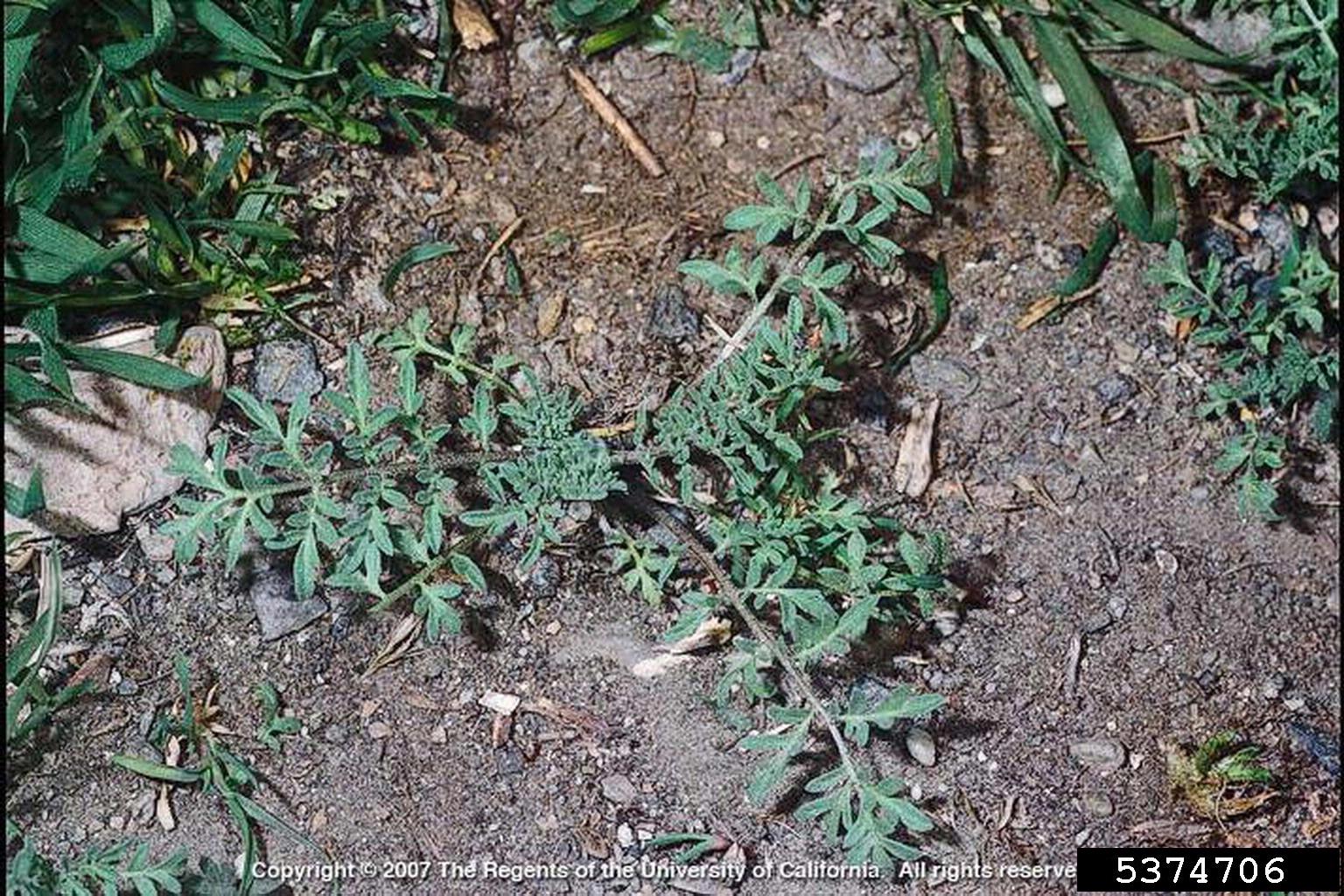
Herb sophia plant in Santa Fe County, New Mexico.
The following description of herb sophia provides characteristics that may be relevant to fire ecology, and is not meant for identification. Keys for identification are available (e.g. [32,48,51,64,106]).
Herb sophia is an exotic, cool-season annual or biennial. It is the type species for the genus [51,64,88,130,134]. The single, 6- to 31-inch-long (15-80 cm) stem is coarse, with basal and cauline leaves. Cauline leaves have a large amount of surface area, being 2 or 3 times pinnately divided. The inflorescence is a raceme of bisexual flowers. The fruit is a 1 × 10- to 71-mm-long silique bearing 10 to 20 small (10-25 mm long), seeds [32,49,51,64,96,106,145]. Tansymustard (Descurainia spp.) fruits and seeds do not have specialized appendages for dispersal [74,76]. Tansymustards have a short taproot [29,153].
Stand structure of herb sophia-dominated communities is sparse immediately after disturbance. Herb sophia stands often become dense and crowded within a few postdisturbance years, and thin as succession advances [16]. For further information on herb sophia's role in succession, see Successional Status below.
Raunkiaer Life Form
- Therophyte [107]
Seasonal Development
Germination usually begins in winter or early spring [134,135], depending upon latitude and elevation. Herb sophia is 1 of the 1st plants to appear in spring. After the cotyledon stage, the seedling forms a rosette of basal leaves, then grows the stem and cauline leaves [64]. Fall-germinating seeds overwinter as rosettes [16]. In the United States, herb sophia 1st flowers in the Southeast [106,130].
| Region | Event | Period |
|---|---|---|
| Southeast | anthesis | Feb.–Aug. [106,130] |
| Southwest | anthesis | March–July [73] |
| Pacific Northwest | anthesis | March–July [67] |
| Northeast | anthesis | May–July [48] |
| Great Plains, northern | anthesis | Mid-June–late July [49,96] |
| Great Plains, southern | anthesis | March–Sept. [32] |
| Great Lakes | anthesis | June–Aug. [90] |
| fruits ripen | June–early Sept. [96] |
Regeneration Processes
Herb sophia reproduces solely from seed [114,126].
Pollination and Breeding System
Pollination is insect-mediated. The sepals contain nectaries that attract insect pollinators [63]. Mustards (Brassicaceae) are cross-pollinated. Selfing also occurs [63].
Seed Production
Herb sophia produces an average of 75-650 seeds per plant [124]. A large plant may produce upwards of 700,000 seeds [114].
Seed Dispersal
Wind, water, machinery, and animals transport herb sophia seed, although most seed falls near the parent plant [114]. Animals disperse tansymustard seeds when the mucilaginous seedcoat sticks to feathers or fur [155].
Seed Banking
Herb sophia builds up a soil seed bank [2,5,39,149]. The seed bank can be large: Stevens [126] documented a herb sophia seed population of 704,582/m2 in North Dakota soil. Herb sophia was an important component of the soil seed pool (all spp.) in big sagebrush-green rabbitbrush (Chrysothamnus viscidiflorus) of southwestern Wyoming [30]. On the Nevada Test Site near Las Vegas, herb sophia was the 2nd most common species to emerge on irrigated and unirrigated test plots; red brome was most common [149]. Long-term viability of herb sophia seed is unknown, but the seed is reported to remain viable for "considerable periods in the soil" [114]. Buried flixweed seed remained viable at least 4 years in Fairbanks, Alaska. Seed viability generally dropped with years of soil storage [26]:
| 0 Years | 2.7 Years | 3.7 Years | 4.7 Years |
| 67% | 28% | 36% | 10% |
Germination
Herb sophia shows good germination [27], with a mean rate of about 70% [114]. Seed collected in Alberta showed 75% germination after cold storage/stratification. In another aspect of the study, some seeds from the lot survived digestion by ruminant grazers or short-term silage. Three percent of ingested seed germinated after 1 day in a cow's rumen, and seed stored in the bottom of a barley (Hordeum vulgare)-filled silo for 8 weeks showed 2% germination [19].

Herb sophia seedling.
Herb sophia is adapted to establishing in dry environments. The seedcoat of tansymustards forms a thin layer of mucilage after wetting [64,155]; the mucilaginous layer helps germinating seeds retain water [155].
Seedling Establishment and Growth
The taproot exploits moisture in the upper soil layer [29,152,153], and uncrowded plants develop rapidly. Plants may develop numerous leaves and up to 15 lateral, fruit-bearing branches at maturity [16].
Vegetative Reproduction and Regeneration
Herb sophia does not reproduce or regenerate vegetatively.
Successional Status
Herb sophia occurs in early seral communities. It is common on disturbed ground [36,39,60,61,95,128,136]. For example, in a big sagebrush community in northwestern Colorado, herb sophia appeared the 1st year after bulldozing, showing mean productivity of 1 g/m2. Productivity peaked at postdisturbance year 2, and declined for the next 5 years. Herb sophia was present in only trace amounts on undisturbed control plots. It showed the same pattern of succession on plots that were fertilized with nitrogen after bulldozing, except productivity was greater on fertilized plots compared to unfertilized plots (15 vs. 5 g/m2 at postdisturbance year 2) [84]. On oilfields of Prudhoe Bay, Alaska, herb sophia was among the most important forbs 5 to 8 years after exploratory drilling [83]. Herb sophia is nonmycorrhizal [98]; thus, it is able to pioneer on sterile sites or on sites undergoing primary succession [3,17].
A common pattern of succession in disturbed sagebrush steppe begins with Russian-thistle. Herb sophia, western tansymustard (Descurainia pinnata), and/or tall tumblemustard (Sisymbrium altissimum) soon follow successionally. Russian-thistle may in turn reinvade the mustard stands with grazing disturbance, but more commonly, the mustards are succeeded by cheatgrass (Bromus tectorum) [66,101,152]. In desert environments, cheatgrass usually requires litter for successful germination and establishment. Dried skeletons of herb sophia and other annual forbs may facilitate cheatgrass establishment by providing litter [37,38]. For information on the interactions of herb sophia and cheatgrass, see Fire Management Considerations and the FEIS review on cheatgrass.
Herb sophia is uncommon to absent in late seres [115]. In central Saskatchewan, herb sophia occurred in fallow and recently harvested wheat (Triticum aestivum) fields. It was not present, or found in seed bank soil samples, of adjacent undisturbed shortbristle need-and-thread-western wheatgrass (Hesperostipa curtiseta-Pascopyrum smithii) prairie [5]. On strip-mined sites in south-central Alaska, herb sophia volunteered on revegetated reclamation sites, but was absent by posttreatment year 10 [34]. Herb sophia is most likely to persist in communities that retain unlittered soil and open canopies into late succession. In singleleaf pinyon-Colorado pinyon (Pinus edulis)-Utah juniper communities of west-central Utah, where litter build-up can be slow, herb sophia occurred on burns in early to late stages of succession (3-100+ years), but was most common on new burns [13]. On mixed-grass prairies in Wyoming, which are likely to build up litter quickly, herb sophia was common for ~10 years postdisturbance, then became increasing scarce [115].
Herb sophia and the native western tansymustard are apparently equally invasive, and fill similar ecological niches [89].
Immediate Fire Effects
While in the rosette stage, herb sophia may be top-killed by fire. If the root crown is not damaged, herb sophia rosettes can sprout new basal leaves from the root crown. As an annual with a single stem, herb sophia lacks adaptations for regrowth once it has bolted [2,39], and plants burned after the rosette stage are killed. Research on fire's impact to the seed bank is lacking as of this writing (2003), but it appears that fire has little effect on herb sophia seed populations. Herb sophia has tiny seeds [32,51,64,106] that easily fall into fire-safe microsites such as soil crevices. While fire is likely to kill some seed, its overall effect to the herb sophia seed bank is probably negligible.
Postfire Regeneration Strategy
- Ground residual colonizer (on-site, initial community)
- Initial off-site colonizer (off-site, initial community) [127]
Fire Adaptations
Herb sophia establishes from soil-stored seed after fire [2,39]. Animal, wind, or machinery transport from off-site may provide additional, minor sources of seed [155] or introduce herb sophia to burns where it is not already present in the soil seed bank. Fire creates conditions favorable for herb sophia establishment (bare soil, open canopy, reduced growth interference) [16,101]. As a shade-intolerant, invasive species, herb sophia thrives in the early postfire environment [151].
Plant Response to Fire
Herb sophia establishes from soil-stored seed after fire [2,39], reaching greatest density in early postfire succession [13,95]. Banked seed usually germinates and establishes in postfire years 1 or 2. The postfire population increases rapidly, and by postfire years 2 to 4, localized, dense stands of herb sophia may form [13,39]. In pinyon-juniper (Pinus-Juniperus spp.) stands of Nevada and Utah, for example, herb sophia appears in early successional years along with other annual herbs [13,102]. Herb sophia density decreases as postfire succession continues, although herb sophia may persist in low numbers in late-successional burns that have retained an open canopy [13,14].
In big sagebrush communities that have experienced fire or other disturbance that removes the sagebrush, herb sophia commonly dominates or is an important component of the initial postfire community. Along with herb sophia, Russian-thistle, western tansymustard, and/or tall tumblemustard form the initial plant community, which is dominated by annuals. Cheatgrass may be part of the initial community in mesic environments. On dry sites, it may follow successionally soon after the annual forbs [101], when litter has created a seedbed favorable for cheatgrass germination [37,38].
Although fire creates an open canopy and bare mineral soil, which favors herb sophia establishment, herb sophia is not an obligate "fire follower." Any area with bare ground, open sunlight, and a seed source is vulnerable to herb sophia invasion [60,61].
Grazing: Few studies have focused on the interactive effects of fire and grazing on herb sophia. One study suggests that fire and grazing may reduce postfire cover of annuals more than fire alone, but the results are inconclusive for herb sophia. Russian-thistle, herb sophia, and prickly-lettuce (Lactuca serriola) were the 3 most important annual forbs, respectively, on a Wyoming big sagebrush (Artemisia tridentata ssp. wyomingensis)-green rabbitbrush burn in central Utah. The 3 annual forbs showed greatest coverage on ungrazed, burned sites (~50%), slightly less cover on grazed, burned sites (~45%), and least cover on grazed, unburned sites (~27%). (Data are pooled means for the 3 forbs over 12 postfire years) [146]. Further studies are needed to understand how combined fire and grazing affect herb sophia.
Herb sophia may invade after restoration treatments [34], including postfire restoration. It was the most abundant exotic forb species 1 and 2 years after prescribed burning and glyphosate treatment to control smooth brome (Bromus inermis) on native rough fescue (Festuca altaica) prairie in Saskatchewan. Herb sophia numbers were similar on smooth brome-infested and native prairie plots, which were also treated with fire and herbicide [53].
Burning may not increase postfire cover of herb sophia. In his classic study of postfire succession of herb sophia and other exotics in big sagebrush, Piemeisel [100] wrote "the mere statement that a field has been burned is not sufficient information to foretell what the effect will be on the succeeding plant cover." For example, a Gambel oak/common snowberry (Symphoricarpos albus) community in Utah was chained and burned to increase forage production for cattle and elk. Two years after treatment, herb sophia cover showed little change (± 1%) compared to pretreatment levels [79]. Piemesel [100] stated that site grazing history, postfire weather patterns, and level of postfire cheatgrass cover will affect cover and relative abundance of herb sophia and other early successional forbs.
The FEIS Research Project Summary Nonnative annual grass fuels and fire in California's Mojave Desert provides information on prescribed fire and postfire response of plant community species including herb sophia.
Fire Regimes
Introduced species can alter the rate of spread of fire, the probability of occurrence of fire, and the intensity of fire in an ecosystem [31]. Herb sophia has multiple, finely divided leaves [32,51,64,106] and tends to form dense stands that are dead and dry by the fire season [16]; hence, it provides a source of fine surface fuels that can spread fire. If herb sophia stands do not burn, they provide litter that favors establishment of species, including cheatgrass, which are more sensitive to desiccation as germinants and seedlings than herb sophia [37,38].
Herb sophia was absent or unimportant in fire-prone ecosystems when historic fire regimes were functional; however, western and other tansymustards were present. Herb sophia and western tansymustard are morphologically and ecologically similar [89], and herb sophia is filling or sharing the ecological niche of western tansymustard as an initial colonizer and early seral species on burns. The role of both species in facilitating establishment of other weedy species in dry environments by providing litter (and subsequently, more mesic conditions for germination and seedling growth of other species including cheatgrass) needs further investigation. There may be subtle differences in the effectiveness of the 2 species in facilitating postdisturbance succession; this also bears investigation, particularly in areas vulnerable to cheatgrass invasion.
Because herb sophia is widespread, it is difficult to exclude many ecosystems as potential hosts of herb sophia plants or populations. The following table provides some fire return intervals for plant communities where herb sophia may be important. For additional fire regime information, search FEIS for this species by entering the species name on the Advanced Search page and selecting “Fire Regime” as the publication type.
| Community or Ecosystem | Dominant Species | Fire Return Interval Range (years) |
|---|---|---|
| silver fir-Douglas-fir | Abies amabilis-Pseudotsuga menziesii var. menziesii | > 200 |
| grand fir | A. grandis | 35-200 [8] |
| maple-beech-birch | Acer-Fagus-Betula | > 1000 |
| silver maple-American elm | A. saccharinum-Ulmus americana | < 35 to 200 |
| sugar maple | A. saccharum | > 1,000 |
| sugar maple-basswood | A. saccharum-Tilia americana | > 1,000 [144] |
| California chaparral | Adenostoma and/or Arctostaphylos spp. | < 35 to < 100 [97] |
| bluestem prairie | Andropogon gerardii var. gerardii-Schizachyrium scoparium | < 10 [77,97] |
| Nebraska sandhills prairie | A. gerardii var. paucipilus-S. scoparium | < 10 |
| bluestem-Sacahuista prairie | A. littoralis-Spartina spartinae | < 10 [97] |
| silver sagebrush steppe | Artemisia cana | 5-45 [62,104,150] |
| sagebrush steppe | A. tridentata/Pseudoroegneria spicata | 20-70 [97] |
| basin big sagebrush | A. tridentata var. tridentata | 12-43 [116] |
| mountain big sagebrush | A. tridentata var. vaseyana | 15-40 [9,23,87] |
| Wyoming big sagebrush | A. tridentata var. wyomingensis | 10-70 (40**) [141,156] |
| coastal sagebrush | A. californica | < 35 to < 100 |
| saltbush-greasewood | Atriplex confertifolia-Sarcobatus vermiculatus | < 35 to < 100 |
| desert grasslands | Bouteloua eriopoda and/or Pleuraphis mutica | 5-100 [97] |
| plains grasslands | Bouteloua spp. | < 35 [97,150] |
| blue grama-needle-and-thread grass-western wheatgrass | B. gracilis-Hesperostipa comata-Pascopyrum smithii | < 35 [97,113,150] |
| blue grama-buffalo grass | B. gracilis-Buchloe dactyloides | < 35 [97,150] |
| grama-galleta steppe | Bouteloua gracilis-Pleuraphis jamesii | < 35 to < 100 |
| blue grama-tobosa prairie | B. gracilis-P. mutica | < 35 to < 100 |
| cheatgrass | Bromus tectorum | < 10 |
| California montane chaparral | Ceanothus and/or Arctostaphylos spp. | 50-100 [97] |
| sugarberry-America elm-green ash | Celtis laevigata-Ulmus americana-Fraxinus pennsylvanica | < 35 to 200 [144] |
| paloverde-cactus shrub | Cercidium microphyllum/Opuntia spp. | < 35 to < 100 [97] |
| curlleaf mountain-mahogany* | Cercocarpus ledifolius | 13-1000 [11,118] |
| mountain-mahogany-Gambel oak scrub | C. ledifolius-Quercus gambelii | < 35 to < 100 [97] |
| Atlantic white-cedar | Chamaecyparis thyoides | 35 to > 200 [144] |
| blackbrush | Coleogyne ramosissima | < 35 to < 100 |
| Arizona cypress | Cupressus arizonica | < 35 to 200 |
| northern cordgrass prairie | Distichlis spicata-Spartina spp. | 1-3 [97] |
| beech-sugar maple | Fagus spp.-Acer saccharum | > 1000 [144] |
| California steppe | Festuca-Danthonia spp. | < 35 [97,129] |
| black ash | Fraxinus nigra | < 35 to 200 [144] |
| juniper-oak savanna | Juniperus ashei-Quercus virginiana | < 35 |
| Ashe juniper | J. ashei | < 35 |
| western juniper | J. occidentalis | 20-70 |
| Rocky Mountain juniper | J. scopulorum | < 35 |
| cedar glades | J. virginiana | 3-7 |
| tamarack | Larix laricina | 35-200 [97] |
| western larch | L. occidentalis | 25-100 [8] |
| creosotebush | Larrea tridentata | < 35 to < 100 |
| Ceniza shrub | L. tridentata-Leucophyllum frutescens-Prosopis glandulosa | < 35 [97] |
| yellow-poplar | Liriodendron tulipifera | < 35 [144] |
| wheatgrass plains grasslands | Pascopyrum smithii | < 5-47+ [97,104,150] |
| Great Lakes spruce-fir | Picea-Abies spp. | 35 to > 200 |
| northeastern spruce-fir | Picea-Abies spp. | 35-200 [33] |
| southeastern spruce-fir | Picea-Abies spp. | 35 to > 200 [144] |
| Engelmann spruce-subalpine fir | P. engelmannii-A. lasiocarpa | 35 to > 200 [8] |
| black spruce | P. mariana | 35-200 [33] |
| blue spruce* | P. pungens | 35-200 [8] |
| red spruce* | P. rubens | 35-200 [33] |
| pine-cypress forest | Pinus-Cupressus spp. | < 35 to 200 [8] |
| pinyon-juniper | Pinus-Juniperus spp. | < 35 [97] |
| whitebark pine* | P. albicaulis | 50-200 [1,6] |
| jack pine | P. banksiana | <35 to 200 [33] |
| Mexican pinyon | P. cembroides | 20-70 [91,132] |
| Rocky Mountain lodgepole pine* | P. contorta var. latifolia | 25-300+ [7,8,112] |
| Sierra lodgepole pine* | P. contorta var. murrayana | 35-200 [7] |
| shortleaf pine | P. echinata | 2-15 |
| shortleaf pine-oak | P. echinata-Quercus spp. | < 10 [144] |
| Colorado pinyon | P. edulis | 10-400+ [44,50,75,97] |
| slash pine | P. elliottii | 3-8 |
| slash pine-hardwood | P. elliottii-variable | < 35 |
| sand pine | P. elliottii var. elliottii | 25-45 [144] |
| Jeffrey pine | P. jeffreyi | 5-30 |
| western white pine* | P. monticola | 50-200 [8] |
| longleaf-slash pine | P. palustris-P. elliottii | 1-4 [94,144] |
| longleaf pine-scrub oak | P. palustris-Quercus spp. | 6-10 [144] |
| Pacific ponderosa pine* | P. ponderosa var. ponderosa | 1-47 [8] |
| interior ponderosa pine* | P. ponderosa var. scopulorum | 2-30 [8,12,80] |
| Arizona pine | P. ponderosa var. arizonica | 2-15 [12,28,119] |
| Table Mountain pine | P. pungens | < 35 to 200 [144] |
| red pine (Great Lakes region) | P. resinosa | 10-200 (10**) [33,46] |
| red-white-jack pine* | P. resinosa-P. strobus-P. banksiana | 10-300 [33,58] |
| pitch pine | P. rigida | 6-25 [21,59] |
| pocosin | P. serotina | 3-8 |
| pond pine | P. serotina | 3-8 |
| eastern white pine | P. strobus | 35-200 |
| eastern white pine-eastern hemlock | P. strobus-Tsuga canadensis | 35-200 |
| eastern white pine-northern red oak-red maple | P. strobus-Quercus rubra-Acer rubrum | 35-200 |
| loblolly pine | P. taeda | 3-8 |
| loblolly-shortleaf pine | P. taeda-P. echinata | 10 to < 35 |
| Virginia pine | P. virginiana | 10 to < 35 |
| Virginia pine-oak | P. virginiana-Quercus spp. | 10 to < 35 |
| sycamore-sweetgum-American elm | Platanus occidentalis-Liquidambar styraciflua-Ulmus americana | < 35 to 200 [144] |
| galleta-threeawn shrubsteppe | Pleuraphis jamesii-Aristida purpurea | < 35 to < 100 |
| eastern cottonwood | Populus deltoides | < 35 to 200 [97] |
| aspen-birch | P. tremuloides-Betula papyrifera | 35-200 [33,144] |
| quaking aspen (west of the Great Plains) | P. tremuloides | 7-120 [8,55,86] |
| mesquite | Prosopis glandulosa | < 35 to < 100 [85,97] |
| mesquite-buffalo grass | P. glandulosa-Buchloe dactyloides | < 35 |
| Texas savanna | P. glandulosa var. glandulosa | < 10 [97] |
| black cherry-sugar maple | Prunus serotina-Acer saccharum | > 1000 [144] |
| mountain grasslands | Pseudoroegneria spicata | 3-40 (10**) [7,8] |
| Rocky Mountain Douglas-fir* | Pseudotsuga menziesii var. glauca | 25-100 [8,9,10] |
| coastal Douglas-fir* | P. menziesii var. menziesii | 40-240 [8,92,109] |
| California mixed evergreen | P. menziesii var. m.-Lithocarpus densiflorus-Arbutus menziesii | < 35 |
| California oakwoods | Quercus spp. | < 35 [8] |
| oak-hickory | Quercus-Carya spp. | < 35[144] |
| oak-juniper woodland (Southwest) | Quercus-Juniperus spp. | < 35 to < 200 [97] |
| northeastern oak-pine | Quercus-Pinus spp. | 10 to < 35 [144] |
| oak-gum-cypress | Quercus-Nyssa-spp.-Taxodium distichum | 35 to > 200 [94] |
| southeastern oak-pine | Quercus-Pinus spp. | < 10 [144] |
| coast live oak | Q. agrifolia | 2-75 [52] |
| white oak-black oak-northern red oak | Q. alba-Q. velutina-Q. rubra | < 35 [144] |
| canyon live oak | Q. chrysolepis | <35 to 200 |
| blue oak-foothills pine | Q. douglasii-Pinus sabiniana | <35 [8] |
| northern pin oak | Q. ellipsoidalis | < 35 [144] |
| Oregon white oak | Q. garryana | < 35 [8] |
| bear oak | Q. ilicifolia | < 35 >[144] |
| California black oak | Q. kelloggii | 5-30 [97] |
| bur oak | Q. macrocarpa | < 10 [144] |
| oak savanna | Q. macrocarpa/Andropogon gerardii-Schizachyrium scoparium | 2-14 [97,144] |
| shinnery | Q. mohriana | < 35 [97] |
| chestnut oak | Q. prinus | 3-8 |
| northern red oak | Q. rubra | 10 to < 35 |
| post oak-blackjack oak | Q. stellata-Q. marilandica | < 10 |
| black oak | Q. velutina | < 35 |
| live oak | Q. virginiana | 10 to< 100 [144] |
| interior live oak | Q. wislizenii | < 35 [8] |
| cabbage palmetto-slash pine | Sabal palmetto-Pinus elliottii | < 10 [94,144] |
| blackland prairie | Schizachyrium scoparium-Nassella leucotricha | < 10 |
| Fayette prairie | S. scoparium-Buchloe dactyloides | < 10 |
| little bluestem-grama prairie | S. scoparium-Bouteloua spp. | < 35 |
| tule marshes | Scirpus and/or Typha spp. | < 35 [144] |
| redwood | Sequoia sempervirens | 5-200 [8,42,131] |
| southern cordgrass prairie | Spartina alterniflora | 1-3 [97] |
| baldcypress | Taxodium distichum var. distichum | 100 to > 300 |
| pondcypress | T. distichum var. nutans | < 35 [94] |
| western redcedar-western hemlock | Thuja plicata-Tsuga heterophylla | > 200 [8] |
| eastern hemlock-yellow birch | T. canadensis-Betula alleghaniensis | > 200 [144] |
| western hemlock-Sitka spruce | T. heterophylla-Picea sitchensis | > 200 |
| mountain hemlock* | T. mertensiana | 35 to > 200 [8] |
| elm-ash-cottonwood | Ulmus-Fraxinus-Populus spp. | < 35 to 200 [33,144] |
| *fire return interval varies widely; trends in variation are noted in the species summary **mean | ||
Fire Management Considerations
Fire as a Control Agent
There are no published studies on using fire to control herb sophia, but given herb sophia's strong response to increased light and nutrients and open ground, fire alone is unlikely to provide control. If herb sophia is already onsite in the seed bank, or as a few plants, fire is likely to increase the species' importance in the early postfire community.
Interactions with Cheatgrass
If present in the seed bank, herb sophia is liable to dominate early postfire communities if the seedbed or the postfire climate are unfavorable for cheatgrass establishment [37,38,100]. Even when cheatgrass dominates the postfire community, herb sophia is likely to be an important forb. The 2 species are frequently found together in the prefire seed bank. In a big sagebrush-rubber rabbitbrush (Chrysothamnus nauseosus) community in Wyoming, cheatgrass dominated the seed bank, but herb sophia was 1 of the most important forbs in the seed bank [93]. Succession after a July 1985 wildfire on the Snake River Birds of Prey Area, southwestern Idaho, followed a typical pattern, with herb sophia showing greater cover than any other plant species except cheatgrass. There was much open ground in the area, especially on sites prepared for postfire rehabilitation [54].
| Plot condition | Burned | Partially burned | Burned and rehabilitated* | Unburned, untreated control |
| Herb sophia | 5 | 3 | 6 | < 1 |
| Cheatgrass | 26 | 9 | 14 | 5 |
| Bare ground | 22 | 22 | 54 | 22 |
| *drill-seeded with crested wheatgrass (Agropyron cristatum), yellow sweetclover (Melilotus officinalis), and fourwing saltbush (Atriplex canescens) | ||||
Interactions with Western and Other Tansymustards
Although they are taxonomically and ecologically similar, little is known of possible growth interference of exotic herb sophia to western and other native tansymustards in postfire environments. Limited studies are inconclusive, and further research is needed in this area. A review by Wright and others [151] describes herb sophia as more resilient to fall prescribed burning than western tansymustard ("undamaged" vs. "slightly damaged" by fall fire, respectively). Postfire responses of the 2 species probably depend upon their relative abundance in the prefire seed bank and poorly understood differences in germination and seedling establishment requirements. Floyd-Hanna and others [45] noted the presence of both species after the Chapin 5 Wildfire at Mesa Verde National Park in the summer of 1996. Herb sophia was more frequent on study plots than western tansymustard at postfire year 1. Herb sophia was not observed on study plots at postfire year 2, while western tansymustard increased [45].
| Plant community | Herb sophia | Western tansymustard | ||
|---|---|---|---|---|
| 1997 | 1998 | 1997 | 1998 | |
| Gambel oak/Utah serviceberry* mountain shrubland | 16 | 0 | 3 | 31 |
| Gambel oak-Colorado pinyon-Utah juniper | 12 | 0 | 1 | 24 |
| Colorado pinyon-Utah juniper | 10 | 0 | 2 | 27 |
Federal Status
None
Other Status
Herb sophia is classified as a noxious weed list in Colorado and Minnesota [137,138].
Importance to Wildlife and Livestock
Herb sophia is toxic to livestock, causing blindness, staggering, and loss of ability to swallow. All parts of the plant contain poisonous levels of nitrate [43,123]. The seeds contain poisonous isoallyl thiocyanates and irritant oils. Large quantities of the plant must be consumed for long periods of time for poisoning to occur [43].
Wildlife use of herb sophia and other tansymustards is poorly documented, and further studies are needed to determine the relative importance of tansymustards in animal communities.
Small mammals: Townsend's ground squirrels graze tansymustards, sometimes in large quantity. Spring use of tansymustard has ranged from 3% on the Snake River Birds of Prey Area in southwestern Idaho to 33% in eastern Washington [71,111,154].
Birds: Sage-grouse in Nevada grazed most of the early spring forbs in a big sagebrush community, but avoided herb sophia [117]. In free-choice trials, chukar preferred western tansymustard seeds to cheatgrass seeds, which form the main staple of their diet [155].
Herb sophia is a larval food for orangetip, white checkered, and white cabbage butterflies [68].
Palatability and Nutritional Value
Herb sophia is moderately palatable to livestock, although livestock may prefer other tansymustard species. In free-choice trials, cattle in Montana selected western tansymustard more often than herb sophia [99].
Cover Value
No information.
Other Uses
Herb sophia seeds have a flavor similar to commercial black mustard (Brassica nigra) seeds, and are used as a spice [32]. The Navajo used ground herb sophia seeds in baked goods [140]. The stems and leaves are used as fiber in India [139].

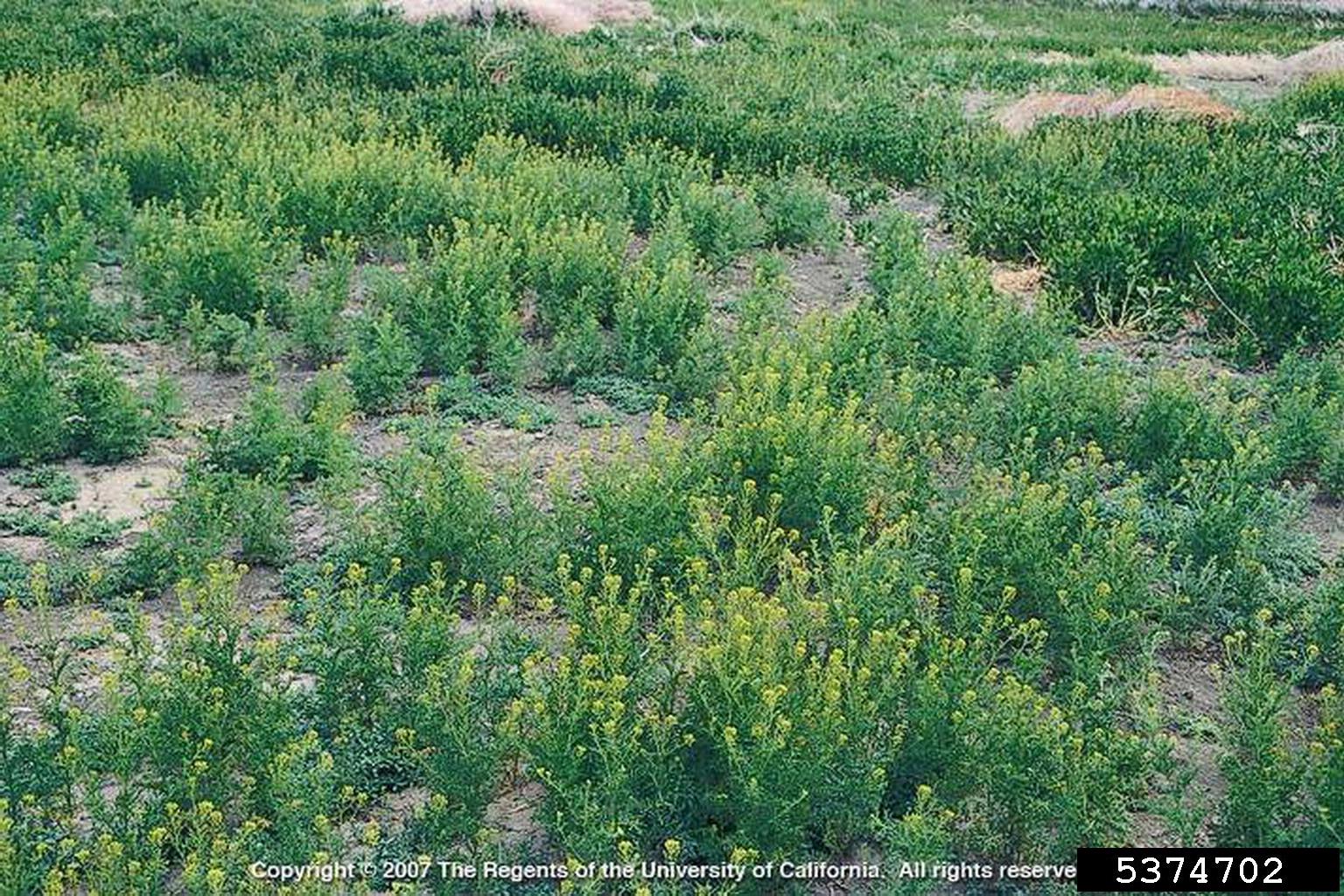
Field infested with herb sophia.
Impacts
The greatest impact of herb sophia and other tansymustards to wildlands is probably their role in facilitating succession. See Successional Status for further information.
Herb sophia invades rangelands disturbed by heavy grazing [105]. It is a common volunteer on restoration and rehabilitation projects [122,143].
Herb sophia is a crop pest [89] and an alternate host for beet leafhoppers, which transmit curly top virus to sugar beet (Beta vulgaris) crops [65].
Prevention
Since herb sophia is an early seral species, minimizing soil disturbance and seed dispersal and maintaining a healthy plant community is the best way to prevent establishment of herb sophia [25].
Control
Herb sophia does not usually persist in late-seral communities and may not require special control measures. Canopy closure, litter accumulation and/or growth interference from later-successional species tend to exclude tansymustard over time. For example, herb sophia volunteered between rough fescue sod patches on a restoration project in Alberta. As the rough fescue grew and litter accumulated, herb sophia became less abundant [108]. Perhaps because it is largely controlled by succession, there is scant wildland-management interest in using resource monies to control herb sophia with fire, herbicides, or other treatments.
Fire
See Fire Management Considerations.
Physical and Mechanical Control
Small infestations of herb sophia can be controlled by hand pulling rosettes in the fall or early spring [25].
Biological Control
There are no biological control organisms reported for herb sophia [25].
Chemical Control
Herbicides are effective in gaining initial control of a new invasion or a severe infestation, but are rarely a complete or long-term solution to weed management [24]. Herbicides are more effective on large infestations when incorporated into long-term management plans that include replacement of weeds with desirable species, careful land use management, and prevention of new infestations. Control with herbicides is temporary, as it does not change those conditions that allow infestations to occur [157]. See the Weed Control Methods Handbook for considerations on the use of herbicides in natural areas and detailed information on specific chemicals.
Herb sophia seedlings are sensitive to most herbicides at relatively low application rates. Glyphosate and 2,4-D give excellent control [135,148], as do many other herbicides [148]. Herbicide choice and rates are influenced by growth stage, stand density, and environmental conditions (e.g. drought or cold temperatures). Check with state or county weed specialists for appropriate local use rates and timing.
Integrated Management
Land management practices that promote later-successional species can exclude herb sophia from most plant communities [25]. Some communities, such as sagebrush steppe and salt-desert shrubland, maintain open light and bare ground conditions well into late succession [81]. For these communities, herb sophia is controlled by eliminating seed production until the seed bank is depleted. Mechanical treatment or herbicide application prior to seed set treats established plants [25]. Managers are encouraged to use combinations of control techniques that are appropriate to the site objectives, desired plant community, available resources, and timing of application. For information on integrated weed management without herbicides, see the Bio-Integral Resource Center (BIRC) website.
Revegetation
Copy text
The following biogeographic classification systems are presented as a guide to demonstrate where herb sophia may be found. Precise distribution information is limited. Because it is so widespread, it is difficult to exclude many ecosystems as potential hosts of herb sophia plants or populations; therefore, these lists are speculative.
Table A1— Forest and range ecosystems, Bureau of Land Management (BLM) physiographic regions, Kuchler plant associations, Society for American Foresters (SAF) forest cover types, and Society for Rangeland Management (SRM) rangeland cover types in which this species occurs.
Forest and Range Ecosystems (Garrison et al. 1977)
- FRES10 White-red-jack pine
- FRES11 Spruce-fir
- FRES12 Longleaf-slash pine
- FRES13 Loblolly-shortleaf pine
- FRES14 Oak-pine
- FRES15 Oak-hickory
- FRES16 Oak-gum-cypress
- FRES17 Elm-ash-cottonwood
- FRES18 Maple-beech-birch
- FRES19 Aspen-birch
- FRES20 Douglas-fir
- FRES21 Ponderosa pine
- FRES22 Western white pine
- FRES23 Fir-spruce
- FRES24 Hemlock-Sitka spruce
- FRES25 Larch
- FRES26 Lodgepole pine
- FRES27 Redwood
- FRES28 Western hardwoods
- FRES29 Sagebrush
- FRES30 Desert shrub
- FRES31 Shinnery
- FRES32 Texas savanna
- FRES33 Southwestern shrubsteppe
- FRES34 Chaparral-mountain shrub
- FRES35 Pinyon-juniper
- FRES36 Mountain grasslands
- FRES37 Mountain meadows
- FRES38 Plains grasslands
- FRES39 Prairie
- FRES40 Desert grasslands
- FRES41 Wet grasslands
- FRES42 Annual grasslands
- FRES44 Alpine
BLM Physiographic Regions (Bernard and Brown 1977)
- 1 Northern Pacific Border
- 2 Cascade Mountains
- 3 Southern Pacific Border
- 4 Sierra Mountains
- 5 Columbia Plateau
- 6 Upper Basin and Range
- 7 Lower Basin and Range
- 8 Northern Rocky Mountains
- 9 Middle Rocky Mountains
- 10 Wyoming Basin
- 11 Southern Rocky Mountains
- 12 Colorado Plateau
- 13 Rocky Mountain Piedmont
- 14 Great Plains
- 15 Black Hills Uplift
- 16 Upper Missouri Basin and Broken Lands
Kuchler Plant Associations (Kuchler 1964)
- K001 Spruce-cedar-hemlock forest
- K002 Cedar-hemlock-Douglas-fir forest
- K003 Silver fir-Douglas-fir forest
- K004 Fir-hemlock forest
- K005 Mixed conifer forest
- K006 Redwood forest
- K007 Red fir forest
- K008 Lodgepole pine-subalpine forest
- K009 Pine-cypress forest
- K010 Ponderosa shrub forest
- K011 Western ponderosa forest
- K012 Douglas-fir forest
- K013 Cedar-hemlock-pine forest
- K014 Grand fir-Douglas-fir forest
- K015 Western spruce-fir forest
- K016 Eastern ponderosa forest
- K017 Black Hills pine forest
- K018 Pine-Douglas-fir forest
- K019 Arizona pine forest
- K020 Spruce-fir-Douglas-fir forest
- K021 Southwestern spruce-fir forest
- K022 Great Basin pine forest
- K023 Juniper-pinyon woodland
- K024 Juniper steppe woodland
- K025 Alder-ash forest
- K026 Oregon oakwoods
- K027 Mesquite bosques
- K028 Mosaic of K002 and K026
- K029 California mixed evergreen forest
- K030 California oakwoods
- K031 Oak-juniper woodland
- K032 Transition between K031 and K037
- K033 Chaparral
- K034 Montane chaparral
- K035 Coastal sagebrush
- K036 Mosaic of K030 and K035
- K037 Mountain-mahogany-oak scrub
- K038 Great Basin sagebrush
- K039 Blackbrush
- K040 Saltbush-greasewood
- K041 Creosote bush
- K042 Creosote bush-bur sage
- K043 Paloverde-cactus shrub
- K044 Creosote bush-tarbush
- K045 Ceniza shrub
- K046 Desert: vegetation largely lacking
- K047 Fescue-oatgrass
- K048 California steppe
- K049 Tule marshes
- K050 Fescue-wheatgrass
- K051 Wheatgrass-bluegrass
- K052 Alpine meadows and barren
- K053 Grama-galleta steppe
- K054 Grama-tobosa prairie
- K055 Sagebrush steppe
- K056 Wheatgrass-needlegrass shrubsteppe
- K057 Galleta-threeawn shrubsteppe
- K058 Grama-tobosa shrubsteppe
- K059 Trans-Pecos shrub savanna
- K060 Mesquite savanna
- K061 Mesquite-acacia savanna
- K062 Mesquite-live oak savanna
- K063 Foothills prairie
- K064 Grama-needlegrass-wheatgrass
- K065 Grama-buffalo grass
- K066 Wheatgrass-needlegrass
- K067 Wheatgrass-bluestem-needlegrass
- K068 Wheatgrass-grama-buffalo grass
- K069 Bluestem-grama prairie
- K070 Sandsage-bluestem prairie
- K071 Shinnery
- K072 Sea oats prairie
- K073 Northern cordgrass prairie
- K074 Bluestem prairie
- K075 Nebraska Sandhills prairie
- K076 Blackland prairie
- K077 Bluestem-sacahuista prairie
- K078 Southern cordgrass prairie
- K079 Palmetto prairie
- K080 Marl everglades
- K081 Oak savanna
- K082 Mosaic of K074 and K100
- K083 Cedar glades
- K084 Cross Timbers
- K085 Mesquite-buffalo grass
- K086 Juniper-oak savanna
- K087 Mesquite-oak savanna
- K088 Fayette prairie
- K089 Black Belt
- K090 Live oak-sea oats
- K091 Cypress savanna
- K092 Everglades
- K093 Great Lakes spruce-fir forest
- K094 Conifer bog
- K095 Great Lakes pine forest
- K096 Northeastern spruce-fir forest
- K097 Southeastern spruce-fir forest
- K098 Northern floodplain forest
- K099 Maple-basswood forest
- K100 Oak-hickory forest
- K101 Elm-ash forest
- K102 Beech-maple forest
- K103 Mixed mesophytic forest
- K104 Appalachian oak forest
- K105 Mangrove
- K106 Northern hardwoods
- K107 Northern hardwoods-fir forest
- K108 Northern hardwoods-spruce forest
- K109 Transition between K104 and K106
- K110 Northeastern oak-pine forest
- K111 Oak-hickory-pine
- K112 Southern mixed forest
- K113 Southern floodplain forest
- K114 Pocosin
- K115 Sand pine scrub
- K116 Subtropical pine forest
SAF Cover Types (Eyre 1980)
- 1 Jack pine
- 5 Balsam fir
- 12 Black spruce
- 13 Black spruce-tamarack
- 14 Northern pin oak
- 15 Red pine
- 16 Aspen
- 17 Pin cherry
- 18 Paper birch
- 19 Gray birch-red maple
- 20 White pine-northern red oak-red maple
- 21 Eastern white pine
- 22 White pine-hemlock
- 23 Eastern hemlock
- 24 Hemlock-yellow birch
- 25 Sugar maple-beech-yellow birch
- 26 Sugar maple-basswood
- 27 Sugar maple
- 28 Black cherry-maple
- 30 Red spruce-yellow birch
- 31 Red spruce-sugar maple-beech
- 32 Red spruce
- 33 Red spruce-balsam fir
- 34 Red spruce-Fraser fir
- 35 Paper birch-red spruce-balsam fir
- 37 Northern white-cedar
- 38 Tamarack
- 39 Black ash-American elm-red maple
- 40 Post oak-blackjack oak
- 42 Bur oak
- 43 Bear oak
- 44 Chestnut oak
- 45 Pitch pine
- 46 Eastern redcedar
- 50 Black locust
- 51 White pine-chestnut oak
- 52 White oak-black oak-northern red oak
- 53 White oak
- 55 Northern red oak
- 57 Yellow-poplar
- 58 Yellow-poplar-eastern hemlock
- 59 Yellow-poplar-white oak-northern red oak
- 60 Beech-sugar maple
- 61 River birch-sycamore
- 62 Silver maple-American elm
- 63 Cottonwood
- 64 Sassafras-persimmon
- 65 Pin oak-sweetgum
- 66 Ashe juniper-redberry (Pinchot) juniper
- 67 Mohrs (shin) oak
- 68 Mesquite
- 69 Sand pine
- 70 Longleaf pine
- 71 Longleaf pine-scrub oak
- 72 Southern scrub oak
- 73 Southern redcedar
- 74 Cabbage palmetto
- 75 Shortleaf pine
- 76 Shortleaf pine-oak
- 78 Virginia pine-oak
- 79 Virginia pine
- 80 Loblolly pine-shortleaf pine
- 81 Loblolly pine
- 82 Loblolly pine-hardwood
- 83 Longleaf pine-slash pine
- 84 Slash pine
- 85 Slash pine-hardwood
- 87 Sweetgum-yellow-poplar
- 88 Willow oak-water oak-diamondleaf (laurel) oak
- 89 Live oak
- 91 Swamp chestnut oak-cherrybark oak
- 92 Sweetgum-willow oak
- 93 Sugarberry-American elm-green ash
- 94 Sycamore-sweetgum-American elm
- 95 Black willow
- 96 Overcup oak-water hickory
- 97 Atlantic white-cedar
- 98 Pond pine
- 100 Pondcypress
- 101 Baldcypress
- 102 Baldcypress-tupelo
- 103 Water tupelo-swamp tupelo
- 104 Sweetbay-swamp tupelo-redbay
- 105 Tropical hardwoods
- 106 Mangrove
- 107 White spruce
- 108 Red maple
- 109 Hawthorn
- 110 Black oak
- 111 South Florida slash pine
- 201 White spruce
- 202 White spruce-paper birch
- 203 Balsam poplar
- 204 Black spruce
- 205 Mountain hemlock
- 206 Engelmann spruce-subalpine fir
- 207 Red fir
- 208 Whitebark pine
- 209 Bristlecone pine
- 210 Interior Douglas-fir
- 211 White fir
- 212 Western larch
- 213 Grand fir
- 215 Western white pine
- 216 Blue spruce
- 217 Aspen
- 218 Lodgepole pine
- 219 Limber pine
- 220 Rocky Mountain juniper
- 221 Red alder
- 222 Black cottonwood-willow
- 223 Sitka spruce
- 224 Western hemlock
- 225 Western hemlock-Sitka spruce
- 226 Coastal true fir-hemlock
- 227 Western redcedar-western hemlock
- 228 Western redcedar
- 229 Pacific Douglas-fir
- 230 Douglas-fir-western hemlock
- 231 Port-Orford-cedar
- 232 Redwood
- 233 Oregon white oak
- 234 Douglas-fir-tanoak-Pacific madrone
- 235 Cottonwood-willow
- 236 Bur oak
- 237 Interior ponderosa pine
- 238 Western juniper
- 239 Pinyon-juniper
- 240 Arizona cypress
- 241 Western live oak
- 242 Mesquite
- 243 Sierra Nevada mixed conifer
- 244 Pacific ponderosa pine-Douglas-fir
- 245 Pacific ponderosa pine
- 246 California black oak
- 247 Jeffrey pine
- 248 Knobcone pine
- 249 Canyon live oak
- 250 Blue oak-foothills pine
- 251 White spruce-aspen
- 252 Paper birch
- 253 Black spruce-white spruce
- 254 Black spruce-paper birch
- 255 California coast live oak
- 256 California mixed subalpine
SRM Rangeland Cover Types (Shiflet 1994)
- 101 Bluebunch wheatgrass
- 102 Idaho fescue
- 103 Green fescue
- 104 Antelope bitterbrush-bluebunch wheatgrass
- 105 Antelope bitterbrush-Idaho fescue
- 106 Bluegrass scabland
- 107 Western juniper/big sagebrush/bluebunch wheatgrass
- 108 Alpine Idaho fescue
- 109 Ponderosa pine shrubland
- 110 Ponderosa pine-grassland
- 201 Blue oak woodland
- 202 Coast live oak woodland
- 203 Riparian woodland
- 204 North coastal shrub
- 205 Coastal sage shrub
- 206 Chamise chaparral
- 207 Scrub oak mixed chaparral
- 208 Ceanothus mixed chaparral
- 209 Montane shrubland
- 210 Bitterbrush
- 211 Creosote bush scrub
- 212 Blackbush
- 213 Alpine grassland
- 214 Coastal prairie
- 215 Valley grassland
- 216 Montane meadows
- 217 Wetlands
- 301 Bluebunch wheatgrass-blue grama
- 302 Bluebunch wheatgrass-Sandberg bluegrass
- 303 Bluebunch wheatgrass-western wheatgrass
- 304 Idaho fescue-bluebunch wheatgrass
- 305 Idaho fescue-Richardson needlegrass
- 306 Idaho fescue-slender wheatgrass
- 307 Idaho fescue-threadleaf sedge
- 308 Idaho fescue-tufted hairgrass
- 309 Idaho fescue-western wheatgrass
- 310 Needle-and-thread-blue grama
- 311 Rough fescue-bluebunch wheatgrass
- 312 Rough fescue-Idaho fescue
- 313 Tufted hairgrass-sedge
- 314 Big sagebrush-bluebunch wheatgrass
- 315 Big sagebrush-Idaho fescue
- 316 Big sagebrush-rough fescue
- 317 Bitterbrush-bluebunch wheatgrass
- 318 Bitterbrush-Idaho fescue
- 319 Bitterbrush-rough fescue
- 320 Black sagebrush-bluebunch wheatgrass
- 321 Black sagebrush-Idaho fescue
- 322 Curlleaf mountain-mahogany-bluebunch wheatgrass
- 323 Shrubby cinquefoil-rough fescue
- 324 Threetip sagebrush-Idaho fescue
- 401 Basin big sagebrush
- 402 Mountain big sagebrush
- 403 Wyoming big sagebrush
- 404 Threetip sagebrush
- 405 Black sagebrush
- 406 Low sagebrush
- 407 Stiff sagebrush
- 408 Other sagebrush types
- 409 Tall forb
- 410 Alpine rangeland
- 411 Aspen woodland
- 412 Juniper-pinyon woodland
- 413 Gambel oak
- 414 Salt desert shrub
- 415 Curlleaf mountain-mahogany
- 416 True mountain-mahogany
- 417 Littleleaf mountain-mahogany
- 418 Bigtooth maple
- 419 Bittercherry
- 420 Snowbrush
- 421 Chokecherry-serviceberry-rose
- 422 Riparian
- 501 Saltbush-greasewood
- 502 Grama-galleta
- 503 Arizona chaparral
- 504 Juniper-pinyon pine woodland
- 505 Grama-tobosa shrub
- 506 Creosotebush-bursage
- 507 Palo verde-cactus
- 508 Creosotebush-tarbush
- 509 Transition between oak-juniper woodland and mahogany-oak association
- 601 Bluestem prairie
- 602 Bluestem-prairie sandreed
- 603 Prairie sandreed-needlegrass
- 604 Bluestem-grama prairie
- 605 Sandsage prairie
- 606 Wheatgrass-bluestem-needlegrass
- 607 Wheatgrass-needlegrass
- 608 Wheatgrass-grama-needlegrass
- 609 Wheatgrass-grama
- 610 Wheatgrass
- 611 Blue grama-buffalo grass
- 612 Sagebrush-grass
- 613 Fescue grassland
- 614 Crested wheatgrass
- 615 Wheatgrass-saltgrass-grama
- 701 Alkali sacaton-tobosagrass
- 702 Black grama-alkali sacaton
- 703 Black grama-sideoats grama
- 704 Blue grama-western wheatgrass
- 705 Blue grama-galleta
- 706 Blue grama-sideoats grama
- 707 Blue grama-sideoats grama-black grama
- 708 Bluestem-dropseed
- 709 Bluestem-grama
- 710 Bluestem prairie
- 711 Bluestem-sacahuista prairie
- 712 Galleta-alkali sacaton
- 713 Grama-muhly-threeawn
- 714 Grama-bluestem
- 715 Grama-buffalo grass
- 716 Grama-feathergrass
- 717 Little bluestem-Indiangrass-Texas wintergrass
- 718 Mesquite-grama
- 719 Mesquite-liveoak-seacoast bluestem
- 720 Sand bluestem-little bluestem (dunes)
- 721 Sand bluestem-little bluestem (plains)
- 722 Sand sagebrush-mixed prairie
- 723 Sea oats
- 724 Sideoats grama-New Mexico feathergrass-winterfat
- 725 Vine mesquite-alkali sacaton
- 726 Cordgrass
- 727 Mesquite-buffalo grass
- 728 Mesquite-granjeno-acacia
- 729 Mesquite
- 730 Sand shinnery oak
- 731 Cross timbers-Oklahoma
- 732 Cross timbers-Texas (little bluestem-post oak)
- 733 Juniper-oak
- 734 Mesquite-oak
- 735 Sideoats grama-sumac-juniper
- 801 Savanna
- 802 Missouri prairie
- 803 Missouri glades
- 804 Tall fescue
- 805 Riparian
- 806 Gulf Coast salt marsh
- 807 Gulf Coast fresh marsh
- 808 Sand pine scrub
- 809 Mixed hardwood and pine
- 810 Longleaf pine-turkey oak hills
- 811 South Florida flatwoods
- 812 North Florida flatwoods
- 813 Cutthroat seeps
- 814 Cabbage palm flatwoods
- 815 Upland hardwood hammocks
- 816 Cabbage palm hammocks
- 817 Oak hammocks
- 818 Florida salt marsh
- 819 Freshwater marsh and ponds
- 820 Everglades flatwoods
- 821 Pitcher plant bogs
- 822 Slough
- ALASKA RANGELANDS
- 901 Alder
- 902 Alpine herb
- 903 Beach wildrye-mixed forb
- 904 Black spruce-lichen
- 905 Bluejoint reedgrass
- 906 Broadleaf forest
- 908 Fescue
- 910 Hairgrass
- 912 Low scrub shrub birch-ericaceous
- 915 Mixed herb-herbaceous
- 917 Tall shrub swamp
- 918 Tussock tundra
- 920 White spruce-paper birch
- 921 Willow
1. Agee, James K. 1994. Fire and weather disturbances in terrestrial ecosystems of the eastern Cascades. Gen. Tech. Rep. PNW-GTR-320. Portland, OR: U.S. Department of Agriculture, Forest Service, Pacific Northwest Research Station. 52 p. (Everett, Richard L., assessment team leader; Eastside forest ecosystem health assessment; Hessburg, Paul F., science team leader and tech. ed., Volume III: assessment). [22991]
2. Akinsoji, Aderopo. 1988. Postfire vegetation dynamics in a sagebrush steppe in southeastern Idaho, USA. Vegetatio. 78: 151-155. [6944]
3. Allen, Edith B.; Allen, Michael F. 1988. Facilitation of succession by the nonmycotrophic colonizer Salsola kali (Chenopodiaceae) on a harsh site: effects of mycorrhizal fungi. American Journal of Botany. 75(2): 257-266. [2921]
4. Allen, Edith Bach; Allen, Michael F. 1980. Natural re-establishment of vesicular-arbuscular mycorrhizae following stripmine reclamation in Wyoming. Journal of Applied Ecology. 17(1): 139-147. [44048]
5. Archibold, O. W. 1981. Buried viable propagules in native prairie and adjacent agricultural sites in central Saskatchewan. Canadian Journal of Botany. 59: 701-706. [26128]
6. Arno, Stephen F. 1976. The historical role of fire on the Bitterroot National Forest. Res. Pap. INT-187. Ogden, UT: U.S. Department of Agriculture, Forest Service, Intermountain Forest and Range Experiment Station. 29 p. [15225]
7. Arno, Stephen F. 1980. Forest fire history in the Northern Rockies. Journal of Forestry. 78(8): 460-465. [11990]
8. Arno, Stephen F. 2000. Fire in western forest ecosystems. In: Brown, James K.; Smith, Jane Kapler, eds. Wildland fire in ecosystems: Effects of fire on flora. Gen. Tech. Rep. RMRS-GTR-42-vol. 2. Ogden, UT: U.S. Department of Agriculture, Forest Service, Rocky Mountain Research Station: 97-120. [36984]
9. Arno, Stephen F.; Gruell, George E. 1983. Fire history at the forest-grassland ecotone in southwestern Montana. Journal of Range Management. 36(3): 332-336. [342]
10. Arno, Stephen F.; Scott, Joe H.; Hartwell, Michael G. 1995. Age-class structure of old growth ponderosa pine/Douglas-fir stands and its relationship to fire history. Res. Pap. INT-RP-481. Ogden, UT: U.S. Department of Agriculture, Forest Service, Intermountain Research Station. 25 p. [25928]
11. Arno, Stephen F.; Wilson, Andrew E. 1986. Dating past fires in curlleaf mountain-mahogany communities. Journal of Range Management. 39(3): 241-243. [350]
12. Baisan, Christopher H.; Swetnam, Thomas W. 1990. Fire history on a desert mountain range: Rincon Mountain Wilderness, Arizona, U.S.A. Canadian Journal of Forest Research. 20: 1559-1569. [14986]
13. Barney, Milo A. 1972. Vegetation changes following fire in the pinyon-juniper type of west central Utah. Provo, UT: Brigham Young University. 71 p. Thesis. [38767]
14. Barney, Milo A.; Frischknecht, Neil C. 1974. Vegetation changes following fire in the pinyon-juniper type of west-central Utah. Journal of Range Management. 27(2): 91-96. [397]
15. Bernard, Stephen R.; Brown, Kenneth F. 1977. Distribution of mammals, reptiles, and amphibians by BLM physiographic regions and A.W. Kuchler's associations for the eleven western states. Tech. Note 301. Denver, CO: U.S. Department of the Interior, Bureau of Land Management. 169 p. [434]
16. Best, K. F. 1977. The biology of Canadian weeds. 22. Descurainia sophia (L.) Webb. Canadian Journal of Plant Science. 57: 499-507. [44054]
17. Birks, H. J. B. 1980. The present flora and vegetation of the moraines of the Klutlan Glacier, Yukon Territory, Canada: a study in plant succession. Quaternary Research. 14(1): 60-86. [13490]
18. Blackburn, Wilbert H.; Tueller, Paul T.; Eckert, Richard E., Jr. 1968. Vegetation and soils of the Duckwater Watershed. Reno, NV: University of Nevada, College of Agriculture. 81 p. In cooperation with: U.S. Department of the Interior, Bureau of Land Management. [7439]
19. Blackshaw, Robert E.; Rode, Lyle M. 1991. Effect of ensiling and rumen digestion by cattle on weed seed viability. Weed Science. 39(1): 104-108. [21835]
20. Brooks, Matthew Lamar. 1998. Ecology of a biological invasion: alien annual plants in the Mojave Desert. Riverside, CA: University of California. 186 p. Dissertation. [37220]
21. Buchholz, Kenneth; Good, Ralph E. 1982. Density, age structure, biomass and net annual aboveground productivity of dwarfed Pinus rigida Moll. from the New Jersey Pine Barren Plains. Bulletin of the Torrey Botanical Club. 109(1): 24-34. [8639]
22. Budd, A. C.; Campbell, J. B. 1959. Flowering sequence of a local flora. Journal of Range Management. 12: 127-132. [552]
23. Burkhardt, Wayne J.; Tisdale, E. W. 1976. Causes of juniper invasion in southwestern Idaho. Ecology. 57: 472-484. [565]
24. Bussan, Alvin J.; Dyer, William E. 1999. Herbicides and rangeland. In: Sheley, Roger L.; Petroff, Janet K., eds. Biology and management of noxious rangeland weeds. Corvallis, OR: Oregon State University Press: 116-132. [35716]
25. Colorado Natural Areas Program. 2002. Appendix 4. Profiles of Colorado state-listed noxious weeds, [Online]. In: Invasive weed management handbook. Available: http://parks.state.co.us/cnap/IWM_handbook/App4_b_d.pdf [2003, April 24]. [44034]
26. Conn, Jeffery S. 1990. Seed viability and dormancy of 17 weed species after burial for 4.7 years in Alaska. Weed Science. 38: 134-138. [11815]
27. Conn, Jeffery S.; Farris, Martha L. 1987. Seed viability and dormancy of 17 weed species after 21 months in Alaska. Weed Science. 35: 524-529. [5]
28. Cooper, Charles F. 1961. Pattern in ponderosa pine forests. Ecology. 42(3): 493-499. [5780]
29. Craddock, George W.; Pearse, C. Kenneth. 1938. Surface run-off and erosion on granitic mountain soils of Idaho as influenced by range cover, soil disturbance, slope, and precipitation intensity. Circular No. 482. Washington, DC: U.S. Department of Agriculture. 24 p. [44027]
30. Crist, Thomas O.; MacMahon, James A. 1992. Harvester ant foraging and shrub-steppe seeds: interactions of seed resources and seed use. Ecology. 73(5): 1768-1779. [23498]
31. D'Antonio, Carla M. 2000. Fire, plant invasions, and global changes. In: Mooney, Harold A.; Hobbs, Richard J., eds. Invasive species in a changing world. Washington, DC: Island Press: 65-93. [37679]
32. Diggs, George M., Jr.; Lipscomb, Barney L.; O'Kennon, Robert J. 1999. Illustrated flora of north-central Texas. Sida Botanical Miscellany No. 16. Fort Worth, TX: Botanical Research Institute of Texas. 1626 p. [35698]
33. Duchesne, Luc C.; Hawkes, Brad C. 2000. Fire in northern ecosystems. In: Brown, James K.; Smith, Jane Kapler, eds. Wildland fire in ecosystems: Effects of fire on flora. Gen. Tech. Rep. RMRS-GTR-42-vol. 2. Ogden, UT: U.S. Department of Agriculture, Forest Service, Rocky Mountain Research Station: 35-51. [36982]
34. Elliott, Charles L.; McKendrick, Jay D.; Helm, D. 1987. Plant biomass, cover, and survival of species used for stripmine reclamation in south-central Alaska, U.S.A. Arctic and Alpine Research. 19(4): 572-577. [6116]
35. Erdman, James A. 1970. Pinyon-juniper succession after natural fires on residual soils of Mesa Verde, Colorado. Brigham Young University Science Bulletin: Biological Series. 11(2): 1-26. [11987]
36. Erhard, Dean H. 1979. Plant communities and habitat types in the Lava Beds National Monument, California. Corvallis, OR: Oregon State University. 173 p. Thesis. [869]
37. Evans, Raymond A.; Young, James A. 1972. Microsite requirements for establishment of annual rangeland weeds. Weed Science. 20(4): 350-356. [878]
38. Evans, Raymond A.; Young, James A. 1987. Seedbed microenvironment, seedling recruitment, and plant establishment on rangelands. In: Frasier, Gary W.; Evans, Raymond A., eds. Seed and seedbed ecology of rangeland plants: proceedings of symposium; 1987 April 21-23; Tucson, AZ. Washington, DC: U.S. Department of Agriculture, Agricultural Research Service: 212-220. [3354]
39. Everett, Richard L. 1987. Plant response to fire in the pinyon-juniper zone. In: Everett, Richard L., compiler. Proceedings--pinyon-juniper conference; 1986 January 13-16; Reno, NV. Gen. Tech. Rep. INT-215. Ogden, UT: U.S. Department of Agriculture, Forest Service, Intermountain Research Station: 152-157. [4755]
40. Everett, Richard L.; Ward, Kenneth. 1984. Early plant succession on pinyon-juniper controlled burns. Northwest Science. 58(1): 57-68. [901]
41. Eyre, F. H., ed. 1980. Forest cover types of the United States and Canada. Washington, DC: Society of American Foresters. 148 p. [905]
42. Finney, Mark A.; Martin, Robert E. 1989. Fire history in a Sequoia sempervirens forest at Salt Point State Park, California. Canadian Journal of Forest Research. 19: 1451-1457. [9845]
43. Fishel, Fred. 2003. Weeds of field crops and pastures: Tansy mustard. In: Missouri weeds, [Online]. Available: http://www.psu.missouri.edu/fishel/tansy_mustard.htm [2003, March 20]. [43670]
44. Floyd, M. Lisa; Romme, William H.; Hanna, David D. 2000. Fire history and vegetation pattern in Mesa Verde National Park, Colorado, USA. Ecological Applications. 10(6): 1666-1680. [37590]
45. Floyd-Hanna, Lisa; Hanna, David; Romme, William H. 1998. Chapin 5 Fire vegetation monitoring and mitigation annual report, year 2. Washington, DC: U.S. Department of the Interior, National Park Service, Mesa Verde National Park. 7 p. [+ Appendices]. Unpublished report on file with: U.S. Department of Agriculture, Forest Service, Rocky Mountain Research Station, Fire Sciences Laboratory, Missoula, MT. [34460]
46. Frissell, Sidney S., Jr. 1968. A fire chronology for Itasca State Park, Minnesota. Minnesota Forestry Research Notes No. 196. St. Paul, MN: University of Minnesota. 2 p. [34527]
47. Garrison, George A.; Bjugstad, Ardell J.; Duncan, Don A.; Lewis, Mont E.; Smith, Dixie R. 1977. Vegetation and environmental features of forest and range ecosystems. Agric. Handb. 475. Washington, DC: U.S. Department of Agriculture, Forest Service. 68 p. [998]
48. Gleason, Henry A.; Cronquist, Arthur. 1991. Manual of vascular plants of northeastern United States and adjacent Canada. 2nd ed. New York: New York Botanical Garden. 910 p. [20329]
49. Goetz, Harold. 1963. Growth and development of native range plants in the mixed grass prairie of western North Dakota. Fargo, ND: North Dakota State University. 141 p. Thesis. [5661]
50. Gottfried, Gerald J.; Swetnam, Thomas W.; Allen, Craig D.; [and others]. 1995. Pinyon-juniper woodlands. In: Finch, Deborah M.; Tainter, Joseph A., eds. Ecology, diversity, and sustainability of the Middle Rio Grande Basin. Gen. Tech. Rep. RM-GTR-268. Fort Collins, CO: U.S. Department of Agriculture, Forest Service, Rocky Mountain Forest and Range Experiment Station: 95-132. [26188]
51. Great Plains Flora Association. 1986. Flora of the Great Plains. Lawrence, KS: University Press of Kansas. 1392 p. [1603]
52. Greenlee, Jason M.; Langenheim, Jean H. 1990. Historic fire regimes and their relation to vegetation patterns in the Monterey Bay area of California. The American Midland Naturalist. 124(2): 239-253. [15144]
53. Grilz, Perry L.; Romo, J. T. 1995. Management considerations for controlling smooth brome in fescue prairie. Natural Areas Journal. 15(2): 148-156. [25741]
54. Groves, Craig R.; Steenhof, Karen. 1988. Responses of small mammals and vegetation to wildfire in shadscale communities of southwestern Idaho. Northwest Science. 62(5): 205-210. [6584]
55. Gruell, G. E.; Loope, L. L. 1974. Relationships among aspen, fire, and ungulate browsing in Jackson Hole, Wyoming. Lakewood, CO: U.S. Department of the Interior, National Park Service, Rocky Mountain Region. 33 p. In cooperation with: U.S. Department of Agriculture, Forest Service, Intermountain Region. [3862]
56. Halvorson, Gary A.; Lang, Kent J. 1989. Revegetation of a salt water blowout site. Journal of Range Management. 42(1): 61-65. [11208]
57. Harrington, H. D. 1964. Manual of the plants of Colorado. 2d ed. Chicago: The Swallow Press, Inc. 666 p. [6851]
58. Heinselman, Miron L. 1970. The natural role of fire in northern conifer forest. In: The role of fire in the Intermountain West: Proceedings of a symposium; 1970 October 27-29; Missoula, MT. Missoula, MT: Intermountain Fire Research Council: 30-41. In cooperation with: University of Montana, School of Forestry. [15735]
59. Hendrickson, William H. 1972. Perspective on fire and ecosystems in the United States. In: Fire in the environment: Symposium proceedings; 1972 May 1-5; Denver, CO. FS-276. [Washington, DC]: U.S. Department of Agriculture, Forest Service: 29-33. In cooperation with: Fire Services of Canada, Mexico, and the United States; Members of the Fire Management Study Group; North American Forestry Commission; FAO. [17276]
60. Hernandez, Helios. 1973. Natural plant recolonization of surficial disturbances, Tuktoyaktuk Peninsula region, Northwest Territories. Canadian Journal of Botany. 51: 2177-2196. [20372]
61. Hessing, M. B.; Johnson, C. D. 1982. Early secondary succession following restoration and reseeding treatments in northern Arizona. Journal of Range Management. 35(5): 667-669. [34929]
62. Heyerdahl, Emily K.; Berry, Dawn; Agee, James K. 1994. Fire history database of the western United States. Final report. Interagency agreement: U.S. Environmental Protection Agency DW12934530; U.S. Department of Agriculture, Forest Service PNW-93-0300; University of Washington 61-2239. Seattle, WA: U.S. Department of Agriculture, Pacific Northwest Research Station; University of Washington, College of Forest Resources. 28 p. [+ Appendices]. Unpublished report on file with: U.S. Department of Agriculture, Forest Service, Rocky Mountain Research Station, Fire Sciences Laboratory, Missoula, MT. [27979]
63. Hickey, Michael; King, Clive J. 1981. 100 families of flowering plants. New York: Cambridge University Press. 567 p. [44073]
64. Hickman, James C., ed. 1993. The Jepson manual: Higher plants of California. Berkeley, CA: University of California Press. 1400 p. [21992]
65. Hironaka, M. 1986. Piemeisel exclosures. Rangelands. 8(5): 221-223. [1157]
66. Hironaka, M.; Tisdale, E. W. 1963. Secondary succession in annual vegetation in southern Idaho. Ecology. 44(4): 810-812. [1160]
67. Hitchcock, C. Leo; Cronquist, Arthur. 1964. Vascular plants of the Pacific Northwest. Part 2: Salicaceae to Saxifragaceae. Seattle, WA: University of Washington Press. 597 p. [1166]
68. Huffman, Margaret. 2003. Suggestions for L.A. butterfly gardeners, [Online]. Los Angeles, CA: North American Butterfly Association, Los Angeles Chapter (Producer). Available: http://www.naba.org/chapters/nabala/Gardens.htm [2003, February 14]. [43456]
69. Hulten, Eric. 1968. Flora of Alaska and neighboring territories. Stanford, CA: Stanford University Press. 1008 p. [13403]
70. Hume, L.; Archibold, O. W. 1986. The influence of a weedy habitat on the seed bank of an adjacent cultivated field. Canadian Journal of Botany. 64: 1879-1883. [27685]
71. Johnson, Mark K. 1980. Food of Townsend ground squirrels on the Arid Land Ecology Reserve (Washington). The Great Basin Naturalist. 37: 128. [44030]
72. Kartesz, John T.; Meacham, Christopher A. 1999. Synthesis of the North American flora (Windows Version 1.0), [CD-ROM]. Available: North Carolina Botanical Garden. In cooperation with the Nature Conservancy, Natural Resources Conservation Service, and U.S. Fish and Wildlife Service [2001, January 16]. [36715]
73. Kartesz, John Thomas. 1988. A flora of Nevada. Reno, NV: University of Nevada. 1729 p. [In 3 volumes]. Dissertation. [42426]
74. Keeley, J. E.; Morton, B. A.; Pedrosa, A.; Trotter, P. 1985. Role of allelopathy, heat and charred wood in the germination of chaparral herbs and suffrutescents. Journal of Ecology. 73: 445-458. [5564]
75. Keeley, Jon E. 1981. Reproductive cycles and fire regimes. In: Mooney, H. A.; Bonnicksen, T. M.; Christensen, N. L.; [and others], technical coordinators. Fire regimes and ecosystem properties: Proceedings of the conference; 1978 December 11-15; Honolulu, HI. Gen. Tech. Rep. WO-26. Washington, DC: U.S. Department of Agriculture, Forest Service: 231-277. [4395]
76. Keeley, Jon E. 1991. Seed germination and life history syndromes in the California chaparral. The Botanical Review. 57(2): 81-116. [36973]
77. Kucera, Clair L. 1981. Grasslands and fire. In: Mooney, H. A.; Bonnicksen, T. M.; Christensen, N. L.; [and others], technical coordinators. Fire regimes and ecosystem properties: Proceedings of the conference; 1978 December 11-15; Honolulu, HI. Gen. Tech. Rep. WO-26. Washington, DC: U.S. Department of Agriculture, Forest Service: 90-111. [4389]
78. Kuchler, A. W. 1964. United States [Potential natural vegetation of the conterminous United States]. Special Publication No. 36. New York: American Geographical Society. 1:3,168,000; colored. [3455]
79. Kufeld, Roland C.; Stewart, Larry. 1975. Experimental improvement of oakbrush on deer, elk and cattle ranges - Hightower Mountain. Project No. W-101-R-17: Game Range Investigations. Work Plan No. 4: Job No. 3. Job Progress Report: April 1, 1974 through March 31, 1975. Denver, CO: Colorado Department of Fish and Game: 25-92. [16427]
80. Laven, R. D.; Omi, P. N.; Wyant, J. G.; Pinkerton, A. S. 1980. Interpretation of fire scar data from a ponderosa pine ecosystem in the central Rocky Mountains, Colorado. In: Stokes, Marvin A.; Dieterich, John H., technical coordinators. Proceedings of the fire history workshop; 1980 October 20-24; Tucson, AZ. Gen. Tech. Rep. RM-81. Fort Collins, CO: U.S. Department of Agriculture, Forest Service, Rocky Mountain Forest and Range Experiment Station: 46-49. [7183]
81. Lesica, Peter; DeLuca, Thomas H. 1996. Long-term harmful effects of crested wheatgrass on Great Plains grassland ecosystems. Journal of Soil and Water Conservation. 51(5): 408-409. [27722]
82. Martin, William C.; Hutchins, Charles R. 1981. A flora of New Mexico. Volume 2. Germany: J. Cramer. 2589 p. [37176]
83. McKendrick, Jay D. 1987. Plant succession on disturbed sites, North Slope, Alaska, U.S.A. Arctic and Alpine Research. 19(4): 554-565. [6077]
84. McLendon, Terry; Redente, Edward F. 1994. Role of nitrogen availability in the transition from annual-dominated to perennial-dominated seral communities. In: Monsen, Stephen B.; Kitchen, Stanley G., compilers. Proceedings--ecology and management of annual rangelands; 1992 May 18-22; Boise, ID. Gen. Tech. Rep. INT-GTR-313. Ogden, UT: U.S. Department of Agriculture, Forest Service, Intermountain Research Station: 352-362. [24309]
85. McPherson, Guy R. 1995. The role of fire in the desert grasslands. In: McClaran, Mitchel P.; Van Devender, Thomas R., eds. The desert grassland. Tucson, AZ: The University of Arizona Press: 130-151. [26576]
86. Meinecke, E. P. 1929. Quaking aspen: A study in applied forest pathology. Tech. Bull. No. 155. Washington, DC: U.S. Department of Agriculture. 34 p. [26669]
87. Miller, Richard F.; Rose, Jeffery A. 1995. Historic expansion of Juniperus occidentalis (western juniper) in southeastern Oregon. The Great Basin Naturalist. 55(1): 37-45. [26637]
88. Mitich, Larry W. 2002. Flixweed (Descurainia sophia), [Online]. Available: http://www.wssa.net/subpages/weed/larrymitich/flixweed.html [2003, April 22]. [44053]
89. Mitich, Larry W.; Kyser, Guy B. 1992. Impact of exotic weeds in the United States. In: Lym, Rodney G., ed. Proceedings, Western Society of Weed Science; 1992 March 10-12; Salt Lake City, UT. [Place of publication unknown]: Western Society of Weed Science: 86-93. [20616]
90. Mohlenbrock, Robert H. 1986. [Revised edition]. Guide to the vascular flora of Illinois. Carbondale, IL: Southern Illinois University Press. 507 p. [17383]
91. Moir, William H. 1982. A fire history of the High Chisos, Big Bend National Park, Texas. The Southwestern Naturalist. 27(1): 87-98. [5916]
92. Morrison, Peter H.; Swanson, Frederick J. 1990. Fire history and pattern in a Cascade Range landscape. Gen. Tech. Rep. PNW-GTR-254. Portland, OR: U.S. Department of Agriculture, Forest Service, Pacific Northwest Research Station. 77 p. [13074]
93. Mull, John F.; MacMahon, James A. 1996. Factors determining the spatial variability of seed densities in a shrub-steppe ecosystem: the role of harvester ants. Journal of Arid Environments. 32(2): 182-192. [30129]
94. Myers, Ronald L. 2000. Fire in tropical and subtropical ecosystems. In: Brown, James K.; Smith, Jane Kapler, eds. Wildland fire in ecosystems: Effects of fire on flora. Gen. Tech. Rep. RMRS-GTR-42-vol. 2. Ogden, UT: U.S. Department of Agriculture, Forest Service, Rocky Mountain Research Station: 161-173. [36985]
95. Nelson, David L.; Harper, Kimball T.; Boyer, Kenneth C.; [and others]. 1989. Wildland shrub dieoffs in Utah: an approach to understanding the cause. In: Wallace, Arthur; McArthur, E. Durant; Haferkamp, Marshall R., compilers. Proceedings--symposium on shrub ecophysiology and biotechnology; 1987 June 30 - July 2; Logan, UT. Gen. Tech. Rep. INT-256. Ogden, UT: U.S. Department of Agriculture, Forest Service, Intermountain Research Station: 119-135. [5942]
96. Patman, Jacqueline P.; Iltis, Hugh H. 1961. Preliminary reports on the flora of Wisconsin. No. 44. Cruciferae--Mustard family. Wisconsin Academy of Science, Arts and Letters. 50: 17-73. [37898]
97. Paysen, Timothy E.; Ansley, R. James; Brown, James K.; [and others]. 2000. Fire in western shrubland, woodland, and grassland ecosystems. In: Brown, James K.; Smith, Jane Kapler, eds. Wildland fire in ecosystems: Effects of fire on flora. Gen. Tech. Rep. RMRS-GTR-42-volume 2. Ogden, UT: U.S. Department of Agriculture, Forest Service, Rocky Mountain Research Station: 121-159. [36978]
98. Pendleton, R. I.; Smith, B. N. 1983. Vesicular-arbuscular mycorrhizae of weedy and colonizer plant species at disturbed sites in Utah. Oecologia. 59: 296-301. [44055]
99. Pfister, James A.; Lacey, John R.; Baker, Dale C.; [and others]. 1990. Is tansymustard causing photosensitization of cattle in Montana? Rangelands. 12(3): 170-172. [11797]
100. Piemeisel, R. L. 1938. Changes in weedy plant cover on cleared sagebrush land and their probable causes. Technical Bulletin No. 654. Washington, DC: U.S. Department of Agriculture. 44 p. [1887]
101. Piemeisel, Robert L. 1951. Causes affecting change and rate of change in a vegetation of annuals in Idaho. Ecology. 32(1): 53-72. [1888]
102. Pieper, Rex D.; Wittie, Roger D. 1990. Fire effects in Southwestern chaparral and pinyon-juniper vegetation. In: Krammes, J. S., technical coordinator. Effects of fire management of southwestern natural resources: Proceedings of the symposium; 1988 November 15-17; Tucson, AZ. Gen. Tech. Rep. RM-191. Fort Collins, CO: U.S. Department of Agriculture, Forest Service, Rocky Mountain Forest and Range Experiment Station: 87-93. [11276]
103. Pyke, David A. 2000. Invasive exotic plants in sagebrush ecosystems of the Intermountain West. In: Entwistle, P. G.; DeBolt, A. M.; Kaltenecker, J. H.; Steenhof, K., compilers. Sagebrush steppe ecosystems symposium: Proceedings; 1999 June 21-23; Boise, ID. Publ. No. BLM/ID/PT-001001+1150. Boise, ID: U.S. Department of the Interior, Bureau of Land Management, Boise State Office: 43-44. [42719]
104. Quinnild, Clayton L.; Cosby, Hugh E. 1958. Relicts of climax vegetation on two mesas in western North Dakota. Ecology. 39(1): 29-32. [1925]
105. Quinton, Dee A.; McLean, Alistair; Stout, Darryl G. 1982. Vegetative and reproductive growth of bluebunch wheatgrass in interior British Columbia. Journal of Range Management. 35(1): 46-51. [1927]
106. Radford, Albert E.; Ahles, Harry E.; Bell, C. Ritchie. 1968. Manual of the vascular flora of the Carolinas. Chapel Hill, NC: The University of North Carolina Press. 1183 p. [7606]
107. Raunkiaer, C. 1934. The life forms of plants and statistical plant geography. Oxford: Clarendon Press. 632 p. [2843]
108. Revel, Richard D. 1993. Canada's rough fescue grasslands. Restoration & Management Notes. 11(2): 117-124. [30472]
109. Ripple, William J. 1994. Historic spatial patterns of old forests in western Oregon. Journal of Forestry. 92(11): 45-49. [33881]
110. Rogers, Garry F. 1982. Then and now: a photographic history of vegetation change in the central Great Basin Desert. Salt Lake, UT: University of Utah Press. 152 p. [9932]
111. Rogers, L. E.; Gano, K. A. 1980. Townsend ground squirrel diets in the shrub-steppe of southcentral Washington. Journal of Range Management. 33(6): 463-464. [44029]
112. Romme, William H. 1982. Fire and landscape diversity in subalpine forests of Yellowstone National Park. Ecological Monographs. 52(2): 199-221. [9696]
113. Rowe, J. S. 1983. Concepts of fire effects on plant individuals and species. In: Wein, Ross W.; MacLean, David A., eds. The role of fire in northern circumpolar ecosystems. SCOPE 18. New York: John Wiley & Sons: 135-154. [2038]
114. Salisbury, Edward J. 1961. Weeds and aliens. London: Collins. 330 p. [44074]
115. Samuel, Marilyn J.; Hart, Richard H. 1994. Sixty-one years of secondary succession on rangelands of the Wyoming high plains. Journal of Range Management. 47: 184-191. [23026]
116. Sapsis, David B. 1990. Ecological effects of spring and fall prescribed burning on basin big sagebrush/Idaho fescue--bluebunch wheatgrass communities. Corvallis, OR: Oregon State University. 105 p. Thesis. [16579]
117. Savage, David E. 1969. Relation of sage grouse to upland meadows in Nevada. Job Completion Report: Federal Aid in Wildlife Project No. W-39-R-9. Reno, NV: University of Nevada, Nevada Cooperative Wildlife Research Unit. 101 p. [36877]
118. Schultz, Brad W. 1987. Ecology of curlleaf mountain mahogany (Cercocarpus ledifolius) in western and central Nevada: population structure and dynamics. Reno, NV: University of Nevada. 111 p. Thesis. [7064]
119. Seklecki, Mariette T.; Grissino-Mayer, Henri D.; Swetnam, Thomas W. 1996. Fire history and the possible role of Apache-set fires in the Chiricahua Mountains of southeastern Arizona. In: Ffolliott, Peter F.; DeBano, Leonard F.; Baker, Malchus, B., Jr.; [and others], tech. coords. Effects of fire on Madrean Province ecosystems: a symposium proceedings; 1996 March 11-15; Tucson, AZ. Gen. Tech. Rep. RM-GTR-289. Fort Collins, CO: U.S. Department of Agriculture, Forest Service, Rocky Mountain Forest and Range Experiment Station: 238-246. [28082]
120. Shiflet, Thomas N., ed. 1994. Rangeland cover types of the United States. Denver, CO: Society for Range Management. 152 p. [23362]
121. Skougard, Michael G.; Brotherson, Jack D. 1979. Vegetational response to three environmental gradients in the salt playa near Goshen, Utah County, Utah. The Great Basin Naturalist. 39(1): 44-58. [11198]
122. Skousen, J. G.; Davis, J. N.; Brotherson, J. D. 1989. Pinyon-juniper chaining and seeding for big game in central Utah. Journal of Range Management. 42(2): 98-104. [1297]
123. Stephens, H. A. 1980. Poisonous plants of the central United States. Lawrence, KS: The Regents Press of Kansas. 165 p. [3803]
124. Stevens, O. A. 1954. Weed seed facts. Circular A-218. Grand Forks, ND: North Dakota College. [Unknown]. [44072]
125. Stevens, O. A. 1956. Flowering dates of weeds in North Dakota. North Dakota Agricultural Experiment Station Bimonthly Bulletin. 18(6): 209-213. [5168]
126. Stevens, O. A. 1957. Weights of seeds and numbers per plant. Weeds. 5: 46-55. [44071]
127. Stickney, Peter F. 1989. Seral origin of species originating in northern Rocky Mountain forests. Unpublished draft on file at: U.S. Department of Agriculture, Forest Service, Intermountain Research Station, Fire Sciences Laboratory, Missoula, MT. 10 p. [20090]
128. Stockrahm, Donna M. Bruns; Olson, Theresa Ebbenga; Harper, Elizabeth K. 1993. Plant species in black-tailed prairie dog towns in Billings County, North Dakota. Prairie Naturalist. 25(2): 173-183. [23166]
129. Stomberg, Mark R.; Kephart, Paul; Yadon, Vern. 2001. Composition, invasibility, and diversity in coastal California grasslands. Madrono. 48(4): 236-252. [41371]
130. Strausbaugh, P. D.; Core, Earl L. 1977. Flora of West Virginia. 2nd ed. Morgantown, WV: Seneca Books, Inc. 1079 p. [23213]
131. Stuart, John D. 1987. Fire history of an old-growth forest of Sequoia sempervirens (Taxodiaceae) forest in Humboldt Redwoods State Park, California. Madrono. 34(2): 128-141. [7277]
132. Swetnam, Thomas W.; Baisan, Christopher H.; Caprio, Anthony C.; Brown, Peter M. 1992. Fire history in a Mexican oak-pine woodland and adjacent montane conifer gallery forest in southeastern Arizona. In: Ffolliott, Peter F.; Gottfried, Gerald J.; Bennett, Duane A.; [and others], technical coordinators. Ecology and management of oak and associated woodlands: perspectives in the southwestern United States and northern Mexico: Proceedings; 1992 April 27-30; Sierra Vista, AZ. Gen. Tech. Rep. RM-218. Fort Collins, CO: U.S. Department of Agriculture, Forest Service, Rocky Mountain Forest and Range Experiment Station: 165-173. [19759]
133. The Royal Botanic Garden Edinburgh. 2002. Flora Europaea, [Online]. Available: http://www.rbge.org.uk/forms/fe.html [2003, April 22]. [41088]
134. Thomas, A. G. 1991. Floristic composition and relative abundance of weeds in annual crops of Manitoba. Canadian Journal of Plant Science. 71(3): 831-839. [21786]
135. Thomas, A. G.; Donaghy, D. I. 1991. A survey of the occurrence of seedling weeds in spring annual crops in Manitoba. Canadian Journal of Plant Science. 71(3): 811-820. [21781]
136. Tisdale, E. W.; Hironaka, M.; Fosberg, M. A. 1969. The sagebrush region in Idaho: a problem in range resource management. Bulletin 512. Moscow, ID: University of Idaho, College of Agriculture, Agricultural Experiment Station. 15 p. [7514]
137. U.S. Department of Agriculture, Animal and Plant Health Inspection Service (APHIS), Plant Protection and Quarantine Program (PPQ). 1999. Colorado summaries of exterior quarantines: Noxious weed list. In: National Plant Board, Federal and state plant quarantine summaries, [Online]. Available: http://www.aphis.usda.gov/npb/F&SQS/cosq.html [2003, April 22]. [36892]
138. U.S. Department of Agriculture, National Resource Conservation Service. 2003. PLANTS database (2003), [Online]. Available: https://plants.usda.gov /. [34262]
139. Vantomme, Paul; Markkula, Annu; Leslie, Robin N., eds. 2002. India. In: Non-wood forest products in 15 countries of tropical Asia: An overview, [Online]. FOA (Food and Agriculture Organization of the the United Nations) (Producer). Available: http://www.fao.org/DOCREP/005/AB598E/AB598E12.htm (2003, April 22). [44032]
140. Vestal, Paul A. 1952. Ethnobotany of the Ramah Navaho. Papers of the Peabody Museum of American Archeology and Ethnology. Reports of the Ramah Project: Report No. 4; Vol. 40 (4). Cambridge, MA: Harvard University. 94 p. [37064]
141. Vincent, Dwain W. 1992. The sagebrush/grasslands of the upper Rio Puerco area, New Mexico. Rangelands. 14(5): 268-271. [19698]
142. Voss, Edward G. 1985. Michigan flora. Part II. Dicots (Saururaceae--Cornaceae). Bull. 59. Bloomfield Hills, MI: Cranbrook Institute of Science; Ann Arbor, MI: University of Michigan Herbarium. 724 p. [11472]
143. Waaland, Marc E.; Allen, Edith B. 1987. Relationships between VA mycorrhizal fungi and plant cover following surface mining in Wyoming. Journal of Range Management. 40(3): 271-276. [35164]
144. Wade, Dale D.; Brock, Brent L.; Brose, Patrick H.; [and others]. 2000. Fire in eastern ecosystems. In: Brown, James K.; Smith, Jane Kapler, eds. Wildland fire in ecosystems: Effects of fire on flora. Gen. Tech. Rep. RMRS-GTR-42-vol. 2. Ogden, UT: U.S. Department of Agriculture, Forest Service, Rocky Mountain Research Station: 53-96. [36983]
145. Welsh, Stanley L.; Atwood, N. Duane; Goodrich, Sherel; Higgins, Larry C., eds. 1987. A Utah flora. The Great Basin Naturalist Memoir No. 9. Provo, UT: Brigham Young University. 894 p. [2944]
146. West, Neil E.; Yorks, Terence P. 2002. Vegetation responses following wildfire on grazed and ungrazed sagebrush semi-desert. Journal of Range Management. 55(2): 171-181. [40796]
147. Wiggins, Ira L. 1980. Flora of Baja California. Stanford, CA: Stanford University Press. 1025 p. [21993]
148. William, Ray D.; Ball, Dan; Miller, Terry L.; [and others], compilers. 2001. Pacific Northwest weed management handbook. Corvallis, OR: Oregon State University. 408 p. [38715]
149. Winkel, Von K.; Ostler, W. Kent; Gabbert, Warren D.; Lyon, Glen E. 1995. Effects of seedbed preparation, irrigation and water harvesting on seedling emergence at the Nevada Test Site. In: Roundy, Bruce A.; McArthur, E. Durant; Haley, Jennifer S.; Mann, David K., compilers. Proceedings: wildland shrub and arid land restoration symposium; 1993 October 19-21; Las Vegas, NV. Gen. Tech. Rep. INT-GTR-315. Ogden, UT: U.S. Department of Agriculture, Forest Service, Intermountain Research Station: 135-141. [24839]
150. Wright, Henry A.; Bailey, Arthur W. 1982. Fire ecology: United States and southern Canada. New York: John Wiley & Sons. 501 p. [2620]
151. Wright, Henry A.; Neuenschwander, Leon F.; Britton, Carlton M. 1979. The role and use of fire in sagebrush-grass and pinyon-juniper plant communities: A state-of-the-art review. Gen. Tech. Rep. INT-58. Ogden, UT: U.S. Department of Agriculture, Forest Service, Intermountain Forest and Range Experiment Station. 48 p. [2625]
152. Yensen, Dana L. 1981. The 1900 invasion of alien plants into southern Idaho. The Great Basin Naturalist. 41(2): 176-183. [2634]
153. Yensen, Dana. 1980. A grazing history of southwestern Idaho with emphasis on the Birds of Prey Study Area. Boise, ID: U.S. Department of Agriculture, Bureau of Land Management, Snake River Birds of Prey Research Project, Boise District. 82 p. [4148]
154. Yensen, Eric; Quinney, Dana L. 1992. Can Townsend's ground squirrels survive on a diet of exotic annuals? The Great Basin Naturalist. 52(3): 269-277. [20990]
155. Young, James A.; Evans, Raymond A. 1973. Mucilaginous seed coats. Weed Science. 21(1): 52-54. [5937]
156. Young, James A.; Evans, Raymond A. 1981. Demography and fire history of a western juniper stand. Journal of Range Management. 34(6): 501-505. [2659]
157. Youtie, Berta; Soll, Jonathan. 1990. Diffuse knapweed control on the Tom McCall Preserve and Mayer State Park. Unpublished report prepared for the Mazama Research Committee. On file at: U.S. Department of Agriculture, Forest Service, Rocky Mountain Research Station, Fire Sciences Laboratory, Missoula, MT. 18 p. [38353]