


Diervilla lonicera, northern bush honeysuckle
Sullivan, Janet. 1993. Diervilla lonicera, northern bush honeysuckle. In: Fire Effects Information System, [Online]. U.S. Department of Agriculture, Forest Service, Rocky Mountain Research Station, Fire Sciences Laboratory (Producer). Available: https://research.fs.usda.gov/feis/species-reviews/dielon
| Abbreviation | Common Name | Scientific Name | Classification | Status |
|---|---|---|---|---|
| Plants | ||||
| DIELON | northern bush honeysuckle | Diervilla lonicera | Life Form: Plants/Shrub Kingdom: Plantae Class: Dicot Order: Dipsacales Family: Caprifoliaceae Genus: Diervilla | Fed. Protected: No Nativity: Native Invasiveness: Noninvasive |

Taxonomy
The scientific name of northern bush honeysuckle is Diervilla lonicera Mill. It is a member of the honeysuckle family (Caprifoliaceae). There are no accepted subspecies. A variety with hairy leaf undersides occurs in Ontario, northern Wisconsin, and northern Minnesota: D. l. var. hypomalaca Fern. [13,15].
Northern bush honeysuckle is closely related to southern bush honeysuckle (D. sessilifolia), from which it may not be specifically distinct [36].
Synonyms
- Diervilla diervilla (L.) MacM.
Other Common Names
bush-honeysuckle, dwarf bush-honeysuckle, herbe bleue
General Distribution
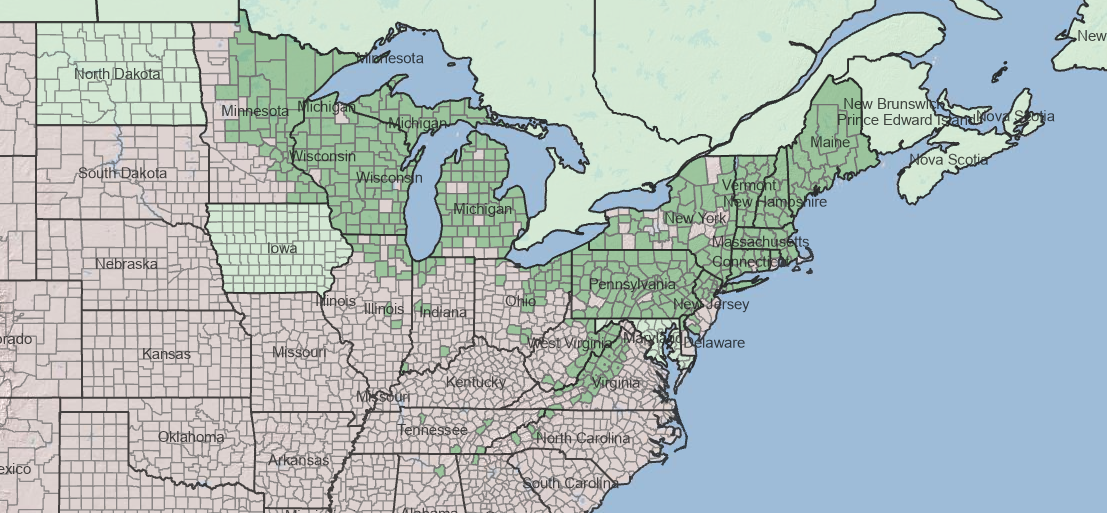
Northern bush honeysuckle occurs from Newfoundland west to Saskatchewan; south to Nova Scotia, New England, Delaware; and in the mountains to Virginia, North Carolina, and Tennessee; and west to Ohio, Indiana, Illinois, and Iowa [13,15,36].

Distribution of northern bush honeysuckle.
States and Provinces
- United States: CT DE IL IN IA KY ME MD MA MI MN NH NJ NY NC OH PA RI TN VT VA WV WI
- Canada: MB NB NF NS ON PE PQ SK
Site Characteristics
Northern bush honeysuckle is common on exposed, rocky sites and on dry to mesic, well-drained soils [15,22]. In northern Michigan, it is found in open, sandy thickets, woodlands, and jack pine (Pinus banksiana) plains [40]. It is best developed on dry, infertile soils in cool climates [7].
In the Adirondack Mountains of New York, northern bush honeysuckle is found from elevations of 100 feet (30 m) to 4,050 feet (1,234 m) [22].
Plant Communities
Northern bush honeysuckle is not named as an understory dominant or indicator in published classifications. It is found in a variety of cover types and has a number of plant associates. The most widely distributed shrub associates of northern bush honeysuckle include beaked hazel (Corylus cornuta), alternate-leaf dogwood (Cornus alternifolia), speckled alder (Alnus rugosa), American green alder (A. viridis ssp. crispa), checkerberry wintergreen (Gaultheria procumbens), and blueberries (Vaccinium spp.). Herbaceous associates include wild lily-of-the-valley (Maianthemum canadense), bigleaf aster (Aster macrophyllus), and wild sarsaparilla (Aralia nudicaulis). Bracken fern (Pteridium aquilinum) is often associated with northern bush honeysuckle in the understory of some cover types; northern bush honeysuckle is also found on bracken fern-dominated grasslands in northeastern Wisconsin [23,27,35,42,48].
Botanical Description

Northern bush honeysuckle.
Northern bush honeysuckle is a native, deciduous small shrub that usually grows from 2 to 4 feet (0.6-1.2 m) tall [15]. The branches run close to the ground, ascending slightly. The fruit is a dry, woody, dehiscent capsule [8].
Raunkiaer Life Form (Raunkiaer 1934)
- Chamaephyte
Seasonal Development
The peak flowering season for northern bush honeysuckle is from early June to early July, but flowers have opened as late as August in Michigan [15,40]. The fruit matures and releases seeds in September [8].
Regeneration Processes
Asexual: Northern bush honeysuckle reproduces from rhizomes, forming widely-scattered clumps or patches [3,40,44].
Sexual: Northern bush honeysuckle is insect pollinated. Its most important pollinators in Michigan are bumblebees. It is self-incompatible; successful seed set requires pollination by insects that have travelled from another clonal patch, which is usually some distance away [40,44].
Successional Status
Northern bush honeysuckle is relatively insensitive to differences in light intensity [3]. Its abundance in jack pine communities usually remains relatively constant for a long time but declines in older (approximately 80 years of age) stands [3]. In jack pine-balsam fir community types, northern bush honeysuckle is most common on sites that have been cleared and/or burned within the past 30 to 50 years [31,40].
Immediate Fire Effects
Cool surface fires top-kill northern bush honeysuckle [9].
Postfire Regeneration Strategy (Stickney 1989)
- Rhizomatous shrub, rhizome in soil
- Secondary colonizer - off-site seed
Fire Adaptations
Northern bush honeysuckle sprouts from the rhizomes following top-kill by fire. Regeneration depends on initiation of growth from dormant buds on protected stem portions and rhizomes [9].
Plant Response to Fire
Northern bush honeysuckle rapidly regenerates after fire, though no sexual structures are produced the first postfire growing season [9]. Seeds of northern bush honeysuckle were found only on old burns in Petersham, Massachusetts, which suggested a possible period of heavy fruit production approximately 13 years after fire [5,25].
Northern bush honeysuckle abundance is usually unchanged by fire; abundance in postfire communities is dependent on northern bush honeysuckle prefire density and the response of its competitors [3,20]. Northern bush honeysuckle increased slightly in cover (from 1 to 2.2 percent) after a prescribed fire in a jack pine community in Minnesota [2]. In a Minnesota jack pine stand where both logging and prescribed fire were conducted, northern bush honeysuckle frequency decreased the first postfire year but returned to prefire levels by the second growing season. Its frequency declined slightly in the fourth year [1]. Following prescribed fire in a red pine-white pine (Pinus strobus) community in Ontario, northern bush honeysuckle increased in stem number but not frequency, with an overall increase in biomass [30].
After wildfire in jack pine types in northern Minnesota, northern bush honeysuckle regenerated better on sites that had burned in summer as compared to sites that had experienced a spring wildfire [33].
The Research Project Summary Effects of surface fires in a mixed red and eastern white pine stand in Michigan provides information on prescribed fire and postfire response of plant community species, including northern bush honeysuckle, that was not available when this species review was written.
Fire Regimes
For fire regime information, search FEIS for this species by entering the species name on the Advanced Search page and selecting “Fire Regime” as the publication type.
Fire Management Considerations
Loomis and others [26] measured the moisture content of a number of upper Midwest understory shrubs and herbs, including northern bush honeysuckle; this information can be used for a number of fire management considerations.
Federal Status
None
Other Status
No entry.
Importance to Wildlife and Livestock
Northern bush honeysuckle provides winter browse for moose, and winter and summer browse for white-tailed deer [18]. Leaves and twigs are eaten by woodland caribou, but northern bush honeysuckle is not an important component of the woodland caribou diet [10]. Sharp-tailed grouse consume the vegetative buds. Northern bush honeysuckle provides brood cover for sharp-tailed grouse in Wisconsin [16].
Palatability and Nutritional Value
Northern bush honeysuckle is preferred by white-tailed deer in late summer [18].
Cover Value
No entry.
Value for Rehabilitation or Restoration of Disturbed Sites
No entry.
Other Uses
No entry.
Other Management Considerations
Seed-tree cuts or clearcuts in red pine (Pinus resinosa) communities often result in a dense growth of shrubs, including northern bush honeysuckle. Northern bush honeysuckle increased in density following logging in a balsam fir (Abies balsamea)-paper birch (Betula papyrifera) stand near Duluth, Minnesota [34]. Leaving more of the canopy when logging reduces the amount of shrub growth [12].
Northern bush honeysuckle competes with lowbush blueberry (Vaccinium angustifolium) after fire-pruning of lowbush blueberry fields [17].
Northern bush honeysuckle is susceptible to foliar sprays of 2,4-D [6].
Northern bush honeysuckle is probably resistant to browsing; on Isle Royale, Michigan, it was found in higher densities in control plots than in moose exclosures [38].
Table A1— Forest and range ecosystems, Bureau of Land Management (BLM) physiographic regions, Kuchler plant associations, Society for American Foresters (SAF) forest cover types, and Society for Rangeland Management (SRM) rangeland cover types in which this species occurs.
Forest and Range Ecosystems (Garrison et al. 1977)
- FRES10 White - red - jack pine
- FRES11 Spruce – fir
- FRES15 Oak – hickory
- FRES17 Elm - ash – cottonwood
- FRES18 Maple - beech – birch
- FRES19 Aspen – birch
- FRES13 Loblolly - shortleaf pine
BLM Physiographic Regions (Bernard and Brown 1977)
No entry.
Kuchler Plant Associations (Kuchler 1964)
- K093 Great Lakes spruce - fir forest
- K095 Great Lakes pine forest
- K096 Northeastern spruce - fir forest
- K099 Maple - basswood forest
- K102 Beech - maple forest
- K103 Mixed mesophytic forest
- K104 Appalachian oak forest
- K106 Northern hardwoods
- K107 Northern hardwoods - fir forest
- K108 Northern hardwoods - spruce forest
- K110 Northeastern oak - pine forest
SAF Cover Types (Eyre 1980)
- 1 Jack pine
- 5 Balsam fir
- 12 Black spruce
- 14 Northern pin oak
- 15 Red pine
- 16 Aspen
- 17 Pin cherry
- 18 Paper birch
- 20 White pine - northern red oak - red maple
- 22 White pine – hemlock
- 23 Eastern hemlock
- 24 Hemlock - yellow birch
- 25 Sugar maple - beech - yellow birch
- 26 Sugar maple – basswood
- 27 Sugar maple
- 37 Northern white-cedar
- 39 Black ash - American elm - red maple
- 51 White pine - chestnut oak
- 52 White oak - black oak - northern red oak
- 55 Northern red oak
- 59 Yellow-poplar - white oak - northern red oak
- 60 Beech - sugar maple
- 107 White spruce
108 Red maple
SRM Rangeland Cover Types (Shiflet 1994)
No entry.
1. Ahlgren, Clifford E. 1966. Small mammals and reforestation following prescribed burning. Journal of Forestry. 64: 614-618. [206]
2. Ahlgren, Clifford E. 1970. Some effects of prescribed burning on jack pine reproduction in northeastern Minnesota. Misc. Rep. 94, Forestry Series 5-1970. Minneapolis, MN: University of Minnesota, Agricultural Experiment Station. 14 p. [7285]
3. Ahlgren, C. E. 1974. Effects of fires on temperate forests: north central United States. In: Kozlowski, T. T.; Ahlgren, C. E., eds. Fire and ecosystems. New York: Academic Press: 195-223. [13110]
4. Ahlgren, Clifford E. 1979. Buried seed in the forest floor of the Boundary Waters Canoe Area. Minnesota Forestry Research Note No. 271. St. Paul, MN: University of Minnesota, College of Forestry. 4 p. [3459]
5. Alban, David H.; Perala, Donald A.; Jurgensen, Martin F.; [and others]. 1991. Aspen ecosystem properties in the Upper Great Lakes. Res. Pap. NC-300. St. Paul, MN: U.S. Department of Agriculture, Forest Service, North Central Forest Experiment Station. 47 p. [18412]
6. Bovey, Rodney W. 1977. Response of selected woody plants in the United States to herbicides. Agric. Handb. 493. Washington, DC: U.S. Department of Agriculture, Agricultural Research Service. 101 p. [8899]
7. Brand, Gary J. 1985. Environmental indices for common Michigan trees and shrubs. Res. Pap. NC-261. St. Paul, MN: U.S. Department of Agriculture, Forest Service, Northcentral Forest Experiment Station. 5 p. [14465]
8. Chapman, William K.; Bessette, Alan E. 1990. Trees and shrubs of the Adirondacks. Utica, NY: North Country Books, Inc. 131 p. [12766]
9. Chapman, Rachel Ross; Crow, Garrett E. 1981. Application of Raunkiaer's life form system to plant species survival after fire. Torrey Botanical Club. 108(4): 472-478. [7432]
10. Cringan, Alexander Thom. 1957. History, food habits and range requirements of the woodland caribou of continental North America. Transactions, North American Wildlife Conference. 22: 485-501. [15651]
11. Eyre, F. H., ed. 1980. Forest cover types of the United States and Canada. Washington, DC: Society of American Foresters. 148 p. [905]
12. Eyre, F. H.; Zehngraff, Paul. 1948. Red pine management in Minnesota. Circular No. 778. Washington, DC: U.S. Department of Agriculture. 70 p. [12177]
13. Fernald, Merritt Lyndon. 1950. Gray's manual of botany. [Corrections supplied by R. C. Rollins]. Portland, OR: Dioscorides Press. 1632 p. (Dudley, Theodore R., gen. ed.; Biosystematics, Floristic & Phylogeny Series; vol. 2). [14935]
14. Garrison, George A.; Bjugstad, Ardell J.; Duncan, Don A.; [and others]. 1977. Vegetation and environmental features of forest and range ecosystems. Agric. Handb. 475. Washington, DC: U.S. Department of Agriculture, Forest Service. 68 p. [998]
15. Moran, G. F.; Marshall, D. R.; Muller, W. J. 1981. Phenotypic variation and plasticity in the colonizing species Xanthium strumarium L. (Noogoora Burr). Australian Journal of Biological Science. 34: 639-648. [20392]
16. Hamerstrom, F. N., Jr. 1963. Sharptailed brood habitat in Wisconsin's northern pine barrens. Journal of Wildlife Management. 27(4): 793-802. [15809]
17. Hoefs, M. E. G.; Shay, Jennifer M. 1981. The effects of shade on shoot growth of Vaccinium angustifolium Ait. after fire pruning in southeastern Manitoba. Canadian Journal of Botany. 59: 166-174. [4977]
18. Irwin, Larry L. 1985. Foods of moose, Alces alces, and white-tailed deer, Odocoileus virginianus, on a burn in boreal forest. Canadian Field-Naturalist. 99(2): 240-245. [4513]
19. Kartesz, John T.; Kartesz, Rosemarie. 1980. A synonymized checklist of the vascular flora of the United States, Canada, and Greenland. Volume II: The biota of North America. Chapel Hill, NC: The University of North Carolina Press; in confederation with Anne H. Lindsey and C. Richie Bell, North Carolina Botanical Garden. 500 p. [6954]
20. Krefting, Laurits W.; Ahlgren, Clifford E. 1974. Small mammals and vegetation changes after fire in a mixed conifer-hardwood forest. Ecology. 55: 1391-1398. [9874]
21. Kuchler, A. W. 1964. Manual to accompany the map of potential vegetation of the conterminous United States. Special Publication No. 36. New York: American Geographical Society. 77 p. [1384]
22. Range, Phil; Veisze, Paul; Zschaechner, Greg. 1981. Great Basin rate-of-spread study: Fire effects. Unpublished draft on file at: U.S. Department of the Interior, Bureau of Land Management, Office of Fire and Aviation Management, Reno, Nevada. 55 p. [1936]
23. Larsen, James A. 1971. Vegetational relationships with air mass frequencies: boreal forest and tundra. Arctic. 24: 177-194. [8258]
24. Larson, D. W.; Spring, S. H.; Matthes-Sears, U.; Bartlett, R. M. 1991. Microsite- and age-specific processes controlling natural populations of Acer saccharum at cliff edges. Canadian Journal of Botany. 69: 552-559. [13053]
25. Livingston, R. B.; Allessio, Mary L. 1968. Buried viable seed in successional field and forest stands, Harvard Forest, Massachusetts. Bulletin of the Torrey Botanical Club. 95(1): 58-69. [3377]
26. Loomis, Robert M.; Roussopoulos, Peter J.; Blank, Richard W. 1979. Summer moisture contents of understory vegetation in northeastern Minnesota. Res. Pap. NC-179. St. Paul, MN: U.S. Department of Agriculture, Forest Service, North Central Forest Experiment Station. 7 p. [14330]
27. Lutz, H. J. 1930. The vegetation of Heart's Content, a virgin forest in northwestern Pennsylvania. Ecology. 11(1): 2-29. [14480]
28. MacLean, David A.; Wein, Ross W. 1977. Changes in understory vegetation with increasing stand age in New Brunswick forests: species composition, cover, biomass, and nutrients. Canadian Journal of Botany. 55: 2818-2831. [10106]
29. McRae, D. J. 1979. Prescribed burning in jack pine logging slash: a review. Report 0-X-289. Sault Ste. Marie, ON: Canadian Forestry Service, Great Lakes Forest Research Centre. 57 p. [7290]
30. Methven, Ian R. 1973. Fire, succession and community structure in a red and white pine stand. Information Report PS-X-43. Chalk River, ON: Environment Canada, Forestry Service, Petawawa Forest Experiment Station. 18 p. [18601]
31. Noble, Mark G.; DeBoer, Linda K.; Johnson, Kenneth L.; [and others]. 1977. Quantitative relationships among some Pinus banksiana - Picea mariana forests subjected to wildfire and postlogging treatments. Canadian Journal of Forest Research. 7: 368-377. [16532]
32. Lewis, T. 1983. The effects of prescribed fire on forest productivity and wildlife in the boreal and spruce-willow-birch zones of Prince Rupert Forest region. In: Trowbridge, R. L.; Macadam, A., eds. Prescribed fire-forest soils: Symposium proceedings; 1982 March 2-3; Smithers, BC. Land Management Report Number 16. Victoria, BC: Province of British Columbia, Ministry of Forests: 49-55. [8851]
33. Ohmann, Lewis F.; Grigal, David F. 1981. Contrasting vegetation responses following two forest fires in northeastern Minnesota. American Midland Naturalist. 106(1): 54-64. [8285]
34. Outcalt, Kenneth Wayne; White, Edwin H. 1981. Phytosociological changes in understory vegetation following timber harvest in northern Minnesota. Canadian Journal of Forest Research. 11: 175-183. [16301]
35. Perala, D. A. 1989. Scarification requirements for regenerating paper birch (Betula papyrifera) under shelterwood. In: Sutton, R. F.; Riley, L. F.,, eds. Proceedings of a symposium on the equipment/silviculture interface in stand establishment research and operations; 1985 September 28 - October 3; Jasper, AB. Inf. Rep. O-X-401. Sault Ste. Marie, ON: Forestry Canada: 122-130. [13553]
36. Radford, Albert E.; Ahles, Harry E.; Bell, C. Ritchie. 1968. Manual of the vascular flora of the Carolinas. Chapel Hill, NC: The University of North Carolina Press. 1183 p. [7606]
37. Raunkiaer, C. 1934. The life forms of plants and statistical plant geography. Oxford: Clarendon Press. 632 p. [2843]
38. Risenhoover, Kenneth L.; Maass, Steven A. 1987. The influence of moose on the composition and structure of Isle Royale forests. Canadian Journal of Forest Research. 17: 357-364. [8230]
39. Scheiner, Samuel M.; Teeri, James A. 1981. A 53-year record of forest succession following fire in northern lower Michigan. Michigan Botanist. 20(1): 3-14. [5022]
40. Schoen, Daniel J. 1977. Floral biology of Diervilla lonicera (Caprifoliaceae). Bulletin of the Torrey Botanical Club. 104(3): 234-240. [21461]
41. Stickney, Peter F. 1989. Seral origin of species originating in northern Rocky Mountain forests. Unpublished draft on file at: U.S. Department of Agriculture, Forest Service, Intermountain Research Station, Fire Sciences Laboratory, Missoula, MT; RWU 4403 files. 7 p. [20090]
42. Stocks, B. J. 1989. Fire behavior in mature jack pine. Canadian Journal of Forest Research. 19: 783-790. [8672]
43. Stocks, Brian J.; Alexander, Martin E. 1980. Forest fire behaviour and effects research in northern Ontario: a field oriented program. In: Martin, Robert E.; Edmonds, Robert L.; Faulkner, Donald A.; [and others], eds. Proceedings, 6th conference on fire and forest meteorology; 1980 April 22-24; Seattle, WA. Washington, DC: Society of American Foresters: 18-24. [10291]
44. Thomson, James D. 1985. Pollination and seed set in Diervilla lonicera (Caprifoliaceae): Temporal patterns of flower and ovule development. American Journal of Botany. 72(5): 737-740. [21462]
45. U.S. Department of Agriculture, Natural Resources Conservation Service. 2018. PLANTS Database, [Online]. U.S. Department of Agriculture, Natural Resources Conservation Service (Producer). Available: https://plants.usda.gov/. [34262]
46. Wilm, H. G. 1936. The relation of successional development to the silviculture of forest burn communities in southern New York. Ecology. 17(2): 283-291. [3483]
47. Wright, Henry A.; Bailey, Arthur W. 1982. Fire ecology: United States and southern Canada. New York: John Wiley & Sons. 501 p. [2620]
48. Vogl, R. J. 1964. The effects of fire on the vegetational composition of bracken-grassland. Wisconsin Academy of Sciences, Arts and Letters. 53: 67-82. [9142]
49. Zoladeski, C. A. 1988. Classification and gradient analysis of forest vegetation of Cape Enrage, Bic Park, Quebec. Le Naturaliste Canadien. 115(1): 9-18. [13610]
50. Zoladeski, Christopher A.; Maycock, Paul F. 1990. Dynamics of the boreal forest in northwest Ontario. American Midland Naturalist. 124(2): 289-300. [13496]