


Echinochloa crus-galli, barnyardgrass
Esser, Lora L. 1994. Echinochloa crus-galli, barnyardgrass. In: Fire Effects Information System, [Online]. U.S. Department of Agriculture, Forest Service, Rocky Mountain Research Station, Fire Sciences Laboratory (Producer). Available: https://research.fs.usda.gov/feis/species-reviews/echcru
| Abbreviation | Common Name | Scientific Name | Classification | Status |
|---|---|---|---|---|
| Plants | ||||
| ECHCRU | barnyardgrass | Echinochloa crus-galli | Life Form: Plants/Graminoid Kingdom: Plantae Class: Monocot Order: Cyperales Family: Poaceae Genus: Echinochloa | Fed. Protected: No Nativity: Nonnative Invasiveness: Invasive |


Taxonomy
The scientific name of barnyardgrass is Echinochloa crus-galli (L.) Beauv. (Poaceae) [16,19,45,80].
Synonyms
- Panicum crus-galli L.
Other Common Names
common barnyard grass
General Distribution
Barnyardgrass is a weed of Eurasian origin that occurs throughout the continental United States. It is also found in southern Canada from British Columbia east to Nova Scotia [19,27,39,57,63].

Distribution of barnyardgrass in the United States.
States and Provinces
- United States: AZ AR CA CO CT FL GA HI ID IL IN IA KS KY LA ME MD MA MI MN MS MO MT NE NV NH NJ NM NY NC ND OH OK OR PA SC SD TN TX UT VT VA WA WV WI WY DC
- Canada: DC AB BC MB NB NS ON PQ SK
- Mexico
Site Characteristics
Barnyardgrass is widespread in fields, waste places, ditches, marshes, wet meadows, floodplains and along lakeshores and streambanks [18,20,33,38,39]. It is locally common in floodplains, riverbottoms, and seasonally wet habitats [1,63,80], but also occurs in drier habitats [24]. Barnyardgrass is most often found on disturbed, generally nonsaline soils [25,53,63], but grows on a variety of soil types [38,53]. Echinochloa crus-galli var. crus-galli is generally absent from sites that have greater than 12 inches (30 cm) of standing water for more than 4 weeks at a time [42,63]. It occurs in shallow water or after drawdown [63]. Barnyardgrass tolerates poor drainage and flooding, but not severe drought [7,31,44,60].

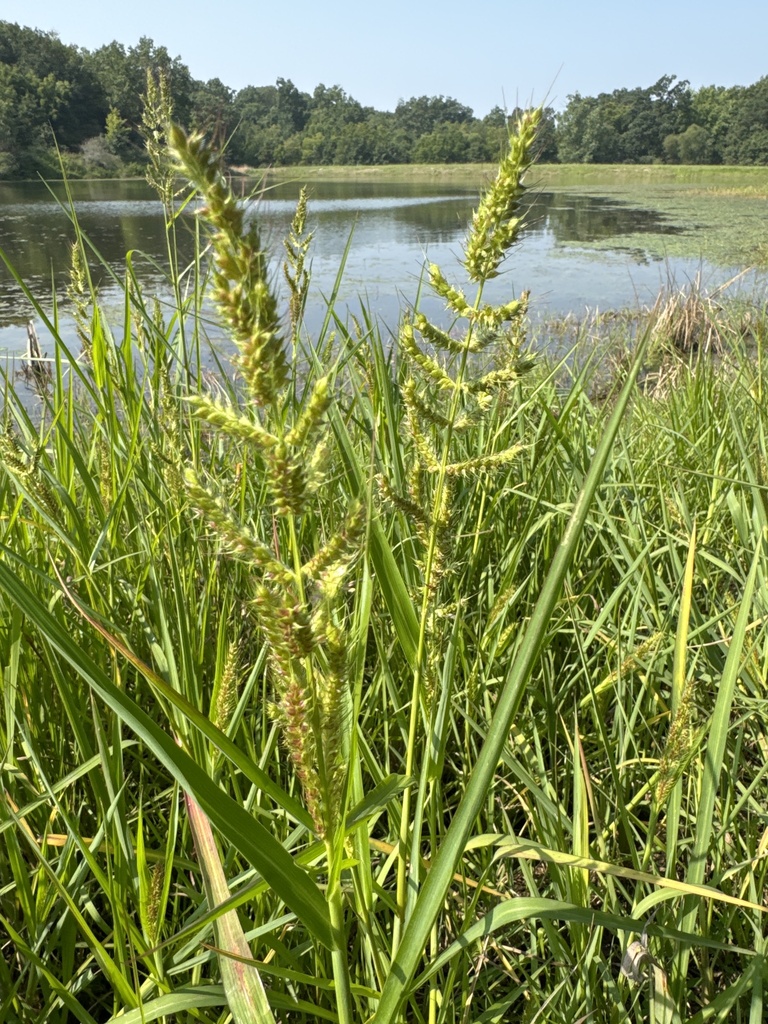
Barnyard grass growing in Missouri.
In California, barnyardgrass cosmopolitan weed of wet, disturbed ground and occurs in shallow water around the periphery of rice fields [1].
Elevations of barnyardgrass are as follows:
| State | Elevation (ft) | Elevation (m) | Source |
|---|---|---|---|
| Arizona | 150–7,000 | 45–2,100 | [27] |
| California | <4,950 | <1,500 | [20] |
| Colorado | 4,500–7,500 | 1,350–2,250 | [19] |
| Kansas | 3,370–4,675 | 1,021–1,417 | [38] |
| Montana | 2,800–3,300 | 840–1,000 | [86] |
| South Dakota | 1,940–2,025 | 587–614 | [71] |
| Texas | 7,400 | 2,320 | [21] |
| Utah | 2,705–7,045 | 820–2,135 | [80] |
| Wyoming | 3,700–5,100 | 1,110–1,530 | [86] |
Plant Communities
In the Sacramento Valley of California, barnyardgrass occurs in wetland communities with swamp grass (Crypsis schoenoides) and bearded sprangletop (Leptochloa fascicularis) [47].
Barnyardgrass is found in the southern High Plains region of northern Texas and southern New Mexico. In this region, it is codominant with red sprangletop (L. filiformis) in wet meadow and prairie communities and is also found in shinnery communities [4,5].
Barnyardgrass occurs in temporarily flooded palustrine wetlands of the northern prairie and plains communities [26,83].
In eastern Colorado and western Kansas, barnyardgrass occurs in the plains cottonwood (Populus deltoides) riparian zone. Common associates include saltcedar (Tamarix ramosissima), sandbar willow (Salix exigua), and Russian-olive (Elaeagnus angustifolia) [38,60]. Barnyardgrass is also a member of saltcedar and willow-cottonwood communities in Arizona [55].
Barnyardgrass is the dominant species in some wetlands of North Dakota. Common associates include water plantain (Alisma triviale), American slough grass (Beckmannia syzigachne), needle spikerush (Eleocharis acicularis), hedge hyssop (Gratiola neglecta), and pale smartweed (Polygonum lapathifolium) [16,63].
In South Dakota, barnyardgrass occurs in mixed-grass prairie dominated by blue grama (Bouteloua gracilis), buffalograss (Buchloe dactyloides), western wheatgrass (Pascopyrum smithii), and needlegrass (Stipa spp.). Other associates include needleleaf sedge (Carex eleocharis), Sandberg bluegrass (Poa secunda), sideoats grama (Bouteloua curtipendula), and little bluestem (Schizachyrium scoparium) [37,71]. In tallgrass prairies of northeast Kansas, barnyardgrass occurs in communities dominated by big bluestem (Andropogon gerardii var. gerardii), little bluestem, and Indiangrass (Sorghastrum nutans) [14].
At Gettysburg National Military Park in Pennsylvania, barnyardgrass occurs in a variety of forest cover types as an understory species. Species associated with barnyardgrass not previously mentioned include white ash (Fraxinus americana), mockernut hickory (Carya tomentosa), shagbark hickory (C. ovata), black walnut (Juglans nigra), eastern redbud (Cercis canadensis), flowering dogwood (Cornus florida), sassafrass (Sassafrass albidum), and red pine (Pinus resinosa) [85].
Botanical Description
Barnyardgrass is an introduced, nonrhizomatous, warm-season annual. Stems may be solitary or in small tufts, erect or reclining at the base, up to 6.6 feet tall (2 m) [16,28,39,52,80]. Leaves are flat, 4 to 12 inches (10-30 cm) long and 0.2 to 0.6 (5-15 mm) inch wide [18,19,27,46]. The panicle is 2 to 8.4 inches (5-21 cm) long, upright or nodding [19,46,68]. Barnyardgrass has a fibrous root system [39,49].

Barnyardgrass panicle.
Raunkiaer Life Form (Raunkiaer 1934)
- Therophyte
Seasonal Development
Barnyardgrass flowering dates for several states are as follows:
| State/area | Flowering dates | Source |
|---|---|---|
| Arizona | July–Sept | [27] |
| California | July–Oct | [46] |
| Colorado | Aug–Sept | [86] |
| Florida | All year | [84] |
| Illinois | Aug–Oct | [45] |
| Montana | June–Oct | [86] |
| Nebraska | Aug–Sept | [61] |
| North Carolina | July–Oct | [52] |
| North Dakota | July 15 | [65] |
| South Carolina | July–Oct | [52] |
| West Virginia | Aug–Oct | [67] |
| Wyoming | Aug–Oct | [86] |
| Great Plains | June–Sept | [16] |
Regeneration Processes
Barnyardgrass reproduces by seed. It is self-pollinating [51] and a prolific seed producer [28,44,68]. A healthy plant can produce from 750,000 to one million seeds [44]. Barnyardgrass seed is water dispersed [1]. Seed viability in soil is variable [10,44]. In Stoneville, Mississippi, in 1972, a 50-year study on longevity of buried seed of barnyardgrass was initiated. Seed viability was 1 percent after burial for 2.5 years; less than 6 percent of seed survived 6 months or longer [10]. However, according to Dawson [8], barnyardgrass seed may be viable in the soil for up to 13 years. In another study by Mitich [44], seed viability of barnyardgrass was 100 percent after 6 to 8 years of dry storage in irrigated sandy loam soil, and all seed was nonviable after 15 years. Watanabe [79] found that barnyardgrass seed germination rate was 27 percent after burial for 6 months and 3 percent after burial for 6.5 years. Barnyardgrass seed germinates over a wide temperature range, 55 to 104 degrees Fahrenheit (13-40 deg C), with optimum germination occurring from 68 to 86 degrees Fahrenheit (20-30 deg C) [53,62].
The buoyancy and hence dispersal by water of barnyardgrass seeds is probably influenced by their weight. A survey of seed weight [1] demonstrated that seeds of rice barnyardgrass (E. phyllopogon) were on average 2 to 3 times heavier than those of barnyardgrass (E. crus-galli). The lighter seeds of barnyardgrass exhibited greater buoyancy, with approximately 50 percent of seeds remaining afloat after 4 to 5 days in water. In contrast, 95 percent of rice barnyardgrass seeds had sunk after 5 days. Decay of dormancy in rice barnyardgrass is more rapid than in barnyardgrass following dry storage and burial in soil.
Successional Status
Barnyardgrass is a pioneer species that readily invades disturbed sites [63,68]. It is found most often in open, unshaded areas [25,44], and is intolerant of dense shade [44]. Barnyardgrass invades South Dakota rangelands and rapidly colonizes overflow and subirrigated range sites that have been denuded or disturbed in Nebraska [37,68]. In Idaho, barnyardgrass is an increaser species on periodically flooded sites along streams [58]. At a restoration prairie site in Ohio, barnyard grass established at the edge of an ephemeral pond that is subject to periodic flooding and drying [7]. In an old-field succession deciduous forest in southwestern Ohio, barnyardgrass was found growing in a 2-year-old stand, but was not present in stands 10, 50, 90, or 200 years old [56,74].
Immediate Fire Effects
Barnyardgrass is probably killed by fire.
Postfire Regeneration Strategy (Stickney 1989)
- No entry
Fire Adaptations
Barnyardgrass may colonize burned areas from soil-stored seed after fire. Fires that thin or remove canopy vegetation produce conditions that may be conducive to colonization by barnyardgrass.
Plant Response to Fire
No entry.
Fire Regimes
For fire regime information, search FEIS for this species by entering the species name or acronym on the home page and selecting “Fire Regime” as the publication type.
Fire Management Considerations
No entry.
Federal Status
None
Other Status
No entry.
Importance to Wildlife and Livestock
Barnyardgrass is readily grazed by livestock in Arizona and West Virginia, and can be cultivated for hay [27,67].
Seeds of barnyardgrass are eaten by songbirds, waterfowl, and greater prairie chickens [6,9,59,63,75]. Barnyardgrass is an important source of food and cover for waterfowl in the Sacramento Valley [47]. In the playa lakes of Texas and New Mexico, meadows dominated by barnyardgrass are important habitat for waterfowl and pheasant [4].
Palatability and Nutritional Value
Barnyardgrass produces fair pasture when grazed during early growth stages but becomes harsh and unpalatable at maturity [68]. It is palatable to sheep in Minnesota [40].
Barnyardgrass has fair to poor forage value for livestock [68]. In Minnesota, toxic levels of nitrate have been reported in barnyardgrass [40]. Nutritional values of sun-cured barnyardgrass in the milk stage are as follows [87]:
| Nutrient | As fed | Dry |
|---|---|---|
| Dry matter (%) | 84.2 | 100.0 |
| Ash (%) | 7.7 | 9.1 |
| Crude fiber (%) | 31.0 | 36.8 |
| Ether extract (%) | 1.8 | 2.1 |
| N-free extract (%) | 34.0 | 40.4 |
| Species | Digestible protein as fed (%) | Digestible protein dry (%) |
|---|---|---|
| Domestic sheep | 57.0* | 57.0* |
| Cattle | 5.9 | 7.0 |
| Goats | 6.2 | 7.4 |
| Horses | 6.2 | 7.4 |
| Rabbits | 6.4 | 7.6 |
| Sheep | 5.6 | 6.6 |
*Protein digestible coefficient
| Species | Energy type | Energy as fed (Mcal/kg) | Energy dry (Mcal/kg) |
|---|---|---|---|
| Cattle | Digestible energy | 1.95 | 2.31 |
| Domestic sheep | Digestible energy | 1.98 | 2.35 |
| Cattle | Metabolizable energy | 1.60 | 1.90 |
| Sheep | Metabolizable energy | 1.62 | 1.93 |
Cover Value
Barnyardgrass cover values are as follows [86]:
| Species | Utah | Wyoming | North Dakota |
|---|---|---|---|
| Upland game birds | Poor | Fair | Good |
| Waterfowl | Poor | Fair | Good |
| Small nongame birds | Fair | Fair | Good |
| Small mammals | Fair | Fair | — |
Value for Rehabilitation or Restoration of Disturbed Sites
Barnyardgrass has colonized desert riparian and wetland community sites along the Gila River in Arizona that were supplied by year-round flows of wastewater. If wastewater areas are managed on a permanent year-round basis, habitat rehabilitation and avian colonization may occur [55].
Barnyardgrass can be utilized for quick, temporary erosion control on coal mine sites in the eastern United States [75].
Other Uses
No entry.
Other Management Considerations
Generally, seed yields from barnyardgrass stands are reduced in 2 to 3 years because of competition with other weeds [43]. In Missouri, natural seeding of barnyardgrass was stimulated by periodic draining and flooding of a wetland site; a July 1 to September 15 drawdown produced an excellent stand of barnyardgrass which was utilized by waterfowl [6]. In California, draining barnyardgrass fields in the spring and disking them can benefit stands. At the Mendota Waterfowl Management Area, California, this practice has been used to perpetuate stands of barnyardgrass for up to 6 years. Barnyardgrass may harbor a virus-like disease of cereals [17].
Toxicity tests of effluents in water and sediment were conducted using the two varieties of barnyardgrass. Effluents from a sewage treatment plant, tannery, textile mill, pulp and paper mill, and coking plant inhibited germination, chlorophyll synthesis, and growth of barnyardgrass [77,78].
Table A1— Forest and range ecosystems, Bureau of Land Management (BLM) physiographic regions, Kuchler plant associations, Society for American Foresters (SAF) forest cover types, and Society for Rangeland Management (SRM) rangeland cover types in which this species occurs.
Forest and Range Ecosystems (Garrison et al. 1977)
- FRES15 Oak - hickory
- FRES17 Elm - ash - cottonwood
- FRES18 Maple - beech - birch
- FRES28 Western hardwoods
- FRES31 Shinnery
- FRES38 Plains grasslands
- FRES39 Prairie
- FRES41 Wet grasslands
- FRES42 Annual grasslands
BLM Physiographic Regions (Bernard and Brown 1977)
- 3 Southern Pacific Border
- 5 Columbia Plateau
- 6 Upper Basin and Range
- 8 Northern Rocky Mountains
- 10 Wyoming Basin
- 12 Colorado Plateau
- 13 Rocky Mountain Piedmont
- 14 Great Plains
- 16 Upper Missouri Basin and Broken Lands
Kuchler Plant Associations (Kuchler 1964)
- K048 California steppe
SAF Cover Types (Eyre 1980)
- 20 White pine - northern red oak - red maple
- 22 White pine - hemlock
- 23 Eastern hemlock
- 28 Black cherry - maple
- 39 Black ash - American elm - red maple
- 52 White oak - black oak - northern red oak
- 53 White oak
- 55 Northern red oak
- 57 Yellow-poplar
- 58 Yellow-poplar - eastern hemlock
- 59 Yellow-poplar - white oak - northern red oak
- 63 Cottonwood
- 67 Mohrs (shin) oak
- 110 Black oak
- 217 Aspen
- 235 Cottonwood - willow
SRM Rangeland Cover Types (Shiflet 1994)
- No entry
1. Barrett, Spencer C. H.; Wilson, Blake F. 1983. Colonizing ability in the Echinochloa crus-galli complex (barnyard grass). II. Seed biology. Canadian Journal of Botany. 61: 556-562. [24031]
2. Bernard, Stephen R.; Brown, Kenneth F. 1977. Distribution of mammals, reptiles, and amphibians by BLM physiographic regions and A.W. Kuchler's associations for the eleven western states. Tech. Note 301. Denver, CO: U.S. Department of the Interior, Bureau of Land Management. 169 p. [434]
3. Blackshaw, Robert E.; Rode, Lyle M. 1991. Effect of ensiling and rumen digestion by cattle on weed seed viability. Weed Science. 39(1): 104-108. [21835]
4. Bolen, Eric G.; Smith, Loren M.; Schramm, Harold L., Jr. 1989. Playa Lakes: prairie wetlands of the southern High Plains. BioScience. 39(9): 615-623. [11483]
5. Bryant, Fred C.; Smith, Loren M. 1988. The role of wildlife as an economic input into a farming or ranching operation. In: Mitchell, John E., ed. Impacts of the Conservation Reserve Program in the Great Plains: Proceedings; 1987 September 16-18; Denver, CO. Gen. Tech. Rep. RM-158. Fort Collins, CO: U.S. Department of Agriculture, Forest Service, Rocky Mountain Forest and Range Experiment Station: 95-98. [5147]
6. Burgess, Harold H. 1969. Habitat management on a mid-continent waterfowl refuge. Journal of Wildlife Management. 33(4): 843-847. [14506]
7. Conover, Denis G.; Geiger, Donald R. 1989. Establishment of a prairie on a borrow-pit at the Bergamo-Mt. St. John Nature Preserve in Greene County, Ohio. Ohio Journal of Science. 89(3): 42-44. [9744]
8. Dawson, J. H.; Bruns, V. F. 1975. Longevity of barnyardgrass, green foxtail, and yellow foxtail seeds in soil. Weed Science. 23(5): 437-440. [24041]
9. Dugger, Katie M.; Fredrickson, Leigh H. 1992. Life history and habitat needs of the wood duck. Fish and Wildlife Leaflet 13.1.6. Waterfowl Management Handbook. Washington, DC: U.S. Department of the Interior, Fish and Wildlife Service. 8 p. [20789]
10. Egley, G. H.; Chandler, J. M. 1978. Germination and viability of weed seeds after 2.5 years in a 50-year buried seed study. Weed Science. 26(3): 230-239. [19609]
11. Eyre, F. H., ed. 1980. Forest cover types of the United States and Canada. Washington, DC: Society of American Foresters. 148 p. [905]
12. Fassett, Norman C. 1951. Grasses of Wisconsin. Madison, WI: The University of Wisconsin Press. 173 p. [21728]
13. Garrison, George A.; Bjugstad, Ardell J.; Duncan, Don A.; [and others]. 1977. Vegetation and environmental features of forest and range ecosystems. Agric. Handb. 475. Washington, DC: U.S. Department of Agriculture, Forest Service. 68 p. [998]
14. Gibson, David J. 1989. Effects of animal disturbance on tallgrass prairie vegetation. The American Midland Naturalist. 121: 144-154. [6641]
15. Gleason, Henry A.; Cronquist, Arthur. 1991. Manual of vascular plants of northeastern United States and adjacent Canada. 2nd ed. New York: New York Botanical Garden. 910 p. [20329]
16. Great Plains Flora Association. 1986. Flora of the Great Plains. Lawrence, KS: University Press of Kansas. 1392 p. [1603]
17. Haber, S.; Harder, D. E. 1992. Green foxtail (Setaria viridis) & barnyardgrass (Echinochloa crusgalli), new hosts of the virus-like agent causing flame chlorosis in cerals. Canadian Journal of Plant Pathology. 14: 278-280. [24042]
18. Hallsten, Gregory P.; Skinner, Quentin D.; Beetle, Alan A. 1987. Grasses of Wyoming. 3rd ed. Research Journal 202. Laramie, WY: University of Wyoming, Agricultural Experiment Station. 432 p. [2906]
19. Harrington, H. D. 1964. Manual of the plants of Colorado. 2d ed. Chicago: The Swallow Press Inc. 666 p. [6851]
20. Hickman, James C., ed. 1993. The Jepson manual: Higher plants of California. Berkeley, CA: University of California Press. 1400 p. [21992]
21. Hinckley, L. C. 1944. The vegetation of the Mount Livermore area in Texas. The American Midland Naturalist. 32: 236-250. [4451]
22. Hitchcock, A. S. 1951. Manual of the grasses of the United States. Misc. Publ. No. 200. Washington, DC: U.S. Department of Agriculture, Agricultural Research Administration. 1051 p. [2nd edition revised by Agnes Chase in two volumes. New York: Dover Publications, Inc.]. [1165]
23. Hitchcock, C. Leo; Cronquist, Arthur. 1973. Flora of the Pacific Northwest. Seattle, WA: University of Washington Press. 730 p. [1168]
24. Holmgren, Arthur H. 1958. Weeds of Utah. Special Report 12. Logan, UT: Utah State University, Agricultural Experiment Station. 85 p. [2935]
25. Johnson, James R.; Nichols, James T. 1970. Plants of South Dakota grasslands: A photographic study. Bull. 566. Brookings, SD: South Dakota State University, Agricultural Experiment Station. 163 p. [18483]
26. Kantrud, Harold A.; Millar, John B.; van der Valk, A. G. 1989. Vegetation of wetlands of the prairie pothole region. In: van der Valk, Arnold, ed. Northern prairie wetlands. Ames, IA: Iowa State University Press: 132-187. [15217]
27. Kearney, Thomas H.; Peebles, Robert H.; Howell, John Thomas; McClintock, Elizabeth. 1960. Arizona flora. 2d ed. Berkeley, CA: University of California Press. 1085 p. [6563]
28. Keeley, Paul E.; Thullen, Robert J. 1991. Growth and interaction of barnyardgrass (Echinochloa crus-galli) with cotton (Gossypium hirsutum). Weed Science. 39: 369-375. [24036]
29. Kempen, Harold M. 1984. Cotton production losses form weed competition in Kern County: a three year evaluation. In: Proceedings, Western Society of Weed Science. 37: 47-51. [25180]
30. Kuchler, A. W. 1964. Manual to accompany the map of potential vegetation of the conterminous United States. Special Publication No. 36. New York: American Geographical Society. 77 p. [1384]
31. Kudish, Michael. 1992. Adirondack upland flora: an ecological perspective. Saranac, NY: The Chauncy Press. 320 p. [19377]
32. Lackschewitz, Klaus. 1991. Vascular plants of west-central Montana--identification guidebook. Gen. Tech. Rep. INT-227. Ogden, UT: U.S. Department of Agriculture, Forest Service, Intermountain Research Station. 648 p. [13798]
33. Larson, Gary E. 1993. Aquatic and wetland vascular plants of the Northern Great Plains. Gen. Tech. Rep. RM-238. Fort Collins, CO: U.S. Department of Agriculture, Forest Service, Rocky Mountain Forest and Range Experiment Station. 681 p. [22534]
34. Laubhan, Murray K.; Fredrickson, Leigh H. 1992. Estimating seed production of common plants in seasonally flooded wetlands. Journal of Wildland Management. 56(2): 329-337. [18094]
35. Leather, Gerald R. 1987. The seed germination process. In: Frasier, Gary W.; Evans, Raymond A., eds. "Seed and seedbed ecology of rangeland plants": Proceedings of symposium; 1987 April 21-23; Tucson, AZ. Washington, DC: U.S. Department of Agriculture, Agricultural Research Service: 1-4. [15300]
36. Leather, Gerald R.; Sung, Shi-Jean; Hale, Maynard G. 1992. The wounding response of dormant barnyardgrass (Echinochloa crus-galli) seeds. Weed Science. 40(2): 200-203. [19445]
37. Lewis, James K.; Van Dyne, George M.; Albee, Leslie R.; Whetzal, Frank W. 1956. Intensity of grazing: Its effect on livestock and forage production. Bulletin 459. Brookings, SD: South Dakota State College, Agricultural Experiment Station. 44 p. [11737]
38. Lindauer, Ivo E. 1983. A comparison of the plant communities of the South Platte and Arkansas River drainages in eastern Colorado. The Southwestern Naturalist. 28(3): 249-259. [5886]
39. Magee, Dennis W. 1981. Freshwater wetlands: A guide to common indicator plants of the Northeast. Amherst, MA: University of Massachusetts Press. 245 p. [14824]
40. Marten, G. C.; Andersen, R. N. 1975. Forage nutritive value and palatability of 12 common annual weeds. Crop Science. 15: 821-827. [25]
41. Maun, M. A. 1977. Suppressing effect of soybeans on barnyard grass. Canadian Journal of Plant Science. 57: 485-490. [24035]
42. McAtee, W. L. 1917. Propagation of wild-duck foods. Bulletin No. 465. Washington, DC: U.S. Department of Agriculture. 40 p. [20530]
43. Miller, A. Wendell. 1962. Waterfowl habitat improvement in California. In: Proceedings, annual conference of Western Association of State Fish & Game Commissioners. [Volume unknown]: 112-118. [15439]
44. Mitich, Larry W. 1990. Intriguing world of weeds: barnyardgrass. Weed Technology. 4(4): 918-920. [14946]
45. Mohlenbrock, Robert H. 1986. (Revised edition). Guide to the vascular flora of Illinois. Carbondale, IL: Southern Illinois University Press. 507 p. [17383]
46. Munz, Philip A. 1973. A California flora and supplement. Berkeley, CA: University of California Press. 1905 p. [6155]
47. Mushet, David M.; Euliss, Ned H., Jr.; Harris, Stanley W. 1992. Effects of irrigation on seed production and vegetative characteristics of four moist-soil plants on impounded wetlands in California. Wetlands. 12(3): 204-207. [24038]
48. Nelson, Noland F.; Dietz, Reuben H. 1966. Cattail control methods in Utah. Publication No. 66-2. Salt Lake City, UT: Utah State Department of Fish and Game. 66 p. [17809]
49. Nester, Ruel P. 1969. Barnyardgrass competition and control in rice. Rice Journal. 72(2): 12-14. [24034]
50. Peterson, D. E.; Regehr, D. L.; Ohlenbusch, P. D.; [and others]. 1991. Chemical weed control for field crops, pastures, rangeland, and noncropland, 1992. Report of Progress 643. Manhattan, KS: Kansas State University, Aricultural Experiment Station. 51 p. [18385]
51. Potvin, Catherine. 1991. Temperature-induced variation in reproductive success: field and control experiments with the C4 grass Echinochloa crus-galli. Canadian Journal of Botany. 69: 1577-1582. [24039]
52. Radford, Albert E.; Ahles, Harry E.; Bell, C. Ritchie. 1968. Manual of the vascular flora of the Carolinas. Chapel Hill, NC: The University of North Carolina Press. 1183 p. [7606]
53. Rahman, Marlis; Ungar, Irwin A. 1990. The effect of salinity on seed germination and seedling growth of Echinochloa crusgalli. Ohio Journal of Science. 90(1): 13-15. [11635]
54. Raunkiaer, C. 1934. The life forms of plants and statistical plant geography. Oxford: Clarendon Press. 632 p. [2843]
55. Rea, Amadeo M. 1988. Habitat restoration and avian recolonization from wastewater on the Middle Gila River, Arizona. In: Whitehead, E. E. [and others], eds. Proceedings, Arid lands conference; 1985; Tucson, AZ. [Place of publication unknown]: Bellhaven/Westview Press: 1395-1405. [9823]
56. Roberts, Teresa L.; Vankat, John L. 1991. Floristics of a chronosequence corresponding to old field-deciduous forest succession in southwestern Ohio. II. Seed banks. Bulletin of the Torrey Botanical Club. 118(4): 377-384. [17752]
57. Roland, A. E.; Smith, E. C. 1969. The flora of Nova Scotia. Halifax, NS: Nova Scotia Museum. 746 p. [13158]
58. Rosentreter, Roger. 1992. High-water indicator plants along Idaho waterways. In: Clary, Warren P.; McArthur, E. Durant; Bedunah, Don; Wambolt, Carl L., compilers. Proceedings--symposium on ecology and management of riparian shrub communities; 1991 May 29-31; Sun Valley, ID. Gen. Tech. Rep. INT-289. Ogden, UT: U.S. Department of Agriculture, Forest Service, Intermountain Research Station: 18-24. [19090]
59. Schmidt, F. J. W. 1936. Winter food of the sharp-tailed grouse and pinnated grouse in Wisconsin. Wilson Bulletin. September: 186-203. [16729]
60. Sedgwick, James A.; Knopf, Fritz L. 1991. Prescribed grazing as a secondary impact in a western riparian floodplain. Journal of Range Management. 44(4): 369-373. [15091]
61. Seymour, Frank Conkling. 1982. The flora of New England. 2d ed. Phytologia Memoirs 5. Plainfield, NJ: Harold N. Moldenke and Alma L. Moldenke. 611 p. [7604]
62. Shipley, B.; Parent, M. 1991. Germination responses of 64 wetland species in relation to seed size, minimum time to reproduction and seedling relative growth rate. Functional Ecology. 5(1): 111-118. [14554]
63. Smeins, Fred E. 1971. Effect of depth of submergence on germination of Echinochloa crusgalli (L.) Beauv. Proceedings, North Dakota Academy of Science. 24(2): 14-18. [24037]
64. Stennis, John H.; Smith, Lawrence P.; Cofer, Henry P. 1959. Studies on cattail management in the Northeast. Transactions, Northeast Wildlife Conference. [Volume unknown]: 149-155. [19975]
65. Stevens, O. A. 1956. Flowering dates of weeds in North Dakota. North Dakota Agricultural Experiment Station Bimonthly Bulletin. 18(6): 209-213. [5168]
66. Stickney, Peter F. 1989. Seral origin of species originating in northern Rocky Mountain forests. Unpublished draft on file at: U.S. Department of Agriculture, Forest Service, Intermountain Research Station, Fire Sciences Laboratory, Missoula, MT; RWU 4403 files. 10 p. [20090]
67. Strausbaugh, P. D.; Core, Earl L. 1977. Flora of West Virginia. 2nd ed. Morgantown, WV: Seneca Books, Inc. 1079 p. [23213]
68. Stubbendieck, J.; Nichols, James T.; Roberts, Kelly K. 1985. Nebraska range and pasture grasses (including grass-like plants). E.C. 85-170. Lincoln, NE: University of Nebraska, Department of Agriculture, Cooperative Extension Service. 75 p. [2269]
69. Sung, Shi-Jean S.; Leather, Gerald R.; Hale, Maynard G. 1987. Development and germination of barnyardgrass (Echinochloa crus-galli) seeds. Weed Science. 35: 211-215. [24040]
70. Thomas, A. G.; Donaghy, D. I. 1991. A survey of the occurrence of seedling weeds in spring annual crops in Manitoba. Canadian Journal of Plant Science. 71(3): 811-820. [21781]
71. Tieszen, Larry L.; Ode, David J.; Barnes, Paul W.; Bultsma, Paul M. 1983. Seasonal variation in C3 and C4 biomass at the Ordway Prairie and selectivity by bison and cattle. In: Kucera, Clair L., ed. Proceedings, 7th North American prairie conference; 1980 August 4-6; Springfield, MO. Columbia, MO: University of Missouri: 165-174. [3218]
72. U.S. Department of Agriculture, Natural Resources Conservation Service. 2018. PLANTS Database, [Online]. U.S. Department of Agriculture, Natural Resources Conservation Service (Producer). Available: https://plants.usda.gov/. [34262]
73. U.S. Department of the Interior, National Biological Survey. [n.d.]. NP Flora [Data base]. Davis, CA: U.S. Department of the Interior, National Biological Survey. [23119]
74. Vankat, John L.; Carson, Walter P. 1991. Floristics of a chronosequence corresponding to old field-deciduous forest succession in sw Ohio. III. Post-disturbance vegetation. Bulletin of the Torrey Botanical Club. 118(4): 385-391. [17754]
75. Vogel, Willis G. 1981. A guide for revegetating coal minesoils in the eastern United States. Gen. Tech. Rep. NE-68. Broomall, PA: U.S. Department of Agriculture, Forest Service, Northeastern Forest Experiment Station. 190 p. [15575]
76. Walsh, Gerald E.; Weber, David E.; Nguyen, Mau T.; Esry, Linda K. 1991. Responses of wetland plants to effluents in water and sediment. Environmental and Experimental Botany. 31(3): 351-358. [24033]
77. Walsh, Gerald E.; Weber, David E.; Simon, Tasha L.; Brashers, Linda K. 1991. Toxicity tests of effluents with marsh plants in water and sediment. Environmental Toxicology and Chemistry. 10(4): 517-525. [24032]
78. Walsh, Gerald E.; Weber, David E.; Simon, Tasha L.; [and others]. 1991. Use of marsh plants for toxicity testing of water and sediment. In: Gorusch, J. W.; Lower, W. R.; Wang, W.; Lewis, M. A., eds. Plants for toxicity assessment: Volume 2. ASTM STP 1115. Philadelphia, PA: American Society for Testing and Materials: 341-354. [25181]
79. Watanabe, Yasushi. 1982. Mechanisms regulating seed germination and emergence of some summer annual weeds in Hokkaido. Japanese Agricultural Research Quarterly. [Ibaraki: Ministry of Agriculture, Forestry and Fisheries, Tropical Agricultural Research Center]. 15(3): 161-166. [33876]
80. Welsh, Stanley L.; Atwood, N. Duane; Goodrich, Sherel; Higgins, Larry C., eds. 1987. A Utah flora. The Great Basin Naturalist Memoir No. 9. Provo, UT: Brigham Young University. 894 p. [2944]
81. White, David A. 1989. Accreting mudflats at the Mississippi River Delta: sedimentation rates and vascular plant succession. U.S. Fish and Wildlife Service: Biological Report. 89(22): 49-57. [17336]
82. Whitson, Tom D., ed. 1987. Weeds and poisonous plants of Wyoming and Utah. Res. Rep. 116-USU. Laramie, WY: University of Wyoming, College of Agriculture, Cooperative Extension Service. 281 p. [2939]
83. Wienhold, C. E.; van der Valk, A. G. 1989. The impact of duration of drainage on the seed banks of northern prairie wetlands. Canadian Journal of Botany. 67(6): 1878-1884. [13799]
84. Wunderlin, Richard P. 1982. Guide to the vascular plants of central Florida. Tampa, FL: University Presses of Florida, University of South Florida. 472 p. [13125]
85. Yahner, R. H.; Storm, G. L.; Melton, R. E.; [and others]. 1991. Floral inventory and vegetative cover type mapping of Gettysburg National Military Park and Eisenhower National Historic Site. Tech. Rep. NPS/MAR/NRTR - 91/050. Philadelphia, PA: U.S. Department of the Interior, National Park Service, Mid-Atlantic Region. 149 p. [17987]
86. Dittberner, Phillip L.; Olson, Michael R. 1983. The plant information network (PIN) data base: Colorado, Montana, North Dakota, Utah, and Wyoming. FWS/OBS-83/86. Washington, DC: U.S. Department of the Interior, Fish and Wildlife Service. 786 p. [806]
87. National Academy of Sciences. 1971. Atlas of nutritional data on United States and Canadian feeds. Washington, DC: National Academy of Sciences. 772 p. [1731]