


Elymus elymoides, squirreltail
Simonin, Kevin A. 2001. Elymus elymoides, squirreltail. In: Fire Effects Information System, [Online]. U.S. Department of Agriculture, Forest Service, Rocky Mountain Research Station, Fire Sciences Laboratory (Producer). Available: https://research.fs.usda.gov/feis/species-reviews/elyely
| Abbreviation | Common Name | Scientific Name | Classification | Status |
|---|---|---|---|---|
| Plants | ||||
| ELYELY | squirreltail | Elymus elymoides | Life Form: Plants/Graminoid Kingdom: Plantae Class: Monocot Order: Cyperales Family: Poaceae Genus: Elymus | Fed. Protected: No Nativity: Native Invasiveness: Noninvasive |


Taxonomy

Squirreltail in fruit in Wind Cave National Park.
The scientific name of squirreltail is Elymus elymoides (Raf.) Swezey [60,87,113] (Poaceae). Barkworth and Dewey [12] realigned Sitanion hystrix (Nuttall) J. G. Smith in the Elymus genus as Elymus elymoides. Realignment of the Elymus genus is based upon morphological and genomic characters [12,56].
The following subspecies are currently recognized: Elymus elymoides ssp. brevifolius, E. e. ssp. californicus, E. e. ssp. elymoides, and E. e. ssp. hordeoides [93]. Squirreltail hybridizes frequently with other Elymus species and infrequently with Hordeum species [200]. Squirreltail also hybridizes with saline wildrye (Leymus salinus) [106].
Synonyms
- Sitanion hystrix (Nutt.) J. G. Smith [51,82,115,123,132]
Other Common Names
bottlebrush squirreltail
General Distribution
Squirreltail is found from British Columbia to Saskatchewan, south throughout the western and central United States and into Mexico [200]. The PLANTS database provides a distributional map for squirreltail. Elymus elymoides subsp. brevifolius occurs in the San Bernardino Mountains, Peninsular Ranges, Modoc Plateau, and Mojave Desert of California to Oregon, the Great Plains and south to northern Mexico. Elymus elymoides subsp. californicus is found in the Klamath Range, Cascade Range, Sierra Nevada, San Gabriel Mountains, San Bernardino Mountains, east Sierra Nevada of California to Washington, Montana and Utah. Elymus elymoides subsp. elymoides is found in the Transverse Ranges, San Jacinto Mountains, and Great Basin floristic Province from California to Washington, Wyoming and Colorado. Elymus elymoides subsp. hordeoides occurs in Klamath Range from California to Washington and Nevada.

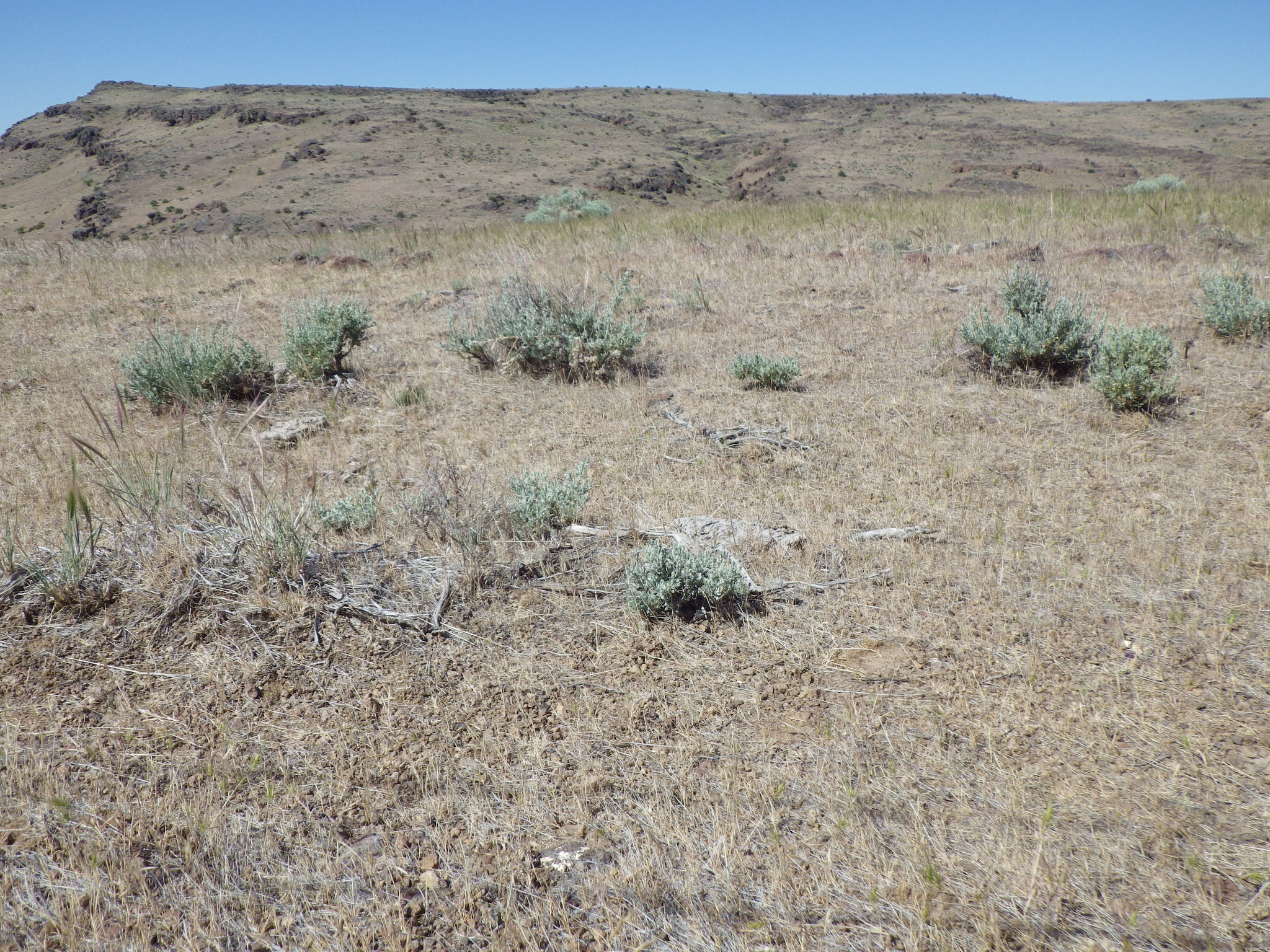
Squirreltail growing on talus slopes on Mount Rose in Nevada (CC BY 4.0).
States and Provinces
- United States: AZ CA CO ID IL KS KY MI MT NE NV NM ND OK OR SD TX UT WA WY
- Canada: AB BC MB SK
- Mexico
Site Characteristics
Squirreltail has wide ecological amplitude [161], but it most commonly occurs in disturbed areas of deserts, valleys, foothills, and mountain meadows [18].
Regional
Squirreltail is found throughout Colorado on dry hills, plains, and rocky slopes, and within open woods and meadows [92]. In Montana, squirreltail occurs in dry, open habitats, from valley to timberline [123]. Throughout the western Great Plains, squirreltail is commonly found on dry soils of pastures and roadsides [82]. In Utah, squirreltail prefers dry to moist vegetation types, from salt desert shrub to alpine grassland [200]. Plains, rocky hills, or montane slopes are common sites in New Mexico [132]. In Arizona, open sandy ground, rocky hills, and open pine woods are common sites [115]. Squirreltail is common to dry rangeland areas of Kansas [154]. In central Washington, squirreltail prefers disturbed sites. Within these sites plant density is negatively correlated with individual plant size [153]. In California, squirreltail is found in scattered stands at high elevations on dry, gravelly soils. It is also common to hillsides and brush associations [168].
Soils
Squirreltail inhabits a wide variety of soil types and is tolerant of saline [108] and alkaline soils [168]. It is widely distributed in salt-desert shrub ranges of the west, on dry, gravelly soils, or within alkaline conditions. Squirreltail is found on clayey soils of northeastern California sagebrush communities [27]. Throughout Montana it occurs predominantly on dry, gravelly soils, in saline or alkaline areas [150]. Within alpine areas of Olympic National Park, Washington, squirreltail prefers well-drained, undifferentiated, disturbed, shallow and stony soils [21]. Passey and Hugie [158] found squirreltail to achieve better growth on Newdale silt loam soils than on Brunt silt loam, in areas with similar climate, slope, and exposure. Squirreltail may also occur on loose, ashy soil [11].
Squirreltail is not common within wet areas such as river lowlands and soil along irrigation canals [153].
Elevation
| State | Elevation |
|---|---|
| Arizona | 2,000 to 11,500 (609-3,505 m) [115] |
| west-central Montana | 7,000 to 9,200 feet (2,135-2,805 m) [123] |
| New Mexico | 4,500 to 11,500 feet (1,372-3,505 m) [132] |
| Utah | 3,510 to 11,400 feet (1,070-3,500 m) [200] |
Plant Communities
Squirreltail is a common component of sagebrush (Artemisia spp.)/grass communities of the Intermountain shrubsteppe [109,212].
Within rangelands of Utah, Nevada, southern Idaho, and western Wyoming, squirreltail commonly grows under and adjacent to shadscale (Atriplex confertifolia), black greasewood (Sarcobatus vermiculatus), and green rabbitbrush (Chrysothamnus viscidiflorus) [161]. Bottlebrush squirreltail is a common component of pinyon-juniper (Pinus spp.-Juniperus spp.) communities of the Great Basin. It occurs mostly within the mountain ranges of Nevada and Utah, and to a lesser extent in California and Idaho [191].
Arizona
Squirreltail occurs in northern desert shrub communities [137] and ponderosa pine (Pinus ponderosa) forests [39,137]. Within aspen (Populus tremuloides)-bunchgrass communities of northern Arizona, squirreltail commonly occurs with Arizona fescue (Festuca arizonica), mountain muhly (Muhlenbergia montana), western yarrow (Achillea millefolium), lupine (Lupinus spp.), fleabane (Erigeron spp.) and American vetch (Vicia americana) [86]. Squirreltail is occasionally found in openings and under shrub canopies within shrub live oak (Quercus turbinella)-mixed shrub communities [173].
California
Squirreltail is native to California's central valley and is commonly associated with purple tussock grass (Nassella pulchra), nodding tussock grass (N. cernua), smallflower tussockgrass (N. lepida), and shooting star (Dodecatheon spp.) [14]. It is a minor component of blue oak (Quercus douglasii) [28,126] and interior live oak (Q. wislizenii) habitats [126].
Within sagebrush scrub of the White Mountains, prairie Junegrass (Koeleria macrantha), muhly (Muhlenbergia spp.) and timberline bluegrass (Poa glauca spp. rupicola) are common associates [130]. Within alluvial fans of desert shrub communities, squirreltail is commonly associated with Indian ricegrass (Achnatherum hymenoides) and desert needlegrass (A. speciosum). Shrub associates of squirreltail include California jointfir (Ephedra californica), goldenfleece (Ericameria arborescens), white burrobrush (Hymenoclea salsola), and purple sage (Salvia dorrii) [135].
Squirreltail occasionally occurs in alpine flora of the Sierra Nevada eastern slope [40]. It is also an occasional understory species of California red fir (Abies magnifica) forests in the Sierra Nevada [155].
Colorado
Squirreltail is a member of north-central Colorado's short-grass prairie [45,57,175]. Within the short-grass prairie, squirreltail is commonly associated with western wheatgrass (Pascopyrum smithii), purple threeawn (Aristida purpurea), sideoats grama (Bouteloua curtipendula), blue grama (Bouteloua gracilis), buffalo grass (Buchloe dactyloides), and needle-and-thread grass (Hesperostipa comata) [57]. It occurs in blue grama ranges of Colorado along with sun sedge (Carex heliophila), sand dropseed (Sporobolus cryptandrus), and purple threeawn [139].
Within Colorado pinyon-Utah juniper (Pinus edulis-Juniperus osteosperma) habitats of Colorado, squirreltail is associated with Gambel oak (Quercus gambelii), Utah serviceberry (Amelanchier utahensis), true mountain-mahogany (Cercocarpus montanus), fendlerbush (Fendlera rupicola), banana yucca (Yucca baccata), and antelope bitterbrush (Purshia tridentata). Grass associates include cheatgrass (Bromus tectorum), Indian ricegrass, mutton grass (Poa fendleriana), and brome grasses (Bromus spp.) [67].
Squirreltail is an occasional associate of Rocky Mountain bristlecone pine (Pinus aristata) [162].
Idaho
Squirreltail is a dominant species in shadscale communities of south-central Idaho [174], along with Indian ricegrass [189].
Montana
Squirreltail generally occurs as scattered plants on rangelands [150]. In the eastern plains of Montana, squirreltail is a dominant species of saline rangelands in association with alkali sacaton (Sporobolus airoides), western wheatgrass (Pascopyrum smithii), thickspike wheatgrass (Elymus lanceolatus), inland saltgrass (Distichlis stricta), Sandberg bluegrass (Poa secunda), and basin wildrye (Leymus cinereus). Shrub associates include black greasewood and Nuttall's saltbush (Atriplex nuttallii).
Nevada
Squirreltail occurs in gray low sagebrush (Artemisia arbuscula ssp. arbuscula) and big sagebrush (A. tridentata) communities. Principal grass associates include cheatgrass [24], Sandberg bluegrass [24,25], bluebunch wheatgrass (Pseudoroegneria spicata), and Thurber needlegrass (Achnatherum thurberianum). Common shrub associates include green rabbitbrush and gray horsebrush (Tetradymia canescens). Forb associates include bird's-beak (Cordylanthus ramosus), mourning milkvetch (Astragalus atratus), woollypod milkvetch (Astragalus purshii), desert yellow fleabane (Erigeron linearis), lava aster (Lonactis alpina), Heerman's buckwheat (Eriogonum heermanii), tail cup lupine (Lupinus caudatus) and phlox (Phlox longifolia) [25].
In northeastern Nevada squirreltail is commonly found with black sagebrush (Artemisia nova) [107,219], shadscale, Nevada ephedra (Ephedra nevadensis), Sandberg bluegrass and Indian ricegrass [107].
Squirreltail also occurs in shadscale communities [24,145]. Common shrub associates include green molly (Kochia americana), winterfat (Krascheninnikovia lanata), budsage (Artemisia spinescens) and spiny hopsage (Grayia spinosa) [145]. Common grass associates are cheatgrass, Indian ricegrass [24] and galleta (Pleuraphis jamesii) [145]. Several common forb associates are salt lover (Halogeton glomeratus), Adonis blazingstar (Mentzelia multiflora) and gooseberryleaf globemallow (Sphaeralcea grossulariifolia). Squirreltail is also common to juniper (Juniperus spp.) and greasewood communities [24].
Squirreltail is found in Wyoming big sagebrush (Artemisia tridentata ssp. wyomingensis) rangelands of Nevada [23].
Oregon
Eastern Oregon grass associates of squirreltail include bluebunch wheatgrass, prairie Junegrass [31], Idaho fescue (Festuca idahoensis), Thurber needlegrass [31,59], Sandberg bluegrass and cheatgrass. Common forbs include Hood's phlox (Phlox hoodii) and maiden blue eyed Mary (Collinsia parviflora) [59]. Squirreltail occurs in lodgepole pine stands in the Cascades of Oregon [61], along with western needlegrass (Achnatherum occidentale) and Ross' sedge (Carex rossii) [65].
Texas
In western Texas squirreltail occurs in Pinchot juniper (Juniperus pinchotii) rangelands with sideoats grama, buffalo grass, slim tridens (Tridens muticus), awnless bushsunflower (Simsia calva) and plains fleabane (Erigeron modestus) [143].
Utah
Squirreltail is common in salt-desert shrub ranges along with the shrubs shadscale (Atriplex confertifolia), mat saltbush (A. corrugata), fourwing saltbush (A. canescens), valley saltbush (A. cunneata), greasewood, winterfat, spiny hopsage, budsage, black sagebrush and green rabbitbrush. Common grasses include Indian ricegrass, Sandberg bluegrass, galleta, alkali sacaton, sand dropseed, and blue grama. Squirreltail is also found in pinyon-juniper woodlands [29], ponderosa pine savannas [148] along with dry Douglas-fir (Pseudotsuga menziesii) and mixed conifer habitats [29].
Wyoming
Squirreltail commonly occurs in big sagebrush steppe along with aspen, big sagebrush, mountain snowberry (Symphoricarpos oreophilus), Utah serviceberry, rose (Rosa spp.), Scouler's willow (Salix scouleriana), and Oregon-grape (Mahonia repens). Common forb associates include rosy pussytoes (Antennaria microphylla), arrowleaf buckwheat (Eriogonum compositum), pineywoods geranium (Geranium caespitosum) and northern bedstraw (Galium boreale). Graminoid associates include needle-and-thread grass, Columbia needlegrass (Achnatherum nelsonii), and elk sedge (Carex geyeri) [36].
Classifications describing plant communities in which squirreltail is a dominant species are as follows:
- Idaho [97]
- California [218] Colorado [119]
- New Mexico [94,146]
- Nevada [24,25,107,125,192,221]
- Oregon [59,101,197]
- Utah [151,203]
- Wyoming [186]
Botanical Description

Squirreltail growth form.
Squirreltail is a cool season, [8] perennial bunchgrass native to the Intermountain West [18]. It is solitary [200], possessing solid, mostly flowering culms [210], with flat leaf blades. The inflorescence is a spike 0.8 to 6.7 inches (2-17 cm) long [82,150,200]. Ecotypic variation is common among squirreltail populations [9].
Reynolds and Fraley [164] found bottlebrush squirreltail roots to achieve depths of 39.4 inches (100 cm) below the soil surface. Depths below 39.4 inches (100 cm) were not seen due to a subsurface layer of basalt, suggesting rooting depths greater than 39.4 inches (100 cm) are possible. A lateral root extension of 16 inches (40 cm) was observed at 9.8, 20, 24 and 39.4 inch (25, 50, 60 and 100 cm) depths.
Raunkiaer Life Form
- Hemicryptophyte [163]
Seasonal Development
The wide ecological amplitude of squirreltail leads to differential timing of phenological events between individuals of differing habitats [43,109]. Flowering generally occurs in spring or early summer [18,57]. Lower elevation populations (that is, cold desert, salt desert habitats) usually mature early June with higher elevation populations (that is, mountain brush, mountain meadows) reaching maturity in late July [18]. Hironaka and Tisdale observed phenological differences between the subspecies Elymus elymoides ssp. elymoides and ssp. californicum. In a common garden experiment E. e. ssp. elymoides developed 10 to 14 days earlier than ssp. californicum [100].
Between 1960 and 1969, Murray and others evaluated squirreltail phenology in southern Idaho. Growth began from mid-March to mid-April. Flower stalks began to form late-April to mid-May, with anthesis occurring in early to mid-June. Plants were dormant from the middle of July to the end of August with fall regrowth occurring through October [152].
Clary [43] evaluated squirreltail phenology and rate of growth from different environments using a transplant garden and growth chamber. The timing of squirreltail phenological events and overall growth rate was closely related to homesite environmental conditions. Squirreltail individuals from higher elevations were limited by cold temperatures whereas individuals from lower elevations were limited by water availability and warm temperatures. Under the same environmental constraints, squirreltail from areas with low moisture stress and cool climates showed higher growth rates, attaining maximum height earlier than individuals from warmer drier sites. Squirreltail requires the longest time to flower in areas of relatively moderate temperature and moisture regimes:
Time to flowering in days for squirreltail individuals from different habitats is shown below. Plants were grown at 6,490 feet (1,980 m) on a clay loam with an annual precipitation of 21.4 inches (544 mm) and annual temperature of 49 degree Fahrenheit (9.5 °C).
| Squirreltail collection site description | Days to flower |
|---|---|
| 7,410 feet (2,260 m), silt loam, ponderosa pine | 205.5 |
| 4,990 feet (1,520 m), stony clay loam, ponderosa pine | 201.2 |
| 7,200 feet (2,200 m), loam, pinyon-juniper | 193.8 |
| 7,810 feet (2,380 m), clay loam, ponderosa pine | 192.5 |
| 9,780 feet (2,980 m), gravelly loam, spruce-fir | 172.5 |
| 9,320 feet (2,840 m), gravelly sandy loam, mountain grassland | 166.8 |
| 4,530 feet (1,380 m), loamy fine sand, short grass | 165.8 |
| 4,720 feet (1,440 m), cobble clay, pinyon-juniper | 162.2 |
| 4,990 feet (1,520 m), stony clay loam, ponderosa pine | 159.5 |
| 5,510 feet (1,680 m), silty clay loam, sagebrush-greasewood | 158.0 |
| 4,530 feet (1,380 m), stony loam, oak savannah | 153.5 |
Squirreltail is responsive to fall rains in northern areas of the Great Basin, allowing for fall regrowth. Fall regrowth uses the majority of total available root carbohydrates partitioned during the summer [50]. The optimal soil temperature for root and shoot growth occurs at approximately 77 degrees Fahrenheit (25 °C). However, squirreltail shows continuous root growth down to 41 degrees Fahrenheit (5 °C) soil temperature [100].
Regeneration Processes
Squirreltail regenerates from surviving root crown [29,201] and seed [18]. Vegetative propagation is nonexistent [18]. Squirreltail has the ability to produce large numbers [99,214] of highly germinable seeds, with relatively rapid germination [214] when exposed to the correct environmental cues. Plants are self-fertilizing [55]. Seeds are readily dispersed by wind [15,99] a few days following maturation [18]. Dispersal is a function of squirreltail's long reflexed awns and disarticulating, mature inflorescence [99,131,148]. Seeds are dispersed when the spike inflorescence is carried along the ground by wind catching the long awns [131].
Although squirreltail has the potential for long distance seed dispersal, Martlette and Anderson [131] found natural plant cover to act as a barrier to dispersal. Wind dispersal of squirreltail seed did not exceed 131 feet (40 m), with viable seed remaining relatively close to mature squirreltail plants.
Dormancy protects squirreltail seeds from germinating during seasonal dry periods. Dry seeds require a period of afterippening, which widens environmental conditions conducive to germination [18]. Allen and others [2] found germination rate increased and dormancy levels decreased as the duration of dry storage increased. Desert squirreltail seed commonly show higher levels of dormancy than seed from mountain populations [18].
Squirreltail seeds may germinate without a period of afterippening, showing a partial state of dormancy. However mean germination time for recently harvested seeds is longer than for afterippened seeds.
Beckstead [19] evaluated the germination temperature requirements of recently harvested bottlebrush squirreltail seeds obtained from mountain and desert habitats. The greatest germination occurred primarily at 50/68 degrees Fahrenheit (10/20 °C) and 59/77 degrees Fahrenheit (15/25 °C), with higher temperatures of 68/86 degrees Fahrenheit (20/30 °C) inhibiting germination.
Environmental conditions and timing of phenological events greatly affect the probability of recently harvested squirreltail seed germination. Temperatures of 50/68 degrees Fahrenheit (10/20 °C) and 59/77 degrees Fahrenheit (15/25 °C) are unlikely to occur during summer months in desert habitats. In higher, mountain habitats, summer temperatures of 50/68 degrees Fahrenheit (10/20 °C) and 59/77 degrees Fahrenheit (15/25 °C) may occur; however, squirreltail usually ripens later at higher elevations [19]. In general, recently harvested squirreltail seeds at lower elevations have a much greater probability of fall germination than seeds from higher elevations [2].
Chabet and Billings [40] observed germination of squirreltail seeds from alpine sites (10,793 feet (3,290 m)) in the Sierra Nevada. The greatest germination (%) occurred at day/night temperatures of 81/73 degrees Fahrenheit (27/23 °C (96%)) and 90/82 degrees Fahrenheit (32/28 °C (92%)).
Successional Status
Depending upon habitat type, squirreltail may occur as an early, mid-, or late successional species.
Shrub Rangelands
Squirreltail is generally a dominant component of seral big sagebrush/bunchgrass communities [217]. Squirreltail is represented in early seral and climax stages of big sagebrush/bluebunch wheatgrass associations in Nevada. Tueller and Platou observed the most pronounced bottlebrush squirreltail during early and climax stages of big sagebrush/bluebunch wheatgrass associations in Nevada [190]. Squirreltail is found within seral and climax stages of big sagebrush rangelands in southeastern Idaho [4]. It is a component of climax big sagebrush communities in Idaho [205] and is a member of climax big sagebrush/western wheatgrass communities of Colorado [183]. Within shrub-steppe ecosystems of western Colorado, squirreltail is an early seral species [117]. Squirreltail also occurs in climax shadscale communities [100].
Pinyon-juniper Communities
Squirreltail is common in mid-seral and climax pinyon-juniper communities of Mesa Verde, Colorado [67,68]. Squirreltail is a component of seral and climax western juniper (Juniper occidentalis) communities of the Pacific Northwest [54].
Ponderosa Pine Communities
Squirreltail is a member of interior ponderosa pine climax communities within the central and southern Rocky Mountains [209].
Prior to invasion of nonnative annuals in the Snake River Plain, Idaho, squirreltail occupied a mid to late seral status, suppressing the early seral fescues, sixweeks fescue (Vulpia octoflora), and foxtail fescue (Vulpia myuros) [160].
Immediate Fire Effects
Although squirreltail is generally top-killed by fire, its small size and low density of coarse fuel per unit basal area make it relatively fire tolerant [31,198,208]. Low density of above ground plant tissue produces a quick, "hot" flame, transferring little heat to growing points below the soil surface [208,210]. The solid culms of squirreltail do not readily burn, compared to those of perennial grass associates [210].

Squirreltail growing with weedy annual grasses including cheatgrass and medusahead on a burned site in Elmore County, Idaho (CC BY 4.0).
Postfire Regeneration Strategy
- Crown residual colonizer (on-site, initial community)
- Secondary colonizer (on-site or off-site seed sources) [182]
Fire Adaptations
Squirreltail's small size, coarse stems, and sparse leafy material aid in its tolerance of fire [31]. Postfire regeneration occurs from surviving root crowns and from on- and off-site seed sources [29]. Frequency of disturbance greatly influences postfire response of squirreltail. Undisturbed plants within a 6 to 9 year age class generally contain large amounts of dead material, increasing squirreltail's susceptibility to fire [210].
Koniak [120] found squirreltail to be a major component of postfire pinyon-juniper communities of the Great Basin at any time during succession. Greatest occurrence and coverage of squirreltail are generally achieved during mid-seral stages.
| Successional stage | Occurrence (%) | Percent of areas achieving > 5% cover |
|---|---|---|
| Early (1 year old) | 43 | 3 |
| Early-mid (4-8 years old) | 58 | 15 |
| Mid (15-17 years old) | 49 | 28 |
| Late-mid (22-60 years old) | 90 | 0 |
| Late > 60 years old | 44 | 0 |
Plant Response to Fire
Squirreltail sprouts from surviving root crown [29,201] and colonizes from seed [29].
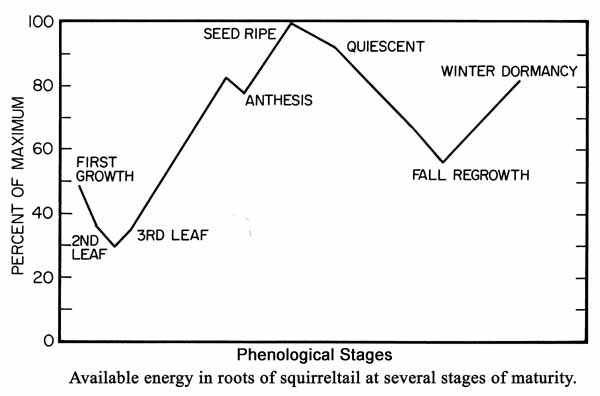
Seasonal trends in squirreltail root carbohydrate reserves greatly affect postfire response. Burning is generally harmful during late spring and early summer [30,208] coinciding with low points in carbohydrate reserves [20]. Squirreltail is most tolerant of late summer (anthesis) or mid-fall (before regrowth) fires [30,49,79], coinciding with relatively high carbohydrate reserves [20]:

A difference in phenological traits of surviving postfire individuals may exist between small (1 to 3 inch (2.5-7.6 cm) crown diameter) and large (>3.5 inches (8.9 cm) crown diameter) squirreltail plants. Wright [210] found large plants to produce significantly (p<0.01) higher numbers of flowering stalks than small plants after fire.
Wright [208] compared squirreltail response to burning and clipping near Boise, Idaho. Heat was applied by propane burner for 20 to 30 seconds to raise soil surface temperature to 400 or 800 degrees Fahrenheit. The 800 degree Fahrenheit treatment killed 25% of squirreltail plants during July and August. No other treatment caused mortality. Burning and clipping during all seasons reduced yields 1 year after treatment. Burning reduced yield most during May. Average herbage weight (in grams) per squirreltail plants in relation to season and treatment at 1 postfire year is summarized below:
| Season | 400 °F | 800 °F | Clipped | Control |
|---|---|---|---|---|
| May | 3.94a | 5.48 | 7.41 | 22.58 |
| June | 6.96 | 8.50 | 7.26 | 22.09 |
| July | 8.51a | 4.32ab | 13.25 | 14.01 |
| August | 7.50a | 9.42 | 11.58 | 16.61 |
| September | 10.44 | 6.11ab | 10.21 | 21.97 |
a Differences from clipped treatment significant at p<0.05 b Differences from 400 °F treatment significant at p<0.05 | ||||
Wright [207] conducted time/temperature evaluations of squirreltail mortality on 5 dates between 19 May and 21 September, at temperatures between 120 to 200 degrees Fahrenheit (48.9-93.3 °C). Time required to kill squirreltail tissue at all temperatures within the test range increased as burning date increased. The greatest change occurred between 10 June and 21 July.
Time (minutes) required to kill squirreltail tissue at 172 degrees Fahrenheit (78 °C) [208]:
| Date | 19 May | 10 June | 21 July | 20 August | 21 September |
| Time (minutes) | 4.00 | 5.50 | 18.50 | 28.00 | 33.50 |
Fox [77] found a direct association between postfire response of squirreltail and ponderosa pine tree density and canopy cover. The greatest cover (%) of squirreltail was achieved in areas with larger (>4 inches (10 cm) diameter) trees and less dense tree canopies.
Blank and others [26] grew squirreltail under greenhouse conditions in soil from a July wildfire site and adjacent unburned areas within a big sagebrush habitat of Nevada. Squirreltail had greater aboveground biomass and more total N, P and K, along with greater silica content, when grown in soil collected from wildfire sites.
Spring
Early spring fire (May) within sagebrush ecosystems of eastern Oregon greatly reduced squirreltail basal area [31,32]. Basal area decreased an average of 47 % the 2nd postfire year. Britton and others [31] compared squirreltail postfire response in eastern Oregon to clipping. Yield (1 postfire year) after a May fire was less than yield from clipping (down to 0.4 inch (1 cm) stubble). Results the 2nd year showed no significant difference.
Squirreltail populations increased after a "moderate" spring (May 1972) wildfire in a ponderosa pine forest on limestone-sandstone derived soils, near flagstaff Arizona. The area observed was logged 2 years before, averaging 16,875 board feet/acre (6,750 board feet/ha). Number of bottlebrush squirreltail stems per hectare in 1972 and 1974 is summarized below in thousands/ha [17]:
| Year | Moderate burn | Severe burn | Control (logged, not burned) |
|---|---|---|---|
| 1972 | 7.2 | 0 | 0 |
| 1974 | 18.1 | 0.1 | 1.1 |
Although frequency of squirreltail was too low for statistical analysis, Champlin [42] reported no damage to squirreltail basal cover and height 2 postfire years after a spring fire in a big sagebrush community of northern California. Squirreltail vigor increased the 1st and 2nd postfire growing season in central Oregon, following a spring fire within a sagebrush-bitterbrush/bunchgrass plant community [1].
Summer
Squirreltail increased following an August wildfire in a big sagebrush community with an understory dominated by cheatgrass and Lyall's milkvetch (Astragalus lyallii) [95]. Significantly (p<0.01) greater biomass was achieved 1 postfire year after a 19 July prescribed fire in Oregon. At time of burn, bottlebrush squirreltail had entered summer quiescence with no green shoot material evident. Mean shoot biomass of burned plants was greater per unit crown area, compared to control. Burned plants also averaged 49% higher root biomass per unit crown area, producing a shoot:root biomass ratio of 1.73 compared to control plots at 0.43 shoot:root biomass. Burning also increased the proportion of reproductive culms; 74.8% of all shoots of burned plants produced reproductive culms compared to 14.3% for unburned plants [220].
Squirreltail showed a negative postfire response to summer (July) wildfire within a sagebrush rangeland in Utah, for the 2nd and 3rd postfire years compared to control [202]. Squirreltail decreased in abundance 1 postfire year after a summer (July) prescribed fire and after a lightning fire within a mountain mahogany-big sagebrush community [187].
Fall
Squirreltail maintained previous levels of production (kg/ha) 1 postfire year after an October fire in an aspen-bunchgrass community of northern Arizona. Although total vegetative production remained constant, percent cover and density of squirreltail were significantly higher. The October fire resulted in a large squirreltail population consisting of small individuals whose combined vegetative biomass equaled or exceeded preburn levels. Associated dominants, Arizona fescue and mountain muhly, decreased [86].
For further information on squirreltail response to fire, see Fire Case Studies, Lyon's Research Paper (Lyon 1971), and the following Research Project Summaries:
- Response of vegetation to prescribed burning in a Jeffrey pine-California black oak woodland and a deergrass meadow at Cuyamaca State Park, California
- Effects of fall and spring prescribed burning in sagebrush steppe in east-central Oregon
- Vegetation response to restoration treatments in ponderosa pine-Douglas-fir forests of western Montana
Fire Regimes
Fire regimes for plant communities in which squirreltail occurs are summarized below. For additional fire regime information, search FEIS for this species by entering the species name on the Advanced Search page and selecting “Fire Regime” as the publication type.
| Community or Ecosystem | Dominant Species | Fire Return Interval Range (years) |
|---|---|---|
| silver fir-Douglas-fir | Abies amabilis-Pseudotsuga menziesii var. menziesii | >200 |
| sagebrush steppe | Artemisia tridentata/Pseudoroegneria spicata | 20-70 [33] |
| basin big sagebrush | A. t. var. tridentata | 12-43 [170] |
| mountain big sagebrush | A. t. var. vaseyana | 20-60 [7,37] |
| Wyoming big sagebrush | A. t. var. wyomingensis | 10-70 (40)** [196,215] |
| saltbush-greasewood | Atriplex confertifolia-Sarcobatus vermiculatus | <35 to <100 |
| desert grasslands | Bouteloua eriopoda and/or Pleuraphis mutica | 5-100 |
| plains grasslands | Bouteloua spp. | <35 |
| blue grama-needle-and-thread grass-western wheatgrass | B. g.-Hesperostipa comata-Pascopyrum smithii | <35 |
| blue grama-buffalo grass | B. g.-Buchloe dactyloides | <35 |
| grama-galleta steppe | B. g.-Pleuraphis jamesii | <35 to <100 |
| blue grama-tobosa prairie | B. g.-P. mutica | <35 to <100 |
| cheatgrass | Bromus tectorum | <10 |
| mountain-mahogany-Gambel oak scrub | Cercocarpus ledifolius-Quercus gambelii | <35 to <100 |
| western juniper | Juniperus occidentalis | 20-70 |
| Rocky Mountain juniper | J. scopulorum | <35 |
| Sierra lodgepole pine* | Pinus contorta var. murrayana | 35-200 |
| Rocky Mountain ponderosa pine* | P. ponderosa var. scopulorum | 2-10 |
| Arizona pine | P. p. var. arizonica | 2-10 |
| galleta-threeawn shrubsteppe | Pleuraphis jamesii-Aristida purpurea | <35 to <100 |
| mesquite-buffalo grass | Prosopis glandulosa-Buchloe dactyloides | <35 |
| Texas savanna | P. g. var. glandulosa | <10 [33] |
| mountain grasslands | Pseudoroegneria spicata | 3-40 (10)** [6] |
| Rocky Mountain Douglas-fir* | Pseudotsuga menziesii var. glauca | 25-100 |
| interior live oak | Quercus wislizenii | <35 [33] |
*fire return interval varies widely; trends in variation are noted in the species summary **(mean) | ||
Fire Management Considerations
Humphrey and Schupp [103] compared squirreltail seedling emergence within burned and unburned cheatgrass dominated areas of the Great Basin, Utah. Greater seedling emergence (April) occurred on seeded burned areas compared to unseeded, within loamy fine sand (85% sand) sites. On a dune site with sandy soil (95% sand), seedling emergence occurred in March with no significant difference between burned and unburned sites. However, a significantly greater proportion of squirreltail seedlings survived on burned dune areas compared to unburned.
Seeding
Aerially applied seed mixture of mutton grass, prairie Junegrass, Indian ricegrass, slender wheatgrass (Elymus trachycaulus) and squirreltail aided in the reestablishment of squirreltail after a summer (August) wildfire within Mesa Verde National Park, Colorado [74]. Squirreltail was an important component 1, 2, [76] and 3 postfire years [75] in seeded areas, whereas no squirreltail was observed in unseeded areas [74].
Postfire recovery of squirreltail occurred after a summer (June 1956) wildfire in Arizona chaparral, aerially seeded with weeping lovegrass (Eragrostis curvula) and crested wheatgrass. Results shown that percent frequency of squirreltail within 9.6 foot (2.9 m) square plots increased steadily for 4 years postfire [157]:
| Species | 1956 | 1957 | 1958 | 1960 | 1961 |
|---|---|---|---|---|---|
| squirreltail | 0 | 2.5 | 4.0 | 10.5 | 21.5 |
| crested wheatgrass | 0 | 14.0 | 20.5 | 17.5 | 13.0 |
| weeping lovegrass | 0.5 | 2.0 | 1.5 | 4.0 | 6.0 |
Seeding postfire pinyon-juniper communities of the Great Basin with desert wheatgrass (Agropyron desertorum), intermediate wheatgrass (Thinopyrum intermedium), and smooth brome (Bromus inermis) inhibits establishment of bottlebrush squirreltail [120].
Pinyon-juniper Communities
Four years after a late summer (July-August) wildfire in pinyon-juniper woodlands of Mesa Verde, Colorado, Erdman [67] found bottlebrush squirreltail as an important component. Squirreltail, along with Indian rice grass and mutton grass, assumed dominance after a 3-year annual grass/forb stage. At 25 postfire years, squirreltail is a member of climax stands.
Within pinyon-juniper ranges of west-central Utah, squirreltail is an important native perennial species at 5 to 6 postfire years [13].
A fire return interval less than 10 to 25 years should increase abundance of bottlebrush squirreltail in newly expanded (young) western juniper stands (Juniperus occidentalis) receiving greater than 14 inches (350 mm) precipitation, at elevations higher than 4,900 feet (1,500 m), in southwestern Idaho [35].
Squirreltail postfire response in a ponderosa pine forest of Arizona
Source
Vose, James M.; White, Alan S. 1991. Biomass response mechanisms of understory species the first year after prescribed burning in an Arizona ponderosa pine community. Forest Ecology and Management. 40(3/4): 175-187. [199].
Season/Severity Classification
This was a late October fire. The fire smoldered for several days and consumed the entire litter layer, with a total heat yield of 115,830 calories/ft2 (1600 kJ/m2).
Study Location
The prescribed fire took place within open sawtimber sites, pole sites, and sapling sites within a ponderosa pine (Pinus ponderosa)/Arizona fescue (Festuca arizonica) habitat type on the Fort Valley Experiment Forest near Flagstaff.
Prefire Vegetative Community
| Site type | Tree characteristics |
|---|---|
| Saw timber sites | 296 trees/acre (120 trees/ha) |
| Pole sites | average tree diameter of 5.9 inches (15cm) at 1,730 trees/ha |
| Sapling sites | average tree diameter 1.8 inches (4.5 cm) at 10,070 trees/ha |
Target Species Phenological State
No entry.
Site Description
Ponderosa pine/Arizona fescue habitat type
Fire Description
The day of initiation, average temperature was between 57.2 and 64.4 degrees Fahrenheit (14-18 °C) and relative humidity was 21%.
Fire Effects on Target Species
Vegetative biomass within open saw timber sites, including surviving squirreltail plants and new seedlings, was approximately 3 times greater (P<0.05) on burn plots compared to control, 247 lbs (112 kg/ha) and 88 lbs (40 kg/ha) respectively. Surviving squirreltail plants within burned, open saw timber areas had more than twice the vegetative production. Seedling recruitment within open saw timber sites was also greater on burned than control plots. Burned open saw timber plots produced an average seedling biomass 15 times greater (p<0.05) than on control plots. Squirreltail in pole sites and sapling sites showed a more negative response to fire than in open sawtimber sites. Results for squirreltail are summarized below:
| Plant type | Burn biomass (kg/ha) | Control biomass (kg/ha) | Density (plants/m2) | Control density (plants/m2) |
|---|---|---|---|---|
| Open saw timber sites | ||||
| all plants | 112.45 | 40.06 | 9.06 | 5.74 |
| residual plants | 96.00 | 40.23 | 4.34 | 4.56 |
| seedlings | 15.84 | 1.03 | 4.98 | 0.57 |
| Pole sized sites | ||||
| all plants | 18.97 | 21.86 | 2.27 | 5.56 |
| residual plants | 18.23 | 18.64 | 2.05 | 3.41 |
| seedlings | 0.78 | 3.17 | 0.28 | 1.99 |
| Sapling sites | ||||
| all plants | 14.08 | 11.72 | 2.91 | 4.18 |
| residual plants | 12.77 | 10.64 | 1.96 | 2.97 |
| seedlings | 1.36 | 0.77 | 1.14 | 0.52 |
No significant phenological differences were found between all burned areas and control.
Fire Management Implications
Overall response of squirreltail within pole and sapling stands was less than in open saw timber areas; however, the response of surviving plants in pole and sapling stands remained strong. Seedlings are generally more vulnerable to environmental changes than established plants. The postfire response of surviving squirreltail plants may result in an increased presence of bottlebrush squirreltail within later postfire stages.
Federal Status
None
Other Status
No entry.
Importance to Wildlife and Livestock
Squirreltail is a dietary component of several wildlife species. It is a minor component of bison and cattle summer diets within sagebrush rangelands of southern Utah [195]. Although of little importance, squirreltail may provide forage for mule deer [122,124]. Pronghorn of western Utah feed upon squirreltail [16]. Townsend's ground squirrels [211], Nuttall's cottontails [111,127], and black-tailed jackrabbits [5,72,112,127] all feed upon squirreltail.
In southeastern Oregon salt desert-shrub ranges, squirreltail is an important component of domestic livestock seasonal diets. Winter months show greatest use [83,140].
Palatability and Nutritional Value
Squirreltail is a very palatable winter forage for domestic sheep of Intermountain ranges. Domestic sheep relish the green foliage [104]. Overall, bottlebrush squirreltail is considered moderately palatable to livestock.
When present, the long sharp awns of squirreltail greatly reduce its palatability [150]. Mature awns may penetrate flesh around the mouth of grazing animals, producing inflammation [51,115]. Eye and ear injury may also occur [51].
Clary [44] compared chemical constituents (%) of squirreltail within open and timbered ponderosa pine overstories in Arizona. Greater digestibility and significantly (p<0.05) higher crude protein were found in open versus timbered overstories:
| Chemical constituent | Open | Timbered |
|---|---|---|
| Crude protein (%) | 16 | 9.7 |
| Phosphorus (%) | 0.25 | 0.26 |
| Ash (%) | 12.3 | 13.7 |
| Digestibility (%) | 66.7 | 61 |
Bottlebrush squirreltail nutrient levels fluctuate throughout the growing season. Levels of S, P, and K usually drop from March to October. Amounts of Mg and Ca stay relatively the same with high points in spring, late summer, and early fall [152]. Overall, squirreltail is a poor source of phosphorus, carotene, and digestible protein, but a good source of energy [48]. The average chemical composition (%) of squirreltail in Great Basin desert ranges is summarized below [47]:
| Nutrient | Composition (%) |
|---|---|
| Ether Extract | 2.6 |
| Total protein | 4.5 |
| Ash | 17.1 |
| Lignin | 8.7 |
| Cellulose | 37.5 |
| Other Carbohydrates | 29.6 |
| Phosphorus | 0.07 |
| Gross energy | 1730 (kcal/lb) |
| Carotene | 0.5 (mg/lb) |
Cover Value
The degree of environmental protection provided by squirreltail for wildlife species is as follows [58]:
| Animal | Utah | Wyoming |
|---|---|---|
| Pronghorn | Poor | Poor |
| Elk | Poor | Poor |
| Mule deer | Poor | Poor |
| White-tailed deer | — | Poor |
| Small mammals | Good | Good |
| Small nongame birds | Fair | Good |
| Upland game birds | Fair | Fair |
| Waterfowl | Poor | Fair |
Value for Rehabilitation of Disturbed Sites
Squirreltail is tolerant of disturbance [133]. The Bureau of Land Management, U.S. Department of the Interior, identifies bottlebrush squirreltail as a high priority species for restoring native plant diversity in the Great Basin and the Columbia River Plateau [90]. Squirreltail naturally colonizes disturbed sites in Yellowstone National Park and is a component of seed mixtures used for restoration of lodgepole pine communities [129]. Brown and Amacher [34] recommend squirreltail for use in restoration of disturbed arid to semi-arid, desert shrub and pinyon-juniper systems. Squirreltail is well adapted for seeding of Wyoming, black and low sagebrush communities of the Intermountain West, receiving 9 to 13 inches (229-330 mm) annual precipitation. Squirreltail grows well under rabbitbrush canopies in south-central Idaho rangelands [149].
Squirreltail inhabits xeric sandy soils (73.9% sand, 16.8% silt, 9.2% clay, 1.3% organic matter) of a 50-year-old abandoned tailings pond from a Pb-Zn-processing mill [41], and is recommended for seed mixtures used to reclaim strip mines in southeastern Montana [64].
The large ecological amplitude of squirreltail lends to ecotypic differentiation. Phenological differences in growth rate, root:shoot ratios, leaf area, and overall plant size exist between subspecies of squirreltail. Differences are directly related to subspecies distribution [100]. Squirreltail seed source should be considered when implementing revegetation projects. Arredondo and others [9] observed a higher root length-to-leaf area ratio in plants grown from seed collected from different environments. Differences in phenology between individuals of different habitats are common (see Seasonal Development).
Squirreltail seed is available commercially [103,104,134]. The United States Department of Agriculture (USDA), Utah Division of Wildlife Resources, in conjunction with the Intermountain Research Station, Forest Service, USDA, established squirreltail seed quality standards. Seed quality standards as of 1990 are summarized below [181]:
| Seed unit1 | Acceptable purity (%)2 | Acceptable viability (%)2 |
|---|---|---|
| spikelet with or without awns | 90 | 85 |
1 Reproductive structure marketed as seed. 2 Purity (%) and germination (%) expected using seed quality testing rules in seeds of commercial quality. | ||
Germinability of primed squirreltail seed significantly (p<0.05) decreases when dried and stored [89].
Competition with Invasive Weeds
The persistence of squirreltail in areas invaded by exotic weeds is well recognized. Bottlebrush squirreltail persists in areas infested with cheatgrass [9,18,99,100,103,188], medusahead (Taeniatherum caput-medusae) [9,96,169,213,216], and Japanese brome (Bromus japonicus) [166].
Squirreltail naturally invades rangelands dominated by cheatgrass and medusahead [9]. However, mechanisms behind squirreltail's ability to occupy weed-infested areas are not completely understood. Several studies have evaluated the persistence of squirreltail within cheatgrass infested ranges. Beckstead [18] found recently harvested bottlebrush squirreltail seeds from mountain brush and meadow sites to possess lower levels of dormancy than cheatgrass at higher temperatures, 68/86 degrees Fahrenheit (20/30 C), whereas the opposite was true of lower temperatures, 41/59 degrees Fahrenheit (5/15 C). Squirreltail at lower elevations (4,100 feet (1,250 m)) have a greater probability of autumn germination than cheatgrass [2]. Established squirreltail plants generally initiate growth before the rosettes of cheatgrass in desert rangelands of Nevada [188]. Beckstead [18] suggests fall seeding of squirreltail into cheatgrass infested rangelands.
Early spring growth and ability to grow at low temperatures contribute to the persistence of squirreltail among cheatgrass dominated ranges [100]. Bottlebrush squirreltail seedlings have the ability to grow roots at low soil temperatures, allowing for soil penetration similar to medusahead and cheatgrass in the northern regions of the Great Basin. Root development at low temperatures promotes squirreltail seedling establishment and effective competition with medusahead [96].
Bottlebrush squirreltail has potential to outcompete medusahead. Management goals often concentrate on protecting squirreltail seedlings from livestock and rabbits, along with maintaining a natural supply of seed [169]. Hironaka and Sindelar [98] evaluated squirreltail growth under greenhouse conditions, when closely associated with medusahead. Squirreltail plants (10 plants) were observed in combination with 0, 4, 12, 36, 108, and 324 medusahead/foot2. Squirreltail growth was not affected by medusahead until 5 weeks old, grown under densities of 108 and 324 medusahead/foot2. Although stunted, no squirreltail mortality was seen at all densities tested, whereas a large amount of medusahead mortality was observed in the 324 medusahead/foot2 level. Squirreltail acquired greater root carbohydrate reserves than medusahead under competitive conditions. Under proper management, Hironaka [96] suggests a successional sequence of cheatgrass to medusahead to squirreltail dominated sites for northern Great Basin areas receiving greater than 11 inches (279 mm) precipitation.
Rome and Eddelman [166] compared squirreltail seedling growth in competition with Japanese brome at densities of 0, 50, 100, 200, 400 Japanese brome/m2. Observations were made in Missoula, Montana at 23, 42, 56, 82, and 97 days following an 8 April seeding of squirreltail and Japanese brome. Squirreltail averaged 85% survival in areas without Japanese brome, compared to an average of 66% survival from areas with 100 to 400 Japanese brome/m2 (p<0.05). Overall, squirreltail under competition with Japanese brome showed the greatest competitive ability at 100 Japanese brome/m2.
Martlette and Anderson [131] observed poor squirreltail seed dispersal into adjacent crested wheatgrass (Agropyron cristatum) stands. Plant cover acted as a barrier restricting the dispersal capabilities of squirreltail.
Under greenhouse conditions, Schlatterer and Tisdale [172] found sagebrush leaf litter to significantly (p<0.05) decrease squirreltail germination compared to moss and rabbitbrush (Chrysothamnus spp.) litter. The average number of squirreltail seeds (20 seeds/pot) germinating under different litter treatments is summarized below:
| Litter type | Big sagebrush | Moss | Rabbitbrush | No litter |
| Number of squirreltail seeds germinating (n=20) | 11.25 | 18.75 | 18.25 | 18.25 |
Squirreltail will readily establish in pinyon-juniper tree litter when a fermentation layer is not present [69].
Robertson [165] observed seeded squirreltail within a big sagebrush habitat at 5,200 feet (1,585 m) in northern Nevada to be short lived, persisting for 5 years. Squirreltail persisted for 30 years following direct seeding within a big sagebrush/bluebunch wheatgrass site in south-central Idaho [148].
Other Uses
No entry.
Other Management Considerations
The addition of nitrogen to disturbed sagebrush communities in Colorado [141] and mountain meadows of Nevada [62] had no positive effect on squirreltail establishment. Squirreltail decreased after the addition of nutrients in the form of stabilized sewage sludge [78].
Squirreltail reproductive potential is adversely affected by jointworm larvae. Spears and Barr [179] found culm length, seed weight, germination (%), and germination rate all significantly lower (p<0.01) on squirreltail infested with jointworms compared to uninfested plants. Results are summarized below:
| Larvae presence | Infested | Uninfested |
| Culm length (cm) | 30.0 | 33.7 |
| Leaf length (cm) | 22.0 | 23.1 |
| # of spikelets | 5 | 9 |
| Seed weight (mg 25 seeds) | 108.2 | 162.5 |
| Germination (%) | 20.0 | 66.0 |
| Growth rate (Seedlings day -1 100 seeds -1) | 2.8 | 7.8 |
Rangelands
Squirreltail is a valuable winter range plant in the Great Basin [48], with leaves remaining green and succulent through the winter.
Squirreltail's total available root carbohydrate reserves are lowest in early spring (approximately 3rd leaf stage), and at the beginning of fall regrowth. Total available carbohydrates are highest after anthesis [50]. By the 4th leaf stage, squirreltail has replaced the carbohydrate reserves found in roots at the beginning of the growing season [20]. Wright [206] found squirreltail most tolerant to herbage removal at time of seed maturity, declining slightly after maturity before fall regrowth. In eastern Oregon, squirreltail is resistant to late season defoliation [31]
Squirreltail generally increases in abundance when moderately grazed or protected on the foothills of intermountain winter ranges [104]. Moderate trampling by livestock in big sagebrush rangelands of central Nevada enhanced squirreltail seedling emergence compared to untrampled conditions. Heavy trampling destroys germination sites and significantly (p<0.05) reduces germination, whereas moderate trampling may enhance germination [63].
Squirreltail is tolerant of grazing in big sagebrush rangelands of southeastern Idaho [4]. In sagebrush rangelands of western Utah, Cook and Child [46] found winter harvesting to have a minor effect on crown cover, whereas early spring (April 1, May 1) harvest greatly reduced squirreltail cover.
Squirreltail vegetative vigor was evaluated over 25 years within a sagebrush rangeland of southeastern Oregon excluded from grazing. Vigor of squirreltail increased significantly over the 25 year period, with the 1st decade showing slower growth than the 2nd. The average annual precipitation over the 25 years equaled 8.3 inches (210 mm) with 40% falling during April, May, and June. Winters were cold with snow cover from December to March. Summers were hot, occasionally exceeding 100 degrees Fahrenheit (38 °C) [3].
Squirreltail is commonly found in heavily grazed and browsed (cattle and deer) aspen stands of big sagebrush steppe in Wyoming [36].
McPherson and Wright [144] observed significantly (p<0.01) greater coverage of bottlebrush squirreltail on ungrazed versus grazed Pinchot juniper rangelands in western Texas. Within the ponderosa pine bunchgrass ranges of the central Rocky Mountains, squirreltail production is greatest under light and moderate grazing regimes [52]. Squirreltail is tolerant of heavy grazing in the ponderosa pine zone of the Coconino Plateau, Arizona, since its long, sharp awns are usually present to discourage grazing [8].
On shortgrass ranges of the central plains squirreltail is very tolerant of light to moderate grazing [118].
Silviculture
Climax western juniper stands are of mixed age, consisting of 1st year seedlings to trees several hundred years old. Seral stands are composed of predominately younger aged trees. In central Oregon, Vaitkus and Eddleman [194] observed significantly greater (p<0.05) squirreltail production when associated with large (older) trees compared to small trees. Production of bottlebrush squirreltail was also significantly greater (p<0.05) under juniper canopies compared to intercanopy zones. McPherson and others [143] observed significantly greater (p<0.01) squirreltail under Pinchot juniper canopies and at canopy edges compared to areas beyond canopy, within grazed and relict grasslands of western Texas. Evaluations by Tueller and Platou [190] lend supporting evidence (see Successional Status).
Squirreltail does not reduce ponderosa pine seedling growth. Two-year-old pine seedlings that were planted the 1st postfire spring, after a June wildfire in northern Arizona, were not affected in height or diameter by competition with squirreltail [66]. In Arizona ponderosa pine forests, seedlings normally gain dominance over squirreltail within 5 years [8].
Squirreltail drastically increased 4 years after a clear-cut within a lodgepole pine forest of northeastern Utah at 8,800 feet (2,700 m). Bottlebrush squirreltail showed the largest increase in vegetative production out of all grasses present [10]:
| Graminoid species | 1976 (kg/ha) | 1980 (kg/ha) |
|---|---|---|
| Ross' sedge | 56.8 | 42.0 |
| elk sedge | 2.1 | 4.4 |
| Poa spp. | 10.2 | 40.7 |
| squirreltail | 3.3 | 47.7 |
| 5 others | 0 | 13.9 |
Squirreltail was an early colonizer after the clear-cut of a ponderosa pine forest in north-central California [138].
Squirreltail populations were greatest 11 to 25 years after clearcuts of a red fir forest in the Sierra Nevada, California [73].
Everett and Sharow [70] found squirreltail seed production was less under singleleaf pinyon (Pinus monophylla)-Utah juniper woodland canopies than in clearcut areas (1 and 2 postharvest years).
Table A1— Forest and range ecosystems, Bureau of Land Management (BLM) physiographic regions, Kuchler plant associations, Society for American Foresters (SAF) forest cover types, and Society for Rangeland Management (SRM) rangeland cover types in which this species occurs.
Forest and Range Ecosystems
- FRES20 Douglas-fir
- FRES21 Ponderosa pine
- FRES23 Fir-spruce
- FRES26 Lodgepole pine
- FRES28 Western hardwoods
- FRES29 Sagebrush
- FRES30 Desert shrub
- FRES32 Texas savanna
- FRES33 Southwestern shrubsteppe
- FRES34 Chaparral-mountain shrub
- FRES35 Pinyon-juniper
- FRES36 Mountain grasslands
- FRES38 Plains grasslands
- FRES40 Desert grasslands
- FRES44 Alpine [80]
BLM Physiographic Regions
- 3 Southern Pacific Border
- 4 Sierra Mountains
- 5 Columbia Plateau
- 6 Upper Basin and Range
- 7 Lower Basin and Range
- 8 Northern Rocky Mountains
- 9 Middle Rocky Mountains
- 10 Wyoming Basin
- 11 Southern Rocky Mountains
- 12 Colorado Plateau
- 13 Rocky Mountain Piedmont
- 14 Great Plains
- 15 Black Hills Uplift [22]
Kuchler Plant Associations
- K005 Mixed conifer forest
- K007 Red fir forest
- K008 Lodgepole pine-subalpine forest
- K010 Ponderosa shrub forest
- K011 Western ponderosa forest
- K012 Douglas-fir forest
- K016 Eastern ponderosa forest
- K017 Black Hills pine forest
- K018 Pine-Douglas-fir forest
- K019 Arizona pine forest
- K020 Spruce-fir-Douglas-fir forest
- K021 Southwestern spruce-fir forest
- K022 Great Basin pine forest
- K023 Juniper-pinyon woodland
- K024 Juniper steppe woodland
- K026 Oregon oakwoods
- K030 California oakwoods
- K031 Oak-juniper woodland
- K032 Transition between K031 and K037
- K037 Mountain-mahogany-oak scrub
- K038 Great Basin sagebrush
- K039 Blackbrush
- K040 Saltbush-greasewood
- K041 Creosotebush
- K046 Desert: vegetation largely lacking
- K050 Fescue-wheatgrass
- K052 Alpine meadows and barren
- K053 Grama-galleta steppe
- K054 Grama-tobosa prairie
- K055 Sagebrush steppe
- K056 Wheatgrass-needlegrass shrubsteppe
- K057 Galleta-threeawn shrubsteppe
- K059 Trans-Pecos shrub savanna
- K060 Mesquite savanna
- K064 Grama-needlegrass-wheatgrass
- K065 Grama-buffalo grass
- K066 Wheatgrass-needlegrass
- K085 Mesquite-buffalo grass
- K086 Juniper-oak savanna [121]
SAF Cover Types
- 66 Ashe juniper-redberry (Pinchot) juniper
- 68 Mesquite
- 207 Red fir
- 209 Bristlecone pine
- 210 Interior Douglas-fir
- 217 Aspen
- 218 Lodgepole pine
- 220 Rocky Mountain juniper
- 229 Pacific Douglas-fir
- 237 Interior ponderosa pine
- 238 Western juniper
- 239 Pinyon-juniper
- 241 Western live oak
- 242 Mesquite
- 243 Sierra Nevada mixed conifer
- 244 Pacific ponderosa pine-Douglas-fir
- 246 California black oak
- 250 Blue oak-foothills pine
- 256 California mixed subalpine [71]
SRM Rangeland Cover Types
- 101 Bluebunch wheatgrass
- 102 Idaho fescue
- 104 Antelope bitterbrush-bluebunch wheatgrass
- 105 Antelope bitterbrush-Idaho fescue
- 106 Bluegrass scabland
- 107 Western juniper/big sagebrush/bluebunch wheatgrass
- 108 Alpine Idaho fescue
- 109 Ponderosa pine shrubland
- 110 Ponderosa pine-grassland
- 201 Blue oak woodland
- 207 Scrub oak mixed chaparral
- 210 Bitterbrush
- 211 Creosotebush scrub
- 212 Blackbush
- 301 Bluebunch wheatgrass-blue grama
- 310 Needle-and-thread-blue grama
- 314 Big sagebrush-bluebunch wheatgrass
- 315 Big sagebrush-Idaho fescue
- 318 Bitterbrush-Idaho fescue
- 320 Black sagebrush-bluebunch wheatgrass
- 321 Black sagebrush-Idaho fescue
- 322 Curlleaf mountain-mahogany-bluebunch wheatgrass
- 401 Basin big sagebrush
- 403 Wyoming big sagebrush
- 405 Black sagebrush
- 406 Low sagebrush
- 407 Stiff sagebrush
- 408 Other sagebrush types
- 409 Tall forb
- 410 Alpine rangeland
- 412 Juniper-pinyon woodland
- 413 Gambel oak
- 414 Salt desert shrub
- 415 Curlleaf mountain-mahogany
- 416 True mountain-mahogany
- 417 Littleleaf mountain-mahogany
- 501 Saltbush-greasewood
- 502 Grama-galleta
- 503 Arizona chaparral
- 504 Juniper-pinyon pine woodland
- 509 Transition between oak-juniper woodland and mahogany-oak association
- 607 Wheatgrass-needlegrass
- 611 Blue grama-buffalo grass
- 612 Sagebrush-grass
- 614 Crested wheatgrass
- 615 Wheatgrass-saltgrass-grama
- 704 Blue grama-western wheatgrass
- 712 Galleta-alkali sacaton
- 713 Grama-muhly-threeawn
- 714 Grama-bluestem
- 715 Grama-buffalo grass
- 718 Mesquite-grama
- 727 Mesquite-buffalo grass
- 735 Sideoats grama-sumac-juniper [176]
1. Adams, Glenn R. 1980. Results of range/wildlife prescribed burning on the Fort Rock Ranger District in central Oregon. R-6 Fuels Management Notes. September 24, 1980. Portland, OR: U.S. Department of Agriculture, Forest Service, Pacific Northwest Region, Aviation and Fire Management. 6 p. [292]
2. Allen, Phil S.; Debaene-Gill, Susan B.; Meyer, Susan E. 1994. Regulation of germination timing in facultatively fall-emerging grasses. In: Monsen, Stephen B.; Kitchen, Stanley G., compilers. Proceedings--ecology and management of annual rangelands; 1992 May 18-22; Boise, ID. Gen. Tech. Rep. INT-GTR-313. Ogden, UT: U.S. Department of Agriculture, Forest Service, Intermountain Research Station: 215-219. [24284]
3. Anderson, Jay E.; Holte, Karl E. 1981. Vegetation development over 25 years without grazing on sagebrush-dominated rangeland in southeastern Idaho. Journal of Range Management. 34(1): 25-29. [319]
4. Anderson, Jay E.; Jeppson, R. J.; Wildosz, R. J.; [and others]. 1978. Trends in vegetation development on the Idaho National Engineering Laboratory Site. In: Markham, O. D., ed. Ecological studies on the Idaho National Engineering Laboratory Site: 1978 Progress Report. IDO-112087. Idaho Falls, ID: U.S. Department of Energy, Environmental Sciences Branch, Radiological and Environmental Sciences Lab: 144-166. [320]
5. Anderson, Jay E.; Shumar, Mark L. 1986. Impacts of black-tailed jackrabbits at peak population densities on sagebrush vegetation. Journal of Range Management. 39(2): 152-155. [322]
6. Arno, Stephen F. 1980. Forest fire history in the Northern Rockies. Journal of Forestry. 78(8): 460-465. [11990]
7. Arno, Stephen F.; Gruell, George E. 1983. Fire history at the forest-grassland ecotone in southwestern Montana. Journal of Range Management. 36(3): 332-336. [342]
8. Arnold, Joseph F. 1950. Changes in ponderosa pine bunchgrass ranges in northern Arizona resulting from pine regeneration and grazing. Journal of Forestry. February: 118-126. [352]
9. Arredondo, J. Tulio; Jones, Thomas A.; Johnson, Douglas A. 1998. Seedling growth of Intermountain perennial and weedy annual grasses. Journal of Range Management. 51(5): 584-589. [35483]
10. Austin, D. D.; Urness, Philip J. 1982. Vegetal responses and big game values after thinning regenerating lodgepole pine. The Great Basin Naturalist. 42(4): 512-516. [8354]
11. Bailey, Warren Hutchinson. 1963. Revegetation in the 1914-1915 devastated area of Lassen Volcanic National Park. Corvallis, OR: Oregon State University. 195 p. Dissertation. [29203]
12. Barkworth, Mary E.; Dewey, Douglas R. 1985. Genomically based genera in the perennial Triticeae of North America: identification and membership. American Journal of Botany. 72(5): 767-776. [393]
13. Barney, Milo A.; Frischknecht, Neil C. 1974. Vegetation changes following fire in the pinyon-juniper type of west-central Utah. Journal of Range Management. 27(2): 91-96. [397]
14. Barry, W. James. 1972. The Central Valley prairie. Vol 1. Sacramento, CA: State of California, Department of Parks and Recreation. 82 p. [28344]
15. Bates, Jon D.; Miller, Richard F.; Svejcar, Tony J. 1998. Understory dynamics in a cut juniper woodland (1991-1997). In: Annual report: Eastern Oregon Agricultural Research Center. Corvallis, OR: Oregon State University, Agricultural Experiment Station: 24-33. [29191]
16. Beale, Donald M.; Smith, Arthur D. 1970. Forage use, water consumption, and productivity of pronghorn antelope in western Utah. Journal of Wildlife Management. 34(3): 570-582. [6911]
17. Beaulieu, Jean Thomas. 1975. Effects of fire on understory plant populations in a northern Arizona ponderosa pine forest. Flagstaff, AZ: Northern Arizona University. 38 p. Thesis. [29095]
18. Beckstead, Julie. 1994. Between-population differences in the germination ecophysiology of cheatgrass (Bromus tectorum) and squirreltail (Elymus elymoides) during afterripening. Provo, UT: Brigham Young University. 96 p. Thesis. [27522]
19. Beckstead, Julie; Meyer, Susan E.; Allen, Phil S. 1995. Effects of afterripening on cheatgrass (Bromus tectorum) and squirreltail (Elymus elymoides) germination. In: Roundy, Bruce A.; McArthur, E. Durant; Haley, Jennifer S.; Mann, David K, compilers. Proceedings: wildland shrub and arid land restoration symposium; 1993 October 19-21; Las Vegas, NV. Gen. Tech. Rep. INT-GTR-315. Ogden, UT: U.S. Department of Agriculture, Forest Service, Intermountain Research Station: 165-172. [24843]
20. Bedell, Thomas E. 1980. Range plant growth and development. Extension Circular 1038. Corvallis, OR: Oregon State University, Extension Service. 4 p. [6518]
21. Belsky, J.; Del Moral, R. 1982. Ecology of an alpine-subalpine meadow complex in the Olympic Mountains, Washington. Canadian Journal of Botany. 60: 779-788. [6740]
22. Bernard, Stephen R.; Brown, Kenneth F. 1977. Distribution of mammals, reptiles, and amphibians by BLM physiographic regions and A.W. Kuchler's associations for the eleven western states. Tech. Note 301. Denver, CO: U.S. Department of the Interior, Bureau of Land Management. 169 p. [434]
23. Bethlenfalvay, Gabor J.; Dakessian, Suren. 1984. Grazing effects on mycorrhizal colonization and floristic composition of the vegetation on a semiarid range in northern Nevada. Journal of Range Management. 37(4): 312-316. [439]
24. Blackburn, Wilbert H.; Eckert, Richard E., Jr.; Tueller, Paul T. 1969. Vegetation and soils of the Cow Creek Watershed. R-49. Reno, NV: University of Nevada, Agricultural Experiment Station. 77 p. In cooperation with: U.S. Department of the Interior, Bureau of Land Management. [458]
25. Blackburn, Wilbert H.; Eckert, Richard E., Jr.; Tueller, Paul T. 1971. Vegetation and soils of the Rock Springs Watershed. R-83. Reno, NV: University of Nevada, Agricultural Experiment Station. 116 p. In cooperation with: U.S. Department of the Interior, Bureau of Land Management. [457]
26. Blank, Robert R.; Allen, Fay; Young, James A. 1994. Growth and elemental content of several sagebrush-steppe species in unburned and post-wildfire soil and plant effects on soil attributes. Plant and Soil. 164: 35-41. [26887]
27. Blank, Robert R.; Trent, James D.; Young, James A. 1992. Sagebrush communities on clayey soils of northeastern California: a fragile equilibrium. In: Clary, Warren P.; McArthur, E. Durant; Bedunah, Don; Wambolt, Carl L., compilers. Proceedings--symposium on ecology and management of riparian shrub communities; 1991 May 29-31; Sun Valley, ID. Gen. Tech. Rep. INT-289. Ogden, UT: U.S. Department of Agriculture, Forest Service, Intermountain Research Station: 198-202. [19121]
28. Borchert, Mark; Davis, Frank W.; Allen-Diaz, Barbara. 1991. Environmental relationships of herbs in blue oak (Quercus douglasii) woodlands of central coastal California. Madrono. 38(4): 249-266. [17067]
29. Bradley, Anne F.; Noste, Nonan V.; Fischer, William C. 1992. Fire ecology of forests and woodlands of Utah. Gen. Tech. Rep. INT-287. Ogden, UT: U.S. Department of Agriculture, Forest Service, Intermountain Research Station. 128 p. [18212]
30. Britton, C. M.; Sneva, F. A.; Clark, R. G. 1979. Effect of harvest date on five bunchgrasses of eastern Oregon. In: 1979 Progress report...research in rangeland management. Special Report 549. Corvallis, OR: Oregon State University, Agricultural Experiment Station: 16-19. In cooperation with: U.S. Department of Agriculture, SEA-AR. [2743]
31. Britton, Carlton M.; McPherson, Guy R.; Sneva, Forrest A. 1990. Effects of burning and clipping on five bunchgrasses in eastern Oregon. The Great Basin Naturalist. 50(2): 115-120. [12371]
32. Britton, Carlton M.; Ralphs, Michael H. 1979. Use of fire as a management tool in sagebrush ecosystems. In: The sagebrush ecosystem: a symposium: Proceedings; 1978 April; Logan, UT. Logan, UT: Utah State University, College of Natural Resources. 101-109. [518]
33. Brown, James K.; Smith, Jane Kapler, eds. 2000. Wildland fire in ecosystems: Effects of fire on flora. Gen. Tech Rep. RMRS-GRT-42-vol. 2. Ogden, UT: U.S. Department of Agriculture, Forest Service, Rocky Mountain Research Station. 257 p. [36581]
34. Brown, Ray W.; Amacher, Michael C. 1999. Selecting plant species for ecological restoration: a perspective for land managers. In: Holzworth, Larry K.; Brown, Ray W., comps. Revegetation with native species: Proceedings, 1997 Society for Ecological Restoration annual meeting; 1997 November 12-15; Fort Lauderdale, FL. Proc. RMRS-P-8. Ogden, UT: U.S. Department of Agriculture, Forest Service, Rocky Mountain Research Station: 1-16. [30341]
35. Bunting, Stephen C. 1987. Use of prescribed burning in juniper and pinyon-juniper woodlands. In: Everett, Richard L., compiler. Proceedings--pinyon-juniper conference; 1986 January 13-16; Reno, NV. Gen. Tech. Rep. INT-215. Ogden, UT: U.S. Department of Agriculture, Forest Service, Intermountain Research Station: 141-144. [4836]
36. Burke, Ingrid C.; Reiners, William A.; Olson, Richard K. 1989. Topographic control of vegetation in a mountain big sagebrush steppe. Vegetatio. 84(2): 77-86. [11178]
37. Burkhardt, Wayne J.; Tisdale, E. W. 1976. Causes of juniper invasion in southwestern Idaho. Ecology. 57: 472-484. [565]
38. Busse, M. D.; Cochran, P. H.; Barrett, J. W. 1996. Changes in ponderosa pine site productivity following removal of understory vegetation. Soil Science Society of America Journal. 60: 1614-1621. [28434]
39. Campbell, R. E.; Baker, M. B., Jr.; Ffolliott, P. F.; [and others]. 1977. Wildfire effects on a ponderosa pine ecosystem: an Arizona case study. Res. Pap. RM-191. Fort Collins, CO: U.S. Department of Agriculture, Forest Service, Rocky Mountain Forest and Range Experiment Station. 12 p. [4715]
40. Chabot, Brian F.; Billings, W. D. 1972. Origins and ecology of the Sierran alpine flora and vegetation. Ecological Monographs. 42(2): 163-199. [11228]
41. Chambers, Jeanne C.; Sidle, Roy C. 1991. Fate of heavy metals in an abandoned lead-zinc tailings pond: I. Vegetation. Journal of Environmental Quality. 20(4): 745-751. [34948]
42. Champlin, Mark R. 1982. Big sagebrush (Artemisia tridentata) ecology and management with emphasis on prescribed burning. Corvallis, OR: Oregon State University. 136 p. Dissertation. [9484]
43. Clary, Warren P. 1975. Ecotypic adaptation in Sitanion hystrix. Ecology. 56(6): 1407-1415. [34923]
44. Clary, Warren P. 1975. Range management and its ecological basis in the ponderosa pine type of Arizona: the status of our knowledge. Res. Pap. RM-158. Fort Collins, CO: U.S. Department of Agriculture, Forest Service, Rocky Mountain Forest and Range Experiment Station. 35 p. [4688]
45. Coffin, D. P.; Lauenroth, W. K. 1989. Small scale disturbances and successional dynamics in a shortgrass plant community: interactions of disturbance characteristics. Phytologia. 67(3): 258-286. [34887]
46. Cook, C. Wayne; Child, R. Dennis. 1971. Recovery of desert plants in various states of vigor. Journal of Range Management. 24: 339-343. [677]
47. Cook, C. Wayne; Harris, Lorin E. 1968. Nutritive value of seasonal ranges. Bulletin 472. Logan, UT: Utah State University, Agricultural Experiment Station. 55 p. [679]
48. Cook, C. Wayne; Stoddart, L. A.; Harris, Lorin E. 1954. The nutritive value of winter range plants in the Great Basin as determined with digestion trials with sheep. Bulletin 372. Logan, UT: Utah State University, Agricultural Experiment Station. 56 p. [682]
49. Countryman, Clive M.; Cornelius, Donald R. 1957. Some effects of fire on a perennial range type. Journal of Range Management. 10: 39-41. [699]
50. Coyne, Patrick I.; Cook, C. Wayne. 1970. Seasonal carbohydrate reserve cycles in eight desert range species. Journal of Range Management. 23: 438-444. [707]
51. Cronquist, Arthur; Holmgren, Arthur H.; Holmgren, Noel H.; Reveal, James L. 1972. Intermountain flora: Vascular plants of the Intermountain West, U.S.A. Vol. 1. New York: Hafner Publishing Company, Inc. 270 p. [717]
52. Currie, Pat O. 1975. Grazing management of ponderosa pine-bunchgrass ranges of the central Rocky Mountains. Res. Pap. RM-159. Fort Collins, CO: U.S. Department of Agriculture, Forest Service, Rocky Mountain Forest and Range Experiment Station. 24 p. [12600]
53. Currie, Pat O.; Goodwin, D. L. 1966. Consumption of forages by black-tailed jackrabbits on salt-desert ranges of Utah. Journal of Wildlife Management. 30(2): 304-311. [25015]
54. Dealy, J. Edward; Geist, J. Michael; Driscoll, Richard S. 1978. Western juniper communities on rangelands of the Pacific Northwest. Hyder, Donald, ed. Proceedings, 1st international rangeland congress; 1978 August 14-18; Denver, CO. Denver, CO: Society for Range Management: 201-204. [785]
55. Dewey, D. R. 1988. The U.S. living collection of perennial Triticeae grasses. Utah Science. Fall: 71-76. [11384]
56. Dewey, Douglas R. 1983. Historical and current taxonomic perspectives of Agropyron, Elymus, and related genera. Crop Science. 23: 637-642. [793]
57. Dickinson, C. E.; Dodd, Jerrold L. 1976. Phenological pattern in the shortgrass prairie. The American Midland Naturalist. 96(2): 367-378. [799]
58. Dittberner, Phillip L.; Olson, Michael R. 1983. The plant information network (PIN) data base: Colorado, Montana, North Dakota, Utah, and Wyoming. FWS/OBS-83/86. Washington, DC: U.S. Department of the Interior, Fish and Wildlife Service. 786 p. [806]
59. Doescher, P. S.; Miller, R. F.; Swanson, S. R.; Winward, A. H. 1986. Identification of the Artemisia tridentata ssp. wyomingensis/Festuca idahoensis habitat type in eastern Oregon. Northwest Science. 60(1): 55-60. [815]
60. Dorn, Robert D. 1984. Vascular plants of Montana. Cheyenne, WY: Mountain West Publishing. 276 p. [819]
61. Dyrness, C. T. 1976. Effect of wildfire on soil wettability in the high Cascades of Oregon. PNW-202. Portland, OR: U.S. Department of Agriculture, Forest Service, Pacific Northwest Forest and Range Experiment Station. 18 p. [8573]
62. Eckert, R. E. 1975. Improvement of mountain meadows in Nevada. Research Report. Reno, NV: U.S. Department of Agriculture, Bureau of Land Management. 45 p. [8124]
63. Eckert, Richard E., Jr.; Peterson, Frederick F.; Emmerich, Fay L. 1987. A study of factors influencing secondary succession in the sagebrush [Artemisia spp. L.] type. In: Frasier, Gary W.; Evans, Raymond A., eds. Proceedings of the symposium: "Seed and seedbed ecology of rangeland plants"; 1987 April 21-23; Tucson, AZ. Washington, DC: U.S. Department of Agriculture, Agricultural Research Service: 149-168. [3544]
64. Eddleman, Lee E.; Doescher, Paul S. 1978. Selection of native plants for spoils revegetation based on regeneration characteristics and successional status. In: Land Reclamation Program, Annual Report July 1976-October 1977. ANL/LRP-2. Argonne, IL: Argonne National Laboratory, Energy & Environmental Systems Division: 132-138. [5729]
65. Edgerton, Paul J.; McConnell, Burt R.; Smith, Justin G. 1975. Initial response of bitterbrush to disturbance by logging and slash disposal in a lodgepole pine forest. Journal of Range Management. 28(2): 112-114. [16009]
66. Elliott, Katherine J.; White, Alan S. 1987. Competitive effects of various grasses and forbs on ponderosa pine seedlings. Forest Science. 33(2): 356-366. [860]
67. Erdman, James A. 1970. Pinyon-juniper succession after natural fires on residual soils of Mesa Verde, Colorado. Brigham Young University Science Bulletin: Biological Series. 11(2): 1-26. [11987]
68. Erdman, James Allen. 1969. Pinyon-juniper succession after fires on residual soils of the Mesa Verde, Colorado. Boulder, CO: University of Colorado. 81 p. Dissertation. [11437]
69. Everett, Richard L. 1987. Allelopathic effects of pinyon and juniper litter on emergence and growth of herbaceous species. In: Frasier, Gary W.; Evans, Raymond A., eds. Proceedings of symposium: "Seed and seedbed ecology of rangeland plants"; 1987 April 21-23; Tucson, AZ. Washington, DC: U.S. Department of Agriculture, Agricultural Research Service: 62-67. [3353]
70. Everett, Richard L.; Sharrow, Steven H. 1983. Understory seed rain on tree-harvested and unharvested pinyon-juniper sites. Journal of Environmental Management. 17(4): 349-358. [35997]
71. Eyre, F. H., ed. 1980. Forest cover types of the United States and Canada. Washington, DC: Society of American Foresters. 148 p. [905]
72. Fagerstone, Kathleen A.; Lavoie, G. Keith; Griffith, Richard E., Jr. 1980. Black-tailed jackrabbit diet and density on rangeland and near agricultural crops. Journal of Range Management. 33(3): 229-233. [21756]
73. Fernau, R. F.; Rey Benayas, J. M.; Barbour, M. G. 1998. Early secondary succession following clearcuts in red fir forests of the Sierra Nevada, California. Madrono. 45(2): 131-136. [30094]
74. Floyd-Hanna, Lisa; DaVega, Anne; Hanna, David; Romme, William H. 1997. Chapin 5 fire vegetation monitoring and mitigation first year report. Unpublished report. Washington, DC: U.S. Department of the Interior, National Park Service, Mesa Verde National Park. 7 p. (+ Appendices). On file with: U.S. Department of Agriculture, Forest Service, Rocky Mountain Research Station, Fire Sciences Laboratory, Missoula, MT. [34181]
75. Floyd-Hanna, Lisa; Hanna, David. 1999. Chapin 5 fire vegetation monitoring and mitigation annual report, year 3. Unpublished report. Washington, DC: U.S. Department of the Interior, National Park Service, Mesa Verde National Park. 8 p. (+Appendices). On file with: U.S. Department of Agriculture, Forest Service, Rocky Mountain Research Station, Fire Sciences Laboratory, Missoula, MT. [34569]
76. Floyd-Hanna, Lisa; Hanna, David; Romme, William H. 1998. Chapin 5 Fire vegetation monitoring and mitigation annual report, year 2. Unpublished report. Washington, DC: U.S. Department of the Interior, National Park Service, Mesa Verde National Park. 7 p. (+ Appendices). On file with: U.S. Department of Agriculture, Forest Service, Rocky Mountain Research Station, Fire Sciences Laboratory, Missoula, MT. [34460]
77. Foxx, Teralene S. 1996. Vegetation succession after the La Mesa Fire at Bandelier National Monument. In: Allen, Craig D., ed. Fire effects in southwestern forests: Proceedings, 2nd La Mesa fire symposium; 1994 March 29-31; Los Alamos, NM. RM-GTR-286. Fort Collins, CO: U.S. Department of Agriculture, Forest Service, Rocky Mountain Forest and Range Experiment Station: 47-69. [27283]
78. Fresquez, P. R.; Francis, Richard E.; Dennis, G. L. 1990. Soil and vegetation responses to sewage sludge on a degraded semiarid broom snakeweed/blue grama plant community. Journal of Range Management. 43(4): 325-331. [34945]
79. Gaines, Edward M.; Kallander, Harry R.; Wagner, Joe A. 1958. Controlled burning in southwestern ponderosa pine: results from the Blue Mountain plots, Fort Apache Indian Reservation. Journal of Forestry. 56: 323-327. [988]
80. Garrison, George A.; Bjugstad, Ardell J.; Duncan, Don A.; [and others]. 1977. Vegetation and environmental features of forest and range ecosystems. Agric. Handb. 475. Washington, DC: U.S. Department of Agriculture, Forest Service. 68 p. [998]
81. Gates, Robert J. 1985. Observations of the formation of sage grouse lek. Wilson Bulletin. 97(2): 219-221. [25625]
82. Great Plains Flora Association. 1986. Flora of the Great Plains. Lawrence, KS: University Press of Kansas. 1392 p. [1603]
83. Green, Lisle R.; Sharp, Lee A.; Cook, C. Wayne; Harris, Lorin E. 1951. Utilization of winter range forage by sheep. Journal of Range Management. 4: 233-241. [7891]
84. Gregg, Michael A.; Crawford, John A.; Drut, Martin S. 1993. Summer habitat use and selection by female sage grouse (Centrocercus urophasianus) in Oregon. The Great Basin Naturalist. 53(3): 293-298. [22057]
85. Grey, William E.; Quimby, Paul C., Jr.; Mathre, Donald E.; Young, James A. 1995. Potential for biological control of downy brome (Bromus tectorum) and medusahead (Taeniatherum caput-medusae) with crown and root rot fungi. Weed Technology. 9(2): 362-365. [35196]
86. Haisley, James R. 1984. The effects of prescribed burning on four aspen-bunchgrass communities in northern Arizona. Flagstaff, AZ: Northern Arizona University. 47 p. Thesis. [27667]
87. Hallsten, Gregory P.; Skinner, Quentin D.; Beetle, Alan A. 1987. Grasses of Wyoming. 3rd ed. Research Journal 202. Laramie, WY: University of Wyoming, Agricultural Experiment Station. 432 p. [2906]
88. Hardegree, S. P.; Van Vactor, S. S. 1999. Predicting germination response of four cool-season range grasses to field-variable temperature regimes. Environmental and Experimental Botany. 41(3): 209-217. [35229]
89. Hardegree, Stuart P. 1994. Drying and storage effects on germination of primed grass seeds. Journal of Range Management. 47(3): 196-199. [34943]
90. Hardegree, Stuart P. 1994. Germination enhancement of perennial grasses native to the Intermountain region. In: Monsen, Stephen B.; Kitchen, Stanley G, compilers. Proceedings--ecology and management of annual rangelands; 1992 May 18-22; Boise, ID. Gen. Tech. Rep. INT-GTR-313. Ogden, UT: U.S. Department of Agriculture, Forest Service, Intermountain Research Station: 229-232. [24287]
91. Hedrick, D. W.; Hyder, D. N.; Sneva, F. A.; Poulton, C. E. 1966. Ecological response of sagebrush-grass range in central Oregon to mechanical and chemical removal of Artemisia. Ecology. 47(3): 432-439. [1115]
92. Herzman, Carl W.; Everson, A. C.; Mickey, Myron H.; [and others]. 1959. Handbook of Colorado native grasses. Bull. 450-A. Fort Collins, CO: Colorado State University, Extension Service. 31 p. [10994]
93. Hickman, James C., ed. 1993. The Jepson manual: Higher plants of California. Berkeley, CA: University of California Press. 1400 p. [21992]
94. Hill, Alison; Pieper, Rex D.; Southward, G. Morris. 1992. Habitat-type classification of the pinyon-juniper woodlands in western New Mexico. Bulletin 766. Las Cruces, NM: New Mexico State University, College of Agriculture and Home Economics, Agricultural Experiment Station. 80 p. [37374]
95. Hinds, W. T.; Sauer, R. H. 1976. Soil erodibility, soil erosion, and revegetation following wildfire in a shrug-steppe community. In: Atmosphere-surface exchange of particulate and gaseous pollutants; proceedings of a symposium; [Date of conference unknown]; Richland, WA. [Place of publication unknown]. [Publisher unknown]. 571-590. [8092]
96. Hironaka, M. 1994. Medusahead: natural successor to the cheatgrass type in the northern Great Basin. In: Monsen, Stephen B.; Kitchen, Stanley G., compilers. Proceedings--ecology and management of annual rangelands; 1992 May 18-22; Boise, ID. Gen. Tech. Rep. INT-GTR-313. Ogden, UT: U.S. Department of Agriculture, Forest Service, Intermountain Research Station: 89-91. [24259]
97. Hironaka, M.; Fosberg, M. A.; Winward, A. H. 1983. Sagebrush-grass habitat types of southern Idaho. Bulletin Number 35. Moscow, ID: University of Idaho, Forest, Wildlife and Range Experiment Station. 44 p. [1152]
98. Hironaka, M.; Sindelar, Brian W. 1975. Growth characteristics of squirreltail seedlings in competition with medusahead. Journal of Range Management. 28(4): 283-285. [1159]
99. Hironaka, M.; Tisdale, E. W. 1963. Secondary succession in annual vegetation in southern Idaho. Ecology. 44(4): 810-812. [1160]
100. Hironaka, M.; Tisdale, E. W. 1972. Growth and development of Sitanion hystrix and Poa sandbergii. Research Memorandum RM 72-24. U.S. International Biological Program, Desert Biome. 15 p. [1161]
101. Hopkins, William E. 1979. Plant associations of the Fremont National Forest. R6-ECOL-79-004. Portland, OR: U.S. Department of Agriculture, Forest Service, Pacific Northwest Region. 106 p. [7340]
102. Hosten, P. E.; West, N. E. 1994. Cheatgrass dynamics following wildfire on a sagebrush semidesert site in central Utah. In: Monsen, Stephen B.; Kitchen, Stanley G., compilers. Proceedings--ecology and management of annual rangelands; 1992 May 18-22; Boise, ID. Gen. Tech. Rep. INT-GTR-313. Ogden, UT: U.S. Department of Agriculture, Forest Service, Intermountain Research Station: 56-62. [24253]
103. Humphrey, L. David; Schupp, Eugene W. 1999. Temporal patterns of seeding emergence and early survival of Great Basin perennial plant species. The Great Basin Naturalist. 59(1): 35-49. [29654]
104. Hutchings, Selar S.; Stewart, George. 1953. Increasing forage yields and sheep production on Intermountain winter ranges. Circular No. 925. Washington, DC: U.S. Department of Agriculture. 63 p. [1227]
105. Jameson, Donald A. 1966. Competition in a blue grama-broom snakeweed-actinea community and responses to selective herbicides. Journal of Range Management. 19: 121-124. [1250]
106. Jensen, Kevin B.; Redinbaugh, M.; Blood, M.; [and others]. 1999. Natural hybrids of Elymus elymoides x Leymus salinus subsp. salmonis (Poaceae: Triticeae) Crop Science. 39(4): 976-982. [35162]
107. Jensen, M. E.; Peck, L. S.; Wilson, M. V. 1988. A sagebrush community type classification for mountainous northeastern Nevada rangelands. The Great Basin Naturalist. 48: 422-433. [27717]
108. Jensen, M. E.; Simonson, G. H.; Dosskey, M. 1990. Correlation between soils and sagebrush-dominated plant communities of northeastern Nevada. Soil Science Society of America Journal. 54: 902-910. [15502]
109. Jirik, Steven. 1989. A study on the post-fire defoliation response of Agropyron spicatum and Sitanion hystrix. Moscow, ID: University of Idaho. 42 p. Thesis. [15509]
110. Johnsen, Thomas N., Jr. 1987. Seeding pinyon-juniper sites in the Southwest. In: Everett, Richard L., compiler. Proceedings--pinyon-juniper conference; 1986 January 13-16; Reno, NV. Gen. Tech. Rep. INT-215. Ogden, UT: U.S. Department of Agriculture, Forest Service, Intermountain Research Station: 465-472. [29497]
111. Johnson, Mark K.; Hansen, Richard M. 1979. Foods of cottontails and woodrats in south-central Idaho. Journal of Mammalogy. 60(1): 213-215. [23859]
112. Johnson, Randal D.; Anderson, Jay E. 1984. Diets of black-tailed jack rabbits in relation to population density and vegetation. Journal of Range Management. 37(1): 79-83. [21837]
113. Jones, Stanley D.; Wipff, Joseph K.; Montgomery, Paul M. 1997. Vascular plants of Texas. Austin, TX: University of Texas Press. 404 p. [28762]
114. Kartesz, John T. 1994. A synonymized checklist of the vascular flora of the United States, Canada, and Greenland. Volume I--checklist. 2nd ed. Portland, OR: Timber Press. 622 p. [23877]
115. Kearney, Thomas H.; Peebles, Robert H.; Howell, John Thomas; McClintock, Elizabeth. 1960. Arizona flora. 2d ed. Berkeley, CA: University of California Press. 1085 p. [6563]
116. Kitchen, Stanley G.; McArthur, E. Durant; Jorgensen, Gary L. 1999. Species richness and community structure along a Great Basin elevational gradient. In: McArthur, E. Durant; Ostler, W. Kent; Wambolt, Carl L., compilers. Proceedings: shrub ecotones; 1998 August 12-14; Ephraim, UT. Proceedings RMRS-P-11. Ogden, UT: U.S. Department of Agriculture, Forest Service, Rocky Mountain Research Station: 59-65. [36063]
117. Klein, D. A.; Frederick, B. A.; Redente, E. F. 1989. Fertilizer effects on soil microbial communities and organic matter in the rhizosphere of Sitanion hystrix and Agropyron smithii. Arid Soil Research and Rehabilitation. 3: 397-404. [11097]
118. Klipple, G. E.; Costello, David F. 1960. Vegetation and cattle responses to different intensities of grazing on short-grass ranges on the Central Great Plains. Technical Bulletin No. 1216. Washington, DC: U.S. Department of Agriculture. 82 p. [4284]
119. Komarkova, Vera; Alexander, Robert R.; Johnston, Barry C. 1988. Forest vegetation of the Gunnison and parts of the Uncompahgre National Forests: a preliminary habitat type classification. Gen. Tech. Rep. RM-163. Fort Collins, CO: U.S. Department of Agriculture, Forest Service, Rocky Mountain Forest and Range Experiment Station. 65 p. [5798]
120. Koniak, Susan. 1985. Succession in pinyon-juniper woodlands following wildfire in the Great Basin. The Great Basin Naturalist. 45(3): 556-566. [1371]
121. Kuchler, A. W. 1964. United States [Potential natural vegetation of the conterminous United States]. Special Publication No. 36. New York: American Geographical Society. 1:3,168,000; colored. [3455]
122. Kufeld, Roland C.; Wallmo, O. C.; Feddema, Charles. 1973. Foods of the Rocky Mountain mule deer. Res. Pap. RM-111. Fort Collins, CO: U.S. Department of Agriculture, Forest Service, Rocky Mountain Forest and Range Experiment Station. 31 p. [1387]
123. Lackschewitz, Klaus. 1991. Vascular plants of west-central Montana--identification guidebook. Gen. Tech. Rep. INT-227. Ogden, UT: U.S. Department of Agriculture, Forest Service, Intermountain Research Station. 648 p. [13798]
124. Leckenby, Donavin A.; Adams, Arthur W. 1969. Ecological study of mule deer. Project No.: W-53-R-11. Job Progress Report No. 1. July 1, 1968 to June 30, 1969. Portland, OR: Oregon Game Commission, Research Division. 51 p. [16754]
125. Lewis, Mont E. 1971. Flora and major plant communities of the Ruby-East Humboldt Mountains with special emphasis on Lamoille Canyon. Elko, NV: U.S. Department of Agriculture, Forest Service, Region 4, Humboldt National Forest. 62 p. [1450]
126. Lytle, Dennis J.; Finch, Sherman J. 1987. Relating cordwood production to soil series. In: Plumb, Timothy R.; Pillsbury, Norman H., technical coordinators. Proceedings of the symposium on multiple-use management of California's hardwood resources; 1986 November 12-14; San Luis Obispo, CA. Gen. Tech. Rep. PSW-100 .w. Berkeley, CA: U.S. Department of Agriculture, Forest Service, Pacific Southwest Forest and Range Experiment Station: 260-267. [5380]
127. MacCracken, James G.; Hansen, Richard M. 1984. Seasonal foods of blacktail jackrabbits and Nuttall cottontails in southeastern Idaho. Journal of Range Management. 37(3): 256-259. [25010]
128. Madany, Michael H.; West, Neil E. 1984. Vegetation of two relict mesas in Zion National Park. Journal of Range Management. 37(5): 456-461. [6883]
129. Majerus, Mark. 1999. Collection and production of indigenous plant material for National Park restoration. In: Revegetation with native species: Proceedings, 1997 Society for Ecological Restoration annual meeting; 1997 November 12-15; Fort Lauderdale, FL. Proceedings RMRS-P-8. Ogden, UT: U.S. Department of Agriculture, Forest Service, Rocky Mountain Research Station: 17-21. [30375]
130. Marchand, Denis E. 1973. Edaphic control of plant distribution in the White Mountains, eastern California. Ecology. 54(2): 233-250. [1521]
131. Marlette, Guy M.; Anderson, Jay E. 1986. Seed banks and propagule dispersal in crested-wheatgrass stands. Journal of Applied Ecology. 23: 161-175. [1526]
132. Martin, William C.; Hutchins, Charles R. 1981. A flora of New Mexico. Volume 1. Germany: J. Cramer. 647 p. [37175]
133. Maser, Chris; Strickler, Gerald S. 1978. The sage vole, Lagurus curtatus, as an inhabitant of subalpine sheep fescue, Festuca ovina, communities on Steens Mountain--an observation and interpretation. Northwest Science. 52(3): 276-284. [15507]
134. McArthur, E. Durant; Young, Stanford A. 1999. Development of native seed supplies to support restoration of pinyon-juniper sites. In: Monsen, Stephen B.; Stevens, Richard, compilers. Proceedings: ecology and management of pinyon-juniper communities within the Interior West: Sustaining and restoring a diverse ecosystem; 1997 September 15-18; Provo, UT. Proc. RMRS-P-9. Ogden, UT: U.S. Department of Agriculture, Forest Service, Rocky Mountain Research Station: 327-330. [30591]
135. McCarten, Niall; Van Devender, Thomas R. 1988. Late Wisconsin vegetation of Robber's Roost in the western Mohave Desert, California. Madrono. 35(3): 226-237. [6183]
136. McClaran, Mitchel P.; Allen, Larry S.; Ruyle, George B. 1992. Livestock production and grazing management in the encinal oak woodlands of Arizona. In: Ffolliott, Peter F.; Gottfried, Gerald J.; Bennett, Duane A.; [and others], technical coordinators. Ecology and management of oak and associated woodlands: perspectives in the southwestern United States and northern Mexico: Proceedings; 1992 April 27-30; Sierra Vista, AZ. Gen. Tech. Rep. RM-218. Fort Collins, CO: U.S. Department of Agriculture, Forest Service, Rocky Mountain Forest and Range Experiment Station: 57-64. [19743]
137. McClaran, Mitchel P.; Brady, Ward W. 1994. Arizona's diverse vegetation and contributions to plant ecology. Rangelands. 16(5): 208-217. [29721]
138. McDonald, Philip M. 1999. Diversity, density, and development of early vegetation in a small clear-cut environment. Res. Pap. PSW-RP-239. Albany, CA: U.S. Department of Agriculture, Forest Service, Pacific Southwest Research Station. 22 p. [36204]
139. McGinnies, W. J.;Laycock, W. A.;Tsuchiya, T.,Yonker, C.M.;Edmunds, D. A. 1988. Variability within a native stand of blue grama. Journal of Range Management. 41(5): 391-395. [5971]
140. McInnis, Michael L.; Vavra, Martin. 1987. Dietary relationships among feral horses, cattle, and pronghorn in southeastern Oregon. Journal of Range Management. 40(1): 60-66. [1605]
141. McLendon, Terry; Redente, Edward F. 1994. Role of nitrogen availability in the transition from annual-dominated to perennial-dominated seral communities. In: Monsen, Stephen B.; Kitchen, Stanley G., compilers. Proceedings--ecology and management of annual rangelands; 1992 May 18-22; Boise, ID. Gen. Tech. Rep. INT-GTR-313. Ogden, UT: U.S. Department of Agriculture, Forest Service, Intermountain Research Station: 352-362. [24309]
142. McPherson, Guy R. 1992. Ecology of oak woodlands in Arizona. In: Ffolliott, Peter F.; Gottfried, Gerald J.; Bennett, Duane A.; [and others], technical coordinators. Ecology and management of oak and associated woodlands: perspectives in the southwestern United States and northern Mexico: Proceedings; 1992 April 27-30; Sierra Vista, AZ. Gen. Tech. Rep. RM-218. Fort Collins, CO: U.S. Department of Agriculture, Forest Service, Rocky Mountain Forest and Range Experiment Station: 24-33. [19737]
143. McPherson, Guy R.; Rasmussen, G. Allen; Wester, David B.; Masters, Robert A. 1991. Vegetation and soil zonation associated with Juniperus pinchoth Sudw. trees. The Great Basin Naturalist. 51(4): 316-324. [18105]
144. McPherson, Guy R.; Wright, Henry A. 1990. Effects of cattle grazing and Juniperus pinchotii canopy cover on herb cover and production in western Texas. The American Midland Naturalist. 123: 144-151. [11148]
145. Medin, Dean E. 1990. Birds of a shadscale (Atriplex confertifolia) habitat in east central Nevada. The Great Basin Naturalist. 50(3): 295-298. [14989]
146. Medina, Alvin L. 1987. Woodland communities and soils of Fort Bayard, southwestern New Mexico. Journal of the Arizona-Nevada Academy of Science. 21: 99-112. [3978]
147. Moir, W. H. 1993. Alpine tundra and coniferous forest. In: Dick-Peddie, William A., ed. New Mexico vegetation: Past, present, and future. Albuquerque, NM: University of New Mexico Press: 47-84. [21099]
148. Monsen, Stephen B.; Anderson, Val Jo. 1995. A 52-year ecological history of selected introduced and native grasses planted in central Idaho. In: Proceedings, 17th international grassland congress; 1993 February 8-21; Palmerston North, New Zealand. [Place of publication unknown]: [Publisher unknown]: 1740-1741. [25664]
149. Monsen, Stephen B.; Shaw, Nancy L. 1983. Seeding antelope bitterbrush with grasses on south-central Idaho rangelands--a 39-year response. In: Tiedemann, Arthur R.; Johnson, Kendall L., compilers. Proceedings--research and management of bitterbrush and cliffrose in western North America; 1982 April 13-15; Salt Lake City, UT. Gen. Tech. Rep. INT-152. Ogden, UT: U.S. Department of Agriculture, Forest Service, Intermountain Forest and Range Experiment Station: 126-136. [1684]
150. Morris, H. E.; Booth, W. E.; Payne, G. F.; Stitt, R. E. 1950. Important grasses on Montana ranges. Bull. No. 470. Bozeman, MT: Montana Agricultural Experiment Station. 52 p. [5520]
151. Mueggler, Walter F.; Campbell, Robert B., Jr. 1986. Aspen community types of Utah. Res. Pap. INT-362. Ogden, UT: U.S. Department of Agriculture, Forest Service, Intermountain Research Station. 69 p. [1714]
152. Murray, R. B.; Mayland, H. F.; Van Soest, P. J. 1978. Growth and nutritional value to cattle of grasses on cheatgrass range in southern Idaho. Research Paper INT-199. Ogden, UT: U.S. Department of Agriculture, Forest Service, Intermountain Forest and Range Experiment Station. 57 p. [1723]
153. Newsome, R.D.; Sauer, R.H. 1983. The ecology of Sitanion (Graminaceae) in Benton County, Washington. In: Brewer, Richard, ed. Proceedings of the eighth North American prairie conference; 1982 August 1-4; Kalamazoo, MI. Kalamazoo, MI: Western Michigan University, Department of Biology: 15-20. [3116]
154. Ohlenbuseh, Paul D.; Hodges, Elizabeth P.; Pope, Susan. 1983. Range grasses of Kansas. Manhattan, KS: Kansas State University, Cooperative Extension Service. 23 p. [5316]
155. Oosting, H. J.; Billings, W. D. 1943. The red fir forest of the Sierra Nevada: Abietum magnificae. Ecological Monographs. 13(3): 260-273. [11521]
156. Pase, Charles P. 1982. Sierran subalpine conifer forest. In: Brown, David E., ed. Biotic communities of the American Southwest--United States and Mexico. Desert Plants. 4(1-4): 40-41. [8883]
157. Pase, Charles P.; Pond, Floyd W. 1964. Vegetation changes following the Mingus Mountain burn. Res. Note RM-18. Fort Collins, CO: U.S. Department of Agriculture, Forest Service, Rocky Mountain Forest and Range Experiment Station. 8 p. [5700]
158. Passey, H. B.; Hugie, V. K. 1963. Some plant-soil relationships on an ungrazed range area of southeastern Idaho. Journal of Range Management. 16: 113-118. [1831]
159. Pearson, Henry A. 1965. Studies of forage digestibility under ponderosa pine stands. In: Proceedings: Society of American Foresters meeting; 1964 September 27 - October 1; Denver, CO. Washington, DC: Society of American Foresters: 71-73. [11513]
160. Peters, Erin F.; Bunting, Stephen C. 1994. Fire conditions pre- and postoccurrence of annual grasses on the Snake River Plain. In: Monsen, Stephen B.; Kitchen, Stanley G., compilers. Proceedings--ecology and management of annual rangelands; 1992 May 18-22; Boise, ID. Gen. Tech. Rep. INT-GTR-313. Ogden, UT: U.S. Department of Agriculture, Forest Service, Intermountain Research Station: 31-36. [24249]
161. Plummer, A. Perry; Hull, A. C., Jr.; Stewart, George; Robertson, Joseph H. 1955. Seeding rangelands in Utah, Nevada, southern Idaho and western Wyoming. Agric. Handb. 71. Washington, DC: U.S. Department of Agriculture, Forest Service. 73 p. [11736]
162. Ranne, Brigitte M.; Baker, William L.; Andrews, Tom; Ryan, Michael G. 1997. Natural variability of vegetation, soils, and physiography in the bristlecone pine forests of the Rocky Mountains. The Great Basin Naturalist. 57(1): 21-37. [27383]
163. Raunkiaer, C. 1934. The life forms of plants and statistical plant geography. Oxford: Clarendon Press. 632 p. [2843]
164. Reynolds, Timothy D.; Fraley, Leslie, Jr. 1989. Root profiles of some native and exotic plant species in southeastern Idaho. Environmental and Experimental Botany. 29(2): 241-248. [36276]
165. Robertson, Joseph H. 1947. Responses of range grasses to different intensities of competition with sagebrush (Artemisia tridentata Nutt.). Ecology. 28(1): 1-16. [2008]
166. Romo, J. T.; Eddleman, L. E. 1987. Effects of Japanese brome on growth of bluebunch wheatgrass, Junegrass, and squirreltail seedlings. Reclamation and Revegetation Research. 6: 207-218. [262]
167. Ross, Robert L.; Hunter, Harold E. 1976. Climax vegetation of Montana: Based on soils and climate. Bozeman, MT: U.S. Department of Agriculture, Soil Conservation Service. 64 p. [2028]
168. Sampson, Arthur W.; Chase, Agnes; Hedrick, Donald W. 1951. California grasslands and range forage grasses. Bull. 724. Berkeley, CA: University of California College of Agriculture, California Agricultural Experiment Station. 125 p. [2052]
169. Sanders, Kenneth D. 1994. Can annual rangelands be converted and maintained as perennial grasslands through grazing management? In: Monsen, Stephen B.; Kitchen, Stanley G., compilers. Proceedings--ecology and management of annual rangelands; 1992 May 19-22; Boise, ID. Gen. Tech. Rep. INT-GTR-313. Ogden, UT: U.S. Department of Agriculture, Forest Service, Intermountain Research Station: 412-413. [24321]
170. Sapsis, David B. 1990. Ecological effects of spring and fall prescribed burning on basin big sagebrush/Idaho fescue--bluebunch wheatgrass communities. Corvallis, OR: Oregon State University. 105 p. Thesis. [16579]
171. Schlatterer, Edward F.; Hironaka, M. 1972. Some factors influencing tolerance to moisture stress of three range grasses. Journal of Range Management. 25(5): 364-367. [35440]
172. Schlatterer, Edward F.; Tisdale, E.W. 1969. Effects of litter of Artemisia, Chrysothamnus, and Tortula on germination and growth of three perennial grasses. Ecology. 50(5): 869-873. [2078]
173. Severson, Kieth E.; DeBano, Leonard F. 1991. Influence of Spanish goats on vegetation and soils in Arizona chaparral. Journal of Range Management. 44(2): 111-117. [15770]
174. Sharp, Lee A.; Sanders, Ken; Rimbey, Neil. 1990. Forty years of change in a shadscale stand in Idaho. Rangelands. 12(6): 313-328. [15527]
175. Shaw, R. B.; Anderson, S. L.; Schultz, K. A.; Diersing, V. E. 1989. Floral inventory for the U. S. Army Pinon Canyon Maneuver Site, Colorado. Phytologia. 67(1): 1-42. [12137]
176. Shiflet, Thomas N., ed. 1994. Rangeland cover types of the United States. Denver, CO: Society for Range Management. 152 p. [23362]
177. Sneva, Forrest A. 1971. Species succession on sprayed range under continuously deferred grazing. Progess report. Burns, OR: Squaw Butte Experiment Station: 61-96. [2187]
178. Sneva, Forrest A.; Rittenhouse, L. R.; Tueller, P. T.; Reece, P. 1984. Changes in protected and grazed sagebrush-grass in eastern Oregon, 1937 to 1974. Station Bulletin 663. Corvallis, OR: Oregon State University, Agricultural Experiment Station. 11 p. [2195]
179. Spears, Brian M.; Barr, William F. 1985. Effect of jointworms on the growth and reproduction of four native range grasses of Idaho. Journal of Range Management. 38(1): 44-46. [2205]
180. Stevens, Richard. 1983. Species adapted for seeding mountain brush, big, black, and low sagebrush, and pinyon-juniper communities. In: Monsen, Stephen B.; Shaw, Nancy, compilers. Managing Intermountain rangelands--improvement of range and wildlife habitats: Proceedings; 1981 September 15-17; Twin Falls, ID; 1982 June 22-24; Elko, NV. Gen. Tech. Rep. INT-157. Ogden, UT: U.S. Department of Agriculture, Forest Service, Intermountain Forest and Range Experiment Station: 78-82. [2240]
181. Stevens, Richard; Meyer, Susan E. 1990. Seed quality testing for range and wildland species. Rangelands. 12(6): 341-346. [14163]
182. Stickney, Peter F. 1989. Seral origin of species originating in northern Rocky Mountain forests. Unpublished draft on file at: U.S. Department of Agriculture, Forest Service, Intermountain Research Station, Fire Sciences Laboratory, Missoula, MT; RWU 4403 files. 10 p. [20090]
183. Strong, Laurence L.; Dana, Robert W.; Carpenter, Len H. 1985. Estimating phytomass of sagebrush habitat types from microdensitometer data. Photogrammetric Engineering and Remote Sensing. 51(4): 467-474. [2267]
184. Sturges, David L. 1986. Responses of vegetation and ground cover to spraying a high elevation, big sagebrush watershed with 2,4-D. Journal of Range Management. 39(2): 141-146. [2276]
185. Tausch, Robin J.; West, Neil E. 1977. Competition and structural changes during secondary succession in juniper-pinyon woodlands. Unpublished report on file at: U.S. Department of Agriculture, Forest Service, Intermountain Forest and Range Experiment Station, Intermountain Fire Sciences Laboratory, Missoula, MT. [2307]
186. Thilenius, John F.; Brown, Gary R.; Medina, Alvin L. 1995. Vegetation on semi-arid rangelands, Cheyenne River Basin, Wyoming. Gen. Tech. Rep. RM-GTR-263. Fort Collins, CO: U.S. Department of Agriculture, Forest Service, Rocky Mountain Forest and Range Experiment Station. 60 p. [26478]
187. Tiagwad, Tamara E.; Olson, Craig M.; Martin, Robert E. 1982. Single-year response of breeding bird populations to fire in a curlleaf mountainmahogany-big sagebrush community. In: Starkey, Edward E.; Franklin, Jerry F.; Matthews, Jean W., technical coordinators. Ecological research in national parks in the Pacific Northwest; [Date of conference unknown]; [Location of conference unknown]. Corvallis, OR: Oregon State University, Forest Research Lab: 101-110. [8087]
188. Tipton, F. H. 1994. Cheatgrass, livestock, and rangeland. In: Monsen, Stephen B.; Kitchen, Stanley G., compilers. Proceedings--ecology and management of annual rangelands; 1992 May 19-22; Boise, ID. Gen. Tech. Rep. INT-GTR-313. Ogden, UT: U.S. Department of Agriculture, Forest Service, Intermountain Research Station: 414-416. [24322]
189. Tisdale, E. W. 1986. Native vegetation of Idaho. Rangelands. 8(5): 202-207. [2339]
190. Tueller, P. T.; Platou, K. A. 1991. A plant succession gradient in a big sagebrush/grass ecosystem. Vegetatio. 94(1): 57-68. [16576]
191. Tueller, Paul T.; Beeson, C. Dwight; Tausch, Robin J.; [and others]. 1979. Pinyon-juniper woodlands of the Great Basin: distribution, flora, vegetal cover. Res. Pap. INT-229. Ogden, UT: U.S. Department of Agriculture, Forest Service, Intermountain Forest and Range Experiment Station. 22 p. [2367]
192. Tueller, Paul T.; Eckert, Richard E., Jr. 1987. Big sagebrush (Artemisia tridentata vaseyana) and longleaf snowberry (Symphoricarpos oreophilus) plant associations in northeastern Nevada. The Great Basin Naturalist. 47(1): 117-131. [3015]
193. U.S. Department of Agriculture, Soil Conservation Service. 1994. Plants of the U.S.--alphabetical listing. Washington, DC: U.S. Department of Agriculture, Soil Conservation Service. 954 p. [23104]
194. Vaitkus, Milda R.; Eddleman, Lee E. 1991. Tree size and understory phytomass production in a western juniper woodland. The Great Basin Naturalist. 51(3): 236-243. [16869]
195. Van Vuren, Dirk. 1984. Summer diets of bison and cattle in southern Utah. Journal of Range Management. 37(3): 260-261. [24531]
196. Vincent, Dwain W. 1992. The sagebrush/grasslands of the upper Rio Puerco Area, New Mexico. Rangelands. 14(5): 268-271. [19698]
197. Volland, Leonard A. 1985. Plant associations of the central Oregon Pumice Zone. R6-ECOL-104-1985. Portland, OR: U.S. Department of Agriculture, Forest Service, Pacific Northwest Region. 138 p. [7341]
198. Volland, Leonard A.; Dell, John D. 1981. Fire effects on Pacific Northwest forest and range vegetation. Portland, OR: U.S. Department of Agriculture, Forest Service, Pacific Northwest Region, Range Management and Aviation and Fire Management. 23 p. [2434]
199. Vose, James M.; White, Alan S. 1991. Biomass response mechanisms of understory species the first year after prescribed burning in an Arizona ponderosa pine community. Forest Ecology and Management. 40(3/4): 175-187. [35011]
200. Welsh, Stanley L.; Atwood, N. Duane; Goodrich, Sherel; Higgins, Larry C., eds. 1987. A Utah flora. The Great Basin Naturalist Memoir No. 9. Provo, UT: Brigham Young University. 894 p. [2944]
201. West, Neil E. 1994. Effects of fire on salt-desert shrub rangelands. In: Monsen, Stephen B.; Kitchen, Stanley G., compilers. Proceedings--ecology and management of annual rangelands; 1992 May 18-22; Boise, ID. Gen. Tech. Rep. INT-GTR-313. Ogden, UT: U.S. Department of Agriculture, Forest Service, Intermountain Research Station: 71-74. [24256]
202. West, Neil E.; Hassan, M. A. 1985. Recovery of sagebrush-grass vegetation following wildfire. Journal of Range Management. 38(2): 131-134. [2513]
203. West, Neil E.; Tausch, Robin J.; Tueller, Paul T. 1998. A management-oriented classification of pinyon-juniper woodlands of the Great Basin. Gen. Tech. Rep. RMRS-GTR-12. Ogden, UT: U.S. Department of Agriculture, Forest Service, Rocky Mountain Research Station. 42 p. [29131]
204. White, Alan S.; Cook, James E.; Vose, James M. 1991. Effects of fire and stand structure on grass phenology in a ponderosa pine forest. The American Midland Naturalist. 126(2): 269-278. [16885]
205. Winward, Alma H. 1970. Taxonomic and ecological relationships of the big sagebrush complex in Idaho. Moscow, ID: University of Idaho. 79 p. Ph.D. dissertation. [2583]
206. Wright, Henry A. 1967. Contrasting responses of squirreltail and needleandthread to herbage removal. Journal of Range Management. 20: 398-400. [2606]
207. Wright, Henry A. 1970. A method to determine heat-caused mortality in bunchgrasses. Ecology. 51(4): 582-587. [2609]
208. Wright, Henry A. 1971. Why squirreltail is more tolerant to burning than needle-and-thread. Journal of Range Management. 24: 277-284. [2610]
209. Wright, Henry A. 1978. The effect of fire on vegetation in ponderosa pine forests: A state-of-the-art review. Lubbock, TX: Texas Tech University, Department of Range and Wildlife Management. 21 p. In cooperation with: U.S. Department of Agriculture, Forest Service, Intermountain Forest and Range Experiment Station. [4425]
210. Wright, Henry A.; Klemmedson, James O. 1965. Effect of fire on bunchgrasses of the sagebrush-grass region in southern Idaho. Ecology. 46(5): 680-688. [2624]
211. Yensen, Eric; Quinney, Dana L. 1992. Can Townsend's ground squirrels survive on a diet of exotic annuals? The Great Basin Naturalist. 52(3): 269-277. [20990]
212. Young, James A. 1989. Intermountain shrubsteppe plant communities--pristine and grazed. In: Western raptor management symposium and workshop: Proceedings; 1987; Boise, ID. Scientific Technical Series No. 12. Washington, DC: National Wildlife Federation: 3-14. [25377]
213. Young, James A.; Evans, Raymond A. 1970. Invasion of medusahead into the Great Basin. Weed Science. 18(1): 89-97. [2647]
214. Young, James A.; Evans, Raymond A. 1977. Squirreltail seed germination. Journal of Range Management. 30(1): 33-36. [280]
215. Young, James A.; Evans, Raymond A. 1981. Demography and fire history of a western juniper stand. Journal of Range Management. 34(6): 501-505. [2659]
216. Young, James A.; Evans, Raymond A.; Eckert, Richard E., Jr. 1969. Wheatgrass establishment with tillage and herbicides in a mesic medusahead community. Journal of Range Management. 22: 151-155. [2666]
217. Young, James A.; Evans, Raymond A.; Major, J. 1972. Alien plants in the Great Basin. Journal of Range Management. 25: 194-201. [2674]
218. Young, James A.; Evans, Raymond A.; Major, Jack. 1977. Sagebrush steppe. In: Barbour, Michael G.; Major, Jack, eds. Terrestrial vegetation of California. New York: John Wiley & Sons: 763-796. [4300]
219. Young, James A.; Palmquist, Debra E. 1992. Plant age/size distributions in black sagebrush (Artemisia nova): effects on community structure. The Great Basin Naturalist. 52(4): 313-320. [20180]
220. Young, Richard P.; Miller, Richard F. 1985. Response of Sitanion hystrix (Nutt.) J. G. to prescribed burning. The American Midland Naturalist. 113(1): 182-187. [2682]
221. Zamora, B.; Tueller, Paul T. 1973. Artemisia arbuscula, A. longiloba, and A. nova habitat types in northern Nevada. The Great Basin Naturalist. 33(4): 225-242. [2688]