


Eriodictyon californicum, California yerba santa
Howard, Janet L. 1992. Eriodictyon californicum, California yerba santa. In: Fire Effects Information System, [Online]. U.S. Department of Agriculture, Forest Service, Rocky Mountain Research Station, Fire Sciences Laboratory (Producer). Available: https://research.fs.usda.gov/feis/species-reviews/erical
| Abbreviation | Common Name | Scientific Name | Classification | Status |
|---|---|---|---|---|
| Plants | ||||
| ERICAL | California yerba santa | Eriodictyon californicum | Life Form: Plants/Shrub Kingdom: Plantae Class: Dicot Order: Solanales Family: Hydrophyllaceae Genus: Eriodictyon | Fed. Protected: No Nativity: Native Invasiveness: Noninvasive |


Taxonomy
The scientific name of California yerba santa is Eriodictyon californicum (H. & A.) Torr., in the family Hydrophyllaceae. There are no recognized subspecies or varieties [25].
Synonyms
- No entry
Other Common Names
mountain balm

Distribution of California yerba santa
General Distribution
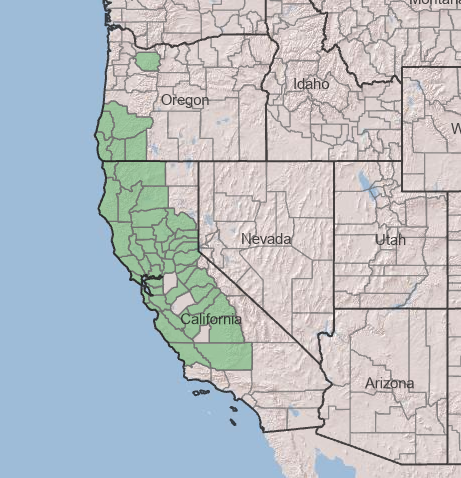
California yerba santa occurs in California and Oregon. It is distributed along the Coast and Klamath ranges from Monterey County north to Siskiyou County, California. It occurs in the Sierra Nevada and Cascade Range from Kern County north to Klamath and Jackson counties, Oregon [12,25].
States
- United States: CA OR
Site Characteristics
California yerba santa occurs on dry, rocky slopes and ridges. It is common on south- or east-facing slopes [25,33].
Elevation: California yerba santa occurs below 5,500 feet (1,676 m), with a mean elevation of 2,120 feet (636 m) [1,25].
Soil: California yerba santa grows in shallow to deep, slightly acidic soil. Soil texture varies from sandy loam to heavy clay [5,6,8,28]. It will tolerate serpentine soil [15,21].
Climate: California yerba santa occurs in a Mediterranean climate with wet, mild winters and hot, dry summers. Snow showers occur during the winter months but usually melt off rapidly [23]. Soil temperatures are frequently below freezing in winter [29].
Plant Communities
California yerba santa is an occasionally dominant shrub in annual grassland and oak (Quercus spp.) woodland. It is listed as a dominant ecoassociation type (eas) in the following published classification:
| Area | Classification | Authority |
|---|---|---|
| CA: Sierra Nevada Mts. | CA hardwood eas | Allen and others 1991 |
Associated species: Associated species include chaparral whitethorn (Ceanothus leucodermis), wedgeleaf ceanothus (C. cuneatus), manzanita (Arctostaphylos spp.), tree poppy (Dendromecon rigida), broadleaf and redstem filaree (Erodium botrys and E. cicutarium), soft chess (Bromus mollis), and foxtail fescue (Festuca megalura) [28,29,36]. Also see SAF cover types listed in table A1.
Botanical Description
California yerba santa is an erect, much-branched, native evergreen shrub from 2 to 8 feet (0.6-2.4 m) in height. The branches are glutinous or resinous; lanceolate leaves are glutinous on top. Mature leaves are often blackened by a sooty fungus [25,27]. The root system is shallow, with multibranching rhizomes. Most of the main roots are confined to the top 3 inches (7.6 cm) of soil [9,20]. The fruit is a small capsule, 0.08 to 0.12 inch (2-3 mm) long, containing two to eight small seeds [25].
Raunkiaer Life Form (Raunkiaer 1934)
- Phanerophyte
Seasonal Development
The seasonal development of California yerba santa is as follows [20,25,28]:
| Seasonal event | Months |
|---|---|
| Vegetative growth begins | April |
| Flowers in bloom | May to June |
| Seed ripe | September |
| Seed dissemination | September to November |
| Germination | March |
| March seedlings emerge | April |
Regeneration Processes
Sexual: California yerba santa reproduces from seed [25,27,28]. Seedlings may be abundant after fire [37]. They emerge 1 to 3 weeks later than seedlings of other brush species, and experience high mortality [28]. California yerba santa seedlings are poor competitors. Seedlings are particularly sensitive to emerging herbaceous species [6,19,28]. A seedbed rich in herbaceous species will competitively eliminate most emerging California yerba santa seedlings [19]. Surviving seedlings grow rapidly. Schultz and Biswell [28] reported seedlings attaining heights of up to 20 inches within the first season. Plants become sexually mature within 2 or 3 years. Most seed falls beneath the parent plant. The seed is very small, and is readily buried beneath the litter layer, duff, and soil to become part of the seedbank. Seed germinates following a disturbance such as fire or mechanical site preparation [6]. Longevity of soil-stored seed is unknown [37].
Vegetative: California yerba santa regenerates asexually through rhizomes, which may be produced as early as the first growing season following seedling establishment [6,11,19,33]. Vegetative reproduction is the most successful method of self-propagation in established communities [6]. Biswell [37] reported that rhizomes may grow as much as 8 feet (2.5 m) in one summer, giving rise to plants every 8 to 10 inches (20-25 cm). Vegetative growth is not usually this rapid, such rapid grow may occur on ash beds after fire if soil is fertile and moisture abundant.
Successional Status
California yerba santa is both a residual colonizer and a survivor in disturbed communities, establishing either from seed or by sprouting from rhizomes [6,24,29]. Mature shrubs are found in early seral communities. It is a diminished survivor, however. It is shade-intolerant, and plants gradually die out as the community matures. California yerba santa is displaced in climax communities by chaparral whitethorn, wedgeleaf ceanothus, and various manzanitas [21].
Immediate Fire Effects
Moderate-severity fire top-kills California yerba santa; severe fire may kill it. Survival of underground rhizomes is most likely after low- to moderate-severity fire [28].
Postfire Regeneration Strategy (Stickney 1989)
- Rhizomatous shrub, rhizome in soil
- Ground residual colonizer (on-site, initial community)
Fire Adaptations
California yerba santa establishes after fire by sprouting from rhizomes or through germination of seed stored in the seedbank [6,19,27].
California yerba santa leaves secrete flammable resins and waxes which build up and make the leaf surface gummy [9,25,27]. The branches are also glutinous. Older, resinous leaves are dropped during summer, producing highly flammable litter.
Plant Response to Fire
California yerba santa germinates from seed during the first postfire growing season. Seeds that have lain dormant in the soil for decades will germinate following a fire [6]. It is possible that California yerba santa has hard-coated seeds that will not germinate except when scarified. Yerba santa seeds are very difficult to germinate under laboratory conditions [14]; and may have some mechanism that inhibits water imbibition and germination. Alternatively, fire may break the seed's dormancy by burning off the litter layer and exposing the seed to sufficient light to allow germination. Newly established seedlings grow rapidly, and may begin vegetative reproduction in the second postfire growing season [6].
California yerba santa sprouts from surviving rhizomes at the first postfire growing season [19].
Fire Regimes
For fire regime information, search FEIS for this species by entering the species name on the Advanced Search page and selecting “Fire Regime” as the publication type.
Fire Management Considerations
Repeated prescribed fires are not recommended for eradicating California yerba santa. Repeated rangeland fires have increased California yerba santa populations and decreased the number of desirable browse species. The combination of fire and herbivory removes competing species. If fire is to be used as a management tool, a single fire is recommended to top-kill existing plants; thereafter herbicides should be used to kill sprouts and seedlings [6,19].
Federal Status
No special status
Other Status
No entry.
Importance to Wildlife and Livestock
Domestic goats occasionally consume California yerba santa leaves and twigs. Otherwise, livestock do not use it [10,18]. In winter and spring, plants are lightly browsed by black-tailed deer, contributing to about 6 percent of their total diet [3]. During winters when more desirable forage is scarce, California yerba santa may become a critical element in the diet of deer [6]. In addition, deer consumption increases during the first two growing seasons following a fire. In Madera County, California, deer consumed 78 percent of new seedlings and sprouts of the first postfire growing season. At postfire year 2, consumption was down to 30 percent [27]. No information concerning seed consumption is available. Full seed capsules may be eaten by birds and rodents. The seeds alone are probably too small (0.04 to 0.06 inch (1.0-1.5 mm)) to be eaten by most animals, although insects probably consume them.
Palatability and Nutritional Value
California yerba santa leaves contain aromatic compounds that give them an unpleasant odor and bitter taste [9,27]. Consequently, it is not preferred browse. The browse rating of California yerba santa for livestock and wildlife species is as follows [27]:
| Animal | Browse rating |
|---|---|
| Cattle | Poor |
| Sheep | Poor |
| Horses | Poor |
| Goats | Poor |
| Mule deer | Fair to poor |
California yerba santa is nutritious in spring. In one study, the dry-weight protein content of twigs and leaves varied from 5.4 percent in July to 17.0 percent in April [4]. In a separate study on mineral nutrition, California yerba santa proved to be a better source of calcium and sulfur than any of 11 other chaparral browse species tested. The mineral content of California yerba santa browse is as follows [28]:
| Mineral | Composition (%) |
|---|---|
| Phosphorus | 0.11 |
| Sulfur | 0.22 |
| Calcium | 1.15 |
| Magnesium | 0.55 |
| Potassium | 0.83 |
Cover Value
Mature California yerba santa shrubs are often spindly, with leaves at the tips of the branches and bare limbs below. Their cover value is poor. Younger shrubs provide cover for various birds and small mammals.
Value for Rehabilitation or Restoration of Disturbed Sites
California yerba santa can be utilized in rangeland rehabilitation because the plant establishes well in disturbed soil. California yerba santa sprouts adventitiously when roots are exposed following mechanical site preparation [33]. In addition, seeds will germinate in disturbed areas. If California yerba santa is to be used for rehabilitation, it is necessary to avoid excessively overturning the soil and damaging existing rhizomes, or burying seed too deeply for germination.
Other Uses
California yerba santa leaf extract was used by Native Americans and early settlers as a remedy for cough, colds, grippe, and asthma [25,27].
Other Management Considerations
California yerba santa can become dominant on heavily used rangelands, particularly in areas that have been converted from brushland to grassland. Livestock consume other plants before they browse yerba santa [27]. With reduced competition, California yerba santa eventually forms dense pure stands [6,11,19].
Control: The best method of control is to move livestock off the range before desirable browse becomes overgrazed. Chemical control is possible but may be difficult. Some California yerba santa populations are beginning to show resistance to phenoxy compounds such as 2,4-D. These chemicals can still be effective in some areas, however. Basal applications of karbutilate are also effective. Precautions for its use in pastures and rangelands have been detailed [7]. Karbutilate requires several months to break down. If treated in the summer or early fall, the rangeland could be seeded with desirable grass and/or herbaceous species in the early spring. Chemical control, along with reseeding, would probably be an effective eradication strategy.
Table A1— Forest and range ecosystems, Bureau of Land Management (BLM) physiographic regions, Kuchler plant associations, Society for American Foresters (SAF) forest cover types, and Society for Rangeland Management (SRM) rangeland cover types in which this species occurs.
Forest and Range Ecosystems (Garrison et al. 1977)
- FRES20 Douglas-fir
- FRES21 Ponderosa pine
- FRES27 Redwood
- FRES28 Western hardwoods
- FRES34 Chaparral - mountain shrub
BLM Physiographic Regions (Bernard and Brown 1977)
- 1 Northern Pacific Border
- 3 Southern Pacific Border
- 4 Sierra Mountains
Kuchler Plant Associations (Kuchler 1964)
- KOO5 Mixed conifer forest
- KOO6 Redwood forest
- K009 Pine - cypress forest
- K010 Ponderosa shrub forest
- K029 California mixed evergreen forest
- K030 California oakwoods
- K033 Chaparral
- K034 Montane chaparral
SAF Cover Types (Eyre 1980)
- 229 Pacific Douglas-fir
- 232 Redwood
- 234 Douglas-fir - tanoak - Pacific madrone
- 243 Sierra Nevada mixed conifer
- 244 Pacific ponderosa pine - Douglas-fir
- 245 Pacific ponderosa pine
- 246 California black oak
- 247 Jeffrey pine
- 249 Canyon live oak
- 250 Blue oak - gray pine
- 255 California coast live oak
SRM Rangeland Cover Types (Shiflet 1994)
- No entry
1. Allen, Barbara H.; Holzman, Barbara A.; Evett, Rand R. 1991. A classification system for California's hardwood rangelands. Hilgardia. 59(2): 1-45. [17371]
2. Bernard, Stephen R.; Brown, Kenneth F. 1977. Distribution of mammals, reptiles, and amphibians by BLM physiographic regions and A.W. Kuchler's associations for the eleven western states. Tech. Note 301. Denver, CO: U.S. Department of the Interior, Bureau of Land Management. 169 p. [434]
3. Bissell, Harold Deane. 1951. Nutritive value of winter deer browse with respect to burning and growth stage. Berkeley, CA: University of California. 31 p. Thesis. [17046]
4. Bissell, Harold D.; Strong, Helen. 1955. The crude protein variations in the browse diet of California deer. California Fish and Game. 41(2): 145-155. [10524]
5. Biswell, H. H. 1961. Manipulation of chamise brush for deer range improvement. California Fish and Game. 47(2): 125-144. [6366]
6. Biswell, H. H.; Gilman, J. H. 1961. Brush management in relation to fire and other environmental factors on the Tehama deer winter range. California Fish and Game. 47(4): 357-389. [6275]
7. Bovey, Rodney W. 1977. Response of selected woody plants in the United States to herbicides. Agric. Handb. 493. Washington, DC: U.S. Department of Agriculture, Agricultural Research Service. 101 p. [8899]
8. Burma, George D. 1968. Controlled burning on the public domain in California. In: Proceedings, Tall Timbers fire ecology conference; 1967 November 9-10; Hoberg, California. No. 7. Tallahassee, FL: Tall Timbers Research Station: 235-243. [6269]
9. Cooper, W. S. 1922. The broad-sclerophyll vegetation of California. Publ. No. 319. Washington, DC: The Carnegie Institution of Washington. 145 p. [6716]
10. Dayton, William A. 1931. Important western browse plants. Misc. Publ. 101. Washington, DC: U.S. Department of Agriculture. 214 p. [768]
11. Dennis, Mike. 1981. Periodic burning enhances utilization of grass type conversions. Rangelands. 3(5): 205-207. [5603]
12. Detling, LeRoy E. 1961. The chaparral formation of southwestern Oregon, with considerations of its postglacial history. Ecology. 42(2): 348-357. [6360]
13. Everett, Percy C. 1957. A summary of the culture of California plants at the Rancho Santa Ana Botanic Garden 1927-1950. Claremont, CA: The Rancho Santa Ana Botanic Garden. 223 p. [7191]
14. Eyre, F. H., ed. 1980. Forest cover types of the United States and Canada. Washington, DC: Society of American Foresters. 148 p. [905]
15. Franklin, Jerry F.; Dyrness, C. T. 1973. Natural vegetation of Oregon and Washington. Gen. Tech. Rep. PNW-8. Portland, OR: U.S. Department of Agriculture, Forest Service, Pacific Northwest Forest and Range Experiment Station. 417 p. [961]
16. Garrison, George A.; Bjugstad, Ardell J.; Duncan, Don A.; [and others]. 1977. Vegetation and environmental features of forest and range ecosystems. Agric. Handb. 475. Washington, DC: U.S. Department of Agriculture, Forest Service. 68 p. [998]
17. Gill, A. Malcolm. 1981. Fire adaptive traits of vascular plants. In: Mooney, H. A.; Bonnicksen, T. M.; Christensen, N. L.; [and others], technical coordinators. Fire regimes and ecosystem properties: Proceedings of the conference; 1978 December 11-15; Honolulu, HI. Gen. Tech. Rep. WO-26. Washington, DC: U.S. Department of Agriculture, Forest Service: 208-230. [4394]
18. Green, Lisle R.; Newell, Leonard A. 1982. Using goats to control brush regrowth on fuelbreaks. Gen. Tech. Rep. PSW-59. Berkeley, CA: U.S. Department of Agriculture, Forest Service, Pacific Southwest Forest and Range Experiment Station. 13 p. [10681]
19. Hedrick, Donald W. 1951. Studies on the succession and manipulation of chamise brushlands in California. College Station, TX: Texas Agricultural and Mechanical College. 113 p. Dissertation. [8525]
20. Hellmers, H.; Horton, J. S.; Juhren, G.; O'Keefe, J. 1955. Root systems of some chaparral plants in southern California. Ecology. 36(4): 667-678. [6147]
21. Holland, Robert F. 1986. Preliminary descriptions of the terrestrial natural communities of California. Sacramento, CA: California Department of Fish and Game. 156 p. [12756]
22. Kuchler, A. W. 1964. Manual to accompany the map of potential vegetation of the conterminous United States. Special Publication No. 36. New York: American Geographical Society. 77 p. [1384]
23. Leach, Howard R.; Hiehle, Jack L. 1956. Food habits of the Tehama deer herd. California Fish and Game. 43: 161-178. [6874]
24. Lyon, L. Jack; Stickney, Peter F. 1976. Early vegetal succession following large northern Rocky Mountain wildfires. In: Proceedings, Tall Timbers fire ecology conference and Intermountain Fire Research Council fire and land management symposium; 1974 October 8-10; Missoula, MT. No. 14. Tallahassee, FL: Tall Timbers Research Station: 355-373. [1496]
25. Munz, Philip A. 1973. A California flora and supplement. Berkeley, CA: University of California Press. 1905 p. [6155]
26. Raunkiaer, C. 1934. The life forms of plants and statistical plant geography. Oxford: Clarendon Press. 632 p. [2843]
27. Sampson, Arthur W.; Jespersen, Beryl S. 1963. California range brushlands and browse plants. Berkeley, CA: University of California, Division of Agricultural Sciences, California Agricultural Experiment Station, Extension Service. 162 p. [3240]
28. Schultz, A. M.; Biswell, H. H. 1952. Competition between grasses reseeded on burned brushlands in California. Journal of Range Management. 5: 338-345. [16545]
29. Schultz, A. M.; Launchbaugh, J. L.; Biswell, H. H. 1955. Relationship between grass density and brush seedling survival. Ecology. 36(2): 226-238. [12503]
30. Scrivner, Jerry H.; Vaughn, Charles E.; Jones, Milton B. 1988. Mineral concentrations of black-tailed deer diets in California chaparral. Journal of Wildlife Management. 52(1): 37-40. [3055]
31. Stocking, Stephen K. 1966. Influences of fire and sodium-calcium borate on chaparral vegetation. Madrono. 18(7): 193-203. [9794]
32. Taber, Richard D. 1956. Deer nutrition and population dynamics in the north Coast Range of California. In: Transactions, 21st North American Wildlife Conference. 21: 159-172. [16311]
33. Taber, Richard D.; Dasmann, Raymond F. 1958. The black-tailed deer of the chaparral: Its life history and management in the North Coast Range of California. Game Bulletin No. 8. Sacramento, CA: State of California, Department of Fish and Game, Game Management Branch. 166 p. [16312]
34. U.S. Department of Agriculture, Natural Resources Conservation Service. 2018. PLANTS Database, [Online]. U.S. Department of Agriculture, Natural Resources Conservation Service (Producer). Available: https://plants.usda.gov/. [34262]
35. Vankat, John L.; Major, Jack. 1978. Vegetation changes in Sequoia National Park, California. Journal of Biogeography. 5: 377-402. [17353]
36. Vogl, Richard J.; Armstrong, Wayne P.; White, Keith L.; Cole, Kenneth L. 1977. The closed-cone pines and cypress. In: Barbour, Michael G.; Major, Jack, eds. Terrestrial vegetation of California. New York: John Wiley and Sons: 295-358. [7219]
37. Biswell, Harold H. 1974. Effects of fire on chaparral. In: Kozlowski, T. T.; Ahlgren, C. E., eds. Fire and ecosystems. New York: Academic Press: 321-364. [14542]