


Eubotrys racemosus, swamp doghobble
Coladonato, Milo. 1992. Eubotrys racemosus, swamp doghobble. In: Fire Effects Information System, [Online]. U.S. Department of Agriculture, Forest Service, Rocky Mountain Research Station, Fire Sciences Laboratory (Producer). Available: https://research.fs.usda.gov/feis/species-reviews/eubbrac
| Abbreviation | Common Name | Scientific Name | Classification | Status |
|---|---|---|---|---|
| Plants | ||||
| EUBRAC | swamp doghobble | Eubotrys racemosus | Life Form: Plants/Shrub Kingdom: Plantae Class: Dicot Order: Ericales Family: Ericaceae Genus: Leucothoe | Fed. Protected: No Nativity: Native Invasiveness: Noninvasive |

Taxonomy
The scientific name for swamp doghobble is Eubotrys racemosus (L.) Nutt. [22].
Synonyms
- Eubotrys racemosa (L.) Nutt. [22]
Other Common Names
deciduous swamp fetterbush, deciduous fetterbush, dog hobble, fetterbush, pepper-bush, swamp fetterbush, sweet-bells, white-osier

Distribution of swamp doghobble in US.
General Distribution
Swamp doghobble is widely distributed throughout the Coastal Plain of the southeastern United States from eastern Massachusetts to southern Florida and west through the Gulf States to southeastern Texas [10,14].
States and Provinces
- United States: AL CT DE FL GA LA MD MA MS NJ NY NC PA RI SC TN TX VA
Site Characteristics
Swamp doghobble grows on a variety of sites in the coastal plains of the southeastern United States but is restricted to climates with mild winters and long, hot, humid summers. It grows best in shrub-tree bogs, cypress (Taxodium spp.)-gum (Nyssa spp.) depressions, along marshy streambanks, and forest edges [2,15].
Plant Communities
Swamp doghobble is an important shrub species in pocosins [1,11]. Common overstory associates include swamp blackgum (Nyssa sylvatica var. biflora), loblolly bay (Gordonia lasianthus), sweetbay (Persea borbonia), red maple (Acer rubrum), titi (Cyrilla racemiflora), and southern white cedar (Chamaecyparis thyoides). Understory associates include hurrahbush (Lyonia lucida), sweet pepperbush (Clethra alnifolia) southern bayberry (Myrica cerifera), and laurelleaf greenbrier (Smilax laurifolia) [1,3,4,5].
Botanical Description
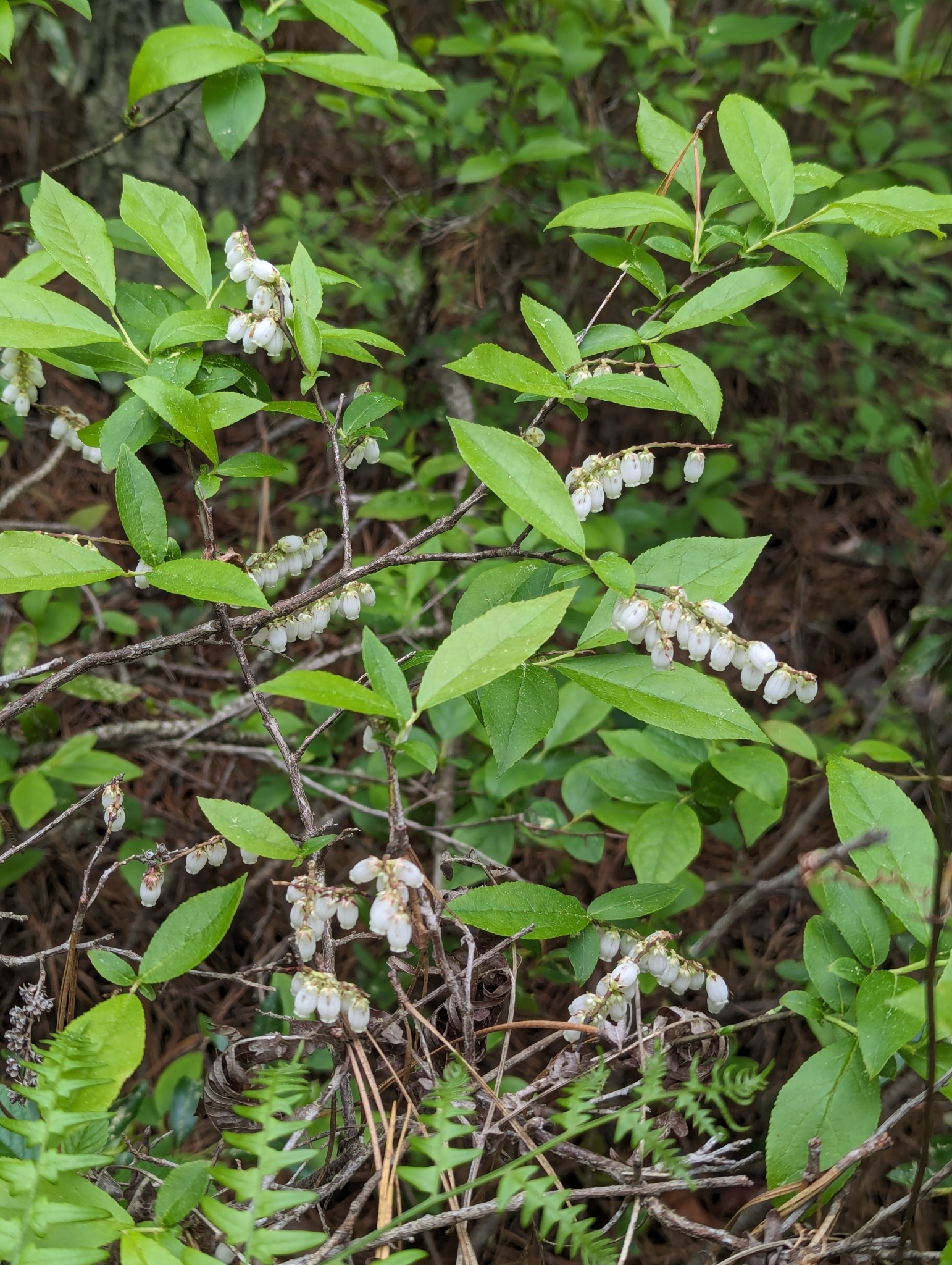
Swamp doghobble is a small to large, widely branched, deciduous shrub [7,10]. It is prostrate to erect in form, reaching heights between 3 to 12 feet (1.0 - 3.5 m). The leaves are short, thin, and smooth with the smaller leaves occurring on the twig among the larger leaves. The short, tubular flowers are borne in clusters at the end of the stems. The fruit is a five-part capsule that persists over the winter [14,20].
Raunkiaer Life Form (Raunkiaer 1934)
- Phanerophyte
Seasonal Development
Swamp doghobble begins extensive growth in early March and peaks in growth in early summer [17]. It flowers between April and June [20].
Regeneration Processes
Swamp doghobble reproduces vegetatively by sprouting from adventitious buds on the roots following disturbance [21]. It also regenerates sexually, although the details have not been described.
Successional Status
Swamp doghobble is an early- to mid-seral species that is intolerant to shade and grows best in full sunlight [3,15]. In a southern white cedar forest in southeastern North Carolina, swamp doghobble was present in the initial stages after disturbance, gradually reduced in the middle-age forest, and disappeared in the mature forest [3].
Immediate Fire Effects
Fire typically top-kills aboveground portions of swamp doghobble [4].
Postfire Regeneration Strategy (Stickney 1989)
- Survivor species; on-site surviving root crown or caudex
- Off-site colonizer; seed carried by animals or water; postfire years 1 and 2
Fire Adaptations
Fire does not usually invade the wetlands and lower slopes of the floodplain because the soil and duff layers are usually very damp [11,21]. Shallow burns favor swamp doghobble because of its ability to sprout quickly after aboveground portions of the plant are killed [1,4].
Plant Response to Fire
Swamp doghobble will sprout from adventitious buds on the root following fire [4].
Fire Regimes
For fire regime information, search FEIS for this species by entering the species name on the Advanced Search page and selecting “Fire Regime” as the publication type.
Fire Management Considerations
No entry.
Federal Status
No special status.
Other Status
No entry.
Importance to Wildlife and Livestock
Swamp doghobble is listed as a medium choice browse to white-tailed deer in the Longleaf Pine Belt of Alabama [9]. The leaves of swamp doghobble are poisonous to livestock [19,20].
Palatability and Nutritional Value
No entry.
Cover Value
No entry.
Value for Rehabilitation or Restoration of Disturbed Sites
No entry.
Other Uses
No entry.
Other Management Considerations
No entry.
Table A1— Forest and range ecosystems, Bureau of Land Management (BLM) physiographic regions, Kuchler plant associations, Society for American Foresters (SAF) forest cover types, and Society for Rangeland Management (SRM) rangeland cover types in which this species occurs.
Forest and Range Ecosystems (Garrison et al. 1977)
- FRES12 Longleaf - slash pine
- FRES13 Loblolly - shortleaf pine
- FRES14 Oak - pine
- FRES15 Oak – hickory
- FRES16 Oak - gum - cypress
BLM Physiographic Regions (Bernard and Brown 1977)
- No entry
Kuchler Plant Associations (Kuchler 1964)
- K090 Live oak - sea oats
- K091 Cypress savanna
- K100 Oak – hickory
- K111 Oak - hickory - pine forest
- K112 Southern mixed forest
- K113 Southern floodplain forest
- K114 Pocosin
SAF Cover Types (Eyre 1980)
- 63 Cottonwood
- 70 Longleaf pine
- 75 Shortleaf pine
- 76 Shortleaf pine – oak
- 79 Virginia pine
- 80 Loblolly pine - shortleaf pine
- 81 Loblolly pine
- 82 Loblolly pine – hardwood
- 83 Longleaf pine - slash pine
- 84 Slash pine
- 87 Sweetgum - yellow-poplar
- 88 Live oak
- 89 Willow oak - water oak - diamondleaf oak
- 93 Sugarberry - American elm - green ash
- 96 Overcup oak - water hickory
- 97 Atlantic white cedar
- 98 Pond pine
- 100 Pondcypress
- 101 Baldcypress
- 102 Baldcypress – tupelo
- 103 Water tupelo - swamp tupelo
- 104 Sweetbay - swamp tupelo - redbay
SRM Rangeland Cover Types (Shiflet 1994)
- No entry
1. Ash, A. N.; McDonald, C. B.; Kane, E. S.; Pories, C. A. 1983. Natural and modified pocosins: literature synthesis and management options. FWS/OBS-83/04. Washington, DC: U.S. Fish and Wildlife Service, Division of Biological Sciences. 156 p. [16178]
2. Barbour, Michael G.; Billings, William Dwight, eds. 1988. North American terrestrial vegetation. Cambridge; New York: Cambridge University Press. 434 p. [13876]
3. Buell, Murray F.; Cain, Robert L. 1943. The successional role of southern white cedar, Chamaecyparis thyoides, in southeastern North Carolina. Ecology. 24(1): 85-93. [14091]
4. Cypert, Eugene. 1961. The effects of fires in the Okefenokee Swamp in 1954 and 1955. American Midland Naturalist. 66(2): 485-503. [11018]
5. Duever, Michael J.; Riopelle, Lawrence A. 1983. Successional sequences and rates on tree islands in the Okefenokee Swamp. American Midland Naturalist. 110(1): 186-191. [14590]
6. Eyre, F. H., ed. 1980. Forest cover types of the United States and Canada. Washington, DC: Society of American Foresters. 148 p. [905]
7. Fernald, Merritt Lyndon. 1950. Gray's manual of botany. [Corrections supplied by R. C. Rollins]. Portland, OR: Dioscorides Press. 1632 p. (Dudley, Theodore R., gen. ed.; Biosystematics, Floristic & Phylogeny Series; vol. 2). [14935]
8. Garrison, George A.; Bjugstad, Ardell J.; Duncan, Don A.; [and others]. 1977. Vegetation and environmental features of forest and range ecosystems. Agric. Handb. 475. Washington, DC: U.S. Department of Agriculture, Forest Service. 68 p. [998]
9. Goodrum, Phil D.; Reid, Vincent H. 1958. Deer browsing in the longleaf pine belt. In: Proceedings, 58th annual meeting of the Society of American Foresters; 1958 September 28-October 2; Salt Lake City, UT. Washington, DC: Society of American Foresters: 139-143. [17023]
10. Godfrey, Robert K. 1988. Trees, shrubs, and woody vines of northern Florida and adjacent Georgia and Alabama. Athens, GA: The University of Georgia Press. 734 p. [10239]
11. Gresham, Charles A. 1989. A literature review of effects of developing pocosins. In: Hook, Donal D.; Lea, Russ, eds. Proceedings of the symposium: The forested wetlands of the Southern United States; 1988 July 12-14; Orlando, FL. Gen. Tech. Rep. SE-50. Asheville, NC: U.S. Department of Agriculture, Forest Service, Southeastern Forest Experiment Station: 44-50. [9228]
12. Kuchler, A. W. 1964. Manual to accompany the map of potential vegetation of the conterminous United States. Special Publication No. 36. New York: American Geographical Society. 77 p. [1384]
13. Lyon, L. Jack; Stickney, Peter F. 1976. Early vegetal succession following large northern Rocky Mountain wildfires. In: Proceedings, Tall Timbers fire ecology conference and Intermountain Fire Research Council fire and land management symposium; 1974 October 8-10; Missoula, MT. No. 14. Tallahassee, FL: Tall Timbers Research Station: 355-373. [1496]
14. Magee, Dennis W. 1981. Freshwater wetlands: A guide to common indicator plants of the Northeast. Amherst, MA: University of Massachusetts Press. 245 p. [14824]
15. Ogden, J. Gordon, III. 1962. Forest history of Martha's Vineyard, Massachusetts. I. Modern and pre-colonial forests. American Midland Naturalist. 66(2): 417-430. [10118]
16. Raunkiaer, C. 1934. The life forms of plants and statistical plant geography. Oxford: Clarendon Press. 632 p. [2843]
17. Schlesinger, William H. 1978. On the relative dominance of shrubs in Okefenokee Swamp. American Naturalist. 112(987): 949-954. [15360]
18. U.S. Department of Agriculture, Natural Resources Conservation Service. 2018. PLANTS Database, [Online]. U.S. Department of Agriculture, Natural Resources Conservation Service (Producer). Available: https://plants.usda.gov/ [34262]
19. Van Dersal, William R. 1938. Native woody plants of the United States, their erosion-control and wildlife values. Washington, DC: U.S. Department of Agriculture. 362 p. [4240]
20. Vines, Robert A. 1960. Trees, shrubs, and woody vines of the Southwest. Austin, TX: University of Texas Press. 1104 p. [7707]
21. Wells, B. W.; Whitford, L. A. 1976. History of stream-head swamp forests, pocosins, and savannahs in the Southeast. Journal of the Elisha Mitchell Science Society. 92: 148-150. [15038]
22. Flora of North America Editorial Committee, eds. 2014. Flora of North America north of Mexico, [Online]. Flora of North America Association (Producer). Available: http://www.efloras.org/flora_page.aspx?flora_id=1. [36990]