


Eucalyptus globulus, Tasmanian bluegum
Esser, Lora L. 1993. Eucalyptus globulus, Tasmanian bluegum. In: Fire Effects Information System, [Online]. U.S. Department of Agriculture, Forest Service, Rocky Mountain Research Station, Fire Sciences Laboratory (Producer). Available: https://research.fs.usda.gov/feis/species-reviews/eucglo
| Abbreviation | Common Name | Scientific Name | Classification | Status |
|---|---|---|---|---|
| Plants | ||||
| EUCGLO | Tasmanian bluegum | Eucalyptus globulus | Life Form: Plants/Tree Kingdom: Plantae Class: Dicot Order: Myrtales Family: Myrtaceae Genus: Eucalyptus | Fed. Protected: No Nativity: Nonnative Invasiveness: Invasive |


Taxonomy
The scientific name of Tasmanian bluegum is Eucalyptus globulus Labill. (Myrtaceae) [32]. Infrataxa include [7,22,47,49]:
- Eucalyptus globulus subsp. bicostata Maiden, eurabbie
- Eucalyptus globulus subsp. globulus, Tasmanian bluegum
- Eucalyptus globulus subsp. maidenii (F. Muell) J.B. Kirkpat., Tasmanian bluegum
Natural or controlled hybrids of Tasmanian bluegum are known with E. blakelyi, E. botryoides, E. cinera, E. cypellocarpa, E. ovata, E. rudis, E. tereticornis, E. urnigera, and E. viminalis [7].
Synonyms
- Eucalyptus maidenii F. Muell.
Other Common Names
bluegum, bluegum eucalyptus
General Distribution

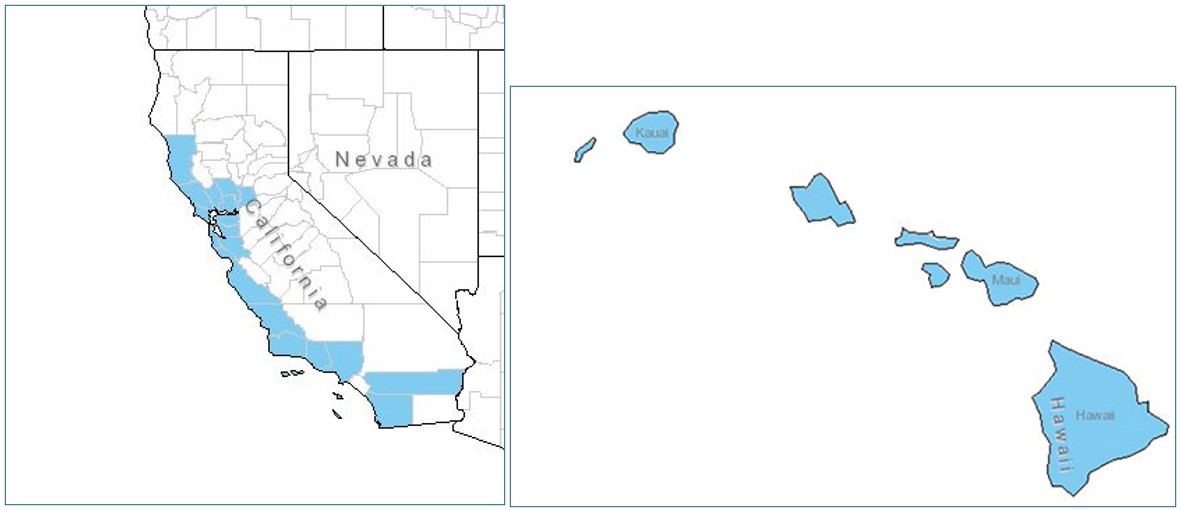
Distribution of Tasmanian bluegum in California (left) and Hawai’i (right).
Tasmanian bluegum is native to Tasmania and southeastern Australia. It was introduced into California in 1856 and into Hawai’i in about 1865. It has naturalized in both states [3,7]. It is a fairly common ornamental in Arizona but has not naturalized there [7]. The planted range in California extends from Humboldt County south to San Diego County, with best growth in the coastal fog belt near San Francisco. There are numerous plantings in the Central Valley from Redding south to Bakersfield and San Bernardino. Hawai’i has about 12,000 acres (5,000 ha) of planted and naturalized Tasmanian bluegum, almost all of them on the islands of Hawai’i and Maui [7].
States and Provinces
- United States: AZ CA HI
Site Characteristics
Tasmanian bluegum grows best in Mediterranean climates, characterized by cool, wet winters and dry, warm summers [37]. In coastal California, it does well with only 21 inches (530 mm) of annual rainfall accompanied by a pronounced dry season, primarily because frequent fogs compensate for lack of rain [7].
Tasmanian bluegum grows well on a wide range of soils, but requires good drainage, low salinity, and a soil depth of 2 feet (0.6 m) or more. In California, it grows best on deep alluvial soils because of the greater moisture supply [7]. Hawaiian soils supporting Tasmanian bluegum are about 3 feet (0.9 m) deep. They are usually acidic, moderately well-drained, silty clay loams [40,42].
In California, Tasmanian bluegum occurs at elevations below 1,000 feet (300 m) [32]. It occurs at 1,400 to 6,000 feet (425-1,800 m) in Hawai’i [40,42].
Plant Communities

A stand of Tasmanian bluegum, San Luis Obispo County, California. (CC0 1.0)
Most dense Tasmanian bluegum stands in California and Hawai’i are almost devoid of understory vegetation, except for a few hardy grasses. In Hawai’i, firetree (Myrica faga) sometimes invades bluegum stands, and the noxious passion fruit vine (Passiflora mollissima) has been found in young Tasmanian bluegum coppice stands [7].
In its native habitat Tasmanian bluegum grows in pure stands and in mixtures with many other eucalypt species. In California, it has been planted with forest redgum eucalyptus (Eucalyptus tereticornis) and river redgum eucalyptus (E. camaldulensis). In Hawai’i, it has been planted with many other eucalypts [7].
Botanical Description

Tasmanian bluegum flowers, San Luis Obispo County, California. (CC0 1.0)
Tasmanian bluegum is an introduced, deciduous tree that generally grows from 98 to 180 feet (30-55 m) tall [3,10]. Some bluegums have attained heights of 260 feet (80 m) in California [32]. Most height growth of Tasmanian bluegum occurs within the first 5 to 10 years; 60 to 70 percent of total height growth is achieved by about age 10. Tasmanian bluegum typically grows in dense monocultures [42].
The sclerophyllous leaves are 4 to 11 inches (10-30 cm) long [10]. The flower clusters develop within an envelope formed by two bracteoles which split and are shed, exposing the flower buds [24]. The fruit is a woody capsule 0.25 to 1 inch (6-25 mm) in diameter [24]. The bark is shreddy, peeling in large strips [7].
Tasmanian bluegum generally does not form a taproot. It produces roots throughout the soil profile, rooting several feet deep in some soils [7].
Raunkiaer Life Form (Raunkiaer 1934)
- Phanerophyte
Seasonal Development
In California, flowering occurs from November to April. Fruit ripens from October to March, about 11 months after flowering. In Hawai’i, some trees flower throughout the year, but flowering is heaviest in February and March. Fruit ripens throughout the year [7].
Regeneration Processes
Seed production and dissemination: Flowers are pollinated by insects and hummingbirds [7]. Seed set begins at approximately 4 to 5 years of age. Good seed crops are produced in most locations at 3- to 5-year intervals [7]. The seeds of are relatively small and abundant [24]. Capsules open immediately on ripening, and the seed is dispersed by wind within 1 to 2 months [7,24]. Dispersal distance from one 131-foot (40 m) tree, with winds of 6 mph (10 km/h), was 66 feet (20 m) [7]. Newly released seeds germinate within a few weeks under suitable conditions. Germination is epigeal. Seed collections from individual trees in California had highly variable germination rates, ranging from 2 to 80 percent within a 30-day germination period [24]. Soil-stored seed under older stands often germinates prolifically following logging or other disturbance [7].
Vegetative reproduction: Tasmanian bluegum sprouts readily from the bole, from stumps of all sizes and ages, from the lignotuber, and from the roots [7,17]. The lignotuber can live for many years in the soil after stems die back [42]. Tasmanian bluegum also reproduces by layering [7].
Successional Status
In Hawai’i and California, Tasmanian bluegum regenerates within and near the edges of plantations. It does not spread far and rarely invades wildlands [2,7]. It has, however, invaded an oak woodland on Angel Island in the San Francisco Bay [6].
Tasmanian bluegum is shade intolerant; failure to regenerate within forests in the absence of fire is related to low light intensities [3]. Tasmanian bluegum is drought tolerant and somewhat frost hardy. Frost resistance increases with maturity [7].
Immediate Fire Effects
Crown fire's effect upon Tasmanian bluegum varies. Because the stringy outer bark is highly flammable and bark thickness is readily reduced by fire, past fire frequency largely determines the relative protection bark offers. Repeated fire damage to bark before bark thickness has been restored may result in top-kill, or at times, tree mortality. If bark is sufficiently thick, Tasmanian bluegum branches survive crown fire and send out epicormic sprouts [50]. No studies quantifying bark thickness with tree survival were found.
Postfire Regeneration Strategy (Stickney 1989)
- Tree with adventitious-bud root crown/soboliferous species root sucker
- Ground residual colonizer (on-site, initial community)
- Crown residual colonizer (on-site, initial community)
- Initial-offsite colonizer (off-site, initial community)
- Secondary colonizer - off-site seed
Fire Adaptations
Most eucalyptus communities in Australia have evolved in the presence of periodic fire [3]. Tasmanian bluegum is highly flammable, but is seldom killed by fire. The bark catches fire readily, and deciduous bark streamers and lichen epiphytes tend to carry fire into the canopy and to disseminate fire ahead of the main front [3,7,8,50]. Other features of Tasmanian bluegum that promote fire spread include heavy litter fall, flammable oils in the foliage, and open crowns bearing pendulous branches, which encourages maximum updraft [3,9]. Despite the presence of volatile oils that produce a hot fire, leaves of Tasmanian bluegum are classed as intermediate in their resistance to combustion, and juvenile leaves are highly resistant to flaming [11].
Adaptations to fire include seedbanking, sprouting, and heat-resistant seed capsules [3,7]. Seed capsules protect the seed for a critical short period as the fire reaches the crowns; this protection delays penetration of heat to the seeds. Seeds were protected for about 4 minutes from a lethal rise in temperature when capsules were subjected to a heat of 826 degrees Fahrenheit (440 deg C) [3]. Following all types of fire, an accelerated seed shed occurs, even where crowns are only subjected to heat scorch.
Plant Response to Fire
Tasmanian bluegum recovers well from fire [3]. Epicormic sprouting is common in trees only scorched by fire. It is also common in trees where crown fire occurred but bark was thick enough to protect dormant branch buds. Heat-damaged bark is shed, and sprouting proceeds rapidly [50]. Top-killed trees sprout from the lignotuber. Vigorous sprouting is supported by food reserves stored in the root system and lignotuber [3].
Tasmanian bluegum also establishes from seed after fire. Some seed is already stored in the seedbank. Release of crown-stored seed is triggered by shoot death, and crown-stored seeds are rapidly disseminated after fire [50]. In 1929, a catastrophic fire burned a Tasmanian bluegum stand in California. The forest regenerated to a fully stocked condition. In November 1946, a second fire burned much of the same area. Again, the forest regenerated. By 1983, it was a very dense uneven-aged stand [33].
Fire Regimes
For fire regime information, search FEIS for this species by entering the species name on the Advanced Search page and selecting “Fire Regime” as the publication type.
Fire Management Considerations
Fuel buildup occurs very rapidly in unmanaged Tasmanian bluegum stands in California [1,33]. Fuel reduction programs can reduce wildfire hazard, as can the establishment of fuelbreaks [1,31].
In December, 1972, the San Francisco Bay Area experienced a severe cold snap, resulting in extensive frost damage to Tasmanian bluegum trees [6,18]. Frost-killed leaves and twigs increased Tasmanian bluegum litter ten-fold. By early 1973, following a particularly hot, dry summer and autumn, the litter combined with standing dead and damaged bluegums constituted a major fire hazard [1,6,18]. Several fuel reduction methods were proposed: mechanical removal of trees, thinning of present stands, and prescribed fire. The first two alternatives are commonly applied now in freeze-killed or damaged stands. Broadcast fires have been used with success in undisturbed areas under reasonably moist (13-19% fuel moisture) weather conditions. Spring fires have reduced fuel loads up to 87 to 96 percent without damage to overstory trees. Prescribed burning has been widely applied to eucalyptus forests in Australia to reduce fuel loads and prevent wildfires [1].
Federal Status
None
Other Status
None
Importance to Wildlife and Livestock
No entry.
Palatability and Nutritional Value
Tasmanian bluegum foliage is unpalatable to cattle, sheep, and goats [7,37].
Cover Value
No entry.
Value for Rehabilitation or Restoration of Disturbed Sites
Tasmanian bluegum is used for windbreaks, shelterbelts, and sight and sound barriers along highways [7,24,30]. After it becomes established, however, it may suppress or eliminate other species [7].
Other Uses
Tasmanian bluegum is widely planted as an ornamental throughout California [17]. It is also a source of nectar for honey production [7,43].
Tasmanian bluegum oil has numerous medical applications. In pharmaceutical preparations it has diaphoretic, expectorant, insecticidal, and oestrogenic properties. The oil has antifungal and antibacterial activity against Bacillus subtilis, Staphylococcus aureus, and Escherichia coli. Eucalyptus oil is generally nonirritating, nonsensitizing, and nonphototoxic to the skin. When taken internally, it may be toxic to the kidneys and can be a nervous system depressant [45].
The oil is used as a flavoring agent in cold and cough medicines. It is used in disinfectants, antiseptic liniments, ointments, toothpastes, and mouthwashes. It is used by veterinarians for treating influenza in horses, distemper in dogs, and septicaemia in all animals.
Tasmanian bluegum oil is used as a flavor ingredient in boiled sweets and food products such as beverages, dairy desserts, candy, baked goods, gelatins, puddings, and meat products [45]. The cosmetic industry uses it as a fragrance component in soaps, detergents, air fresheners, bath oils, and perfumes [45].
Tasmanian bluegum is an important source of fuelwood in many countries. It burns freely, leaves little ash, and produces good charcoal [7,33]. Plantations can be harvested for firewood every 7 years [17]. It is also widely used as pulpwood [42]. The wood is unsuitable for lumber because of excessive cracking, shrinkage, and collapse on drying [43], but is used for fenceposts, poles, and crates [33].
Other Management Considerations
Tasmanian bluegum is highly flammable and should not be planted near homes and other structures [27]. For information regarding the eradication of Tasmanian bluegum, see Fiedler [14], Groenendaal [17], and Rice [38].
The leaves of Tasmanian bluegum release a number of terpenes and phenolic acids. These chemicals may be responsible for the paucity of accompanying vegetation in plantations [4]. Natural fog drip from Tasmanian bluegum inhibits the growth of annual grass seedlings in bioassays, suggesting that such inhibition occurs naturally [10,34]. At least one leaf extract has been shown to strongly inhibit root growth of seedlings of other species [4]. The frass from the chrysomelid beetle, which feeds upon Tasmanian bluegum, is allelopathic to grasses at very low levels [34].
Tasmanian bluegum is used short-rotation fuel biomass plantations [26,30,35]. The coppice method of regeneration is most common because it allows, at least for a limited number of years, repeated harvesting at short intervals and exploitation of exceptionally high early growth rates [35].
In Hawai’i, four 64-year-old coppice stands were studied 2 to 5 years after logging. Seventy to eighty percent of the stumps had sprouted. All stands also had seedlings. The seedlings made up more than 20 percent of the total number of stems, but contributed very little to volume as they were usually suppressed by the sprouting stems [42].
Table A1— Forest and range ecosystems, Bureau of Land Management (BLM) physiographic regions, Kuchler plant associations, Society for American Foresters (SAF) forest cover types, and Society for Rangeland Management (SRM) rangeland cover types in which this species occurs.
Forest and Range Ecosystems (Garrison et al. 1977)
- FRES28 Western hardwoods
- FRES34 Chaparral - mountain shrub
- FRES42 Annual grasslands
BLM Physiographic Regions (Bernard and Brown 1977)
- 3 Southern Pacific Border
Kuchler Plant Associations (Kuchler 1964)
- K030 California oakwoods
- K033 Chaparral
- K048 California steppe
SAF Cover Types (Eyre 1980)
- 248 Knobcone pine
- 250 Blue oak - grey pine
- 255 California coast live oak
SRM Rangeland Cover Types (Shiflet 1994)
- 201 Blue oak woodland
- 202 Coast live oak woodland
- 203 Riparian woodland
- 214 Coastal prairie
- 215 Valley grassland
1. Agee, J. K.; Wakimoto, R. H.; Darley, E. F.; Biswell, H. H. 1973. Eucalyptus fuel dynamics, and fire hazard in the Oakland Hills. California Agriculture. 27(9): 13-15. [21913]
2. Aschmann, Homer. 1976. Man's impact on the southern California flora. In: Latting, June, ed. Symposium proceedings: plant communities of southern California; 1974 May 4; Fullerton, CA. Special Publication No. 2. Berkeley, CA: California Native Plant Society: 40-48. [4220]
3. Ashton, D. H. 1981. Fire in tall open-forests (wet sclerophyll forests). In: Gill, A. M.; Groves, R. H.; Noble, I. R., eds. Fire and the Australian biota. Canberra City, ACT: The Australian Academy of Science: 339-366. [21566]
4. Baker, Herbert G. 1966. Volatile growth inhibitors produced by Ecualyptus globulus. Madrono. 18: 207-210. [18652]
5. Bernard, Stephen R.; Brown, Kenneth F. 1977. Distribution of mammals, reptiles, and amphibians by BLM physiographic regions and A.W. Kuchler's associations for the eleven western states. Tech. Note 301. Denver, CO: U.S. Department of the Interior, Bureau of Land Management. 169 p. [434]
6. Bulman, Teresa L. 1988. The eucalyptus in California. Fremontia. 16(1): 9-12. [22087]
7. Skolmen, Roger G.; Ledig, F. Thomas. 1990. Eucalyptus globulus Labill. bluegum eucalyptus. In: Burns, Russell M.; Honkala, Barbara H., technical coordinators. Silvics of North America: Vol. 2, Hardwoods. Agriculture Handbook 654. Washington, DC: U.S. Department of Agriculture, Forest Service: 299-304. [22391]
8. Colwell, Robert N. 1973. ERTS-1 imagery and high flight photographs as aids to fire hazard appraisal at the NASA San Pablo Reservoir Test Site. In: Symposium on significant results obtained from the Earth Resources Technology Satellite 1: Proceedings; [Location unknown]. [Place of publication unknown]: [Publisher unknown]: 145-156. [22092]
9. Crosby, Bill. 1992. Our wildfire. Sunset. June: 62-72. [21662]
10. del Moral, Roger; Muller, Cornelius H. 1969. Fog drip: a mechanism of toxin transport from Eucalyptus globulus. Bulletin of the Torrey Botanical Club. 96(4): 467-475. [21909]
11. Dickinson, K. J. M.; Kirkpatrick, J. B. 1985. The flammability and energy content of some important plant species and fuel components in the forests of southeastern Tasmania. Journal of Biogeography. 12: 121-134. [20835]
12. Enari, Leonid. 1976. The blue gum. LASCA Leaves. Los Angles, CA: [Los Angles State City Arbor]; 26(1): 11-13. [22089]
13. Eyre, F. H., ed. 1980. Forest cover types of the United States and Canada. Washington, DC: Society of American Foresters. 148 p. [905]
14. Fiedler, Peggy Lee; Leidy, Robert A. 1987. Plant communities of Ring Mountain Preserve, Marin County, California. Madrono. 34(3): 173-192. [4068]
15. Garrison, George A.; Bjugstad, Ardell J.; Duncan, Don A.; [and others]. 1977. Vegetation and environmental features of forest and range ecosystems. Agric. Handb. 475. Washington, DC: U.S. Department of Agriculture, Forest Service. 68 p. [998]
16. Gomes, A. R. Sena; Kozlowski, T. T. 1980. Effects of flooding on Eucalyptus camaldulensis and Eucalyptus globulus seedlings. Oecologia. 46(2): 139-142. [21906]
17. Groenendaal, Gayle M. 1983. Part 1. History of eucalypts in California: Eucalyptus helped solve a timber problem: 1853-1880. In: Standiford, Richard B.; Ledig, F. Thomas, technical coordinators. Proceedings of a workshop on Eucalyptus in California; 1983 June 14-16; Sacramento, CA. Gen. Tech. Rep. PSW-69. Berkeley, CA: U.S. Department of Agriculture, Forest Service, Pacific Southwest Forest and Range Experiment Station: 1-8. [19565]
18. Hamilton, W. Douglas; McHenry, W. B. 1982. Eucalyptus stump sprout control. Journal of Arboriculture. 8(12): 327-328. [21911]
19. Hunt, Lee O. 1983. Adaptability of some Eucalyptus species in southwest Oregon. In: Standiford, Richard B.; Ledig, F. Thomas, technical coordinators. Proceedings of a workshop on Eucalyptus in California; 1983 June 14-16; Sacramento, CA. Gen. Tech. Rep. PSW-69. Berkeley, CA: U.S. Department of Agriculture, Forest Service, Pacific Southwest Forest and Range Experiment Station: 9-13. [19566]
20. James, Susanne. 1984. Lignotubers and burls--their structure, function and ecological significance in Mediterranean ecosystems. Botanical Review. 50(3): 225-266. [5590]
21. Kaul, O. N.; Srivastava, P. B. L.; Tandon, V. N. 1970. Nutrition studies on Eucalyptus. IV. Diagnosis of mineral deficiencies in Eucalyptus globulus seedlings. Indian Forests. 96(6): 453-456. [21908]
22. Kirkpatrick, J. 1975. Geographical variation in Eucalyptus globulus. Bulletin No. 47. Canberra, Australia: Australian Forestry and Timber Bureau. 64 p. [21912]
23. Kittredge, Joseph. 1955. Some characteristics of forest floors from a variety of forest types in California. Journal of Forestry. 53(9): 645-647. [8176]
24. Krugman, Stanley L. 1974. Eucalyptus L'Herit eucalyptus. In: Schopmeyer, C. S., ed. Seeds of woody plants in the United States. Agriculture Handbook No. 450. Washington, DC: U.S. Department of Agriculture, Forest Service: 384-392. [7663]
25. Kuchler, A. W. 1964. Manual to accompany the map of potential vegetation of the conterminous United States. Special Publication No. 36. New York: American Geographical Society. 77 p. [1384]
26. Ledig, F. Thomas. 1983. Eucalypt improvement for California: progress and plans. In: Standiford, Richard B.; Ledig, F. Thomas, technical coordinators. Proceedings of a workshop on Eucalyptus in California; 1983 June 14-16; Sacramento, CA. Gen. Tech. Rep. PSW-69. Berkeley, CA: U.S. Department of Agriculture, Forest Service, Pacific Southwest Forest and Range Experiment Station: 115-120. [19581]
27. Libby, William J.; Rodrigues, Kimberly A. 1992. Revegetating the 1991 Oakland-Berkeley Hills burn. Fremontia. 20(1): 12-18. [19086]
28. McColl, J. G. 1978. Ionic composition of forest soil solutions and effect of clearcutting. Soil Science Society of America Journal. 42: 358-363. [20739]
29. Molina, A.; Reigosa, M. J.; Carballeira, A. 1991. Release of allelochemical agents from litter, throughfall, and topsoil in plantations of Eucalyptus globulus, labill, in Spain. Journal of Chemical Ecology. 17(1): 147-160. [21898]
30. Moore, Paul W. 1983. Southern California trial plantings of Eucalyptus. In: Standiford, Richard B.; Ledig, F. Thomas, technical coordinators. Proceedings of a workshop on Eucalyptus in California; 1983 June 14-16; Sacramento, CA. Gen. Tech. Rep. PSW-69. Berkeley, CA: U.S. Department of Agriculture, Forest Service, Pacific Southwest Forest and Range Experiment Station: 14-17. [19567]
31. Mortenson, Bryan G. 1984. Urban fuelbreak management plan, an integrated pest management approach. In: "Weeds on planet Earth": Proceedings, 36th annual California weed conference; 1984 January 16-19; Sacramento, CA. [Place of publication unknown]. [Publisher unknown]. 86-92. [7871]
32. Munz, Philip A. 1973. A California flora and supplement. Berkeley, CA: University of California Press. 1905 p. [6155]
33. Osterling, Ralph S. 1983. Managing a coastal bluegum (Eucalyptus globulus) forest. In: Standiford, Richard B.; Ledig, F. Thomas, technical coordinators. Proceedings of a workshop on Eucalyptus in California; 1983 June 14-16; Sacramento, CA. Gen. Tech. Rep. PSW-69. Berkeley, CA: U.S. Department of Agriculture, Forest Service, Pacific Southwest Forest and Range Experiment Station: 93-94. [19576]
34. Payne, Lori. 1992. Forest allelopathy: a review of the literature. Women in Natural Resources. 13(3): 12-23. [20362]
35. Pereira, J. S.; Almeida, I.; Esquivel, M. G.; [and others]. 1985. Annual variation in sprouting capacity of stumps of coppiced Eucalyptus globulus. In: Bioenergy `84: Proceedings of an international conference on bioenergy; 1984 June 15-21; [Location unknown]. [Publisher unknown]. 2: 127-131. On file at: U.S. Department of Agriculture, Forest Service, Intermountain Research Station, Fire Sciences Lab, Missoula, MT. [22091]
36. Raunkiaer, C. 1934. The life forms of plants and statistical plant geography. Oxford: Clarendon Press. 632 p. [2843]
37. Rice, Carol L.; Aronson, C. Richard. 1985. The fire management program in the East Bay Regional Park District. In: Long, James N., ed. Fire management: the challenge of protection and use: Proceedings of a symposium; 1985 April 17-19; Logan, UT. [Place of publication unknown]. [Publisher unknown]. 173-180. [21156]
38. Rice, Carol. 1990. Restoration plays an integral role in fire hazard reduction plan for the Berkeley Hills Area. Restoration & Management Notes. 8(2): 125-126. [13792]
39. Rinehart, James A.; Standiford, Richard B. 1983. Growth and yield in Eucalyptus globulus. In: Standiford, Richard B.; Ledig, F. Thomas, technical coordinators. Proceedings of a workshop on Eucalyptus in California; 1983 June 14-16; Sacramento, CA. Gen. Tech. Rep. PSW-69. Berkeley, CA: U.S. Department of Agriculture, Forest Service, Pacific Southwest Forest and Range Experiment Station: 61-68. [19572]
40. Schubert, Thomas H.; Whitesell, Craig D. 1985. Species trials for biomass plantations in Hawaii: a first appraisal. Res. Pap. PSW-176. Berkeley, CA: U.S. Department of Agriculture, Forest Service, Pacific Southwest Forest and Range Experiment Station. 13 p. [19147]
41. Shakesby, Richard A.; Coelho, Celeste de O. A.; Ferreira, Antonio D.; [and others]. [n.d.]. Wildfire impacts on soil erosion and hydrology in wet Mediterranean forest, Portugal. International Journal of Wildland Fire. 3(2): 95-110. [21359]
42. Skolmen, Roger G. 1983. Growth and yield of some eucalypts of interest to California. In: Standiford, Richard B.; Ledig, F. Thomas, technical coordinators. Proceedings of a workshop on Eucalyptus in California; 1983 June 14-16; Sacramento, CA. Gen. Tech. Rep. PSW-69. Berkeley, CA: U.S. Department of Agriculture, Forest Service, Pacific Southwest Forest and Range Experiment Station: 49-57. [19570]
43. Standiford, Richard B.; Ledig, F. Thomas, technical coordinators. 1983. Proceedings of a workshop on Eucalyptus in California; 1983 June 14-16; Sacramento, CA. Gen. Tech. Rep. PSW-69. Berkeley, CA: U.S. Department of Agriculture, Forest Service, Pacific Southwest Forest and Range Experiment Station. 128 p. [19583]
44. Stickney, Peter F. 1989. Seral origin of species originating in northern Rocky Mountain forests. Unpublished draft on file at: U.S. Department of Agriculture, Forest Service, Intermountain Research Station, Fire Sciences Laboratory, Missoula, MT; RWU 4403 files. 7 p. [20090]
45. Tewari, Rakesh; Akhila, Anand. 1985. Essential oil from Eucalyptus globulus Labill.: a review. CROMAP. 7(2): 94-102. [22090]
46. USDA Natural Resources Conservation Service. 2018. PLANTS Database, [Online]. U.S. Department of Agriculture, Natural Resources Conservation Service (Producer). Available: https://plants.usda.gov/. [34262]
47. Wang, D.; Bachelard, E. P.; Banks, J. C. G. 1988. Growth and water relations of seedlings of two subspecies of Eucalyptus globulus. Tree Physiology. 4(2): 129-138. [21903]
48. Williams, Robert D.; Hanks, Sidney H. 1976. Hardwood nurseryman's guide. Agric. Handb. 473. Washington, DC: U.S. Department of Agriculture, Forest Service. 78 p. [4182]
49. Young, Gary L. 1983. Soil Conservation Service tests of Eucalyptus species for windbreaks. In: Standiford, Richard B.; Ledig, F. Thomas, technical coordinators. Proceedings of a workshop on Eucalyptus in California; 1983 June 14-16; Sacramento, CA. Gen. Tech. Rep. PSW-69. Berkeley, CA: U.S. Department of Agriculture, Forest Service, Pacific Southwest Forest and Range Experiment Station: 18-21. [19568]
50. Gill, A. Malcolm. 1977. Plant traits adaptive to fires in Mediterranean land ecosystems. In: Mooney, Harold A.; Conrad, C. Eugene, technical coordinators. Proceedings of the symposium on the environmental consequences of fire and fuel management in Mediterranean ecosystems; 1977 August 1-5; Palo Alto, CA. Gen. Tech. Rep. WO-3. Washington, DC: U.S. Department of Agriculture, Forest Service: 17-26. [4798]