


Festuca californica, California fescue
Walsh, Roberta A. 1994. Festuca californica, California fescue. In: Fire Effects Information System, [Online]. U.S. Department of Agriculture, Forest Service, Rocky Mountain Research Station, Fire Sciences Laboratory (Producer). Available: https://research.fs.usda.gov/feis/species-reviews/fescal
| Abbreviation | Common Name | Scientific Name | Classification | Status |
|---|---|---|---|---|
| Plants | ||||
| FESCAL | California fescue | Festuca californica | Life Form: Plants/Graminoid Kingdom: Plantae Class: Monocot Order: Cyperales Family: Poaceae Genus: Festuca | Fed. Protected: No Nativity: Native Invasiveness: Noninvasive |

Taxonomy
The currently accepted scientific name of California fescue is Festuca californica Vasey [5,6,7,9]. It is in the family Poaceae. Recognized varieties are as follows [5,6,10]:
- F. c. var. californica
- F. c. var. parishii (Piper) Hitchc.
Synonyms
- No entry
Other Common Names
None
General Distribution
California fescue occurs in the Coast Ranges from southwestern Oregon to San Luis Obispo County, California [9]. It occurs in the Cascade Range from Clackamas County, Oregon, south into California to the north and central Sierra Nevada [5,6,7]. Festuca californica var. parishii occurs as a disjunct population in the San Bernardino Mountains, California [5,10].
States and Provinces
- United States: CA OR
Site Characteristics
California fescue occurs on open dry ground, chaparral [5,9], thickets, open forests [5,6], wood borders, shaded places [9], and moist streambanks [7]. It occurs at elevations below 6,500 feet (1,981 m) [5,9,10].

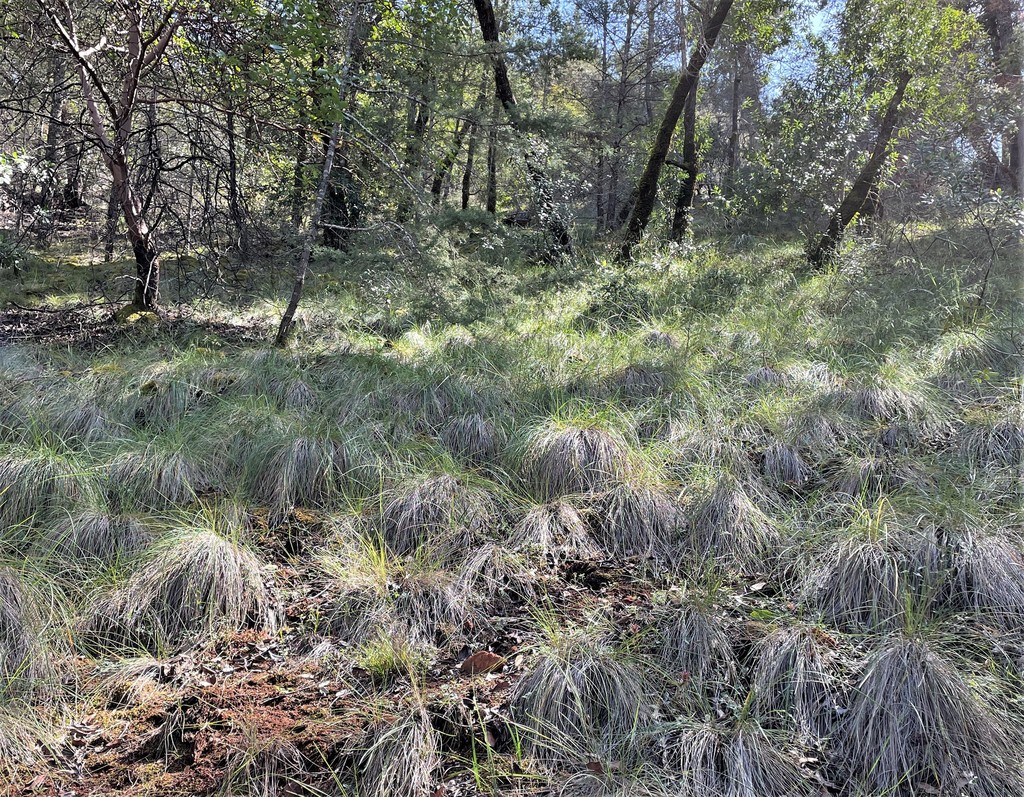
California fescue growing in Sonoma County, California.
Festuca californica var. parishii occurs on dry benches at elevations of 2,500 to 6,500 feet (762-1,981 m) [10].
Plant Communities
See the Appendix for a list of cover types and plant associations in which this species may occur.
California fescue is associated with tanoak (Lithocarpus densiflorus) in the Coast Ranges of California and southwestern Oregon. Other species associated with California fescue in these areas include chinquapin (Chrysolepsis chrysophylla), canyon live oak (Quercus chrysolepsis), California black oak (Q. kelloggii), California bay (Umbellularia californica), blueblossom (Ceanothus thyrsiflorus), California hazel (Corylus cornuta var. californica), salal (Gaultheria shallon), Pacific bayberry (Myrica californica), Pacific rhododendron (Rhododendron macrophyllum), flowering currant (Ribes sanguineum), thimbleberry (Rubus parviflorus), evergreen huckleberry (Vaccinium ovatum), prince's-pine (Chimaphila umbellata var. occidentalis), dwarf Oregon-grape (Berberis nervosa), bull thistle (Cirsium vulgare), western whipplea (Whipplea modesta), California brome (Bromus carinatus), and California sweetgrass (Hierochloe occidentalis) [13].
Botanical Description
California fescue is a native, perennial bunchgrass [5,9]. Culms are 16 to 47 inches (40-120 cm) long [6,9,10]. Leaf blades are firm, scabrous, and 4 to 39 inches (10-100 cm) long [5]. The inflorescence is an open sparsely branched panicle 4 to 12 inches (10-30 cm) long; the branches usually occur in pairs [5,6]. Spikelets are four to six flowered [5,9]. The lemma is acuminate or short awned [6,7]. The fruit is a caryopsis. California fescue does not produce rhizomes [5].

California fescue spikelets.
Raunkiaer Life Form (Raunkiaer 1934)
- Hemicryptophyte
Seasonal Development
California fescue blooms from April to July [9].
Festuca californica var. parishii blooms from May to July [10].
Regeneration Processes
California fescue sprouts from perennating buds at the base of the culms. It also reproduces by seed [5].
Successional Status
Facultative Seral Species
California fescue grows in both open and shaded areas [5,6,7,9].
Immediate Fire Effects
California fescue culms and leaves are probably killed by fire during the growing season.
Postfire Regeneration Strategy (Stickney 1989)
- Tussock graminoid
- Secondary colonizer - off-site seed
Fire Adaptations
California fescue has basal culm buds which may sprout after aerial portions are burned. California fescue has densely clumped stems with conspicuous dead leaf sheaths at the plant base [5]. If thick tufts form, they may protect the basal buds from fire damage.
Plant Response to Fire
No entry.
Fire Regimes
For fire regime information, search FEIS for this species by entering the species name or acronym on the home page and selecting “Fire Regime” as the publication type.
Fire Management Considerations
No entry.
Federal Status
None
Other Status
No entry.
Importance to Wildlife and Livestock
No entry.
Value for Rehabilitation or Restoration of Disturbed Sites
California fescue is recommended for stabilizing or restoring disturbed or degraded areas, for erosion control, and for wildlife food and cover [5].
The Soil Conservation Service is investigating California fescue for grassland habitat restoration in California [1].
Other Uses
No entry.
Other Management Considerations
California fescue cultivars are available in the horticultural trade [5].
Table A1— Forest and range ecosystems, Bureau of Land Management (BLM) physiographic regions, Kuchler plant associations, Society for American Foresters (SAF) forest cover types, and Society for Rangeland Management (SRM) rangeland cover types in which this species occurs.
Forest and Range Ecosystems (Garrison et al. 1977)
- FRES20 Douglas-fir
- FRES21 Ponderosa pine
- FRES23 Fir - spruce
- FRES27 Redwood
- FRES28 Western hardwoods
- FRES34 Chaparral - mountain shrub
- FRES36 Mountain grasslands
BLM Physiographic Regions (Bernard and Brown 1977)
- 1 Northern Pacific Border
- 2 Cascade Mountains
- 3 Southern Pacific Border
- 4 Sierra Mountains
Kuchler Plant Associations (Kuchler 1964)
- K005 Mixed conifer forest
- K006 Redwood forest
- K012 Douglas-fir forest
- K029 California mixed evergreen forest
- K030 California oakwoods
- K033 Chaparral
- K034 Montane chaparral
- K047 Fescue - oatgrass
SAF Cover Types (Eyre 1980)
- 229 Pacific Douglas-fir
- 232 Redwood
- 234 Douglas-fir - tanoak - Pacific madrone
- 243 Sierra Nevada mixed conifer
- 244 Pacific ponderosa pine - Douglas-fir
- 245 Pacific ponderosa pine
- 255 California coast live oak
SRM Rangeland Cover Types (Shiflet 1994)
- No entry
1. Amme, David; Pitschel, Barbara M. 1990. Restoration and management of California's grassland habitats. In: Hughes, H. Glenn; Bonnicksen, Thomas M., eds. Restoration `89: the new management challenge: Proceedings, 1st annual meeting of the Society for Ecological Restoration; 1989 January 16-20; Oakland, CA. Madison, WI: The University of Wisconsin Arboretum, Society for Ecological Restoration: 532-542. [14721]
2. Bernard, Stephen R.; Brown, Kenneth F. 1977. Distribution of mammals, reptiles, and amphibians by BLM physiographic regions and A.W. Kuchler's associations for the eleven western states. Tech. Note 301. Denver, CO: U.S. Department of the Interior, Bureau of Land Management. 169 p. [434]
3. Eyre, F. H., ed. 1980. Forest cover types of the United States and Canada. Washington, DC: Society of American Foresters. 148 p. [905]
4. Garrison, George A.; Bjugstad, Ardell J.; Duncan, Don A.; [and others]. 1977. Vegetation and environmental features of forest and range ecosystems. Agric. Handb. 475. Washington, DC: U.S. Department of Agriculture, Forest Service. 68 p. [998]
5. Hickman, James C., ed. 1993. The Jepson manual: Higher plants of California. Berkeley, CA: University of California Press. 1400 p. [21992]
6. Hitchcock, A. S. 1951. Manual of the grasses of the United States. Misc. Publ. No. 200. Washington, DC: U.S. Department of Agriculture, Agricultural Research Administration. 1051 p. [2nd edition revised by Agnes Chase in two volumes. New York: Dover Publications, Inc.]. [1165]
7. Hitchcock, C. Leo; Cronquist, Arthur. 1973. Flora of the Pacific Northwest. Seattle, WA: University of Washington Press. 730 p. [1168]
8. Kuchler, A. W. 1964. Manual to accompany the map of potential vegetation of the conterminous United States. Special Publication No. 36. New York: American Geographical Society. 77 p. [1384]
9. Munz, Philip A. 1973. A California flora and supplement. Berkeley, CA: University of California Press. 1905 p. [6155]
10. Munz, Philip A. 1974. A flora of southern California. Berkeley, CA: University of California Press. 1086 p. [4924]
11. Raunkiaer, C. 1934. The life forms of plants and statistical plant geography. Oxford: Clarendon Press. 632 p. [2843]
12. Stickney, Peter F. 1989. Seral origin of species originating in northern Rocky Mountain forests. Unpublished draft on file at: U.S. Department of Agriculture, Forest Service, Intermountain Research Station, Fire Sciences Laboratory, Missoula, MT; RWU 4403 files. 7 p. [20090]
13. Tappeiner, John C., II; McDonald, Philip M.; Roy, Douglass F. 1990. Lithocarpus densiflorus (Hook. & Arn.) Rehd. tanoak. In: Burns, Russell M.; Honkala, Barbara H., technical coordinators. Silvics of North America. Volume 2. Hardwoods. Agric. Handb. 654. Washington, DC: U.S. Department of Agriculture, Forest Service: 417-425. [13969]
14. U.S. Department of Agriculture, Soil Conservation Service. 1982. National list of scientific plant names. Vol. 1. List of plant names. SCS-TP-159. Washington, DC. 416 p. [11573]