


Gaultheria procumbens, eastern teaberry
Coladonato, Milo. 1994. Gaultheria procumbens, eastern teaberry. In: Fire Effects Information System, [Online]. U.S. Department of Agriculture, Forest Service, Rocky Mountain Research Station, Fire Sciences Laboratory (Producer). Available: https://research.fs.usda.gov/feis/species-reviews/gaupro
| Abbreviation | Common Name | Scientific Name | Classification | Status |
|---|---|---|---|---|
| Plants | ||||
| GAUPRO | eastern teaberry | Gaultheria procumbens | Life Form: Plants/Shrub Kingdom: Plantae Class: Dicot Order: Ericales Family: Ericaceae Genus: Gaultheria | Fed. Protected: No Nativity: Native Invasiveness: Noninvasive |

Taxonomy
The scientific name of eastern teaberry is Gaultheria procumbens L. (Ericaceae) [18]. There are no infrataxa.
Synonyms
No entry.
Other Common Names
teaberry, wintergreen
General Distribution
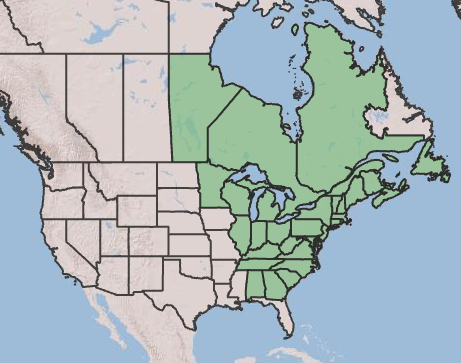
Eastern teaberry occurs from Newfoundland and New England south in the mountains to Georgia and west to Minnesota [13,32].

Distribution of eastern teaberry.
States and Provinces
- United States: AL CT DE GA IL IN KY ME MD MA MI MN NH NJ NY NC OH PA RI TN VT VA WV WI
- Canada: MB NB NF NS ON PE PQ
Site Characteristics
As long as the soil is acidic, eastern teaberry grows well on many substrates including peat, sand, sandy loam, and coal spoils. It has been found growing where soil pH ranged from 3.5 to 6.9 on the surface to 4.0 to 6.9 below the surface. However, a pH of 4.5 to 6.0 has been reported as optimum for growth, with 7.0 the maximum eastern teaberry tolerates. Eastern teaberry mainly occurs on moist sites but tolerates moisture conditions ranging from dry to poorly drained [2,32].
In jack pine communities in upper Michigan, eastern teaberry was present on xeric, transitional, and mesic sites with frequencies of 11, 62, and 86 percent, respectively [3]. In Nova Scotia, eastern teaberry is found on the tops of ridges and knolls in very shallow soil [58].
Plant Communities
Eastern teaberry is commonly found in the understory of pine (Pinus spp.) and hardwood forests of New England. In western Nova Scotia and the Great Lake States, it occurs in jack pine (P. banksiana) and spruce-larch (Picea spp.-Larix spp.) forests [4,20,53,59]. It is a common understory species in maple-oak (Acer spp.-Quercus spp.) forests of upper Michigan [52]. It is a dominant understory shrub of oak-poplar/fern (Quercus spp.-Populus spp./Pteridium spp.) communities of southern New York [60].
Eastern teaberry is named as a dominant or codominant understory species in the following classifications:
Habitat classification system field guide: northern Lake States Region (Upper Peninsula of Michigan and northeast Wisconsin) [8] Forest-type studies in the Adirondack Region [19] Field guide to forest habitat types of northern Wisconsin [21] Vegetation of the Great Smoky Mountains [42]
Understory species commonly associated with eastern teaberry include huckleberries (Gaylussacia spp.), blueberries (Vaccinium spp.), raspberries (Rubus spp.), grapes (Vitis spp.), mountain-laurel (Kalmia latifolia), Virginia creeper (Parthenocissus quinquefolia), witchhazel (Hamamelis virginiana), bog Labrador tea (Ledum groenlandicum), partridgeberry (Mitchella repens), and lily-of-the-valley (Maianthemum canadense), [7,24,35,42].
Botanical Description
Eastern teaberry is a spreading, evergreen, rhizomatous shrub which grows 4 to 8 inches (10-20 cm) tall [5,11,28]. Eastern teaberry creeps along the ground, forming a dense carpet of shiny leaves that are 2 to 6 inches (5-15 cm) long. The small flowers are less than 0.5 inches (1.2 cm) long and are borne at the base of the leaves [27]. The fruit is berrylike capsule with a large fleshy calyx [45]. The roots are 1 inch (2.5 cm) or less in depth [14,31].
Raunkiaer Life Form (Raunkiaer 1934)
- Hemicryptophyte
- Geophyte
Seasonal Development
Eastern teaberry flowers from the end of May to September depending on geographic location [10,37]. In Illinois, eastern teaberry flowers initiated during June open in mid-July, with the fruit maturing in September [45]. In New Jersey and Penn Sylvia, the flowering period is from mid-July through early August [55]. The leaves usually persist throughout the winter [27,32]. The fruit may remain attached till the following spring [45].
Regeneration Processes
Reproduction in eastern teaberry is both sexual and asexual. It typically reproduces vegetatively from rhizomes. Vegetative growth is initiated as additional branching on old stems, or as new stems on creeping rhizomes [55]. The long, infrequently branching rhizomes distribute ramets over large areas; it exploits gaps in litter for clonal propagation [23,50]. Bird-disseminated seeds are probably the source of new plants colonizing old fields [32,41].
In the oak-pine upland forest of the Pine Barrens of New Jersey, eastern teaberry occurrence was positively correlated (p<0.05) with the presence of litter and dead wood [50].
Successional Status
Eastern teaberry is shade tolerant. Fruiting, however, usually occurs in openings [23,32,50]. It is a common understory species in the Northeast [9]. In a Minnesota Norway pine (P. resinosa) forest, eastern teaberry had greatest abundance of cover under intermediate light intensities [56].
Eastern teaberry is found in the oldest vegetation in Grass River Bog, an undrained sand plain in the Adirondacks [43].
Eastern teaberry is part of the understory vegetation in climax pine forests of northern Minnesota [57].
In eastern hemlock (Tsuga canadensis) climax forest in northeastern Pennsylvania, eastern teaberry frequency ranged from 0 to 6 percent [47]. In the Algonquin Provincial Park, Ontario, eastern teaberry was present in early and climax stages of forest succession [49]. Frequency in the birch-poplar (Betula spp.-Populus spp.) stage was 58 percent; it was "abundant" in the pine stage. Frequency was 36 percent in the fir-spruce (Abies spp.-Picea spp.) stage. Eastern teaberry was not present in the sugar maple (Acer saccharum) stage, but frequency was 14 percent in eastern hemlock climax forest [49].
Immediate Fire Effects
Fire top-kills eastern teaberry [15]. Surviving rhizomes may sprout [16,30,33,54].
Postfire Regeneration Strategy (Stickney 1989)
- Rhizomatous low woody plant, rhizome in organic mantle
- Secondary colonizer - off-site seed
Fire Adaptations
Eastern teaberry is not well-adapted to fire that removes litter and/or the organic layer of soil. Rhizomes are restricted to the upper 0.8 to 1.2 inches (2-3 cm) of the organic layer, and eastern teaberry usually does not survive if the organic layer is removed by fire [15]. The rhizomes are especially vulnerable to severe fire [54]. If eastern teaberry survives, the fire was probably of short duration or light enough that the fire removed only aboveground vegetation and little litter [14].
Eastern teaberry rhizomes can tolerate brief exposure to high temperatures. In one study its rhizomes were collected in spring, summer, and fall and subjected to wet heat. Maximum shoot growth and number of stems occurred after spring-collected rhizomes were placed in a water bath at 131 degrees Fahrenheit (55 deg C) for 5 minutes. Rhizomes died when subjected to a 140 degrees Fahrenheit (60 deg C) bath for 5 minutes [14].
Plant Response to Fire
The response of eastern teaberry to fire and its role in fire related succession seems to be highly variable.
In southwestern Nova Scotia, eastern teaberry survived a July fire. The following summer density (stems/9 sq ft) and frequency (%) on covered and uncovered quadrats were as follows [26]:
| Exposure | Density (stems/9 sq ft) | Frequency (%) |
|---|---|---|
| Covered | 0.3 | 20 |
| Exposed | 0 | 0 |
In southeast Manitoba, five plots were burned in April. No prefire data were given. Results from the end of August showed the average frequency of eastern teaberry was 54 percent and the average cover was 3.8 percent. Different levels of shade (0-100 %) had little or no effect [46].
Percent frequency of eastern teaberry was monitored for 2 years after a fall (September) prescribed fire on a jack pine clearcut in northern Michigan. Little change occurred, at least in the first year. Results are given [1]:
| Year | Unburned Blocks (frequency, %) | Burned Blocks (frequency, %) |
|---|---|---|
| 1980 | 5.6 | 5.4 |
| 1981 | 4.6 | 0.8 |
Some research indicates that eastern teaberry is sensitive to fire. A spring controlled fire was conducted on bracken fern (Pteridium aquilinum)-grassland in Wisconsin. Sampling was done in July and August of the year of the fire. The average frequency of eastern teaberry decreased by 25.8 percent [38]. In the Pine Barrens of northern Wisconsin, eastern teaberry average frequency decreased from 28 to 14 percent 1 year after a spring fire [39]. In the New Jersey Pine Barrens, eastern teaberry became less important with increasing fire frequencies. Fire frequencies ranged from annual to 15-year intervals [44]. Eastern teaberry in this area exploit fire-generated gaps in litter through clonal propagation [50].
Other studies indicate that fire may favor eastern teaberry. In northwest Minnesota, a severe May fire burned only the uppermost centimeters of the forest floor. Eastern teaberry cover in unburned stands was 0 to 5 percent. After fire it was present in several associations and increased through the sixth year following fire to a maximum cover of 6.2 percent. Biomass increased after fire, more in dry than moist stands, but leveled off after the second year, perhaps because of the low-bush growth form of eastern teaberry [51]. In a survey of the burned-over forest lands in southwestern Nova Scotia, frequencies of eastern teaberry related to years since fire were as follows [48]:
| Postfire Year | Frequency (%) |
|---|---|
| 1 | 10.5 |
| 2 | 16.6 |
| 9 | 4.0 |
| 22 | 40 |
| 29 | 48.2 |
| 40 | 40 |
Discussion and Qualification of Plant Response:
The following Research Project Summaries provide information on prescribed fire use and postfire response of plant community species, including eastern teaberry, that was not available when this species review was originally written: Early postfire effects of a prescribed fire in the southern Appalachians Early postfire response of southern Appalachian Table Mountain-pitch pine stands to prescribed fires in North Carolina and Virginia.
Fire Regimes
For fire regime information, search FEIS for this species by entering the species name on the Advanced Search page and selecting “Fire Regime” as the publication type.
Fire Management Considerations
No entry.
Federal Status
None
Other Status
No entry.
Importance to Wildlife and Livestock
Eastern teaberry is not taken in large quantities by any species of wildlife, but the regularity of its use enhances its importance. Its fruit persists through the winter and it is one of the few sources of green leaves in winter [32]. White-tailed deer browse eastern teaberry throughout its range, and in some localities it is an important winter food. Other animals that eat eastern teaberry are wild turkey, sharp-tailed grouse, northern bobwhite, ring-necked pheasant, black bear, white-footed mouse, and red fox. Eastern teaberry is a favorite food of the eastern chipmunk, and the leaves are a minor winter food of the gray squirrel in Virginia [26,37].
Palatability and Nutritional Value
No entry.
Cover Value
copy text
Value for Rehabilitation or Restoration of Disturbed Sites
No entry.
Other Uses
The leaves of eastern teaberry are used to make oil of eastern teaberry [27]
Other Management Considerations
Eastern teaberry is ordinarily plentiful in the woodlands of the Northeast, and no special care is needed to perpetuate it. Seedlings or clones are established by plantings beneath taller shrubs or in other partially shaded sites. When plants have established, fruit production is stimulated by thinning timber stands and removing overtopping vegetation [32].
Eastern teaberry can be controlled by phenoxy herbicides [32].
Table A1— Forest and range ecosystems, Bureau of Land Management (BLM) physiographic regions, Kuchler plant associations, Society for American Foresters (SAF) forest cover types, and Society for Rangeland Management (SRM) rangeland cover types in which this species occurs.
Forest and Range Ecosystems (Garrison et al. 1977)
- FRES10 White - red - jack pine
- FRES11 Spruce – fir
- FRES13 Loblolly - shortleaf pine
- FRES14 Oak – pine
- FRES15 Oak – hickory
- FRES17 Elm - ash – cottonwood
- FRES18 Maple - beech – birch
- FRES19 Aspen - birch
BLM Physiographic Regions (Bernard and Brown 1977)
No entry.
Kuchler Plant Associations (Kuchler 1964)
- K082 Mosaic of K074 and K100
- K093 Great Lakes spruce - fir forest
- K095 Great Lakes pine forest
- K099 Maple - basswood forest
- K100 Oak - hickory forest
- K101 Elm - ash forest
- K102 Beech - maple forest
- K103 Mixed mesophytic forest
- K104 Appalachian oak forest
- K106 Northern hardwoods
- K107 Northern hardwoods - fir forest
- K108 Northern hardwoods - spruce forest
- K110 Northeastern oak - pine forest
- K111 Oak - hickory - pine forest
SAF Cover Types (Eyre 1980)
- 1 Jack pine
- 12 Black spruce
- 13 Black spruce – tamarack
- 14 Northern pin oak
- 15 Red pine
- 16 Aspen
- 17 Pin cherry
- 18 Paper birch
- 19 Gray birch - red maple
- 20 White pine - northern red oak - red maple
- 21 Eastern white pine
- 23 Eastern hemlock
- 24 Hemlock - yellow birch
- 25 Sugar maple - beech - yellow birch
- 26 Sugar maple – basswood
- 27 Sugar maple
- 28 Black cherry – maple
- 30 Red spruce - yellow birch
- 32 Red spruce
- 33 Red spruce - balsam fir
- 37 Northern white-cedar
- 38 Tamarack
- 39 Black ash - American elm - red maple
- 40 Post oak - blackjack oak
- 42 Bur oak
- 43 Bear oak
- 45 Pitch pine
- 46 Eastern redcedar
- 53 White oak
- 55 Northern red oak
- 57 Yellow-poplar
- 60 Beech - sugar maple
- 62 Silver maple - American elm
- 73 Southern redcedar
- 75 Shortleaf pine
- 79 Virginia pine
SRM Rangeland Cover Types (Shiflet 1994)
No entry.
1. Abrams, Marc D.; Dickmann, Donald I. 1984. Floristic composition before and after prescribed fire on a jack pine clear-cut site in northern lower Michigan. Canadian Journal of Forest Research. 14: 746-749. [7236]
2. Archambault, Louis; Barnes, Burton V.; Witter, John A. 1989. Ecological species groups of oak ecosystems of southeastern Michigan. Forest Science. 35(4): 1058-1074. [9768]
3. Beaufait, W. R.; Brown, R. T. 1962. Phytogeography of a representative outwash plain jack pine site. Papers of the Michigan Academy of Science, Arts & Letters. 47: 201-209. [7239]
4. Braun, E. Lucy. 1950. Deciduous forests of eastern North America. Philadelphia, PA: Blakiston Books. [pages unknown]. [19812]
5. Braun, E. Lucy. 1961. The woody plants of Ohio. Columbus, OH: Ohio State University Press. 362 p. [12914]
6. Bernard, Stephen R.; Brown, Kenneth F. 1977. Distribution of mammals, reptiles, and amphibians by BLM physiographic regions and A.W. Kuchler's associations for the eleven western states. Tech. Note 301. Denver, CO: U.S. Department of the Interior, Bureau of Land Management. 169 p. [434]
7. Cain, Stanley A. 1931. Ecological studies of the vegetation of the Great Smoky Mountains of North Carolina and Tennessee. Botanical Gazette. 91: 22-41. [10340]
8. Coffman, Michael S.; Alyanak, Edward; Resovsky, Richard. 1980. Field guide habitat classification system: For Upper Peninsula of Michigan and northeast Wisconsin. [Place of publication unknown]: Cooperative Research on Forest Soils. 112 p. [8997]
9. Collins, Scott L.; Good, Ralph E. 1986. Canopy-ground layer relationships of oak-pine forests in the New Jersey Pine Barrens. American Midland Naturalist. 117(2): 280-288. [8636]
10. Dimock, Edward J., II; Johnston, William F.; Stein, William I. 1974. Gaultheria L. wintergreen. In: Schopmeyer, C. S., ed. Seeds of woody plants in the United States. Agriculture Handbook No. 450. Washington, DC: U.S. Department of Agriculture, Forest Service: 422-426. [7671]
11. Duncan, Wilbur H.; Duncan, Marion B. 1987. The Smithsonian guide to seaside plants of the Gulf and Atlantic Coasts from Louisiana to Massachusetts, exclusive of lower peninsular Florida. Washington, DC: Smithsonian Institution Press. 409 p. [12906]
12. Eyre, F. H., ed. 1980. Forest cover types of the United States and Canada. Washington, DC: Society of American Foresters. 148 p. [905]
13. Fernald, Merritt Lyndon. 1950. Gray's manual of botany. [Corrections supplied by R. C. Rollins]. Portland, OR: Dioscorides Press. 1632 p. (Dudley, Theodore R., gen. ed.; Biosystematics, Floristic & Phylogeny Series; vol. 2). [14935]
14. Flinn, Marguerite A.; Pringle, Joan K. 1983. Heat tolerance of rhizomes of several understory species. Canadian Journal of Botany. 61: 452-457. [8444]
15. Flinn, Marguerite A.; Wein, Ross W. 1977. Depth of underground plant organs and theoretical survival during fire. Canadian Journal of Botany. 55: 2550-2554. [6362]
16. Flinn, Marguerite Adele. 1980. Heat penetration and early postfire regeneration of some understory species in the Acadian forest. Halifax, NB: University of New Brunswick. 87 p. Thesis. [9876]
17. Garrison, George A.; Bjugstad, Ardell J.; Duncan, Don A.; [and others]. 1977. Vegetation and environmental features of forest and range ecosystems. Agric. Handb. 475. Washington, DC: U.S. Department of Agriculture, Forest Service. 68 p. [998]
18. Gleason, Henry A.; Cronquist, Arthur. 1991. Manual of vascular plants of northeastern United States and adjacent Canada. 2nd ed. New York: New York Botanical Garden. 910 p. [20329]
19. Heimburger, Carl C. 1934. Forest-type studies in the Adirondack Region. Memoir 165. Ithaca, NY: Cornell University, Agricultural Experiment Station. 122 p. [21495]
20. Kittredge, J., Jr. 1934. Evidence of the rate of forest succession on Star Island, Minnesota. Ecology. 15(1): 24-35. [10102]
21. Kotar, John; Kovach, Joseph A.; Locey, Craig T. 1988. Field guide to forest habitat types of northern Wisconsin. Madison, WI: University of Wisconsin, Department of Forestry; Wisconsin Department of Natural Resources. 217 p. [11510]
22. Kuchler, A. W. 1964. Manual to accompany the map of potential vegetation of the conterminous United States. Special Publication No. 36. New York: American Geographical Society. 77 p. [1384]
23. Kudish, Michael. 1992. Adirondack upland flora: an ecological perspective. Saranac, NY: The Chauncy Press. 320 p. [19376]
24. Kurmis, Vilis; Webb, Sara L.; Merriam, Lawrence C., Jr. 1986. Plant communities of Voyageurs National Park, Minnesota, U.S.A. Canadian Journal of Botany. 64: 531-540. [16088]
25. Martin, Alexander C.; Zim, Herbert S.; Nelson, Arnold L. 1951. American wildlife and plants. New York: McGraw-Hill Book Company, Inc. 500 p. [4021]
26. Martin, J. Lynton. 1955. Observations on the origin and early development of a plant community following a forest fire. Forestry Chronicle. 31: 154-161. [11363]
27. Pivorunas, David J. 1987. Gaultheria procumbens. American Nurseryman. 166(9): 218. [22716]
28. Radford, Albert E.; Ahles, Harry E.; Bell, C. Ritchie. 1968. Manual of the vascular flora of the Carolinas. Chapel Hill, NC: The University of North Carolina Press. 1183 p. [7606]
29. Raunkiaer, C. 1934. The life forms of plants and statistical plant geography. Oxford: Clarendon Press. 632 p. [2843]
30. Sidhu, S. S. 1973. Early effects of burning and logging in pine-mixedwoods. II. Recovery in numbers of species and ground cover of minor vegetation. Inf. Rep. PS-X-47. Chalk River, ON: Canadian Forestry Service, Petawawa Forest Experiment Station. 23 p. [8227]
31. Sperka, Marie. 1973. Growing wildflowers: A gardener's guide. New York: Harper & Row. 277 p. [10578]
32. Robinette, Sadie L. 1974. Checkerberry wintergreen (Gaultheria procembens L. In: Gill, John D.; Healy, William M., compiler (also revised). Shrubs and vines for northeastern wildlife. Gen. Tech. Rep. NE-9. Upper Darby, PA: U.S. Department of Agriculture, Forest Service, Northeastern Forest Experiment Station: 20-22. [10109]
33. Ross, S. Rachel. 1978. The effects of prescribed burning on ground cover vegetation of white pine and mixed hardwood forests in southeastern New Hampshire. Durham, NH: University of New Hampshire. 151 p. Thesis. [20674]
34. Stickney, Peter F. 1989. Seral origin of species originating in northern Rocky Mountain forests. Unpublished draft on file at: U.S. Department of Agriculture, Forest Service, Intermountain Research Station, Fire Sciences Laboratory, Missoula, MT; RWU 4403 files. 7 p. [20090]
35. Trimble, George R., Jr.; Patric, James H.; Gill, John D.; [and others]. 1974. Some options for managing forest land in the central Appalachians. Gen. Tech. Rep. NE-12. Upper Darby, PA: U.S. Department of Agriculture, Forest Service, Northeastern Forest Experiment Station. 42 p. [13545]
36. U.S. Department of Agriculture, Soil Conservation Service. 1982. National list of scientific plant names. Vol. 1. List of plant names. SCS-TP-159. Washington, DC. 416 p. [11573]
37. Van Dersal, William R. 1938. Native woody plants of the United States, their erosion-control and wildlife values. Washington, DC: U.S. Department of Agriculture. 362 p. [4240]
38. Vogl, R. J. 1964. The effects of fire on the vegetational composition of bracken-grassland. Wisconsin Academy of Sciences, Arts and Letters. 53: 67-82. [9142]
39. Vogl, Richard J. 1971. Fire and the northern Wisconsin pine barrens. In: Proceedings, annual Tall Timbers Fire ecology conference; 1970 August 20-21; New Brunsick, Canada. No. 10. Tallahassee, FL: Tall Timbers Research Station: 175-209. [2432]
40. Weber, M. G. 1991. Aspen management options using fire or cutting. Information Report PI-X-100. Chalk River, ON: Forestry Canada, Petawawa National Forestry Institute. 11 p. [17250]
41. White, Douglas W.; Stiles, Edmund W. 1992. Bird dispersal of fruits of species introduced into eastern North America. Canadian Journal of Botany. 70: 1689-1696. [19713]
42. Whittaker, R. H. 1956. Vegetation of the Great Smoky Mountains. Ecological Monographs. 26(1): 1-79. [11108]
43. Bray, William L. 1920. The history of forest development on an undrained sand plain in the Adirondacks. Syracuse, NY: New York State College of Forestry. 47 p. [21340]
44. Buell, Murray F.; Cantlon, John E. 1953. Effects of prescribed burning on ground cover in the New Jersey pine region. Ecology. 34: 520-528. [9262]
45. Chou, Y. L. 1952. Floral morphology of three species of Gaultheria. Botanical Gazette. 114: 198-221. [9500]
46. Hoefs, M. E. G.; Shay, Jennifer M. 1981. The effects of shade on shoot growth of Vaccinium angustifolium Ait. after fire pruning in southeastern Manitoba. Canadian Journal of Botany. 59: 166-174. [4977]
47. Hough, A. F. 1936. A climax forest community on East Tionesta Creek in northwestern Pennsylvania. Ecology. 17(1): 9-28. [3460]
48. Martin, J. Lynton. 1956. An ecological survey of burned-over forest land in southwestern Nova Scotia. Forestry Chronicle. 32: 313-336. [8932]
49. Martin, N. D. 1959. An analysis of forest succession in Algonquin Park, Ontario. Ecological Monographs. 29(3): 187-218. [19930]
50. Matlack, G. R.; Good, R. E. 1989. Plant-scale pattern among herbs and shrubs of a fire-dominated coastal plain forest. Vegetatio. 82: 95-103. [9829]
51. Ohmann, Lewis F.; Grigal, David F. 1979. Early revegetation and nutrient dynamics following the 1971 Little Sioux Forest Fire in northeastern Minnesota. Forest Science Monograph 21. Bethesda, MD: The Society of American Foresters. 80 p. [6992]
52. Crow, T. R.; Mroz, G. D.; Gale, M. R. 1991. Regrowth and nutrient accumulations following whole-tree harvesting of a maple-oak forest. Canadian Journal of Forest Research. 21: 1305-1315. [16600]
53. MacLean, David A.; Wein, Ross W. 1977. Changes in understory vegetation with increasing stand age in New Brunswick forests: species composition, cover, biomass, and nutrients. Canadian Journal of Botany. 55: 2818-2831. [10106]
54. Matlack, G. R.; Gibson, D. J.; Good, R. E. 1993. Clonal propagation, local disturbance, and the structure of vegetation: Ericaceous shrubs in the Pine Barrens of New Jersey. Biological Conservation. 63: 1-8. [20098]
55. Mirick, Sally; Quinn, James A. 1981. Some observations on the reproductive biology of Gaultheria procumbens (Ericaceae). American Journal of Botany. 68(10): 1298-1305. [10113]
56. Shirley, Hardy L. 1932. Light intensity in relation to plant growth in a virgin Norway pine forest. Journal of Agricultural Research. 44: 227-244. [10360]
57. Stallard, Harvey. 1929. Secondary succession in the climax forest formations of northern Minnesota. Ecology. 10(4): 476-547. [3808]
58. Strang, R. M. 1971. The ecology of the rocky heathlands of western Nova Scotia. In: Proceedings, annual Tall Timbers fire ecology conference; 1970 August 20-21; Fredericton, NB. No. 10. Tallahassee, FL: Tall Timbers Research Station: 287-292. [5466]
59. Weatherbee, Pamela B.; Crow, Garrett E. 1992. Natural plant communities of Berkshire County, Massachusetts. Rhodora. 94(878): 171-209. [19726]
60. Wilm, H. G. 1936. The relation of successional development to the silviculture of forest burn communities in southern New York. Ecology. 17(2): 283-291. [3483]
61. USDA Natural Resources Conservation Service. 2018. PLANTS Database, [Online]. U.S. Department of Agriculture, Natural Resources Conservation Service (Producer). Available: https://plants.usda.gov/ [34262]