


Gordonia lasianthus, loblolly bay
Coladonato, Milo. 1992. Gordonia lasianthus, loblolly bay. In: Fire Effects Information System, [Online]. U.S. Department of Agriculture, Forest Service, Rocky Mountain Research Station, Fire Sciences Laboratory (Producer). Available: https://research.fs.usda.gov/feis/species-reviews/gorlas
| Abbreviation | Common Name | Scientific Name | Classification | Status |
|---|---|---|---|---|
| Plants | ||||
| GORLAS | loblolly bay | Gordonia lasianthus | Life Form: Plants/Shrub, Plants/Tree Kingdom: Plantae Class: Dicot Order: Theales Family: Theaceae Genus: Gordonia | Fed. Protected: No Nativity: Native Invasiveness: Noninvasive |


Taxonomy
The scientific name for loblolly bay is Gordonia lasianthus (L.) J. Ellis (Theacea) [10,25].
Synonyms
- None
Other Common Names
holly bay, Gordonia, bay
General Distribution

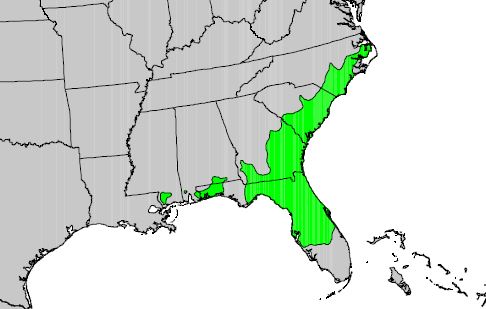
Distribution of loblolly bay.
Loblolly bay is distributed continuously along the Atlantic and Gulf coastal plains from the Albermarle Sound of North Carolina to the Apalachicola River in the Florida Panhandle. Discontinuous populations exist in Florida, the coastal counties of Alabama, and southern Mississippi. In South Carolina it is common in the lower Coastal Plain but restricted to specific sites in the middle and upper Coastal Plain [1,6,9,12].
States and Provinces
- United States: AL FL GA MS NC SC
Site Characteristics
Loblolly bay grows in warm, wet, temperate climates with an average annual precipitation of 64 inches (1,630 mm) in Florida to about 44 inches (1,120 mm) in North Carolina. The species grows in acid, swampy soils of pinelands and bays on the Atlantic and Gulf coastal plains. Loblolly bay is found on several soil series. It grows on certain Spodosols, Inceptisols, Ultisols, and Histosols, and to a lesser degree on Entisols and Mollisols. Loblolly bay grows in flat woodlands or shallow depressions with little or no slope, slow runoff, rapid permeability, and poor to very poor drainage. In South Carolina the soils are usually of sandy coastal plain or marine origin, except for the organic soils. The water table is usually at or near the soil surface from 6 to 9 months of the year [1,2,12,18].

Loblolly bay in the understory of a conifer forest community.
Loblolly bay grows in warm, wet, temperate climates with an average annual precipitation of 64 inches (1,630 mm) in Florida to about 44 inches (1,120 mm) in North Carolina. The species grows in acid, swampy soils of pinelands and bays on the Atlantic and Gulf coastal plains. Loblolly bay is found on several soil series. It grows on certain Spodosols, Inceptisols, Ultisols, and Histosols, and to a lesser degree on Entisols and Mollisols. Loblolly bay grows in flat woodlands or shallow depressions with little or no slope, slow runoff, rapid permeability, and poor to very poor drainage. In South Carolina the soils are usually of sandy coastal plain or marine origin, except for the organic soils. The water table is usually at or near the soil surface from 6 to 9 months of the year [1,2,12,18].
Associated hardwoods include water oak (Quercus nigra), sweetgum (Liquidambar styraciflua), American holly (Ilex opaca), redbay (Persea borbonia var. borbonia), and black tupelo (Nyssa sylvatica). Associated shrubs include fetterbush (Lyonia lucida), inkberry (Ilex glabra), greenbrier (Smilax spp.), southern bayberry (Myrica cerifera), and swamp cyrilla (Cyrilla racemiflora) [1,3,11,18].
Plant Communities
Loblolly bay occurs in evergreen shrub-tree bogs and bayheads, baldcypress (Taxodium distichum) swamps, and other swamps [10,25].
Botanical Description

Loblolly bay flower, North Carolina.
Loblolly bay is a small to medium-sized native, evergreen tree or shrub. It grows to about 65 feet (20 m) in height and has a narrow conical to columnar crown [10]. The simple leaves are alternate, leathery, and thick. The rough bark of mature trees is thin, interlaced with flat-topped ridges and separated by narrow furrows. The perfect, solitary flowers are axillary to close-set leaves on the current years twigs. The fruit is a hard, woody, five-valved capsule about 0.6 inch (1.5 cm) long with each valve containing four to eight flat, winged seeds. Loblolly bay has a large primary root with secondary roots branching downward [9,20,23,24].
Raunkiaer Life Form (Raunkiaer 1934)
- Phanerophyte
Seasonal Development
Loblolly bay flowers from the last week in June to the first week in July. Flowers remain open for 1 or 2 days and are pollinated by bees, flies, and hummingbirds. After the second day, the sepals and petals fall, leaving the ovary at the end of the peduncle. As the ovaries develop, they gradually turn brown and five sutures develop. Mature open capsules first appear during September or October, and all the capsules open by the middle of December. Seedfall starts in October, peaks in December, and continues until early March [12].
Regeneration Processes
Seed production and dissemination
Loblolly bay produces an abundance of lightweight, winged seed. Most of the seeds fall within a radius of two to three times the height of the source tree. Seeds are shaken out of the capsules by the wind, and empty capsules remain attached until peduncle and capsule abscission [6,12].
Seedling development
Germination is epigeal. Most loblolly bay seedlings do not live past the first growing season; those that do show slow initial growth. By the end of the third growing season the seedlings are about 4 to 6 inches (10-15 cm) tall and by the eighth growing season are 12 to 16 inches (30-40 cm) tall [12].
Vegetative reproduction
Vegetative reproduction of first-year shoots in a peat and sand medium under mist is commonly used by horticulturists. In the field, vegetative reproduction is more common than regeneration from seed. Stump sprouts may grow as much as 3 feet (1 m) in the first year [12].
Successional Status
Loblolly bay is classed as tolerant of shade. In bays and wet flats where tree cover is relatively light, loblolly bay is a strong competitor [12,13,19].
Immediate Fire Effects
Fire typically top-kills loblolly bay. Five major fires in 1954 and 1955 occurred in the Okefenokee Swamp during an extreme drought. In some areas the fires were severe enough to burn into the peat, completely killing all loblolly bay trees. Where only surface fires occurred, the larger top-killed trees sprouted from the root crown [4,5].
Postfire Regeneration Strategy (Stickney 1989)
- Tree with adventitious-bud root crown/root sucker
Fire Adaptations
Loblolly bay is sensitive to fire. The thin bark and shallow root system contribute to its low fire tolerance. Loblolly bay has the ability to sprout from the root crown after being top-killed [4,5].
Plant Response to Fire
Loblolly bay sprouts from the root crown following fire [5,12]. Data pertaining to postfire density, frequency, or growth rates of loblolly bay following fire were not found in the literature.
Fire Regimes
For fire regime information, search FEIS for this species by entering the species name or acronym on the home page and selecting “Fire Regime” as the publication type.
Fire Management Considerations
Within swamp bay forests, three fires occurring within 60 or 70 years or a single, deep peat burn with a high postburn water table may produce open marsh areas or "prairies". These open areas provide important habitat for a number of wildlife species, including the sandhill crane, bitterns, rails, gallinules, the round-tailed muskrat, and waterfowl [5].
Federal Status
None
Other Status
No entry.
Importance to Wildlife and Livestock
White-tailed deer heavily browse the stump sprouts of loblolly bay [12].
Palatability and Nutritional Value
No entry.
Cover Value
No entry.
Value for Rehabilitation or Restoration of Disturbed Sites
Loblolly bay has been used in riparian ecosystem restoration in central Florida [17].
Other Uses
In the Southeast, loblolly bay is considered a handsome and hardy tree and valued as an ornamental. Extracts of its bark are used as a tanning agent [11,26].
Loblolly bay is slow growing, with soft, light-colored, fine-grained wood of little commercial value, although it could be managed as a source of pulpwood. Loblolly bay is also used as fuel wood [12,24].
Other Management Considerations
Because of its ability to grow in bogs and wet flats where loblolly pine (Pinus taeda) does poorly, loblolly bay plantations may offer a management alternative for such areas [12].
Table A1— Forest and range ecosystems, Bureau of Land Management (BLM) physiographic regions, Kuchler plant associations, Society for American Foresters (SAF) forest cover types, and Society for Rangeland Management (SRM) rangeland cover types in which this species occurs.
Forest and Range Ecosystems (Garrison et al. 1977)
- FRES12 Longleaf - slash pine
- FRES13 Loblolly - shortleaf pine
- FRES14 Oak - pine
- FRES16 Oak - gum - cypress
BLM Physiographic Regions (Bernard and Brown 1977)
- No entry.
Kuchler Plant Associations (Kuchler 1964)
- K111 Oak - hickory - pine forest
- K112 Southern mixed forest
- K113 Southern floodplain forest
- K114 Pocosin
SAF Cover Types (Eyre 1980)
- 70 Longleaf pine
- 82 Loblolly pine - hardwood
- 97 Atlantic white-cedar
- 98 Pond pine
- 100 Pondcypress
- 104 Sweetbay - swamp tupelo - redbay
SRM Rangeland Cover Types (Shiflet 1994)
- No entry.
1. Best, G. Ronnie; Segal, Debra S.; Wolfe, Charlotte. 1990. Soil-vegetation correlations in selected wetlands and uplands of north-central Florida. Biol. Rep. 90(9). Washington, DC: U.S. Department of the Interior, Fish and Wildlife Service. 51 p. [18161]
2. Brown, Randall B.; Stone, Earl L.; Carlisle, Victor W. 1990. Soils. In: Myers, Ronald L.; Ewel, John J., eds. Ecosystems of Florida. Orlando, FL: University of Central Florida Press: 35-69. [17386]
3. Buford, Marilyn A.; Williams, Claire G.; Hughes, Joseph H. 1991. Growth and survival of Atlantic white-cedar on a South Carolina coastal plain site--first year results. In: Coleman, Sandra S.; Neary, Daniel G., compilers. Proceedings, 6th biennial southern silvicultural research conference: Volume 2; 1990 October 30 - November 1; Memphis, TN. Gen. Tech. Rep. SE-70. Asheville, NC: U.S. Department of Agriculture, Forest Service, Southeastern Forest Experiment Station: 579-583. [17502]
4. Namkoong, G.; Roberds, J. H. 1974. Extinction probabilities and the changing age structure of redwood forests. The American Naturalist. 108(961): 355-368. [11081]
5. Cypert, Eugene. 1973. Plant succession on burned areas in Okefenokee Swamp following the fires of 1954 and 1955. In: Proceedings, annual Tall Timbers fire ecology conference; 1972 June 8-9; Lubbock, TX. Number 12. Tallahassee, FL: Tall Timbers Research Station: 199-217. [8467]
6. Duncan, Wilbur H.; Duncan, Marion B. 1988. Trees of the southeastern United States. Athens, GA: The University of Georgia Press. 322 p. [12764]
7. Eyre, F. H., ed. 1980. Forest cover types of the United States and Canada. Washington, DC: Society of American Foresters. 148 p. [905]
8. Garrison, George A.; Bjugstad, Ardell J.; Duncan, Don A.; [and others]. 1977. Vegetation and environmental features of forest and range ecosystems. Agric. Handb. 475. Washington, DC: U.S. Department of Agriculture, Forest Service. 68 p. [998]
9. Godfrey, Robert K. 1988. Trees, shrubs, and woody vines of northern Florida and adjacent Georgia and Alabama. Athens, GA: The University of Georgia Press. 734 p. [10239]
10. Godfrey, Robert K.; Wooten, Jean W. 1981. Aquatic and wetland plants of southeastern United States: Dicotyledons. Athens, GA: The University of Georgia Press. 933 p. [16907]
11. Gresham, Charles A. 1982. Biomass relations of Gordonia lasianthus, loblolly-bay. In: Baldwin, V. C., Jr.; Lohrey, R., eds. Proceedings, Southern forest biomass working group workshop; 1982 June 16-18; Alexandria, LA. New Orleans, LA: U.S. Department of Agriculture, Forest Service, Southern Forest Experiment Station: 81-87. [15862]
12. Gresham, Charles A.; Lipscomb, Donald J. 1990. Gordonia lasianthus (L.) Ellis loblolly-bay. In: Burns, Russell M.; Honkala, Barbara H., tech. coords. Silvics of North America. Volume 2. Hardwoods. Agric. Handb. 654. Washington, DC: U.S. Department of Agriculture, Forest Service: 365-369. [19444]
13. Johnson, A. Sydney; Hillestad, Hilburn O.; Shanholtzer, Sheryl Fanning; Shanholtzer, G. Frederick. 1974. An ecological survey of the coastal region of Georgia. Scientific Monograph Series No 3, NPS 116. Washington, DC: U.S. Department of the Interior, National Park Service. 233 p. [16102]
14. Kuchler, A. W. 1964. Manual to accompany the map of potential vegetation of the conterminous United States. Special Publication No. 36. New York: American Geographical Society. 77 p. [1384]
15. Little, Elbert L., Jr. 1979. Checklist of United States trees (native and naturalized). Agric. Handb. 541. Washington, DC: U.S. Department of Agriculture, Forest Service. 375 p. [2952]
16. Lyon, L. Jack; Stickney, Peter F. 1976. Early vegetal succession following large northern Rocky Mountain wildfires. In: Proceedings, Tall Timbers fire ecology conference and Intermountain Fire Research Council fire and land management symposium; 1974 October 8-10; Missoula, MT. No. 14. Tallahassee, FL: Tall Timbers Research Station: 355-373. [1496]
17. Manci, Karen M. 1989. Riparian ecosystem creation and restoration: a literature summary. Biol. Rep.89(20). Washington, DC: U.S. Department of the Interior, Fish and Wildlife Service. 60 p. [11757]
18. Monk, Carl D. 1968. Successional and environmental relationships of the forest vegetation of north central Florida. The American Midland Naturalist. 79(2): 441-457. [10847]
19. Penfound, William T. 1952. Southern swamps and marshes. The Botanical Review. 18: 413-446. [11477]
20. Radford, Albert E.; Ahles, Harry E.; Bell, C. Ritchie. 1968. Manual of the vascular flora of the Carolinas. Chapel Hill, NC: The University of North Carolina Press. 1183 p. [7606]
21. Raunkiaer, C. 1934. The life forms of plants and statistical plant geography. Oxford: Clarendon Press. 632 p. [2843]
22. U.S. Department of Agriculture, Soil Conservation Service. 1982. National list of scientific plant names. Vol. 1. List of plant names. SCS-TP-159. Washington, DC. 416 p. [11573]
23. Van Dersal, William R. 1938. Native woody plants of the United States, their erosion-control and wildlife values. Washington, DC: U.S. Department of Agriculture. 362 p. [4240]
24. Vines, Robert A. 1960. Trees, shrubs, and woody vines of the Southwest. Austin, TX: University of Texas Press. 1104 p. [7707]
25. Wunderlin, Richard P.; Hansen, Bruce F. 2003. Guide to the vascular plants of Florida. 2nd edition. Gainesville, FL: The University of Florida Press. 787 p. [69433]
26. Thompson, Robert S.; Anderson, Katherine H.; Bartlein, Patrick J. 1999. Digital representations of tree species range maps from "Atlas of United States trees" by Elbert L. Little, Jr. (and other publications). In: Atlas of relations between climatic parameters and distributions of important trees and shrubs in North America. Denver, CO: U.S. Geological Survey, Information Services (Producer). On file at: U.S. Department of Agriculture, Forest Service, Rocky Mountain Research Station, Fire Sciences Laboratory, Missoula, MT; FEIS files. [92575]