


Hamamelis virginiana, American witchhazel
Coladonato, Milo. 1993. Hamamelis virginiana, American witchhazel. In: Fire Effects Information System, [Online]. U.S. Department of Agriculture, Forest Service, Rocky Mountain Research Station, Fire Sciences Laboratory (Producer). Available: https://research.fs.usda.gov/feis/species-reviews/hamvir
| Abbreviation | Common Name | Scientific Name | Classification | Status |
|---|---|---|---|---|
| Plants | ||||
| HAMVIR | American witchhazel | Hamamelis virginiana | Life Form: Plants/Shrub, Plants/Tree Kingdom: Plantae Class: Dicot Order: Hamamelidales Family: Hamamelidaceae Genus: Hamamelis | Fed. Protected: No Nativity: Native Invasiveness: Noninvasive |


Taxonomy
The scientific name for American witchhazel is Hamamelis virginiana L. [24].
Synonyms
- Hamamelis virginiana var. parvifolia Nutt. [3], prairie peninsula
Other Common Names
witch-hazel
General Distribution

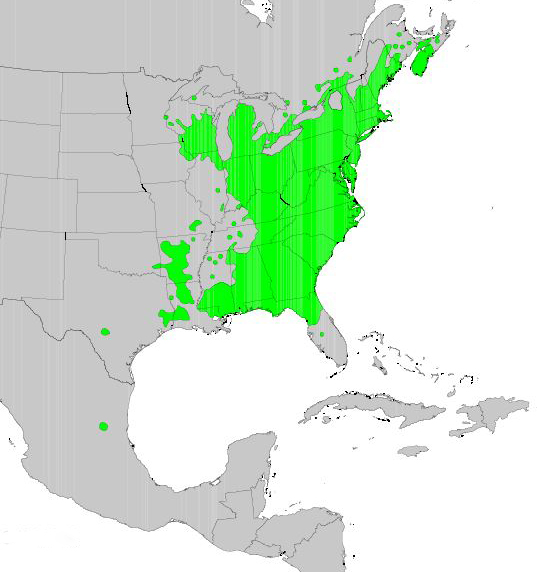
Distribution of American witchhazel.
American witchhazel occurs throughout the northeastern and southeastern United States. It extends from the Appalachian Mountains south to the northern Florida Panhandle and west from the mountains into Indiana, Illinois, Iowa, Minnesota, western Kentucky, eastern Missouri, eastern Oklahoma, and eastern Texas. At its northern limit, American witchhazel ranges along the southern border of Canada from southern Ontario to southern Nova Scotia. Isolated populations occur in south-central Texas and east-central Mexico at its southern limit [3,12,25,32,40].
States and Provinces
- United States: AL AR CT DE FL GA IL IN IA KY LA ME MD MA MI MN MS MO NH NJ NY NC OH OK PA SC TN TX VT VA WV
- Canada: NB NS ON PQ
- Mexico
Site Characteristics
American witchhazel is found on a variety of sites but is most abundant in mesic woods and bottoms. In the western and southern parts of its range, it is confined to moist cool valleys, moist flats, north and east slopes, coves, benches, and ravines. In the northern part of its range, it is found on drier and warmer sites of slopes and hilltops [1,6,8,27].
In addition to those species listed in Table A1, common tree and shrub associates of American witchhazel include white ash (Fraxinus americana), blackgum, mountain laurel (Kalmia latifolia), blueberry (Vaccinium spp.), rhododendron (Rhododendron spp.), pepperbush (Clethra acuminata), sweetgum, flowering dogwood (Cornus florida), and eastern hophornbeam (Ostrya virginiana) [6,7,20,30].

American witchhazel, Middlesex County, Massachusetts. (CC BY-NC 4.0)
Plant Communities
No entry.
Botanical Description
American witchhazel is a deciduous shrub or small tree with a short trunk, bearing numerous spreading, crooked branches. At maturity, it is commonly 15 to 25 (4.5-7.5 m) feet tall. It has thin bark and shallow roots. The fruit is a woody capsule containing two to four seeds [19,20,21,23].
Raunkiaer Life Form (Raunkiaer 1934)
- Phanerophyte
Seasonal Development

American witchhazel flowers, Washington, D.C. (CC0 1.0)
The flowers of American witchhazel open in September and October, and the fruit ripens the next fall. Shortly after ripening, the capsules burst open, discharging their seed [4,5].
Regeneration Processes
American witchhazel reproduces mainly by seed. After maturing the capsules burst open, explosively discharging their seeds several yards from the parent plant. There is limited dispersal by birds. The seeds germinate the second year after dispersal [5,29]. Brinkman [4] reported that American witchhazel can be propagated by layering.
Successional Status
American witchhazel is a shade-tolerant, mid- to late-seral species. It sometimes forms a solid understory in second-growth and old-growth forests in the eastern United States [9,13,14].
Immediate Fire Effects
American witchhazel is readily killed by fire. In a prescribed fire in a loblolly pine community in western Tennessee, witch hazel suffered 54 percent mortality [10].
Postfire Regeneration Strategy (Stickney 1989)
- Secondary colonizer - off-site seed
Fire Adaptations
DeBruyn and Buckner [10] rated American witchhazel low in fire resistance. This is probably due to its thin bark, shallow roots, and low-branching habit. Fire survival strategies were not given.
Plant Response to Fire
American witchhazel's response to fire is not well documented. Literature suggests that it is generally a fire decreaser, although pre- and postfire/unburned control comparisons were unavailable as of 1993 [17,31,38].
On the George Washington National Forest, West Virginia, a spring prescribed fire increased American witchhazel seedling density in a mixed-hardwood forest. Average American witchhazel seedling densities before fire and in postfire year 5 were 290 and 365 seedlings/acre, respectively; American witchhazel sprout densities were 395 sprouts/acre before and 184 sprouts/acre 5 years after the fire. See the Research Paper of Wendel and Smith's [39] study for details on the fire prescription and fire effects on American witchhazel and 6 other tree species.
The following Research Project Summaries provide information on prescribed fire use and postfire response of plant community species, including American witchhazel, that was not available when this species review was originally written:
- Early postfire effects of a prescribed fire in the southern Appalachians of North Carolina
- Early postfire response of southern Appalachian Table Mountain-pitch pine stands to prescribed fires in North Carolina and Virginia
Fire Regimes
For fire regime information, search FEIS for this species by entering the species name on the Advanced Search page and selecting “Fire Regime” as the publication type.
Fire Management Considerations
No entry.
Federal Status
None
Other Status
None
Importance to Wildlife and Livestock
The fruit of American witchhazel is eaten by ruffed grouse, northern bobwhite, ring-necked pheasant, and white-tailed deer. The fruit is also frequently eaten by beaver and cottontail rabbit [11,35].
American witchhazel fruit is a minor fall food for black bear in western Massachusetts [15].
Palatability and Nutritional Value
No entry.
Cover Value
No entry.
Value for Rehabilitation or Restoration of Disturbed Sites
No entry.
Other Uses
Medicinal extracts, lotions, and salves are prepared from the leaves, twigs, and bark of American witchhazel. The distillate is used to reduce inflammation, stop bleeding, and check secretions of the mucous membranes. Extracts of the twigs were also believed to infuse the imbiber with occult powers [36,37].
Other Management Considerations
American witchhazel competes with more desirable hardwoods for available light and moisture [26]. Its dense cover inhibits seed germination of intolerant species [9]. Blair and Burnett [2] reported that American witchhazel, along with Carolina jessamine (Gelsemium sempervirens), blackgum (Nyssa sylvatica), sweetgum (Liquidambar styraciflua), red maple (Acer rubrum), and post oak (Quercus stellata), declined by 94.7 percent collectively after logging.
Table A1— Forest and range ecosystems, Bureau of Land Management (BLM) physiographic regions, Kuchler plant associations, Society for American Foresters (SAF) forest cover types, and Society for Rangeland Management (SRM) rangeland cover types in which this species occurs.
Forest and Range Ecosystems (Garrison et al. 1977)
- FRES10 White - red - jack pine
- FRES11 Spruce - fir
- FRES12 Longleaf - slash pine
- FRES13 Loblolly - shortleaf pine
- FRES14 Oak - pine
- FRES15 Oak - hickory
- FRES18 Maple - beech - birch
BLM Physiographic Regions (Bernard and Brown 1977)
- No entry.
Kuchler Plant Associations (Kuchler 1964)
- K095 Great Lakes pine forest
- K096 Northeastern spruce - fir forest
- K097 Southeastern spruce - fir forest
- K100 Oak - hickory forest
- K101 Elm - ash forest
- K102 Beech - maple forest
- K104 Appalachian oak forest
- K106 Northern hardwoods
- K111 Oak - hickory - pine forest
- K112 Southern mixed forest
- K113 Southern floodplain forest
SAF Cover Types (Eyre 1980)
- 14 Northern pin oak
- 17 Pin cherry
- 19 Gray birch - red maple
- 20 White pine - northern red oak - red maple
- 21 Eastern white pine
- 22 White pine - hemlock
- 23 Eastern hemlock
- 24 Hemlock - yellow birch
- 25 Sugar maple - beech - yellow birch
- 28 Black cherry - maple
- 31 Red spruce - sugar maple - beech
- 32 Red spruce
- 40 Post oak - blackjack oak
- 42 Bur oak
- 43 Bear oak
- 44 Chestnut oak
- 45 Pitch pine
- 51 White pine - chestnut oak
- 52 White oak - black oak - northern red oak
- 53 White oak
- 55 Northern red oak
- 57 Yellow-poplar
- 59 Yellow-poplar - white oak - northern red oak
- 60 Beech - sugar maple
- 62 Silver maple - American elm
- 64 Sassafras - persimmon
- 75 Shortleaf pine
- 79 Virginia pine
- 80 Loblolly pine - shortleaf pine
- 81 Loblolly pine
- 82 Loblolly pine - hardwood
- 83 Longleaf pine - slash pine
- 93 Sugarberry - American elm - green ash
- 97 Atlantic white-cedar
- 108 Red maple
- 110 Black oak
SRM Rangeland Cover Types (Shiflet 1994)
- No entry.
1. Adams, Harold S.; Stephenson, Steven L. 1989. Old-growth red spruce communities in the mid-Appalachians. Vegetatio. 85: 45-56. [11409]
2. Blair, Robert M.; Brunett, Louis E. 1976. Phytosociological changes after timber harvest in a southern pine ecosystem. Ecology. 57: 18-32. [9646]
3. Braun, E. Lucy. 1961. The woody plants of Ohio. Columbus, OH: Ohio State University Press. 362 p. [12914]
4. Brinkman, Kenneth A. 1974. Hamamelis virginiana L. witch-hazel. In: Schopmeyer, C. S., ed. Seeds of woody plants in the United States. Agric. Handb. 450. Washington, DC: U.S. Department of Agriculture, Forest Service: 443-444. [7679]
5. Chapman, William K.; Bessette, Alan E. 1990. Trees and shrubs of the Adirondacks. Utica, NY: North Country Books, Inc. 131 p. [12766]
6. Core, Earl L. 1929. Plant ecology of Spruce Mountain, West Virginia. Ecology. 10(1): 1-13. [9218]
7. Crawford, Hewlette S.; Hooper, R. G.; Harlow, R. F. 1976. Woody plants selected by beavers in the Appalachian Ridge and Valley Province. Res. Pap. NE-346. Upper Darby, PA: U.S. Department of Agriculture, Forest Service, Northeastern Forest Experiment Station. 6 p. [20005]
8. Cross, Shirley G. 1992. An indigenous population of Clintonia borealis (Liliaceae) on Cape Cod. Rhodora. 94(877): 98-99. [18125]
9. Curtis, John T. 1959. The vegetation of Wisconsin. Madison, WI: The University of Wisconsin Press. 657 p. [7116]
10. de Bruyn, Peter; Buckner, Edward. 1981. Prescribed fire on sloping terrain in west Tennessee to maintain loblolly pine (Pinus taeda). In: Barnett, James P., ed. Proceedings, 1st biennial southern silvicultural research conference; 1980 November 6-7; Atlanta, GA. Gen. Tech. Rep. SO-34. New Orleans, LA: U.S. Department of Agriculture, Forest Service, Southern Forest Experiment Station: 67-69. [12091]
11. Della-Bianca, Lino; Johnson, Frank M. 1965. Effect of an intensive cleaning on deer-browse production in the southern Appalachians. Journal of Wildlife Management. 29(4): 729-733. [16404]
12. Duncan, Wilbur H.; Duncan, Marion B. 1987. The Smithsonian guide to seaside plants of the Gulf and Atlantic Coasts from Louisiana to Massachusetts, exclusive of lower peninsular Florida. Washington, DC: Smithsonian Institution Press. 409 p. [12906]
13. Downs, Julie A.; Abrams, Marc D. 1991. Composition and structure of an old-growth versus a second-growth white oak forest in southwestern Pennsylvania. In: McCormick, Larry H.; Gottschalk, Kurt W., eds. Proceedings, 8th central hardwood forest conference; 1991 March 4-6; University Park, PA. Gen. Tech. Rep. NE-148. Radnor, PA: U.S. Department of Agriculture, Forest Service, Northeastern Forest Experiment Station: 207-223. [15313]
14. Eggler, Willis A. 1938. The maple-basswood forest type in Washburn County, Wisconsin. Ecology. 19(2): 243-263. [6907]
15. Elowe, Kenneth D.; Dodge, Wendell E. 1989. Factors affecting black bear reproductive success and cub survival. Journal of Wildlife Management. 53(4): 962-968. [10339]
16. Eyre, F. H., ed. 1980. Forest cover types of the United States and Canada. Washington, DC: Society of American Foresters. 148 p. [905]
17. Fennell, Norman H.; Hutnik, Russell J. 1970. Ecological effects of forest fires. Unpublished paper on file at: U.S. Department of Agriculture, Forest Service, Intermountain Research Station, Fire Sciences Laboratory, Missoula, MT. 84 p. [16873]
18. Garrison, George A.; Bjugstad, Ardell J.; Duncan, Don A.; [and others]. 1977. Vegetation and environmental features of forest and range ecosystems. Agric. Handb. 475. Washington, DC: U.S. Department of Agriculture, Forest Service. 68 p. [998]
19. Godfrey, Robert K. 1988. Trees, shrubs, and woody vines of northern Florida and adjacent Georgia and Alabama. Athens, GA: The University of Georgia Press. 734 p. [10239]
20. Gleason, Henry A.; Cronquist, Arthur. 1991. Manual of vascular plants of northeastern United States and adjacent Canada. 2nd ed. New York: New York Botanical Garden. 910 p. [20329]
21. Hosie, R. C. 1969. Native trees of Canada. 7th ed. Ottawa, ON: Canadian Forestry Service, Department of Fisheries and Forestry. 380 p. [3375]
22. Kuchler, A. W. 1964. Manual to accompany the map of potential vegetation of the conterminous United States. Special Publication No. 36. New York: American Geographical Society. 77 p. [1384]
23. Kudish, Michael. 1992. Adirondack upland flora: an ecological perspective. Saranac, NY: The Chauncy Press. 320 p. [19376]
24. Little, Elbert L., Jr. 1979. Checklist of United States trees (native and naturalized). Agric. Handb. 541. Washington, DC: U.S. Department of Agriculture, Forest Service. 375 p. [2952]
25. Marquis, David A. 1990. Prunus serotina Ehrh. black cherry. In: Burns, Russell M.; Honkala, Barbara H., technical coordinators. Silvics of North America. Volume 2. Hardwoods. Agric. Handb. 654. Washington, DC: U.S. Department of Agriculture, Forest Service: 594-604. [13972]
26. McGee, Charles E.; Hooper, Ralph M. 1970. Regeneration after clearcutting in the southern Appalachians. Res. Pap. SE-70. Asheville, NC: U.S. Agriculture, Forest Service, Southeastern Forest Experiment Station. 12 p. [10886]
27. McGinnes, Burd S.; Ripley, Thomas H. 1962. Evaluation of wildlife response to forest-wildlife management--a preliminary report. In: Southern forestry on the march: Proceedings, Society of American Foresters meeting; [Date of conference unknown]; Atlanta, GA. [Place of publication unknown]. [Publisher unknown]. 167-171. [16735]
28. Raunkiaer, C. 1934. The life forms of plants and statistical plant geography. Oxford: Clarendon Press. 632 p. [2843]
29. Roland, A. E.; Smith, E. C. 1969. The flora of Nova Scotia. Halifax, NS: Nova Scotia Museum. 746 p. [13158]
30. Schlesinger, Richard C. 1990. Fraxinus americana L. white ash. In: Burns, Russell M.; Honkala, Barbara H., technical coordinators. Silvics of North America. Vol. 2. Hardwoods. Agric. Handb. 654. Washington, DC: U.S. Department of Agriculture, Forest Service: 333-338. [13965]
31. Silker, T. H. 1957. Prescribed burning in the silviculture and management of southern pine-hardwood and slash pine stands. In: Society of American Foresters: Proceedings of the 1956 annual meeting; [Date of conference unknown]; [Location of conference unknown]. Washington, DC: Society of American Foresters: 94-99. [15279]
32. Soper, James H.; Heimburger, Margaret L. 1982. Shrubs of Ontario. Life Sciences Misc. Publ. Toronto, ON: Royal Ontario Museum. 495 p. [12907]
33. Stickney, Peter F. 1989. Seral origin of species originating in northern Rocky Mountain forests. Unpublished draft on file at: U.S. Department of Agriculture, Forest Service, Intermountain Research Station, Fire Sciences Laboratory, Missoula, MT; RWU 4403 files. 7 p. [20090]
34. U.S. Department of Agriculture, Soil Conservation Service. 1982. National list of scientific plant names. Vol. 1. List of plant names. SCS-TP-159. Washington, DC. 416 p. [11573]
35. Van Dersal, William R. 1938. Native woody plants of the United States, their erosion-control and wildlife values. Washington, DC: U.S. Department of Agriculture. 362 p. [4240]
36. Vines, Robert A. 1960. Trees, shrubs, and woody vines of the Southwest. Austin, TX: University of Texas Press. 1104 p. [7707]
37. Walker, Laurence C. 1991. The southern forest: A chronicle. Austin, TX: University of Texas Press. 322 p. [17597]
38. Wydeven, Adrian P.; Kloes, Glenn G. 1989. Canopy reduction, fire influence oak regeneration (Wisconsin). Restoration & Management Notes. 7(2): 87-88. [11413]
39. Wendel, G. W.; Smith, H. Clay. 1986. Effects of a prescribed fire in a central Appalachian oak-hickory stand. NE-RP-594. Broomall, PA: U.S. Department of Agriculture, Forest Service, Northeastern Forest Experiment Station. 8 p. [73936]
40. Thompson, Robert S.; Anderson, Katherine H.; Bartlein, Patrick J. 1999. Digital representations of tree species range maps from "Atlas of United States trees" by Elbert L. Little, Jr. (and other publications). In: Atlas of relations between climatic parameters and distributions of important trees and shrubs in North America. Denver, CO: U.S. Geological Survey, Information Services (Producer). On file at: U.S. Department of Agriculture, Forest Service, Rocky Mountain Research Station, Fire Sciences Laboratory, Missoula, MT; FEIS files. [92575]