


Ilex decidua, possumhaw
Sullivan, Janet. 1993. Ilex decidua, possumhaw. In: Fire Effects Information System, [Online]. U.S. Department of Agriculture, Forest Service, Rocky Mountain Research Station, Fire Sciences Laboratory (Producer). Available: https://research.fs.usda.gov/feis/species-reviews/iledec
| Abbreviation | Common Name | Scientific Name | Classification | Status |
|---|---|---|---|---|
| Plants | ||||
| ILEDEC | possumhaw | Ilex decidua | Life Form: Plants/Shrub, Plants/Tree Kingdom: Plantae Class: Dicot Order: Celastrales Family: Aquifoliaceae Genus: Ilex | Fed. Protected: No Nativity: Native Invasiveness: Noninvasive |
Taxonomy
The scientific name of possumhaw is Ilex decidua Walt. [8, 20].
Synonyms
- Ilex cuthbertii Small
- Ilex curtissii (Fern) Small
- Ilex decidua var. curtissii Fern.
Other Common Names
deciduous holly, swamp holly, winterberry, bearberry, Curtiss possumhaw
General Distribution

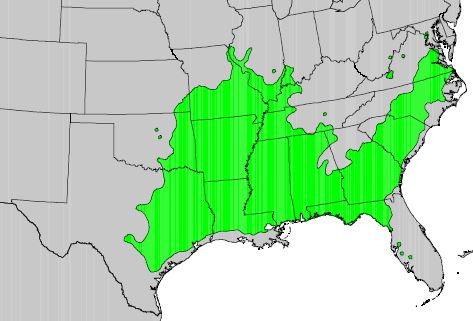
Distribution of possumhaw.
Possumhaw is found throughout the southeastern United States, from Virginia west to southern Indiana, southern Illinois, and eastern Kansas; south to Florida, Mississippi, Louisiana, south-central Texas, and northeastern Mexico [8, 10].
States and Provinces
- United States: AL AR FL GA IL IN KS KY LA MD MS MO NC OK SC TN TX VA WV
- Mexico
Site Characteristics

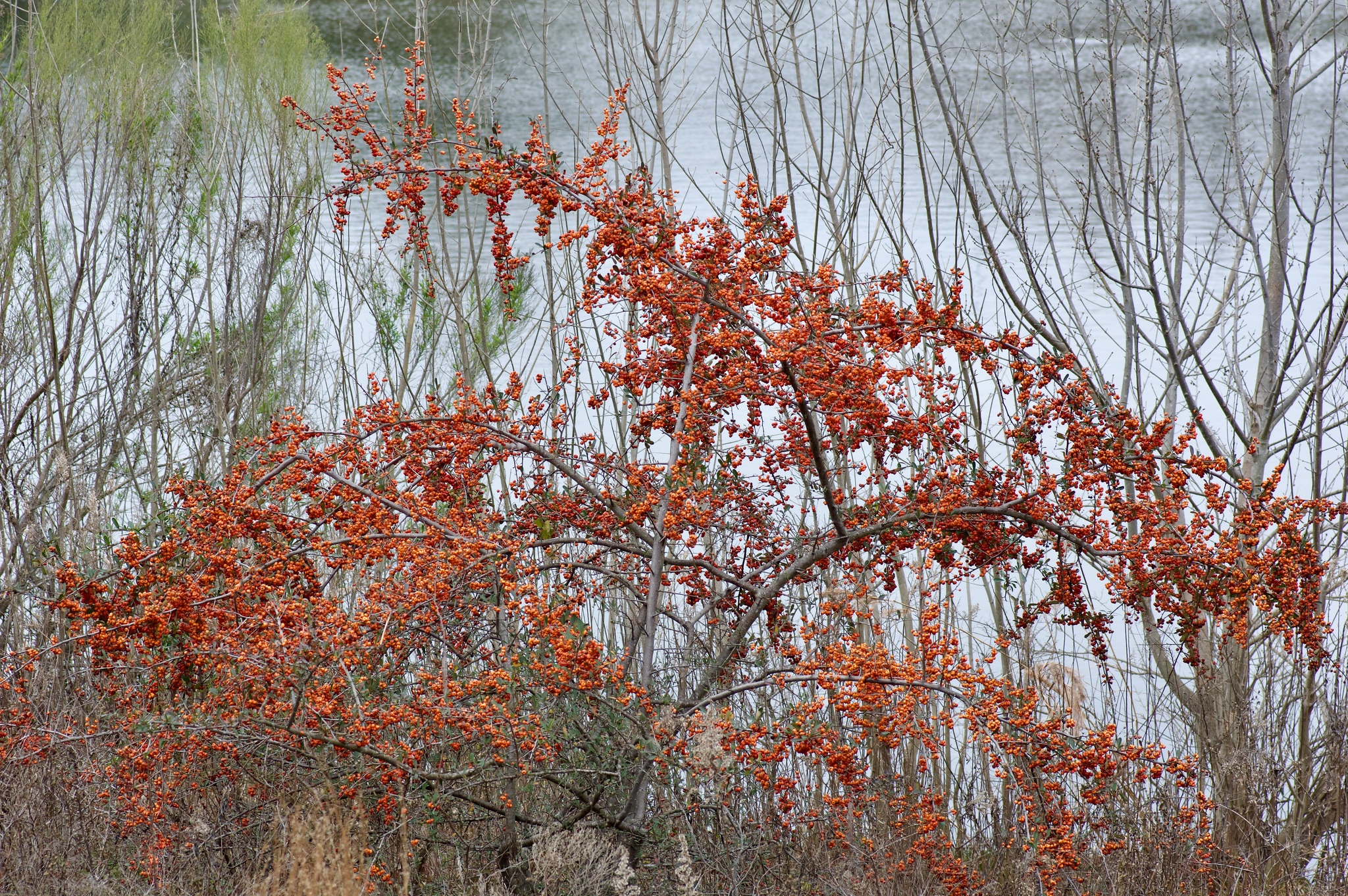
Possumhaw in winter with berries, Travis County, Texas. (CC BY 4.0)
Possumhaw is usually found on moist soils of floodplains, low woodlands, wet thickets, and along streams. It occurs infrequently on well-drained wooded slopes or sandy pineland ridges [3, 8, 43]. It is occasional in hydric hammocks in Florida [41]. It occurs in elevations of up to 1,180 feet (360 m) throughout its distribution [4].
Plant Communities
Possumhaw is not a dominant or indicator species in habitat typings. It occurs in a variety of cover types and has a number of associated species. The most common overstory and midstory associates not previously mentioned include red maple (Acer rubrum), winged elm (Ulmus alata), blackgum (Nyssa sylvatica), southern red oak (Quercus falcata), flowering dogwood (Cornus florida), tree huckleberry (Vaccinium arboreum), American hornbeam (Carpinus caroliniana), American holly (Ilex opaca), and yaupon (I. vomitoria). Understory associates include rusty blackhaw (Viburnum rufidulum), Alabama supplejack (Berchemia scandens), trumpetcreeper (Campis radicans), grapes (Vitis spp.), and greenbriers (Smilax spp.) [16, 18, 21, 23, 26, 27, 34, 37, 40].
Botanical Description

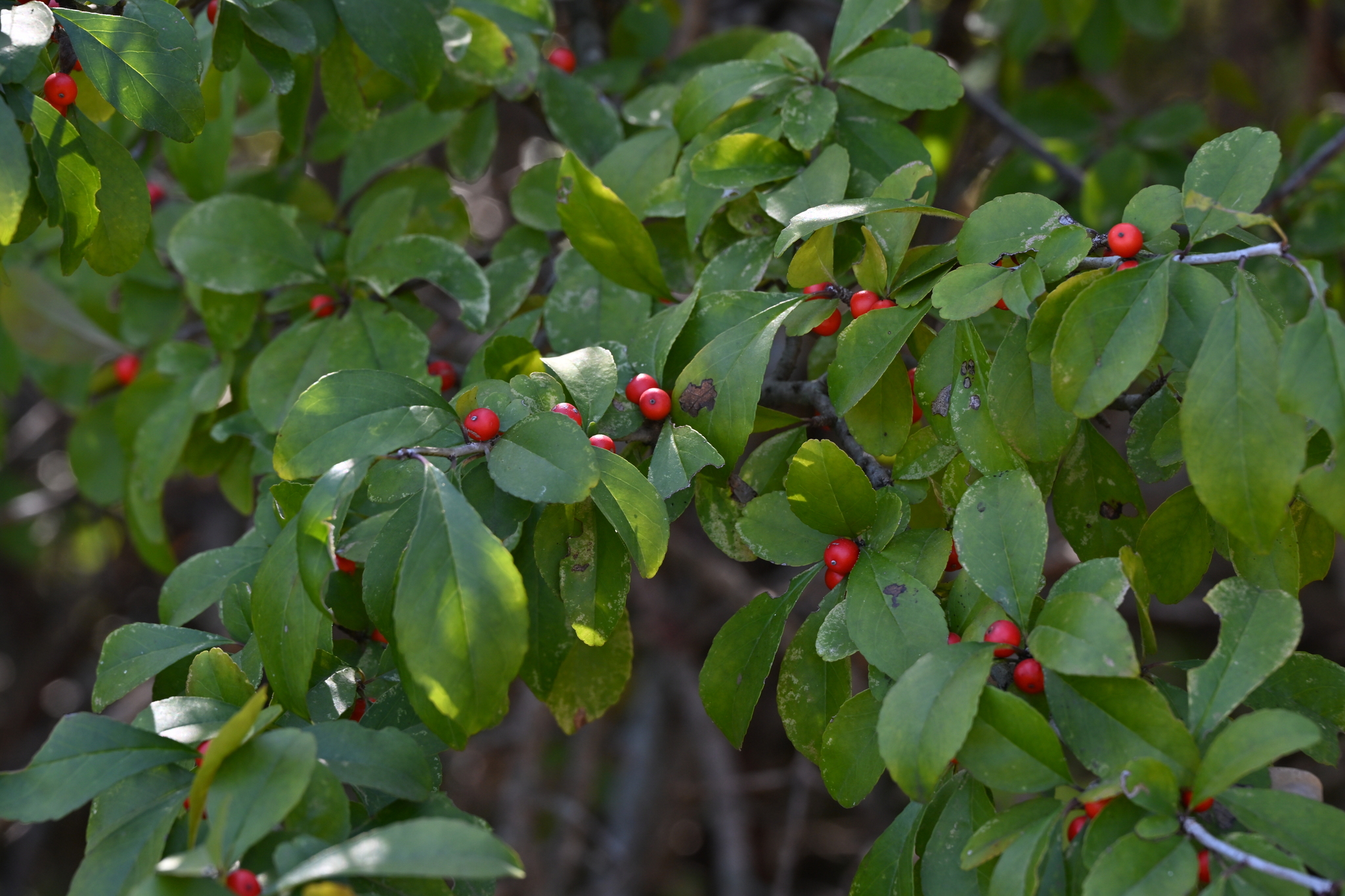
Possumhaw leaves and berries, Dallas County, Texas. (CC0 1.0)
Possumhaw is a native, large shrub or small tree. The average maximum height at maturity is 33 feet (10 m) [8, 10, 42]. The bark is smooth or slightly roughened [10, 30]. The fruit is a four- to seven-seeded berry [3].
The national champion (1981), located in South Carolina, is 3 feet (9 m) in circumference and 42 feet (12.8 m) in height [8].
Raunkiaer Life Form (Raunkiaer 1934)
- Phanerophyte
Seasonal Development
Possumhaw flowers from March to May [4]. The fruits ripen in September and persist until the following spring [13]. Seedling emergence occurs before spring canopy development in early February, and continues through May [37].
Regeneration Processes
Possumhaw produces abundant, light seeds that are dispersed by frugivores. In bottomland hardwood forests in Texas, first-year seedling survivorship was good. Seedling survival increases with distance from a conspecific or sweetgum (Liquidambar styraciflua) adult. Possumhaw seedlings grow slowly, about 0.4 to 0.8 inch (1-2 cm) per year [37].
Successional Status
Possumhaw is found in all successional stages. It colonizes areas that have been disturbed by fire, and it is found in old-growth bottomland hardwood forests [27, 25].
Possumhaw was abundant in the third and fourth years after removal of a young green ash (Fraxinus pensylvanica)-American elm (Ulmus americana) stand [6].
Immediate Fire Effects
Possumhaw is damaged, top-killed, or killed by light- or moderate-severity fires [27, 36]. After two prescribed fires in loblolly-shortleaf pine (Pinus echinata) stands, possumhaw exhibited moderate mortality (up to 50 percent) after fires in cut-over sawtimber-sized stands, and low mortality after fires in pulpwood-sized timber [33]. High mortality (up to 100 percent) of stems less than 1 inch (2.54 cm) in diameter occurred after winter prescribed fire in a slash pine plantation [44].
Postfire Regeneration Strategy (Stickney 1989)
- Tall shrub, adventitious-bud root crown
- Initial-offsite colonizer (off-site, initial community)
Fire Adaptations
Possumhaw grows in a number of habitats, some of which may be subject to fire. Some resistance to fire is conferred by the ability to sprout after top-kill. Its main fire adaptation is the ability to colonize disturbed soils through animal-dispersed seed [27].
Plant Response to Fire
The number of possumhaw stems increased following prescribed spring fires in loblolly-shortleaf pine stands. Fruit production increased following fire, but since there was also a large increase in fruit production on control plots, it was difficult to separate the effects of fire from other effects [36].
Numerous possumhaw seedlings occurred on loblolly-shortleaf pine plots that received two prescribed fire treatments [33]. Nine years after wildfire in a loblolly pine community, possumhaw did not occur on plots that had undergone surface fire only. Plots where fire crowning occurred were colonized by seedlings resulting from animal-dispersed seed [27].
Fire Regimes
For fire regime information, search FEIS for this species by entering the species name on the Advanced Search page and selecting “Fire Regime” as the publication type.
Fire Management Considerations
The mean, ash-free caloric value for possumhaw leaves is 5,311 calories per gram. This value can be used in calculations to predict heat release during fire on sites with possumhaw litter [12].
Federal Status
None
Other Status
Possumhaw is state-listed as threatened in Florida [45].
Importance to Wildlife and Livestock
Possumhaw fruits are consumed by small mammals, songbirds and game birds, including eastern bluebirds, wild turkeys, and quail. They are also eaten by white-tailed deer [10, 13]. White-tailed deer and cattle browse both leaves and twigs [2].
Palatability and Nutritional Value
No entry.
Cover Value
No entry.
Value for Rehabilitation or Restoration of Disturbed Sites
No entry.
Other Uses
Possumhaw is planted as an ornamental [42].
Other Management Considerations
Possumhaw is moderately tolerant to periodic flooding. Mature trees can withstand flooding of up to 35 percent of the growing season. Saplings have survived 105 days of flooding from March to July [11]. Near Alton, Illinois, possumhaw maintained vigorous growth through 4 years of continuous flooding, but declined in the fifth year [9]. It is more likely to survive in frequently flooded plots than is common persimmon (Diospyros virginiana) or elms (Ulmus spp.) [37].
Possumhaw can suppress regeneration of timber species [10].
Control: Possumhaw is susceptible to stem injection of 2,4-D and glyphosate [10, 22]. Possumhaw seedling counts were highest on bottomland hardwood sites that had been harvested and site-prepared by herbicide stem injection of all stems larger than 2 inches (5 cm) d.b.h. The lowest numbers of possumhaw seedlings occurred on sites that had been harvested and site-prepared by shearing [14]. When managing for white-tailed deer, burning or slashing possumhaw stems is preferable to herbicide application; the sprouts resulting from those treatments provide deer browse [10].
Possumhaw is a good choice in plantings for wildlife; individual plant fruit production is consistent from year to year, and a high percentage (greater than 70 percent) of individuals bear fruit [28].
Increase: Production of possumhaw browse was highest under medium- thinning intensity in loblolly pine (Pinus taeda) plantations [2]. Possumhaw can be propagated by cuttings [42].
Table A1— Forest and range ecosystems, Bureau of Land Management (BLM) physiographic regions, Kuchler plant associations, Society for American Foresters (SAF) forest cover types, and Society for Rangeland Management (SRM) rangeland cover types in which this species occurs.
Forest and Range Ecosystems (Garrison et al. 1977)
- FRES12 Longleaf - slash pine
- FRES13 Loblolly - shortleaf pine
- FRES14 Oak - pine
- FRES15 Oak - hickory
- FRES16 Oak - gum - cypress
- FRES17 Elm - ash - cottonwood
BLM Physiographic Regions (Bernard and Brown 1977)
- 14 Great Plains
Kuchler Plant Associations (Kuchler 1964)
- K083 Cedar glades
- K084 Cross Timbers
- K089 Black Belt
- K111 Oak - hickory - pine forest
- K112 Southern mixed forest
- K113 Southern floodplain forest
SAF Cover Types (Eyre 1980)
- 46 Eastern redcedar
- 57 Yellow-poplar
- 64 Sassafras - persimmon
- 65 Pin oak - sweetgum
- 73 Southern redcedar
- 74 Cabbage palmetto
- 75 Shortleaf pine
- 76 Shortleaf pine - oak
- 78 Virginia pine - oak
- 79 Virginia pine
- 80 Loblolly pine - shortleaf pine
- 81 Loblolly pine
- 82 Loblolly pine - hardwood
- 83 Longleaf pine - slash pine
- 84 Slash pine
- 87 Sweet gum - yellow-poplar
- 88 Willow oak - water oak - diamondleaf oak
- 89 Live oak
- 91 Swamp chestnut oak - cherrybark oak
- 92 Sweetgum - willow oak
- 93 Sugarberry - American elm - green ash
- 94 Sycamore - sweetgum - American elm
- 96 Overcup oak - water hickory
- 97 Atlantic white-cedar
- 98 Pond pine
- 101 Baldcypress
- 102 Baldcypress - tupelo
- 103 Water tupelo - swamp tupelo
- 104 Sweetbay - swamp tupelo - redbay
SRM Rangeland Cover Types (Shiflet 1994)
- No entry.
1. Bernard, Stephen R.; Brown, Kenneth F. 1977. Distribution of mammals, reptiles, and amphibians by BLM physiographic regions and A.W. Kuchler's associations for the eleven western states. Tech. Note 301. Denver, CO: U.S. Department of the Interior, Bureau of Land Management. 169 p. [434]
2. Blair, Robert M. 1960. Deer forage increased by thinnings in a Louisiana loblolly pine plantation. Journal of Wildlife Management. 24(4): 401-405. [16891]
3. Clewell, Andre F. 1985. Guide to the vascular plants of the Florida Panhandle. Tallahassee, FL: Florida State University Press. 605 p. [13124]
4. Duncan, Wilbur H.; Duncan, Marion B. 1988. Trees of the southeastern United States. Athens, GA: The University of Georgia Press. 322 p. [12764]
5. Eyre, F. H., ed. 1980. Forest cover types of the United States and Canada. Washington, DC: Society of American Foresters. 148 p. [905]
6. Francis, John K. 1987. Regrowth after complete harvest of a young bottomland hardwood stand. In: Phillips, Douglas R., compiler. Proceedings, 4th biennial southern silvicultural research conference; 1986 November 4-6; Atlanta, GA. Gen. Tech. Rep. SE-42. Asheville, NC: U.S. Department of Agriculture, Forest Service, Southeastern Forest Experiment Station: 120-128. [4200]
7. Garrison, George A.; Bjugstad, Ardell J.; Duncan, Don A.; [and others]. 1977. Vegetation and environmental features of forest and range ecosystems. Agric. Handb. 475. Washington, DC: U.S. Department of Agriculture, Forest Service. 68 p. [998]
8. Godfrey, Robert K. 1988. Trees, shrubs, and woody vines of northern Florida and adjacent Georgia and Alabama. Athens, GA: The University of Georgia Press. 734 p. [10239]
9. Green, William E. 1947. Effect of water impoundment on tree mortality and growth. Journal of Forestry. 45(2): 118-120. [3718]
10. Halls, Lowell K. 1977. Possumhaw/Ilex decidua Walt. In: Halls, Lowell K., ed. Southern fruit-producing woody plants used by wildlife. Gen. Tech. Rep. SO-16. New Orleans, LA: U.S. Department of Agriculture, Forest Service, Southern Region, Southern Forest Experiment Station: 44-45. [21490]
11. Hook, D. D. 1984. Waterlogging tolerance of lowland tree species of the South. Southern Journal of Applied Forestry. 8: 136-149. [19808]
12. Hough, Walter A. 1969. Caloric value of some forest fuels of the southern United States. Res. Note SE-120. Asheville, NC: U.S. Department of Agriculture, Forest Service, Southeastern Forest Experiment Station. 6 p. [10517]
13. Hunter, Carl G. 1989. Trees, shrubs, and vines of Arkansas. Little Rock, AR: The Ozark Society Foundation. 207 p. [21266]
14. Hurst, George A.; Bourland, Thomas R. 1980. Hardwood density and species composition in bottomland areas treated for regeneration. Southern Journal of Applied Forestry. 4(3): 122-127. [7839]
15. Ivey, T. L.; Causey, M. K. 1984. Response of white-tailed deer to prescribed fire. Wildlife Society Bulletin. 12(2): 138-141. [8393]
16. Jones, Robert H.; Sharitz, Rebecca R. 1991. Dynamics of advance regeneration in four South Carolina bottomland hardwood forests. In: Coleman, Sandra S.; Neary, Daniel G., compilers. Proceedings, 6th biennial southern silvicultural research conference: Vol. II; 1990 October 30 - November 1; Memphis, TN. Gen. Tech. Rep. SE-70. Asheville, NC: U.S. Department of Agriculture, Forest Service, Southeastern Forest Experiment Station: 567-578. [17501]
17. Kartesz, John T.; Kartesz, Rosemarie. 1980. A synonymized checklist of the vascular flora of the United States, Canada, and Greenland. Volume II: The biota of North America. Chapel Hill, NC: The University of North Carolina Press; in confederation with Anne H. Lindsey and C. Richie Bell, North Carolina Botanical Garden. 500 p. [6954]
18. Kucera, C. L.; Martin, S. Clark. 1957. Vegetation and soil relationships in the glade region of the southwestern Missouri Ozarks. Ecology. 38: 285-291. [11126]
19. Kuchler, A. W. 1964. Manual to accompany the map of potential vegetation of the conterminous United States. Special Publication No. 36. New York: American Geographical Society. 77 p. [1384]
20. Little, Elbert L., Jr. 1979. Checklist of United States trees (native and naturalized). Agric. Handb. 541. Washington, DC: U.S. Department of Agriculture, Forest Service. 375 p. [2952]
21. Matos, J. A.; Rudolph, D. C. 1985. The vegetation of the Roy E. Larsen Sandylands Sanctuary in the Big Thicket of Texas. Castanea. 50(4): 228-249. [10114]
22. McLemore, B. F. 1984. A comparison of herbicides for tree injection. In: Proceedings, 37th annual meeting of the southern Weed Science Society: 161-167. [17294]
23. Monk, Carl D. 1965. Southern mixed hardwood forest of northcentral Florida. Ecological Monographs. 35: 335-354. [9263]
24. Newling, Charles J. 1990. Restoration of bottomland hardwood forests in the lower Mississippi Valley. Restoration & Management Notes. 8(1): 23-28. [14611]
25. Nixon, E. S.; Ward, J. R.; Fountain, E. A.; Neck, J. S. 1991. Woody vegetation of an old-growth creekbottom forest in north-central Texas. Texas Journal of Science. 43(2): 157-164. [15407]
26. Nixon, Elray S.; Willett, R. Larry; Cox, Paul W. 1977. Woody vegetation of a virgin forest in an eastern Texas river bottom. Castanea. 42: 227-236. [9898]
27. Oosting, Henry J. 1944. The comparative effect of surface and crown fire on the composition of a loblolly pine community. Ecology. 25(1): 61-69. [9919]
28. Billings, W. D.; Thompson, J. H. 1957. Composition of a stand of old bristlecone pines in the White Mountains of California. Ecology. 38(1): 158-160; 1957. [446]
29. Pitts, T. David. 1979. Foods of eastern bluebirds during exceptionally cold weather in Tennessee. Journal of Wildlife Management. 43(3): 752-754. [19256]
30. Radford, Albert E.; Ahles, Harry E.; Bell, C. Ritchie. 1968. Manual of the vascular flora of the Carolinas. Chapel Hill, NC: The University of North Carolina Press. 1183 p. [7606]
31. Raunkiaer, C. 1934. The life forms of plants and statistical plant geography. Oxford: Clarendon Press. 632 p. [2843]
32. Short, Henry L.; Epps, E. A., Jr. 1976. Nutrient quality and digestibility of seeds and fruits from southern forests. Journal of Wildlife Management. 40(2): 283-289. [10510]
33. Silker, T. H. 1961. Prescribed burning to control undesirable hardwoods in southern pine stands. Bulletin No. 51. Kirbyville, TX: Texas Forest Service. 44 p. [16898]
34. Smeins, Fred E., Hinton, Johnny Z. 1987. Vegetation of the loblolly-shortleaf pine-hardwood type, Angelina National Forest, Texas. In: Pearson, Henry A.; Smeins, Fred E.; Thill, Ronald E, compilers. Ecological, physical, and socioeconomic relationships within southern National Forests; 1987 May 26 - May 27; Long Beach, MS. General Technical Report SO-68. New Orleans, LA: United States Department of Agriculture, Forest Service, Southern Forest Experiment Station: 31-38. [10174]
35. Stickney, Peter F. 1989. Seral origin of species originating in northern Rocky Mountain forests. Unpublished draft on file at: U.S. Department of Agriculture, Forest Service, Intermountain Research Station, Fire Sciences Laboratory, Missoula, MT; RWU 4403 files. 7 p. [20090]
36. Stransky, John J.; Halls, Lowell K. 1979. Effect of a winter fire on fruit yields of woody plants. Journal of Wildlife Management. 43(4): 1007-1010. [9660]
37. Streng, Donna R.; Glitzenstein, Jeff S.; Harcombe, P. A. 1989. Woody seedling dynamics in an east Texas floodplain forest. Ecological Monographs. 59(2): 177-204. [6894]
38. Thieret, John W. 1971. Quadrat study of a bottomland forest in St. Martin Parish, Louisiana. Castanea. 36: 174-181. [9923]
39. U.S. Department of Agriculture, Soil Conservation Service. 1982. National list of scientific plant names. Vol. 1. List of plant names. SCS-TP-159. Washington, DC. 416 p. [11573]
40. Van Auken, O. W.; Ford, A. L.; Stein, A. 1979. A comparison of some woody upland and riparian plant communities of the southern Edwards Plateau. Southwestern Naturalist. 24(1): 165-180. [10489]
41. Vince, Susan W.; Humphrey, Stephen R.; Simons, Robert W. 1989. The ecology of hydric hammocks: A community profile. Biological Rep. 85(7.26). Washington, DC: U.S. Department of the Interior, Fish and Wildlife Service, Research and Development. 82 p. [17977]
42. Whaley, Jim. 1991. Ilex decidua `Warren's red'. American Nurseryman. 174(8): 66. [21078]
43. Wunderlin, Richard P. 1982. Guide to the vascular plants of central Florida. Tampa, FL: University Presses of Florida, University of South Florida. 472 p. [13125]
44. Silker, T. H. 1957. Prescribed burning in the silviculture and management of southern pine-hardwood and slash pine stands. In: Society of American Foresters: Proceedings of the 1956 annual meeting; [Date of conference unknown]; [Location of conference unknown]. Washington, DC: Society of American Foresters: 94-99. [15279]
45. Wood, Don A., compiler. 1994. Official lists of endangered & potentially endangered fauna and flora in Florida. Tallahassee, FL: Florida Game and Fresh Water Fish Commission. 22 p. [24196]
46. Thompson, Robert S.; Anderson, Katherine H.; Bartlein, Patrick J. 1999. Digital representations of tree species range maps from "Atlas of United States trees" by Elbert L. Little, Jr. (and other publications). In: Atlas of relations between climatic parameters and distributions of important trees and shrubs in North America. Denver, CO: U.S. Geological Survey, Information Services (Producer). On file at: U.S. Department of Agriculture, Forest Service, Rocky Mountain Research Station, Fire Sciences Laboratory, Missoula, MT; FEIS files. [82831]