


Krameria bicolor, white ratany
Brahmsteadt, Taryn R. 2026. Krameria bicolor, white ratany. In: Fire Effects Information System, [Online]. U.S. Department of Agriculture, Forest Service, Rocky Mountain Research Station, Missoula Fire Sciences Laboratory (Producer). Available: https://research.fs.usda.gov/feis/species-reviews/krabic
| Abbreviation | Common Name | Scientific Name | Classification | Status |
|---|---|---|---|---|
| Plants | ||||
| KRABIC | white ratany | Krameria bicolor | Life Form: Plants/Shrub Kingdom: Plantae Class: Dicot Order: Polygalales Family: Krameriaceae Genus: Krameria | Fed. Protected: No Nativity: Native Invasiveness: Noninvasive |
This review summarizes the information that was available in the scientific literature as of 2026 on the biology, ecology, and effects of fire on white ratany in North America.
White ratany is a thorny and intricately branched hemiparasitic shrub. Individuals typically grow to 60 cm, although they occasionally grow to 120 cm, and are generally wider than tall. It is drought-deciduous with photosynthetic stems. Leaves are sparse, and sometimes completely absent.
White ratany is native to North American warm deserts and occurs most often in washes, bajadas, alluvial fans, and hillslopes in the southwestern United States and Mexico. It is drought tolerant and typically grows in areas with bimodal precipitation patterns. It may codominate in creosotebush communities with or without white bursage and often occurs in a variety of other desert scrub communities.
White ratany establishes by seed and may resprout after injury or top-kill. Fruit production is apparently dependent on pollination by female, oil-collecting Centris bees. Seedling establishment may be limited because it seems to require specific climatic or site conditions such as relatively wet winters, presence of host plants, and protection from herbivores.
Fire typically kills or top-kills white ratany. Degree of resprouting depends on fire and site characteristics. Populations generally decrease in density or cover after fire although it is possible that populations may maintain their abundance by resprouting.
Historically, plant communities where white ratany occurs did not have enough fine fuel to carry fire in most years. Patches of vegetation were separated by large areas of bare ground, and cover of annual and perennial herbs was sparse and discontinuous, except after one or more relatively wet years. Fuel and fire regime characteristics in contemporary warm desert scrub communities have likely shifted outside the range of historical variation, primarily due to the introduction and spread of invasive grasses. Invasive grasses have fueled many wildfires in white ratany communities over the last several decades. These fires may lead to permanent vegetation type conversion on frequently or severely burned sites.
Climate models suggest that North American warm deserts may become warmer and drier over the next century possibly causing a shift in white ratany phenology. Shifts in the timing of moisture availability could result in changes in vegetation community structure and composition. Climate change and variability may benefit invasive plant species that can interfere with white ratany establishment and persistence.




Taxonomy

Figure 1—Flowering white ratany growing in Joshua Tree National Park (CC BY-NC 4.0).
The scientific name of white ratany (fig. 1) is Krameria bicolor S. Watson (Krameriaceae) [12,51,69]. The synonym K. grayi has been used for this species in numerous publications, but K. bicolor is an earlier name and is the accepted name for this species as of this writing (2026) [122]. There are no recognized infrataxa [12,51].
Common names are used throughout this Species Review. See tables A1 and A2 for scientific names of plants and animals mentioned in this review.
Synonyms
- Krameria canescens A. Gray [34]
- Krameria grayi Rose & Painter [41,70,96,142]
- Krameria sonorae Britton [125]
Other Common Names
chacate, cosahui, crimson-beak, Gray’s ratany, white rhatany
General Distribution
White ratany is native to the warm deserts of North America—the Mojave [96], Sonoran [12], and Chihuahuan [122]—and the transition zone between desert scrub and Arizona chaparral [131]. It occurs in the southwestern United States and much of Mexico, from southern California and southern Nevada east to Ellis County, Texas (fig. 2), and south to Michoacán, Mexico [51]. Southern populations in Zacatecas, Jalisco, Michoacán, Nayarit, and Hidalgo are apparently disjunct from populations occurring in Sonora, Sinaloa, Baja California, and the United States [125].

Figure 2—Distribution of white ratany in the United States. White ratany also occurs in Mexico [51]. Map courtesy of the U.S. Department of Agriculture, Natural Resources Conservation Service [142] [2 December 2025].
States and Provinces
- United States: AZ, CA, NM, NV, TX, UT [142]
- Mexico: BCN, BCS, Chih, Coah, Dgo, Hgo, Jal, Mich, Nay, Sin, Son, Zac [51]
Site Characteristics
White ratany grows on a variety of landforms and topographic positions. It occurs on bajadas [56,123], hillslopes, alluvial fans [14], gravelly mesas [84], and sandy or rocky flats [134]. It may occur with higher frequency in more mesic channels within these landforms [15,48,60,109,147]. White ratany often grows in sandy or gravelly soils [93] derived from limestone, volcanic, or igneous parent materials [125], often from alluvial [102] or sometimes colluvial sources [15,98,102]. It can grow on gypsum soils but generally does not reach optimal development [148].
White ratany grows in arid climates with bimodal or winter precipitation patterns. Annual precipitation over white ratany’s distribution typically ranges from 50 to 400 mm, depending on elevation and location, and varies greatly from year to year [83]. Summer precipitation occurs during late summer monsoons, when localized, intense thunderstorms deliver sometimes large amounts of rain. All three of the North American warm deserts exhibit seasonal rainfall bimodality to some degree, with the relative contribution of winter precipitation generally decreasing from west to east. Precipitation peaks in winter in the Mojave Desert, grades from winter-dominant to summer-dominant precipitation across the Sonoran Desert, and peaks in summer in the Chihuahuan Desert [83,139,156].
White ratany is drought-tolerant [146]; however, extended drought—especially with large deficits of cool-season precipitation [95]—may cause shortened lifespan or high mortality rates [86,112]. For example, 66% to 100% mortality was recorded at four sites in Joshua Tree National Park and Ocotillo, California after 3 years of drought, followed by a 4th year of extreme drought. During the same time period, white ratany had 33% mortality at a site in Joshua Tree National Park and 0% mortality at a site in the Buckskin Mountains. Sample size was small, with two to four plants per site. Of 18 plants recorded at all sites, 11 (61%) died due to drought [86].
High temperatures regularly exceed 40 °C in the Chihuahuan Desert [30] and 45 °C in much of the Mojave Desert [138]. Across white ratany’s range, mean summer temperatures commonly exceed 32 °C and, although winters are relatively warm, temperatures drop below freezing (0 °C) with some regularity [73,83], although not usually for long durations [137]. At one study site in Arizona Upland vegetation in the Sonoran Desert, June high temperatures average 37.9 °C and January low temperatures average 2.4 °C [33].
White ratany generally occurs below 1,500 m throughout its range (table 1).
| Area | Elevation (m) |
|---|---|
| Across range | 0–1,400 [125] |
| Southwest | 0–1,200 [146] |
| Arizona | <1,200 [71] |
| California, Mojave and Sonoran Deserts | <1,400 [12] |
| California, southern | <1,200 [96] |
| Nevada | 400–1,400 [70] |
| New Mexico | 1,070–1,220 [85] |
| Texas, Trans-Pecos | 300–1,500 [106] |
| Utah | 670–1,170 [150] |
Plant Communities
White ratany is rarely a dominant species but occurs in many communities throughout its range. It occurs most frequently in creosotebush communities—with or without white bursage [41,70,95,96]—blackbrush communities [150], and other desert scrub communities [8,37,106,144]. It also occurs in some desert grassland communities, most often low-elevation shrub-steppe communities with creosotebush, white bursage [151], and big galleta [87]. White ratany is an indicator of dry, low-elevation sites [87].
The following discussion is organized by vegetation Groups described by NatureServe [98] and others (as cited), which correspond to Biophysical Settings (BpS) described by LANDFIRE [77].
Mojave-Sonoran Bajada & Valley Desert Scrub Group
Sonora-Mojave Creosotebush – White Bursage Desert Scrub (BpS series 10870)
White ratany is among several species of shrubs and dwarf-shrubs that may be present to codominant in plant communities dominated by creosotebush and white bursage [13,103]. Communities in this group are characterized by an open, xeromorphic shrub layer and a typically sparse herbaceous layer with seasonal cover of annual grasses and forbs. Soils are typically well-drained, sandy, derived from colluvium or alluvium, and are often calcareous with a caliche hardpan or a desert pavement surface. Vegetation is often very sparse, and bare ground may be a major feature. White ratany is present to codominant in seven associations in two alliances in this group [98]:
- Creosotebush - Burrobush Bajada & Valley Desert Scrub Alliance
- Creosotebush - Burrobush - (Littleleaf Ratany, White Ratany) Shrubland Association
- Creosotebush - Burrobush - Mojave Yucca Desert Shrubland Association
- Creosotebush - Burrobush / Big Galleta Desert Shrubland Association
- Creosotebush - Burrobush - Desert Senna Desert Shrubland Association
- Creosotebush - Ocotillo Upper Bajada & Rock Outcrop Desert Scrub Alliance
- Creosotebush Shrubland Association
- Creosotebush - Brittlebush - Burrobush Desert Shrubland Association
- Creosotebush / Big Galleta Desert Shrubland Association
Mojave Mid-Elevation Mixed Desert Scrub Group
Mojave Mid-Elevation Mixed Desert Scrub (BpS series 10820)
This group occurs over extensive areas of the Mojave Desert and Great Basin transition zone at mid-elevations above creosotebush – white bursage desert scrub and below desert woodlands. These communities are often dominated by blackbrush and a variety of desert scrub species including white ratany. White ratany is often present in four alliances in this group [98]:
- Blackbrush Mojave Desert Scrub Alliance
- Blackbrush – Joint-fir Warm Desert Shrubland Association
- Mojave yucca Scrub Alliance
- Mojave yucca – Creosotebush – Burrobush Shrubland Association
- Mojave yucca – Blackbrush Shrubland Association
- Joshua tree Wooded Scrub Alliance
- Joshua tree/Creosotebush – Mojave yucca/big galleta Wooded Shrubland Association
- Eastern Mojave buckwheat – Parish’s goldeneye Desert Scrub Alliance
Warm Semi-Desert Shrub & Herb Dry Wash & Colluvial Slope Group
North American Warm Desert Riparian Systems (BpS Series 11550); North American Warm Desert Riparian Systems – Stringers (BpS Series 11552)
This group is part of the North American Warm-Desert Xeric–Riparian Scrub Macrogroup [98]. White ratany is one of many woody species that occurs frequently in these intermittently flooded washes and arroyos that dissect bajadas, mesas, plains, and basin floors throughout the warm deserts of the western United States and northwestern Mexico [15]. This group is restricted to intermittently flooded upland drainages, which occur as linear or braided features within desert scrub- or desert grassland-dominated landscapes. Species composition and structure vary, ranging from sparse and patchy to moderately dense canopies. Stands are often distributed along drainage banks but sometimes occur within the channel. White ratany is occasionally to often present in two associations [98]:
- Fremont’s smokebush – Nevada smokebush Desert Wash Scrub Alliance
- Fremont’s smokebush Wash Shrubland Association
- Burrobrush – Sweetbush Mojave-Sonoran Desert Wash Scrub Alliance
- Desert senna – Burrobrush Desert Wash Shrubland Association
North American Warm Semi-desert Dune & Sand Flat Group
This group is part of the North American Warm Semi-desert Dune & Sand Flat Macrogroup. Stands occur on flat ridges, lower slopes, and partially stabilized sand dunes, often with low total vegetation cover that is patchy or scattered. White ratany occurs in a scattered shrub layer of one association in this group [98]:
- Big Galleta Desert Grassland Alliance
- Big Galleta Dune Grassland Association
In addition to the NatureServe types described above, white ratany is listed as present to characteristic in plant community classifications for California [13], Nevada [103], and the Chihuahuan Desert [94].
Botanical Description
This description covers characteristics that may be relevant to fire ecology and is not meant for identification. Identification keys are available (e.g., [12,51,70]).
White ratany is a thorny and intricately branched [146] perennial shrub. Individuals typically grow to 60 cm [85], but may occasionally grow to 120 cm, and are generally wider than tall [41]. Young twigs are densely hairy [150], and branchlets taper to a sharp point and resemble thickened thorns. It is drought-deciduous with blue-green photosynthetic stems [10,125]. Leaves are sparse, and sometimes completely absent. Leaves are generally linear, growing 4 to 20 mm long and 1 to 5 mm wide. Leaves are silvery green and covered in fine, grayish-white pubescence [125].
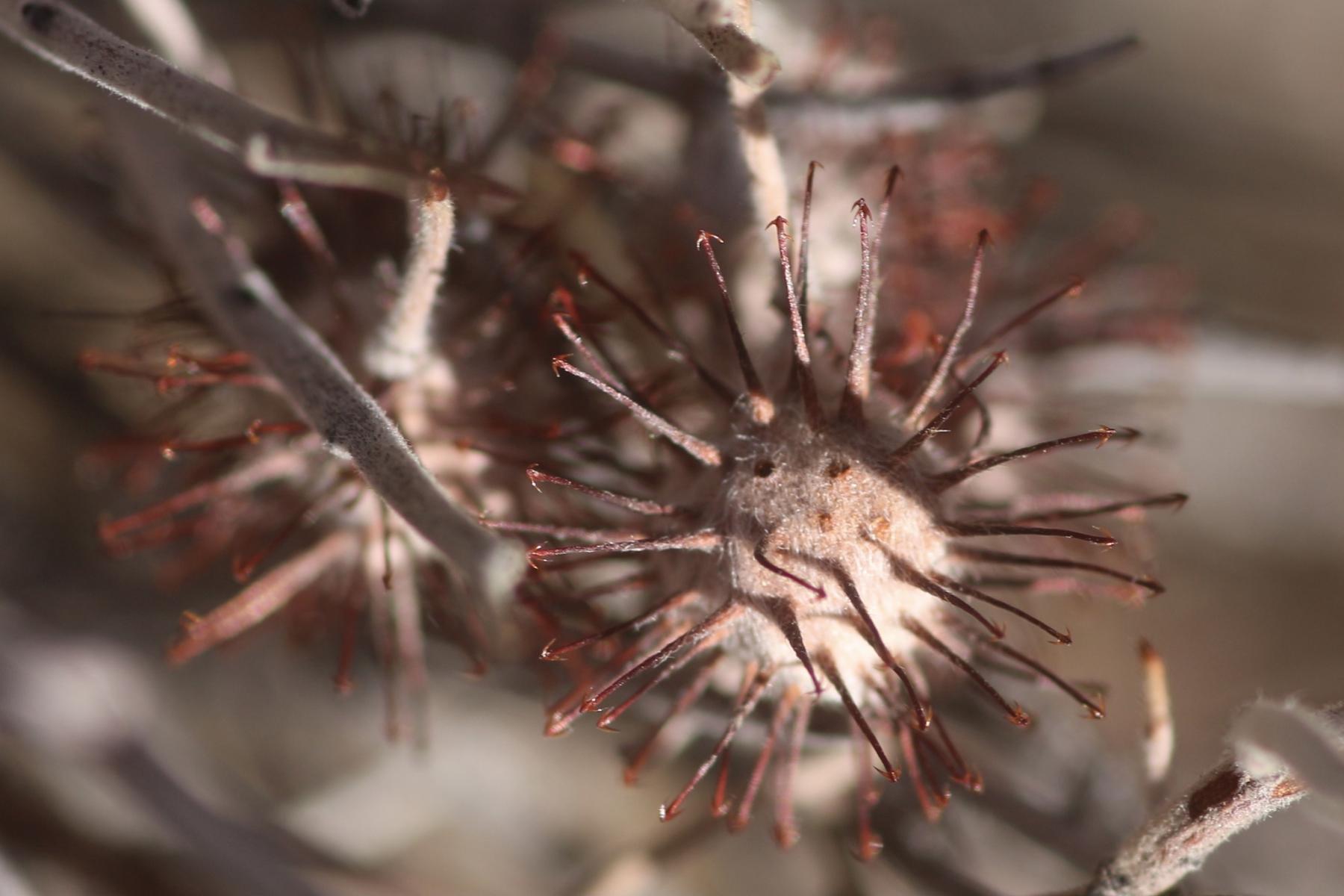
Attractive flowers grow at the end of branchlets and are comprised of five showy sepals, three spatulate upper petals, and two fleshy glandular petals [12,144] (fig. 3). The two fleshy glandular petals secrete oils to attract pollinators [124]. Fruits are roughly spherical and covered in many prickles, each of which ends in a whorl of barbs [41,150] (fig. 4).

Figure 3—A white ratany flower with reflexed, showy purplish sepals, three spatulate upper petals, and two orange, fleshy glandular petals.

Figure 4—White ratany fruits, with barbs at the ends of prickles.
White ratany is a root hemiparasite [125,146], meaning that it photosynthesizes, but it also attaches its roots to a host plant to get water and nutrients. The root system is generally comprised of a short taproot and radiating, shallow lateral roots [125]. The taproot and lateral roots do not typically branch, lack filamentous roots, and lack root hairs. Lateral roots attach to the roots of a host plant via small roots called haustoria [34]. Young white ratany grow a pronounced taproot with relatively few and short lateral roots, which bear haustoria if the plant is growing near a suitable host plant. At some point in its life after the taproot has reached a “rather large” size, the lower portion of the taproot dies and the lateral roots grow as far as 2 m from the main axis. Some lateral roots also apparently die as the plant ages [34]. Based on dry weight, an average of 27% of white ratany’s biomass is in its roots, with 65% and 8% accounted for by stems and leaves, respectively [55]. For detailed descriptions of white ratany’s belowground habit and host relationships, see Cannon and MacDougal’s descriptions of root excavations [34,82].
Raunkiaer Life Form
- Phanerophyte
- Geophyte [108]
Population Structure
White ratany populations typically occur as scattered individuals in a variety of desert community types. Individuals are generally randomly distributed as juveniles and adults. However, the densities of juveniles and adults are positively correlated, indicating that juveniles are more likely to establish in the vicinity of mature plants, although they are not aggregated around mature plants [155].
On Tumamoc Hill in the northern Sonoran Desert, the estimated average maximum lifespan of white ratany was 184 years, although estimates ranged from 34 to 404 years [19]. Based on observations from permanent plots at the same site, 72% of white ratany individuals lived for at least 7 years (n=151) and 50% lived for at least 50 years (n=38) [56]. Longevity dropped to 18% of the long-term average during a severe drought in the early 2000s [19].
Seasonal Development
White ratany grows small leaves in the spring, which it loses during times of water stress [125], typically in the late spring and early summer in the deserts where it grows in the United States.
White ratany flowers in the spring following cool-season rainfall, and it may flower a second time in the summer if there is adequate summer precipitation [123] (table 2). White ratany’s flowering time also appears to be associated with the flowering phenology of its plant associates. In the Sonoran Desert, for example, white ratany’s flowering time largely overlaps with the mass flowering periods of other large, mass-blooming shrubs and large populations of digger bee pollinators [128].
| Location | Flowering period |
|---|---|
| Throughout range | Flowering and fruiting March to May (June) and/or again from (July) August to October [125] |
| Intermountain West | April-May [41] |
| Southwest | April-September [146] |
| Arizona | April-September [71] |
| California | April-May [12,110,127] |
| Nevada | March-September [70] |
| New Mexico | April-August; throughout growing season [37,85] |
| Texas, Trans-Pecos | Spring to fall [106] |
| Utah | April-May [144] |
| Baja California | April-September [152] |
Regeneration Processes
White ratany reproduces by seed [125]. It can also regenerate after being top-killed or damaged by disturbances such as fire [114,154] (see Plant Response to Fire); however, details are lacking.
Pollination and Breeding System

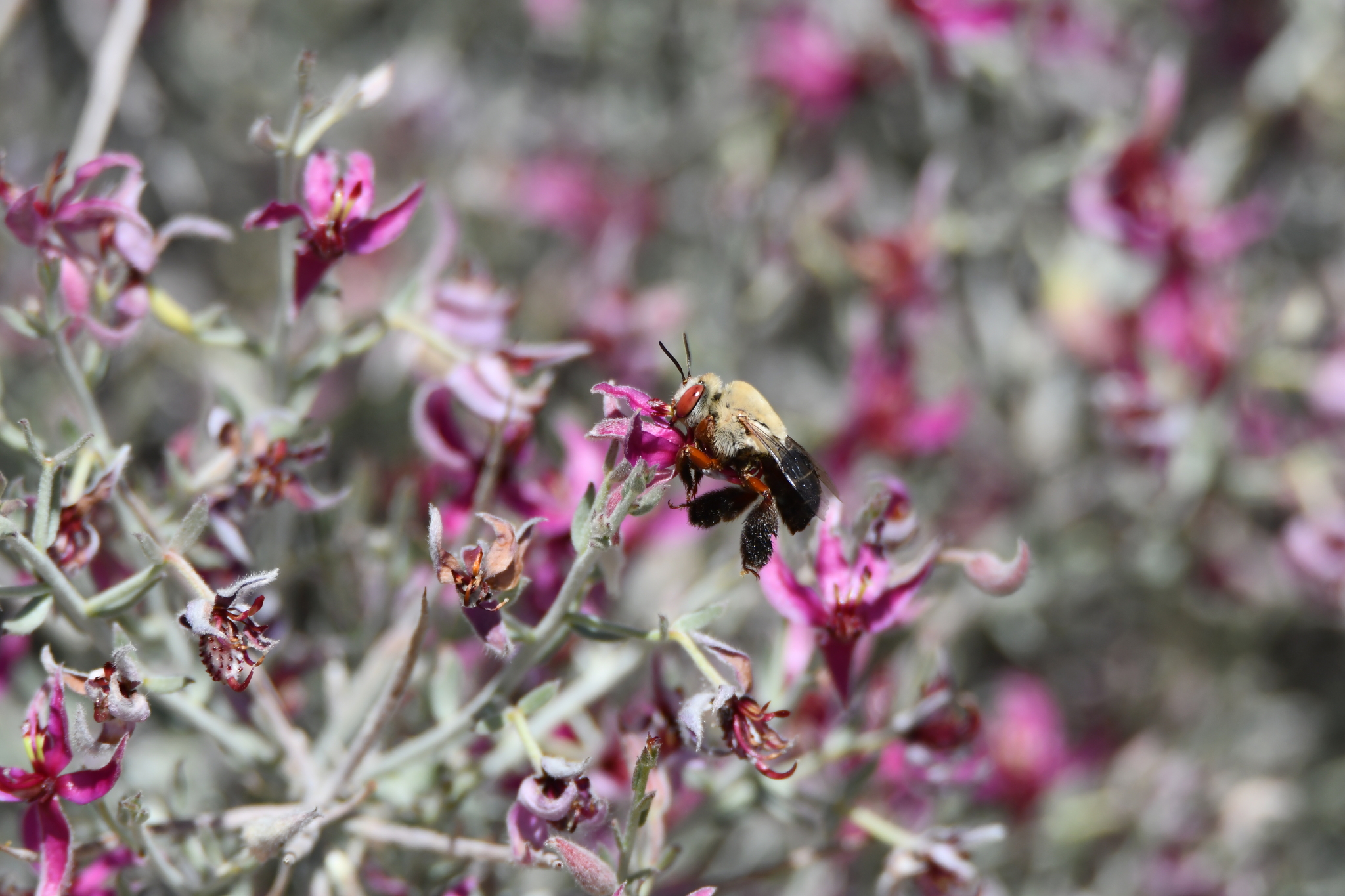
Figure 5—A red-legged oil-digger bee on a white ratany flower (CC BY-NC 4.0).
White ratany relies on oil-collecting digger bees (i.e., Centris bees) for pollination (fig. 5) [11,36,128]. Flowers attract pollinators with specialized oil-producing tissues—elaiophores—rather than nectar [123,124]. Although a few other small bee taxa occasionally visit to collect pollen, white ratany is obligately dependent on digger bees and does not set significant seed without visits to the flowers by female digger bees [128].
White ratany produces perfect flowers, although these are likely self-incompatible, and visitation by oil-collecting digger bees appears to be necessary for fertilization [80,123,128]. In a compatibility study in Arizona, several hundred self-pollinations yielded no mature fruits, whereas a comparable number of cross-pollinations resulted in six mature fruits [123]; however, the same author suggests in a later study that indications of self-incompatibility may have been an artifact of sampling size [128].
Seed Production and Predation
Information about white ratany seed production and predation is limited. However, information about ratany species in general likely applies to white ratany. Viable ratany fruits contain one [125,146] large (>5 mg) [119] seed. The fruit can be considered a single-seeded capsule, as the pericarp (i.e., the outer “shell” of the fruit) sometimes splits lengthwise to release the seed, although it is often described as a nut. Despite high fruit production, white ratany seed production may be very low, and the number of viable versus empty fruits varies greatly from year to year [125].
Ratany fruits are often inviable because they may not have been fertilized, may be aborted after fertilization, and are frequently infested with twirler moth larvae [128]. Twirler moth larvae may destroy up to 90% of the seeds in some seasons [125]. An assessment of seed viability found that 27% to 63% of white ratany fruits contained mature or maturing seeds, 13% to 38% of fruits showed signs of insect damage, and 7% to 14% had active insect infestations (Paloney 1975, cited in [125]). In Beaver Dam Wash, Utah, seed viability was generally low in 2012 and 2013, ranging from 0% to 7% in burned areas and from 4% to 6% in unburned areas [80].
Seed Dispersal
The spines of white ratany fruit apparently aid in dispersal by animals [125]. Old fruits may often be found under white ratany’s canopy (personal observation of the author, Mojave Desert, 2019-2022).
Seed Banking
No information is available on this topic.
Germination
White ratany seeds germinated “readily” in a greenhouse when they were sown in the season that they matured or 1 year later, and regardless of whether they were seeded together with a host plant [82]. Information regarding white ratany germination in the field, including viability and climate requirements, was not found in the literature.
Seedling Establishment
White ratany seems to require specific climatic conditions for establishment. On Tumamoc Hill in Arizona, white ratany showed a nearly continuous increase in canopy cover over 72 years after the area was fenced to exclude grazing by cattle, burros, and horses. However, plant density did not increase until 20 to 30 years after fencing, indicating that it may take decades before climatic conditions are suitable for white ratany establishment [56].
Although seedlings can establish independently, white ratany may require a host plant to persist [82]. Greenhouse plantings show that white ratany requires host plants to survive for a significant length of time, as “no one” has been able to raise ratany plants for an extended period of time without host plants [125]. White ratany seedlings established and grew equally well for a few months when planted in pots with Jerusalem thorn and when planted alone. At a few months old, plants were removed from the soil to examine their roots. Those grown with Jerusalem thorn had some roots with enlarged tips, some of which were attached to Jerusalem thorn roots. However, differences in growth or a critical point when seedlings failed to thrive without a host was not documented [82]. Another author describes growing ratany plants in a greenhouse for 4 years by transplanting wild plants, including 1 m2 of the grassland in which they occurred [125].
Plant Growth and Mortality
White ratany is classified as a long-lived species [119,129]. See Population Structure for estimates of its lifespan.
Vegetative Reproduction and Regeneration
White ratany may [123] or may not [119] reproduce vegetatively. It may resprout after top-kill or damage from disturbances such as fire (see Plant Response to Fire). One source describes it as capable of vegetative reproduction but does not provide any details on frequency of vegetative reproduction or conditions under which it may reproduce vegetatively [123].
Successional Status
White ratany is often associated with late successional communities [94,145], but its ability to resprout may allow it to be present in early successional communities after disturbances such as flood or fire [153]. To establish in early successional communities, white ratany likely requires the prior establishment of a suitable host plant (see Seedling Establishment). White ratany is a palatable shrub and often recovers over time along with “climax grasses” in degraded rangelands after they are protected from grazing [136].
White ratany is typically a larger component of undisturbed vegetation than disturbed vegetation. White ratany had not yet established in a borrow pit bottom 8 years after it was dug but was a dominant species in adjacent undisturbed vegetation with creosotebush and teddybear cholla. The borrow pit bottom was instead dominated by button brittlebush, with much smaller numbers of white bursage, brownplume wirelettuce, and teddybear cholla [145]. On the Nevada Test and Training Range, density of the closely-related littleleaf ratany ranged from 5.6 to 10.0 plants/100 m2 on 108 undisturbed plots in each of three different vegetation types—creosotebush-white bursage, blackbrush, and creosotebush-desert thorn-spiny hopsage—but was absent in disturbed plots, except in creosotebush-white bursage communities where density was 0.2 plants/100 m2 [54].
Immediate Fire Effects
White ratany is killed [31,64,81,129] or top-killed [79,114,154] by fire. When white ratany burns, it is often partially to completely incinerated due to its low growth habit and compact crown [31]. In Arizona Upland desert scrub, 20% to 67% of white ratany biomass was consumed during two June wildfires, and 95% to 97% of photosynthetic tissue was killed [114] (see Plant Response to Fire).
Information on effects of heating or burning on white ratany seeds was not available. No observations of postfire seedling establishment were described in the literature.
Postfire Regeneration Strategy
- Small shrub, adventitious buds and/or a sprouting root crown
- Geophyte, growing points deep in soil [130]
Fire Adaptations
Many desert plants are poorly adapted to survive fire or to reproduce after fire [28,153], which is one reason fire is thought to have been historically rare in the North American warm deserts [77,156]. Although white ratany is likely to burn due to its densely-branched growth form and short stature, it may resprout after top-kill or damage from fire (fig. 6) [79,114,154]. Postfire resprouting in desert species may have evolved as a response to climatic or physical stressors, such as drought or flash flooding, rather than to fire [153]. Resprouting can help desert species such as white ratany persist with increased fire occurrence [154], although it is unclear what frequency of fire it can tolerate. The degree to which white ratany resprouts may be influenced by environmental factors [118]. Rates of resprouting in white ratany are often low, and sprouting may occur more frequently in Sonoran Desert communities than in Mojave Desert communities (see Plant Response to Fire).

Figure 6—White ratany growing rapidly five months after a wildfire in May 2021 in San Diego County, California (CC BY-NC 4.0).
No information about effects of fire on seed survival was available, and no observations of postfire establishment from the soil seed bank were found in the literature.
Plant Response to Fire
After fire, white ratany abundance often decreases [6,31,64,81,114,118,129], but may remain stable or return to prefire values within a few years [79,154]. White ratany postfire abundance may be greater in more mesic microhabitats or during times with relatively high postfire soil moisture content [6,79] due to higher rates of postfire resprouting under those conditions [45,118]. However, data are limited.
White ratany is often a poor resprouter after fire [31,64,81], but may be a moderate [114] or strong [79,154] resprouter under some conditions. Rates of resprouting are influenced by postfire site conditions [6], especially available moisture. For example, on upland sites, cover of white ratany was 0.06% on unburned sites and 0.00% on burned sites, but on xeroriparian sites, cover was 0.07% on unburned sites and 0.03% on burned sites [45]. White ratany may be more likely to resprout in the Sonoran Desert than in the Mojave Desert, due to differences in timing and amounts of precipitation (see Site Characteristics) or other factors [118].
White ratany seedlings were not documented after fire, and only one study explicitly stated that no white ratany seedlings were observed after fire [31].
Sonoran Desert: Arizona Upland Communities
Three to 4 years after two June 1974 wildfires in Arizona Upland vegetation near Phoenix, Arizona, white ratany resprouts were present to a moderate degree, but no seedlings were recorded. During one of the wildfires, 67% of white ratany biomass was consumed and 97% of photosynthetic tissue was killed. Three years after that fire, 54 living white ratany individuals occurred in burned plots and transects, 29 of which were resprouts. The authors did not specify whether individuals on transects that were not resprouts had been skipped by fire or were seedlings. There were no recorded seedlings in burned plots. During a second wildfire in the same area, 20% of white ratany biomass was consumed and 95% of photosynthetic tissue of white ratany was killed. Four years after that fire, 19 living white ratany individuals occurred in burned plots and transects, including 12 resprouts [114].
Despite some incidence of resprouting, postfire decreases in white ratany cover and density appear to be relatively consistent and long lasting on some sites. On the Tonto National Forest, white ratany cover and density were lower on three of four burned sites than in adjacent unburned controls up to 21 years after fire [6] (table 3). At 13 sites located throughout the Sonoran Desert burned 8 to 33 years before surveys, white ratany cover averaged 43% lower and density averaged 71% lower in burned areas than unburned areas [118].
| Fire | Time since fire (years) | White ratany cover (%) | White ratany density (plants/ha) | ||
|---|---|---|---|---|---|
| Burned | Unburned | Burned | Unburned | ||
| Bush Highway | Repeated burns (6 years since most recent burn) | 0.5 | 1.9* | 58 | 324* |
| River | 5 | 0.5 | 1.0* | 125 | 703* |
| Vista | 7 | 0.0 | 0.1 | 13 | 10 |
| Massacre | 17 | — | — | — | — |
| Siphon | 21 | 0.1 | 0.2* | 15 | 90* |
In some instances, a strong resprouting response may allow white ratany populations to maintain prefire abundance, at least in the short term. One year after the May 1993 Vista View fire, white ratany density was 306 plants/ha, with 294 resprouts/ha. Density of white ratany on an unburned control plot was 274 plants/ha [154]. This population of burned white ratany appears to have persisted at numbers similar to unburned populations for at least 7 years (see table 3, referred to as the Vista fire). However, 7 years after this fire, white ratany had much lower density and cover in both burned and unburned plots than plots assessed after 1 year [6], possibly due to plot location, methodology, or other factors.
White ratany was described as an “aggressive resprouter” when it resprouted soon after two prescribed fires on the Tonto National Forest. Data were collected before fire and up to 11 months after fire on a site burned in June 1985, and 12 to 35 months after fire on a site burned in 1983. Data were stratified by microsite: open/shrub microsites either had no perennial vegetation or were dominated by triangle bur ragweed, and tree microsites were dominated by yellow paloverde. White ratany density and cover were lower than prefire values during the first postfire year on both microsite types on the site of the 1985 fire (table 4). White ratany reached its greatest density 35 months after the 1983 fire, with densities similar to the prefire densities of the 1985 fire. Cover values differed by microsite and had reached levels similar to the 1985 prefire levels on tree microsites, but not on open-shrub microsites 35 months after the 1983 fire. No values were significantly different from prefire values (table 4). Annual plant cover and biomass—especially that of nonnative invasive species such as red brome—increased after fire and remained above prefire levels 35 months after fire [79].
| Time since fire (months) | Shrub/open microsites | Tree microsites | ||
|---|---|---|---|---|
| Density (plants/ha) | Cover (m2/ha) | Density (plants/ha) | Cover (m2/ha) | |
| 1985 Burn site | ||||
| Prefire | 138 | 100 | 141 | 39 |
| 1 day | 63 | 75 | 109 | 21 |
| 5 | 52 | 44 | 16 | 6 |
| 11 | 63 | 60 | 63 | 31 |
| 1983 Burn site | ||||
| 12 | 104 | 29 | 125 | 63 |
| 29 | 108 | 63 | 125 | 60 |
| 35 | 139 | 56 | 167 | 107 |
Creosotebush – White Bursage Communities
Four studies documented white ratany’s response to fire in creosotebush – white bursage communities in the Mojave Desert, where it was generally a poor resprouter [31,64,81,129].
In the Coachella Valley in the Sonoran Desert, white ratany was nearly absent from areas burned 2 to 28 years after fire, especially when compared with paired unburned areas (table 5) [31,129]. Reduced abundance of long-lived native shrubs, including creosotebush, white ratany, and white bursage in burned areas was apparent soon after fire [31] and persisted up to 28 years after fire [129]. Burned sites exhibited shifts towards an alternative stable state dominated by native ruderal white brittlebush or nonnative invasive annual grasses [31,129].
| Time since fire (years) | White ratany cover (%) | White ratany density (plants/500 m2) | Source | ||
|---|---|---|---|---|---|
| Burned | Unburned | Burned | Unburned | ||
| 2 | 0.0 | 1.5 | 0.7 | 6.5* | [129] |
| 3 | 0 | 7.5 | 0 | 12.5 | [31] |
| 5 | 0 | 1.5 | 0 | 2.5 | [31] |
| 9 | 0.0 | 2.1* | 0.8 | 11.5* | [129] |
| 12 | 0.0 | <0.1 | 0.0 | 1.3 | [129] |
| 20 | 0.0 | 2.9* | 0.3 | 16.3* | [129] |
| 24 | 0.0 | 0.7 | 0.0 | 4.5* | [129] |
| 28 | 0.0 | 0.7 | 0.0 | 3.0* | [129] |
Six years after four fires in 2005 in Beaver Dam Wash, Utah, ratany density was 87% lower and cover was 91% lower in burned than unburned areas [64]. Seven to 9 years after the fires, white ratany was not detected by surveys in more severely burned areas towards the interior of burned areas, and its abundance was greatly reduced along burned edges. White ratany density was 84% lower and cover was 94% lower in burned edge areas than in unburned areas. In burned edge areas, density of white ratany flowers and fruits was 0.00 flowers and fruits/m2, compared to 0.09 flowers/m2 and 0.05 fruits/m2 in unburned areas. White ratany individuals produced an average of 37 fruits/plant in burned edge areas and 56 fruits/plant in unburned areas, although differences were not significant [81].
Fuel Characteristics
Aboveground parts of white ratany are often consumed by fire due to their receptive fuel structure: low-statured plants with compact crowns in close proximity to surface fuels and finely divided branching habits (fig. 7) [31]. Invasive annual grasses, particularly annual brome species, often grow at higher densities under shrubs in desert scrub communities, and white ratany may be associated with high densities of these highly flammable grasses. The closely related littleleaf ratany, which has a similar growth habit and shares much the same range as white ratany, supports moderate [25] or high [3] densities of nonnative annual red brome.

Figure 7—White ratany is typically low-statured and densely branched. Annual forbs and grasses are young and green in this photo taken in January but will grow taller and dry out in the late spring and summer, developing into a flammable bed of fine fuels (CC BY-NC 4.0).
In most years, desert scrub communities where white ratany occurs are fuel-limited, because vegetation is typically sparse and discontinuous. However, after one or more years with above-average precipitation, establishment of annual forbs and grasses can create relatively thick and continuous patches of fine fuels that are sufficient to carry fire [7,29,44,45,58,90,113,156]. These abundant and novel fuels increase fuel biomass and continuity, thus increasing the potential for uncharacteristically large and frequent fires [29,44,58,153,156]. Patches of bare ground that previously impeded fire spread become fuel bridges that can increase fire extent. This is especially true after 2 or more consecutive wet years (i.e., years with above-average precipitation) because high establishment and seed production during the 1st wet year can result in even greater establishment during the 2nd wet year [23,90,113].
Nonnative invasive plants that have impacted or have the potential to impact fuels in white ratany communities include the annual grasses compact brome, red brome [44,121], cheatgrass [135], Bermudagrass [35], and common Mediterranean grass [24,28], and the perennial grasses buffelgrass [44,67,89], crimson fountaingrass, and Lehmann lovegrass [153]. Nonnative invasive perennial grasses may increase fuel loading relative to nonnative annuals or native species, resulting in greater fuel continuity and higher fire intensity [89,153]. Annual invasive forbs such as redstem stork’s bill [66] and Sahara mustard [68] can also contribute to cover and continuity of fine surface fuels. Historically, native annuals did not occur in densities sufficient to carry fire as often as contemporary nonnatives, so fire intervals were longer [77].
Fire Regimes
Historically, fires were probably rare to infrequent in most communities where white ratany is common. Mean historical fire intervals derived from LANDFIRE succession modeling are estimated to exceed several centuries in most of these communities (see LANDFIRE Biophysical Settings section) [77]. White ratany is most common in shrub-dominated communities where fire was likely rare to infrequent as inferred by a lack of fuels to carry fire in most years, and a lack of fire adaptations [6,140] and slow recovery rate of dominant plants [6,44,114] (e.g., saguaro [61] or Joshua tree [22]). White ratany also grows in communities dominated by perennial graminoids (see Plant Communities), in which fires may have been relatively more frequent than in areas dominated by shrubs. Perennial grass-dominated stands may have been more common in parts of the Mojave [87], Sonoran, and Chihuahuan Deserts [78] before widespread cattle grazing reduced native grass cover, although factors including fire suppression [78] and wetter winters [32] have been suggested as causes of increasing shrub cover in some areas.
Invasive annual grasses are altering fire regimes in North American deserts [26]. Mojave and Sonoran desert scrub communities are particularly vulnerable to fire regime shifts. In the desert regions of the southwestern United States and northern Mexico, larger and more frequent fires may create a feedback loop known as the invasive grass-fire cycle, in which nonnative invasive grasses replace less fire-adapted native species, increasing the likelihood for additional fires [23,42,74,88,156]. In ecosystems where white ratany occurs, contemporary fire regimes may be outside their historical range of variability due to increases in human-caused ignitions combined with increased receptive fine fuel loads and continuity caused by nonnative plant invasions (see Fuel Characteristics) [107] that drive shorter fire intervals [27,72,115,156]. Rapid recovery of herbaceous fuels after fire—especially of nonnative grasses—may lead to repeated fires on a site (i.e., establishment of a grass-fire cycle). Repeated fires or high-severity fire can lead to vegetation type conversions that may persist indefinitely [75,156] (see Plant Response to Fire).
Postfire communities are more likely to be dominated by nonnative invasive annual grasses [31]—especially where propagules of native ruderal species are lacking [129]—which can generate abundant, continuous fuels after above-average cool-season precipitation [64,65]. Climate change is likely to further exacerbate nonnative grass invasions, extend fire seasons, and intensify fire activity in North American warm deserts [1] (see Management Under a Changing Climate).
See these FEIS publications for information on historical fire regimes in plant communities in which white ratany is most common or dominant:
- Fire Regimes of Sonoran Desert Scrub Communities
- Fire Regimes of Mojave Mid-elevation Mixed Desert Scrub Communities
- Fire Regimes of Creosotebush-White Bursage Desert Scrub Communities
- Fire Regimes of Chihuahuan Creosotebush Desert Scrub Communities
For additional fire regime information, search FEIS for this species by entering the species name on the Advanced Search page and selecting “Fire Regime” as the publication type.
Fire Management Considerations
Postfire resprouting of white ratany may maintain prefire population abundance [154]; however, resprouting and seedling establishment together are typically inadequate to maintain prefire populations [114,129]. Postfire seedling establishment is apparently uncommon. It is unlikely that even high rates of resprouting would be adequate to maintain white ratany populations after multiple fires.
Fire is generally considered harmful to desert scrub communities where white ratany occurs. While white ratany may resprout in sufficient numbers to recover after fire under some conditions, fire was historically infrequent in these communities (see Fire Regimes) and many dominant species are not resilient to frequent, large, and/or severe wildfires, especially in communities invaded by nonnative grasses and forbs [156]. Dominant species such as saguaro, paloverde, and creosotebush, may have high mortality rates and low establishment rates after fire [114,119], especially after multiple fires [6,129]. If native dominant species are reduced or eliminated by fire, burned areas may become dominated by nonnative species or by native “ruderal” species, such as white brittlebush [31,129], for decades or longer [156]. A grass-fire cycle can initiate when invasive annual grasses have increased dominance after fire, which increases the likelihood that a burned area will burn again [29]. Because postfire recovery of predisturbance vegetation may not occur for decades or even centuries [43,118], if at all [129], the primary fire management strategy is fire prevention, part of which requires fuels management in the form of reducing cover of nonnative invasive plants [156], and/or fuels that might sustain large-scale, high-intensity fires [97,133].
While there is some debate over the importance of fire in driving nonnative annual grass invasion (e.g., in sagebrush ecosystems [141]), nonnative invasive species are better adapted to take advantage of postfire conditions in desert ecosystems than are native species. More frequent and larger fires will likely promote invasion fronts and subsequent expansion when invasive species are able to spread into previously uninvaded areas after fire [1]. The resulting fire patterns reduce native shrub cover, reduce native biodiversity, and set the stage for a grass-driven fire regime [29,57].
Federal Status
None [143].
Other Status
As of 2026, white ratany is vulnerable (S3) in Nevada and imperiled (S2) in Utah but has no status rank in the other three US states where it is native. It is ranked as globally secure (G5). Additional information on conservation status of plant species in the United States and Canada is available at NatureServe [98].
Importance to Wildlife and Livestock
White ratany provides preferred browse for wildlife and livestock [92,106,146]. When available, white ratany may be one of the most important plants in the diets of feral burros [2] and desert bighorn sheep [92]. A review found that white ratany was the 14th most important species for burros, comprising an average of 1.3% and maximum of 7% of burro diets across seven studies [2]. In the Sonoran Desert of western Arizona, white ratany was the third-most preferred forage species of bighorn sheep [92]. Rodents may eat the fruit of white ratany, and rabbits may gnaw on stems (Paloney 1975, cited in [125]). White ratany was eaten by desert tortoises at five sites including along the Colorado River in Nevada, the southeastern Mojave Desert, and the Colorado Desert in California. Tortoises may climb off the ground into the shrubs to eat the flowers [46].
White ratany is vulnerable to overgrazing by livestock [91] and feral burros, especially in dry years [60]. White ratany cover increases after protection from grazing [4,18,53,56].
White ratany supports specialist pollinators that collect oil, as well as larvae of butterflies and moths. Oil-collecting digger bees collect oil from white ratany’s oil-producing petals to mix with pollen and nectar to feed to their larvae [125]. Twirler moths lay eggs on or in the ovaries of open white ratany flowers so larvae can consume the developing white ratany seeds. Larvae emerge from a hole chewed in the fruit [125].
Palatability and Nutritional Value
White ratany is apparently palatable to wildlife and livestock as it provides preferred browse [92,106,146].
See the following sources for nitrogen content: [55], and in-depth nutritional information: [116].
Cover Value
Ratany species provide habitat for threatened desert tortoises in the Sonoran and Mojave deserts [16,17]. White ratany and littleleaf ratany were dominant species in desert tortoise habitat, where 25.0% of ratany plots had tortoise sign (e.g., tortoise burrows, scat, etc.). However, experts ranked white ratany’s value as a cover species for Sonoran desert tortoises as relatively low (ranked 1 on a scale from 0 to 3, where 3 indicates high value as cover) [117]. In the Mojave Desert, white ratany was the tenth most frequently used cover plant by Mojave desert tortoises [46]. Overgrazing by burros may reduce ratany’s value as a plant providing cover for Mojave desert tortoises [17].
Value for Restoration of Disturbed Sites
Restoration goals in many habitats where white ratany occurs often involve control and removal of nonnative invasive annual grasses, such as red brome [25]. Because ratanies may facilitate invasive annual brome growth, planting white ratany in revegetation projects in areas already invaded by nonnative invasive annual grasses may be inadvisable [3]. However, if invasive annual grasses are not prevalent in restoration areas, white ratany may be valuable in restoration to develop fertile islands and facilitate growth of native annuals and cacti, given its low, much-branching growth form [132]. White ratany is incorporated in Mojave Seed Menus, which is a tool that provides land managers with a list of species predicted to have suitable habitat at a given restoration site. The tool also provides species’ life history, disturbance ecology, pollinator interactions, and propagation techniques [120]. White ratany may require the presence of host plants before it can establish, given its hemiparasitic nature, but this is not documented in the literature. It apparently does not require a host plant to germinate [46,82].
White ratany has been seeded with imprinting for a restoration study in Joshua Tree National Park, although subsequent winter rainfall was low and germination of native species was limited in that season. In the Mojave Desert, several growing seasons may be required until conditions are right for germination [63]. Long-term monitoring results were not found in the literature.
Other Uses
Ratany has been used medicinally in North and South America, as well as Europe, with European use peaking between 1850 and 1920 [126]. White ratany roots contain 18 chemical constituents, including neolignans and nor-neolignans [5], which may have antibacterial, antifungal, antiparasitic, and/or platelet aggregation properties, among others [52]. The Seri Indians use a tea made from flowers to cure upset stomach and diarrhea, while tea made from the roots with the bark removed is used to “make the blood very red.” Dried and ground stems are sprinkled on skin sores that are slow to heal [49]. A tincture of the root or strong tea from the leaves is “one of the best astringents and topical hemostatic” for sores of the mouth [37]. Shoshone Tribes use white ratany to prepare a wash that treat eye infections [5,106]. People of the Pima and Shoshone use an infusion of the root internally and externally to treat gonorrhea [126]. American Indians in Mexico use white ratany root bark to make a yellow rust-red dye [146] to stain baskets and other items. The dye from white ratany roots has also been exploited commercially to produce stain for wood and leather [106].
Other Management Considerations
Important management considerations for white ratany include white ratany’s hemiparasitism on associated species, its role as a nurse plant, and climate change concerns and outcomes.
Hemiparasitism
White ratany is a hemiparasite on a variety of shrubs with which it occurs (see Botanical Characteristics). However, some excavated individuals had no apparent root attachments to other plants [34]. Suitable host plants apparently include a wide range of species, including trees, shrubs, and grasses [34,82,125], including ragweed [76] and especially creosotebush [82,95]. It is unclear whether shrubby ratanies can survive with only herbaceous hosts [125]. White ratany’s haustoria—the structure by which white ratany attaches to the roots of other species—may not “perfect its water relations” with its host until long after it has penetrated the root system [82]. White ratany may require a host plant to successfully establish (see Seedling Establishment).
Nurse Plant Relationships
White ratany may act as a nurse plant for young cholla. White ratany was strongly associated with the two smallest size classes of three species of cholla. It also was the most effective plant species at fruit trapping and providing shade (84%). Seedlings appear to survive better under white ratany than under big galleta, another major nurse plant, perhaps because woody shrubs provide better protection than the grass, or because the grass is a stronger competitor for water than root-parasitic white ratany. The function of nurse plants for cholla species appears to be biotic (e.g., protection from herbivores or fruit trapping) rather than abiotic (e.g., shading or frost protection) [39]. It is possible white ratany acts as a nurse plant for other perennial species—given its presumed low competition for water, high shade production, high herbivore protection, and seed trapping abilities—but no other nurse plant relationship was described in the literature.
White ratany may facilitate annual plant growth. As a late-successional species that forms fertile islands, white ratany provides a more favorable environment for annual species’ establishment and growth than do interspaces or short-lived desert species. Factors such as canopy morphology, seasonality of growth, lifespan, degree and nature of fertile island formation, litterfall and decomposition, and rooting habit could be important for determining which species white ratany may interfere with and which it may facilitate [3].
Management Under a Changing Climate
The deserts of the southwestern United States are particularly vulnerable to climate change and increasing climate variability because desert organisms already live near their limits for water and temperature stress. Many climate models predict that precipitation will decrease and shift in timing, and temperature will increase across most of the warm deserts of the American Southwest and Mexico [1,9,105]. Shifting precipitation patterns include increased variability in rainfall amount and timing, which may result in soil water content below plant thresholds more often [104]. Some desert species may require multiple consecutive wet years to persist, but the probability of consecutive wet years is expected to decrease [50]. Evidence of a warming and drying climate is already apparent in the Southwest [9,40,101], including in the Mojave [59], Sonoran [149], and Chihuahuan [62] deserts. Climate models project that surface temperatures in the desert southwest will increase by nearly 2 °C between 2001 and 2100 [38]; however, temperature increases of 1.5 °C have already been recorded over just 30 years in the Mojave Desert [59]. While precipitation predictions have more uncertainty than temperature predictions, models suggest precipitation will increase slightly in the Chihuahuan Desert and decrease throughout the Mojave and Sonoran deserts. Irregularity of precipitation is projected to increase throughout the Southwest—with longer dry periods interrupted by high-intensity storms—which is expected to increase both drought and flood events [9].
As desert climates change, white ratany will likely shift its range and may shift its phenology. White ratany is likely to decline in parts of its range because of increased aridity. Long-term research in Sonoran Desert creosotebush shrublands documented a decline in white ratany cover over 90 years that was best explained by increased aridity rather than temperature or precipitation values alone [95]. However, as temperatures rise, areas to the north and upwards in elevation of current habitat may become suitable habitat for white ratany. An analysis of flowering shrubs in the northern Sonoran Desert found that flowering may have advanced by 21 to 40 days between 1894 and 2004 due to warmer spring temperatures. White ratany was among the species analyzed, but it was not addressed individually [20].
While information is limited regarding germination, establishment, and flowering requirements, it is possible that white ratany requires minimum rainfall events or moisture thresholds to be met for successful reproduction and establishment. For example, after Tumamoc Hill was protected from grazing, white ratany density did not increase until 20 to 30 years after protection, suggesting that specific requirements for establishment had not been met until then [56]. Potential minimum cool-season precipitation requirements for germination, establishment, or flowering of white ratany may be met less often and/or may be followed by hotter, drier periods, potentially resulting in decreased establishment, or shifted or truncated flowering periods, as has been observed for other desert shrubs [21,47,99,100].
Climate change is likely to increase dominance by nonnative invasive plants. Nonnative invasive annual grasses are more able to respond to sporadic precipitation than most native vegetation. Nonnative invasive perennial plants such as Lehmann lovegrass have greater seedling drought tolerance and are better able to take advantage of winter moisture than native perennial grasses. Buffelgrass populations, currently limited by low winter temperatures [1], may expand in the desert southwest as temperatures rise and the frost-free season lengthens [38]. Increased drought and aridity are expected to increase native woody vegetation stress and mortality. Climate change will likely increase interference from nonnative invasive grasses, increase the number and size of annual grass-driven fires, and decrease the ability of native woody vegetation to recover after fire [1].
Climate change is expected to intensify grass-fire cycles in the desert southwest. As the climate changes, conditions are projected to become more conducive to nonnative invasive annual grass establishment, and disturbances that facilitate invasion are projected to become more frequent. Hotter and drier conditions are likely to promote an earlier start to the fire season, and fires are expected to burn preferentially in fuels that dry earlier in the year, including invasive brome grasses [1]. Nonnative invasive grass-driven fire regimes may transform desert communities into near-monocultures of invasive grasses [9].
Because invasive plant species are likely to thrive at the expense of native plant species under climate change, managers must consider climate factors in control methods. For example, managers may choose to control frost-sensitive invasive species in winters when temperatures drop below freezing. During a wet spring, invasive annual grasses may be abundant, but managers may choose to implement a prescribed fire because native woody species have high fuel moisture and will be more likely to survive the fire. Seeding or outplanting native species may be desirable following several years of drought, when the seedbank of invasive annual grasses is likely to be depleted. Novel ecosystems are likely to become increasingly common as climate continues to change, bringing novel challenges and opportunities for conservation and management [1].
| Biophysical Setting | Mean Fire Interval (years) | Fire Severity Percent (%) | ||||||
|---|---|---|---|---|---|---|---|---|
| Code | Fire Regime Group | Low | Mixed | Replacement | All | Low | Mixed | Replacement |
| Series 10820 - Mojave Mid-Elevation Mixed Desert Scrub | ||||||||
| 10820_12_15_16_17_23_24 | V-B | 815 | 815 | 0 | 0 | 100 | ||
| 10820_14 | V-A | 406 | 406 | 0 | 0 | 100 | ||
| 10820_4_13 | V-A | 399 | 399 | 0 | 0 | 100 | ||
| Series 11552 - North American Warm Desert Riparian Systems - Stringers | ||||||||
| 11552_13_14_15 | V-B | 735 | 735 | 0 | 0 | 100 | ||
| Series 10870 - Sonora-Mojave Creosotebush-White Bursage Desert Scrub | ||||||||
| 10870_4_6_12_13_14_15_17_24_25 | V-A | 329 | 329 | 0 | 0 | 100 | ||
| Series 10740 - Chihuahuan Creosotebush Desert Scrub | ||||||||
| 10740_25_26 | ||||||||
| Series 11350 - Inter-Mountain Basins Semi-Desert Grassland | ||||||||
| 11350_13_14 | IV-B | 119 | 119 | 0 | 0 | 100 | ||
| Series 11090 - Sonoran Paloverde-Mixed Cacti Desert Scrub | ||||||||
| 11090_14 | V-B | 1056 | 1056 | 0 | 0 | 100 | ||
| 11090_15_25 | V-B | 1049 | 1049 | 0 | 0 | 100 | ||
| 11090_4_13 | V-B | 1284 | 1284 | 0 | 0 | 100 | ||
| Series 10910 - Sonoran Mid-Elevation Desert Scrub | ||||||||
| 10910_13_14 | IV-B | 104 | 104 | 0 | 0 | 100 | ||
| Summary | ||||||||
| Minimum | 104 | 104 | 0 | 0 | 100 | |||
| Maximum | 1284 | 1284 | 0 | 0 | 100 | |||
| Mean | 630 | 630 | 0 | 0 | 100 | |||
| Median | 571 | 571 | 0 | 0 | 100 | |||
| Percentage of fires in 3 fire severity classes, derived from LANDFIRE succession modeling. Replacement-severity fires cause >75% kill or top-kill of the upper canopy layer; mixed-severity fires cause 26%-75%; low-severity fires cause <26%. | ||||||||
| LANDFIRE. 2020. Biophysical settings models and descriptions, [Online]. Washington, DC: U.S. Department of Agriculture, Forest Service; U.S. Department of the Interior; U.S. Geological Survey; Arlington, VA: The Nature Conservancy, (Producers). Available: https://www.landfirereview.org/search.php [96496] | ||||||||
Table A1—Common and scientific names of plants in this review.
| Life Form | Common Name | Scientific Name |
|---|---|---|
| Forb/shrub/tree | Mojave yucca | Yucca schidigera |
| Forb/subshrub | brownplume wirelettuce | Stephanomeria pauciflora |
| Graminoid | Bermudagrass | Cynodon dactylon |
| Graminoid | big galleta | Pleuraphis rigida |
| Graminoid | brome | Bromus spp. |
| Graminoid | buffelgrass | Pennisetum ciliare |
| Graminoid | cheatgrass | Bromus tectorum |
| Graminoid | common Mediterranean grass | Schismus barbatus |
| Graminoid | compact brome | Bromus madritensis |
| Graminoid | crimson fountaingrass | Pennisetum setaceum |
| Graminoid | Lehmann lovegrass | Eragrostis lehmanniana |
| Graminoid | red brome | Bromus rubens |
| Shrub | blackbrush | Coleogyne ramosissima |
| Shrub | button brittlebush | Encelia frutescens |
| Shrub | creosotebush | Larrea tridentata |
| Shrub | desert senna | Senna armata |
| Shrub | Fremont's smokebush | Psorothamnus fremontii |
| Shrub | joint-fir | Ephedra spp. |
| Shrub | Nevada smokebush | Psorothamnus polydenius |
| Shrub | ocotillo | Fouquieria splendens |
| Shrub/subshrub | Eastern Mojave buckwheat | Eriogonum fasciculatum |
| Shrub/subshrub | littleleaf ratany | Krameria erecta |
| Shrub/subshrub | Parish's goldeneye | Viguiera parishii |
| Shrub/subshrub | sweetbush | Bebbia juncea |
| Shrub/subshrub | teddybear cholla | Cylindropuntia bigelovii |
| Shrub/subshrub | white brittlebush (a.k.a. brittlebush) | Encelia farinosa |
| Shrub/subshrub | white bursage (a.k.a. burrobush) | Ambrosia dumosa |
| Shrub/tree | Joshua tree | Yucca brevifolia, Y. jaegeriana |
| Shrub/tree | paloverde | Parkinsonia spp. |
| Subshrub | burrobrush | Hymenoclea salsola |
| Tree | saguaro | Carnegiea gigantea |
Table A2—Common and scientific names of animals in this review.
| Life Form | Common Name | Scientific Name |
|---|---|---|
| Insect | digger bee | Centris spp. |
| Insect | red-legged oil-digger bee | Centris rhodopus |
| Insect | twirler moth | Geledchiidae |
| Mammal | bighorn sheep | Ovis canadensis |
| Mammal | burro | Equus asinus |
| Mammal | cattle | Bos taurus |
| Mammal | desert bighorn sheep | Ovis canadensis subsp. nelsoni |
| Mammal | rabbits | Leporidae |
| Reptile | desert tortoise | Gopherus spp. |
| Reptile | Mojave desert tortoise | Gopherus agassizii |
| Reptile | Sonoran desert tortoise | Gopherus morafkai |
1. Abatzoglou, John T.; Kolden, Crystal A. 2011. Climate change in western US deserts: Potential for increased wildfire and invasive annual grasses. Rangeland Ecology & Management. 64(5): 471-478. [92501]
2. Abella, Scott R. 2008. A systematic review of wild burro grazing effects on Mojave Desert vegetation, USA. Environmental Management. 41(6): 809-819. [97472]
3. Abella, Scott R.; Craig, Donovan J.; Chiquoine, Lindsay P.; Prengaman, Kathryn A.; Schmid, Sarah M.; Embrey, Teague M. 2011. Relationships of native desert plants with red brome (Bromus rubens): Toward identifying invasion-reducing species. Invasive Plant Science and Management. 4(1): 115-124. [98829]
4. Abella, Scott R.; Guida, Ross J.; Roberts, Chris L.; Norman, Carrie M.; Holland, James S. 2019. Persistence and turnover in desert plant communities during a 37-yr period of land use and climate change. Ecological Monographs. 89(4): e01390. [98258]
5. Achenbach, Hans. 1995. Neolignans, nor-neolignans and other compounds from roots of Krameria grayi. Phytochemistry. 39(2): 413-415. [100289]
6. Alford, Eddie J.; Brock, John H. 2002. The effects of fire on Sonoran Desert plant communities. Final Report: RMRS-99164-RJVA. Fort Collins, CO: U.S. Department of Agriculture, Forest Service, Rocky Mountain Research Station. 111 p. [Alford's Dissertation]. On file with: U.S. Department of Agriculture, Forest Service, Rocky Mountain Research Station, Fire Sciences Laboratory, Missoula, MT. [47514]
7. Alford, Eddie J.; Brock, John H.; Gottfried, Gerald J. 2005. Effects of fire on Sonoran Desert plant communities. In: Gottfried, Gerald J.; Gebow, Brooke S.; Eskew, Lane G.; Edminster, Carleton B., comps. Connecting mountain islands and desert seas: Biodiversity and management of the Madrean Archipelago II; 5th conference on research and resource management in the southwestern deserts; 2004 May 11-15; Tucson, AZ. Proceedings RMRS-P-36. Fort Collins, CO: U.S. Department of Agriculture, Forest Service, Rocky Mountain Research Station: 451-454. [61785]
8. Allred, Kelly W.; Jercinovic, Eugene M.; DeWitt, Ivey. 2020. Flora Neomexicana III: An illustrated identification Manual; Part 2: Dicotyledonous plants. 2nd ed. Independently published. 795 p. [94735]
9. Archer, Steven R.; Predick, Katharine I. 2008. Climate change and ecosystems of the southwestern United States. Rangelands. 30(3): 23-28. [96376]
10. Avila Lovera, Eleinis. 2018. Do plants with photosynthetic stems respond differently to drought? An ecophysiological evaluation of desert communities. Riverside, CA: University of California. 117 p. Dissertation. [98850]
11. Balbuena, Maria; Buchmann, Stephen; Papaj, Daniel; Raguso, Robert. 2023. Organ-specific volatiles from Sonoran desert Krameria flowers as potential signals for oil-collecting bees. Phytochemistry. 218(1): 113937. [100290]
12. Baldwin, Bruce G.; Goldman, Douglas H.; Keil, David J.; Patterson, Robert; Rosatti, Thomas J.; Wilken, Dieter H., eds. 2012. The Jepson manual. Vascular plants of California. 2nd ed. Berkeley, CA: University of California Press. 1568 p. [86254]
13. Barbour, Michael G.; Keeler-Wolf, Todd; Schoenherr, Allan A., eds. 2007. Terrestrial vegetation of California, 3rd ed. Berkeley, CA: University of California Press. 712 p. [82605]
14. Bedford, David. 2008. Effects of vegetation-related soil heterogeneity on runoff, infiltration, and redistribution in semi-arid shrubland and grassland landscapes. Denver, CO: University of Colorado. 197 p. Dissertation. [100296]
15. Berry, Kristin H.; Gowan, Timothy A.; Miller, David M.; Brooks, Matthew L. 2014. Models of invasion and establishment for African mustard (Brassica tournefortii). Invasive Plant Science and Management. 7(4): 599-616. [97353]
16. Berry, Kristin H.; Turner, Frederick B. 1986. Spring activities and habits of juvenile desert tortoises, Gopherus agassizii, in California. Copeia. 1986(4): 1010-1012. [70479]
17. Berry, Kristin H.; Yee, Julie L.; Lyren, Lisa M. 2020. Feral burros and other influences on desert tortoise presence in the western Sonoran Desert. Herpetologica. 76(4): 403-413. [97463]
18. Blydenstein, John; Hungerford, C. Roger; Day, Gerald I.; Humphrey, R. 1957. Effect of domestic livestock exclusion on vegetation in the Sonoran Desert. Ecology. 38(3): 522-526. [4570]
19. Bowers, Janice E. 2005. Effects of drought on shrub survival and longevity in the northern Sonoran Desert. Journal of the Torrey Botanical Society. 132(3): 421-431. [96659]
20. Bowers, Janice E. 2007. Has climatic warming altered spring flowering date of Sonoran Desert shrubs. The Southwestern Naturalist. 52(3): 347-355. [68657]
21. Bowers, Janice E.; Dimmitt, Mark A. 1994. Flowering phenology of six woody plants in the northern Sonoran Desert. Bulletin of the Torrey Botanical Club. 121(3): 215-229. [49034]
22. Brahmsteadt, Taryn R. 2025. Yucca brevifolia, Yucca jaegeriana, Joshua tree, [Online]. In: Fire Effects Information System, [Online]. U.S. Department of Agriculture, Forest Service, Rocky Mountain Research Station, Fire Sciences Laboratory (Producer). Available: https://research.fs.usda.gov/feis/species-reviews/yucspp. [100307]
23. Brooks, M. L.; Matchett, J. R. 2006. Spatial and temporal patterns of wildfires in the Mojave Desert, 1980-2004. Journal of Arid Environments. 67(Supplement): 148-164. [65283]
24. Brooks, Matthew L. 1999. Alien annual grasses and fire in the Mojave Desert. Madrono. 46(1): 13-19. [34386]
25. Brooks, Matthew L. 2009. Spatial and temporal distribution of non-native plants in upland areas of the Mojave Desert. In: Webb, R. H.; Fenstermaker, L. F.; Heaton, J. S.; Hughson, D. L.; McDonald, E. V.; Miller, D. M., eds. The Mojave Desert: Ecosystem processes and sustainability. 1st edition. Reno, NV: University of Nevada Press: 101-124. [97405]
26. Brooks, Matthew L.; D'Antonio, Carla M.; Richardson, David M.; Grace, James B.; Keeley, Jon E.; DiTomaso, Joseph M.; Hobbs, Richard J.; Pellant, Mike; Pyke, David. 2004. Effects of invasive alien plants on fire regimes. BioScience. 54(7): 677-688. [50224]
27. Brooks, Matthew L.; Minnich, Richard A. 2006. Southeastern deserts bioregion. In: Sugihara, Neil G.; van Wagtendonk, Jan W.; Shaffer, Kevin E.; Fites-Kaufman, Joann; Thode, Andrea E., eds. Fire in California's ecosystems. Berkeley, CA: University of California Press: 391-414. [65559]
28. Brooks, Matthew L.; Minnich, Richard A.; Matchett, John R. 2018. Southeastern deserts bioregion. In: van Wagtendonk, Jan W.; Sugihara, Neil G.; Stephens, Scott L.; Thode, Andrea E.; Shaffer, Kevin E.; Fites-Kaufman, Jo Ann, eds. Fire in California's ecosystems. 2nd ed. Oakland, CA: University of California Press: 353-378. [93914]
29. Brooks, Matthew; Brown, Cynthia; Chambers, Jeanne; D'Antonia, Carla; Keeley, Jon; Belnap, Jayne. 2016. Exotic annual Bromus invasions: Comparisons among species and ecoregions in the western United States. In: Germino, Matthew; Chambers, Jeanne; Brown, Cynthia. Exotic brome-grasses in arid and semiarid ecosystems of the western US. Springer Series on Environmental Management. Cham, Switzerland: Springer International Publishing: 11-60. [100291]
30. Brown, David E. 1982. Chihuahuan desertscrub. In: Brown, David E., ed. Biotic communities of the American Southwest--United States and Mexico. Desert Plants. 4(1-4): 169-179. [3607]
31. Brown, David E.; Minnich, Richard A. 1986. Fire and changes in creosote bush scrub of the western Sonoran Desert, California. The American Midland Naturalist. 116(2): 411-422. [537]
32. Brown, James; Valone, Thomas; Curtin, Charles. 1997. Reorganization of an arid ecosystem in response to climate change. Proceedings of the National Academy of Sciences. 94(18): 9729-9733. [100311]
33. Butterfield, Bradley James. 2009. Structure and dynamics of Sonoran Desert perennial plant communities. Tucson, AZ: Arizona State University. 147 p. Dissertation. [97310]
34. Cannon, William Austin. 1911. The root habits of desert plants. Washington, DC: The Carnegie Institution of Washington. 96 p. [5003]
35. Carey, Jennifer H. 1995. Cynodon dactylon. In: Fire Effects Information System, [Online]. U.S. Department of Agriculture, Forest Service, Rocky Mountain Research Station, Fire Sciences Laboratory (Producer). Available: www.fs.usda.gov/database/feis/plants/graminoid/cyndac/all.html [2024, January 11]. [98834]
36. Carneiro, Liedson Machado, Isabel. 2023. Oil flowers and related oil-collecting bees: A 50-year timeline of knowledge and future directions. Arthropod-Plant Interactions. 17: 543–562. [100292]
37. Carter, Jack L. 1997. Trees and shrubs of New Mexico. Boulder, CO: Johnson Books. 534 p. [72647]
38. Cayan, Daniel R.; Tyree, Mary; Kunkel, Kenneth E.; Castro, Chris; Gershunov, Alexander; Barsugli, Joseph; Ray, Andrea J.; Overpeck, Jonathan; Anderson, Michael; Russell, Joellen; Rajagopalan, Balaji; Rangwala, Imtiaz; Duffy, Phil. 2013. Future climate: Projected average. In: Garfin, Gregg; Jardine, Angela; Merideth, Robert; Black, Mary; LeRoy, Sarah, eds. Assessment of climate change in the southwest United States. National Climate Assessment 2013 Report. Washington, DC: Island Press: 101-125. [97457]
39. Cody, Martin L. 1993. Do cholla cacti (Opuntia spp., subgenus Cylindropuntia) use or need nurse plants in the Mojave Desert? Journal of Arid Environments. 24: 139-154. [22628]
40. Cook, Benjamin I.; Mankin, Justin S.; Anchukaitis, Kevin J. 2018. Climate change and drought: From past to future. Current Climate Change Reports. 4(2): 164-179. [99098]
41. Cronquist, Arthur; Holmgren, Noel H.; Holmgren, Patricia K. 1997. Intermountain flora: Vascular plants of the Intermountain West, U.S.A. Vol. 3, Part A: Subclass Rosidae (except Fabales). New York: The New York Botanical Garden. 446 p. [28652]
42. D'Antonio, Carla M.; Vitousek, Peter M. 1992. Biological invasions by exotic grasses, the grass/fire cycle, and global change. Annual Review of Ecology and Systematics. 23: 63-87. [20148]
43. Esque, Todd C.; Schwalbe, Cecil R. 2002. Alien annual grasses and their relationships to fire and biotic change in Sonoran Desert scrub. In: Tellman, Barbara, ed. Invasive exotic species in the Sonoran region. Arizona-Sonora Desert Museum Studies in Natural History. Tucson, AZ: University of Arizona Press; Arizona-Sonora Desert Museum: 165-194. [48660]
44. Esque, Todd C.; Schwalbe, Cecil R.; Haines, Dustin F.; Halvorson, William L. 2004. Saguaros under siege: Invasive species and fire. Desert Plants. 20(1): 49-55. [91075]
45. Esque, Todd C.; Webb, Robert H.; Wallace, Cynthia S. A.; van Riper, Charles, III; McCreedy, Chris; Smythe, Lindsay. 2013. Desert fires fueled by native annual forbs: Effects of fire on communities of plants and birds in the lower Sonoran Desert of Arizona. The Southwestern Naturalist. 58(2): 223-233. [87384]
46. Esque, Todd; Defalco, Lesley; Tyree, Gayle; Drake, Kristina; Nussear, Kenneth; Wilson, Joseph. 2021. Priority species lists to restore desert tortoise and pollinator habitats in Mojave Desert shrublands. Natural Areas Journal. 41(2): 145-158 [+ supplement]. [100293]
47. Everett, Percy C. 1957. A summary of the culture of California plants at the Rancho Santa Ana Botanic Garden, 1927-1950. Claremont, CA: The Rancho Santa Ana Botanic Garden. 223 p. [7191]
48. Faulconer, Joshua D. 2015. Thresholds for runoff generation in ephemeral streams with varying morphology in the Sonoran Desert in Arizona, USA. Fort Collins, CO: Colorado State University. 66 p. Dissertation. [100294]
49. Felger, Richard S.; Moser, Mary Beck. 1974. Seri Indian pharmacopoeia. Economic Botany. 28: 414-436. [2767]
50. Fleishman, Erica; Belnap, J.; Cobb, N.; Enquist, C. A. F.; Ford, K.; MacDonald, G.;Pellant, M.; Schoennagel, T.; Schmit, L. M.; Schwartz, M.; van Drunick, S.; Westerling, A, L.; Keyser, A.; Lucas, R. 2013. Natural Ecosystems. In: Garfin, Gregg; Jardine, Angela; Merideth, Robert; Black, Mary; LeRoy, Sarah, eds. Assessment of climate change in the southwest United States. National Climate Assessment 2013 Report. Washington, DC: Island Press: 149-167. [100139]
51. Flora of North America Editorial Committee, eds. 2026. Flora of North America north of Mexico, [Online]. Flora of North America Association (Producer). Available: http://www.efloras.org/flora_page.aspx?flora_id=1. [36990]
52. Frezza, Claudio; Venditti, Alessandro; Toniolo, Chiara; De Vita, Daniela; Franceschin, Marco; Ventrone, Antonio; Tomassini, Lamberto; Sebastiano, Foddai; Guiso, Marcella; Nicoletti, Marcello; Serafini, Mauro; Bianco, Armandodoriano. 2020. Nor-Lignans: Occurrence in Plants and Biological Activities - A Review. Molecules. 25(1): 197. [100295]
53. Funicelli, Carianne S.; Anning, Pamela J.; Turner, Dale S. 2001. Long-term vegetation monitoring at Saguaro National Park: A decade of change. Tech. Rep. No. 70. Tucson, AZ: USGS Sonoran Desert Field Station, University of Arizona. 76 p. [95824]
54. Gabbert, W. D.; Schultz, B. W.; Angerer, J. P.; Ostler, W. K. 1995. Plant succession on disturbed sites in four plant associations in the northern Mojave Desert. In: Roundy, Bruce A.; McArthur, E. Durant; Haley, Jennifer S.; Mann, David K., compilers. Proceedings: Wildland shrub and arid land restoration symposium; 1993 October 19-21; Las Vegas, NV. Gen. Tech. Rep. INT-GTR-315. Ogden, UT: U.S. Department of Agriculture, Forest Service, Intermountain Research Station: 183-188. [24846]
55. Garcia-Moya, Edmondo; McKell, Cyrus M. 1970. Contribution of shrubs to the nitrogen economy of a desert-wash plant community. Ecology. 51(1): 81-88. [52371]
56. Goldberg, Deborah E.; Turner, Raymond M. 1986. Vegetation change and plant demography in permanent plots in the Sonoran Desert. Ecology. 67(3): 695-712. [4410]
57. Gorder, Joel; Shaw, Rachel; Whitney, Rebecca. 2005. Joshua Tree National Park: Fire management plan. Environmental Assessment. Twentynine Palms, CA: U.S. Department of the Interior, National Park Service, Joshua Tree National Park (Producer). Available: http://www.nps.gov/jotr/parkmgmt/upload/fire.pdf [2006, September 8]. [63502]
58. Gray, Miranda E.; Dickson, Brett G.; Zachmann, Luke J. 2014. Modelling and mapping dynamic variability in large fire probability in the lower Sonoran Desert of south-western Arizona. International Journal of Wildland Fire. 23(8): 1108-1118. [88832]
59. Guida, Ross J.; Abella, Scott R.; Smith, William J.; Stephen, Haroon; Roberts, Chris L. 2014. Climate change and desert vegetation distribution: Assessing thirty years of change in southern Nevada's Mojave Desert. Professional Geographer. 66(2): 311-322. [98840]
60. Hanley, Thomas A.; Brady, Ward W. 1977. Feral burro impact on a Sonoran Desert range. Journal of Range Management. 30(5): 374-377. [4337]
61. Helmy, Olga. 2021. Carnegiea gigantea, saguaro. In: Fire Effects Information System, [Online]. U.S. Department of Agriculture, Forest Service, Rocky Mountain Research Station, Missoula Fire Sciences Laboratory (Producer). Available: www.fs.usda.gov/database/feis/plants/cactus/cargig/all.html. [97411]
62. Hoerling, Martin P.; Dettinger, Michael; Wolter, Klaus; Lukas, Jeff; Eischeid, Jon; Nemani, Rama; Liebmann, Brant; Kunkel, Kenneth E. 2013. Present weather and climate: Evolving conditions. In: Garfin, Gregg; Jardine, Angela; Merideth, Robert; Black, Mary; LeRoy, Sarah, eds. Assessment of climate change in the southwest United States. National Climate Assessment 2013 Report. Washington, DC: Island Press: 74-96. [97414]
63. Holden, Mark; Miller, Carol. 1995. New arid land revegetation techniques at Joshua Tree National Monument. In: Roundy, Bruce A.; McArthur, E. Durant; Haley, Jennifer S.; Mann, David K., compilers. Proceedings: Wildland shrub and arid land restoration symposium; 1993 October 19-21; Las Vegas, NV. Gen. Tech. Rep. INT-GTR-315. Ogden, UT: U.S. Department of Agriculture, Forest Service, Intermountain Research Station: 99-101. [24832]
64. Horn, Kevin J. 2013. Factors underlying invasive grass fire regimes in the Mojave Desert and its consequences on plant and animal communities. Provo, UT: Brigham Young University. 160 p. Dissertation. [88029]
65. Horn, Kevin J.; St. Clair, Samuel B. 2017. Wildfire and exotic grass invasion alter plant productivity in response to climate variability in the Mojave Desert. Landscape Ecology. 32(3): 635-646. [91698]
66. Howard, Janet L. 1992. Erodium cicutarium. In: Fire Effects Information System, [Online]. U.S. Department of Agriculture, Forest Service, Rocky Mountain Research Station, Fire Sciences Laboratory (Producer). Available: www.fs.usda.gov/database/feis/plants/forb/erocic/all.html [2024, January 11]. [98842]
67. Innes, Robin J. 2022. Pennisetum ciliare, buffelgrass. In: Fire Effects Information System, [Online]. U.S. Department of Agriculture, Forest Service, Rocky Mountain Research Station, Missoula Fire Sciences Laboratory (Producer). Available: www.fs.usda.gov/database/feis/plants/graminoid/pencil/all.html. [98237]
68. Innes, Robin J. 2023. Brassica tournefortii, Sahara mustard. In: Fire Effects Information System, [Online]. U.S. Department of Agriculture, Forest Service, Rocky Mountain Research Station, Missoula Fire Sciences Laboratory (Producer). Available: www.fs.usda.gov/database/feis/plants/forb/bratou/all.html. [98218]
69. Kartesz, J. T.; The Biota of North America Program (BONAP). 2015. Taxonomic Data Center, [Online]. Chapel Hill, NC: The Biota of North America Program, (Producer). Available: http://bonap.net/tdc [maps generated from Kartesz, J. T. 2015. Floristic synthesis of North America, Version 1.0. Biota of North America Program (BONAP)] (in press). [84789]
70. Kartesz, John Thomas. 1988. A flora of Nevada. Reno, NV: University of Nevada. 1729 p. Dissertation. [42426]
71. Kearney, Thomas H.; Peebles, Robert H.; Howell, John Thomas; McClintock, Elizabeth. 1960. Arizona flora. 2nd ed. Berkeley, CA: University of California Press. 1085 p. [6563]
72. Keeley, Jon E.; Keeley, Sterling C. 1988. Chaparral. In: Barbour, Michael G.; Billings, William Dwight, eds. North American terrestrial vegetation. New York: Cambridge University Press: 165-207. [19545]
73. Kemp, Paul R. 1989. Seed banks and vegetation processes in deserts. In: Leck, Mary Allessio; Parker, V. Thomas; Simpson, Robert L., eds. Ecology of soil seed banks. San Diego, CA: Academic Press: 257-281. [60865]
74. Klinger, Rob; Brooks, Matt. 2017. Alternative pathways to landscape transformation: Invasive grasses, burn severity and fire frequency in arid ecosystems. Journal of Ecology. 105(6): 1521-1533. [92303]
75. Klinger, Rob; Underwood, Emma C.; McKinley, Randy; Brooks, Matthew L. 2021. Contrasting geographic patterns of ignition probability and burn severity in the Mojave Desert. Frontiers in Ecology and Evolution. 9: 593167. [95796]
76. Lambert, S. E.; Jones, Cynthia; Schenk, H. 2010. Distribution of axis-splitting in Mojave Desert shrub species along an elevational gradient. Journal of Arid Environments. 75(2): 106-111. [100297]
77. LANDFIRE. 2020. Biophysical settings models and descriptions, [Online]. Washington, DC: U.S. Department of Agriculture, Forest Service; U.S. Department of the Interior; U.S. Geological Survey; Arlington, VA: The Nature Conservancy, (Producers). Available: http://www.landfirereview.org/search.php [2024, February 2]. [96496]
78. Leavitt, Daniel J.; Leavitt, Allison F.; Ritzi, Christopher M. 2010. Post-grazing changes of vegetation in Big Bend National Park, Texas: a 50-year perspective. The Southwestern Naturalist. 55(4): 430-500. [82386]
79. Loftin, Samuel Robert. 1987. Postfire dynamics of a Sonoran Desert ecosystem. Tempe, AZ: Arizona State University. 97 p. Thesis. [12296]
80. Lybbert, Andrew H. 2014. Fire and ungulate herbivory differentially affect the sexual reproduction of generalist and specialist pollinated plants. Provo, UT: Brigham Young University. 75 p. Thesis. [88569]
81. Lybbert; Andrew H.; Taylor, Justin; DeFranco, Alyssa; St. Clair, Samuel B. 2017. Reproductive success of wind, generalist, and specialist pollinated plant species following wildfire in desert landscapes. International Journal of Wildland Fire. 26(12): 1030-1039. [93080]
82. MacDougal, Daniel Trembly; Cannon, William Austin. 1910. The conditions of parasitism in plants. Biodiversity Heritage Library. Washington, D.C: Carnegie Institution of Washington. 97 p. [100298]
83. MacMahon, James A.; Wagner, Frederic H. 1985. The Mojave, Sonoran and Chihuahuan Deserts of North America. In: Evenari, Michael; Noy-Meir, Imanuel; Goodall, David W. eds. 12A: Hot deserts and arid shrublands. Ecosystems of the world. Amsterdam: Elsevier: 105-201. [95987]
84. Marks, John Brady. 1950. Vegetation and soil relations in the lower Colorado Desert. Ecology. 31(2): 176-193. [44004]
85. Martin, William C.; Hutchins, Charles R. 1981. A flora of New Mexico. Volume 2. Germany: J. Cramer. 2589 p. [37176]
86. McAuliffe, J. R.; Hamerlynck, E. P. 2010. Perennial plant morality in the Sonoran and Mojave deserts in response to severe, multi-year drought. Journal of Arid Environments. 74(8): 885-896. [81411]
87. McAuliffe, Joseph R. 2016. Perennial grass-dominated plant communities of the eastern Mojave Desert region. Desert Plants. 32(1): 8-91. [91546]
88. McDonald, C. J.; McPherson, G. R. 2011. Fire behavior characteristics of buffelgrass-fueled fires and native plant community composition in invaded patches. Journal of Arid Environments. 75(11): 1147-1154. [83896]
89. McDonald, Christopher J.; McPherson, Guy R. 2013. Creating hotter fires in the Sonoran Desert: Buffelgrass produces copious fuels and high fire temperatures. Fire Ecology. 9(2): 26-39. [87751]
90. McLaughlin, Steven P.; Bowers, Janice E. 1982. Effects of wildfire on a Sonoran Desert plant community. Ecology. 63(1): 246-248. [1619]
91. Milchunas, Daniel G., ed. 2006. Responses of plant communities to grazing in the southwestern United States. Gen. Tech. Rep. RMRS-GTR-169. Fort Collins, CO: U.S. Department of Agriculture, Forest Service, Rocky Mountain Research Station. 126 p. [63342]
92. Miller, Gary D.; Gaud, William S. 1989. Composition and variability of desert bighorn sheep diets. The Journal of Wildlife Management. 53(3): 597-606. [14429]
93. Miriti, Maria N.; Howe, Henry F.; Wright, S. Joseph. 1998. Spatial patterns of mortality in a Colorado desert plant community. Plant Ecology. 136(1): 41-51. [61300]
94. Muller, Cornelius H. 1940. Plant succession in the Larrea-Flourensia climax. Ecology. 21: 206-212. [4244]
95. Munson, Seth M.; Webb, Robert H.; Belnap, Jayne; Hubbard, J. Andrew; Swann, Don E.; Rutman, Sue. 2012. Forecasting climate change impacts to plant community composition in the Sonoran Desert region. Global Change Biology. 18(3): 1083-1095. [97255]
96. Munz, Philip A. 1974. A flora of southern California. Berkeley, CA: University of California Press. 1086 p. [4924]
97. National Park Service. 2021. Resource stewardship strategy summary: Joshua Tree National Park, California. Twentynine Palms, CA: U.S. Department of the Interior, National Park Service, Joshua Tree National Park. 115 p. [99334]
98. NatureServe. 2026. NatureServe network biodiversity location data, [Online]. Arlington, VA: NatureServe, (Producer). Available: https://explorer.natureserve.org. [94379]
99. Neil, Kaesha. 2008. Effects of urbanization on flowering phenology in the metropolitan phoenix region of USA: Findings from herbarium records. Tempe, AZ: Arizona State University. 117 p. Dissertation. [98852]
100. Neil, Kaesha; Wu, Jianguo; Bang, Christofer; Faeth, Stanley. 2014. Urbanization affects plant flowering phenology and pollinator community: Effects of water availability and land cover. Ecological Processes. 3(1): 17. [99136]
101. Overpeck, Jonathan T.; Udall, Bradley. 2020. Climate change and the aridification of North America. PNAS. 117(22): 11856-11858. [99094]
102. Parker, Kathleen C. 1988. Environmental relationships and vegetation associates of columnar cacti in the northern Sonoran Desert. Vegetatio. 78(3): 125-140. [6953]
103. Peterson, Eric B. 2008. International vegetation classification alliances and associations occurring in Nevada with proposed additions. Carson City, NV: Nevada Natural Heritage Program. 347 p. [77864]
104. Petrie, M. D.; Collins, S. L.; Gutzler, D. S.; Moore, D. M. 2014. Regional trends and local variability in monsoon precipitation in the northern Chihuahuan Desert, USA. Journal of Arid Environments. 103: 63-70. [98820]
105. Polley, Wayne H.; Briske, David D.; Morgan, Jack A.; Wolter, Klaus; Bailey, Derek W.; Brown, Joel R. 2013. Climate change and North American rangelands: Trends, projections, and implications. Rangeland Ecology & Management. 66(5): 512-528. [98950]
106. Powell, A. Michael. 1988. Trees and shrubs of Trans-Pecos Texas: Including Big Bend and Guadalupe Mountains National Parks. Big Bend National Park, TX: Big Bend Natural History Association. 536 p. [6130]
107. Rao, Leela E.; Matchett, John R.; Brooks, Matthew L.; Johnson, Robert F.; Minnich, Richard A.; Allen, Edith B. 2015. Relationships between annual plant productivity, nitrogen deposition and fire size in low-elevation California desert scrub. International Journal of Wildland Fire. 2491: 48-58. [89121]
108. Raunkiaer, C. 1934. The life forms of plants and statistical plant geography. Oxford, England: Clarendon Press. 632 p. [2843]
109. Rautenstrauch, Kurt R.; Krausman, Paul R.; Whiting, Frank M.; Brown, William H. 1988. Nutritional quality of desert mule deer forage in King Valley, Arizona. Desert Plants. 8(4): 172-174. [2768]
110. Richardson, Jesse M.; Gealy, David R.; Morrow, Larry A. 1987. Preventing downy brome (Bromus tectorum) seed production with DPX-Y6202 and flauzifop. Weed Science. 35: 277-281. [1974]
111. Righetti, Timothy L.; Munns, Donald N. 1980. Nodulation and nitrogen fixation in cliffrose (Cowania mexicana var. stansburiana (Torr. Jeps.). Plant Physiology. 65(2): 411-412; 1980. [1992]
112. Robertson, J. H.; Neal, D. L.; McAdams, K. R.; Tueller, P. T. 1970. Changes in crested wheatgrass ranges under different grazing treatments. Journal of Range Management. 23: 27-34. [2005]
113. Rogers, G. F.; Vint, M. K. 1987. Winter precipitation and fire in the Sonoran Desert. Journal of Arid Environments. 13(1): 47-52. [5547]
114. Rogers, Garry F.; Steele, Jeff. 1980. Sonoran Desert fire ecology. In: Stokes, Marvin A.; Dieterich, John H., technical coordinators. Proceedings of the fire history workshop; 1980 October 20-24; Tucson, AZ. Gen. Tech. Rep. RM-81. Fort Collins, CO: U.S. Department of Agriculture, Forest Service, Rocky Mountain Forest and Range Experiment Station: 15-19. [16036]
115. Schmid, Mary K.; Rogers, Garry F. 1988. Trends in fire occurrence in the Arizona upland subdivision of the Sonoran Desert, 1955 to 1983. The Southwestern Naturalist. 33(4): 437-444. [6103]
116. Seegmiller, Rick F.; Krausman, Paul R.; Brown, William H.; Whiting, Frank M. 1990. Nutritional composition of desert bighorn sheep forage in the Harquahala Mountains, Arizona. Desert Plants. 10(2): 87-90. [11943]
117. Shryock, Daniel F.; Esque, Todd C.; Chen, Felicia C. 2015. A 30-year chronosequence of burned areas in Arizona - effects of wildfires on vegetation in Sonoran Desert tortoise (Gopherus morafkai) habitats. Open-File Report 2015-1060. Reston, VA: U.S. Geological Survey. 61 p. [97280]
118. Shryock, Daniel F.; Esque, Todd C.; Chen, Felicia C. 2015. Topography and climate are more important drivers of long-term, post-fire vegetation assembly than time-since-fire in the Sonoran Desert, US. Journal of Vegetation Science. 26(6): 1134-1147. [92517]
119. Shryock, Daniel; Defalco, Lesley; Esque, Todd. 2014. Life-history traits predict perennial species response to fire in a desert ecosystem. Ecology and Evolution. 4(15): 3046-3059. [99803]
120. Shryock, Daniel; Defalco, Lesley; Esque, Todd. 2022. Seed menus: An integrated decision-support framework for native plant restoration in the Mojave Desert. Ecology and Evolution. 12(4): 1-16. [100306]
121. Simonin, Devin A. 2001. Bromus madritensis, Bromus rubens. In: Fire Effects Information System, [Online]. U.S. Department of Agriculture, Forest Service, Rocky Mountain Research Station, Fire Sciences Laboratory (Producer). Available: www.fs.usda.gov /database/feis/plants/graminoid/brospp/all.html [2024, January 12]. [98867]
122. Simpson, B. B. 2013. Krameria bicolor, the correct name for Krameria grayi (Krameriaceae). Phytoneuron. 2013-62: 1. [100302]
123. Simpson, Beryl B. 1977. Breeding systems of dominant perennial plants of two disjunct warm desert ecosystems. Oecologia. 27(3): 203-226. [96409]
124. Simpson, Beryl B. 1982. Krameria (Krameriaceae) flowers: Orientation and elaiophore morphology. Taxon. 31(3): 517-528. [100300]
125. Simpson, Beryl B. 1989. Krameriaceae. Flora Neotropica. Monograph 49: 1-108. [100301]
126. Simpson, Beryl B. 1991. The past and present uses of rhatany (Krameria, Krameriaceae). Economic Botany. 45(3): 397-409. [100303]
127. Simpson, Beryl B. 2012. Krameria bicolor, in Jepson Flora Project (eds.) Jepson eFlora. ttps://ucjeps.berkeley.edu/eflora/eflora_display.php?tid=91905, [27, March 2026]. [100304]
128. Simpson, Beryl B.; Neff, John L. 1987. Pollination Ecology in the Southwest. Journal of Systematic and Floristic Botany. 11(4): 2. [100299]
129. Steers, Robert J.; Allen, Edith B. 2011. Fire effects on perennial vegetation in the western Colorado Desert, USA. Fire Ecology. 7(3): 59-74. [85189]
130. Stickney, Peter F. 1989. Seral origin of species comprising secondary plant succession in northern Rocky Mountain forests. FEIS workshop: Postfire regeneration. Unpublished draft on file at: U.S. Department of Agriculture, Forest Service, Rocky Mountain Research Station, Fire Sciences Laboratory, Missoula, MT. 10 p. [20090]
131. Swank, Wendell G. 1958. The mule deer in Arizona chaparral. Wildlife Bulletin No. 3. Phoenix, AZ: State of Arizona, Game and Fish Department. 109 p. [12327]
132. Thompson, D. B.; Walker, L. R.; Landau, F. H.; Stark, L. R. 2005. The influence of elevation, shrub species, and biological soil crust on fertile islands in the Mohave Desert, USA. Journal of Arid Environments. 61(4): 609-629. [52364]
133. Thornburg, John. 2016. Saguaro National Park: Fire management plan. Tucson, AZ: National Park Service, Saguaro National Park. 110 p. [99333]
134. Thorne, Robert F.; Prigge, Barry A.; Henrickson, James. 1981. A flora of the higher ranges and the Kelso Dunes of the eastern Mojave Desert in California. Aliso. 10(1): 71-186. [3767]
135. Thrift, Brian D.; Mosley, Jeffrey C.; Brewer, Tracy K.; Roeder, Brent L.; Olson, Bret E.; Kott, Rodney W. 2008. Prescribed sheep grazing to suppress spotted knapweed on foothill rangeland. Rangeland Ecology & Management. 61(1): 18-25. [93768]
136. Tueller, Paul T. 1975. Secondary succession, disclimax, and range condition standards in desert scrub vegetation. In: Hyder, D. N., ed. Arid shrublands--Proceedings, 3rd workshop of the United States/Australia rangelands panel; 1973 March 26 - April 5; Tucson, AZ. Denver, CO: Society for Range Management: 57-65. [3790]
137. Turnage, William V.; Hinckley, Arthur L. 1938. Freezing weather in relation to plant distribution in the Sonoran Desert. Ecological Monographs. 8(2): 530-550. [3789]
138. Turner, Raymond M. 1982. Mohave desertscrub. In: Brown, David E., ed. Biotic communities of the American Southwest--United States and Mexico. Desert Plants. 4(1-4): 157-168. [2374]
139. Turner, Raymond M.; Brown, David E. 1982. Sonoran desertscrub. Desert Plants. 4(1-4): 181-221. [2375]
140. Turner, Raymond M.; Webb, Robert H.; Esque, Todd C.; Rogers, Garry F. 2010. Repeat photography and low-elevation fire responses in the southwestern United States. In: Webb, Robert H.; Boyer, Diane E.; Turner, Raymond M. Repeat photography: Methods and applications in the natural sciences. 1st ed. Washington, DC: Island Press: 224-235. [95737]
141. Urza, Alexandra K.; Board, David I.; Bradford, John B.; Brown, Jessi L.; Chambers, Jeanne C.; Schlaepfer, Daniel R.; Short, Karen C. 2024. Disentangling drivers of annual grass invasion: Abiotic susceptibility vs. fire-induced conversion to cheatgrass dominance in the sagebrush biome. Biological Conservation. 297: 110737. [99529]
142. USDA, NRCS. 2026. The PLANTS database, [Database]. Greensboro, NC: U.S. National Plant Data Team, (Producer). Available: https://plants.usda.gov/. [34262]
143. USDI, Fish and Wildlife Service. 2026. Endangered Species Program, [Online]. U.S. Department of the Interior, Fish and Wildlife Service (Producer). Available: https://www.fws.gov/endangered/. [86564]
144. Van Buren, Renee; Cooper, Janet G.; Shultz, Leila M.; Harper, Kimball T. 2011. Woody plants of Utah. A field guide with identification keys to native and naturalized trees, shrubs, cacti, and vines. Logan, UT: Utah State University Press. 513 p. [93924]
145. Vasek, Frank C. 1979. Early successional stages in Mojave Desert scrub vegetation. Israel Journal of Botany. 28(3-4): 133-148. [4579]
146. Vines, Robert A. 1960. Trees, shrubs, and woody vines of the Southwest. Austin, TX: University of Texas Press. 1104 p. [7707]
147. Warren, Peter L.; Anderson, L. Susan. 1985. Gradient analysis of a Sonoran Desert wash. In: Johnson, R. Roy; [and others], technical coordinators. Riparian ecosystems and their management: Reconciling conflicting issues: Proceedings, 1st North American riparian conference; 1985 April 16-18; Tucson, AZ. Gen. Tech. Rep. RM-120. Fort Collins, CO: U.S. Department of Agriculture, Forest Service, Rocky Mountain Forest and Range Experiment Station: 150-155. [17158]
148. Waterfall, U. T. 1946. Observations on the desert gypsum flora of southwestern Texas and adjacent New Mexico. The American Midland Naturalist. 36(2): 456-466. [60505]
149. Weiss, Jeremy L.; Overpeck, Jonathan T. 2005. Is the Sonoran Desert losing its cool? Global Change Biology. 11(12): 2065-2077. [95504]
150. Welsh, Stanley L.; Atwood, N. Duane; Goodrich, Sherel; Higgins, Larry C., eds. 2016. A Utah flora. 5th ed. Provo, UT: Brigham Young University. 987 p. [94185]
151. Whitbeck, Douglas Craig. 2013. Mapping of Sonoran Desert vegetation communities of San Cristobal Valley and southern Sentinel Plains, Barry M. Goldwater Range and variables influencing route proliferation in the Barry M. Goldwater Range's San Cristobal Valley. University of Arizona. 102 p. Thesis. [100305]
152. Wiggins, Ira L. 1980. Flora of Baja California. Stanford, CA: Stanford University Press. 1025 p. [21993]
153. Wilder, Benjamin T.; Jarnevich, Catherine S.; Baldwin, Elizabeth; Black, Joseph S.; Franklin, Kim A.; Grissom, Perry; Hovanes, Katherine A.; Olsson, Aaryn; Maulsa, Jim; Kibria, Abu S. M. G.; Li, Yue M.; Lien, Aaron M.; Ponce, Alejandro; Rowe, Julia A.; Soto, Jose R.; Stahl, Maya R.; Young, Nicholas E.; Betancourt, Julio L. 2021. Grassification and fast-evolving fire connectivity and risk in the Sonoran Desert, United States. Frontiers in Ecology and Evolution. 9: e955561 [+Supplement]. [96620]
154. Wilson, R. C.; Narog, M. G.; Koonce, A. L.; Corcoran, B. M. 1994. Postfire regeneration in Arizona's giant saguaro shrub community. In: DeBano, Leonard F.; Gottfried, Gerald J.; Hamre, Robert H.; Edminster, Carleton B.; Ffolliott, Peter F.; Ortega-Rubio, Alfredo. Biodiversity and management of the Madrean Archipelago: The Sky Islands of southwestern United States and northwestern Mexico. RM-GTR-264. Fort Collins, CO: U.S. Department of Agriculture, Forest Service, Rocky Mountain Forest and Range Experiment Station: 669 p. [95503]
155. Wright, S. J.; Howe, H. F. 1987. Pattern and mortality in Colorado desert plants. Oecologia. 73: 543-552. [2755]
156. Zouhar, Kristin. 2023. Fire regimes of Sonoran desert scrub communities. In: Fire Effects Information System, [Online]. U.S. Department of Agriculture, Forest Service, Rocky Mountain Research Station, Missoula Fire Sciences Laboratory (Producer). Available: www.fs.usda.gov/database/feis/fire_regimes/Sonoran_desert_scrub/all.html. [98816]