


Larix decidua, European larch
Sullivan, Janet. 1994. Larix decidua, European larch. In: Fire Effects Information System, [Online]. U.S. Department of Agriculture, Forest Service, Rocky Mountain Research Station, Fire Sciences Laboratory (Producer). Available: https://research.fs.usda.gov/feis/species-reviews/lardec
| Abbreviation | Common Name | Scientific Name | Classification | Status |
|---|---|---|---|---|
| Plants | ||||
| LARDEC | European larch | Larix decidua | Life Form: Plants/Tree Kingdom: Plantae Class: Conifer Order: Pinales Family: Pinaceae Genus: Larix | Fed. Protected: No Nativity: Nonnative Invasiveness: Noninvasive |

Taxonomy
The currently accepted scientific name for European larch is Larix decidua Mill. (Pinaceae) [12]. There are four or five geographic races, sometimes given status as subspecies or varieties (Alpen [Alpine], Sudeten, Tatra, Polen [Polish], Rumanian) [17,25]:
- Larix decidua var. decidua
- Larix decidua var. pendula Henk and Hochst. [7]
- Larix decidua var. polonica Raciborski [15]
- Larix decidua var. sudetica [15]
- Larix decidua var. tatrensis [15]
European larch hybridizes with Japanese larch (L. leptolepis) when they are planted together (they are not sympatric). The hybrid, L. x eurolepis A. Henry, is called the Dunkeld larch [3,7].
Synonyms
- Larix europaea D. C. [12]
- Larix larix Karst. [17]
Other Common Names
common larch
General Distribution
The native range of European larch is separated into four distinct, closed regions plus several outliers centered in the Alps. It extends from Switzerland south to Italy [3,14,15]. European larch been widely planted throughout Europe and Great Britain, and has also been planted in southern Canada and the northeastern United States. It has become naturalized in Maine, Michigan, New York, Connecticut, New Hampshire, Vermont, and Rhode Island [12,22,24].
States
- United States: CT ME MI NH NY RI VT
Site Characteristics
European larch grows best on uniformly moist, deep, fertile soils. It does not do well on pure sand [10]. Preferred soil textures include loamy sands, loams, and silty loams. European larch does not occur on poorly drained or very wet sites [2]. It tolerates soils with a lower pH limit ranging from 4.0 to 5.0 [10,21], and will tolerate pH of up to 7.8 [25]. In the central Alps, the upper elevational limit of European larch ranges from 6,500 to 8,000 feet (1,981-2,438 m). The lower elevational limit in the Alps is around 1,400 feet (427 m) [3]; plantations at lower elevations often suffer from larch canker due to the increased moisture [25].
Plant Communities
European larch is a subalpine or montane species, occurring in the Alps with Swiss stone pine (Pinus cembra) and mountain pine (P. montana). It sometimes occurs naturally in pure stands [25]. At middle elevations its associates include Norway spruce (Picea abies) and European silver fir (Abies alba), and at the lowest elevations it may be found with European beech (Fagus sylvatica) [3].
Botanical Description

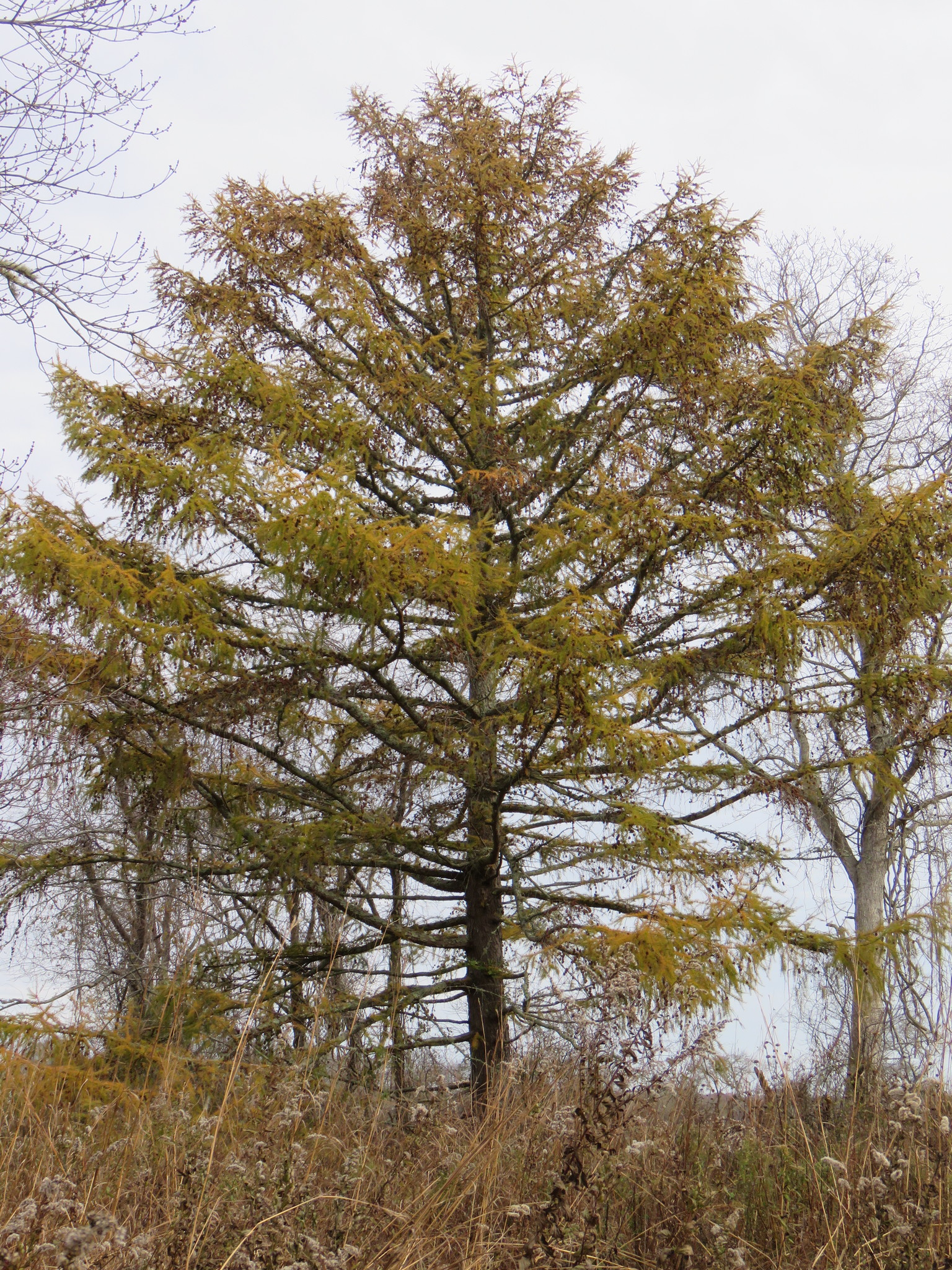
European larch, Trustom Pond National Wildlife Refuge, Washington County, Rhode Island. (CC BY-NC 4.0)
European larch is an introduced deciduous conifer. Mature height usually ranges from 30 to 130 feet (9-40 m) in the United States and Canada; larger individuals have occasionally been reported, particularly from Europe (up to 177 feet [54 m]) [10,17]. The needles are spirally arranged in fascicles of 30 to 65 needles, on short shoots. The bark of young trees is thin, smooth, developing fissures as it matures. On older trees the bark is very flaky and heavily ridged with wide fissures [14,15]. In the Alps, the bark at the base of very old trunks is up to 1 foot (30 cm) thick [3]. The crown of young trees is symmetrical, open, and narrowly conic. Old trees often have large, buttressed low branches that run level for 8 to 10 feet (2.4-3 m) before turning upward [10,15]. European larch is characterized as deep-rooted [25].
European larch exhibits rapid early growth and occasionally early senescence (at 30 to 40 years of age), particularly in mixed stands. The average age at senescence is between 100 and 150 years of age [10]; ages of 600 years or more have been reported for European larch in the Alps [3,25]. The oldest European larch on record was 672 years old in 1955. Record height for European larch is reported as 184 feet (56 m) for a specimen in Baden, Germany [25].
Raunkiaer Life Form (Raunkiaer 1934)
- Phanerophyte
Seasonal Development
The growing season of European larch in North America is at least 100 days, longer than that of many native conifers. Bud burst occurs in early spring, before the ground has completely thawed. Height growth continues at an appreciable rate until September [1].
The female cones appear before leaf-out in early spring and pollination occurs from March to May or June [14,17]. The seed cones ripen from September to December of the same year, and the seeds are dispersed from September to spring [17]. In Great Britain, European larch cones do not open until spring [3]. European larch needles die and are abscised in early November in the British Isles; some are retained through December [15].

European larch with cones, Jackson County, Michigan. (CC BY-NC 4.0)
Regeneration Processes
European larch is monoecious. Minimum age of first reproduction is around 10 years. Large seed crops are produced at 3- to 10-year intervals. The seeds are wind dispersed. Most larch (Larix spp.) seeds germinate without pretreatment. European larch seeds can be stored for 3 to 7 years. Viable seeds may remain in the cone for 1 to 2 years [17]. Stored seed germination rates are improved by stratification at 32 to 39 degrees Fahrenheit (0-4 deg C) for 20 to 60 days [14].
Successional Status
European larch is intolerant of shade at any age [10]. Its open crown transmits a considerable amount of light so that it does not tend to suppress more tolerant understory species [25].
Immediate Fire Effects
No entry.
Postfire Regeneration Strategy (Stickney 1989)
- No entry
Fire Adaptations
Information was not available regarding fire ecology or adaptations of European larch. However, young European larch is probably susceptible to fire because the bark is thin. Thick bark on mature European larch [15] and the ability to produce new foliage each year may make them somewhat fire resistant. In Europe, European larch commonly occurs in upper-elevation forest zones that rarely burn [10].
Plant Response to Fire
No entry.
Fire Regimes
For fire regime information, search FEIS for this species by entering the species name on the Advanced Search page and selecting “Fire Regime” as the publication type.
Fire Management Considerations
The thick, tightly packed litter produced by European larch may produce fire behavior that differs from what occurs in natural fuels in North America [18].
The caloric value of oven-dried European larch needles ranged from 4,608 to 4,637 calories per gram. The caloric value of ovendry litter averaged 3,996 calories per gram [8].
European larch was planted in a fuelbreak on a dry, sandy site in Wexford County, Michigan, in 1967. After 6 years, European larch had the highest survival (45 percent) and growth (60 inches [152 cm]) of the nine species planted [23].
Federal Status
No special status.
Other Status
No entry.
Importance to Wildlife and Livestock
No entry.
Palatability and Nutritional Value
No entry.
Cover Value
No entry.
Value for Rehabilitation or Restoration of Disturbed Sites
European larch is listed by Vogel [21] with other species that are of "limited importance or use" for revegetation of surface mine disturbances. It is primarily used for this purpose in Pennsylvania, West Virginia, and Ohio. It is recommended for rehabilitation of sites at higher elevations in the northern Appalachians [21].
Other Uses
European larch is planted as an ornamental and in shelterbelts [15].
European larch wood is durable and strong [3], of moderately high density, with excellent toughness and stiffness. It is used for pulp [2], framing timber, roof tiles, flooring, and log houses. It is suitable for veneer and other decorative purposes [14]. Larch (Larix spp.) wood is resistant to rot, and is therefore valuable for posts, poles, railroad ties, mine props, wharves, and pilings [3,17].
Other Management Considerations
European larch has been used in the eastern United States for reforestation [7].
Silvicultural systems: Group selection is successful with European larch, providing that advance regeneration has not been suppressed for very long; suppressed seedlings do not respond well to release [13]. Planting in mixtures with more tolerant species works well if the stands are thinned to allow European larch to maintain a dominant crown position; it does not usually suppress its more tolerant neighbors [25]. European larch planted on slopes are susceptible to stem bending ("saber growth form") and breakage from snow [13].
European larch grows rapidly and produces heavy litter which forms a thick, tightly packed mat. In Wisconsin, 10-year-old European larch plantations produced twice as much litter by weight as 10-year-old red pine (Pinus resinosa) [18].
Insects and disease: European larch seeds are vulnerable to seed weevils [17], adult trees on moist sites are vulnerable to larch canker [25]. European larch is host to a number of insect species, none of which have been of economic importance [25].
Table A1— Forest and range ecosystems, Bureau of Land Management (BLM) physiographic regions, Kuchler plant associations, Society for American Foresters (SAF) forest cover types, and Society for Rangeland Management (SRM) rangeland cover types in which this species occurs.
Forest and Range Ecosystems (Garrison et al. 1977)
- FRES10 White - red - jack pine
- FRES19 Aspen - birch
BLM Physiographic Regions (Bernard and Brown 1977)
- No entry
Kuchler Plant Associations (Kuchler 1964)
- No entry
SAF Cover Types (Eyre 1980)
- No entry
SRM Rangeland Cover Types (Shiflet 1994)
- No entry
1. Cook, David B. 1941. Five seasons' growth of conifers. Ecology. 22(3): 285-296. [10909]
2. Einspahr, Dean W.; Wyckoff, Gary W.; Fiscus, Marianne (Harder). 1984. Larch--a fast-growing fiber source for the Lake States and Northeast. Journal of Forestry. 82(2): 104-106. [22389]
3. Elwes, H. J.; Henry, A. 1907. The trees of Great Britain and Ireland. Edinburgh: privately printed. [Pages unknown]. [22373]
4. Eyre, F. H., ed. 1980. Forest cover types of the United States and Canada. Washington, DC: Society of American Foresters. 148 p. [905]
5. Fernald, Merritt Lyndon. 1950. Gray's manual of botany. [Corrections supplied by R. C. Rollins]. Portland, OR: Dioscorides Press. 1632 p. (Dudley, Theodore R., gen. ed.; Biosystematics, Floristic & Phylogeny Series; vol. 2). [14935]
6. Garrison, George A.; Bjugstad, Ardell J.; Duncan, Don A.; [and others]. 1977. Vegetation and environmental features of forest and range ecosystems. Agric. Handb. 475. Washington, DC: U.S. Department of Agriculture, Forest Service. 68 p. [998]
7. Harlow, William M.; Harrar, Ellwood S. 1937. Textbook of dendrology. New York: McGraw-Hill Book Company Inc. 527 p. [22371]
8. Hough, Walter A. 1969. Caloric value of some forest fuels of the southern United States. Res. Note SE-120. Asheville, NC: U.S. Department of Agriculture, Forest Service, Southeastern Forest Experiment Station. 6 p. [10517]
9. Kartesz, John T.; Kartesz, Rosemarie. 1980. A synonymized checklist of the vascular flora of the United States, Canada, and Greenland. Volume II: The biota of North America. Chapel Hill, NC: The University of North Carolina Press; in confederation with Anne H. Lindsey and C. Richie Bell, North Carolina Botanical Garden. 500 p. [6954]
10. Kostler, Josef. 1956. Silviculture. Edinburgh: Oliver and Boyd. 416 p. [22369]
11. Kuchler, A. W. 1964. Manual to accompany the map of potential vegetation of the conterminous United States. Special Publication No. 36. New York: American Geographical Society. 77 p. [1384]
12. Little, Elbert L., Jr. 1979. Checklist of United States trees (native and naturalized). Agric. Handb. 541. Washington, DC: U.S. Department of Agriculture, Forest Service. 375 p. [2952]
13. Matthews, J. D. 1989. Silvicultural systems. Oxford: Clavendon Press. 284 p. [22372]
14. Miller, J. T.; Knowles, F. B. 1988. Introduced forest trees in New Zealand: recognition, role, and seed source. 3. The larches. Larix decidua Miller - European larch, Larix kaempferi (Lambert) Carr. - Japanese larch, Larix X eurolepis A. Henry - hybrid larch. FRI Bulletin No. 124. Rotorua, New Zealand: Ministry of Forestry, Forest Research Institute. 17 p. [22390]
15. Mitchell, Alan F. 1972. Conifers in the British Isles: A descriptive handbook. Forestry Commission Booklet No. 33. London: Her Majesty's Stationery Office. 322 p. [20571]
16. Raunkiaer, C. 1934. The life forms of plants and statistical plant geography. Oxford: Clarendon Press. 632 p. [2843]
17. Rudolf, Paul O. 1974. Larix Mill. larch. In: Schopmeyer, C. S., ed. Seeds of woody plants in the United States. Agric. Handb. 450. Washington, DC: U.S. Department of Agriculture, Forest Service: 478-485. [7689]
18. Sartz, Richard S.; Tolsted, David N. 1974. Larch litter removal has no significant effect on runoff. Res. Note NC-163. St, Paul MI: U.S. Department of Agriculture, Forest Service, North Central Forest Experiment Station. 2 p. [11223]
19. Stickney, Peter F. 1989. Seral origin of species originating in northern Rocky Mountain forests. Unpublished draft on file at: U.S. Department of Agriculture, Forest Service, Intermountain Research Station, Fire Sciences Laboratory, Missoula, MT; RWU 4403 files. 7 p. [20090]
20. U.S. Department of Agriculture, Soil Conservation Service. 1982. National list of scientific plant names. Vol. 1. List of plant names. SCS-TP-159. Washington, DC. 416 p. [11573]
21. Vogel, Willis G. 1981. A guide for revegetating coal minesoils in the eastern United States. Gen. Tech. Rep. NE-68. Broomall, PA: U.S. Department of Agriculture, Forest Service, Northeastern Forest Experiment Station. 190 p. [15575]
22. Seymour, Frank Conkling. 1982. The flora of New England. 2d ed. Phytologia Memoirs 5. Plainfield, NJ: Harold N. Moldenke and Alma L. Moldenke. 611 p. [7604]
23. Johnson, Von J. 1975. Hardwood fuel-breaks for northeastern United States. Journal of Forestry. 73(9): 588-589. [10921]
24. Voss, Edward G. 1972. Michigan flora. Part I. Gymnosperms and monocots. Bloomfield Hills, MI: Cranbrook Institute of Science; Ann Arbor, MI: University of Michigan Herbarium. 488 p. [11471]
25. McComb, A. L. 1955. The European larch: its races, site requirements and characteristics. Forest Science. 1(4): 298-318. [22642]