


Lyonia lucida, fetterbush lyonia
Van Deelen, Timothy R. 1991. Lyonia lucida, Fetterbush lyonia. In: Fire Effects Information System, [Online]. U.S. Department of Agriculture, Forest Service, Rocky Mountain Research Station, Fire Sciences Laboratory (Producer). Available: https://research.fs.usda.gov/feis/species-reviews/lyoluc
| Abbreviation | Common Name | Scientific Name | Classification | Status |
|---|---|---|---|---|
| Plants | ||||
| LYOLUC | fetterbush lyonia | Lyonia lucida | Life Form: Plants/Shrub Kingdom: Plantae Class: Dicot Order: Ericales Family: Ericaceae Genus: Lyonia | Fed. Protected: No Nativity: Native Invasiveness: Noninvasive |


Taxonomy
The scientific name of fetterbush lyonia is Lyonia lucida (Lam.) K. Koch (Ericaceae). There are no infrataxa [9,14].
Synonyms
- Desmothamnus lucidus (Lam.) Small (documented in [32])
- Lyonia nitida (Bartr.) Fern. [36]
Other Common Names
hurrahbush, staggerbush
General Distribution
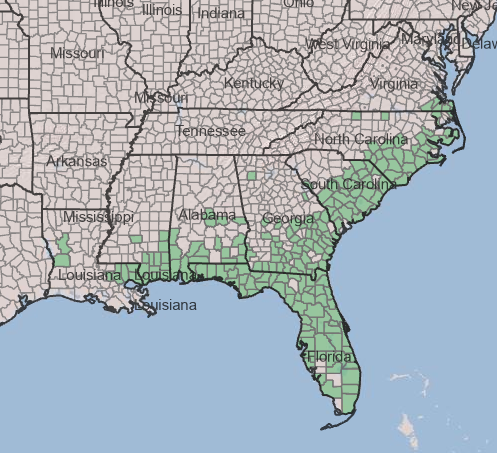
Fetterbush lyonia grows along the United States' southeastern Coastal Plain from southeastern Virginia, throughout south-central peninsular Florida, west to Louisiana. It also grows in Cuba [9,14].

Distribution of fetterbush lyonia in the United States.
States
- United States: AL FL GA LA MS NC SC VA
Site Characteristics
Fetterbush lyonia occurs on sites where flooding is common [14]. Typically, these sites flood during the spring and dry out during the fall. Water tables fall well below the soil surface for the better part of the growing season. Seasonal flooding eliminates upland competitors, and summer desiccation eliminates more hydric competitors [14].
Fetterbush lyonia commonly grows on soils that are strongly to extremely acidic, poorly drained, peaty, and organic (Histisols) [19,27]. It may grow on the accumulated mats of peat and root fibers that collect around the bases of cypress trees in cypress swamps [24].
Plant Communities
Fetterbush lyonia is a principal shrub in the understories of pocosins [13,27,31], bayheads [23], and cypress (Taxodium spp.) heads [18,24] (all synonyms of "evergreen shrub bog" [27]). Other fetterbush lyonia sites include conifer swamps, seasonally wet flatwoods and savannas, cypress-gum (Nyssa spp.) ponds, depressions, and broadleaf seepage areas [6,9,14,28]. It is a principal understory species in the Big Cypress [7] and Okeefenokee [1] swamps, and one of the more abundant and constant shrubs in saw-palmetto (Serenoa repens) prairie [35]. Occasionally, fetterbush lyonia grows on more xeric sites such as gallberry (Ilex glabra) flatwoods and dry prairies [2,28]. Austin and others [2] describe it as a scrub "indicator", although Godfrey [14] considers it occasional in scrub communities.
Overstory associates include Atlantic white cedar (Chamaecyparis thyoides), various southern pines (Pinus spp.), sweet bay (Magnolia virginiana), red bay (Persea borbonia), loblolly bay (Gordonia lasianthus), cypress, and tupelo (Nyssa spp.) [9,27,28]. Understory associates include gallberry, shrubby oaks (Quercus spp.), sweetbells leucothoe (Leucothoe racemosa), highbush blueberry (Vaccinium corymbosum), sweet pepperbush (Clethera alnifolia), titi (Cyrilla racemiflora), laurelleaf greenbrier (Smilax laurifolia), and honeycup (Zenobia pulveralenta) [9,16,27].
Botanical Description

Fetterbush lyonia.
Fetterbush lyonia is a slow-growing, common, showy, evergreen shrub. It varies in height from 8 inches (20 cm) to 13 feet (4 m). Large shrubs have robust, branchy bases with crowns that are as broad as the height of the plant.
Leaves are simple, alternate, and leathery. They are borne on green twigs which are flecked with dark, loose, deciduous scales. The small, pink flowers are borne on fascicles. The fruit is a capsule containing amber-brown, wedge-shaped seeds.
Fetterbush lyonia has extensive, interconnected rhizomes which sprout and form dense clonal thickets [3,9,14,21].
Raunkiaer Life Form (Raunkiaer 1934)
- Phanerophyte
Seasonal Development
Fetterbush lyonia has been reported to flower from April to June [9], from February to April [4], or beginning in January [29]. Leaf production begins in June and continues through September. Most leaves are lost in the November of their second year [31].
Regeneration Processes
The primary mode of fetterbush lyonia regeneration is vegetative: Fetterbush lyonia sprouts from rhizomes. In nutrient-poor environments, it devotes its energy stores to vegetative growth instead of sexual reproduction and does not flower [31]. Information on seedling establishment and growth is lacking.
Successional Status
Fetterbush lyonia is a mid-seral species. It follows the establishment of deciduous shrubs after disturbance in southern swamps. [8,15,25,29]. Although an understory species, it does well in full sunlight [8] and is one of several shrubs that prospers in lightly or infrequently burned pine flatwoods [5].
Immediate Fire Effects
Most fires top-kill fetterbush lyonia [30].
Postfire Regeneration Strategy (Stickney 1989)
- Small shrub, adventitious-bud root crown
- Rhizomatous shrub, rhizome in soil
Fire Adaptations
Fetterbush lyonia survives fire by sprouting from rhizomes and dormant basal buds [3,16,20].
Plant Response to Fire
Fetterbush lyonia responds to fire by sprouting from its rhizomes and rootstock [30].
Fire Regimes
For additional fire regime information, search FEIS for this species by entering the species name on the Advanced Search page and selecting “Fire Regime” as the publication type.
Fire Management Considerations
No entry.
Federal Status
None
Other Status
No entry.
Importance to Wildlife and Livestock

Fetterbush lyonia.
Because fetterbush lyonia is related to several other toxic plants in the Ericaceae family, Kingsbury [18] suspects that it may be toxic to livestock as well. Specific use of fetterbush lyonia by wildlife has not been reported although evergreen-shrub-bog habitats (see Site Characteristics) are important to a variety of southeastern wildlife species including the black bear, white-tailed deer, bobcat, marsh rabbit, eastern gray squirrel, eastern diamond-back rattlesnake, American alligator, pine barrens tree frog, and the endangered red-cockaded woodpecker [27].
Palatability and Nutritional Value
Cattle find fetterbush lyonia unpalatable [30].
Cover Value
No entry.
Value for Rehabilitation or Restoration of Disturbed Sites
No entry.
Other Uses
No entry.
Other Management Considerations
Because of fetterbush lyonia's sprouting response, clearcutting reduces cover but increases foliage biomass [6].
Table A1— Forest and range ecosystems, Bureau of Land Management (BLM) physiographic regions, Kuchler plant associations, Society for American Foresters (SAF) forest cover types, and Society for Rangeland Management (SRM) rangeland cover types in which this species occurs.
Forest and Range Ecosystems (Garrison et al. 1977)
- FRES12 Longleaf - slash pine
- FRES13 Loblolly - shortleaf pine
- FRES14 Oak – pine
- FRES15 Oak – hickory
- FRES16 Oak - gum – cypress
- FRES41 Wet grasslands
BLM Physiographic Regions (Bernard and Brown 1977)
- No entry
Kuchler Plant Associations (Kuchler 1964)
- K079 Palmetto prairie
- K080 Marl – everglades
- K089 Black belt
- K090 Live oak - sea oats
- K091 Cypress savanna
- K105 Mangrove
- K112 Southern mixed forest
- K113 Southern floodplain forest
- K114 Pocosin
SAF Cover Types (Eyre 1980)
- 69 Sand pine
- 73 Southern redcedar
- 74 Cabbage palmetto
- 81 Loblolly pine
- 83 Longleaf pine - slash pine
- 84 Slash pine
- 85 Slash pine – hardwood
- 98 Pond pine
- 101 Baldcypress
- 102 Baldcypress – tupelo
- 103 Water tupelo - swamp tupelo
- 104 Sweetbay - swamp tupelo – redbay
- 106 Mangrove
SRM Rangeland Cover Types (Shiflet 1994)
- No entry
1. Abrahamson, Warren G. 1984. Post-fire recovery of Florida Lake Wales Ridge vegetation. American Journal of Botany. 71(1): 9-21. [9509]
2. Austin, Daniel F.; Posin, Freda R.; Burch, James N. 1987. Scrub species patterns on the Atlantic Coastal Ridge, Florida. Journal of Coastal Research. 3(4): 491-498. [9340]
3. Brown, Sandra L.; Cowles, Sidney W.; Odum, Howard T. 1984. Metabolism and transpiration of cypress domes in north-central Florida. In: Ewel, Katherine Carter; Odum, Howard T., eds. Cypress swamps. Gainesville, FL: University of Florida Press: 145-163. [14847]
4. Clewell, Andre F. 1985. Guide to the vascular plants of the Florida Panhandle. Tallahassee, FL: Florida State University Press. 605 p. [13124]
5. Clewell, Andre F. 1989. Natural history of wiregrass (Aristida stricta Michx., Gramineae). Natural Areas Journal. 9(4): 223-233. [10092]
6. Conde, Louis F.; Swindel, Benee F.; Smith, Joel E. 1983. Plant species cover, frequency, and biomass: Early responses to clearcutting, chopping, and bedding in Pinus elliottii flatwoods. Forest Ecology and Management. 6: 307-317. [9661]
7. Cypert, Eugene. 1973. Plant succession on burned areas in Okefenokee Swamp following the fires of 1954 and 1955. In: Proceedings, annual Tall Timbers fire ecology conference; 1972 June 8-9; Lubbock, TX. Number 12. Tallahassee, FL: Tall Timbers Research Station: 199-217. [8467]
8. Duever, Michael J.; Riopelle, Lawrence A. 1983. Successional sequences and rates on tree islands in the Okefenokee Swamp. American Midland Naturalist. 110(1): 186-191. [14590]
9. Duncan, Wilbur H.; Duncan, Marion B. 1987. The Smithsonian guide to seaside plants of the Gulf and Atlantic Coasts from Louisiana to Massachusetts, exclusive of lower peninsular Florida. Washington, DC: Smithsonian Institution Press. 409 p. [12906]
10. Ewel, Katherine Carter. 1984. Effects of fire and wastewater on understory vegetation in cypress domes. In: Ewel, Katherine Carter; Odum, Howard T., eds. Cypress swamps. Gainesville, FL: University of Florida Press: 119-126. [14845]
11. Eyre, F. H., ed. 1980. Forest cover types of the United States and Canada. Washington, DC: Society of American Foresters. 148 p. [905]
12. Garrison, George A.; Bjugstad, Ardell J.; Duncan, Don A.; [and others]. 1977. Vegetation and environmental features of forest and range ecosystems. Agric. Handb. 475. Washington, DC: U.S. Department of Agriculture, Forest Service. 68 p. [998]
13. Gresham, Charles A. 1989. A literature review of effects of developing pocosins. In: Hook, Donald D.; Lea, Russ, eds. Proceedings of the symposium: The forested wetlands of the Southern United States; 1988 July 12-14; Orlando, FL. Gen. Tech. Rep. SE-50. Asheville, NC: U.S. Department of Agriculture, Forest Service, Southeastern Forest Experiment Station: 44-50. [9228]
14. Godfrey, Robert K. 1988. Trees, shrubs, and woody vines of northern Florida and adjacent Georgia and Alabama. Athens, GA: The University of Georgia Press. 734 p. [10239]
15. Harris, Larry D.; Vickers, Charles R. 1984. Some faunal community characteristics of cypress ponds and the changes induced by perturbations. In: Ewel, Katherine Carter; Odum, Howard T., eds. Cypress swamps. Gainesville, FL: University of Florida Press: 171-185. [14849]
16. Johnson, Ann F.; Abrahamson, Warren G.; McCrea, Kenneth D. 1986. Compar. of biomass recovery after fire of a seeder (Ceratiola ericoides) and a sprouter (Quercus inopina) species from south-central Florida. American Midland Naturalist. 116(2): 423-428. [10217]
17. Kartesz, John T.; Kartesz, Rosemarie. 1980. A synonymized checklist of the vascular flora of the United States, Canada, and Greenland. Volume II: The biota of North America. Chapel Hill, NC: The University of North Carolina Press; in confederation with Anne H. Lindsey and C. Richie Bell, North Carolina Botanical Garden. 500 p. [6954]
18. Kingsbury, John M. 1964. Poisonous plants of the United States and Canada. Englewood Cliffs, NJ: Prentice-Hall, Inc. 626 p. [122]
19. Kuchler, A. W. 1964. Manual to accompany the map of potential vegetation of the conterminous United States. Special Publication No. 36. New York: American Geographical Society. 77 p. [1384]
20. Langdon, O. Gordon. 1981. Some effects of prescribed fire on understory vegetation in loblolly pine stands. In: Wood, Gene W., ed. Prescribed fire and wildlife in southern forests: Proceedings of a symposium; 1981 April 6-8; Myrtle Beach, SC. Georgetown, SC: Clemson University, Belle W. Baruch Forest Science Institute: 143-153. [14821]
21. Little, Silas; Garrett, Peter W. 1990. Chamaecyparis thyoides (L.) B.S.P. Atlantic white-cedar. In: Burns, Russell M.; Honkala, Barbara H., technical coordinators. Silvics of North America. Volume 1. Conifers. Agric. Handb. 654. Washington, DC: U.S. Department of Agriculture, Forest Service: 103-108. [13374]
22. Lyon, L. Jack; Stickney, Peter F. 1976. Early vegetal succession following large northern Rocky Mountain wildfires. In: Proceedings, Tall Timbers fire ecology conference and Intermountain Fire Research Council fire and land management symposium; 1974 October 8-10; Missoula, MT. No. 14. Tallahassee, FL: Tall Timbers Research Station: 355-373. [1496]
23. Monk, Carl D. 1966. An ecological study of hardwood swamps in north-central Florida. Ecology. 47: 649-654. [10802]
24. Monk, Carl D.; Brown, Timothy W. 1965. Ecological consideration of cypress heads in north-central Florida. American Midland Naturalist. 74: 126-140. [10848]
25. Penfound, William T. 1952. Southern swamps and marshes. The Botanical Review. 18: 413-446. [11477]
26. Raunkiaer, C. 1934. The life forms of plants and statistical plant geography. Oxford: Clarendon Press. 632 p. [2843]
27. Richardson, Curtis J. 1983. Pocosins: vanishing wastelands or valuable wetlands?. Bioscience. 33(10): 626-633. [13818]
28. Richardson, Donald Robert. 1977. Vegetation of the Atlantic Coastal Ridge of Palm Beach County, Florida. Florida Scientist. 40(4): 281-330. [9644]
29. Schlesinger, William H. 1978. On the relative dominance of shrubs in Okefenokee Swamp. American Naturalist. 112(987): 949-954. [15360]
30. Shepherd, W. O.; Dillard, E. U.; Lucas, H. L. 1951. Grazing and fire influences in pond pine forests. Tech. Bull. No. 97. Raleigh, NC: North Carolina State College, Agricultural Experiment Station. 56 p. In cooperation with: U.S. Department of Agriculture, Forest Service, Southeastern Forest Experiment Station. [14546]
31. Simms, E. L. 1987. The effect of nitrogen and phosphorus addition on the growth, reproduction, and nutrient dynamics of two ericaceous shrubs. Oecologia. 71: 541-547. [15359]
32. U.S. Department of Agriculture, Natural Resources Conservation Service. 2018. PLANTS Database, [Online]. U.S. Department of Agriculture, Natural Resources Conservation Service (Producer). Available: https://plants.usda.gov/. [34262]
33. Bernard, Stephen R.; Brown, Kenneth F. 1977. Distribution of mammals, reptiles, and amphibians by BLM physiographic regions and A.W. Kuchler's associations for the eleven western states. Tech. Note 301. Denver, CO: U.S. Department of the Interior, Bureau of Land Management. 169 p. [434]
34. Stickney, Peter F. 1989. Seral origin of species originating in northern Rocky Mountain forests. Unpublished draft on file at: U.S. Department of Agriculture, Forest Service, Intermountain Research Station, Fire Sciences Laboratory, Missoula, MT; RWU 4403 files. 7 p. [20090]
35. Davis, John H., Jr. 1943. The natural features of southern Florida especially the vegetation, and the Everglades. Geological Bull. No. 25. Tallahassee, FL: State of Florida, Department of Conservation, Florida Geological Survey. 311 p. [17747]
36. Fernald, Merritt Lyndon. 1950. Gray's manual of botany. [Corrections supplied by R. C. Rollins]. Portland, OR: Dioscorides Press. 1632 p. (Dudley, Theodore R., gen. ed.; Biosystematics, Floristic & Phylogeny Series; vol. 2). [14935]