


Oxydendrum arboreum, sourwood
Coladonato, Milo. 1992. Oxydendrum arboreum, sourwood. In: Fire Effects Information System, [Online]. U.S. Department of Agriculture, Forest Service, Rocky Mountain Research Station, Fire Sciences Laboratory (Producer). Available: https://research.fs.usda.gov/feis/species-reviews/oxyarb
| Abbreviation | Common Name | Scientific Name | Classification | Status |
|---|---|---|---|---|
| Plants | ||||
| OXYARB | sourwood | Oxydendrum arboreum | Life Form: Plants/Shrub, Plants/Tree Kingdom: Plantae Class: Dicot Order: Ericales Family: Ericaceae Genus: Oxydendrum | Fed. Protected: No Nativity: Native Invasiveness: Noninvasive |

Taxonomy
The currently accepted scientific name for sourwood is Oxydendrum arboreum (L.) DC. [21]. Oxydendrum is a monotypic genus [15]. There are no recognized subspecies, varieties, or forms.
Synonyms
- None
Other Common Names
sorrel-tree, lily-of-the-valley-tree
General Distribution
Sourwood grows in upland forests of the southeastern United States. It is found from southern Pennsylvania, Ohio, and Indiana, to southeastern Louisiana and the panhandle of Florida. It also grows in the mountainous regions of Kentucky and Tennessee and along the Atlantic Coast from North Carolina to Virginia. The main range of sourwood lies between 30 and 40 degrees N. and 75 and 92 degrees W. Sourwood reaches its largest size on the western slopes of the Great Smoky Mountains in Tennessee [9,30,32].
States and Provinces
- United States: AL FL GA KY LA MD MS NC OH PA SC TN VA WV
Site Characteristics

Sourwood in bloom on the edge of a lake, Georgia.
In the central Appalachian Mountains sourwood is most abundant on subxeric open slopes and ridges occupied by chestnut oak (Quercus prinus), white oak (Q. alba), scarlet oak (Q. coccinea), and Virginia pine (Pinus virginiana). It is less frequent on more mesic sites such as coves and sheltered slopes. Throughout this area sourwood is found up to 5,000 feet (1,520 m) but rarely to 5,600 feet (1,710 m) in elevation [3,6,32].
Sourwood grows throughout the Piedmont uplands. It is also found along Piedmont streams on well-drained lowland areas not subject to flooding. In the Coastal Plain it is found on gently rolling areas. Toward the coast it is restricted to old dunes and well-drained slopes and ridges above streams and swamp borders. Sourwood is commonly found growing on soils in the orders Ultisols, Inceptisols, and Entisols [5,26,32].
Other associates of sourwood in addition to the cover type species are sweetgum (Liquidambar styraciflua), tuliptree (Liriodendron tulipifera), southern red oak (Q. falcata), red and sugar maple (Acer rubrum and A. saccharum), shagbark, bitternut, pignut, and mockernut hickory (Carya ovata, C. cordiformis, C. glabra, and C. tomentosa), white ash (Fraxinus americanus), American beech (Fagus grandifolia), eastern hemlock (Tsuga canadensis), flowering dogwood (Cornus florida), sassafras (Sassafras albidum), American hornbeam (Carpinus caroliniana), hophornbeam (Ostrya virginiana), and redbud (Cercis canadensis) [2,18,32].
Plant Communities
No entry.
Botanical Description

Sourwood flowers, Virginia.
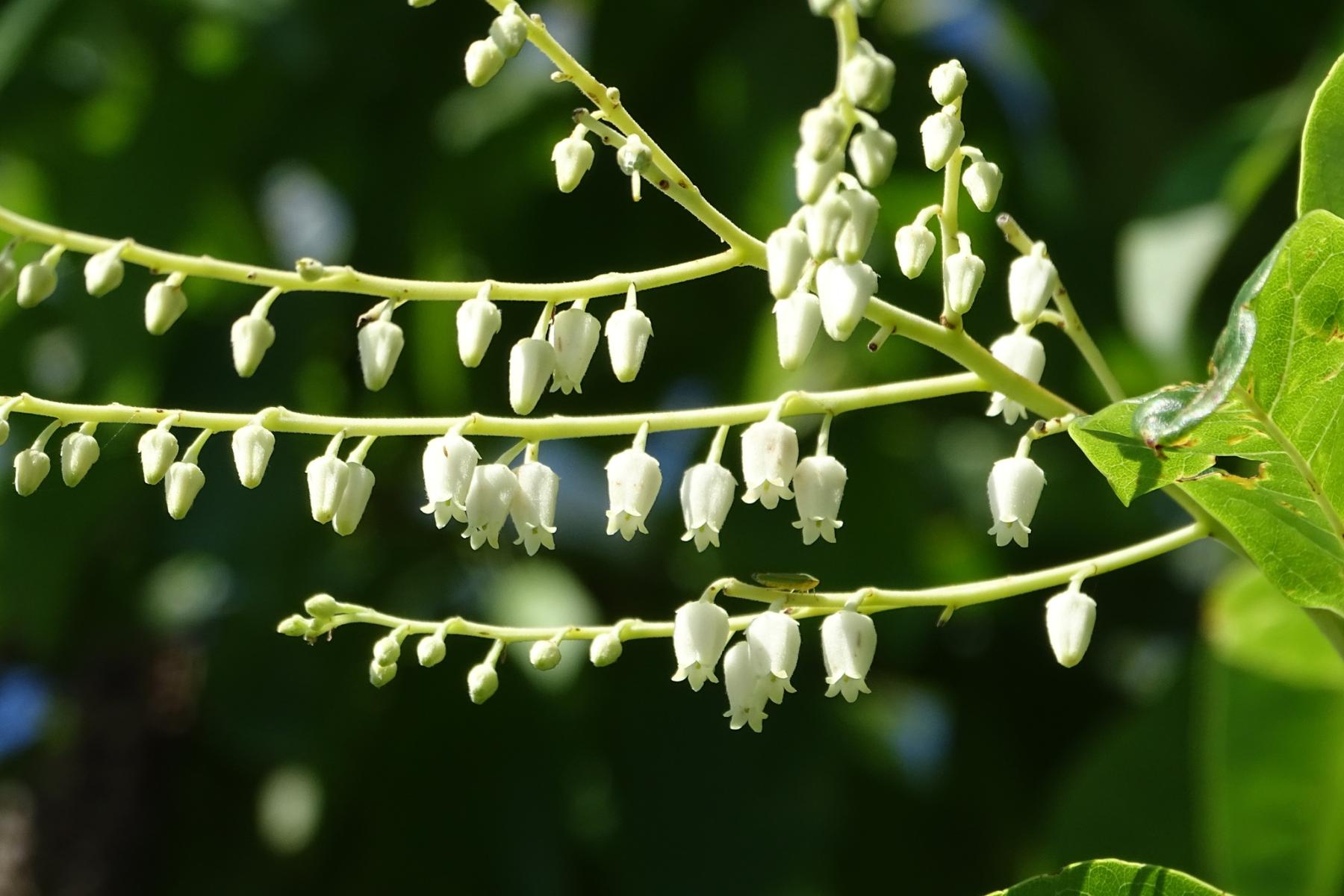
Sourwood is a native, deciduous, medium-sized tree, 40 to 60 feet (12-15 m) tall [13,30]. It develops a slender trunk and small crown in dense stands. In the open it forms a short, often leaning trunk dividing into several stout, ascending limbs [32]. The inflorescence is a raceme emanating from a central axis. The simple, alternate leaves are 4 to 7 inches (10-18 cm) long and variable in shape. The fruit is a capsule 0.25 to 0.5 inch (6-13 mm) long containing many tiny seeds [9,23,42]. No information on the rooting habit of sourwood was found in the literature.
Raunkiaer Life Form (Raunkiaer 1934)
- Phanerophyte
Seasonal Development
Sourwood blooms from late June to August; the fruit ripens from September through October [30,41].
Regeneration Processes
Seed production and dissemination
Estimated seed production ranging from 1,850,000 to 5,500,000 seeds per pound (4,080,000-12,250,000 seeds/kg) has been reported [32,42]. The fruits are shed in the fall and the seeds are dispersed gradually throughout the winter by the dehiscing capsule. Sourwood seeds germinate well without special treatment [32,33].
Seedling development
Germination is epigeal. Seedbed requirements for sourwood have not been reported. In the Piedmont, sourwood seed germination and establishment may occur on litter and under partially shaded conditions. Techniques for sourwood seed collection, storage, and germination have been described [32].
Vegetative reproduction
Sourwood sprouts prolifically and persistently from the stump and root crown [11,17]. It is difficult to propagate from cuttings; no reports were found of propagation from grafting [32].
Successional Status
Facultative seral species.
Sourwood is shade tolerant. In the Piedmont sourwood seedlings and saplings are found in all stages of succession from young pine (Pinus spp.) stands to oak-hickory (Quercus spp.- Carya spp.) forests. Sourwood's response to release is not known [7,32,35].
Immediate Fire Effects
Low-severity fire typically top-kills sourwood [1,20]. Oosting [31] reports that a single high-severity ground fire completely eliminated sourwood from a loblolly pine (Pinus taeda) community in North Carolina.
Postfire Regeneration Strategy (Stickney 1989)
- Tree with adventitious-bud root crown/root sucker
Fire Adaptations
Sourwood has the ability to sprout from the root crown or stump following fire [4,11,16].
Plant Response to Fire
Sourwood is usually an increaser following low-severity fire [32]. Following an early summer prescribed fire on the Sumter National Forest in South Carolina, sourwood stem density increased from 33 stems per acre (82 stem/ha) to 420 stems per acre (1,040 stems/ha) [38].
The following Research Project Summaries provide information on prescribed fire use and postfire response of plant community species, including sourwood, that was not available when this species review was originally written:
- Early postfire effects of a prescribed fire in the southern Appalachians of North Carolina
- Early postfire response of southern Appalachian Table Mountain-pitch pine stands to prescribed fires in North Carolina and Virginia
Fire Regimes
For fire regime information, search FEIS for this species by entering the species name or acronym on the home page and selecting “Fire Regime” as the publication type.
Fire Management Considerations
If used as a management tool, Trousdell [39] recommends one winter fire followed by three summer fires as the treatment most effective in controlling sourwood.
Federal Status
None
Other Status
No entry.
Importance to Wildlife and Livestock
Sourwood sprouts are often browsed by white-tailed deer [14,30]. In a study on 35 acres (14 ha) of the Pisgah National Forest in North Carolina, browse utilization of sourwood twigs by white-tailed deer was 74 percent [8].
Palatability and Nutritional Value
No entry.
Cover Value
Sourwood snags provide cavity-nesting sites for various birds in southern Appalachian forests [24].
Value for Rehabilitation or Restoration of Disturbed Sites
No entry.
Other Uses
Sourwood is occasionally used as an ornamental because of the brilliant fall color of its leaves and midsummer flowers. The flowers of sourwood are also an important source of honey [30,32].
Sourwood is of little value as a commercial timber species. The wood is used to make tool handles and for fuel. Sourwood is used with a mixture of other species for pulp [30,41].
Other Management Considerations
Sourwood sprouts often compete with the establishment of more desirable species in second-growth and cutover areas [25,39]. Methods and effectiveness of herbicide treatment for controlling sourwood and other undesirable hardwoods have been given in detail [27,28,29,36].
Damaging Agents: Several insects attack sourwood. The dogwood-twig borer (Oberea tripunctata) and the twig girdler (Oncideres cingulata) attack the twigs. The fall webworm (Hyphantria cunea) and the hickory horn devil (the larvae of the regal moth [Citheronia regalis]) consume the foliage. There are no known serious diseases that affect sourwood [32].
Table A1— Forest and range ecosystems, Bureau of Land Management (BLM) physiographic regions, Kuchler plant associations, Society for American Foresters (SAF) forest cover types, and Society for Rangeland Management (SRM) rangeland cover types in which this species occurs.
Forest and Range Ecosystems (Garrison et al. 1977)
- FRES13 Loblolly - shortleaf pine
- FRES14 Oak - pine
- FRES15 Oak - hickory
BLM Physiographic Regions (Bernard and Brown 1977)
- No entry.
Kuchler Plant Associations (Kuchler 1964)
- K100 Oak - hickory forest
- K104 Appalachian oak forest
- K111 Oak - hickory - pine forest
- K112 Southern mixed forest
SAF Cover Types (Eyre 1980)
- 40 Post oak - blackjack oak
- 44 Chestnut oak
- 52 White oak - black oak - northern red oak
- 53 White oak
- 75 Shortleaf pine
- 76 Shortleaf pine - oak
- 78 Virginia pine - oak
- 79 Virginia pine
- 81 Loblolly pine
- 82 Loblolly pine - hardwood
SRM Rangeland Cover Types (Shiflet 1994)
- No entry.
1. Allen, Peter H. 1960. Scorch and mortality after a summer burn in loblolly pine. Res. Note No. 144. Asheville, NC: U.S. Department of Agriculture, Forest Service, Southeastern Forest Experiment Station. 2 p. [12256]
2. Artigas, Francisco J.; Boerner, Ralph E. J. 1989. Advance regeneration and seed banking of woody plants in Ohio pine plantations: implications for landscape change. Landscape Ecology. 2(3): 139-150. [13633]
3. Barden, Lawrence S.; Woods, Frank W. 1974. Characteristics of lightning fires in southern Appalachian forests. In: Proceedings, annual Tall Timbers fire ecology conference; 1973 March 22-23; Tallahassee, FL. No. 13. Tallahassee, FL: Tall Timbers Research Station: 345-361. [19012]
4. Beck, Donald E. 1988. Clearcutting and other regeneration options for upland hardwoods. In: Proceedings, 16th annual hardwood symposium of the Hardwood Research Council; 1988 May 15-18; Chashiers, NC. Vol. 16. [Place of publication unknown]. Hardwood Research Council: 44-54. [10903]
5. Braun, E. Lucy. 1942. Forests of the Cumberland Mountains. Ecological Monographs. 12(4): 413-447. [9258]
6. Cain, Stanley A. 1932. Concerning certain phytosociological concepts. Ecological Monographs. II(4): 476-508. [18116]
7. Day, Frank P., Jr.; Monk, Carl D. 1974. Vegetation patterns on a southern Appalachian watershed. Ecology. 55(5): 1064-1074. [17560]
8. Della-Bianca, Lino; Johnson, Frank M. 1965. Effect of an intensive cleaning on deer-browse production in the southern Appalachians. Journal of Wildlife Management. 29(4): 729-733. [16404]
9. Duncan, Wilbur H.; Duncan, Marion B. 1988. Trees of the southeastern United States. Athens, GA: The University of Georgia Press. 322 p. [12764]
10. Eyre, F. H., ed. 1980. Forest cover types of the United States and Canada. Washington, DC: Society of American Foresters. 148 p. [905]
11. Freeman, Phillip C.; Van Lear, D. H. 1977. Performance of eastern white pine and competing vegetation following two methods of stand conversion. Southern Journal of Applied Forestry. 1(3): 7-9. [10638]
12. Garrison, George A.; Bjugstad, Ardell J.; Duncan, Don A.; [and others]. 1977. Vegetation and environmental features of forest and range ecosystems. Agric. Handb. 475. Washington, DC: U.S. Department of Agriculture, Forest Service. 68 p. [998]
13. Godfrey, Robert K. 1988. Trees, shrubs, and woody vines of northern Florida and adjacent Georgia and Alabama. Athens, GA: The University of Georgia Press. 734 p. [10239]
14. Goodrum, Phil D.; Reid, Vincent H. 1958. Deer browsing in the longleaf pine belt. In: Proceedings, 58th annual meeting of the Society of American Foresters; [Date of meeting unknown]; [Place of meeting unknown]. Washington, DC: [Society of American Foresters]: 139-143. [17023]
15. Harlow, William M.; Harrar, Ellwood S., White, F. M. 1979. Textbook of dendrology. 6th ed. New York: McGraw-Hill, Inc. 510 p. [18070]
16. Harmon, Mark E. 1984. Survival of trees after low-intensity surface fires in Great Smoky Mountains National Park. Ecology. 65(3): 796-802. [10997]
17. Horsley, Stephen B. 1988. How vegetation can influence regeneration. In: Smith, H. Clay; Perkey, Arlyn W.; Kidd, William E., Jr, eds. Guidelines for regenerating Appalachian hardwood stands: Workshop proceedings; 1988 May 24-26; Morgantown, WV. Society of American Foresters Publ. 88-03. Morgantown, WV: West Virginia University Books: 38-54. [13544]
18. Horsley, Stephen B. 1988. How vegetation can influence regeneration. In: Smith, H. Clay; Perkey, Arlyn W.; Kidd, William E., Jr, eds. Guidelines for regenerating Appalachian hardwood stands: Workshop proceedings; 1988 May 24-26; Morgantown, WV. Society of American Foresters Publ. 88-03. Morgantown, WV: West Virginia University Books: 38-54. [13544]
19. Kuchler, A. W. 1964. Manual to accompany the map of potential vegetation of the conterminous United States. Special Publication No. 36. New York: American Geographical Society. 77 p. [1384]
20. Langdon, O. Gordon. 1981. Some effects of prescribed fire on understory vegetation in loblolly pine stands. In: Wood, Gene W., ed. Prescribed fire and wildlife in southern forests: Proceedings of a symposium; 1981 April 6-8; Myrtle Beach, SC. Georgetown, SC: Clemson University, Belle W. Baruch Forest Science Institute: 143-153. [14821]
21. Little, Elbert L., Jr. 1979. Checklist of United States trees (native and naturalized). Agric. Handb. 541. Washington, DC: U.S. Department of Agriculture, Forest Service. 375 p. [2952]
22. Lyon, L. Jack; Stickney, Peter F. 1976. Early vegetal succession following large northern Rocky Mountain wildfires. In: Proceedings, Tall Timbers fire ecology conference and Intermountain Fire Research Council fire and land management symposium; 1974 October 8-10; Missoula, MT. No. 14. Tallahassee, FL: Tall Timbers Research Station: 355-373. [1496]
23. McComb, William C.; Muller, Robert N. 1983. Snag densities in old-growth and second-growth Appalachian forests. Journal of Wildlife Management. 47(2): 376-382. [13736]
24. Turner, Raymond M. 1990. Long-term vegetation change at a fully protected Sonoran Desert site. Ecology. 7(2): 464-477. [10866]
25. McMinn, James W. 1989. Influence of whole-tree harvesting on stand composition and structure in the oak-pine type. In: Waldrop, Thomas A., ed. Proceedings of pine-hardwood mixtures: a symposium on management and ecology of the type; 1989 April 18-19; Atlanta, GA. Gen. Tech. Rep. SE-58. Asheville, SC: U.S. Department of Agriculture, Forest Service, Southeastern Forest Experiment Station: 96-99. [10263]
26. Michael, J. L. 1985. Hardwood control by injection with two new chemicals. Proceedings of the Southern Weed Science Society. 38: 164-167. [12687]
27. Miller, James H. 1990. Streamline basal application of herbicide for small-stem hardwood control. Southern Journal of Applied Forestry. 14(4): 161-165. [13538]
28. Neary, D. G.; Douglass, J. E.; Ruehle, J. L.; Fox, W. 1984. Converting rhododendron-laurel thickets to white pine with picloram and mycorrhizae-inoculated seedlings. Southern Journal of Applied Forestry. 8(3): 163-168. [10697]
29. Olson, David F., Jr.; Barnes, R. L. 1974. Oxydendrum arboreum (L.) DC. Sourwood. In: Schopmeyer, C. S., ed. Seeds of woody plants in the United States. Agriculture Handbook No. 450. Washington: U. S. Department of Agriculture, Forest Service: 566-567. [7719]
30. Oosting, Henry J. 1944. The comparative effect of surface and crown fire on the composition of a loblolly pine community. Ecology. 25(1): 61-69. [9919]
31. Smith, H. Clay; Rosier, Robert L.; Hammack, K. P.. 1976. Reproduction 12 years after seed-tree harvest cutting in Appalachian hardwoods. Res. Pap. NE-350. Upper Darby, PA: U.S. Department of Agriculture, Forest Service, Northeastern Forest Experiment Station. 11 p. [10887]
32. Raunkiaer, C. 1934. The life forms of plants and statistical plant geography. Oxford: Clarendon Press. 632 p. [2843]
33. Sander, Ivan L. 1988. Guidelines for regenerating Appalachian oak stands. In: Smith, H. Clay; Perkey, Arlyn W.; Kidd, William E., Jr., eds. Guidelines for regenerating Appalachian hardwood stands: Workshop proceedings; 1988 May 24-26; Morgantown, WV. SAF Publ. 88-03. Morgantown, WV: West Virginia University Books: 189-198. [13945]
34. Sluder, Earl R. 1958. Control of cull trees and weed species in hardwood stands. Station Paper 95. Asheville, NC: U.S. Department of Agriculture, Forest Service, Southeastern Forest Experiment Station. 13 p. [16503]
35. Smith, H. Clay; Rosier, Robert L.; Hammack, K. P.. 1976. Reproduction 12 years after seed-tree harvest cutting in Appalachian hardwoods. Res. Pap. NE-350. Upper Darby, PA: U.S. Department of Agriculture, Forest Service, Northeastern Forest Experiment Station. 11 p. [10887]
36. Teuke, Michael J.; Van Lear, David H. 1982. Prescribed burning and oak advance regeneration in the southern Appalachians. Georgia Forest Research Paper 30. Macon, GA: Georgia Forestry Commission. 11 . [16034]
37. Trousdell, Kenneth B. 1970. Disking and prescribed burning: sixth-year residual effects on loblolly pine and competing vegetation. Asheville, NC: U.S. Department of Agriculture, Forest Service, Southeastern Forest Experiment Station. 6 p. [10190]
38. U.S. Department of Agriculture, Soil Conservation Service. 1982. National list of scientific plant names. Vol. 1. List of plant names. SCS-TP-159. Washington, DC. 416 p. [11573]
39. Van Dersal, William R. 1938. Native woody plants of the United States, their erosion-control and wildlife values. Washington, DC: U.S. Department of Agriculture. 362 p. [4240]
40. Vines, Robert A. 1960. Trees, shrubs, and woody vines of the Southwest. Austin, TX: University of Texas Press. 1104 p. [7707]