


Pandion haliaetus, osprey
Tesky, Julie L. 1993. Pandion haliaetus, osprey. In: Fire Effects Information System, [Online]. U.S. Department of Agriculture, Forest Service, Rocky Mountain Research Station, Fire Sciences Laboratory (Producer). Available: https://research.fs.usda.gov/feis/species-reviews/paha
| Abbreviation | Common Name | Scientific Name | Classification | Status |
|---|---|---|---|---|
| Animals | ||||
| PAHA | osprey | Pandion haliaetus | Life Form: Animals/Bird Kingdom: Animalia Class: Bird Order: Falconiformes Family: Pandionidae Genus: Pandion | Fed. Protected: No Nativity: Native Invasiveness: Noninvasive |


Taxonomy
The currently recognized scientific name for the osprey is Pandion haliaetus (Linnaeus) [4,24,32]. Four subspecies are recognized. Size and plumage best separate subspecies, but the differences are not always clear. This report will primarily deal with the North American subspecies: Pandion haliaetus ssp. carolinesis (Gmelin). Other recognized subspecies are [24,32]:
- Pandion haliaetus ssp. haliaetus
- Pandion haliaetus ssp. ridgwayi
- Pandion haliaetus ssp. cristatus
Synonyms
- No entry
Other Common Names
fish hawk, fish eagle
General Distribution
The osprey is nearly worldwide in distribution. It breeds in temperate and tropical regions of all continents except South America. In North America the subspecies carolinensis breeds from northwest Alaska and northern Yukon to central Labrador and Newfoundland and south to Baja California, central Arizona, southern Texas, the Gulf Coast, and southern Florida [5,28]. They are migratory throughout most of their range, wintering in Central and South America as far south as Argentina and Chile [4,25]. Populations in southern Florida, Baja California, and the Pacific coast of Mexico are year-round residents [25]. The distributions of the other three subspecies are as follows [4]:
- P. h. haliaetus - occurs from the Palearctic (Europe, the northwest coast of Africa, and Asia north of the Himalayas).
- P. h. ridgwayii - occurs in the Caribbean
- P. h. cristatus - occurs in Australia, New Guinea, and nearby South Pacific islands
States and Provinces
- United States: AL AK AZ AR CA CO CT DE FL GA ID LA ME MD MA MI MN MS MO MT NV NH NJ NM NY NC OH OK OR PA RI SC SD TN TX UT VT VA WA WI WY
- Canada: AB BC MB NB NF NT NS ON PE PQ SK YT
Plant Communities
Ospreys occur in a variety of plant communities in association with riparian habitat including shrublands, grasslands, swamps, and coniferous and deciduous forests [14,24,30]. In Minnesota, ospreys nest most frequently in lowland communities such as those dominated by black spruce (Picea mariana) and tamarack (Larix laricina) [17]. In California, ospreys are primarily associated with ponderosa pine (Pinus ponderosa) and mixed-conifer types [30].
Biological Characteristics
Development and Reproduction
- Courtship - Ospreys generally arrive on their breeding grounds in late March or early April. Pair bonding persists from one year to the next, and the same nest site may be used for many years [26]. Most ospreys are monogamous; occasionally they breed as a polygynous trio (one male breeding concurrently with two females) [24].
- Age at first reproduction - Ospreys generally first breed when they are between 3 and 4 years old [24,28]. Juveniles spend about 17 months on the wintering grounds. At around 2 years of age they return to the nesting grounds but do not breed until the following year [28]. Age at first reproduction varies not only among individual ospreys but among populations, apparently in relation to the availability of nest sites and other resources. For example, birds along the eastern shore of Chesapeake Bay do not start breeding until they are 5 to 7 years old due to the lack of nest sites [24].
- Clutch/incubation/fledging - Most migratory ospreys lay two to four eggs from late April to early May and incubate them for 5 to 6 weeks [24,28]. An average of 1.1 to 1.3 young per active nest are fledged per year [28]. Young fledge when they are about 2 months old [4,28]. They return to the nest for feeding and roosting for another week, and can be found nearby for sometime after that [4]. Most resident ospreys lay their clutch in winter. In southern Florida, for example, ospreys lay from early December until late February [24].
- Life span - On average, out of 100 fledged young, 37 will be alive 4 years after fledging, 17 will be alive 8 years after fledging, and only six to eight will be alive 12 years after fledging. The greatest longevity recorded is 25 years [24].
Predators
Crocodiles (Crocodylus spp.) have been known to eat ospreys roosting on mudbanks, but only owls (mostly great horned owls (Bubo virginianus)) kill adult ospreys with any regularity. Raccoons (Procyon lotor) will eat osprey eggs and chicks. Predators exert a major impact on the nest sites ospreys choose. Most climbing predators like raccoons seem reluctant to swim far, so only aerial predators such as owls reach overwater nests easily [24].
Habitat
Diet
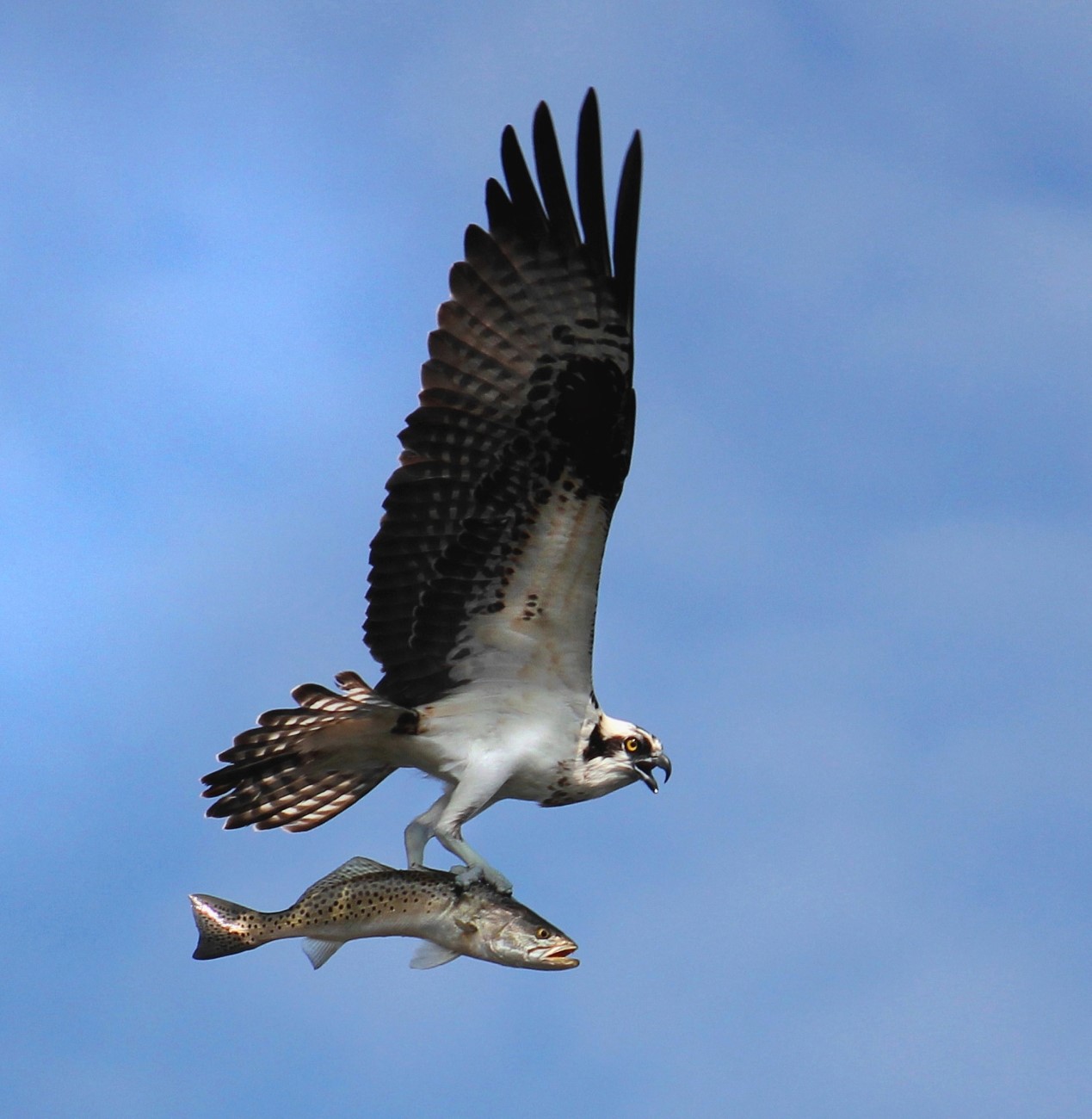
The osprey diet consists almost entirely of fish, but they will occasionally eat frogs, snakes, ducks, crows, and small mammals [5,6,28,29]. Ospreys can penetrate only about 3 feet (1 m) below the water surface. Therefore, they generally catch only surface fish or those that frequent shallow flats and shorelines. Ospreys are opportunists. If fish are abundant, accessible, and the right size they seldom go unconsumed [24]. Poole [24] found that along the southern coast of New England, about one-half of the fish ospreys eat during the breeding season are winter flounder (Pseudopleuonectes americanus). White herring (Alosa spp.) and Menhaden (Brevoortia tyrannus) each supply another 20 percent of the diet. Inland ospreys are likely to eat the same species of fish throughout the breeding season, but coastal populations change prey regularly in response to the seasonal migration of marine fish [24]. Ospreys in western North America often eat suckers, carp, bullhead (Ictalurus spp.), and perch (Perca flavescens) when nesting near warm shallow lakes or reservoirs but eat trout when nesting near deeper, colder waters [24,29].
Preferred Habitat
Ospreys occupy a wide range of habitats near water, primarily lakes, rivers, and coastal waters with adequate supplies of fish [4]. Their nests are generally built within 6 to 7 miles (9.6-11.2 km) of large lakes or rivers with slow-moving water [14,30]. Flattened portions of partially broken off snags, trees, rocks, dirt pinnacles, cacti, and numerous man-made structures such as utility poles and duck blinds are used for nests [14,28,30]. The nests consist of a large interwoven pile of sticks lined with some soft material such as cedar bark or moss [28,30]. The area around the nest is generally open, giving the birds clear access when landing. Ponderosa pine in the western United States, tupelo (Nyssa sylvatica) in the eastern United States, and mangroves (Rhizophora spp.) in the subtropics are all favored as nest trees for this reason [24].
Cover Requirements
Ospreys typically nest at the extreme tip of a tree or snag with little or no overhead cover [17]. They prefer tall snags that provide good visibility and security [5]. Ospreys also prefer to nest over water for protection against climbing predators. Islands free of mammalian predators allow safe nesting in low trees and even on the ground. Swamps also provide safe nesting [24].
Fire-caused Mortality
Ospreys are probably able to escape fire, however, nests may be destroyed.
Fire Effects on Habitat
Information was not found in the literature on habitat related fire effects of the osprey; however, fires will presumably create and destroy snags used by ospreys. Additionally, the short-term effects of a riparian fire may affect the osprey's food supply. Removal of streamside vegetation increases the risk of streambank erosion, reduces available habitat and raises stream temperatures, all of which could potentially reduce fish populations in the stream. However, the long-term effect of fire on fish populations could be beneficial. The thinning and removal of conifers along streams by fire and stimulation of deciduous vegetation promotes cover, provides shading, and allows development of terrestrial insects important in the diet of fish [31].
Fire Regimes
For fire regime information, search FEIS for this species by entering the species name or acronym on the home page and selecting “Fire Regime” as the publication type.
Fire Management Considerations
No entry.
Federal Status
None
Other Status
Information on state- and province-level protection status of animals in the United States and Canada is available at NatureServe, although recent changes in status may not be included.
Other Management Information
In the 1960's osprey populations declined as a result of DDT which were washed into water courses and ingested by fish. These DDT residues affected the estrogen hormone which controls calcium and egg shell thickness, resulting in thinner shells and broken eggs [4,26]. Following tight restrictions on the use of DDT, pesticide residues declined, and North American osprey populations increased consistently between 1968 and 1981. Ospreys are still vulnerable to contamination during migration in Central and South America, where DDT continues to be used to control mosquitos which carry malaria parasites [26].
Some bird species have been observed forming protective nesting associations with ospreys by building their nests in the sides or bottoms of the stick nests of ospreys. These include house wrens (Troglodytes aedon), house sparrows (Passer domesticus), European starlings (Sturnus vulgaris), common grackles (Quiscalus quiscula), night-herons (Nycticorax spp.), swallows (Hirundinidae), and jays (Corvidae) [26].
Artificial nest sites are successfully used by ospreys. One study showed that the overall breeding success improved from 45.9 percent in natural trees to 62.9 percent in man-made platforms [12].
Human disturbance during the critical periods of incubation and early nesting stages can be fatal to embryos and nestlings if adults are kept from their nests. Until an osprey pair becomes habituated to human activities, human disturbance will jeopardize their nesting success [29].
Table A1— Forest and range ecosystems, Bureau of Land Management (BLM) physiographic regions, Kuchler plant associations, Society for American Foresters (SAF) forest cover types, and Society for Rangeland Management (SRM) rangeland cover types in which this species occurs.
Forest and Range Ecosystems (Garrison et al. 1977)
- FRES10 White-red-jack pine
- FRES11 Spruce-fir
- FRES12 Longleaf-slash pine
- FRES13 Loblolly-shortleaf pine
- FRES14 Oak-pine
- FRES15 Oak-hickory
- FRES16 Oak-gum-cypress
- FRES17 Elm-ash-cottonwood
- FRES18 Maple-beech-birch
- FRES19 Aspen-birch
- FRES20 Douglas-fir
- FRES21 Ponderosa pine
- FRES22 Western white pine
- FRES23 Fir-spruce
- FRES24 Hemlock-Sitka spruce
- FRES25 Larch
- FRES26 Lodgepole pine
- FRES35 Pinyon-juniper
- FRES36 Mountain grasslands
- FRES37 Mountain meadows
- FRES39 Prairie
- FRES41 Wet grasslands
- FRES42 Annual grasslands
BLM Physiographic Regions (Bernard and Brown 1977)
- 1 Northern Pacific Border
- 2 Cascade Mountains
- 3 Southern Pacific Border
- 4 Sierra Mountains
- 5 Columbia Plateau
- 6 Upper Basin and Range
- 7 Lower Basin and Range
- 8 Northern Rocky Mountains
- 9 Middle Rocky Mountains
- 10 Wyoming Basin
- 11 Southern Rocky Mountains
- 12 Colorado Plateau
- 13 Rocky Mountain Piedmont
- 16 Upper Missouri Basin and Broken Lands
Kuchler Plant Associations (Kuchler 1964)
- K001 Spruce - cedar - hemlock forest
- K002 Cedar - hemlock - Douglas-fir forest
- K003 Silver fir - Douglas-fir forest
- K004 Fir - hemlock forest
- K005 Mixed conifer forest
- K008 Lodgepole pine - subalpine forest
- K009 Pine - cypress forest
- K010 Ponderosa shrub forest
- K011 Western ponderosa pine
- K012 Douglas-fir forest
- K013 Cedar - hemlock - pine forest
- K014 Grand fir - Douglas-fir forest
- K015 Western spruce - fir forest
- K016 Eastern ponderosa forest
- K018 Pine - Douglas-fir forest
- K019 Arizona pine forest
- K020 Spruce - fir - Douglas-fir forest
- K021 Southwestern spruce - fir forest
- K022 Great Basin pine forest
- K023 Juniper - pinyon woodland
- K025 Alder - ash forest
- K026 Oregon oakwoods
- K029 California mixed evergreen forest
- K030 California oakwoods
- K031 Oak - juniper woodlands
- K032 Transition between K031 and K037
- K047 Fescue - oatgrass
- K049 Tule marshes
- K050 Fescue - wheatgrass
- K051 Wheatgrass - bluegrass
- K053 Grama - galleta steppe
- K054 Grama - tobosa prairie
- K063 Foothills prairie
- K064 Grama - needlegrass - wheatgrass
- K065 Grama - buffalograss
- K066 Wheatgrass - needlegrass
- K067 Wheatgrass - bluestem - needlegrass
- K068 Wheatgrass - grama - buffalograss
- K069 Bluestem - grama prairie
- K070 Sandsage - bluestem prairie
- K071 Shinnery
- K072 Sea oats prairie
- K073 Northern cordgrass prairie
- K074 Bluestem prairie
- K075 Nebraska Sandhills prairie
- K076 Blackland prairie
- K077 Bluestem - sacahuista prairie
- K078 Southern cordgrass prairie
- K079 Palmetto prairie
- K080 Marl - everglades
- K081 Oak savanna
- K082 Mosaic of K074 and K100
- K083 Cedar glades
- K084 Cross Timbers
- K085 Mesquite - buffalograss
- K086 Juniper - oak savanna
- K087 Mesquite - oak savanna
- K088 Fayette prairie
- K089 Black Belt
- K090 Live oak - sea oats
- K091 Cypress savanna
- K092 Everglades
- K093 Great Lakes spruce - fir forest
- K094 Conifer bog
- K096 Northeastern spruce - fir forest
- K097 Southeastern spruce - fir forest
- K098 Northern floodplain forest
- K099 Maple - basswood forest
- K100 Oak - hickory forest
- K101 Elm - ash forest
- K102 Beech - maple forest
- K103 Mixed mesophytic forest
- K104 Appalachian oak forest
- K105 Mangrove
- K106 Northern hardwoods
- K107 Northern hardwoods - fir forest
- K108 Northern hardwoods - spruce forest
- K109 Transition between K104 and K106
- K110 Northeastern oak - pine forest
- K111 Oak - hickory - pine forest
- K112 Southern mixed forest
- K113 Southern floodplain forest
- K116 Subtropical pine forest
SAF Cover Types (Eyre 1980)
- 1 Jack pine
- 5 Balsam fir
- 12 Black spruce
- 13 Black spruce - tamarack
- 15 Red pine
- 16 Aspen
- 17 Pin cherry
- 18 Paper birch
- 19 Gray birch - red maple
- 20 White pine - northern red oak - red maple
- 21 Eastern white pine
- 22 White pine - hemlock
- 23 Eastern hemlock
- 24 Hemlock - yellow birch
- 25 Sugar maple - beech - yellow birch
- 26 Sugar maple - basswood
- 27 Sugar maple
- 28 Black cherry - maple
- 35 Paper birch - red spruce - balsam fir
- 37 Northern white-cedar
- 38 Tamarack
- 39 Black ash - American elm - red maple
- 40 Post oak - blackjack oak
- 42 Bur oak
- 43 Bear oak
- 44 Chestnut oak
- 45 Pitch pine
- 46 Eastern redcedar
- 50 Black locust
- 51 White pine - chestnut oak
- 52 White oak - black oak - northern red oak
- 53 White oak
- 55 Northern red oak
- 57 Yellow-poplar
- 58 Yellow-poplar - eastern hemlock
- 59 Yellow-poplar - white oak - northern red oak
- 60 Beech - sugar maple
- 61 River birch - sycamore
- 62 Silver maple - American elm
- 63 Cottonwood
- 64 Sassafras - persimmon
- 65 Pin oak - sweetgum
- 69 Sand pine
- 70 Longleaf pine
- 71 Longleaf pine - scrub oak
- 73 Southern redcedar
- 75 Shortleaf pine
- 76 Shortleaf pine - oak
- 78 Virginia pine - oak
- 79 Virginia pine
- 80 Loblolly pine - shortleaf pine
- 81 Loblolly pine
- 83 Longleaf pine - slash pine
- 84 Slash pine
- 85 Slash pine - hardwood
- 88 Willow oak - water oak - diamondleaf oak
- 89 Live oak
- 91 Swamp chestnut oak - cherrybark oak
- 92 Sweetgum - willow oak
- 93 Sugarberry - American elm - green ash
- 94 Sycamore - sweetgum - American elm
- 95 Black willow
- 107 White spruce
- 108 Red maple
- 98 Pond pine
- 96 Overcup oak - water hickory
- 101 Baldcypress
- 111 South Florida slash pine
- 109 Hawthorn
- 110 Black oak
- 201 White spruce
- 202 White spruce - paper birch
- 203 Balsam poplar
- 204 Black spruce
- 208 Whitebark pine
- 209 Bristlecone pine
- 210 Interior Douglas-fir
- 211 White fir
- 212 Western larch
- 213 Grand fir
- 215 Western white pine
- 216 Blue spruce
- 217 Aspen
- 218 Lodgepole pine
- 219 Limber pine
- 221 Red alder
- 222 Black cottonwood - willow
- 223 Sitka spruce
- 224 Western hemlock
- 225 Western hemlock - Sitka spruce
- 226 Coastal true fir - hemlock
- 227 Western redcedar - western hemlock
- 228 Western redcedar
SRM Rangeland Cover Types (Shiflet 1994)
- No entry
1. Benson, Patrick C. 1979. Land use and wildlife with emphasis on raptors. [Ogden, UT]: U.S. Department of Agriculture, Forest Service, Intermountain Region. 32 p. On file with: U.S. Department of Agriculture, Forest Service, Intermountain Research Station, Fire Sciences Laboratory, Missoula, MT. [17208]
2. Bernard, Stephen R.; Brown, Kenneth F. 1977. Distribution of mammals, reptiles, and amphibians by BLM physiographic regions and A.W. Kuchler's associations for the eleven western states. Tech. Note 301. Denver, CO: U.S. Department of the Interior, Bureau of Land Management. 169 p. [434]
3. Bider, J. Roger; Bird, David M. 1983. Distribution and densities of osprey populations in the Great Whale Region of Quebec. In: Bird, David M.; Seymour, Norman R.; Gerrard, Jon M., eds. Biology and management of bald eagles and ospreys. Raptor Research Foundation, Inc.: 223-230. [20128]
4. Cadman, Michael D.; Eagles, Paul F. J.; Helleiner, Frederick M. 1987. Atlas of the breeding birds of Ontario. University of Waterloo Press. 617 p. [20129]
5. DeGraaf, Richard M.; Scott, Virgil E.; Hamre, R. H.; [and others]. 1991. Forest and rangeland birds of the United States: Natural history and habitat use. Agric. Handb. 688. Washington, DC: U.S. Department of Agriculture, Forest Service. 625 p. [15856]
6. DuBois, Kristi; Becker, Dale; Thornbrugh, Joe. 1987. Identification of Montana's birds of prey. Montana Outdoors. 18(6): 11-31. [3606]
7. Eyre, F. H., ed. 1980. Forest cover types of the United States and Canada. Washington, DC: Society of American Foresters. 148 p. [905]
8. Finch, Deborah M. 1992. Threatened, endangered, and vulnerable species of terrestrial vertebrates in the Rocky Mountain Region. Gen. Tech. Rep. RM-215. Fort Collins, CO: U.S. Department of Agriculture, Forest Service, Rocky Mountain Forest and Range Experiment Station. 38 p. [18440]
9. Flook, Donald R.; Forbes, L. Scott. 1983. Ospreys and water management at Creston, British Columbia. In: Bird, David M.; Seymour, Norman R.; Gerrard, Jon M., eds. Biology and management of bald eagles and ospreys. Raptor Research Foundation, Inc.: 281-286. [20130]
10. Garrison, George A.; Bjugstad, Ardell J.; Duncan, Don A.; [and others]. 1977. Vegetation and environmental features of forest and range ecosystems. Agric. Handb. 475. Washington, DC: U.S. Department of Agriculture, Forest Service. 68 p. [998]
11. Glinski, Richard L.; Grubb, Teryl G.; Forbis, Larry A. 1983. Snag use by selected raptors. In: Davis, Jerry W.; Goodwin, Gregory A.; Ockenfeis, Richard A., technical coordinators. Snag habitat management: Proceedings of the symposium; 1983 June 7 - June 9; Flagstaff, AZ. Gen. Tech. Rep. RM-99. Fort Collins, CO: U.S. Department of Agriculture, Forest Service, Rocky Mountain Forest and Range Experiment Station: 130-133. [17827]
12. Houston, C. Stuart; Scott, Frank. 1992. The effect of man-made platforms on osprey reproduction at Loon Lake, Saskatchewan. Journal of Raptor Research. 26(3): 152-158. [20131]
13. Kochert, Michael N. 1986. Raptors. In: Cooperrider, Allan Y.; Boyd, Raymond J.; Stuart, Hanson R., eds. Inventory and monitoring of wildlife habitat. Denver, CO: U.S. Department of the Interior, Bureau of Land Management, Denver Service Center: 313-349. [13527]
15. Kuchler, A. W. 1964. Manual to accompany the map of potential vegetation of the conterminous United States. Special Publication No. 36. New York: American Geographical Society. 77 p. [1384]
16. Kushlan, James A.; Bass, Orin L., Jr. 1983. Decreases in the southern Florida osprey population, a possible of food stress. In: Bird, David M.; Seymour, Norman R.; Gerrard, Jon M., eds. Biology and management of bald eagles and ospreys. Raptor Research Foundation, Inc.: 187-200. [20132]
17. Mathisen, John E. 1968. Identification of bald eagle and osprey nests in Minnesota. Loon. 40(4): 113-114. [13996]
19. Meslow, E. Charles. 1978. The relationship of birds to habitat structure - plant communities and successional stages. In: DeGraaf, Richard M, technical coordinator. Proceedings of the Workshop on Nongame Bird Habitat Management in the Coniferous Forests of the Western United States; 1977 February 7 - February 9; Portland, OR. General Technical Report PNW-64. Portland, OR: U.S. Department of Agriculture, Forest Service, Pacific Northwest Forest and Range Experiment Station: 12-18. [17782]
20. Miller, Eileen; Miller, Donald R. 1980. Snag use by birds. In: DeGraaf, Richard M., technical coordinator. Management of western forests and grasslands for nongame birds; 1980 February 11-14; Salt Lake City, UT. Gen. Tech. Rep. INT-86. Ogden, UT: U.S. Department of Agriculture, Forest Service, Intermountain Forest and Range Experiment Station: 337-356. [17914]
21. Munther, Greg; Diebert, Jerry; Hillis, Mike. 1978. Some wildlife and fisheries habitat management concepts. Forest Workshops: 1978 May 3-4; [Location of workshops unknown]. Missoula, MT: U.S. Department of Agriculture, Forest Service, Region 1, Lolo National Forest.66 p. [17163]
22. Perala, Donald A. 1977. Manager's handbook for aspen in the north central states. Gen. Tech. Rep. NC-36. St. Paul, MN: U.S. Department of Agriculture, Forest Service, North Central Forest Experiment Station. 30 p. [5632]
23. Phillips, Robert L.; Wheeler, Anne H.; Lockhart, J. Michael; [and others]. 1990. Nesting ecology of golden eagles and other raptors in southeastern Montana and northern Wyoming. Fish and Wildlife Technical Report 26. Washington, DC: U.S. Department of the Interior, Fish and Wildlife Service. 13 p. [15474]
24. Poole, Alan F. 1989. Ospreys: a natural and unnatural history. Cambridge; New York: Cambridge University Press. 246 p. [20133]
25. Prevost, Yves A. 1983. Osprey distribution and subspecies taxonomy. In: Bird, David M.; Seymour, Norman R.; Gerrard, Jon M., eds. Biology and management of bald eagles and ospreys. Raptor Research Foundation, Inc.: 157-186. [20134]
26. Ryser, Fred A. 1985. Birds of the Great Basin. Reno, NV: University of Nevada Press. 604 p. [20135]
27. Sanderson, H. Reed; Bull, Evelyn L.; Edgerton, Paul J. 1980. Bird communities in mixed conifer forests of the interior northwest. In: DeGraaf, Richard M., technical coordinator. Management of western forests and grasslands for nongame birds: Workshop proceedings; 1980 February 11-14; Salt Lake City, UT. Gen. Tech. Rep. INT-86. Ogden, UT: U.S. Department of Agriculture, Forest Service, Intermountain Forest and Range Experiment Station: 224-237. [17907]
28. Burns, Timothy S. 1974. Wildlife situation report and management plan for the American osprey. Coordinating Guidelines for Wildlife Habitat Management No. 1. Hamilton, MT: U.S. Department of Agriculture, Forest Service, Northern Region, Bitterroot National Forest. 6 p. [20008]
29. Van Daele, Lawrence J.; Van Daele, Hilary A. 1982. Factors affecting the productivity of ospreys nesting in west-central Idaho. Condor. 84: 292-299. [15143]
30. Verner, Jared; Boss, Allan S., tech. coords. 1980. California wildlife and their habitats: western Sierra Nevada. Gen. Tech. Rep. PSW-37. Berkeley, CA: U.S. Department of Agriculture, Forest Service, Pacific Southwest Forest and Range Experiment Station. 439 p. [10237]
31. Wright, Henry A.; Bailey, Arthur W. 1982. Fire ecology: United States and southern Canada. New York: John Wiley & Sons. 501 p. [2620]
32. Donohoe, Robert W. 1974. American hornbeam Carpinus caroliniana Walt. In: Gill, John D.; Healy, William M., eds. Shrubs and vines for northeastern wildlife. Gen. Tech. Rep. NE-9. Upper Darby, PA: U.S. Department of Agriculture, Forest Service, Northeastern Forest Experiment Station: 86-88. [13714]
33. South Dakota Department of Game, Fish and Parks. 1994. Fragile legacy: Endangered, threatened and rare animals of South Dakota. Pierre, SD: South Dakota Department of Game, Fish, and Parks, Wildlife Division. 55 p. [24341]
34. France, R.; Sharp, M. 1992. First record of the rough-legged hawk, Buteo lagopus, from Ellesmere Island, Northwest Territories. Canadian Field-Naturalist. 106(4): 511-512. [23425]
35. Washington Department of Wildlife. 1994. Species of special concern in Washington - state and federal status. Olympia, WA: Washington Department of Wildlife. 41 p. [25414]