


Parkinsonia florida, blue paloverde
Pavek, Diane S. 1994. Parkinsonia florida, blue paloverde. In: Fire Effects Information System, [Online]. U.S. Department of Agriculture, Forest Service, Rocky Mountain Research Station, Fire Sciences Laboratory (Producer). Available: https://research.fs.usda.gov/feis/species-reviews/parflo
| Abbreviation | Common Name | Scientific Name | Classification | Status |
|---|---|---|---|---|
| Plants | ||||
| PARFLO | blue paloverde | Parkinsonia florida | Life Form: Plants/Tree Kingdom: Plantae Class: Dicot Order: Fabales Family: Fabaceae Genus: Parkinsonia | Fed. Protected: No Nativity: Native Invasiveness: Noninvasive |
Taxonomy
The currently accepted scientific name of blue paloverde is Parkinsonia florida (Benth.) S. Wats. [62,82,83]. Besides the typical subspecies that is recognized throughout most of the species range, peninsular blue pale verde (described as C. f. ssp. peninsulare (Rose) Carter) occurs in Baja California [76]. Occasionally, blue paloverde hybridizes with yellow paloverde (P. microphyllum) [39].
Synonyms
- Cercidium floridum Benth ex Gray. (Fabaceae) [5,27,55,82]
- Cercidium torreyanum (S. Wats.) Sarg. [30]
Other Common Names
None
General Distribution
Blue paloverde is distributed through the Sonoran Desert. Its range extends from central and southwestern Arizona into southeastern California [15,25,35,39,62,68]. Blue paloverde continues southward through western Sonora, Mexico [5,21,47]. Disjunct populations of blue paloverde are located in northern Sinaloa and Baja California Sur [27,31,39,55,76].
States and Provinces
- United States: AZ CA
- Mexico
Site Characteristics

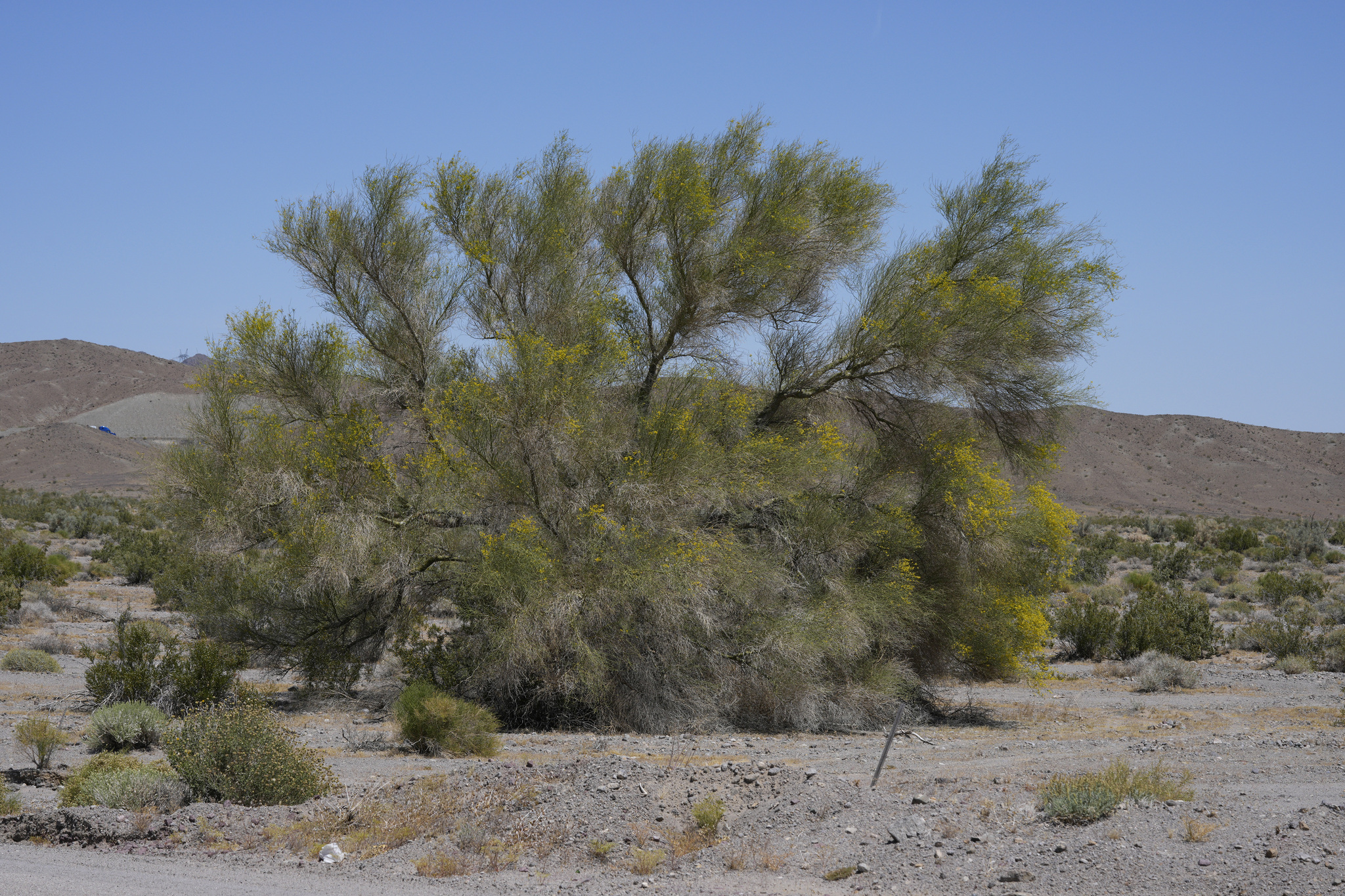
Blue paloverde, San Bernardino County, California. (CC BY-NC 4.0)
Blue paloverde occurs in arid and semiarid climates characterized by high summer temperatures and highly variable rainfall. Precipitation predominantly falls bimodally, in winter and in summer [40,52,53,66].
Blue paloverde is found at elevations from sea level to 4,000 feet (0-1,220 m) [4,15,26,34,74]. It occurs on almost level (less than 5%) to steep slopes [4].
Blue paloverde predominantly grows in washes, but is also found in upland habitats. Blue paloverde occurs in moderate to large watersheds from 1 to 50 square miles (2.6-130 sq km) [81]. It grows on terraces, high flood plains, arroyos or dry washes, and intermittent streambeds more than 4 to 5 feet (1.2-1.5 m) wide with deep soil [8,54,79,81]. In the northern Sonoran Desert at moderately high elevations, blue paloverde grows in upland positions [66]. Blue paloverde occupies hills, mountain slopes, and middle to lower bajadas [4,54,65].
Blue paloverde grows in soils with low levels of nutrients, especially nitrogen and phosphorus [3]. Soil textures it occurs on may be sandy to gravelly, coarse loamy to fine sand overlain with fine gravel [4,54,65].
Plant Communities
Blue paloverde is a characteristic member of the Sonoran Desert floristic region [38,79]. It is a member of desert scrub communities. Blue paloverde is a major component in creosotebush (Larrea tridentata) and white bursage (Ambrosia dumosa) climax communities on lower bajadas [8,12,22,38,74].
Blue paloverde is a facultative desert riparian species that may be restricted to washes or arroyos in parts of its range but also occurs in upland communities. It primarily occurs in communities irregularly scattered along arroyos [68]. These communities with intermittent water are variously classified as desert riparian associations [33], pseudo-riparian communities [11], desert wash woodlands [7,13,53,71], Colorado River riparian forests [49], and desert microphyll associations [61]. Codominants in all of these classifications are honey mesquite (Prosopis glandulosa var. glandulosa), smoketree (Psorothamnus spinosus), ironwood (Olneya tesota), desert willow (Chilopsis linearis), and catclaw acacia (Acacia greggii) [52,58,71].
Blue paloverde is a dominant member of the mixed scrub series with ironwood and jojoba (Simmondsia chinensis) [68]. Within the broadleaf woodland subformation, the paloverde series is dominated by either blue paloverde or yellow paloverde; the understory is sparse in this series [43].
Blue paloverde is listed as a dominant or indicator species in the following publications:
- A vegetation classification system applied to southern California [43]
- The vascular plant communities of California [61]
- Vegetation of the Santa Catalina Mountains, Arizona: a gradient analysis of the south slope [74].
Species associated with blue paloverde but not mentioned in table A1 include desert hackberry (Celtis pallida), desert lavender (Hyptis emoryi), big saltbrush (Atriplex lentiformis), Torrey seepweed (Suaeda torreyana), spidergrass (Aristida ternipes), and Rothrock grama (Bouteloua rothrockii) [23,47,49,68].
Botanical Description

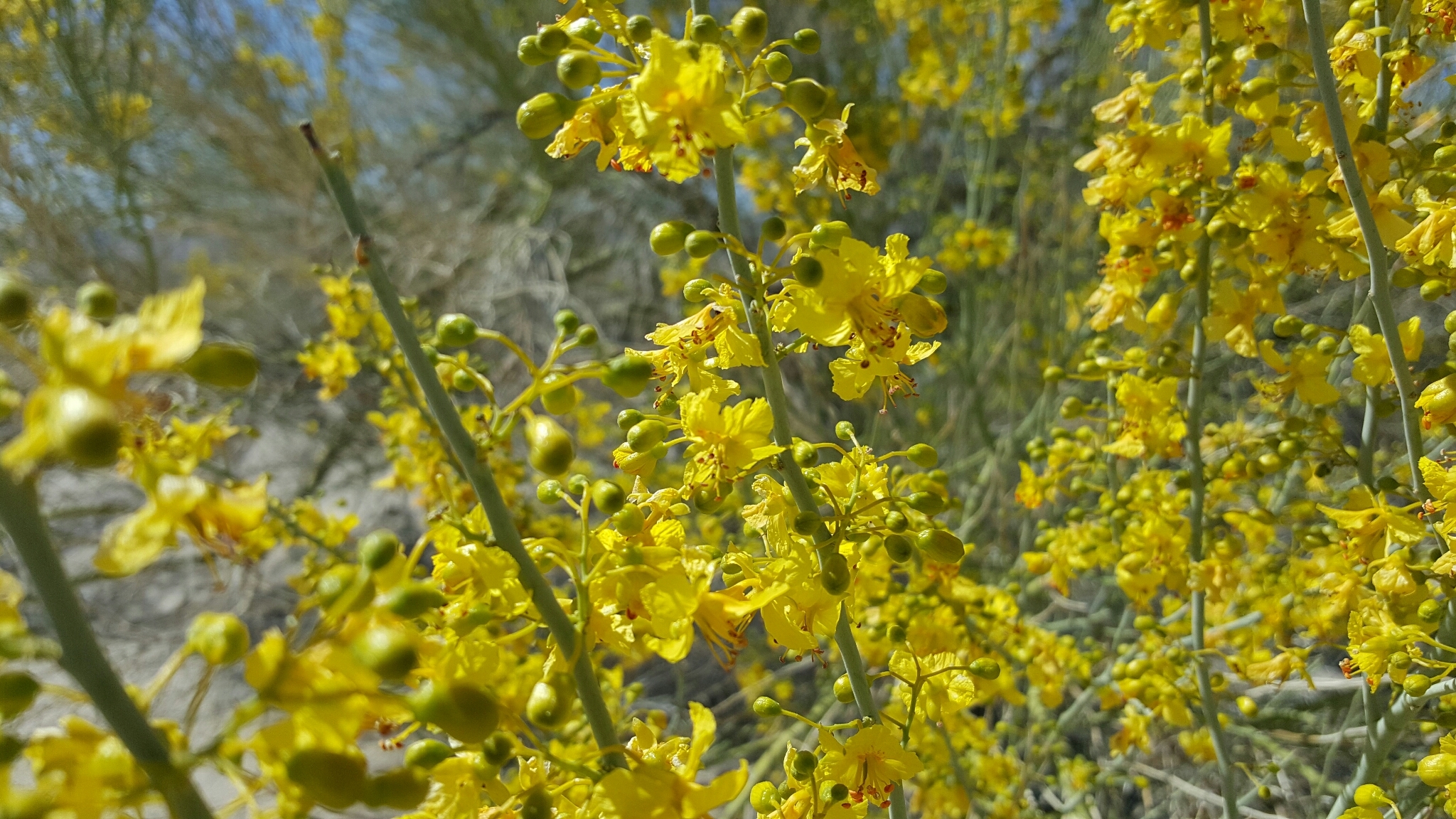
Blue paloverde flowers, Joshua Tree National Park, Riverside County, California. (CC BY-NC 4.0)
Blue paloverde is a native, spiny, small tree or subtree [30,35,39,78]. It has multiple stems [4]. Blue paloverde grows to 32.8 feet (10 m) tall with a trunk diameter of 1.5 feet (0.5 m) and a crown spread of 163.4 square feet (15.2 sq m) [4,5,30,39]. Blue paloverde has thin-barked, photosynthetic stems [3,66]. Age influences photosynthetic rate of stems; younger stems have higher photosynthetic rates [41]. Its pinnately compound leaves are about 1 inch (2.5 cm) long and drought-deciduous [3,30,54,66,78]. Inflorescences of blue paloverde are 1.5 to 4.7 inches (4-12 cm) long with one or more flowers [55,62,70]. The fruits are flat legumes, 1.5 to 4 inches (4-10 cm) long [39,62,70]. Each legume holds one to eight flat seeds [36,39,70].
Raunkiaer Life Form (Raunkiaer 1934)
- Phanerophyte
Seasonal Development
Flower and leaf production of blue paloverde vary according to the amounts of precipitation received [66]. Blue paloverde remains leafless throughout most of the year [30]. Leaves are produced between mid-July and late November, depending on the summer rains [66]. Leaves drop during drought and are not replaced until the following spring [13]. Blue paloverde typically flowers sporadically after rains from late March to May, but flowering may extend into July [5,15,30,66,70]. Populations of blue paloverde also may bloom August to October [30]. Fruits mature about 1 month after flowering, typically from May to July [66,70].
Regeneration Processes
Blue paloverde reproduces sexually and probably asexually. In a greenhouse study, young blue paloverde sprouted after plants were clipped to less than one-half of their total height [3]. A close relative, yellow paloverde, sprouts following top-kill [32].
Photoperiod controls blue paloverde flower and fruit initiation and stem growth; however, moisture and temperature determine actual organ production [13,66].
Abiotic and biotic agents aid in seed dispersal. The flat seeds of blue paloverde prevent air loft and allow downward dispersal into washes. Fruits and seeds do not float. Occasionally, blue paloverde fruits disperse unopened. Some seed dispersal occurs via animals. Blue paloverde has been found occasionally in ant formicaries below the soil surface. Seeds will germinate in these caches. Birds probably move seed upstream [36].
Large seedbanks of blue paloverde may be present. Scarification from flash floods or other abrasive processes facilitates germination [36,43,71,73]. Blue paloverde germinates well on sandy deposits [67]. Shade and litter beneath mature blue paloverde alters seed microsites and makes germination more likely [54].
Blue paloverde establishment is limited by climate extremes, low moisture availability, poor soil characteristics, and herbivory. Rapid, deep root development is important for blue paloverde establishment. In greenhouse trials, blue paloverde roots grew an average of 0.3 inch per day (0.9 cm/day) [3]. Mature blue paloverde has deep root systems that reach ground water and make blue paloverde less vulnerable to drought [42]. A herbivory experiment was conducted on blue paloverde at Travertine Point, California. Seven months after blue paloverde germinated, rabbits and other rodents grazed 86 percent of the seedlings. Ninety percent of these grazed blue paloverde seedlings appeared unlikely to survive [3].
Successional Status
Blue paloverde occurs from pioneer to climax communities, depending on site characteristics. In fact, classical succession may not occur in the desert ecosystems where blue paloverde occurs. In the xeroriparian systems to which blue paloverde belongs, community development is influenced by catastrophic floods and long recovery periods [26]. After disturbance of the desert scrub communities, former dominants such as blue paloverde are the first to appear and replace themselves [48].
Immediate Fire Effects
Blue paloverde with its thin photosynthetic bark is probably top-killed by fire. Surviving rootstocks may sprout if the response of blue paloverde is similar to yellow paloverde [32]. If plants are heat damaged, they may die several months after burning [14]. Seeds are probably killed by fire unless protected by insulating layers of soil.
Postfire Regeneration Strategy (Stickney 1989)
- Tree with adventitious-bud root crown/soboliferous species root sucker
- Secondary colonizer - off-site seed
Fire Adaptations
Blue paloverde is susceptible to fire; its photosynthetic stems are probably easily killed by fire. It may sprout from the root crown if its postfire response is similar to its response to clipping.
Plant Response to Fire
In desert plant communities where blue paloverde occurs, 20 years may be necessary for plant densities to recover to prefire levels [14,32,51].
Four years after a February 1964 fire in a southeastern California desert scrub community, soils beneath burned and unburned woody plants were surveyed. Soil beneath burned blue paloverde had a strongly hydrophobic layer overlain by a slightly hydrophobic layer. Burned soil had a slightly higher degree of water repellency than unburned soil. This water-repellent burned soil causes a reduction of available water moisture and inhibits germination of species such as annuals beneath blue paloverde [1]. This may protect blue paloverde from some fires. Native annual plants probably did not create the same large fuel load that introduced annual species currently provide [32].
Fire Regimes
The historical fire regime of the Sonoran Desert is mostly unknown [24]. Thomas [59] mentioned that fire free periods in the Sonoran Desert are greater than 250 years. However, Loftin [32] stated that fires were relatively common in the Sonoran Desert under appropriate conditions, especially during summer. Fires that do occur are usually low-severity due to small fuel loads [37].
Grazing and vegetation change have probably altered the fire regime from historic patterns. On the Santa Rita Experimental Range in southern Arizona, frequent fires were common until 1916 because dense stands of grass were present. Fires were frequent at the turn of the century in desert grasslands that border the desert scrub communities where blue paloverde occurs. By the 1960s, fire frequencies had declined due to grazing and fire suppression [24]. In south-central Arizona, understory vegetation beneath paloverde species, ironwood, mesquite, and saguaro associations changed from grasses to low shrubs due to grazing pressures. This has altered the fire regime, resulting in less frequent fires [50]. However, where introduced annual grasses now predominate, fire frequency may have increased.
The Sonoran savanna grasslands are subtropical, fire-climax communities. Blue paloverde occurs infrequently in these communities at their northern limits [10].
For additional fire regime information, search FEIS for this species by entering the species name on the Advanced Search page and selecting “Fire Regime” as the publication type.
Fire Management Considerations
It is difficult to control shrubs and trees with fire on arid habitats due to lack of fuel. Two consecutive wet winters are probably necessary to develop adequate fuel to sustain a fire in the desert scrub [37]. Prescribed fires once every 10 years would keep blue paloverde in check [23].
Depending upon the season of burning, soil nutrients may be quickly translocated following fire on the desert soils where blue paloverde occurs. Available nitrogen in the soil drops below prefire levels for several years due to removal of nitrogen-containing ash by run-off [75].
Dry matter levels are useful for predicting flammability of fuels. Near Tucson, Arizona, aboveground biomass of blue paloverde was 80.3 percent dry matter [4].
Federal Status
No special status.
Other Status
No entry.
Importance to Wildlife and Livestock
Blue paloverde fruits, twigs, and leaves are used as livestock forage throughout the year [60]. Mule deer, bighorn sheep, and burros browse its twigs and leaves [15,80]. Small mammals consume blue paloverde seeds during summer and fall [15].
In southern Arizona, blue paloverde taller than 6.7 feet (2 m) is used for nesting [65]. With a large canopy, blue paloverde offers many sites for bird perching, nesting, and foraging. The blue paloverde-ironwood vegetation type supports a high density and diversity of breeding birds [7,16,20]. In south central Arizona, 19 species of breeding birds were present in mesquite (Prosopis spp.) bosques where blue paloverde occurred [56].
Blue paloverde leaves and stems contain cyanogenic glycosides, alkaloids, and cinnamic phenolic acid which may deter herbivory [77].
Palatability and Nutritional Value
Blue paloverde aboveground biomass is about 22 percent nitrogen, 50 to 80 percent dry matter, and 17 percent crude protein [4,63,64,80].
Equations are available to predict amounts of dry matter, nitrogen, and carbon based on blue paloverde height and crown measurements [4].
Cover Value
No entry.
Value for Rehabilitation or Restoration of Disturbed Sites
Blue paloverde has successfully established by artificial seeding following highway construction [9].
Blue paloverde naturally established following removal of invasive populations of saltcedar (Tamarix ramosissima) [2]. Soil preparation, planting, and irrigation methods for blue paloverde are discussed in the literature [3,71].
Other Uses
Blue paloverde fruits have been used by Native Americans for food [5]. The Pima and Papago in Arizona cooked young blue paloverde fruits and seeds and ground the seeds for porridge [15].
The Pima carved blue paloverde into large serving spoons [46].
The wood of blue paloverde is light to heavy, soft, and close-grained [30,70]. Blue paloverde is used for fuel [49].
Other Management Considerations
Blue paloverde and other species were tested for biomass production for use in fuelwood and erosion control programs. Blue paloverde and ironwood ranked lowest of the tested species for biomass production [18].
Young blue paloverde can tolerate moderate grazing. In greenhouse tests, blue paloverde sprouted following top removal. At a transplant site near Travertine Point, California, severely gnawed blue paloverde transplants survived only when irrigated [3].
Seed predation by invertebrates such as bruchid beetles can lead to logarithmic increases in seed mortality of blue paloverde [28].
Blue paloverde has decreased in some areas of Arizona partly due to the erosion of broad flat washes into narrow, steep-sided channels [67]. In the microphyll woodlands of the desert washes, disturbance by offroad vehicles decreases density and biomass of perennial plants such as blue paloverde [7].
Natural recovery following disturbance is slow in wash woodlands in which blue paloverde occurs. Optimal conditions for reestablishment occur infrequently. It may take up to 60 years for these woodlands to reach predisturbance levels of biomass, and 180 years to reach predisturbance levels of species diversity [71].
In southeastern California, blue paloverde is a nurse plant for saguaro (Carnegiea gigantea) [13]. Saguaro eventually outlive or contribute to the death of paloverde species [35].
Blue paloverde does not have mycorrhizal nodules [72]. The presence of other mycorrhizal associations was not discussed.
Table A1— Forest and range ecosystems, Bureau of Land Management (BLM) physiographic regions, Kuchler plant associations, Society for American Foresters (SAF) forest cover types, and Society for Rangeland Management (SRM) rangeland cover types in which this species occurs.
Forest and Range Ecosystems (Garrison et al. 1977)
- FRES30 Desert shrub
- FRES40 Desert grasslands
BLM Physiographic Regions (Bernard and Brown 1977)
- 7 Lower Basin and Range
Kuchler Plant Associations (Kuchler 1964)
- K027 Mesquite bosque
- K041 Creosotebush
- K042 Creosotebush - bursage
- K043 Paloverde - cactus shrub
SAF Cover Types (Eyre 1980)
- 68 Mesquite
- 242 Mesquite
SRM Rangeland Cover Types (Shiflet 1994)
- No entry
1. Adams, Susan; Strain, B. R.; Adams, M. S. 1970. Water-repellent soils, fire, and annual plant cover in a desert scrub community of southeastern California. Ecology. 51(4): 696-700. [5407]
2. Anderson, Bertin W.; Ohmart, Robert D.; Disano, John. 1979. Revegetating the riparian floodplain for wildlife. In: Johnson, R. Roy; McCormick, J. Frank, technical coordinators. Strategies for protection and management of floodplain wetlands & other riparian ecosystems: Proc. of the symposium; 1978 December 11-13; Callaway Gardens, GA. Gen. Tech. Rep. WO-12. Washington, DC: U.S. Department of Agriculture, Forest Service: 318-331. [4367]
3. Bainbridge, David A.; Virginia, Ross A. 1990. Restoration in the Sonoran Desert of California. Restoration and Management Notes. 8(1): 3-14. [14975]
4. Barth, R. C.; Klemmedson, J. O. 1982. Amount and distribution of dry matter, nitrogen, and organic carbon in soil-plant systems of mesquite and palo verde. Journal of Range Management. 35(4): 412-418. [2980]
5. Benson, Lyman; Darrow, Robert A. 1981. The trees and shrubs of the Southwestern deserts. Tucson, AZ: The University of Arizona Press. [18066]
6. Bernard, Stephen R.; Brown, Kenneth F. 1977. Distribution of mammals, reptiles, and amphibians by BLM physiographic regions and A.W. Kuchler's associations for the eleven western states. Tech. Note 301. Denver, CO: U.S. Department of the Interior, Bureau of Land Management. 169 p. [434]
7. Berry, Kristin H. 1980. A review of the effects of off-road vehicles on birds and other vertebrates. In: DeGraaf, Richard M., technical coordinator. Management of western forests and grasslands for nongame birds: Workshop proceedings; 1980 February 11-14; Salt Lake City, UT. Gen. Tech. Rep. INT-86. Ogden, UT: U.S. Department of Agriculture, Forest Service, Intermountain Forest and Range Experiment Station: 451-467. [17918]
8. Bowers, Michael A. 1988. Plant associations on a Sonoran Desert bajada: geographical correlates and evolutionary source pools. Vegetatio. 74: 107-112. [4408]
9. Brady, E. LeRoy. 1991. Use of native plants for roadside revegetation. In: Rangeland Technology Equipment Council, 1991 annual report. 9222-2808-MTDC. Washington, DC: U.S. Department of Agriculture, Forest Service, Technology and Development Program: 15-16. [17081]
10. Brown, David E. 1982. Sonoran savanna grassland. In: Brown, David E., ed. Biotic communities of the American Southwest--United States and Mexico. Desert Plants. 4(1-4): 137-141. [8897]
11. Brown, David E.; Lowe, Charles H.; Hausler, Janet F. 1977. Southwestern riparian communities: their biotic importance and management in Arizona. In: Johnson, R. Roy; Jones, Dale A., tech. coords. Importance, preservation and management of riparian habitat: a symposium: Proceedings; 1977 July 9; Tucson, AZ. Gen. Tech. Rep. RM-43. Fort Collins, CO: U.S. Department of Agriculture, Forest Service, Rocky Mountain Forest and Range Experiment 201-211. [5348]
12. Burgess, Tony L.; Bowers, Janice E.; Turner, Raymond M. 1991. Exotic plants at the Desert Laboratory, Tucson, Arizona. Madrono. 38(2): 96-114. [15362]
13. Burk, Jack H. 1977. Sonoran Desert. In: Barbour, M. G.; Major, J., eds. Terrestrial vegetation of California. New York: John Wiley and Sons: 869-899. [3731]
14. Cave, George Harold, III. 1982. Ecological effects of fire in the upper Sonoran Desert. Tempe, AZ: Arizona State University. 124 p. Thesis. [12295]
15. Elias, Thomas S. 1980. The complete trees of North America: field guide and natural history. New York: Times Mirror Magazines, Inc. 948 p. [21987]
16. England, A. Sidney; Foreman, Larry D.; Laudenslayer, William F., Jr. 1984. Composition and abundance of bird populations in riparian systems of the California deserts. In: Warner, Richard E.; Hendrix, Kathleen M., eds. California riparian systems: Ecology, conservation, and productive management. Berkeley, CA: University of California Press: 694-705. [5870]
17. Eyre, F. H., ed. 1980. Forest cover types of the United States and Canada. Washington, DC: Society of American Foresters. 148 p. [905]
18. Felker, Peter; Cannell, G. H.; Clark, Peter R.; [and others]. 1983. Biomass production of Prosopis species (mesquite), Leucaena, and other leguminous trees grown under heat/drought stress. Forest Science. 29(3): 592-606. [4765]
19. Garrison, George A.; Bjugstad, Ardell J.; Duncan, Don A.; [and others]. 1977. Vegetation and environmental features of forest and range ecosystems. Agric. Handb. 475. Washington, DC: U.S. Department of Agriculture, Forest Service. 68 p. [998]
20. Goodwin, John G., Jr.; Hungerford, C. Roger. 1977. Habitat use by native Gambel's and scaled quail and released masked bobwhite quail in southern Arizona. Res. Pap. RM-197. Fort Collins, CO: U.S. Department of Agriculture, Forest Service, Rocky Mountain Forest and Range Experiment Station. 8 p. [14970]
21. Hastings, James R.; Turner, Raymond M.; Warren, Douglas K. 1972. An atlas of some plant distributions in the Sonoran Desert. Technical Reports on the Meteorology and Climatology of Arid Regions No. 21. Tucson, AZ: University of Arizona, Institute of Atmospheric Physics. 255 p. [10534]
22. Herbel, Carlton H. 1979. Utilization of grass- and shrublands of the south-western United States. In: Walker, B. H., ed. Management of semi-arid ecosystems. Volume 7. Developments in agriculture and managed-forest ecology. Amsterdam: Elsevier Scientific Publishing Company: 161-203. [1134]
23. Humphrey, R. R. 1949. Fire as a means of controlling velvet mesquite, burroweed, and cholla on southern Arizona ranges. Journal of Range Management. 2: 175-182. [5050]
24. Humphrey, Robert R. 1963. The role of fire in the desert and desert grassland areas of Arizona. In: Proceedings, 2nd annual Tall Timbers fire ecology conference; 1963 March 14-15; Tallahassee, FL. Tallahassee, FL: Tall Timbers Research Station: 45-61. [19000]
25. Johnson, Hyrum B. 1976. Vegetation and plant communities of southern California deserts--a functional view. In: Latting, June, ed. Symposium proceedings: plant communities of southern California; 1974 May 4; Fullerton, CA. Special Publication No. 2. Berkeley, CA: California Native Plant Society: 125-164. [1278]
26. Johnson, R. Roy; Bennett, Peter S.; Haight, Lois T. 1989. Southwestern woody riparian vegetation and succession: an evolutionary approach. In: Abell, Dana L., technical coordinator. Proceedings of the California riparian systems conference: Protection, management, and restoration for the 1990's; 1988 September 22-24; Davis, CA. Gen. Tech. Rep. PSW-110. Berkeley, CA: U.S. Department of Agriculture, Forest Service, Pacific Southwest Forest and Range Experiment Station: 135-139. [13515]
27. Kearney, Thomas H.; Peebles, Robert H.; Howell, John Thomas; McClintock, Elizabeth. 1960. Arizona flora. 2d ed. Berkeley, CA: University of California Press. 1085 p. [6563]
28. Kingsolver, J. M.; Johnson, C. D.; Swier, S. R.; Teran, A. 1977. Prosopis fruits as a resource for invertebrates. In: Simpson, B. B., ed. Mesquite: Its biology in two desert ecosystems. US/IBP Synthesis 4. Stroudsburg, PA: Dowden, Hutchinson & Ross, Inc.: 108-122. [5193]
29. Kuchler, A. W. 1964. Manual to accompany the map of potential vegetation of the conterminous United States. Special Publication No. 36. New York: American Geographical Society. 77 p. [1384]
30. Little, Elbert L., Jr. 1950. Southwestern trees: A guide to the native species of New Mexico and Arizona. Agriculture Handbook No. 9. Washington, DC: U.S. Department of Agriculture, Forest Service. 109 p. [20330]
31. Little, Elbert L., Jr. 1976. Atlas of United States trees. Volume 3. Minor western hardwoods. Misc. Publ. 1314. Washington, DC: U.S. Department of Agriculture, Forest Service. 13 p. 290 maps. [10430]
32. Loftin, Samuel Robert. 1987. Postfire dynamics of a Sonoran Desert ecosystem. Tempe, AZ: Arizona State University. 97 p. Thesis. [12296]
33. Lowe, Charles H., Jr. 1961. Biotic communities in the sub-Mogollon region of the inland Southwest. Arizona Academy of Science Journal. 2: 40-49. [20379]
34. Lowe, Charles H.; Holm, Peter A. 1991. The amphibians and reptiles at Saguaro National Monument, Arizona. Technical Report No. 37. Tucson, AZ: University of Arizona, School of Renewable Natural Resources, Cooperative National Park Resources Study Unit. 20 p. [18335]
35. MacMahon, James A. 1988. Warm deserts. In: Barbour, Michael G.; Billings, William Dwight, eds. North American terrestrial vegetation. Cambridge; New York: Cambridge University Press: 231-264. [19547]
36. Maddox, Jay C.; Carlquist, Sherwin. 1985. Wind dispersal in Californian desert plants: experimental studies and conceptual considerations. Aliso. 11(1): 77-96. [3256]
37. McLaughlin, Steven P.; Bowers, Janice E. 1982. Effects of wildfire on a Sonoran Desert plant community. Ecology. 63(1): 246-248. [1619]
38. Minckley, W. L.; Clark, Thomas O. 1981. Vegetation of the Gila River Resource Area, eastern Arizona. Desert Plants. 3(3): 124-140. [10863]
39. Munz, Philip A. 1974. A flora of southern California. Berkeley, CA: University of California Press. 1086 p. [4924]
40. Niering, William A.; Lowe, Charles H. 1984. Vegetation of the Santa Catalina Mountains: community types and dynamics. Vegetatio. 58: 3-28. [12037]
41. Nilsen, Erik T.; Meinzer, F. C.; Rundel, P. W. 1989. Stem photosynthesis in Psorothamnus spinosus (smoke tree) in the Sonoran desert of California. Oecologia. 79: 193-197. [8731]
42. Odening, Walter R.; Strain, B. R.; Oechel, W. C. 1974. The effect of decreasing water potential on net CO2 exchange of intact desert shrubs. Ecology. 55: 1086-1095. [17775]
43. Paysen, Timothy E.; Derby, Jeanine A.; Black, Hugh, Jr.; [and others]. 1980. A vegetation classification system applied to southern California. Gen. Tech. Rep. PSW-45. Berkeley, CA: U.S. Department of Agriculture, Forest Service, Pacific Southwest Forest and Range Experiment Station. 33 p. [1849]
44. Pemberton, Robert W. 1988. The abundance of plants bearing extrafloral nectaries in Colorado and Mojave Desert communities of southern California. Madrono. 35(3): 238-246. [6163]
45. Raunkiaer, C. 1934. The life forms of plants and statistical plant geography. Oxford: Clarendon Press. 632 p. [2843]
46. Rea, Amadeo. 1979. Velvet mesquite. Environment Southwest. 486: 3-7. [2977]
47. Rea, Amadeo M. 1983. Sonoran desert oases: plants, birds and native people. Environment Southwest. 503: 5-9. [2967]
48. Reynolds, Hudson G. 1962. Some characteristics and uses of Arizona's major plant communities. Journal of the Arizona Academy of Science. 2: 62-71. [1959]
49. Roberts, Warren G.; Howe, J. Greg; Major, Jack. 1980. A survey of riparian forest flora and fauna in California. In: Sands, Anne, editor. Riparian forests in California: Their ecology and conservation: Symposium proceedings. Davis, CA: University of California, Division of Agricultural Sciences: 3-19. [5271]
50. Robinett, Dan. 1990. Tohono O'odham range history. Rangelands. 12(6): 296-300. [14968]
51. Thomas, Renee L.; Anderson, Roger C. 1993. Influence of topography on stand composition in a midwestern ravine forest. American Midland Naturalist. 130(1): 1-12. [1742]
52. Sharifi, M. R.; Meinzer, F. C.; Nilsen, E. T.; [and others]. 1988. Effect of manipulation of water & nitrogen supplies on the quantitative phenology of Larrea tridentata (creosote bush) in the Sonoran Desert. American Journal of Botany. 75(8): 1163-1174. [5476]
53. Sharifi, M. R.; Meinzer, F. C.; Rundel, P. W.; Nilsen, E. T. 1990. Effect of manipulating soil water and nitrogen regimes on clipping production and water relations of creosote bush. In: McArthur, E. Durant; Romney, Evan M.; Smith, Stanley D.; Tueller, Paul T., compilers. Proceedings--symposium on cheatgrass invasion, shrub die-off, and other aspects of shrub biology and management; 1989 April 5-7; Las Vegas, NV. Gen. Tech. Rep. INT-276. Ogden, UT: U.S. Department of Agriculture, Forest Service, Intermountain Research Station: 245-249. [12857]
54. Shreve, Forrest. 1942. The desert vegetation of North America. Botanical Review. 8(4): 195-246. [5051]
55. Shreve, F.; Wiggins, I. L. 1964. Vegetation and flora of the Sonoran Desert. Stanford, CA: Stanford University Press. 2 vols. [21016]
56. Stamp, Nancy E. 1978. Breeding birds of riparian woodland in south-central Arizona. Condor. 80: 64-71. [8079]
57. Stickney, Peter F. 1989. Seral origin of species originating in northern Rocky Mountain forests. Unpublished draft on file at: U.S. Department of Agriculture, Forest Service, Intermountain Research Station, Fire Sciences Laboratory, Missoula, MT; RWU 4403 files. 7 p. [20090]
58. Swank, Wendell G. 1958. The mule deer in Arizona chaparral. Wildlife Bulletin No. 3. Phoenix, AZ: State of Arizona, Game and Fish Department. 109 p. [12327]
59. Thomas, P. A. 1991. Response of succulents to fire: a review. International Journal of Wildland Fire. 1(1): 11-22. [14991]
60. Thornber, J. J. 1910. The grazing ranges of Arizona. Bull. No. 65. Tucson, AZ: University of Arizona, Agricultural Experiment Station. 360 p. [4555]
61. Thorne, Robert F. 1976. The vascular plant communities of California. In: Latting, June, ed. Symposium proceedings: plant communities of southern California; 1974 May 4; Fullerton, CA. Special Publication No. 2. Berkeley, CA: California Native Plant Society: 1-31. [3289]
62. Tidestrom, I.; Kittell, T. 1941. A flora of Arizona and New Mexico. Washington, DC: The Catholic University of America Press. 897 p. [18145]
63. Tiedemann, Arthur R. 1981. Stream chemistry, nutrient economy, and site productivity consequences of wildland management and wildfire. In: Baumgartner, David M., ed. Interior West watershed management: Proceedings; 1980 April 8-10; Spokane, Wa. Pullman, WA: Washington State University, Cooperative Extension: 183-201. [8591]
64. Tiedemann, Arthur R.; Clary, Warren P. 1985. Nitrogen distribution in northcentral Utah Gambel oak stands. In: Johnson, Kendall L., ed. Proceedings, 3rd Utah shrub ecology workshop; 1983 August 30-31; Provo, UT. Logan, UT: Utah State University, College of Natural Resources: 13-18. [3081]
65. Tomoff, Carl S. 1974. Avian species diversity in desert scrub. Ecology. 55: 396-403. [19307]
66. Turner, Raymond M. 1963. Growth in four species of Sonoran Desert trees. Ecology. 44: 760-765. [9883]
67. Turner, Raymond M.; Bowers, Janice E. 1988. Long-term changes in populations of Carnegiea gigantea, exotic plant species and Cercidium floridum at the Desert Lab, Tumamoc, Tucson, Arizona. In: Whitehead, E. E.; Hutchinson, Charles E.; Timmermann, Barbara N.; Varady, Robert G., eds. Arid lands: Today and tomorrow, proceedings of an international research and development conference; 1985 October 20-25; Tucson, AZ. Boulder, CO: Westview Press: 445-455 [15007]
68. Turner, Raymond M.; Brown, David E. 1982. Sonoran desertscrub. In: Brown, David E., ed. Biotic communities of the American Southwest--United States and Mexico. Desert Plants. 4(1-4): 181-221. [2375]
69. U.S. Department of Agriculture, Soil Conservation Service. 1982. National list of scientific plant names. Vol. 1. List of plant names. SCS-TP-159. Washington, DC. 416 p. [11573]
70. Vines, Robert A. 1960. Trees, shrubs, and woody vines of the Southwest. Austin, TX: University of Texas Press. 1104 p. [7707]
71. Virginia, Ross A.; Bainbridge, David A. 1988. Revegetation in the Colorado Desert: lessons from the study of natural systems. In: Rieger, John P.; Williams, Bradford K., eds. Proceedings, 2nd native plant revegetation symposium; 1987 April 15-18; San Diego, CA. Madison, WI: University of Wisconsin - Arboretum, Society of Ecological Restoration and Management: 52-63. [4095]
72. Waldon, Hollis B. 1987. Sonoran Desert rhizobia found to nodulate Acacia constricta. Desert Plants. 8(3): 106-110. [10877]
73. Went, F. W. 1948. Ecology of desert plants. I. Observations on germination in the Joshua Tree National Monument, California. Ecology. 29(3): 242-253. [12915]
74. Whittaker, R. H.; Niering, W. A. 1965. Vegetation of the Santa Catalina Mountains, Arizona: a gradient analysis of the south slope. Ecology. 46: 429-452. [9637]
75. Whysong, Gary L.; Heisler, Michael H. 1978. Nitrogen levels of soil and vegetation in the upper Sonoran Desert as affected by fire. In: Hyder, Donald N., ed. Proceedings, 1st international rangeland congress; 1978 August 14-18; Denver, CO. Denver, CO: Society for Range Management: 697-699. [3990]
76. Wiggins, Ira L. 1980. Flora of Baja California. Stanford, CA: Stanford University Press. 1025 p. [21993]
77. Wisdom, Charles S.; Gonzalez-Coloma, Azucena; Rundel, Philip W. 1987. Phytochemical constituents in a Sonoran Desert plant community. In: Provenza, Frederick D.; Flinders, Jerran T.; McArthur, E. Durant, compilers. Proceedings--symposium on plant-herbivore interactions; 1985 August 7-9; Snowbird, UT. Gen. Tech. Rep. INT-222. Ogden, UT: U.S. Department of Agriculture, Forest Service, Intermountain Research Station: 84-87. [7401]
78. Young, James A.; Young, Cheryl G. 1986. Collecting, processing and germinating seeds of wildland plants. Portland, OR: Timber Press. 236 p. [12232]
79. Zimmermann, Robert C. 1969. Plant ecology of an arid basin: Tres Alamos-Redington Area, southeastern Arizona. Geological Survey Professional Paper 485-D. Washington, DC: U.S. Department of the Interior, Geological Survey. 51 p. [4287]
80. Rautenstrauch, Kurt R.; Krausman, Paul R.; Whiting, Frank M.; Brown, William H. 1988. Nutritional quality of desert mule deer forage in King Valley, Arizona. Desert Plants. 8(4): 172-174. [2768]
81. Warren, Peter L.; Anderson, L. Susan. 1985. Gradient analysis of a Sonoran Desert wash. In: Johnson, R. Roy; [and others], technical coordinators. Riparian ecosystems and their management: reconciling conflicting issues: Proceedings, 1st North American riparian conference; 1985 April 16-18; Tucson, AZ. Gen. Tech. Rep. RM-120. Fort Collins, CO: U.S. Department of Agriculture, Forest Service, Rocky Mountain Forest and Range Experiment Station: 150-155. [17158]
82. Hickman, James C. 2008. Descriptions and keys from The Jepson Manual: higher plants of California (including updated information from The Jepson Desert Manual and other sources), [Online]. In: Jepson Flora Project: Jepson online interchange for California floristics. Berkeley, CA: University of California, University and Jepson Herbaria (Producers). Available: http://ucjeps.berkeley.edu/jepman.html [61354]
83. Kartesz, John T. 1999. A synonymized checklist and atlas with biological attributes for the vascular flora of the United States, Canada, and Greenland. 1st ed. In: Kartesz, John T.; Meacham, Christopher A. Synthesis of the North American flora (Windows Version 1.0), [CD-ROM]. Chapel Hill, NC: North Carolina Botanical Garden (Producer). In cooperation with: The Nature Conservancy; U.S. Department of Agriculture, Natural Resources Conservation Service; U.S. Department of the Interior, Fish and Wildlife Service. [36715]