


Pennisetum ciliare, buffelgrass
Innes, Robin J. 2022. Pennisetum ciliare, buffelgrass. In: Fire Effects Information System, [Online]. U.S. Department of Agriculture, Forest Service, Rocky Mountain Research Station, Missoula Fire Sciences Laboratory (Producer). Available: https://research.fs.usda.gov/feis/species-reviews/pencil
| Abbreviation | Common Name | Scientific Name | Classification | Status |
|---|---|---|---|---|
| Plants | ||||
| PENCIL | buffelgrass | Pennisetum ciliare | Life Form: Plants/Graminoid Kingdom: Plantae Class: Monocot Order: Cyperales Family: Poaceae Genus: Pennisetum | Fed. Protected: No Nativity: Nonnative Invasiveness: Invasive |
This review summarizes the information that was available in the scientific literature as of 2022 on the biology, ecology, and effects of fire and control methods on buffelgrass in North America.
Buffelgrass is a long-lived, deep-rooted warm-season, perennial grass. It is invasive in parts of its introduced range in North America, South America, Australia, and several Atlantic and Pacific islands. In North America, it is most invasive in desert scrub communities of the Arizona Upland subdivision of the Sonoran Desert, where buffelgrass can form dense stands that reduce native plant abundance and change native plant community composition and structure; alter fuel loads, fire characteristics, and fire regimes; reduce wildlife habitat and forage; and alter soil physical and chemical properties. It is also considered a threat to native plant communities in the South Texas Plains and Hawaii.
Buffelgrass regenerates primarily from seeds, but also vegetatively. It can sprout after top-kill. Seedlings emerge and plants grow whenever temperature is moderate and soil moisture is available. Plants can flower over an extended period from early spring to late fall, depending on location. Buffelgrass plants can produce thousands of seeds, which are dispersed potentially long distances by wind, water, and animals. Buffelgrass has a short-term persistent soil seed bank, and a small percentage of seeds may persist for 5 years or more.
Buffelgrass is considered fire-adapted because it typically survives and resprouts after fire, and it establishes from seeds and often spreads after fire. Seedlings may establish after fire from off-site, unburned areas or from on-site seed sources such as plants that resprout after fire, or from undamaged seeds in the soil seed bank; however, no information is available on the latter topic. Buffelgrass seeds have no effective seed burial mechanism and typically remain on or close to the soil surface, where they are likely to be killed by fire. Fire is likely to create conditions that are favorable for buffelgrass seedling establishment, although limited observations suggest that postfire seedling survival may be low. Buffelgrass abundance and growth often increase after fire, but the plant’s response to fire depends on postfire moisture availability, phenological stage at the time of burning, and fire frequency, intensity, and severity.
In Sonoran desert scrub communities where buffelgrass is invasive, a single fire is likely to benefit buffelgrass and harm native plants, many of which are not fire-adapted. Therefore, prescribed burning is generally not recommended to control buffelgrass in the Sonoran Desert. Preventing buffelgrass from establishing is critical, and the most effective and least costly management method. Once established, control methods such as hand pulling, herbicide application, and seeding native plants may be effective in reducing buffelgrass abundance and restoring native vegetation. In Hawaii, limited evidence suggests that prescribed fire integrated with other control methods, such as hand pulling, herbicide application, or livestock grazing, may be effective in reducing buffelgrass abundance and restoring native vegetation in some areas with fire-adapted native plants. Whatever method is used to control buffelgrass, repeated follow-up treatments are needed to prevent reestablishment because buffelgrass seeds may remain in the soil seed bank for many years.






Taxonomy
The scientific name of buffelgrass is Pennisetum ciliare (L.) Link (Poaceae) [128,359,401].
No infrataxa are recognized. While Jones et al. (1997) considered Pennisetum ciliare var. setigerum (Vahl) Leeke a cultivated variety of Pennisetum ciliare [225], the PLANTS Database considers Pennisetum ciliare var. setigerum a synonym for Cenchrus setiger (birdwood grass) [401].

Buffelgrass patch in Hawaii.
Taxonomic Uncertainty
Buffelgrass has highly varied morphological and physiological characteristics (see Botanical Description), which when combined with its wide geographic distribution, have led to considerable taxonomic uncertainty [255,409]. In published literature, it is commonly placed both in the genus Pennisetum and in the genus Cenchrus (see Synonyms). These genera are closely related [448]. See these sources for more information on the taxonomic placement of buffelgrass: [2,7,73].
Cultivars and Strains
As a widely planted forage plant, numerous buffelgrass cultivars have been introduced in North America [41,289,396]. Most of these cultivars were derived from the strain first introduced to and most common in North America, 'T-4464', which originated in the Turkana Desert in north-central Kenya [31,87,89]. This strain is referred to as "common buffelgrass" in this review [31]. While common buffelgrass is considered the most abundant strain in North America, numerous other strains have been introduced [176,299,396]. Similarly, both common buffelgrass and other buffelgrass strains (e.g., from Pakistan and southern Africa) were introduced to and established on millions of hectares in Australia [89], and much of the literature on buffelgrass fire ecology comes from studies of these populations in Australia. Most of the literature included in this review does not identify buffelgrass by cultivar or strain. Therefore, in this review, "buffelgrass" refers to the species in general. Cultivars, when identified as such in the literature, are referred to by cultivar name in single quotation marks (e.g., 'Llano').
Hybrids
Buffelgrass hybridizes with two nonnative grasses that are introduced in North America: birdwood grass [369] and pearl millet [409].
Common names are used throughout this Species Review. For scientific names of plants and animals mentioned in this review, see table A1 and table A2.
Synonyms
- Cenchrus ciliaris L. (e.g., [108,109,128,228,233,409,418,421,445,446,447])
- Cenchrus setigerus Vahl [225,255,409]
Other Common Names
buffel grass, African foxtail grass, anjan grass, buffel sandbur, dhaman grass, foxtail buffalo grass, zacate buffel
General Distribution
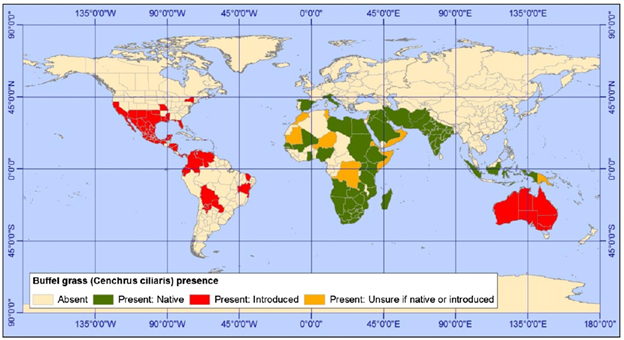
Buffelgrass is native to southern Europe, Africa, and southern Asia from the Middle East east to Indonesia [41,167,184,255,396] (fig. 1). It was intentionally introduced in parts of North America, South America, Europe, eastern Asia, Australia, and several Atlantic and Pacific islands [255,328,410,445] for cattle forage and erosion control. It has since spread into native ecosystems in many areas [255].

Figure 1—Global distribution of buffelgrass.
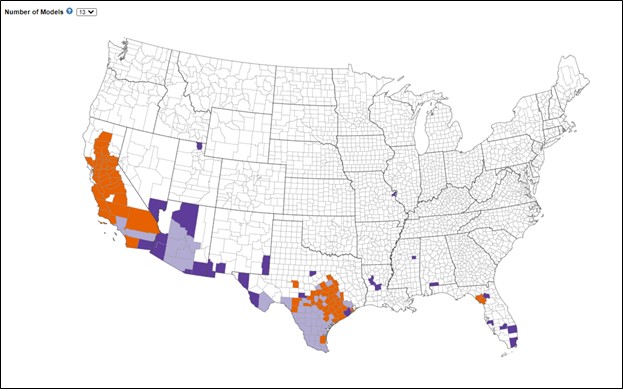
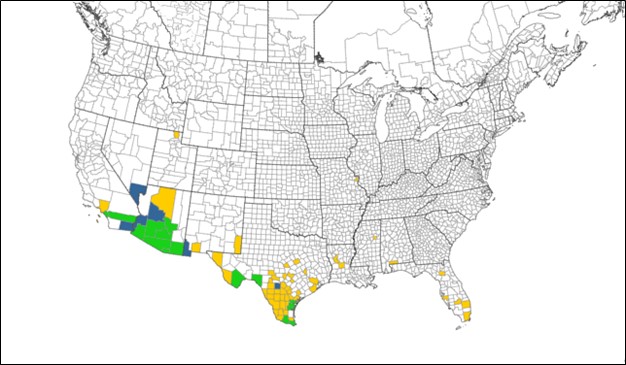
Buffelgrass occurs in the southern United States from California to Florida [113,227,401], with outlying populations in Utah [113,227], Missouri, and Tennessee [401] (fig. 2). It also occurs in Puerto Rico and Hawaii [113,287,401,441]. Some sources suggest it occurs in New York (e.g. [401]); however, this is based on a single specimen collected on wool mill waste in Westchester County in 1898, and no voucher or specimens were available in that state as of 2017 [425]. Buffelgrass also occurs throughout Mexico [8,255]. Areas with the highest suitability for buffelgrass in the southwestern United States and northern Mexico include the Sonoran Desert in southern Arizona and northern Sonora, including the foothills of the Mexican Sierra Madre Occidental, and part of the eastern coast of Baja California and Baja California Sur. Areas of moderate suitability include southern California, southern New Mexico, and western Texas; and Baja California, Chihuahua, and western Coahuila, Mexico. High elevation sites in this range have low suitability for buffelgrass [8].
In the United States, buffelgrass was first introduced in northern Texas in 1917 [255], but not successfully established until the 1940s. Since then, it has been used to stabilize soils on overgrazed rangelands and provide livestock forage [42,184,256,420]. Buffelgrass was commercially available by the 1950s [255], and by 1975, it occupied 90% of the seeded rangeland south of San Antonio [128]. By 1985, buffelgrass was established on over 4-million ha in southern Texas [89]. In 2020, buffelgrass remained a commonly planted pasture grass in Texas despite its impacts on native plant communities [430].

Figure 2—County-level distribution of buffelgrass in the United States.
Buffelgrass was introduced into Arizona in the 1930s and 1940s to control erosion [55,58,79,380]. It spread into native communities in Arizona from these introductions and from introductions in adjacent Sonora [53,255] (see Seed Dispersal), where hundreds of thousands of hectares of native desert and thornscrub vegetation have been converted to buffelgrass pastures [56,58,145]. Buffelgrass was first observed in Saguaro National Park in 1989 and by 2015 had spread to 2,000 ha despite management to control it [419]. It was first observed at the Desert Laboratory in Tucson in 1968, and its frequency increased by 7,983% from 1983 to 2005 [43]. It was first observed at Organ Pipe Cactus National Monument in the 1970s or 1980s, and by 1994 occurred on as much as 162,000 ha of the monument [345]. Olsson et al. (2012) reconstructed buffelgrass spread at 11 sites in the Santa Catalina Mountains using historical aerial photographs and found the area invaded by buffelgrass doubled every 2 to 7 years from 1988 to 2008 [299].
Buffelgrass was introduced on cattle ranches in Sonora in the 1970s [255]. Between 1990 and 1998, the Mexican government subsidized cattle ranchers to convert native desert and thornscrub to buffelgrass pastures [56], and as of 2006, as much as 1.6 million ha had been seeded to buffelgrass in Sonora [145]. The vast conversion of native communities to buffelgrass pasture facilitated the spread of buffelgrass into native communities of the Sonoran Desert and the mediterranean region of Baja California [8,136,159,294]. In the early 2000s, conversion of native communities to buffelgrass was ongoing [145], and it was still being cultivated on millions of hectares as of 2017 [45].
Buffelgrass was introduced into Hawaii in the 1930s [66,418], and it has since invaded many native grassland, shrubland, and woodland communities on the leeward side of the islands [97,136,157,240,287,364,399,418]. In 1988 and 1990, buffelgrass was seeded by the US Army Corps of Engineers on two highly eroded sites in the central plateau region of Kaho'olawe Island. By 1996, buffelgrass cover was 9% and 18% [450].
States and Provinces
- United States: AL, AZ, CA, FL, HI, LA, MO, MS, NM, NY, PR, TX, UT, VI [113,227,255,401]
- Mexico: Ags, BC, BCS, Camp, Chih, Chis, Coah, Col, Dgo, Edomex, Gro, Gto, Hgo, Jal, Mich, Mor, Nay, NL, Oax, Pue, QR, Qro, SLP, Sin, Son, Tab, Tamps, Tlax, Ver, Yuc, Zac [255]
Site Characteristics
Buffelgrass is most likely to spread where site conditions resemble that of its native range [206]. Habitat suitability of buffelgrass appears to be driven mainly by summer and winter precipitation, total annual rainfall, winter temperatures, aspect, soil characteristics, and distance to roads (e.g., [8,89,107,195,206,218,255,304]). Throughout its distribution, it is common along roads and highways [56,58,79,122,137,145,187,314,405,408].
Specific climate, landscape features, and soil characteristics that are reported to influence buffelgrass distribution are summarized in the sections below and in table 4 of the review by Marshall et al. (2012) [255].
Climate and Weather
Buffelgrass is considered highly adapted to extreme aridity [180] and is common in deserts throughout the world (e.g., [87,89,180,231,308,320]). It is intolerant of freezing temperatures [195]. It is native to and has been introduced in areas with tropical, subtropical, arid, semiarid, and subhumid climates [23,140,218,219,255]. In North America, buffelgrass is most invasive in areas with arid and semiarid climates [23].
Based on its global distribution, buffelgrass habitat suitability is best where summer rainfall is between about 150 and 550 mm, winter rainfall is less than about 400 to 600 mm, and winter temperatures are between 5 and 20 C [89,218]. A habitat suitability model for the continental United States confined buffelgrass to areas with mean annual precipitation between 200 and 1,200 mm/year and sites that do not freeze [195,206]. Local distribution models for Saguaro National Park indicated that buffelgrass habitat suitability was greatest in areas with winter temperatures above 10 C [218]. A preliminary analysis of data from Sonora suggests that annual rainfall below 100 mm limits the spread of buffelgrass along the northwestern coast, and winter temperatures below 0 °C limit buffelgrass establishment at high elevations along the Sierra Madre Occidental [284]. Despite having an unfavorable climate for buffelgrass (very little precipitation during the summer growing season (10 mm, on average)), buffelgrass was common along roads in the mediterranean region of Baja California. The researchers proposed that summer fog might supply additional water during the summer growing season that allows buffelgrass to establish [159].
In North America, buffelgrass is best studied and most common in the Sonoran Desert and the South Texas Plains. The climate of the Sonoran Desert is considered more suitable for buffelgrass than that of the South Texas Plains [8] (see General Distribution). The Sonoran Desert ecoregion has a dry, subtropical desert climate, with very hot summers and mild winters. Mean annual temperature ranges from approximately 19 to 25 °C, with 200 to 365 frost-free days. Amount and timing of precipitation vary widely across time and space. Annual precipitation ranges from 75 to 560 mm and averages 206 mm. Winter rainfall decreases from west to east, while summer rainfall decreases from east to west. Evaporation rates are high in the entire ecoregion [432]. Summer precipitation was the most important variable in a buffelgrass habitat suitability model for the Sonoran Desert. The researchers concluded that buffelgrass is better suited to the higher winter and summer precipitation of the Arizona Upland subdivision than the drier Lower Colorado River subdivision, and that it is likely to remain rare in the hottest desert areas with extremely low summer rainfall [107]. The South Texas Plains is an ecoregion commonly referred to as “brush country” and is part of the Tamaulipan Biotic Province that extends into northern Mexico [191]. The ecoregion has a dry subtropical semiarid climate, with hot summers and mild winters. Mean annual temperature ranges from approximately 20 to 24 °C, with 270 to 360 frost-free days. Mean annual precipitation ranges from 450 to 750 mm and averages 592 mm. Rain falls mostly in spring and fall [432].
Buffelgrass also occurs in the Chihuahuan Desert, but the climate is less suitable there than in the Sonoran Desert [8]. The climate of the Chihuahuan Desert ecoregion has a dry arid to semiarid climate, with hot summers and mild winters. Mean annual temperature ranges from approximately 17 to 20 °C, with 150 to more than 320 frost-free days. Mean annual precipitation ranges from 200 to 635 mm, and averages 340 mm. Precipitation varies with elevation and occurs mostly in summer [432]. In Hawaii, buffelgrass occurs on the dry, leeward sides of the islands [136].
In the Sonoran Desert, buffelgrass germination, establishment, and reproduction are favored by wet summers and warm winters [299], and buffelgrass populations there may expand during relatively wet periods and contract during relatively dry periods [55,90]; however, this pattern is not consistent. For example, at the Desert Laboratory in Tucson, buffelgrass was present since around 1968 but did not become widespread and invasive until the 1980s, probably in response to above-average October to May precipitation in the early 1970s and 1980s (ranging from 289-386 mm, compared to an average of 186 mm) [55]. At 11 sites in the Santa Catalina Mountains median buffelgrass patch size increased 136% from 1988 to 2008, with the area invaded by buffelgrass doubling in size every 2 to 7 years; however, precipitation and mean temperature in winter and summer did not predict buffelgrass spread rates [299]. Year-to-year buffelgrass patch expansion rates along a road in southern Arizona varied widely, and also did not correspond well with precipitation, which was below average each year of the 3-year study (106, 107, 164 mm during the 3 years, compared to an average of 179 mm). Median buffelgrass patch size increased 271%, and patch expansion rates ranged from -0.26% to 21,904% per year [427]. During 10 years in its native range in India, there was no correlation between buffelgrass biomass and growing-season rainfall, which ranged from 70 to 775 mm and averaged 315 mm [326]. Buffelgrass accessions and cultivars differ in their rainfall preferences [255], and differences among studies may be due to differences in the variety studied, or differences in climate and/or associated vegetation. For example, buffelgrass population expansion during wet periods following an extended drought may be facilitated by reduced abundance of native vegetation from drought-induced mortality, as was observed in Queensland, Australia [139].
Topography
Landform and Terrain
Buffelgrass occurs on lowlands [83] and uplands [83,375]. In the Southwest and globally, buffelgrass commonly occurs along rivers and creeks, on alluvial fans and terraces, in drainages and natural depressions [3,84,122,138,141,165,255,299,314,423], on sparsely vegetated sand dunes and interdunal areas [180], and along roads [56,58,79,122,137,145,187,314,405,408]. These landscape features are areas where moisture is concentrated, provide dispersal pathways for propagules, and/or tend to have high levels of soil disturbance, all of which favor buffelgrass seedling establishment [314] (see Seedling Establishment and Mortality).
Buffelgrass occurs on both disturbed [55,167,197,447] and undisturbed [55,122,197] sites (see Successional Status). For example, in the Arizona Upland subdivision of the Sonoran Desert, buffelgrass is most common 1) on disturbed rights-of-way, especially along large, paved roads that have been repeatedly bladed; 2) on undisturbed, steep, southern, southeastern, and southwestern aspects of hills with very poorly developed soils and caliche near the surface; 3) on shallowly incised drainages on hillsides with steep, southern aspects; and 4) along the upper portions of shallow arroyos in valley flats [405]. Buffelgrass is considered adapted to floodplains in the Sonoran and Chihuahuan deserts [91]. Buffelgrass may dominate the herbaceous layer of Tamaulipan riparian scrub forests that occur in mesic environments, including floodplains and arroyos (ramaderos) that are temporarily or intermittently flooded but dry during most the year [136,293]. Buffelgrass is invasive in oases of the Sonoran Desert on the Baja California Peninsula [294]. It occurs along coastal areas in Texas [142], Hawaii, and Baja California [136].

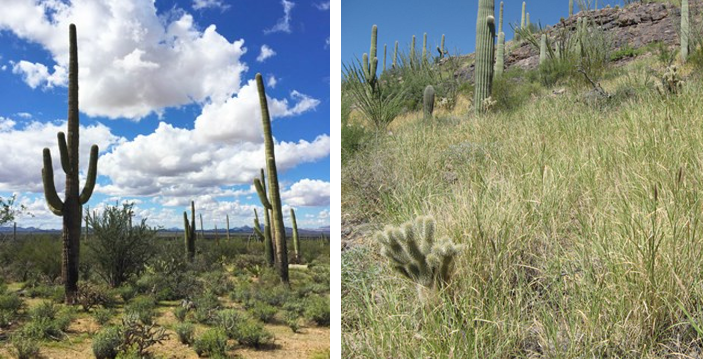
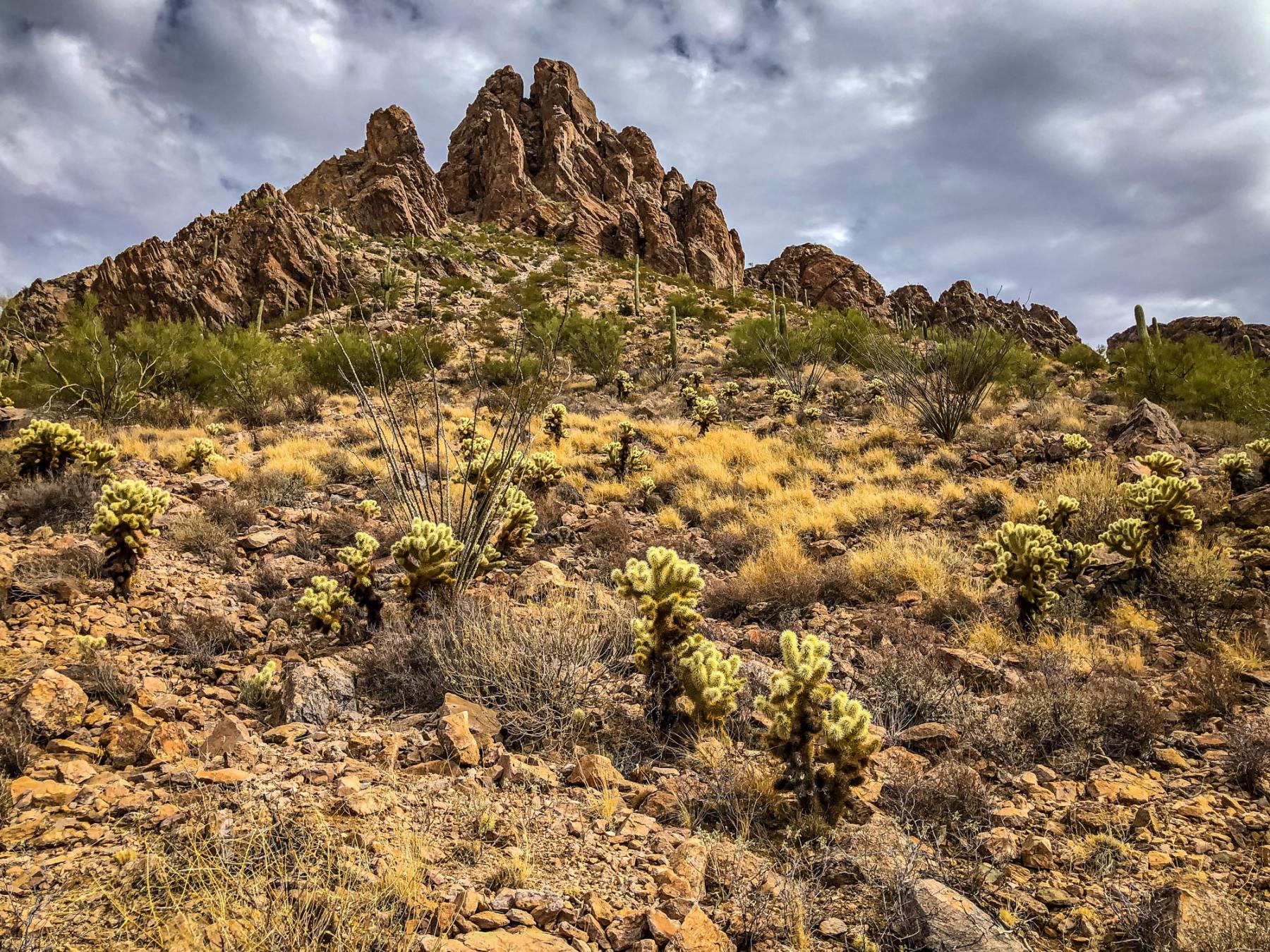
Figure 3—Buffelgrass invasion near Tucson, Arizona.
Slope and Aspect
Buffelgrass occurs on sites that are flat [267] to steeply [405,440] sloping. It occurs on all aspects but is most common on southern aspects and least common on northern aspects [115,218,405,423,433]. For example, in Saguaro National Park and Organ Pipe Cactus National Monument, buffelgrass abundance was highest on southern aspects and positively correlated with percent slope, although the steepness of the slopes it occurred on was not provided [200]. In the Sonoran Desert in Arizona, northern aspects and high elevations were considered less suitable for buffelgrass than other aspects and low elevations because it is cold intolerant [107]. In Texas, it occurs on southern aspects in canyons [423]. Buffelgrass is common in the Plains of Sonora subdivision of the Sonoran Desert in Mexico, where it occurs in large, flat areas and on adjacent slopes [103,255]. In Sonora, buffelgrass was most common on sites with relict clays soils and slopes ranging from 25% to 34%, and it was less common on gently sloping bajadas [405].
Elevation
According to a review, buffelgrass occurs from sea level to 2,000 m globally [255]. Freezing temperatures limit its occurrence and spread at higher elevations [381]. In Arizona, it occurs up to 1,600 m. At the highest elevations it tends to occur on southern aspects [261,312,388,405,407]. In the Santa Catalina Mountains, buffelgrass occurs from 839 m in the Tucson Basin up to 1,476 m. From 900 to 1,200 m, buffelgrass was dense and occurred in large (>20 ha), continuous patches. Below 900 m and above 1,200 m, its density and occurrence decreased, and it occurred in small (<20 ha), isolated patches [433]. In Big Bend National Park, Texas, buffelgrass is rare, overall, but locally abundant between 560 and 760 m [141]. In Hawaii, it occurs from sea level to 120 m [240,418] or 150 m [363]. In Mexico, it occurs up to 1,300 m [405,408] but is typically below 900 m [23].
Soils
Buffelgrass grows on soils with various parent materials [255,405], orders [115], textures [401], and depths [136,208,386], although soils are typically well-drained [115,255]. In the Sonoran Desert, buffelgrass appears to grow mainly on soils derived from volcanic, gneissic, and limestone parent materials with varied chemistry and mineralogy [255]. In the Rincon Mountain and Tucson Mountain districts of Saguaro National Park, buffelgrass cover was greater on well-drained, poorly developed Entisols and Inceptisols without restrictive layers than on Aridisols or Mollisols [115].
Buffelgrass establishes, persists, and spreads in sands, sandy loams, loams, clay loams, and sandy clay loams (e.g., [28,85,89,98,103,185,206,208,222,290]). In southern Texas and Mexico, buffelgrass spread was most likely on sites with a high percent of sand (sand, loamy sand, sandy loam, and sandy clay loam soil texture classes) and spread was least on sites with a high percent of silt and clay (silty clay loam and clay loam soil texture classes) (table 1 and table 2) [206]. Distribution and habitat suitability models also suggest that sites with sandy [195,206] or loamy [89] soils are best suited for buffelgrass. It may establish, persist, and spread in some clay soils [62,206,290,314,405], although not on poorly drained [196], “tight” [185], or “heavy” [405] clays. Cox (1988) concluded that buffelgrass seedling emergence declines as either sand, clay, or silt content approaches 100%, and that seedlings gradually lose vigor and die when established in silt, silt loam, silty clay loam, silty clay, or clay soils [89]. However, Mutz and Scifres (1975) found that soils with a relatively high clay content may support the most rapid seedling growth. Thirty days after emergence, buffelgrass seedling culm length and seedling oven-dry weight were 15.6 cm and 92.7 mg in clay (65% clay, 27% silt, and 8% sand), 7.8 cm and 91.3 mg in sandy clay loam (29% clay, 26% silt, and 45% sand), and 7.2 cm and 62.4 mg in sandy loam (20% clay, 5% silt, and 75% sand) [290]. At 14 sites in Sonoran desert scrub communities in Saguaro National Park, soil texture did not differ between buffelgrass-invaded patches (67% sand, 24% silt, and 10% clay) and nearby uninvaded patches in plant interspaces (68% sand, 24% silt, and 9% clay), suggesting that buffelgrass is likely capable of invading the uninvaded sites but has not yet done so because of insufficient propagule pressure or other factors [3].
| Soil texture class | Number of sites | Spreada (%) | Persistedb (%) | Diedc (%) |
|---|---|---|---|---|
| Sand | 7 | 86 | 14 | 0 |
| Loamy sand | 17 | 71 | 29 | 0 |
| Sandy loam | 27 | 78 | 15 | 7 |
| Sandy clay loam | 28 | 75 | 25 | 0 |
| Loam | 19 | 37 | 21 | 42 |
| Clay loam | 35 | 20 | 37 | 43 |
| Clay | 27 | 30 | 48 | 22 |
| Silty clay loam | 4 | 0 | 75 | 25 |
| Silty clay | 3 | 0 | 0 | 100 |
| Total | 167 | 49 | 30 | 21 |
aSurvived in the seeded area for 10 or more years and plants established outside the seeded area from seeds dispersed from these plants. bSurvived in the seeded area for 10 or more years but plants did not establish outside the seeded area. cSurvived in the seeded areas for 10 or more years but all plants eventually died. | ||||
Buffelgrass is generally considered drought tolerant [401], although drought tolerance varies among accessions and cultivars with regard to germination (e.g., [342]) and growth (e.g., [230,253]). Both low and high water-holding capacities of coarse- and fine-textured soils, respectively, retard buffelgrass growth, as do high water tables [185,255]. Buffelgrass is tolerant of short-term flooding, but long-term flooding kills it [19]. In Australia, >90% of buffelgrass plants survived 5 days of flooding, while 15% to 80% survived 20 days of flooding. Flood-tolerance varied among cultivars and with plant height [19]. Several buffelgrass cultivars have been developed to withstand flooding, and thus are more likely to be able to establish on fine-textured soils that tend to flood [255].
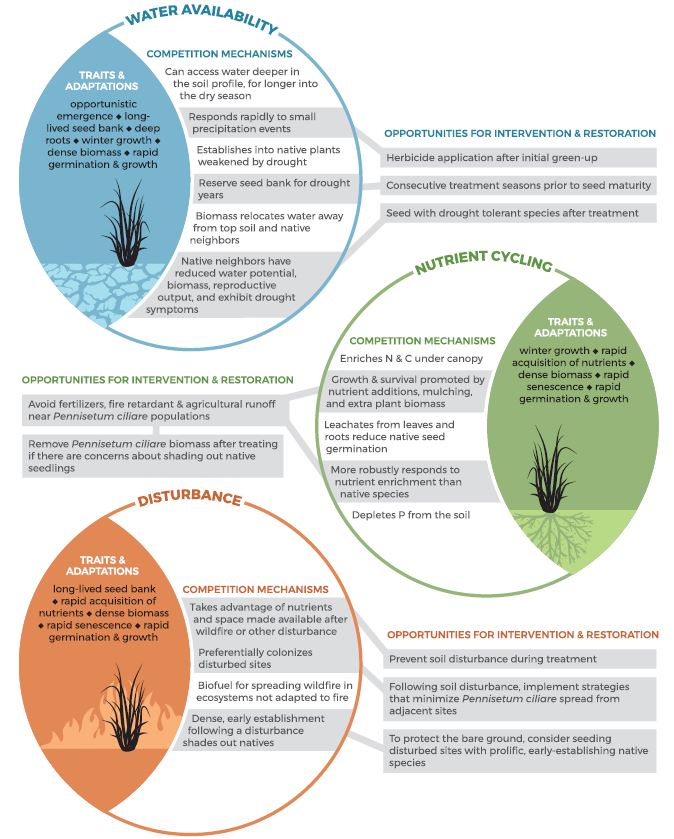
Buffelgrass tolerates and/or creates low nutrient soil conditions [206]. In Texas and Mexico, where common buffelgrass has been planted, and sites in Kenya, where common buffelgrass is native, common buffelgrass is favored on sites where soils have a high percentage of sand, low total nitrogen, low percentage of organic carbon, and low cation exchange capacity [87,88,206] (table 2). It also grows in soils with relatively high phosphorus content [94,103,197,450], and shows increased growth with nitrogen and phosphorus fertilization (e.g., [162,244,248,255,326,431]). Thus, it may benefit from any short-term increases in nutrients following fire [278] or application of fire retardant, although no information was available on these topics.
| Soil properties | Survival regime | Kenya | ||
|---|---|---|---|---|
| Spreada | Persistedb | Diedc | ||
| Sand (%) | 61.1 (20.2) | 44.9 (24.6) | 35.3 (15.4) | 82.0 (14.8) |
| Silt (%) | 17.5 (10.8) | 24.1 (13.2) | 32.3 (7.2) | 11.9 (9.2) |
| Clay (%) | 21.5 (11.6) | 31.0 (15.3) | 32.4 (11.2) | 6.1 (6.1) |
| Silt + clay (%) | 39.0 (18.7) | 55.1 (24.3) | 64.7 (16.2) | 18.0 (14.8) |
| pH | 7.8 (0.5) | 7.6 (0.6) | 7.5 (0.4) | 8.1 (0.5) |
| Total nitrogen (%) | 0.1 (0.1) | 0.3 (0.2) | 0.5 (0.3) | 0.1 (0.1) |
| Organic carbon (%) | 0.9 (0.7) | 2.6 (2.9) | 4.4 (3.6) | 0.3 (0.2) |
| Phosphorus (mg/kg) | 10.6 (11.9) | 12.9 (12.7) | 10.0 (22.3) | 17.2 (9.2) |
| Cation exchange capacity (cmol/kg) | 22.5 (13.4) | 38.1 (24.4) | 61.8 (24.9) | 15.6 (13.7) |
| Sodium (cmol/kg) | 0.4 (0.6) | 0.4 (0.4) | 0.4 (0.2) | 0.2 (0.2) |
| Potassium (cmol/kg) | 1.1 (0.7) | 1.9 (1.3) | 1.8 (0.9) | 1.0 (0.9) |
| Calcium (cmol/kg) | 35.9 (26.5) | 42.0 (23.0) | 47.8 (16.6) | 12.4 (13.5) |
| Magnesium (cmol/kg) | 1.9 (1.5) | 3.2 (2.2) | 3.7 (2.5) | 2.1 (1.6) |
aSurvived in the seeded area for 10 or more years and plants established outside the seeded area from seeds dispersed from these plants. bSurvived in the seeded area for 10 or more years but plants did not establish outside the seeded area. cSurvived in the seeded area for 10 or more years but all plants eventually died. | ||||
Buffelgrass grows in soils with pH ranging from strongly acidic to strongly alkaline (5.5-8.5) [103,255,258,401,404]. Limited evidence suggests that germination [346] and seedling establishment [222] may be better on neutral or alkaline than acidic soils, respectively.
The PLANTS Database categorized buffelgrass as having intermediate salinity tolerance [401]. However, salinity tolerance varies among buffelgrass accessions and cultivars and ranges from sensitive to highly salt tolerant (e.g., [174,252,342,343]). High salinity can reduce buffelgrass growth [185,251,343], reproduction, and germination [343]. In Tunisia, where buffelgrass is “seriously endangered”, soil salinization may limit germination, seedling establishment, and growth and contribute to buffelgrass scarcity [106]. Common buffelgrass is relatively susceptible to salt stress [174].
Plant Communities
In its native range, buffelgrass occurs in grasslands [39,175], savannas [118,119], sparsely vegetated sand dunes, and interdunal areas [180]. In its nonnative range, buffelgrass occurs in grasslands, shrublands, savannas, and woodlands (e.g., [136,167,405]). Buffelgrass has been planted on millions of hectares of pastures and rangelands in North America and worldwide [255].
In North America, buffelgrass is most common in desert ecosystems in the southwestern United States, northern Mexico, Baja California, and Baja California Sur (e.g., [8,56,122,183,184,205,345,380,381,396]). Buffelgrass is most invasive in Sonoran desert scrub communities of the Arizona Upland subdivision of the Sonoran Desert but also occurs in other subdivisions of the Sonoran Desert and in the Chihuahuan Desert [8,107,405] (see Climate and Weather). It also occurs in interior chaparral communities [233,405] and semidesert grasslands, both of which often occur upslope of Sonoran desert scrub [239,398]. A review of fire and nonnative invasive plants in the Interior West Bioregion categorized buffelgrass as a “high threat” or a “potentially high threat” in desert grasslands and desert shrublands and a “low threat” in mountain grasslands, sagebrush shrublands, pinyon-juniper woodlands, open-canopy forests, closed canopy forests, and riparian areas [331].
In other parts of North America, buffelgrass is common in ecosystems of the Tamaulipan Mezquital ecoregion in southern Texas and northeastern Mexico, which occurs east of the Chihuahuan Desert and is bisected by the lower Rio Grande [136]; and it occurs in dry, tropical ecosystems in Hawaii [364,396,418], Puerto Rico [383,401,441], and Florida [446,447].
In temperate ecosystems in Oklahoma and Missouri buffelgrass occurs in disturbed plant communities [401].
Southwestern Deserts
In the Sonoran and Chihuahuan deserts of the southwestern United States and northern Mexico, buffelgrass occurs in desert and semidesert grassland, desert scrub, interior chaparral, and oak woodland communities [136,405]. Sonoran desert scrub communities dominated by species such as brittle bush, acacia, spiny hackberry, Arizona mimosa, honey mesquite, creosote bush, saltbush, triangle bur ragweed, desert ironwood, yellow paloverde, and saguaro are susceptible to invasion by buffelgrass [56,122,205,273,299,345,380,381,396]. In the Arizona Upland and Lower Colorado River Valley subdivisions of the Sonoran Desert, buffelgrass is most invasive in paloverde-mixed cactus desert scrub, and may also occur in mixed salt desert scrub, and semidesert grassland and steppe [107]. Throughout Mexico, desert scrub is considered the most at risk for buffelgrass invasion. Mesquite woodlands, tropical deciduous forests, and desert grasslands are also at risk [23,408].

Figure 4—An isolated buffelgrass patch near Ragged Top in Ironwood Forest National Monument, Arizona.
South Texas Plains and Tamaulipan Mezquital
In the South Texas Plains and Tamaulipan Mezquital ecoregions in southwestern Texas and northeastern Mexico, buffelgrass is common to dominant and may be invasive in mesquite, acacia, and/or hackberry communities (i.e., mixed brush or thornscrub communities) (e.g., [136,183,184,243,265,280]). For example, buffelgrass frequently invades and may dominate the herbaceous layer in honey mesquite associations [136]. Along the Lower Rio Grande in Salineno, Texas, common buffelgrass was dominant in the understory of several mesquite-acacia associations, where buffelgrass cover averaged 24% [243]. It is also common to dominant in Tamaulipan riparian scrub forests. In 2016, buffelgrass was “becoming more common” in the Rio Grande palmetto-Texas ebony-cedar elm Tamaulipan riparian scrub forest group on floodplains and riparian areas adjacent to the Rio Grande and other large rivers in southern Texas and northeastern Mexico. Buffelgrass is present in Tamaulipan dry grasslands dominated by little bluestem and cane bluestem [136].
Buffelgrass may also occur in coastal communities of the Gulf Prairies and Marshes ecoregion of Texas. In Laguna Atascosa National Wildlife Refuge, for example, uplands 250 to 400 m from the coastline are dominated by gulf cordgrass (28%), buffelgrass (14.5%), and alkali sacaton (13.5%) [142].
Great Plains
Buffelgrass is a “major concern” in the southern portion of the Great Plains [169], where it is invasive in southern mixedgrass prairie and shortgrass steppe communities. A review of fire and nonnative invasive plants in the Central Bioregion categorized buffelgrass as a “high threat” in southern mixedgrass prairie and shortgrass steppe, a “low threat” in southern tallgrass prairie, and not invasive in northern and central tallgrass prairie and northern mixedgrass prairie [170]. In the Great Plains, buffelgrass occurs in buffelgrass and Kleberg’s bluestem ruderal grassland associations [136].
Southeast and Midwest
In the Southeast, buffelgrass occurs in disturbed plant communities [421]. In St. Louis, Missouri, buffelgrass occurs in plant communities along railroads [156,448].
California and Baja California
In California, buffelgrass comprises the crimson fountaingrass-buffelgrass ruderal grassland alliance on steep coastal cliffs, bluffs, roadcuts, coastal dunes, coastal scrub, and desert scrub [136].
In the coastal mediterranean region of Baja California, buffelgrass is “widely established” along paved roads in coastal sage scrub and coastal succulent scrub [159].
Hawaii
In Hawaii, buffelgrass occurs in the coastal dry ruderal woodland association, the Polynesian ruderal lowland shrubland, grassland, and savanna group, and the Polynesian ruderal scrub and herb coastal strand group [136]. Buffelgrass occurs in coastal dry forests on all the main islands and is an understory dominant with fingergrass in nonnative kiawe forests. It also occurs in 'ohai dry shrublands and lowland dry grasslands dominated by native pili grass and/or nonnative jaraguagrass [136,157,240,287,399,418]. A review of fire and nonnative invasive plants in the Hawaiian Islands bioregion categorized buffelgrass as a “high threat” or a “potentially high threat” in lowland dry and mesic communities, including grasslands, shrublands, forests, and woodlands [240].
Puerto Rico
In Puerto Rico, buffelgrass occurs in the Caribbean-Mesoamerican lowland ruderal grassland and shrubland group [136]. At the Guánica Commonwealth Forest Biosphere Reserve, buffelgrass occurs with nonnative guineagrass in burned patches of tropical dry forests. Both were originally introduced as pasture grasses and then spread into the forest. These burned forest patches typically have no trees other than nonnative white leadtree and tend to be located near roadsides and areas where human access is frequent and human-caused fires occur every 1 to 3 years [383,441].
Australia
Large areas in northeastern Australia have been converted to cattle pastures by clearing native vegetation and planting buffelgrass. Buffelgrass is also invasive and has spread into natural areas on sites adjacent to developed pastures, as well as in regions that have never been cleared, such as in central Australia [76,130,139,255]. Invaded plant communities include eucalyptus [82,130,139,213,360] and acacia [62,278] woodlands.
Botanical Description
This description covers characteristics that may be relevant to fire ecology and is not meant for identification. Identification keys are available for buffelgrass in the United States (e.g., [128,167,179,359,418,421,422]) and elsewhere (e.g., [400,409,410,445]).

Figure 5—Buffelgrass seedhead.
Buffelgrass exhibits a high amount of morphological, phenotypical, and ecotypical variation (e.g., [24,25,31,188,193,231,232,249,348,412]) and genotypic and cytological diversity (e.g., [176,193,231,232]) among populations and cultivars. Intraspecies variation has arisen both naturally and from the commercial development of new cultivars [255]. Buffelgrass’s genetic diversity and phenotypic plasticity have been identified as key determinants of its invasion success. For information on genotypic and phenotypic diversity, see the review by Kharrat-Souissi et al. (2014) [232].
Aboveground Description
Buffelgrass is a warm-season perennial [41,42,83,179,256,420,436] or sometimes a facultative annual [137,345]. It has a C4 photosynthetic pathway [231].
Buffelgrass is highly plastic in its growth form [255]. It can be a bunchgrass [30,400,414,445] or a sod-forming grass [83]. Some growth forms develop rhizomes [30,31,112,192,304,359,375,414,445]. For example, the cultivars 'Nueces' and 'Llano' are rhizomatous [31,414], while common buffelgrass is not [255]. Other forms develop tillers [194,203,231,304,349,376] or stolons [445].
Buffelgrass culms are erect or bending at the lower nodes [179], usually with hardened, "knotty" bases [121,128,167,233]. Culms (and tillers) may have much secondary branching from lower or basal nodes [403,408,418,445]. These features can make plants appear “almost woody” [400,418] or “shrub-like” [403,408].
Buffelgrass may reach 10 to 150 cm tall (e.g., [30,105,128,167,255,359,400,403,418,445]). For a review of the provenance, nonnative distribution, conditions for growth, and characteristic traits of some commonly sown buffelgrass cultivars, see table 3 in the review by Marshall et al. (2012) [255].
Buffelgrass has coarse, often dense foliage [121]. Its leaves are thin and flat, 3 to 50 cm long and 2 to 13 mm wide [128,137,167,179,375,400,418,421,445,448].
The “bottlebrush-like” inflorescence is a dense panicle 2 to 20 cm (up to 32 cm) long and 10 to 35 mm wide [30,128,167,229,359,375,400,418,422,445] (fig. 5). Each inflorescence typically contains two to four spikelet clusters (fascicles or burrs) [448] and each is 2 to 5.6 mm (7 mm) long with two flowers [167,179,375,400,403,422,448]. Spikelets are dispersed whole [119,439]. The fruit is an ovoid caryopsis (or grain; hereafter, seed) [177,389,439]. The seeds are dimorphic in length and weight [238,303], ranging from 1.1 to 2.3 mm long and 0.4 to 1 mm wide [160,167,238,295,396,418].
Belowground Description
The root system of buffelgrass has been variously described as “long”, “dense” [396], “huge” [121], and “massive” [197]. Roots grow up to 2.8 m deep and spread up to 3.0 m horizontally [378]. Most roots occur in the top 0.2 m of soil [70,367,378]. These shallow roots can take advantage of light rainfalls [103]. Its root system allows buffelgrass to persist and grow soon after fire [334] (see Plant Response to Fire) and is one of the reasons buffelgrass has been planted to stabilize soil and prevent erosion in parts of the Southwest [255] (see Other Uses).
Rooting depth, root elongation rate, and shoot: root ratio are highly variable within the species [203] (see Plant Growth and Mortality).
Life Span
Buffelgrass is a long-lived perennial. Individual tussocks may live up to 10 [420] or 20 [150] years.
Raunkiaer Life Form
- Hemicryptophyte [6,436]
- Therophyte [379]
Population Structure
Buffelgrass can occur as “lone tussocks”, patches, or “clumps” [43,255,317]. It can spread to form dense mats [179,400,418] or colonies [55]. Buffelgrass has formed monocultures or near monocultures where it was intentionally planted (e.g., in South Texas [317,362], Mexico [68], and Australia [278]), and on some sites where it has spread into wildlands (e.g., in Sonoran desert scrub [121,382]). Buffelgrass plant density, patch size, and invasiveness may vary within a site in response to changes in the amount and timing of precipitation (see Climate and Weather) or in response to a single or repeated fires (see Plant Response to Fire).
Where it invades native communities in the Sonoran Desert, buffelgrass may first establish in small patches, which then spread and connect to form large patches (e.g. [43,278,300]). From 1983 to 2005 at the Desert Laboratory in Tucson, for example, buffelgrass spread from ”isolated pockets” to form several continuous stands, the largest of which was about 50 ha [43]. In the Santa Catalina Mountains north of Tucson, researchers mapped 6,485 patches of buffelgrass totaling 443 ha in 2018. Of these, 129 patches were at least 0.4 ha in size, and the largest patch was 34 ha and comprised 7.8% of all buffelgrass mapped. Buffelgrass stand structure and plant density varied with elevation and aspect, with denser and larger patches coalescing into “stands of buffelgrass that cover entire slopes” at lower elevations (~950-1,150 m) and on southern aspects (see Elevation) [433].
Seasonal Development
Buffelgrass is a warm-season plant [83,206]. Growth occurs whenever temperature is adequate (greater than about 10 °C [85,89,206,211]) and soil moisture is available [89,261] (see Plant Growth and Mortality). Once growth is initiated, a short vegetative period of 4 to 6 weeks occurs, followed by stem elongation and emergence of floral parts. Flowering can occur within 3 months of germination [255,420] (see Seed Production and Predation). If moisture is adequate, new tillers can develop and produce inflorescences throughout most of the growing season [94,197]. According to the Field Guide for Managing Buffelgrass in the Southwest, buffelgrass matures and flowers within 6 weeks after at least 19 mm of rain occurring over 3 to 5 days [403]. In the southern Tucson Mountains, Arizona, buffelgrass remains dormant during most of the year. However, during the summer rainy season plants fluctuate rapidly between dormancy and active growth. In this area, active growth usually occurs for 2 to 6 weeks between July and September [32]. In Sonora, growth is also greatest during summer, when temperature is most suitable and most of the precipitation occurs [90]. For example, near Hermosillo, buffelgrass produced live biomass throughout the year, but peak production over 3 years was in August [257]. However, in other parts of the Southwest, it can grow in winter at low elevations after rainfall [403]. In Florida, buffelgrass grows year-round [179].
Flowering times vary among locations. In Texas, under "favorable" growing conditions, buffelgrass sets seed from early spring until late fall [83,167]. In Florida, buffelgrass flowers as early as July but most commonly from September to October [179]. In Missouri, buffelgrass flowers from August to September [448]. In Australia, buffelgrass produces flowerheads throughout the year [177]. Under nursery conditions, a single buffelgrass plant can bloom twice a year, once in May and again in September or October [36].
Regeneration Processes
Buffelgrass regenerates primarily from seeds [56,110,193,214,375,396]. It also regenerates vegetatively. Some forms develop rhizomes [30,31,112,192,359,375,414,445], while others develop tillers [203,231,349,376] or stolons [192,445]. Precipitation of greater than about 6 mm stimulates buffelgrass germination [361,420] (see Germination: Moisture), and precipitation of greater than about 13 mm stimulates growth of dormant plants [40,66,145,185,255,257,419] (see Plant Growth and Mortality: Weather), although the amount of precipitation required varies by location and site characteristics. Weston et al. (2016) describe a “satellite dispersal strategy” for buffelgrass, meaning that it spreads by establishing satellite populations at varied distance from the source population, rather than establishing solely near existing patches [99].
Breeding System and Pollination
Buffelgrass individuals have one of several modes of reproduction: obligate apomictic, facultative apomictic, or obligate sexual. Most buffelgrass individuals are apomictic, producing seeds asexually that are genetically identical to the mother plant [39,55,105,193,232,255,366,406,414,420]. Some buffelgrass individuals are facultative apomicts [193,232,341,406]. The expression of apomixis and sexuality in the facultative apomicts varies among genotypes [204]. Obligately sexual individuals are rare (e.g., [204,232,255,341]). Cultivars such as 'Neuces' and 'Llano' were bred by crossing sexual and apomictic plants [232]. Reviews on this topic are available: [232,255,341].
Buffelgrass plants that reproduce sexually are wind-pollinated [47].
Seed Production and Predation
Buffelgrass can begin producing seeds within its first growing season [138,255,420]. Days to 50% flowering ranged from 13 to 285 days for 10 buffelgrass cultivars and 147 buffelgrass accessions collected from Africa and South America [348].
Buffelgrass can produce abundant seeds [401]. Up to 518 inflorescences/plant [129], 285 spikelets/inflorescence [348], 215 seeds/fascicle [178], 38,304 seeds/plant [303], and 350 kg of seeds/ha [319] have been reported from throughout its native and nonnative ranges. Buffelgrass seed production may be higher on burned than unburned sites [208] (see Postfire Reproduction).
Seed production depends, in part, on buffelgrass accession or genotype [129,249,319,320,348,412], as well as photoperiod [129], temperature, elevation [81], and precipitation [177,319]. For example, characteristics of 10 buffelgrass cultivars and 147 buffelgrass accessions collected from Africa and South America were highly variable when grown in the field in Ethiopia. Plants produced a range of 6 to 322 inflorescences/plant, 13 to 285 spikelets/inflorescence, and 3 to 113 seeds/inflorescence [348]. Rhizomatous cultivars 'Nueces' and 'Llano' produce fewer seeds than nonrhizomatous cultivars such as common buffelgrass [31,414]. Average seed production in eight buffelgrass accessions ranged from 36 to 110 seeds/inflorescence, with 89 seeds/inflorescence in common buffelgrass. Averaged across all accessions, seed production was highest in plants grown with a 12-hour photoperiod [129]. Plants collected from semiarid locations averaged more than 3 to 5 seeds/spikelet, whereas plants collected from arid locations generally averaged 2 to 3 seeds/spikelet [304]. Mean seed production of four buffelgrass cultivars in a garden in Tamaulipas, Mexico, was lower at a cooler, high-elevation site than at a warmer, low-elevation site [81]. Seed production in 1- to 3-year old buffelgrass plants differed among four genotypes collected from a dry, arid region in India and seemed to increase with increased precipitation [319].
Seed production is reduced by cutting and defoliation [40,320].
Buffelgrass seed predation in the United States is not discussed in the literature, but a review considered buffelgrass largely free of insect predators [110]. In Veracruz, Mexico, the native tropical fire ant preferred native deertongue seeds over buffelgrass seeds [333].
Seed Dispersal
Buffelgrass seeds are light, surrounded by stiff, umbrella-like bristles, and disperse potentially long distances—primarily by wind and water [56,58,214,405,426]—until they are trapped by debris next to stones, in woody litter, under trees and shrubs, or in loose, disturbed soil [56]. A review reported that buffelgrass seeds could be dispersed 0.60 to 7.26 m at wind speeds of 2.5 to 10 m/second, respectively [74]. Barbed bristles on buffelgrass seed coats allow them to adhere to animal skin and fur, which could potentially disperse them long distances. Motor vehicles also disperse buffelgrass seeds [56,58,74]. Wind and vehicles are considered the primary dispersal agents for buffelgrass in Organ Pipe Cactus National Monument. Secondary dispersal agents are feral livestock, native mammals, and people [345]. It is unlikely that cattle disperse buffelgrass seeds in their feces. Buffelgrass seeds fed to cattle did not germinate following passage through the digestive tract [160,161].
Seed Banking
Buffelgrass has a short-term persistent soil seed bank, and a small percentage of seeds may persist for a longer period [361,439]. A review described buffelgrass seed bank longevity as “extreme” [255] based on anecdotal information from Pakistan suggesting buffelgrass seed longevity of up to 30 years [150]. However, no other information in the literature supports this. Under suitable moisture and temperature conditions (see Germination), most buffelgrass seeds germinate the first growing season after dispersal and are therefore lost to the soil seed bank. Exposure to either very dry [439] or moist conditions and high temperatures [178] in the field are likely to reduce seed viability, and thus longevity in the soil seed bank.
Seed Longevity
Seeds can maintain high rates of viability and germination (60%-100%) after 3 to 5 years of storage under laboratory conditions (e.g., [54,302,361,438,439]), although they may decline over time [54].
Longevity of soil-stored seeds is much shorter than that of laboratory-stored seeds, and viability and germination of soil-stored seeds decreases rapidly over time. Most buffelgrass seeds lose viability or germinate within 1 or 2 years in the soil, although a small percentage may retain viability in the soil seed bank for 5 years or longer (e.g., [111,329,361,439]). In Queensland, Australia, most buried and surface-sown buffelgrass seeds lost viability within 12 months. After 2 “fairly dry” years, only seeds in shaded microsites retained viability, and few seedlings were observed [361]. At two locations in South Texas, germination of ‘Pecos’ buffelgrass seeds buried 5 to 8 cm deep in mesh bags was 19% and 26% after 11 months of burial, 6% and 13% after 20 months, and 2% after 39 months. At the time of burial, germination was 90% [329]. In central Australia, germination was 35% for freshly harvested seeds, 12% after 1 year of burial, and 10% after 2 and 3 years of burial [438] (see Germination). In western Australia, germination was about 10% after 2 years of burial and <5% after 5 years [439].
Seed Bank Density
Buffelgrass seed bank density can be high, both on invaded sites and nearby uninvaded sites dominated by native plants (e.g., [75]). Seed bank densities up to 85,000 seeds/m2 have been reported in invaded sites in North America, although only three studies were available on this topic [3,75,284]. Studies from Arizona [75] and Australia [177,443] show a substantial reduction of seed bank density after 1 to 3 years of treatments that remove buffelgrass seedheads or entire plants; however, follow-up treatments may be needed for several years to prevent buffelgrass reestablishment (see Control). Cattle grazing may reduce buffelgrass seed production and thereby reduce seed bank density [177].
Information about buffelgrass seed bank density in North America comes from two studies in Saguaro National Park [3,75] and one study from Sonora [284]. In Saguaro National Park, seed bank densities in the top 5 cm of soil estimated using a seed extraction assay method were about 1,000 seeds/m2 in plots within native vegetation, about 5,000 seeds/m2 in plots where buffelgrass had been removed and had few to no buffelgrass plants in the aboveground vegetation, and about 85,000 seeds/m2 in plots in untreated, buffelgrass-invaded sites. When estimated using the emergence method (germinating seeds in a greenhouse), seed bank densities in treated and untreated-buffelgrass invaded plots did not differ from plots within native vegetation [75]. In another study at Saguaro National Park using the emergence method, density of buffelgrass seeds in the top 5 cm of soil in 10-year-old buffelgrass patches averaged 645 seeds/m2 under buffelgrass plants and 10 seeds/m2 in interspaces (table 3) [3].
| Site type | Buffelgrass-invaded patches | Uninvaded patches |
|---|---|---|
| Buffelgrass | 645 | Not applicable |
| Brittle bush | 222 | 0a |
| Cactus apple | 232 | 0 |
| Interspace | 10 | 30 |
| aIndicates a significant difference between invaded and uninvaded patches at p ≤ 0.05. | ||
Buffelgrass seed bank densities in the top 1 cm of soil ranged from 0 to 3,820 seeds/m2 in five desert scrub plant communities in Sonora (table 4). One site (Siete Cerros) had a relatively high density of adult plants (0.99 adult plants/m2), but also a high density of dead plants (0.62 dead plants/m2) and no seeds in the soil seed bank, suggesting that several dry years that killed plants also reduced seed bank density. The Bachoco site was the only site with evidence of recent fire, and this site had the highest density of seeds in the soil seed bank (3,820 seeds/m2) (see Postfire Seed Banks). Seed bank densities were determined using a Tetrazolium test to measure seed viability [284].
| Site name | Seeds/m2 | Plants/m2 | ||
|---|---|---|---|---|
| Adult | Juvenile | Dead | ||
| Siete Cerros | 0 | 0.99 | 0.06 | 0.62 |
| La Pintada | 343 | 1.04 | 0.05 | 0.17 |
| Cruz del Diablo | 1,763 | 0.16 | <0.01 | <0.01 |
| Mina Nyco | 1,812 | 0.78 | 0.44 | 0.33 |
| Bachoco | 3,821 | 0.91 | 0.05 | 0.12 |
Germination
Buffelgrass germination is influenced by genotype or accession and seed characteristics that influence dormancy, as well as environmental conditions including temperature, moisture, light, burial depth, and pH. Under appropriate environmental conditions (precipitation greater than about 6 mm [361,420] and temperature greater than about 10 °C [18,389]), buffelgrass seeds can germinate at any time of year.
Genotype or Accession
Germination varies among genotypes and accessions and from year to year [178,303,319]. For example, germination of 4 buffelgrass genotypes over 3 years ranged from 23.5% to 73.0% [319] and germination of 11 accessions ranged from 34% to 70% [303]. Germination may be influenced by climatic conditions at the collection site (e.g., [178]).
Seed Dormancy
Lower germination percentages for freshly harvested seeds than that of stored seeds indicates that buffelgrass seeds exhibit some degree of primary dormancy [18,178,209,389,438]. Winkworth (1963) reported that 60% of freshly harvested seeds were dormant [438], while other studies reported that >90% were dormant [18,178]. Secondary dormancy may also occur in buffelgrass seeds [177,302,438,439]. Primary and secondary dormancy in buffelgrass seeds favor the building of a persistent soil seed bank [389].
Seed dormancy can be broken by increases or fluctuations in temperature and moisture [18,177,358,389,438,439]; mechanical removal of the structures covering the seeds (e.g., glumes, lemma, and/or palea) (e.g., by weathering) [18,177,209,303,304,389,439]; or scarification of the seed coat by acid or alkali treatment (e.g., leaching by rain) (e.g., [18,291,303]). Limited information suggests that passage through the digestive tract of animals does not improve germination [160,161], and likely kills seeds (see Seed Dispersal). Dormant seeds exposed to high temperatures (60 °C) for 4, 8, or 12 weeks then germinated at a 30/25 °C day/night temperature regime in a laboratory had higher germination than freshly harvested seeds exposed to high temperatures, suggesting that high temperatures broke seed dormancy [177]. However, short-term exposure (e.g., 1-5 minutes) to temperatures >120 °C is likely to kill buffelgrass seeds [118,220,389]. Smoke does not appear to stimulate germination [411] (see Immediate Fire Effects on Seeds).
Temperature
In the laboratory, buffelgrass germinates under a range of temperatures, from as low as 10 °C to as high as 40 °C [18,303,389], but germination is best at moderate temperatures [18,304,389,411]. For example, in the laboratory, one study found maximum germination of buffelgrass seeds (78.5%) at 25 °C [389], and another found optimal germination at 25/15 and 30/20 °C day/night temperature regimes [411]. Andersen (1953) also found optimum germination (98%) at a 30/20 °C day/night temperature regime and at 30 °C with constant light [18].
Moisture
Buffelgrass seeds can germinate any time that temperature and moisture conditions are favorable [35]. In the Sonoran Desert, this is usually during the summer monsoon season (see Seedling Establishment and Mortality: Weather). Buffelgrass seeds have a wide range of tolerance to water stress and germinate under a wide range of osmotic potentials (e.g., [304,389,411]). However, germination decreases as water stress increases [304,315,389,411], and lack of sufficient soil moisture appears to be an important cause of seed mortality [439]. Extended wet periods can promote seed pathogens and also reduce viability and germination [89].
Buffelgrass can germinate in response to relatively small amounts of rainfall [420]. In a greenhouse, the minimum amount of water required for buffelgrass emergence was 6.3 mm (two consecutive watering events of 3.14 mm). Other Sonoran Desert species required a minimum of 17.5 to 35.6 mm of precipitation for emergence [420]. In Australia, field trials with ‘Gayndah’ buffelgrass indicated that germination occurred after small rainfall events (13 and 20 mm) within the first 10 months of sowing; however, seedlings then died, implying that the amount of rainfall was not enough to establish seedlings. When a “soaking” rainfall event occurred 18 to 28 months after sowing, no buffelgrass germinated because “seed reserves were exhausted” and viability of 18- to 28-month-old seeds was “poor” [361].
According to a review, sufficient rainfall to stimulate germination may not occur each year in the western United States, so buffelgrass germination may be episodic and occur only in relatively high rainfall years [110]. Dehydration occurring after initial wetting is detrimental to buffelgrass germination [116] and seedling establishment [358,361]. However, long imbibition times (>1 day) also result in reduced germination [116], suggesting that there is a “fine line between too much rainfall for germination and enough rainfall for seedling establishment” [235] (see Seedling Establishment and Mortality).
Light
Buffelgrass can germinate in light and in dark [18,35,303,389,411,439], but studies are inconsistent. Germination percentages were similar in light and in dark for buffelgrass seeds collected from Sonora [389]. Other studies report higher germination with light exposure (e.g., [35,303]). For example, buffelgrass seeds collected from Kuwait were 1.5 times more likely to germinate if exposed to light than dark, regardless of temperature regime, suggesting that buried buffelgrass seeds would be less likely to germinate than those on the soil surface [35]. In contrast, germination of buffelgrass seeds collected from Michoacán, Mexico, and incubated in the dark was higher than that of those incubated under white light. Buffelgrass germinated under various wavelengths of white light, and germination was highest for seeds germinated in red and far-red light [411].
Burial Depth
Buffelgrass seeds have no effective seed burial mechanism and typically remain on or close to the soil surface [213]. In a greenhouse, buffelgrass seed germination was about 40% higher for seeds on a bare soil surface than for seeds buried up to 2.4 cm deep [290]. However, conditions are often too dry on the soil surface to support seedling emergence in the field [197].
While no information was available on litter cover and bare soil effects on buffelgrass germination and emergence in North America, litter cover appears to reduce germination and emergence of buffelgrass in Australian pastures [130,213,270]. Several Australian studies noted buffelgrass establishment in bare areas but not in densely vegetated areas [82,130,271] (see Seedling Establishment and Mortality).
pH
A laboratory study indicated that buffelgrass germination decreased with decreasing pH. After 12 days, buffelgrass germination was ~65% at pH 7.0, ~55% at pH 4.0, and 0% at pH 1.0 [346].
Seed Characteristics
Buffelgrass has dimorphic seeds with some seeds on a plant having greater mass and higher germinability than others [35,36,209,238]. For example, large, heavy (>0.07 g) common buffelgrass seeds collected from 10 inflorescences in Tamaulipas, Mexico, had higher germination rates (56.3%) than small, light (<0.04 g) seeds from those inflorescences (39.3%) [209].
Seedling Establishment and Mortality
Buffelgrass seedlings may establish at any time of year if temperatures are above about 20 °C and soil moisture is sufficient. Establishment in arid and semiarid sites is generally greatest at the onset of the wet season [271,396]. Lack of soil moisture and freezing temperatures may kill buffelgrass seedlings in the short term; however, they may also promote buffelgrass establishment by reducing abundance of associated vegetation and thus creating suitable microsites for establishment in the long term [55,130,271].
Weather
Young buffelgrass plants are intolerant of extreme temperatures [20,81,102], although tolerance varies among strains and cultivars [20,81,369]. All potted buffelgrass seedlings in a growth chamber died at alternating day/night temperatures of 45/35 °C. While maximum temperatures in the Sonoran Desert can approach 50 °C, shade provided by associated vegetation can provide favorable microenvironments for buffelgrass establishment, especially during the rainy season [102]. Buffelgrass is generally intolerant of freezing temperatures [20,81,369]. In a growth chamber, common buffelgrass seedlings exposed to -4 °C for an unspecified amount of time did not survive [369].
In the Sonoran Desert, buffelgrass establishes during or soon after summer rainfall events [14,92]. Because buffelgrass germination depends on adequate moisture (see Germination: Moisture), the scarcity and spatial and temporal irregularity of precipitation in the Sonoran Desert probably contributes to low rates of establishment of buffelgrass in some areas, such as in northern Baja California [159]. A critical driver of buffelgrass establishment in southern Arizona appears to be the amount of monsoonal rainfall. Precipitation amount appears more important than competition with associated vegetation to buffelgrass seedling development in this area [442].
Site Characteristics
Although buffelgrass seedlings can establish under vegetation canopies [226], where wind-dispersed seeds are frequently trapped [56], studies in Arizona, Mexico, and Australia reported that buffelgrass seedling establishment is greater in open areas (i.e., full sunlight) and on bare soil than in densely vegetated areas [62,82,255,271]. For example, buffelgrass seedling establishment was higher in open and/or bare areas than in areas with dense stands of mature buffelgrass plants [221], abundant litter or thatch [130,221], or under mid- or overstory canopy cover [62]. Buffelgrass seedlings may be “weak competitors” with associated vegetation [103,130,271] for resources such as soil nutrients and soil moisture [197,271]. In in southeastern Australia, no buffelgrass seedlings survived in plots in dense pasture, while 40% to 80% of seedlings survived in plots with all aboveground vegetation removed [271]. For more information on how light availability, cover by associated vegetation, and disturbance affect seedling establishment, see Successional Status.
Plant Growth and Mortality
Once established, buffelgrass seedling growth rate is "fast" [83]. Buffelgrass averaged 26.7, 72.6, and 82.8 cm tall 30, 60, and 90 days after sowing in a garden, respectively [306]. Plant growth may be affected by weather, site characteristics, accession or cultivar [203], and seed size [209]. In addition, growth may increase following defoliation [244,320,397].
Weather
During drought and freezing temperatures, buffelgrass dies back to short stems with nodes, leaving viable apical meristems at the soil surface. This allows it to grow new leaves and flower as soon as temperature increases and moisture is available [248].
Cold and/or freezing temperatures can kill buffelgrass plants [89,414] or damage leaves [305] and reduce growth [59,102,211], although cold tolerance varies among buffelgrass cultivars [414]. Greenhouse studies found that buffelgrass stopped growing when mean daily temperature was around 11.5 °C and that the optimal day/night temperature regimes for growth were 35/29 °C [210] and 30/20 °C [102].
In the Sonoran Desert, leaf growth of common buffelgrass typically begins when mean minimum temperature rises to about 10 °C, but stem growth occurs only when minimum temperature is between 15 to 20 °C and mean maximum temperature is below 40 °C [85,89,206]. For more information on how buffelgrass cold tolerance affects habitat suitability, see Site Characteristics: Climate and Weather.
Once established, buffelgrass is considered drought tolerant [401] (see Soils) and is strongly competitive for water under water-limited conditions (e.g., [371,420]); however, water stress reduces plant growth (biomass, height, and number of living leaves) (e.g., [71,103,397]). Periods of relatively high precipitation can increase buffelgrass growth and spread (e.g., [55,90]) (see Site Characteristics: Climate and Weather).
Little growth occurs during dry periods [104,185], and dormant plants quickly respond to even small amounts of rainfall (e.g., [40,66,145,185,255,257,419]), although the amount of rainfall needed may depend on location [419] and season [40]. For example, a model to predict the phenological greenness of buffelgrass in Arizona indicated that buffelgrass would be 50% green 8 to 16 days after a 24-day period with precipitation totaling over 46 mm in the Santa Catalina Mountains or 25 mm in the Tucson Mountains. Differences between the Santa Catalina and Tucson mountain sites were attributed to differences in soils, aspect, and geology [419]. In Sonora, dormant plants sprouted within 15 days after 20 mm of rain [257]. In Australia, buffelgrass initiated growth after 24 mm of rain in spring (October-November) and after 78 mm in summer (February-March). Growth peaked 10 to 14 days after rainfall [40].
Site Characteristics
Buffelgrass growth is likely to be greater in open areas with little vegetation than in densely vegetated areas. Common buffelgrass seedling height and weight were greater in the field than in a greenhouse, likely due to greater light availability in the field [209]. In pastures in southeastern Australia, buffelgrass plants remained as single tillers, had lower biomass, and did not flower in plots with other vegetation, while plants in plots with all other aboveground vegetation removed had multiple tillers (>5), more biomass, and greater flowering rates [271]. Shading affects buffelgrass growth, although effects differ among sites [59,77,279,315] (see Shade Tolerance).
Accession and Cultivar
Rooting depth, root elongation rate, and shoot: root ratio are highly variable among buffelgrass accessions and cultivars [203]. In a greenhouse experiment using 110 buffelgrass accessions, as well as common buffelgrass, mean rooting depth of 28-day-old seedlings ranged from 63 to 200 cm and was 147 cm for common buffelgrass; mean rate of root elongation ranged from 1.8 to 7.14 cm/day and was 5.25 cm/day for common buffelgrass; and shoot:root ratio ranged from 0.89 to 3.43 and was 2.39 for common buffelgrass [203].
Seed Size
Seed size may affect seedling growth. Common buffelgrass seedling height and weight were positively associated with seed size at 60 days old [209].
Defoliation
Buffelgrass growth may increase after defoliation (e.g., by cutting, grazing, or burning), although plant response depends on plant age and the frequency, intensity, and timing of defoliation [244,320,397]. For example, in an 18-week field experiment in northeastern Mexico that compared various cutting regimes, common buffelgrass biomass was generally higher in plots with less frequent (every 42 days) than more frequent (every 21 days) defoliation and higher in more severe (5-cm cutting height) than less severe (15 cm) defoliation. Plots cut in summer (July-August or August-September) tended to have higher biomass than plots cut in fall (September-November) [244]. In contrast, plant height, number of fertile tillers per meter, and dry matter yield of three buffelgrass genotypes in India were highest for plants that were not cut compared to plants that were cut at 30 and 45 days after monsoonal rains began or at 50% flowering [320].
Vegetative Reproduction and Regeneration
Buffelgrass may spread by rhizomes, tillers, or stolons (see Botanical Description), although vegetative spread rate is classified as “slow” [401]. Tillering and number of rhizomes is less in buffelgrass plants found in arid than in semiarid locations [304].
Buffelgrass resprouts after top-killing disturbances such as fire [122,255]. In the Avra Valley, Arizona, many buffelgrass plants resprouted within 5 days of burning buffelgrass old fields (C. J. McDonald, personal observation cited in [267]). In Queensland, Australia, all buffelgrass plants survived and resprouted after a low-intensity fire [139].
While one source suggests that buffelgrass “rapidly resprouts from the root crown” after fire [121], other sources indicate it regenerates from stem nodes [248,278,406] or basal shoots [363]. See Immediate Fire Effects on Plants for more information on postfire resprouting.
Successional Status
Shade Tolerance
Publications describe buffelgrass as both shade intolerant [401] and relatively tolerant of shade [315], and information from the literature about buffelgrass shade tolerance is anecdotal and inconsistent. Overstory shading appears to inhibit the spread of buffelgrass on some sites [62,115,148], and appears to favor its presence on other sites (e.g., [139,405]). For example, in Saguaro National Park, buffelgrass cover was highest on “less shady”, southern aspects than on other aspects [115], and in Queensland, Australia, buffelgrass cover in acacia woodlands was negatively correlated with woody cover [62]. In contrast, on gently sloping bajadas in Sonora, buffelgrass tends to clump in the shade of trees, large shrubs, and chollas [405]. In eucalyptus woodlands in Queensland, buffelgrass occurrence was positively associated with tree canopies at more than half of the sites examined, perhaps because the trees had diffuse canopies and soil nutrient availability was greater under trees [139].
While buffelgrass seedling establishment is less in areas with intact mid- or overstory canopy cover than in open areas [62,77,82,255,271] (see Seedling Establishment and Mortality), once established, mature buffelgrass plants may persist in shade, although growth (e.g., tiller and dry matter production) [59,77,279], cover, and density tend to be less in shade than in open areas [62,148]. Effects of shading on growth differ among sites. Buffelgrass plant growth, rates of tillering, leaf appearance, flowering, seedhead emergence, and rhizome initiation increased with increasing solar radiation in a greenhouse [59]. Dry matter production of buffelgrass growing under honey mesquite canopies in Venezuela decreased as shading increased and was about 21% lower under canopies than in the open. Shaded plants tended to be larger and thinner and have wider leaves and larger leaf area [77]. In India, tiller production and leaf area index of buffelgrass plants growing under acacia canopies was marginally lower than in the open. However, buffelgrass plants were taller under tree canopies and accumulated more chlorophyll, “indicating its shade adaptation potential” [279]. In Hawaii, buffelgrass grew taller and had greater dry shoot weight under increasing shade from 0% to 60% shade, whether grown alone or with other grasses (sourgrass and nonnative guineagrass) [315].
Succession
Buffelgrass is a pioneer species that establishes best in disturbed areas. Disturbances that create suitable establishment sites for buffelgrass include drought, freezing temperatures, and overgrazing by livestock [55,92,130,269,271].
Buffelgrass dominates in early succession and persists and may dominate on severely and/or frequently disturbed sites such as frequently burned areas [46,56,407,441], old fields [46,56,416], creek banks [255], watercourses, dry washes, arroyo margins [56], roadsides [43,137,255,405], railways [288], levees [416], landfills [43], and human developments [103]. Buffelgrass is especially common along roadsides that are frequently disturbed by fire [407,441] or blading [405]. For example, buffelgrass dominates roadsides in southwestern Puerto Rico that have been burned repeatedly in prescribed or wildfires for at least 10 years [441]. Buffelgrass also colonizes disturbed sites created by heavy livestock grazing, livestock and wildlife trails, burrowing mammal activity, and ant activity [46,255,371]. Stevens and Falk (2000) stated buffelgrass establishment and spread are likely to continue in the Sonoran Desert because both human and natural disturbances are common [371].
Reducing abundance of associated vegetation via prescribed fire, herbicides, livestock grazing, or other control methods may increase buffelgrass abundance [208,262,263]. In buffelgrass pastures in former thornscrub communities in Texas, frequent disturbances (i.e., treatments) are required to reduce brush and maintain buffelgrass [183,212,265] (see Fire Management Considerations). Without such treatments, buffelgrass “may be seriously reduced within 10 years after planting” [182]. In buffelgrass pastures near Hermosillo, Sonora, buffelgrass biomass and seed production were greater when brittle bush abundance (density and biomass) was reduced using various methods, including prescribed fire [208]. Buffelgrass biomass production increased after cover of threadleaf snakeweed [262] and common goldenbush [262,263] were reduced with herbicides near Laredo in the South Texas Plains. Seeded ‘Biloela’ buffelgrass established within 7 weeks after anchor-chaining and burning brigalow stands. By postfire year 3, buffelgrass was dominant [78].
Buffelgrass can also establish and spread on undisturbed sites in the Sonoran Desert [55,56,58,137,145,243] and South Texas Plains [154], although density may be lower than on disturbed sites [56]. Disturbance may be less important for invasion on sites where propagule pressure is high [284], such as in areas of native vegetation adjacent to disturbed areas with large or productive buffelgrass populations, such as pastures, roadsides, and urban developments (e.g., [46,58,103,121,284,352,382,405]). For example, buffelgrass is abundant along highways in the Arizona Upland in Arizona and Sonora. From these areas, buffelgrass has spread into lower, hotter, drier desert scrub in the Lower Colorado River Valley to the west, and into higher, colder, wetter desert grasslands to the east. In the Arizona Upland, outside of cultivation buffelgrass is most common on disturbed rights-of-way, shallowly incised drainages, and shallow arroyos, as well as undisturbed southern aspects [405] (see Topography). On the Reed Plateau, Texas, buffelgrass initially occurred in disturbed areas near roads, homes, and construction sites, and it has since spread from these sites into adjacent native desert sites likely due to road construction in 2003 [423].
Once established in native communities, buffelgrass can alter native successional patterns [55,56,58] by interfering with the establishment of native plants (e.g., [55,57,283,300]) and by fueling uncharacteristic wildfires in Sonoran desert scrub and other native plant communities (e.g., [53,56,96,122,145,334,356,426]). Frequent and high-intensity fires fueled by buffelgrass and favoring buffelgrass dominance in postfire succession may lead to a grass/fire cycle that results in a shift from native, fire-sensitive desert scrub to nonnative, fire-adapted grasslands [371] (see Fire Regimes). Burquez et al. (1998) stated that the increased incidence of fire, coupled with disturbance by cattle, and a marginal advantage in water use by buffelgrass can shift the dominance from desert arborescent forms to desert grasslands dominated by buffelgrass in the deep alluvial soils of central Sonora [58]. At the Desert Laboratory in Tucson, buffelgrass spread on some rocky slopes after a freeze that caused "considerable mortality" of brittle bush, and brittle bush did not reestablish in areas dominated by buffelgrass [55].
Immediate Fire Effects
Immediate Fire Effects on Plants
Quantitative information on rates of fire mortality and postfire sprouting are lacking in the literature, although observations indicate that buffelgrass generally survives fire and resprouts soon after [86,122,133,256,278,363,396]. Buffelgrass plants may be killed by fire, especially when plants are small [213,256]. Fire mortality likely also depends on plant phenology as well as fuel and fire characteristics; however, information on these topics is lacking.
Fire is more likely to kill seedlings [118] and small plants than older, larger plants [213]. For example, basal area of killed plants was smaller than that of plants that survived prescribed fires in northern Queensland, Australia [213]. Near Catarina, Texas, no old, established buffelgrass plants appeared to be killed by an August prescribed fire in buffelgrass pastures, even though the fire occurred “under extremely dry soil conditions” [183]. Fire mortality may increase with greater fire intensity. In northern Queensland, buffelgrass plant mortality was positively correlated with fire intensity in plots at each of two sites, regardless of season of burning. Buffelgrass plant mortality was low (<6% of tagged plants) following both an early, dry-season prescribed fire (June) and a late, dry-season prescribed fire (November) in a eucalyptus savanna and a Mitchell grass grassland [213].
Plant phenology at the time of burning may influence mortality rates. In the Sonoran Desert near Hermosillo, Sonora, burning buffelgrass before active growth (27 July) killed or injured 75% to 85% of adult plants, while burning during active growth (29 August, leaves >20 cm long) killed or injured fewer plants (50%). The authors suggest that exposure of root crowns to “intense soil surface heat” (50-60 °C) was responsible for high mortality in the July fire [256]; however, they do not provide comparable information from the August fire.
Immediate Fire Effects on Seeds
Buffelgrass seeds can tolerate exposure to temperatures of 60, 70, 80, 100 °C, and possibly 120 °C for a short duration [118,220,389], and exposure to temperatures in this range may stimulate germination [220]. However, exposure to higher temperatures (>120 °C) is likely to kill buffelgrass seeds [118,220,389], and buffelgrass-fueled fires can reach extremely high temperatures. Peak temperatures of up to 900 °C were recorded during fires in buffelgrass-dominated old fields in the Sonoran Desert [268], suggesting that buffelgrass seeds are likely to be killed by such fires.
Laboratory experiments suggest that exposure to heat for short periods may stimulate germination of buffelgrass seeds, although temperatures above 100 to 120 °C may be lethal, depending on exposure time and seed condition. Buffelgrass seeds collected from Argentina showed higher germination after exposure to 70 °C for 60 minutes (91.3%), and 100 °C (88.0%) or 120 °C (78.0%) for 5 minutes compared to unheated control seeds (71.3%). Germination was substantially lower (12.7%) after exposure to 180 °C for 5 minutes [220]. Mean germination of buffelgrass seeds collected from southeastern Botswana and exposed to 100 °C and 116 °C for 2 minutes was 90.2% and 0%, respectively, compared to 95.5% for unheated control seeds. One month after germination, mean survival of seedlings emerging from seeds heated to 100 °C was 16.9%, compared with 100% survival of seedlings from unheated seeds [118].
Heat tolerance may be greater for seeds lacking structures covering the seeds. Buffelgrass seeds collected from Hermosillo, Sonora, that were either “covered” (having the palea, lemma, glumes, and burr intact) or “naked” (having these structures removed) were placed in dry sand and exposed to 60, 80, and 120 °C for 1 minute or 60, 80, and 100 °C for 60 minutes. For covered seeds, germination probability was highest for unheated controls seeds (about 70%) and decreased as the temperature of exposure increased. No covered seeds germinated after exposure to 120 °C for 1 minute or 100 °C for 60 minutes. For naked seeds, germination probability was highest after exposure to 80 °C (about 90% after 1 minute and 80% after 60 minutes) followed by unheated control seeds (about 70%). It decreased to about 10% after exposure to 120 °C for 1 minute and to about 20% after exposure to 100 °C for 60 minutes [389].
Buried seeds may be more likely to survive fire than seeds on the soil surface [389]; however, buffelgrass seeds have no effective seed burial mechanism and typically remain on or close to the soil surface where they are exposed to the heat of fire [213]. Ernst (1991) suggested that buffelgrass seeds on the soil surface are killed by fire due to the high flammability of the spikelet, while buried seeds are susceptible to damage by dry heat [118]. In Queensland, Australia, few buffelgrass seeds were found in the top 5 cm of soil after late dry-season (November) prescribed fires in buffelgrass-dominated eucalyptus savanna and buffelgrass-dominated Mitchell grass grassland [213]. In acacia-dominated savannas in Botswana, buffelgrass seeds were sown on the soil surface of a community with 80% perennial grass cover (curlyleaf) that was then burned. Fuel consumption was estimated at 300 g/m², and heat yield was estimated at 18,000 kJ/kg. No buffelgrass seeds collected from the burned plot germinated in a laboratory. Similarly, all buffelgrass seeds sown on bare soil and experimentally burned in a laboratory were “completely destroyed” [118]. In experimental fires in a laboratory using buffelgrass fuels, buffelgrass seeds on the soil surface and buried 1 and 2 cm deep were exposed to 241, 115, and 41 °C, respectively, for 4.8 minutes, on average. Seeds on the soil surface and seeds buried 1 cm deep did not germinate. Seeds buried 2 cm deep had similar germination as control seeds (about 90%) [389].
Exposure to smoke may reduce germination of buffelgrass seed. Germination of buffelgrass seeds collected from pastures in Michoacán, Mexico, and incubated in smoke-infused water in a laboratory was lower (10.6%) than that of control seeds incubated in distilled water (12.2%), although the difference was small. The researchers concluded that because the fire season in Mexico occurs months before the development and release of seeds, it is likely that its adaptations to fire are restricted to mature stages of development, and that it lacks adaptations for postfire germination and establishment from the soil seed bank [411].
Postfire Regeneration Strategy
- Rhizomatous herb, rhizome in soil
- Tussock graminoid
- Herbaceous root crown, growing points in soil
- Geophyte, growing points deep in soil
- Ground residual colonizer (on site, initial community)
- Initial off-site colonizer (off site, initial community)
- Secondary colonizer (on- or off-site seed sources) [374]
Fire Adaptations
Buffelgrass is described as a fire-adapted species because it typically survives and resprouts after fire, and it establishes from seeds and often spreads after fire [56,380,406,430]. Buffelgrass is a long-lived, deep-rooted perennial grass (See Botanical Description) that produces abundant seeds on burned (see Postfire Reproduction) and unburned (see Seed Production and Predation) sites. It may establish after fire from seeds dispersed potentially long distances from off-site sources (see Seed Dispersal) and from plants that survive and resprout after fire (see Immediate Fire Effects on Plants). Buffelgrass may establish after fire from undamaged seeds in the soil seed bank (see Postfire Seed Banks); however, little information is available on this topic, and most evidence suggests that on-sites seeds are likely to be killed by fire (see Immediate Fire Effects on Seeds).
Fire is likely to create conditions that are favorable for buffelgrass seedling establishment, although limited observations suggest that postfire seedling survival may be low [82,242] (see Postfire Seedling Establishment and Mortality). Buffelgrass abundance and growth often increase after fire, but the plant’s response to fire depends on postfire moisture availability, phenological stage at the time of burning, and fire frequency, intensity, and severity (see Postfire Abundance and Postfire Growth). According to a review, buffelgrass can tolerate burning better than most long-lived native perennials in the Sonoran Desert [110].

Figure 6—Buffelgrass-fueled fires can kill native cacti that are not adapted to survive fire.
Plant Response to Fire
Information on buffelgrass response to fire in North America comes primarily from studies in the Sonoran Desert—including southern Arizona and central and northern Mexico—and the South Texas Plains. Much of this information comes from studies in areas where buffelgrass is planted in pastures as a desirable livestock forage, and prescribed fires are used to maintain its dominance (i.e., prevent establishment and spread of woody plants) and promote its growth. Limited anecdotal information was available from southern Mexico and Hawaii. Outside of North America, information comes from studies in Australia and its native India. No information is available from other locations or plant communities.
This review focuses on information from North America. Information from locations outside North America, especially Australia, is provided in the context of how it might inform management of buffelgrass in North America.
Postfire Abundance
Little information was available on buffelgrass abundance after fire in native plant communities in North America, and this comes mostly from studies of fire in buffelgrass pastures in the Sonoran Desert and South Texas Plains. These studies indicate that buffelgrass abundance (biomass or cover) is influenced by many factors including postfire moisture availability [28,182,205,208,256,257,265,377], phenological stage of buffelgrass at the time of burning [28,256], fire weather [183,264], fire timing, intensity, and severity [130,139,175], fire frequency [175,360], plant community composition (i.e., buffelgrass abundance at the time of the fire) [278], and site characteristics (e.g., disturbance and management history) [28].
Sonoran Desert
Observations suggest that buffelgrass cover can increase and that buffelgrass can “quickly dominate many sites” after fire in Sonoran Desert shrublands (M. Brooks and G. R. McPherson, personal observations cited in [331]); however, no quantitative information is available on buffelgrass postfire abundance in native communities in the Sonoran Desert. Buffelgrass abundance generally increased after prescribed and accidental fires in buffelgrass pastures in Sonora [205,208], but postfire response may depend on postfire precipitation and soil water availability at the time of burning [205,256].
Buffelgrass biomass was higher on burned than unburned plots 5 months after prescribed fire in two 9-year-old buffelgrass pastures near Hermosillo, Sonora. One pasture had high brittle bush density and one had low brittle bush density, and prescribed fires and other treatments were intended to reduce brittle bush cover and increase buffelgrass cover. Prescribed fires were conducted before summer rains, in May, in a year of below-average precipitation. In the pasture with high brittle bush density, buffelgrass biomass was 363 kg/ha on burned plots and 253 kg/ha on untreated control plots. In the pasture with low brittle bush density, buffelgrass biomass was 2,286 kg/ha on burned plots and 1,345 kg/ha on untreated control plots [208]. In three studies in 4- to 15-year-old buffelgrass pastures in Sonora, buffelgrass abundance was generally greater on burned than unburned plots 1, 2, and 3 growing seasons after June fires and on sites burned once, twice, or three times within 6 years, with one exception. On a site in which June burning was followed by an unusually dry growing season (76 mm of precipitation, compared with 300 mm the second postfire year), buffelgrass productivity was less on burned than unburned plots in the first year; it was greater in the second year [205]. See the Research Project Summary for detailed information on this study.
| Growth stage (date of burn) | Postfire year | |||
|---|---|---|---|---|
| 1 | 2 | 3 | 4 | |
| Dormant (27 July) | 1,650ab | 1,650ab | 1,600ab | 1,900ab |
| Second leaf (7 August) | 1,700a | 2,900a | 2,600a | 2,550a |
| Early culm elongation (23 August) | 1,350bc | 1,700ab | 2,600a | 2,750a |
| Active growth (29 August) | 650c | 700c | 700c | 800c |
| Unburned control | 1,550ab | 1,200bc | 750c | 700c |
Buffelgrass postfire growth may depend on timing of prescribed fires with regard to buffelgrass phenological stage and soil water availability. One to 4 years after fire in pastures near Hermosillo, Sonora, buffelgrass biomass was always lowest on plots burned during the peak summer growing season in late August when soil moisture availability is low and was generally highest on plots burned when buffelgrass was in the dormant and early growth stages (table 5) [256]. See the Research Project Summary for detailed information on this and associated studies.
Elsewhere in Mexico
After 3 consecutive years of spring prescribed burning in nonnative pastures at the El Macho Experimental Station in west-central Mexico, buffelgrass biomass was not consistently higher on burned plots than on unburned, grazed control plots (table 6). Precipitation during the study was within 6% of average [295].
| Fire year | Burned | Unburned |
|---|---|---|
| 1982a | 9,152 | 7,746 |
| 1983b | 11,617a | 9,851b |
| 1984b | 10,980a | 10,781a |
aBiomass was measured when plants were dormant in January 1983 and statistical differences were not determined. bBiomass was measured every 15 days throughout the growing season and mean values within rows followed by different letters are significantly different (p < 0.05). | ||
South Texas Plains
Rio Grande Palmetto
Buffelgrass cover appeared to be higher 3 months after a fast-moving April wildfire in Rio Grande palmetto communities in Brownsville than before the fire. Drought conditions occurred during the 5 months prior to the fire, and postfire cover was observed after 190 mm of late-spring precipitation [415].
Thornscrub
In thornscrub at the Chaparral Wildlife Management Area, buffelgrass and Lehmann lovegrass cover (combined) in fall was less on burned (11%) than unburned control (42%) plots 2 years after summer and early fall prescribed fires. The researchers hypothesized that lower nonnative grass cover on burned plots could have been due to burning during their peak growth stage, below-average precipitation during and after the fires, and/or heavy postfire wildlife grazing. They also noted that the study was short term and that buffelgrass cover could increase over time [28].
Pastures in Former Thornscrub
Several studies are available from the 1970s and 1980s on the short-term (up to 45 months) response of buffelgrass to prescribed fires in seeded buffelgrass pastures in former thornscrub communities [182,183,264,265]. Prescribed fires are frequently used in these pastures to kill woody plants and stimulate buffelgrass growth for livestock forage. They are conducted in winter, when buffelgrass plants are dormant (e.g., [182,183]). Buffelgrass persists after one or more fires in these settings, although its postfire abundance varies among studies. Differences among studies may be due to a number of factors, including moisture conditions before and after burning [181,182,183,264].
Little postfire growth of buffelgrass occurs until the first rainfall after fire [182,183,265,357], and growth is limited by dry weather after fire [181,182,183,264]. Buffelgrass biomass may be higher in burned than unburned pastures when fires are followed by relatively wet periods [183,264,265]. Conversely, buffelgrass biomass in pastures burned during dry periods may be similar to or lower than that in unburned pastures in the first 2 to 4 postfire years [181,182,183,264].
Southern Great Plains
No information was available on postfire abundance of buffelgrass in shortgrass or mixedgrass communities of the southern Great Plains, although buffelgrass is considered a “high threat” in these communities [170] (see Plant Communities: Great Plains).
Hawaii
In Hawaii, Smith (1985) described buffelgrass as a “fire-enhanced” species because "its cover typically increases with each succeeding fire”. However, no other details were provided [363].
Buffelgrass may increase after fire in woodlands and shrublands in dry lowland areas in Hawaii. For example, nonnative kiawe communities are frequently burned by wildfire due to low rainfall and continuous fine fuels. The survival rate of kiawe after fire is approximately 20%, allowing for the rapid establishment and potential dominance of buffelgrass after fire [364].
Australia and India
Much like in North American studies, studies in Australia and India are short term (<8 years) and many are conducted in planted buffelgrass pastures. They indicate varied responses of buffelgrass abundance to fire, including increases [62,133,139,175,278], decreases [139,278,313,360], and no difference [130,377]. Changes in buffelgrass abundance on burned compared to unburned sites seems to depend on fire characteristics, amount and timing of precipitation relative to burning, and time since fire; however, information on these topics is limited in the available literature.
Buffelgrass postfire abundance in Australia may be reduced more on burned than unburned plots during dry periods, as indicated by many North American studies (e.g., [181,182,183,205,256,264]). During the first year after an August (winter) wildfire in a ‘Bioela’ buffelgrass-purple bushbean pasture in Queensland, Australia, buffelgrass biomass increased similarly on burned and unburned plots during wet periods and decreased more on burned than unburned plots during dry periods. Biomass and precipitation were measured at 4-week intervals from October to March [377].
As in North American studies (e.g., [205,295]), in Australia, frequent spring fires may stimulate buffelgrass growth; however, information on the effects of repeated fires is limited. In Queensland, buffelgrass frequency (2.2%) and biomass (≈25 kg/ha) were lower in plots in a frequently burned acacia community 8 years after the last fire than in unburned plots (frequency: 6.1%, biomass: ≈125 kg/ha). Woodlands were burned in spring (September-November) in 6 out of 8 years [360].
Buffelgrass abundance may be reduced by high-intensity fires on some sites [139,175,213,278], although this response is not consistent and may vary among plant communities. Three studies in Queensland compared buffelgrass postfire abundance on plots burned at varied fire intensities and found it was either similar on high- and low-intensity burned sites (e.g., in acacia woodlands [130] and Mitchell grass grassland [213]), or lower on high-intensity than low-intensity burned sites (e.g., in eucalyptus savanna [213] and eucalyptus woodland [139]). For example, in postfire year 1, no relationship between buffelgrass cover and fire intensity was found in a Mitchell grass grassland in Moorrinya National Park, whereas buffelgrass cover declined with increasing fire intensity in buffelgrass-dominated sites in a eucalyptus savanna in Dalrymple National Park (Adj r2 = 0.41) [213]. In acacia woodlands in southwest Queensland, buffelgrass cover was similar on plots burned by relatively low-intensity fires (scorch height up to 1 m on trees and canopy unscorched) and plots burned by relatively high-intensity fires (tree canopy scorched) [130]. A study in India found that buffelgrass abundance increased after both summer and winter prescribed fires, although buffelgrass increased less after summer than winter fires, likely because summer fires were more intense. The fires were conducted either annually for 2 years or biennially for 4 years [175].
Postfire Reproduction
Little information is available on postfire seed production of buffelgrass. One study in two 9-year-old buffelgrass pastures in the Sonoran Desert near Hermosillo, Sonora, found that buffelgrass seed production was higher on burned than unburned sites 5 months after May prescribed fires meant to remove brittle bush plants. In a pasture with low brittle bush density, buffelgrass seed production was 20.1 kg/ha in burned plots and 13.9 kg/ha in unburned plots. In a pasture with high brittle bush density, buffelgrass seed production was 9.5 kg/ha in burned plots, and 7.6 kg/ha in unburned plots [208].
While buffelgrass flowering has been reported to be enhanced by fire in Australia, particularly when fire was followed by rain (L. Baker, personal communication cited in [198]), Jackson (2004) reported that fires had “little effect on flowering” in savannas in Queensland, regardless of season of burning. In buffelgrass-dominated eucalyptus savanna in Dalrymple National Park, the mean number of inflorescences per plant and the mean percentage of plants in flower were similar between plots burned in the early dry season (June), plots burned in the late dry season (November), and unburned control plots. More large plants flowered (53%) than small plants (14%) and large plants had more inflorescences (5.1 inflorescences/plant) than small plants (0.3 inflorescences/plant). In buffelgrass-dominated Mitchell grass grassland in Moorrinya National Park, the mean number of inflorescences per plant was higher in late dry-season burned plots than early dry-season burned plots, but neither differed from unburned control plots and the mean percentage of plants in flower was similar among plots. The relative lack of a response may have been due to the low intensity of the fires in both seasons [213].
Postfire Seed Banks
Information on postfire buffelgrass seed banks in limited. In Sonora, Mexico, a desert scrub site with evidence of recent fire (Bachoco) had higher density of seeds in the top 1 cm of soil (3,820 seeds/m2) than four other sites without evidence of recent fire (0-1,812 seeds/m2) [284] (table 4), but no other information was provided. See Seed Banking for more information on this study.
Postfire Seedling Establishment and Mortality
Buffelgrass may establish from on- or off-site seed sources after fire, and fire is likely to create conditions that are favorable for buffelgrass seedling establishment by reducing litter [213,270] (see Germination: Burial Depth) and vegetation [255] and increasing bare ground [271] and soil nutrient availability [255]. Seeds buried or protected in the soil seed bank may survive and germinate after fire [389]; however, exposure to high temperatures during fire is likely to kill buffelgrass seeds on or near the soil surface [118,220,389] (see Immediate Fire Effects on Seeds). Buffelgrass may establish on burned sites from seeds of surviving plants or from seeds dispersed from off-site by wind, water, or animals (see Seed Dispersal).
Postfire seedling survival may be low [82,242]. However, few studies reported information on postfire seedling establishment or mortality in North America. Near Catarina, Texas, buffelgrass seedling establishment was “negligible” 10 months after an August prescribed fire in former thornscrub. The fire occurred “under extremely dry soil conditions” and soils remained dry for the first 10 postfire months [181,183].
Information from studies of buffelgrass seeds sown onto burned areas in the Sonoran Desert in Arizona [242] and pastures in Australia [82,242] indicate high [242], low [82], and no [270] seedling establishment on burns and low seedling survival [82,242]. On the Tonto National Forest, Arizona, eight herbaceous species, including buffelgrass, were seeded individually in plots in burned chaparral communities soon after the 1959 Boulder Mountain Fire. During the first growing season, buffelgrass was the “most vigorous” species based on plant size and appearance, and its establishment was rated “excellent”. Overwinter mortality of seedlings was high, however, and this stand died during the first winter. A “poor” stand of buffelgrass seedlings established the second postfire growing season but also died during the second winter. The third postfire growing season, only a few scattered buffelgrass seedlings were found [242].
In Queensland, Australia, postfire seedling establishment from seeds sown on burned areas varied among studies [82,270]. In native and nonnative pastures sown with ‘Biloela’ buffelgrass seeds, buffelgrass seedlings did not establish on burned plots in either pasture type, but they did establish on untreated control plots (0%-1.2%), herbicide-treated plots (0.6%-9.9%), and cultivated plots (4.3%-34.5%) during 2 years. The authors concluded that the “temporary reduction in aboveground competition by burning had no beneficial effect” on seedling establishment. Cultivation was beneficial apparently because it removed belowground plant competition and improved seed-soil contact [270]. In eucalyptus forests where trees had been either cleared or killed, emergence of sown ‘Basilisk’ and ‘Gayndah’ buffelgrass seedlings was lower on burned plots (7.5%-15.1%) than unburned control plots (19.0%-31.9%); however, seedling survival was typically higher in burned (0-2.9%) than unburned (0%) plots [82].
Postfire Growth
Observations in North America suggest that new buffelgrass growth can appear within 5 to 10 days after complete top-kill [86,256,365]. Postfire growth may depend on season of burning and postfire precipitation [86], but little information is available on these topics. In the Sonoran Desert, buffelgrass leaves began to appear within 5 to 10 days after summer prescribed fires “irrespective of temperature and precipitation” immediately after burning [256]. In Carbo, Mexico, green leaves appeared in less than 10 days on all buffelgrass plants on summer-burned plots, but growth during the following 60 days depended on precipitation amount and timing. Green leaves appeared on fall-burned plots in either December or February, but active growth occurred only in March following precipitation [86]. Smith (2010) described buffelgrass sprouts as “fast emerging” following prescribed fire in the South Texas Plains, with sprouts appearing within “a few days” of burning [365]. In buffelgrass pastures in the Northern Territory, Australia, buffelgrass growth began within 19 days after top-kill by a dry-season wildfire, and biomass increased until at least postfire day 146. A decline in biomass by postfire day 175 (fig. 7), was possibly due to some leaf death during a 2-week dry period [133].

Figure 7—Buffelgrass green-leaf biomass after wildfire in buffelgrass pastures in the Northern Territory, Australia.
Buffelgrass plants may be taller on burned than unburned plots during an average or relatively wet year, but shorter on burned plots during a dry year. In buffelgrass pastures at the El Macho Experimental Station, south of the Sonoran Desert in Nayarit, Mexico, buffelgrass plants were taller on burned (109 and 113 cm) than unburned control (98 and 99 cm) plots during postfire years 2 and 3, respectively. Precipitation was average both years [295]. In a 15-year-old buffelgrass stand in the Sonoran Desert in Sonora, buffelgrass was shorter on burned than unburned sites the first postfire growing season, but taller on burned than unburned sites during second postfire growing season. The first postfire growing season was an exceptionally dry year (total annual precipitation: 76 mm), while precipitation was higher during the second postfire growing season (300 mm) [205]. See the Research Project Summary for detailed information on this study.
Fuel and Fire Characteristics
Buffelgrass fuels are dense, flammable, and persistent for many months after curing and can result in high-intensity fires [121,132,350]. Buffelgrass biomass greens up earlier [68] and cures later than that of associated native species [198]. Biomass can exceed 12,000 kg/ha but varies among locations and site types (table 7). Buffelgrass can burn “easily” even when green [121,406], although fires in green buffelgrass fuels are less uniform [258] (see Fire as a Control Agent). Esque et al. (2002) describes buffelgrass as an "almost-woody subshrub" that accumulates flammable material over several years [121]. Sands and Goolsby (2011) noted that very few detritivores feed on and decompose litter from buffelgrass and other African grasses in North America and Australia, resulting in accumulation of dead leaves and a build-up of fine fuels; thus, increasing the likelihood of wildfires [350]. In Kruger National Park, South Africa, buffelgrass litter decomposed faster in relatively wetter areas across four savannas [101].
| Location | Site type | Buffelgrass biomass (kg/ha) | Reference |
|---|---|---|---|
| Arizona | |||
| Avra Valley | Fallow fields planted to buffelgrass (old fields) | 6,710-12,100 | [268] |
| Saguaro National Park | Desert scrub sites invaded by buffelgrass | 2,480-2,828 | [122] |
| Saguaro National Park | Invaded native communities | 2,600-6,850 | [268] |
| South Texas Plains | |||
| Laredo | Buffelgrass pastures that were “relatively old and low in vigor” | 2,350-5,410 | [265] |
| Starr County | Root-plowed thornscrub community planted to buffelgrass | 1,548-3,384 | [162] |
| Mexico | |||
| Hermosillo, Sonora | Buffelgrass pasture | 465-3,045 | [257] |
| Hermosillo, Sonora | Buffelgrass pasture | 700-1,550 | [256] |
| Throughout south-central Sonora | Buffelgrass pastures with honey mesquite, huisache, and Arizona mimosa or brittle bush | 2,600-6,730 | [205] |
| Western Nayarit | Nonnative pastures with buffelgrass | 3,691-7,326 | [295] |
| Australia | |||
| Northern Territory | Acacia woodland with a grassy understory | 1,804-6,667 | [278] |
| Queensland | Eucalyptus woodland with a grassy understory and varying cover of buffelgrass | Up to 6,500 | [214] |
Buffelgrass invasion can result in increased abundance and continuity of persistent fine fuels that can burn at greater fire intensity relative to native plant communities, as has been observed in the Sonoran Desert [122,268], in pili grass grasslands in Hawaii [97], and in brigalow woodlands in Australia (e.g., [255,298]). Anecdotally, buffelgrass stands are said to burn “hot” [428] or "very hot" [79], and Smith (2010) described a 20,000-ha “buffelgrass-assisted” wildfire in La Salle County, Texas, in 2008 as an “inferno” [365]. Thus, it is commonly suggested that buffelgrass invasion results in increased fire hazard and fire risk in the Sonoran Desert [16,17,50,65,107,115,122,155,298], Hawaii [97], and Australia [62,272]. In Australia, during fires at Simpsons Gap in 2011, 86% to 100% of buffelgrass-invaded areas burned compared with only 12% to 20% of areas where buffelgrass had been removed [355].
Sonoran Desert
Fuel Loads
In native Sonoran desert scrub communities, fine fuels are dominated by annual plants, which are typically sparse and discontinuous. Cover, density, and continuity of annual plant fuels fluctuate in response to variation in annual and seasonal precipitation, such that fine surface fuels are inadequate to carry fire, except during relatively wet periods [121,356,371,433]. Buffelgrass growth and spread is also greater in relatively wet years [90,257] (see Plant Growth and Mortality); however, in contrast to native vegetation, buffelgrass accumulates flammable material over several years, such that fine fuel loads and continuity are less affected by annual climatic variability where buffelgrass invades [121,268]. Buffelgrass can fuel wildfires in any month and in any given year, regardless of precipitation timing and amount [124,268,433]. Buffelgrass fine fuel loads are generally much higher than fine fuel loads from native herbaceous plants in Sonoran desert scrub communities [122,255,268,298,371], and fires in buffelgrass fuels burn at higher intensity than those in native fuels [121,268] (see Sonoran Desert: Fire Characteristics).
In Saguaro National Park, buffelgrass aboveground biomass averaged 2,828 and 2,480 kg/ha on two desert scrub sites invaded by buffelgrass. These values were well above the minimum amount required to carry fire and were high in comparison to fine fuels from annuals. Fine fuels from annuals (both native and nonnative combined) typically range from 0 to greater than 700 kg/ha in warm deserts of North America. During the year of the study, sites received <267 mm of rain, and buffelgrass moisture content was very low (3.6%) [122]. A comparison of buffelgrass fuels in native desert scrub in Saguaro National Park to those in planted buffelgrass old fields in Avra Valley, Arizona, showed buffelgrass fuel loads ranged from 2,600 to 6,850 kg/ha in invaded native communities and from 6,710 to 12,100 kg/ha in old fields. These fuel loads were higher than buffelgrass fuel loads reported in most other studies in the Sonoran Desert (table 7), perhaps due to climate, time-since-fire, or both. Interannual variation in buffelgrass biomass was much lower than that of other invasive grasses, including native and nonnative annual grasses [268].
Fuel Continuity
When buffelgrass invades Sonoran desert scrub communities, it increases continuity of fine surface fuels by growing in what are typically bare interspaces between patches of native grasses, shrubs, trees, and succulents [132,268] (fig. 8). In native desert scrub communities in Sonora, buffelgrass invaded some sites by growing among native plants, filling interspaces, and forming a denser and more continuous herbaceous layer. Bare soil was much lower in a buffelgrass-invaded site (6.6%) than in uninvaded desert scrub (58%). Total plant cover on invaded sites was 93.4% and composed primarily of buffelgrass (57%), with native species, Arizona mimosa (17%) and yellow paloverde (8.8%) dominating the overstory. By comparison, total plant cover in native desert scrub was 42% and composed primarily of Arizona mimosa (15.7%), yellow paloverde (13.5%), and Willard’s acacia (6.5%) [44].

Figure 8—Left: Native Sonoran desert scrub community with sparse, discontinuous surface fuels and no buffelgrass. Right: Buffelgrass-invaded community with dense, continuous surface fuels.
Continuous buffelgrass fuels increase the probability of fire spread and large fires in the Sonoran Desert. The large size of the lightning-caused 48,600-ha Bighorn Fire, which occurred in summer 2020 in the Santa Catalina Mountains, was attributed to increased fuel loads and connectivity resulting from invasion by buffelgrass and other nonnative grasses, including crimson fountaingrass, weeping lovegrass, Lehmann’s lovegrass, and red brome. On south-facing slopes in desert scrub, winter annuals were relatively sparse, and fire was carried by dense patches (>50% cover) of buffelgrass and fountaingrass; however, such patches were generally small and discontinuous along rocky hillsides and thus limited the fire’s extent. Dense, continuous buffelgrass also fueled the lightning-caused, 10-ha Mercer Fire in the Santa Catalina Mountains in August 2019, which burned to the edge of a buffelgrass patch on a south-facing slope, ran out of fuels, and burned out [433].
Fire Characteristics

Figure 9—A buffelgrass-fueled fire in Arizona with 6-m flame lengths.
Because buffelgrass fine fuel loads are generally much higher than fine fuel loads from native plants in Sonoran desert scrub communities, fires in buffelgrass stands are likely to have higher temperatures, longer flame lengths, and greater rates of spread than fires in native desert scrub [122]. In the Sonoran Desert, buffelgrass-fueled fires can reach temperatures “so hot that the soil is scorched and the bedrock cracked” [121]. Headfires in buffelgrass stands have been reported to reach temperatures of 585 to 900 °C [86,268,296]. In the Avra Valley, Arizona, four May prescribed fires in buffelgrass old fields with fuel loads ranging from 6,710 to 12,110 kg/ha and buffelgrass cover ranging from 50.8% to 78.7% were more intense than fires in other arid ecosystems in the Southwest (e.g., red brome communities in the Mojave Desert and thornscrub in Texas). A maximum temperature of 871 °C (height not given) and mean maximum temperatures ranging from 568 °C at the soil surface to 799 °C at 30 cm above ground were recorded during the fires. Temperatures during the peak fire season (June-July) would likely be even higher than those observed under the relatively cool conditions in May [267,268]. In comparison, using similar but not identical methods, mean maximum temperatures at 30 cm above ground during a June prescribed fire in an uninvaded paloverde-saguaro community on the Tonto National Forest, Arizona, were 76 °C in interspaces, 167 °C under yellow paloverdes, and 210 °C within triangle bur ragweeds. The highest temperatures in the native community were recorded at 1 cm above ground, with mean maximum temperatures of 88 °C in interspaces, 299 °C under yellow paloverdes, and 405 °C within triangle bur ragweeds [307].
Four buffelgrass-fueled fires in old fields fit more closely with a moderate load, humid-climate grassland model than an arid-climate grassland fuel model. Rate of spread was 0.67 m/s and peak flame lengths ranged from 3.7 to 7.5 m. Several fire whirls, one up to 28-m tall, were observed when winds were light and variable. Under hotter, drier, and/or windier fire weather conditions, flame lengths are likely to exceed this. High radiant heat and long flame lengths suggested that common fuel breaks such as trails, unpaved roads, or rocky slopes would likely be insufficient to contain buffelgrass fires [267,268].
South Texas Plains
Fine fuel loads produced in buffelgrass pastures in the South Texas Plains the first several years following establishment normally exceed the minimum amount needed to carry a prescribed burn [182].
Southern Great Plains
Buffelgrass is invasive in southern mixedgrass prairie and shortgrass steppe communities, where it may not substantially alter fuel characteristics because these communities are already dominated by grasses [170]. No information was available regarding impacts of buffelgrass invasions on fuels in these grasslands.
Hawaii
Buffelgrass fuels frequent fires in dry coastal lowlands of Hawaii [95,364], although few details are provided in published literature.
Extensive pili grasslands are thought to have been maintained by burning in the dry coastal lowlands prior to the 1700s, but they are now limited to small, scattered remnants [240]. Buffelgrass stands are denser than native pili grass stands, providing more abundant fuels. In addition, buffelgrass can grow on open rock outcrops where pili grass does not, thus providing fuels in areas that previously provided barriers to fire spread. Therefore, buffelgrass fires have the potential to spread farther and faster than pili grass fires [97].
Australia
Fuel loads
Buffelgrass has been reported to produce 2 to 3 times as much biomass as native species in some parts of Australia, and buffelgrass pastures have fuel loads of up to 20 times that found in similar intact, native vegetation [95,213]. In addition, buffelgrass cures later in the year than native plants. Thus, buffelgrass invasion is leading to an increased incidence of high-intensity, late-season fires in native plant communities [198].
Fuel Continuity
Buffelgrass establishes monocultures in the understory of plant communities that are unlikely to burn in their native state, such as dry Australian rainforests and brigalow woodlands. Buffelgrass fuels are more uniformly flammable than native plant fuels [350]. Historically, watercourses were natural firebreaks in arid ecosystems of Australia, but the spread of buffelgrass in watercourses from water-dispersed seed has turned these areas into "wicks" for fire [198].
Fire Characteristics
Fire intensity may increase as buffelgrass cover increases. On rehabilitated coal mine sites in central Queensland, mean fire intensity during a fall (late May) prescribed fire was 4,612 kW/m in grasslands where buffelgrass cover was 87.5%, and it was 1,977 kW/m in open woodlands where buffelgrass cover was 64.1%. Fire was more continuous in grasslands and patchier in woodlands, and fire severity (biomass loss) was greater in grasslands (9,150 kg/ha) than in woodlands (4,840 kg/ha) [272]. Because fire intensity is correlated with overstory mortality [278], buffelgrass fueled fire is likely to lead to increased mortality of trees in open woodlands in Australia [355].
Fire Regimes
In North America, buffelgrass is invasive primarily in the Sonoran Desert, South Texas Plains, and Hawaii. Brief descriptions of historical and contemporary fire regimes in these regions are provided in the following sections. Additional information on fire regimes in Biophysical Settings where buffelgrass is invasive is available in the following FEIS Fire Regime publications:
- Fire regimes of Hawai’ian plant communities
- Fire regimes of plains grassland and prairie ecosystems
- Fire regimes of Sonoran desert scrub communities
- Fire regimes of mesquite scrub and woodland communities
- Fire regimes of South Texas scrub communities
- Fire regimes of southwestern grassland and steppe communities
For fire regime information, search FEIS for this species by entering the species name or acronym on the home page and selecting “Fire Regime” as the publication type.
Sonoran Desert
Historically, fires were rare to very infrequent in most Sonoran desert scrub communities because fine fuels were too sparse and discontinuous to carry fire in most years [122,354,356]. Thomas (1991) estimated that presettlement fire-free periods in the Sonoran Desert had to be more than 250 years, based on the sensitivity of native succulents to fire [385]. Fire frequency estimates based on LANDFIRE succession modeling range from 1,000 years or more in paloverde-mixed cacti communities, to 500 years in Sonoran granite outcrop desert scrub, to 103 to 350 years in mid-elevation desert scrub [239]. Historically, fires in Sonoran desert scrub communities may have been ignited by dry lightning during summer monsoonal storms [52,239,311,340]; however, lack of continuous fuels meant that most fires were small, and large wildfires in desert scrub communities were probably extremely rare or absent. Fires fueled by native annuals would have been of relatively low intensity [268,444]. Minimal fuels in lower-elevation Sonoran desert scrub habitats would have stopped fires from spreading from higher-elevation forests and woodlands, where fires were more frequent [199]. In contrast to native species, buffelgrass produces a large amount of continuous, fine fuel, thereby increasing the potential for large, intense, and severe fires [122,132,255,267,268] (see Fuel and Fire Characteristics: Sonoran Desert).
The primary carriers of contemporary fires in the Sonoran Desert are nonnative invasive plants, such as buffelgrass [121], which generally fuel higher intensity fires than native fuels (see Fuel and Fire Characteristics: Sonoran Desert). Temperatures reached during an experimental fire fueled by buffelgrass in Saguaro National Park are thought to have been two to eight times hotter than temperatures reached during historical fires fueled by native annual plants. Flame lengths in buffelgrass are predicted to be four to nine times taller than those observed in fires in native vegetation [292]. During four May prescribed fires in and near Tucson, Arizona, rate of fire spread in buffelgrass old fields averaged 2.3 to 4.8 km/hour under moderate fire weather conditions (wind speeds 0-14.5 km/hour, air temperature 27-34 °C, and relative humidity from 18%-29%) [267]. This is about 10 times faster than predicted for typical Sonoran Desert fuels [292].
Fire occurrence and frequency have increased in buffelgrass-invaded areas compared to uninvaded areas in the Sonoran Desert in Arizona. In the Southwest, fire occurrence was three times greater and fire frequency two times greater in buffelgrass-invaded areas compared with uninvaded areas. Buffelgrass fires were about five times smaller than fires in uninvaded areas. However, models based on these data suggest a strong relationship between buffelgrass presence and greater fire frequency and occurrence, and a weak relationship between buffelgrass presence and smaller fire size [155]. According to personal observations by McDonald (2013), buffelgrass had not fueled large wildfires as of 2013, but it had fueled small wildfires in urban areas and along roadsides of Pima County, Arizona; the size of the fires was not provided (C. J. McDonald, personal observations cited in [268]). Wilder et al. (2021) noted that buffelgrass fueled the 10-ha Mercer Fire in 2019 that occurred in the Pusch Ridge Wilderness northeast of Tucson. Small patches of buffelgrass on southern aspects also helped fuel the 2020 Bighorn Fire in the Coronado National Forest [433]. Fire sizes are expected to increase as buffelgrass spreads over larger areas [216,268]. Simulations in the Santa Catalina Mountains that included scenarios both with and without buffelgrass invasion showed a marked increase in both burned area and fire frequency if buffelgrass patches continue to expand and coalesce at the Sonoran desert scrub-semidesert grassland interface [433].
Increases in fire frequency [155], intensity [268], and severity [433] attributed to buffelgrass may create a positive feedback loop (i.e., a grass/fire cycle) [49,96,371]. While no studies examined this in the Sonoran Desert, many researchers speculate that continued establishment and spread of buffelgrass could lead to a grass/fire cycle [49,96] that would limit the persistence of native vegetation (e.g., [53,56,96,122,145,334,356,426]) and favor fire-adapted buffelgrass, thus increasing the likelihood of more frequent fire and eventually a shift from native desert scrub communities to nonnative grasslands dominated by buffelgrass [266,371] (see Impacts on Native Plant Communities). Evidence in support of a grass/fire cycle occurring with buffelgrass invasion has been observed in some parts of Australia [5] but not others [139] (see Fire Regimes: Australia).
Historically, ignitions in the Sonoran Desert would have been from lightning during summer monsoonal storms from June to September [52,239,311,340]. In contrast, buffelgrass fires can occur at any time of year [124,256,268,433] because buffelgrass can burn “easily” even when green [121,406] (see Fuel and Fire Characteristics: Sonoran Desert). Buffelgrass-fueled fires are most likely during warm, dry months (May-July) when temperatures are high and relative humidity is low [121]. Buffelgrass greens up earlier (producing an “immediate greenness” after the very first rainfall pulses) [68] and cures later than native species [198], which suggests that buffelgrass invasion has the potential to lengthen the fire season.
Increased fuel continuity in areas of buffelgrass invasion can increase the potential for fire to spread from ignitions in higher-elevation grassland and montane communities or adjacent urban and suburban areas into invaded desert scrub communities, and vice versa [216,267,299,433]. Montane communities in Saguaro National Park and other areas of the Sonoran Desert include ponderosa pine and Madrean pine-oak-juniper communities, which are characterized by historical fire intervals of <10 years [29,444]. Buffelgrass may provide a novel fuel linkage that may increase the number of fires in montane systems during seasons when fire was historically rare or absent and threaten human communities in urban and suburban areas [216,267].
South Texas Plains
Buffelgrass is common in thornscrub and former thornscrub communities dominated by mesquite and acacia on the South Texas Plains, where it has been widely planted for pasture [183,184,265]. Fire was frequent in thornscrub communities historically. Fire frequency estimates based on LANDFIRE succession modeling for Tamaulipan mixed deciduous thornscrub is 15 years [239]. Buffelgrass and nonnative guineagrass can create highly flammable conditions that may be substantially different from historical conditions, and they can act as ladder fuels [239] that increase the risk of high-severity fire in these biophysical settings. Smith (2010) described a 20,000-ha “buffelgrass-assisted” wildfire in La Salle County in 2008 but did not report information on buffelgrass patch sizes [365]. More information is needed on this topic.
Southern Great Plains
No information was available on how buffelgrass might affect fire regimes of shortgrass and mixedgrass prairies in the southern Great Plains. Given that invasive grasses are less likely to substantially alter fuel characteristics in invaded grasslands [170] (see Fuel and Fire Characteristics: Southern Great Plains), fire regime characteristics are less likely to change than in other invaded plant communities; however, little information is available on this topic.
Hawaii
In Hawaii, a single nonnative grass-fueled fire can kill most native trees and shrubs in dry coastal lowland areas. Nonnative grasses, including buffelgrass, have increased fuel loads and consequentially fire frequency and severity, resulting in conversion of woodlands and shrublands in these areas to nonnative grasslands [96,364].
In native pili grass grasslands, buffelgrass has the potential to replace native pili grass and other native grasses when fire is excluded [97,418]. Pili grass competes well with buffelgrass after fire [97,240], so fire helps maintain pili grass. Daehler and Carino (1998) compared historical pili grass cover (1965-1968) with pili grass cover in 1998 at 41 sites on Oahu where pili grass had been dominant in the 1960s and fire had generally been excluded. At two-thirds of the unburned sites, nonnative grasses, particularly buffelgrass, had replaced pili grass, and on the other one-third of the sites, pili grass was completely absent [97].
Australia
Buffelgrass fuels frequent fires in Australia [76,95,214], may extend the fire season [198,213], and may create a grass/fire cycle in some areas [278] but not others [139]. In a recently burned woodland area near Alice Springs in central Australia, Miller et al. (2010) found strong correlative evidence that greater buffelgrass abundance increased fuel loads and burn severity (i.e., greater mortality of woodland overstory trees), and that higher burn severity resulted in more rapid postfire buffelgrass establishment, greater aboveground biomass of buffelgrass, and an increased likelihood of future fires compared to sites without buffelgrass [278]. However, on nutrient-poor sites in central Australia, where buffelgrass invasion also increased fuel loads and fire intensity, buffelgrass establishment was not enhanced by fire. Because enhanced postfire establishment is a critical positive feedback in the grass–fire cycle, the researchers concluded that a buffelgrass/fire cycle is unlikely to establish in that area [139].
Fire Management Considerations
Key Fire Management Considerations
- Fires in bufflegrass stands are likely to have higher temperatures, longer flame lengths, and greater rates of spread than fires in native desert scrub.
- Preventing buffelgrass from establishing in burned areas is the most effective and least costly postfire management method.
- In the Sonoran Desert, excluding or suppressing fires in buffelgrass-invaded areas is recommended.
- Prescribed fire is not likely to control buffelgrass, especially when soil moisture is high.
- Prescribed fire integrated with hand pulling or herbicides may control buffelgrass.
- Buffelgrass seeds may remain in the soil seed bank for many years. Postfire monitoring and removal of seedlings is necessary to prevent establishment and spread.
- Seeding of desirable species after fire or buffelgrass removal may be necessary where native vegetation is depleted.
In the Sonoran Desert, buffelgrass-fueled fires are likely to increase fire frequency [155], intensity [268], and severity [433] (see Fuel and Fire Characteristics: Sonoran Desert), which may create a positive feedback loop, wherein fire-adapted buffelgrass is favored over native, fire-sensitive perennials after fire [371] (see Fire Regimes). Therefore, researchers recommend excluding or suppressing fires in buffelgrass-invaded areas in the Sonoran Desert (see Fire Prevention/Exclusion), in addition to removing buffelgrass plants and reestablishing native plants (Revegetation). Preventing buffelgrass from establishing is critical, and the most effective and least costly management method. Prescribed burning alone is generally not recommended to control buffelgrass in Sonoran Desert scrub communities because it can lead to an increase in buffelgrass abundance and kill or severely damage native plants, many of which are not fire-adapted. In Hawaii, limited evidence suggests that prescribed fire integrated with other control methods may be effective in reducing buffelgrass abundance and restoring native vegetation in some areas with fire-adapted native plants (see Fire as a Control Agent).
Preventing Postfire Establishment and Spread
Buffelgrass may establish after fire from seeds dispersed potentially long distances from off-site sources (see Seed Dispersal) and fire is likely to create conditions that are favorable for buffelgrass seedling establishment (see Postfire Seedling Establishment and Mortality). Preventing buffelgrass and other invasive plants from establishing in weed-free burned areas is critical and the most effective and least costly management method. This may be accomplished through early detection and eradication, careful monitoring and follow-up, and limiting dispersal of invasive plant propagules into burned areas. General recommendations for preventing postfire establishment and spread of invasive plants include:
- Incorporate cost of weed prevention and management into fire rehabilitation plans
- Acquire restoration funding
- Include weed prevention education in fire training
- Minimize soil disturbance and vegetation removal during fire suppression and rehabilitation activities
- Reestablish desirable vegetation in disturbed areas as soon as possible
- Minimize the use of retardants that may alter soil nutrient availability, such as those containing nitrogen and phosphorus
- Avoid areas dominated by high priority invasive plants when locating firelines, monitoring camps, staging areas, and helibases
- Clean equipment and vehicles prior to entering burned areas
- Regulate or prevent human and livestock entry into burned areas until desirable site vegetation has recovered sufficiently to resist invasion by undesirable vegetation
- Monitor burned areas and areas of significant disturbance or traffic from management activity
- Detect weeds early and eradicate before vegetative spread and/or seed dispersal
- Eradicate small patches and contain or control large invasions within or adjacent to the burned area
- Avoid use of fertilizers in postfire rehabilitation and restoration
- Use only certified weed-free seed mixes when revegetation is necessary
For more detailed information on these topics, see the following publications: [26,48,164,402].
Fire Prevention/Exclusion
In Sonoran desert scrub communities where buffelgrass is invasive, a single fire is likely to benefit buffelgrass and harm native plants, many of which are not fire-adapted [55,56,110,122,356,396,403] (see Impacts on Native Plant Communities: Sonoran Desert). In South Texas thornscrub, many native shrubs resprout after fire (e.g., mesquite and acacia); however, very frequent fires (for example, at 3- to 5-year intervals) are likely to be detrimental to native sprouting shrubs, while buffelgrass can tolerate frequent, repeated fires [183,357]. A 2019 review of literature from the Sonoran Desert, South Texas Plains, and Australia concluded that fire alone (both prescribed and wildfire) significantly increased the abundance of buffelgrass in wildlands and pastures and significantly decreased the abundance of native species [135] (see Integrated Management with Fire). State-and-transition models developed for Saguaro National Park predicted buffelgrass increasing at a greater rate when fire was included than when fire was excluded [216,219]. Indeed, frequent prescribed fire is often used with the objective of increasing buffelgrass abundance and “vigor” in buffelgrass pastures (e.g., [265,295]). For these reasons, researchers recommend excluding or suppressing fires in buffelgrass-invaded areas in the Sonoran Desert [152,371], south-central United States [152], and Australia [62], in addition to removing buffelgrass plants and reestablishing native plants [62,135].
Reducing biomass and breaking the continuity of buffelgrass fuels in invaded communities is important for reducing wildfire risk [62,268,403] and subsequent fire injury to native plants (e.g., [336]). Butler and Fairfax (2003) stated that most management options for buffelgrass will “effectively be about managing fuels, such as by maintaining fire breaks around (native) remnants, using herbicides, grazing, and/or possibly prescribed fire” [62]. See Control for more information on control methods other than fire.
Fire as a Control Agent
Prescribed burning alone is generally not recommended to control buffelgrass in native plant communities because it can lead to an increase in buffelgrass abundance and kill or severely damage native plants (e.g., [110,175,182,183,205,265,403]) (see Postfire Abundance). Prescribed fire integrated with other control methods, such as hand pulling, herbicide application, or livestock grazing, may be effective in reducing buffelgrass abundance and restoring native vegetation in some areas of Hawaii and Australia, where native plants are fire adapted [98,355] (see Integrated Management with Fire), but few studies examined this and caution is warranted. Information about using prescribed fire comes largely from studies in buffelgrass pastures in the Sonoran Desert in Mexico and the South Texas Plains, where fires were intended to “maintain and rejuvenate” [170] buffelgrass pastures by reducing litter, woody plants [181,182,205,265], and insect pests (spittlebugs) [258]. No quantitative information is available on buffelgrass postfire abundance in native communities in the Sonoran Desert (see Postfire Abundance: Sonoran Desert), but prescribed fire is not usually appropriate in Sonoran desert scrub communities because native plants are not fire adapted (see Fire Regimes: Sonoran Desert). Whatever method is used to control buffelgrass, repeated follow-up treatments are needed to prevent reestablishment because buffelgrass seeds may remain in the soil seed bank for many years [439] (see Seed Banking).

Figure 10—Experimental fire in a buffelgrass community in Saguaro National Park, Arizona.
Integrated Management with Fire
In areas where fire is not detrimental to native plants, prescribed fire integrated with other control methods, such as hand pulling, herbicide application, or seeding native plants may be effective in reducing buffelgrass abundance and restoring native vegetation [98,355]. For example, at two pili grassland sites in Hawaii, prescribed fires were conducted in February 1998, plots were seeded with pili grass and watered 3 weeks after fire, then burned plots were reburned once or twice in the next 4 years. On some plots, buffelgrass was removed via hand pulling or herbicide application, then plots were burned. Four years after the initial treatments (2002), buffelgrass cover was lower on burned+herbicide plots (5%) and burned+hand-pulled plots (7%) than on burned (48%) or unburned plots (72%). Pili grass cover was <10% on unburned and burned plots compared to 30% on burned+herbicide plots and 38% on burned+hand-pulled plots [98]. At three corkwood-acacia sites with buffelgrass in West MacDonnell National Park in central Australia, cover of buffelgrass was lower and cover of native species in the ground layer was higher on burned plots managed with mowing (2008) and herbicides (2008-2012) than on burned, unmanaged plots, before and 16 months after two wildfires (June and August 2011) [355].
Literature reviews (2019) of studies conducted almost entirely in planted buffelgrass pastures in Sonora, the South Texas Plains, Hawaii, and Australia, concluded that prescribed fire combined with one or more other treatments (hand pulling, herbicide application, livestock grazing, seeding, or irrigation) significantly reduced buffelgrass abundance and enhanced native species establishment, compared to fire without additional treatments; and that fire alone (both prescribed and wildfire) significantly increased buffelgrass abundance and significantly decreased native species abundance in pastures and wildlands [135]. Caution is warranted when interpreting these results because few studies were available (i.e., sample sizes were small)—especially from invaded sites in the Sonoran Desert. In addition, no effort was made to differentiate results from integrated management studies among the “additional treatment” methods, which may vary substantially. For example, only one of the integrated management studies was conducted in invaded sites in the Sonoran Desert and only qualitative results from this study were included in analyses [345]. Also, the objective of many studies in buffelgrass pastures that used prescribed fire either alone or in combination with other methods was to increase buffelgrass and reduce native plant growth (e.g., [181,182,205,258,265]).
Livestock prefer new postfire growth of buffelgrass on burned areas compared to buffelgrass on unburned areas [182], and Smith (2010) described using prescribed fire followed by livestock grazing to control buffelgrass in La Salle County, Texas, but results were not provided [365]. Buffelgrass was reduced when burning was followed by light grazing in some areas [140]; however, livestock grazing may help spread buffelgrass in other areas [139]. In Queensland, Australia, cattle grazing modestly enhanced buffelgrass invasion, relative to the absence of grazing, although the difference was only significant without burning, and buffelgrass did not increase after fire [139] (see Livestock Grazing). In the Sonoran Desert [86] and northern Australia [377], fire has been discouraged as a management tool in buffelgrass pastures due to loss of pasture nutrients and consequent reduction in cattle production. For information on postfire forage quality, see Fire Effects on Palatability and Nutritional Value.
Wildlife Management and Fire
In native Sonoran desert scrub communities, fire exclusion is recommended to prevent vegetation and structural changes in native communities and maintain habitat for wildlife species, such as the Sonoran desert tortoise [121]. In the south-central United States, a 2013 review noted that nonnative grasses are most likely to reduce habitat quality for wildlife species if the nonnative grasses dominate the herbaceous plant community [152].
In buffelgrass pastures with few other species present, prescribed fire is sometimes recommended to increase habitat heterogeneity for wildlife. In pastures dominated by buffelgrass and Old World bluestems in La Salle County, Texas, burning patches in winter followed by livestock grazing increased patch heterogeneity. This was associated with an increase in northern bobwhite densities in treated stands, although northern bobwhite demographic variables remained similar between treated and untreated stands. The researchers concluded that patch burning and grazing are viable tools for managing monotypic buffelgrass grasslands for northern bobwhites in semiarid environments [171].
For information on the impacts of buffelgrass on wildlife, see Importance to Wildlife and Livestock.
Fire Effects on Palatability and Nutritional Value
Buffelgrass can be palatable and nutritious to wildlife and livestock (see Palatability and Nutritional Value), and burning may increase nutritional content of buffelgrass in the short term (<1 year after fire); however, effects are varied, and likely depend on buffelgrass plant phenology and time of burning and sampling [127,133,186,295]. For example, in western Nayarit, Mexico, crude protein and digestibility values appeared to be higher in burned than unburned, grazed control plots sampled when buffelgrass was dormant 8 months after prescribed fires in 1982. However, statistical tests were not conducted and differences in crude protein and digestibility were less evident at other phenological stages and after fires in other years (table 8) [295]. On the Rio Grande Plains of Texas, buffelgrass crude protein and total digestible nutrients, including phosphorus, potassium, and calcium, were higher on burned than unburned plots 3 to 4 months after a late winter prescribed fire in common buffelgrass pastures [186]. In southern Texas, a prescribed fire in a buffelgrass pasture in February generally increased nutritional value of buffelgrass 3 to 10 months after fire, although results varied [127].
| Phenological stage | Growing | Flowering | Mature | Dormant | ||||
|---|---|---|---|---|---|---|---|---|
| Site | U | B | U | B | U | B | U | B |
| Fire year | Digestibility (%) | |||||||
| 1982 | — | — | — | — | — | — | 32.8 | 46.9 |
| 1983 | 65 | 55.8 | 52.8 | 50 | 44.3 | 43.8 | 40.5 | 40.6 |
| 1984 | 64 | 66.7 | 54 | 55.8 | 44.7 | 47.5 | 42 | 43.4 |
| Fire year | Crude protein (%) | |||||||
| 1982 | — | — | — | — | — | — | 3.2 | 3.6 |
| 1983 | 8.1 | 6.6 | 6.9 | 5.5 | 4.5 | 4.1 | 3.3 | 3.4 |
| 1984 | 10.4 | 12.3 | 8 | 10.5 | 5.7 | 8.4 | 4.9 | 5.8 |
Federal Status
None
Other Status
Buffelgrass is categorized as a Class C noxious weed in Arizona [21].
Importance to Wildlife and Livestock
Buffelgrass invasion reduces habitat suitability for many wildlife species, including some threatened and endangered species, but it increases forage biomass for livestock [330].
Wildlife Forage and Cover
Mammals
White-tailed Deer
Buffelgrass is not usually an important component of white-tailed deer diets, although it may comprise a small portion of their diet in some areas (≤10% in any season) [277]. White-tailed deer prefer browse and forbs over grasses [93,260]. Publications reporting white-tailed deer use of buffelgrass are limited to the South Texas Plains and Tamaulipan Mezquital. In some areas of this region, buffelgrass is rarely eaten [93,260], its preference rating is low relative to other available plant species [125], and buffelgrass-invaded communities are used less than other habitat types [274], even in areas where buffelgrass is one of the most common grasses [93]. In Zapata County, Texas, buffelgrass was the fourth most common plant species consumed, contributing 10% of the white-tailed deer’s diet in late fall, the only season examined [241].
Desert Mule Deer
Buffelgrass is not important in diets of desert mule deer in the Sonoran Desert [9,10], although Ortega et al. (2013) suggest that the “youngest and most succulent parts of the plant” are eaten, and that methods used are inadequate for detecting its use [301]. Desert mule deer use habitats with buffelgrass [9] that also have adequate thermal cover from shrubs and trees [10]. For example, in central and western Sonora, desert mule deer used buffelgrass habitat year-round, and they selected for sites with shrub and tree cover [10]. Studies to improve wildlife habitat in Sonora found that densities of desert mule deer almost doubled 3 years after planting native shrubs and trees in buffelgrass pasture [259].
American Badger
In southern Texas, American badgers selected burrowing sites dominated by honey mesquite and buffelgrass [80].
Eurasian Wild Boar
In Zavala County, Texas, dense stands of buffelgrass provided forage and cover for nonnative Eurasian wild boars [84].
Small Mammals
One study in the South Texas Plains indicated that buffelgrass invasion reduced small mammal diversity. Small mammal communities were less diverse and less stable in buffelgrass grassland interspersed with Old World bluestems and patches of honey mesquite than in native Tamaulipan thornscrub. Hispid cotton rats and mice were primarily captured in buffelgrass grasslands, while Ord’s kangaroo rat and southern plains woodrat were only captured in native thornscrub [189].
Despite eating buffelgrass [11,301], lagomorphs appear to prefer native plant communities over buffelgrass communities [11]. In central Sonora, antelope jackrabbit pellet densities were greater in native desert scrub and decreased toward the center of buffelgrass pastures. Although they used buffelgrass as a food item (6.1% of the diet, annually), especially during the late winter and early spring when native grasses were less available, antelope jackrabbits mostly ate native grasses and forbs [11].
Birds
Habitat and forage of many birds are reduced by buffelgrass invasion and pasture development. Less forage is available on buffelgrass-dominated sites than native plant communities, due to decreased cover, density, and diversity of forbs and decreased abundance and diversity of arthropods [143,351,430]. For example, areas dominated by nonnative Lehmann lovegrass and buffelgrass in South Texas appear to provide less suitable habitat for breeding birds than rangelands dominated by native vegetation, especially for bird species that forage on or near the ground. Overall breeding bird abundance was 32% greater on sites dominated by native grasses than on sites dominated by buffelgrass and Lehmann lovegrass. Lark sparrows were 73% more abundant. Four other species—black-throated sparrow, northern mockingbird, northern bobwhite, and Cassin’s sparrow—were 26% to 70% more abundant. The guild of birds that foraged on the ground under open brush canopies was almost twice as abundant in native vegetation. Arthropod abundance was 60% greater on the native-grass site than on a buffelgrass site. Specifically, spiders, beetles, and ants were 42% to 83% more abundant [143]. On the Rio Grande Plains of Texas, buffelgrass grassland interspersed with Old World bluestems and patches of honey mesquite contained less diverse and less stable winter and breeding bird communities than native Tamaulipan thornscrub [189].
Owls
Buffelgrass invasion is a threat to the endangered cactus ferruginous pygmy owl in the Sonoran Desert in northern Mexico. Relative abundance of these owls declined for 4 years due to the combined effects of buffelgrass planting, agriculture, wood cutting, and housing development [144].
Hummingbirds
Increased fire frequency and loss of native vegetation can have negative impacts on hummingbirds that nest or forage in desert scrub habitats, including Costa’s hummingbird and black-chinned hummingbird, and those that use these habitats during migration, including Anna’s hummingbird, Calliope hummingbird, and possibly Allen’s hummingbird [13].
Sparrows
In choice experiments, buffelgrass seeds were avoided by Baird’s sparrows, grasshopper sparrows, and savannah sparrows, but they ate them when other seeds were unavailable, suggesting that buffelgrass may be a source of winter food for these sparrows in the Southwest and Mexico. However, wintering grassland sparrows are probably unable to consume enough of these seeds to meet daily energy requirements, indicating that buffelgrass invasion and pasture development are likely to reduce available forage for these birds [391]. In contrast, some sparrow species may be unaffected by buffelgrass invasion. For example, variation in buffelgrass cover among rufous-winged sparrow nests did not explain variation in daily nest survival probability in central Sonora, suggesting that the species was resilient to changes in habitat resulting from conversion of Sonoran desert scrub and Sinaloan thornscrub to buffelgrass pastures [250].
Quail
In general, habitats dominated by invasive nonnative grasses are not good quail habitats [84,153,190,430]. In La Salle and McMullen counties, Texas, habitat for chestnut-bellied scaled quail is reduced in areas dominated by buffelgrass and Old World bluestems. These quail avoided locations with >10% canopy cover of these nonnative grasses [153]. Buffelgrass establishment and dominance degrades northern bobwhite habitat by reducing 1) bare ground for foraging and traveling because of excessive biomass and litter, 2) forbs that are important for forage and cover, 3) arthropods that depend on native forbs and are an important food source, and 4) plant community richness and patch heterogeneity [143,171,351,352,392]. Habitat is most reduced for northern bobwhites when nonnative plants such as buffelgrass dominate the landscape and form dense monocultures [190,352].
Population declines of endangered masked bobwhite populations in Sonora have been attributed to the large-scale development of buffelgrass pastures (M. Hunnicutt 2007, personal communication cited in [407]). One study found that masked bobwhite in Sonora used buffelgrass as cover during a drought, although their use declined once native herbaceous vegetation recovered [237]. Similarly, northern bobwhites may use buffelgrass as cover when native species cover is limited, such as during drought [190,236,301,430].
Reptiles
Buffelgrass invasion in the Sonoran Desert is considered a threat to Sonoran desert tortoises because it reduces habit (especially, thermal cover and shelter sites) and forage by altering native plant species cover, composition, and structure. Monocultures of buffelgrass may become virtually impassable barriers to Sonoran desert tortoise movements. In addition, buffelgrass-fueled fires can kill Sonoran desert tortoises and increase mortality rates [121,123,339]. In the Rincon and Tucson Mountains of Saguaro National Park, density of Sonoran desert tortoises did not vary appreciably with the amount of buffelgrass cover; similarly, age and sex structure of Sonoran desert tortoise populations did not vary with buffelgrass cover. Condition of adult Sonoran desert tortoises, however, averaged 10% lower in areas where cover of buffelgrass was high (15%) relative to areas where buffelgrass was absent or cover was low (<1%). The authors suggested that reduced condition of Sonoran desert tortoises in areas invaded by buffelgrass could manifest as population-level effects over time [172].
Increased cover and density of nonnative plants, such as buffelgrass, in semiarid regions also could reduce mobility of lizards, which may have negative consequences for foraging, predation risk, and social interactions [332]. For example, Texas horned lizards in Duval County, Texas, avoided fields dominated by buffelgrass and nonnative kleingrass, perhaps due to dense vegetation and litter that reduced their movements or to the lower abundance of harvester ants (a preferred food) as compared with other available habitats [131].
Amphibians
Stream sedimentation due to clearing native vegetation and replacing it with buffelgrass in southern Sonora resulted in a decline in Tarahumara frog populations [337].
Arthropods
Buffelgrass does not offer floral resources for bees or butterflies. On the Rio Grande Plains of Texas, buffelgrass grassland interspersed with Old World bluestems and patches of honey mesquite appeared to be unsuitable habitat for butterflies in fall due to the lack of available flowers [189]. A review by Danforth et al. (2019) suggests that buffelgrass invasion may reduce solitary bee diversity and abundance by offering no floral resources and by fueling wildfires that eliminate nesting resources (e.g., resins, wood, and hollow stems) [100].
The response of ants and termites to buffelgrass invasion is inconsistent. Tree microhabitats were important in structuring ant communities in the Sonoran Desert, indicating that removing trees and creating buffelgrass pastures would alter ant community composition [34]. Ant density, species composition, and trophic guilds differed between tropical deciduous forest and areas converted to buffelgrass and other nonnative grasses in Jalisco, Mexico [67]. In contrast, ant abundance, diversity, and species composition was similar in native desert scrub and thornscrub habitats and buffelgrass pastures in the Sonoran Desert in Mexico [147]; and in Sonora, termite presence, seasonal activity and frequency were similar between native and buffelgrass savanna ecosystems [68].
Livestock Forage
Buffelgrass is an important forage species for livestock—especially cattle but also domestic goats and domestic sheep—on rangelands and pastures in Texas (e.g., [126,163,276]) and Mexico (e.g., [9,104,145,246,260,325]).
Palatability and Nutritional Value
Buffelgrass can be palatable and is considered a good source of minerals, proteins, lipids, carbohydrates, and gross energy for wildlife and livestock [6,27]. For example, in Kleberg County, Texas, buffelgrass comprised 9% of white-tailed deer’s diet in spring and provided “excellent nutrition” for white-tailed deer relative to other available graminoids [277]. In Hidalgo County, buffelgrass was not an important forage plant and white-tailed deer preferred forbs, shrubs, and cacti over buffelgrass and other grasses even though grasses were “readily available”. In Kenedy and Willacy counties, Texas, buffelgrass was a “major forage plant” for white-tailed deer in fall and early winter; however, its preference rating was relatively low compared with other available plants and its crude protein levels were below the nutritional requirements of white-tailed deer in winter [125].
Nutritional quality of buffelgrass differs among plant parts, plant growth stages, and season (e.g., [163,186,276,321,322,323,324,349,429]), as well as by genotype and cultivar (e.g., [25,158,281,347]) and seasonal rainfall and site characteristics [77,321,429]. In Hidalgo County, Texas, crude protein was highest in fall (10.4%), followed by summer (9.3%), spring (7.4%), and winter (5.5%) [163]. In Cotulla, Texas, mean crude protein content was higher during a year of above-average precipitation (770 mm) than during a year of below-average precipitation (408 mm) [429]. Buffelgrass growing in sun may be more nutritious than that growing in shade [77].
Moderate levels of defoliation increase buffelgrass nutrition [244,297,397]. Similarly, burning may increase nutritional content of buffelgrass in the short term [127,133,186,295] (see Fire Effects on Palatability and Nutritional Value).
See the following sources for information on buffelgrass nutritional content in Texas (e.g., [125,127,163,186,276,277,349,429]), Mexico (e.g., [158,244,281,321,322,323,324]), South America (e.g., [77]), Africa (e.g., [393,397]), and Asia (e.g., [6,25,297,347,379]). For nutritional value of common buffelgrass see: [186,281,322,429].
Other Uses
In the United States and Mexico, buffelgrass has been extensively planted for livestock forage due to its high nutritional value (see Livestock Forage) and to stabilize soil and prevent erosion due to its deep and horizontally spreading root system, and high tolerance to drought [42,55,56,79,184,255,256,380,420]. Its drought and salt tolerance suggest its potential as a substitute for traditional forage crops under drought [253] and saline conditions [251]. However, it has also spread to nontarget environments and has altered vegetation composition and structure, reduced native plant species abundance, altered fire regimes, and reduced wildlife habitat and forage [255], making its continued use for these purposes controversial. It is classified as noxious in Arizona, where impacts of buffelgrass invasion are potentially severe (see Impacts). Despite these concerns, buffelgrass remains a commonly planted pasture grass in some areas, such as in Texas, Mexico, and Australia [45,135,430] (see General Distribution).
In Pakistan and India, buffelgrass is considered a medicinal plant [6]. It has been used in remedies for tumors, sores, kidney pain, and wounds; as a pain reliever; a diuretic; an emollient; and a lactagogue [112]. It has anti-inflammatory [6], antioxidant [6,22], antibacterial (e.g., [6,22]), and antifungal [22] activities, as well as antispasmodic, antidiarrheal, antimalarial, anticancer, and antiemetic activities [12]. See table 1 in Arora (2018) for a list of the bioactivities of phytocompounds identified in buffelgrass leaves collected from India [22]. Its grains are sometimes eaten by people during famine periods [6,22,409].
Impacts and Invasion Success
Impacts
While buffelgrass is “seriously endangered” in some parts of its native range (e.g. drylands in Tunisia [106]), it is invasive in parts of its introduced range in North America, South America, Australia, and several Atlantic and Pacific islands [255,328,410,445] (see General Distribution). Buffelgrass invasion is associated with reduced native plant abundance and changes in native plant community composition and structure in the Sonoran Desert [56,79,283,345,380,396], the Lower Rio Grande Valley in Texas [122], dry coastal lowlands in Hawaii [396,450], and eucalyptus and acacia woodlands in Australia [76,214] (see Impacts on Native Plant Communities). Buffelgrass can occur in dense stands (fig. 8) or monocultures (see Population Structure) that:
- alter fuel loads, fire characteristics, and fire regimes;
- reduce wildlife habitat and forage; and
- alter soil physical and chemical properties.
In addition to the sections below, see table 5 in Marshall et al. (2012) [255] for a review of buffelgrass invasion impacts on flora and fauna.
Impacts on Native Plant Communities
Because the objective of pasture development and maintenance is to convert native plant communities to nonnative grasslands, it has dramatic and severe impacts on native plant communities, including reduced cover [68,146], richness [58,140,146], diversity [56], structural complexity [58,146], total aboveground plant biomass and productivity [56,58,145,146,223], and reproduction and regeneration [390] of native plant species.
Buffelgrass invasion into native plant communities can have similar impacts on native plant community composition and structure and can ultimately result in loss of native plant communities and conversion to nonnative grassland on some sites [58,121,146,405]. Several sources indicate that buffelgrass invasion resulted in reduced native plant species:
- cover [3,143,300,351],
- density [44,351,405],
- richness (e.g., [76,143,243,300,351,355]),
- diversity [284,300,405],
- total aboveground plant biomass [372], and
- reproduction and regeneration [114,372].
The impacts of buffelgrass invasion generally increase with time since invasion [3,68] and with increased buffelgrass cover [267,351]. Fires are associated with buffelgrass invasion [155], and these fires are likely to increase the severity of impacts on native plant communities, especially if a grass/fire cycle establishes [284,355], which can result in conversion to nonnative grassland (see Fire Regimes).
Sonoran Desert
Buffelgrass impacts to native plant communities may be most severe in Sonoran desert scrub communities, partly due to its effects on fuels and fire regimes [155] (see Fire Regimes: Sonoran Desert). Brenner and Franklin (2017) stated that buffelgrass is “arguably the greatest ecological threat facing the Sonoran Desert today” [45], and Marazzi et al. (2015) stated that buffelgrass is ”widely believed to pose a greater risk to the ecological integrity of the Sonoran Desert than any other threat” because buffelgrass-fueled fires have “the potential to transform much of this region from a desert dominated by iconic cacti to one that more closely resembles a savanna, with far-reaching consequences for both species interactions and ecosystem functioning” [254].
Buffelgrass invasion can reduce abundance of native plants in Sonoran desert scrub communities, with or without fire [300], and these impacts appear to increase as buffelgrass cover increases and over time since invasion [3,68], although this pattern was not consistently described. In Saguaro National Park, both species richness and native plant cover declined as buffelgrass cover increased; however, this relationship did not occur in Organ Pipe Cactus National Monument, where buffelgrass cover was, on average, 16 times lower than in Saguaro National Park [267]. At 14 sites in Sonoran desert scrub communities in Saguaro National Park, native plant cover was 43% lower in 10- to 15-year-old buffelgrass-invaded patches than in uninvaded patches; however, native species richness was the same (14 species/100 m2) in both invaded and uninvaded patches. The lack of an effect on species richness was attributed to the early stage of the invasion [3]. Schesinger et al. (2013) hypothesized that decreases in richness of native grasses and forbs in the early stages of buffelgrass invasion were likely due to competition for resources. In later stages, impacts of buffelgrass-fueled fires are likely to increase the impact of buffelgrass invasion on species richness [355].
Buffelgrass invasion appears to impact native plant communities more when combined with fire. Buffelgrass invasion had a significant effect on native plant species diversity on a burned site, but not on four unburned sites in Sonora [284]. McDonald and McPherson (2011) recorded a large drop in species richness after fires in areas with high buffelgrass cover (60%), from 26 to 5 species [267], but it is difficult to interpret these results without comparative data for burned areas without buffelgrass or information on longer term effects after rainfall has stimulated postfire recovery [355].
Many native trees, shrubs, and cacti in Sonoran desert scrub communities are easily killed by fire or die eventually from fire damage [69,267,335,437] and are slow to establish in the postfire environment [79,122,255,267,334,370], partly due to reduced abundance of nurse plants that they rely on for regeneration (e.g., [44]). These include cacti such as the iconic saguaro [334] and the endangered Nichol’s Turk’s head cactus in southeastern Arizona [387], and Graham’s nipple cactus [44] and hairbrush cactus [282] in Sonora. While some cacti in the Sonoran Desert may survive a single fire, a second fire within 10 years may be "catastrophic" [275]. Rodriguez-Rodriguez (2017) stated that the “immediate threat” to saguaro populations is the increase in wildfires fueled by buffelgrass [334]. See the FEIS Species Review on saguaro for more information on threats to this species.
Buffelgrass-fueled fires are likely to be more intense than fires fueled by native species [433] (see Fuel and Fire Characteristics: Sonoran Desert) and more likely to kill native trees, shrubs, and cacti [79,267,334] (fig. 6). In the Santa Catalina Mountains, the lightning-caused Mercer Fire (August 2019) started in a dense saguaro-paloverde stand that was "heavily infested” with buffelgrass and killed many saguaros and other endemic species. The researchers noted that saguaros were burned more severely in areas where surface fuels were dominated by buffelgrass than in areas where surface fuels were dominated by winter annuals [433]. Buffelgrass-fueled fires near El Batamote, Mexico, “not only killed but completely incinerated” desert ironwood and fragrant bursera [121], and in the Sonoran Desert Biological Reserve, buffelgrass burned “so intensely” that desert ironwood trees were completely consumed. Anecdotal evidence suggested that there was no recruitment of native perennials in burned areas of the Reserve, where native vegetation was being replaced by grassland [57]. While some native Sonoran Desert plants can resprout after fire, buffelgrass generally resprouts more quickly, within 5 days after burning, making it more competitive for resources and more likely to dominate in the early postfire environment [267].
South Texas Plains
Buffelgrass invasion is considered a “serious threat” to three federally endangered plants of the Lower Rio Grande Valley: Walker's manihot, Zapata bladderpod, and Rio Grande ayenia; and in Big Bend National Park, the endangered Chisos Mountain hedgehog cactus is highly susceptible to mortality from buffelgrass-fueled fire [122].
Impacts on native plant communities in the South Texas Plains are likely more severe as buffelgrass cover increases. In La Salle and Dimmit counties, Texas, plots with high buffelgrass cover (>25%) had lower native forb canopy cover, forb species richness, and forb stem density than native grass-dominated plots with 0% to 5% buffelgrass cover [351].
Hawaii
In Hawaii, buffelgrass displaces native pili grass and interferes with the growth of native woody species [240,364,418]. In addition, buffelgrass invasion threatens the habitat of two endangered grassland species: ‘ohai on Molokai and Oahu cowpea on Kahoolawe (J. Lau 1992, personal communication cited in [399]).
Impacts on Wildlife
Reduced abundance and diversity of native plant species resulting from buffelgrass invasion, buffelgrass-fueled fires (see Fuel and Fire Characteristics), and intentional conversion of desert scrub and thornscrub habitats to buffelgrass pastures reduces habitat and forage for wildlife [147] (see Impacts on Native Plant Communities). Critical habitat for many mammals [122,275], birds [38,153], reptiles [51,60], and arthropods [34,100,189] may be lost for long periods because many native plants are slow to recover after fire. See Importance to Wildlife and Livestock for more information on buffelgrass impacts on wildlife.
Impacts on Soils
Soils under buffelgrass may have higher insolation, soil temperature [285,317], and daily and seasonal soil temperature fluctuations [68]; reduced soil moisture availability [68,285]; and altered microbial communities [166,435] compared with soils under native vegetation.
While buffelgrass has been planted to reduce erosion in some areas [255] (see General Distribution), conversion of native plant communities to buffelgrass pasture may increase runoff and erosion, depending on the method of conversion, length of buffelgrass pasture establishment, and subsequent land use (e.g., [247,310]). The decline in Tarahumara frog population in southern Sonora has been attributed to stream sedimentation due to clearing native vegetation and replacing it with buffelgrass [337].
A review of buffelgrass effects on nutrient cycling concluded that buffelgrass invasion enriches nitrogen and carbon and depletes phosphorus from the soil relative to uninvaded sites [135] (fig. 11). At 14 sites in Sonoran desert scrub communities in Saguaro National Park, soil organic carbon and nitrogen were about two-fold greater in 10-year-old buffelgrass patches than in nonbuffelgrass patches [3]. However, in field studies in Mexico, soil nitrogen [206,207] and extractable phosphorous [286] as well as soil organic carbon content [206,207], were lower in pastures, especially relatively older pastures [286], than in native plant communities. For example, soil nutrients in ≥10-year-old buffelgrass pastures were lower than in native grassland, and differences were greater in tropical ecosystems in southeastern Mexico than in arid ecosystems in northern Mexico [207]. However, Johnson (2007) did not find any evidence that buffelgrass establishment altered the physical or chemical characteristics of soil in a shade house after 35 days [224].
Invasion Success
In a review, Stevens and Falk (2009) attribute buffelgrass’s invasion success to: 1) its greater drought tolerance or better access to resources than natives; 2) seed structural properties that facilitate long-distance dispersal; 3) high seed production and seedling establishment rates and repeated introductions from well-established source populations resulting in “extremely high” propagule pressure; 4) ability to colonize disturbed and undisturbed areas; 5) escape from natural enemies; and 6) fuel characteristics that can alter fire intensity and frequency [371]. Allelopathy may also be a mechanism by which buffelgrass achieves dominance (e.g., [72,128,151,201,202,413]).
Farrell and Gornish (2019) developed a conceptual model using evidence of buffelgrass-caused changes in water availability, nutrient cycling, and disturbance regimes that result in a self-reinforcing feedback loop that promotes further invasion (fig. 11). They state that land managers can use the model to find ways to interrupt the feedback loop, control buffelgrass, and establish native species [135] (see Control).
Buffelgrass can adapt to local conditions, which may be a key mechanism of invasion success [232] (see Botanical Description and Site Characteristics: Climate and Weather). Buffelgrass: 1) is highly genetically differentiated, 2) is very phenotypically plastic, and 3) can tolerate extreme variation of rainfall and temperature in arid environments. A study of the invasive capacity of buffelgrass in Mexico concluded that invasion success is not directly linked to genotypic variation, and that factors such as phenotypic plasticity and propagule pressure are likely greater determinants [176].
Prevention
Preventing buffelgrass invasion is the most economically and ecologically effective management strategy [255,328]. Buffelgrass should not be planted for forage or erosion control in or near wildlands [403]. Minimizing soil disturbance and maintaining desirable vegetation, limiting buffelgrass seed dispersal, and establishing a program for monitoring and early detection and eradication of new populations can help prevent its establishment, persistence, and spread. If disturbance cannot be avoided, establishing desirable species on disturbed areas as soon as possible may reduce buffelgrass establishment and spread [3,149,215,403] (see Revegetation). See the Field Guide for Managing Buffelgrass in the Southwest for specific guidelines for preventing buffelgrass spread [403]. See the Guide to Noxious Weed Prevention Practices [402] for general guidelines in preventing the spread of weed seeds and propagules under different management conditions. See Fire Management Considerations for information on preventing postfire establishment and spread.
In a review on treatment efficacy, Farrell and Gornish (2019) noted that buffelgrass continues to be sold and planted in Texas, Mexico, and Australia, providing a continued source of propagules [135]. Grechi et al. (2014) created a decision framework to help manage buffelgrass in areas where it is considered an economically valuable forage species and suggested that managers may have to prioritize either forage production or biodiversity [173].

Figure 11—Conceptual model of buffelgrass traits and adaptations that result in altered water availability (blue), nutrient cycling (green), and disturbance regimes (orange), enabling it to outcompete native species. The model is based on a review of literature about buffelgrass impacts on its environment; see table S4 in Farrell and Gornish (2019) for a list of sources.
Control
Understanding the traits and adaptations that make buffelgrass a successful invader is important for elucidating opportunities for intervention and restoration and designing and implementing an effective control strategy [135,371] (see Invasion Success, fig. 11). Several reviews discuss buffelgrass control strategies: [110,371,403]. Control of buffelgrass requires removing established plants and reducing propagule pressure [63,130,139] by preventing seed production, depleting the buffelgrass soil seed bank, and establishing and maintaining desired vegetation [63,329]. Studies of seed longevity suggest that follow up treatments to control buffelgrass are needed for 3 to 5 years to prevent buffelgrass reestablishment (see Seed Longevity). The Field Guide for Managing Buffelgrass in the Southwest recommends repeating treatments annually, and possibly within a single growing season, for several consecutive years to deplete the buffelgrass seed bank [403].
Removing satellite patches can substantially reduce buffelgrass spread [217,427], although buffelgrass control is unlikely unless high-density source habitats that supply propagules are also controlled [371]. Propagule pressure is generally greatest in areas adjacent to or nearby buffelgrass pastures and roadside populations, as these are the areas from which buffelgrass is most likely to establish and spread [63,76,130,139,217,284] (see Successional Status). Because of this, Van Devender et al. (2006) recommended prioritizing the control of buffelgrass along roadsides [405]. However, an examination of buffelgrass dispersal pattern and spread along a roadside in southern Arizona indicated that targeting buffelgrass satellite patches was more effective at reducing its spread than targeting the largest patches [427]. Jarnevich et al. (2022) also found support for prioritizing small patch treatment in Saguaro National Park [217].
Choice of control method(s) for buffelgrass depends on many local factors including degree of invasion, current land use, and site conditions (terrain, accessibility, microclimate, nontarget flora and fauna present, etc.) [200,403]. The Field Guide for Managing Buffelgrass in the Southwest summarizes management considerations for controlling buffelgrass in different site types (e.g., wildland-urban interface, roadsides, and rangeland). For all management options they recommend minimizing soil disturbance and revisiting treated sites to kill new buffelgrass seedlings and previously missed plants [403]. Buffelgrass control in the Sonoran Desert is complicated by the fact that invaded areas typically include steep slopes and extremely broken and gullied terrain. In combination with hot, dry weather conditions, access and treatment by ground is generally slow, difficult, and potentially dangerous [254,384].
As of 2019, most published studies on buffelgrass treatment effectiveness were short-term (from 1 to 36 months, averaging 15 months), and long-term studies of treatment efficacy and treatment impacts on native communities are needed [135]. Available evidence suggests that permanent eradication without ongoing maintenance is unlikely [135].
Decision support tools are available to identify and prioritize control strategies for buffelgrass in the Southwest (e.g., [65,149,215]). For example, a spatial state-and-transition simulation model (STSM) for the wildland-urban interface on the lower southern slopes of the Santa Catalina Mountains showed that without treatment, buffelgrass invasions that started with as little as 80 ha could grow to more than 6,000 ha by the year 2060. In contrast, all management scenarios reduced the total invaded area compared with no management [149]. Nearby, at Ironwood Forest National Monument, alternative management scenarios analyzed using a spatial STSM projected an increase in invaded area from 30 ha to 219 ha over 20 years. The authors concluded that “broad and aggressive management” was required to reduce buffelgrass populations, and that investing more resources when invaded area is small is likely to reduce the overall cost and increase the efficiency of buffelgrass management [215]. The importance of monitoring and inventorying buffelgrass populations is emphasized in both studies [149,215], as most scenarios showed substantial impact of undetected new populations due to their exponential growth [215].
The following sections include information about general control methods available for buffelgrass, including fire, physical and mechanical control, biological control, livestock grazing, and chemical control. Manual removal and chemical control are among the most common control methods for buffelgrass used in the United States [235]. A combination of methods is likely to be more effective than any method alone [135,200,403] (see Integrated Management).
Fire
See the Fire Management Considerations section of this Species Review.
Physical and Mechanical Control
Manual Removal
Regardless of the method (hand pulling, grubbing, or hoeing), the entire root mass must be removed to prevent resprouting. Manual removal is most suitable for small patches—because it is time consuming and labor-Intensive [110,255,403]—and for young plants—because the tough root crown and a long, dense root mass make manual removal of mature plants more difficult [403].
While manual removal is possible year-round on most sites [110,235], removal is easiest when soils are moist, and care must be taken if seeds are present on the plants. The optimal time for manual removal is at least 4 days after 13 to 25 mm of precipitation, when soil is moist [110,420] and seedlings have emerged [420]. In the foothills of the Santa Catalina Mountains, there are only two brief periods—in early March and again in mid-July—when seeds are absent and seed dispersal during removal is not a concern [338]. When possible, plants should be bagged and removed from the site to prevent seed dispersal [403]. Otherwise, uprooted buffelgrass plants can be spread compactly onto the area disturbed by uprooting to create a thatch layer that helps reduce buffelgrass seedling establishment. Plants can be kept in place by placing rocks on top of them [221,403].
Because manual removal may facilitate further invasion through seed dispersal and soil disturbance [403], at least 2 years of treatment are required to successfully remove mature buffelgrass plants from a site, and then sites need to be monitored, and newly established seedlings removed, until the seed bank is depleted [110,312,345,403]. In 1994, physical removal (hand pulling and digging with a shovel) of buffelgrass at Organ Pipe Cactus National Monument was initiated in a test plot. The following winter, many buffelgrass seedlings were removed from the site. By 1996, no seedlings were found. At another site at the monument, physical removal of buffelgrass resulted in almost no reestablishment. Sites where buffelgrass was most likely to reestablish following physical removal at the monument included burned sites, buffelgrass stands at least several years old, areas near a seed source, areas with roads and trails, areas with white-throated woodrat middens, and areas with topsoil loss due to erosion or bulldozing [345].
Groups such as the Sonoran Desert Weedwackers, established in 2000, have been successful at organizing volunteers to hand pull buffelgrass over large areas of Tucson Mountain Park, Arizona (e.g., [45,117,312,345]). Since then, numerous other volunteer “weedwacker” groups, neighborhood groups, and other nonprofit groups have formed to control buffelgrass [312].
Mowing
Mowing and cutting are not effective methods for buffelgrass control because buffelgrass growth rate may increase after defoliation, and plants can set seed at any height [110,208,403]. However, mowing can be used to decrease standing biomass before herbicide application to decrease the amount of herbicide needed and increase its efficacy [110]. See the Field Guide for Managing Buffelgrass in the Southwest [403] for details. Cutting buffelgrass plants before seed stalks are developed and cleaning vehicles and clothing before moving to another site to avoid dispersing seeds is recommended [403]. Mowing is most practical in large, relatively flat, dry areas [110].
Cultivation
While Humphreys (1967) stated that buffelgrass is difficult to eradicate with cultivation (tilling, disking, or plowing) due to the “massive, fibrous root system” [197], and increases or a lack of change in buffelgrass cover following cultivation are frequently reported (e.g., [154,222,237,344]), other reviews suggest that properly timed and repeated cultivation can eventually eliminate a buffelgrass population [110,403]. Repeated cultivation is typically needed to deplete the soil seed bank [417]. Cultivation is not typically appropriate in natural areas [110], and it increases the risk of erosion by exposing soil [329,417]. In addition, cultivation can stimulate germination from the soil seed bank and spread buffelgrass if all vegetative reproductive parts are not removed [110] and follow up treatments are not conducted. Cultivation is most effective when followed by other control methods that kill reestablishing plants [403].
Biological Control
There are no approved biological control agents available for buffelgrass [110,403]. A spittlebug (Aeneolamia albofasciata), fungal blight (Magnaporthe grisea), leaf blight (Pyricularia grisea), and leaf spot (Cochliobolus australiensis) have the potential to damage buffelgrass stands in the United States and Mexico [110,403]. Sands et al. (2011) proposed that detritivores of African grasses may be potential biological control agents for senescing and dead biomass and meet the specificity requirements as agents to control invasive African grasses in the USA and Australia [350].
Livestock Grazing
Buffelgrass can generally withstand continuous and heavy grazing [42,64,194,197,376], which is one reason it has been grown widely in tropical and subtropical arid rangelands around the world [110,255] (see General Distribution). Buffelgrass is better able to withstand grazing than many native grass species because it has a larger number of nodal tillers remaining after defoliation [194,434]. Therefore, livestock grazing alone is not a practical option for reducing buffelgrass, except perhaps in limited situations (i.e., where continuous or heavy grazing will not be detrimental to native plant communities) and when used in an integrated management approach [110,255,403] (see Integrated Management and Integrated Management with Fire). For example, anecdotal evidence suggests that grazed buffelgrass pastures are less likely to carry fire than ungrazed pastures due to reduced fuel biomass [301,405].
The effect of grazing on buffelgrass depends on the type, timing, frequency, and severity of grazing and plant community composition. In Tamaulipan thornscrub in northeastern Mexico, buffelgrass had higher relative abundance in a “savory” (planned holistic) grazing system after 12 years of use (26.63%) than in a continuous grazing system after 22 years of use (0.98%) [280]. In native-dominated and buffelgrass-dominated plant communities in two private ranches in the South Texas Plains and Coastal Prairies ecoregions of Texas, targeted grazing (intermittent, heavy grazing) reduced buffelgrass cover and increased species diversity, species richness, and cover of native plants [330].
Buffelgrass seed production and soil seed bank density may be reduced by livestock grazing or other means of defoliation [320] (see Seed Production and Predation and Seed Banking), and a lack of grazing in buffelgrass pastures might increase propagule pressure and allow it to spread into adjacent natural vegetation [197,301]. Ceasing livestock grazing is unlikely to reduce buffelgrass dominance without additional control treatments. Buffelgrass remained dominant 25 years after livestock grazing ceased and Tamaulipan thornscrub vegetation was allowed to naturally regenerate in two pastures in northeastern Mexico, even though species richness and alpha diversity increased [309].
Chemical Control
Buffelgrass may be controlled by some herbicides; however, studies on herbicide effectiveness are lacking and provide only short-term data [135]. Repeated applications are typically necessary to kill all plants [33,329], herbicides can have negative impacts on nontarget species [403], and buffelgrass may develop herbicide resistance [41]. See reviews by DiTomaso et al. (2013) [110], Farrell and Gornish (2019) [135], and the US Forest Service (2017) [403] for specific methods, chemicals, and application rates. See also the studies in the review by Farrell and Gornish (2019) [135] and these studies published since: [120,200,384].
Glyphosate and imazapyr are two of the most common herbicides used to kill buffelgrass. Glyphosate is most effective when most of the plant is green and actively growing, which usually restricts its use to the monsoon season (July-September) in the Sonoran Desert [235,403,419]. Models are available for predicting greenness of buffelgrass at different locations in Arizona [32,419]. Rosemartin et al. (2014) provides a figure showing buffelgrass canopy foliar greenness over time in the foothills of the Santa Catalina Mountains that could be used to determine the appropriate timing for herbicide application [338].
Herbicides may be effective at reducing buffelgrass fuel loads and breaking the continuity of buffelgrass fuels. For example, 3 years after herbicide application in buffelgrass-dominated old fields in the Sonoran Desert, buffelgrass fuel loads were discontinuous and low, and landscapes appeared more fire-resistant [268]. Herbicides are more effective at killing emerging plants and small seedlings than older, established plants [42].
Herbicides may be effective in gaining initial control of a population of nonnative plants, but they are rarely a complete or long-term solution to weed management [61]. Control with herbicides is temporary, as it does not change conditions that allow invasion to occur in the first place [449]. In a review of treatment efficacy, Farrell and Gornish (2019) reported that herbicide treatments showed detrimental impacts on native plant communities and that many studies are greenhouse-based or conducted in planted buffelgrass fields, with effects recorded 1 to 3 months after herbicide application. This approach demonstrates the effectiveness of the herbicides’ active ingredients, but it fails to incorporate the complexities land managers deal with, such as access to treatment sites and unintended effects on native species [135]. On large populations, herbicides are most effective when incorporated into long-term management plans that include replacement of weeds with desirable species (see Revegetation), careful land use management, and prevention of new invasions. See the Weed Control Methods Handbook [395] for considerations on the use of herbicides in natural areas.
Integrated Management
Reviews recommend integrating control methods to enhance the success of buffelgrass control [135,403]. The Field Guide for Managing Buffelgrass in the Southwest suggests combining herbicide application with manual removal, mowing, tilling, livestock grazing, or prescribed fire to increase success [403]. See Integrated Management with Fire for more information on combining various control methods with prescribed fire.
A review of buffelgrass treatment efficacy concluded that buffelgrass is most effectively controlled by using multiple techniques and including follow-up treatments to kill multiple generations and cohorts. However, most of the buffelgrass control studies reviewed conducted only one to two treatments, and the average period between treatment and measurement was 15 months, which is inadequate to determine long-term treatment success. Fewer than one-third of the studies reported impacts of management on native species in tandem with buffelgrass control, and the most studied treatment type (herbicide) showed detrimental impacts on native plant communities [135].
Revegetation
No matter what method is used to kill buffelgrass plants (see Control), establishment or maintenance of desirable plants is needed for long-term control [135,271]. Interference from associated plants reduces buffelgrass seedling establishment and survival, plant growth (biomass), tillering, and flowering [134,135,271,373]. If the native seed bank is intact, sites may not require revegetation after buffelgrass is removed [3,4,75,135,217]. However, restoration of heavily invaded sites with few remaining native species is unlikely without revegetation efforts [146,154].
To help prevent establishment and reinvasion by buffelgrass, revegetation efforts should use a variety of plant species with a diversity of functional traits that fill all resource niches, especially species that have similar functional traits as buffelgrass (e.g., similar root depth or establishment timing). Candidates for revegetation efforts might include species that can 1) establish in low-water conditions, 2) establish quickly after disturbance, 3) tolerate periods of drought, 4) tolerate fire, and 5) tolerate buffelgrass allelopathy [134,135]. Follow-up treatments to prevent buffelgrass from resprouting or emerging from the soil seed bank may be necessary while desirable plants are establishing [392].
Caution is warranted when removing other nonnative invasive species in revegetation efforts because buffelgrass may establish following their removal. Buffelgrass emerged in a giant reed-dominated riparian area in Laredo, Texas, after periodic cutting of the aboveground biomass of giant reed over 27 months [318].
Successful restoration of desirable vegetation by removing buffelgrass and seeding and/or planting native species has been observed [98,111,168,245,248,417], but success varies with many factors, including buffelgrass abundance and time-since-establishment, precipitation, site preparation method, revegetation method, and follow-up treatments [4,94,98,217,392,442]. Woods et al. (2012) found that active revegetation after herbicide treatment on five sites in Saguaro National Park had no effect on buffelgrass abundance; however, precipitation was below-average during the study, and the researchers suggested that seeding during years of higher rainfall or using a higher seeding rate might be more effective [442]. Models evaluating the effects of different types and frequencies of treatment are available: [149,217].
Revegetation and Wildlife Management
Restoration of buffelgrass pastures to native vegetation can increase wildlife habitat and forage. After restoration of buffelgrass grassland in La Salle County, Texas, by discing and planting native seed, abundance, species richness, diversity, and evenness of native plants, birds (breeding and winter), butterflies, and small mammals were generally higher than on unrestored buffelgrass grassland. Prior to restoration, the site experienced rotational cattle grazing and systematic prescribed burns (± 3-year rotation) to stimulate buffelgrass production and reduce woody plants, and buffelgrass dominated the site for >30 years [168,189]. For more information on managing buffelgrass pastures for wildlife, see Wildlife Management and Fire.
Management Under a Changing Climate
Habitat suitability of buffelgrass is driven by annual precipitation and mean annual temperature (e.g., [8,89,107,195,206,218,255,304]) (see Site Characteristics: Climate and Weather); therefore, future changes in climate are likely to have a substantial effect on buffelgrass distribution. Young buffelgrass plants are sensitive to extreme high and low ambient temperatures [20,81,102,316], and all buffelgrass plants are intolerant of freezing temperatures [20,81,369] (see Seedling Establishment and Mortality: Weather).
Climate data from the Sonoran Desert show widespread warming trends in winter and spring, decreased frequency of freezing temperatures, lengthening of the freeze-free season, and increased minimum winter temperatures. These changes are likely to favor buffelgrass range expansion northward and upslope [424]. Buffelgrass cultivars with greater cold tolerance may have the potential to establish even farther north and upslope with climate change [20,298,371,434].
Changes in the amount and timing of precipitation have important implications for potential trajectories of vegetation change in the Sonoran Desert region and for future buffelgrass distribution [424]. Recent analyses of future climate predictions for the Southwest lean towards decreased warm-season precipitation [219]; however, projected precipitation patterns and incidence of drought differ among climate models and are less certain than temperature projections [1,424]. In contrast, strong agreement among models suggests decreased cool-season (November-March) precipitation in the Sonoran Desert region (south of about 37 N). Reduced warm-season and cold-season precipitation could limit buffelgrass’s distribution [1].

Figure 12—County-level distribution of the modeled future range (about 2050) of buffelgrass in the United States, based on climate change models from Allen et al. (2016) [15].
Increases in buffelgrass in the Southwest since the 1980s have been attributed to warming climate during the same period (e.g., [20,298,368]). Climate models project both increases and decreases in buffelgrass distribution, depending on location. A series of climate models based on 8,394 reported occurrences of buffelgrass in the United States [15] predicted that by about 2050, buffelgrass is likely to spread in California, Texas, and Florida; and to retract from parts of the Southwest [113] (fig. 12). Modeling by Albuquerque et al. (2019) used 18,550 buffelgrass locations and predicted expansion of suitable habitat mostly in California, Arizona, New Mexico, and Chihuahua; and contraction of suitable habitat mostly in portions of the Sonoran Desert, the foothills of the southern Sierra Madre Occidental, and in the driest areas around the lower Colorado River [8]. In contrast, modeling by Holcombe (2009) used 1,876 buffelgrass locations and predicted expansion in some areas (primarily along the periphery of current invasions in Arizona) and contraction or no change in others (such as the core of its distribution in southern Arizona), which resulted in no overall change in suitable habitat in the continental United States for buffelgrass by 2035 [195]. Jarnevich et al. (2018) suggested that predicted changes in climate are expected to increase habitat suitability for buffelgrass in Saguaro National Park [218].
According to a review, buffelgrass appears to “perform particularly well at elevated CO2 levels” [255]. Tropical C4 grasses such as buffelgrass typically show increases in biomass, plant height, leaf length, and leaf width with increased atmospheric carbon dioxide [37,255]. However, buffelgrass cultivars respond differently to elevated carbon dioxide levels [353], and response may depend on soil nutrient availability [234]. Australian grassland community composition and species interactions may shift to more nonnative-dominated communities with predicted increases in carbon dioxide and fire frequency, although overall grassland productivity may not change [394].
Projected changes in temperature and precipitation suggest an additional 3 weeks of extreme fire danger in the Sonoran Desert [1], which is likely to benefit fire-adapted buffelgrass over nonfire-adapted native plants, as long as temperature and moisture are not limiting to its establishment and spread [79,267,334] (see Impacts on Native Plant Communities: Sonoran Desert).
| Common name | Scientific name |
|---|---|
| Trees | |
| acacia | Acacia spp. |
| brigalow* | Acacia harpophylla |
| cedar elm | Ulmus crassifolia |
| corkwood* | Hakea spp. |
| desert ironwood | Olneya tesota |
| eucalyptus* | Eucalyptus spp. |
| fountaingrass* | Pennisetum spp. |
| huisache | Vachellia farnesiana |
| honey mesquite | Prosopis glandulosa (syn. Prosopis juliflora) |
| juniper | Juniperus spp. |
| kiawe* | Prosopis pallida |
| mesquite | Prosopis spp. |
| oak | Quercus spp. |
| pine | Pinus spp. |
| pinyon | Pinus spp. |
| Rio Grande palmetto | Sabal mexicana |
| white leadtree* | Leucaena leucocephala |
| Willard’s acacia | Mariosousa willardiana |
| Shrubs | |
| Arizona mimosa | Mimosa distachya var. laxiflora |
| brittle bush | Encelia farinosa |
| common goldenbush | Isocoma coronopifolia |
| creosote bush | Larrea tridentata |
| fragrant bursera | Bursera fagaroides |
| hackberry | Celtis spp. |
| 'ohai | Sesbania tomentosa |
| paloverde | Parkinsonia spp. |
| Rio Grande ayenia | Ayenia limitaris |
| sage | Salvia spp. |
| sagebrush | Artemisia spp. |
| saltbush | Atriplex spp. |
| spiny hackberry | Celtis ehrenbergiana (syn. Celtis pallida) |
| Texas ebony | Ebenopsis ebano |
| threadleaf snakeweed | Gutierrezia microcephala |
| triangle bur ragweed | Ambrosia deltoidea |
| yellow paloverde | Parkinsonia microphylla |
| Forbs | |
| purple bushbean* | Macroptilium atropurpureum cv. siratro |
| Walker's manihot | Manihot walkerae |
| Zapata bladderpod | Lesquerella thamnophila |
| Graminoids | |
| alkali sacaton | Sporobolus airoides |
| Arizona cottontop | Digitaria californica |
| birdwood grass* | Cenchrus setiger |
| cane bluestem | Bothriochloa barbinodis |
| cheatgrass* | Bromus tectorum |
| crimson fountaingrass* | Pennisetum setaceum |
| curlyleaf* | Eragrostis rigidior |
| deertongue | Dichanthelium clandestinum (syn. Panicum clandestinum) |
| fingergrass | Chloris spp. |
| giant reed* | Arundo donax |
| guineagrass* | Urochloa maxima |
| gulf cordgrass | Spartina spartinae |
| jaraguagrass* | Hyparrhenia rufa |
| Kleberg’s bluestem* | Dichanthium annulatum |
| kleingrass* | Panicum coloratum |
| Lehmann lovegrass* | Eragrostis lehmanniana |
| little bluestem | Schizachyrium scoparium |
| Mitchell grass* | Astrebla spp. |
| Old World bluestems* | Bothriochloa spp. and Dichanthium spp. |
| pili grass | Heteropogon contortus |
| red brome* | Bromus rubens |
| sourgrass | Digitaria insularis |
| weeping lovegrass* | Eragrostis curvula |
| Cacti | |
| cactus apple | Opuntia engelmannii |
| Chisos Mountain hedgehog cactus | Echinocereus chisoensis |
| cholla | Opuntia spp. |
| Graham’s nipple cactus | Mammillaria grahamii |
| hairbrush cactus | Pachycereus pecten-aboriginum |
| Nichol’s Turk’s head cactus | Echinocactus horizonthalonius var. nicholii |
| organ pipe cactus | Stenocereus thurberi |
| saguaro | Carnegiea gigantea |
| Common name | Scientific name |
|---|---|
| Arthropods | |
| ants | Formicidae |
| bees | Hymenoptera |
| beetles | Coleoptera |
| butterflies | Lepidoptera |
| fire ants | Solenopsis spp. |
| harvester ants | Pogonomyrmex spp. |
| spiders | Araneae |
| spittlebug | Aeneolamia albofasciata |
| termites | Blattodea |
| tropical fire ant | Solenopsis geminate |
| Reptiles and Amphibians | |
| Sonoran desert tortoise | Gopherus morafkai |
| Tarahumara frog | Rana tarahumarae |
| Texas horned lizard | Phrynosoma cornutum |
| Birds | |
| Allen’s hummingbird | Selasphorus sasin |
| Anna’s hummingbird | Calypte anna |
| Baird’s sparrow | Centronyx bairdii |
| black-chinned hummingbird | Archilochus alexandri |
| black-throated sparrow | Amphispiza bilineata |
| cactus ferruginous pygmy owl | Glaucidium brasilianum subsp. cactorum |
| Calliope hummingbird | Selasphorus calliope |
| Cassin’s sparrow | Aimophilla cassini |
| chestnut-bellied scaled quail | Callipepla squamata subsp. castanogastris |
| Costa’s hummingbird | Calypte costae |
| grasshopper sparrow | Ammodramus savannarum |
| hummingbirds | Trochilidae |
| lark sparrow | Chondestes grammacus |
| masked bobwhite | Colinus virginianus subsp. ridgwayi |
| northern bobwhite | Colinus virginianus |
| northern mockingbird | Mimus polyglottos |
| quail | Odontophoridae |
| rufous-winged sparrow | Peucaea carpalis |
| savannah sparrow | Passerculus sandwichensis |
| sparrows | Passerellidae |
| Mammals | |
| American badger | Taxidea taxus |
| antelope jackrabbit | Lepus alleni |
| desert mule deer | Odocoileus hemionus subsp. eremicus |
| Eurasian wild boar* | Sus scrofa |
| hispid cotton rats | Sigmodon hispidus |
| lagomorphs | Lagomorpha |
| mice | Peromyscus spp. |
| North American deermouse | Peromyscus maniculatus |
| Ord’s kangaroo rat | Dipodomys ordii |
| southern plains woodrat | Neotoma micropus |
| white-tailed deer | Odocoileus virginianus |
| white-throated woodrat | Neotoma albigula |
1. Abatzoglou, John T.; Kolden, Crystal A. 2011. Climate change in western US deserts: Potential for increased wildfire and invasive annual grasses. Rangeland Ecology & Management. 64(5): 471-478. [92501]
2. Abdi, Sazda; Dwivedi, Anuj; Shashi; Kumar, Suresh; Bhat, Vishnu. 2019. Development of EST-SSR markers in Cenchrus ciliaris and their applicability in studying the genetic diversity and cross-species transferability. Journal of Genetics. 98(4): 101. [96296]
3. Abella, Scott R.; Chiquoine, Lindsay P.; Backer, Dana M. 2012. Ecological characteristics of sites invaded by buffelgrass (Pennisetum ciliare). Invasive Plant Science and Management. 5(4): 443-453. [96003]
4. Abella, Scott R.; Chiquoine, Lindsay P.; Backer, Dana M. 2013. Soil, vegetation, and seed bank of a Sonoran Desert ecosystem along an exotic plant (Pennisetum ciliare) treatment gradient. Environmental Management. 52(4): 946-957. [95873]
5. Abouhaldar, Fareed. 1992. Influence of livestock grazing on saguaro seedling establishment. In: Stone, Charles P.; Bellantoni, Elizabeth S. Proceedings of the symposium on Saguaro National Monument; 1991 January 23-24; Tucson, AZ. Tucson, AZ: National Park Service, Rincon Institute, Southwest Parks and Monuments Association: 57-61. [95828]
6. Akhtar, M. F.; Parveen, A.; Hussain, A.; Mumtaz, M. Z.; Kamran, M.; Farooqi, M. A.; Ahmad, M. 2019. Exploring the potential of four medical plants for antioxidant enzymes activity, proximate and nutritional composition. Acta Botanica Hungarica. 61(3-4): 219-231. [95941]
7. Akiyama, Yukio; Goel, Shailendra; Conner, Joann A.; Hanna, Wayne W.; Yamada-Akiyama, Hitomi; Ozias-Akins, Peggy. 2011. Evolution of the apomixis transmitting chromosome in Pennisetum. Evolutionary Biology. 11(1): 289. [96297]
8. Albuquerque, Fabio Suzart; Macias-Rodriguez, Miguel Angel; Burquez, Alberto; Astudillo-Scalia, Yaiyr. 2019. Climate change and the potential expansion of buffelgrass (Cenchrus ciliaris L., Poaceae) in biotic communities of Southwest United States and northern Mexico. Biological Invasions. 21(11): 3335-3347. [95639]
9. Alcala-Galvan, Carlos Hugo; Krausman, Paul R. 2012. Diets of desert mule deer in altered habitats in the lower Sonoran Desert. California Fish and Game. 98(2): 81-103. [96437]
10. Alcala-Galvan, Carlos Hugo; Krausman, Paul R. 2013. Home range and habitat use by desert mule deer in altered habitats. California Fish and Game. 99(2): 65-79. [96438]
11. Alcala, Carlos; Miranda, Hector. 1989. Incidence of hares in prairies of zacate buffel in the central region of Sonora. Report of centro de investigacion pecuaria en el estado de Sonora, A.C. Livestock Research Center for the State of Sonora, A.C. 2 p. [96439]
12. Aleem, Ambreen; Janbaz, Khalid Hussain. 2017. Ethnopharmacological evaluation of Cenchrus ciliaris for multiple gastrointestinal disorders. Bangladesh Journal of Pharmacology. 12(2): 125-132. [96478]
13. Alexander, John D.; Williams, Elizabeth J.; Gillespie, Caitlyn R.; Contreras-Martinez, Sarahy; Finch, Deborah M. 2020. Effects of fire and restoration on habitats and populations of western hummingbirds: A literature review. Gen. Tech. Rep. RMRS-GTR-408. Fort Collins, CO: U.S. Department of Agriculture, Forest Service, Rocky Mountain Research Station. 64 p. [94566]
14. Allen, Edith B.; Steers, Robert J.; Dickens, Sara Jo. 2011. Impacts of fire and invasive species on desert soil ecology. Rangeland Ecology & Management. 64(5): 450-462. [84648]
15. Allen, Jenica M.; Bradley, Bethany A. 2016. Out of the weeds? Reduced plant invasion risk with climate change in the continental United States. Biological Conservation. 203: 306-312 [+Supplements]. [95314]
16. Allen, Larry S. 1996. Ecological role of fire in the Madrean Province. In: Ffolliott, Peter F.; DeBano, Leonard F.; Baker, Malchus B., Jr.; Gottfried, Gerald J.; Solis-Garza, Gilberto; Edminster, Carleton B.; Neary, Daniel G.; Allen, Larry S.; Hamre, R. H., tech. coords. Effects of fire on Madrean Province ecosystems: A symposium proceedings; 1996 March 11-15; Tucson, AZ. Gen. Tech. Rep. RM-GTR-289. Fort Collins, CO: U.S. Department of Agriculture, Forest Service, Rocky Mountain Forest and Range Experiment Station: 5-10. [28059]
17. Allen, Larry. 1998. Grazing and fire management. In: Tellman, Barbara; Finch, Deborah M.; Edminster, Carl; Hamre, Robert, eds. The future of arid grasslands: Identifying issues, seeking solutions: Proceedings; 1996 October 9-13; Tucson, AZ. Proceedings RMRS-P-3. Fort Collins, CO: U.S. Department of Agriculture, Forest Service, Rocky Mountain Research Station: 97-100. [29261]
18. Andersen, Alice M. 1953. Germination of buffel grass seed. In: Proceedings of the 44th annual meeting of the Association of Official Seed Analysts; 1954 June 28-July 2; Ames, IA. Ithaca, NY: Association of Official Seed Analysts. Vol. 43: 72-82. [96363]
19. Anderson, E. R. 1970. Effect of flooding on tropical grasses. In: Norman, M. J. T. (ed.). Proceedings of the XI international grassland congress; 1970 April 13-23; Surfers Paradise, Queensland, Australia. Queensland, Australia: University Press: 591-594. [96418]
20. Archer, Steven R.; Predick, Katharine I. 2008. Climate change and ecosystems of the southwestern United States. Rangelands. 30(3): 23-28. [96376]
21. Arizona Department of Agriculture. 2022. Noxious Weeds. In: Arizona Department of Agriculture: Plants/produce (Producer). Available: https://agriculture.az.gov/pestspest-control/agriculture-pests/noxious-weeds. 2 p. [96980]
22. Arora, S.; Kumar, G. 2018. Screening of bioactive compounds from leaf of Cenchrus ciliaris L. from thar region of Rajasthan, India. International Journal of Pharmaceutical Sciences and Research. 9(5): 1878-1885. [96477]
23. Arriaga, Laura; Castellanos, Alejandro E.; Moreno, Elizabeth; Alarcon, Jesus. 2004. Potential ecological distribution of alien invasive species and risk assessment: A case study of buffel grass in arid regions of Mexico. Conservation Biology. 18(6): 1504-1514. [95670]
24. Arshad, Mohammad; Ashraf, Muhammad Yasin; Aahmad, Maqsood; Zaman, Fakhar. 2007. Morpho-genetic variability potential of Cenchrus ciliaris L., from Cholistan Desert, Pakistan. Pakistan Journal of Botany. 39(5): 1481-1488. [96326]
25. Arshadullah, Muhammad; Malik, Muhammad Azim; Rasheed, Muhammad; Jilani, Ghulam; Zahoor, Faisal; Kaleem, Shoaib. 2011. Seasonal and genotypic variations influence the biomass and nutritional ingredients of Cenchrus ciliaris grass forage. International Journal of Agriculture and Biology. 13(1): 120-124. [96330]
26. Asher, Jerry; Dewey, Steven; Olivarez, Jim; Johnson, Curt. 1998. Minimizing weed spread following wildland fires. In: Christianson, Kathy, ed. Proceedings of the Western Society of Weed Science; 1998 March 10-12; Waikoloa, HI. Vol. 51. Westminster, CO: Western Society of Weed Science: 49. Abstract. [40409]
27. Ashraf, Muhammad Aqeel; Mahmood, Karamat; Yusoff, Ismail; Qureshi, Ahmad Kaleem. 2013. Chemical constituents of Cenchrus ciliaris L. from the Cholistan Desert, Pakistan. Archives of Biological Sciences. 65(4): 1473-1478. [96463]
28. Ayala-A., Felix; Ortega-S., J. Alfonso; Fulbright, Timothy E.; Rasmussen, G. Allen; Drawe, D. Lynn; Synatzske, David R.; Litt, Andrea R. 2012. Long-term effects of aeration and fire on invasion of exotic grasses in mixed-brush plant communities. Rangeland Ecology & Management. 65(2): 153-159. [85622]
29. Baisan, Christopher H.; Swetnam, Thomas W. 1990. Fire history on a desert mountain range: Rincon Mountain Wilderness, Arizona, U.S.A. Canadian Journal of Forest Research. 20(10): 1559-1569. [14986]
30. Barkworth, Mary E.; Capels, Kathleen M.; Long, Sandy; Piep, Michael B., eds. 2003. Flora of North America north of Mexico. Vol. 25: Magnoliophyta: Commelinidae (in part): Poaceae, part 2. New York: Oxford University Press. 814 p. [68091]
31. Bashaw, E. C. 1984. Buffelgrass origins. In: Runge, E. C. A.; Schuster, Joseph L., eds. Buffelgrass: Adaptation, management, and forage quality: Proceedings of a symposium; 1984 June 7; Weslaco, TX. College Station, TX: Texas A&M University, Texas Agricultural Experiment Station. In cooperation with: Texas Agricultural Extension Service; U.S. Department of Agriculture, Soil Conservation Service; Agricultural Research Service.: 6-8. [96080]
32. Bean, Travis Maclain. 2014. Tools for improved management of buffelgrass in the Sonoran Desert. Tucson, AZ: The University of Arizona. 177 p. Dissertation. [95758]
33. Best, Chris. 2009. Fighting weeds with weeds: Battling invasive grasses in the Rio Grande Delta of Texas. In: Van Devender, Thomas R.; Espinosa-Garcia, Francisco J.; Harper-Lore, Bonnie L.; Hubbard, Tani, eds. Invasive plants on the move: Controlling them in North America. Tucson, AZ: Arizona-Sonora Desert Museum: 307-317. [96596]
34. Bestelmeyer, Brandon T.; Schooley, Robert L. 1999. The ants of the southern Sonoran Desert: Community structure and the role of trees. Biodiversity and Conservation. 8(5): 643-657. [96459]
35. Bhatt, Arvind; Batista-Silva, William; Gallacher, David J.; Pompelli, Marcelo F. 2020. Germination of Cenchrus ciliaris, Pennisetum divisum, and Panicum turgidum is seasonally dependent. Botany. 98(8): 449-458. [96357]
36. Bhatt, Arvind; Phondani, Prakash C.; Pompelli, Marcelo F. 2018. Seed maturation time influences the germination requirements of perennial grasses in desert climate of Arabian Gulf. Saudi Journal of Biological Sciences. 25(8): 1562-1567. [96336]
37. Bhatt, R. K. ; Baig, M. .J.; Tiwari, H. S. 2007. Growth, biomass production, and assimilatory characters in Cenchrus ciliaris L. under elevated CO2 condition. Photosynthetica. 45(2): 296-298. [95979]
38. Bock, Carl E.; Block, William M. 2005. Response of birds to fire in the American Southwest. In: Ralph, C. John; Rich, Terrell D., eds. Bird conservation implementation and integration in the Americas: Proceedings of the 3rd international Partners in Flight conference: Vol. 2; 2002 March 20-24; Asilomar, CA. Gen. Tech. Rep. PSW-GTR-191. Albany, CA: U.S. Department of Agriculture, Forest Service, Pacific Southwest Research Station: 1093-1099. [61162]
39. Bogdan, A. V. 1961. Breeding behaviour of Cenchrus ciliaris in Kenya. East African Agricultural and Forest Journal. 26(4): 241. [70234]
40. Bosch, O. J. H.; Dudzinski, M. L. 1984. Defoliation and its effects on Enneapogon avenaceus and Cenchrus ciliaris populations during two summer growth periods in central Australian rangelands. The Rangeland Journal. 6(1): 17-25. [96343]
41. Bovey, B. W.; Meyer, R. E.; Merkle, M. G.; Bashaw, E. C. 1986. Effect of herbicides and handweeding on establishment of kleingrass and buffelgrass. Journal of Range Management. 39(6): 547-551. [69191]
42. Bovey, Rodney W.; Hein, Hugo, Jr.; Meyer, Robert E. 1984. Effect of herbicides on the production of common buffelgrass (Cenchrus ciliaris). Weed Science. 32(1): 8-12. [69174]
43. Bowers, Janice E.; Bean, Travis M.; Turner, Raymond M. 2006. Two decades of change in the distribution of exotic plants at the Desert Laboratory, Tucson, Arizona. Madrono. 53(3): 252-263. [95675]
44. Bracamonte, Jesus Arturo; Tinoco-Ojanguren, Clara; Coronado, Maria Esther Sanchez; Molina-Freaner, Francisco. 2017. Germination requirements and the influence of buffelgrass invasion on a population of Mammillaria grahamii in the Sonoran Desert. Journal of Arid Environments. 137: 50-59. [91502]
45. Brenner, Jacob C.; Franklin, Kimberly A. 2017. Living on the edge: Emerging environmental hazards on the peri-urban fringe. Environment: Science and Policy for Sustainable Development. 59(6): 16-29. [96614]
46. Brenner, Jacob C.; Kanda, L. Leann. 2013. Buffelgrass (Pennisetum ciliare) invades lands surrounding cultivated pastures in Sonora, Mexico. Invasive Plant Science and Management. 6(1): 187-195. [95746]
47. Brock, John H. 1998. Ecological characteristics of invasive alien plants. In: Tellman, Barbara; Finch, Deborah M.; Edminster, Carl; Hamre, Robert, eds. The future of arid grasslands: Identifying issues, seeking solutions: Proceedings; 1996 October 9-13; Tucson, AZ. Proceedings RMRS-P-3. Fort Collins, CO: U.S. Department of Agriculture, Forest Service, Rocky Mountain Research Station: 137-143. [29293]
48. Brooks, Matthew L. 2008. Effects of fire suppression and postfire management activities on plant invasions. In: Zouhar, Kristin; Smith, Jane Kapler; Sutherland, Steve; Brooks, Matthew L., eds. Wildland fire in ecosystems: Fire and nonnative invasive plants. Gen. Tech. Rep. RMRS-GTR-42. Vol. 6. Ogden, UT: U.S. Department of Agriculture, Forest Service, Rocky Mountain Research Station: 269-280. [70909]
49. Brooks, Matthew L.; D'Antonio, Carla M.; Richardson, David M.; Grace, James B.; Keeley, Jon E.; DiTomaso, Joseph M.; Hobbs, Richard J.; Pellant, Mike; Pyke, David. 2004. Effects of invasive alien plants on fire regimes. BioScience. 54(7): 677-688. [50224]
50. Brooks, Matthew L.; Esque, Todd C. 2002. Alien plants and fire in desert tortoise (Gopherus agassizii) habitat of the Mojave and Colorado deserts. Chelonian Conservation Biology. 4(2): 330-340. [44468]
51. Brooks, Matthew L.; Esque, Todd C.; Schwalbe, Cecil R. 1999. Effects of exotic grasses via wildfire on desert tortoises and their habitat. In: 24th annual symposium of the Desert Tortoise Council: Proceedings of the 1999 symposium; 1999 March 5-8; St. George, UT. Wrightwood, CA: Desert Tortoise Council: 40-41. [89346]
52. Brooks, Matthew L.; Minnich, Richard A.; Matchett, John R. 2018. Southeastern deserts bioregion. In: van Wagtendonk, Jan W.; Sugihara, Neil G.; Stephens, Scott L.; Thode, Andrea E.; Shaffer, Kevin E.; Fites-Kaufman, Jo Ann, eds. Fire in California's ecosystems. 2nd ed. Oakland, CA: University of California Press: 353-378. [93914]
53. Brooks, Matthew L.; Pyke, David A. 2001. Invasive plants and fire in the deserts of North America. In: Galley, Krista E. M.; Wilson, Tyrone P., eds. Proceedings of the invasive species workshop: The role of fire in the control and spread of invasive species. Fire conference 2000: 1st national congress on fire ecology, prevention, and management; 2000 November 27 - December 1; San Diego, CA. Misc. Publ. No. 11. Tallahassee, FL: Tall Timbers Research Station: 1-14. [40491]
54. Brzostowski, H. W.; Owen, M. A. 1966. Production and germination capacity of buffel grass (Cenchrus ciliaris) seeds. Tropical Agriculture. 43(1): 1-10. [96420]
55. Burgess, Tony L.; Bowers, Janice E.; Turner, Raymond M. 1991. Exotic plants at the Desert Laboratory, Tucson, Arizona. Madrono. 38(2): 96-114. [15362]
56. Burquez-Montijo, Alberto; Miller, Mark E.; Martinez-Yrizar, Angelina. 2002. Mexican grasslands, thornscrub, and the transformation of the Sonoran Desert by invasive exotic buffelgrass (Pennisetum ciliare). In: Tellman, Barbara, ed. Invasive exotic species in the Sonoran region. Arizona-Sonora Desert Museum Studies in Natural History. Tucson, AZ: University of Arizona Press; Arizona-Sonora Desert Museum: 126-146. [48657]
57. Burquez, Alberto; de los Angeles Quintana, Maria. 1994. Islands of biodiversity: Ironwood ecology and the richness of perennials in a Sonoran Desert biological reserve. In: Nabhan, Gary Paul; Carr, John L., eds. Ironwood: An ecological and cultural keystone of the Sonoran Desert. Conservation International's Occasional Papers in Conservation Biology, No. 1. Chicago, IL: University of Chicago Press.: 9-27. [97060]
58. Burquez, Alberto; Martinez-Yrzar, Angelina; Miller, Mark; Rojas, Karla; de los Angeles Quintana, Mara; Yetman, David. 1998. Mexican grasslands and the changing aridlands of Mexico: An overview and a case study in northwestern Mexico. In: Tellman, Barbara; Finch, Deborah M.; Edminster, Carl; Hamre, Robert, eds. The future of arid grasslands: Identifying issues, seeking solutions: Proceedings; 1996 October 9-13; Tucson, AZ. Proceedings RMRS-P-3. Fort Collins, CO: U.S. Department of Agriculture, Forest Service, Rocky Mountain Research Station: 21-32. [29256]
59. Burt, R. L. 1968. Growth and development of buffel grass (Cenchrus ciliaris). Australian Journal of Experimental Agriculture. 8(35): 712-719. [96383]
60. Bury, R. Bruce; Germano, David J.; Van Devender, Thomas R.; Martin, Brent E. 2002. The desert tortoise in Mexico. In: Van Devender, Thomas R., ed. The Sonoran desert tortoise: Natural history, biology, and conservation. Arizona-Sonora Desert Museum Studies in Natural History. Tucson, AZ: University of Arizona Press; Arizona-Sonora Desert Museum: 86-108. [69904]
61. Bussan, Alvin J.; Dyer, William E. 1999. Herbicides and rangeland. In: Sheley, Roger L.; Petroff, Janet K., eds. Biology and management of noxious rangeland weeds. Corvallis, OR: Oregon State University Press: 116-132. [35716]
62. Butler, Don W.; Fairfax, Russell J. 2003. Buffel grass and fire in a gidgee and brigalow woodland: A case study from central Queensland. Ecological Management and Restoration. 4(2): 120-125. [95744]
63. Butler, Sarah; McAlpine, Clive; Fensham, Rod; House, Alan. 2014. Climate and exotic pasture area in landscape determines invasion of forest fragments by two invasive grasses. Journal of Applied Ecology. 51(1): 114-123. [96322]
64. Butt, Nasir M.; Donart, Gary B.; Southward, Morris G.; Pieper, Rex D.; Mohammed, Noor. 1992. Effects of defoliation on plant growth of buffel grass (Cenchrus ciliaris L.). Annals of Arid Zone. 31(1): 19-24. [19396]
65. Buyuktahtakin, Esra; Feng, Zhuo; Olsson, Aaryn D.; Frisvold, George; Szidarovsky, Ferenc. 2014. Invasive species control optimization as a dynamic spatial process: An application to buffelgrass (Pennisetum ciliare) in Arizona. Invasive Plant Science and Management. 7(1): 132-146. [95772]
66. Carlson, Norman K. 1952. Three grasses' struggle for supremacy on the island of Molokai. Journal of Range Management. 5(1): 8-12. [82631]
67. Castano-Meneses, Gabriela; Palacios-Vargas, Jose G. 2003. Effects of fire and agricultural practices on neotropical ant communities. Biodiversity and Conservation. 12(9): 1913-1919. [96640]
68. Castellanos, A. E.; Celaya, H.; Hinojo, C.; Ibarra, A.; Romo, J.R. 2013. Biodiversity effects on ecosystem function due to land use: The case of buffel savannas in the Sky Islands seas in the central region of Sonora. In: Gottfried, Gerald J.; Ffolliott, Peter F.; Gebow, Brooke S.; Eskew, Lane G.; Collins, Loa C. Merging science and management in a rapidly changing world: Biodiversity and management of the Madrean Archipelago III and 7th conference on research and resource management in the southwestern deserts; 2012 May 1-5; Tucson, AZ. RMRS-P-67. Fort Collins, CO: US Department of Agriculture, Forest Service, Rocky Mountain Research Station: 191-196. [95620]
69. Cave, George H.; Patten, Duncan T. 1984. Short-term vegetation responses to fire in the upper Sonoran Desert. Journal of Range Management. 37(6): 491-496. [610]
70. Chaieb, Mohamed; Henchi, Belgacem; Boukhris, Makki. 1996. Impact of clipping on root systems of 3 grasses species in Tunisia. Journal of Range Management. 49(4): 336-339. [97248]
71. Chandra, Amaresh; Dubey, A. 2009. Assessment of ploidy level on stress tolerance of Cenchrus species based on leaf photosynthetic characteristics. Acta Physiologiae Plantarum. 31(5): 1003-1013. [96393]
72. Cheam, A. H. 1984. Allelopathy in buffel grass (Cenchrus ciliaris L.) Part 1 Influence of buffel grass association on calotrope (Calotropis procera (Ait.) W.T.Ait.). Australian Weeds. 3(4): 133-136. [96616]
73. Chemisquy, M. Amelia; Giussani, Liliana M.; Scataglini, Maria A.; Kellogg, Elizabeth A.; Morrone, Osvaldo. 2010. Phylogenetic studies favour the unification of Pennisetum, Cenchrus and Odontelytrum (Poaceae): A combined nuclear, plastid and morphological analysis, and nomenclatural combinations in Cenchrus. Annals of Botany. 106(1): 107-130. [96295]
74. Cheplick, Gregory P. 1998. Seed dispersal and seedling establishment in grass populations. In: Cheplick, Gregory P., ed. Population biology of grasses. Cambridge, MA: Cambridge University Press: 84-105. [44420]
75. Chiquoine, Lindsay P.; Abella, Scott R. 2018. Soil seed bank assay methods influence interpretation of non-native plant management. Applied Vegetation Science. 21(4): 626-635. [96354]
76. Clarke, Peter J.; Latz, Peter K.; Albrecht, David E. 2005. Long-term changes in semi-arid vegetation: Invasion of an exotic perennial grass has larger effects than rainfall variability. Journal of Vegetation Science. 16(2): 237-248. [53472]
77. Clavero, T.; Razz, R. 2010. Cenchrus ciliaris in a silvopastoral system with Prosopis juliflora. Journal of Dairy Science. 93: 57. [96392]
78. Coaldrake, J. E.; Russell, M. J. 1969. Establishment and persistence of some legumes and grasses after ash seeding on newly burnt brigalow land. Tropical Grasslands. 3(1): 49-55. [96617]
79. Cohn, Jeffrey P. 2005. Tiff over tamarisk: Can a nuisance be nice, too? Bioscience. 55(8): 648-654. [55523]
80. Collins, Daniel P., III; Harveson, Louis A.; Ruthven, Donald C., III. 2012. Spatial characteristics of American badgers (Taxidea taxus) in southern Texas. The Southwestern Naturalist. 57(4): 473-478. [96036]
81. Conde-Lozano, E.; Martinez-Gonzalez, J. C.; Briones-Encinia, F.; Saldivar-Fitzmaurice, A. J. 2011. Seed production of buffel grass (Cenchrus ciliaris L.) under different agroecological environments from Tamaulipas, Mexico. Revista de la Facultad de Agronomia. 28(3): 360-375. [96083]
82. Cook, S. J. 1984. Establishment of four pasture grasses and siratro from seed oversown into dense and open speargrass pastures. Australian Journal of Experimental Agriculture. 24(126): 360-369. [96346]
83. Cooper, H. W.; Smith, James E., Jr.; Atkins, M. D. 1957. Producing and harvesting grass seed in the Great Plains. Farmers' Bulletin 2112. Washington, DC: U.S. Department of Agriculture. 30 p. [27329]
84. Cooper, Susan M.; Sieckenius, Shane S. 2016. Habitat selection of wild pigs and northern bobwhites in shrub-dominated rangeland. Southeastern Naturalist. 15(3): 382-393. [96307]
85. Cox, J. R.; Martin-R., M. H.; Ibarra-F., F. A.; Fourie, J. H.; Rethman, M. F. G.; Wilcox, D. G. 1987. Effects of climate and soils on the distribution of four African grasses. In: Frasier, Gary W.; Evans, Raymond A., eds. Seed and seedbed ecology of rangeland plants: Proceedings of symposium; 1987 April 21-23; Tucson, AZ. Washington, DC: U.S. Department of Agriculture, Agricultural Research Service: 225-241. [15297]
86. Cox, Jerry R.; Ibarra-F, F. A.; Martin-R, M. H. 1990. Fire effects on grasses in semiarid deserts. In: Krammes, J. S., tech. coord. Effects of fire management of southwestern natural resources: Proceedings of the symposium; 1988 November 15-17; Tucson, AZ. Gen. Tech. Rep. RM-191. Fort Collins, CO: U.S. Department of Agriculture, Forest Service, Rocky Mountain Forest and Range Experiment Station: 43-49. [11272]
87. Cox, Jerry R.; Ibarra-F., Fernando A.; Martin-R.; H., Martha. 1994. An international approach for selecting seeding sites: A case study. In: Monsen, Stephen B.; Kitchen, Stanley G., comps. Proceedings—ecology and management of annual rangelands; 1992 May 18-22; Boise, ID. Gen. Tech. Rep. INT-GTR-313. Ogden, UT: U.S. Department of Agriculture, Forest Service, Intermountain Research Station: 291-294. [24299]
88. Cox, Jerry R.; Ibarra-F., Fernando; Martin-R., Martha; Crowl, Todd A.; Post, Donald F.; Miller, Raymond W.; Rasmussen, G. Allen. 1995. Relationships between buffelgrass survival, organic matter, and soil color in Mexico. In: Wester, David B.; Britton, Carlton M., eds. Research highlights: Noxious brush and weed control: Range, wildlife and fisheries management. Lubbock, TX: Texas Tech University, College of Agricultural Sciences and Natural Resources. Vol. 26: p 24. [26620]
89. Cox, Jerry R.; Martin-R, M. H.; Ibarra-F, F. A.; Fourie, J. H.; Rethman, N. F. G.; Wilcox, D. G. 1988. The influence of climate and soils on the distribution of four African grasses. Journal of Range Management. 41(2): 127-139. [69677]
90. Cox, Jerry R.; Martin-R., Martha; Ibarra-F., Fernando. 1995. Climatic effects on buffelgrass productivity in the Sonoran Desert. In: Wester, David B.; Britton, Carlton M., eds. Research highlights: Noxious brush and weed control: Range, wildlife and fisheries management. Lubbock, TX: Texas Tech University, College of Agricultural Sciences and Natural Resources. Volume 26: p. 25-26. [26623]
91. Cox, Jerry R.; Morton, Howard L.; Johnsen, Thomas N., Jr.; Jordan, Gilbert L.; Martin, S. Clark; Fierro, Louis C. 1982. Vegetation restoration in the Chihuahuan and Sonoran deserts of North America. Agricultural reviews and manuals ARM-W-28. Washington, DC: U.S. Department of Agriculture, Agriculture Research Service. 37 p. [4600]
92. Cox, Jerry R.; Thacker, Gary W. 1998. Revegetation of abandoned agricultural fields in the Sonoran Desert. In: Tellman, Barbara; Finch, Deborah M.; Edminster, Carl; Hamre, Robert, eds. The future of arid grasslands: Identifying issues, seeking solutions: Proceedings; 1996 October 9-13; Tucson, AZ. Proceedings RMRS-P-3. Fort Collins, CO: U.S. Department of Agriculture, Forest Service, Rocky Mountain Research Station: 306-311. [96626]
93. Crider, Brandi L.; Fulbright, Timothy E.; Hewitt, David G.; Deyoung, Charles A.; Grahmann, Eric D.; Priesmeyer, Whitney J.; Wester, David B.; Echols, Kim N.; Draeger, Don. 2015. Influence of white-tailed deer population density on vegetation standing crop in a semiarid environment. The Journal of Wildlife Management. 79(3): 413-424. [96436]
94. Crowder, L. V.; Chheda, H. R. 1982. Tropical grassland husbandry. Tropical Agriculture Series. NY: Longman Inc. 574 p. [96335]
95. D'Antonio, Carla M. 2000. Fire, plant invasions, and global changes. In: Mooney, Harold A.; Hobbs, Richard J., eds. Invasive species in a changing world. Washington, DC: Island Press: 65-93. [37679]
96. D'Antonio, Carla M.; Vitousek, Peter M. 1992. Biological invasions by exotic grasses, the grass/fire cycle, and global change. Annual Review of Ecology and Systematics. 23: 63-87. [20148]
97. Daehler, Curtis C.; Carino, Debbie A. 1998. Recent replacement of native pili grass (Heteropogon contortus) by invasive African grasses in the Hawaiian islands. Pacific Science. 52(3): 220-227. [70270]
98. Daehler, Curtis C.; Goergen, Erin M. 2005. Experimental restoration of an indigenous Hawaiian grassland after invasion by buffel grass (Cenchrus ciliaris). Restoration Ecology. 13(2): 380-389. [70555]
99. Damery-Weston, Jaron. 2016. Buffelgrass expansion rate and dispersal type on recently invaded Barry M. Goldwater Range of southwestern Arizona. Tucson, AZ: The University of Arizona. 23 p. Thesis. [96347]
100. Danforth, Bryan N.; Minckley, Robert L.; Neff, John L. 2019. Threats to solitary bees and their biological conservation. In: Danforth, Bryan N.; Minckley, Robert L.; Neff, John L.; Fawcett, Frances. The solitary bees: Biology, evolution, and conservation. Princeton, NJ: Princeton University Press: 341-378. [96458]
101. Davies, Andrew. B.; van Rensburg, Berndt J.; Eggleton, Paul; Parr, Catherine L. 2013. Interactive effects of fire, rainfall, and litter quality on decomposition in savannas: Frequent fire leads to contrasting effects. Ecosystems. 16(5): 866-880. [96426]
102. de la Barrera, Erick; Castellanos, Alejandro E. 2007. High temperature effects on gas exchange for the invasive buffel grass (Pennisetum ciliare [L.] Link). Weed Biology and Management. 7(2): 128-131. [96012]
103. de la Barrera, Erick. 2008. Recent invasion of buffel grass (Cenchrus ciliaris) of a natural protected area from the southern Sonoran Desert. Revista Mexicana de Biodiversidad. 79(2): 385-392. [96013]
104. de la Fuente, Eduardo Gomez; Solis, Heriberto Diaz; Fitzmaurice, Alberlardo Saldivar; Enciniac, Florencio Briones; Tristan, Virginia Vargas; Grant, William E. 2007. Growth rate pattern of buffelgrass [Pennisetum ciliare L. (Link.) syn. Cenchrus ciliaris L.] in Tamaulipas, Mexico. Tecnica Pecuaria en Mexico. 45(1): 1-17. [70471]
105. De Lisle, Donald G. 1963. Taxonomy and distribution of the genus Cenchrus. Iowa State College Journal of Science. 37(3): 259-351. [70232]
106. Debouba, Mohamed; Kbaier, Nadia; Talbi, Sihem; Gouia, Houda; Ferchichi, Ali. 2012. Seed germination and shoot growth responses of a threatened Poaceae (Cenchrus ciliaris L.) to increasing salt stress. Revue d' Ecologie. 67: 19-27. [96319]
107. Dickson, Brett G.; Sisk, Thomas D.; Sesnie, Steven E.; Bradley, Bethany A. 2015. Integrated spatial models of non-native plant invasion, fire risk, and wildlife habitat to support conservation of military and adjacent lands in the arid Southwest. SERDP Project RC-1722. Flagstaff, AZ: Northern Arizona University Landscape Conservation Initiative School of Earth Sciences and Environmental Sustainability. 106 p. [95722]
108. Diggs, George M., Jr.; Lipscomb, Barney L.; O' Kennon, Robert J. 1999. Illustrated flora of north-central Texas. Sida Botanical Miscellany, No. 16. Fort Worth, TX: Botanical Research Institute of Texas. 1626 p. [35698]
109. Diggs, George M., Jr.; Lipscomb, Barney L.; O'Kennon, Robert J. 1999. Illustrated flora of north-central Texas. Sida Botanical Miscellany, No. 16. Fort Worth, TX: Botanical Research Institute of Texas. 1626 p. [35698]
110. DiTomaso, Joseph M.; Kyser, Guy B.; Oneto, Scott R.; Wilson, Rob G.; Orloff, Steve B.; Anderson, Lars W.; Wright, Steven D.; Roncoroni, John A.; Miller, Timothy L.; Prather, Timothy S.; Ransom, Corey; Beck, K. George; Duncan, Celestine; Wilson, Katherine A.; Mann, J. Jeremiah. 2013. Weed control in natural areas in the western United States. Davis, CA: University of California, Davis, Weed Research and Information Center. 544 p. [91004]
111. Dixon, I. R.; Dixon, K. W.; Barrett, M. 2002. Eradication of buffel grass (Cenchrus ciliaris) on Airlie Island, Pilbara Coast, Western Australia. In: Veitch, C. R.; Clout, M. N. Turning the tide: The eradication of invasive species: Proceedings of the International conference on eradication of island invasives; 2001 February 19-23; Aukland, NZ. Gland, Switzerland and Cambridge, United Kingdom: International Union for the Conservation of Nature SSC Invasive Species Specialist Group: 92-101. [96352]
112. Duke, James A. 1983. Cenchrus ciliaris L., [Online]. [Originally in Handbook of Energy Crops]. In: Center for New Crops and Plant Products. West Lafayette, In: Purdue University, Department of Horticulture and Landscape Architecture (Producer). Available: https://hort.purdue.edu/newcrop/duke_energy/dukeindex.html [2021, May 21]. [70480]
113. EDDMapS. 2021. Early detection & distribution mapping system. Athens, GA: The University of Georgia, Center for Invasive Species and Ecosystem Health. Available: https://www.eddmaps.org. [93957]
114. Edwards, Kaisha M.; Schlesinger, Christine; Ooi, Mark K. J.; French, Kris; Gooden, Ben. 2019. Invasive grass affects seed viability of native perennial shrubs in arid woodlands. Biological Invasions. 21(5): 1763-1774. [96642]
115. Elkind, Kaitlyn; Sankey, Temuulen T.; Munson, Seth M.; Aslan, Clare E. 2019. Invasive buffelgrass detection using high-resolution satellite and UAV imagery on Google Earth Engine. Remote Sensing in Ecology and Conservation. 5(4): 318-331. [95676]
116. Emmerich, William E.; Hardegree, Stuart P. 1996. Partial and full dehydration impact on germination of 4 warm-season grasses. Journal of Range Management. 49(4): 355-360. [96359]
117. Ericson, Jenny A.; Hubbard, Tani; Hanson, Marilyn; Barnett, Dave; Block, Giselle. 2006. Engaging volunteers in invasive species management in the United States. In: Van Devender, Thomas R.; Espinosa-Garcia, Francisco J.; Harper-Lore, Bonnie L.; Hubbard, Tani, eds. Invasive plants on the move: Controlling them in North America. Tucson, AZ: Arizona-Sonora Desert Museum: 337-347. [96615]
118. Ernst, W. H. O. 1991. Fire, dry heat, and germination of savanna grasses in Botswana. In: Esser, G.; Overdieck, D., eds. Modern ecology: Basic and applied aspects. Amsterdam: Elsevier Publishing: 349-361. [70469]
119. Ernst, W. H. O.; Kuiters, A. T.; Tolsma, D. J. 1991. Dormancy of annual and perennial grasses from a savanna of southeastern Botswana. Acta Ecologica. 12(6): 727-739. [70470]
120. Espinoza, Dulce O.; Molina-Freaner, Francisco; Tinoco-Ojanguren, Clara. 2020. Response of four species of Sonoran Desert trees to buffel grass removal treatments. Plant Ecology. 221(4): 255-264. [95761]
121. Esque, Todd C.; Burquez, Alberto; Schwalbe, Cecil R.; Van Devender, Thomas R.; Anning, Pamela J.; Nijhuis, Michelle J. 2002. Fire ecology of the Sonoran desert tortoise. In: Van Devender, Thomas R., ed. The Sonoran desert tortoise: Natural history, biology, and conservation. Arizona-Sonora Desert Museum Studies in Natural History. Tucson, AZ: University of Arizona Press; Arizona-Sonora Desert Museum: 312-333. [67598]
122. Esque, Todd C.; Schwalbe, Cecil; Lissow, Jessica A.; Haines, Dustin F.; Foster, Danielle; Garnett, Megan C. 2006. Buffelgrass fuel loads in Saguaro National Park, Arizona, increase fire danger and threaten native species. Park Science. 24(2): 33-37. [69872]
123. Esque, Todd C.; Schwalbe, Cecil R.; DeFalco, Lesley A.; Duncan, Russell B.; Hughes, Timothy J. 2003. Effects of desert wildfires on desert tortoise (Gopherus agassizii) and other small vertebrates. The Southwestern Naturalist. 48(1): 103-111. [44080]
124. Esque, Todd C.; Schwalbe, Cecil R.; Haines, Dustin F.; Halvorson, William L. 2004. Saguaros under siege: Invasive species and fire. Desert Plants. 20(1): 49-55. [91075]
125. Everitt, J. H.; Gonzalez, C. L. 1979. Botanical composition and nutrient content of fall and early winter diets of white-tailed deer in South Texas. The Southwestern Naturalist. 24(2): 297-310. [12982]
126. Everitt, J. H.; Gonzalez, C. L.; Scott, G.; Dahl, B. E. 1981. Seasonal food preferences of cattle on native range in the South Texas Plains. Journal of Range Management. 34(5): 384-388. [12981]
127. Everitt, J. H.; Mayeaux, H. S. 1983. Nutritive contents of two grasses and one browse species following rangeland burning in South Texas. The Southwestern Naturalist. 28(2): 242-244. [902]
128. Everitt, James H.; Drawe, D. Lynn; Little, Christopher R.; Lonard, Robert I. 2011. Grasses of South Texas: A guide to identification and value. Lubbock, TX: Texas Tech University Press. 321 p. [87107]
129. Evers, Gerald W.; Holt, E. C.; Bashaw, E. C. 1969. Seed production characteristics and photoperiodic responses in buffelgrass, Cenchrus ciliaris L. Crop Science. 9(3): 309-310. [96342]
130. Eyre, Teresa J.; Wang, Jian; Venz, Melanie F.; Chilcott, Chris; Whish, Giselle. 2009. Buffel grass in Queensland's semi-arid woodlands: Response to local and landscape scale variables, and relationship with grass, forb and reptile species. The Rangeland Journal. 31(3): 293-305. [96323]
131. Fair, W. Scott; Henke, Scott E. 1997. Effects of habitat manipulations on Texas horned lizards and their prey. The Journal of Wildlife Management. 61(4): 1366-1370. [34536]
132. Falk, Donald A. 2013. Are Madrean ecosystems approaching tipping points? Anticipating interactions of landscape disturbance and climate change. In: Gottfried, Gerald J.; Ffolliott, Peter F.; Gebow, Brooke S.; Eskew, Lane G.; Collins, Loa C. Merging science and management in a rapidly changing world: Biodiversity and management of the Madrean Archipelago III and 7th conference on research and resource management in the Southwestern Deserts; 2012 May 1-5. RMRS-P-67. U.S. Department of Agriculture, Forest Service, Rocky Mountain Research Station: 40-47. [90340]
133. Falvey, J. Lindsay. 1977. Dry season regrowth of six forage species following wildfire. Journal of Range Management. 30(1): 37-39. [69199]
134. Farrell, Hannah L.; Funk, Jennifer; Law, Darin; Gornish, Elise S. 2022. Impacts of drought and native grass competition on buffelgrass (Pennisetum ciliare). Biological Invasions. 24(3): 697-708. [96618]
135. Farrell, Hannah L.; Gornish, Elise S. 2019. Pennisetum ciliare: A review of treatment efficacy, competitive traits, and restoration opportunities. Invasive Plant Science and Management. 12(4): 203-213. [95755]
136. Federal Geographic Data Committee, Vegetation Subcommittee. 2021. U.S. National Vegetation Classification, [Online]. Version 2.03. Washington, DC: Federal Geographic Data Committee (Producer). Available: https://usnvc.org/ [2021, May 24]. [90140]
137. Felger, Richard S. 1990. Non-native plants of Organ Pipe Cactus National Monument, Arizona. Tech. Rep. No. 31. Tucson, AZ: University of Arizona, School of Renewable Natural Resources, Cooperative National Park Resources Studies Unit. 93 p. [14916]
138. Felger, Richard Stephen; Van Devender, Thomas R.; Broyles, Bill; Malusa, Jim. 2012. Flora of Tinajas Altas, Arizona—a century of botanical forays and forty thousand years of Neotoma chronicles. Journal of the Botanical Research Institute of Texas. 6(1): 157-257. [95621]
139. Fensham, Rod J.; Donald, Sam; Dwyer, John M. 2013. Propagule pressure, not fire or cattle grazing, promotes invasion of buffel grass Cenchrus ciliaris. Journal of Applied Ecology. 50(1): 138-146. [87882]
140. Fensham, Roderick J.; Wang, Jian; Kilgour, Cameron. 2015. The relative impacts of grazing, fire and invasion by buffel grass (Cenchrus ciliaris) on the floristic composition of a rangeland savanna ecosystem. The Rangeland Journal. 37(3): 227-237. [95723]
141. Fenstermacher, Joselyn; Powell, A. Michael; Sirotnak, Joe; Martin, Terry. 2008. Annotated vascular flora of the Dead Horse Mountains, Big Bend National Park, Texas, with notes on local vegetation communities and regional floristic relationships. Journal of the Botanical Research Institute of Texas. 2(1): 685-730. [95622]
142. Ferrato, Jacqueline R.; Simpson, Thomas R.; Small, Michael F.; Veech, Joseph A.; Conway, Mark H. 2017. Population density and habitat associations of the seaside sparrow (Ammodramus maritimus) on Laguna Atascosa National Wildlife Refuge, Cameron County, Texas. The Wilson Journal of Ornithology. 129(1): 131-138. [96324]
143. Flanders, Aron A.; Kuvlesky, William P., Jr.; Ruthven, Donald C., III; Zaiglin, Robert E.; Bingham, Ralph L.; Fulbright, Timothy E.; Hernandez, Fidel; Brennan, Leonard A. 2006. Effects of invasive exotic grasses on South Texas rangeland breeding birds. The Auk. 123(1): 171-182. [96261]
144. Flesch, Aaron D.; Steidl, Robert J. 2006. Population trends and implications for monitoring cactus ferruginous pygmy owls in northern Mexico. The Journal of Wildlife Management. 70(3): 867-871. [96442]
145. Franklin, Kim A.; Lyons, Kelly; Nagler, Pamela L.; Lampkin, Derrick; Glenn, Edward P.; Molina-Freaner, Francisco; Markow, Therese; Huete, Alfredo R. 2006. Buffelgrass (Pennisetum ciliare) land conversion and productivity in the plains of Sonora, Mexico. Biological Conservation. 127(1): 62-71. [55821]
146. Franklin, Kimberly; Molina-Freaner, Francisco. 2010. Consequences of buffelgrass pasture development for primary productivity, perennial plant richness, and vegetation structure in the drylands of Sonora, Mexico. Conservation Biology. 24(6): 1664-1673. [96517]
147. Franklin, Kimberly. 2012. The remarkable resilience of ant assemblages following major vegetation change in an arid ecosystem. Biological Conservation. 148(1): 96-105. [96460]
148. Franks, Andrew J. 2002. The ecological consequences of buffel grass Cenchrus ciliaris establishment within remnant vegetation of Queensland. Pacific Conservation Biology. 8(2): 99-107. [96374]
149. Frid, Leonardo; Holcombe, Tracy; Morisette, Jeffrey T.; Olsson, Aaryn D.; Brigham, Lindy; Bean, Travis M.; Betancourt, Julio L.; Bryan, Katherine. 2013. Using state-and-transition modeling to account for imperfect detection in invasive species management. Invasive Plant Science and Management. 6(1): 36-47. [95747]
150. Friedel, Margaret; Bastin, G.; Brock, C.; Butler, D. W.; Clarke, A.; Eyre, T. J.; Fox, J.; Grice, T.; van Leeuwen, S.; Pitt, J.; Puckey, H.; Smyth, A. 2007. Developing a research agenda for the distribution and rate of spread of buffel grass (Cenchrus ciliaris) and identification of landscapes and biodiversity assets at most risk from invasion. Report to the Department of the Environment, Water, Heritage and the Arts. Australian Department of Climate Change, Energy, the Environment and Water, (Producers). 28 p. [96349]
151. Fulbright, Nurdin; Fulbright, Timothy E. 1990. Germination of 2 legumes in leachate from introduced grasses. The Journal of Wildlife Management. 43(5): 466-467. [96627]
152. Fulbright, Timothy E.; Hickman, Karen R.; Hewitt, David G. 2013. Exotic grass invasion and wildlife abundance and diversity, south-central United States. Wildlife Society Bulletin. 37(3): 503-509. [96434]
153. Fulbright, Timothy E.; Kline, Holley N.; Wester, David B.; Grahmann, Eric D.; Hernandez, Fidel; Brennan, Leonard A.; Hehman, Michael W. 2019. Non-native grasses reduce scaled quail habitat. The Journal of Wildlife Management. 83(7): 1581-1591. [96452]
154. Fulbright, Timothy E.; Lozano-Cavazos, E. Alejandro; Ruthven, Donald C., III; Litt, Andrea R. 2013. Plant and small vertebrate composition and diversity 36-39 years after root plowing. Rangeland Ecology & Management. 66(1): 19-25. [96696]
155. Fusco, Emily J.; Finn, John T.; Balch, Jennifer K.; Nagy, R. Chelsea; Bradley, Bethany A. 2019. Invasive grasses increase fire occurrence and frequency across US ecoregions. PNAS. 116(47): 23594-23599. [95452]
156. Gagan, Alison Baird. 2002. The effects of prescribed fire on millipede and salamander populations in a southern Appalachian deciduous forest. Johnson City, TN: East Tennessee State University. 37 p. Thesis. [70736]
157. Gagne, Wayne; Cuddihy, Linda W. 1999. Vegetation. In: Wagner, Warren L.; Herbst, Derral H.; Sohmer, Sy H., eds. Manual of the flowering plants of Hawai'i. Vol. 1, rev. Bishop Museum Special Publication 97. Honolulu, HI: University of Hawai'i Press; Bishop Museum Press: 45-114. [81253]
158. Garcia-Dessommes, Guillermo Juan; Ramirez-Lozano, Roque Gonzalo; Morales-Rodriguez, Rocio; Garcia-Diaz, Graciela. 2007. Ruminal digestion and chemical composition of new genotypes of buffelgrass (Cenchrus ciliaris L.) under irrigation and fertilization. Interciencia. 32(5): 349-353. [96475]
159. Garcillan, Pedro P.; Gonzalez-Abraham, Charlotte E.; Lopez-Reyes, Eulogio; Casillas, Francisco. 2013. Crossing the fence? Buffelgrass (Cenchrus cilliaris L.) spreading along the coastal scrub of Baja California, Mexico. The Southwestern Naturalist. 58(3): 370-375. [95748]
160. Gardener, C. J.; McIvor, J. G.; Jansen, Anne. 1993. Passage of legume and grass seeds through the digestive tract of cattle and their survival in faeces. Journal of Applied Ecology. 30(1): 63-74. [69225]
161. Gardener, C. J.; McIvor, J. G.; Jansen, Anne. 1993. Survival of seeds of tropical grassland species subjected to bovine digestion. Journal of Applied Ecology. 30(1): 75-85. [69247]
162. Gonzalez, C. L.; Dodd, J. D. 1979. Production response of native and introduced grasses to mechanical brush manipulation, seeding, and fertilization. Journal of Range Management. 32(4): 305-309. [69197]
163. Gonzalez, C. L.; Everitt, J. H. 1982. Nutrient contents of major food plants eaten by cattle in the South Texas Plains. Journal of Range Management. 35(6): 733-736. [69227]
164. Goodwin, Kim; Sheley, Roger; Clark, Janet. 2002. Integrated noxious weed management after wildfires. EB-160. Bozeman, MT: Montana State University, Extension Service. 46 p. Available: https://digitalcommons.usu.edu/cgi/viewcontent.cgi?article=1586&context=govdocs [2021, January 28]. [45303]
165. Gormally, Josh. 2011. Plants found along the effluent dominated stretch of the Middle Santa Cruz River. Desert Plants. 27(1): 19-31. [83580]
166. Gornish, Elise S.; Franklin, Kim; Rowe, Julia; Barberan, Albert. 2020. Buffelgrass invasion and glyphosate effects on desert soil microbiome communities. Biological Invasions. 22(8): 2587-2597. [96653]
167. Gould, Frank W. 1978. Common Texas grasses. College Station, TX: Texas A&M University Press. 267 p. [5035]
168. Gowdy, Geron Gene. 2020. Vegetation and wildlife response to a native-grassland restoration. Kingsville, TX: Texas A&M University-Kingsville. 104 p. Thesis. [96480]
169. Grace, James B.; Smith, Melinda D.; Grace, Susan L.; Collins, Scott L.; Stohlgren, Thomas J. 2001. Interactions between fire and invasive plants in temperate grasslands of North America. In: Galley, Krista E. M.; Wilson, Tyrone P., eds. Proceedings of the invasive species workshop: The role of fire in the control and spread of invasive species. Fire conference 2000: The first national congress on fire ecology, prevention, and management; 2000 November 27 - December 1; San Diego, CA. Misc. Publ. No. 11. Tallahassee, FL: Tall Timbers Research Station: 40-65. [40677]
170. Grace, James B.; Zouhar, Kristin. 2008. Fire and nonnative invasive plants in the Central bioregion. In: Zouhar, Kristin; Smith, Jane Kapler; Sutherland, Steve; Brooks, Matthew L., eds. Wildland fire in ecosystems: Fire and nonnative invasive plants. Gen. Tech. Rep. RMRS-GTR-42-vol. 6. Ogden, UT: U.S. Department of Agriculture, Forest Service, Rocky Mountain Research Station: 113-140. [70483]
171. Grahmann, Eric D., Fulbright, Timothy E.; Hernandez, Fidel; Hehman, Michael W.; Wester, David B.; Ortega-Santos, Alfonso; Martin, Blake A. 2018. Demographic and density response of northern bobwhites to pyric herbivory of non-native grasslands. Rangeland Ecology & Management. 71(4): 458-469. [96435]
172. Gray, Katherine M.; Steidl, Robert J. 2015. A plant invasion affects condition but not density or population structure of a vulnerable reptile. Biological Invasions. 17(7): 1979-1988. [90048]
173. Grechi, Isabelle; Chades, Iadine; Buckley, Yvonne M.; Friedel, Margaret H.; Grice, Anthony C.; Possingham, Hugh P.; van Klinken, Rieks D.; Martin, Tara G. 2014. A decision framework for management of conflicting production and biodiversity goals for a commercially valuable invasive species. Agricultural Systems. 125: 1-11. [95773]
174. Griffa, S.; Ribotta, A.; Colomba, E. Lopez; Tommasino, E.; Carloni, E.; Luna, C.; Grunberg, K. 2010. Evaluation seedling biomass and its components as selection criteria for improving salt tolerance in buffel grass genotypes. Grass and Forage Science. 65(3): 358-361. [96320]
175. Gupta, J. N.; Trivedi, B. K. 2001. Impact of fire on rangeland species. Range Management and Agroforestry. 22(2): 237-240. [70477]
176. Gutierrez-Ozuna, R.; Equiarte, L. E.; Molina-Freaner, F. 2009. Genotypic diversity among pasture and roadside populations of the invasive buffelgrass (Pennisetum ciliare L. Link) in north-western Mexico. Journal of Arid Environments. 73(1): 26-32. [96294]
177. Hacker, J. B. 1989. The potential for buffel grass renewal from seed in 16-year-old buffel grass-siratro pastures in south-east Queensland. Journal of Applied Ecology. 26(1): 213-222. [96129]
178. Hacker, J. B.; Ratcliff, D. 1989. Seed dormancy and factors controlling dormancy breakdown in buffel grass accessions from contrasting provenances. Journal of Applied Ecology. 26(1): 201-212. [96167]
179. Hall, David W. 1978. The grasses of Florida. Gainesville, FL: University of Florida. 498 p. Dissertation. [53560]
180. Hameed, Mansoor; Ashraf, Muhammad; Al-Quriany, F.; Nawaz, Tahira; Ahmad, Muhammad Sajid Aqeel; Younis, Adnan; Naz, Nargis. 2011. Medicinal flora of the Cholistan Desert: A review. Pakistan Journal of Botany. 43(2): 39-50. [96302]
181. Hamilton, W. T.; Scifres, C. J. 1982. Acute effects of summer burns on South Texas mixed brush—PR-3990. In: Summaries of brush management and range improvement research: 1980-81. CPR 3968-4014B. College Station, TX: Texas A&M University, Texas Agricultural Experiment Station: p. 10. [70240]
182. Hamilton, W. T.; Scifres, C. J. 1982. Prescribed burning during winter for maintenance of buffelgrass. Journal of Range Management. 35(1): 9-12. [1071]
183. Hamilton, Wayne T. 1980. Prescribed burning of improved pastures. In: Hanselka, C. Wayne, ed. Prescribed range burning in the coastal prairie and eastern Rio Grande Plains of Texas: Proceedings of a symposium; 1980 October 16; Kingsville, TX. College Station, TX: The Texas A&M University System, Texas Agricultural Extension Service: 114-128. [11456]
184. Hamilton, Wayne T.; Scifres, Charles J. 1983. Buffelgrass (Cenchrus ciliaris) responses to tebuthiuron. Weed Science. 31(5): 634-638. [69178]
185. Hanselka, C. Wayne. 1988. Buffelgrass—South Texas wonder grass. Rangelands. 10(6): 279-281. [6104]
186. Hanselka, C. Wayne. 1989. Forage quality of common buffelgrass as influenced by prescribed fire. Texas Journal of Agriculture and Natural Resources. 3: 15-18. [69271]
187. Harper-Lore, Bonnie L. 2002. Invasive species and fence lines. In: Tellman, Barbara, ed. Invasive exotic species in the Sonoran region. Arizona-Sonora Desert Museum Studies in Natural History. Tucson, AZ: University of Arizona Press; Arizona-Sonora Desert Museum: 307-310. [48673]
188. Harsh, L. N.; Verma, C. M.; Jain, B. L. 1981. Relationship between precipitation and forage production of Cenchrus ciliaris in arid regions. Annals of Arid Zone. 20(2): 101-106. [70237]
189. Henehan, Anthony K. 2016. Bird, small mammal, and butterfly response during native grassland restoration. College Station, TX: Texas A&M University. 162 p. Thesis. [96440]
190. Hernandez, Fidel; Brennan, Leonard A.; DeMaso, Stephen J.; Sands, Joseph P.; Wester, David B. 2013. On reversing the northern bobwhite population decline: 20 years later. Wildlife Society Bulletin. 37(1): 177-188. [96448]
191. Hernandez, Fidel; Perez, Robert M.; Guthery, Fred S. 2007. Bobwhites on the South Texas Plains. In: Brennan, Leonard A. Texas quails: Ecology and management. College Station, TX: Texas A&M University Press: 273-296. [96345]
192. Hickman, James C., ed. 1993. The Jepson manual: Higher plants of California. Berkeley, CA: University of California Press. 1400 p. [21992]
193. Hignight, K. W.; Bashaw, E. C.; Hussey, M. A. 1991. Cytological and morphological diversity of native apomictic buffelgrass, Pennisetum ciliare (L.) Link. Botanical Gazette. 152(2): 214-218. [69164]
194. Hodgkinson, K. C.; Ludlow, M. M.; Mott, J. J.; Baruch, Z. 1989. Comparative responses of the savanna grasses Cenchrus ciliaris and Themeda triandra to defoliation. Oecologia. 79(1): 45-52. [69252]
195. Holcombe, Tracy R. 2009. Early detection and rapid assessment of invasive organisms under global climate change. Fort Collins, CO: Colorado State University. 113 p. Dissertation. [80527]
196. Holt, E. C. 1984. Buffelgrass - A brief history. In: Runge, E. C. A.; Schuster, Joseph L., eds. Buffelgrass: Adaptation, management, and forage quality: Proceedings of a symposium; 1984 June 7; Weslaco, TX. College Station, TX: Texas A&M University, Texas Agricultural Experiment Station. In cooperation with: Texas Agricultural Extension Service; U.S. Department of Agriculture, Soil Conservation Service; Agricultural Research Service: 1-5. [97033]
197. Humphreys, L. R. 1967. Buffel grass (Cenchrus cilliaris) in Australia. Tropical Grasslands. 1(2): 123-134. [96661]
198. Humphries, S. E.; Mitchell, D. S.; Groves, R. H. 1991. Plant invasions of Australian ecosystems. In: Longmore, Richard, ed. Plant invasions: The incidence of environmental weeds in Australia. Australian National Parks and Wildlife; Kowari 2. Canberra, Australia: Pirie Printers Sales Pty Ltd: 1-134. [96421]
199. Hunter, Molly E.; Iniguez, Jose M.; Farris, Calvin A. 2014. Historical and current fire management practices in two wilderness areas in the Southwestern United States: The Saguaro Wilderness Area and the Gila-Aldo Leopold Wilderness Complex. Gen. Tech. Rep. RMRS-GTR-325. Fort Collins, CO: U.S. Department of Agriculture, Forest Service, Rocky Mountain Research Station. 38 p. [89221]
200. Hunter, Molly. 2012. Assessment and guidelines for determining effectiveness and longevity of buffelgrass treatments in southern Arizona. Final Report. Flagstaff, AZ: Northern Arizona University (Producer). Available: https://in.nau.edu/wp-content/uploads/sites/128/2018/08/NAU-335-ek.pdf. 14 p. [96309]
201. Hussain, Farrukah; Ilahi, Ihsan; Malik, Saeed Ahmad; Dasti, Altaf Ahmad; Ahmad, Bashir. 2011. Allelopathic effects of rain leachates and root exudates of Cenchrus ciliaris L. and Bothriochloa pertusa (L.) A. Camus. Pakistan Journal of Botany. 43(1): 341-350. [96655]
202. Hussain, Farrukh; Ahmad, Bashir; Ilahi, Ihsan. 2010. Allelopathic effects of Cenchrus ciliaris L. and Bothriochloa pertusa (L.) A. Camus. Pakistan Journal of Botany. 42(5): 3587-3604. [96654]
203. Hussey, M. A. 1987. Variation in rooting characters for buffelgrass (Cenchrus ciliaris L.). In: Proceedings: 49th southern pasture forage crop improvement conference. 1993 June 14-16; Longboat Key, FL: 23-24. [69276]
204. Hussey, M. A.; Bashaw, E. C.; Hignight, K. W.; Wipff, J.; Hatch, S. L. 1993. Fertilisation of unreduced female gametes: A technique for genetic enhancement within the Cenchrus-Pennisetum agamic complex. In: 404-405. Proceedings of the XVII International Grassland Congress; 1993 February 21; Palmerston North, New Zealand. Palmerston North, New Zealand; New Zealand Grassland Association: 404-405. [96339]
205. Ibarra-F, Fernando; Martin-R, M.; Cox, J. R.; Miranda-Z, H. 1996. The effect of prescribed burning to control brush species on buffelgrass pastures in Sonora, Mexico. In: Ffolliott, Peter F.; DeBano, Leonard F.; Baker, Malchus B., Jr.; Gottfried, Gerald J.; Solis-Garza, Gilberto; Edminster, Carleton B.; Neary, Daniel G.; Allen, Larry S.; Hamre, R. H., tech. coords. Effects of fire on Madrean Province ecosystems: A symposium proceedings; 1996 March 11-15; Tucson, AZ. Gen. Tech. Rep. RM-GTR-289. Fort Collins, CO: U.S. Department of Agriculture, Forest Service, Rocky Mountain Forest and Range Experiment Station: 195-204. [28078]
206. Ibarra-F., Fernando A.; Cox, Jerry R.; Martin-R., Martha H.; Crowl, Todd A.; Call, Christopher A. 1995. Predicting buffelgrass survival across a geographical and environmental gradient. Journal of Range Management. 48(1): 53-59. [24421]
207. Ibarra-Flores, Fernando; Cox, Jerry R.; Martin-Rivera, Martha; Crowl, Todd A.; Norton, Brien E.; Banner, Roger E.; Miller, Raymond W. 1999. Soil physicochemical changes following buffelgrass establishment in Mexico. Arid Soil Research and Rehabilitation. 13(1): 39-52. [96481]
208. Ibarra, Fernando A.; Martin, Martha H.; Torres, L. Ricardo; Silva, Martin F.; Morton, Howard L.; Cox, Jerry R. 1986. The brittlebush problem and potential control measures in buffelgrass pastures in Sonora, Mexico. In: Proceedings, Western Society of Weed Science. 39: 57-66. [21947]
209. Ibarra, H. M.; Zarate, P.; Saldivar, A. J. 2004. Evaluation of seed size on germination and seedling growth of buffelgrass. American Forage and Grassland Council, Proceedings. 13: 272-275. [69263]
210. Ivory, D. A.; Whiteman, P. C. 1978. Effect of temperature on growth of five subtropical grasses. I. Effect of day and night temperature on growth and morphological development. Australian Journal of Plant Physiology. 5(2): 131-148. [96384]
211. Ivory, D. A.; Whiteman, P. C. 1978. Effect of temperature on growth of five subtropical grasses. II. Effect of low night temperature. Australian Journal of Plant Physiology. 5(2): 131-148. [96385]
212. Jackley, James J.; Demarais, Stephen. 1990. Diet overlap among axis, fallow, sitka, and white-tailed deer in the Edwards Plateau region. In: Webster, David B.; Schramm, Harold L., Jr., eds. Research highlights: Noxious brush and weed control; Range and wildlife management. Vol. 21. Lubbock, TX: Texas Tech University, College of Agricultural Sciences: 18-19. [14459]
213. Jackson, Janice B. 2004. Impacts and management of Cenchrus cilliaris (buffel grass) as an invasive species in northern Queensland. Queensland, Australia: James Cook University. 223 p. Dissertation. [95874]
214. Jackson, Janice. 2005. Is there a relationship between herbaceous species richness and buffel grass (Cenchrus ciliaris)? Austral Ecology. 30(5): 505-517. [69261]
215. Jarnevich, Catherine S.; Holcombe, Tracy R.; Thomas, Catherine Cullinane; Frid, Leonardo; Olsson, Aaryn. 2015. Simulating long-term effectiveness and efficiency of management scenarios for an invasive grass. AIMS Environmental Science. 2(2): 427-447. [95771]
216. Jarnevich, Catherine S.; Thomas, Catherine Cullinane; Young, Nicholas E.; Backer, Dana; Cline, Sarah; Frid, Leonardo; Grissom, Perry. 2018. Developing an expert elicited simulation model to evaluate invasive species and fire management alternatives. Ecosphere. 10(5): e02730. [95724]
217. Jarnevich, Catherine S.; Thomas, Catherine Cullinane; Young, Nicholas E.; Grissom, Perry; Backer, Dana; Frid, Leonardo. 2022. Coupling process-based and empirical models to assess management options to meet conservation goals. Biological Conservation. 265: e109379. [96619]
218. Jarnevich, Catherine S.; Young, Nicholas E.; Talbert, Marian; Talbert, Colin. 2018. Forecasting an invasive species' distribution with global distribution data, local data, and physiological information. Ecosphere. 9(5): e02279. [95749]
219. Jarnevich, Catherine S.; Young, Nicholas E.; Thomas, Catherine Cullinane; Grissom, Perry; Backer, Dana; Frid, Leonardo. 2020. Assessing ecological uncertainty and simulation model sensitivity to evaluate an invasive plant species' potential impacts to the landscape. Scientific Reports. 10(1): 1-13. [96067]
220. Jaureguiberry, Pedro; Diaz, Sandra. 2015. Post-burning regeneration of the Chaco seasonally dry forest: Germination response of dominant species to experimental heat shock. Oecologia. 177(3): 689-699. [95726]
221. Jernigan, Marcus B.; McClaran, Mitchel P.; Biedenbender, Sharon H.; Fehmi, Jeffrey S. 2016. Uprooted bufflegrass thatch reduces buffelgrass seedling establishment. Arid Land Research and Management. 30(3): 320-329. [91358]
222. Johnson, M. V. V.; Fulbright, T. E. 2008. Is exotic plant invasion enhanced by a traditional wildlife habitat management technique? Journal of Arid Environments. 72(10): 1911-1917. [71518]
223. Johnson, Mari-Vaughn V.; Kiniry, James R.; Sanchez, Homer; Polley, H. Wayne; Fay, Philip A. 2010. Comparing biomass yields of low-input high-diversity communities with managed monocultures across the central United States. BioEnergy Research. 3(4): 353-361. [96519]
224. Johnson, Mari-Vaughn Virginia. 2007. Pennisetum ciliare invasion: Mechanisms and effects. Kingsville, TX: Texas A&M University. 60 p. Dissertation. [96648]
225. Jones, Stanley D.; Wipff, Joseph K.; Montgomery, Paul M. 1997. Vascular plants of Texas.: Austin, TX: University of Texas Press. 404 p. [28762]
226. Jurado, Enrique; Garcia, Jaime F.; Flores, Joel; Estrada, Eduardo; Gonzalez, Humberto. 2011. Abundance of seedlings in response to elevation and nurse species in northeastern Mexico. The Southwestern Naturalist. 56(2): 154-161. [96375]
227. Kartesz, J. T. The Biota of North America Program (BONAP). 2015. North American Plant Atlas, [Online]. Chapel Hill, NC: The Biota of North America Program (Producer). Available: http://bonap.net/napa [maps generated from Kartesz, J. T. 2015. Floristic synthesis of North America, Version 1.0. Biota of North America Program (BONAP)] (in press). [94573]
228. Kartesz, J. T., The Biota of North America Program (BONAP). 2015. Taxonomic Data Center, [Online]. Chapel Hill, NC: The Biota of North America Program (Producer). Available: http://bonap.net/tdc [maps generated from Kartesz, J. T. 2015. Floristic synthesis of North America, Version 1.0. Biota of North America Program (BONAP)] (in press). [84789]
229. Kearney, Thomas H.; Peebles, Robert H.; Howell, John Thomas; McClintock, Elizabeth. 1960. Arizona flora. 2nd ed. Berkeley, CA: University of California Press. 1085 p. [6563]
230. Kharrat-Souissi, Amina; Baumel, Alex; Chaieb, Mohamed. 2012. Genetic differentiation of the dominant perennial grass Cenchrus ciliaris L. contributes to response to water deficit in arid lands. The Rangeland Journal. 34(1): 55-62. [96315]
231. Kharrat-Souissi, Amina; Baumel, Alex; Mseddi, Khalil; Torre, Franck; Chaieb, Mohamed. 2011. Polymorphism of Cenchrus ciliaris L. a perennial grass of arid zones. African Journal of Ecology. 49(2): 209-220. [96304]
232. Kharrat-Souissi, Amina; Siljak-Yakovlev, Sonja; Brown, Spencer C.; Baumel, Alex; Torre, Franck; Chaieb, Mohamed. 2014. The polyploid nature of Cenchrus ciliaris L. (Poaceae) has been overlooked: New insights for the conservation and invasion biology of this species—a review. The Rangeland Journal. 36(1): 11-23. [95936]
233. Knipe, O. D.; Pase, C. P.; Carmichael, R. S. 1979. Plants of the Arizona chaparral. Gen. Tech. Rep. RM-64. Fort Collins, CO: U.S. Department of Agriculture, Forest Service, Rocky Mountain Forest and Range Experiment Station. 54 p. [1365]
234. Ksiksi, Taou Saleh; El-Shaigy, Noor Othman. 2012. Growth responses of nutrient-stressed Cenchrus ciliaris under carbon dioxide enrichment. Journal of Earth Science & Climatic Change. 3(3): e1000127. [95991]
235. Kurc, S. 2008. Extreme makeovers: Crossing critical thresholds into desertification. Arid Lands Newsletter. 60: 4-11. [96360]
236. Kuvlesky, William P., Jr.; Brennan, Leonard A.; Fulbright, Timothy E.; Hernandez, Fidel; DeMaso, Steven J.; Sands, Joseph P.; Perez, Robert M.; Hardin, Jason B. 2012. Impacts of invasive, exotic grasses on quail of southwestern rangelands: A decade of progress? In: Owens, Audrey K.; Inman, Heather; ed. Proceedings of the national quail symposium; 2012 January 9-12; Tucson, AZ. Vol. 7: Article 136. Knoxville, TN: University of Tennessee: 25-33. [96450]
237. Kuvlesky, William P., Jr.; Fulbright, Timothy E.; Engel-Wilson, Ron. 2002. The impact of invasive exotic grasses on quail in the southwestern United States. In: Hellickson, Mick; ed. Quail 5: Proceedings of the fifth national quail symposium; 2002 January 23-27; Corpus Christi, TX. Vol. 5: Article 59. Austin, TX: Texas Parks and Wildlife Department.: 118-128. [96451]
238. Lahiri, A. N.; Kharabanda, B. C. 1961. Dimorphic seeds in some arid zone grasses and the significance of growth differences in their seedlings. Science and Culture. 27(9): 448-450. [96356]
239. LANDFIRE. 2020. Biophysical settings models and descriptions, [Online]. Washington, DC: U.S. Department of Agriculture, Forest Service; U.S. Department of the Interior; U.S. Geological Survey; Arlington, VA: The Nature Conservancy (Producer). Available: http://www.landfirereview.org/search.php [2022, February 2]. [96496]
240. LaRosa, Anne Marie; Tunison, J. Timothy; Ainsworth, Alison; Kauffman, J. Boone; Hughes, R. Flint. 2008. Fire and nonnative invasive plants in the Hawaiian Islands bioregion. In: Zouhar, Kristin; Smith, Jane Kapler; Sutherland, Steve; Brooks, Matthew L., eds. Wildland fire in ecosystems: Fire and nonnative invasive plants. Gen. Tech. Rep. RMRS-GTR-42-vol. 6. Ogden, UT: U.S. Department of Agriculture, Forest Service, Rocky Mountain Research Station: 225-242. [70484]
241. Lavelle, Michael J.; Blass, Chad R.; Fischer, Justin W.; Hygnstrom, Scott E.; Hewitt, David G.; VerCauteren, Kurt C. 2015. Food habits of adult male white-tailed deer determined by camera collars. Wildlife Society Bulletin. 39(3): 651-657. [96445]
242. Lavin, Fred; Pase, Charles P. 1963. A comparison of 16 grasses and forbs for seeding chaparral burns. Res. Note RM-6. Fort Collins, CO: U.S. Department of Agriculture, Forest Service, Rocky Mountain Forest and Range Experiment Station. 4 p. [16928]
243. Lonard, Robert; Judd, Frank W. 2002. Riparian vegetation of the lower Rio Grande. The Southwestern Naturalist. 47(3): 420-432. [42279]
244. Lopez-Chuken, Ulrico J.; Lopez-Dominguez, Ulrico. 2012. Effect of fertilization, intensity, frequency and season of defoliation on herbage yield and nutritive value of Cenchrus ciliaris L. Range Management & Agroforestry. 33(2): 157-161. [96317]
245. Lopez-Lozano, Nguyen E.; Carcano-Montiel, Moises G.; Bashan, Yoav. 2016. Using native trees and cacti to improve soil potential nitrogen fixation during long-term restoration of arid lands. Plant Soil. 403(1): 317-329. [96613]
246. Lopez-Trujillo, R.; Garcia-Elizondo, R. 1995. Botanical composition and diet quality of goats grazing natural and grass reseeded shrublands. Small Ruminant Research. 16(1): 37-47. [42363]
247. Ludwig, J. A.; Tongway, D. J. 2002. Clearing savannas for use as rangelands in Queensland: Altered landscapes and water-erosion processes. The Rangeland Journal. 24(1): 83-95. [96650]
248. Lyons, Kelly G.; Maldonado-Leal, Baruk G.; Owen, Gigi. 2013. Community and ecosystem effects of buffelgrass (Pennisetum ciliare) and nitrogen deposition in the Sonoran Desert. Invasive Plant Science and Management. 6(1): 65-78. [95893]
249. M'Seddi, Khalil; Visser, Marjolein; Neffati, Mohamed; Reheul, Dirk; Chaieb, M. 2002. Seed and spike traits from remnant populations of Cenchrus ciliaris L. in South Tunisia: High distinctiveness, no ecotypes. Journal of Arid Environments. 50(2): 309-324. [96328]
250. Macias-Duarte, Alberto; Alvarado-Castro, J. Andres; Ortega-Rosas, Carmen I.; Pool, Duane B.; Gutierrez-Ruacho, Oscar G.; Villarruel-Sahagu, Leopoldo. 2019. Factors influencing nesting phenology and nest success of the rufous-winged sparrow (Peucaea carpalis) at the center of its distribution in Sonora, Mexico. The Wilson Journal of Ornithology. 131(1): 72-83. [96444]
251. Mahmood, Seema; Irshad, Ahsan; Ishtiaq, Shabnam. 2014. Bunch grass (Cenchrus ciliaris L.): A potential forage crop for saline environment. Philippine Journal of Crop Science. 39(1): 52-57. [96318]
252. Mansoor, Ubeda; Fatima, Sana; Hameed, Mansoor; Naseer, Mehwish; Ahmad, Muhammad Sajid Aqeel; Ashraf, Muhammad; Ahmad, Farooq; Waseem, Muhammad. 2019. Structural modifications for drought tolerance in stem and leaves of Cenchrus ciliaris L. ecotypes from the Cholistan Desert. Flora. 261: 151485. [96321]
253. Mansoor, Ubeda; Naseer, Mehwish; Hameed, Mansoor; Riaz, Atif; Ashraf, Muhammad; Younis, Adnan; Ahmad, Farooq. 2015. Root morpho-anatomical adaptations for drought tolerance in Cenchrus ciliaris L. ecotypes from the Cholistan Desert. Phyton. 55(1): 159-179. [96316]
254. Marazzi, Brigitte; Bronstein, Judith L.; Sommers, Pacifica N.; Lopez, Blanca R.; Ortega, Enriquena Bustamante; Burquez, Alberto; Medellin, Rodrigo A.; Aslan, Clare; Franklin, Kim. 2015. Plant biotic interactions in the Sonoran Desert: Conservation challenges and future directions. Journal of the Southwest. 57(2-3): 457-501. [95463]
255. Marshall, V. M.; Lewis, M. M.; Ostendorf, B. 2012. Buffel grass (Cenchrus ciliaris) as an invader and threat to biodiversity in arid environments: A review. Journal of Arid Environments. 78: 1-12. [95607]
256. Martin-R., Martha; Cox, Jerry R.; Ibarra-Flores, Fernando; Alston, Diana G.; Banner, Roger E.; Malecheck, John C. 1999. Spittlebug and buffelgrass responses to summer fires in Mexico. Journal of Range Management. 52(6): 621-625. [69189]
257. Martin-R., Martha H.; Cox, Jerry R.; Ibarra-Flores, Fernando. 1995. Climatic effects on buffelgrass productivity in the Sonoran Desert. Journal of Range Management. 48(1): 60-63. [24432]
258. Martin-R., Martha; Ibarra-Flores, Fernando; Cox, Jerry R.; Alston, D. G.; Rasmussen, G. A. 1996. Fire effects on spittlebug populations on buffelgrass pastures in the Sonoran Desert. In: Ffolliott, Peter F.; DeBano, Leonard F.; Baker, Malchus B., Jr.; Gottfried, Gerald J.; Solis-Garza, Gilberto; Edminster, Carleton B.; Neary, Daniel G.; Allen, Larry S.; Hamre, R. H., tech. coords. Effects of fire on Madrean Province ecosystems: A symposium proceedings; 1996 March 11-15; Tucson, AZ. Gen. Tech. Rep. RM-GTR-289. Fort Collins, CO: U.S. Department of Agriculture, Forest Service, Rocky Mountain Forest and Range Experiment Station: 169-174. [28074]
259. Martin-Rivera, Martha; Ibarra-Flores, Fernando; Guthery, Fred S.; Kublesky, William P., Jr.; Camou-Luders, Gustavo; Fimbres-Preciado, Jesus; Johnson-Gordon, Donald. 2001. Habitat improvement for wildlife in north-central Sonora, Mexico. In: McArthur, E. Durant; Fairbanks, Daniel J., comps. Shrubland ecosystem genetics and biodiversity: Proceedings; 2000 June 13-15; Provo, UT. Ogden, UT: US Department of Agriculture, Forest Service, Rocky Mountain Research Station. Proc. RMRS-P-21.: 356-360. [96423]
260. Martinez M., Alfonso; Molina, Victor; Gonzalez S., Fernando; Marroquin, Jorge S.; Navar Ch., Jesus. 1997. Observations of white-tailed deer and cattle diets in Mexico. Journal of Range Management. 50(3): 253-257. [84808]
261. Mauz, Kathryn. 1999. Flora of the Sawtooth Mountains, Pinal County, Arizona. Desert Plants. 15(2): 3-27. [38731]
262. Mayeux, H. S., Jr.; Crane, Richard A. 1982. Control of threadleaf snakeweed (Gutierrezia microcephala) and common goldenweed (Isocoma coronopifolia) with herbicides. Weed Science. 30(3): 249-254. [23617]
263. Mayeux, H. S., Jr.; Drawe, D. L.; Scifres, C. J. 1979. Control of common goldenweed with herbicides and associated forage release. Journal of Range Management. 32(4): 271-274. [95768]
264. Mayeux, H. S., Jr.; Hamilton, W. T. 1979. Cool-season burns suppress common goldenweed. In: Proceedings of the Southern Weed Science Society 32nd annual meeting: Herbicides for food, fiber and profit; 1979 January 23-25; Atlanta, GA. Westminster, CO: SWSPBE: 225. [96413]
265. Mayeux, H. S., Jr.; Hamilton, W. T. 1983. Response of common goldenweed (Isocoma coronopifolia) and buffelgrass (Cenchrus ciliaris) to fire and soil-applied herbicides. Weed Science. 31(3): 355-360. [3391]
266. McDaniel, Josh. 2012. Buffelgrass: Southern Arizona fights back, [Online]. Flagstaff, AZ: Southwest Fire Science Consortium, Northern Arizona University, School of Forestry (Producer). Available: https://swfireconsortium.org/wp-content/uploads/2012/06/Buffelgrass_article_final_WEB.pdf. 9. [96427]
267. McDonald, C. J.; McPherson, G. R. 2011. Fire behavior characteristics of buffelgrass-fueled fires and native plant community composition in invaded patches. Journal of Arid Environments. 75(11): 1147-1154. [83896]
268. McDonald, Christopher J.; McPherson, Guy R. 2013. Creating hotter fires in the Sonoran Desert: Buffelgrass produces copious fuels and high fire temperatures. Fire Ecology. 9(2): 26-39. [87751]
269. McIvor, J. G.; Ash, A. J.; Grice, A. C. 2000. Introduced grasses: Do they add value or should they be vilified? In: Proceedings of the northern grassy landscapes conference; 2000 August 29-31; Katherine, Australia; Northern Territory University. Darwin, Australia: Tropical Savannas CRC: 79-82. [96657]
270. McIvor, J. G.; Gardener, J. F. 1981. Establishment of introduced grasses at different stages of pasture development: Effects of seedbed. Australian Journal of Experimental Agriculture and Animal Husbandry. 21(111): 417-423. [96180]
271. McIvor, John G. 2003. Competition affects survival and growth of buffel grass seedlings—is buffel grass a coloniser or an invader? Tropical Grasslands. 37(3): 176-181. [96183]
272. McKenna, Phill; Glenn, Vanessa; Erskine, Peter D.; Doley, David; Sturgess, Andrew. 2017. Fire behavior on engineered landforms stabilised with high biomass buffel grass. Ecological Engineering. 101: 237-246. [95727]
273. McLendon, Terry. 1994. SRM 728: Mesquite-granjeno-acaia. In: Shiflet, Thomas N., ed. Rangeland cover types of the United States. Denver, CO: Society for Range Management: 104. [67380]
274. McMahan, Craig A.; Inglis, Jack. 1974. Use of Rio Grande Plain brush types by white-tailed deer. Journal of Range Management. 27(5): 369-374. [11557]
275. McPherson, Guy R. 1995. The role of fire in the desert grasslands. In: McClaran, Mitchel P.; Van Devender, Thomas R., eds. The desert grassland. Tucson, AZ: The University of Arizona Press: 130-151. [26576]
276. Meyer, Michael W.; Brown, Robert D. 1985. Seasonal trends in the chemical composition of ten range plants in South Texas. Journal of Range Management. 38(2): 154-157. [69176]
277. Meyer, Michael W.; Brown, Robert D.; Graham, Michael W. 1984. Protein and energy content of white-tailed deer diets in the Texas Coastal Bend. The Journal of Wildlife Management. 48(2): 527-534. [96066]
278. Miller, Georgia; Friedel, Margaret; Adam, Paul; Chewings, Vanessa. 2010. Ecological impacts of buffel grass (Cenchrus ciliaris L.) invasion in central Australia—does field evidence support a fire-invasion feedback? The Rangeland Journal. 32(4): 353-365. [95728]
279. Mishra, A. K.; Tiwari, H. S.; Bhatt, R. K. 2010. Growth, biomass production and photosynthesis of Cenchrus ciliaris L. under Acacia tortilis (Forssk.) Hayne based silvopastoral systems in semi arid tropics. Journal of Environmental Biology. 31(6): 987-993. [96395]
280. Molina-Guerra, Victor Manuel; Pando-Moreno, Marisela; Alanis-Rodriguez, Eduardo; Canizales-Velazquez, Pamela Anabel; Rodriguez, Humberto Gonzalez; Jimenez-Perez, Javier. 2013. Composicion y diversidad vegetal de dos sistemas de pastoreo en el matorral espinoso tamaulipeco del Noreste de Mexico. Vegetation composition and diversity in two grazing systems in the Tamaulipan thornscrub of northeast Mexico. Revista Mexicana de Ciencias Pecuarias. 4(3): 361-371. [96325]
281. Morales-Rodriguez, R.; Ramirez, R. G.; Garcia-Dessommes, G. J.; Gonzalez-Rodriguez, H. 2006. Nutrient content and in situ disappearance in genotypes of buffelgrass (Cenchrus ciliaris L.). Journal of Applied Animal Research. 29(1): 17-22. [96467]
282. Morales-Romero, D.; Godinez-Alvarez, H.; Campo-Alves, J.; Molina-Freaner, F. 2012. Effects of land conversion on the regeneration of Pachycereus pecten-aboriginum and its consequences on the population dynamics in northwestern Mexico. Journal of Arid Environments. 77: 123-129. [96646]
283. Morales-Romero, D.; Molina-Freaner, F. 2008. Influence of buffelgrass pasture conversion on the regeneration and reproduction of the columnar cactus, Pachycereus pecten-aboriginum, in northwestern Mexico. Journal of Arid Environments. 72(3): 228-237. [69072]
284. Morales-Romero, Daniel; Lopez-Garcia, Hector; Martinez-Rodriguez, Jose; Molina-Freaner, Francisco. 2019. Documenting a plant invasion: The influence of land use on buffelgrass invasion along roadsides in Sonora, Mexico. Journal of Arid Environments. 164: 53-59. [95750]
285. Morales-Romero, Daniel; Molina-Freaner, Francisco. 2016. Conversion of thornscrub to buffelgrass pasture in northwestern Mexico: Microclimatic consequences. Journal of Arid Environments. 125: 110-115. [90891]
286. Morales-Romero, Daniel; Campo, Julio; Godinez-Alvarez, Hector; Molina-Freaner, Francisco. 2015. Soil carbon, nitrogen and phosphorus changes from conversion of thornscrub to buffelgrass pasture in northwestern Mexico. Agriculture, Ecosystems and Environment. 199: 231-237. [97327]
287. Mueller-Dombois, Dieter; Fosberg, F. Raymond. 1998. Northern Polynesia: The Hawaiian islands. In: Mueller-Dombois, Dieter; Fosberg, F. Raymond. Vegetation of the tropical Pacific Islands. Ecological Studies 132. NY: Springer-Verlag: 461-577. [86007]
288. Muhlenbach, Victor. 1979. Contributions to the synanthropic (adventive) flora of the railroads in St. Louis, Missouri, USA. Annals of the Missouri Botanical Garden. 66(1): 1-108. [71736]
289. Munda, P.; Pater, M. 2001. Commercial sources of conservation plant materials, [Online]. Tucson, AZ: U.S. Department of Agriculture, Natural Resources Conservation Service, Tucson Plant Materials Center (Producer). Available: https://www.nrcs.usda.gov/plant-materials/cp/releases [2022, November 8]. [44989]
290. Mutz, J. L.; Scifres, C. J. 1975. Soil texture and planting depth influence buffelgrass emergence. Journal of Range Management. 28(3): 222-224. [69181]
291. Nagar, R. P.; Meena, S. S. 2015. Effect of pretreatments on seed dormancy and seedling vigour in Anjan grass (Cenchrus ciliaris). Range Management and Agroforestry. 36(2): 221-224. [96364]
292. National Park Service. 2011. Buffelgrass management. Resource Brief. Tucson, AZ: U.S. Dept. of Interior, National Park Service, Saguaro National Park. 2 p. [96639]
293. NatureServe. 2018. International ecological classification standards: Terrestrial ecological classifications. NVC groups of the eastern U.S. on the LANDFIRE legend. Arlington, VA: NatureServe. 696 p. Available: https://landfire.gov/documents/LANDFIRE_Natural_NVC_Groups_Descriptions_EasternUS.pdf [2021, February 18]. [95146]
294. Navarro, Jose Juan Perez; Rodriguez-Estrella, Ricardo; Gonzalez-Abraham, Antalia. 2019. Human activity and geographical factors influence vegetation and plant richness in vanishing oases of Baja California Peninsula. Natural Areas Journal. 39(4): 409-419. [96308]
295. Negrete-Ramos, Luis Fernando. 1986. Response of six tropical grasses to prescribed burning in the west coast of Mexico. Lubbock, TX: Texas Tech University. 89 p. Thesis. [95729]
296. Nijhuis, Michelle. 2007. Bonfire of the superweeds, [Online]. In: High Country News. 39(15). Available: https://www.hcn.org/issues/352/17167 [2022, June 2]. [70124]
297. Nisa, Mahr-un; Khan, M. Ajmal; Sarwar, M.; Mushtaque, M.; Murtaza, G.; Lee, W. S.; Kim, H. S. 2006. Influence of re-growth interval on chemical composition, herbage yield, digestibility and digestion kinetics of Setaria sphacelata and Cenchrus ciliaris in Buffaloes. Asian-Australasian Journal of Animal Sciences. 19(3): 381-385. [96461]
298. O'Connor, Christopher D.; Garfin, Gregg M.; Falk, Donald A.; Swetnam, Thomas W. 2011. Human pyrogeography: A new synergy of fire, climate and people is reshaping ecosystems across the globe. Geography Compass. 5/6: 329-350. [85677]
299. Olsson, A. D.; Betancourt, J. L.; Crimmins, M. A.; Marsh, S. E. 2012. Constancy of local spread rates for buffelgrass (Pennisetum ciliare L.) in the Arizona upland of the Sonoran Desert. Journal of Arid Environments. 87: 136-143. [95751]
300. Olsson, Aaryn D.; Betancourt, Julio; McClaran, Mitchel P.; Marsh, Stuart E. 2012. Sonoran Desert ecosystem transformation by a C4 grass without the grass/fire cycle. Diversity and Distributions. 18(1): 10-21. [95472]
301. Ortega-S., J. Alsonso; Ibarra-Flores, Fernando A.; Melgoza, Alicia; Gonzalez-Valenzuela, Eduardo A.; Martin-Rivera, Martha H.; Avila-Curiel, J. Miguel; Ayala-Alvares, Felix; Pinedo, Carmelo; Rivero, Otilia. 2013. Exotic grasses and wildlife in northern Mexico. Wildlife Society Bulletin. 37(3): 537-545. [96428]
302. Panchal, Krishna R.; Pandya, Neeta R.; Albert, Susy; Gandhi, Dhara J. 2011. Germination responses of several Poaceae members towards differential storage durations. Notulae Scientia Biologicae. 3(4): 44-50. [96353]
303. Pandeya, S. C.; Jayan, P. K. 1978. Range management—seed and germinability of eleven ecotypes of Cenchrus ciliaris under different agronomic conditions. Proceedings of the Indian National Science Academy. 44(5B): 266-281. [96629]
304. Pandeya, S. C.; Pathak, S. J. 1978. Germination behavior of some ecotypes of Anjan grass (Cenchrus ciliaris) under dry storage and physical stress. In: Hyder, Donald N., ed. Proceedings of the first international rangeland congress; 1978 August 14-18; Denver, CO. Denver, CO: Society for Range Management: 376-383. [96090]
305. Parera, Victoria; Ruiz, Monica; Parera, Carlos. 2019. Effect of cold stress at cellular and foliar level and regrowth capacity of three Cenchrus ciliaris L. cultivars: Americana, Biloela and Texas 4464. Revista de la Facultad de Ciencias Agrarias UNCuyo. 51(1): 29-39. [96382]
306. Parwani, Rajkumari; Mankad, Archana. 2009. Biomass productivity of selected palatable grasses. Range Management & Agroforestry. 30(2): 159-162. [96390]
307. Patten, Duncan T.; Cave, George H. 1984. Fire temperatures and physical characteristics of a controlled burn in the upper Sonoran Desert. Journal of Range Management. 37(3): 277-280. [181]
308. Peacock, J. M.; Ferguson, M. E.; Alhadrami, G. A.; McCann, I. R.; Hajoj, A. Al; Saleh, A.; Karnik, R. 2003. Conservation through utilization: A case study of the indigenous forage grasses of the Arabian Peninsula. Journal of Arid Environments. 54(1): 15-28. [96943]
309. Pequeno-Ledezma, Miguel A.; Alanis-Rodriguez, Eduardo; Molina-Guerra, Victor M.; Mora-Olivo, Arturo, Alcala-Rojas, Alejandro G.; Martinez-Avalos, Jose Guadalupe; Garza-Ocanos, Fortunato. 2018. Plant composition and structure of two post-livestock areas of Tamaulipan thornscrub, Mexico. Revista Chilena de Historia Natural. 91(4): 1-8. [96598]
310. Perramond, Eric P. 2000. A preliminary analysis of soil erosion and buffelgrass in Sonora, Mexico. In: Conference of Latin Americanist geographers; 2000; Austin, TX. Yearbook: 26: 131-138. [96652]
311. Phillips, Barbara G. 1997. History of fire and fire impacts at Tonto National Monument, Arizona. Tech. Rep. No. 59. Tucson, AZ: University of Arizona. 79 p. [95476]
312. Powell, Brian. 2021. NRPR invasive plant program history, accomplishments, and future directions. Invasive Plant Species Report. Tucson, AZ: Pima County Natural Resources, Parks and Recreation Department, (producer). 40 p. [96310]
313. Pressland, A. J.; Graham, T. W. G. 1989. Approaches to the restoration of rangelands—the Queensland experience. Australian Rangeland Journal. 11(2): 101-109. [96415]
314. Puckey, Helen; Brock, Chris; Yates, Cameron. 2007. Improving the landscape scale management of buffel grass Cenchrus ciliaris using aerial survey, predictive modelling, and a geographic information system. Pacific Conservation Biology. 13(4): 264-273. [95730]
315. Pyon, J. Y.; Whitney, A. S.; Nishimoto, R. K. 1977. Biology of sourgrass and its competition with buffelgrass and guineagrass. Weed Science. 25(2): 171-174. [69185]
316. Quade, Bill. 2011. Ecophysiological response of native and invasive grasses with warming. Kenosha, WI: Carthage College. 32 p. Thesis. [95993]
317. Racelis, A. E.; Davey, R. B.; Goolsby, J. A.; Perez De Leon, A. A.; Varner, K.; and Duhaime, R. 2012. Facilitative ecological interactions between invasive species: Arundo donax stands as favorable habitat for cattle ticks (Acari: Ixodidae) along the US-Mexico border. Journal of Medical Entomology. 49(2): 410-417. [95625]
318. Racelis, Alex E., Rubio, Amede; Vaughan, Thomas; Goolsby, John A. 2012. Passive restoration potential of riparian areas invaded by giant reed (Arundo donax) in Texas. Ecological Restoration. 30(2): 103-105. [95623]
319. Rajora, M. P.; Jindal, S. K.; Singh, Manjit; Patidar, M. 2008. Seed yield components and stability analysis in buffel grass (Cenchrus ciliaris). Indian Journal of Agricultural Sciences. 78(3): 225-229. [96340]
320. Rajora, M. P.; Mahajan, S. S.; Bhatt, R. K.; Jindal, S. K.; Roy, M. M. 2016. Response of genotypes to cutting management for seed yield in Cenchrus ciliaris under hot arid conditions. Proceedings of the National Academy of Science. 86(2): 455-462. [96305]
321. Ramirez, R. G. 2007. In situ digestibility of neutral detergent fiber of introduced Cenchrus ciliaris and six native Mexican grasses consumed by small ruminants. Journal of Applied Animal Research. 31(1): 53-57. [96464]
322. Ramirez, R. G.; Foroughbackhch, R.; Hauad, L.; Alba-Avila, J.; Garcia-Castillo, C. G.; Espinosa-Vazquez, M. 2001. Seasonal dynamics of dry matter, crude protein and cell wall digestion in total plant, leaves and stems of common buffelgrass (Cenchrus ciliaris). Journal of Applied Animal Research. 19(2): 209-218. [96468]
323. Ramirez, R. G.; Foroughbackhch, R.; Hauad, L.; Alba-Avila, J.; Garcia-Castillo, C. G.; Espinosa-Vazquez, M. 2001. Seasonal variation of in situ digestibility of dry matter, crude protein and cell wall of total plant leaves and stems of Nueces buffelgrass (Cenchrus ciliaris l.). Journal of Applied Animal Research. 20(1): 73-82. [96469]
324. Ramirez, R. G.; Gonzalez-Rodriguez, H.; Morales-Rodriguez, R.; Cerrillo-Soto, A.; Juarez-Reyes, A.; Garcia-Dessommes, G. J.; Guerrero-Cervantes, M. 2009. Chemical composition and dry matter digestion of some native and cultivated grasses in Mexico. Czech Journal of Animal Science. 65(4): 150-162. [96462]
325. Ramirez, R. G.; Sauceda, J. G.; Narro, J. A.; Aranda, J. 1993. Preference indices for forage species grazed by Spanish goats on a semiarid shrubland in Mexico. Journal of Applied Animal Research. 3(1): 55-66. [48981]
326. Rao, A. S.; Singh, K. C.; Wight, J. R. 1996. Productivity of Cenchrus ciliaris in relation to rain-fall and fertilization. Journal of Range Management. 49(2): 143-146. [96389]
327. Raunkiaer, C. 1934. The life forms of plants and statistical plant geography. Oxford, England: Clarendon Press. 632 p. [2843]
328. Read, John L.; Firn, Jennifer; Grice, Anthony C.; Murphy, Rachel; Ryan-Colton, Ellen; Schlesinger, Christine A. 2020. Ranking buffel: Comparative risk and mitigation costs of key environmental and socio-cultural threats in central Australia. Ecology and Evolution. 10(23): 12745-12763. [96298]
329. Reilley, John; Maher, Shelly. 2019. Effects of seed burial on buffelgrass [Pennisetum ciliare (L.) Link] germination in South Texas. Final Study Report. Kingsville, TX: U.S. Dept. of Agriculture. 6 p. [96358]
330. Rhodes, Aaron C.; Rutledge, Jimmy; DuPont, Bart; Plowes, Robert M.; Gilbert, Lawrence E. 2021. Targeted grazing of an invasive grass improves outcomes for native plant communities and wildlife habitat. Rangeland Ecology & Management. 75(5895): 41-50. [96454]
331. Rice, Peter M.; McPherson, Guy R.; Rew, Lisa J. 2008. Fire and nonnative invasive plants in the Interior West bioregion. In: Zouhar, Kristin; Smith, Jane Kapler; Sutherland, Steve; Brooks, Matthew L., eds. Wildland fire in ecosystems: Fire and nonnative invasive plants. Gen. Tech. Rep. RMRS-GTR-42-vol. 6. Ogden, UT: U.S. Department of Agriculture, Forest Service, Rocky Mountain Research Station: 141-173. [70332]
332. Rieder, J. P.; Newbold, T. A. S.; Ostoja, S. M. 2010. Structural changes in vegetation coincident with annual grass invasion negatively impacts sprint velocity of small vertebrates. Biological Invasions. 12(8): 2429-2439. [96456]
333. Risch, Stephen J.; Carroll, C Ronald. 1986. Effects of seed predation by a tropical ant on competition among weeds. Ecology. 67(5): 1319-1327. [96344]
334. Rodriguez-Rodriguez, Lucero; Stafford, Erin; Williams, Anna; Wright, Brian; Kribs, Christopher; Rios-Soto, Karin. 2017. A stage structured model of the impact of buffelgrass on saguaro cacti and their nurse trees. QRLSSP. Tucson, AZ: Arizona State University. Tech. Rep. 29 p. [96069]
335. Rogers, Garry F. 1985. Mortality of burned Cereus giganteus. Ecology. 66(2): 630-631. [2020]
336. Roldan-Nicolau, Estefania; Terrazas, Teresa; Montesinos, Margarita Navarrete; Pi, Teresa; Tinoco-Ojanguren, Clara. 2020. Effect of buffelgrass fires on two Sonoran Desert trees: Bark and structural analyses. Journal of Arid Environments. 178: 104166. [95265]
337. Rorabaugh, James C.; Hale, Stephen F.; Sredl, Michael J.; Ivanyi, Craig. 2005. Return of the Tarahumara frog to Arizona. In: Gottfried, Gerald J.; Gebow, Brooke S.; Eskew, Lane G.; Edminster, Carleton B., comps. Connecting mountain islands and desert seas: Biodiversity and management of the Madrean Archipelago II; 2004 May 11-15; Tucson, AZ. Proceedings RMRS-P-36. Fort Collins, CO: U.S. Department of Agriculture, Forest Service, Rocky Mountain Research Station: 345-348. [61752]
338. Rosemartin, Alyssa H.; Crimmins, Theresa M.; Enquist, Carolyn A. F.; Gerst, Katherine L.; Kellermann, Jherime L.; Posthumus, Erin E.; Denny, Ellen G.; Guertin, Patricia; Marsh, Lee; Weltzin, Jake F. 2014. Organizing phenological data resources to inform natural resource conservation. Biological Conservation. 173: 90-97. [95666]
339. Rosen, Philip C.; Resendiz, Rafael Lara; Sinervo, Barry; Arenas-Moreno, Diego Miguel; Melendez Torres, Cristina; Jimenez, Fernando Isai Valle. 2014. Preliminary report on operative temperatures for desert tortoises in tropical deciduous forest and desertscrub Mexico. Conservation status, ecology, and distribution of desert tortoises in Mexico: The Mexico tortoise project, 2001-2013. Desert tortoise in Mexico: Final Report 2014. Phoenix, AZ: United States Fish and Wildlife Service, Arizona Ecological Service Office: 129-140. [96455]
340. Rosen, Philip C.; Schwalbe, Cecil R. 2002. Widespread effects of introduced species on reptiles and amphibians in the Sonoran Desert region. In: Tellman, Barbara, ed. Invasive exotic species in the Sonoran region. Arizona-Sonora Desert Museum Studies in Natural History. Tucson, AZ: The University of Arizona Press; The Arizona-Sonora Desert Museum: 220-240. [48666]
341. Roy, A. K.; Malaviya, D. R.; Kaushal, P. 2019. Genetic improvement of dominant tropical Indian range grasses. Range Management & Agroforestry. 40(1): 1-25. [96337]
342. Ruiz, M.; Terenti, O. 2012. Germinacion de cuatro pastos bajo condiciones de estres salino. Phyton Revista Internacional de Botanica Experimental. 81(2): 169-176. [96312]
343. Ruiz, Monica; Taleisnik, Edith. 2013. Field hydroponics assessment of salt tolerance in Cenchrus ciliaris (L.): Growth, yield, and maternal effect. Crop & Pasture Science. 64(6): 631-639. [96313]
344. Ruthven, Donald C., III; Fulbright, Timothy E.; Beasom, Samuel L.; Hellgren, Eric C. 1993. Long-term effects of root plowing on vegetation in the eastern South Texas Plains. Journal of Range Management. 46(4): 351-354. [96611]
345. Rutman, Sue; Dickson, Lara. 2002. Management of buffelgrass on Organ Pipe Cactus National Monument, Arizona. In: Tellman, Barbara, ed. Invasive exotic species in the Sonoran region. Arizona-Sonora Desert Museum Studies in Natural History. Tucson, AZ: University of Arizona Press; Arizona-Sonora Desert Museum: 311-318. [48674]
346. Ryan, John; Miyamoto, Seiichi; Stroehlein, J. I. 1975. Effect of acidity on germination of some grasses and alfalfa. Journal of Range Management. 28(2): 154-155. [25220]
347. Saini, M. L.; Jain, P.; Joshi, U. N. 2007. Morphological characteristics and nutritive value of some grass species in an arid ecosystem. Grass and Forage Science. 62(1): 104-108. [96474]
348. Sanchez-Gutierrez, Ricardo A.; Hanson, Jean; Jones, Christopher S.; Jurado-Guerra, Pedro; Santellano-Estrada, Eduardo; Melgoza-Castillo, Alicia; Morales-Nieto, Carlos. 2020. Morphological characterization of buffelgrass with potential for forage and seed production. Revista Fitotecnia Mexicana. 43(3): 343-347. [96327]
349. Sanderson, M. A.; Voigt, P.; Jones, R. M. 1999. Yield and quality of warm-season grasses in central Texas. Journal of Range Management. 52(2): 145-150. [69168]
350. Sands, D.; Goolsby, J. A. 2011. The case for biological control of exotic African grasses in Australia and USA using introduced detritivores. In: Wu, Yun; Johnson, Tracy; Sing, Sharlene; Raghu, S.; Wheeler, Greg; Pratt, Paul; Warner, Keith; Center, Ted; Goolsby, John; Reardon, Richard. XIII international symposium on biological control of weeds; 2011 September 11-16; Waikoloa, HI. Washington DC: U.S. Department of Agriculture, Forest Service, Forest Health Technology Enterprise Team: 103-109. [95770]
351. Sands, Joseph P.; Brennan, Leonard A.; Hernandez, Fidel; Kuvlesky, William P., Jr.; Gallagher, James F.; Ruthven, Donald C., III; Pittman, James E., III. 2009. Impacts of buffelgrass (Pennisetum ciliare) on a forb community in South Texas. Invasive Plant Science and Management. 2(2): 130-140. [96441]
352. Sands, Joseph P.; Brennan, Leonard A.; Hernandez, Fidel; Kuvlesky, William P., Jr.; Gallagher, James F.; Ruthven, Donald C., III. 2012. Impacts of introduced grasses on breeding season habitat use by northern bobwhite in the South Texas Plains. The Journal of Wildlife Management. 76(3): 608-618. [84903]
353. Santos, Roberta Machado; Voltolini, Tadeu Vinhas; Angelotti, Francislene; Aidar, Saulo de Tarso; de Melo Chaves, Agnaldo Rodrigues. 2014. Productive and morphogenetic responses of buffel grass at different air temperatures and CO2 concentrations. Revista Brasileira de Zootecnia. 43(8): 404-409. [95995]
354. Schiermeier, Quirin. 2005. Pall hangs over desert's future as alien weeds fuel wildfires. Nature. 435(7043): 724. [53380]
355. Schlesinger, Christine; White, Sarah; Muldoon, Shane. 2013. Spatial pattern and severity of fire in areas with and without buffel grass (Cenchrus ciliaris) and effects on native vegetation in central Australia. Austral Ecology. 38(7): 831-840. [95731]
356. Schmid, Mary K.; Rogers, Garry F. 1988. Trends in fire occurrence in the Arizona Upland Subdivision of the Sonoran Desert, 1955 to 1983. The Southwestern Naturalist. 33(4): 437-444. [6103]
357. Scifres, C. J.; Hamilton, W. T. 1993. Prescribed burning for brushland management: The South Texas example. College Station, TX: Texas A&M University Press. 246 p. [51017]
358. Sharif-Zadeh, Farzad; Murdoch, Alistair J. 2001. The effects of temperature and moisture on after-ripening of Cenchrus ciliaris seeds. Journal of Arid Environments. 49(4): 823-831. [96361]
359. Shaw, Robert B. 2012. Guide to Texas grasses. College Station, TX: Texas A&M University Press. 1080 p. [87108]
360. Silcock, R. G.; Hall, T. J.; Jones, P.; Filet, P. G.; Douglas, J. 2018. Spring fire effects on two Aristida/Bothriochloa native pastures in central Queensland, Australia. The Rangeland Journal. 40(5): 485-500. [95732]
361. Silcock, R. G.; Smith, Flora T. 1990. Viable seed retention under field conditions by western Queensland pasture species. Tropical Grasslands. 24: 65-74. [96348]
362. Skousen, J. G.; Call, C. A. 1987. Grass and forb species for revegetation of mixed soil-lignite overburden in east central Texas. Journal of Soil and Water Conservation. 42(6): 438-442. [10012]
363. Smith, Clifford W. 1985. Impact of alien plants on Hawai'i's native biota. In: Stone, Charles P.; Scott, J. Michael, eds. Hawai'i's terrestrial ecosystems: Preservation and management: Proceedings of a symposium; 1984 June 5-6; Hawai'i Volcanoes National Park. Honolulu, HI: University of Hawai'i Press; Cooperative National Park Resources Studies Unit: 180-250. [70547]
364. Smith, Clifford W.; Tunison, J. Timothy. 1992. Fire and alien plants in Hawai'i: Research and management implications for native ecosystems. In: Stone, C. P.; Smith, C. W.; Tunison, J. T., eds. Alien plant invasions in native systems of Hawai'i: Management and research. Honolulu, HI: University of Hawai'i Press: 394-408. [36490]
365. Smith, Forrest S. 2010. Texas today: A sea of the wrong grasses. Ecological Restoration. 28(2): 112-117. [96070]
366. Snyder, L. A.; Hernandez, Alice R.; Warmke, H. E. 1955. The mechanism of apomixis in Pennisetum ciliare. Botanical Gazette. 116(3): 209-221. [69193]
367. Soni, M. L.; Beniwal, R. K.; Talwar, H. S.; Yadava, N. D.; Singh, J. P.; Kumar, Sunil. 2006. Root distribution pattern of sewan (Lasiurus sindicus) and buffel grass (Cenchrus ciliaris) of arid ecosystem of western Rajasthan in relation to their soil binding capacity. Indian Journal of Agricultural Science. 76(12): 716-720. [96331]
368. Springer, Adam C.; Swann, Don E.; Crimmins, Michael A. 2015. Climate change impacts on high elevation saguaro range expansion. Journal of Arid Environments. 116: 57-62. [95492]
369. Stair, D. W.; Dahmer, M. L.; Bashaw, E. C.; Hussey, M. A. 1998. Freezing tolerance of selected Pennisetum species. International Journal of Plant Sciences. 159(4): 599-605. [69170]
370. Steenbergh, Warren F.; Lowe, Charles H. 1977. Ecology of the saguaro: II. Reproduction, germination, establishment, and survival of the young plant. National Park Service Scientific Monograph Series No. 8. Washington, DC: U.S. Department of the Interior, National Park Service. 242 p. [5211]
371. Stevens, Jason; Falk, Donald A. 2009. Can buffelgrass invasions be controlled in the American Southwest? Using invasion ecology theory to understand buffelgrass success and develop comprehensive restoration and management. Ecological Restoration. 27(4): 417-427. [80810]
372. Stevens, Jason M.; Fehmi, Jeffrey S. 2009. Competitive effect of two nonnative grasses on a native grass in southern Arizona. Invasive Plant Science and Management. 2(4): 379-385. [96518]
373. Stevens, Jason M.; Fehmi, Jeffrey S. 2011. Early establishment of a native grass reduces the competitive effect of a non-native grass. Restoration Ecology. 19(3): 399-406. [83759]
374. Stickney, Peter F. 1989. Seral origin of species comprising secondary plant succession in northern Rocky Mountain forests. FEIS workshop: Postfire regeneration. Unpublished draft on file at: U.S. Department of Agriculture, Forest Service, Rocky Mountain Research Station, Missoula Fire Sciences Laboratory. 10 p. [20090]
375. Stubbendieck, James; Hatch, Stephan L.; Butterfield, Charles H. 1992. North American range plants. 4th ed. Lincoln, NE: University of Nebraska Press. 493 p. [25162]
376. Stuth, J. W.; Fernandez, Oscar. 1988. Tiller growth dynamics of buffelgrass in response to defoliation. In: CPR-4592. College Station, TX: Texas Agricultural Experiment Station: 15-16. [69273]
377. T' Mannetje, L.; Cook, S. J.; Wildin, J. H. 1983. The effects of fire on a buffel grass and siratro pasture. Tropical Grasslands. 17(1): 30-38. [19448]
378. Taerum, R. 1970. Comparative shoot and root growth studied on six grasses in Kenya. East African Agricultural and Forestry Journal. 36(1): 94-113. [96088]
379. Tahir, M. N.; Khan, Z.; Ahmad, S.; Ihsan, M. Z.; Lashari, M. H.; Khan, M. A. 2020. In situ dry matter, protein and neutral detergent fibre degradation kinetics of Cholistan Desert grasses. South African Journal of Animal Science. 50(2): 334-344. [96334]
380. Tellman, Barbara. 1997. Exotic pest plant introduction in the American Southwest. Desert Plants. 13(1): 3-10. [27408]
381. Tellman, Barbara. 1998. Stowaways and invited guests: How some exotic plant species reached the American Southwest. In: Tellman, Barbara; Finch, Deborah M.; Edminster, Carl; Hamre, Robert, eds. The future of arid grasslands: Identifying issues, seeking solutions: Proceedings; 1996 October 9-13; Tucson, AZ. Proceedings RMRS-P-3. Fort Collins, CO: U.S. Department of Agriculture, Forest Service, Rocky Mountain Research Station: 144-149. [29294]
382. Tellman, Barbara. 2002. Introduction. In: Tellman, Barbara, ed. Invasive exotic species in the Sonoran region. Arizona-Sonora Desert Museum Studies in Natural History. Tucson, AZ: University of Arizona Press; Arizona-Sonora Desert Museum: xvii-xxvi. [48644]
383. Thaxton, Jarrod M.; Van Bloem, Skip J.; Whitmire, Stafanie. 2012. Fuel conditions associated with native and exotic grasses in a subtropical dry forest in Puerto Rico. Fire Ecology. 8(3): 9-17. [87349]
384. Thistle, H. W.; White, J. A.; Backer, D. M.; Ghent, J. H.; Throop, W. E.; Bean, T.M.; Siegel, D.; Psillas, J. L. 2014. A buffelgrass aerial spraying pilot project: Spray application and deposition. Applied Engineering in Agriculture. 30(1): 17-24. [95769]
385. Thomas, P. A. 1991. Response of succulents to fire: A review. International Journal of Wildland Fire. 1(1): 11-22. [14991]
386. Thornburg, Ashley A. 1982. Plant materials for use on surface-mined lands. SCS-TP-157. Washington, DC: U.S. Department of Agriculture, Soil Conservation Service. 88 p. [3769]
387. Thornton, Bill. 2007. Nichols Turk's Head conservation at Ironwood Forest National Monument. Cactus and Succulent Journal. 79(1): 7-9. [96647]
388. Thornton, Bill. 2008. How many saguaros? Cactus and Succulent Journal. 80(4): 160-169. [95494]
389. Tinoco-Ojanguren, C.; Sanchez-Coronado, M. E.; Molina-Freaner, F.; Orozco-Segovia, A. 2016. Germination of an invasive Cenchrus ciliaris L. (buffel grass) population of the Sonoran Desert under various environmental conditions. South African Journal of Botany. 104: 112-117. [96076]
390. Tinoco-Ojanguren, Clara; Diaz, Anabel; Martinez, Jose; Molina-Freaner, Francisco. 2013. Species diversity and regeneration of native species in Pennisetum ciliare (buffelgrass) pastures from the thornscrub of Sonora, Mexico. Journal of Arid Environments. 97: 26-37. [96641]
391. Titulaer, Mieke; Melgoza-Castillo, Alicia; Macias-Duarte, Alberto; Panjabi, Arvind O. 2018. Seed size, bill morphology, and handling time influence preferences for native vs. nonnative grass seeds in three declining sparrows. The Wilson Journal of Ornithology. 130(2): 445-456. [96443]
392. Tjelmeland, Aaron D.; Fulbright, Timothy E.; Lloyd-Reilley, John. 2008. Evaluation of herbicides for restoring native grasses in buffelgrass-dominated grasslands. Restoration Ecology. 16(2): 263-269. [96446]
393. Tlili, Abderrazak; Tarhouni, Mohamed; Cerda, Artemi; Louhaichi, Mounir; Neffati, Mohamed. 2018. Comparing yield and growth characteristics of four pastoral plant species under two salinity soil levels. Land Degradation and Development. 29(9): 3104-3111. [96071]
394. Tooth, Ifeanna M.; Leishman, Michelle R. 2014. Elevated carbon dioxide and fire reduce biomass of native grass species when grown in competition with invasive exotic grasses in a savanna experimental system. Biological Invasions. 16(2): 257-268. [95997]
395. Tu, Mandy; Hurd, Callie; Randall, John M., eds. 2001. Weed control methods handbook: Tools and techniques for use in natural areas. Version April 2001. Davis, CA: The Nature Conservancy and Wildland Invasive Species Team. 194 p. [37787]
396. Tu, Mandy. 2002. Element stewardship abstract: Cenchrus ciliaris L., [Online]. Randall, John M.; Rice, Barry; eds. Invasive and exotic species of North America. Davis, CA: The Nature Conservancy's Wildland Invasive Species Team, Dept. of Vegetable Crops & Weed Sciences, University of California (Producer). Available: https://www.invasive.org/gist/esadocs/documnts/cenccil.pdf [2022, June 2]. [70119]
397. Tuffa, Samuel; Hoag, Dana; Treydte, Anna C. 2017. Clipping and irrigation enhance grass biomass and nutrients: Implications for rangeland management. Acta Oecologica. 81: 32-39. [96394]
398. Turner, Raymond M.; Brown, David E. 1982. Sonoran desertscrub. In: Brown, David E., ed. Biotic communities of the American Southwest--United States and Mexico. Desert Plants. 4(1-4): 181-221. [2375]
399. U.S. Department of the Interior, Fish and Wildlife Service. 1999. Recovery plan for the multi-island plants. Portland, OR: U.S. Department of the Interior, Fish and Wildlife Service. 206 p. [+ appendices]. [70695]
400. University of Karachi; Missouri Botanical Garden. 2022. Flora of Pakistan, [Online]. Karachi, Pakistan: University of Karachi; St. Louis, MO: Missouri Botanical Garden, (Producers). http://legacy.tropicos.org/Project/Pakistan [2022, Nov 7]. [73152]
401. USDA, NRCS. 2021. The PLANTS Database, [Online]. Greensboro, NC: U.S. Department of Agriculture, Natural Resources Conservation Service, National Plant Data Team (Producer). Available: https://plants.usda.gov/. [34262]
402. USDA. 2001. Guide to noxious weed prevention practices, [Online]. Washington, DC: U.S. Department of Agriculture, Forest Service (Producer). 25 p. Available: https://www.fs.usda.gov/invasivespecies/documents/FS_WeedBMP_2001.pdf [2021, February 3]. [37889]
403. USFS. 2017. Field guide for managing buffelgrass in the Southwest. Report TP-R3-16-03. Albuquerque, NM: U.S. Department of Agriculture, Forest Service, Southwest Region. 13 p. [95754]
404. Valdez Zamudio, Diego. 2009. Application of computer modeling in buffelgrass pastures studies. Tucson, AZ: The University of Arizona. 93 p. Dissertation. [96311]
405. Van Devender, Thomas R.; Dimmitt, Mark A. 2006. Final report on conservation of Arizona Upland Sonoran Desert habitat. Status and threats of buffelgrass (Pennisetum ciliare) in Arizona and Sonora. (Project# 2004-0013-003). Tucson, AZ: Arizona-Sonora Desert Museum (Producer). Available: https://www.desertmuseum.org/programs/buffel_survey_report.pdf. 28 p. [96072]
406. Van Devender, Thomas R.; Felger, Richard S.; Burquez, Alberto. 1997. Exotic plants in the Sonoran Desert region, Arizona and Sonora. In: Kelly, M.; Wagner, E.; Warner, P., eds. Proceedings, California Exotic Pest Plant Council symposium; 1997 October 2-4; Concord, CA. Vol. 3. Berkeley, CA: California Exotic Pest Plant Council: 10-15. [44103]
407. Van Devender, Thomas R.; Felger, Richard S.; Reina-Guerrero, Ana Lilia; Sanchez-Escalante, J. Jesus. 2009. Sonora: Non-native and invasive plants. In: Van Devender, Thomas R.; Espinosa-Garcia, Francisco J.; Harper-Lore, Bonnie L.; Hubbard, Tani, eds. Invasive plants on the move: Controlling them in North America. . Tucson, AZ: Arizona-Sonora Desert Museum: 85-124. [96595]
408. Van Devender, Thomas R.; Reina, Ana Lilia. 2005. The forgotten flora of la frontera. In: Gottfried, Gerald J.; Gebow, Brooke S.; Eskew, Lane G.; Edminster, Carleton B., comps. Connecting mountain islands and desert seas: Biodiversity and management of the Madrean Archipelago II; 2004 May 11-15; Tucson, AZ. Proceedings RMRS-P-36. Fort Collins, CO: U.S. Department of Agriculture, Forest Service, Rocky Mountain Research Station: 158-161. [95664]
409. Veldkamp, J. F. 2014. A revision of Cenchrus incl. Pennisetum (Gramineae) in Malesia with some general nomenclatural notes. Blumea. 59(1): 59-75. [95939]
410. Verloove, Filip; Sanchez Gullon, Enrique. 2012. A taxonomic revision of non-native Cenchrus s.str. (Paniceae, Poaceae) in the Mediterranean area. Willdenowia. 42(1): 67-75. [96299]
411. Villa-Reyes, Fernando; de la Barrera, Erick. 2016. Environmental cues for germination of the invasive bunch grass Pennisetum ciliare (L.) Link. Acta Physiologiae Plantarum. 38(6): 1-8. [96077]
412. Visser, M.; M'seddi, K.; Chaieb, M.; Neffati, M. 2008. Assessing yield and yield stability of remnant populations of Cenchrus ciliaris L. in arid Tunisia: Developing a blueprint for initiating native seed production. Grass and Forage Science. 63(3): 301-313. [96329]
413. Vo, Duyen Thuy. 2013. Detection and attempted quantification of allelopathic chemicals in buffelgrass (Pennisetum ciliare) root leachates using reverse phase-HPLC. Tucson, TX: The University of Arizona. 16 p. Thesis. [96656]
414. Voigt, P. W.; Oaks, Wendall. 1985. Lovegrasses, dropseeds, and other desert and subtropical grasses. In: Range plant improvement in western North America: Proceedings of a symposium at the annual meeting of the Society for Range Management; 1985 February 14; Salt Lake City, UT. Denver, CO: Society for Range Management: 70-79. [4387]
415. Vora, Robin S. 1989. Fire in an old field adjacent to a sabal palm grove in South Texas. Texas Journal of Science. 41(1): 107-108. [7063]
416. Vora, Robin S.; Messerly, John F. 1990. Changes in native vegetation following different disturbances in the lower Rio Grande Valley, Texas. Texas Journal of Science. 42(2): 151-158. [11831]
417. Vreugdenhil, Ellart J. 2019. Restoration of non-native grasslands and woody canopy selection by scaled quail. Kingsville, TX: Texas A&M University-Kingsville. 143 p. Thesis. [96612]
418. Wagner, Warren L.; Herbst, Derral R.; Sohmer, S. H., eds. 1999. Manual of the flowering plants of Hawai'i. Vol. 2, rev. Bishop Museum Special Publication 97. Honolulu, HI: University of Hawai'i Press; Bishop Museum Press. 929 p. [70168]
419. Wallace, Cynthia S.A.; Walker, Jessica J.; Skirvin, Susan M.; Patrick-Birdwell, Caroline; Weltzin, Jake F.; Raichle, Helen. 2016. Mapping presence and predicting phenological status of invasive buffelgrass in southern Arizona using MODIS, climate and citizen science observation data. Remote Sensing. 8(524): 1-24 [+Supplement]. [95667]
420. Ward, Judy P.; Smith, Steven E.; McClaran, Mitchel P. 2006. Water requirements for emergence of buffelgrass (Pennisetum ciliare). Weed Science. 54(4): 720-725. [69259]
421. Weakley, Alan S. 2020. Flora of the southeastern United States: Alabama, [Online]. Chapel Hill, NC: University of North Carolina (Producer). Available: https://ncbg.unc.edu/research/unc-herbarium/flora-request/. [94921]
422. Weakley, Alan S. 2020. Flora of the southeastern United States: Florida, [Online]. Chapel Hill, NC: University of North Carolina (Producer). Available: https://ncbg.unc.edu/research/unc-herbarium/flora-request/. [94935]
423. Weckesser, Wendy; Terry, Martin. 2014. An annotated flora of reed plateau and adjacent areas, Brewster County, Texas, USA. Journal of the Botanical Research Institute of Texas. 8(1): 353-379. [95626]
424. Weiss, Jeremy L.; Overpeck, Jonathan T. 2005. Is the Sonoran Desert losing its cool? Global Change Biology. 11(12): 2065-2077. [95504]
425. Werier, David. 2017. Catalogue of the vascular plants of New York State. Memoirs of the Torrey Botanical Society. 27: 1-542. [96300]
426. West, Patricia; Nabhan, Gary Paul. 2002. Invasive plants: Their occurrence and possible impact on the central Gulf Coast of Sonora and the Midriff Islands in the Sea of Cortes. In: Tellman, Barbara, ed. Invasive exotic species in the Sonoran region. Arizona-Sonora Desert Museum Studies in Natural History. Tucson, AZ: University of Arizona Press; Arizona-Sonora Desert Museum: 91-111. [48653]
427. Weston, Jaron D.; McClaran, Mitchel P.; Whittle, Richard K.; Black, Christian W.; Fehmi, Jeffrey S. 2019. Satellite patches, patch expansion, and doubling time as decision metrics for invasion control: Pennisetum ciliare expansion in southwestern Arizona. Invasive Plant Science and Management. 12(1): 36-42. [96333]
428. White, Larry D. 1980. Principles, requirements, and techniques for prescribed range burning. In: Hanselka, C. Wayne, ed. Prescribed range burning in the coastal prairie and eastern Rio Grande Plains of Texas: Proceedings of a symposium; 1980 October 16; Kingsville, TX. College Station, TX: The Texas A&M University System, Texas Agricultural Extension Service: 30-64. [11450]
429. White, Larry D.; Wolfe, David. 1985. Nutritional value of common buffelgrass. In: Buffelgrass: Adaptation management and forage quality. Texas Agricultural Experimental Station. Bull. MP-1557, Texas A & M University. College Station, Texas, USA, pp. 13-24. [96466]
430. Wied, Justin P.; Perotto-Baldivieso, Humberto L.; Conkey, April A. T.; Brennan, Leonard A.; Mata, Jose M. 2020. Invasive grasses in South Texas rangelands: Historical perspectives and future directions. Invasive Plant Science and Management. 13(2): 41-58. [96414]
431. Wiedenfeld, R. P.; Woodward, W. T. W.; Hoverson, R. R. 1985. Forage responses of buffelgrass and 'Pretoria 90' bluestem to nitrogen and phosphorus fertilization in a subtropical climate. Journal of Range Management. 38(3): 242-246. [69183]
432. Wiken, Ed; Nava, Francisco Jimenez; Griffith, Glenn. 2011. North American terrestrial ecoregions—Level III. Commission for Environmental Cooperation, Montreal, Canada : Commission for Environmental Cooperation (Producer). Available: http://www.cec.org/files/documents/publications/10415-north-american-terrestrial-ecoregionslevel-iii-en.pdf. 149 p. [96944]
433. Wilder, Benjamin T.; Jarnevich, Catherine S.; Baldwin, Elizabeth; Black, Joseph S.; Franklin, Kim A.; Grissom, Perry; Hovanes, Katherine A.; Olsson, Aaryn; Maulsa, Jim; Kibria, Abu S. M. G.; Li, Yue M.; Lien, Aaron M.; Ponce, Alejandro; Rowe, Julia A.; Soto, Jose R.; Stahl, Maya R.; Young, Nicholas E.; Betancourt, Julio L. 2021. Grassification and fast-evolving fire connectivity and risk in the Sonoran Desert, United States. Frontiers in Ecology and Evolution. 9: e955561 [+Supplement]. [96620]
434. Williams, David G.; Baruch, Zdravko. 2000. African grass invasion in the Americas: Ecosystem consequences and the role of ecophysiology. Biological Invasions. 2(2): 123-140. [70478]
435. Williams, Jared P.; Gornish, Elise S.; Barberan, Albert. 2022. Effects of buffelgrass removal and nitrogen addition on soil microbial communities during an extreme drought in the Sonoran Desert. Restoration Ecology. 30(2): e13570. [96637]
436. Wilson, Michael F.; Leigh, Linda; Felger, Richard S. 2002. Invasive exotic plants in the Sonoran Desert. In: Tellman, Barbara, ed. Invasive exotic species in the Sonoran region. Arizona-Sonora Desert Museum Studies in Natural History. Tucson, AZ: University of Arizona Press; Arizona-Sonora Desert Museum: 81-90. [48652]
437. Wilson, R. C.; Narog, M. G.; Koonce, A. L.; Corcoran, B. M. 1995. Impact of wildfire on saguaro distribution patterns. In: Reynolds, Jennifer, comp. Abstract from proceedings: 1995 desert research symposium; San Bernadino, CA. SBCMA Quarterly: 42(2): 46-47. [50978]
438. Winkworth, R. E. 1963. The germination of buffel grass (Cenchrus ciliaris) seed after burial in a central Australian soil. Australian Journal of Experimental Agriculture and Animal Husbandry. 3(11): 326-328. [96131]
439. Winkworth, R. E. 1971. Longevity of buffel grass seed sown in an arid Australian range. Journal of Range Management. 24(2): 141-145. [96130]
440. Wirt, Elizabeth B.; Robichaux, Robert H. 2001. Survey and monitoring of the desert tortoise Gopherus agassizii at Saguaro National Park. Final Report. National Resources Preservation Program Fund. Tucson, AZ: University of Arizona, Department of Ecology and Evolutionary Biology. 60 p. (+ appendices). [70409]
441. Wolfe, Brett T.; Van Bloem, Skip J. 2012. Subtropical dry forest regeneration in grass-invaded areas of Puerto Rico: Understanding why Leucaena leucocephala dominates and native species fail. Forest Ecology and Management. 267: 253-261. [96301]
442. Woods, S. R.; Fehmi, J. S.; Backer, D. M. 2012. An assessment of revegetation treatments following removal of invasive Pennisetum ciliare (buffelgrass). Journal of Arid Environments. 87: 168-175. [86374]
443. Wright, Boyd R.; Latz, Peter K.; Albrecht, David E.; Fensham, Roderick J. 2020. Buffel grass (Cenchrus ciliaris) eradication in arid central Australia enhances native plant diversity and increases seed resources for granivores. Applied Vegetation Science. 24(1): e12533. [96355]
444. Wright, Henry A.; Bailey, Arthur W. 1982. Fire ecology: United States and southern Canada. New York: John Wiley & Sons. 501 p. [2620]
445. Wu, Z. Y.; Raven, P. H.; Hong, D. Y., eds. 2021. Flora of China: Volumes 1-25, [Online]. In: eFloras. St. Louis, MO: Missouri Botanical Garden; Cambridge, MA: Harvard University Herbaria, (Producers). Available: https://www.missouribotanicalgarden.org/media/fact-pages/flora-of-china. [72954]
446. Wunderlin, R. P.; Hansen, B. F. 2008. Atlas of Florida plants, [Online]. Tampa, FL: University of South Florida, Institute for Systematic Botany (Producer). Available: https://www.florida.plantatlas.usf.edu/ [2009, October 15]. [54934]
447. Wunderlin, Richard P.; Hansen, Bruce F. 2003. Guide to the vascular plants of Florida. 2nd ed. Gainesville, FL: The University of Florida Press. 787 p. [69433]
448. Yatskievych, George. 1999. Steyermark's flora of Missouri. Vol. 1, rev.: Jefferson City, MO: The Missouri Department of Conservation, Missouri Botanical Garden Press. 991 p. . [83140]
449. Youtie, Berta; Soll, Jonathan. 1990. Diffuse knapweed control on the Tom McCall Preserve and Mayer State Park. Grant proposal prepared for the Mazama Research Committee, Portland OR. Unpublished paper on file at: U.S. Department of Agriculture, Forest Service, Rocky Mountain Research Station, Missoula Fire Sciences Laboratory. 18 p. [38353]
450. Ziegler, Alan D.; Warren, Steven D.; Perry, J. Lyman; Giambelluca, Thomas W. 2000. Reassessment of revegetation strategies for Kaho'olawe Island, Hawai'i. Journal of Range Management. 53(1): 106-113. [69223]