


Physocarpus malvaceus, mallow ninebark
Habeck, R. J. 1992. Physocarpus malvaceus, mallow ninebark. In: Fire Effects Information System, [Online]. U.S. Department of Agriculture, Forest Service, Rocky Mountain Research Station, Fire Sciences Laboratory (Producer). Available: https://research.fs.usda.gov/feis/species-reviews/phymal
| Abbreviation | Common Name | Scientific Name | Classification | Status |
|---|---|---|---|---|
| Plants | ||||
| PHYMAL | mallow ninebark | Physocarpus malvaceus | Life Form: Plants/Shrub Kingdom: Plantae Class: Dicot Order: Rosales Family: Rosaceae Genus: Physocarpus | Fed. Protected: No Nativity: Native Invasiveness: Noninvasive |


Taxonomy
The currently accepted scientific name of mallow ninebark is Physocarpus malvaceus (Green) Kuntze [17]. There are no recognized subspecies, varieties, or forms.
Synonyms
- No entry
Other Common Names
few-flowered ninebark, mallowleaved ninebark, mountain ninebark, ninebark, shallow ninebark
General Distribution
Mallow ninebark generally occurs east of the Cascades, from south-central British Columbia to central and eastern Washington and Oregon; east to southwestern Alberta, Idaho, Montana, Wyoming, Nevada, and Utah [17].
States and Provinces
- United States: ID MT NV OR UT WA WY
- Canada: AB BC

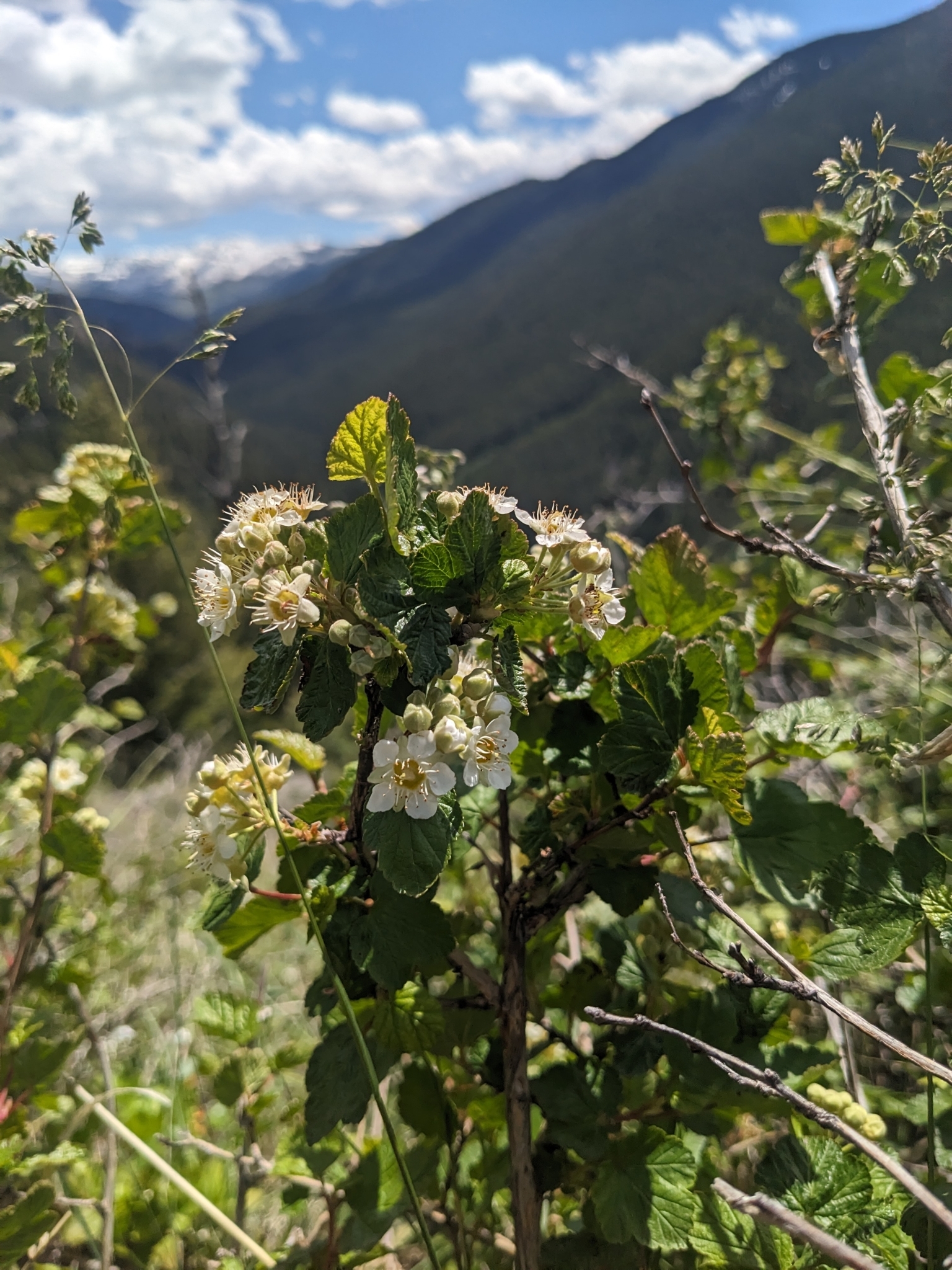
Mallow ninebark growing in Spokane County, Washington (CC BY-NC 4.0).
Site Characteristics
Mallow ninebark is most commonly found on hillsides, canyons, and grasslands on mesic ponderosa pine and Douglas-fir sites [17,23]. It also has been found on moist slopes and streamsides in mountain-brush, aspen, and mixed-conifer woodlands at 5,250 to 10,000 feet (1,600-3,000 m) elevation [37].
Soils
Mallow ninebark is found predominantly on soils with no exposed rocks. Parent materials range from calcareous/noncalcareous sedimentary rocks such as limestone, sandstone, and conglomerates, to igneous rock such as granites and basalts. Soil textures found on mallow ninebark sites range from sandy loams to silty clay loams. Ash layers have been found on some loess soils in central Idaho. Surface soil acidity range from pH 5.5 to 7.1. The average duff layer is 2.6 inches (6.5 cm) with an effective rooting depth generally at 15 inches (38 cm) [8,40,47].
Plant Communities
Mallow ninebark occurs in a wide variety of habitat types from cool/moist subalpine fir (Abies lasiocarpa), grand fir (A. grandis), and Engelmann spruce (Picea engelmannii) to more mesic Douglas-fir (Pseudotsuga menziesii) and ponderosa pine (Pinus ponderosa) sites. Mallow ninebark's associates generally include ocean-spray (Holodiscus discolor), common snowberry (Symphoricarpos albus), mountain snowberry (Symphoricarpos oreophilus), white spirea (Spiraea betulifolia), serviceberry (Amelanchier alnifolia), Oregon grape (Mahonia repens), and pinegrass (Calamagrostis rubescens) [8,20,40,45,47].
Publications listing mallow ninebark as an indicator or dominant species in habitat types (hts), plant associations (pas), or community types (cts) are as follows:
| Area | Classification | Authority |
|---|---|---|
| Idaho, central | Forest (hts) | Steele and others, 1981 |
| Idaho, central | Forest (hts) | Steele & Geier-Hayes, 1989 |
| Idaho, eastern; western Wyoming | Forest (hts) | Steele and other, 1983 |
| Idaho, northern | Forest (hts) | Cooper and others, 1991 |
| Montana | Forest (hts) | Pfister and others, 1977 |
| Montana, western | Forest (hts) | Arno and others, 1985 |
| Oregon | Forest (cts) | Cole, 1982 |
| Oregon, Wallowa-Whitman National Forest | Forest (pas) | Johnson & Simon, 1987 |
| Utah, northern | Forest (hts) | Mauk & Henderson, 1984 |
| Washington | Forest (hts) | Williams & Lillybridge, 1983 |
Botanical Description
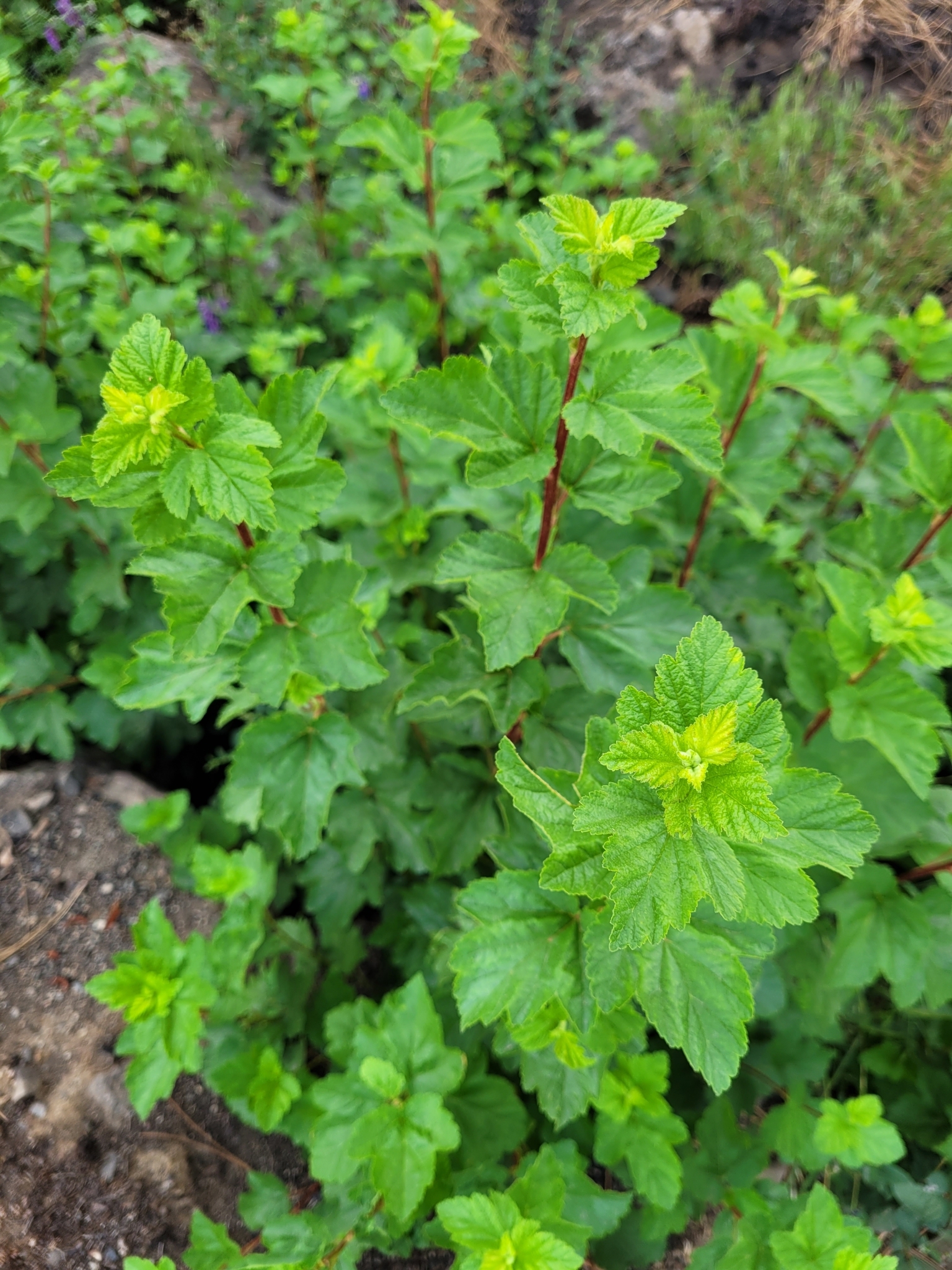
This deciduous shrub is generally 2.0 to 7.0 feet (0.6-2.1 m) tall; broad stem structure; twigs glabrous; bark shreddy on older branchlets; inflorescence corymbose [21]. The fruit is an inflated two- to three-chambered capsule with two to four very small seeds per chamber. Mallow ninebark leaves are palmately three- to five-lobed, and begin to turn color as early as late July, becoming brownish-red by early autumn [23].
Mallow ninebark has a horizontal perennating root system, although it is often called a "rootcrown shrub". Sectioning revealed that its perennating organ is a rhizome [3].
Raunkiaer Life Form (Raunkiaer 1934)
- Phanerophyte
Seasonal Development
Mallow ninebark flowering and fruiting dates are as follows [16]:
| Site | Elevation (ft) | Flowering dates | Fruit ripening dates | Seed dispersal dates |
|---|---|---|---|---|
| Kootenai County, Idaho | 3,200 | 20 May–30 June | August | September 15+ |
| Missoula County, Montana | 3,200 | 30 May–25 June | 20 August–5 September | October 10+ |
| Missoula County, Montana | 4,400 | 20 June–10 July | 20 August–25 September | October 5+ |
| Missoula County, Montana | 5,400 | 25 June–15 July | 20 August–30 September | October 5+ |
| Missoula County, Montana | 6,400 | 5 July–25 July | 5 September–25 September | October 10+ |
Mallow ninebark shrubs in northern Idaho showed stem elongation 25 days earlier on southern aspects than on the cooler eastern aspects. From this, it is hypothesized that stem elongation may be controlled by air temperature [11].
Seasonal development for mallow ninebark east of the Continental Divide in Montana and Yellowstone National Park from 1928 to 1937 are as follows [43]:
| Seasonal event | Average date | Earliest date | Latest date | Standard error (days) | # of observations |
|---|---|---|---|---|---|
| First appearance | 3 May | 6 April | 20 May | 2 | 23 |
| Leaves full grown | 18 June | 17 May | 20 July | 3 | 23 |
| Flowers start | 13 June | 22 May | 30 June | 2 | 24 |
| Flowers end | 6 July | 18 June | 21 July | 2 | 24 |
| Fruits ripe | 4 August | 16 June | 9 September | 4 | 24 |
| Seed fall starts | 17 August | 26 June | 18 September | 16 | 3 |
| Leaves wither | 9 August | 1 July | 19 September | 3 | 24 |
| Leaves fallen | 24 August | 23 July | 26 September | 3 | 24 |
| First frost injury | 25 September | 28 August | 26 October | 3 | 24 |
Major phenological activities of mallow ninebark in northern Idaho are as follows [36]:
| Year | Bud swell | Leafing out | Stem growth | Blooming | Fruit growth | Leaf color change | Leaf fall |
|---|---|---|---|---|---|---|---|
| 1971 | NA | 21 April–11 May | 4 May–18 June | 26 May–18 June | 18 June–NA | 23 September | 23 September |
| 1972 | NA | 19 April–23 May | 6 May–13 June | 19 May–13 June | 13 June–NA | 26 September | 26 September |
| 1973 | 3–15 April | 23 April–4 June | 2 May–4 June | 23 May–12 June | 19 June–NA | 28 August | 2 October |
Regeneration Processes

Flowering mallow ninebark.
Seeds, Flowering, and Fruiting
Flowering dates vary from May to July, and fruit ripening occurs between late August and early October. Mallow ninebark averaged 756,000 cleaned seeds per pound (344,000/kg), with a 16 percent soundness value [16]. Mallow ninebark seeds are primarily transported by gravity. Seeds stored in the soil are 11 percent viable, and germinate in partial shade on scarified soil [46].
Regeneration Following Disturbance
In western Montana, Bradley [4] found mallow ninebark to occur in two forms: singularly or in small clumps of stems sprouting from one rhizome; or in large groupings with many stems originating from a number of interlaced rhizomes. External observations of rhizomes revealed numerous suppressed buds along the entire length of the axis. One half of the shrubs excavated had stems arising from more than one section of the rhizome. Presence of buds throughout the rhizome may permit sprouting at many points given the proper environmental conditions [4].
Successional Status
Mallow ninebark is associated with a variety of species through its successional progression. In early seral stages, mallow ninebark is a part of communities that reflect great species diversity. This would include overstory species such as quaking aspen (Populus tremuloides), shrub species like redstem ceanothus (Ceanothus velutinus), and numerous herbaceous species. In mid-seral communities mallow ninebark is associated mostly with ponderosa pine and Douglas-fir, shrubs in the Salix and Prunus genera, and herbs such as penstemon (Penstemon attenuatus) and Fragaria species. In climax mallow ninebark associations, Douglas-fir is the dominant overstory species and occurs in pure stands. Shrub layers become increasingly simple, consisting primarily of Physocarpus, Symphoricarpos, Amelanchier, and Spiraea. The herbaceous layer decreases and is generally limited to shade-tolerant rhizomatous species [46].
In the Intermountain West, mallow ninebark forms a union primarily in the Douglas-fir/mallow ninebark association. In northern Idaho, this association is generally found between the drier ponderosa pine/Idaho fescue (Festuca idahoensis) or ponderosa pine/mallow ninebark associations, and the moister grand fir/mountain lover (Pachistima myrsinites) association [6].
Mallow ninebark responds to various forms of disturbance such as silvicultural cutting or wildfire by major vegetative responses. This includes an increase in coverage from existing plants and vigorous rhizome sprouting [46]. Mallow ninebark is an obligate pioneer species that predictably increases rapidly in average height following disturbance. Over time, as overstory competition increases, the height of mallow ninebark generally decreases [24].
Immediate Fire Effects
Mallow ninebark is classified as fire resistant [14]. It is, however, susceptible to death from severe fire temperatures. Roots may be damaged by moderate to severe fires. Often there is a decrease in aboveground parts following fire, subsequently delaying regeneration [9,14].
Prefire and postfire measurements of mallow ninebark in central Idaho are as follows [25]:
| Burn status | Average live crown diameter (ft) | Average live crown height (ft) | Average crown below 7 ft (%) | Average dead crown (%) | # of basal sprouts | Average sprout height (ft) |
|---|---|---|---|---|---|---|
| Prefire | 2.5 | 4.5 | 100.0 | 20.0 | 4.0 | 2.0 |
| Postfire | 1.5 | 3.0 | 100.0 | 100.0 | 21.0 | 2.0 |
* prefire measurements taken March/1965; postburn measurements taken August/1965. ** postfire measurements were taken on the part of the plant which existed before treatment. | ||||||
Postfire Regeneration Strategy (Stickney 1989)
- Survivor species; on-site surviving rhizomes
Fire Adaptations

Mallow ninebark sprouting after fire (CC BY-NC 4.0).
Mallow ninebark sprouts vigorously following fire. Sprouts originate from horizontal rhizomes, of which a high proportion are situated in mineral soil. Mallow ninebark has 36 to 99 percent of its rhizomes buried in mineral soil, ensuring its potential for survival and sprouting following a fire. It has been ranked in the highest fire-survival category in a western Montana study [4,9,14,38].
Plant Response to Fire
Mallow ninebark has been found to be more abundant on burned sites than on unburned sites. Twig densities on mallow ninebark shrubs increased through the third postfire growing season in northern Idaho. Shrub heights on burned and unburned sites were equal by the fourth growing season, while aboveground biomass of burned shrubs was only 64 percent of that of unburned shrubs [5,32]. Owens [39] found that the annual twig production for mallow ninebark increased proportional to the removal of shrub canopy by fire in northern Idaho.
The Research Project Summary Understory recovery after low- and high-intensity fires in northern Idaho ponderosa pine forests provides information on prescribed fire and postfire response of plant species including mallow ninebark.
Fire Regimes
For fire regime information, search FEIS for this species by entering the species name on the Advanced Search page and selecting “Fire Regime” as the publication type.
Fire Management Considerations
No entry.

Mallow ninebark growing in Custer Gallatin National Forest, Montana (CC BY 4.0).
Federal Status
None.
Other Status
No entry.
Importance to Wildlife and Livestock
Mallow ninebark's importance to livestock and wildlife is generally low to moderate. In central Idaho and western Montana, the grazing values for livestock and wildlife are poor to none [35,46]. Mallow ninebark made up only 8 percent of bighorn sheep browse in central Idaho [12].
Wildlife use of mallow ninebark is usually minimal because more palatable shrubs are commonly associated with it. For up to 3 years following fire, mallow ninebark sprouts are frequently browsed by deer. Mallow ninebark becomes a more important browse species on drier sites [38].
Palatability and Nutritional Value
Mallow ninebark is generally avoided as browse. In northern Idaho, mallow ninebark was scarcely browsed when it exhibited a high cover percent [31]. In cedar/hemlock (Thuja/Tsuga) ecosystems, it was found to be less palatable than associated browse species [19]. In northern Utah, however, mule deer browsed on mallow ninebark during the summer months [44]. In northern Idaho, livestock browsing on mallow ninebark seemed to increase its utilization by producing more palatable stems. Thilenius [48] found that mallow ninebark became more palatable to white-tailed deer following browsing by livestock.
The degree of mallow ninebark use shown by livestock and wildlife species in several western states is rated as follows [3,10]:
| Animal | Montana | Utah | British Columbia |
|---|---|---|---|
| Cattle | Poor | Poor | — |
| Sheep | Fair | Fair | — |
| Horses | Poor | Poor | — |
| Bighorn | — | — | Poor |
| Elk | — | — | Poor |
| Moose | — | — | Poor |
| Mule deer | — | — | Poor |
| White-tailed deer | — | — | Poor |
| Caribou | — | — | Poor |
In Montana and Utah, mallow ninebark only rated "fair" in energy and protein values [10].
Mean mineral concentration values of the upper one-third of mallow ninebark's current annual growth measured over 3 years (1974-76) on burned and unburned sites on the Selway-Bitterroot Wilderness, Idaho, were as follows [32]:
| Burn status | N (%) | K (%) | Mn (ppm) | Cu (ppm) | Mg (%) | Ca (%) | P (%) | Zn (ppm) | Na (ppm) |
|---|---|---|---|---|---|---|---|---|---|
| Burned | 1.30 | 1.60 | 40 | 6.50 | 0.22 | 1.20 | 0.30 | 14 | 48 |
| Unburned | 0.90 | 1.20 | 60 | 5.80 | 0.20 | 1.00 | 0.28 | 20 | 53 |
Cover Value
Mallow ninebark can form dense thickets, which provide good shelter and cover for a variety of wildlife species from small birds to large mammals.
Value for Rehabilitation of Disturbed Sites
The Soil Conservation Service in Pullman, Washington, has evaluated mallow ninebark in order to develop this shrub's soil-stabilizing characteristics for streambank stabilization projects [26]. Results from this evaluation are not available.
Mallow ninebark suitability ratings for revegetating road cuts in northwestern Montana are as follows [18]:
| Initial survival (1) | Final survival (2) | Growth | Vigor (3) | Natural spread | Soil stabilization (4) | Composite rating |
|---|---|---|---|---|---|---|
| 6 | 8 | 5 | 5 | 0 | 4 | 28 |
(1) Ratings for each factor are based on a scale from 0 to 10 with 10 being best. (2) Final survival based on percentage of initial survivors alive after 4 years. (3) Based on flowering growth rate and appearance. (4) Based on root system and observed holding power. | ||||||
Other Uses
No entry.
Other Management Considerations
Mallow ninebark decreases the productivity of forest lands by severely restricting regeneration. Tordon 22K and Tordon 101 have been used successfully to control this deep-rooted, perennial shrub [41]. Distortion, curling, and browning of mallow ninebark leaf margins were noted 1 week after application. At the end of one growing season, there was almost 100 percent browning and drying of foliage [41].
In northern Idaho, mallow ninebark showed two peaks of apparent susceptibility to damage from spraying 2,4-D and 2,4,5-T: in June, when the plants were in bloom, and again in September before leaf drop. Crown kill averaged 99 and 80 percent respectively. Following these treatments, sprouts averaged about two per plant. Spraying at these times decreases mallow ninebark, thereby possibly benefiting associated species [28,36].
Two to three quarts (1.9-2.8 l) of Roundup herbicide with water top-killed 62 to 80 percent of mallow ninebark foliage when applied during late foliar development [33]. Mallow ninebark control using Esteron brush killer achieved best results when this herbicide was mixed with diesel and sprayed by helicopter from low altitudes [less than 150 feet (46 m)] [34].
In many Douglas-fir/mallow ninebark habitat types, pocket gophers have been identified as a management problem. They apparently damage young pines, perhaps allowing mallow ninebark communities to outcompete conifer species. Burning, livestock grazing, and scarification have been attempted to rid mallow ninebark sites of pocket gophers [46].
Table A1— Forest and range ecosystems, Bureau of Land Management (BLM) physiographic regions, Kuchler plant associations, Society for American Foresters (SAF) forest cover types, and Society for Rangeland Management (SRM) rangeland cover types in which this species occurs.
Forest and Range Ecosystems (Garrison et al. 1977)
- FRES20 Douglas-fir
- FRES21 Ponderosa pine
- FRES25 Larch
- FRES28 Western hardwoods
BLM Physiographic Regions (Bernard and Brown 1977)
- 2 Cascade Mountains
- 5 Columbia Plateau
- 6 Upper Basin and Range
- 8 Northern Rocky Mountains
- 9 Middle Rocky Mountains
Kuchler Plant Associations (Kuchler 1964)
- K011 Western ponderosa forest
- K012 Douglas-fir forest
- K014 Grand fir - Douglas-fir forest
- K018 Pine - Douglas-fir forest
- K037 Mountain-mahogany - oak scrub
- K063 Foothills prairie
SAF Cover Types (Eyre 1980)
- 210 Interior Douglas-fir
- 212 Western larch
- 213 Grand fir
- 217 Aspen
- 237 Interior ponderosa pine
SRM Rangeland Cover Types (Shiflet 1994)
- No entry
1. Arno, Stephen F.; Simmerman, Dennis G.; Keane, Robert E. 1986. Characterizing succession within a forest habitat type--an approach designed for resource managers. Res. Note INT-357. Ogden, UT: U.S. Department of Agriculture, Forest Service, Intermountain Research Station. 8 p. [347]
2. Bernard, Stephen R.; Brown, Kenneth F. 1977. Distribution of mammals, reptiles, and amphibians by BLM physiographic regions and A.W. Kuchler's associations for the eleven western states. Tech. Note 301. Denver, CO: U.S. Department of the Interior, Bureau of Land Management. 169 p. [434]
3. Blower, Dan. 1982. Key winter forage plants for B.C. ungulates. Victoria, BC: British Columbia Ministry of the Environment, Terrestrial Studies Branch. [17065]
4. Bradley, Anne Foster. 1984. Rhizome morphology, soil distribution, and the potential fire survival of eight woody understory species in western Montana. Missoula, MT: University of Montana. 183 p. Thesis. [502]
5. Cattelino, Peter J. 1980. A reference base for vegetative response and species reproductive strategies. Final Report. Supplement No. 10 to Master Memorandum between Intermountain Forest and Range Experiment Station and Gradient Modeling, Inc. Missoula, MT: Gradient Modeling, Inc. 30 p. [12085]
6. Cholewa, Anita F.; Johnson, Frederic D. 1983. Secondary succession in the Pseudotsuga menziesii/Phyaocarpus malvaceus association. Northwest Science. 57(4): 273-282. [11402]
7. Cole, David N. 1982. Vegetation of two drainages in Eagle Cap Wilderness, Wallowa Mountains, Oregon. Res. Pap. INT-288. Ogden, UT: U.S. Department of Agriculture, Forest Service, Intermountain Forest and Range Experiment Station. 42 p. [658]
8. Cooper, Stephen V.; Neiman, Kenneth E.; Roberts, David W. 1991. (Rev.) Forest habitat types of northern Idaho: a second approximation. Gen. Tech. Rep. INT-236. Ogden, UT: U.S. Department of Agriculture, Forest Service, Intermountain Research Station. 143 p. [14792]
9. Crane, M. F.; Fischer, William C. 1986. Fire ecology of the forest habitat types of central Idaho. Gen. Tech. Rep. INT-218. Ogden, UT: U.S. Department of Agriculture, Forest Service, Intermountain Research Station. 85 p. [5297]
10. Dittberner, Phillip L.; Olson, Michael R. 1983. The plant information network (PIN) data base: Colorado, Montana, North Dakota, Utah, and Wyoming. FWS/OBS-83/86. Washington, DC: U.S. Department of the Interior, Fish and Wildlife Service. 786 p. [806]
11. Wagonfehr, Bob. 1987. Chaparral and the Tonto land management plan. In: Wagner, Michael R., ed. Challenges and opportunities in chaparral management: Proceedings of the Southwestern Society of American Foresters annual fall meeting; 1986 November 12-14; Prescott, AZ. SAF Publication No. SAF 87.10. Flagstaff, AZ: Northern Arizona State University and the San Francisco Peaks Chapter of the Society of American Foresters: 14. [5654]
12. Elliott, Charles R.; Flinders, Jerran T. 1984. Plant nutrient levels on two summer ranges in the River of No Return Wilderness Area, Idaho. The Great Basin Naturalist. 44(1): 621-626. [859]
13. Eyre, F. H., ed. 1980. Forest cover types of the United States and Canada. Washington, DC: Society of American Foresters. 148 p. [905]
14. Fischer, William C.; Bradley, Anne F. 1987. Fire ecology of western Montana forest habitat types. Gen. Tech. Rep. INT-223. Ogden, UT: U.S. Department of Agriculture, Forest Service, Intermountain Research Station. 95 p. [633]
15. Garrison, George A.; Bjugstad, Ardell J.; Duncan, Don A.; [and others]. 1977. Vegetation and environmental features of forest and range ecosystems. Agric. Handb. 475. Washington, DC: U.S. Department of Agriculture, Forest Service. 68 p. [998]
16. Gill, John D.; Pogge, Franz L. 1974. Physocarpus Maxim. Ninebark. In: Schopmeyer, C. S., ed. Seeds of woody plants in the United States. Agriculture Handbook No. 450. Washington: U. S. Department of Agriculture, Forest Service: 584-586. [7727]
17. Hitchcock, C. Leo; Cronquist, Arthur. 1973. Flora of the Pacific Northwest. Seattle, WA: University of Washington Press. 730 p. [1168]
18. Hungerford, Roger D. 1984. Native shrubs: suitability for revegetating road cuts in northwestern Montana. Res. Pap. INT-331. Ogden, UT: U.S. Department of Agriculture, Forest Service, Intermountain Forest and Range Experiment Station. 13 p. [1220]
19. Irwin, Larry L. 1976. Effects of intensive silviculture on big game forage sources in northern Idaho. In: Hieb, S., ed. Proceedings, elk-logging roads symposium. Moscow, ID: University of Idaho: 135-142. [16146]
20. Johnson, Charles G., Jr.; Simon, Steven A. 1987. Plant associations of the Wallowa-Snake Province: Wallowa-Whitman National Forest. R6-ECOL-TP-255A-86. Baker, OR: U.S. Department of Agriculture, Forest Service, Pacific Northwest Region, Wallowa-Whitman National Forest. 399 p. [9600]
21. Kartesz, John T.; Kartesz, Rosemarie. 1980. A synonymized checklist of the vascular flora of the United States, Canada, and Greenland. Volume II: The biota of North America. Chapel Hill, NC: The University of North Carolina Press; in confederation with Anne H. Lindsey and C. Richie Bell, North Carolina Botanical Garden. 500 p. [6954]
22. Kuchler, A. W. 1964. Manual to accompany the map of potential vegetation of the conterminous United States. Special Publication No. 36. New York: American Geographical Society. 77 p. [1384]
23. Lackschewitz, Klaus. 1991. Vascular plants of west-central Montana--identification guidebook. Gen. Tech. Rep. INT-227. Ogden, UT: U.S. Department of Agriculture, Forest Service, Intermountain Research Station. 648 p. [13798]
24. Laursen, Steven B. 1984. Predicting shrub community composition and structure following management disturbance in forest ecosystems of the Intermountain West. Moscow, ID: University of Idaho. 261 p. Dissertation. [6717]
25. Leege, Thomas A.; Hickey, William O. 1966. Lochsa elk study. Big Game Surveys and Investigations: W 85-R-17, Job No. 8. July 1, 1965 to June 30, 1966. Boise, ID: State of Idaho Fish and Game Department. 22 p. [16759]
26. Lines, Ivan L., Jr.; Carlson, Jack R.; Corthell, Robert A. 1979. Repairing flood-damaged streams in the Pacific Northwest. In: Johnson, R. Roy; McCormick, J. Frank, technical coordinators. Strategies for protection and management of floodplain wetlands & other riparian ecosystems: Proc. of the symposium; 1978 December 11-13; Callaway Gardens, GA. Gen. Tech. Rep. WO-12. Washington, DC: U.S. Department of Agriculture, Forest Service: 195-200. [4361]
27. Loucks, Donna M.; Harrington, Timothy B. 1991. Herbaceous vegetation in forests of the western United States: an annotated bibliography. Corvallis, OR: Oregon State University, College of Forestry, Forest Research Laboratory. 104 p. [17207]
28. Lyon, L. Jack; Mueggler, Walter F. 1968. Herbicide treatment of north Idaho browse evaluated six years later. Journal of Wildlife Management. 32(3): 538-541. [8428]
29. Lyon, L. Jack; Stickney, Peter F. 1976. Early vegetal succession following large northern Rocky Mountain wildfires. In: Proceedings, Tall Timbers fire ecology conference and Intermountain Fire Research Council fire and land management symposium; 1974 October 8-10; Missoula, MT. No. 14. Tallahassee, FL: Tall Timbers Research Station: 355-373. [1496]
30. Mauk, Ronald L.; Henderson, Jan A. 1984. Coniferous forest habitat types of northern Utah. Gen. Tech. Rep. INT-170. Ogden, UT: U.S. Department of Agriculture, Forest Service, Intermountain Forest and Range Experiment Station. 89 p. [1553]
31. McCulloch, Clay Y., Jr. 1955. Utilization of winter browse on wilderness big game range. Journal of Wildlife Management. 19(2): 206-215. [7933]
32. Merrill, Evelyn H. 1982. Shrub responses after fire in an Idaho ponderosa pine community. Journal of Wildlife Management. 46(2): 496-501. [1641]
33. Miller, Daniel L.; Kidd, Frank A. 1983. Shrub control in the Inland Northwest--a summary of herbicide test results. Forestry Research Note RN-83-4. Lewiston, ID: Potlatch Corporation. 49 p. [7861]
34. Miller, Daniel L.; Robinson, Vernon S. 1983. The influence of spray altitude on shrub control. Forestry Research Note RN-83-1. Lewiston, ID: Potlach Corporation, Wood Products, Western Division. 6 p. [3399]
35. Morris, Melvin S.; Schmautz, Jack E.; Stickney, Peter F. 1962. Winter field key to the native shrubs of Montana. Bulletin No. 23. Missoula, MT: Montana State University, Montana Forest and Conservation Experiment Station. 70 p. [17063]
36. Mueggler, Walter F. 1966. Herbicide treatment of browse on a big-game winter range in northern Idaho. Journal of Wildlife Management. 30(1): 141-151. [8427]
37. Mueggler, Walter F. 1988. Aspen community types of the Intermountain Region. Gen. Tech. Rep. INT-250. Ogden, UT: U.S. Department of Agriculture, Forest Service, Intermountain Research Station. 135 p. [5902]
38. Noste, Nonan V.; Bushey, Charles L. 1987. Fire response of shrubs of dry forest habitat types in Montana and Idaho. Gen. Tech. Rep. INT-239. Ogden, UT: U.S. Department of Agriculture, Forest Service, Intermountain Research Station. 22 p. [255]
39. Owens, T. E. 1982. Postburn regrowth of shrubs related to canopy mortality. Northwest Science. 56(1): 34-40. [1806]
40. Pfister, Robert D.; Kovalchik, Bernard L.; Arno, Stephen F.; Presby, Richard C. 1977. Forest habitat types of Montana. Gen. Tech. Rep. INT-34. Ogden, UT: U.S. Department of Agriculture, Forest Service, Intermountain Forest and Range Experiment Station. 174 p. [1878]
41. Potter, Dale R. 1968. New herbicide kills ninebark. Research Note INT-75. Ogden, UT: U.S. Department of Agriculture, Forest Service, Intermountain Forest & Range Experiment Station. 2 p. [5399]
42. Raunkiaer, C. 1934. The life forms of plants and statistical plant geography. Oxford: Clarendon Press. 632 p. [2843]
43. Schmidt, Wyman C.; Lotan, James E. 1980. Phenology of common forest flora of the northern Rockies--1928 to 1937. Res. Pap. INT-259. Ogden, UT: U.S. Department of Agriculture, Forest Service, Intermountain Forest and Range Experiment Station. 20 p. [2082]
44. Smith, Arthur D. 1953. Consumption of native forage species by captive mule deer during summer. Journal of Range Management. 6: 30-37. [2161]
45. Steele, Robert; Cooper, Stephen V.; Ondov, David M.; [and others]. 1983. Forest habitat types of eastern Idaho-western Wyoming. Gen. Tech. Rep. INT-144. Ogden, UT: U.S. Department of Agriculture, Forest Service, Intermountain Forest and Range Experiment Station. 122 p. [2230]
46. Steele, Robert; Geier-Hayes, Kathleen. 1989. The Douglas-fir/ninebark habitat type in central Idaho: succession and management. Gen. Tech. Rep. INT-252. Ogden, UT: U.S. Department of Agriculture, Forest Service, Intermountain Research Station. 65 p. [8136]
47. Steele, Robert; Pfister, Robert D.; Ryker, Russell A.; Kittams, Jay A. 1981. Forest habitat types of central Idaho. Gen. Tech. Rep. INT-114. Ogden, UT: U.S. Department of Agriculture, Forest Service, Intermountain Forest and Range Experiment Station. 138 p. [2231]
48. Thilenius, John Frederick. 1960. Forage utilization by cattle and white-tailed deer on a northern Idaho forest range. Moscow, ID: University of Idaho. 87 p. Thesis. [5910]
49. U.S. Department of Agriculture, Soil Conservation Service. 1982. National list of scientific plant names. Vol. 1. List of plant names. SCS-TP-159. Washington, DC. 416 p. [11573]
50. Williams, Clinton K.; Lillybridge, Terry R. 1983. Forested plant associations of the Okanogan National Forest. R6-Ecol-132b. Portland, OR: U.S. Department of Agriculture, Forest Service, Pacific Northwest Region. 116 p. [2566]