


Picea breweriana, Brewer spruce
Cope, Amy B. 1992. Picea breweriana, Brewer spruce. In: Fire Effects Information System, [Online]. U.S. Department of Agriculture, Forest Service, Rocky Mountain Research Station, Fire Sciences Laboratory (Producer). Available: https://research.fs.usda.gov/feis/species-reviews/picbre
| Abbreviation | Common Name | Scientific Name | Classification | Status |
|---|---|---|---|---|
| Plants | ||||
| PICBRE | Brewer spruce | Picea breweriana | Life Form: Plants/Tree Kingdom: Plantae Class: Conifer Order: Pinales Family: Pinaceae Genus: Picea | Fed. Protected: No Nativity: Native Invasiveness: Noninvasive |

Taxonomy
The currently accepted scientific name of Brewer spruce is Picea breweriana Wats. [14,18,19]. There are no recognized subspecies or varieties. Brewer spruce grows adjacent to Engelmann spruce (Picea engelmannii), but no hybridization between the two has been observed [18].
Synonyms
- No entry.
Other Common Names
Brewer's spruce, weeping spruce.
General Distribution
Brewer spruce is endemic to the Klamath region of northwestern California and adjacent Oregon. It is distributed from from Del Norte, Trinity, and Siskiyou counties in California to Curry and Josephine counties in Oregon [11,14,18]. The best developed stands are located on high ridges and upper valleys of the Klamath, Shasta-Trinity, and Six Rivers National Forests of California and in the Siskiyou and Rogue River National Forests of Oregon [11,18,20].
States and Provinces
- United States: CA OR
Site Characteristics
Despite its restricted distribution, Brewer spruce has a broad ecological amplitude. Its apparent limitations are high water tables and frequent fires [17,18]. Brewer spruce is quite tolerant of soil moisture stress, cold temperatures, low light, low-fertility soils, and snow [13,18,21]. Although Brewer spruce can tolerate considerable soil moisture stress, it is sensitive to high evaporation demands. Under such demand, stomata close, halting photosynthesis [13,18,21].
Brewer spruce grows in a climate of cold, wet winters and warm, relatively dry summers with respective temperature ranges of 30 to 41 degrees Fahrenheit (-1 to 5 deg C) and 52 to 68 degrees Fahrenheit (11-20 deg C). Annual precipitation varies between 39 and 110 inches (1,000-2,800 mm) [18].

Brewer spruce, Trinity Alps Wilderness, CA.
Brewer spruce stands occur on north-, south-, east-, and west-facing slopes, but the preferred habitat is steep, north-facing slopes [3,18]. Brewer spruce occurs on rocky ridges [18], cold hollows [14], and on dry talus and moraines [17]. It never occurs in areas where the soils are saturated during the growing season, such as boggy or wet areas. The slope is generally 11 to 70 percent [18].
Brewer spruce grows on soils developed from sedimentary, granitic, serpentine, and metavolcanic rock [18]. Most soils are shallow, rocky, and undeveloped; however, Brewer spruce does occur on deeper soils [18]. Soil pH ranges between 4.6 and 7.2 on mica schist, meta volcanic, granitic, and ultrabasic soils [21]. Soil depth varies between 12 and 50 inches (6.5-127 cm) [3]. Kruckeberg [9] lists Brewer spruce as an indicator of serpentine soils. Heavy metals, especially iron and nickel, can attain high levels in soil and plant tissues of Brewer spruce [9].
Brewer spruce occurs at the elevations listed below [3,18]:
| Region | Feet | Meters |
|---|---|---|
| Siskiyou Region | 3,840-5,120 | 1,163-1,515 |
| Eastern Klamath Region | 4,500-7,500 | 1,370-2,290 |
The majority of Brewer spruce overstory associates are listed in Table A1. Other overstory associates not mentioned previously include noble fir (Abies procera), sugar pine (Pinus lambertina), Pacific yew (Taxus brevifolia), and Alaska cedar (Chamaecyparis nootkatensis) [3,4,8,17,18]. Shrubs that occur in association with Brewer spruce include Sadler oak, huckleberry oak (Quercus vaccinifolia), greenleaf manzanita (Arctostaphylos patula), pinemat manzanita (A. nevadensis), thinleaf huckleberry (Vaccinium membranaceum), snowberry (Symphoricarpos hesperius), dwarf Oregon grape (Berberis nervosa), and Labrador tea (Ledum glandulosum) [3,17,18]. Associates that occur in the herbaceous layer are beargrass (Xerophyllum tenax), western prince's pine (Chimaphila umbellata), vanillaleaf (Achlys triphylla), rattlesnake plantain (Goodyera oblongifolia), Pacific trillium (Trillium ovatum), false Solomon's seal (Smilacina stellata), queenscup (Clintonia uniflora), starflower (Tridentalis latifolia), and groundsel (Senecio triangularis) [3,4,17,18].
Plant Communities
Although Brewer spruce grows throughout the Klamath region, it usually occurs in local, disjunct populations [17]. It is a minor component of a variety of communities [24]. In some areas, Brewer spruce is a minor climax species in stands dominated by California red fir (Abies magnifica), white fir (A. concolor), or mountain hemlock (Tsuga mertensiana) [3]. It occurs occasionally as a codominant in some California red fir and western hemlock habitat types. Near the Russian Peak area of the Marble Mountains of California, Brewer spruce is a major component of the California red fir/northern twinflower (Linnaea borealis) and California ref fir/huckleberry oak (Quercus vaccinifolia) types [17]. This species also occurs in small dense stands on mostly north-facing slopes, as individuals invading seral pine stands and montane chaparral, and as scattered individuals in closed white fir forests [17]. Brewer spruce is often an indicator of cold and wet environments [2].
Brewer spruce is listed as a dominant or codominant overstory species in the following published classification:
- Preliminary plant associations of the Siskiyou Mountain Province [3].
Botanical Description
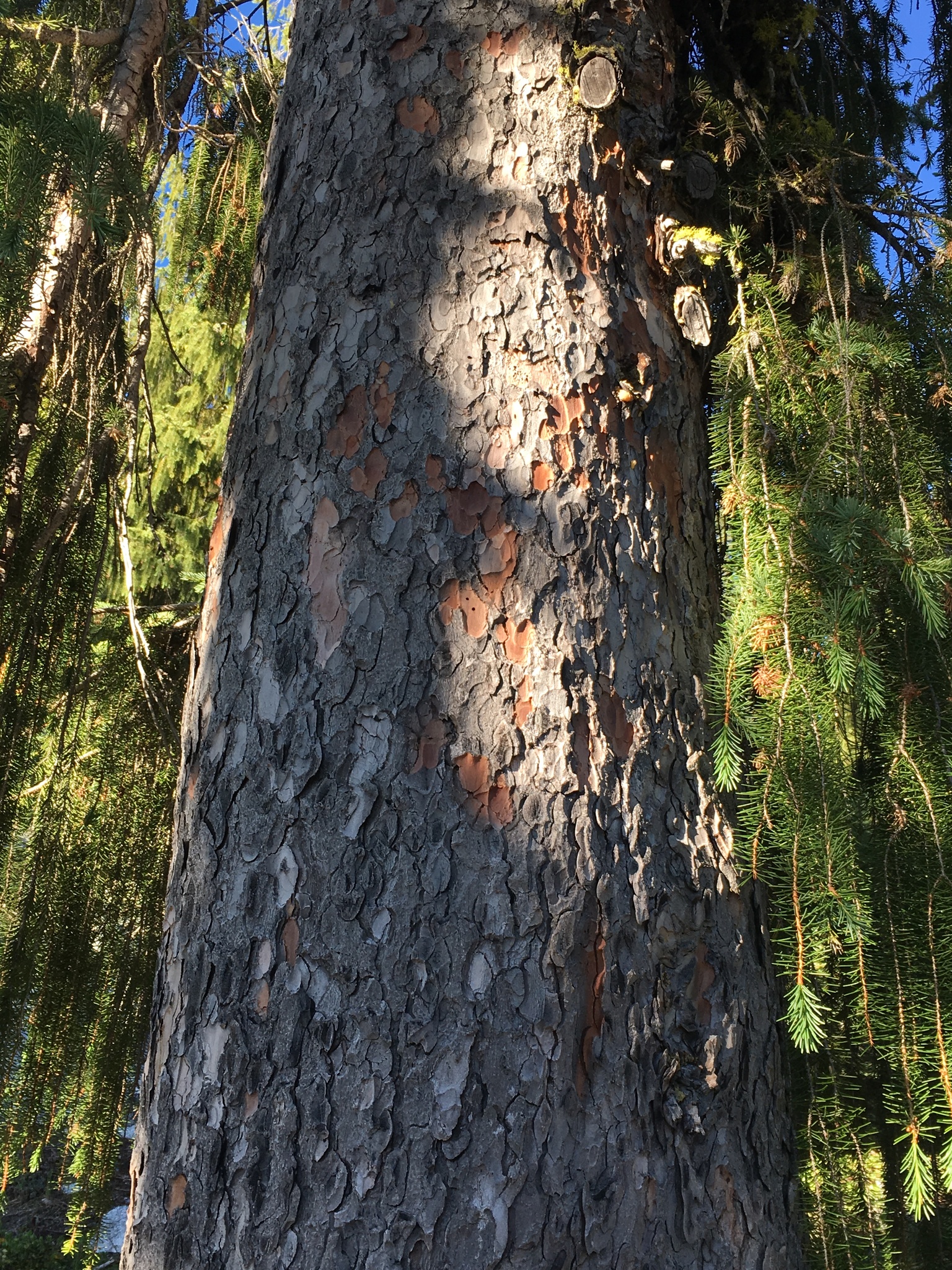
Brewer spruce is a native, endemic conifer. It has a distinctive, drooping appearance caused by the presence of thousands of long, ropelike branches hanging from all but the topmost horizontal limbs [14,18,19,23]. At maturity, Brewer spruces usually reaches 80 to 100 feet (24-30 m) in height [16], but can reach up to 172 feet (52 m) in height [21]. Diameters range from approximately 3.8 feet (117 cm) [18] to up to 4.5 feet (1.35 m) in some areas [21]. The bark is thin and broken into long, thin, appressed scales [14,16].

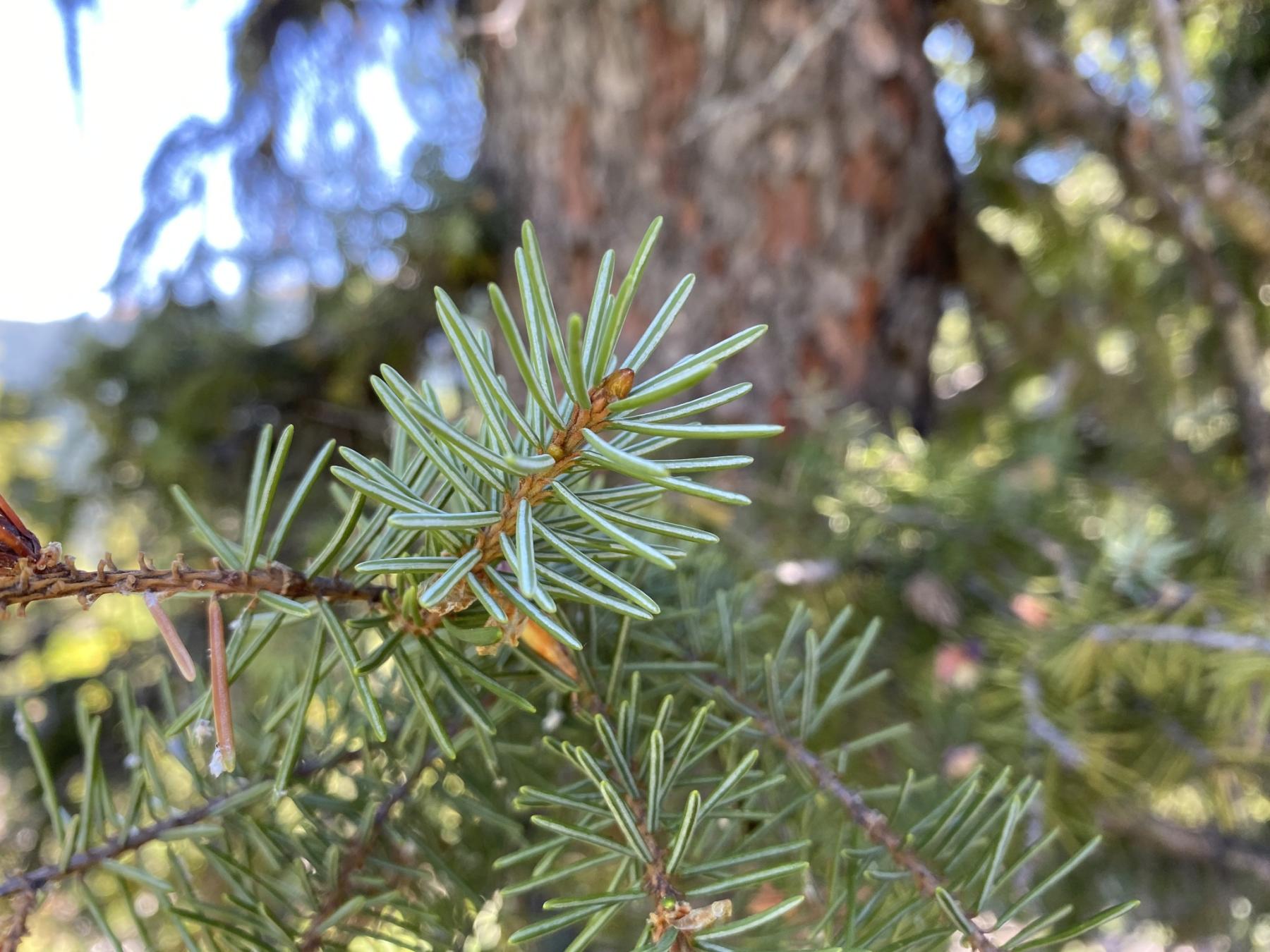
Brewer spruce needles, Josephine County, OR.
The leaves are obtuse, flat on top, and rounded underneath, and spread from all sides of the branchlets. The male cones are stalked and oblong (3 to 4 inches [7-10 cm] long). The seeds are 0.12 inch (3 mm) long [14,16].
The root system generally is shallow; however, on deeper soils, a few vertical roots may extend several meters [18].
Brewer spruce can live as long as 900 years [21].
Raunkiaer Life Form (Raunkiaer 1934)
- Phanerophyte
Seasonal Development
Strobilus buds appear in early summer, accompanied by the shedding of pollen, at which time the conelets are receptive. The male strobili develop from axils of needles of the previous year's shoots. After pollination, the strobili dry and fall from the tree and the conelets turn down and mature over the summer, into September and October. Dissemination follows immediately [18].
Regeneration Processes
The major regeneration mode of Brewer spruce is by seed [2]. Brewer spruce is monoecious and begins producing seed at 20 to 30 years of age. Mature Brewer spruce are apparently fair seed producers [18]. Crops occur at 2-year intervals, but some trees produce cones yearly [18]. Production of seed ranges between 51,000 and 74,000 seeds per pound (112,500-163,000 seeds/kg) [18], with a reported average of 61,000 seeds per pound (134,500 seeds/kg) [16]. Seeds of Brewer spruce require a stratification period of 30 to 90 days [14,16]. Germinations rates vary from 50 to 96 percent, with an average of 88 percent [16,18].
Germination is epigeal and occurs on loose soil from upturned roots, decaying logs, forest humus, and leaf litter under brushfields. Seedlings are unable to survive strong sunlight and are sensitive to high moisture stress and temperatures of exposed sites. First season epicotyl height growth is less than 0.24 inch (6 mm). Further growth is slow, but it appears to be faster on south-facing montane chaparral [18]. Saplings and pole-sized Brewer spruce average 6 inches (0.15 m) in annual height growth [18].
Successional Status
Brewer spruce is very shade tolerant and can become established under an almost closed canopy [18,21]. It is usually occurs in late seral or climax communities but can also invades seral pine stands and montane chaparral [17,21]. Toward the eastern limit of its range, stands dominated by western white pine (Pinus monticola) and Douglas-fir (Pseudotsuga menziesii) are replace by Brewer spruce-Shasta red fir (Abies magnifica var. shastensis) climax [21]. Brewer spruce is restricted to less fertile soils because of strong competition from other conifers [18,21].
Immediate Fire Effects
In a series of fires in 1987 that burned throughout the range of Brewer spruce, low-intensity surface fires killed Brewer spruce in mixed stands. In small stands on north, rocky slopes, Brewer spruce was undamaged [18]. On granitic soils fire can be extremely damaging to Brewer spruce because the shallow root system is damaged by heat transfer to the soil [3].
Postfire Regeneration Strategy (Stickney 1989)
- Tree without adventitious-bud root crown
- Secondary colonizer - off-site seed
Fire Adaptations

Brewer spruce bark, Klamath National Forest, CA.
Brewer spruce is not fire resistant; the thin bark, drooping nature of the branches, and shallow root system make it sensitive to fire [17,18,23]. Fire sensitivity appears to have limited the range of Brewer spruce [18]; it is largely confined to fire-resistant open forests on north-facing slopes or rocky ridges [17,23].
Plant Response to Fire
Brewer spruce recovery from fire is generally slow. Seedlings are unable to survive strong sunlight and are intolerant of moisture stress [18]. The recovery of Brewer spruce from the extensive fires of 1987 may take decades or centuries [18]. Atzet and Wheeler [2], however, reported that light fires may stimulate seeding or germination of Brewer spruce.
Fire Regimes
For fire regime information, search FEIS for this species by entering the species name on the Advanced Search page and selecting “Fire Regime” as the publication type.
Fire Management Considerations
Brewer spruce serves as a medium fuel type [2].
Federal Status
None
Other Status
No entry.
Importance to Wildlife and Livestock
Brewer spruce provides excellent wildlife habitat [4]. Cones and seeds of Brewer spruce do not appear to be a preferred food for rodents [18].
Palatability and Nutritional Value
No entry.
Cover Value
No entry.
Value for Rehabilitation or Restoration of Disturbed Sites
No entry.
Other Uses
In Europe, Brewer spruce is considered a popular ornamental [18].
The wood of Brewer spruce is soft, heavy, and close grained [14]. The branching habit of Brewer spruce results in the wood having many knots, and it has little commercial value. Trees that are harvested are often mixed with other trees for use as low grade lumber [18].
Other Management Considerations
Brewer spruce is best managed on mesic sites that are characterized by the presence of Sadler oak (Quercus sadleriana). Brewer spruce growth is best in mixed stands with uneven-aged management [18]. Natural regeneration of Brewer spruce is good under dense white fir-Brewer spruce stands, but it does not regenerate as well in open conditions [3].
Little information on volume or yield of Brewer spruce is available. The average total basal area of a few sampled stands is 205 square feet per acre (47 sq m/ha), with an annual increment of 9 square feet per acre (2 sq m/ha) [18].
Artificial propagation is best from seed. Some spruce seeds have been stored without loss of viability for periods of 5 to 17 years [16]. Safford [26] describes methods of seed extraction and storage and nursery practice.
Cooley spruce gall adelgid (Adelges cooleyi) is common in Brewer spruce but does little harm. Seed chalcids (Megastigmus spp.) have been observed in mature seeds of Brewer spruce. Parasitism by dwarf mistletoe (Arceuthobium campylopodum) has been observed in 36 percent of local populations. Brewer spruce is more susceptible to windthrow than its associates because of its shallow root system. Shallow roots also result in high incidences of root rot (Heterobasision annosum) in some areas [18].
Table A1— Forest and range ecosystems, Bureau of Land Management (BLM) physiographic regions, Kuchler plant associations, Society for American Foresters (SAF) forest cover types, and Society for Rangeland Management (SRM) rangeland cover types in which this species occurs.
Forest and Range Ecosystems (Garrison et al. 1977)
- FRES20 Douglas-fir
- FRES21 Ponderosa pine
- FRES23 Fir - spruce
- FRES24 Hemlock - Sitka spruce
BLM Physiographic Regions (Bernard and Brown 1977)
- 1 Northern Pacific Border
- 4 Sierra Mountains
Kuchler Plant Associations (Kuchler 1964)
- K001 Spruce - cedar - hemlock forest
- K004 Fir - hemlock forest
- K005 Mixed conifer forest
- K007 Red fir forest
- K012 Douglas-fir forest
- K029 California mixed evergreen forest
SAF Cover Types (Eyre 1980)
- 205 Mountain hemlock
- 206 Engelmann spruce - subalpine fir
- 207 Red fir
- 211 White fir
- 215 Western white pine
- 224 Western hemlock
- 229 Pacific Douglas-fir
- 231 Port-Orford-cedar
- 234 Douglas-fir - tanoak - Pacific madrone
- 243 Sierra Nevada mixed conifer
- 244 Pacific ponderosa pine - Douglas-fir
- 247 Jeffrey pine
- 256 California mixed subalpine
SRM Rangeland Cover Types (Shiflet 1994)
- No entry.
1. Atzet, Thomas. 1979. Description and classification of the forests of the upper Illinois River drainage of southwestern Oregon. Corvallis, OR: Oregon State University. 211 p. Dissertation. [6452]
2. Atzet, Thomas; Wheeler, David L. 1982. Historical and ecological perspectives on fire activity in the Klamath Geological Province of the Rogue River and Siskiyou National Forests. Portland, OR: U.S. Department of Agriculture, Forest Service, Pacific Northwest Region. 16 p. [6252]
3. Atzet, Thomas; Wheeler, David L. 1984. Preliminary plant associations of the Siskiyou Mountain Province. Portland, OR: U.S. Department of Agriculture, Forest Service, Pacific Northwest Region. 278 p. [9351]
4. Atzet, Tom; Wheeler, David; Riegel, Gregg; [and others]. 1984. The mountain hemlock and Shasta red fir series of the Siskiyou Region of southwest Oregon. FIR Report. 6(1): 4-7. [9486]
5. Bernard, Stephen R.; Brown, Kenneth F. 1977. Distribution of mammals, reptiles, and amphibians by BLM physiographic regions and A.W. Kuchler's associations for the eleven western states. Tech. Note 301. Denver, CO: U.S. Department of the Interior, Bureau of Land Management. 169 p. [434]
6. Eyre, F. H., ed. 1980. Forest cover types of the United States and Canada. Washington, DC: Society of American Foresters. 148 p. [905]
7. Garrison, George A.; Bjugstad, Ardell J.; Duncan, Don A.; [and others]. 1977. Vegetation and environmental features of forest and range ecosystems. Agric. Handb. 475. Washington, DC: U.S. Department of Agriculture, Forest Service. 68 p. [998]
8. Harris, A. S. 1990. Chamaecyparis nootkatensis (D. Don) Spach Alaska-cedar. In: Burns, Russell M.; Honkala, Barbara H., technical coordinators. Silvics of North America. Volume 1. Conifers. Agric. Handb. 654. Washington, DC: U.S. Department of Agriculture, Forest Service: 97-102. [13373]
9. Kruckeberg, Arthur R. 1984. California serpentines: flora, vegetation, geology, soils and management problems. Publications in Botany Volume 48. Berkeley, CA: University of California Press. 180 p. [12482]
10. Kuchler, A. W. 1964. Manual to accompany the map of potential vegetation of the conterminous United States. Special Publication No. 36. New York: American Geographical Society. 77 p. [1384]
11. Charbonneau, Robert; Rice, Carol. 1990. Upper Strawberry Creek watershed restoration at the University of California, Berkeley. In: Hughes, H. Glenn; Bonnicksen, Thomas M., eds. Restoration '89: the new management challenge: Proceedings, 1st annual meeting of the Society for Ecological Restoration; 1989 January 16-20; Oakland, CA. Madison, WI: The University of Wisconsin Arboretum, Society for Ecological Restoration: 97-109. [14691]
12. Lyon, L. Jack; Stickney, Peter F. 1976. Early vegetal succession following large northern Rocky Mountain wildfires. In: Proceedings, Tall Timbers fire ecology conference and Intermountain Fire Research Council fire and land management symposium; 1974 October 8-10; Missoula, MT. No. 14. Tallahassee, FL: Tall Timbers Research Station: 355-373. [1496]
13. Minore, Don. 1979. Comparative autecological characteristics of northwestern tree species--a literature review. Gen. Tech. Rep. PNW-87. Portland, OR: U.S. Department of Agriculture, Forest Service, Pacific Northwest Forest and Range Experiment Station. 72 p. [1659]
14. Munz, Philip A. 1973. A California flora and supplement. Berkeley, CA: University of California Press. 1905 p. [6155]
15. Raunkiaer, C. 1934. The life forms of plants and statistical plant geography. Oxford: Clarendon Press. 632 p. [2843]
16. Safford, L. O. 1974. Picea A. Dietr. spruce. In: Schopmeyer, C. S., ed. Seeds of woody plants in the United States. Agric. Handb. 450. Washington, DC: U.S. Department of Agriculture, Forest Service: 587-597. [7728]
17. Sawyer, John O.; Thornburgh, Dale A. 1977. Montane and subalpine vegetation of the Klamath Mountains. In: Barbour, Michael G.; Major, Jack, eds. Terrestrial vegetation of California. New York: John Wiley & Sons: 699-732. [685]
18. Thornburgh, Dale. 1990. Picea breweriana Wats. Brewer spruce. In: Burns, Russell M.; Honkala, Barbara H., technical coordinators. Silvics of North America. Volume 1. Conifers. Agric. Handb. 654. Washington, DC: U.S. Department of Agriculture, Forest Service: 181-186. [13383]
19. U.S. Department of Agriculture, Soil Conservation Service. 1982. National list of scientific plant names. Vol. 1. List of plant names. SCS-TP-159. Washington, DC. 416 p. [11573]
20. Waring, R. H. 1969. Forest plants of the eastern Siskiyous: their environment and vegetational distribution. Northwest Science. 43(1): 1-17. [9047]
21. Waring, R. H.; Emmingham, W. H.; Running, S. W. 1975. Environmental limits of an endemic spruce, Picea breweriana. Canadian Journal of Botany. 53: 1599-1613. [19036]
22. Zobel, Donald B.; Roth, Lewis F.; Hawk, Glenn M. 1985. Ecology, pathology, and management of Port-Orford-cedar (Chamaecyparis lawsoniana). Gen. Tech. Rep. PNW-184. Portland, OR: U.S. Department of Agriculture, Forest Service, Pacific Northwest Forest and Range Experiment Station. 161 p. [9245]
23. Arno, Stephen F.; Hammerly, Ramona P. 1977. Northwest trees. Seattle, WA: The Mountaineers. 222 p. [4208]
24. Arno, Stephen F.; Hammerly, Ramona P. 1984. Timberline: Mountain and arctic forest frontiers. Seattle, WA: The Mountaineers. 304 p. [339]