


Pickeringia montana, chaparral pea
Howard, Janet L. 1992. Pickeringia montana, chaparral pea. In: Fire Effects Information System, [Online]. U.S. Department of Agriculture, Forest Service, Rocky Mountain Research Station, Fire Sciences Laboratory (Producer). Available: https://research.fs.usda.gov/feis/species-reviews/picmon
| Abbreviation | Common Name | Scientific Name | Classification | Status |
|---|---|---|---|---|
| Plants | ||||
| PICMON | chaparral pea | Pickeringia montana | Life Form: Plants/Shrub Kingdom: Plantae Class: Dicot Order: Fabales Family: Fabaceae Genus: Pickeringia | Fed. Protected: No Nativity: Native Invasiveness: Noninvasive |
Taxonomy
The currently accepted scientific name of chaparral pea is Pickeringia montana Nutt. (Fabaceae) [16]. Pickeringia is a monotypic genus [16,21]. There are two recognized subspecies: Pickeringiamontana ssp. montana and Pickeringiamontana ssp. tomentosa (Abrams) Abrams. P.m. ssp. tomentosa is distinguished by canescent young leaves and twigs [16].
Synonyms
- None
Other Common Names
None
General Distribution
Chaparral pea is endemic to California. It is distributed in the Coast Ranges from the Santa Monica Mountains north to Mendocino County, and in the foothills of the Sierra Nevada from Nevada County north to Butte County. It is also found on Santa Cruz Island. Pickeringia montana ssp. tomentosa occurs in the mountains of eastern San Diego County and in the San Bernardino Mountains [16,20].
States and Provinces
- United States: CA
Site Characteristics
The climate in which chaparral pea grows is Mediterranean, characterized by wet, mild winters and hot, dry summers [19]. Soils are usually low in fertility [5]. Soil pH varies from moderately to slightly acid [8,19]. Soil parent materials include siliceous sandstone, siliceous shale, serpentine, and diabase [26]. Chaparral pea occurs at elevations from 2,000 to 5,000 feet (610-1,524 m). It is most commonly found on ridgetops [3,13,23]
Plant Communities
Chaparral pea occurs in mixed chaparral but is not usually dominant. It may be a minor component of seral chamise (Adenostoma fasciculatum) chaparral or California mixed evergreen forest [9,12,16,24].
Overstory associates not listed in table A1 include Tecate cypress (Cupressus forbesii), Sargent's cypress (C. sargentii), bishop pine (Pinus muricata), Coulter pine (P. coulteri), tanoak (Lithocarpus densiflora), and California bay (Umbellularia californica) [26,27].
Common shrub associates include Eastwood manzanita (Arctostaphylos glandulosa), chamise, wedgeleaf ceanothus (Ceanothus cuneatus), chaparral whitethorn (C. leucodermis), birchleaf mountain-mahogany (Cercocarpus betuloides), sawtooth goldenbush (Haplopappus squarrosus), poison-oak (Toxicodendron diversilobum), hollyleaf cherry (Prunus ilicifolia), California scrub oak (Quercus dumosa), and chaparral yucca (Yucca whipplei) [9,26].
Herbaceous associates are rare in mature chaparral stands but are common following disturbance in the plant community [5]. Common herbaceous associates include California goldenrod (Solidago californica), chaparral pentstemon (Pentstemon heterophyllus), common soap-plant (Chlorogalum pomeridianum), dove lupine (Lupinus bicolor), wild oat (Avena fatua), ripgut brome (Bromus rigidus), soft chess (B. mollis), foothill stipa (Stipa lepida), and smallflower melicgrass (Melica imperfecta) [19,26].
Botanical Description
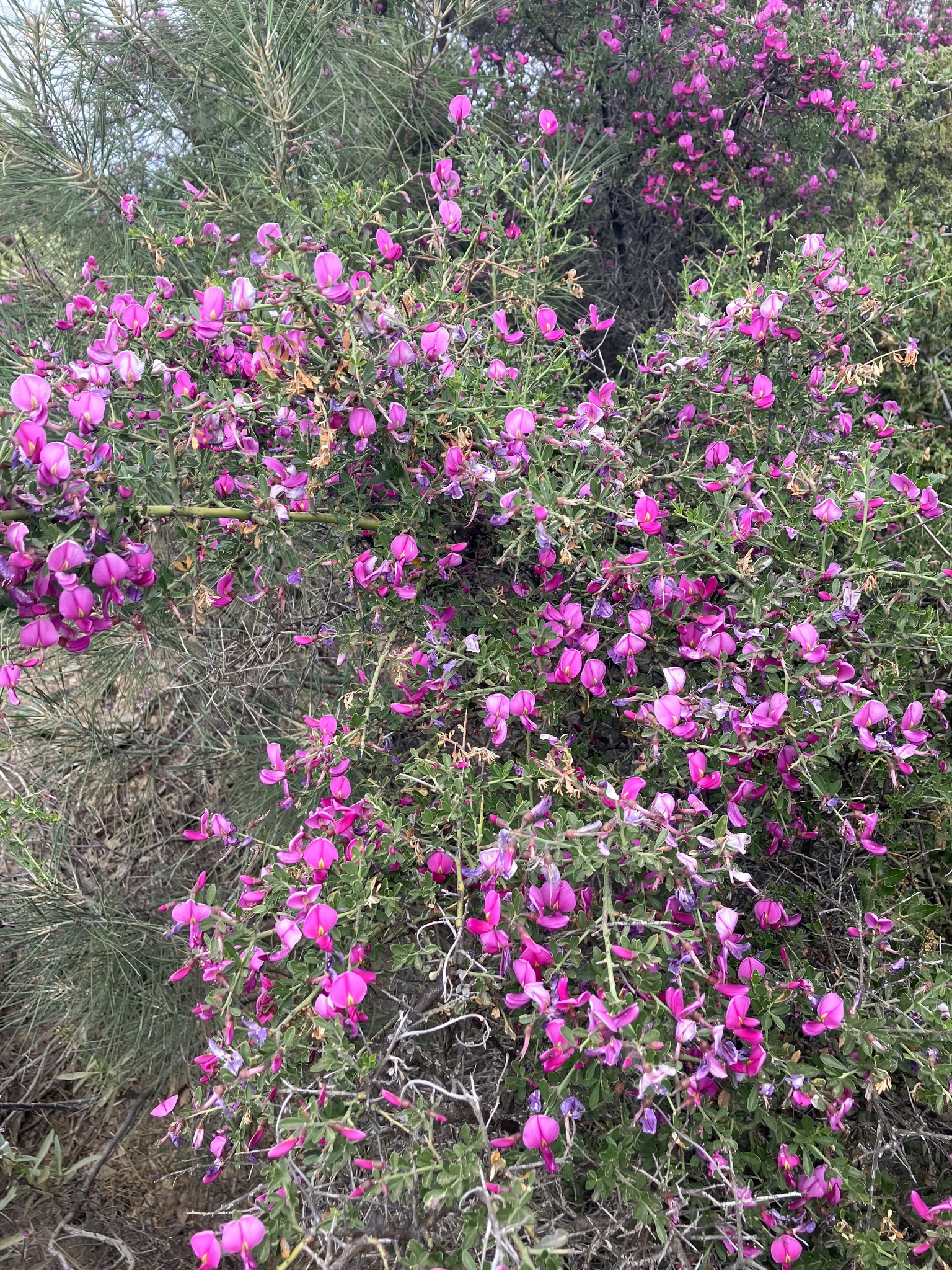
Chaparral pea is a native evergreen shrub from 1.6 to 6.6 feet (0.5-2 m) in height. Branches are stiff and dense, with spine-tipped branchlets [16]. The schlerophyllous leaves are 2 to 6 inches (5-15 cm) long. The fruit is a legume containing 6 to 10 seeds. Root nodules are dense and arranged in large clusters [13,22].
Raunkiaer Life Form (Raunkiaer 1934)
- Phanerophyte
- Cryptophyte
Seasonal Development
Chaparral pea begins growth in February [11]. Plants flower from May through June [16].
Regeneration Processes
The primary method of reproduction is vegetative. Most sources state that chaparral pea spreads by sprouting from the roots [4,6,20,23]. Munz [16], however, stated that it spreads from rhizomes. Damaged plants sprout from the roots and root crown [23,26].
Fruiting is rare [16,20]. Zedler [27] suggests that the few seeds that do mature have high rates of sterility or low viability.
Successional Status
Ecologists disagree as to the successional status of mixed chaparral. It has been variously described as climax [7], fire-climax [4], or fire subclimax [24]. Chaparral pea is a component of mature, mixed chaparral communities [4,24]. Following fire or other disturbance, it is a survivor, repopulating the initial community from sprouts [4]. Seedling colonization following disturbance is largely unstudied. Chaparral pea has tentatively been classified as having a low to intermediate rate of seedling establishment in secondary succession [28]. In the absence of fire or other disturbance, chaparral pea and associated chaparral shrubs are replaced by oak woodland or coniferous forest [24].
Since chaparral pea grows in mixed evergreen forest, it is probably moderately shade tolerant.
Immediate Fire Effects
Moderate-severity fire usually top-kills chaparral pea [18]. Plant mortality due to such fire is low to intermediate [28]. The percentage of complete kill varies by season. Spring or early summer fire, when carbohydrate reserves are depleted by rapid topgrowth, causes higher mortality than does late summer or fall fire [18].
Postfire Regeneration Strategy (Stickney 1989)
- Small shrub, adventitious-bud root crown
- Geophyte, growing points deep in soil
Fire Adaptations
Chaparral pea has adapted to fire by sprouting from the roots and root crown following damage to aboveground portions of the plant [4,20,23,26].
Plant Response to Fire
Data pertaining to postfire density, frequency, or growth rate of chaparral pea sprouts were not found in the literature. Schlerophyllous shrubs, including chaparral pea, typically sprout within a few weeks following fire [7]. Sprouts grow most rapidly after late summer or fall fires. Shrub canopy generally closes within 10 years postfire [18].
Postfire chaparral pea seedling recruitment appears to be scant. Zedler [27] initially stated that the species did not colonize burn areas. Later, he found that postfire colonization occurred but was rare [28]. One study of postfire recovery of mixed chaparral, conducted in southwest San Diego County, showed a density of 4.6 chaparral pea seedlings per square yard (3.8 plants/sq m) at the first postfire growing season. Seedling mortality was 64 percent in the first year [11].
Fire Regimes
Prior to fire suppression, mixed chaparral burned at fairly frequent intervals. Most chaparral shrubs, presumably including chaparral pea, recover quickly from fire. Litter accumulation in mixed chaparral is often heavy [12]. Consequently, these mixed stands are able to carry fire after only a few years of postfire growth [18]. Frequent fire kept chaparral pea and associated shrubs at a young stage of development. Because of this periodic fuel consumption, chaparral fires usually did not burn with the intensity of the fires of today [4].
For additional fire regime information, search FEIS for this species by entering the species name on the Advanced Search page and selecting “Fire Regime” as the publication type.
Fire Management Considerations
Deer management: Prescribed spring fire was used successfully in Lake County to improve deer habitat. Openings and "edge" were created in formerly dense chaparral brush. Browse quality was improved by the sprouting of top-killed shrubs, including chaparral pea. A year following the fire, the ratio of fawns to does increased greatly, and weight gain in bucks was improved, especially in young animals [3].
Federal Status
No special status.
Other Status
No entry.
Importance to Wildlife and Livestock
Chaparral pea is important browse for black-tailed deer. They carefully pick out leaves and flowers from among the thorny stems; flower consumption is particularly heavy. Livestock rarely browse the species [20].
Palatability and Nutritional Value
Chaparral pea browse is rated as excellent to good for black-tailed deer, depending on the season and the number of sprouts available. It is fair to poor browse for sheep and goats, poor for cattle, and useless for horses [20].
Protein levels in chaparral pea are notably higher than levels in most chaparral shrubs during the early growth stages, and higher than average during winter [20]. Analysis of chaparral pea leaves and stems yielded the following results [2]:
| Month | Crude protein (%) |
|---|---|
| February | 8.1 |
| April | 19.2 |
| May | 18.1 |
| June | 14.3 |
| July | 11.5 |
| August | 11.4 |
| September | 6.1 |
| October | 7.5 |
Cover Value
No entry.
Value for Rehabilitation or Restoration of Disturbed Sites
Fire depletes nitrogen from chaparral soils. Nitrogen-fixing bacteria within chaparral pea root nodules increase soil fertility [18,22].
Chaparral pea provides watershed protection [11].
Other Uses
No entry.
Other Management Considerations
Black-tailed deer rarely browse chaparral pea in dense older stands. Heaviest use occurs on recent burns or mechanically treated brush fields, where deer readily crop young sprouts [20]. Light disking of mature chaparral pea increases available forage because plants sprout wherever roots are exposed [23].
Table A1— Forest and range ecosystems, Bureau of Land Management (BLM) physiographic regions, Kuchler plant associations, Society for American Foresters (SAF) forest cover types, and Society for Rangeland Management (SRM) rangeland cover types in which this species occurs.
Forest and Range Ecosystems (Garrison et al. 1977)
- FRES20 Douglas-fir
- FRES28 Western hardwoods
- FRES34 Chaparral - mountain shrub
BLM Physiographic Regions (Bernard and Brown 1977)
- 3 Southern Pacific Border
- 4 Sierra Mountains
Kuchler Plant Associations (Kuchler 1964)
- K029 California mixed evergreen forest
- K030 California oakwoods
- K033 Chaparral
- K035 Coastal sagebrush
- K037 Mountain-mahogany - oak scrub
SAF Cover Types (Eyre 1980)
- 234 Douglas-fir - tanoak - Pacific madrone
- 248 Knobcone pine
- 249 Canyon live oak
- 250 Blue oak - gray pine
- 255 California coast live oak
SRM Rangeland Cover Types (Shiflet 1994)
- No entry
1. Bernard, Stephen R.; Brown, Kenneth F. 1977. Distribution of mammals, reptiles, and amphibians by BLM physiographic regions and A.W. Kuchler's associations for the eleven western states. Tech. Note 301. Denver, CO: U.S. Department of the Interior, Bureau of Land Management. 169 p. [434]
2. Bissell, Harold D.; Strong, Helen. 1955. The crude protein variations in the browse diet of California deer. California Fish and Game. 41(2): 145-155. [10524]
3. Biswell, H. H. 1958. The use of fire in California chaparral for game habitat improvement. In: Proceedings: Society of American Foresters meeting; 1957 November 10-13; Syracuse, NY. Washington, DC: Society of American Foresters: 151-155. [12149]
4. Biswell, Harold H. 1974. Effects of fire on chaparral. In: Kozlowski, T. T.; Ahlgren, C. E., eds. Fire and ecosystems. New York: Academic Press: 321-364. [14542]
5. Biswell, H. H.; Taber, R. D.; Hedrick, D. W.; Schultz, A. M. 1952. Management of chamise brushlands for game in the north coast region of California. California Fish and Game. 38(4): 453-484. [13673]
6. Conrad, C. Eugene. 1987. Common shrubs of chaparral and associated ecosystems of southern California. Gen. Tech. Rep. PSW-99. Berkeley, CA: U.S. Department of Agriculture, Forest Service, Pacific Southwest Forest and Range Experiment Station. 86 p. [4209]
7. Cooper, W. S. 1922. The broad-sclerophyll vegetation of California. Publ. No. 319. Washington, DC: The Carnegie Institution of Washington. 145 p. [6716]
8. Eyre, F. H., ed. 1980. Forest cover types of the United States and Canada. Washington, DC: Society of American Foresters. 148 p. [905]
9. Gardner, Robert A. 1958. Soil-vegetation associations in the redwood - Douglas-fir zone of California. In: Proceedings, 1st North American forest soils conference; [Date of conference unknown]; East Lansing, MI. East Lansing, MI: Michigan State University, Agricultural Experiment Station: 86-101. [12581]
10. Garrison, George A.; Bjugstad, Ardell J.; Duncan, Don A.; [and others]. 1977. Vegetation and environmental features of forest and range ecosystems. Agric. Handb. 475. Washington, DC: U.S. Department of Agriculture, Forest Service. 68 p. [998]
11. Gautier, Clayton R. 1983. Sedimentation in burned chaparral watersheds: is emergency revegetation justified?. Water Resources Bulletin. 19(5): 793-802. [4633]
12. Holland, Robert F. 1986. Preliminary descriptions of the terrestrial natural communities of California. Sacramento, CA: California Department of Fish and Game. 156 p. [12756]
13. Jepson, Willis Linn. 1925. A manual of the flowering plants of California. Berkeley, CA: University of California Press. 1238. [19365]
14. Kuchler, A. W. 1964. Manual to accompany the map of potential vegetation of the conterminous United States. Special Publication No. 36. New York: American Geographical Society. 77 p. [1384]
15. Lyon, L. Jack; Stickney, Peter F. 1976. Early vegetal succession following large northern Rocky Mountain wildfires. In: Proceedings, Tall Timbers fire ecology conference and Intermountain Fire Research Council fire and land management symposium; 1974 October 8-10; Missoula, MT. No. 14. Tallahassee, FL: Tall Timbers Research Station: 355-373. [1496]
16. Munz, Philip A. 1973. A California flora and supplement. Berkeley, CA: University of California Press. 1905 p. [6155]
17. Raunkiaer, C. 1934. The life forms of plants and statistical plant geography. Oxford: Clarendon Press. 632 p. [2843]
18. Rundel, Philip W. 1986. Structure and function in California chaparral. Fremontia. 14(3): 3-10. [18650]
19. Sampson, Arthur W. 1944. Plant succession on burned chaparral lands in northern California. Bull. 65. Berkeley, CA: University of California, College of Agriculture, Agricultural Experiment Station. 144 p. [2050]
20. Sampson, Arthur W.; Jespersen, Beryl S. 1963. California range brushlands and browse plants. Berkeley, CA: University of California, Division of Agricultural Sciences, California Agricultural Experiment Station, Extension Service. 162 p. [3240]
21. Schmida, Avi; Barbour, Mitchel. 1982. A comparison of two types of Mediterranean scrub in Israel and California. In: Conrad, C. Eugene; Oechel, Walter C., technical coordinators. Proceedings of the symposium on dynamics and management of Mediterranean-type ecosystems; 1981 June 22-26; San Diego, CA. Gen. Tech. Rep. PSW-58. Berkeley, CA: U.S. Department of Agriculture, Forest Service, Pacific Southwest Forest and Range Experiment Station: 100-106. [6014]
22. Schultz, A. M.; Biswell, H. H.; Vlamis, J. 1958. Responses of brush seedlings to fertilizers. California Fish and Game. 44(4): 335-348. [6274]
23. Taber, Richard D.; Dasmann, Raymond F. 1958. The black-tailed deer of the chaparral: Its life history and management in the North Coast Range of California. Game Bulletin No. 8. Sacramento, CA: State of California, Department of Fish and Game, Game Management Branch. 166 p. [16312]
24. Thorne, Robert F. 1976. The vascular plant communities of California. In: Latting, June, ed. Symposium proceedings: plant communities of southern California; 1974 May 4; Fullerton, CA. Special Publication No. 2. Berkeley, CA: California Native Plant Society: 1-31. [3289]
25. U.S. Department of Agriculture, Soil Conservation Service. 1982. National list of scientific plant names. Vol. 1. List of plant names. SCS-TP-159. Washington, DC. 416 p. [11573]
26. Wells, Philip V. 1962. Vegetation in relation to geological substratum and fire in the San Luis Obispo Quadrangle, California. Ecological Monographs. 32(1): 79-103. [14183]
27. Zedler, Paul H. 1977. Life history attributes of plants and the fire cycle: a case study in chaparral dominated by Cupressus forbesii. In: Mooney, Harold A.; Conrad, C. Eugene, technical coordinators. Symposium on the environmental consequences of fire and fuel management on Mediterranean ecosystems: Proceedings; 1977 August 1-5; Palo Alto, CA. Gen. Tech. Rep. WO-3. Washington, DC: U.S. Department of Agriculture, Forest Service: 451-458. [4876]
28. Zedler, Paul H. 1981. Vegetation change in chaparral and desert communities in San Diego County, California. In: West, D. C.; Shugart, H. H.; Botkin, D. B., eds. Forest succession: Concepts and application. New York: Springer-Verlag: 406-430. [4241]