


Picea sitchensis, Sitka spruce
Griffith, Randy Scott. 1992. Picea sitchensis, Sitka spruce. In: Fire Effects Information System, [Online]. U.S. Department of Agriculture, Forest Service, Rocky Mountain Research Station, Fire Sciences Laboratory (Producer). Available: https://research.fs.usda.gov/feis/species-reviews/picsit
| Abbreviation | Common Name | Scientific Name | Classification | Status |
|---|---|---|---|---|
| Plants | ||||
| PICSIT | Sitka spruce | Picea sitchensis | Life Form: Plants/Tree Kingdom: Plantae Class: Conifer Order: Pinales Family: Pinaceae Genus: Picea | Fed. Protected: No Nativity: Native Invasiveness: Noninvasive |

Taxonomy
The scientific name of Sitka spruce is Picea sitchensis (Bongard) Carriere (Pinaceae) [28,50].
Species within the genus Picea form hybrid swarms at the interface of their ranges. Sitka spruce naturally hybridizes with white spruce (P. glauca) to produce Lutz spruce (Picea X lutzii Little) [22,23,24,55]. It is often difficult to identify Picea X lutzii by morphological chacteristics in stands with low levels of introgression [23].
Sitka spruce in plantations will also hybridize with Yezo spruce (Picea jezoensis), Serbian spruce (P. omorika), and Engelmann spruce (P. engelmannii) [22,23,24].
Synonyms
- No entry.
Other Common Names
tideland spruce, coast spruce, yellow spruce, silver spruce, western spruce, Menzies' spruce.
General Distribution
Sitka spruce's natural range is a narrow strip of land along the northern Pacific coast from south-central Alaska to northern California. Its widest distribution (130 miles [210 km] inland) occurs in southwestern Alaska and northern British Columbia. Its southern boundary is defined by a disjunct population in Mendocino County, California [23,24].
Sitka spruce has been extensively introduced into the British Isles [35,57].
States and Provinces
- United States: AK CA HI OR WA
- Canada: BC YT
Site Characteristics
Sitka spruce occurs in hypermaritime to maritime cool mesothermal climates [32,33]. It occurs from shoreline to timberline in the northern portion of its range but is restricted to shoreline in the southern portion of its range [6]. Sitka spruce grows best on sites with deep, moist, well-drained soils [22]. It can tolerate the salty ocean spray of seaside dunes, headlands, and beaches, and the brackish water of bogs [34]. Sitka spruce is limited to areas of high annual precipitation with cool, moist summers [16,23].

Sitka spruce growing on coastal dunes, Olympic National Park, Washington.
Soil: Sitka spruce has a strong affinity for soils high in calcium, magnesium, and phosphorus in the soil orders Entisols, Spodosols, Inceptisols, and Histosols. These soils are usually acidic with pH typically ranging from 4.0 to 5.7 [24].
Elevation: Sitka spruce grows from sea level to timberline in Alaska (0 to 3,900 feet (0-1,189 m)) [55] with elevational limitations of 2,000 feet (600 m) in Washington and 1,500 feet (450 m) in Oregon and California [5].
Associates: In addition to those listed in Table A1, Sitka spruce's overstory associates include mountain hemlock (Tsuga mertensiana), yellow-cedar (Chamaecyparis nootkatensis), lodgepole pine (Pinus contorta), and western white pine (P. monticola) [24].
Understory associates include western swordfern (Polystichum munitum), false lily-of-the-valley (Maianthemum dilatatum), stream violet (Viola glabella), evergreen violet (V. sempervirens), red huckleberry (Vaccinium parvifolium), devils club (Oplopanax horridus), salmonberry (Rubus spectablis), and thimbleberry (R. parviflorus) [24].
Plant Communities
Sitka spruce is listed as a dominant overstory species in the following published classifications:
- Natural vegetation of Oregon and Washington [16].
- Plant association and management guide: Siuslaw National Forest [27].
- Preliminary classification of forest vegetation of the Kenai Peninsula, Alaska [46].
Botanical Description
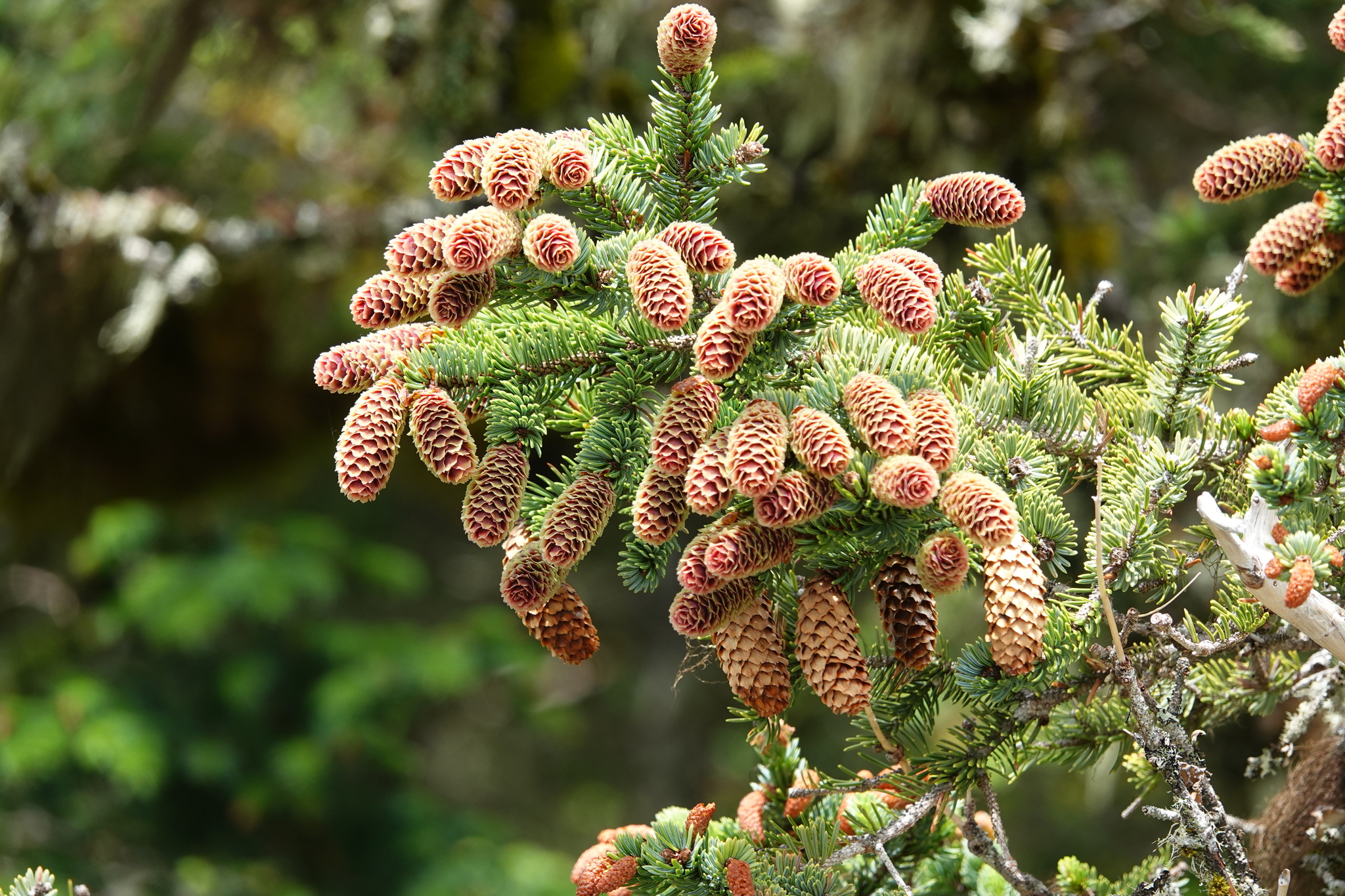
Sitka spruce is a native, long-lived (greater than 800 years), evergreen, monoecious tree [24,55]. Female strobili are produced at the ends of primary branches near the top, while the male strobili are positioned lower in the tree on secondary branches [24].

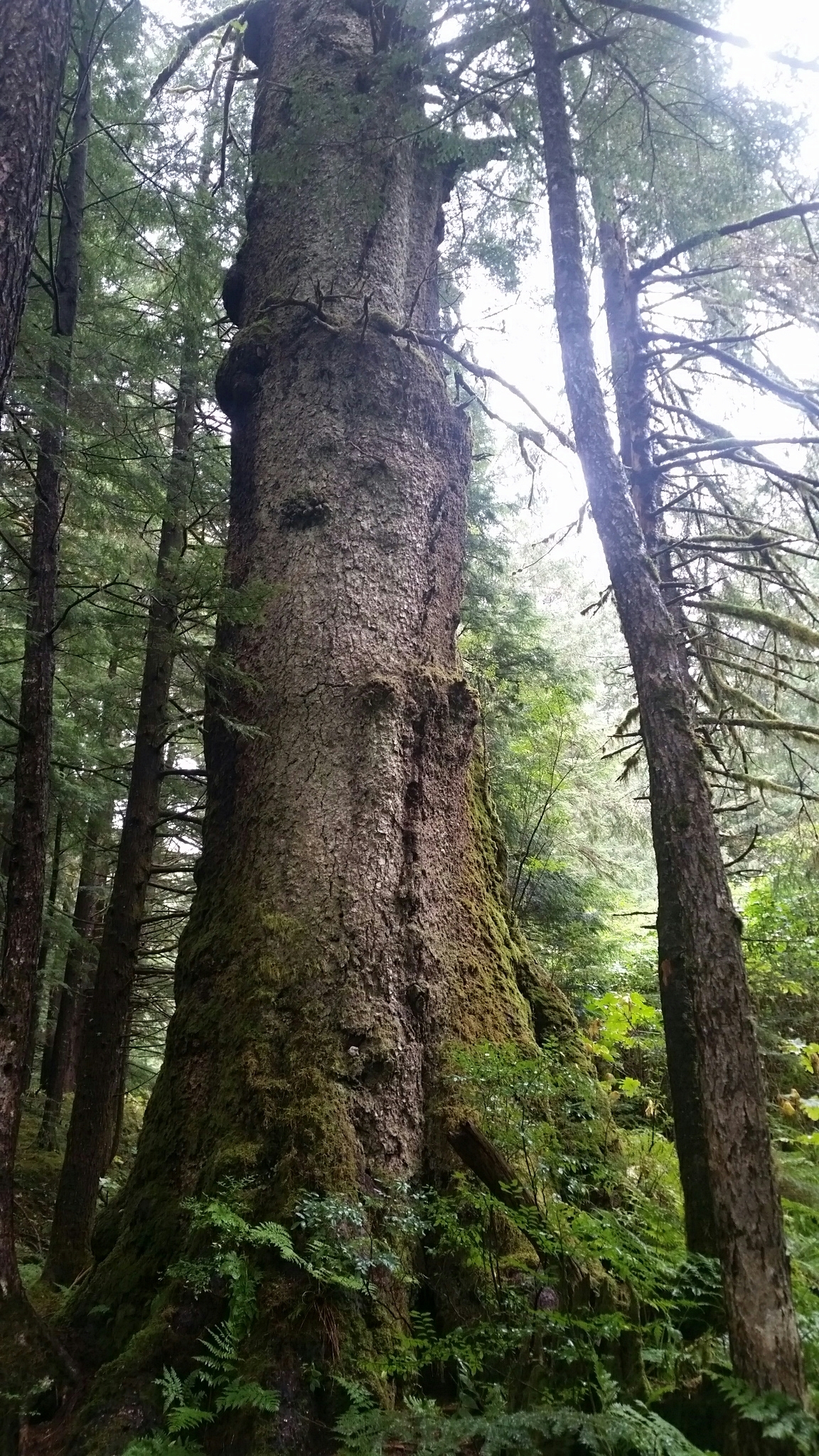
Sitka spruce, Ketchikan, AK.
Sitka spruce is the world's largest spruce. It can obtain heights of greater than 210 feet (65 m) with a d.b.h. of 16 feet (5 m) on better sites [24]. The base of the bole is buttressed [55]. When forest grown the bole is long and free of lower limbs [23].
The root system of Sitka spruce is shallow and platelike with long lateral roots with few branchings. On deep well-drained soils the root system may reach depths of 6.5 feet (2 m), especially on alluvial soils. Root grafting often occurs between roots of the same tree and adjacent trees [22,24].
Raunkiaer Life Form (Raunkiaer 1934)
- Phanerophyte
Seasonal Development
Flowering and seed dispersal dates for Sitka spruce in Alaska and Oregon are as follows [22,50]:
| State | Flowering | Fruit ripens | Seed dispersal |
|---|---|---|---|
| Alaska | April to June | late August to mid-September | starts in October |
| Oregon | May | August | October to spring |
Seed dispersal is moisture-dependent; when the ripe cones dry dispersal begins. The majority (73 percent) of seed are dispersed in the first 6 weeks; the remainder are released over the next year [22].
Regeneration Processes

Sitka spruce cones, Kodiak Island County, AK.
Sitka spruce reproduces both sexually and asexually. Sexual maturity varies from 20 to 40 years. Dispersal of seeds is moisture dependent; when the ripe cones dry the seed is dispersed, and when the cones become wet again they close. To avoid loss of seed, cones should be collected soon after ripening [50]. The seeds are small with a mean of 210,000 cleaned seeds per pound (467,000/kg) [24]. The germination rate is 54 percent, but this can be raised to 66 percent by moistening the germination medium with a 0.2 percent potassium nitrate (KNO3) solution [50].
Germination is epigeal. Sitka spruce seed will germinate on almost any substrate, although mineral soil or a mixture of mineral soil and organic soil are considered the best seedbeds [24]. The "nurse log syndrome" has a key role in the regeneration of Sitka spruce in its wetter environs [12,15,20]. Germination and seedling survival are greater on rotting logs then on the forest floor. In a germination study less than 1 percent of the seeds in a moss mat germinated, and of these 38 percent were killed within a month by fungi [21]. Nurse log syndrome results in a "colonnade" where there are several trees in a row with the roots supporting the bole in mid-air after the nurse log has rotted away [5].
Seedling establishment and growth can be enhanced with the inoculation of the mycorrhizal fungi, Thelephora terrestris [10,40].
Sitka spruce shows strong trends in hardiness and growth in relation to geographic origination. These trends can be used to increase growth rate, but they can also have adverse effects on survival [22,38]. Lester and others [38] provide information on seed sources, outplanting results, hardiness, and growth rate trends.
Sitka spruce reproduces asexually by layering. This usually takes place in moist areas or at timberline [22,24,31,55]. Cuttings from current year's growth root more readily than older branches [24].
Successional Status
Sitka spruce is a shade-intolerant species [33] that is both a pioneer and a climax species [22]. Sitka spruce acts as an early pioneer on the undeveloped soils of landslides, sand dunes, uplifted beaches, and deglaciated terrain; it is a climax species in the coastal forests [22].
Immediate Fire Effects
The immediate effect of a cool to hot fire is damage to the cambium layer, usually resulting in death of the tree [5,8].
Postfire Regeneration Strategy (Stickney 1989)
- Secondary colonizer - offsite seed
Fire Adaptations
Fire is not an important factor in the ecology of Sitka spruce [1]. Its thin bark and a shallow root system make it very susceptible to fire damage [5,8]. Sitka spruce forests have a fire regime of long-interval (150 to 350+ years) severe crown or surface fires which result in total stand replacement [44].
Plant Response to Fire
Sitka spruce will invade a burned site via wind-dispersed seed from adjacent unburned forests [49]. Wind-dispersed seed travels 33 to 880 yards (30-792 m) from the parent tree [24].
Fire Regimes
For fire regime information, search FEIS for this species by entering the species name on the Advanced Search page and selecting “Fire Regime” as the publication type.
Fire Management Considerations
Arguments for and against slash burning in spruce forests recur throughout the literature. The strategy chosen will yield different results, depending on latitude.
In the northern portion of Sitka spruce's range broadcast burning will favor Sitka spruce over western hemlock, but unless Sitka spruce is planted, seedling establishment will be delayed until the next seed crop [14,26,48,49]. Ruth and Harris [49] list the advantages of slash burning as follows:
- Reduces fire hazard
- Destroys advance regeneration*
- Changes timber type
* This can have both positive and negative ramifications. It reduces competition with western hemlock, but growth of Sitka spruce seedlings in one study was reduced [14].
In the southern portion of its range broadcast burning will favor the establishment of Douglas-fir (Pseudotsuga menziesii) mixed forest, while long-term fire exclusion will result in loss of Douglas-fir from the overstory. This is advantageous due to the increased stumpage value of Douglas-fir and the negative impacts of the spruce weevil [44,49].
In the coastal area of Alaska, broadcast burning has been recommended to reduce the negative aesthetic value of large quantities of slash from clearcut old-growth Sitka spruce forests [53].
However, removal of the slash by burning in Sitka spruce forests is not required because of the to rapid decay in that moist environment [48]. Burning is not recommended on steep slopes and where water quality may be degraded [48,53].
Federal Status
No special status.
Other Status
No entry.
Importance to Wildlife and Livestock
Sitka spruce forests in various phases of succession provide habitat, in many cases critical habitat, for a large variety of mammals, game and nongame birds, reptiles, and amphibians [7,19,43]. Its value as a browse species for large ungulates is poor [11], while it has fair to good value for some game birds [42].
Palatability and Nutritional Value
Sitka spruce is slightly palatable to large ungulates. It is browsed only in the spring, and then only the new growth [5,11]. In Alaska and British Columbia the needles comprise up to 90 percent of the winter diet of blue grouse [42].
Cover Value
Sitka spruce forests provide hiding and thermal cover for a large variety of mammals. Old-growth Sitka spruce forests in Alaska and British Columbia are critical winter habitat for the Sitka deer. Old growth provides thermal cover and acts as a snow screen, allowing easier access to browse species [25,51]. Sitka deer require large blocks of old growth from sea level to the alpine and subalpine environments for migrational movements from summer to winter range [51]. Sitka spruce forests also provide habitat for Roosevelt elk, woodland caribou [19], Alaskan brown bear, and mountain goat [42].
Sitka spruce provides good nesting and roosting habitat for avifauna [52,56]. Snags and live trees with broken tops provide nesting habitat for primary and secondary cavity nesters [27]. The bald eagle uses primarily (greater than 90 percent) Sitka spruce for nesting trees on Admiralty Island [42], and also uses them as roosting trees to survey the incoming breakers for food [5]. The peregrine falcon in coastal British Columbia uses Sitka spruce for platform nesting and secondary cavity nesting [9].
Value for Rehabilitation or Restoration of Disturbed Sites
Sitka spruce is a pioneer species which colonizes glacial moraines as the glaciers retreat. On the Juneau Icefield, Sitka spruce has colonized "nunatacks" (rocky peaks) protruding through the icefield [6]. Sitka spruce also acted as an aggressive pioneer on uplifted terrain from the 1964 earthquake [4].
Other Uses
Native Americans have used Sitka spruce for various purposes. The roots can be woven to produce baskets and rain hats. The pitch was used for calking canoes [5], for chewing, and medicinal purposes [47].
Pioneers split Sitka spruce into shakes for roofing and siding [5].
Sitka spruce also has limited food value for humans, for the inner bark and young shoots may be eaten as emergency food. Tea can be made from the young shoots [47].
In the first half of this century Sitka spruce provided most of the wood for structural components of World War I and II aircraft [5,55]. More recently it has been used as the nose cones for missiles and space craft [50].
Sitka spruce is the most important timber species in Alaska [5]. The wood, with its high strength to weight ratio, is valuable for use as turbine blades for wind-driven electrical generators, masts for sail boats, ladders, oars [24], boats, and racing sculls [55]. Sitka spruce's high resonant quality makes it valuable in the manufacture of piano sounding boards and guitars. The wood from Sitka spruce is also used in saw timber, high-grade wood pulp, and plywood [30,55].
Other Management Considerations
Sitka spruce, as one of the most important timber species and components of old-growth habitat, has recently been the center of many management concerns. Proposals for changes in timber harvest areas and methods have been explored by Nyberg and others [43] and Schoen and Kirchhoff [51]. They provide in-depth information and management alternatives.
Wildlife habitat: Even-aged management of the species results in reduced habitat for the black-tailed deer. Shrub fields created after clearcutting are of limited use to deer in the winter. The depth of snow accumulation is greater, and snow persists longer in the clearcuts, reducing the time available for browsing. The forage in clearcuts is less digestible than that grown in the shade of the preharvest stands. Also, the large amount of slash resulting from clearcutting old-growth Sitka spruce impedes movement of large ungulates, especially during winter migration. Lastly, once the regeneration has reached canopy closure (20 to 30 years), the understory production is greatly reduced for at least the next 100 years, compared to old-growth stands with their various stages of regeneration [19,25].
Alaback [2] studied ways to reduce the negative impact of clearcutting on Sitka deer. Thinning the stands prior to canopy closure (less than 25 years) seems to be the best method for areas already cut. Thinning to 12 x 12 feet (3.5 x 3.5 m) spacing results in the most diverse vegetation. Once canopy closure has occurred (greater than 30 years), uneven-aged management practices can result in the creation of gaps in the canopy, which in turn will allow for a more diverse understory [3].
Damaging agents: Sitka spruce is susceptible to Sitka spruce weevil, or white pine weevil (Pissodes strobi)), spruce aphid (Elatobium abietinum), spruce beetle (Dendroctonus rufipennis), and root rot by Armillaria millea and Heterobasidian annosum [24].
The Sitka spruce weevil has such a detrimental effect on Sitka spruce in the lower portion of its range, from southern British Columbia to northern California, that Sitka spruce is not actively managed for regeneration there. The F1 generation of the hybrid, Lutz spruce, yields a tree 100 percent resistant to weevil attack, but growth rate is sacrificed. Back-crossing the F1 generation with Sitka spruce increases the growth rate, but up to 50 percent of the progeny are susceptible to weevil attack [41]. Also, although Lutz spruce is less susceptible to the Sitka spruce weevil, it is more susceptible than Sitka spruce to the spruce beetle [29].
Sitka spruce is susceptible to wind throw, which can account for up to 80 percent of the mortality within stands. Regeneration from gap phase replacement, however, is rapid [15].
Control: Shrub control is often required to regenerate Sitka spruce successfully following harvest [18,36].
Table A1— Forest and range ecosystems, Bureau of Land Management (BLM) physiographic regions, Kuchler plant associations, Society for American Foresters (SAF) forest cover types, and Society for Rangeland Management (SRM) rangeland cover types in which this species occurs.
Forest and Range Ecosystems (Garrison et al. 1977)
- FRES20 Douglas-fir
- FRES23 Fir - spruce
- FRES24 Hemlock - Sitka spruce
- FRES27 Redwood
BLM Physiographic Regions (Bernard and Brown 1977)
- 1 Northern Pacific Border
- 2 Cascade Mountains
- 3 Southern Pacific Border
Kuchler Plant Associations (Kuchler 1964)
- K001 Spruce - cedar - hemlock forest
- K002 Cedar - hemlock - Douglas-fir forest
- K006 Redwood forest
- K029 California mixed evergreen forest
SAF Cover Types (Eyre 1980)
- 221 Red alder
- 222 Black cottonwood - willow
- 223 Sitka spruce
- 224 Western hemlock
- 225 Western hemlock - Sitka spruce
- 227 Western redcedar - western hemlock
- 228 Western redcedar
- 229 Pacific Douglas-fir
- 230 Douglas-fir - western hemlock
- 231 Port-Orford-cedar
- 232 Redwood
SRM Rangeland Cover Types (Shiflet 1994)
- No entry.
1. Alaback, Paul B. 1982. Dynamics of understory biomass in Sitka spruce-western hemlock forests of southeast Alaska. Ecology. 63(6): 1932-1948. [7305]
2. Alaback, Paul B. 1984. Plant succession following logging in the Sitka spruce-western hemlock forests of southeast Alaska. Gen. Tech. Rep. PNW-173. Portland, OR: U.S. Department of Agriculture, Forest Service, Pacific Northwest Forest and Range Experiment Station. 26 p. [7849]
3. Alaback, Paul B.; Herman, F. R. 1988. Long-term response of understory vegetation to stand density in Picea-Tsuga forests. Canadian Journal of Forest Research. 18: 1522-1530. [6227]
4. Alden, John N. 1988. Species selection for forest development in Alaska. In: Slaughter, Charles W.; Gasbarro, Tony, eds. Proceedings of the Alaska forest soil productivity workshop: Proceedings of a workshop; 1987 April 28-30; Anchorage, AK. Gen. Tech. Rep. PNW-GTR-219. Portland, OR: U.S. Department of Agriculture, Forest Service, Pacific Northwest Research Station: 110-120. [5584]
5. Arno, Stephen F.; Hammerly, Ramona P. 1977. Northwest trees. Seattle, WA: The Mountaineers. 222 p. [4208]
6. Arno, Stephen F.; Hammerly, Ramona P. 1984. Timberline: Mountain and arctic forest frontiers. Seattle, WA: The Mountaineers. 304 p. [339]
7. Bernard, Stephen R.; Brown, Kenneth F. 1977. Distribution of mammals, reptiles, and amphibians by BLM physiographic regions and A.W. Kuchler's associations for the eleven western states. Tech. Note 301. Denver, CO: U.S. Department of the Interior, Bureau of Land Management. 169 p. [434]
8. Brown, Arthur A.; Davis, Kenneth P. 1973. Forest fire control and use. 2nd ed. New York: McGraw-Hill. 686 p. [15993]
9. Campbell, R. Wayne; Paul, Marilyn A.; Rodway, Michael S.; Carter, Harry R. 1978. Tree-nesting peregrine falcons in British Columbia. Condor. 79(4): 500-501. [13724]
10. Coutts, M. P.; Nicoll, B. C. 1990. Growth and survival of shoots, roots, and mycorrhizal mycelium in clonal Sitka spruce during the first growing season after planting. Canadian Journal of Forestry Research. 20: 861-868. [12095]
11. Cowan, Ian McTaggart. 1945. The ecological relationships of the food of the Columbian black-tailed deer, Odocoileus hemionus columbianus (Richardson), in the c. forest region southern Vancouver Island, British Columbia. Ecological Monographs. 15(2): 110-139. [16006]
12. Deal, Robert L.; Oliver, Chadwick Dearing; Bormann, Bernard T. 1991. Reconstruction of mixed hemlock-spruce stands in coastal southeast Alaska. Canadian Journal of Forest Research. 21: 643-654. [14673]
13. Eyre, F. H., ed. 1980. Forest cover types of the United States and Canada. Washington, DC: Society of American Foresters. 148 p. [905]
14. Feller, M. C. 1982. The ecological effects of slashburning with particular reference to British Columbia: a literature review. Victoria, BC: Ministry of Forests. 60 p. [10470]
15. Franklin, Jerry F. 1988. Pacific Northwest forests. In: Barbour, Michael G.; Billings, William Dwight, eds. North American terrestrial vegetation. Cambridge; New York: Cambridge University Press: 103-130. [13879]
16. Franklin, Jerry F.; Dyrness, C. T. 1973. Natural vegetation of Oregon and Washington. Gen. Tech. Rep. PNW-8. Portland, OR: U.S. Department of Agriculture, Forest Service, Pacific Northwest Forest and Range Experiment Station. 417 p. [961]
17. Garrison, George A.; Bjugstad, Ardell J.; Duncan, Don A.; [and others]. 1977. Vegetation and environmental features of forest and range ecosystems. Agric. Handb. 475. Washington, DC: U.S. Department of Agriculture, Forest Service. 68 p. [998]
18. Gratkowski, H. 1977. Site preparation and conifer release in Pacific Northwest forests. In: Proceedings, 27th annual weed conference; [Date of conference unknown]; Yakima, WA. [Place of publication unknown]. [Publisher unknown]. 29-32. [17160]
19. Hanley, Thomas A.; Robbins, Charles T.; Spalinger, Donald E. 1989. Forest habitats and the nutritional ecology of Sitka black-tailed deer: a research synthesis with implications for forest management. Gen. Tech. Rep. PNW-GTR-230. Portland, OR: U.S. Department of Agriculture, Forest Service, Pacific Northwest Research Station. 52 p. [7509]
20. Harmon, Mark E. 1989. Retention of needles and seeds on logs in Picea sitchensis - Tsuga heterophylla forests of coastal Oregon and Washington. Canadian Journal of Botany. 67: 1833-1837. [7984]
21. Harmon, Mark E.; Franklin, Jerry F. 1989. Tree seedlings on logs in Picea-Tsuga forests of Oregon and Washington. Ecology. 70(1): 48-59. [13082]
22. Harris, A. S. 1966. Effects of slash burning on conifer regeneration in southeast Alaska. Research Note NOR-18. Juneau, AK: U.S. Department of Agriculture, Forest Service, Northern Forest Experiment Station. 6 p. [7304]
23. Harris, A. S. 1978. Distribution, genetics, and silvical characteristics of Sitka spruce. In: Proceedings, IUFRO Joint Meeting Workshop Parties; [Date of conference unknown]; Vancouver, BC. Volume 1. Victoria, BC: BC Ministry of Forestry, Information Service Branch: 95-122. [7785]
24. Harris, A. S. 1990. Picea sitchensis (Bong.) Carr. Sitka spruce. In: Burns, Russell M.; Honkala, Barbara H., technical coordinators. Silvics of North America. Volume 1. Conifers. Agric. Handb. 654. Washington, DC: U.S. Department of Agriculture, Forest Service: 260-267. [13389]
25. Harris, John. 1983. Wildlife on managed forested lands. In: O'Loughlin, Jennifer; Pfister, Robert D., eds. Management of second-growth forests: The state of knowledge and research needs: Proceedings of a symposium; 1982 May 14; Missoula, MT. Missoula, MT: University of Montana, School of Forestry, Montana Forest and Conservation Experiment Station: 209-221. [7102]
26. Hawkes, B. C.; Feller, M. C.; Meehan, D. 1990. Site preparation: fire. In: Lavender, D. P.; Parish, R.; Johnson, C. M.; [and others], eds. Regenerating British Columbia's forests. Vancouver, BC: University of British Columbia Press: 131-149. [10712]
27. Hemstrom, Miles A.; Logan, Sheila E. 1986. Plant association and management guide: Siuslaw National Forest. R6-Ecol 220-1986a. Portland, OR: U.S. Department of Agriculture, Forest Service, Pacific Northwest Region. 121 p. [10321]
28. Hitchcock, C. Leo; Cronquist, Arthur. 1973. Flora of the Pacific Northwest. Seattle, WA: University of Washington Press. 730 p. [1168]
29. Holsten, Edward H; Werner, Richard A. 1990. Comparison of white, Sitka, and Lutz spruce and hosts of the spruce beetle in Alaska. Canadian Journal of Forestry Research. 20: 292-297. [11042]
30. Hosie, R. C. 1969. Native trees of Canada. 7th ed. Ottawa, ON: Canadian Forestry Service, Department of Fisheries and Forestry. 380 p. [3375]
31. Hulten, Eric. 1968. Flora of Alaska and neighboring territories. Stanford, CA: Stanford University Press. 1008 p. [13403]
32. Klinka, K.; Feller, M. C.; Green, R. N.; [and others]. 1990. Ecological principles: applications. In: Lavender, D. P.; Parish, R.; Johnson, C. M.; [and others], eds. Regenerating British Columbia's forests. Vancouver, BC: University of British Columbia Press: 55-72. [10710]
33. Klinka, K.; Krajina, V. J.; Ceska, A.; Scagel, A. M. 1989. Indicator plants of coastal British Columbia. Vancouver, BC: University of British Columbia Press. 288 p. [10703]
34. Krajina, V. J.; Klinka, K.; Worrall, J. 1982. Distribution and ecological characteristics of trees and shrubs of British Columbia. Vancouver, BC: University of British Columbia, Department of Botany and Faculty of Forestry. 131 p. [6728]
35. Kruckeberg, A. R. 1982. Gardening with native plants of the Pacific Northwest. Seattle: University of Washington Press. 252 p. [9980]
36. Krygier, James T.; Ruth, Robert H. 1961. Effects of herbicides on salmonberry and on Sitka spruce and western hemlock seedlings. Weeds. 9(3): 416-422. [6608]
37. Kuchler, A. W. 1964. Manual to accompany the map of potential vegetation of the conterminous United States. Special Publication No. 36. New York: American Geographical Society. 77 p. [1384]
38. Lester, D. T.; Ying, C. C.; Konishi, J. D. 1990. Genetic control and improvement of planting stock. In: Lavender, D. P.; Parish, R.; Johnson, C. M.; [and others], eds. Regenerating British Columbia's Forests. Vancouver, BC: University of British Columbia Press: 180-192. [10715]
39. Lyon, L. Jack; Stickney, Peter F. 1976. Early vegetal succession following large northern Rocky Mountain wildfires. In: Proceedings, Tall Timbers fire ecology conference and Intermountain Fire Research Council fire and land management symposium; 1974 October 8-10; Missoula, MT. No. 14. Tallahassee, FL: Tall Timbers Research Station: 355-373. [1496]
40. Minore, Don. 1979. Comparative autecological characteristics of northwestern tree species--a literature review. Gen. Tech. Rep. PNW-87. Portland, OR: U.S. Department of Agriculture, Forest Service, Pacific Northwest Forest and Range Experiment Station. 72 p. [1659]
41. Mitchell, Russel G.; Wright, Kenneth H.; Johnson, Norman E. 1990. Damage by the Sitka spruce weevil (Pissodes strobi) and growth patterns for 10 spruce species & hybrids over 26 years in the Pacific Northwest. Res. Pap. PNW-RP-434. Portland, OR: U.S. Department of Agriculture, Forest Service, Pacific Northwest Research Station. 12 p. [15127]
42. Meehan, William R. 1974. The forest ecosystem of southeast Alaska: 4. Wildlife habitats. Gen. Tech. Rep. PNW-16. Portland, OR: U.S. Department of Agriculture, Forest Service, Pacific Northwest Forest and Range Experiment Station. 32 p. [13479]
43. Nyberg, J. Brian; McNay R, Scott; Kirchoff, Matthew D.; [and others]. 1989. Integrated management of timber and deer: coastal forests of British Columbia and Alaska. Gen. Tech. Rep. PNW-GTR-226. Ogden, UT: U.S. Department of Agriculture, Forest Service, Pacific Northwest Research Station. 65 p. [7468]
44. Parminter, John. 1991. Fire history and effects on vegetation in three biogeoclimatic zones of British Columbia. In: Nodvin, Stephen C.; Waldrop, Thomas A., eds. Fire and the environment: ecological and cultural perspectives: Proceedings of an international symposium; 1990 March 20-24; Knoxville, TN. Gen. Tech. Rep. SE-69. Asheville, NC: U.S. Department of Agriculture, Forest Service, Southeastern Forest Experiment Station: 263-272. [16651]
45. Raunkiaer, C. 1934. The life forms of plants and statistical plant geography. Oxford: Clarendon Press. 632 p. [2843]
46. Reynolds, Keith M. 1990. Preliminary classification of forest vegetation of the Kenai Peninsula, Alaska. Res. Pap. PNW-RP-424. Portland, OR: U.S. Department of Agriculture, Forest Service, Pacific Northwest Research Station. 67 p. [14581]
47. Robuck, O. Wayne. 1985. The common plants of the muskegs of southeast Alaska. Miscellaneous Publication/July 1985. Portland, OR: U.S. Department of Agriculture, Forest Service, Pacific Northwest Forest and Range Experiment Station. 131 p. [11556]
48. Ruth, Robert H. 1974. Regeneration and growth of west-side mixed conifers. In: Camer, Owen P., ed. Environmental effects of forest residues in the Pacific Northwest: A state-of-knowledge compendium. Gen. Tech. Rep. PNW-24. Portland, OR: U.S. Department of Agriculture, Forest Service, Pacific NorthwestForest and Range Experiment Station: K-1 to K-21. [6381]
49. Ruth, Robert H.; Harris, A. S. 1975. Forest residues in hemlock-spruce forests of the Pacific Northwest and Alaska--a state-of-knowledge review w. recommendations for residue mgmt. Gen. Tech. Rep. PNW-39. Portland, OR: U.S. Department of Agriculture, Forest Service, Pacific Northwest Forest and Range Experiment Station. 52 p. [15125]
50. Safford, L. O. 1974. Picea A. Dietr. spruce. In: Schopmeyer, C. S., ed. Seeds of woody plants in the United States. Agric. Handb. 450. Washington, DC: U.S. Department of Agriculture, Forest Service: 587-597. [7728]
51. Schoen, John W.; Kirchhoff, Matthew D. 1990. Seasonal habitat use by Sitka black-tailed deer on Admiralty Island, Alaska. Journal of Wildlife Management. 54(3): 371-378. [11940]
52. Smith, Kimberly G. 1980. Nongame birds of the Rocky Mountain spruce-fir forests and their management. In: DeGraaf, Richard M., technical coordinator. Management of western forests and grasslands for nongame birds: Workshop proceedings; 1980 February 11-14; Salt Lake City, UT. Gen. Tech. Rep. INT-86. Ogden, UT: U.S. Department of Agriculture, Forest Service, Intermountain Forest and Range Experiment Station: 258-279. [17910]
53. Stednick, John D.; Tripp, Larry N.; McDonald, Robert J. 1982. Slash burning effects on soil and water chemistry in southeastern Alaska. Journal of Soil and Water Conservation. 37(2): 126-128. [8606]
54. U.S. Department of Agriculture, Soil Conservation Service. 1982. National list of scientific plant names. Vol. 1. List of plant names. SCS-TP-159. Washington, DC. 416 p. [11573]
55. Viereck, Leslie A.; Little, Elbert L., Jr. 1972. Alaska trees and shrubs. Agric. Handb. 410. Washington, DC: U.S. Department of Agriculture, Forest Service. 265 p. [6884]
56. Wiens, John A. 1975. Avian communities, energetics, and functions in coniferous forest habitats. In: Smith, Dixie R, technical coordinator. Proceedings of the symposium on management of forest and range habitats for nongame birds; 1975 May 6-9; Tucson, AZ. Gen. Tech. Rep. WO-1. Washington, DC: U.S. Department of Agriculture, Forest Service: 226-265. [17773]
57. Worrell, R.; Malcolm, D. C. 1990. Productivity of Sitka spruce in northern Britain. 1. The effects of elevation and climate. Forestry. 63(2): 105-118. [11762]