


Pinus nigra, Austrian pine
Sullivan, Janet. 1993. Pinus nigra, Austrian pine. In: Fire Effects Information System, [Online]. U.S. Department of Agriculture, Forest Service, Rocky Mountain Research Station, Fire Sciences Laboratory (Producer). Available: https://research.fs.usda.gov/feis/species-reviews/pinnig
| Abbreviation | Common Name | Scientific Name | Classification | Status |
|---|---|---|---|---|
| Plants | ||||
| PINNIG | Austrian pine | Pinus nigra | Life Form: Plants/Tree Kingdom: Plantae Class: Conifer Order: Pinales Family: Pinaceae Genus: Pinus | Fed. Protected: No Nativity: Nonnative Invasiveness: Noninvasive |

Taxonomy
The scientific name of Austrian pine is Pinus nigra Arnold [13,21]. The species is genetically diverse. Numerous subspecies, varieties, and forms have been named; there is much controversy as to the correct interpretation of these infrataxa [21]. In general, there are three main groups of Austrian pine races recognized:
- the western group from around Austria, France, and Spain (Austrian and Pyrenees pines),
- the central group (Corsican pine) from Corsica, Italy, and Sicily, and
- the eastern group (Crimean pine) from the Balkans and the Crimea [11,23].
Some natural hybrids with other European pines have been reported. Artificial hybrids have also been created [23].
Synonyms
- No entry.
Other Common Names
Australian pine, Corsican pine, Crimean pine, Pyrenees pine, black pine, European black pine
General Distribution
Austrian pine is native to Europe and Asia. Its range there extends from Spain and Morocco east to eastern Turkey, south to Cypress, and north to northeastern Austria and the Crimea, Russia. In the United States Austrian pine widely planted in northern states in New England, around the Great Lakes, and in the Northwest. It has naturalized in New England and the Great Lakes States [21].
States and Provinces
- United States: CT IL ME MD MA MI MS MO NJ NY OH PA WV
- Canada: AB BC ON PE QC
Site Characteristics

Naturalized Austrian pine on the edge of Lake Erie, Chautauqua County, New York. (CC BY-NC 4.0)
Austrian pine is mainly suited to northern temperate climate zones in the United States; it does not grow well in the southern states [21]. Different provenances (seed sources by geographic area) or varieties are adapted to different soil types: Austrian and Pyrenees pines grow well on a wide range of soil types, Corsican pine grows poorly on limestone-derived soils, and Crimean pine grows well on poorer, limestone-derived soils. Most provenances will also show good growth on podzolic soils. Whatever the soil type, however, the soils need to be deep for good growth [11,21]. Austrian pine grows well on high pH soils in New England. Some provenances exhibit better winter hardiness than others [21].
In Europe, Austrian pine is found at elevations ranging from 820 to 5,910 feet (250-1,800 m) [21].
Plant Communities
In Europe trees usually associated with Austrian pine include Scotch pine (Pinus sylvestris), Swiss mountain pine (P. mugo), Aleppo pine (P. halepinsis), Italian stone pine (P. pinea), and Heldreich pine (P. heldreichii). In the United States where it has become naturalized, Austrian pine may be developing natural associations [21].
Botanical Description

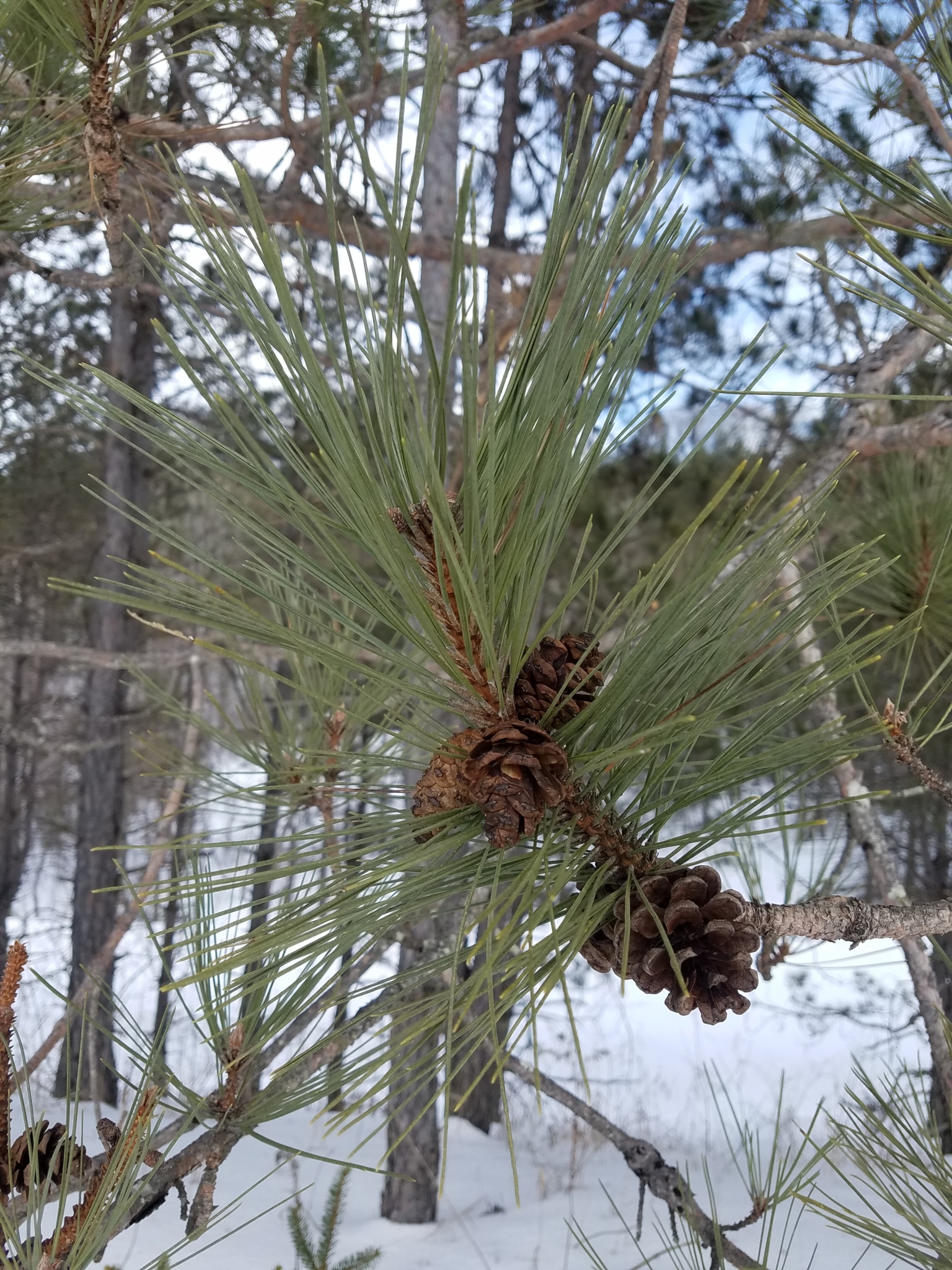
Austrian pine, Windsor County, Vermont. (CC BY-NC-ND 4.0)
Austrian pine is an introduced, medium-sized, two-needle pine [7]. Mature height (approximately 80 years of age [21]) ranges from 66 to 165 feet (20-50 m) [11]. Some characters vary depending on the subspecific taxon; the type variety has dark brown to black bark that is widely split by flaking fissures into scaly plates [14]. The bark becomes increasingly creviced with age [17]. Austrian pine is fast growing and usually has a pyramidal form. It has deep lateral roots. Austrian pine is long lived; harvest rotation times of up to 360 years have been used in Europe [21].
Raunkiaer Life Form (Raunkiaer 1934)
- Phanerophyte
Seasonal Development
In Ontario Austrian pine pollen is released from May to June. Individual ovulate cones are only receptive to pollen for approximately 3 days, but collectively are receptive from May to June. Fertilization takes place 13 months after pollination. Cones mature from September to November and seeds are dispersed from October to November [21].
Regeneration Processes
Austrian pine attains sexual maturity at ages ranging from 15 to 40 years. Trees from Corsican sources in England produce their first heavy seed crops at 25 to 30 years of age, with maximum production at 60 to 90 years of age. Large seed crops are produced at 2- to 5-year intervals [21]. The winged seeds are wind dispersed [11]. Fresh seed does not require stratification for good germination, but stored seeds can be cold stratified for up to 60 days to hasten germination [11].
Austrian pine can be propagated by grafting [21].
Successional Status
Austrian pine is intolerant of shade and needs to be planted in full sun [21,22]. In England direct sowing of Austrian pine seeds is successful on north-facing slopes on young sand dunes [21]. European black pine (Corsican pine) plantations in England develop a more closed canopy than similar-aged plantations of Scotch pine [17].
Immediate Fire Effects
No specific information on the effect of fire on Austrian pine is available in the English language literature.
Postfire Regeneration Strategy (Stickney 1989)
- Tree without adventitious-bud root crown
Fire Adaptations
In Europe, Austrian pine is associated with Scotch pine, a species which is maintained by periodic fire. No information on the fire adaptations of Austrian pine is available in the English language literature.
Plant Response to Fire
No entry.
Fire Regimes
For fire regime information, search FEIS for this species by entering the species name on the Advanced Search page and selecting “Fire Regime” as the publication type.
Fire Management Considerations
No entry.
Federal Status
None
Other Status
None
Importance to Wildlife and Livestock
In Wyoming mule deer that were forced onto a conifer tree nursery by bad weather browsed Austrian pine in preference to ponderosa pine (Pinus ponderosa), blue spruce (Picea pungens), bristlecone pine (Pinus aristata), and Rocky Mountain juniper (Juniperus scopulorum). Damage was concentrated on the lateral branch buds and needles [9].
Palatability and Nutritional Value
White-tailed deer showed intermediate preference for Austrian pine as compared to other ornamental species (including yews [Taxus spp.], other conifers, and various hardwoods) [2].
Cover Value
No entry.
Value for Rehabilitation or Restoration of Disturbed Sites
Austrian pine is recommended for planting on strip-mined lands in Pennsylvania [10]. It has probably not been widely used for surface-mine plantings. Austrian pine is similar to red pine in climatic adaptation and growth performance on acid minesoils. It is recommended for use in Ohio on fine-clay, poorly drained minesoils with a pH of 5 to 7, although suitable native pines are preferred [22]. In Idaho it was reported as having good potential for revegetating sites denuded by heavy metal pollution from smelter emissions [1].
Other Uses
In the United States Austrian pine is mainly planted for shelterbelts, as a street tree, and as an ornamental [21,22]. It is recommended for windbreaks in the Northern Great Plains on medium to deep moist or upland soils [16]. Its value as a street tree is largely due to its resistance to salt spray (used in road de-icing) and various industrial pollutants, and its intermediate drought tolerance [21]. It is resistant to snow and ice damage. In Missouri Austrian pines were undamaged by a sleet storm that caused widespread and extensive damage to many other street trees [4].
One- to three-year-old Austrian pine seedlings were found to have no symptoms of ozone damage after exposure to 0.020 ppm of ozone for 5-hour periods (treatment repeated over one growing season) [5].
The wood of Austrian pine is similar to that of Scotch pine and red pine (Pinus resinosa), which is moderately hard and straight-grained. Austrian pine wood, however, is rougher, softer, and not as strong [21].
In the Mediterranean region Austrian pine wood is used for general construction, fuel, and in other purposes [21].
In the United States Austrian pine is of little importance as a timber species. It is planted mainly for shelterbelts [21].
Other Management Considerations
Most of the Austrian pine planted in the United States is from Austrian sources [21].
Austrian pine seedlings up to about 2 months of age are subject to predation by voles and rabbits; older seedlings apparently become unpalatable [21].
Insects and diseases: Austrian pine seedlings are damaged by damping off fungi and seedling root rots. Mature trees are easily infected by Dithostroma needle blight, the most damaging foliage disease of Austrian pine. Other diseases include Lophodermium needle cast, which is damaging to Austrian pine in the Great Lakes States [21]. Austrian pine is also moderately to highly susceptible to infection by brown spot needle disease [18]. The dagger nematode damages seedlings. Insect damage to Austrian pine is generally of less importance than damage by fungal pathogens [21].
Table A1— Forest and range ecosystems, Bureau of Land Management (BLM) physiographic regions, Kuchler plant associations, Society for American Foresters (SAF) forest cover types, and Society for Rangeland Management (SRM) rangeland cover types in which this species occurs.
Forest and Range Ecosystems (Garrison et al. 1977)
- FRES10 White - red - jack pine
- FRES15 Oak - hickory
- FRES18 Maple - beech - birch
BLM Physiographic Regions (Bernard and Brown 1977)
- No entry.
Kuchler Plant Associations (Kuchler 1964)
- No entry.
SAF Cover Types (Eyre 1980)
- No entry.
SRM Rangeland Cover Types (Shiflet 1994)
- No entry.
1. Carter, Daniel B.; Loewenstein, Howard. 1978. Factors affecting the revegetation of smelter-contaminated soils. Reclamation Review. 1(3/4): 113-119. [22577]
2. Conover, M. R.; Kania, G. S. 1988. Browsing preference of white-tailed deer for different ornamental species. Wildlife Society Bulletin. 16: 175-179. [8933]
3. Critchfield, William B.; Little, Elbert L., Jr. 1966. Geographic distribution of the pines of the world. Misc. Publ. 991. Washington, DC: U.S. Department of Agriculture, Forest Service. 97 p. [20314]
4. Croxton, W. C. 1939. A study of the tolerance of trees to breakage by ice accumulation. Ecology. 20: 71-73. [5993]
5. Davis, D. D.; Umbach, D. M.; Coppolino, J. B. 1981. Susceptibility of tree and shrub species and response of black cherry foliage to ozone. Plant Disease. 65(11): 904-907. [12517]
6. Eyre, F. H., ed. 1980. Forest cover types of the United States and Canada. Washington, DC: Society of American Foresters. 148 p. [905]
7. Fernald, Merritt Lyndon. 1950. Gray's manual of botany. [Corrections supplied by R. C. Rollins]. Portland, OR: Dioscorides Press. 1632 p. (Dudley, Theodore R., gen. ed.; Biosystematics, Floristic & Phylogeny Series; vol. 2). [14935]
8. Garrison, George A.; Bjugstad, Ardell J.; Duncan, Don A.; [and others]. 1977. Vegetation and environmental features of forest and range ecosystems. Agric. Handb. 475. Washington, DC: U.S. Department of Agriculture, Forest Service. 68 p. [998]
9. Hammer, Dennie A. 1989. Deer damage to an Austrian pine tree nursery in Wheatland, Wyoming. In: Bjugstad, Ardell J.; Uresk, Daniel W.; Hamre, R. H., technical coordinators. Proceedings, 9th Great Plains wildlife damage control workshop; 1989 April 17-20; Fort Collins, CO. Gen. Tech. Rep. RM-171. Fort Collins, CO: U.S. Department of Agriculture, Forest Service, Rocky Mountain Forest and Range Experiment Station: 105-108. [9815]
10. Hughes, H. Glenn. 1990. Ecological restoration: fact or fantasy on strip-mined lands in western Pennsylvania?. In: Hughes, H. Glenn; Bonnicksen, Thomas M., eds. Restoration '89: the new management challenge: Proceedings, 1st annual meeting of the Society for Ecological Restoration; 1989 January 16-20; Oakland, CA. Madison, WI: The University of Wisconsin Arboretum, Society for Ecological Restoration: 237-243. [14699]
11. Krugman, Stanley L.; Jenkinson, James L. 1974. Pinaceae--pine family. In: Schopmeyer, C. S., technical coordinator. Seeds of woody plants in the United States. Agric. Handb. 450. Washington, DC: U.S. Department of Agriculture, Forest Service: 598-637. [1380]
12. Kuchler, A. W. 1964. Manual to accompany the map of potential vegetation of the conterminous United States. Special Publication No. 36. New York: American Geographical Society. 77 p. [1384]
13. Little, Elbert L., Jr. 1979. Checklist of United States trees (native and naturalized). Agric. Handb. 541. Washington, DC: U.S. Department of Agriculture, Forest Service. 375 p. [2952]
14. Mitchell, Alan F. 1972. Conifers in the British Isles: A descriptive handbook. Forestry Commission Booklet No. 33. London: Her Majesty's Stationery Office. 322 p. [20571]
15. Raunkiaer, C. 1934. The life forms of plants and statistical plant geography. Oxford: Clarendon Press. 632 p. [2843]
16. Read, Ralph A. 1964. Tree windbreaks for the Central Great Plains. Agric. Handb. 250. Washington, DC: U.S. Department of Agriculture, Forest Service. 68 p. [2897]
17. Rose, C. I. 1979. Observations on the ecology and conservation value of native and introduced tree species. Quarterly Journal of Forestry. 73(4): 219-229. [22219]
18. Skilling, Darroll D.; Nicholls, Thomas H. 1974. Brown spot needle disease-biology and control in Scotch pine plantations. Research Paper NC-109. St. Paul, MN: U.S. Department of Agriculture, Forest Service, North Central Forest Experiment Station. 19 p. [10512]
19. Stickney, Peter F. 1989. Seral origin of species originating in northern Rocky Mountain forests. Unpublished draft on file at: U.S. Department of Agriculture, Forest Service, Intermountain Research Station, Fire Sciences Laboratory, Missoula, MT; RWU 4403 files. 7 p. [20090]
20. U.S. Department of Agriculture, Soil Conservation Service. 1982. National list of scientific plant names. Vol. 1. List of plant names. SCS-TP-159. Washington, DC. 416 p. [11573]
21. Van Haverbeke, David F. 1990. Pinus nigra Arnold European black pine. In: Burns, Russell M.; Honkala, Barbara H., technical coordinators. Silvics of North America. Volume 1. Conifers. Agric. Handb. 654. Washington, DC: U.S. Department of Agriculture, Forest Service: 395-404. [13178]
22. Vogel, Willis G. 1981. A guide for revegetating coal minespoils in the eastern United States. Gen. Tech. Rep. NE-68. Broomall, PA: U.S. Department of Agriculture, Forest Service, Northeastern Forest Experiment Station. 190 p. [15577]
23. Anon. 1979. Pinus nigra nigra. American Nurseryman. 149(12): 34, 36. [22216]