


Pinus strobiformis, southwestern white pine
McKinney, Shawn T. 2025. Pinus strobiformis, southwestern white pine. In: Fire Effects Information System, Online. U.S. Department of Agriculture, Forest Service, Rocky Mountain Research Station, Missoula Fire Sciences Laboratory (Producer). Available: https://research.fs.usda.gov/feis/species-reviews/pinsto
| Abbreviation | Common Name | Scientific Name | Classification | Status |
|---|---|---|---|---|
| Plants | ||||
| PINSTO | southwestern white pine | Pinus strobiformis | Life Form: Plants/Tree Kingdom: Plantae Class: Conifer Order: Pinales Family: Pinaceae Genus: Pinus | Fed. Protected: No Nativity: Native Invasiveness: Noninvasive |
This review summarizes the information available in the scientific literature as of 2025 on the biology, ecology, and effects of fire on southwestern white pine.
Southwestern white pine, a five-needle conifer, is a component of mixed-species forests, rarely dominating stand composition. It occurs in scattered areas in mountainous regions of the southwestern United States but is most common throughout the Sierra Madre Occidental in Mexico, and there is strong evidence that all individuals in the United States are hybrids with limber pine. Southwestern white pine is common between 2,130 to 3,050 m in elevation, and it is usually most abundant between 2,290 and 2,750 m. Its range does not extend to treeline. It occurs on a variety of slope aspects and topographical positions, depending on elevation, and it is commonly found in moist environments.
Southwestern white pine is intermediate in shade tolerance. Regeneration density is low and sporadic relative to associated mixed conifer species. Seedling survival is lower and growth slower at sites with high amounts of understory plant cover, and in open areas that receive high amounts of sunlight. Shaded duff and litter layers significantly enhance seedling survival and growth. Its seeds are relatively large and mostly wingless and are dispersed by a myriad of vertebrate species and wind, although seed dispersal dynamics are not thoroughly understood.
Southwestern white pine is adapted to survive low-severity fire, and it occurs in forests that historically experienced a relatively frequent, low-severity to occasional, mixed-severity fire regime. However, within its range, contemporary wildfires have become larger and more severe than historically. Large fires that replace entire stands pose a significant risk to populations because stands are often isolated, such as in the Sky Islands. An additional pernicious threat is Cronartium ribicola, the invasive fungal pathogen causing white pine blister rust. Infection rates are currently low compared to other North American five-needle species, but possible spread is a significant concern as is the loss of genetically rust resistant trees to wildfire.




Taxonomy
The scientific name of southwestern white pine is Pinus strobiformis Engelm. (Pinaceae) [29,49,58,107,136].
Common names are used throughout this Species Review. See the Appendix for scientific names of plants and animals mentioned in this review.
Hybrids
Southwestern white pine hybridizes with limber pine where the two cooccur in the southwestern United States (see General Distribution), and these populations are sometimes identified as a variety of limber pine (Pinus flexilis var. reflexa) [140] or as a separate species (Pinus reflexa) [3,69]. In this review, “southwestern white pine” refers to populations within the hybrid zone as well as those farther south.
Synonyms
- Pinus ayacahuite C.A. Ehrenb
- Pinus reflexa Engelm. [3,69]
- Pinus flexilis var. reflexa Engelm. [140]
Other Common Names
Arizona white pine, Mexican white pine, border limber pine, border white pine
General Distribution
Southwestern white pine occurs in scattered areas in the mountainous regions of the southwestern United States but is most common throughout the Sierra Madre Occidental in Mexico (fig. 1). There is strong evidence that all of the U.S. distribution is a hybrid zone of genetic admixture of various proportions with limber pine. The relative proportion of genetic ancestry derived from southwestern white pine increases with decreasing latitude such that the southwestern Colorado population has the lowest proportion of southwestern white pine ancestry (0.03 hybrid index), while the west Texas population has the highest proportion (0.99 hybrid index). Populations in Mexico are considered pure southwestern white pine [81,89,102]. For example, Allred et al. (2020) note that most of New Mexico is a zone of genetic mixing between southwestern white pine and limber pine, and that populations to the north are morphologically more like limber pine and those to the south more like southwestern white pine [3] (see Hybrids).

Figure 1—Geographic distribution of southwestern white pine and its hybrids. The area inside the dashed circle approximates the hybrid zone, where populations have varying proportions of genetic ancestry derived from southwestern white pine and limber pine. The four northernmost green shapes are hybrid populations in areas that were previously recognized as limber pine (see also [117]). Inset map of North America shows southwestern white pine distribution within the black square. Original southwestern white pine distribution map (i.e., without the four northernmost populations) is from Little (1971) [80] and was digitized by Thompson et al. (1999) [131].
States and Provinces
- United States: AZ CO NM TX [136]
- Mexico: Chihuahua, Coahuila, Durango, Nuevo Leon, Sonora, Zacatecas [82]
Site Characteristics
Southwestern white pine occurs in montane and subalpine ecosystems. While it is adaptable to a wide range of environmental conditions [11,98], its distribution is shaped by environmental factors, including elevation [11], moisture [98], and temperature [77]. In Mexico, the presence of southwestern white pine is also linked to other factors including aspect and the availability of topographically protected areas [101].
Southwestern white pine prefers moderately developed soils and, depending on elevation, can be found in a variety of aspects and topographical settings [7,98,106].
Southwestern white pine shares environmental traits with Douglas-fir and white fir, thriving in areas with higher fire ignition frequencies, more soil organic matter content, greater soil pH, and finer soil texture compared to lower-elevation pine and oak forests [7].
Elevation and Topography
Southwestern white pine is a common component of mixed-conifer forests at elevations ranging from 2,130 to 3,050 m, and it is usually most abundant between 2,290 and 2,750 meters [82]. It most commonly occurs in relatively high-elevation, moist environments [11,118]. It does not extend to the treeline. Topographic position and aspect occupied by southwestern white pine vary by location and elevation [98,106,142].
In the southwestern United States, southwestern white pine occurs in ponderosa pine-oak forests at around 1,800 m and extends to Engelmann spruce-subalpine fir forests from about 2,700 m to 3,400 m [11,77,82,98]. In the Chiricahua Mountains of southern Arizona, it is most prevalent around 2,700 m on northwest-facing sites with moderately developed soils [118].
In Mexico, southwestern white pine occurs at elevations ranging from 2,200 to 3,600 m (Aguirre-Calderón et al. 2003, cited in [82]), [33] and tends to be more prevalent on northern aspects and in topographically protected areas. In the Sierra Madre Occidental, it is most frequent in sheltered, low-slope locations [101], and on northern aspects and stream banks near El Salto, Durango (Valenzuela Nuñez and Granados Sánchez 2009, cited in [82]). It is present on northern aspects at the highest elevations of 3,300 to 3,600 m on Cerro Potosí, Nuevo León (Aguirre-Calderón et al. 2003, cited in [82]).
Soils
Southwestern white pine thrives in soils that are moderately developed [6,98,106]. Soils are often formed from basalt and other volcanic parent materials, but can also originate from coarse-grained igneous, sedimentary, and metamorphic parent materials (United States Department of Agriculture 1995 and 1987, cited in [81]). Southwestern white pine is also found on sites with loamy soil textures ranging from shallow, gravelly loams to deep, sandy loams to stony silty clay loams [27,42,43,62].
Climate
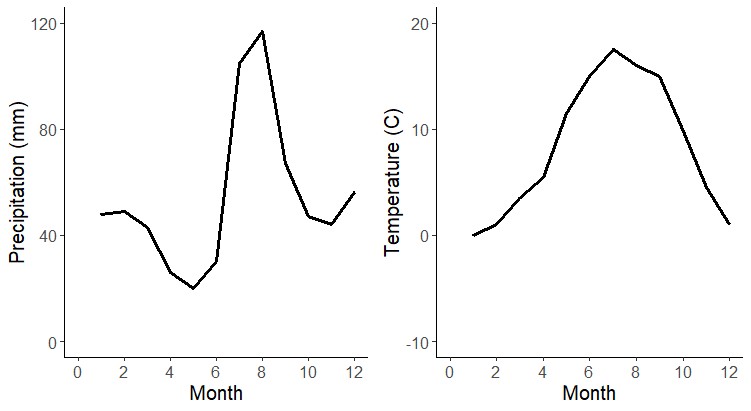
Climate in the American Southwest generally features cold and wet winters along with summer rainfall driven by monsoons [123] (fig. 2). Around 50% of the yearly rainfall happens during the winter months, and this proportion increases from east to west [123]. There are significant dry spells in late spring, early summer, and autumn (fig. 2). Southwestern white pine occurs on sites with a relatively cool and humid climate compared to the broader Southwest, which can be attributed to the relatively high elevations that the pine occupies [81]. Climate data from Arizona and New Mexico indicate a variety of environmental conditions exist across southwestern white pine’s northern range (table 1). Average annual precipitation varied from 456 mm to 916 mm, and average annual temperature ranged from 6.6°C to 13.3°C across southwestern white pine study sites in Arizona and New Mexico [81].

Figure 2—Monthly mean precipitation and temperature from 1981 to 2010 for southwestern white pine U. S. distribution. Data derived from Schoettle et al. (2022) [120].
| Elevation (m) | Aspect (°) | Slope (°) | Precipitation (mm) | Temp max (°C) | Temp min (°C) |
|---|---|---|---|---|---|
| 2608.7 (87.6) | 200 (13.2) | 14.5 (2.0) | 799.2 (154.4) | 14.4 (1.6) | -0.7 (2.8) |
In Arizona's Santa Catalina Mountains, the species reaches its greatest abundance at a mid-point along a moisture gradient [98], closely matching the distribution of white fir. In Arizona and New Mexico, southwestern white pine relative abundance peaks near 2,900 m [77].
Southwestern white pine appears moderately resilient to drought, although it is not as resilient as limber pine [120] or ponderosa pine [82]. Southwestern white pine possesses genetic traits that confer drought tolerance and the species has the flexibility to adapt to hot and dry environments, enhancing its water use efficiency and chances of survival (DaBell, J.A., 2017, cited in [120]), [12]. Drought conditions early in the season are characteristic of habitats where southwestern white pine occurs in the United States. In Durango, Mexico, previous winter and early spring drought were positively correlated with earlywood production; however overall radial growth had a weak association with climate variables likely because of the pine’s affinity for moist environments (Acosta-Hernández et al. 2020, cited in [120]).
Southwestern white pine resistance to high-temperature droughts is primarily seen in mature, established trees [41], whereas young plants may lack water conservation strategies necessary for survival and recruitment [121].
Hybrid Zone
Compared to the closely related and often hybridized partner limber pine, southwestern white pine occupies a more limited ecological niche and is less capable of surviving in extreme cold or at very high elevations [12,82,119,144], (Acosta-Hernández et al. 2020, cited in [120]). The zone where southwestern white pine hybridizes with limber pine correlates with latitude (see General Distribution) and is characterized by a drought gradient that affects the level of hybridization [47,78,89,102]. Broad genetic differences between southwestern white pine and limber pine confer different levels of drought tolerance [94] that appear to be related to ecological niche separation between the species which is related to water availability within the hybrid zone [89].
The hybrid index of southwestern white pine and limber pine (i.e., the proportion of the genotype that is southwestern white pine) is linked to four key metrics related to water availability. In general, this means that within the hybrid zone a greater amount of southwestern white pine genetics is associated with wetter springs, warmer autumns, stronger monsoons, and less annual snow. For example, there was a positive relationship between the hybrid index and relative humidity in spring (r = 0.28), maximum autumn temperature (r = 0.39), and the monsoon index (r = 0.73), and a negative relationship between the hybrid index and annual snowfall (r = -0.61) at sample sites throughout the hybrid zone [89]. Peach et al. (2024) [102] suggest that a higher hybrid index increases a tree's ability to initially resist, recover from, and maintain resilience to changes in growth following the onset of high-temperature drought. These effects are largely additive, suggesting that droughts driven by high temperatures might lead to more pronounced phenotypic changes than droughts defined by low precipitation (i.e., water year-defined droughts) or low atmospheric moisture (i.e., vapor pressure deficit-defined droughts). Variation in drought tolerance aligns with a water-availability gradient within the hybrid zone [90,91,102].
Plant Communities
Southwestern white pine is typically found in mixed stands, although there are occasional reports of stands where it predominates [54,55,81,82,116]. It is seldom the dominant species and is typically found within diverse, mixed-species forests [11,81,98,106,118]. In its northern range, southwestern white pine occurs in Rocky Mountain mixed-conifer environments [116], while in the south, it is associated with a broader diversity of pine and hardwood species [19]. In the United States, it is scattered across the southwestern Sky Islands, where it occurs alongside eight other tree species characteristic of the Rocky Mountains ecoregion, including Douglas-fir, ponderosa pine, limber pine, quaking aspen, white fir, subalpine fir, blue spruce, and Engelman spruce [64,77,81,82]. In southern Arizona, southern New Mexico, and Texas, it is also found with other pine species such as Arizona pine, Chihuahuan pine, Apache pine, and border pinyon [7,98,106]. Below about 2,400 m, it is associated with alligator juniper, Arizona cypress, Arizona madrone, and various oak species [7,98,106,116]. In the Chiricahua Mountains of southeastern Arizona, southwestern white pine is most prevalent in high-elevation, mixed-conifer forests [118]. On north-facing slopes and canyons in western Texas, it is associated with ponderosa pine and oaks (Gambel, silverleaf, and netleaf) [127]. In southwestern Texas and northern Mexico, habitats dominated by southwestern white pine and ponderosa pine are noted for their high tree species diversity [106].
In addition to the pines identified above in its U.S. range, in Mexico, southwestern white pine occurs with several endemic Mexican pine species (Aguirre-Calderón et al. 2003, cited in [82], [19,32,34,35,101] and a variety of hardwood oaks, plums, alders, elms, and madrones [19,32,34,101]. Similar to its U.S. range, Douglas-fir and aspen are noted as associated species (e.g., [19,120]). Co-occurring, shade-tolerant conifers include Chihuahua spruce, Vejar’s fir, and sacred fir [35,59]. Other associated species include Arizona cypress and Mexican cypress, and various juniper species occur in certain areas [19,35]. Like in the United States, southwestern white pine does not typically form pure stands in Mexico.
Southwestern white pine’s canopy position likely varies among plant communities and successional stages [11,81,98], driven by its tolerance of shade that is generally intermediate to that of associated species (see Successional Status). Shade tolerance plays a critical role in forest succession, competition response, and the ability to persist when site conditions change. It is often the most shade-tolerant among the pine species it associates with [19,59,64], but generally intermediate in shade tolerance compared to its other habitat associates. In southern Arizona, it occupies upper canopy layers above Douglas-fir in the Huachuca Mountains [11], whereas it occurs as a lower-canopy species with white fir, Douglas-fir, and ponderosa pine in the Santa Catalina Mountains [98]. On Cerro Potosí, Nuevo León, it typically occupies mid-canopy levels alongside shade-intolerant Hartweg’s pine and shade-tolerant Vejar’s fir (Aguirre-Calderón et al. 2003, cited in [82]).
Botanical Description
This description covers characteristics that may be relevant to fire ecology and is not meant for identification. Identification keys are available (e.g.,[14,49,107]).
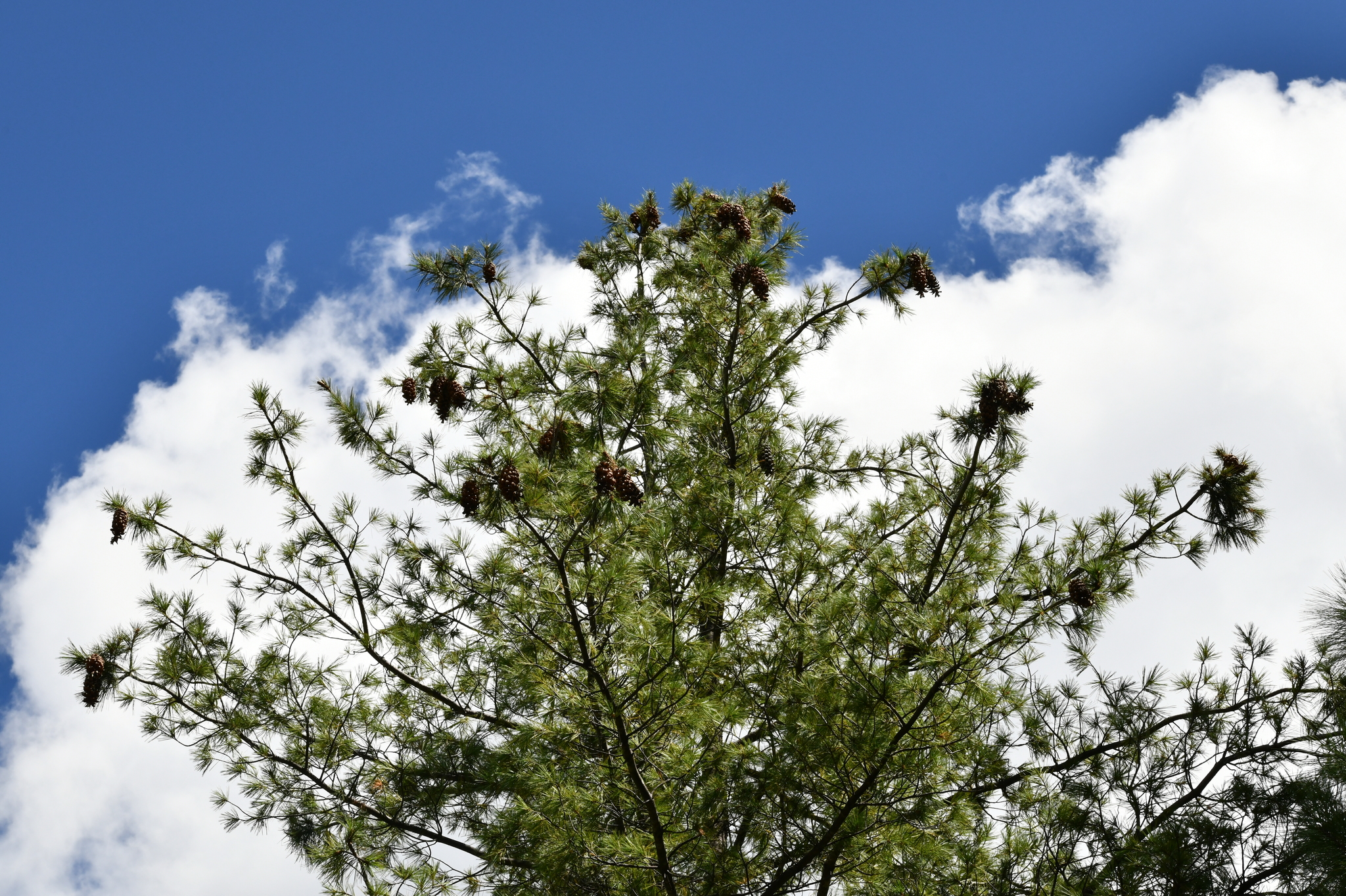
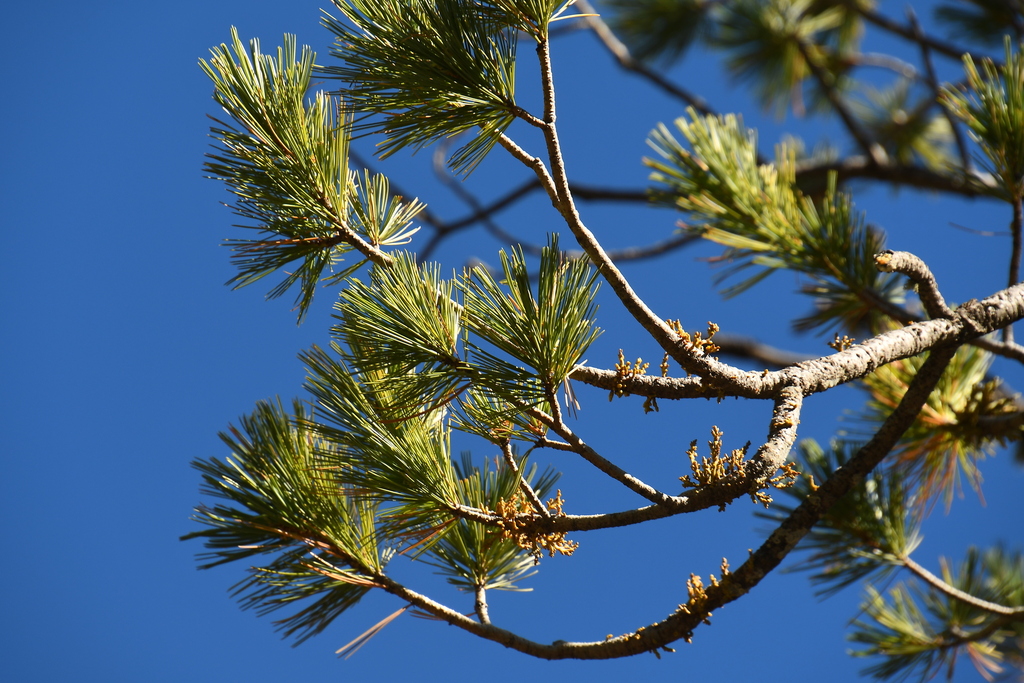
Southwestern white pine is a native, five-needle conifer. Mature trees are characterized by an open and irregularly shaped crown, with heights ranging from 15 to 30 m and trunk diameters from 0.5 to 1.0 m [29,49,69,117]. The trunk is slender and straight [14,29]. The bark is gray and smooth to shallowly fissured when young [3,49,107], and deeply furrowed, with narrow, irregular, scaly ridges as it ages [29,69,117] (fig. 3). Southwestern white pine grows taller and straighter on ‘productive’ sites but tends to be shorter with irregular growth forms on ‘harsher’ sites that are often characterized by wind- or sun-exposed slopes [133].

The branches are long [117] and ascending in the upper portion of the crown [29,49], becoming more horizontal to hanging in the lower portion [49,117]. Its needles are between 6 and 10 cm long [107,117] (fig. 4).

Figure 4—Immature (left photo) and mature (right photo) southwestern white pine trees growing on the Lincoln National Forest, New Mexico (CC BY).
The seed cones are slender or cylindrical, 7 to 25 cm long, with thick, reflexed scales that open when mature to release seeds [14,49,117]. Within a tree, the cones may be upward-pointing, horizontally-oriented, or pendulous [132]. Each cone produces about 65 seeds on average. Seeds are 10 to 12 mm long, weigh from 120 to 160 mg, and usually lack wings [117], although some may have small wings [49]. In the Chiricahua Mountains, mean seed length = 1.26 cm (± 0.02 SE), width = 0.86 cm (± 0.01 SE), and weight = 0.254 g (± 0.005 SE) [108]. Across 15 different sample sites, the average seed mass was 0.201 g (± 0.021 SE) [129].
Raunkiaer Life Form
- Phanerophyte [109]
Stand Structure
Southwestern white pine is typically a component of complex, mixed-species forests and rarely dominates stand composition (reviewed by [81]). It is associated with a variety of tree species (see Plant Communities) on a variety of sites (see Site Characteristics) and stand structure in these forests varies among them. Because shade tolerance in southwestern white pine is generally intermediate to that of associated species (see Successional Status) [64,81,120], its relative abundance and canopy position depend on associated species, as well as site characteristics, and successional stage. Stand structure in these forests has been studied by several authors (e.g., [37,81,111]).
Looney and Waring (2012) studied the structure of southwestern white pine forests in Arizona and New Mexico in 59 plots among five National Forests (Coconino, Apache-Sitgreaves, Coronado, Gila, and Santa Fe) and the Fort Apache Indian Reservation where mean elevation among the plots was 2,609 m (table 1). They found that southwestern white pine tends to occupy lower strata in ponderosa pine-dominated stands, and when it is the canopy dominant in mixed-species stands, it is likely to be replaced by more shade-tolerant competitors, particularly Douglas-fir and white fir. Southwestern white pine occurred with other tree species in 58 of the 59 plots, and it had the greatest mean basal area (10.6 m2/ha) of all species (mean BA of all species = 36 m2/ha) followed closely by Douglas-fir (10.4 m2/ha) and then ponderosa pine (6.7 m2/ha). Douglas-fir had the highest density (400.8 trees/ha) followed by southwestern white pine (269.2 trees/ha), white fir (208.6 trees/ha), and ponderosa pine (115.5 trees/ha) [81].
Estimates of overall stand density and southwestern white pine density increased dramatically from 1879 to 2014 on the Coconino National Forest, Arizona [113]. However, southwestern white pine’s relative abundance (measured as Ecological Importance Value) changed very little over time. Estimated stand densities in 1879 (before fire exclusion) were 139.8 live trees/ha (SE = 17.5) and 10.3 m2/ha basal area (SE = 0.86), and stands were dominated by ponderosa pine followed by Gambel oak. By 2014, estimated tree densities had increased almost ten-fold to 1,116.8 live trees/ha (SE = 185.1) while basal area increased to 42.3 m2/ha (SE = 1.81), and stands were dominated by Douglas-fir, followed by white fir, and then ponderosa pine. In 1879, estimated canopy cover was 14.9% (SE = 3.9) and increased to 55.3% (SE = 2.3) by 2014. Southwestern white pine was a relatively minor component of stand structure in 1879 (Ecological Importance Value (EIV) = 11.2, SE = 9.6), and the prevalence of the species varied among plots. In 2014, southwestern white pine was still a minor component (EIV = 8.7, SE = 4.3), but stands were dominated by shade tolerant species. Southwestern white pine density in 1879 was 3.8 trees/ha (SE = 3.4) and 0.45 m2/ha basal area (SE = 0.15), and in 2014, it was 54.5 trees/ha (SE = 29.1) and 1.65 m2/ha basal area (SE = 0.9) [113].
Variability in stand density is high across sampled stands in Arizona and New Mexico for both southwestern white pine trees exclusively and for all tree species combined. However, relative density and relative abundance values were far less variable, indicating that although absolute stand density can have high spatial variability, southwestern white pine almost always occurs with other species (table 2) [81].
Total stand density of four sites in Chihuahua, Mexico, was similar to sampled stands in the United States, but southwestern white pine relative tree density and relative basal area were both lower in Mexico (table 2). Mean tree height of southwestern white pine in these 4 stands was 7.6 m and mean stand canopy cover was 56.7% [20].
| Location | SWWP (no./ha) | All species (no./ha) | Relative density (%) | Relative basal area (%) |
|---|---|---|---|---|
| San Juan Mts., CO1 | 24.6 | 157.2 | 15.7 | 42.0 |
| San Juan Mts., CO1 | 68.0 | 204.0 | 33.3 | 24.8 |
| Chiricahua Mts., AZ1 | 63.5 | 279.4 | 22.7 | 20.4 |
| Santa Rita Mts., AZ1 | 418.9 | 716.2 | 58.5 | 48.7 |
| Multiple, AZ and NM2 | 269.2 | 1,163.7 | 23.1 | 29.5 |
| Chihuahua, Mexico3 | 70.0 | 687.5 | 12.6 | 14.4 |
| Data extracted from: 1Riser (2003) [111], 2Looney and Waring (2012) [81], and 3Cortes-Montano et al [20]. Sample locations in Looney and Waring (2012) included the Fort Apache Indian Reservation; the Coconino, Apache-Sitgreaves, and Coronado National Forests, Arizona; and the Gila and Santa Fe National Forests, New Mexico. | ||||
Seedling and sapling densities are also highly variable across sampled stands in New Mexico and Arizona, reflecting the general pattern found among western conifers (table 3). Across six mountain ranges in Arizona and New Mexico, southwestern white pine seedlings (individuals <140 cm tall) were present in 85.5% of 55 sampled stands, and saplings (>140 cm tall and <12.75 cm DBH) were present in 83.6% of stands [37]. Seedling densities varied significantly, ranging from 0 to 3,931 per hectare, and sapling densities ranged from 0 to 1,304 per hectare. Southwestern white pine seedling density was significantly correlated with mean annual July through September precipitation, perhaps related to the occurrence of monsoonal rain. Sapling density was significantly correlated with Douglas-fir sapling density, canopy closure, and basal area of live southwestern white pines and Douglas-firs. The relative proportion of southwestern white pine seedlings varied by location, with values ranging from 2.7% in the Sacramento Mountains, New Mexico, to 42.5% on the San Francisco Peaks, Arizona. Similarly, the relative proportion of southwestern white pine saplings varied from 7.1% on Mount Graham, Arizona, to 60.6% on the San Francisco Peaks. Southwestern white pine relative basal area ranged from 16.3% at Signal Peak, New Mexico, to 50.8% on the San Francisco Peaks [37].
| Life stage | Study site | Stem density | Basal area | ||||
|---|---|---|---|---|---|---|---|
| SWWP (no./ha) | All species (no./ha) | Relative abundance (%) | SWWP (m2/ha) | All species (m2/ha) | Relative abundance (%) | ||
| Saplings | CO1 | 11.4 | 100.4 | 11.4 | 1.7 | 18.4 | 9.2 |
| CO2 | 68.0 | 224.0 | 30.4 | 14.9 | 53.6 | 27.8 | |
| AZ1 | 19.0 | 311.1 | 6.1 | 3.6 | 43.0 | 8.4 | |
| AZ2 | 445.9 | 567.6 | 78.6 | 92.6 | 148.5 | 62.4 | |
| Seedlings | CO1 | 1.9 | 41.7 | 4.6 | <0.1 | 0.7 | 0.1 |
| CO2 | 96.0 | 224.0 | 42.9 | 1.1 | 4.1 | 26.8 | |
| AZ1 | 12.7 | 279.4 | 4.5 | <0.2 | 0.2 | 89.3 | |
| AZ2 | 689.2 | 1,108.1 | 62.2 | 4.1 | 13.2 | 31.1 | |
| Data extracted from Riser (2003) [111]. Colorado sites (CO1 and CO2) were in the San Juan Mountains. Arizona site (AZ1) was in the Chiricahua Mountains, and Arizona site (AZ2) was in the Santa Rita Mountains. | |||||||
Seasonal Development
Southwestern white pine flowers in June [92]. Seed cones mature, shed seeds, and fall at the end of the second growing season [49]. Cones mature in September, and seeds are dispersed from September to October [92]. Southwestern white pine seeds germinate either in spring or summer after rain [62].
Regeneration Processes
Southwestern white pine sexually reproduces resulting in relatively large seeds housed in a megagametophyte (seed cone) prior to dispersal. It has relatively low seed output compared to other North American mixed-conifer species [61,62,64]. Seed dispersal is facilitated by multiple dispersal agents, including birds and rodents; however, a precise accounting of the conditions under which specific vertebrate species disperse southwestern white pine seeds is lacking and requires detailed study across the species distribution [82,117]. Cone crops are diminished and seeds are lost due to predation by vertebrates [117].
Research on optimal site conditions for natural regeneration or planting of southwestern white pine is limited. Shaded duff and litter layers significantly enhance survival and growth of naturally occurring southwestern white pine seedlings [12,39].
Pollination and Breeding System
Southwestern white pine, like most conifers, is monoecious, housing both male pollen cones and female seed cones on the same individual (fig. 5). Like all conifers, pollen grains are transported via wind and land on woody seed cones where pollination, and ultimately, fertilization occurs, forming a diploid zygote.

Figure 5—A) Yellow, male cones (Culberson County, Texas (CC BY)) disperse pollen grains by wind that land on B) green, immature female cones (Santa Fe National Forest, New Mexico (CC BY-NC)) where pollination and fertilization take place, leading to the development of a seed embryo housed in C) brown, mature female cones with yellow pitch (Coconino County, Arizona (CC BY-NC)).
Seed Production and Predation
Southwestern white pine begins producing seed cones at about 15 years old [61,92]. Across southwestern white pine stands in New Mexico and Arizona, southwestern white pine trees ≥12.7 cm DBH were generally cone-bearing if growing in relatively open conditions [81]. Seed production varies within and among populations and across years, with seed crops occurring every 3 to 4 years [92]. Generally, fewer seeds are produced in drought years than in years with normal precipitation.
Southwestern white pine has the lowest seed output among six mixed-conifer species studied [63]; however, low seed production is offset by the notable resistance of southwestern white pine seedlings to factors such as frost, native fungal infections, intense sunlight, and possibly browsing damage [8,61,62].
Seed predation can be high, leaving few seeds available for dispersal. For example, only 7% of initial cones remained on trees by late summer in Colorado, with most of the loss attributed to red squirrels [117]. Postdispersal seed predation can also limit the number of seeds available for germination and regeneration, although quantitative estimates are lacking. Food-hoarding mammals, such as chipmunks and mice, are known to harvest seeds, pilfer caches, and also act as secondary seed dispersers, so their ultimate role as seed predator versus seed disperser is unknown [117,138]. Red squirrels harvest entire cones and cache them in middens; however, germination from middens is extremely rare, meaning red squirrels act mostly as seed predators rather than dispersers [53].
While rodents may have some role in seed dispersal, their impact on the regeneration of southwestern white pine appears to be largely detrimental through seed predation. The morphology of southwestern white pine cones—including their large size, often upright orientation, and thick scales—help to minimize seed predation by squirrels, which are common in the pine’s range across the United States [126].
Seed Dispersal
Southwestern white pine seed dispersal involves multiple agents, although a detailed understanding of its seed dispersal dynamics is lacking [82], and information is geographically limited, coming mostly from the northern part of its range [120]. Southwestern white pine cones and seeds tend to decrease in size and weight from north to south [9,78,133] and the seeds have increasingly larger wings southward in Mexico, suggesting a greater reliance on wind dispersal in those populations [74]. Seeds do not typically disperse over long distances, and birds and rodents are the primary animal dispersers, however the specific species involved differ geographically [117,133]. Southwestern white pine trees can occasionally be found growing in clusters, suggesting seedling establishment from a seed cache, particularly in northern populations where Clark’s nutcracker disperses the seeds [117], but it is more commonly observed as a solitary stem in other areas [37].
Clark’s nutcrackers disperse southwestern white pine seeds in the northern part of the range. In these northern populations, southwestern white pine trees produce large seeds with a relatively small wing or lacking wings, which limits wind dispersal [64,83,133]. This seed morphology closely resembles that of whitebark and limber pines, which rely heavily on mutualistic interactions with corvids, particularly Clark’s nutcracker, for seed dispersal [4,75]. Nutcrackers harvest seeds and distribute them over considerable distances (>20 km), often burying them in caches at depths conducive to germination [74,83]. In the San Juan Mountains of southern Colorado and the San Francisco Peaks of Arizona, Clark’s nutcracker is known to gather and disperse seeds from both southwestern white pine and limber pine [9,117]. However, the role of avian dispersal for southwestern white pine seeds in other areas is not well documented. For example, farther south in the core area of the Sky Islands, Clark’s nutcrackers are not residents or reliable dispersers [133]. Samano and Tomback (2003) reported that Steller’s jays harvested and cached southwestern white pine seeds in southern Colorado. They proposed that, despite their lower effectiveness in caching compared to Clark’s nutcracker, Steller’s jays could serve as significant dispersal agents in areas where nutcrackers are not prevalent [117].
In southern populations in Mexico, southwestern white pine seeds are dispersed by gravity and wind, and likely by birds and rodents. In the Sierra del Carmen region of northern Coahuila, Mexico, Mexican jay is a potential seed disperser [10]. Although southwestern white pine serves as an important food source for the endangered thick-billed parrot in the Sierra Madre Occidental, the feeding behavior of this parrot does not seem to facilitate effective seed dispersal [19,76]. Typically, these parrots consume the cones while they remain on the trees and do not cache seeds [76]. During a reintroduction attempt of the thick-billed parrot in the Chiricahua Mountains of southern Arizona, researchers found that the cone pitch (fig. 5) of southwestern white pine was significant enough to deter the parrots from foraging [128].
Southwestern white pine cones ripened synchronously among and within individual trees in north-central Arizona, a ripening phenology often associated with wind dispersal in conifers [9]. However, in the northern part of its range in southwestern Colorado and in the Chiricahua Mountains of southern Arizona, cone opening was asynchronous both within and among individual trees, a pattern associated with seed dispersal by vertebrates [117,133]. The geographic variability in cone opening phenology across the species range could be attributed to the varied dispersal mechanisms. Notably, nutcrackers selecting for traits promoting avian seed dispersal and southwestern white pine evolving traits to limit predispersal seed predation by tree squirrels.
Rodents may aid in seed dispersal for southwestern white pine through secondary seed dispersal [83]. Tomback et al. (2011) found that nocturnal rodents disperse seeds of southwestern white pine in the Chiricahua Mountains of southern Arizona [133]. No information was available on the germination success of southwestern white pine seeds in rodent caches.
Seed Banking
Evidence of soil seed banking in southwestern white pine was not found, nor is it likely to occur given the pine’s large seed size and relatively low seed production.
Germination
Seed germination rates varied widely in a common garden experiment [37], with germination rates in families (i.e., groups of individuals with one or both parents in common and that are more closely related to each other than to other individuals in a population) ranging between 0% and 100%, and germination rates in populations ranging between 27% and 99%. Seeds were collected from 24 sites over a range of 3.53 degrees of latitude, 6.15 degrees of longitude, and an elevation difference of 765 m. A significant positive correlation (r = 0.42) existed between mean family germination rate and mean family seed weight, with heavier seeds having higher germination rates than lighter seeds. Additionally, mean family seed weight was positively correlated (r = 0.42) with mean family seedling height at two months. However, by 6 months, the relationship between seedling height and seed weight became independent (r = 0.19), indicating that other factors may influence seedling growth at that later stage. The average germination rates for populations did not show significant correlations with latitude (r = 0.31), longitude (r = 0.26), or the elevation of seed sources (r = 0.32) [37,73].
Southwestern white pine seeds require 2 weeks to 4 months stratification before germinating [65,92]. Germination rates can vary between 52% and 95% [65,92]. A first period of germination begins in spring and a second period begins later, after summer rains begin [64]. Seed collection and germination methods are discussed in detail in these sources: [50,92].
Seedling Establishment and Mortality
Southwestern white pine seedling establishment and recruitment are highly sensitive to factors such as light, litter moisture, and seedling density [41,121] (fig. 6). Field studies indicate that shaded duff and litter layers significantly enhance the survival and growth of naturally occurring southwestern white pine seedlings [6,12,39,45]. Southwestern white pine seedlings may lack drought tolerance initially [121], but then develop a large taproot, which likely improves drought tolerance [62,64].
Information regarding optimal sites for natural regeneration or planting of southwestern white pine seedlings is lacking [120].

Figure 6—A clump of southwestern white pine seedlings growing in a forest opening on the Lincoln National Forest, New Mexico, could be the result of seed caching from corvids or sciurid animals (CC BY).
Litter cover can enhance survival of established southwestern white pine seedlings by retaining moisture and reducing soil surface temperatures [6,45]. In Sierra Madre Occidental, Durango, Mexico, abundance of southwestern white pine and closely related Mexican white pine seedlings and saplings was positively correlated with the depth of litter and duff combined, overstory basal area, lower slope positions, and the absence of bare mineral soil [101]. Southwestern white pine regeneration in Arizona and New Mexico was positively linked to areas with abundant litter and log cover and negatively associated with bare mineral soil [81]. Additionally, southwestern white pine seedlings had greater growth and survival rates in shaded environments than associated pine species in the Chiricahua Mountains of southern Arizona [6]. Similarly, woody debris acts as nurse objects for limber pine [18] and could do the same for southwestern white pine.
Observations indicate that southwestern white pine can establish and persist in the understory of both xeric mixed-pine and mixed-conifer forests in southern Arizona and southern New Mexico [23,98,118,139], as well as in mixed-conifer forests on the San Francisco Peaks, Arizona [15].
Southwestern white pine seedling abundance was generally low across 59 plots in Arizona and New Mexico, while Douglas-fir and white fir seedlings were most abundant. Abundance of southwestern white pine seedlings was correlated with overstory basal area and type of ground cover present [81]. Seedlings were notably scarce in plots with abundant grasses and forbs, which could be due to interference from these plants or to enhanced browsing by animals attracted to the herbs [61,64]. Quaking aspen and Gambel oak sprouts occurred at extremely high understory densities in some local areas. These sprouts may interfere with southwestern white pine seedling establishment, although they are less likely than conifers to grow into the overstory in the absence of fire [15,31]. In Mexico, conditions under forest overstory at the edge of forest gaps is associated with greater seedling densities than the open conditions within those gaps [84].
Drought tolerance of southwestern white pine seedlings relative to that of associated species varies among plant communities. Drought tolerance of southwestern white pine seedlings was significantly lower than that observed in border pinyon and Chihuahua pine seedlings [8]. In contrast, southwestern white pine seedlings show greater drought resistance than associated spruce and white fir in the White Mountains of eastern Arizona [62,64]. When subjected to drought conditions, the survival rates of southwestern white pine seedlings are comparable to those of ponderosa pine, yet they tend to die at higher soil moisture levels [8].
Southwestern white pine seedling density is usually low relative to other conifer species in mixed species stands in the Southwest, however, low abundance can be offset by high survival [81]. Southwestern white pine seed and seedling survival increases in areas lacking intact rodent populations, such as sites lacking adequate ground cover such as logs and coarse woody debris that favor rodent populations [61]. Seedling survival is also higher in areas lacking high levels of grass, forb, and shrub ground cover; high amounts of ground cover from these life forms is often associated with regenerating clearcuts or partial harvests in the Southwest [64].
Information about survival of planted southwestern white pine seedlings is limited. An experimental planting in a Nebraska plantation found southwestern white pine had high survival rates and exhibited consistent, rapid height growth compared to limber pine. Seventy-two percent of the 159 planted southwestern white pine seedlings survived over the 17-year study period, whereas only 15% of limber pine seedlings survived. Previous establishment and growth trials in Nebraska had poor growth possibly resulting from seed sources that were less suited for Nebraska winters [137]. This suggests that planted southwestern white pine seedlings may thrive—at least in plantations— but further evaluations are necessary to understand their optimum conditions for survival and establish effective management strategies.
Plant Growth and Mortality
Little information is available about growth and mortality of southwestern white pine. One study measured southwestern white pine growth in unharvested stands. In Arizona's White Mountains, the growth rate (i.e., the annual percent increase in basal area) of individual southwestern white pine trees was slower than that of blue spruce, Engelman spruce, and subalpine fir; similar to Douglas-fir, Gambel oak, and white fir; and faster than ponderosa pine. Southwestern white pine mortality rate in these stands appeared to be lower than that of associated species. The cumulative 5-year mortality rate for southwestern white pine was 13%. Nearly all tree deaths were attributed to management activities, though the study did not clarify the nature or reason for these activities in an unharvested stand. Only 1% of the tree deaths were due to lightning, which was the primary natural cause of mortality [42].
Southwestern white pine exhibits a moderate level of shade tolerance, allowing it to regenerate and grow in undisturbed environments and after partial logging operations [40,64,81,120]. However, its height growth is significantly hindered in heavily shaded conditions, specifically when the overstory basal area exceeds approximately 30 m² per hectare [39].
Vegetative Reproduction and Regeneration
Southwestern white pine does not reproduce or regenerate vegetatively.
Successional Status
Southwestern white pine is often the most shade-tolerant among the pine species it associates with [19,59,64], but it has an intermediate level of shade tolerance compared to all associated tree species [19,40,59,64,82,101,120]. According to Jones (1974), it is more shade-tolerant than ponderosa pine or aspen, similar to blue spruce and Douglas-fir, and less tolerant than Engelmann spruce, subalpine fir, and white fir [64]. Southwestern white pine demonstrates that a species’ ability to tolerate shade can influence forest succession, competition dynamics, and potential to thrive [81].
In Mexico, southwestern white pine is considered intermediate in shade tolerance, being less shade-tolerant than Douglas-fir and Vejar fir, yet more tolerant than Montezuma pine [82]. Southwestern white pine dominates the overstory with Durango pine and Douglas-fir in an old-growth forest in the Sierra Madre Occidental, Durango, where oak species are abundant in the understory and the mean fire interval ranges between 6 and 12 years. Southwestern white pine most frequently occupies mid-canopy positions alongside Hartweg’s pine and Vejar fir on Cerro Potosí, Nuevo León (Aguirre-Calderón et al. 2003, cited in [82]). Hartweg’s pine, which is shade intolerant, is less likely to occur in the lower canopy than southwestern white pine, while Vejar fir is more likely [82].
Its classification of shade tolerance relative to its associated species is complicated by its low population density and occurrence in diverse environments [98,118]. As a result, there is ongoing debate about its typical canopy position and precise shade tolerance. Among subalpine five-needled white pines, species like whitebark pine, limber pine, and foxtail pine are generally less tolerant of shade than southwestern white pine and do not persist in old, moist sites [4,25,26].
Immediate Fire Effects

Figure 7—A fire-scarred southwestern white pine tree growing on the Lincoln National Forest, New Mexico (CC BY).
Mature southwestern white pine trees can survive surface fires as evidenced by trees with fire scars, and, although young trees can be killed from low-intensity fire, some survive [24,116]. One study compared a small number of fire scars in southwestern white pines to paired ponderosa pines (n = 6 pairs) and suggested that the two species scar at similar rates [24]. In Guadalupe Mountains National Park, Texas, fire-scarred southwestern white pine were small in diameter when they were first scarred (mean diameter = 10.1 cm with 57% < 10 cm, and 26% < 5 cm diameter) and then survived subsequent and repeated fires [116]. Fire-scarred southwestern white pine has been included in several fire history reconstructions in the Southwest United States and Mexico [46,116,147] (fig. 7).
While available literature does not provide data or analysis on immediate fire effects on southwestern white pine, the Fire and Tree Mortality Database [13] provides data on immediate fire effects on southwestern white pine and other tree species. Of 245 individual southwestern white pines that burned in three fires in Arizona, 74 died and 171 were alive in postfire year 1. Of 90 trees greater than 15 cm DBH, 15 died and 75 were alive in postfire year 1. One of the fires was a prescribed fire that burned in October 2008. The other two were wildfires that burned in May (2011) and June (2014) [13].
Postfire Regeneration Strategy
- Tree without adventitious-buds and without a sprouting root crown
- Secondary colonizer - off-site seed [130]
Fire Adaptations
Mature southwestern white pine trees have deeply furrowed bark [29,69,117] enabling them to survive low-severity surface fire [24,82]. Mature trees have a high incidence (90%) of scarring in some areas [24,82]. Southwestern white pine is not adapted to large, stand-replacing fires because it lacks serotinous cones, does not asexually reproduce, does not regenerate vegetatively, and, although nutcrackers can disperse seeds >20 km, nutcrackers are not found throughout the pine’s range, decreasing the likelihood of colonizing large, burned areas [24,82].
Plant Response to Fire
Regeneration dynamics, response to disturbance, and optimal conditions for seedling establishment and recruitment are not well understood for southwestern white pine and are difficult to ascertain in moderately shade tolerant species in general [39]. Moderately-shade tolerant species are less likely to germinate, establish, and grow in the low light conditions typical of dense, undisturbed forest stands [39]. However, southwestern white pine seedlings can establish in the understory in the absence of disturbance and under intermediate shade conditions following partial harvesting [120], suggesting that light conditions following fires that somewhat open the canopy may support southwestern white pine seedlings. Southwestern white pine seedlings generally grow slowly but grow faster and larger with more light [39], and therefore may establish and grow in the postfire environment, although data are lacking. Seedlings in stands recently managed (<20 years) with silvicultural treatments that reduced overstory canopy density and increased light availability to the forest floor had faster growth, thicker branches, and more upright branching pattern than seedlings in unmanaged stands [39]. The estimated time it would take for a southwestern white pine seedling to reach 140 cm height is 20 years in managed stands compared to 49 years in unmanaged stands [39]. In Mexico, overstory cover along gap edges promotes higher regeneration densities than open conditions within gaps [120].
Southwestern white pine establishment can be episodic in both New Mexico [86] and Arizona [56,100], and establishment increases with the amount of time between historical fires in Arizona [56,100]. For example, there were 34 tree establishment dates across three sites between 1650 and 1900 for southwestern white pine in southern Arizona, and most tree establishment dates occurred on sites that experienced fewer and/or smaller fires. This suggests that recently germinated seedlings require some time to establish fire resistant qualities (thicker bark and higher lowest branches) before being able to survive subsequent fires [56].
Recent (late 20th and early 21st century) large fires in the American Southwest, may pose a particular challenge for southwestern white pine seedling establishment because seeds do not typically disperse over long distances (see Seed Dispersal). The seeds of southwestern white pine are generally large and wingless (or with small wings) and therefore are not readily carried long distances by wind or gravity. Large, wingless seeds are generally seen as adaptations for vertebrate seed dispersal; however, the ranges of southwestern white pine and Clark’s nutcracker (the primary seed dispersal agent in western five-needle pines and other conifers) do not completely overlap with nutcrackers absent from most of the pine’s southern range. Therefore, in areas lacking nutcrackers, southwestern white pine seed dispersal distance, at least initially, may be constrained by the limited effect of wind and gravity; meaning seeds would not be carried far from parent trees growing near the edges of large burns. Small mammals can act as secondary dispersers, but their dispersal distances are also short relative to the size of modern fires.
Southwestern white pine annual growth was negatively related to fire severity— basal growth (mm2/yr) of trees in low-severity plots was greater than that of trees in high-severity plots in southeastern Arizona, where severity was calculated using soil burn severity derived from satellite dNBR (Normalized Burn Ratio) [30]. Basal growth increased in all areas following fire, but the change in growth rate was greater in burned plots compared to unburned plots. Southwestern white pine basal growth in low-severity plots was greater in a drier postfire period (2002–2020) than a wetter prefire period (1983–2001). Its basal growth was also negatively associated with time since fire (i.e., it grew faster soon after fire), and because time since fire can correlate with stand density, this relationship suggests that stand density may be more important to southwestern white pine basal growth than moisture availability [30].
Recruitment density (stems <15 cm DBH in 20 x 50 m plots) 17 years after fire varied widely among plots (from a few seedlings to dense stands of young trees) depending on the ecosystem type and fire severity. In plots classified as ponderosa pine-evergreen oak ecosystem type, southwestern white pine and ponderosa pine were the only species recruiting [30]. In high-severity plots classified as ponderosa pine-evergreen oak type, ponderosa pine comprised most of the recruitment and southwestern white pine comprised a small proportion (max = 12% in one stand). In plots classified as mixed-conifer ecosystem type, southwestern white pine recruitment was absent from high-severity plots and ponderosa pine was the only species recruiting. However, southwestern white pine recruitment occurred in low-severity and unburned plots at varying frequencies along with ponderosa pine, Douglas-fir, and white fir [30].
All individuals (of all tree species) recruiting in the mixed-conifer type and most in the ponderosa pine-evergreen oak type were killed in areas that burned at high severity in a subsequent fire [30]. Mean recruitment survival in areas that burned at low severity in a second fire that burned 17 years after the first was 31% in the ponderosa pine-evergreen oak type and 29% in the mixed conifer type. All previous recruits survived in areas unburned in the second fire [30]. Results for southwestern white pine recruits exclusively were not given.
Fuel Characteristics
The dry mixed-conifer forests that southwestern white pine occupies often reside between lower elevation ponderosa pine dominant forests that are generally fuel limited (i.e., the likelihood of fire spread is limited by a low abundance of fuels) and higher elevation mesic mixed-conifer forest that are often moisture limited (i.e., the likelihood of fire spread is limited by wet fuels) [100]. The type and amount of fuels at a specific location is affected by long-term (decadal scale) variability in climatic patterns and recent (< 20 years) disturbance events (e.g., fire and insect outbreaks) [100]. Grazing by domestic herbivores and fire exclusion have altered the type, magnitude, and distribution of fuels for more than 100 years in southwestern conifer forests [67], leading to higher fuel loading and an increase in ladder fuels [21], and larger more severe fires [100].
Estimates of fuel loads in southwestern white pine forests are limited, although values are likely highly variable given the high variation in factors affecting fuel loads (e.g., recent climate and disturbance history, topographic position, and geographic location) across southwestern white pine forests. In the Thomas Creek Experimental Watershed, Arizona where southwestern white pine occurs, the mean density of dead woody fuel was 65 t/ha and that of forest floor fuels (litter, duff, and humus layers) was 55 t/ha for a total fuel load of 120 t/ha. These estimates are similar to an estimated total fuel loading of 133 t/ha for nine other mixed conifer stands on the Apache-Sitgreaves National Forest in Arizona [24]. Dead woody fuel values can be compared to estimates from ponderosa pine and mixed conifer forests across the southwest. Average dead woody fuel loading of 62 undisturbed southwestern ponderosa pine stands was 54 t/ha, and in 16 mixed-conifer stands it was 108 t/ha [115].
Coarse woody debris (CWD, fallen dead material >7.6 cm diameter) was measured at several sites throughout the range of southwestern white pine. Across 16 study sites in mixed-conifer forests in Arizona and New Mexico, CWD averaged 41.7 Mg/ha [114]. At two sites in the Huachuca Mountains and one site in the Chiricahua Mountains of southeastern Arizona, mean CWD was 25.2 Mg/ha [28]. The same study estimated a mean CWD of 8.2 Mg/ha at two sites in Sonora, Mexico. The authors speculate that the much lower CWD values for Mexican forests is due to differences in fire frequency between the two nations. There has been a significant reduction of widespread and recurring fires in southwestern United States since the late 1880s, which enabled CWD to accumulate, while fire has been more frequent in Sonora, Mexico [28]. Estimates of CWD from four sites in Chihuahua, Mexico and their mean value (15.8 Mg/ha) are also lower than estimates from Arizona and New Mexico, adding further support for the putative effect of differences in fire frequency between the United States and Mexico [20].
In a mixed-conifer forest containing southwestern white pine in east-central Arizona, annual leaf litter accumulation was 0.87 Mg/ha and was seasonally distributed with most litter falling from September to November (64.1%), followed by November to May (23.1%), May to July (7.7%), and July to September (5.1%) [44]. The stand had a mean of 183.3 trees/ha and 47.3 m2/ha basal area (all trees, not just southwestern white pine).
Fire Regimes
The presettlement fire regime of plant communities where southwestern white pine is most common was characterized by frequent fires (<20-year intervals), that were mostly low-severity with some component of mixed-severity fires and/or patches of high-severity within larger fires, and predominately occurred in the spring (i.e., earlywood fire scars). Within the overall high-frequency, low-severity fire regime, variability in site-level fire frequency and fire severity is associated with site characteristics that influence moisture availability, fuel characteristics, and potential fire spread (e.g., elevation, slope, and aspect) [57].
Southwestern white pine rarely occurs in pure stands, and instead grows in mixed-species stands where fire regime characteristics and the relative abundance of community associates reflect site conditions. Fire intervals tend to be longer and the component of high-severity fire greater with increasing site moisture. Mesic sites often occur at higher elevations and on north-facing slopes. On these moister sites, southwestern white pine often occurs with fir, spruce, and Douglas-fir, and fire intervals are longer and higher severity fires more common relative to drier sites. Xeric sites, often found at lower elevations and on southern aspects, are predominately comprised of ponderosa pine and varying amounts of Douglas-fir and oak. These drier sites are characterized by a preponderance of high-frequency, low-severity fires [82].
Fire frequency has been estimated at locations from across much of southwestern white pine’s North American distribution, including in Arizona, New Mexico, and Texas. However, there is not published information on fire frequency in southwestern white pine stands in Colorado. Mean fire interval (MFI) ranged from 3 years to 35 years, with 84% of MFI values less than 20 years, among 11 studies that provided estimates from its U.S. distribution. Among these studies, the earliest fire scar is from 1495, and the latest fire scar was recorded before the end of the 19th century in 10 of the 12 studies, corresponding to the advent of fire exclusion. All of the studies described the sampled habitat as either ponderosa pine, mixed conifer, or often a combination of both (58%), while three studies also included pine-oak as part of their habitat description [82]. In the Chiricahua Mountains, Arizona, the earliest recorded fire scar was from 1685 and the latest from 1994 in mixed-conifer forests containing southwestern white pine where MFI ranged from 8.2 to 16.1 years among nine sites [95].
Two lines of evidence (fire scars and charcoal sediment) from two watersheds in northern New Mexico where southwestern white pine is a stand component indicate a widespread, low-severity fire regime existed for centuries and then abruptly ended near the beginning of the 20th century [2]. Fire scars recorded in the same year among trees broadly distributed in space were interpreted as a widespread, low-severity fire regime. At Chihuahueños Bog, nine widespread fires were recorded between 1624 and 1902, with a mean interval between widespread fire years of 34.8 years. The last recorded fires at the site occurred in 1857 and 1902. Bog sediment records indicate consistent charcoal deposition beginning 8,000 years ago and ending around 1900. The same pattern was evident at nearby Alamo Bog where low severity, widespread surface fires were recorded between 1624 and 1879 at an average frequency of 12.8 years, with 1879 being the last widespread fire year. A 9,000-year bog sediment sample shows consistent charcoal deposition throughout that ends abruptly by the late 1800’s [2].
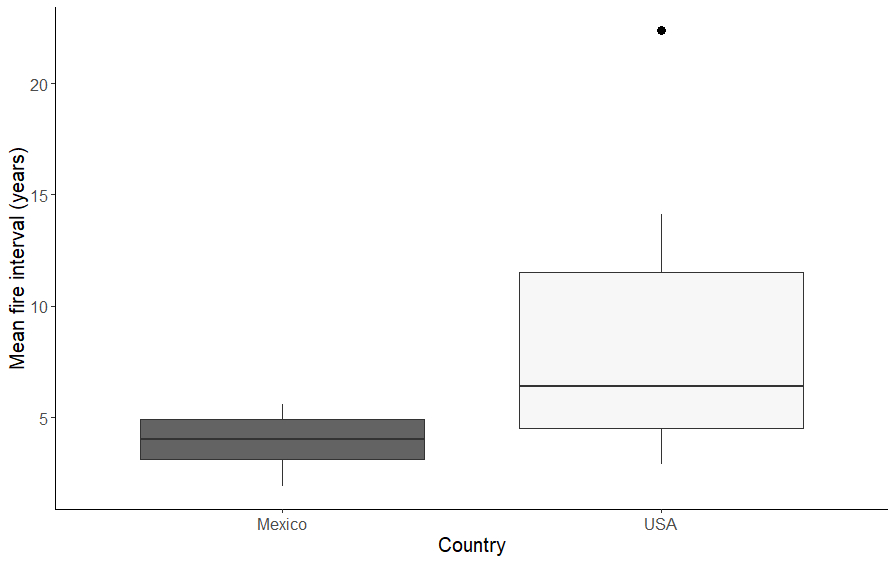
A comparison of the distribution of fire frequency (MFI) values from southwestern white pine forests in the United States and Mexico shows little difference in measures of central tendency, but with broader spread and longer intervals from U.S. forests. Fire history studies of southwestern white pine in the United States had a mean MFI of 6.4 years (min = 2.9, max = 22.2), while those from Mexico had a mean MFI of 4.0 years (min = 1.9, max = 5.6) (fig. 8) [82,105].

Figure 8—Variability of study-level mean fire intervals from fire history studies on southwestern white pine forests in Mexico (n = 9 studies) and in the United States (n = 13 studies). The horizontal line in the middle of each box represents the median value (50th percentile), the ends of the boxes are the first (Q1) and third (Q3) quartiles, which cover the central 50% of the data, and the difference between Q3 and Q1 is the interquartile range (IQR). Vertical lines extend to the most extreme data points that are no more than ± 1.5 x IQR, and the individual outlier beyond the line is displayed as a circle. Data extracted from [82,105].
Southwestern white pine often occurs as a component of multi-species stands that have fire frequency values reflective of the dominant tree species and stand structure. For example, in the Rincon Mountains of Arizona, open stands of southwestern white pine and ponderosa pine with grassy understories record an MFI of about 7 years from 1631 to 1890. This is contrasted with the adjacent mixed-conifer forests containing southwestern white pine that had an MFI of nearly 10 years over a similar period (1748–1886). Although fire frequency was not drastically different between the two habitats, the more mesic mixed-conifer stands had more fire-free periods (>10 years) relative to the more xeric open forest stands [5]. Similarly, overall MFI was shorter (9.5 years) in a landscape characterized by gradual south-facing slopes and comprised of southwestern white pine and ponderosa pine, compared to an adjacent landscape (14.1 years) with steep north-facing slopes and including a large component of white fir and Douglas-fir in the Santa Catalina Mountains of southeastern Arizona [57]. The relationship between site factors and fire frequency is not always pronounced, however. For example, southwestern white pine was associated with three of the five forest types identified in Guadalupe Mountains National Park in Texas, where forest species composition varied with elevation, slope, and aspect, but MFI did not vary spatially. Instead, MFI was ubiquitously short, with an overall MFI of 4 years from 1530 to 1990 [116].
In the San Francisco Peaks, Arizona, following 124 years of fire suppression and exclusion (which began in the 1870’s), tree density and basal area increased in all forest types. Using 1876 as a baseline for reconstructed conditions, shifts in species composition and associated tree density occurred such that mesic species had greater relative abundance and tree density in 2000. Fir, spruce, and limber pine did not occur in ponderosa pine cover types in 1876, but in 2000, all the species except fir occurred there. Limber pine and Douglas-fir became more dominant in mixed-conifer and aspen cover types, as well [15].
Find additional fire regime information for the plant communities in which this species may occur in the United States by entering the species name in FEIS’s Advanced Search page and selecting “Fire Regime” as the publication type.
Fire Management Considerations
Contemporary wildfires in the southwestern United States have become larger and more severe than historically, and this trend is expected to persist [96]. Research by Looney et al. (2015) identified fire as the predominant abiotic threat to southwestern white pine throughout Arizona and New Mexico [104]. Large fires that replace entire stands pose a significant risk to southwestern white pine populations, especially because these trees are often found on isolated sky islands in the region. Such fires have already resulted in the loss of trees that possessed known genetic resistance to white pine blister rust [141] (see Other Management Considerations).
Published literature on the use of prescribed burning in southwestern white pine stands was not found. There is a notable lack of knowledge about southwestern white pine regeneration ecology and response to disturbance, including fire. The ability to design and implement treatments, including prescribed burning, to address threats from white pine blister rust, fire suppression, and climate change is severely limited because of this knowledge gap. Maintaining southwestern white pine trees in the overstory, increasing its regeneration, and reducing competing species are objectives that would sustain southwestern white pine stands, but the conditions under which certain prescriptions would be most effective needs detailed study. These objectives have been reached, however, in the management of whitebark pine and limber pine where prescribed burning has been used to reduce competition, enhance regeneration, and increase the prevalence of rust resistant seedlings [122]. It is plausible, therefore, that prescribed burning in southwestern white pine stands could help achieve these objectives too.
Federal Status
None
Other Status
Southwestern white pine is considered Secure across its range [97].
Importance to Wildlife and Livestock
The mixed-conifer forests where southwestern white pine occurs provide habitat for sensitive, threatened, and endangered species such as Mexican spotted owl, northern goshawk [110], Sacramento Mountain salamander and Jemez Mountains salamander [87], Mount Graham red squirrel [72,145], and Arizona gray squirrel (e.g., [22]).
A myriad of bird and mammal species forage on southwestern white pine seeds, acting as both seed predators (see Seed Production and Predation) and as primary and secondary seed dispersers (see Seed Dispersal). The large, wingless, and nutritious seeds of white pines frequently form the foundation of large trophic networks and promote enhanced biodiversity [68]. Southwestern white pine seeds are an important source of food for many birds and mammals, including corvids, parrots, mice, voles, chipmunks, squirrels, and bears [82,117]. Clark’s nutcrackers and red squirrels are particularly important seed predators and seed dispersers in southwestern white pine’s northern distribution. In the San Juan Mountains, Colorado, nutcrackers were frequently observed dispersing seeds of southwestern white pine in September, whereas nocturnal rodents showed no interest in seed stations (trays of seeds). In contrast, nutcrackers were absent from the Chiricahua Mountains, Arizona, where rodents created 28 southwestern white pine caches over six nights. Of the 28 caches, 11 were buried and contained an average of 2.5 seeds each and were located about 8.7 meters from a seed station, while 17 surface caches held an average of 1.7 seeds each and were approximately 7.2 meters from a seed station. In the Chiricahua Mountains, only deer mice were captured, and were likely responsible for some of the caches. Red squirrels in the San Juan Mountains were very efficient seed predators, cutting down cones for winter storage. In contrast, Chiricahua fox squirrels were less effective at removing seeds and did not store cones [117].
Livestock are not known to use southwestern white pine.
Palatability and Nutritional Value
Southwestern white pine seeds are appealing to granivorous animals due to their large size and high caloric content (see Botanical Description). Unlike those of the other five-needle, large-seeded pines (e.g., limber pine and whitebark pine), southwestern white pine seeds are not retained within cones at maturity [9,134], but instead fall to the forest floor when cones open and where nocturnal rodents and birds can forage for them. Southwestern white pine seedlings are among the least favored by herbivores, second only to spruce species [64].
Cover Value
Southwestern white pine usually occurs in mixed-species stands and is rarely the dominant tree canopy species. Thus, the cover value of southwestern white pine exclusively is difficult to determine, and no specific estimate was found in the literature. However, forest stands containing southwestern white pine have a high diversity of vertebrate species throughout its range and vertebrates use stands for diurnal and nocturnal cover.
In a mixed conifer forest containing southwestern white pine but dominated by ponderosa pine on the Coronado National Forest, Arizona, 16 species of cavity-nesting birds were identified during the breeding seasons of 1984 and 1985 [52]. Only two species—violet-green swallow and northern flicker—declined in abundance following a moderately intense prescribed surface fire that resulted in a 33% decrease in the density of snags preferred for nesting 1 year after the fire. No cavity nesting bird species disappeared from the study area in the first breeding season after the fire. Ponderosas pine represented 94% of all cavity nest tree species and although southwestern white pine was listed as a common stand component, it was not made clear whether birds chose the species to nest in [52].
In the Santa Catalina Mountains, Arizona, red-faced warbler, a ground-nesting bird, selected nest sites that contained large (>23 cm DBH) southwestern white pine trees more frequently than random, non-selected sites [71]. Mixed conifer forests containing southwestern white pine are breeding habitat for red-faced warblers throughout the Sky Islands of southeastern Arizona [36].
In a mixed conifer forest dominated by ponderosa pine and containing southwestern white pine in the Jemez Mountains, New Mexico, four small mammal species were live trapped during a 3-year fire surrogate study: long-tailed vole. Mexican woodrat, deer mouse, and least chipmunk [17]. In the Chiricahua Mountains, Arizona, deer mice were trapped during a seed dispersal study and Chiricahua fox squirrels were observed foraging in southwestern white pine tree canopies [133].
Value for Rehabilitation or Restoration of Disturbed Sites
Southwestern white pine is not used for restoration of disturbed sites.
Other Uses
Southwestern white pine wood is soft, not resinous, and white with a slightly darker heartwood. It is used locally for cabinetry, doors, and window frames [103]. Crooked stems and coarse branches make it undesirable for lumber [64]. Southwestern white pine is grown as an ornamental [135,146] and has good potential for Christmas tree production in the eastern United States [50,146].
Southwestern white pine is planted along streets in urban areas. Its foliage has an intermediate susceptibility to salt spray; medium foliar injury with moderate growth reduction occurred [135].
American Indian uses for southwestern white pine are not described in the Native American Ethnobotany database, but closely related limber pine is described as used for food and medicine [93].
Other Management Considerations
Although the status of southwestern white pine forests is generally considered stable [97], several significant stressors portend future declines, especially Cronartium ribicola, the invasive fungal pathogen that causes the disease white pine blister rust in five-needle pines (fig. 9).

Figure 9—Branch and bole cankers on a southwestern white pine tree in the Sacramento Mountains, New Mexico, infected with Cronartium ribicola, the invasive fungal pathogen that causes white pine blister rust in five-needle pines.
White pine blister rust was first detected in southwestern white pine in the Sacramento Mountains of south-central New Mexico in 1990, with the infection believed to have started around 1975 [48]. The disease subsequently spread throughout New Mexico and reached Arizona, where it was first discovered in 2009; the infections were estimated to have occurred between 1988 and 1995 [16]. As of 2015, occurrences of white pine blister rust in Arizona were confined to the east-central regions, and there had been no reports of the disease in Mexico [104].
Early season drought is common of the habitats where southwestern white pine grows in the southwestern United States. Depending on the patterns of the North American Monsoon, these dry conditions can extend into the autumn months. Research on how southwestern white pine responds to drought in U.S. forests is complicated by the presence of both pure southwestern white pine and hybrids between southwestern white pine and limber pine [89,102]. Available evidence suggests that southwestern white pine has moderate drought tolerance, though it is likely less tolerant than limber pine. Interannual climate variability influences monsoonal patterns [51] which can affect precipitation timing and amount and possibly lead to longer periods of drought [85] that could impact southwestern white pine.
Southwestern white pine has potential to adapt to stressors like white pine blister rust and drought within its current habitat due to its genetic resistance to rust and drought tolerance traits. It possesses both heritable major gene resistance and quantitative resistance to blister rust [60,70]. Initial estimates suggest that the baseline frequency of quantitative resistance is around 10%, which is higher than that of whitebark, limber, and foxtail pines but lower than bristlecone pine [60]. To assess long-term resistance and infection rates, durability trials are established in Arizona and New Mexico, along with an orchard of trees with grafts from trees known to carry major gene resistance [143]. Despite this relatively high resistance to the introduced pathogen, the majority of trees remain highly susceptible, and significant mortality is anticipated as blister rust continues to spread [120].
Southwestern white pine faces several other biotic challenges apart from white pine blister rust, including interspecific competition, mountain pine beetle outbreaks, animal damage, and dwarf mistletoes, primarily Arceuthobium apachecum and A. blumeri in Mexico [120]. These challenges vary in intensity and location. Mountain pine beetles attacked mixed conifer forests following the Wallow Fire (2011) in Arizona, however beetle activity was low and scattered. Five years after fire, only 4% of trees killed by bark beetles were southwestern white pine (mean DBH = 30 cm), and all of these trees occurred in untreated sites (i.e., areas that did not receive thinning and burning fuel treatments prior to the fire) [112]. In northern Arizona, mountain pine beetle attacks were identified as the leading cause and a significant predictor of mortality for southwestern white pine, yet long-term competition was a more reliable predictor of mortality when analyzing past growth patterns [59,66].
Research by Looney et al. (2015) across 59 sites in Arizona and New Mexico found generally healthy populations of southwestern white pine, although localized animal damage—such as girdling by black bears—and dwarf mistletoe were the most prevalent biotic threats [104]. Dwarf mistletoe, which is not uniformly distributed, can lead to local tree mortality in heavily infested areas [88] (fig. 10). Additionally, cone and seed insects can severely affect seed availability, with infestation rates reaching up to 80%, varying significantly by year and location, potentially hindering natural regeneration [79]. With climate warming, these stressors are likely to intensify [120].

Figure 10—A southwestern white pine tree infected with dwarf mistletoe, Pima County, Arizona (CC BY-NC-ND).
Management Under a Changing Climate
Climate models for the southwestern United States predict an increasingly arid climate, which is significant because southwestern white pine is generally found in more humid environments compared to some other high-elevation, five-needle pines. This change in climate may pose challenges to the long-term survival of mature southwestern white pine trees, their reproductive abilities, and the successful establishment of seedlings. Despite these potential challenges, southwestern white pine exhibits heritable traits for drought tolerance and the ability to adapt to warmer and drier conditions, enhancing its water use efficiency and survival chances (DaBell 2017, cited in [120]), [12]. Differentiation in physiological traits among populations was low in well-watered seedlings from isolated populations in Arizona and New Mexico, but population differentiation in physiological traits became more pronounced as seedlings were water stressed in a common garden experiment. These results indicate that populations become more different from one another under stressful, low-water conditions, as some populations harbor traits to cope with stressful conditions while other populations do not and suffer higher rates of mortality [39]. Additionally, differences in drought response among locations indicate that southwestern white pine growth is more constrained by water availability at lower, drier sites than at higher elevations [1].
Increasing size and severity of wildfires is linked to climate warming and is expected to persist in the southwestern United States [96]. In Arizona and New Mexico, fire is identified as the most significant abiotic threat to southwestern white pine populations [104]. Large fires that replace entire stands pose a significant risk to these trees, especially since they often grow in isolated stands in the region, such as in the Sky Islands. Such fires have already killed trees that possessed major gene resistance to white pine blister rust [120]. For example, the 2011 Wallow Fire, the 2014 Signal Fire, and the 2017 Frye Fire were all high-severity fires that resulted in complete loss of overstory trees in southwestern white pine stands [141].
Climate envelope models indicate that much of the southern range in Mexico may become unsuitable for southwestern white pine, although stable habitats are identified throughout its range, with potential expansion areas mainly in the north [124]. Current research is focused on integrating genetic resistance to white pine blister rust, adaptive traits, and statistical models of seed dispersal distances (dispersal kernels) to develop a more comprehensive future distribution model [120]. Findings from a common garden experiment along an elevational gradient in northern Arizona suggest that abruptly moving populations long distances from south to north is unlikely to succeed due to increased variability in fall and spring frost events, which lead to seedling mortality [12]. The process of adaptive introgression between limber pine and southwestern white pine could produce new genotypes and increased genetic diversity, which may enhance the adaptive capacity of hybrid populations [91].
Growth models of mixed-conifer forests dominated by ponderosa pine that burned in the Rodeo-Chediski Fire in Arizona (2002) suggest reduced growth of southwestern white pine. Under the extreme climate change scenario (A2), current forest species, including southwestern white pine, declined after several decades, and species composition shifted toward pinyon and juniper (species not currently present on site) after about 100 years. Under the milder climate change scenario (B1), southwestern white pine persisted in stands but at lower basal area and tree density levels [125]. Modeling successional dynamics of species composition without fire in the Huachuca Mountains, Arizona, suggests that southwestern white pine, along with Douglas-fir and white fir, will replace aspen stands over a 300-year period under 20th century climate. When projected climate change is considered, only a small population of southwestern white pine is predicted to be retained on the landscape after only 30 years of simulation [99].
In the absence of fire, southwestern white pine shows strong regeneration capabilities [38]. Field planting trials are currently being conducted to assess the durability of resistance to white pine blister rust and the survival rates of various source populations [143]. There is a need for a more comprehensive understanding of managing mixed-conifer forests amidst climate change, considering species interactions and the potential emergence of new species combinations. It will be important to collaborate with managers across the entire range to create adaptive management strategies that address climate adaptation, blister rust resistance, and damage from various stressors in the mixed-conifer forests of the southwestern United States and Mexico [120].
Table A1— Forest and range ecosystems, Bureau of Land Management (BLM) physiographic regions, Kuchler plant associations, Society for American Foresters (SAF) forest cover types, and Society for Rangeland Management (SRM) rangeland cover types in which this species occurs.
Forest and Range Ecosystems (Garrison et al. 1977)
- FRES21 Ponderosa pine
- FRES23 Fir - spruce
BLM Physiographic Regions (Bernard and Brown 1977)
- 7 Lower Basin and Range
- 11 Southern Rocky Mountains
- 12 Colorado Plateau
- 13 Rocky Mountain Piedmont
Kuchler Plant Associations (Kuchler 1964)
- K018 Pine - Douglas-fir forest
- K019 Arizona pine forest
- K020 Spruce - fir - Douglas-fir forest
- K021 Southwestern spruce - fir forest
SAF Cover Types (Eyre 1980)
- 206 Engelmann spruce - subalpine fir
- 210 Interior Douglas-fir
- 211 White fir
- 216 Blue spruce
- 217 Aspen
- 219 Limber pine
- 237 Interior ponderosa pine
SRM Rangeland Cover Types (Shiflet 1994)
- No entry
Garrison, George A.; Bjugstad, Ardell J.; Duncan, Don A.; Lewis, Mont E.; Smith, Dixie R. 1977. Vegetation and environmental features of forest and range ecosystems. Agric. Handb. 475. Washington, DC: U.S. Department of Agriculture, Forest Service. 68 p. [998]
Bernard, Stephen R.; Brown, Kenneth F. 1977. Distribution of mammals, reptiles, and amphibians by BLM physiographic regions and A.W. Kuchler's associations for the eleven western states. Tech. Note 301. Denver, CO: U.S. Department of the Interior, Bureau of Land Management. 169 p. [434]
Kuchler, A. W. 1964. Manual to accompany the map of potential vegetation of the conterminous United States. Special Publication No. 36. New York: American Geographical Society. 166 p. [1384]
Eyre, F. H., ed. 1980. Forest cover types of the United States and Canada. Washington, DC: Society of American Foresters. 148 p. [905]
Shiflet, Thomas N., ed. 1994. Rangeland cover types of the United States. Denver, CO: Society for Range Management. 152 p. [23362]
| Common name | Scientific name |
|---|---|
| Arizona pine | Pinus arizonica |
| Apache pine | P. engelmannii |
| border pinyon | P. discolor |
| Rocky Mountain bristlecone pine | P. aristata |
| Chihuahuan pine | P. leiophylla |
| Durango pine | P. durangensis |
| foxtail pine | P. balfouriana |
| Hartweg's pine | P. hartwegii |
| limber pine | P. flexilis |
| Montezuma pine | P. montezumae |
| ponderosa pine | P. ponderosa |
| whitebark pine | P. albicaulis |
| Douglas-fir | Pseudotsuga menziesii |
| sacred fir | Abies religiosa |
| subalpine fir | A. lasiocarpa |
| Vejar's fir | A. vejarii |
| white fir | A. concolor |
| blue spruce | Picea pungens |
| Chihuahua spruce | P. chihuahuana |
| Engelmann spruce | P. engelmannii |
| Gambel oak | Quercus gambelii |
| netleaf oak | Q. rugosa |
| silverleaf oak | Q. hypoleucoides |
| Arizona cypress | Hesperocyparis arizonica |
| Mexican cypress | H. lusitanica |
| Arizona madrone | Arbutus arizonica |
| alligator juniper | Juniperus deppeana |
| quaking aspen | Populus tremuloides |
| Class | Common name | Scientific name |
|---|---|---|
| Amphibia | Sacramento Mountain salamander | Aneides hardii |
| Amphibia | Jemez mountains salamander | Plethodon neomexicanus |
| Aves | northern goshawk | Accipiter gentilis |
| Aves | Mexican jay | Aphelocoma wollweberi |
| Aves | red-faced warbler | Cardellina rubrifrons |
| Aves | northern flicker | Colaptes auratus |
| Aves | Stellar's jay | Cyanocitta stelleri |
| Aves | Clark's nutcracker | Nucifraga columbiana |
| Aves | thick-billed parrot | Rhynchopsitta pachyrhyncha |
| Aves | Mexican spotted owl | Strix occidentalis lucida |
| Aves | violet-green swallow | Tachycineta thalassina |
| Insecta | mountain pine beetle | Dendroctonus ponderosae |
| Mammalia | long-tailed vole | Microtus longicaudus |
| Mammalia | least chipmunk | Neotamias minimus |
| Mammalia | Mexican woodrat | Neotoma mexicana |
| Mammalia | deer mouse | Peromyscus maniculatus |
| Mammalia | Arizona gray squirrel | Sciurus arizonensis |
| Mammalia | Chiricahua fox squirrel | Sciurus nayaritensis |
| Mammalia | American red squirrel | Tamiasciurus hudsonicus |
| Mammalia | Mount Graham squirrel | Tamiasciurus hudsonicus grahamensis |
| Mammalia | American black bear | Ursus americanus |
1. Adams, Henry; Kolb, Thomas. 2004. Drought responses of conifers in ecotone forests of northern Arizona: Tree ring growth and leaf delta13C. Oecologia. 140(2): 217-225. [100118]
2. Allen, Craig D.; Anderson, R. Scott; Jass, Renata B.; Toney, Jaime L.; Baisan, Christopher H. 2008. Paired charcoal and tree-ring records of high-frequency Holocene fire from two New Mexico bog sites. International Journal of Wildland Fire. 17(1): 115-130. [70373]
3. Allred, Kelly W.; Jercinovic, Eugene M.; DeWitt, Ivey. 2020. Flora Neomexicana III: An illustrated identification Manual; Part 1: Introduction, spore plants, gymnosperms, monocotyledonous plants, glossary. 2nd ed. Independently published. 286 p. [94734]
4. Arno, Stephen F.; Hoff, Raymond J. 1989. Silvics of whitebark pine (Pinus albicaulis). Gen. Tech. Rep. INT-253. Ogden, UT: U.S. Department of Agriculture, Forest Service, Intermountain Research Station. 11 p. [1304]
5. Baisan, Christopher H.; Swetnam, Thomas W. 1990. Fire history on a desert mountain range: Rincon Mountain Wilderness, Arizona, U.S.A. Canadian Journal of Forest Research. 20(10): 1559-1569. [14986]
6. Barton, Andrew M. 1993. Factors controlling plant distributions: Drought, competition, and fire in montane pines in Arizona. Ecological Monographs. 63(4): 367-397. [22894]
7. Barton, Andrew M. 1994. Gradient analysis of relationships among fire, environment, and vegetation in a southwestern USA mountain range. Bulletin of the Torrey Botanical Club. 121(3): 251-265. [64752]
8. Barton, Andrew M.; Teeri, James A. 1993. The ecology of elevational positions in plants: Drought resistance in five montane pine species in southwestern Arizona. American Journal of Botany. 80(1): 15-25. [20527]
9. Benkman, Craig W.; Balda, Russell P.; Smith, Christopher C. 1984. Adaptations for seed dispersal and the compromises due to seed predation in limber pine. Ecology. 65(2): 632-642. [429]
10. Bhagabati, Nirmal K.; Horvath, Eric G. 2006. Mexican Jay social group size varies with habitat in northeastern Mexico. Journal of Field Ornithology. 77(2): 104–110. [100119]
11. Brady, Ward; Bonham, Charles D. 1976. Vegetation patterns on an altitudinal gradient, Huachuca Mountains, Arizona. The Southwestern Naturalist. 21(1): 55-66. [21659]
12. Bucholz, Ethan R.; Waring, Kristen M.; Kolb, Thomas E.; Swenson, Jared K.; Whipple, Amy V. 2020. Water relations and drought response of Pinus strobiformis. Canadian Journal of Forest Research. 50(9): 905-916. [100075]
13. Cansler, C. Alina, et. al. 2022. Fire and tree mortality database (FTM), [Database]. 2nd Edition. Fort Collins, CO: USDA, Forest Service Research Data Archive, (Producer). Available: https://doi.org/10.2737/RDS-2020-0001-2. [100135]
14. Carter, Jack L. 1997. Trees and shrubs of New Mexico. Boulder, CO: Johnson Books. 534 p. [72647]
15. Cocke, Allison E.; Fule, Peter Z.; Crouse, Joseph E. 2005. Forest change on a steep mountain gradient after extended fire exclusion: San Francisco Peaks, Arizona, USA. Journal of Applied Ecology. 42(5): 814-823. [55613]
16. Conklin, D. A.; Fairweather, M. L.; Ryerson, D. E.; Geils, B. W.; Vogler, D. R. 2009. White pines, blister rust, and management in the Southwest. R3-FH-09-01. USDA Forest Service, Southwestern Region. 19 p. [100109]
17. Converse, Sarah J.; White, Gary C.; Farris, Kerry L.; Zack, Steve. 2006. Small mammals and forest fuel reduction: National-scale responses to fire and fire surrogates. Ecological Applications. 16(5): 1717-1729. [65278]
18. Coop, Jonathan D.; Schoettle, Anna W. 2009. Regeneration of Rocky Mountain bristlecone pine (Pinus aristata) and limber pine (Pinus flexilis) three decades after stand-replacing fires. Forest Ecology and Management. 257(3): 893-903. [74061]
19. Cortes-Montano, Citlali. 2011. The treasure of the Sierra Madre: Ecology of old-growth forests in Chihuahua, Mexico. Flagstaff, AZ: Northern Arizona University. 155 p. Dissertation. [100076]
20. Cortes-Montano, Citlali; Fule, Peter Z.; Falk, Donald A.; Villanueva-Diaz, Jose; Yocom, Larissa L. 2012. Linking old-growth forest composition, structure, fire history, climate and land-use in the mountains of northern Mexico. Ecosphere. 3(11). Article 106: [Pages unknown] [87521]
21. Covington, W. W.; Moore, M. M. 1994. Postsettlement changes in natural fire regimes and forest structure: Ecological restoration of old-growth ponderosa pine forests. Journal of Sustainable Forestry. 2(1/2): 153-181. [30532]
22. Cudworth, Nichole L.; Koprowski, John L. 2011. Importance of scale in nest-site selection by Arizona gray squirrels. Journal of Wildlife Management. 75(7): 1668 -1674. [96270]
23. Danzer, Shelley R.; Baisan, Chris H.; Swetnam, Thomas W. 1996. The influence of fire and land-use history on stand dynamics in the Huachuca Mountains of southeastern Arizona. In: Ffolliott, Peter F.; DeBano, Leonard F.; Baker, Malchus B., Jr.; Gottfried, Gerald J.; Solis-Garza, Gilberto; Edminster, Carleton B.; Neary, Daniel G.; Allen, Larry S.; Hamre, R. H., tech. coords. Effects of fire on Madrean Province ecosystems: A symposium proceedings; 1996 March 11-15; Tucson, AZ. Gen. Tech. Rep. RM-GTR-289. Fort Collins, CO: U.S. Department of Agriculture, Forest Service, Rocky Mountain Forest and Range Experiment Station: 265-270. [28111]
24. Dieterich, John H. 1983. Fire history of southwestern mixed conifer: A case study. Forest Ecology. 6(1): 13-31. [5242]
25. Donnegan, J. A.; Rebertus, A. J. 1999. Rates and mechanisms of subalpine forest succession along an environmental gradient. Ecology. 80(4): 1370-1384. [37332]
26. Eckert, Andrew J. 2006. Influence of substrate type and microsite availability on the persistence of foxtail pine (Pinus balfouriana, Pinaceae) in the Klamath Mountains, California. American Journal of Botany. 93(11): 1615-1624. [65274]
27. Ffolliott, Peter F.; Gottfried, Gerald J. 1989. Production and utilization of herbaceous plants in small clearcuts in an Arizona mixed conifer forest. Research Note RM-494. Fort Collins, CO: U.S. Department of Agriculture, Forest Service, Rocky Mountain Forest and Range Experiment Station. 5 p. [10543]
28. Ffolliott, Peter F.; Gottfried, Gerald J.; DeBano, Leonard F. 2008. Fuel loadings in forests, woodlands, and savannas of the Madrean Province. In: Narog, Marcia G., tech. coord. Proceedings of the 2002 fire conference: Managing fire and fuels in the remaining wildlands and open spaces of the southwestern United States; 2002 December 2-5; San Diego, CA. Gen. Tech. Rep., PSW-GTR-189. Albany, CA: U.S. Department of Agriculture, Forest Service, Pacific Southwest Research Station: 271-278. [93894]
29. Flora of North America Editorial Committee, eds. 2026. Flora of North America north of Mexico, [Online]. Flora of North America Association (Producer). Available: http://www.efloras.org/flora_page.aspx?flora_id=1. [36990]
30. Fule, Miles; Falk, David A. 2023. Repeated fire and extended drought influences forest resilience in Arizona Sky Islands. Fire Ecology. 21(68): 21 p. [100121]
31. Fule, Peter A.; Covington, W. Wallace; Moore, Margaret M.; Heinlein, Thomas A.; Waltz, Amy E. M. 2002. Natural variability in forests of the Grand Canyon, USA. Journal of Biogeography. 29(1): 31-47. [45921]
32. Fule, Peter Z.; Covington, W. Wallace. 1994. Fire-regime disruption and pine-oak forest structure in the Sierra Madre Occidental, Durango, Mexico. Restoration Ecology. 2(4): 261-272. [54786]
33. Fule, Peter Z.; Covington, W. Wallace. 1996. Changing fire regimes in Mexican pine forests. Journal of Forestry. 94(10): 33-38. [27788]
34. Fule, Peter Z.; Covington, W. Wallace. 1998. Spatial patterns of Mexican pine-oak forests under different recent fire regimes. Plant Ecology. 134(2): 197-209. [28600]
35. Fule, Peter Z.; Villanueva-Diaz, Jose; Ramos-Gomez, Mauro. 2005. Fire regime in a conservation reserve in Chihuahua, Mexico. Canadian Journal of Forest Research. 35(11): 320-330. [55825]
36. Ganey, Joseph L.; Block, William M.; Sanderlin, Jamie S.; Iniquez, Jose M. 2015. Comparative nest-site habitat of painted redstarts and red-faced warblers in the Madrean Sky Islands of southeastern Arizona. Western North American Naturalist. 75(3): 291-300. [93652]
37. Goodrich, Anne E. 2015. Pinus strobiformis in southwestern mixed conifer forests threatened by a non-native forest pathogen: Geographic and environmental variation in regeneration success and adaptive traits. Flagstaff, AZ: Northern Arizona University. 196 p. Dissertation. [100078]
38. Goodrich, B. A.; Waring, K. M. 2018. Southwestern white pine (Pinus strobiformis) regeneration ecology along disease and management gradients in the southwestern United States. In: Schoettle, Anna W.; Sniezko, Richard A.; Kliejunas, John T., eds. Proceedings of the IUFRO joint conference: Genetics of five-needle pines, rusts of forest trees, and Strobusphere; 2014 June 15-20; Fort Collins, CO. RMRS-P-76. Fort Collins, CO: U.S. Department of Agriculture, Forest Service, Rocky Mountain Research Station: 9. [97804]
39. Goodrich, Betsy A.; Waring, Kristen M. 2017. Pinus strobiformis seedling growth in southwestern US mixed conifer forests in managed and non-managed stands. Forestry. 90(3): 393-403. [92086]
40. Goodrich, Betsy A.; Waring, Kristen M.; Auty, David; Sanchez Meador, Andrew J. 2018. Interactions of management and white pine blister rust on Pinus strobiformis regeneration abundance in southwestern USA. Forestry. 91(4): 492-505. [93622]
41. Goodrich, Betsy; Waring, Kristen; Kolb, Thomas. 2016. Genetic variation in Pinus strobiformis growth and drought tolerance from southwestern US populations. Tree Physiology. 36(10): 1219-1235. [100079]
42. Gottfried, Gerald J. 1978. Five-year growth and development in a virgin Arizona mixed conifer stand. Research Paper RM-203. Fort Collins, CO: U.S. Department of Agriculture, Forest Service, Rocky Mountain Forest and Range Experiment Station. 22 p. [15661]
43. Gottfried, Gerald J. 1992. Growth and development in an old-growth Arizona mixed conifer stand following initial harvesting. Forest Ecology and Management. 54(1-4): 1-26. [20231]
44. Gottfried, Gerald J.; Ffolliott, Peter F. 1983. Annual needle and leaf fall in an Arizona mixed conifer stand. Res. Note RM-428. Fort Collins, CO: U.S. Department of Agriculture, Forest Service, Rocky Mountain Forest and Range Experiment Station. 4 p. [8171]
45. Gray, Andrew N.; Zald, Harold S. J.; Kern, Ruth A.; North, Malcolm. 2005. Stand conditions associated with tree regeneration in Sierran mixed-conifer forests. Forest Science. 51(3): 198-210. [55853]
46. Grissino-Mayer, Henri D.; Baisan, Christopher H.; Swetnam, Thomas W. 1995. Fire history in the Pinaleno Mountains of southeastern Arizona: Effects of human-related disturbances. In: DeBano, Leonard H.; Ffolliott, Peter H.; Ortega-Rubio, Alfredo; Gottfried, Gerald J.; Hamre, Robert H.; Edminster, Carleton B., tech. coords. Biodiversity and management of the Madrean Archipelago: The Sky Islands of southwestern United States and northwestern Mexico: Proceedings; 1994 September 19-23; Tucson, AZ. Gen. Tech. Rep. RM-GRT-264. Fort Collins, CO: U.S. Department of Agriculture, Forest Service, Rocky Mountain Forest and Range Experiment Station: 399-407. [26247]
47. Aguirre-Gutierrez, Jesus; Serna-Chavez, Hector; Villalobos-Arambula, Alma R.; Perez de la Rosa, Jorge R.; Raes, Niels. 2014. Similar but not equivalent: Ecological niche comparison across closely-related Mexican white pines. Diversity and Distributions. 21(3): 245-257. [100074]
48. Hawksworth, F. G. 1990. White pine blister rust in southern New Mexico. Plant Disease. 74(11): 938. [100108]
49. Heil, Kenneth D.; O'Kane, Steve L. Jr.; Reeves, Linda Mary; Clifford, Arnold. 2013. Flora of the four corners region: Vascular plants of the San Juan River drainage: Arizona, Colorado, New Mexico, and Utah. St. Louis, MO: Missouri Botanical Garden Press. 1098 p. [94189]
50. Heit, C. E. 1973. Propagation from seed. Part 24. Testing and growing limber and Mexican border pines. American Nurseryman. 137: 8-9; 64-74. [20643]
51. Higgins, R. W.; Mo, K. C.; Yao, Y. 1998. Interannual variability of the U.S. summer precipitation regime with emphasis on the southwestern monsoon. Journal of Climate. 11(10): 2582-2606. [97698]
52. Horton, Scott P.; Mannan, R. William. 1988. Effects of prescribed fire on snags and cavity-nesting birds in southeastern Arizona pine forests. Wildlife Society Bulletin. 16(1): 37-44. [5549]
53. Hutchins, H. E.; Lanner, R. M. 1982. The central role of Clark's nutcracker in the dispersal and establishment of whitebark pine. Oecologia. 55(2): 192-201. [1228]
54. Iniguez, Jose M.; Ganey, Joseph L.; Daugherty, Peter J.; Bailey, John D. 2005. Using cluster analysis and a classification and regression tree model to developed cover types in the Sky Islands of southeastern Arizona. In: Gottfried, Gerald J.; Gebow, Brooke S.; Eskew, Lane G.; Edminster, Carleton B., comps. Connecting mountain islands and desert seas: Biodiversity and management of the Madrean Archipelago II; 2004 May 11-15; Tucson, AZ. Proceedings RMRS-P-36. Fort Collins, CO: U.S. Department of Agriculture, Forest Service, Rocky Mountain Research Station: 195-200. [61702]
55. Iniguez, Jose M.; Swetnam, Thomas W.; Baisan, Christopher H. 2009. Spatially and temporally variable fire regime on Rincon Peak, Arizona, USA. Fire Ecology. 5(1): 3-21. [77010]
56. Iniguez, Jose M.; Swetnam, Thomas W.; Baisan, Christopher H. 2016. Fire history and moisture influences on historical forest age structure in the Sky Islands of southern Arizona, USA. Journal of Biogeography. 43(1): 85-95. [93018]
57. Iniguez, Jose M.; Swetnam, Thomas W.; Yool, Stephen R. 2008. Topography affected landscape fire history patterns in southern Arizona, USA. Forest Ecology and Management. 256: 295-303. [74025]
58. ITIS. 2026. Pinus strobiformis. In: The Integrated Taxonomic Information System (ITIS) database, [Online]. Available: https://www.itis.gov [2026, January 4]. [100137]
59. Jimenez-Perez, Javier; Aguirre-Calderon, Oscar; Kramer, Horst. 2006. Tree crown structure indicators in a natural uneven-aged mixed coniferous forest in northeastern Mexico. In: Aguirre-Bravo, C.; Pellicane, Patrick J.; Burns, Denver P.; Draggan, Sidney, Eds. Monitoring science and technology symposium: Unifying knowledge for sustainability in the western hemisphere; 2004 September 20-24; Denver, CO. Proceedings RMRS-P-42CD. Fort Collins, CO: U.S. Department of Agriculture, Forest Service, Rocky Mountain Research Station: 649-654. [100123]
60. Johnson, Jeremy S; Sniezko, Richard A. 2021. Quantitative disease resistance to white pine blister rust at southwestern white pine’s (Pinus strobiformis) northern range. Frontiers in Forests and Global Change. 4: 765871. [100122]
61. Jones, John R. 1967. Regeneration of mixed conifer clearcuttings on the Apache National Forest, Arizona. Res. Note RM-79. Fort Collins, CO: U.S. Department of Agriculture, Forest Service, Rocky Mountain Forest and Range Experiment Station. 8 p. [16082]
62. Jones, John R. 1971. Mixed conifer seedling growth in eastern Arizona. Res. Note RM-77. Fort Collins, CO: U.S. Department of Agriculture, Forest Service, Rocky Mountain Forest and Range Experiment Station. 19 p. [16497]
63. Jones, John R. 1974. A spot seeding trial with southwestern white pine and blue spruce. Res. Note RM-265. Fort Collins, CO: U.S. Department of Agriculture, Forest Service, Rocky Mountain Forest and Range Experiment Station. 6 p. [20644]
64. Jones, John R. 1974. Silviculture of southwestern mixed conifers and aspen: The status of our knowledge. Res. Pap. RM-122. Fort Collins, CO: U.S. Department of Agriculture, Forest Service, Rocky Mountain Forest and Range Experiment Station. 44 p. [16081]
65. Jones, John R. 1975. Regeneration on an aspen clearcut in Arizona. Res. Note RM-285. Fort Collins, CO: U.S. Department of Agriculture, Forest Service, Rocky Mountain Forest and Range Experiment Station. 8 p. [16484]
66. Kane, Jeffrey; Kolb, Thomas. 2014. Short- and long-term growth characteristics associated with tree mortality in southwestern mixed-conifer forests. Canadian Journal of Forest Research. 44(10): 1227-1235. [100124]
67. Kaufmann, Merrill R.; Huckaby, Laurie S.; Regan, Claudia M.; Popp, John. 1998. Forest reference conditions for ecosystem management in the Sacramento Mountains, New Mexico. Gen. Tech. Rep. RMRS-GTR-19. Fort Collins, CO: U.S. Department of Agriculture, Forest Service, Rocky Mountain Research Station. 87 p. [29128]
68. Keane, Robert E.; Cushman, Samuel A. 2018. Best friends forever: The whitebark pine and Clark's nutcracker. The Wildlife Professional. September/October: 48-52. [100081]
69. Kearney, Thomas H.; Peebles, Robert H.; Howell, John Thomas; McClintock, Elizabeth. 1960. Arizona flora. 2nd ed. Berkeley, CA: University of California Press. 1085 p. [6563]
70. Kinloch, Bohun B., Jr.; Dupper, Gayle E. 2002. Genetic specificity in the white pine-blister rust pathosystem. Phytopathology. 92(3): 278-280. [42273]
71. Kirkpatrick, Chris; Conway, Courtney J. 2010. Importance of montane riparian forest and influence of wildfire on nest-site selection of ground-nesting birds. Journal of Wildland Management. 74(4): 729-738. [81925]
72. Koprowski, John L. 2008. Fire-induced habitat change and response of endangered Mt. Graham red squirrels and introduced Abert's squirrels in the Pinaleno Mountains. Final Report. Tucson, AZ: University of Arizona, School of Natural Resources. 47 p. [81232]
73. Lacher, John R.; Davies, James; Gardner, Kay; Jones, Carol. 1963. Germination studies on mesquite seed. Proceedings of the Association of Official Seed Analysts. 53: 55-66. [10079]
74. Lanner, Ronald M. 1996. Made for each other: A symbiosis of birds and pines. New York: Oxford University Press. 160 p. [29914]
75. Lanner, Ronald M.; Vander Wall, Stephen B. 1980. Dispersal of limber pine seed by Clark's nutcracker. Journal of Forestry. 78(10): 637-639. [1410]
76. Lanning, Dirk V.; Shiflett, James T. 1983. Nesting ecology of thick-billed parrots. The Condor: Ornithological Applications. 85(1): 66-73. [100126]
77. Laughlin, David C.; Fule, Peter Z.; Huffman, David W.; Crouse, Joseph; Laliberte, Etienne. 2011. Climatic constraints on trait-based forest assembly. Journal of Ecology. 99(6): 1489-1499. [100082]
78. Leal-Saenz, Alejandro; Waring, Kristen; Menon, Mitra; Cushman, Samuel; Eckert, Andrew; Flores-Renteria, Lluvia; Hernandez-Diaz, Jose; Lopez-Sanchez, Carlos; Martinez-Guerrero, Jose; Wehenkel, Christian. 2020. Morphological differences in Pinus strobiformis across latitudinal and elevational gradients. Frontiers in Plant Science. 11: 559697. [100083]
79. Leal-Saenz, Alejandro; Waring, Kristen; Zagoya, Rebeca; Hernandez-Diaz, Jose; Lopez-Sanchez, Carlos; Martinez-Guerrero, Jose; Wehenkel, Christian. 2021. Assessment and models of insect damage to cones and seeds of Pinus strobiformis in the Sierra Madre Occidental, Mexico. Frontiers in Plant Science. 12: 628795. [100127]
80. Little, Elbert L., Jr. 1971. Atlas of United States trees. Volume 1. Conifers and important hardwoods. Misc. Publ. 1146. Washington, DC: U.S. Department of Agriculture, Forest Service. 320 p. [1462]
81. Looney, Christopher E.; Waring, Kristen M. 2012. Patterns of forest structure, competition and regeneration in southwestern white pine (Pinus strobiformis) forests. Forest Ecology and Management. 286: 159-170. [86898]
82. Looney, Christopher E.; Waring, Kristen M. 2013. Pinus strobiformis (southwestern white pine) stand dynamics, regeneration, and disturbance ecology: A review. Forest Ecology and Management. 287: 90-102. [87780]
83. Lorenz, Teresa J.; Aubry, Carol; Shoal, Robin. 2008. A review of the literature on seed fate in whitebark pine and the life history traits of Clark's nutcracker and pine squirrels. Gen. Tech. Rep. PNW-GTR-742. Portland, OR: U.S. Department of Agriculture, Forest Service, Pacific Northwest Research Station. 62 p. [70406]
84. Maciel-Najera, Juan; Gonzalez-Elizondo, M. Socorro; Hernandez-Diaz, Jose; Lopez-Sanchez, Carlos; C.E., Bailon-Soto; Carrillo-Parra, Artemio; Wehenkel, Christian. 2021. Influence of environmental factors on forest understorey species in northern Mexico. Forests. 12(9): 1-17. [100107]
85. Margolis, E. Q.; Woodhouse, C. A.; Swetnam, T. W. 2017. Drought, multi-seasonal climate, and wildfire in northern New Mexico. Climatic Change. 142(3): 433-446. [97701]
86. Margolis, Ellis Q.; Balmat, Jeff. 2009. Fire history and fire-climate relationships along a fire regime gradient in the Santa Fe Municipal Watershed, NM, USA. Forest Ecology and Management. 258(11): 2416-2430. [77481]
87. Margolis, Ellis Q.; Malevich, Steven B. 2016. Historical dominance of low-severity fire in dry and wet mixed-conifer forest habitats of the endangered terrestrial Jemez Mountains salamander (Plethodon neomexicanus). Forest Ecology and Management. 375: 12-26. [91078]
88. Mathiasen, Robert L. 1979. Distribution and effect of dwarf mistletoes parasitizing Pinus strobiformis in Arizona, New Mexico, and Northern Mexico. The Southwestern Naturalist. 24(3): 455-461. [100129]
89. Menon, Mitra; Bagley, Justin C.; Friedline, Christopher J.; Whipple, Amy V.; Schoettle, Anna W.; Leal-Saenz, Alejandro; Wehenkel, Christian; Molina-Freaner, Francisco; Flores-Renteria, Lluvia; Gonzalez-Elizondo, M. Socorro; Sniezko, Richard A.; Cushman, Samuel A.; Waring, Kristen M.; Eckert, Andrew J. 2017. The role of hybridization during ecological divergence of southwestern white pine (Pinus strobiformis) and limber pine (P. flexilis). Molecular Ecology. 27(5): 1245-1260. [100085]
90. Menon, Mitra; Bagley, Justin C.; Page, Gerald F. M.; Whipple, Amy V.; Schoettle, Anna W.; Still, Christopher J.; Wehenkel, Christian; Waring, Kristen M.; Flores-Renteria, Lluvia; Cushman, Samuel A.; Eckert, Andrew J. 2021. Adaptive evolution in a conifer hybrid zone is driven by a mosaic of recently introgressed and background genetic variants. Communications Biology. 4(1): 160. [100088]
91. Menon, Mitra; Landguth, Erin; Leal-Saenz, Alejandro; Bagley, Justin C.; Schoettle, Anna W.; Wehenkel, Christian; Flores-Renteria, Lluvia; Cushman, Samuel A.; Waring, Kristen M.; Eckert, Andrew J. 2019. Tracing the footprints of a moving hybrid zone under a demographic history of speciation with gene flow. Evolutionary Application. 13(1): 1-15. [100087]
92. Minor, Charles O. 1964. Site-index curves for young-growth ponderosa pine in northern Arizona. Res. Note RM-37. Fort Collins, CO: U.S. Department of Agriculture, Forest Service, Rocky Mountain Forest and Range Experiment Station. 8 p. [1380]
93. Moerman, Dan. 2003. Native American ethnobotany: A database of foods, drugs, dyes, and fibers of Native American peoples, derived from plants, [Online]. Dearborn, MI: University of Michigan (Producer). Available: http://naeb.brit.org/ [2026, January 5]. [37492]
94. Moreno-Letelier, Alejandra; Barraclough, Timothy. 2015. Mosaic genetic differentiation along environmental and geographic gradients indicate divergent selection in a white pine species complex. Evolutionary Ecology. 29(5): 733 - 748. [100089]
95. Morino, Kiyomi A.; Baisan, Christopher H.; Swetnam, Thomas W. 2000. Historical fire regimes in the Chiricahua Mountains, Arizona: An examination of fire along an elevation gradient and in mixed-conifer forest. Final report. USFS Cooperative Agreement #28-C4-858: Sub-project IV/Amendment 6. On file with: U.S. Department of Agriculture, Forest Service, Rocky Mountain Research Station, Fire Sciences Lab, Missoula, MT. 82 p. [40058]
96. Mueller, Stephanie E.; Thode, Andrea E.; Margolis, Ellis Q.; Yocom, Larissa L.; Young, Jesse D.; Iniquiz, Jose M. 2017. Climate relationships with increasing wildfire in the southwestern US from 1984 to 2015. Forest Ecology and Management. 460: 117861. [95397]
97. NatureServe. 2026. NatureServe network biodiversity location data, [Online]. Arlington, VA: NatureServe, (Producer). Available: https://explorer.natureserve.org. [94379]
98. Niering, William A.; Lowe, Charles H. 1984. Vegetation of the Santa Catalina Mountains: Community types and dynamics. Vegetatio. 58(1): 3-28. [12037]
99. O'Connor, Christopher D.; Falk, Donald A.; Garfin, Gregg M. 2020. Projected climate-fire interactions drive forest to shrubland transition on an Arizona Sky Island. Frontiers in Environmental Science. 8(137): 1-17. [95923]
100. O'Connor, Christopher; Falk, Donald A.; Lynch, Ann M.; Wilcox, Craig P.; Swetnam, Thomas W.; Swetnam, Tyson L. 2013. Growth and demography of Pinaleno high elevation forests. Final Report for U.S. Forest Service, Rocky Mountain Research Station, Research Joint Venture Agreement 07-317. Tucson, AZ: University of Arizona, Laboratory of Tree-Ring Research; School of Natural Resources and the Environment. 21 p. [100092]
101. Park, Andrew. 2001. Environmental influences on post-harvest natural regeneration in Mexican pine-oak forests. Forest Ecology and Management. 144(1-3): 213-228. [100130]
102. Peach, L. R.; Waring, Kristen; Fule, P. Z.; Eckert, A. J.; Menon, M.; Swenson, Jared. 2023. Drought-induced growth phenotypes are associated with genetic variation across a white pine hybrid zone. Canadian Journal of Forest Research. 54(6): 1-13. [100093]
103. Perry, Jesse P., Jr. 1991. The pines of Mexico and Central America. Portland, OR: Timber Press. 231 p. [20328]
104. Potter, Kevin M.; Conkling, Barbara L. 2015. Forest health monitoring: National status, trends, and analysis 2013. General Technical Report SRS-207. Asheville, NC: U.S. Department of Agriculture Forest Service, Southern Research Station. 199 p. [100128]
105. Poulos, H. M.; Diaz, J. Villanueva; Paredes, J. Cerano; Camp, A. E.; Gatewood, R. G. 2013. Human influences on fire regimes and forest structure in the Chihuahuan Desert Borderlands. Forest Ecology and Management. 298: 1-11. [86958]
106. Poulos, Helen M.; Camp, Ann E. 2010. Topographic influences on vegetation mosaics and tree diversity in the Chihuahuan Desert Borderlands. Ecology. 91(4): 1140–1151. [100131]
107. Powell, A. Michael. 1988. Trees and shrubs of Trans-Pecos Texas: Including Big Bend and Guadalupe Mountains National Parks. Big Bend National Park, TX: Big Bend Natural History Association. 536 p. [6130]
108. Pruett, Elizabeth Linnea. 2002. The role of nocturnal rodents in dispersal of southwestern white pine seeds. Denver, CO: University of Colorado. 57 p. Thesis. [100094]
109. Raunkiaer, C. 1934. The life forms of plants and statistical plant geography. Oxford, England: Clarendon Press. 632 p. [2843]
110. Reynolds, Richard T.; Graham, Russel T.; Reiser, M. Hildegard; Bassett, Richard L.; Kennedy, Patricia L.; Boyce, Douglas A., Jr.; Goodwin, Greg; Smith, Randall; Fisher, E. Leon. 1992. Management recommendations for the northern goshawk in the southwestern United States. Gen. Tech. Rep. RM-217. Fort Collins, CO: U.S. Department of Agriculture, Forest Service, Rocky Mountain Forest and Range Experiment Station. 90 p. [27983]
111. Riser, James P. 1995. Seed dispersal and stand structure in southwestern white pine (Pinus strobiformis Engelmann). Denver, CO: University of Colorado. 73 p. Thesis. [100095]
112. Roccaforte, John P.; Sanchez Meador, Andrew; Waltz, Amy E. M.; Gaylord, Monica L.; Stoddard, Michael T.; Huffman, David W. 2018. Delayed tree mortality, bark beetle activity, and regeneration dynamics five years following the Wallow Fire, Arizona, USA: Assessing trajectories towards resiliency. Forest Ecology and Management. 428: 20-26. [93611]
113. Rodman, Kyle C.; Sanchez Meador, Andrew J.; Huffman, David W.; Waring, Kristen M. 2016. Reference conditions and historical fine-scale spatial dynamics in a dry mixed-conifer forest, Arizona, USA. Forest Ecology. 62(3): 268-280. [91296]
114. Sackett, Stephen S. 1979. Natural fuel loadings in ponderosa pine and mixed conifer forests of the Southwest. Res. Pap. RM-213. Fort Collins, CO: U.S. Department of Agriculture, Forest Service, Rocky Mountain Forest and Range Experiment Station. 10 p. [5665]
115. Sackett, Stephen S. 1980. Woody fuel particle size and specific gravity of southwestern tree species. Res. Note RM-389. Fort Collins, CO: U.S. Department of Agriculture, Forest Service, Rocky Mountain Forest and Range Experiment Station. 4 p. [13258]
116. Sakulich, John; Taylor, Alan H. 2007. Fire regimes and forest structure in a sky island mixed conifer forest, Guadalupe Mountains National Park, Texas, USA. Forest Ecology and Management. 241(1/3): 62-73. [67867]
117. Samano, Sheridan; Tomback, Diana F. 2003. Cone opening phenology, seed dispersal, and seed predation in southwestern white pine (Pinus strobiformis) in southern Colorado. Ecoscience. 10(3): 319-326. [65062]
118. Sawyer, David A.; Kinraide, Thomas B. 1980. The forest vegetation at higher altitudes in the Chiricahua Mountains, Arizona. The American Midland Naturalist. 104(2): 224-241. [60192]
119. Schoettle, A. W.; Rochelle, S. G. 2000. Morphological variation of Pinus flexilis (Pinaceae), a bird-dispersed pine, across a range of elevations. American Journal of Botany. 87(12): 1797-1806. [40224]
120. Schoettle, Anna W.; Burns, Kelly S.; McKinney, Shawn T.; Krakowski, Jodie; Waring, Kristen M.; Tomback, Diana F.; Davenport, Marianne. 2022. Integrating forest health conditions and species adaptive capacities to infer future trajectories of the high elevation five-needle white pines. Forest Ecology and Management. 521: 120389. [97632]
121. Schoettle, Anna W.; Jacobi, William R.; Waring, Kristen M.; Burns, Kelly S. 2019. Regeneration for resilience framework to support regeneration decisions for species with populations at risk of extirpation by white pine blister rust. New Forests. 50(3): 89-114. [100132]
122. Schoettle, Anna W.; Sniezko, Richard A. 2007. Proactive intervention to sustain high-elevation pine ecosystems threatened by white pine blister rust. Journal of Forest Research. 12(5): 327-336. [71067]
123. Sheppard, Paul R.; Comrie, Andrew C.; Packin, Gregory D.; Angersbach, Kurt; Hughes, Malcolm K. 2002. The climate of the US Southwest. Climate Research. 21(3): 219-238. [100097]
124. Shirk, Andrew J.; Cushman, Samuel A.; Warin, Kristen M.; Wehenkeld, Christian A.; Leal-Saenz, Alejandro; Toney, Chris; Lopez-Sanchez, Carlos A. 2018. Southwestern white pine (Pinus strobiformis) species distribution models project a large range shift and contraction due to regional climatic changes. Forest Ecology and Management. 411: 176-186. [93499]
125. Shive, K. L.; Fule, P. Z.; Sieg, C. H.; Strom, B. A.; Hunter, M. E. 2014. Managing burned landscapes: Evaluating future management strategies for resilient forests under a warming climate. International Journal of Wildland Fire. 23(7): 915-928. [88798]
126. Siepielski, A. M.; Benkman, C. W. 2007. Selection by a predispersal seed predator constrains the evolution of avian seed dispersal in pines. Functional Ecology. 21(3): 611-618. [68613]
127. Simpson, Benny J. 1988. A field guide to Texas trees. Austin, TX: Texas Monthly Press. 372 p. [11708]
128. Snyder, Noel F. R.; Koenig, Susan; Johnson, Terry B. 1995. Ecological relationships of the thick-billed parrot with the pine forests of southeastern Arizona. In: DeBano, Leonard H.; Ffolliott, Peter H.; Ortega-Rubio, Alfredo; Gottfried, Gerald J.; Hamre, Robert H.; Edminster, Carleton B., tech. coords. Biodiversity and management of the Madrean Archipelago: The sky islands of southwestern United States and northwestern Mexico: Proceedings; 1994 September 19-23; Tucson, AZ. Gen. Tech. Rep. RM-GRT-264. Fort Collins, CO: U.S. Department of Agriculture, Forest Service, Rocky Mountain Forest and Range Experiment Station: 288-293. [26243]
129. Steinhoff, R. J.; Andresen, J. W. 1971. Geographic variation in Pinus flexilis and Pinus strobiformis and its bearing on their taxonomic status. Silvae Genetica. 50(5/6): 159-167. [2233]
130. Stickney, Peter F. 1989. Seral origin of species comprising secondary plant succession in northern Rocky Mountain forests. FEIS workshop: Postfire regeneration. Unpublished draft on file at: U.S. Department of Agriculture, Forest Service, Rocky Mountain Research Station, Fire Sciences Laboratory, Missoula, MT. 10 p. [20090]
131. Thompson, Robert S.; Anderson, Katherine H.; Bartlein, Patrick J. 1999. Digital representations of tree species range maps from "Atlas of United States trees" by Elbert L. Little, Jr. (and other publications). In: Atlas of relations between climatic parameters and distributions of important trees and shrubs in North America. Denver, CO: U.S. Geological Survey, Information Services (Producer). On file at: U.S. Department of Agriculture, Forest Service, Rocky Mountain Research Station, Fire Sciences Laboratory, Missoula, MT; FEIS files. [92575]
132. Tomback, Diana F.; Achuff, Peter; Schoettle, Anna W.; Schwandt, John W.; Mastrogiuseppe, Ron J. 2011. The magnificent high-elevation five-needle white pines: Ecological roles and future outlook. In: Keane, Robert E.; Tomback, Diana F.; Murray, Michael P.; Smith, Cyndi M., eds. The future of high-elevation, five-needle white pines in western North America: Proceedings of the High Five symposium; 2010 June 28-30; Missoula, MT. Proceedings RMRS-P-63. Fort Collins, CO: U.S. Department of Agriculture, Forest Service, Rocky Mountain Research Station: 2-28. [86041]
133. Tomback, Diana F.; Samano, Sheridan; Pruett, Elizabeth L.; Schoettle, Anna W. 2011. Seed dispersal in limber and southwestern white pine: Comparing core and peripheral populations. In: Keane, Robert E.; Tomback, Diana F.; Murray, Michael P.; Smith, Cyndi M., eds. The future of high-elevation, five-needle white pines in western North America: Proceedings of the high five symposium; 2010 June 28-30; Missoula, MT. Proceedings RMRS-P-63. Fort Collins, CO: U.S. Department of Agriculture, Forest Service, Rocky Mountain Research Station: 69-71. [86124]
134. Tomback, Diana F.; Schoettle, Anna W.; Chevalier, Kristen E.; Jones, Cheri A. 2005. Life on the edge for limber pine: Seed dispersal within a peripheral population. Ecoscience. 12(4): 519-529. [62095]
135. Townsend, A. M. 1989. The search for salt tolerant trees. Arboricultural Journal. 13(1): 67-73. [13061]
136. USDA, NRCS. 2026. The PLANTS database, [Database]. Greensboro, NC: U.S. National Plant Data Team, (Producer). Available: https://plants.usda.gov/. [34262]
137. Van Haverbeke, D. F. 1983. Seventeen-year performance of Pinus flexilis and P. strobiformis progenies in eastern Nebraska. Silvae Genetica. 32(3-4): 71-76. [100106]
138. Vander Wall, Stephen B. 1994. Removal of wind-dispersed pine seeds by ground-foraging vertebrates. Oikos. 69(1): 125-132. [23020]
139. Villanueva-Diaz, Jose; McPherson, Guy R. 1995. Forest stand structure in mountains of Sonora, Mexico and New Mexico, U.S.A. In: DeBano, Leonard H.; Ffolliott, Peter H.; Ortega-Rubio, Alfredo; Gottfried, Gerald J.; Hamre, Robert H.; Edminster, Carleton B., tech. coords. Biodiversity and management of the Madrean Archipelago: The Sky Islands of southwestern United States and northwestern Mexico: Proceedings; 1994 September 19-23; Tucson, AZ. Gen. Tech. Rep. RM-GRT-264. Fort Collins, CO: U.S. Department of Agriculture, Forest Service, Rocky Mountain Forest and Range Experiment Station: 416-423. [26249]
140. Vines, Robert A. 1960. Trees, shrubs, and woody vines of the Southwest. Austin, TX: University of Texas Press. 1104 p. [7707]
141. Waring, Kristen W. 2022. Wildfire and climate change in southwestern mixed conifer forests: Implications for P. strobiformis. Nutcracker Notes. Issue 42(Spring): 12-14. [100133]
142. Whittaker, R. H.; Niering, W. A. 1965. Vegetation of the Santa Catalina Mountains, Arizona: A gradient analysis of the south slope. Ecology. 46(4): 429-452. [9637]
143. Wilhelmi, Nicholas; Waring, Kristen M.; Sniezko, Richard A.; Reynolds, Gregory J.; Johnson, Jeremy S. 2022. Maintaining Pinus strobiformis, a tree species threatened by climate change and white pine blister rust. In: Murray, Michael; Smith, Cyndi; McKinney, Shawn; Achuff, Peter, eds. Research and management of high-elevation five-needle pines in western North America: Proceedings of the second High-Five Conference; 2021 October 5-7; Missoula, MT. Arcata, CA: The Press at Cal Poly Humboldt: 104-109. [100101]
144. Windmuller-Campione, Marcella A.; Long, James N. 2016. Limber pine (Pinus flexilis James), a flexible generalist of forest communities in the Intermountain West. PLOS ONE. 11(8): e0160324. [90974]
145. Wood, David J. A.; Drake, Sam; Rushton, Steve P.; Rautenkranz, Doug; Lurz, Peter W. W.; Koprowski, John L. 2007. Fine-scale analysis of Mount Graham red squirrel habitat following disturbance. The Journal of Wildlife Management. 71(7): 2357-2364. [69768]
146. Wright, J. W.; Kung, F. H.; Read, R. A.; Steinhoff, R. J.; Andresen, J. W. 1970. The Christmas tree possibilities of southwestern white and limber pines. American Christmas Tree Journal. 14(4): 27-31. [2626]
147. Yocom, Larissa L.; Fule, Peter Z.; Falk, Donald, A.; Garcia-Dominguez, Celia; Cornejo-Oviedo, Eladio; Brown, Peter M.; Villanueva-Diaz, Jose; Cerano, Julian; Montano, Citlali Cortes. 2014. Fine-scale factors influence fire regimes in mixed-conifer forests on three high mountains in Mexico. International Journal of Wildland Fire. 23(7): 959-968. [88816]