


Pleuraphis jamesii, James' galleta
Simonin, Kevin A. 2000. Pleuraphis jamesii, James' galleta. In: Fire Effects Information System, [Online]. U.S. Department of Agriculture, Forest Service, Rocky Mountain Research Station, Fire Sciences Laboratory (Producer). Available: https://research.fs.usda.gov/feis/species-reviews/plejam
| Abbreviation | Common Name | Scientific Name | Classification | Status |
|---|---|---|---|---|
| Plants | ||||
| PLEJAM | James' galleta | Pleuraphis jamesii | Life Form: Plants/Graminoid Kingdom: Plantae Class: Monocot Order: Cyperales Family: Poaceae Genus: Pleuraphis | Fed. Protected: No Nativity: Native Invasiveness: Noninvasive |


Taxonomy
The scientific name of James' galleta is Pleuraphis jamesii Torr. (Poaceae) [46,56].

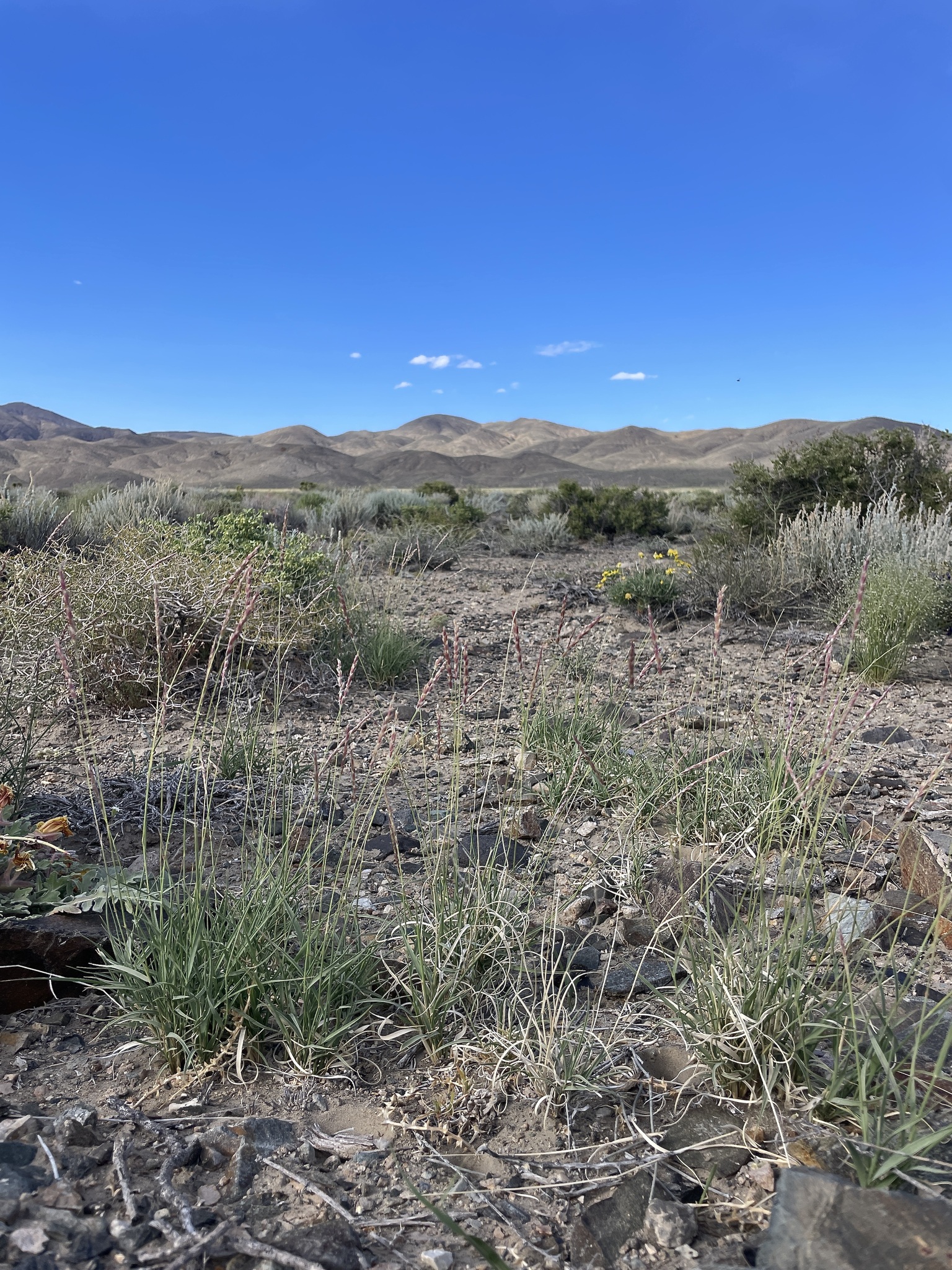
James' galleta growing in Duchesne County, Utah (CC BY-NC 4.0).
Synonyms
- Hilaria jamesii (Torr.) Benth. [18,40]
Other Common Names
curlygrass, galleta
General Distribution
James' galleta is widespread throughout southern California to the desert mountains of Nevada, Arizona, New Mexico, Utah, Colorado, Wyoming and western Texas [39,45,46]. James' galleta is also found in the panhandle of Oklahoma and extreme southwest Kansas [45]. The PLANTS database shows the distribution of galleta.
States and Provinces
- United States: AZ CA CO KS NV NM OK TX UT WY
Site Characteristics
James' galleta prefers arid and slightly mesic habitats, with competitive abilities decreasing as moisture availability increases. James' galleta will inhabit areas receiving the majority of annual precipitation either in summer, or winter and fall [93]. James' galleta is adapted to alkaline soils, both saline and fresh [53] and will grow in fine to coarse textured [53,93] sandy, loam, and clay soils [2].
Platou and others [72] observed edaphic factors associated with James' galleta within the Great Basin. James' galleta prefers neutral to moderately alkaline soils of relatively low water-holding capacity, with a coarse loamy texture. Soil surface horizons possess a low percent clay, high bulk density and high percentage of rock fragments. James' galleta was almost exclusive to soils of moderate temperature (8-15 degrees C) and relatively mesic moisture regimes (light summer precipitation). Cook and others [16] observed James' galleta in the Great Basin on well-drained, gravelly slopes adjacent to salt deserts. James' galleta is a prominent understory species of pinyon-juniper woodlands experiencing cool, dry winters, on soils derived from Kaibab limestone, tertiary sands and gravel basalt [44,81].
Regional: In California, James' galleta occurs on dry, sandy to rocky slopes, and flats within scrub and woodland areas [46]. Dry, sandy plateaus are preferred sites in Arizona. In Utah, dry flats and foothills are preferred [91]. James' galleta also thrives on well-drained, sandy soils, and fractured rockland sites of the Colorado Plateau region [89]. Preferred sites in Texas are dry rocky ledges, rolling slopes, and valley flats [39]. West and others [93] provide a comprehensive overview of topography and soils where James' galleta occurs.
James' galleta is commonly found between 3,500 and 7,500 feet (1,067-2,286 m) [45]. Elevational ranges by state are listed below:
| State | Elevation |
|---|---|
| Arizona | 4,500 to 7,000 feet (1,372-2,134 m) [49] |
| California | 3,281 to 8,202 feet (1,000-2,500 m) [46] |
| New Mexico | 3,500 to 7,500 feet (1,067-2,286 m) [36] |
Plant Communities

James' galleta growing in Inyo County, California (CC BY 4.0).
In the Southwest James' galleta is a member of pinyon-juniper (Pinus-Juniperus) and ponderosa pine (P. ponderosa) habitat types [88,93] and an important component of plains grasslands [12]. James' galleta is also a member of northern desert-shrub communities of California, Nevada, Utah and Colorado [14].
James' galleta is an important understory component in northern regions of the southwestern pinyon-juniper ecosystem [65,71], and in the conifer woodland-grassland transition zones [11]. James' galleta is a member of tallgrass communities along the New Mexico-Colorado border in association with little bluestem (Schizachyrium scoparium), western wheatgrass (Pascopyrum smithii), needle-and-thread (Hesperostipa comata), purple threeawn (Aristida purpurea), and sand dropseed (Sporobolus cryptandrus) [12].
In Arizona James' galleta occurs in pinyon-juniper, shortgrass, and sagebrush plant communities [74]. In Utah, James' galleta occurs in salt desert shrub, creosote bush (Larrea tridentata), desert shrub, sagebrush, pinyon-juniper [91], and blackbrush (Coleogyne ramosissima) communities [87]. In the central portion of the Great Basin (Nevada), James' galleta forms a habitat type with big sagebrush (Artemisia tridentata) [83].
Common Plant Associates

James' galleta growing with a variety of shrubs in a desert shrubland in Esmerelda County, Nevada (CC BY-NC 4.0).
Grasses: black grama (Bouteloua eriopoda) [21,34], blue grama (Bouteloua gracilis) [8,21,74], little bluestem, needle-and-thread [12], Indian ricegrass (Achnatherum hymenoides) [7], desert needlegrass (Stipa speciosa) [84], bottlebrush squirreltail (Elymus elymoides), Sandberg bluegrass (Poa secunda) [8], alkali sacaton (Sporobolous airoides), sand dropseed [8,29,30], gyp dropseed (S. nealleyi), spike dropseed (S. contractus) [30], Fendler threeawn (Aristida purpurea var. fendleriana) [34], and western wheatgrass [74],
Shrubs: shadscale (Atriplex confertifolia), Gardner's saltbush (A. gardneri), fourwing saltbush (A. canescens), valley saltbush (A. cuneata) [8], mound saltbush (A. obovata) [29], greasewood (Sarcobatus vermiculatus), spiny hopsage (Grayia spinosa), bud sagebrush (Picrothamnus desertorum), black sagebrush (Artemisia nova) [8], big sagebrush (A. tridentata) [83], rabbitbrush (Chrysothamnus spp.), winterfat (Krascheninnikovia lanata) [8,83], and broom snakeweed (Guitierrezia sarothrae) [83].
Trees: true pinyon (Pinus edulis), singleleaf pinyon (P. monophylla), Utah juniper (Juniperus osteosperma), Rocky Mountain juniper (J. scopularum) [10], and oneseed juniper (Juniperus monosperma) [29].
Publications listing James' galleta as a dominant or indicator species are:
- Phyto-edaphic communities of the upper Rico Puerco watershed, New Mexico [29]
- Preliminary habitat types of a semiarid grassland [30]
- An ecological approach to classifying semiarid plant communities [31]
- A vegetation classification system applied to southern California [69]
- Plant associations (habitat types) of Region 2, 3rd edition [85]
- A management-oriented classification of pinyon-juniper woodlands of the Great Basin [94]
Botanical Description
James' galleta is a native, warm season, rhizomatous perennial [38,42,46,91] tolerant of arid, desiccating environments [16,78,91,93]. Culms have solid internodes [38] with pilose nodes [42] and commonly attain heights between 3 to 24 inches (8-61 cm) [49,93]. Leaves are firm, generally recurved when dry, 0.04 to 0.012 inches (1-3 mm) wide and 0.04 to 6.3 inches (1-16 cm) long [91]. Inflorescence is an erect spike, usually less than 3.5 inches (9 cm) [93], generally 1.2 to 2.8 inches (3-7 cm) long [46].
Although rhizomatous, James' galleta grows in bunches. Under favorable conditions bunches merge forming a sod [93]. Rhizomes occur 1 to 2 inches (2.5-5.1 cm) below the soil surface [51] and constitute the majority of underground biomass. The tough, woody, scaly rhizome may reach 5 to 6 feet (1.52-1.83 m) in length [43]. According to Hassell and Oaks [44], James' galleta may persist for at least 5 to 7 years. Roots are commonly found within the upper soil profile, with few roots extending further than 18 inches (50 cm) below the soil surface [93].
Raunkiaer Life Form
- Hemicryptophyte [73]
Seasonal Development
Phenological records for James' galleta are extremely variable due to close ties with seasonal moisture availability [93].
Seedling Emergence
Emergence is directly associated with late spring to early summer moisture availability, with greatest seedling emergence occurring during wetter years. In the Great Basin, Humphrey and Schupp [48] found annual seedling emergence of James' galleta to begin and end later than the majority of perennial associates. James' galleta was found to emerge from June to July; all other associated species showed February to June emergence intervals.
Root growth is important during early developmental stages within arid environments. West and others [93] observed seedlings to achieve up to 9.72 inches (24.7 cm) of root penetration at 6 weeks growth.
Vegetative Growth
Moisture availability is the underlying cue for vegetative growth, with growth patterns corresponding to periods of available moisture [51,93]. A common growing season is May to September. Several periods of dormancy may occur during the growing season when moisture is lacking. In the Utah desert experimental range, James' galleta was observed to go through 4 growth-dormancy cycles in a single year [38].
Phenological observations of James' galleta in James' galleta-shadscale and James' galleta-sagebrush communities of New Mexico found annual growth beginning late March to early April [25].
Regeneration Processes
James' galleta reproduces through seed and development of adventitious buds on rhizomes. Since James' galleta is not a prolific seed producer [93], populations are maintained through production of rhizomes [51].
Seed Production
Soil moisture directly affects the flowering cycle of James' galleta [25], with relatively abundant soil moisture providing the cue for initiation of the reproductive phase. Seedstalks emerge under favorable moisture and will not occur during years of below normal precipitation [8,51]. James' galleta may produce seed several times within a growing season depending upon frequency and amount of summer precipitation [25].
Germination and Seedling Establishment
Seed viability and germination are generally poor [53]. However, seedlings have the potential to arise under dry conditions. Knipe [63] found James' galleta seeds to germinate at moisture tensions of 16 atmospheres (101.3 kPa). Cress [17] found 10-day old seedlings to have good survival at soil moisture levels down to 2.9% (-3000 kPa) under greenhouse conditions.
Vegetative Reproduction and Regeneration
Vegetative production is closely tied to moisture availability. A description is found under Seasonal Development below.
Successional Status
According to Hassell and Oaks [44], James' galleta may persist for at least 5 to 7 years, usually lasting 10 to 20 years after disturbance. For information on its recovery rate after fire see Plant Response To Fire.
Immediate Fire Effects
Fire usually top-kills James' galleta, leaving rhizomes relatively intact [55].
Postfire Regeneration Strategy
- Rhizomatous, rhizome in soil [82]
Fire Adaptations
James' galleta is a rhizomatous perennial [38,42,46,91] which can resprout after top-kill by fire [55].
Plant Response to Fire
James' galleta resprouts from rhizomes following fire, achieving or exceeding preburn cover within 2 years [55]. James' galleta decreases after wildfire during below-average years of precipitation [101].
During a year of below-average precipitation, James' galleta decreased in the 1st year after spring (April) fire within a pinyon-juniper habitat of New Mexico [24].
In the Great Basin, burning had no effect on James' galleta seedling emergence but was correlated with seedling survival. Significantly (p<0.05) greater seedling survival occurred on unburned areas [48].
Fire Regimes
Desert Grassland Fire Regime
Knowledge of fire frequency and ecological role in desert grasslands is uncertain. Grassland fires leave no direct evidence of historical frequency, such as tree scars [99]. Our general understanding comes from studies of plant community ecology and physiology of individual plant species along with historical accounts. Scientific research has provided indirect evidence generating several arguments to support and contradict occurrence of fire as a common component of desert grasslands.
Fires in desert grasslands were stand replacing and probably frequent. Several researchers suggest a fire frequency of 7 to 10 years for desert grasslands [95,99]. Fires in desert grasslands of the Chihuahuan Desert were probably less frequent than those of the Sonoran Desert [1]. Many researchers view fire as a necessary component to maintain desert grasslands, mainly due to the current level of invasion by woody species in the absence of fire. It is hypothesized that shrubs in desert grasslands would not have achieved the current level of coverage if stand-replacement fires had occurred at regular intervals [99]. Although fires may kill some grass plants and weaken others, establishment of shrub seedlings requires several more years than establishment of grasses [9]. Grassland fires in deserts are usually low-severity and rapid. With perennial grasses, fires generally remove only a single year's growth without burning deep into root crowns, enabling grasses to sprout [50]. Most desert shrubs with perennating buds on the root crown cannot sprout until a 0.4-inch (1 cm) diameter is achieved, and most shrubs require several growing seasons before fruiting [37].
The desert grassland ecosystem provides all the cues necessary for fire. Annual dry lightning storms mark the beginning of the southwestern rains, which take place late June or early July [99]. Lightning and the dry fine fuels generated by the hot dry periods of desert grasslands provide all the components for ignition and spread. When cured and dried, desert grassland vegetation provides adequate fuels for ignition. Once ignited, plant density is the limiting factor for fire spread in the desert grasslands. The amount of fuel varies between desert grassland sites. Annual productivity can vary from almost nothing to 1,000 lbs/acre. If sparse fuels are present, light winds may carry desert grassland fires [9,95]. Grazing may reduce fuels to the point where fire will no longer carry [9]. The Appleton-Whittell Research Sanctuary, a 7,800-acre (3,160 ha) semiarid grassland preserve in southeastern Arizona, experiences frequent wildfires associated with fuel accumulations resulting from domestic livestock exclusion [36].
The following table provides some fire-return intervals for communities in which James' galleta occurs. For additional fire regime information, search FEIS for this species by entering the species name on the Advanced Search page and selecting “Fire Regime” as the publication type.
| Community or Ecosystem | Dominant Species | Fire Return Interval Range (years) |
|---|---|---|
| bluestem prairie | Andropogon gerardii var. gerardii-Schizachyrium scoparium | <10 |
| bluestem-Sacahuista prairie | Andropogon littoralis-Spartina spartinae | <10 |
| sagebrush steppe | Artemisia tridentata/Pseudoroegneria spicata | 20-70 [95] |
| basin big sagebrush | Artemisia tridentata var. tridentata | 12-43 [76] |
| mountain big sagebrush | Artemisia tridentata var. vaseyana | 20-60 [4,13] |
| Wyoming big sagebrush | Artemisia tridentata var. wyomingensis | 10-70 (40)** [88,102] |
| saltbush-greasewood | Atriplex confertifolia-Sarcobatus vermiculatus | <35 to <100 |
| desert grasslands | Bouteloua eriopoda and/or Pleuraphis mutica | 5-100 |
| plains grasslands | Bouteloua spp. | <35 |
| blue grama-needle-and-thread grass-western wheatgrass | Bouteloua gracilis-Hesperostipa comata-Pascopyrum smithii | <35 |
| grama-James' galleta steppe | Bouteloua gracilis-Pleuraphis jamesii | <35 to <100 |
| blue grama-tobosa prairie | Bouteloua gracilis-Pleuraphis mutica | <35 to <100 |
| blackbrush | Coleogyne ramosissima | <35 to <100 |
| James' galleta-threeawn shrubsteppe | Pleuraphis jamesii-Aristida purpurea | <35 to <100 |
| little bluestem-grama prairie | Schizachyrium scoparium-Bouteloua spp. | <35 [95] |
| **Mean | ||
Fire Management Considerations
James' galleta is most susceptible to fire during periods of low humidity [55]. Fire, during years of below normal precipitation, generally reduces James' galleta within shortgrass prairies [47].
Prescribed burning in winter may prove less deleterious. Jameson [54] found James' galleta survived higher temperatures during winter than summer burns in pinyon-juniper habitats in Arizona. Fatal temperatures ranged from 135.5 to 142.2 degrees Fahrenheit (57.5-61.2 °C) in the summer (July-September) and averaged 155.48 degrees Fahrenheit (68.6 °C) in the winter (November-December) [54].
Federal Status
None
Other Status
No entry.
Importance to Wildlife and Livestock
When actively growing, James' galleta provides good to excellent forage for cattle and horses and fair forage for domestic sheep [16,49]. Although not preferred, all classes of livestock may use James' galleta when it is dry [49].
Domestic sheep show greater use in winter than summer months and typically feed upon central portions of James' galleta tufts, leaving coarser growth around the edges [52].
Desert bighorn sheep of the Mojave Desert utilize James' galleta as forage [84].
Palatability and Nutritional Value
James' galleta provides moderately palatable forage when actively growing and relatively unpalatable forage during dormant periods [22,46,91]. James' galleta also provides usable forage after winter curing [8].
James' galleta may prove somewhat coarse to domestic sheep [41].
James' galleta is a poor source of carotene and phosphorus and is ranked fair in protein value [16,87]. Protein content is drastically reduced after winter curing [87,93]. However, James' galleta is relatively higher in digestible protein than are most desert grasses within winter ranges [16].
James' galleta is lower in energy than the majority of desert grasses [16]. Nutritive quality of James' galleta in various stages, expressed as percent dry matter, is [22]:
| Nutrient | Aerial part, fresh, mid-bloom | Aerial part, fresh, mature | Aerial part, fresh, overripe | Aerial part without lower stems, fresh | Aerial part without lower stems, fresh, mature | Aerial part without lower stems, fresh, dormant |
|---|---|---|---|---|---|---|
| Ash | 11.3 | 14.3 | 14.0 | 10 | 9.4 | 12.6 |
| Crude fiber | 32.2 | 32.9 | 33.0 | 31.8 | 32.0 | 32.0 |
| Ether extract | 1.9 | 1.5 | 1.2 | 1.5 | 1.7 | 1.4 |
| N-free extract | 44.7 | 46.4 | 48 | 50.2 | 51.7 | 50.0 |
| Protein (N x 6.25) | 9.9 | 4.9 | 3.6 | 6.5 | 5.2 | 4.0 |
| Cattle - digestible protein | 6.3 | 2.1 | 1.0 | 3.4 | 2.3 | 1.3 |
| Horses - digestible protein | 5.9 | 1.7 | 0.8 | 3 | 1.9 | 0.9 |
| Sheep - Digestible protein | 6.2 | 1.6 | 0.5 | 0.5 | 1.8 | 0.7 |
| Ca | — | 1.16 | 0.59 | 0.24 | 0.58 | 0.34 |
| P | — | 0.08 | 0.08 | 0.09 | — | — |
| Carotene | — | 0.4 | — | 12.7 | — | — |
| Vitamin A equiv. IU/g | — | 0.4 | — | 21.2 | — | — |
Winter nutritional value [90]:
| In-vitro digestibility (%) | Crude protein (%) | Phosphorous (%) | Carotene (mg/kg) |
|---|---|---|---|
| 48.2 | 4.6 | 0.08 | 0.4 |
Cover Value
James' galleta provides poor cover for most wildlife species. In Utah, James' galleta is ranked as providing fair cover for small mammals and small nongame birds [22].
Value for Rehabilitation of Disturbed Sites
James' galleta possesses several desirable characteristics for restoration of arid lands. James' galleta is a good surface stabilizer [53], providing excellent surface erosion control [36,57] even within areas receiving only 7 inches (178 mm) annual precipitation [43]. Once established, James' galleta is extremely drought tolerant requiring little maintenance [48]. Schultz and Ostler [78] recorded 98% survival after a 4-year (1987-1991) drought in the Mojave Desert, when annual precipitation was 64% of the 25-year average.
Although drought tolerant, initial establishment of James' galleta in arid ranges generally requires supplemental watering. Mulching is also recommended [43]. Winkel and others [78] conducted mulching studies under greenhouse conditions with temperatures similar to the Mojave Desert. Results suggest use of 0.8 to 1.2 inches (2-3 cm) gravel or mulch layer for greater revegetation success. Layers deeper than 1.2 inches (3 cm) were found to prohibit germination. The same authors also recommend irrigation schedules that keep soil water content at matrix potentials above -1.50 mpa.
James' galleta's reliance upon rhizomatous expansion may lead to ecotypic variation. West and others [93] found root distribution to differ between areas according to annual availability of precipitation. Within habitats receiving the majority of precipitation in fall and winter, James' galleta roots were most abundant in relatively deeper areas of soil profiles. Areas where summer rains provide the majority of precipitation supported James' galleta plants with roots concentrated in upper soil layers.
Use of James' galleta for revegetation was previously limited by high seed costs. However, production of the 'Viva' cultivar has improved seed production and seedling vigor [43]. Commercial seed is now readily available [20]. Originally form north-central New Mexico, 'Viva' grows well on sites receiving 10 to 14 inches (250-350 mm) annual precipitation [43].
Knipe [62] observed 85% germination under constant temperatures between 60 and 90 degrees Fahrenheit (15.5-32 °C) at 100% relative humidity. Sabo and others [75] recommend either a constant temperature of 90 degrees Fahrenheit (32 °C) or alternating temperatures of 75 to 95 degrees Fahrenheit (24-35 °C).
National regulations require seeding of native plants on disturbed mine lands in the United States [97]. James' galleta has been used in several mineland rehabilitation projects in arid ecosystems [27,28,32,77]; however, quantitative data on survivorship is limited.
Other Uses
No entry.
Other Management Considerations
James' galleta is not tolerant of mechanical soil disturbance [79], showing slow recovery [33].
Rangeland Management
Within rangeland systems, James' galleta is generally classified as a decreaser in northern deserts and an increaser in southern deserts [45]. Cover dynamics of James' galleta within grazing systems are driven by competition, that is, the presence of other plant species.
Perennial rangelands where James' galleta is dominant generally increase in species diversity following prolonged grazing. Grazing pressure usually allows for increased presence of annuals, which may overtake perennials depending upon duration of grazing [96]. James' galleta is considered tolerant to highly resistant of grazing in the south, increasing as competing species cover decreases [7,19,87]. In areas where more palatable species are present, James' galleta acts as a facultative forage species, often showing better representation in grazed than in non-grazed and heavily grazed areas [7,19,60]. Greater use of James' galleta occurs in areas where other more palatable species, such as Indian ricegrass, are not as abundant [52].
James' galleta possesses several adaptations to grazing in arid rangelands. James' galleta's resistance to drought and tough, woody rhizome contribute to grazing tolerance [8]. Although tolerant of grazing, rotational schedules are recommended. James' galleta requires periods of rest to maintain coverage. Continuous grazing to stubble heights less than 4 inches (10 cm) will eventually remove James' galleta [36,57].
Tetubuthiuron, used for sagebrush reduction, shows no negative effects on James' galleta [66].
Table A1— Forest and range ecosystems, Bureau of Land Management (BLM) physiographic regions, Kuchler plant associations, Society for American Foresters (SAF) forest cover types, and Society for Rangeland Management (SRM) rangeland cover types in which this species occurs.
Forest and Range Ecosystems
- FRES21 Ponderosa pine
- FRES29 Sagebrush
- FRES30 Desert shrub
- FRES32 Texas savanna
- FRES33 Southwestern shrubsteppe
- FRES34 Chaparral-mountain shrub
- FRES35 Pinyon-juniper
- FRES38 Plains grasslands
- FRES39 Prairie
- FRES40 Desert grasslands [35]
BLM Physiographic Regions
- 6 Upper Basin and Range
- 7 Lower Basin and Range
- 10 Wyoming Basin
- 11 Southern Rocky Mountains
- 12 Colorado Plateau
- 13 Rocky Mountain Piedmont [6]
Kuchler Plant Associations
- K019 Arizona pine forest
- K022 Great Basin pine forest
- K023 Juniper-pinyon woodland
- K024 Juniper steppe woodland
- K031 Oak-juniper woodland
- K034 Montane chaparral
- K037 Mountain-mahogany-oak scrub
- K038 Great Basin sagebrush
- K039 Blackbrush
- K040 Saltbush-greasewood
- K041 Creosotebush
- K042 Creosotebush-bursage
- K044 Creosotebush-tarbush
- K045 Ceniza shrub
- K053 Grama-galleta steppe
- K054 Grama-tobosa prairie
- K056 Wheatgrass-needlegrass shrubsteppe
- K057 Galleta-threeawn shrubsteppe
- K058 Grama-tobosa shrubsteppe
- K059 Trans-Pecos shrub savanna
- K060 Mesquite savanna
- K061 Mesquite-acacia savanna
- K065 Grama-buffalo grass
- K085 Mesquite-buffalo grass [64]
SAF Cover Types
- 68 Mesquite
- 237 Interior ponderosa pine
- 238 Western juniper
- 239 Pinyon-juniper
- 242 Mesquite [26]
SRM Rangeland Cover Types
- 206 Chamise chaparral
- 210 Bitterbrush
- 211 Creosotebush scrub
- 212 Blackbush
- 310 Needle-and-thread-blue grama
- 401 Basin big sagebrush
- 402 Mountain big sagebrush
- 403 Wyoming big sagebrush
- 404 Threetip sagebrush
- 405 Black sagebrush
- 406 Low sagebrush
- 407 Stiff sagebrush
- 408 Other sagebrush types
- 412 Juniper-pinyon woodland
- 413 Gambel oak
- 414 Salt desert shrub
- 501 Saltbush-greasewood
- 502 Grama-galleta
- 503 Arizona chaparral
- 504 Juniper-pinyon pine woodland
- 505 Grama-tobosa shrub
- 506 Creosotebush-bursage
- 508 Creosotebush-tarbush
- 601 Bluestem prairie
- 602 Bluestem-prairie sandreed
- 604 Bluestem-grama prairie
- 612 Sagebrush-grass
- 613 Fescue grassland
- 701 Alkali sacaton-tobosagrass
- 702 Black grama-alkali sacaton
- 703 Black grama-sideoats grama
- 704 Blue grama-western wheatgrass
- 705 Blue grama-galleta
- 706 Blue grama-sideoats grama
- 707 Blue grama-sideoats grama-black grama
- 708 Bluestem-dropseed
- 709 Bluestem-grama
- 710 Bluestem prairie
- 712 Galleta-alkali sacaton
- 713 Grama-muhly-threeawn
- 714 Grama-bluestem
- 715 Grama-buffalo grass
- 716 Grama-feathergrass
- 717 Little bluestem-Indiangrass-Texas wintergrass
- 718 Mesquite-grama
- 719 Mesquite-liveoak-seacoast bluestem
- 720 Sand bluestem-little bluestem (dunes)
- 722 Sand sagebrush-mixed prairie
- 725 Vine mesquite-alkali sacaton
- 727 Mesquite-buffalo grass [80]
1. Allen, Larry S. 1996. Ecological role of fire in the Madrean Province. In: Ffolliott, Peter F.; DeBano, Leonard F.; Baker, Malchus, B., Jr.; [and others], tech. coords. Effects of fire on Madrean Province ecosystems: a symposium proceedings; 1996 March 11-15; Tucson, AZ. Gen. Tech. Rep. RM-GTR-289. Fort Collins, CO: U.S. Department of Agriculture, Forest Service, Rocky Mountain Forest and Range Experiment Station: 5-10. [28059]
2. Allison, Chris. 1988. Seeding New Mexico rangeland. Circular 525. Las Cruces, NM: New Mexico State University, College of Agriculture and Home Economics, Cooperative Extension Service. 15 p. [11830]
3. Alzerreca-Angelo, Humberto; Schupp, Eugene W.; Kitchen, Stanley G. 1998. Sheep grazing and plant cover dynamics of a shadscale community. Journal of Range Management. 51(2): 214-222. [28454]
4. Arno, Stephen F.; Gruell, George E. 1983. Fire history at the forest-grassland ecotone in southwestern Montana. Journal of Range Management. 36(3): 332-336. [342]
5. Arnold, Joseph F.; Jameson, Donald A.; Reid, Elbert H. 1964. The pinyon-juniper type of Arizona: effects of grazing, fire and tree control. Production Research Report No. 84. Fort Collins, CO: U.S. Department of Agriculture, Forest Service, Intermountain Forest and Range Experiment Station. 28 p. [353]
6. Bernard, Stephen R.; Brown, Kenneth F. 1977. Distribution of mammals, reptiles, and amphibians by BLM physiographic regions and A.W. Kuchler's associations for the eleven western states. Tech. Note 301. Denver, CO: U.S. Department of the Interior, Bureau of Land Management. 169 p. [434]
7. Bich, Brian S.; Butler, Jack L.; Schmidt, Cheryl A. 1995. Effects of differential livestock use of key plant species and rodent populations within selected Oryzopsis hymenoides/Hilaria jamesii communities in Glen Canyon National Recreation Area. The Southwestern Naturalist. 40(3): 281-287. [26494]
8. Blaisdell, James P.; Holmgren, Ralph C. 1984. Managing Intermountain rangelands--salt-desert shrub ranges. Gen. Tech. Rep. INT-163. Ogden, UT: U.S. Department of Agriculture, Forest Service, Intermountain Forest and Range Experiment Station. 52 p. [464]
9. Bock, Carl E.; Bock, Jane H.; Grant, Michael C.; Seastedt, Timothy R. 1995. Effects of fire on abundance of Eragrostis intermedia in a semi-arid grassland in southeastern Arizona. Journal of Vegetation Science. 6: 325-328. [27140]
10. Bradley, Anne F.; Noste, Nonan V.; Fischer, William C. 1992. Fire ecology of forests and woodlands of Utah. Gen. Tech. Rep. INT-287. Ogden, UT: U.S. Department of Agriculture, Forest Service, Intermountain Research Station. 128 p. [18212]
11. Brown, David E. 1982. Great Basin conifer woodland. In: Brown, David E., ed. Biotic communities of the American Southwest--United States and Mexico. Desert Plants. 4(1-4): 52-57. [535]
12. Brown, David E. 1982. Plains and Great Basin grasslands. In: Brown, David E., ed. Biotic communities of the American Southwest--United States and Mexico. Desert Plants. 4(1-4): 115-121. [536]
13. Burkhardt, Wayne J.; Tisdale, E. W. 1976. Causes of juniper invasion in southwestern Idaho. Ecology. 57: 472-484. [565]
14. Clary, Warren P.; Holmgren, Ralph C. 1987. Reversal of desertification on the low-shrub cold desert. In: Aldon, Earl F.; Gonzales Vicente, Carlos E.; Moir, William H., technical coordinators. Strategies for classification and management of native vegetation for food production in arid zones: Proceedings; 1987 October 12-16; Tucson, AZ. Gen. Tech. Rep. RM-150. Fort Collins, CO: U.S. Department of Agriculture, Forest Service, Rocky Mountain Forest and Range Experiment Station: 138-142. [2731]
15. Cook, C. Wayne; Harris, Lorin E. 1968. Nutritive value of seasonal ranges. Bulletin 472. Logan, UT: Utah State University, Agricultural Experiment Station. 55 p. [679]
16. Cook, C. Wayne; Stoddart, L. A.; Harris, Lorin E. 1954. The nutritive value of winter range plants in the Great Basin as determined with digestion trials with sheep. Bulletin 372. Logan, UT: Utah State University, Agricultural Experiment Station. 56 p. [682]
17. Cress, William A. 1982. The effect of varied watering regimes on proline production in Atriplex canescens, Hilaria jamesii, and Agropyron smithii. In: Aldon, Earl F.; Oaks, Wendall R., eds. Reclamation of mined lands in the Southwest: a symposium; 1982 October 20-22; Albuquerque, NM. Albuquerque, NM: Soil Conservation Society of America--New Mexico Chapter: 165-169. [711]
18. Cronquist, Arthur; Holmgren, Arthur H.; Holmgren, Noel H.; [and others]. 1977. Intermountain flora: Vascular plants of the Intermountain West, U.S.A. Vol. 6. The Monocotyledons. New York: Columbia University Press. 584 p. [719]
19. Daddy, F.; Trlica, M. J.; Bonham, C. D. 1988. Vegetation and soil water differences among big sagebrush communities with different grazing histories. The Southwestern Naturalist. 33(4): 413-424. [6107]
20. Davenport Seed Corporation. 1997. Rainier Seed, Inc. [Catalog]. Davenport, WA: Davenport Seed Corporation. 20 p. [27624]
21. Dick-Peddie, William A. 1993. New Mexico vegetation: past, present, and future. Albuquerque, NM: University of New Mexico Press. 244 p. [21097]
22. Dittberner, Phillip L.; Olson, Michael R. 1983. The plant information network (PIN) data base: Colorado, Montana, North Dakota, Utah, and Wyoming. FWS/OBS-83/86. Washington, DC: U.S. Department of the Interior, Fish and Wildlife Service. 786 p. [806]
23. Dollahite, James W. 1963. Ergotism produced by feeding Claviceps cinerea growing on tobosagrass (Hilaria mutica) and galletagrass (Hilaria jamesii). Southwestern Veterinarian. 16: 295-296. [4477]
24. Dwyer, Don D.; Pieper, Rex D. 1967. Fire effects on blue grama-pinyon-juniper rangeland in New Mexico. Journal of Range Management. 20: 359-362. [833]
25. Everett, Richard L.; Tueller, Paul T.; Davis, J. Barry; Brunner, Allen D. 1980. Plant phenology in galleta-shadscale and galleta-sagebrush associations. Journal of Range Management. 33(6): 446-450. [900]
26. Eyre, F. H., ed. 1980. Forest cover types of the United States and Canada. Washington, DC: Society of American Foresters. 148 p. [905]
27. Fenchel, G.; Oaks, W. R. 1992. Effects of topsoil dressing over mine spoil on establishment of vegetation at San Juan Mine--northwestern New Mexico. Restoration & Management Notes. 10(2): 210. [Abstract]. [20087]
28. Ferguson, Robert B.; Frischknecht, Neil C. 1985. Reclamation on Utah's Emery and Alton coal fields: techniques and plant materials. Res. Pap. INT-335. Ogden, UT: U.S. Department of Agriculture, Forest Service, Intermountain Forest and Range Experiment Station. 78 p. [917]
29. Francis, Richard E. 1986. Phyto-edaphic communities of the Upper Rio Puerco Watershed, New Mexico. Res. Pap. RM-272. Fort Collins, CO: U.S. Department of Agriculture, Forest Service, Rocky Mountain Forest and Range Experiment Station. 73 p. [954]
30. Francis, Richard E.; Aldon, Earl F. 1983. Preliminary habitat types of a semiarid grassland. In: Moir, W. H.; Hendzel, Leonard, tech. coords. Proceedings of the workshop on Southwestern habitat types; 1983 April 6-8; Albuquerque, NM. Albuquerque, NM: U.S. Department of Agriculture, Forest Service, Southwestern Region: 62-66. [956]
31. Francis, Richard E.; Aldon, Earl F. 1987. An ecological approach to classifying semiarid plant communities. In: Aldon, Earl F.; Gonzales Vicente, Carlos E.; Moir, William H., technical coordinators. Strategies for classification and management of native vegetation for food production in arid zones: Proceedings; 1987 October 12-16; Tucson, AZ. Gen. Tech. Rep. RM-150. Fort Collins, CO: U.S. Department of Agriculture, Forest Service, Rocky Mountain Forest and Range Experiment Station: 9-14. [2726]
32. Francis, Richard E.; Fresquez, P. R.; Gonzales, G. J. 1991. Vegetation establishment on reclaimed coal mine spoils in northwestern New Mexico. Res. Note RM-511. Fort Collins, CO: U.S. Department of Agriculture, Forest Service, Rocky Mountain Forest and Range Experiment Station. 4 p. [17113]
33. Gabbert, W. D.; Schultz, B. W.; Angerer, J. P.; Ostler, W. K. 1995. Plant succession on disturbed sites in four plant associations in the northern Mojave Desert. In: Roundy, Bruce A.; McArthur, E. Durant; Haley, Jennifer S.; Mann, David K., compilers. Proceedings: wildland shrub and arid land restoration symposium; 1993 October 19-21; Las Vegas, NV. Gen. Tech. Rep. INT-GTR-315. Ogden, UT: U.S. Department of Agriculture, Forest Service, Intermountain Research Station: 183-188. [24846]
34. Gardner, J. L. 1951. Vegetation of the creosotebush area of the Rio Grande Valley in New Mexico. Ecological Monographs. 21: 379-403. [4243]
35. Garrison, George A.; Bjugstad, Ardell J.; Duncan, Don A.; [and others]. 1977. Vegetation and environmental features of forest and range ecosystems. Agric. Handb. 475. Washington, DC: U.S. Department of Agriculture, Forest Service. 68 p. [998]
36. Gay, Charles W., Jr.; Dwyer, Don D. 1965. New Mexico range plants. Circular 374. Las Cruces, NM: New Mexico State University, Cooperative Extension Service. 85 p. [4039]
37. Glendening, George E.; Paulsen, Harold A., Jr. 1955. Reproduction and establishment of velvet mesquite as related to invasion of semidesert grasslands. Tech. Bull. 1127. Washington, DC: U.S. Department of Agriculture, Forest Service. 50 p. [3930]
38. Goodrich, Sherel. 1986. Vascular plants of the Desert Experimental Range, Millard County, Utah. Gen. Tech. Rep. INT-209. Ogden, UT: U.S. Department of Agriculture, Forest Service, Intermountain Research Station. 72 p. [1033]
39. Gould, Frank W. 1975. The grasses of Texas. College Station, TX: Texas A&M University Press. 650 p. [5668]
40. Great Plains Flora Association. 1986. Flora of the Great Plains. Lawrence, KS: University Press of Kansas. 1392 p. [1603]
41. Green, Lisle R.; Sharp, Lee A.; Cook, C. Wayne; Harris, Lorin E. 1951. Utilization of winter range forage by sheep. Journal of Range Management. 4: 233-241. [7891]
42. Hallsten, Gregory P.; Skinner, Quentin D.; Beetle, Alan A. 1987. Grasses of Wyoming. 3rd ed. Research Journal 202. Laramie, WY: University of Wyoming, Agricultural Experiment Station. 432 p. [2906]
43. Hassell, Wendall G. 1982. New plant materials for reclamation. In: Aldon, Earl F.; Oaks, Wendall R., eds. Reclamation of mined lands in the Southwest: a symposium: Proceedings; 1982 October 20-22; Albuquerque, NM. Albuquerque, NM: Soil Conservation Society of America, New Mexico Chapter: 108-112. [1104]
44. Hassell, Wendell G.; Oaks, Wendall R. 1987. Herbaceous plant materials for pinyon-juniper renovation projects. In: Everett, Richard L., comp. Proceedings--pinyon-juniper conference; 1986 January 13-16; Reno, NV. Gen. Tech. Rep. INT-215. Ogden, UT: U.S. Department of Agriculture, Forest Service, Intermountain Research Station: 335-342. [1106]
45. Heizer, Richard B.; Hassell, Wendell G. 1985. Improvement of the gramas and other shortgrass prairie species. In: Carlson, Jack R.; McArthur, E. Durant, chairmen. Range plant improvement in western North America: Proceedings of a symposium at the annual meeting of the Society for Range Management; 1985 February 14; Salt Lake City, UT. Denver, CO: Society for Range Management: 63-69. [1122]
46. Hickman, James C., ed. 1993. The Jepson manual: Higher plants of California. Berkeley, CA: University of California Press. 1400 p. [21992]
47. Higgins, Kenneth F.; Kruse, Arnold D.; Piehl, James L. 1989. Effects of fire in the Northern Great Plains. Ext. Circ. EC-761. Brookings, SD: South Dakota State University, Cooperative Extension Service, South Dakota Cooperative Fish and Wildlife Research Unit. 47 p. [14749]
48. Humphrey, L. David; Schupp, Eugene W. 1999. Temporal patterns of seeding emergence and early survival of Great Basin perennial plant species. The Great Basin Naturalist. 59(1): 35-49. [29654]
49. Humphrey, Robert R. 1970. Arizona range grasses: Their description, forage value and management. Bulletin 298 [Revised]. Tucson, AZ: The University of Arizona, Agricultural Experiment Station. 159 p. [5567]
50. Humphrey, Robert R. 1974. Fire in the deserts and desert grassland of North America. In: Kozlowski, T. T.; Ahlgren, C. E., eds. Fire and ecosystems. New York: Academic Press: 365-400. [14064]
51. Hutchings, Selar S. 1954. Managing winter sheep range for greater profit. Farmers' Bulletin No. 2067. Washington, DC: U.S. Department of Agriculture. 46 p. [23306]
52. Hutchings, Selar S.; Stewart, George. 1953. Increasing forage yields and sheep production on Intermountain winter ranges. Circular No. 925. Washington, DC: U.S. Department of Agriculture. 63 p. [1227]
53. Institute for Land Rehabilitation. 1979. Selection, propagation, and field establishment of native plant species on disturbed arid lands. Bulletin 500. Logan, UT: Utah State University, Agricultural Experiment Station. 49 p. [1237]
54. Jameson, Donald A. 1961. Heat and desiccation resistance of tissue of important trees and grasses of the pinyon-juniper type. Botanical Gazette. 122: 174-179. [1246]
55. Jameson, Donald A. 1962. Effects of burning on a galleta-black grama range invaded by juniper. Ecology. 43(4): 760-763. [1247]
56. Jones, Stanley D.; Wipff, Joseph K.; Montgomery, Paul M. 1997. Vascular plants of Texas. Austin, TX: University of Texas Press. 404 p. [28762]
57. Judd, B. Ira. 1962. Principal forage plants of southwestern ranges. Stn. Pap. No. 69. Fort Collins, CO: U.S. Department of Agriculture, Forest Service, Rocky Mountain Forest and Range Experiment Station. 93 p. [1302]
58. Kartesz, John T. 1994. A synonymized checklist of the vascular flora of the United States, Canada, and Greenland. Volume I--checklist. 2nd ed. Portland, OR: Timber Press. 622 p. [23877]
59. Kinraide, Thomas B. 1978. The ecological distribution of cholla cactus (Opuntia imbricata (Haw.) DC.) in El Paso, County, Colorado. The Southwestern Naturalist. 23(1): 117-134. [5163]
60. Kleiner, Edgar F. 1983. Successional trends in an ungrazed, arid grassland over a decade. Journal of Range Management. 36(1): 114-118. [21578]
61. Kleiner, Edgar F.; Harper, K. T. 1977. Occurrence of four major perennial grasses in relation to edaphic factors in a pristine community. Journal of Range Management. 30(4): 286-289. [30411]
62. Knipe, O. D. 1967. Influence of temperature on the germination of some range grasses. Journal of Range Management. 20: 298-299. [114]
63. Knipe, O. D. 1968. Effects of moisture stress on germination of alkali sacaton, galleta, and blue grama. Journal of Range Management. 21: 3-4. [119]
64. Kuchler, A. W. 1964. United States [Potential natural vegetation of the conterminous United States]. Special Publication No. 36. New York: American Geographical Society. 1:3,168,000; colored. [3455]
65. Lymbery, Gordon A.; Pieper, Rex D. 1983. Ecology of pinyon-juniper vegetation in the northern Sacramento Mountains. Bulletin 698. Las Cruces, NM: New Mexico State University, Agricultural Experiment Station. 48 p. [4484]
66. McDaniel, Kirk C.; Balliette, John F. 1986. Control of big sagebrush (Artemisia tridentata) with pelleted tebuthiuron. Weed Science. 34: 276-280. [1596]
67. Miyamoto, S. 1978. Tolerance of some southwestern range plants to sodium chloride and sulfate. PR-3480. College Station, TX: Texas A&M University, Texas Agricultural Experiment Station. 8 p. [35552]
68. Oaks, Wendall R. 1982. Reclamation and seeding of plant materials for reclamation. In: Aldon, Earl F.; Oaks, Wendall R., eds. Reclamation of mined lands in the Southwest: a symposium; 1982 October 20-22; Albuquerque, NM. Albuquerque, NM: Soil Conservation Society of America--New Mexico Chapter; 145-150. [1791]
69. Paysen, Timothy E.; Derby, Jeanine A.; Black, Hugh, Jr.; [and others]. 1980. A vegetation classification system applied to southern California. Gen. Tech. Rep. PSW-45. Berkeley, CA: U.S. Department of Agriculture, Forest Service, Pacific Southwest Forest and Range Experiment Station. 33 p. [1849]
70. Pieper, Rex D. 1970. Species utilization and botanical composition of cattle diets on pinyon-juniper grassland. Bulletin 566. Las Cruces, NM: New Mexico State University, Agricultural Experiment Station. 16 p. [4519]
71. Pieper, Rex D. 1977. The southwestern pinyon-juniper ecosystem. In: Aldon, Earl F.; Loring, Thomas J., technical coordinators. Ecology, uses, and management of pinyon-juniper woodlands: Proceedings of the workshop; 1977 March 24-25; Albuquerque, NM. Gen. Tech. Rep. RM-39. Fort Collins, CO: U.S. Department of Agriculture, Forest Service, Rocky Mountain Forest and Range Experiment Station: 1-6. [17251]
72. Platou, K. A.; Tueller, P. T.; Leonard, S. G.; Miles, R. L. 1986. Soil properties associated with six common grasses of the Great Basin. Journal of Soil and Water Conservation. 41(6): 417-421. [1894]
73. Raunkiaer, C. 1934. The life forms of plants and statistical plant geography. Oxford: Clarendon Press. 632 p. [2843]
74. Reynolds, Hudson G. 1962. Some characteristics and uses of Arizona's major plant communities. Journal of the Arizona Academy of Science. 2: 62-71. [1959]
75. Sabo, David G.; Johnson, Gordon V.; Martin, William C.; Aldon, Earl F. 1979. Germination requirements of 19 species of arid land plants. Res. Pap. RM-210. Fort Collins, CO: U.S. Department of Agriculture, Forest Service, Rocky Mountain Forest and Range Experiment Station. 26 p. [2047]
76. Sapsis, David B. 1990. Ecological effects of spring and fall prescribed burning on basin big sagebrush/Idaho fescue--bluebunch wheatgrass communities. Corvallis, OR: Oregon State University. 105 p. Thesis. [16579]
77. Scholl, David G.; Aldon, Earl F. 1986. Grass establishment on uranium exploration sites in New Mexico. In: New horizons for mined land reclamation: Proceedings, 1986 national meeting of the American society for surface mining and reclamation; 1986 March 17-20; Jackson, MS. Princeton, WV: American Society for Surface Mining and Reclamation: 95-98. [270]
78. Schultz, Brad W.; Ostler, W. Kent. 1995. Effects of prolonged drought on vegetation associations in the northern Mojave Desert. In: Roundy, Bruce A.; McArthur, E. Durant; Haley, Jennifer S.; Mann, David K., compilers. Proceedings: wildland shrub and arid land restoration symposium; 1993 October 19-21; Las Vegas, NV. Gen. Tech. Rep. INT-GTR-315. Ogden, UT: U.S. Department of Agriculture, Forest Service, Intermountain Research Station: 228-235. [24853]
79. Shaw, R. B.; Diersing, V. E. 1990. Tracked vehicle impacts on vegetation at the Pinon Canyon Maneuver Site, Colorado. Journal of Environmental Quality. 19: 234-243. [24484]
80. Shiflet, Thomas N., ed. 1994. Rangeland cover types of the United States. Denver, CO: Society for Range Management. 152 p. [23362]
81. Springfield, H. W. 1976. Characteristics and management of southwestern pinyon-juniper ranges: the status of our knowledge. Res. Pap. RM-160. Fort Collins, CO: U.S. Department of Agriculture, Forest Service, Rocky Mountain Forest and Range Experiment Station. 32 p. [2216]
82. Stickney, Peter F. 1989. Seral origin of species originating in northern Rocky Mountain forests. Unpublished draft on file at: U.S. Department of Agriculture, Forest Service, Intermountain Research Station, Fire Sciences Laboratory, Missoula, MT. 10 p. [20090]
83. Tueller, Paul T. 1985. Sagebrush dominated vegetation of the Great Basin. In: Society of Range Management, technical coordinator. 38th Society for Range Management Meeting; [Date of conference unknown]; Salt Lake City, UT. Denver, CO: Society for Range Management: 24-30. [6893]
84. Turner, Raymond M. 1982. Great Basin desertscrub. In: Brown, David E., ed. Biotic communities of the American Southwest--United States and Mexico. Desert Plants. 4(1-4): 145-155. [2373]
85. U.S. Department of Agriculture, Forest Service, Rocky Mountain Region. 1983. Plant associations (habitat types) of Region 2.,3rd ed. Lakewood, CO. 224 p. [2385]
86. U.S. Department of Agriculture, Soil Conservation Service. 1994. Plants of the U.S.--alphabetical listing. Washington, DC: U.S. Department of Agriculture, Soil Conservation Service. 954 p. [23104]
87. Vallentine, John F. 1961. Important Utah range grasses. Extension Circular 281. Logan, UT: Utah State University. 48 p. [2937]
88. Vincent, Dwain W. 1992. The sagebrush/grasslands of the upper Rio Puerco area, New Mexico. Rangelands. 14(5): 268-271. [19698]
89. Wasser, Clinton H. 1982. Ecology and culture of selected species useful in revegetating disturbed lands in the West. FWS/OBS-82/56. Washington, DC: U.S. Department of the Interior, Fish and Wildlife Service, Office of Biological Services, Western Energy and Land Use Team. 347 p. Available from NTIS, Springfield, VA 22161; PB-83-167023. [2458]
90. Welch, Bruce L. 1989. Nutritive value of shrubs. In: McKell, Cyrus M., ed. The biology and utilization of shrubs. San Diego, CA: Academic Press, Inc: 405-424. [8041]
91. Welsh, Stanley L.; Atwood, N. Duane; Goodrich, Sherel; Higgins, Larry C., eds. 1987. A Utah flora. The Great Basin Naturalist Memoir No. 9. Provo, UT: Brigham Young University. 894 p. [2944]
92. West, N.E. 1983. Southeastern Utah galleta-threeawn shrub steppe. In: West, Neil E., ed. Temperate deserts and semi-deserts. Amsterdam; Oxford; New York: Elsevier Scientific Publishing Company; 1983: 413-421. (Goodall, David W., ed. in chief; Ecosystems of the world; vol. 5). [2509]
93. West, Neil E.; Moore, Russel T.; Valentine, K. A.; [and others]. 1972. Galleta: taxonomy, ecology, and management of Hilaria jamesii on western rangelands. Bull. 487. Logan, UT: Utah State University, Utah Agricultural Experiment Station. 38 p. [5595]
94. West, Neil E.; Tausch, Robin J.; Tueller, Paul T. 1998. A management-oriented classification of pinyon-juniper woodlands of the Great Basin. Gen. Tech. Rep. RMRS-GTR-12. Ogden, UT: U.S. Department of Agriculture, Forest Service, Rocky Mountain Research Station. 42 p. [29131]
95. Westbrooks, Randy G. 1998. Invasive plants: changing the landscape of America. Fact Book. Washington, DC: Federal Interagency Committee for the Management of Noxious and Exotic Weeds. 109 p. [33874]
96. Whisenant, S. G.; Wagstaff, F. J. 1991. Successional trajectories of a grazed salt desert shrubland. Vegetatio. 94(2): 133-140. [16879]
97. Wiedemann, H. T. 1982. Fluffy grass seed metering device for rangeland seeders. In: Aldon, Earl F.; Oaks, Wendall R., eds. Reclamation of mined lands in the Southwest: a symposium; 1982 October 20-22; Albuquerque, NM. Albuquerque, NM: Soil Conservation Society of America--New Mexico Chapter: 178-182. [2548]
98. Winkel, Von K.; Medrano, Juan C.; Stanley, Charles; Walo, Matthew D. 1995. Effects of gravel mulch on emergence of galleta grass seedlings. In: Roundy, Bruce A.; McArthur, E. Durant; Haley, Jennifer S.; Mann, David K., compilers. Proceedings: wildland shrub and arid land restoration symposium; 1993 October 19-21; Las Vegas, NV. Gen. Tech. Rep. INT-GTR-315. Ogden, UT: U.S. Department of Agriculture, Forest Service, Intermountain Research Station: 130-134. [24838]
99. Wolters, Gale L.; Loftin, Samuel R.; Aguilar, Richard. 1996. Changes in species composition along a Chihuahuan Desert scrub/desert grassland transition zone in central New Mexico. In: West, N. E., ed. Proceedings, 5th international rangeland congress symposium; 1995 July 23-28; Salt Lake City, UT. Denver, CO: Society for Range Management: 323-324. [27906]
100. Wright, Henry A. 1980. The role and use of fire in the semidesert grass-shrub type. Gen. Tech. Rep. INT-85. Ogden, UT: U.S. Department of Agriculture, Forest Service, Intermountain Forest and Range Experiment Station. 24 p. [2616]
101. Wright, Henry A.; Bailey, Arthur W.; Thompson, Rita P. 1978. The role and use of fire in the Great Plains: A-state-of-the-art-review. In: Prairie prescribed burning symposium and workshop: Proceedings; 1978 April 25-28; Jamestown, ND. [Place of publication unknown]: The Wildlife Society, North Dakota Chapter: VIII-1 to VIII-29. On file with: U.S. Department of Agriculture, Forest Service, Intermountain Research Station, Fire Sciences Laboratory, Missoula, MT. [13614]
102. Young, James A.; Evans, Raymond A. 1981. Demography and fire history of a western juniper stand. Journal of Range Management. 34(6): 501-505. [2659]