


Quercus ellipsoidalis, northern pin oak
Coladonato, Milo. 1993. Quercus ellipsoidalis, northern pin oak. In: Fire Effects Information System, [Online]. U.S. Department of Agriculture, Forest Service, Rocky Mountain Research Station, Fire Sciences Laboratory (Producer). Available: https://research.fs.usda.gov/feis/species-reviews/queell
| Abbreviation | Common Name | Scientific Name | Classification | Status |
|---|---|---|---|---|
| Plants | ||||
| QUEELL | northern pin oak | Quercus ellipsoidalis | Life Form: Plants/Tree Kingdom: Plantae Class: Dicot Order: Fagales Family: Fagaceae Genus: Quercus | Fed. Protected: No Nativity: Native Invasiveness: Noninvasive |

Taxonomy
The currently accepted scientific name for northern pin oak is Quercus ellipsoidalis E. J. Hill [21]. It is in the subgenus Erythrobalanus, or red (black) oak group [23]. There are no recognized subspecies, varieties, or forms.
Northern pin oak hybridizes with the following species [21,29]:
- x Q. rubra (northern red oak)
- x Q. velutina (black oak): Q. x palaeolithicola Trel.
Synonyms
- No entry
Other Common Names
Hill's oak, jack oak
General Distribution
Northern pin oak has a limited range; it is largely confined to the middle and western parts of the Great Lakes region. It occurs from central Michigan east to north-central Wisconsin, eastern Iowa, northern Illinois, and northern Indiana. Disjunct populations occur in northern Ohio, Arkansas, and extreme southeastern North Dakota [6,10,23].
States and Provinces
- United States: AR IL IN IA KS MI MN MO ND OH WI
Site Characteristics

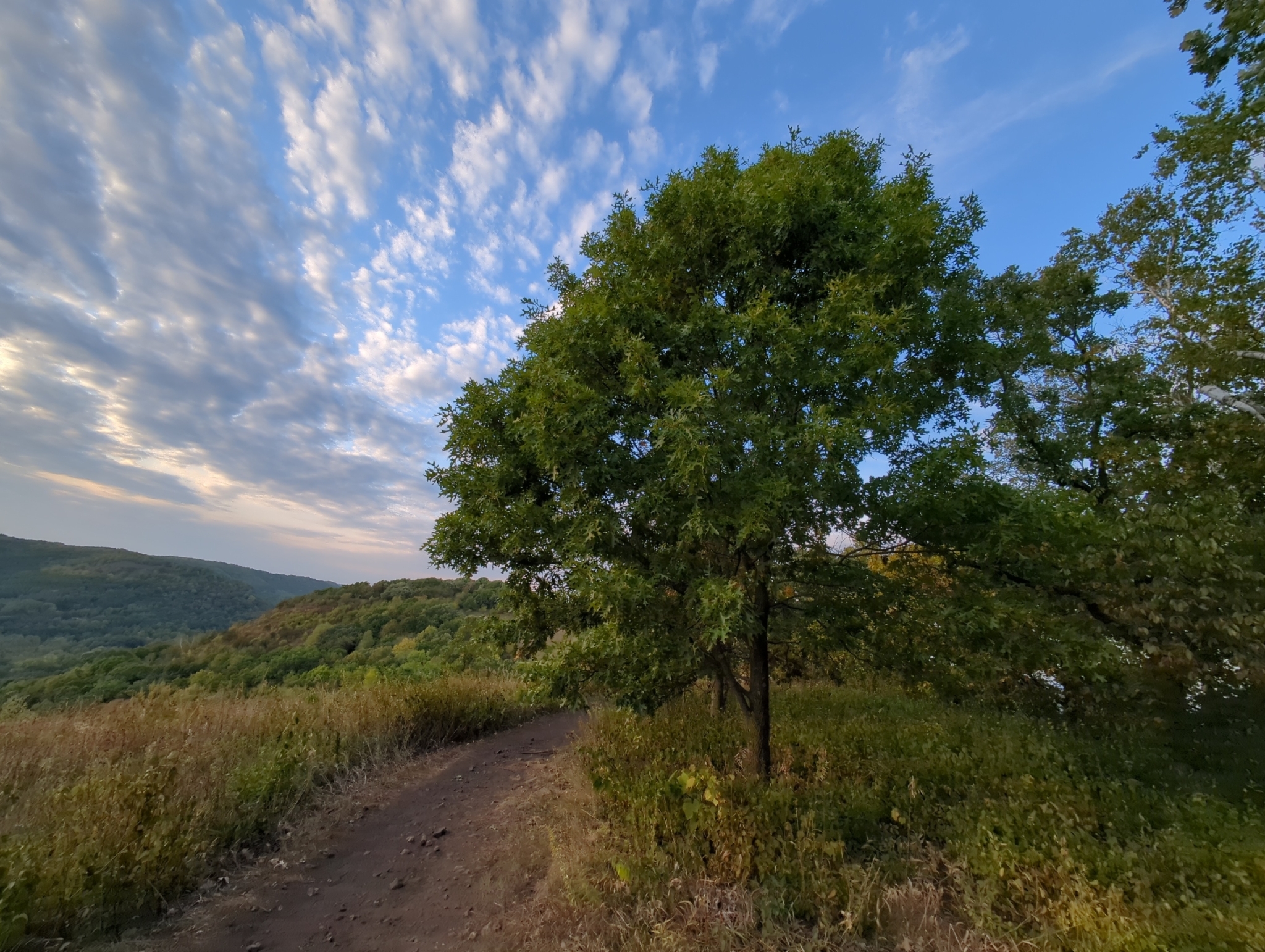
Northern pin oak, Winona County, Wisconsin. (CC BY 4.0)
Northern pin oak is an upland xeric species that commonly grows on dry, acid, sandy soils with a very thin organic layer. It most often occurs on sandy plains and sandstone hills, and develops into extensive pure populations only on such sites [9,10].
Northern pin oak is the most drought tolerant of all black oaks [2].
Plant Communities
Northern pin oak is a common component in central upland deciduous forest. It is pure or comprises a majority of the stocking in varying mixtures with white oak (Quercus alba), black oak (Q. velutina), scarlet oak (Q. coccinea), bur oak (Q. macrocarpa), or northern red oak (Q. borealis) [10].
The following published classifications list northern pin oak as a dominant or codominant species:
- Classification of forest ecosystems in Michigan [26]
- Field guide to forest habitat types in northern Wisconsin [19]
Common tree associates not listed in Table A1 include hophornbeam (Ostrya virginiana), pignut hickory (Carya glabra), shagbark hickory (C. ovata), and pin cherry (Prunus pensylvanica). Common shrub associates include American green alder (Alnus crispa), lowbush blueberry (Vaccinium angustifolium), chokecherry (Prunus virginiana), hawthorns (Crataegus spp.), American hazel (Corylus americana), serviceberry (Amelanchier spp.), snowberry (Symphoricarpos spp.), wintergreen (Gaultheria procumbens), and willow (Salix spp.) [3,10,18,29].
Botanical Description
Northern pin oak is a small to medium-sized, native, deciduous tree, typically reaching heights to 70 feet (21 m) [14,21]. It has an irregularly shaped crown and low-hanging branches that persist for long periods as dead stubs, giving a ragged appearance to the trunks [9]. Northern pin oak has a deep taproot and deep wide spreading lateral roots [4].
Raunkiaer Life Form (Raunkiaer 1934)
- Phanerophyte
Seasonal Development

Northern pin oak fall foliage, Vilas County, Wisconsin. (CC BY-NC 4.0)
Flowering occurs from March to May. Staminate flowers develop from leaf buds of axils of the previous year, whereas the pistillate flowers develop from buds formed during the current year. The fruit ripens in 2 years; dispersal occurs from late August to early December [23].
Regeneration Processes
Sexual: Northern pin oak is monoecious. Seed production begins when the tree is about 20 years old. Good seed crops are not produced every year and in the off years many of the acorns are destroyed by weevils [10,23]. Seed dissemination is by squirrels, blue jays, and gravity [16,17].
Vegetative: Northern pin oak sprouts from the root collar or stump if top-killed or cut [25,32].
Successional Status
Facultative Seral Species.
Northern pin oak is very intolerant and does not reproduce under its own shade [2,26]. The other oaks with which it is commonly associated are less light demanding and thus tend to succeed it. Succession is toward a white oak-black oak-northern red oak and bur oak communities. In central Wisconsin, eastern white pine (Pinus strobus) is encroaching on northern pin oak communities. In parts of eastern Minnesota where pine is absent, northern pin oak forms an edaphic climax on poor sandy soils [10].
Immediate Fire Effects
Fire has very little effect on pole-sized or larger northern pin oak. In eastern Kansas annual prescribed burning had very little effect on trees larger than 10 inches (25 cm) d.b.h. [1,3,5]. However, 13 years of annual burning in Minnesota greatly reduced northern pin oak populations, primarily by killing smaller diameter stems [33].
Postfire Regeneration Strategy (Stickney 1989)
- Tree with adventitious-bud root crown/root sucker
Fire Adaptations
Northern pin oak is well adapted to fire. The thermal insulating properties of the bark of mature trees allow it to survive even annual burning [24]. Smaller trees are easily damaged by surface fires but will sprout vigorously from the root collar or stump after top-kill [8,9].
Plant Response to Fire
Northern pin oak is generally favored by fire. After an early spring fire in northeastern Wisconsin, northern pin oak sprouted vigorously and maintained the preburn density of 30 trees per acre (74/ha) [31].
Fire Regimes
For fire regime information, search FEIS for this species by entering the species name on the Advanced Search page and selecting “Fire Regime” as the publication type.
Fire Management Considerations
No entry.
Federal Status
None
Other Status
No entry.
Importance to Wildlife and Livestock
Northern pin oak acorns provide food for a variety of wildlife species including gray squirrels, white-tailed deer, and blue jays [11,17]. Wood ducks, eastern kingbirds, and the federally endangered Kirtland's warbler utilize trunk cavities of northern pin oak as nesting sites [13,15,22].
Palatability and Nutritional Value
No entry.
Cover Value
No entry.
Value for Rehabilitation or Restoration of Disturbed Sites
Northern pin oak is useful for rehabilitating disturbed sites. It has a deep root system, xeromorphic leaves, low water potential threshold for stomatal closure, and the ability to adjust osmotically. Northern pin oak can maintain high rates of photosynthesis during drought and survives on nutrient-poor soils [2,4].
Other Uses
Like several other oaks, northern pin oak can be used to make furniture, flooring, and interior finishing.
Other Management Considerations
Depending on the manager's objectives, a number of silvicultural methods are appropriate for the regeneration of northern pin oak. Clearcutting is a good method to use if advanced reproduction is adequate to replace the harvested stand. The shelterwood system should be used if advanced reproduction is inadequate [28].
Northern pin oak is susceptible to oak wilt caused by the fungus Ceratocystis fagacearum. The disease is spread from tree to tree through root grafts and by sap-feeding beetles (Nitidulidae spp.) [7,29].
Table A1— Forest and range ecosystems, Bureau of Land Management (BLM) physiographic regions, Kuchler plant associations, Society for American Foresters (SAF) forest cover types, and Society for Rangeland Management (SRM) rangeland cover types in which this species occurs.
Forest and Range Ecosystems (Garrison et al. 1977)
- FRES10 White - red - jack pine
- FRES15 Oak - hickory
- FRES18 Maple - beech - birch
- FRES19 Aspen - birch
- FRES39 Prairie
BLM Physiographic Regions (Bernard and Brown 1977)
- No entry.
Kuchler Plant Associations (Kuchler 1964)
- K081 Oak savanna
- K082 Mosaic of K074 and K100
- K083 Cedar glades
- K095 Great Lakes pine forest
- K099 Maple - basswood forest
- K100 Oak - hickory forest
- K102 Beech - maple forest
- K107 Northern hardwoods - fir forest
SAF Cover Types (Eyre 1980)
- 1 Jack pine
- 14 Northern pin oak
- 18 Paper birch
- 19 Gray birch - red maple
- 21 Eastern white pine
- 23 Eastern hemlock
- 40 Post oak - blackjack oak
- 42 Bur oak
- 43 Bear oak
- 46 Eastern redcedar
- 62 Silver maple - American elm
- 53 White oak
- 55 Northern red oak
- 60 Beech - sugar maple
- 108 Red maple
- 110 Black oak
SRM Rangeland Cover Types (Shiflet 1994)
- No entry
1. Abrams, Marc D. 1986. Ecological role of fire in gallery forests in eastern Kansas. In: Koonce, Andrea L., ed. Prescribed burning in the Midwest: state-of-the-art: Proceedings of a symposium; 1986 March 3-6; Stevens Point, WI. Stevens Point, WI: University of Wisconsin, College of Natural Resources, Fire Science Center: 73-80. [16271]
2. Abrams, Marc D. 1988. Comparative water relations of three successional hardwood species in central Wisconsin. Tree Physiology. 4: 263-273. [15860]
3. Abrams, Marc D. 1988. Effects of prescribed fire on woody vegetation in a gallery forest understory in northeastern Kansas. Transactions of the Kansas Academy of Science. 91(3-4): 63-70. [10796]
4. Abrams, Marc D. 1990. Adaptations and responses to drought in Quercus species of North America. Tree Physiology. 7(1-4): 227-238. [14065]
5. Abrams, Marc D. 1992. Fire and the development of oak forests. BioScience. 42(5): 346-353. [19215]
6. Braun, E. Lucy. 1961. The woody plants of Ohio. Columbus, OH: Ohio State University Press. 362 p. [12914]
7. Bruhn, Johann N.; Heyd, Robert L. 1992. Biology and control of oak wilt in Michigan red oak stands. Northern Journal of Forest Research. 9(2): 47-51. [18750]
8. Crow, T. R. 1988. Reproductive mode and mechanisms for self-replacement of northern red oak (Quercus rubra)--a review. Forest Science. 34(1): 19-40. [8730]
9. Curtis, John T. 1959. The vegetation of Wisconsin. Madison, WI: The University of Wisconsin Press. 657 p. [7116]
10. Eyre, F. H., ed. 1980. Forest cover types of the United States and Canada. Washington, DC: Society of American Foresters. 148 p. [905]
11. Fox, J. F. 1982. Adaptation of gray squirrel behavior to autumn germination by white oak acorns. Evolution. 36(4): 800-809. [10518]
12. Garrison, George A.; Bjugstad, Ardell J.; Duncan, Don A.; [and others]. 1977. Vegetation and environmental features of forest and range ecosystems. Agric. Handb. 475. Washington, DC: U.S. Department of Agriculture, Forest Service. 68 p. [998]
13. Gilmer, David S.; Ball, I. J.; Cowardin, Lewis M.; [and others]. 1978. Natural cavities used by wood ducks in north-central Minnesota. Journal of Wildlife Management. 42(2): 288-298. [13749]
14. Great Plains Flora Association. 1986. Flora of the Great Plains. Lawrence, KS: University Press of Kansas. 1392 p. [1603]
15. Hamas, Michael J. 1983. Nest-site selection by eastern kingbirds in a burned forest. Wilson Bulletin. 95(3): 475-477. [11093]
16. Johnson, Paul S. 1992. Oak overstory/reproduction relations in two xeric ecosystems in Michigan. Forest Ecology and Management. 48: 233-248. [18157]
17. Johnson, W. Carter; Webb, Thompson, III. 1989. The role of blue jays (Cyanocitta cristata L.) in the postglacial dispersal of fagaceous trees in eastern North America. Journal of Biogeography. 16: 561-571. [11875]
18. Kittredge, Joseph, Jr. 1938. The interrelations of habitat, growth rate, and associated vegetation in the aspen community of Minnesota and Wisconsin. Ecological Monographs. 8(2): 152-246. [10356]
19. Kotar, John; Kovack, Joseph; Locey, Craig. 1989. Habitat classification system for northern Wisconsin. In: Ferguson, Dennis E.; Morgan, Penelope; Johnson, Frederic D., eds. Proceedings--Land classifications based on vegetation applications for resource management; 1987 November 17-19; Moscow, ID. Gen. Tech. Rep. INT-257. Ogden, UT: U.S. Department of Agriculture, Forest Service, Intermountain Research Station: 304-306. [6962]
20. Kuchler, A. W. 1964. Manual to accompany the map of potential vegetation of the conterminous United States. Special Publication No. 36. New York: American Geographical Society. 77 p. [1384]
21. Little, Elbert L., Jr. 1979. Checklist of United States trees (native and naturalized). Agric. Handb. 541. Washington, DC: U.S. Department of Agriculture, Forest Service. 375 p. [2952]
22. Mayfield, Harold. 1960. The Kirtland's warbler. Bulletin No. 40. Bloomfield Hills, MI: Cranbrook Institute of Science. 33 p. [16778]
23. Olson, David F., Jr. 1974. Quercus L. oak. In: Schopmeyer, C. S., ed. Seeds of woody plants in the United States. Agric. Handb. 450. Washington, DC: U.S. Department of Agriculture, Forest Service: 692-703. [7737]
24. Nicolai, Volker. 1991. Reactions of the fauna on the bark of trees to the frequency of fires in a North American savanna. Oecologia. 88(1): 132-137. [16715]
25. Nuzzo, Victoria A. 1986. Extent and status of midwest oak savanna: presettlement and 1985. Natural Areas Journal. 6(2): 6-36. [19217]
26. Pregitzer, Kurt S.; Ramm, Carl W. 1984. Classification of forest ecosystems in Michigan. In: Bockheim, James G., ed. Forest land classification: experiences, problems, perspectives: Proceedings of a symposium; 1984 March 18-20; Madison, WI. Madison, WI: University of Wisconsin, Department of Soil Science: 114-131. [12779]
27. Raunkiaer, C. 1934. The life forms of plants and statistical plant geography. Oxford: Clarendon Press. 632 p. [2843]
28. Sander, Ivan L. 1979. Silvicultural systems for the oak-hickory forest type. In: North America's forests: gateway to opportunity: Proceedings of the 1978 joint convention of the Society of American Foresters and the Canadian Institute of Forestry. Washington, D.C.: Society of American Foresters: 344- 348. [10025]
29. Sander, Ivan L. 1990. Quercus velutina Lam. black oak. In: Burns, Russell M.; Honkala, Barbara H., tech. coords. Silvics of North America. Vol. 2. Hardwoods. Agric. Handb. 654. Washington, DC: U.S. Department of Agriculture, Forest Service: 744-750. [19219]
30. Stickney, Peter F. 1989. Seral origin of species originating in northern Rocky Mountain forests. Unpublished draft on file at: U.S. Department of Agriculture, Forest Service, Intermountain Research Station, Fire Sciences Laboratory, Missoula, MT; RWU 4403 files. 7 p. [20090]
31. U.S. Department of Agriculture, Soil Conservation Service. 1982. National list of scientific plant names. Vol. 1. List of plant names. SCS-TP-159. Washington, DC. 416 p. [11573]
32. Vogl, R. J. 1964. The effects of fire on the vegetational composition of bracken-grassland. Wisconsin Academy of Sciences, Arts and Letters. 53: 67-82. [9142]
33. White, Alan S. 1983. The effects of thirteen years of annual prescribed burning on a Quercus ellipsoidalis community in Minnesota. Ecology. 64(5): 1081-1085. [3518]